




Abstract
There is long-standing interest within sociological debate to understand social class inequality spatially. We contribute to this debate by using a spatially differentiated understanding of accent, used here as a ‘window’ to observe the formation of socio-economic difference across space. From a spatial perspective, using the work of Doreen Massey, we draw on a unique multi-sited qualitative dataset, which contains the narratives of over 200 young people (aged 16/17) across 17 UK localities, spanning all nine English regions and the three ‘home’ nations of Wales, Scotland and Northern Ireland. It was a purposefully designed sample intended to capture the field of social relations across geographic space. Accent emerged as a signifier of the spatial manifestation in class boundaries and points of socio-economic difference. Diverse groups are complicit in the construction of normative accents, and the ‘othering’ of accents belonging to historically dominated places and regions. We observe here not only spatial differentiation within social class groups, but the ethnic solidarities that emerge as a consequence of marginalisation.
Introduction
As a manifestation of broader power structures, the specificities and social construction of accent, and the classed geographies of a range of accents, is a significant yet under-researched area. Despite the importance of language to Bourdieu’s (1977) theorising on social (re)production, there have been few attempts to foreground accent and language in understanding the way differentiated classed identities are (re)produced. In research on social class and social mobility, there is sometimes brief mention of accent, but there has not been a spatially sensitive or comprehensive analysis of accent and social (re)production. In the UK, Friedman (2014) mentions accent as a marker of distinction for socially mobile individuals, and Lawler (1999) explores in greater depth the feelings of those with regional working class accents being ‘out of place’ in middle class environs. Reay (1999), drawing on Bourdieu’s idea of ‘linguistic capital’, critically examined relationships between mothers and their child’s school teachers. But accent, and the relational construction of diverse accents across geographic space, has not been the main focus of these studies. Addison and Mountford’s (2015) work more directly addressed accent in differentiating class boundaries, examining the case of higher education institutions, and illustrating how university students and academic staff from working class backgrounds perceive ‘intelligence’ as intertwined with a Received Pronunciation (RP) accent. Moving beyond the broad regional categorisation of accents, our own previous work in this area has illustrated how integrating sociolinguistics into a sociological analysis of social mobility allows us to combine the micro-geography of class, mobility and speech at a more granular level (Donnelly et al., 2019). We build on this work by foregrounding a spatially differentiated understanding of accent as a ‘window’ into spatialised class structure.
The UK context represents an especially interesting context to study accent and spatial class structure because of its socio-spatial divisions, historically embedded spatially uneven economic development and the wide variety of accents and dialects (estimated to be nearly 40 – English Live, n.d.). The south east of England is a centre of economic, political and cultural power, with minority nations of Wales, Scotland and Northern Ireland as well as deindustrialised regions of England on the periphery. To capture this spatial diversity, a multi-sited qualitative dataset forms the basis for our theorising around accent and spatial structure within the UK context. Building on the influential work of those addressing questions around space and place, these data enable us to move beyond examining places in isolation, to discern how places stand in relation to one another.
Space, place and accent
Our work is situated within broader sociological concerns which take a spatial perspective to addressing questions of social boundaries and division, including work on the uneven spatial structuring of economy (Dorling, 2018; Massey, 1994), social class and the relational construction of place (Benson, 2014; Donnelly & Gamsu, 2020; Donnelly et al., 2020; Savage, 2015; Savage et al., 2005), as well as the intertwining of place and race, ethnicity and nationhood (Donnelly & Evans, 2016; Gamsu et al., 2019; Hechter, 1966/1975; Webster, 2003). Savage et al. (2005) use the idea of ‘elective belonging’ to explain the sense of spatial attachment in a relational sense for residents living in four Greater Manchester suburbs. The idea of ‘elective belonging’ describes how place-based attachments are not bounded or fixed, but are fluid, with places as sites for performing classed identities. It is used to discern identifications with the localities and their relational positioning to other places, perceptions of social change and gentrification, as well as mothering practices and positioning within the educational field.
This relational perspective on place can also be found within long-standing debates around gentrification, concerned with social and spatial change characterised by the clustering and displacement of social groups (Butler, 2007; Hamnett, 2003; Paton, 2016). Phillips and Smith (2018) have discussed at length gentrification within rural spaces, as a ‘coping strategy’ for neoliberal reality. Butler (2007) calls for a broader conceptualisation of gentrification in terms of what it looks like and where it can be found, arguing that ‘searching’ for gentrification in its traditional sense tied to particular kinds of locale can mask gentrifying processes operating at different spatial scales (e.g. processes of displacement and clustering in gated communities and the inward/outward flows of people and groups from the London metropolitan region). This illustrates the way in which gentrification is interconnected with the drawing and re-drawing of socio-spatial boundaries.
The relational, unbounded and fluid perspective on space taken in the aforementioned bodies of work is a central element to Massey’s (1994, 2005) theorising on place, which we draw on here to make sense of accent and the manifestation of spatial structure. Massey’s work is just one perspective on what is a long-standing conceptual debate to understanding space and place. Massey (2005) conceives of space as the product of interrelations, as the sphere of multiple coexisting trajectories that are always ‘under construction’; it is never closed, finished and complete but can be viewed as a ‘simultaneity of stories-so-far’ (Massey, 2005, p. 9). The socio-spatial change characterised by processes of gentrification are examples of this kind of ‘incompleteness’ to the spatial sphere.
‘Place’ is characterised as ‘pauses’ in space where a unique set of (dis)connections to the multiplicity of trajectories and social relations can be discerned – including, for example, (dis)connectedness to contemporaneous identities (classed, racialised, gendered, etc.) and structures (economic, political, etc.) circulating across space. In recognising these (dis)connections as forever ‘in-formation’, there is potential to understand the fluidity of places over time – as the product of changing interrelations more broadly speaking (for example, technological advancements). Crucially, these multiple trajectories and flows are not neutrally coexisting in the spatial sphere; they are held together by unequal structures of power relations. Massey’s (1994) theorising on the ways in which places are constitutive of configured power relations which exist across space provides a means of understanding more fully connections between accent, space and place-based subordination. Accent, when examined from Massey’s perspective, can be observed as the manifestation of spatialised class structure, shining a light on the unequal social relations which underpin and maintain place-based hierarchies.
Our thinking on social class identity is shaped by Bourdieu’s (1984) theorising on power as culturally and symbolically created through socialised norms and dispositions which guide behaviour and thinking. The hierarchical positioning of individuals and groups within social space (which implies positions of domination and subordination) is determined relationally and often constitutive of different stores of capital. Bourdieu showed how practice and judgements of taste are related to social position, or rather, are acts of social positioning by oneself and others. The (dis)connectedness of places with processes of production (Massey, 1994) are one way in which association with classed identities is maintained. Processes of production include dominant positions (e.g. research/development, strategic and headquarter functions) as well as subordinate positions (such as manufacturing and labour) within social space. These are historically embedded and connected to the materiality of places (and accents) which can afford places (and accents) their relative hierarchical positioning. We draw on this perspective on how power manifests itself within society to further make sense of how social class, place and accent intersect.
In what follows, we take these theoretical framings to make sense of the normative construction and ‘othering’ of accents, underlying power relations which maintain ‘subordinate’ and ‘dominant’ accents, as well as questions around the geographic boundedness of accents. We now discuss the data and methods from which our analysis derives.
Data and methods
The data we draw on here derive from a larger research project which addressed the social and geographic mobilities of higher education students. This project intended to contribute a spatial perspective to research on higher education inequalities (Donnelly, 2018; Reay et al., 2001). Whilst accent was never the primary focus, it emerged as important in revealing inter- and intra-class relations and how these are distributed spatially.
Methods of data collection
The wider project is a multi-sited qualitative study, with selected localities drawn from the four ‘home’ nations of the UK (England, Scotland, Wales and Northern Ireland) as well as each of the regions within England (North West, North East, Yorkshire/Humberside, East/West Midlands, South East, South West and London). The 17 localities encompass Tyneside, Greater Manchester, the cities of Liverpool and Birmingham, two further northern towns, three different parts of London, a town in the south west of England, an East Anglian coastal town, two coastal towns in south Wales and west Wales, a north Wales town, a city in Northern Ireland and two areas of the Scottish city Glasgow. The case study sites were purposefully chosen to take account of socio-spatial divisions and historically embedded spatially uneven economic development within the UK. Regional economic inequality is a defining feature of the UK’s internal geography (McCann, 2020). London and the south east of England are often described as the centre of economic, political and cultural power which dominate marginalised nations (Wales, Scotland, Northern Ireland) and deindustrialised localities of England (in the north and midlands, for example). Massey (1994) discusses these divisions in terms of spatially uneven relations of production; with economic functions that are afforded higher social positions (e.g. development, headquarters) concentrated in London and the south east of England, and those with lower social position (e.g. labour and production) clustered in other parts of the UK. This offers one way of understanding how classed geographies are formed, in terms of how social class is historically embedded in places over time through spatially uneven relations of production. The lasting legacy of these unequal power relations can be observed in contemporary perceptions of place, as illustrated by our data.
Data collection took place in schools based within each locality, and involved a preliminary ‘mapping exercise' (see Donnelly et al., 2020), which was followed by individual semi-structured interviews. The ‘mapping exercise’ was administered to an entire cohort of those in the penultimate year of school, and was used to select participants and produce a visual aid to loosely guide interviews (for participants to ‘speak to’). Participants were presented with a map of the United Kingdom and asked to colour it according to the following key: (1) green, ‘places where you would prefer to live for university’; (2) red, ‘places where you definitely do not see yourself living for university’; (3) orange, ‘places where you would not mind or are indifferent about living for university’; and (4) blue, ‘places you do not know or haven’t really thought about’. The map of one of our participants discussed in this article, Rhian (based in our Liverpool locality), is provided here as an example (see Figure 1). Participants were also asked to provide basic demographic information, including parental occupation, ethnicity, parental education levels, and information on their intended university choices.
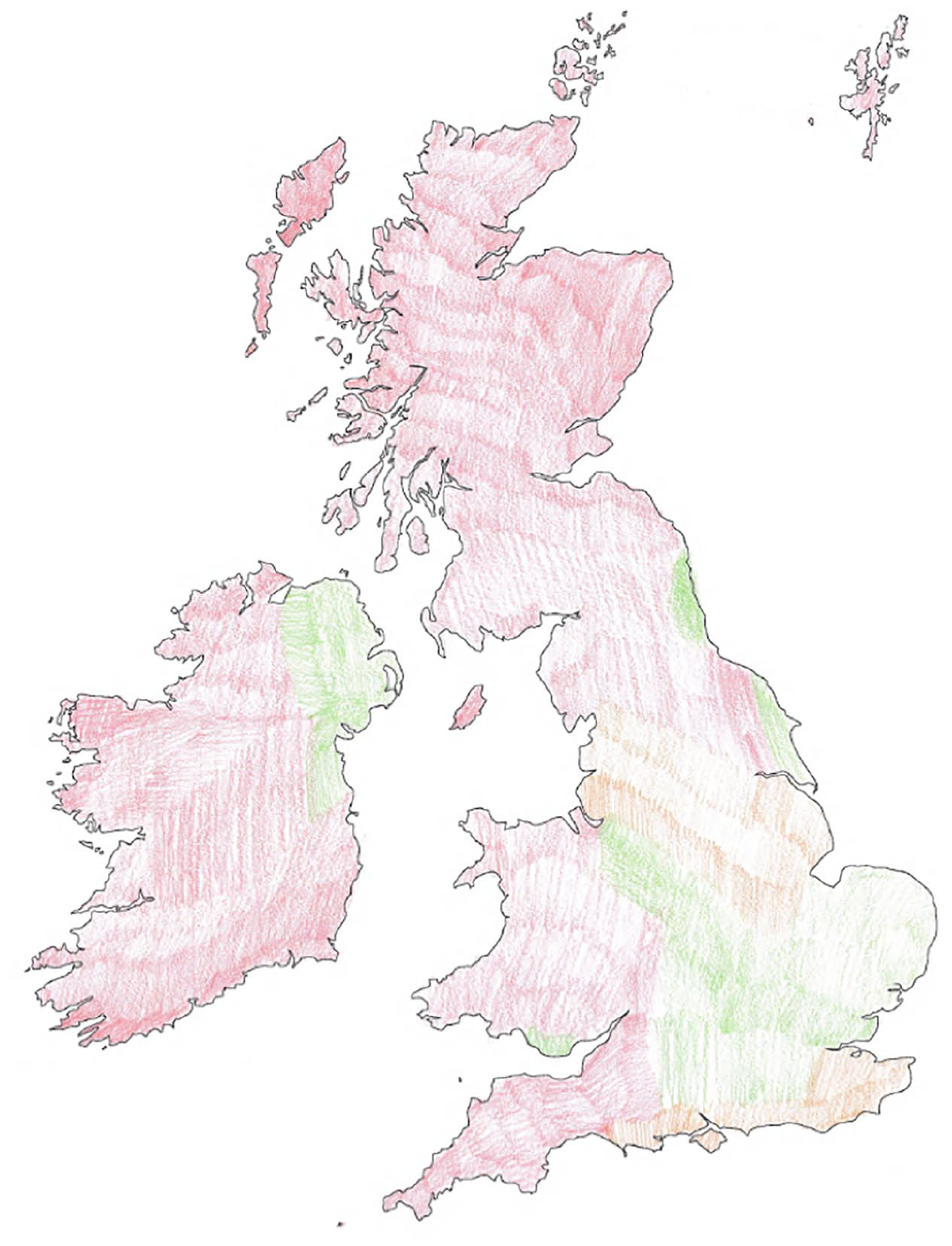
Rhian’s map (Liverpool locality).
Over 200 socially and ethnically diverse young people (aged 16/17) of equally mixed genders were then invited to be interviewed, with the aim of capturing different kinds of spatial preferences indicated by their maps (e.g. those who indicated ‘localised’ versus ‘national’ preferences). The semi-structured interviews carried out in these schools were around 1 hour in length and orientated around their map, which guided participants in discussing the way they imagined different places. We began each interview with the invitation to: ‘tell me about your map’. Follow-up questions attempted to hone in on particular aspects of their map, for example, asking them about particular areas they had shaded in certain colours, revealing their perceptions about places. It must be noted that the two interviewers carrying out the research are male and from northern England. Although the researchers do not have strong northern accents, it is possible they were discernible by participants, which may have been significant – for example, it could have meant some participants with non-normative accents did not feel the need to adapt or change their accent. Indeed, we discuss later how people routinely adapt and change their accents dependent on context and situation, but also the solidarities gained from those with similar accents.
As noted above, our sample of over 200 16- and 17-year-olds from across these localities contains a differentiated group of participants, drawn from diverse social class groups, genders and ethnicities. Our approach to understanding class boundaries takes account of points of difference economically, socially and culturally; we use the National Socio-economic Classification (NS-SEC) as a measure of class derived from parental occupation, but acknowledging its limitations we also use levels of parental education and private schooling as further measures. This captures, for example, the advantage accrued from parents who may be degree educated, but not in higher status occupations (what is referred to as the ‘displaced middle classes’). It is also important to acknowledge the point that younger people may have less experience of travelling within the UK which could mean their interpretations of places are less reliant on direct knowledge. However, at the same time, many of our participants recounted such direct experiences from travelling the breadth of the UK to attend football matches, concerts, visit family/friends and attend university open days. Data were collected in line with British Educational Research Association (BERA) guidelines for ethical research, with voluntary informed consent maintained (no incentive was offered), and data thoroughly anonymised (pseudonyms are used for all participants and their school attended).
After an initial broader thematic coding carried out by two of the researchers, accent emerged as significant, which then prompted a more thorough coding of accent for the entire dataset by a single coder. The data were thematically analysed for mentions of accent within the context of their broader narratives around space and place. It was never the original intention of the study to focus on accent – it emerged spontaneously within participants’ narratives, with no prompting from the interviewer (in total, across the entire dataset, a fifth of participants talked about accents). This presence of accent was spatially uneven, appearing more in some localities than others, justifying a closer reading of the narratives. In this sense, accent emerged as an important lens or ‘window’ to observe the intertwining of space, place and socio-economic difference.
The social construction of ‘accents’
Before directly addressing the question of spatial class structure as manifest through accent, it is first worth dissecting the notion of what it means to have an accent. What is clear from the young people’s narratives, regardless of class position or geographic locality, RP and southern English accents are constructed as the ‘normative’ – they are the silenced, absent ‘norm’ against which all other accents are constructed. The reference to southern English accents, however, is perhaps specifically referring to accents with higher status within that region, or certainly those less stigmatised, such as Estuary English and the variety known as Standard Southern British English (SSBE); this latter variety is in fact referred to by Evans and Iverson (2007) as ‘the prestige accent of English and the accent of education’, with Estuary English suggested to be a happy (linguistic) medium between Cockney and RP (Przedlacka, 2001).
In the same way that Garner (2007) describes the ‘absence of Whiteness’, the ‘accents’ of the dominant southern English and speakers of RP are so ingrained into the subconscious (much like Whiteness and White culture) that they are not even recognised as accents at all. It is this absence which ascribes them their power and maintains social order. From this starting point, the process of ‘othering’ produces ‘accents’ – it is only through the dominant RP and southern accents 1 wherein categories (and hierarchies) of accents are created within social space. The normalisation and ‘othering’ of accents is clearly apparent in how participants narrated their imagined geographies of the UK.
we have the Geordie accent and Leicester have the Leicester [accent] and down there [they] have a posh accent
Oh right
as people [inaudible] it.
Yeah. What do you mean a posher accent?
Just, it sounds posher to a lot of people.
Yeah. Yeah. Do you not think the Geordie accent sounds posh then?
I, I think a lot of people can’t understand it [laughs], I know
Really?
When we go down to Leicester I have to really try not to include it in my um, voice, ’cause most people won’t understand what I’m saying.
We can see here how Karina recognised the phonetic sounds of Newcastle and Leicester accents, ascribing people who use these phonemes as people who have ‘an accent’. Karina is actively ‘othering’ and positioning herself and those who sound like her, constructing her own difference in relation to the normative accent, in other words the accent spoken by dominant groups within social space. A hierarchy of places, of subordination and dominance is palpable here, reflective of unequal power relations (Massey, 1994, 2005). The actual phonetics of the ‘posh’ accent are not made explicit here, reflective of the way dispositions of dominant groups are silenced and assumed as ‘natural’ – which is key to their symbolic potency and as justification for the legitimacy of social structures. It is not those from the south who must change their accent (indeed, they are not seen as having an ‘accent’ in the first place) but will always be those who sound like Karina who must change and adapt their way of speaking. These acts of social positioning are central to Bourdieu’s (1984) thinking about how power is culturally and symbolically (re)produced. The act of normalising the dominant accent and pathologising the ‘othered’ accent was common.
What do you mean they sound like you, you mean your accent?
Yeah almost, like we went down to- sometimes schools would come up from London and I don’t have the, even here I don’t have the best accent, I can make it more middle class when speaking to a teacher, I am asking for something and help, or explaining my point of view. . .
Dan has an acute awareness of his ‘othered’ accent; the phonetic sounds that are heard when he opens his mouth. To assimilate within the elite school he attends, Dan feels compelled to change these phonemes to the phonetic sounds associated with a ‘middle class accent’, in other words the accents of dominant groups within social space. The institutional context is important here – Dan as a bursary student at a prestigious private school is located within an institution that forms part of a system of elite schools that play a national role in the formation of an elite and middle class. Making his accent ‘more middle class’ is also part of the long history of elite schools fostering this form of speech (Honey, 1977). This point is also reflective of the situational dynamic to accent: subjugated accents can be a form of solidarity for those who share them, but they might ‘switch’ accents, as Dan talks about here, when in the classroom or work context to avoid its negative judgements.
Whilst Karina valorised the dominant accent (and at the same time silenced its phonetic sounds) by referring to it as ‘posh’, and Dan as ‘middle class’, Abby refers to the accent as ‘well-spoken’: Scottish words, so it’s not just the Glasgow–I mean Glaswegians have an accent anyway that, like, nobody can understand a lot of the time, but, um. . . it’s quite, like, a whiny voice that’s come about now in a lot of areas and they’re really put off by anybody that’s well-spoken.
Here, the phonemes of ‘being well-spoken’ are not recognised or marked out as an accent at all, but the Glaswegian phonemes almost certainly render it an accent. This underlines the arbitrariness of social order and the way accents are connected to the hierarchical positioning of dominant and dominated groups within social space (Bourdieu, 1984). Care must also be taken in drawing comparisons between places across the four ‘home’ nations; comparing Manchester and Liverpool (both in England) is not the same as Glasgow and Manchester (the former being in Scotland) – considerations of dialect, language and nationhood are important here. Abby’s reference to ‘Scottish words’ suggests dialect, not just accent, with dialect referring to the use of grammar and words which differ from the standard (here, standard Scottish English presumably, if not British English). It is also necessary to consider Scots, which many argue to be a language per se and not merely a dialect, and this is a language used by many Glaswegians.
Speakers of dominant southern English and RP accents also actively maintain the normative accent by silencing their own forms of speech as ‘accents’ and ‘othering’ those who sound different.
Yeah, what do you think of Liverpool and Manchester and Leeds?
Um, Liverpool, obviously the accent and the really nice red buildings, Leeds, I don’t really like, know much about Leeds, and then Manchester, we fly from Manchester quite a lot.
Mention of the ‘accent’ in relation to the city of Liverpool is a telling example because it is the first thing that comes to Camilla’s mind about Liverpool – the phonemes of a Liverpool accent are a signifier here of occupying dominated positions within social space (Bourdieu, 1984). It is as if the only accents that exist are those belonging to the subjugated ‘other’. But this example of Liverpool’s stigmatisation also underlines the lasting legacy of uneven economic development and geographies of deindustrialisation, which are central to interpreting meaning from the Liverpool accent.
There was only one instance of young people being marked out for being ‘well-spoken’. Clara occupied one of the more privileged positions within our sample in terms of her class background, and attended Kings Hill, a state school in North East England. Others we spoke to at this same school talked about noticing those within the school who had English north eastern accents. Clara did not speak with a north eastern accent, and spoke with an accent close to RP; the marking out of her accent by her peers within this north eastern locality had a different quality:
Yeah, and um, and, and, do you think it, um, and is that kind of something you’re aware of in the school, because some people have a stronger accent than others?
Well you do notice the voice, like some people comment on my accent saying like, why do you speak like that, because
Evidently, Clara’s accent was marked out as different here because it was ‘out of place’ amongst the north eastern accents within her school. Indicative of this is the way Clara imitates the north eastern pronunciation of ‘don’t’; where she exaggerates the tell-tale long-o sound as realised in a broad Newcastle accent: [ʊə] – making an innocent joke of the fact she does not have this north eastern accent (at the same time as rendering her own accent invisible as an accent at all). In doing so, Clara is again complicit in the ‘othering’ of the north eastern accent which is connected to subjugated class positions – all the more striking given that the joke is made whilst commenting on how her own accent was marked out by others as different. It is possible to gauge here Clara’s unconscious sense of where accent(s) (as dispositional styles attached to place) stand in relation to one another within social space; embedded within her account is an implicit understanding of the dominant position her own (normative) accent holds in relation to the dominated position which north eastern accents occupy.
Spatial structure as manifest through accent
Our sample of 17 different UK localities provides a degree of spread to discern some of the ‘dominant’ and ‘dominated’ accents present in the UK context, enabling us to see the relative positioning of different accents, in terms of the gradations to which accents are positioned relative to others. Northern English, Glaswegian and Welsh accents stood out as the more negatively judged accents, relative to others. ‘Accent’ was mentioned the most (without prompting) in the northern English localities – including the northern private school and schools with advantaged intakes in the north. Southern English localities had far fewer mentions of accent – and when accent was raised it was not about their accent but the accent of those from peripheral or less economically or culturally powerful locations. This underlines the way judgements about accent at least in part derive from the material conditions of places and the class positions these imply.
It is clear from the data that when the topic of accent is raised in places like the north of England, Glasgow and Wales, it was because participants were talking about the subordination of their accent. However, for southern English localities, when accent was raised, it was contained within narratives about the disenfranchising of these same ‘othered’ accents belonging to places like Liverpool, Manchester and Glasgow. The disenfranchising of their dominated accents was palpable in the minds of those young people in localities like Liverpool, Glasgow and Wales.
You get judged just from being from Liverpool
like in London?
Yeah when I went to a concert, I went to the O2, and they just judge you based on your accent.
Really, who?
There was like a group of girls you could tell they were from Chelsea or somewhere like that in London they were like why is she speaking like that
How is it different than Oxford?
Um, I think it’s because when you’re a commoner like me *laughs*, town person and you go to Oxford and you come in with this Welsh, [Abereynon] accent and they just look at you a bit weird like ‘Where are you from?’ Urm, yeah it’s just different.
These examples from the Liverpool and Wales localities illustrate the way young people relate accents to socio-spatial hierarchies (Massey, 1994, 2005). Accent, as a signifier of social position, comes to represent the spatial structuring of class. Becoming aware of one’s accent and experiencing snobbery in Oxford or, in the case of Rhian her perception that people were from Chelsea, shows how judgements of accent are acts of social positioning and the spatial structuring of power. These are places that ‘carry a legacy of meaning’ associating them with symbolic, cultural and economic forms of (upper) class power (Allen et al., 1998, p. 10).
Spatial differentiation and the middle classes
Accent can also provide a means for understanding the spatial differentiation of middle class subjectivities. Middle classes in the north of England, Wales and Glasgow had also to some extent internalised this sense of their ‘othered’ and dominated accent belonging to these places. An important caveat here is that our reliance on occupation and family history of education is only a partial picture of class consciousness – Rhian, in the Liverpool example above, has no family history of higher education and although objectively is classified as NS-SEC 2 may not hold the same level of cultural and social capital as others categorised as such. This speaks to the need for caution in any interpretation of social class based on NS-SEC alone. Indeed, whilst middle classes in the north might be aware of their subjugated accent, it might be the case that confidence and assuredness derived from their class subjectivities mitigate the impact of accent on their social positioning. Moreover, a middle class northern accent – the suggested General Northern English – is perhaps only subjugated or othered in comparison to those speaking in accents like RP, who are likely holding a more privileged position in social space.
And um, when you’ve been down to Bristol, what was your impression of it?
It’s uh, I really like the city and I thought, I thought it was a lot different to places like Newcastle and that in terms of uh, like sort of, the way people went about and sort of styles and stuff, it was also a lot more expensive and that, and I don’t know, I found talking to people was a bit different to talking to people in Newcastle and stuff like that. . . I think it’s down to more like lingo and stuff, that’s how to describe it. . . a lot of people didn’t know what I was on about, when I talked to them in shops and stuff.
Joseph is aware here how his accent is differentiated from others he encounters in the south of England, but the point is limited to a question of ‘comprehensibility’ in terms of understanding him, without the internalisation of negative judgements or social positioning (unlike Rhian’s experience of her time in London, as discussed above). Whilst on the one hand, it could be said that Joseph’s class identity offered a layer of protection here, on the other hand, it is true that those from similar social class positions in the south didn’t mention not being understood by those in the north, or other parts of the UK. Dan, a bursary student at the elite northern private school, did not occupy the same established middle class position as his fellow classmates, which afforded him a kind of ‘outsider within’ perspective on the middle class culture he was immersed within: . . .especially when the schools from down south come up, you can see the difference in the accent
What can you see, what do you mean?
Just even the posher more middle classed people from around here, just seem, like they have just come from the mines [laughs], even the one that their parents are doctors and stuff, when speaking to people really refined, their accents just sound like really northern, you don’t hear it normally because you are so used to hearing it, but you can pick it up subtly- but then again when people from Liverpool come over then we mock them for theirs, so it’s fine, we are not the bottom of the pile.
Dan’s observation of these north–south intra-class distinctions are significant in how we understand middle class identity and personhood from a spatial perspective. In particular, his reference to a person sounding like they have ‘just come from the mines’ underlines the intertwining of accent, place and education. The subtle distinctions present here between the southern public schools and those in Greater Manchester have historical parallels with Honey (1977, p. 234) reporting historical distinctions of accent amongst these elite schools even in the 19th century. It speaks to the subtle inter-regional distinctions of middle class identity that are reflected in the linguistic distinctions and hierarchies between these schools. Dan is both aware of this and how his accent marked him out relative to his peers in his neighbourhood. This underlines the relational hierarchies of place, class and accent (Massey, 1994, 2005), with individuals situating themselves within multiple geographies of class and speech at the same time.
Speaking from dominant accent positions
A focus on relations between broad regions such as the ‘dominant’ south and ‘dominated’ north of England can mask important gradations within these geographies, which accent can help to foreground. Our data give some indication of accents and places within the north that are especially subjugated. Liverpool stands out as one such place, evident from the number of times it was mentioned and the kinds of judgements made. In the above quote, we see how Dan draws micro-level distinctions between northern places, between Manchester and Liverpool (described as the ‘bottom of the pile’). On the one hand, the heightened disenfranchising of some northern accents over others, like Liverpool, might be owing to them being phonetically further away from the normative accent compared to other northern accents. The Manchester accent may have phonetic features which make it sound closer to the normative accent than Liverpool does. Sociolinguistically, a velar stop in word-final position /k/ as spoken in a broad Liverpool accent is realised as a velar fricative: [x]; an otherwise rare sound in British English. The happY vowel is tense – [i] – and words such as nurse and bird are realised with the tell-tale Liverpool sounds: [nɛ:s] [bɛ:d]. Indeed, Belchem (2006) suggests that the use of a velar fricative might be suggestive of Liverpudlian speakers having congestion – a distinctive phonetic feature perhaps marking them out to a greater extent than other British accents. It might be that classed judgements about the ‘Scouse’ identity (Boland, 2010; Holdsworth, 2009) are a further means of social positioning above and beyond the class positions associated with deindustrialised urban centres in the north, which could account for some of the intra-class distinctions we see here.
What is prominent in our data is that mentions of accent are qualitatively distinct depending on the kinds of accents and places participants are speaking from. As discussed earlier, in the north of England, Wales and Glasgow localities, accent was raised in the context of narratives about the subjugated Liverpudlian, north eastern or Glaswegian accents. But when accent was raised in the south of England, it was nearly always in relation to the ‘othering’ of accents that are attached to dominated places. Often, participants talked about not ‘understanding’ people who spoke with what they considered ‘strong accents’.
I’ve thought about that, haven’t really thought about Birmingham or Manchester
No? Any reason?
The accent annoys me. [laughs] um mainly just, there are some accents that I can get used to, and others that I just go, yeah I, just dislike that accent.
Which ones?
There’s one that I did talk about but I was thinking of going there, but Birmingham it isn’t really somewhere, doesn’t really have. It’s a good place to go, but it’s quite rough around the area,
Yeah
and it’s not, uh, it’s not, uh that clean so I was told to stay away from it. And the other one was Liverpool,
Yeah
Liverpool, but it’s just there because it’s literally, like, that city is way bigger. And it’s got quite a few, and the accent is quite hard to understand as well.
Not only does this maintain the normative accent as ‘natural’, at the same time rendering Liverpudlian forms of speech as ‘accents’, but crucially, the justification that these ‘othered’ accents are incomprehensible works to sanitise the unequal power relations which produced them. This underlines the arbitrariness around why certain accents are differentially judged and valorised. As we saw earlier, the actual people speaking in these dominated accents were simultaneously cognisant of being ‘incomprehensible’ when venturing outside of their geographic areas. This underlines the silent power carried by normative modes of speech, which legitimise the ‘othering’ of dominated accents, observable by those speaking with these accents as well as those who are closer to the normative modes of speech.
Accent and ethnic solidarities
In terms of the significance of speaking in a subjugated accent, previous research has pointed towards the need to ‘adapt’ and ‘assimilate’ accent to avoid the negative social positioning dominated accents signify. We see some evidence of this in our data, in terms of the way young people refer to changing their own accent to ‘fit in’ when they move across different geographic or educational spaces. But we also found evidence of young people expressing positive perceptions of accents that were dismissed in our other interviews:
Oh, that’s good.
So that’s alright really. I think Newcastle is a good option for me because I have family there.
Mmm.
Yeah. And I find it really, like, the neighbourhood there living in is really nice there. Everyone’s really polite. And, I love the accent as well. And it’s just, I like it there. So, Newcastle University as well that’s really prestigious too.
You’ve coloured in up here like Newcastle along the East Coast, can you say a little bit more about that?
[laughs] I just I love Liverpool and Newcastle.
Why?
I just love their accents.
What is it about it?
Like the people are dead friendly dead outgoing and like the way in London I got judged you don’t get judged around Newcastle they say Newcastle girls are the exact same as Liverpool girls [laughs].
Accents that others associate with subjugated social positions have much more positive connotations here. The affinity between Liverpool and Newcastle is especially noteworthy. Hossein, above, also depicts a sense of solidarity with Wales, which was contrasted with his sense of being an ‘outsider’ in Oxford because of his non-normative accent. Dan, and others in the north, spoke about wanting to stay in the north where they would find people ‘like them’, suggestive of a kind of ‘regional consciousness’ (Donnelly & Gamsu, 2018). Normative accents, as the ‘absent’ manifestation of dominance and power, are crucial to understanding the formation of these kinds of solidarities that form and emerge between dominated groups. We must also consider the implications for ethnicity and accent in the UK. Zara (2010) and Ingold (2018) both discuss the sounds specific to Asian-British accents such as the use of retroflex consonants /ʈ/ /ɖ/, and the negative stereotyping that can be attributed to the speaker as a result. As Zara points out, these sounds tend to be avoided by Asian-British individuals in economic and/or work-based contexts, in an attempt ‘to dilute their British Asian identity’.
Geographic boundedness of accents
A crucial distinction between dominant and dominated accents is the extent of their geographic boundedness. Dominated accents always belonged somewhere and are intertwined with classed geographies that derive from spatially uneven economic development. We also saw how the pathologisation of a Liverpudlian accent is associated with the specific geographic place of Liverpool, and Scouse identity (Boland, 2010; Holdsworth, 2009), differentiating and intertwining place with accent in a more bounded, pathologising way. Whilst these subjugated accents belong somewhere, normative accents that occupied dominant positions within social space had a kind of ‘elective belonging’ (Savage et al., 2005). Savage et al. (2005) discussed this in relation to northern territories of Manchester, but we found it also manifest within internally differentiated cities, such as Glasgow in Scotland. However, as mentioned, we need to consider ‘regions within regions’, so that less broad varieties of the Liverpool accent, tied to middle class enclaves within the Liverpool region, would be afforded more capital.
Yeah. And–and–and within Glasgow do you think the–those differences between. . . I mean someone talked before about, like, the Glasgow School of Art accent.
I’d probably call it the Glasgow Uni accent.
The Glasgow Uni accent, yeah, maybe.
Yeah. Yeah, there’s that kind of, like, sense of, like, prestige and, um. . . I don’t know, upper-class, like. . . You just kinda–I think it’s one you pick up. . .. I don’t–Yeah, it’s. . . I don’t know–I don’t really know how it, like, still comes about though because it’s not to do with the lecturers I’m sure ’cos they’re all from, like, all over the place. But, um, I think just, like, the area, like, the geographical area of Glasgow Uni, because it’s in the West End the West End’s quite affluent and is full of a lot of affluent people, um, this accents picked up and it’s just quite. . . it’s just the intonations in people’s voices change kind of slightly.
These distinctions of urban geography and accent within Glasgow were also found by MacFarlane and Stuart-Smith (2012). As well as ‘enclaves’ within the north of England, such as our northern university town locality:
. . .you said Langate Hill doesn’t feel like part of the northeast, does that make you think about the people that might apply there and?
It does feel like part of the [north], it’s just different. Like, different accent and stuff, it’s just posher, it’s probably one of the poshest places up here.
In this sense, the dominant social position associated with normative accents (such as RP) allows it to belong anywhere, with no fixed locale (at the same time, it must also be said that there is a specific, archipelagic geography of middle class spaces and places where their accents are dominant). What is striking here is the imposition of normative accents and middle class identity, which serve to erode and pathologise accents of the places they ‘electively belong’ to (Savage et al., 2005) – in this sense, in places like the northern English university town, those speaking non-normative northern accents are marginalised, in certain contexts, as ‘locals’ holding the status of ‘outsiders within’.
Concluding remarks: Accent, social class and spatial divisions
Spoken accent is a significant and overt manifestation of the spatial structuring of power and the formation and (re)production of difference across space. Previous research has rarely foregrounded accent as a key focus in their analysis, when accent has come up, the terms ‘regional accent’ or ‘local accent’ are often used, juxtaposed to RP. A spatial perspective, as adopted here, delineates a more granular understanding of accent, place and class (Donnelly et al., 2019) – including the hierarchical positioning of accents within social space. We discussed here the variations within northern English accents that are manifestations of northern place-based hierarchies. Clearly, the category of ‘regional/non-regional accent’ masks these complex power relations. Massey’s work (1994, 2005) has been valuable here in foregrounding a more unbounded and relational sense of place in the study of differentiated accent.
On the cusp of adulthood, already ingrained within the subconscious of our participants was a normative way of speaking which subsequently produced, and pathologised, the ‘other’. Those holding these dominated positions were acutely, and painfully sometimes, aware of their accent and its status relative to this norm. But a spatial perspective also enabled us to expose the relative status and hierarchical positioning of different accents within social space, stemming from the material conditions of places, spatial divisions of labour (and their associated classed geographies) and uneven economic development. Intra- and inter-regional distinctions suggest differences within different social classes when it comes to accent and speech. The mutually reinforcing ties holding together different types of accents were observable when looking at socio-economically similar groups across the 17 different UK localities contained within our sample. In this sense, the notion of a ‘regional accent’ can obscure more than it reveals: it might not only be about having a regional accent, but the nature of that accent which matters.
Spoken accent can also play a crucial role in how we understand the identity of places and divisions that exist across space. It is striking that our findings here on the hierarchy of accents perceived by young people map neatly onto the actual geographic mobility patterns of this age group; as shown elsewhere, those in the north east and north west are more likely to stay in their home-region for university than those in southern parts of England, irrespective of social class, ethnicity, prior attainment, university subject choices and a range of other variables controlled for (Donnelly & Gamsu, 2018). The young people included in our research were articulating how they imagined geographic space early in their adult lives, at a time when they were making the choice of where to attend university. In doing so, they were also making and re-making spatial divisions, which suggest regional distinctions between north and south, Wales and (south east) England, but also the more subtle gradations of class and speech within regions and cities and between private schools across different regions. As we have pointed out elsewhere (Gamsu & Donnelly, 2021), the geography of elite and middle class locales is archipelagic, scattered across regions despite having a particular concentration in the south east of England. This is at least partially reflected here with the West End of Glasgow, Edinburgh and Durham appearing as more elite spaces with their own distinctive accent. We find evidence here for the persistence of hierarchies of class, place and accent: the old associations and connotations of accent with certain locales are present amongst this recent cohort of young people. The de-spatialised normative form of middle class speech was also apparent here. More specific multi-sited studies looking at the interrelation of class and place alongside inequalities of race would further extend our understanding of how accents are situated within contemporary inequalities.
Footnotes
Acknowledgements
The authors would like to thank Hugh Lauder, Arif Naveed and the two anonymous reviewers for their insightful comments on earlier drafts of this article.
Funding
This work was supported by the Economic and Social Research Council (grant number ES/N002121/1)