




Abstract
Through a hauntological analysis of Boots Riley’s Afrosurrealist comedy, Sorry to Bother You (2018), we explore how fiction can empower sociologists to think beyond the limits of empiricism to better encounter experiences of erasure and senses of temporal disjuncture that characterise capitalist realism. The panoramic power of cinematic world-building enables representations of the ontologically reified but empirically elusive atmosphere of capitalist realism. Sorry to Bother You, we argue, rearticulates through Afrosurrealism the absurdity of capitalist realism’s whitewashing of its innately racialising violence. Drawing upon the thought of Mark Fisher (1968–2017) we examine the film’s central allegorical spectres: the code-switching comedy of the insidious White Voice, the body horror of the Equisapien human–horse hybrids, and the reality warping influence of shadowy megacorporation Worry Free. By resisting the empirical trappings of capitalist realism, hauntology is able to critique the wavering repression of the no longer and the not yet – the ignored legacies of unresolved traumas and a nostalgia for a future we were promised but never arrived. In response, Sorry to Bother You re-presents to a mass audience the spectre of a positive abolitionism and brings into focus an acid communist horizon using hauntological techniques that visualise experiences denied a presence under capitalist realism. This article aims to highlight the ontological and political potentialities of such works of art and their analysis.
Introduction
Boots Riley’s directorial debut, Sorry to Bother You (2018), is an Afrosurrealist comedy that follows the travails of Cassius ‘Cash’ Green, a young black man struggling to stay afloat amid the crashing tides of economic and technological ‘progress’. The film begins with Cash, filled with existential dread, living in his uncle’s garage, inveigling his way into a job at a seedy telemarketing farm, RegalView. Upon discovering his supernatural gift for projecting a White Voice, which makes his sales pitches irrefusable, Cash is catapulted up the corporate ladder, promoted to the fêted position of PowerCaller, followed soon after by a breakneck drop into a sinister world of bioengineered human–horse hybrid slaves. As film critic Mark Kermode (2018) describes, it is ‘an increasingly anarchic tale of modern slavery and old-school selling out’ that pinballs ‘frenetically between amusement, absurdity and anger’ to take ‘pointed pot-shots’ at capitalism’s coercive properties. For the film’s writer and director, Boots Riley, it is a critique of how capitalism shapes and limits us, how ‘we, as humans, are coerced into being more efficient’ (cited in Pride, 2018). For us, Riley’s film makes visible the repressed violence of capitalist realism – the fatalistic acceptance that there is no alternative to capitalism – and presents a world in which ratified futures are underwritten by the violence of the past, guaranteeing a capitalist realist forever-present that vanquishes critical subjects of sociological enquiry beyond a ‘veil of oblivion’ (Bauman, 2016).
Through our analysis of Sorry to Bother You, we examine how fiction can be employed to reach beyond the limits of empiricism, giving form to obfuscated experiences and subjugated knowledges. To this end, we read Riley’s film hauntologically, concerned, as it is, with critiquing the legitimacy of our present ontological enclosures by drawing attention to the ignored but active influence of weird presences and eerie absences in our lives. Hauntology examines such phenomena as signifiers of silenced legacies of unresolved traumas from our past, or a nostalgia for visions of a better future that we were promised but never arrived. As Fisher (2013, p. 52) explains, hauntology is ‘the proper temporal mode for a history made up of gaps, erased names and sudden abductions’, their traces and stopgaps are fragments from ‘a time out of joint’. Hauntological art, therefore, re-presents liminal indexes of these temporal disjunctures that slip through what Stuart Hall (2011) describes as the sutures of capitalist realism, warning us against the narratives we are told (and tell ourselves) about how we got here and why we feel stranded. Out of these temporal slippages emerges the ‘object’ of our study, what Derrida (1994) terms the spectre – that which cannot be fully present since it has no being in itself and, instead, marks our relation to the no longer or the not yet.
Hauntological cinema, such as Sorry to Bother You, makes visible the ‘past myths of progressive futures’ (Coleman & Tutton, 2017, p. 443) and brings into focus the unresolved traumas and lost futures that mark our capitalist realist present as a ‘time out of joint’ – revealing how the no longer or not yet invade the here and now. Just as the endless flatlands of capitalist realism lead us to somnambulantly repeat gender, sexual and racial inequalities (Coleman & Tutton, 2017), so too is hegemonic empiricism stuck within an ontological loop examining only all that ‘exists’. However, not everything is afforded a presence in what we can loosely call ‘reality’. In response, we argue that cinema is capable of erecting a powerful parallel imaginary in which we can recognise and respond to hauntological traumas in our own lives. Hauntological art aims to provoke a reaction in all of us living through these capitalist realist disjunctures. By operating beyond the limits of empiricism, radical fictions, like Sorry to Bother You, present audiences with a richer, anti-realist visual imaginary that functions to promote a positive abolitionism that, following Angela Davis (2005), is committed not only to tearing down capitalist realism’s oppressive institutions, but in the founding of a truly egalitarian society on new terrains of justice.
Film is never simply confined to the world it creates, and so it is with Sorry to Bother You. Our analysis develops how arts-based methodologies can enrich our understanding of the temporal interplay between the past, present and future (Coleman, 2017). We focus on the ways the cinematic image is written in time, body, materiality and memory to bring to life the contours of experiences otherwise obfuscated. Acting in this context, our aim is twofold: firstly, we present a hauntological analysis of Sorry to Bother You. Here, we examine representations of experiences of epistemic erasure channelled through the film’s three core hauntings: the code-switching comedy of the insidious White Voice, the body horror of the Equisapien human–horse hybrids, and the reality warping influence of the shadowy but omnipresent megacorporation, Worry Free. Secondly, we argue that hauntological cinema works beyond the limits of empiricism to make the absent tangible and challenge capitalist realism’s indelibility, allowing us, as sociologists, to explore experiences of epistemic erasure and senses of temporal slippage. Drawing extensively from the thought of Mark Fisher, we use film as a cracked lens to reveal the holding power of ontological anchors of ‘progress’ – such as empiricism – that limit how we make sense of our world. Taking our cue from Diken and Laustsen (2007, p. 7), ‘society never exists “as such” but is only “seen” as distorted through a gaze’.
Fiction and the sociological imagination
Both sociology and fiction make comprehensible the illegibility of social life. As modes of representation, they each share values and properties through which complex descriptions of social life, and its attendant inequalities and injustices, can be mapped out and analysed. To this end, as Becker (2007, p. 3) argues, fiction is not just ‘made-up fantasies’, but is rich with observations, experiential encounters and situated representations that reveal how ‘society is constructed and works’. Beer (2016, pp. 410–411) maintains that fiction can ‘speak to reality’, offering sociologists access to perspectives that ‘re-imagine and even re-theorise’ our social world. Just as important is how our ‘reality’ is constructed using fictions – not projected onto screens for our entertainment or edification but constitutive of our ontological relationship to our world. As Cetina (1994, p. 5) argues, ‘fictionality [is] a routine aspect of social life’ in how the dominant institutions that define contemporary society all function through an ontology of fiction. Social institutions like the market, the law, the nation state and even sociology may extol the virtues of ‘truth’ and ‘objectivity’, yet they are each infused with fictionality, artifice and creation (Cetina, 1994, p. 5). The disguising of this contingent fictionality as incontestable actuality has narrowed our discipline’s understanding of our world, often to regressive ends. As a case in point, Go (2020) disinters the imperial episteme propagated by Sociology during its formative years, erecting binaries of universalism versus particularism, objectivity versus subjectivity, rationality versus irrationality – that is to say fact versus fiction – valorising a world seen through the eyes of colonialists, epistemically excluding colonised peoples: an act of violence, a form of erasure.
As Appadurai (1993, p. 317) reminds us, ‘utilitarian’ quantifiability emerged from a colonial imaginaire which sought to erect the façade of a controllable Indigenous reality by reducing colonised peoples and their lands to calculable abstractions. Capitalist realism continues this atomising arithmetic by installing a business ontology as society’s de facto operating system, binding all rational expectations to capital accumulation. This reification of instrumentality gives rise to what Beer (2016, p. 31) describes as metric power, a feedback loop of ‘the intensification of measurement, the circulation of those measures and then how those circulations define what is seen to be possible’. The fetishisation of quantifiability perpetuates what is and curtails what ought to be. As Fisher explains, capitalist realism does not connote pragmatism, but is more analogous to the deflationary perspective of a depressive who believes that any positive state, any hope, is a dangerous illusion. Fiction, we hold, can re-inflate the sociological imaginary above and beyond the so-called realism of empiricism, empowering us to, in Fisher’s (2018a) words, articulate the fungible immaterial virtualities and symbolic regimes that are constitutive of, yet abstracted by, the technologies of late capitalism. By embracing fiction as a key component of our social world, we, as sociologists, can work with its more liberatory currents to theorise beyond capitalist realism’s conceptual redactions, unfolding new ‘truths’ that make another world possible.
For us, Sorry to Bother You disrupts the false dichotomy of social reality and fiction and is to be read as, what Diken and Laustsen (2007, p. 6) call, ‘socio-fiction’. That is to say, a text that is able to raise the consciousness of audiences precisely because it deploys an ontology of fiction. Furthermore, film enables creators, such as Riley, to desublimate the metaphysics of capital into encounterable apparitions, communicating ‘the cold lucidity necessary to give an account of the real abstractions of capital’ (Fisher, 2009b, p. 18). Read hauntologically, Sorry to Bother You draws our attention to the illusory organicism and inevitability of capitalist realism by visually allegorising its accompanying temporal slippages and epistemic erasures that ‘haunt’ our present.
Cinema, hauntology and Afrosurrealism
Deconstructing empiricism’s social scientific supremacy, an ontology of fiction shares with hauntology an emphasis on deprioritising being and presence – fetish objects of empiricism – in favour of the ghost: an invisibilised but seething non-presence that is still active in our world, if not recognisable or measurable by the machinery of capitalist realism. Within this, and as Fisher (2012a) explains, hauntology’s focus is twofold. Firstly, it engages with all that in actuality no longer ‘exists’, but which remains effective as a virtuality, an immateriality that affects a form of cultural repetition compulsion. For example, Avery Gordon (2011) highlights capitalism’s incorporation of, rather than reckoning with, its debt to chattel slavery, and how its development thusly follows a fatal pattern, ignoring the ghosts, the warnings, created in its wake; a process that reminds us of Paul Gilroy’s (2005) ‘postcolonial melancholia’. Secondly, hauntology engages with all that in actuality has not yet happened, but which is already effective in the virtual, exerting an immaterial influence over our lives. It is an attractor, an anticipation shaping our present behaviour. For example, Marx and Engels’ spectre of communism haunting Europe, a virtuality undermining ‘The Establishment’. Crucially, both these influences are made encounterable through art that re-presents this agency of the virtual as hauntings. Hauntology, therefore, critiques capitalist realism’s denialism by tracing how, in Jameson’s (1995, p. 86) words, the ‘living present is scarcely as self-sufficient as it claims to be; that we would do well not to count on its density and solidity, which might under exceptional circumstances betray us’.
As such, hauntological art centres the fictionality of our social world, by making ‘the present waver’ (Jameson, 1995, p. 85). It sets out to disturb and disrupt a society locked in a capitalist realist disintegration loop, fated to repeat and decay, distracted by a superficial frenzy of ‘newness’ and pyrrhic perpetual motion. The qualities of such disturbances are elaborated upon in Fisher’s (2014) examination of sonic hauntologists, specifically with musicians who re-use the grainy surface noises made by vinyl records – crackles, hisses, pops – in modern digital recordings to make us aware that we are listening to a ‘time out of joint’. Phonaesthetically invoking a sense of temporal slippage encourages audiences to resist the illusory fidelity of a recorded present. Whether communicated through crackle or overdubbing or stop-motion animation, the result is a blurring of realities that unsettles the perceived distinction between surface and depth, presence and history, actual and virtual. Such signifiers, or ghosts, invite audiences to read the revenants and histories that have informed and motivated their directorial foregrounding. For hauntology progenitor Jacques Derrida, speaking in Ken McMullen’s film Ghost Dance (1983), film holds a unique power to share the experiences of the ghost: The cinema is the art of ghosts, a battle of phantoms. . . . It’s the art of allowing the ghosts to come back . . . and that the modern technology of images like cinematography enhances the power of ghosts and their ability to haunt us.
The power of cinema, in other words, is the ability to visually allegorise the presence of ghosts and their influence on our sense of reality today. Hauntological cinema aims to make audiences aware of the material, technical preconditions of the film world we are immersed in so that we may turn this same critical eye to the narrative reliability of our own world.
Hauntological arts’ temporal disjunctures are designed to be experienced as weird, eerie, surreal, to disturb and disrupt audiences’ fatalistic acquiescence to capitalist realism. Such an ethos dovetails with Riley’s political activism, and, more specifically, Sorry to Bother You’s Afrosurreal composition, working to highlight invisibilised, modern, Black experiences using counter-capitalist realist conventions and aesthetics. We approach Riley’s work as part of a rich tradition of decolonial activists, artists and thinkers who resist epistemic erasure and refuse to give up the ghosts of modernity/coloniality (Mignolo, 2007; Quijano, 2007). This capacity for Afrosurreal art to challenge our deflated collective consciousness is reflected in the success of film makers such as Donald Glover (Atalanta, 2016–), Jordan Peele (Get Out, 2017; Us, 2019), Jenn Nkiru (Beyonce’s visual album Lemonade, 2016) as well as Hannah Beachler’s academy award-winning production designs (Moonlight, 2016; Black Panther, 2018). Running through Afrosurrealism is the agency of the ghost and an urgent critique of white inter-passivity in the face of the indiscriminate excrescence of racial capitalism. For Miller (2013, p. 114), Afrosurrealism presupposes: There is no need for tomorrow’s-tongue speculation about the future. Concentration camps, bombed-out cities, famines, and enforced sterilization have already happened. . . . What is the future? The future has been around so long it is now the past. Afrosurrealists expose this from a ‘future-past’ called RIGHT NOW.
Both Afrosurrealism and hauntology work to amplify the echoes of the past, revisit old ways with new eyes and evoke a trans-temporality to examine the failures of a present alienated from both its past and future. As Miller (2013, pp. 115–116) clarifies, beyond the ‘visible world, there is an invisible world striving to manifest’ and it is the task of Afrosurrealists to ‘clear the murk of the collective unconsciousness as it manifests in these dreams called culture’.
Weaving together the hauntological and Afrosurreal imagination is Miller and Fisher’s shared reverence for Toni Morrison’s Beloved: a work that positions haunting as ‘a fundamental epistemology for [African-Americans] living in the vortex of North America’ (Gordon, 1997, p. 151). Fundamental to Beloved, and revisited in Sorry to Bother You, is a reorientating experience that shocks those rendered amnesiac by the exertions of the present to recognise the legacies of the past and to imagine a new future, one otherwise foreclosed. This shock is an attempt to reverse, what Patterson (1982, p. 5) calls ‘social death’, and to re-anchor the living present with a conscious community of memory, past and future. In creating a new fictive world, Riley explores the violence and consequences of race, as both an imaginary and a social experience, brought together through dark humour, a dreamlike narrative, and an uncertain optimism about the future. Seen through the lenses of hauntology and Afrosurrealism, we argue that Sorry to Bother You recentres unfinished projects of abolitionism and emancipation that have been decommissioned under capitalist realism, grasping and hurtling inter-passive audiences ‘into the maelstrom of the powerful and material forces that lay claim to you whether you claim them as yours or not’ (Gordon, 1997, p. 166). So, whilst empiricism continues to uncritically dig its epistemically delimited ditch, fiction shocks and stimulates us with new modes of enquiry to better understand our experiences of temporal slippage and epistemic erasure under capitalist realism.
In what follows, we examine the sociological freight carried by the film’s hauntological representations. We begin with Cash’s code-switching comedy turn, brought about by his acousmatic capture by the White Voice, a body/voice slippage alluding to an invisible master who is unseen but oppressively active. We then turn our attention to the body horror of the Equisapiens, human–horse hybrids who have been coercively bioengineered to form a slave army, exposing the racialised violence seething beneath the thin veneers of techno-liberal ‘progress’. Lastly, we examine the sustaining and institutional logic behind this violence, Worry Free – itself a parody of industrial and logistical warehousing corporations, such as Amazon or Walmart. Together, these representations help articulate a world resistant to empiricism, advocating for an epistemically traduced world striving to manifest.
White Voice: Acousmatic capture by an invisible master
Sorry to Bother You begins with our protagonist, Cash, being interviewed for a job at RegalView. He is sitting, uneasily, in a cramped office clutching an oversized trophy, Oakland High Moot Court Champion. It is a symbol of his desperation and obviously fake. Yet, his deception is rewarded as demonstrating ‘initiative’, and he is employed as a cold caller with one clear instruction: ‘STICK TO THE SCRIPT’. This is the film’s first erasure. We are shown Cash living in his uncle Sergio’s garage, himself falling behind with his mortgage payments. Cash’s discontentedness is as existential as it is financial. Faced with the ‘horror of finding himself deficient’ and lost amongst an ‘infinity of allegedly accessible options’ (Bauman, 2016, pp. 60–61), Cash is paralysed with anxieties. Sticking to the script does little to remedy his situation. However, Cash’s fortunes change when an older black co-worker, Langston, observes him floundering, and encourages Cash to use his White Voice (Figure 1): I’m not talking bout Will Smith white. That ain’t white, that’s just proper. I’m talking about the real deal. . . . It’s, like, sounding like you don’t have a care. Got your bills paid. You’re happy about your future. You about ready to jump in your Ferrari out there after you get off this call. Put some real breath in there. Breezy like. . . ‘I don’t really need this money’.
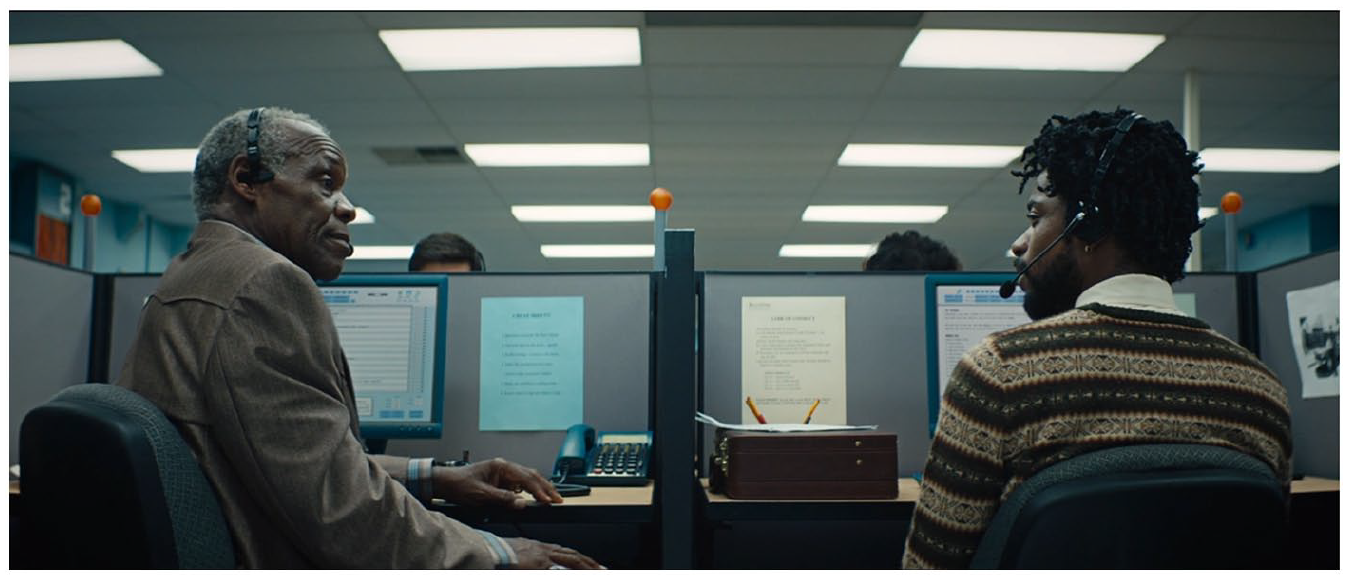
Langston (left) telling Cash (right) to use his ‘White Voice’.
Cash’s White Voice is supernaturally effective, and he is soon promoted to the exalted status of PowerCaller, where ‘they make the real money’. Cash is no longer flogging encyclopaedias to the recently bereaved, but slave labour to multinational weapon manufacturers.
The very nature of Cash’s White Voice needs to be understood as a hauntological object. Like having ‘a stranger within the subject’s own mental topography’ (Abraham, 1994, p. 173), the White Voice appears as a mysterious object ‘out there’ that Cash incorporates ‘within’ himself, symbiotically exercising agency as though alive. Cash crosses the ‘sonic colour line’, a socially constructed boundary of racialised sound, dictating ‘how and why certain bodies are expected to produce, desire, and live amongst particular sounds – and its product, the hierarchical division sounded between “whiteness” and “blackness”’ (Stoever, 2016, p. 7). The White Voice helps Cash to secure a new position of privilege, bringing him into capitalism’s inner sanctum. Yet, as a ventriloquising phantom, the voice is never his own. Rather, Cash adopts, what James (2019, p. 7) calls, the ‘sonic episteme’ of neoliberal capitalism that subsumes his very sense of being. More than ‘selling out’, this process speaks to the violence of epistemic erasure and the way in which our everyman, Cash, not only fails to resist but leans into the violence of unbecoming (Figure 2).
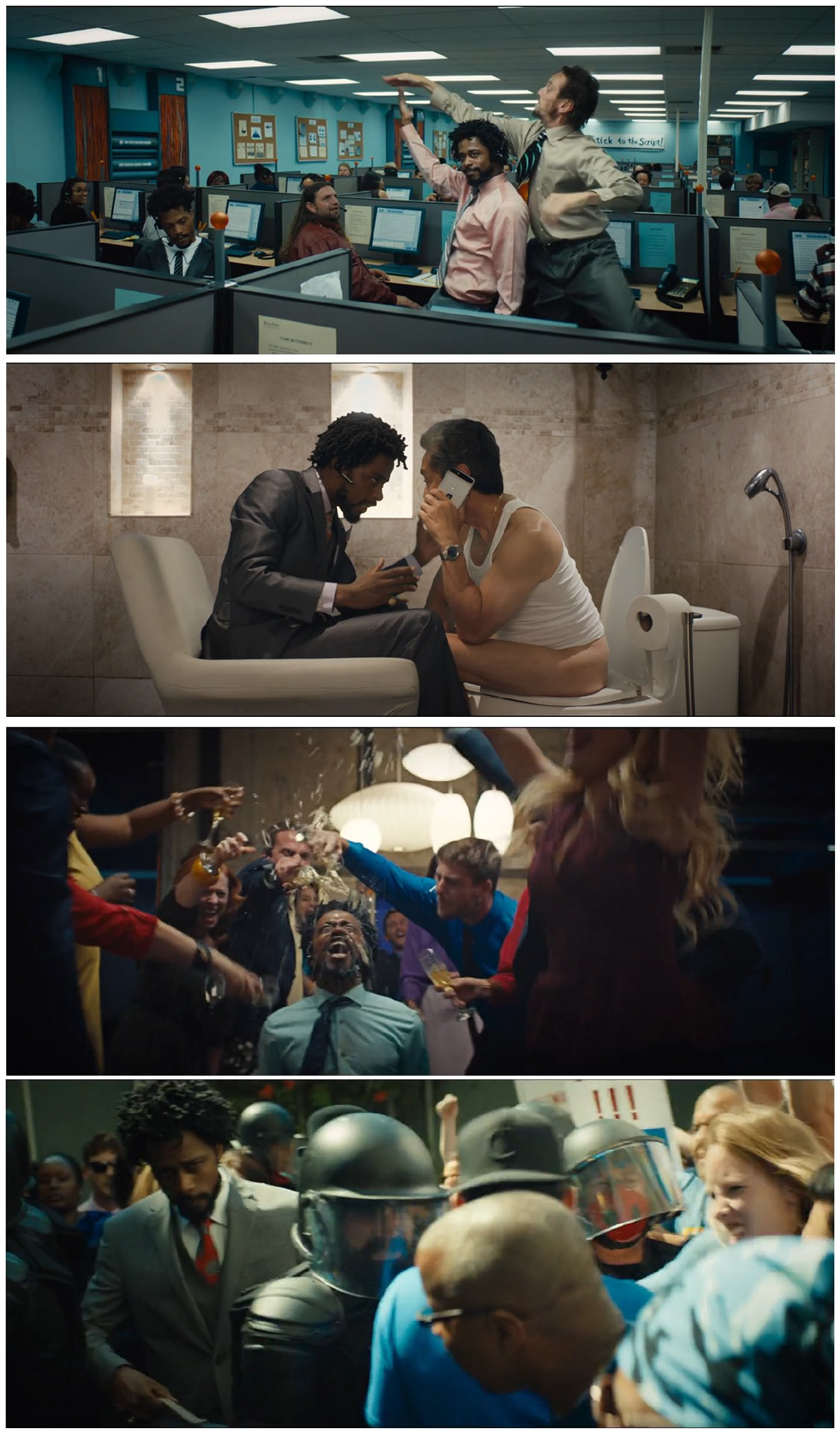
Cash’s unbecoming (clockwise): 1. Standing out at RegalView; 2. The White Voice’s persuasive power in action; 3. PowerCallers celebrating another sale; 4. Crossing the picket line.
This (dis)embodied acousmatic technique used to articulate the White Voice has a long history in cinema. As Žižek (1996) explains, the invention of sound in film brought with it a body/voice slippage that provoked a sense of unease amongst audiences. The appearance of sound, far from lending an authenticity to the visual, had the effect of giving rise to a third, ‘spectral voice, which floats freely in a mysterious intermediate domain and thereby acquires the horrifying dimension of omnipresence and omnipotence’ (Žižek, 1996, p. 96). In Sorry to Bother You, we witness an accentuation of this body/voice slippage with the use of overdubbing: David Cross’s voice emanating from LaKeith Stanfield’s mouth. Ostensibly comic, this floating voice carries the spectral presence of an invisible master that unnerves those closest to Cash:
That’s some puppet master voodoo shit. Sounds like you’re overdubbed.
Man, your white voice, man, it’s fucking scary.
No. Please, no. Stop with that stupid voice!
The use of overdubbing corresponds to the use of the crackle of vinyl that creates a sensory experience of listening to ‘a time out of joint’: neither fully present not entirely past. Rather, it is a process of ‘cognitive estrangement’ (Fisher, 2016, p. 48) in which Cash sacrifices himself at the altar of capital and, in doing so, loses any sense of his authentic self and his ties to ‘reality’. Cash’s White Voice precipitates the breakdown of his relationship with his artist-activist partner, Detroit, and he becomes alienated from his striking co-workers. Yet, all the time, Cash’s ethical dilemmas are assuaged by inordinate remuneration and, most insidiously, a newfound sense of purpose.
As corporate success continues to follow Cash, he finds himself more and more dependent on the White Voice. And yet, we are never fully certain who is controlling whom: is Cash controlling the Voice, or the Voice controlling Cash? Such a question, again, invokes the spectral presence of an invisible master and, following Frosh (2013), aligns hauntology with postcolonialism. In the White Voice, we see the incorporation of anti-blackness as a spectre of a colonial past that continues to shape our present. Besides Cash, Langston and Detroit also project a White Voice, although only sparingly at their workplaces, as well as Mr _______ (whose name is deliberately obscured, denoting the black erasure that comes with the White Voice), who is the first to greet Cash as a PowerCaller (Figure 3).
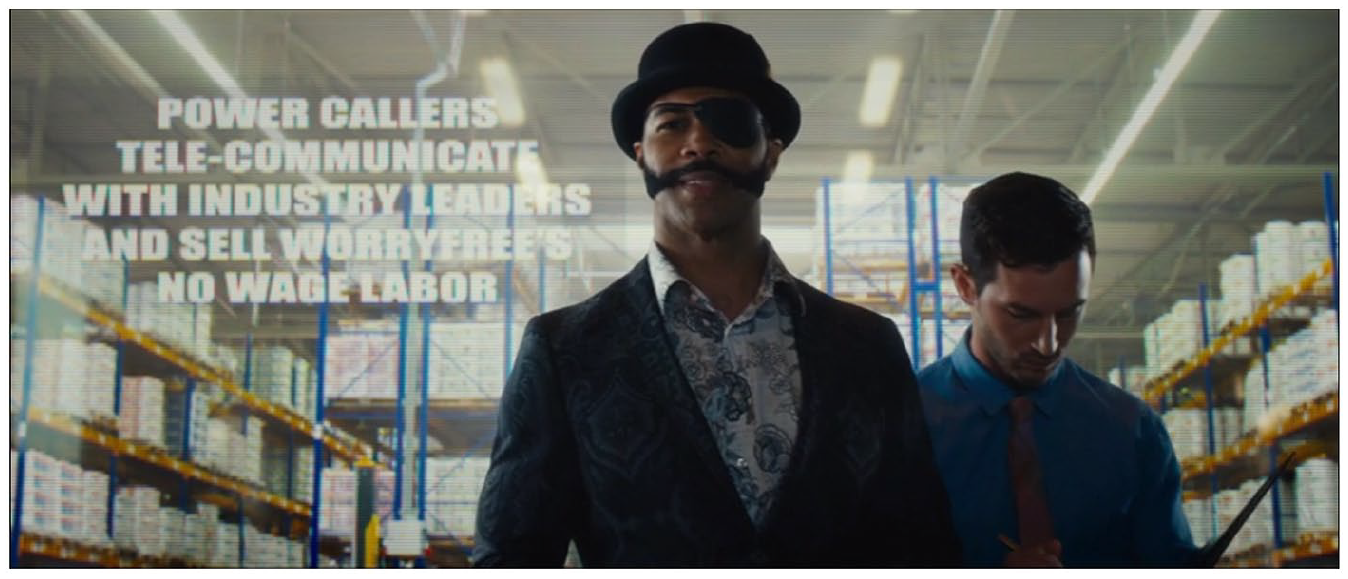
Mr ________, inducting Cash as a PowerCaller.
In each, but to different degrees, the White Voice stands as a vocal colonisation that begins to affect their moral core. They have given up their own voice, but they are now counted under capitalist realism. Hidden, however, is the violence of epistemic erasure: words buried alive and a history expunged. Mr _______ remains a portentous vision of Cash’s future and the near total eradication of self. Yet, as the audience to this horrifying process of body colonisation, we register, in the main, its comedic tenor and are entertained by the unnerving presence of the White Voice. In other words, we see but choose not to fully recognise the unsettling process of capture happening before our eyes. For Cash, he becomes an object incorporated. His own voice is silenced by the White Voice, which, in turn, buries his former self deep in his unconscious, much like ‘the sunken place’ in Jordan Peele’s Get Out (2017). Despite its unnerving presence, Cash, with no small foreshadowing, continues to defend it: ‘I never been good at anything before. I’m feeling myself. I’m a monster at this shit!’
Equisapiens: Bodies from a ‘time out of joint’
If representations of the White Voice toy with sinister undertones in Cash’s racialised inclusion as a PowerCaller, the magnitude of Worry Free’s epistemically exclusionary and excrescently racialising dystopianism is fully encountered in the film’s third act with the discovery of their plans to forcibly mutate their workers into a slave army of human–horse hybrids, the Equisapiens (Figure 4).
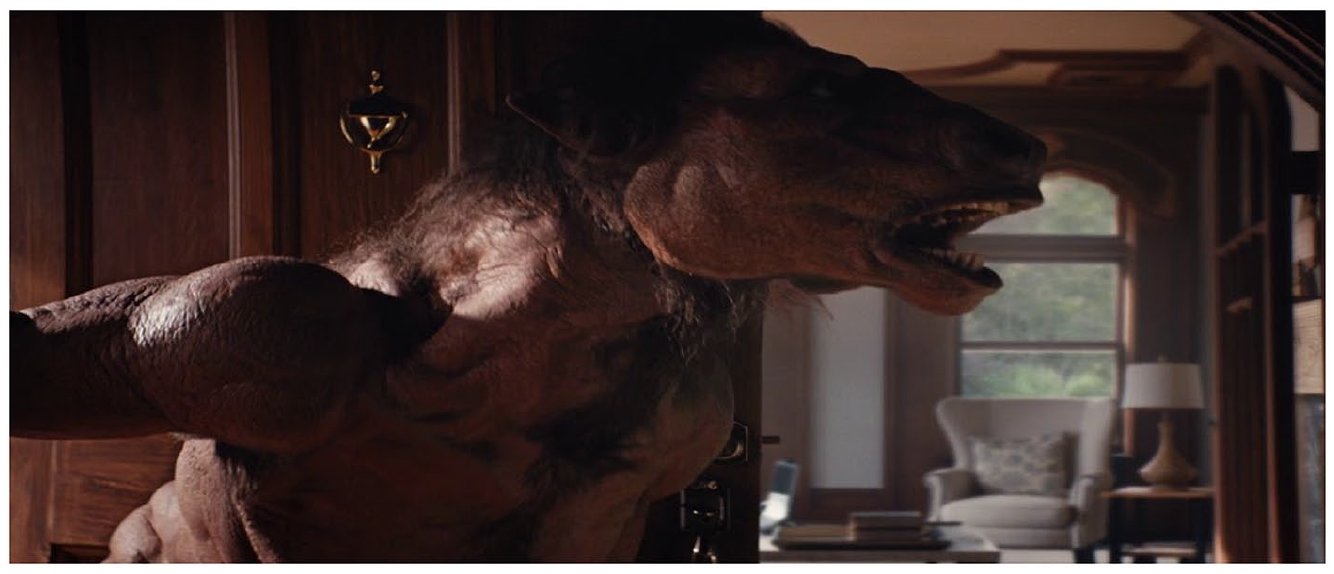
The Equisapiens: bodies out of place, from a time out of joint.
Represented using stop-motion animation, a jarring sight against their live-action environs, Equisapiens are a crude inverse centaur: head and torso of a horse, arms and legs of a human. Whereas, in Greek mythology, the centaur fused equine strength with human wisdom, the Equisapiens are designed to combine literal horsepower with submissiveness. As their creator, Worry Free’s ‘thought leader’ CEO, Steve Lift, explains: ‘[They are] the future of labour, OK? They’re bigger. They’re stronger. They hopefully gripe a lot less. And, also, soon, I’m gonna have millions of them.’
The presence of the Equisapiens is an elision, bodies from a ‘time out of joint’, and reminds audiences of the racialised violence that lies beneath the thin veneer of technological ‘progress’ and corporate practice. Lift’s techno-liberal vision for the future of humanity is anachronistically animated by the afterlives of chattel slavery (Hartman, 2008). In an interview with Oprah, Lift dismisses parallels between Worry Free’s lifetime labour contracts and slavery: No. Conclusively no. Our workers do not sign contracts under threats of physical violence so, therefore, the comparison to slavery is just ludicrous and offensive. We’re transforming life itself.
But later in the film, Cash bluntly asks Lift: ‘So, you’re making half-human, half-horse fucking things so you can make more money?’ and Lift snaps back, ‘Yeah, basically, I just didn’t want you to think I was crazy . . . because this isn’t irrational.’ Lift’s earlier proclamation that Worry Free is ‘saving lives’ is revealed, in a private presentation for shareholders, to mean nothing more than workers being made ‘stronger, more obedient, more durable and therefore more efficient and profitable’. The presence of the Equisapiens reveals just how inured Lift is to the human cost of the profit motive, the logical conclusion of capitalist realism’s business ontology. As Saidiya Hartman (1997) and Ruha Benjamin (2016) remind us, post-racial developments still possess traces of their racist antecedents. Slavery, as Hartman (1997, p. 120) explains, was ‘supplanted by the liberty of contract that spawned debt-peonage’, giving new meaning to contemporary forms of ‘self-discipline and induced internal forms of policing’. In this vein, Lift’s techno-liberal platitudes whitewash Worry Free’s racialising violence and launder a compounding capitalist realism that recirculates in our ‘reality’ as ‘progress’.
Cash becomes embroiled in the Equisapien plot when he is headhunted by Lift and offered $100,000,000 to be ‘temporarily’ transformed into an Equisapien sleeper agent for Worry Free:
They’re [Equisapiens] gonna form their own society. They’ll probably form their own culture. Then maybe they want to organise. Maybe they want to rebel. And that’s why we need someone on the inside who represents Worry Free’s needs. Someone they can relate to.
So, you want a manager? For fucking horse people?
No. No. The Equisapien Martin Luther King, Junior. But one that we create. One that we control.
Having created these trojan horses to unleash further capitalist immiseration, Lift reveals his concern of an anticipated future in which the Equisapiens collectivise. Again, we see future echoes of the past slipping into our present through this forecasting of resistance. However, Lift mischaracterises Martin Luther King Jr. as a pacifist dreamer and, in doing so, erases the martyr who died fighting for workers’ rights at the sanitation strike in Memphis, Tennessee, under the banner of his Poor People’s Campaign (Gordon, 2018). It is not so much that history is fated to be repeated than it is to be refurbished, reincorporated within the dominant logic of capitalist realism, and repackaged as ‘progress’. Riley provides insights into the racial violence hidden along techno-liberalism’s suspiciously short march into the future, one in which the violent erasure of the past leaves a traumatic absence rather than a cleared path for capitalist ‘growth’.
Sorry to Bother You depicts a technological determinism inextricable from the traumas of the past. Just as signifiers of the future created during the 1950s remain relevant today (Coleman & Tutton, 2017), Lift’s vision for the future is violently anachronistic, shamelessly dispensing with the whitewashing pretences of techno-liberalism. Whilst Coleman and Tutton (2017) argue that biotechnology and biomedical advance bring hopes of cures for human disease and dull the repetition of work, Sorry to Bother You warns that capitalist realism builds towards these achievements on top of the violence of the past. Markers of a future-present, the Equisapiens are an allegorical representation of the hauntological dimensions to capitalist realist discourses of ‘progress’.
As bodies out of place, from a ‘time out of joint’, the presence of the Equisapiens, much like the surface crackle of vinyl, acts as a reminder of our attachment to the techniques and formulas of the past and how, as a consequence, our inability to innovate carries history’s traumas into a forever present. For Cash, the surface crackle of the Equisapiens functions as a visual shock that forces him to finally recognise the violence happening to and through him: I know how they view me. How I look in the eyes of fucking Worry Free and RegalView. They just view me as another one of their fucking creatures to control and to manipulate. And that’s not me!
For the audience, the Afrosurreal figure of the Equisapiens disrupts Worry Free’s ambient reality warping. Yet, cinematically, we, the audience, enjoy the novelty of their weird presence, their shock value; their outmoding of the conventional mixes both pleasure and pain in the same way Lacan (2017) describes jouissance. We are encouraged to become uneasy with our own inter-passivity. By bringing the violence of the past to life, Riley renders visible the aftershocks that continue to haunt the present and weigh down future imaginaries. We, the audience, like Cash, are forced to confront all that is smothered under capitalist realism’s sutured dreamwork and to recognise the anomalies and contradictions accommodated under the auspices of ‘progress’.
Worry Free: The corporate crypt
Our third haunting is the Worry Free corporation itself. Again, ostensibly comedic, Worry Free is a brazenly capitalist realist ‘solution’ to the contradictions of its own exploitation. As Mr _______ proudly explains: ‘Workers live in space efficient dwellings in the same facilities where production occurs. They make anything and everything. Lifetime contracts. No wages needed.’ For those unable to ‘keep up’ with the constant churn of capitalist re-flux, including Cash’s uncle, Sergio, Worry Free is their last resort. True to its name, Worry Free provides the relief of extinguished desire to those stranded upon the endless flatlands of capitalist realism, and, with it, total quiescence (Fisher, 2012b, p. 135). Like the invasiveness of the White Voice and the anachronistic aesthetics of the Equisapiens, the spectre of slavery and carceral labour exist in plain sight, but their portents remain repressed, existing beyond challenge or critique.
Worry Free’s LiveWork fulfilment centres take Amazon’s industrial warehousing of goods and people to their next logical stage. Worry Free billboards show rictus-grinned scenes of domestic bliss, with everyone wearing protective factory-floor clothing, always-already at work (Figure 5).
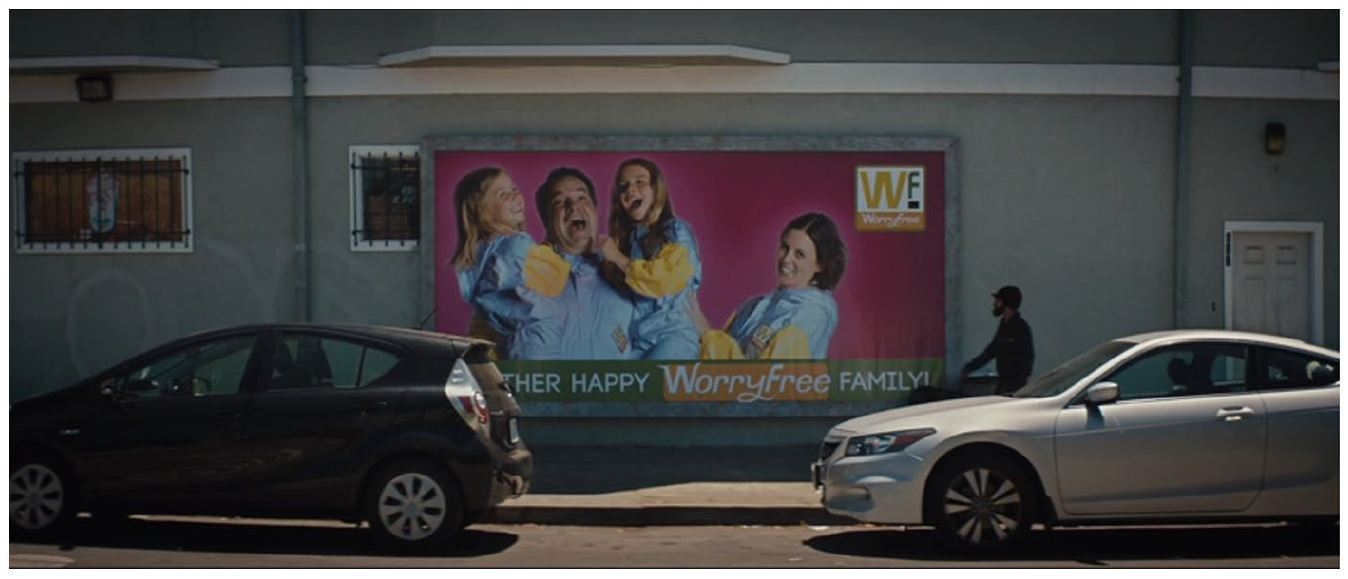
A Worry Free billboard: ‘Another Happy Worry Free Family’
Yet, as one protester describes: ‘These are prisons. People are packed in like sardines, fed cheap slop, and worked to the bone fourteen hours a day.’ LiveWork centres manufacture whatever they have been contracted to build without distinction: phones, cars or intercontinental ballistic missiles, it is all the same. Understanding Worry Free as a logistics company, like Amazon or Walmart, is crucial in articulating its hauntological features, given how the invention of the modern logistics these companies specialise in can be traced back to the Black Atlantic. As Harney argues: The Atlantic slave trade was also the birth of modern logistics because modern logistics is not just about how to transport large amounts of commodities or information or energy, or even how to move these efficiently, but also about the sociopathic demand for access: topographical, jurisdictional, but as importantly bodily and social access. (Harney et al., 2018, p. 96)
This access, as Wilderson (2010) argues, was born in ‘the hold’ of slave ships. Worry Free achieves such access through the containerisation of workers in LiveWork centres. Workers are treated as human cargo, to be speculated upon, both financially and, in this case, genetically. In this sense, Worry Free is both slave ship and sweatshop. It has raised the atmospheric pressure of capitalist realism so high that workers are carried into ‘the hold’ on currents of desperation, filling the void of their subjectivity with the certainty of subsistence.
The logic of logistics is facilitated by workers being ‘held’, both physically and ontologically. But ‘the hold’ implies temporariness, of eventual arrival at different (albeit, still dehumanising) circumstances, but movement, nonetheless. Worry Free’s permanence in space and time turns it from a ‘hold’ to a crypt. Fiddler (2019, p. 467) invites us to think of a crypt as a vault that keeps its contents secure and ‘locked down’ in order to keep those outside ‘safe’. Built by violence, the crypt is an intergenerational structure that incorporates the spectral hauntings of the past, and, in turn, redirects our possible futures into a forever-present (Derrida, 1986; Fiddler, 2019). As a crypt, Worry Free ‘buries alive’ unresolved traumas of the past and ensures we, as a society, are fated to repeat the violence and loss for which it was originally incorporated. Intergenerational trauma becomes part of the foundations on which ‘progress’ is built. In this way, Worry Free becomes more than a simple allegory for modern slavery: it is an allegory for how modernity has ‘buried alive’ the spectres of slavery that now persist through industrial incarceration.
Despite its foreboding presence throughout the film, we, the audience, only get a fleeting glimpse of ‘the real’ of Worry Free’s LiveWork centres. It is a traumatic void mediated through frivolous advertisements and corporate spokespeople. Twice we see news coverage of protests against Worry Free, but each time the channel is quickly switched over to the gameshow, ‘I Got the Shit Kicked Out of Me!’ This humiliation ritual is evidently preferable to confronting the truth of Worry Free. When Langston explains to Cash that comparing their small-time telemarketing with the PowerCallers is like ‘comparing apples with holocausts’, we begin to comprehend how Sorry to Bother You’s dark humour functions both narratively and ontologically. The disconcertingly wacky representations of Worry Free conforms with Žižek’s (2001, p. 68) argument that laughter is often the most effective way to confront, and cope with, incomprehensible horror. An ontology of fiction, in lieu of empiricist comprehensibility, is better able to encounter such atrocity via a surrealism capable of mediating between traumatised testimony and appropriating forgetfulness, between past and present (Diken & Laustsen, 2007, p. 17). The characterisation of Worry Free being akin to a concentration camp continues in the eugenicist drive behind the Equisapien plot: its impossible horror approached in Riley’s contrast between the playful, plasticine presentation for shareholders (Figure 6) depicting equisapienisation as a painless, voluntary process and its tormented Cronenbergian results, a slave army built from, and a testament to, the violence of the past.
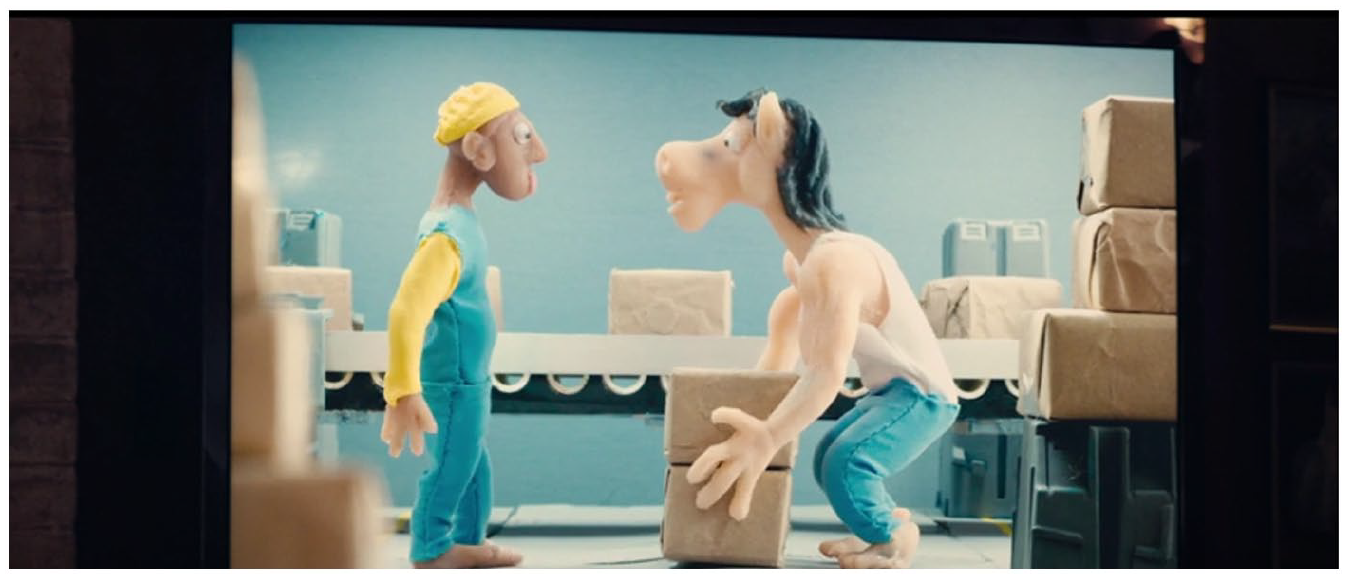
Worry Free’s unnerving shareholder presentation.
Despite all of this, Worry Free’s totalising logic proves impervious. When Cash endures the indignity of appearing on ‘I Got the Shit Kicked Out of Me!’ as the means to reveal to the world the Equisapien plot, it’s all for naught. The very next day Lift’s reputation and Worry Free’s stock price soars as equisapienisation is heralded as a scientific breakthrough (Figure 7).
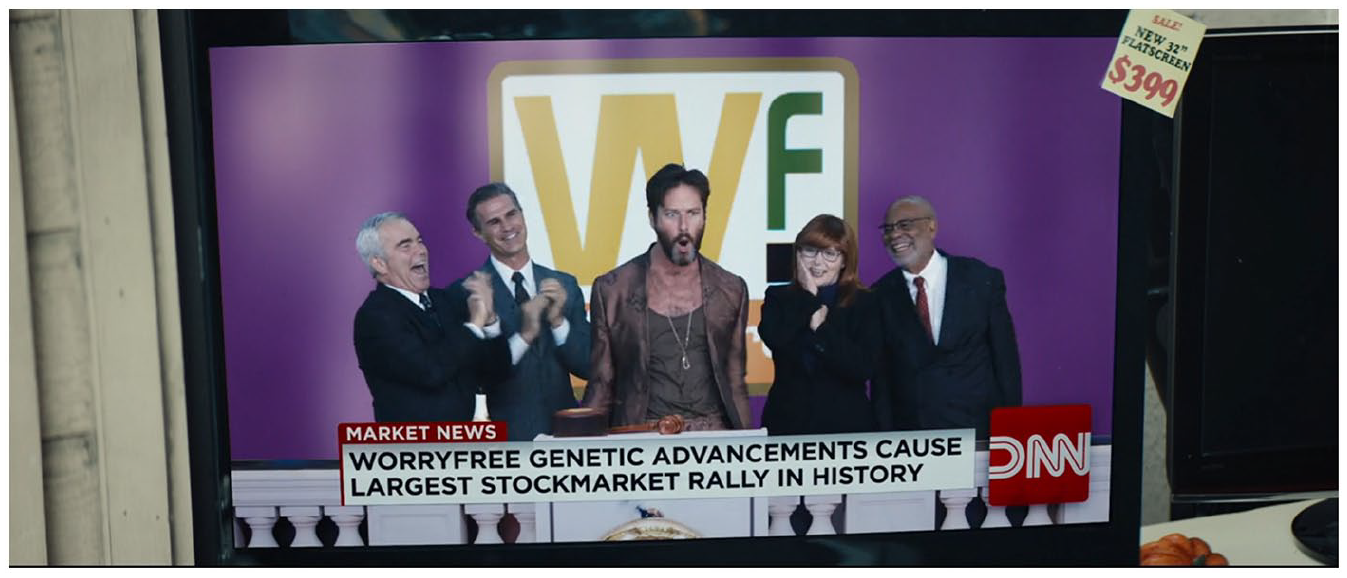
A triumphant Lift (centre) ringing the stock market’s opening bell.
Dejected, Cash turns to Squeeze, a union steward, to help make sense of this turn of events:
I tried to change it. I tried to stop it. But it’s. . . it’s just right in front of their faces. They’re turning human beings into monstrosities and nobody gives a fuck!
Most people that saw you on that screen knew calling their congressman wasn’t gonna do shit. If you get shown a problem, but have no idea how to control it, then you just decide to get used to the problem.
The human cost of Worry Free is accommodated rather than confronted, allegorising our own reflexive impotence, that even if we recognise capitalist maleficence, we convince ourselves we can’t do anything about it, enacting a self-fulfilling prophecy. Such lacunae of logic help whitewash Worry Free’s corporate colonialism. As Derrida (1996, p. 87) argues, the truth is spectral. The unresolved traumas of slavery and colonialism go unspoken and unrecognised, yet they continue to haunt Cash as they re-emerge through the institutional logic of Worry Free and relived by its workers.
Epilogue: Unfinished business
Despite the growing class consciousness stoked throughout Sorry to Bother You, its dystopian spectacle threatens to end on a disconcertingly capitalist realist note. Cash and his co-workers emerge from the strike victorious; his relationship with Detroit has been revitalised; he returns home, to his old garage apartment, now tastefully remodelled; he even suggests he might return to RegalView. We are reminded of prison abolitionist Thomas Mathiesen’s warning that ‘the struggle is terminated by a partial victory’ (2015, p. 51). However, delivering one final twist, reminiscent of Michael Jackson’s music video Thriller (1983), Cash bangs his head closing the garage door. Turning to the camera with bulging eyes and gigantic nostrils, his Equisapien metamorphosis has finally arrived (Figure 8).
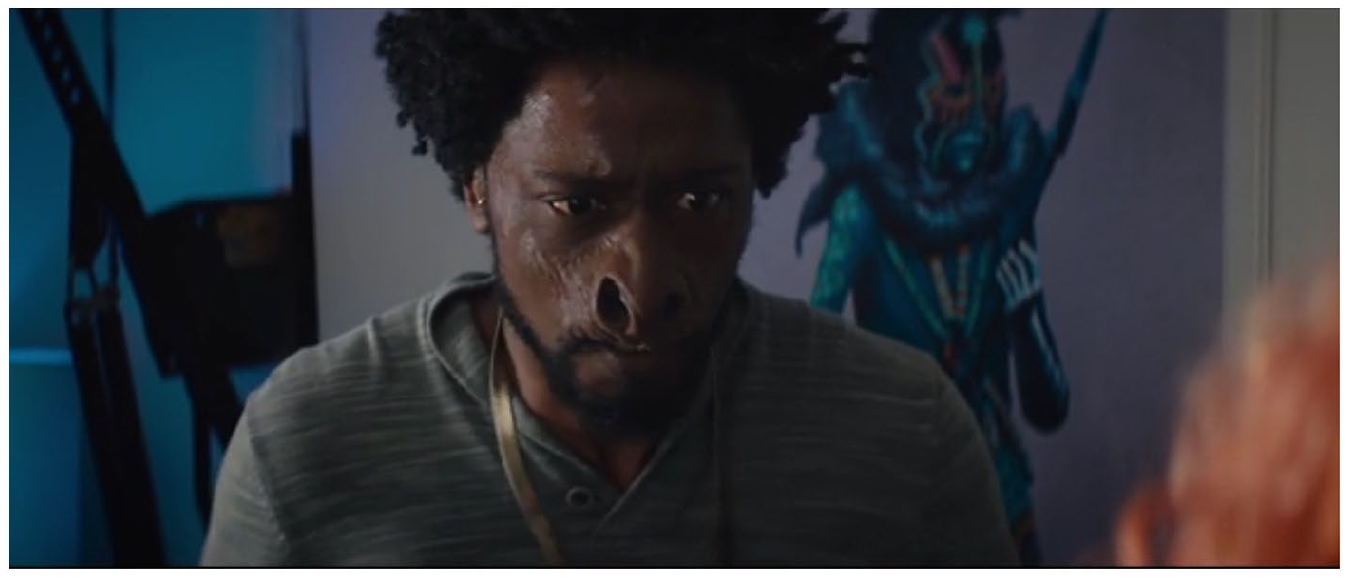
Cash’s final metamorphosis.
Roll credits. But the story is only beginning. The credits stop and we return to an epilogue. Lift is awakened in his mansion. Over the intercom, the leader of a group of Equisapiens shouts: ‘I’m Cassius Green calling on behalf of stomp-a-mudhole-in-yo-ass.com. Sorry to bother you!’ (Figure 9). Cash kicks down the front door, the film’s final word his hair-raising roar. Re-roll credits.
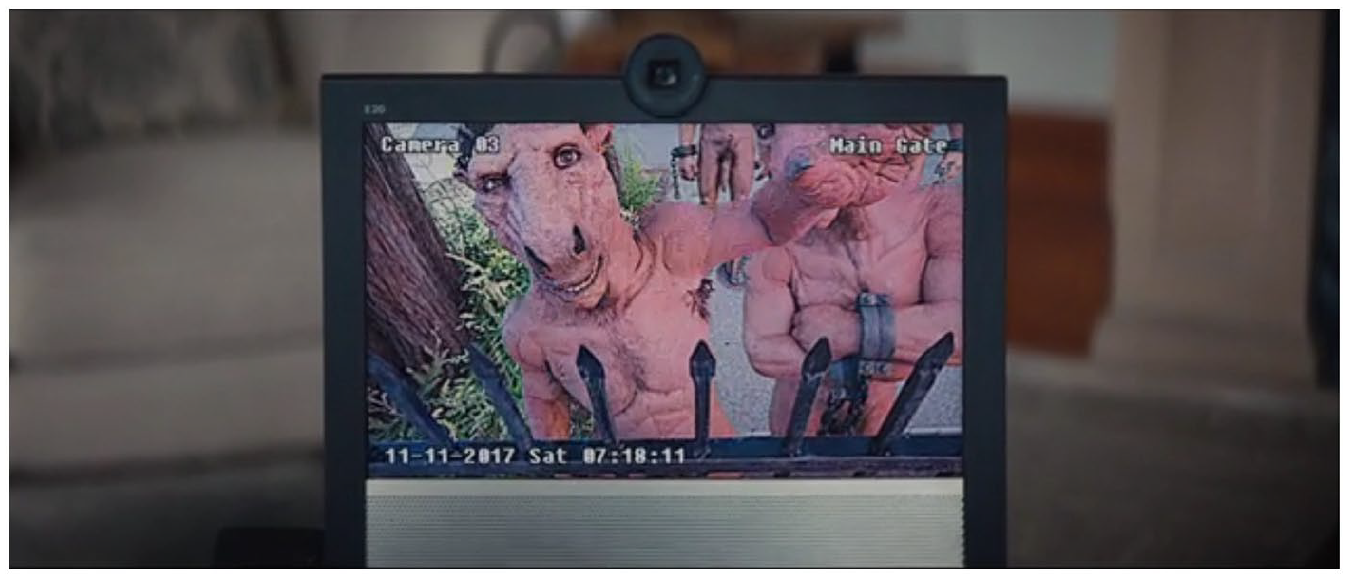
Equisapiens at the gate.
The fake-out ending functions cinematically to reiterate that, following Mathiesen (2015), abolitionist movements must remain forever ‘unfinished’. With resolution comes being ‘defined-in’ to the system, mollified with a stall in the marketplace of ideas. Capitalism is infinitely plastic, capable of absorbing anything it comes into contact with, particularly dissent (Fisher, 2009a). What follows Cash’s final roar is necessarily unclarified – he could be leading a revolution, exacting revenge, or extracting a cure from Lift. This concluding scene resists a definitive, final framing and is left ambiguous so ‘the system’ may not prepare itself for what comes next. As Riley states, ‘The struggle is not finished. It goes to a new level and continues. There is no pause. . . . Cassius has become a monster, physically, but now he’s fighting. And that’s the ending: that we’re now involved in the fight’ (cited in Martin & Kamara, 2020, p. 210). In true Afrosurrealist style, the Equisapiens have become ‘sensuous gods to hunt down beautiful collapsed icons’ (Miller, 2013, p. 117). This final scene transforms the film from a capitalist realist tale of ignored hauntological warnings, of reterritorialised Afrosurrealism, into an Afrofuturist call to arms in a fight for an emancipatory future. We are confronted with, and rightly challenged by, our lack of solidarity against the violence we have numbed ourselves to under capitalist realism. Riley’s hauntology captures the growing eeriness of this quiescence, allowing ‘us to see the inside from the perspective of the outside’ (Fisher, 2016, p. 10). Such a shockingly relatable absence of action haunts us and demands from us a positive, purposive response, not simply to abolish the roots of our present, but to found a new society.
As Mathiesen (2015, p. 58) writes, abolition requires that ‘we break with the established order and at the same time face unbuilt ground’. Ruth Wilson Gilmore (2019) develops this point by proclaiming that ‘abolition is not absence, it is presence’. She reassures explorers daunted by abolitionism’s emancipatory wilderness that ‘what the world will become already exists in fragments and pieces, experiments and possibilities’. Such a positive abolition resembles Fisher’s (2018b) sadly curtailed ‘acid communism’ project that sought a mass ‘unforgetting’ of the multiple forms of collectivities that emerged during the counterculture of the 1960s that neoliberalism’s mandatory individualism purposively wiped from our memories. Infusing new social movements with their labour and civil rights antecedents is one means of reversing our dejection under capitalist realism and to restore our confidence in countercultures once more. Hauntological cinema, such as Riley’s, we argue, can contribute to a popular consciousness raising that brings into focus new ontological and political horizons.
Conclusion
Our hauntological reading of Sorry to Bother You demonstrates how fiction enriches the sociological imaginary by reaching beyond the limits of empiricism to articulate experiences and sensibilities clouded by capitalist realism. By circumventing empiricist trappings of ‘certainty’ and ‘objectivity’, fiction facilitates a new way of seeing that challenges legacy constructions of order and knowledge designed to ignore our unpaid debts to racialising violence. Through this lens, cinema becomes the art of the spectre, exposing audiences to the fractures and confabulations of capitalist realism, providing a glimpse of the traumatic void we repress beneath this ‘reality’, revealing how we are not ‘present’ but living through a ‘time out of joint’, what Miller (2013, p. 114) describes as a ‘future-past called RIGHT NOW’. Cinema has the power to allegorise and accentuate the contours of our denial, bringing to life the active presence of absences we displace in our own lives. Beneath capitalist realism another world is possible, striving to manifest. Whereas ontology is concerned with all that ‘exists’, hauntological fictions articulate all that has had its ‘existence’ traduced, inviting audiences to resolve traumas so we may finally see the future with fresh eyes.
Sorry to Bother You collapses distinctions between hauntology and ‘progress’, fiction and empiricism, actual and virtual, enabling us to think beyond ‘reality’ and rearticulate the unresolved and roiling legacies of slavery. The body/voice slippage of the White Voice aurally articulates an invisible colonial master that, first, strips Cash of his voice and, then, his moral compass. The Equisapiens represent the extractive endgame of corporate colonialism and serve as a visual reminder of a revenant racial violence lurking beneath the thin veneer of techno-liberal ‘progress’. The sustaining logic to this violence is Worry Free, whose social contract incorporates and builds on top of the legacy of slavery; its intergenerational, crypt-like corporate structure, hermetically sealing the ontological lives of its captive population. Finally, Sorry to Bother You’s fake-out ending reminds us of the abolitionist’s unfinished struggle and the speculative, emancipatory power gained in resisting the definitive. To be incorporated, to be defined-in to capitalist realism, is to be ratified but desiccated, contributing to the slow cancellation of our futures. Hauntings refuse this fate, and here, again, lies the importance of fiction: its power to disrupt an ontology that prioritises ‘reality’ whilst denying all which it unjustly subsumes.
Sorry to Both You’s parallel imaginary encourages audiences to recognise and reckon with unresolved traumas and lost futures that have been denied presence in their own lives. Our hauntological reading of the film presents a cracked lens through which we can explore the theoretical possibilities beyond the limits of empiricism, instantiating a political vision beyond capitalist realism. Our analysis highlights how fiction enriches this empoweringly speculative project by reanimating lost futures that had been dispirited away under capitalist realism. To quote Fisher (2009a, p. 81), ‘from a situation in which nothing can happen, suddenly anything is possible again’. Sorry to Bother You promotes a postcapitalist desire (Fisher, 2021) that unites a cornucopia of causes in a global rainbow coalition. As Squeeze says to the newly liberated Equisapien, DeMarius: ‘Same struggle. Same fight’ (Figure 10).
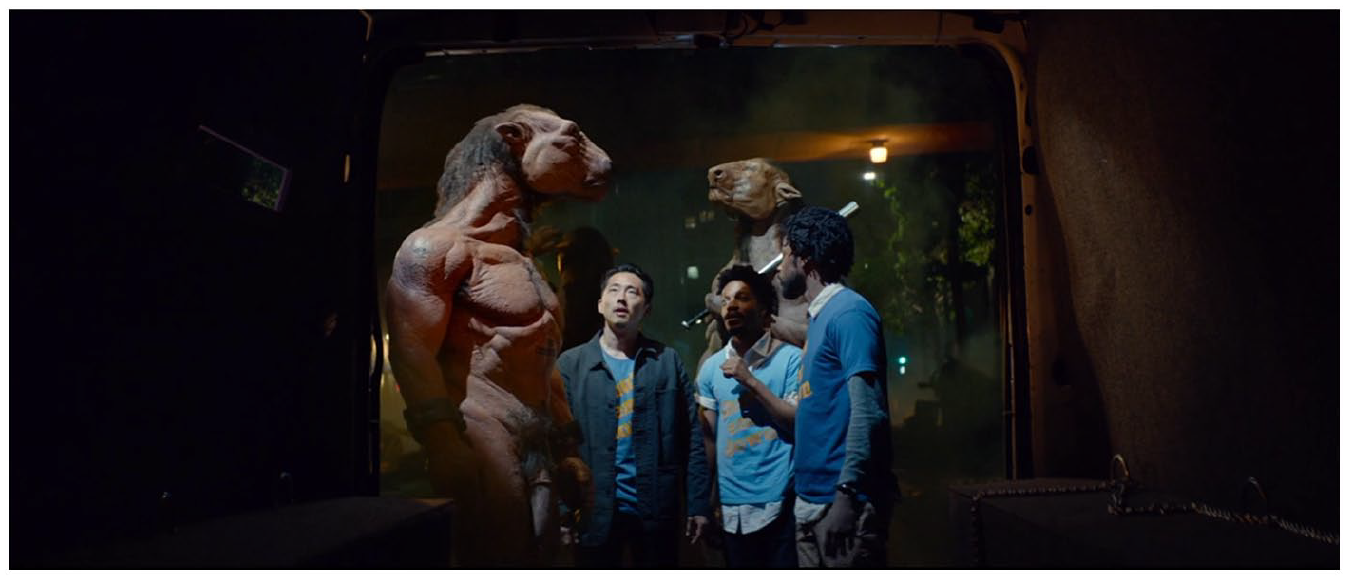
New ontological and political horizons.
Our hauntological reading of Sorry to Bother You supports the film’s cultivation of this desire by highlighting how it not only critiques capitalist realism but raises the spectre of a positive abolitionism and brings into focus new ontological horizons that make another world possible.
Footnotes
Funding
The authors received no financial support for the research, authorship, and/or publication of this article.