




Abstract
Situated within the sociological debate on social change, the present article examines the potential for food movements to transform agrifood systems. Existing analyses within the field of food studies predominantly examine agrifood systems at either the global or local level. By contrast, our analysis begins with the national sphere, and seeks to demonstrate how national transformations relate to those on the global and local scales. We, thus, challenge the approach of dichotomous scales by providing categories and perspectives that highlight the relational and interdependent character of food movements. To do so, we examine the Marcha das Margaridas – a movement based in Brasil – and its achievements in transforming the national agrifood system. Established in 2000, the Marcha das Margaridas is a feminist mobilization that plays a central part in the fight against inequalities in agrifood systems and foments discussion of food politics on a multiplicity of scales. We demonstrate this by mapping the march’s public policy achievements, and by analyzing three of these in detail.
Introduction
The present article analyses the potential of food movements to transform agrifood systems. This has been discussed in the field of food studies, mainly focusing on the potential these movements have to affect agrifood systems on the global (Hendrickson & Heffernan, 2002; Holt Giménez & Shattuck, 2011; McMichael, 2005) or local (Allen, 2010; Allen & Wilson, 2008; Goodman et al., 2011; Hinrichs, 2003; Salcido, 2013) scale. To date, there is a gap in the research concerning the incidence of food movements on the national scale (Borras, 2009; Motta, 2016; Wilkinson & Goodman, 2017), which we aim to address with this work.
We will, thus, analyze the experience of a women’s movement acting mostly in Brazil, as well as its potential to transform the national agrifood system. We also seek to demonstrate how mobilizations operating in the national sphere interact and affect the global and local scales of agrifood systems. 1 Our aim is, therefore, to challenge the dichotomous scale categories simplification, and to recommend more relational categories that draw attention to the interdependence between scales. In summary, the question that guides this article is: what are the contributions of food movements to the transformation of agrifood systems, and how should these systems be regarded beyond the dichotomy local/global?
The article answers these questions by analyzing the experience of Marcha das Margaridas, a feminist Brazilian movement of women from the field, the forests, and the waters which has been in existence since in the year 2000. With a vast political agenda, the Marcha has pursued a broad-based fight for rights and citizenship throughout the first two decades of the 21st century. The Marcha’s agenda has a wide scope, which includes agrarian, environment, social, labor, and social security policies, as well as discussions on sexuality and reproductive rights, democracy, and violence. The transformation of agrifood systems is core to their political agenda and will be the focus of this article.
The Marcha das Margaridas is a coalition of agrarian and feminist movements that can also be considered a food movement as it brings together social movements, networks, and initiatives fighting against injustices in the agrifood system. Inspired by a perspective that sees social movements as an analytical category (Melucci, 1999, 2001; Teixeira, 2018), we use the term food movements to explain the experiences of social movements of different organizational formats. These are constructed by individuals who share identity and solidarities, fight against injustices in the agrifood systems, and are somewhat stable over time. This definition is useful, given that it encompasses diverse empirical experiences and renders them analytically comparable, while still considering specificities.
The decision to analyze Marcha das Margaridas, a movement led by women, was not arbitrary. ‘Women produce 80 percent of food in poor countries; but their knowledges extend beyond food production narrowly conceived to include saving seeds, medicinal plants, animal husbandry and the protection of biodiversity’ (Conway, 2018, p. 201). Bearing in mind the importance of advancing the knowledge on women’s and feminist food sovereignty activism (Masson et al., 2017), the present work seeks to contribute to the debates not only on the potential of food movements to produce changes in agrifood systems, but especially the potential of women’s and feminist food movements to produce such changes.
By centering on a case that has been emblematic in Latin America, part of our intention is the decolonization of food studies as a field (Ashe, 2018), as the latter has been decidedly Anglo-Saxon thus far. In order to identify these achievements, our analysis focuses on mapping public food policies tackled by the Marcha in each of its campaigns, how these achievements shaped the agrifood systems in Brazil in the first two decades of the 21st century. Our methodology was the analysis of primary source documents, interviews with the Marcha’s activists, and our observational participation in the Marcha’s organization and implementation in 2015, and 2019.
The article is divided into four parts. In the first, we present the theoretical debate on agrifood systems and scales. In the second part, we present the Marcha das Margaridas, highlighting its history, main characteristics, and its acting on a multiplicity of scales. In the third part, we present the Marcha’s contributions to the transformation of agrifood systems in Brazil in the first two decades of the 21st century. In this part, we provide an in-depth analysis of three of the Marcha’s achievements, the processes leading to them, and their impact on the agrifood systems. In the fourth and last part, we present our final considerations, re-engaging with the discussion on the scales of analysis. Thereby, we underline the importance of analyzing the national level due to the lack of studies focusing on this scale in recent years.
From global to local: What about the national?
The term agrifood systems is central to the field of food studies, and has been used in different ways: modern food systems (Beardsworth & Keil, 2002), sustainable agrifood systems (Carroll, 2015), and food and nutrition systems (Sobal et al., 1998) are just a few examples. Having as a premise that categories are contextual and serve an analytical purpose, we use the term agrifood systems to refer to the processes of production, distribution, preparation, consumption and residues of food, highlighting the role of different social actors in these processes. We adopt the prefix ‘agri-’ because our object of empirical investigation is a movement that mainly articulates political subjects socio-spatially, politically, and in terms of an agenda that is located in the agrarian portion of the food system. We use the plural form of the term inspired by the conceptualization of ‘decentralized food systems’ in Maluf and Luz (2017). The aim is to draw attention to the distinct, yet interdependent, scales of the food systems: global, national, and local. According to the authors: ‘this approach requires identifying food systems that coexist in a certain socio-spatial unit, and the complementary and conflictive aspects of such coexistence’ (Maluf & Luz, 2017, p. 217).
The dichotomy between global and local scales, prevailing in food systems studies, is based on approaches that contrast those scales in their economic, political, and sociocultural dynamics and configurations. Since ‘localisation has become a catchword often invoked as a counterpoint to globalization’ (Hinrichs, 2003, p. 34) and a ‘call to action under the claim that the antidote to global power is local power’ (Goodman et al., 2011, p. 13), such scale dualism is potentially a reductionist analysis of processes that are complex and interrelated. In part, this reductionism may be attributed to the idea that spatial relations and geographies are themselves the main explanatory keys to access social and environmental patterns, which in reality should be considered in all their proper multifactorial complexity.
Beyond rigid geographical limits, spaces should be observed with historical perspective, and understood as social constructions that are fluid, contingent, and filled with the interactions between multiple actors and scales (Allen, 2010). These interactions are not restricted to their spatial dimension, since they also refer, for instance, to the relations established between technology, power, politics, economy, market, civil society, social movements, and culture. In this sense, Geels (2011) suggests a multi-level perspective as a framework to assess these interactions, and the transformations attributed to them. The author describes this approach as non-linear, and non-causal, since ‘there are processes in multiple dimensions and at different levels which link up with, and reinforce, each other in a “circular causality”’ (Geels, 2011, p. 29). Goodman et al. (2011) argue that a quality turn on the ontology of scales is made when geographical categories are not taken for granted as fixed and preordained, but analyzed in terms of societal processes and sociopolitical struggles. In other words, this means that categories of scale such as local, national, and global – when understood only from their geographic dimension – cannot explain all the dynamics this definition seeks to encapsulate, unless an interactional and interdisciplinary approach is considered.
A great deal of criticism has been leveled at the perspective of food systems localization, which is generically associated with efforts to resist and overcome the ills of neoliberal globalization (Allen, 2010; Ashe, 2018; Born & Purcell, 2006; Robbins, 2015). This is because this perspective tends to mask conflicts, contradictions, inequalities, asymmetries of power, and subsumption under the business logic of supra-local food markets. Salcido (2013) discusses the articulation of local agrifood systems with markets and public policies, highlighting the gaps presented by the local paradigm, which underestimates inequality and power relationships with the national, and global sphere. Similarly – and based on the typology elaborated by Hinrichs (2003) to assess attributes generally associated with the local and global scales – Niederle and Wesz Junior (2018, p. 27) suggest that: ‘Local’ is usually explained by a set of ethical, ecological, and aesthetical aspects. On the other hand, ‘global’ is the space of inequalities, asymmetrical powers, domination relationships, and resource degradation. . . . There is no space to consider dynamics that are not primarily present in one of these two scales, i.e., that are influenced by both national and regional economic configurations (Wilkinson; Goodman, 2017).
Goodman et al. (2011) denominate this type of perspective ‘unreflexive’ localism, that ‘arises from a perfectionist utopian vision of the food system in which food and its production are aligned with a set of normative, pre-set “standards”’ (p. 12). Against this idealized conflict-free portrayal of the local, the authors point out that this ‘normative, values-based localism leads to an elitist, undemocratic politics of perfection marked by problematic conceptions of social justice’ (p. 13). Their critique is specifically directed at the analysis of what have conventionally come to be called alternative food networks as well as the fair trade movement that emerged in response to the unsustainable industrial food system. Their argument is that alternative does not necessarily mean oppositional, since these spaces and the values they promote such as ethics and taste are prey to mainstreaming and commodification, undermining their aspirations to achieve social justice. Therefore, rather than building dichotomies, studies should have a reflexive approach towards the dimensions and scales of agrifood systems, drawing out asymmetries, contradictions, conflicts and relations that are inherent to it.
Seeking to understand the role of social justice in local food systems, Allen (2010) argues that ‘reducing the scale of human interactions does not necessarily achieve social equity, as small-scale institutions are not always more equitable’ (p. 300). She highlights the structural dimensions of class inequality, ethnicity, gender and their intersections in local politics and institutions, in turn, interconnected to the other scales of the food system. She does recognize the potential of certain local experiences and affirms the importance of the scale as a unit of analysis. However, she endorses the paramount importance of a critical multi-scale look, mindful of ‘local traps’ (Born & Purcell, 2006). Considering the potential of alternative agrifood movements in the fight for social justice, she states that ‘it is important to parse to which problems food system localization is a solution, to which it is not and perhaps cannot be, and to examine if there are conditions it reifies or problems it exacerbates’ (Allen, 2010, p. 295). The transformative potential of these movements resides mainly in understanding their role as incubators of new imaginaries of fairer food systems.
Moving onto the global scale, Holt Giménez and Shattuck (2011) are also interested in the transformative potential of food movements that – in the neoliberal context – ‘directly and indirectly challenge the legitimacy and hegemony of the corporate food regime’ (p. 109). They suggest a classification typology of food movements according to their main organizational, political, and ideological characteristics. In addition to hegemonic corporate food regimes, neoliberal and reformist movements or organizations are similarly committed to reproducing the system, and mainly dedicated to strengthening the ‘consumption-as-politics’ as a discourse and action strategy. By contrast, progressive and radical movements are identified as those organized to locally provide alternatives to the industrial agrifood systems and/or are aligned with the right to food and food justice narratives. They are mainly identified as the globally organized social movement La Via Campesina.
In short, the above debate shows a bias in the literature on food systems to focus on global or local dimensions, bypassing or giving little importance to other scales, such as the national. The tendency to diminish the importance of the national dimension, or more specifically the action of states, can be understood in the context of the focus of analysis on the transnational dimension as a result of the effort to understand and interpret social relations in times of intensified globalization. In this sense, Goodman et al. (2011) affirm that ‘the subnational and global levels are gaining prominence at the expense of the nation-state’ (p. 22). Although some authors have called attention to the weakening or the end of the nation-state, as an actor it continues to play a prominent role in the social, political, economic and cultural conformation of our societies (Fiori, 2007).
In this respect, this work adds to previous studies, such as that of Motta (2016), that have pointed out the importance of the national dimension as a scale of transformation of agrifood systems. She argues that ‘despite global patterns in the current food regime, there is enough variation in neoliberal globalism for continued research at the level of the nation state’ (p. 721). The national scale, and specifically the state arena, constitutes a key dimension for the analysis of agrifood systems since it is a locus of regulations, and it is ‘responsible for the agrarian and macroeconomic policies that influence the decision of agrarian actors’ (Motta, 2016, p. 721). Luiz (2018) shows the importance of the Brazilian family farming policies in the debate on agrifood agendas globally.
It also remains central to the operationalization of the corporate food regime’s agenda in national contexts (McMichael, 2009). Targeting this scale also provides an important overview of state–society relations and political and institutional disputes over national legal frameworks and public policies. In sum, it contributes to politicize agrarian change by highlighting the struggles involved (Borras, 2009).
With an impressive performance at the national level, the analysis of the Marcha das Margaridas’ actions contributes to the these debates by bringing to light the potential for changes in agrifood systems through nationally directed action, a scale that has been quite neglected in this field of studies. The power to transform the national agrifood system by means of the collective action of women in the Marcha highlights the importance of looking at the national scale as a prominent level in which the social, political, economic and cultural changes take place. In addition, changes at national scale are related to those on the global and local scales, both in terms of the social movement’s scope for action, and on the actual scale of agrifood systems. Owing to this, it is essential to pay attention to the use of categories of scale and perspectives that draw attention to their relational and interdependent character.
Marcha das Margaridas as a multi-scale movement
The origins of Marcha das Margaridas lie within the history of mobilization and the fight of women in the Rural Workers Labor Union (Movimento Sindical de Trabalhadores e Trabalhadoras Rurais, MSTTR). Although women were part of the union movement since its origins in the early 1960s, their process of political organization gained strength in the 1970s and 1980s. They first fought for the right to join unions, which were predominantly masculine at the time. They then fought for positions of power inside the unions. In order to expand their on achievements by demonstrating their organizational and mobilizing political power, they decided to organize a large feminist act. The general coordination of the Marcha is carried out by the National Committee of Women Rural Workers, formed by the Secretariat of Women for the National Confederation of Family Farmers (Contag), and by the Secretariat of Women for the 27 federations affiliated with the confederation. The Marcha also counts on a broad alliance, which includes other union, social, feminist, and women movements, and international organizations. In 2019, for instance, 16 partner organizations organized the March. 2
The slogan of the first three campaigns was the same: ‘2000 reasons to march against hunger, poverty, and sexist violence’, 3 focusing on hunger and poverty. Raimunda de Mascena, the Marcha’s coordinator for the mobilizations of 2000 and 2003 remembers vividly that: ‘in the 1st March, there were a lot of pots. Women brought a lot of empty pots. Because, well, hunger was severe.’ 4 In 2011, the slogan changed: ‘2011 reasons to march for Sustainable Development with Justice, Autonomy, Equality, and Liberty’. For the first time, the subjects of ‘hunger, poverty, and sexist violence’ were not present in the Marcha’s slogan, which indicates a shift in the women’s central concerns. This change illustrates a transformation happening in Brazil at the time, especially the passage of some successful policies to fight hunger. Brazil’s exit from the United Nation’s Hunger Map in 2014 was strong proof of this. In 2015, the slogan was similar to the year before, with the demand for democracy added. This was due to the threats to democracy that Brazil was suffering at the time. An impeachment process was being mooted for President Rousseff, which became a reality the following year. Finally, in 2019, the slogan was ‘Margaridas in the fight for Brazil with popular sovereignty, democracy, justice, equality, and free of violence’.
The meeting in Brasília for the march is the end result of a long organization and mobilization process, which also involves negotiation with state actors. While the large collective action in Brasília represents the Marcha’s national dimension, it occurs on different scales much earlier, with political actions in municipalities, territories, states, and regions. In many cases, the street protests also happen locally, with demands to the state or municipality government, which are important spheres of public policy formulation. Alessandra Lunas, the national coordinator for the 2015 March highlights: Because the Marcha is not only in Brasília. We organized marches in many cities, some were not possible to be done, but when one was held, the agenda was discussed, the mayor’s responsibilities were identified, and we were able to negotiate, right? State marches, negotiations, delivery of propositions to state governors. There are three levels, and the march acts in all three.
5
The Marcha also acts internationally. In 2000, the Marcha acted on a global scale by joining up with the World March of Women. Soon after the 2000 campaign in Brasília ended, the Marcha’s coordinators joined the World March of Women’s organization team, who engaged in a large-scale action on 17 October 2000, in New York, with the aim of filing a complaint about violence against women to the United Nations. This showed the power of rural women, from the starting point of the Marcha, to joining an international alliance. The Marcha always received the support of international delegations, mainly from, but not restricted to, Latin American, African and Portuguese-speaking countries. Since 2007, one of the Marcha’s international partners is the Mercosur Confederation of Family Farming Organizations (Coprofam), a transnational organization of South American rural social movements and trade unions. 6 The connection between Brazilian activists and those from other countries initiated the creation of the International Articulation Network of Margaridas in 2015.
With this brief introduction to the Marcha das Margaridas, we aim to not only present the history of its mobilization, but also to highlight its multi-scale character, which articulates the local, national, and international scales. This attribute is essential to holistically understand the potential of the Marcha’s activists to exert influence over agrifood systems.
Marcha’s contributions to the construction of agrifood systems in Brazil
In each campaign, the Marcha das Margaridas holds its national meeting in the capital city of Brazil, Brasília, to fight for a broad agenda of rights, among which is the fight against inequalities in the agrifood systems (Motta, 2021, this special issue). One of its main goals is to lobby the national state for public policies and rights. 7 This lobby follows certain forms of action (Teixeira, 2018), which are adapted according to features such as the political and economic context, the current Marcha leadership, and the power relations within the state. An agenda is first drawn up in a cooperative process at all scales of the organization of the union movement (municipality, province, regional, and national). This process includes political formation activities, and strategic planning for the march. After that, the agenda is delivered to state agents before the national street protests occur, which creates an opportunity for negotiation. The agenda is delivered in public hearings with representatives of the executive, legislative, and judicial branches of the state, who may vary from one campaign to the other. The largest group of demands are directed at the executive branch, and our analysis focuses on those. In 2019, the Marcha’s coordinators decided not to deliver the agenda to the state believing that negotiation at that time would mean giving legitimacy to the right-wing government of Jair Bolsonaro that had assumed office that year, and attesting to democratic normality. This should be seen in a context of weakening democratic principles and institutions, as well as the organizing committee’s assessment that they should not negotiate with a government whose discourse is characterized by the subjugation of women and whose ideas strongly criminalize social movements. Instead, they launched a political agenda, a document listing the political proposals advocated by the activists that were presented to society, the state, and international organizations (Motta & Teixeira, 2019).
The street protests are always held in August, the month in which Margarida Maria Alves was murdered. 8 The women march to the heart of the country’s political power house, protesting outside the ministries, congress, Supreme Court, and the executive office of the president. In some years, the mobilization has been met by state actors. In 2003 and 2007, the march was met by president Luís Inácio Lula da Silva, from Partido dos Trabalhadores (PT). In 2011 and 2015, President Dilma Rousseff (PT), the first woman to occupy this position, also greeted the March. Both gave speeches to the crowd of women, announcing the government’s responses that were built thanks to the previous negotiations among the leaders. In 2003, it was the first time after the redemocratization that a progressive government, supported by many popular social movements, had come to power, while the first Marcha, in 2000, took place in a context of a government that had implemented neoliberal reforms in agrarian policies.
Although negotiations with the state begin before the Marcha and have their climax on the day of the protest, they do not cease with the end of the mass street demonstrations in Brasília. The Marcha keeps acting through other means, such as by monitoring the state’s execution of the list of demands. It is worth noting that the Marcha’s action method, as described earlier, is strongly influenced by the rural unionism movement’s own methods (MSTTR). It is the MSTTR who are responsible for the Marcha’s national coordination. MSTTR has Contag as its national representation; the federations representing small-farm workers at state level; and the unions representing the municipalities. Created in 1963, Contag acts and influences the state by proposing, negotiating, and enacting public policies. 9
This overview of the Marcha’s political influence over state actors aimed to provide context to the way activists in the Marcha fight for public policies, and drive transformations in the country. In Table 1, we summarize the Marcha’s achievements resulting from its propositions to the federal executive in relation to the agrifood systems in each one of its campaigns. This mapping was based on the analysis of documents and information available on the website Transformatório das Margaridas, where the records are kept of all its achievements in negotiations with the executive between 2000 and 2011. 10 We focused on data related to the government response to the agenda presented in each campaign. We included actions that were partially or fully executed. Since the website has no systematic information for the 2015 and 2019 campaigns, we collected information from other documents.
Marcha das Margaridas achievements 2000–2019.
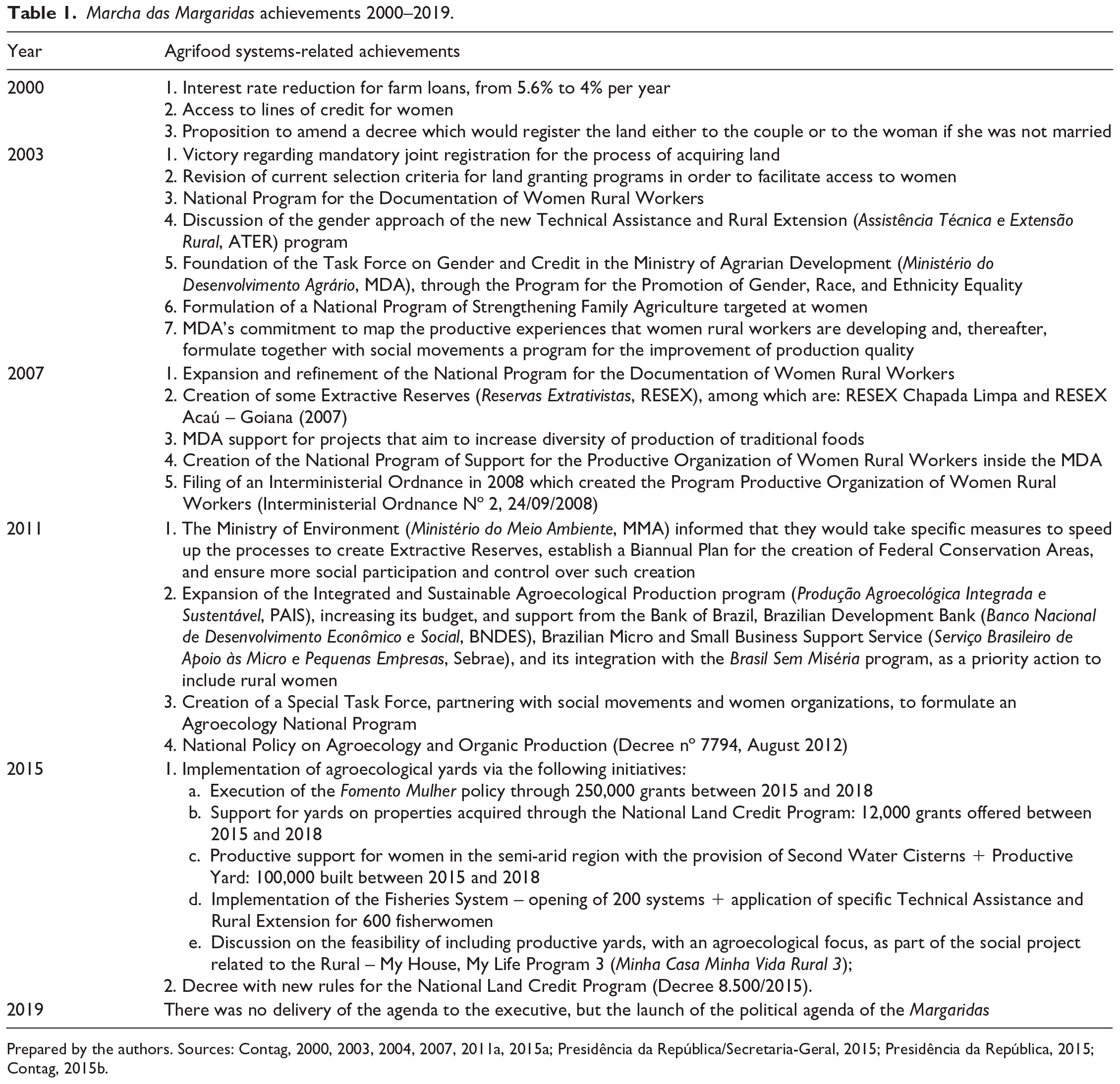
Prepared by the authors. Sources: Contag, 2000, 2003, 2004, 2007, 2011a, 2015a; Presidência da República/Secretaria-Geral, 2015; Presidência da República, 2015; Contag, 2015b.
We will analyze below in more detail three of the achievements mentioned in Table 1, highlighting the process leading to this victory, its significance for the conformation of the agrifood systems in Brazil, and their multi-scale connections. The cases analyzed cover different campaigns of the Marcha and, thus, are illustrative of the debate on agrifood systems at each point in time, as well as the power relations at stake. The following cases will be analyzed: joint land titling (2000 and 2003); National Policy on Agroecology and Organic Production (2011); and the productive yards policy (2015).
Joint land titling
Until 2003, land registrations achieved through agrarian reform tended to be made in the name of the male in a heterosexual couple, although the 1988 Brazilian Constitution established that ‘the domain title and the concession of use will be conferred on men or women, or both, regardless of marital status’ (Brazil, 2020a). Deere (2004) points out that in the mid-1990s, women constituted only 12.6% of the beneficiaries of agrarian reform in Brazil. This low proportion is due to the fact that joint titling remained an option and not an obligation in Brazil until 2003.
What led to this change in 2003 was the publication of a normative act instituted by the National Institute of Colonization and Agrarian Reform (Instituto Nacional de Colonização e Reforma Agrária, Incra), a federal agency whose priority mission consists in carrying out agrarian reform, maintaining the national records of real estates and to manage the public lands of the Union. This act determined that the settler’s registration, the beneficiaries list, the settlement contract and the title become mandatorily issued on behalf of both the woman and the man, in the case of families constituted by a heterosexual couple (Brazil, 2020b).
The creation of this norm also laid the conditions for the realization of the constitutional right for women to have access to land and this was one of the Marcha das Margaridas’ main achievements in 2003. However, this demand had been on the Margaridas’ agenda since its first campaign in 2000. Although the negotiation process with state agents in the 2000 Marcha had also advanced and it had been implied that the demand would be met, it was not, in fact, realized. Deere (2004) reports on the attempts taken by the government at that time, which included a press announcement, by the president of Incra, concerning the change in ownership of rural properties and a government resolution that would start to recognize a gender perspective in all MDA administrative instruments (Resolution No. 6, of 22 February 2001), with its subsequent institutionalization within the ministry through the ‘Affirmative action program for equal opportunities and treatment between men and women’.
At that time, the federal executive was led by the President Fernando Henrique Cardoso (FHC). It was a government with neoliberal policies, aligned with the interests of the International Monetary Fund and the World Bank. It was not particularly receptive to the demands of social movements, least of all from women. Comparing the negotiations of this demand in two different contexts, with two different governments, and with different political orientations, sheds light on the importance of political opportunity structures (Tarrow, 2009) in social movements’ fights for change. In 2003, Luiz Inácio Lula da Silva became president, and this change of government meant a change in the Marcha’s relationship with the State. In turn, the negotiations established by the mobilization of women were also changed.
The Margaridas’ fight for equality in land rights expresses a women’s fight against gender inequalities, which subject them to subordination to the man of the family, such as the husband, father or brother. Based on research with activists from the Landless Workers’ Movement (Movimento dos Trabalhadores Rurais Sem-Terra, MST), Deere (2004) indicates women were excluded from active participation in associations and cooperatives, spaces for decision-making on issues such as production plans, and deterred from taking part in the political life of their settlement and movement. Women were unable to access credit in the absence of a man in the family, and would lose their land in the event of divorce.
If at the beginning of 2000s, the average number of women lot holders represented 13%, in 2007, women already represented 55.8% of the holders (Brazil, n.d.). These data show the importance of this policy for the transformation of women’s land rights. Therefore, the joint titling of lands signified the recognition of women as political subjects and entitled to rights, created conditions for their permanence in the countryside and for the possibility of having autonomy over their productive activities. In short, it was an important step in the fight for equality in rural areas. Though we know that legal statuses do not automatically generate equal conditions between men and women, they are nonetheless an important step towards that end. The expansion of women’s access to land through the Margaridas’ achievement is an excellent example of how the changes at national and local level are related: joint titling has significantly changed the structure of land titling in Brazil, having direct effects on the local agrifood systems, and policy implementation scaling.
National Policy on Agroecology and Organic Production
The Marcha das Margaridas does not appear, a priori, to be an agroecological movement. However, the agenda for the defense of agroecology begins to appear in a more systematic way in its documents and public actions from 2007 onwards, in the face of the criticisms made by women of agri and hydro business and as a proposal to build a new productive model for the land (Siliprandi, 2013). This process becomes possible through the advancement of women’s participation in agroecological movements and, concomitantly, by the alliances that were established between such movements and rural women’s organizations.
Nowadays, there seems to be a consensus on the understanding that agroecology is mainly the domain of women, who, even before the term gained prominence, were the main drivers of agroecological experiences, practices and knowledge. Notwithstanding, its political expression in organizations is not automatic and only started to take shape from the end of the 1990s, driven by the mobilization of rural women. In 2004, two years after the creation of the Agroecology National Articulation (Articulação Nacional de Agroecologia, ANA), women, and leaders from different organizations, created a working group (WG) whose purpose was to give visibility to female participation in the construction of the agroecological movement (Siliprandi, 2013). This WG was, and is, fundamental for the articulation of the different women’s movements and for the insertion of the agroecology agenda into the Marcha das Margaridas.
Moreira (2019) argues that tackling gender inequality in the rural world and defending agroecology are complementary agendas. Based on that, the organizations that make up the Marcha – several of them also participants of the WG for ANA Women – started to demand that the union movement adopt an agroecological perspective within its Alternative Project for Sustainable and Solidary Rural Development. In this way, a link was established between agroecology, feminist economy and the political demands of the Marcha das Margaridas. Consequently, proposals for appropriate public policies begin to emerge. According to Moreira (2019), this process became possible as a consequence of the accumulation of civil society collective actions, and the favorable political situation: ‘although the government had most of its resources directed to agribusiness, it was important to have the institutionality of a specific ministry for agrarian development, . . . who dialogued with social movements and were open to accepting contributions and social pressure’ ( p. 91).
Although the theme of agroecology already appeared in the Marcha’s memoranda and actions in 2003 and 2007, linked to the basic concerns about land and water and about food security and sovereignty, it was only in 2011, when the fourth Marcha was happening, that it appeared as a more cohesive proposal. With regard to this process, Siliprandi (2017) explains that: The proposal to create an agroecology massification program included a set of issues related to production, such as land, territory, water, credit and technical assistance; but it also made progress in solving problems of commercialization, taxation and research. The emphasis was placed on the production of healthy foods, in the dimensions of health and environmental sustainability. (p. 282)
At the close of the 2011 Marcha, then President Dilma Rousseff announced the creation of a working group to develop this proposal into a public policy with the participation of the State and society. This process counted with the active participation of the Contag Women’s Secretariat and the other movements that make up the Marcha das Margaridas, such as the ANA. As a result, the National Policy on Agroecology and Organic Production (Pnapo) was created through Decree nº 7.794/2012.
The translation of women’s demands under this program is evident when we analyze it. Pnapo presents the alternative production model as a concrete solution to issues related to contamination by pesticides, the quality of food available to the Brazilian population, sustainability and local development. More specifically, it mentions the reduction of gender inequalities through actions to promote women’s economic autonomy (Moreira, 2019). The I Planapo Plan, launched in 2013, systematizes governmental actions foreseen in the Pluriannual Plan, which are related to agroecology and organic agriculture. It emphasizes more emphatically the challenge of recognizing and strengthening the role of rural women in organic and agroecological production, as well as combating gender inequalities and defending these women’s economic and productive autonomy. It is worth noting that the Plan was launched by President Dilma Rousseff during the II National Conference on Rural Development, in the presence of women from the Marcha das Margaridas. The Plan presents some strategies for addressing the issues raised and, as Moreira (2019) points out, these strategies dialogue directly or indirectly with the political agenda of the 2011 Marcha das Margaridas.
In 2016, still under Dilma’s government, the II Planapo was launched during the National Conference on Technical Assistance and Rural Extension, with actions planned until 2019. Support for women’s agendas remained a cross-cutting theme in this Plan, which also advanced incorporating traditional communities as a public beneficiary of the policy. It included the regularization of agroecological technical assistance to settlements from land reform and actions related to socio-biodiversity and extractivism of forest products. Funding for the structuring of agroecological systems for women also became a responsibility of the national state.
Agroecology, by definition, affirms that peasants, farmers and indigenous people – women in particular – are protagonists in the construction of a new model of agrifood systems. As far as dialogues between scientific and popular knowledge are concerned (Siliprandi, 2015), the agroecological model starts from local experiences, which hold a great potential for effecting additional change on the other scales. The achievements of Pnapo and Planapo can be largely attributed to the political mobilization of women in various areas of activity and organized in the Marcha das Margaridas. They also constitute an emblematic case of the impacts a food movement’s actions can have on the national agrifood system. The institution of public policy, in turn, affects local dynamics and fuels mobilizations, in a process of ‘causal circularity’ (Geels, 2011) that breaks with the dichotomies that we have been discussing in this article.
Productive yards
In 2015, the Marcha das Margaridas demanded support for productive yards (quintais produtivos, also translated as household vegetable gardens), which are spaces adjacent to rural households. Availing of their experience with agrobiodiversity, women used them to develop agroecology in practice – they produce food, grow medicinal plants, raise small animals, while taking care of the environment. To a certain extent, yards are the local basic unit of agroecological production, in addition to being eminently ‘women’s places’ (Moreira, 2019). In 2011, the Marcha das Margaridas agenda already recognized the importance of these spaces in the following terms: ‘Because they are practices performed by women, in the domestic space and distant from the logic of the market, they have not been valued nor considered as part of the economy’ (Contag, 2011b, pp. 22–23).
There is a consensus on the need to recognize these spaces for agroecological knowledge production, as well as their strategic importance in the sense of denouncing the predatory performance of the global agrifood systems in rural territories and communities. The creole seeds project, for instance, is central to the guarantee of people’s food sovereignty. Not coincidentally, it is also central to the agenda of transnationals operating in the agribusiness sector. The defense of productive yards, in addition to contributing to local development and the livelihood of women small farmers, is also a resistance to the hegemonic productive model. At this point, we see how the scalar dimensions that go from global to local, passing through national levels, are interrelated not only in spatial terms, but through topics and agents that dispute the meaning of food systems.
This perspective, which became more prominent in the 2015 texts of the Marcha, was incorporated into the demands for public policies that could recognize and value the contribution of these spaces to the economy, and women’s income and self-sufficiency (Moreira, 2019). In the same year, participants of ANA’s working group became part of the expanded coordination of the Marcha and played a particularly important role in the development of this theme. The demand for incentives for productive yards was welcomed by President Rousseff, who confirmed that she would support any attempt to integrate new policy concerning recognition of the status of such yards within existing programs, such as the incentive program for settled women in agrarian reform.
Siliprandi (2017) cites that the issue of financing for women’s productive yards was left unresolved, or with diffuse small-scale solutions, since there was no consensus in the commissions on the best way to operationalize it. However, the policy was developed in a number of ways. Regarding the advocacy focus of the Fomento Mulher policy, aimed towards female land reform settlers, the strategy adopted to develop this policy was a joint action of the Marcha activists with Incra and the state staff from the Directorate of Policies for Rural Women. From this action, there were concrete results in some states, with an increase of around 9000 contracts of credit to support women’s production released after the Marcha das Margaridas action (Contag, n.d.).
Despite these advances, the expansion of the productive yards incentives did not occur in a widespread and homogeneous manner throughout the national territory. However, these demands did become part of a public agenda and successfully influenced the design of national public policies concerning agrifood systems – valuing productive spaces, which had been negligible within the hegemonic view of agricultural production until that time.
Final considerations
We have addressed two questions throughout this article: what are the contributions of food movements to the transformation of agrifood systems? How can one think of agrifood systems beyond the local/global dichotomy? To answer the first question, we analyzed the national performance of the Marcha das Margaridas. By mapping the Marcha’s achievements in terms of national public policies related to the agrifood systems and, primarily, by analyzing three achievements in more detail, we have sought to demonstrate the potential to transform agrifood systems through the collective action of social movements.
The analytical focus on the contributions and effects resulting from a national mobilization relativizes the conception that it is at the local level that the most significant changes in the food systems occur. If the dynamics and meanings of inclusion, innovation and participation differ from local to national level and even between different locations, the Marcha das Margaridas’ performance is an eloquent example of the capacity of a social mobilization to promote transformations in the agrifood systems at broader and at different levels.
It is worth noting that the objective of this article was to highlight the importance of national mobilizations and their struggles to transform national agrifood systems, considering also the intertwinings with local and global levels. It is not a question of denying the importance of local or global fights. On the contrary, we seek to highlight a dimension of the struggle which is barely visible or perhaps outdated in current research. With that, we aimed to show its contribution to the understanding of the potential ways to fight food inequalities. In this sense, we agree with Allen and Wilson’s perspective regarding the importance of multiple actions in the fight against food inequalities: ‘Changes in American agrifood policies and citizen engagement with everyday food choices are key to reversing the trend of increasing inequalities both between and within nations’ (Allen & Wilson, 2008, pp. 538–539). Additionally, we can say that historical examples of social mobilizations have pointed out the transformative power of social movements. Whatever the projection, in a globalized world, it is very likely that these changes will have effects and be related in different ways at different scales.
The analysis of a women’s mobilization showed that its political agenda and its achievements contribute to the fight against inequalities in the agrifood systems, as a whole, with a special focus on combating gender inequalities. A careful analysis of the demands and reflections of rural women can help us to better understand how to overcome food inequalities by promoting gender justice. Overcoming food inequalities involves combating other vectors of inequality such as gender, race, ethnicity, generation, or sexuality. In this sense, a research agenda concerned with overcoming food inequalities needs to take into account an intersectional analysis of the differences that shape and limit access to food sovereignty and security (Motta, 2021, this special issue).
To examine the contributions of food movements to the transformation of agrifood systems, we reflect on the meanings and implications of the concept of agrifood systems, especially in relation to their scalar dimension. After diagnosing a lack of studies that focus on the national scale of agrifood systems, we focused on this scale of analysis as an analytical starting point, but showed how transformations at national level interact with global and local scales, either in the social movement’s performance or agrifood systems.
The mobilization of women from the field, the forests, and the waters permeates all scales of action. Marcha das Margaridas’ performance also has effects on global and local levels. Regarding the global sphere, we highlight two of these effects. The first is related to the alliances and influence that such mobilizations can generate over others in different parts of the world. It was common to hear reports from international participants on the inspiration and pedagogical power of the Margaridas’ mobilization. Still, the Marcha das Margaridas – a mobilization that has been characterized by its alliances with other social movements (Aguiar, 2015; Motta & Teixeira, forthcoming; Teixeira & Motta, 2020) – can serve as a chance to reflect on other social mobilizations, especially if we consider Holt Giménez and Shattuck’s reflection (2011) on the importance of alliances between reformist and radical movements to challenge the current food regime.
The second potential effect of the Margaridas on a global scale is related to their political agendas and with the very transformation of national and global agrifood systems. The effects that those transformations have at local and national levels may also appear on a global level. Brazil has become a world reference in policies to fight hunger and for family farming, which is the main reason for healthy food production in Brazil in the first decades of the 21st century. The departure of Brazil from the UN Hunger Map in 2014 made specialists look at the country’s performance in combating this problem in search of clues that could inspire actions in other contexts. In this sense, albeit indirectly, understanding social movements’ contributions to the agendas related to the agrifood systems in Brazil is also a contribution to potential changes in the global agrifood system. Also, social movements’ actions play an important role in spreading the agrifood agenda, whether via international organizations or through global campaigns that benefit the cause.
The effects of Marcha das Margaridas on the local agrifood agenda are numerous. We will highlight two of them. First, the national public policies achieved had a direct effect on local situations, as we show with the example of joint land titling, agroecology policies, and productive yards. Second, the participation of women in the different stages of this mobilization has a political formative dimension. In this process, militants’s actions are replicated in different locations, whether in the institutional fight for public policies at local levels, or through changes in domestic productive structures or in the fight against social inequalities, especially gender, which permeate social relations.
Our analysis has aimed to highlight the importance of avoiding dichotomies that constrain our understanding of phenomena; to make clear that interdependence between local, national and global scales, among others, is key to grounding a more holistic view of the changes in the agrifood systems – and this regardless of the scale which one takes as the point of departure. More than highlighting a physical-geographic dimension, the multi-scale analysis that we propose seeks to analyze social movements’ scales of action, and agrifood systems, focusing on the interdependence of social relations between social subjects in multi-spatial and temporal contexts.
Footnotes
Acknowledgements
We would like to thank Renata Motta, Steven Brown, and the other reviewers for the comments in the previous versions of the article. Needless to say, we retain the responsibility for the content and its shortcomings.
Funding
The research is funded by the German Federal Ministry of Education and Research (BMBF).