



Abstract
Drawing on Critical Policy Studies and feminist STS, this article conceptualizes obesity prevention activities as ongoing and precarious practices of relating – rather than as means for ‘getting results’ or vehicles through which normative discourses are instilled. It focuses on ‘community approaches’ within public health, whose aim is to stimulate healthy initiatives from what policy makers term ‘bottom-up’, emerging from the situations, concerns and abilities within neighbourhoods. Drawing on ethnographic research on the ‘Amsterdam Healthy Weight Programme’, I demonstrate that different practices of relating enact particular versions of health and community. I warn that reliance on statistics-based problem definitions, dietary advice and professional hierarchies preconfigures health promotion as a matter of ‘reaching out’ to particular ‘problem populations’ defined around class and ethnicity. I show, however, that community approaches may also foster spaces for ‘situated caring’, where health emerges in the negotiation of heterogeneous goods, including neighbourhood revival, togetherness and fun. Situated caring has effects that cannot be captured by obesity prevalence statistics. The study of health promotion policies as practices of relating highlights that policy is not a monolithic structure of plans and commitments but is continuously done and redone. The article, then, introduces a new evaluative field that critically articulates the diverse ways in which ideals such as engagement and health are enacted in practices.
Introduction
‘We will get healthy together!’ 1 With this slogan, the ‘Amsterdam Healthy Weight Programme’ (AHWP) set out to achieve a ‘paradigm shift’ in today’s ‘fattening’ society. The vision, as laid out in the policy plans, is that ‘healthy behaviour’ becomes the norm (Gemeente Amsterdam, 2013, p. 3). The ambitious goal of the policy programme, which commenced in 2012, is that by 2033, children in Amsterdam will have a ‘healthy weight’. 2 In 2017, the first hopeful outcomes of the AHWP were published: since 2014 overall overweight prevalence had decreased (Steenkamer et al., 2017). Although more recently, overweight rates seem to have stagnated and in some neighbourhoods have even gone up (Gemeente Amsterdam, 2019), the ‘Amsterdam model’ currently serves as an inspiration for public health campaigns from the UK (Hawkes et al., 2017) to Australia (The Senate, 2018, p. 97).
The Guardian related this success in particular to the policy’s focus on communities: ‘The city of Amsterdam is leading the world in ending the obesity epidemic, thanks to a radical and wide-reaching programme which is getting results even among the poorest communities that are hardest to reach’ (14 April 2017, my emphasis). Following largely ineffective health campaigns, the aim of ‘community approaches’ within public health is to stimulate and encourage healthy initiatives from what policy makers term the ‘bottom-up’, emerging from the situations, concerns and abilities of neighbourhood communities. The promise of this approach is that citizens will feel ownership and agency over public health strategies, which would add to the latter’s effectiveness.
The sociology of health and risk, as well as its related literatures, have, however, critically analysed the possible detrimental social effects of the construction of obesity as a health crisis (Moffat, 2010) and an epidemic (Gard & Wright, 2005). The designers of the AHWP, aware of such sociological critiques of the normalizing, moralizing order of ‘obesity talk’, hope that the focus on communities will also ensure health promotion is socially sensitive. While in scientific and policy circles, the policy programme focuses on healthy weight, public communication carefully avoids references to obesity and weight so as not to contribute to the stigmatization of already vulnerable groups. Instead, the posters stating ‘this is how we stay healthy, won’t you?’ invite neighbourhood inhabitants around the common cause of ‘health’. 3 Yearly ‘inspiration days’ for professionals and volunteers go under the heading ‘It takes a village to raise a child’. This begs the question what this togetherness denotes in practice: How are residents approached, how is their participation configured and evaluated, and what does this make of the ‘health’ that is promoted in neighbourhoods? This article draws on ethnographic fieldwork on community involvement initiatives of the AHWP to explore how communities partake and emerge in health promotion, and which ambitions are enacted through their involvement.
Tracing the practical enactment of an ongoing policy highlights that while models and documents present a policy programme as singular (West, 2011), unity, if at all possible, is itself a practical achievement. Several aims, ideals and engagements are simultaneously fostered through the AHWP. To conceptualize this multiplicity, I draw on the work of scholars in feminist Science and Technology Studies (STS) and Critical Policy Studies and suggest that health promotion policies, and in particular those aimed at obesity prevention, should be analysed as ongoing and precarious practices of relating (Hunter, 2008; Krebbekx, 2018). From this perspective, policy is not something that is thought up in one place and ‘implemented’ in another. Rather, it is a fluid set of concerns, knowledges and ambitions that is continuously enacted and translated to particular conditions.
In the empirical sections of this article, I first show how statistics and nutritional advice may help configure policy as a matter of ‘reaching out’ to citizens. Health promotion activities that rely heavily on such knowledge instruments risk imposing problems and solutions, singling out the behaviour of those belonging to certain ethnic and classed ‘problem populations’. As the AHWP endeavours to address health as a collective social issue starting from what policy makers term ‘bottom-up’, I suggest these practices hamper the commitment to engage dialogically with communities around health and the problem of being overweight. In other health promotion activities that I observed within the AHWP, however, the community did not figure as the source of problems, but as a vital resource. The health fostered in such practices emerges in the negotiation of heterogeneous goods, including neighbourhood revival, togetherness and fun, and is expressed in collectives rather than contained in individual bodies. The effects of such health promotion activities cannot be captured in obesity prevalence statistics; indeed, they potentially complicate a policy focus on obesity altogether. Understanding care as a distributed and relationally afforded mode of ‘doing good’ (Mol et al., 2010), I characterize such policy practices as ‘situated caring’.
By articulating particular forms of relating and contrasting their normative effects, my aim is to contribute to reflexive reconfigurations of health promotion activities, both within the AHWP and elsewhere. Policy practices that engage communities are much more than just a means for ‘getting results’, as The Guardian would have it. Neither can we, in a poststructuralist mode, simply view them as the vehicle through which normative discourses on health are being unilaterally instilled. Instead, the study of health promotion policies as practices of relating introduces a new evaluative field that critically articulates the diverse ways in which ideals such as engagement and health are enacted in practices.
Problematizing fatness
The scientific underpinnings of the problematization of fatness, particularly the relation between health and weight as drawn by the BMI, have been critiqued by social scientists (Bacon & Aphramor, 2011; Gard & Wright, 2005). Others, including fat studies scholars, have warned that public health programmes addressing obesity both fuel and are shaped by a societal ‘fat phobia’ (Boero, 2007; Murray, 2008). Possible unintended consequences of such anti-fat talk include the stigmatization and discrimination of fat bodies (Brewis, 2014) and the encouragement of disordered eating (Greenhalgh, 2016). The focus on diet and exercise that characterizes most obesity prevention policies, moreover, has been critiqued for overemphasizing individual choices in healthy living (Ibáñez Martín, 2018; Mol, 2013). Studies warn that the clear confidence of nutritional recommendations obscures the lack of scientific consensus on what constitutes healthy living and how body weight and lifestyle relate (Sanabria, 2015; Warin, 2014). Despite its neutral, universal tone, moreover, nutrition science incorporates cultural and material worlds that do not always fit the sites and situations where it is employed (Wrenn, 2017; Yates-Doerr, 2015).
Taken together, these studies might suggest that obesity prevention efforts play out similarly everywhere, that they are all driven by the same set of disciplining, normalizing, and moralizing discourses that implore individuals to take charge of their health and control their appetite. Indeed, inspired by Foucault’s work on biopolitics (2003), sociologists and geographers focusing on the normativity of anti-obesity discourses typically argue that they (unilaterally) work to govern bodies, and change the social meanings through which people come to understand themselves, their conduct and that of others (Monaghan et al., 2013; Wright & Harwood, 2009). In its assertion of biopower’s dominance, however, this analysis risks closing off ways of thinking beyond that which it critiques. To explore how it could be otherwise, attending to differences is vital. We may find alternative understandings of health where body weight is a concern from local, cultural notions of health and wellbeing (Yates-Doerr, 2015) or in movements framed in direct resistance to the common problematization of body weight, such as Fat activism and body positivity (Rothblum et al., 2009). Inspired by feminist STS analyses of multiplicity in health care (Driessen & Ibáñez Martín, 2019; Mol, 2002; Skeide, 2019; Vogel, 2016), I argue that promising alternatives may also be derived from within the policy practices that concern themselves with obesity.
Alongside others working in feminist STS and Critical Policy Studies, I develop new forms of critical engagement with public health (Cohn & Lynch, 2017; Vogel & Mol, 2014) by studying public health and policy as practice (Will, 2017). This approach reinvigorates the key poststructuralist Foucauldian argument that health and politics are entwined (Cohn & Lynch, 2017; Foucault, 1979/2000). With a twist. Because from the vantage point of practices, the policy programme is not a monolithic structure of plans and commitments. Instead, it is multiple (Law & Singleton, 2014): it harbours diverse problems, ideals and interests; and is locally adapted to existing organizational structures, available resources and situated capacities (cf. Lipsky, 1980). This means that while public health programmes introduce norms about how people should and should not live, in mundane practices these normativities are also contested, reworked and undermined (Singleton, 2007).
Work that explores policy as an active matter of translation rather than mere transfer (Clarke et al., 2015; Freeman, 2009) likewise complicates a vision of policy as designed in one site and implemented in another. As Gill et al. (2017) argue: ‘policy is performed and re-performed in particular sites and settings and by particular actors, and so it is also a specific kind of ongoing and distributed “doing.” It is not simply a generalised dictate’ (p. 3). By conceptualizing policy as practices of relating, I not only aim to capture this aspect of ‘doing’, but also emphasize the precarious social dynamics involved in policy. Bringing particular forms of ‘the social’ into being, policy practices ‘add to some common worlds and not others’ (Gill, 2017, p. 71), shaping how people can engage as citizens (Ibáñez Martín & de Laet, 2018).
I suggest the development of good forms of relating hinges on policy workers’ translational competency, coined by Emily Yates-Doerr (2018) as: ‘a skill of attending to different understandings of health and how these are negotiated between medical settings and everyday life’ (p. 106). 4 Translational competency signifies commitment to a learning process about what concerns are foregrounded, how this might differ between places and over time, and how these might best be addressed. Development of this skill, first, involves continuous and careful examination of what statistics, behavioural models and nutrition science do in situated practices and where and how they are helpful, or limit the stakes that are attended to. Second, it benefits from the incorporation of other forms of scientific and non-scientific knowledge. In particular, it is important to allow residents’ knowledge to travel, to stick to the policy parlance, from the ‘bottom-up’ to the ‘top’. With this ethnographic analysis of community health practices, I hope to contribute to both of these processes.
Policy in practice
This article emerges from an ethnographic study of overweight care and prevention in the Netherlands. Between 2011 and 2017, I periodically conducted ethnographic fieldwork on the daily practices through which various practitioners and people target obesity or aim to prevent its onset altogether. I followed the AHWP from its inception in 2014 to learn how the ‘obesity epidemic’ was taken up as a governmental and public health concern. I became involved in the research institute founded in parallel with the policy programme and was present at several meetings with policy managers, public health researchers and health promoters involved in AHWP’s design and execution. I conducted unstructured interviews with six of these professionals, enquiring about their work with communities and their opinions on the programme, while keeping in regular contact with others. After attending public days around the policy, I focused my observations on the practices associated with the policy’s ‘community approach’ in two neighbourhoods. This approach mobilizes so-called ‘key figures’ in the neighbourhood: volunteers with large networks spanning inhabitants, professionals and the municipality, and who are already actively trying to improve the neighbourhood as part of all kinds of activities. I followed several of these key figures to the places where they organize their activities and enquired about their experiences with the programme, as well as their efforts at making their communities healthier. To protect my informants’ privacy, I use pseudonyms for my informants and have anonymized the neighbourhoods where I did fieldwork.
I started out my analysis by doubting both the unity of public health and its effects (Will, 2017). I focused on articulating the logics, normativities and challenges that characterized people’s activities around health as these (partly) emerged with support from and upon the encouragement of the AHWP. To do so, I used the terms ‘health’ and ‘community’ as analytical tools, contrasting the different meanings these terms took on in the situations described in my fieldnotes and interview transcriptions.
Having been invited by the municipality to observe the activities in neighbourhoods means I was involved in ‘policy in progress’ (Singleton, 2007). Though in a very modest role, I participated in discussions, had the opportunity to voice concerns, and was occasionally asked for advice by policy makers and epidemiologists. And since policy is constantly done, undone and remade in particular sites and settings, this article brings a version of it into being. This means that while I offer a critical reading of some practices of relating, this critique is not directed at the policy or those involved in it, as if from the outside, and as if policy is a fixed target. Many of my interlocutors were, like me, concerned with possible unintended consequences of obesity prevention policies. Indeed, when I shared an earlier draft of this article with officials involved in the AHWP, they noted that they had already changed the approach in line with some of my concerns and suggestions. In a field that is continuously evolving, a responsiveness to the complex normativities involved invites participation rather than analytical distance (Haraway, 1991) – not only through critique but also through concern, hesitation and praise (Latour, 2004; Puig de la Bellacasa, 2017; Vogel, 2017).
Epidemic concerns and wicked problems
The city council of Amsterdam decided to prioritize obesity prevention after being confronted with worrying numbers. The body weight of children in Amsterdam contrasted starkly with the rest of the country. In 2013, 23% of Amsterdam youth (5–19 years old) were overweight, compared to 15% countrywide (Gemeente Amsterdam, 2013). Statistics further showed that rates of childhood overweight in Amsterdam are strongly correlated with socio-economic status, level of education and ethnicity. This indicated that obesity is not only a problem for the city as a whole but could further increase already persistent social inequalities within it. Faced with these numbers, the consensus in the municipal council (as recounted by AHWP documents) was that government could not ‘look away’ from the problem that was unfolding (Gemeente Amsterdam, 2013, p. 12).
The AHWP terms obesity a ‘wicked problem’: the problem is not only complex, deeply socially embedded, and could be explained in many different ways; it is also unclear which set of solutions is most effective (Van Koperen et al., 2018, p. 5). The public health ambition is thus to target obesity in an ‘integral’ way, targeting the multiple factors that cause (ill-)health together. Or, as one policy manager put it: ‘We shoot with hail. Which particular stone makes the difference, matters less.’
Reminiscent of the famous water pump of London hygienist John Snow, the installation of water taps on public squares and playgrounds were one of the first and most widely advertised ‘hail stones’ that were shot at Amsterdam’s ‘obesogenic environment’. In addition, the municipality is active in a national lobby for a ban on marketing to children, and although this proved difficult, targets the food offer in supermarkets, snack bars and restaurants. While it thus positions itself as an important, powerful actor, its communication also stresses the importance of the involvement of Amsterdam residents themselves. In the following sections, I contrast two practices of relating –‘reaching out’ and ‘situated caring’ – and show how through them, particular notions of health and community take shape.
Reaching out
On an evening in a neighbourhood centre, around 30 people find themselves facing a slide show bearing the logo of the municipality. They have been invited to submit plans to make their neighbourhood healthier. The meeting is organized and headed by public health promoter Jack. He greets the people coming in, knowing everyone by name. There are groups aiming to give cookery classes to parents and their children; a migrant support group will teach women how to bike; local radio stations will start campaigns; and there are initiatives to start walking groups.
A man known by everyone as Abdullah (or big ‘Ab’) presents a plan on behalf of several other men of Moroccan origin who call themselves the ‘Moroccan men group’. The group has been involved in the neighbourhood for quite a while. They started with patrolling the streets following complaints about Dutch-Moroccan youths causing nuisance at night. Now, and with some encouragement from civil servants involved in the AHWP, they realize overgewicht [(being) overweight] is also a problem in their community. ‘Moroccan people are too fat’, Abdullah says, patting his belly. The audience chuckles. As fathers they wanted to give the right example. They had all previously tried and failed to lose weight. They teamed up with a retired general practitioner who is dedicated to promoting a more active role of fathers in child rearing. Now, they intend to exercise together with a coach, two days a week.
While in white (upper) middle-class neighbourhoods, childhood obesity rates are below national average, in other areas these figures can double (Gemeente Amsterdam, 2013). It is the latter, ‘heavier’, neighbourhoods on which the programme focuses. Ethnic or socio-economic groups with higher obesity rates receive particular attention. Dutch-Moroccans are one such group. That Abdullah’s was a ‘men group’ made them particularly interesting for the municipality, which is concerned with the gendered nature of citizen involvement, particularly when it comes to children’s health issues. The AHWP’s community approach was emphasized as one of the more promising ways in which these groups can be encouraged to align themselves with the municipality’s problematization of fatness and lifestyle. Abdullah’s group seemed to be a successful example of such encouragements. Their activities were featured on the municipality’s website and social media profiles with the hope of inspiring others.
Policy workers told me they perceive a gap between the worlds of white, middle-class public health service employees and the reality of everyday life in ethnically diverse areas. Due to their capacities and duties, key figures like Abdullah were seen to have the potential to stand as an in-between, the ‘key’ capable of ‘unlocking’ access to the populations that are known by health promoters as ‘difficult to reach’. Thus understood, their involvement serves a policy goal of delivering the message as close to home as possible.
Delivering the message
Even though weight loss was not a direct goal of prevention activities, health promoters did not just want to engage and facilitate volunteers but also achieve ‘behavioural change’. This was most clear in the discussions on food. For instance, when the men group headed by Abdullah presented their plan to have the retired GP give coaching on food and exercise as well as on parenting, Jack interjected: ‘About the food advice. I advise you to consult a dietician. I do not mean to suggest that you [pointing to the GP] do not have the expertise, but I have to say it.’ He explained: ‘By enrolling a dietician from the neighbourhood, you make the distance to these professionals smaller for your target group.’
Jack ‘had to say this’ because the programme mobilized key figures such as Abdullah to bridge the worlds of institutions and the volunteers’ ‘target groups’. Introducing professionals in a social network was therefore the preferred course of action. In suggesting the replacement of GPs with dieticians, professional expertise emerged as a priority over, for instance, being embedded in or trusted by the community at hand.
The key figures attended trainings on healthy nutrition and behavioural change organized by the municipality. On one of the trainings I attended, a health promoter named Megan started her class off by asking: ‘why is it important to eat healthily?’ One volunteer offered: ‘to stay alive in a healthy way’. Another: ‘to function well’. ‘That you feel good, and can face life better’, added another. The GP working with the ‘men group’ interjected: ‘Well, the Moroccan man wants to become healthier because he wants to look better.’ The audience laughed, but Megan, in a serious tone, presented the right answer: ‘you need food to be able to grow, develop and maintain your body. Independent of how you feel, your body just needs it. If you want to be healthy, you have to eat well.’ A hesitation. ‘Well, you don’t have to do anything [je moet niets], but your body needs it.’
Rather than opening to a discussion about the diverse values that ‘health’ may engender, this meeting was staged as a lesson. And as Megan communicated the nutritional knowledge, she also communicated its incorporated notions of good and bad food, and good and bad behaviour (Mol, 2013). Indeed, I got the succinct impression that it is precisely this normativity that seemed key in the message to be delivered: volunteers need to learn how they and the people around them should ‘behave’ (Vogel & Mol, 2014). The hope of education strategies such as these is that, as soon as they are properly informed, the key figures will apply the insights on nutrition not just to their personal eating habits and bodies, but also inspire the community around them.
Key figures should thus not only introduce professionals, but were themselves encouraged to take up positions alongside health promotion professionals: ‘If you know palm oil is an issue in your target group,’ Jack addressed his audience, ‘like, people wonder if it is healthy or not, then ask the dietician to address this. Or . . . if you notice children stay up until midnight, then perhaps you can ask the child health care professional to give a talk on the importance of bedtimes.’ With their newly acquired knowledge, volunteers were asked to help diagnose ‘issues’ in the lifestyle of their neighbours, family and friends – the key figures’ ‘target groups’ – and then mobilize health care professionals to address these with proper interventions.
Aside from information about nutrition, key figures were also taught about psychological models for understanding health-related behaviours. In one of the municipal meetings, Paul, a member of the board of a Ugandan organization involved in the AHWP, presented on the need for an ‘attitude change’ within his communities with regards to cycling, which in his account was currently considered a shameful activity for Ugandans. In an interview with him, I realized that the focus on ‘attitudes’ was suggested to him by a public health promoter, who had explained that Dutch and Ugandan notions of health did not align. When I asked what motivates him to be active in the organization, however, our conversations led us to talk about unemployment, language barriers, traumas, and discrimination at the workplace; issues Paul cares about a great deal. Paul’s stories suggested that it is as much a shared, vulnerable socio-economic position that draws ‘his’ people together as common ‘Ugandan’ cultural norms around body size and health. Nevertheless, the latter was foregrounded as the relevant common denominator in the municipality’s public meeting where Paul presented himself. The psychological and culturalist discourse adopted by policy workers thus shaped how key figures expressed and understood the problem engaged with in the programme. It foregrounds particular forms and aspects of community to ‘target’ rather than others.
Targeting problem populations
These ethnographic insights into the AHWP in action show that statistics, nutritional advice and behavioural models structured the way policy workers understood and approached communities, and the ideals that were strived for. Statistics, for instance, solidify a particular version of a problem and hide the problematic arrangements and assumptions that are associated with it (cf. de Wilde & Franssen, 2016). As a practical technique, numbers steer government attention to specific social groups, informing policy strategies that target specific ‘subpopulations’ whose bodies, culture and habits are singled out as problematic. These groups should come to ‘realize’ obesity is a problem in their community and be enthused into ‘taking up’ this problem. The promise of enrolling the key figures thus conceived is that this problematization does not (just) come from outside institutions and authorities, but also from the inside out.
What designated a community in policy practices aimed at reaching out, then, rarely went beyond the epidemiological idea of ‘population’ (Cohn, 2014). Ideally, the communities engaged by the policy were the ‘non-Western’ ethnic groups whose bodies stand out statistically. Sometimes, biological differences were drawn onto social categories, for instance when health promoters referred to a genetic disposition for diabetes and cardiovascular diseases among Moroccan or Hindustan groups. More often, differences were made that emphasized cultural habits – ‘we’ are not used to biking, or ‘they’ celebrate with food in abundance. Staging the problem as located within communities risks adding to their labelling and exclusion.
The foregrounding of obesity as the health problem, moreover, comes with a particular set of solutions. Through the insistence on delivering nutritional and physiological knowledge, what is healthy comes to be orchestrated from above and defined beforehand. In other words, this knowledge, which stages complex health issues as a matter of eating, exercising and sleeping (Guthman, 2011), is ‘eroding the possibility of collectives’ that include residents and the municipality together (Gill, 2017, p. 84). Most policy workers listened to the volunteers’ concerns and were very respectful of their efforts in the neighbourhood. And yet when healthy living was discussed, the atmosphere often turned didactic and unidirectional. Expertise was fiercely contained by professional backgrounds, and neighbourhood inhabitants were engaged with as students rather than as people themselves working with the problems their community faces.
Situated caring
Policy managers and health promoters to whom I talked themselves recognized, however, that a ‘top-down’ normative problematization of childhood obesity is at odds with the municipality’s commitment to locality and stimulating citizens’ own initiatives. As Abdullah’s presentation exemplified, on the public meetings of the community approach one may hear plenty of detailed stories of problems going on in the neighbourhood, and the active efforts of various parties to alleviate them. These stories do not always directly relate to food and weight, and the problem of being overweight emerges in close relation to generational conflicts, loneliness and poverty. I also observed that neighbourhood residents were concerned with problems that were at once more general (not limited to bodily measurements or qualities) and more specific (adapted to the local circumstances in which they were situated). In the following sections, I detail how the practices of two volunteers embody the programme. I articulate how they stage a different version of community involvement, which I call ‘situated caring’.
Caring for various goods
I met Kimberly, a participant in the community approach, in the ‘buurtkamer’, a community hall in the corner of four blocks of flats in a neighbourhood in Amsterdam East. The hall hosted activities as diverse as Arabic lessons, a nail salon and aerobics classes for women. It was also where twice a week Kimberly and her neighbour Sandra held their teenager club Dare to Dream. As part of the community approach, Kimberly received some funds for this group. A large space offered a long table and a leather couch. Flyers advertising local activities and organizations hung on the wall – Kimberly: ‘We support each other.’ Showing me around, we walked to a small room which functioned as a storage but also has an office area. Next to a desk with Arabic language books stood a poster of the AHWP detailing the amount of sugar in popular drinks (see Figure 1).
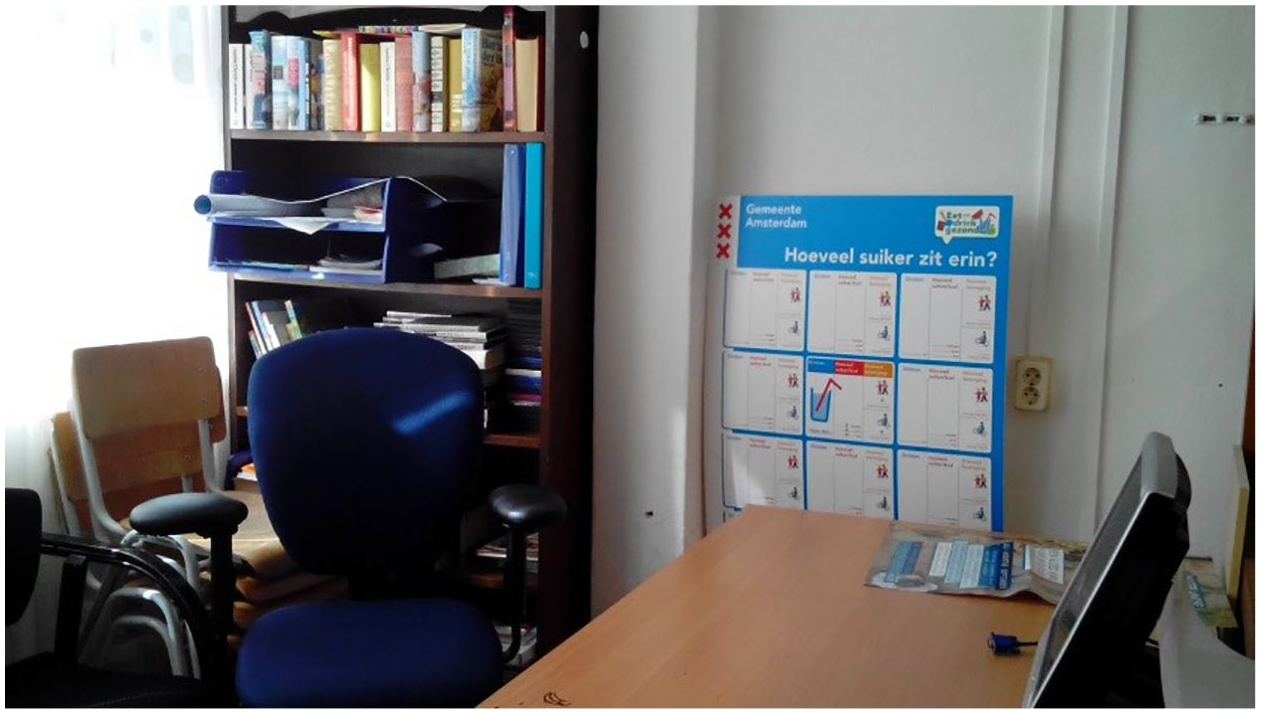
The buurtkamer with some AWHP educational material in the corner.
Kimberly takes the members of the club – all girls – to dance and music classes. Sports have always been her interest, but she never used to think that much about food and health: ‘I heard at the meeting with the municipality that our children will die earlier than we will. We get unhealthy because . . . I should say, because the government has chosen to serve us unhealthy food, sprayed food, and trash, factory farmed chicken et cetera. People don’t see it, they go along with it and believe it.’ Since she became involved in the AHWP community approach, she stopped serving lemonade and started offering water instead. They sometimes cook simple dishes together ‘that the girls don’t get at home, such as an avocado sauce’. Kimberly walks with the teenagers to the local Turkish shop to buy ingredients for a salad or takes them to the restored gardens in between the flats, where they help neighbours with whom Kimberly is acquainted to grow vegetables. These gardeners were likewise supported by the AHWP.
The four apartment buildings surrounding the buurtkamer struggled with trash, unemployment and social isolation. After decades of neglect by the municipality and the social housing corporation that owned the buildings, some years ago social and economic policies were implemented focusing on restructuring the neighbourhood into an attractive living space. Kimberly is one of the inhabitants who welcomed this increased attention to her neighbourhood and the funds and opportunities it brought. She is known in the neighbourhood for organizing parties on the square and mobilizing children into doing litter picks to clean the streets. She lobbied for a football court and was involved in the school of her two children. On election day, Kimberly brought all the women in her flats to the polling station. She explained to those who do not speak Dutch what to do. ‘It was big fun’, she said. She also helped one of the mothers whose children attended her club in securing a year of free sports for her children by taking her to the municipality and showing her how to use her ‘stadspas’ (city pass for low-income citizens to access arts and culture).
Kimberly thus does not limit her efforts to the teenagers of Dare to Dream. In addition to knowing most of her neighbours in the surrounding flats, she is on a first-name basis with the professionals working in the municipality, the housing corporation and the several social welfare organizations that have an active presence in this neighbourhood. A designated ‘neighbourhood ambassador’, she makes street rounds wearing a vest, serving as a contact person for her neighbours.
While the municipality tries to engage citizens around the problem of obesity; conversely, citizens like Kimberly mobilize government support for their projects and concerns, shaping what policy becomes. Kimberly’s story reveals that concerns with obesity may translate into increased attention and funds to neighbourhoods. Under the heading of obesity prevention, vegetable gardens may be established, and playgrounds renovated. In the process, Kimberly became more aware of the need for healthy living. But unlike the way in which this was framed in the public meeting where the Moroccan men group presented itself, Kimberly did not locate problems with obesity within her and her neighbours’ habits and behaviours. In other words, while it was something people had to cope with, obesity did not come to mark her community as problematic; instead, it indicated problems elsewhere.
Though I approached her to talk about her engagement with the community approach of the obesity prevention programme, Kimberly was not particularly keen on focusing our conversation on things like food or exercise. At first, I struggled to discern those activities I thought of as having to do with overweight prevention from all the other caring work she engages in. While talking, however, I began to understand there was a point to this: this distinction simply did not matter to her. Besides offering some new ideas for activities with her girls, healthy eating or weight were not concerns on their own. The ‘good’ of obesity prevention mixed with the already rich set of ideals and concerns that Kimberly cared for. Through Kimberly’s efforts, we see public health practices emerge close to home that care for social, environmental and political problems that do not play out on an individual level.
Health cooked together
Magda is a middle-aged social entrepreneur from Bangladesh who gives cookery classes in a neighbourhood centre located in the square of the shopping centre. I learned that earlier she organized a cookery group for people with disabilities in the large kitchen of the centre. Following this particular project, she met Emily, a municipal employee, who invited her to submit a plan for funding by the AHWP’s community approach.
Her work in elementary schools taught her that children love to cook, cut things up. ‘My mission is that they should have a passion for food, but they should eat the right food, the right ingredients.’ But as they are not the ones doing the cooking at home, she decided to organize cookery classes where children come together with a parent. Five families, all women 5 and their children, signed up and came together on Tuesday afternoons. The result was a mix of diverse cultures. ‘Food is a thing that brings people together. Everyone was enthusiastic to share their cuisine. I learned a lot, too!’
As per the encouragement of the municipality, a dietician is present at all meetings. But whereas most dieticians I met during my fieldwork prescribe a food menu to be followed by an individual deemed overweight, Magda and the dietician proceed from the knowledge that the women involved do not cook for a single person, but for what Yates-Doerr and Carney (2016) call ‘collectives of kin’. They start out with what the participants are used to eating, and then advise specific ways to make changes in their lives. Instead of cognitive centres processing knowledge and making choices, this health practice approaches people as eaters who have already been sensitized to particular foods, tastes and preparation techniques. For instance, they try out participant Jessica’s signature dish. But this time, they cook the chicken in an oven rather than a deep-frying pan. The dietician shows how by adding herbs and spices the dish requires less salt. Magda remarks that ‘you get used to doing things a certain way, but if you try it together, and then you notice, oh the taste is actually better’. While it remains uncertain to what extent Jessica will actually change her cooking routines, it is the collective experimentation and engagement that counts.
Magda herself struggles with her health. After she found out she has sleep apnoea and was advised to lose some weight, she joined a women’s weight loss group that meets up twice a week to swim and walk together. Some of her fellow members then joined her cookery group. She thinks being ‘on both sides’, as a participant and a project leader, puts her in a better position to help others: ‘You know more, because otherwise you just think in one way: this is the information, and people should act accordingly. But why do they do what they do? So many women have problems: broken families, divorce, difficult children . . .’. Most of the mothers in this group were of a similar age and got along well. Her classes, then, do more than teach healthier cooking. They provide a system of support that is often lacking in the women’s lives. As Magda said: ‘The group becomes a family.’
The municipality pays for the food, as well as the dietician and Magda’s fee. At some point, Magda noticed one of the mothers was keen on bringing all the leftovers home. Since then, they make a point of dividing and sharing everything. Sometimes they eat all together, tasting it and discussing what they like and do not. Most often, however, because the building closes early, Magda asks them to bring Tupperware and take the food home. For families struggling financially, part of the group’s attraction is quite simply that it saves them a meal.
Magda is an example of a participant who took great pride in her acquired expertise. But her class provided a useful contrast with the training on healthy eating described in the previous part of the article, in which knowledge was unidirectionally handed down to be applied. Magda cleverly designed her cookery class so that the professional knowledge that the municipality valued is made to fit into daily life and is mixed with situated ways of responding to needs in the community. She employs various kinds of knowledges together, including techniques of food preparation and sensorial experiences. Such learning through cooking and tasting together, not only challenges what constitutes knowledge, but shows that transferring ‘knowledge’ is only peripheral to what goes on in this neighbourhood centre’s kitchen.
Valuing local knowledge
Epidemiologists will value how Kimberly and Magda’s efforts affect causal links whose change might ultimately lead to a reduction in body weight and thus to a healthier population. But if we let go of the idea that health is isolated in individual bodies and their behaviour, we understand their benefits in a different light. Rather than seeing health promotion as that which happens in the few sessions where Kimberly attends to food and exercise, we can see it emerge in relation to her and her neighbours’ many other activities, part of a larger concern with the happiness of children, neighbourhood revival and community strengthening. Magda’s cookery club likewise does not only transfer knowledge, but fosters a version of health that emerges relationally, in family encounters and between newly formed collectives in which who cares for whom is never fixed.
With its community approach, then, the AHWP offers the conditions of possibility for what I term situated caring, where the aim is not just to get people to eat less and move more, but where a range of ‘goods’ may be fostered, including fun, togetherness and self-confidence. Where ‘bads’ such as loneliness and financial hardship are warded off. Community, moreover, does not figure as people belonging to a locale or population – a prefigured group that is then targeted by professionals – rather, it is precisely what emerges in health promotion activities. Differences between people are not obstacles to be overcome but a vital resource when caring for the health of neighbourhoods. Finally, what defines success in such practices, and over what time frame this may be assessed, is not as clearly delineated as in the goals outlined in the policy plans.
Practices of situated caring imply trust that, if properly facilitated, those involved can articulate what problems are urgent and develop fitting ways of handling them. In these, ‘local knowledge’, ‘the very mundane, yet expert understanding of and practical reasoning about local conditions derived from lived experience’ (Yanow, 2004, p. 12), emerges as deeply valuable. Rather than dictating the terms beforehand, this version of the community approach leaves space for various interpretations of problems and solutions. Indeed, the AHWP’s designation of obesity as a ‘wicked problem’ acknowledges the need for a conversation in which what is good to do remains a question rather than a starting point.
Conclusion
Obesity prevention policies do more than affect people’s bodies or public space. In this article, I have conceptualized them as ongoing and precarious practices of relating, where diverse expertise, interests and concerns are variously combined, ordered, emphasized or displaced. In the case I have discussed, policy makers had the ambition to find good forms of relating – that is, to engage communities and adapt health promotion to the specificities of the situations in which it is embedded. Exploiting the multiplicity of policy, I have articulated two strikingly different forms of community and health in the practices associated with the AHWP. Unlike practices aimed at producing and maintaining standards (such as medical weight loss protocols or childhood body weight monitoring), in the community approach, different norms and commitments coexisted or could be cleverly mediated, both by policy workers and volunteers.
In the policy practices aimed at ‘reaching out’, the municipality’s community approach was not living up to its full potential. Despite the good intentions of the health promoters involved, the public health science tradition and its reliance on statistics-based problem definitions, biomedical and behavioural focused notions of health, and professional hierarchies, limited the versions of community and health that were thinkable and ‘doable’. The practices orchestrated and supported by the AHWP which I designated as ‘situated caring’, however, provide a promising alternative to dominant discursive logics of obesity prevention. Instead of the means to deliver a message to those ‘hard to reach’, they offer health promoters the opportunity to listen to neighbourhood inhabitants, to help them articulate problems and think through situated, fitting solutions, and develop their translational competency (Yates-Doerr, 2018). I suggest that it is in such practices that the community approach finds its real promise.
Ultimately, responsive, socially sensitive policy requires policy workers to self-reflexively develop policy goals and commitments over time. Although constructions of an ‘obesity epidemic’ were crucial for obtaining the financial, political and organizational support that allowed Kimberly and Magda’s care to develop, my informants in the programme’s management have indeed started to wonder whether the aim to reduce obesity rates should not be left behind altogether. Many of the positive outcomes I identified arguably occurred ‘in spite of’ the policy’s overall focus on body weight, rather than because of it. But even though policy managers in their public communication already changed the goal of obesity prevention to the more positive-sounding ‘health’, fatness was problematized by various people involved in the community approach, and weight loss remained a lived concern for the neighbourhoods’ volunteers as they shaped their own health practices. Combating the stigmatization and moralization around body weight, food and exercise will therefore likely require more than rephrasing the stated goals and commitments of the AHWP.
By focusing on practices and translations, I have highlighted the care and work that goes into making innovative policy. My analysis, then, reveals the tremendous effort required to surpass ‘conventional categories and boundaries’ (Singleton, 2005, p. 771), but also shows that the practices of policy workers are often more diverse, reflexive and creative than analyses focusing on biopower give them credit for. Contrasting different practices of relating and their effects, as I have done here, allows attention to both these things, introducing new forms of critical engagement with policy. Rather than assessing discursive constructions of policy programmes in light of political and social commitments, this approach focuses on articulating promising and innovative versions of health promotion so these can be reflected upon and shared. In this way, policy can be improved by strengthening the imagination of how it could be, and is often (however precariously) already, otherwise.
Footnotes
Acknowledgements
I am thankful to Christian Broër, Gerlieke Veltkamp and Mutsumi Karasaki, as well as the rest of the Sarphati team, for inspiring collaborations. This article also benefited from feedback given by participants of the ‘Body, Knowledge and Subjectivity’ and ‘Values’ seminar groups at Linköping University, and the LSHTM medical anthropology seminar series, where I presented earlier versions of the article. In particular I thank Annelieke Driessen, Annemarie Mol, Tait Mandler, Arnoud Verhoeff and Steve Woolgar for improving this article. Finally, I am deeply grateful to my informants at the AHWP for their hospitality and openness.
Funding
This research was supported by funding from Sarphati Amsterdam: ‘Research for healthy living’ and a Spinoza grant of the Dutch Research Council (Annemarie Mol).