




Abstract
The sociology of technology needs more nuanced conceptualizations of the temporal aspects of sociotechnical change. In this article, we propose liminality as a useful analytical entry-point to study technologies that seemingly remain in a ‘no man’s land’ – what we call liminal technologies. Drawing on anthropological accounts and technology studies literature, we propose a framework to be used as a sensitizing device that includes four ways of understanding liminal technologies: (1) technologies in shielded transition, (2) technologies under construction through negotiation, (3) technologies that are morphing between worlds, and (4) technologies remaining in an in-between space. We use the Belgrade metro effort – an infrastructure project that has been in development for almost a century – as an extreme case through which to explore the achievements of this framework. The analysis shows that the liminality of the metro was characterized by a combination of spiral, multi-linear and halted temporality. Despite severely dis-aligned expectations, liminality persisted due to a shared belief that a metro would benefit Belgrade. We conclude that using liminal technology as a sensitizing device may in particular be relevant to technologies with prolonged liminality because it highlights temporal patterns that may prevent technological development from being either completed or terminated.
Introduction: The liminal metro
The idea of building a metro in Belgrade, Serbia, was first introduced in 1923. In 2019, nearly a hundred years later, the director of the newly established public utility company ‘Belgrade Metro and Train’ announced that the first metro line would start construction by the end of 2020. However, such promises have been made before. The idea of a metro has never been abandoned but remained a technology under design and planning, never getting beyond the conception stage. Despite the complexity of large projects such as metros, Carse and Kneas (2019) point out that the completion of infrastructures is expected to be imminent even if they often remain unbuilt and unfinished. Such lack of materialization does not mean that the technologies have no agency and politics. Rather, ‘unbuilt and unfinished infrastructures can become the axes of social worlds and sites where temporalities are knotted and reworked in unpredictable ways’ (Carse & Kneas, 2019, p. 10). Such temporalities merit further exploration.
In this article, we use the admittedly extreme case of the Belgrade metro as a point of departure to move beyond linear narratives of successful or failed development of technology. The case offers a fruitful vantage point to further the conceptualization of the temporal aspects of such processes. In particular, we aim to identify features that keep the development of technologies such as the metro active while preventing them from materializing, exploring the gains of using the concept of liminality. Here, liminality refers to the in-between and transformational spaces of planning and design. In the conclusion, we discuss whether we can draw more general lessons about temporal aspects of the development of technologies.
Sociology of technology scholars have developed many analytical tools to account for technological (and by implication infrastructural) change (e.g. Law, 2008; Sovacool & Hess, 2017). Widely used frameworks, such as the social construction of technology (SCOT) (Pinch & Bijker, 1984) and sustainability transition perspectives (Markard et al., 2012), are clearly process-oriented. Still, they usually provide stage-like, evolutionary accounts of technological development. Actor-network theory (ANT) (Latour, 2005) mainly explores temporality by analysing processes of stabilization, resolution of controversies, and reduced complexity or failure to produce such effects. Although development is not conceptualized straightforwardly, the narratives of successful outcomes tend to be linear.
These theories of technological change have definitively proved useful to understand development and design. For example, they have helped transport studies scholars to analyse the development of new transport systems (e.g. Galis, 2006; Pineda & Jørgensen, 2008, 2016; Ureta, 2015), abandoned attempts at creating new systems (e.g. Latour, 1996), and the obduracy of old systems (Hommels, 2005). However, a seemingly endless development such as the Belgrade metro would through these perspectives be categorized as ‘failed’ due to breakdown of negotiations (SCOT), unsuccessful enrolment of allies (ANT), or resistance from existing regimes (sustainability transition perspectives). Such observations are important but insufficient.
Studies of other metros and rail systems provide alternative narratives. Plyushteva (2019) discerns multiple temporalities of the Sofia metro by linking everyday use of the metro to other infrastructural temporalities such as broader transport planning and other political projects in the city. Gibas (2012) explores how the materiality of the socialist past is part of and shapes the Prague metro’s daily rhythms. Similarly, Qviström (2012) shows how railway ruins and their shattered actor-networks in Sweden have inertia in redevelopment projects of new greenways, while Merrill’s (2017) comparative study of London and Berlin’s underground railways explores how social memories of the undergrounds link with physical and everyday spaces, thereby forming landscapes without singular temporal trajectories. Arguably, such technologies have long histories and broad reach, inviting the study of layered temporalities. Our analysis of the Belgrade metro as a technology that has not been and might not become part of a transport system in use contributes to these studies.
In this article, we propose the concept of liminality to better understand the potentially complex temporal features of development of technologies. This concept was initially suggested by Arnold van Gennep (1909/2011), who thought of liminality as a sequence of rites of separation, transition rites and rites of incorporation (Thomassen, 2009). Victor Turner (e.g. 1969) developed the concept further to become central in anthropological studies of transformations of people and communities. However, such ideas have been less used in other social sciences, although there are exceptions (e.g. Stenner, 2018; Szakolczai, 2009; Thomassen, 2009, 2016).
In the next section, we take inspiration from current theorization of liminality and from technology studies literature to introduce four distinct approaches to analyse what we for linguistic simplicity call liminal technologies. These approaches share the idea that technologies develop within spaces where ordinary norms and rules are more or less suspended to allow for transformation and transition, spaces from which technologies such as the Belgrade metro may or may not exit. However, as we shall see, the approaches conceive the transformations as well as their temporality differently. In turn, we argue, the scholarship provides a diversity of sensibilities with respect to the temporality of the development of technology.
Liminal technologies: A framework
The concepts of liminality and liminal space are usually connoted as in-between spaces and/or time-periods of individual and community development. Anthropology scholars have extended the research scope (Horvath et al., 2015), applying it to topics such as diplomacy and geopolitics (McConnell, 2017), interim spaces for the elderly (Leibing et al., 2016), marginal urban spaces (Shields, 1991/2013), experiences of cancer patients (Blows et al., 2012) and biomedical studies of embryos (Squier, 2004; Taylor-Alexander et al., 2016). We focus on liminal technologies.
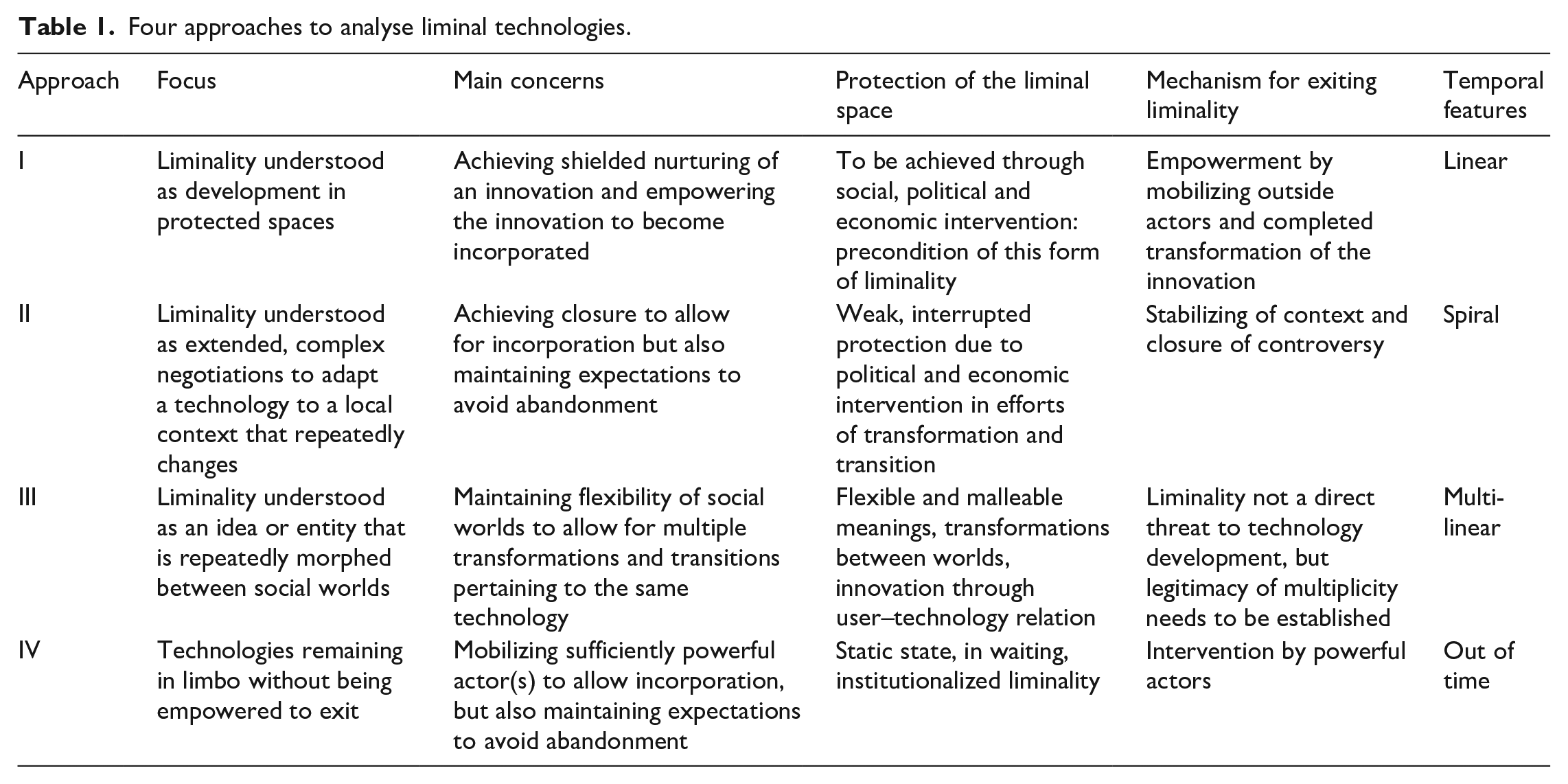
Liminal technologies are sociotechnical objects, knowledge or standards under development. We suggest that they may be conceived in four ways: (1) as technologies in shielded transition, (2) as technologies under construction through negotiation, made to fit a local context, (3) as technologies morphing between social worlds, and (4) as technologies remaining in an in-between space. These approaches differ in their understanding of the processes that may sustain or end liminality and thus of the underlying idea of temporality.
The first approach perceives liminal technologies as under development in a protected space, as innovations to be incorporated in society. This could be compared to the classical anthropological idea that liminality is a specific transformational stage, which is separated from ordinary social structures and norms. Such stages are time-bound and expected to end, even if the outcome may be negative (Turner, 1982, p. 47). In technology studies, we find this approach to liminal technologies used above all by sustainability transition scholars that focus on niches: protected spaces that shield, nurture and empower path-breaking innovations to change the outside world (e.g. Smith & Raven, 2012). The establishment of a niche – the separation activity – requires intervention from political and/or economic actors. These actors may also be called upon to achieve incorporation. Thus, a liminal technology is under development in a space (niche) where social, political and economic forces are (partly) suspended for a limited period until the innovation can be incorporated in society or dismissed as a failure.
In the second approach, a liminal technology is under development in a space where involved actors negotiate to shape it to fit a given, local context. The aim is not to nurture a radical innovation but to establish an agreement about how a technology is to be adapted and built. Thus, liminality is produced and sustained through networks of actors who negotiate views, values and knowledge to try to reach an agreement that allows the implementation (incorporation) of the settlement (Bowker & Star, 1999; Timmermans & Epstein, 2010). However, while niches are temporally limited, the liminality of local spaces of negotiations and adaptation may not end. Controversies may persevere and alignment with legal or technical standards may be difficult and without resolution; hence, technologies may remain in a state of prolonged liminality. However, incorporation may also fail due to a radical change of or fading interest among the involved actors (Latour, 1996; Law, 2002).
A third option is to conceive of liminality as a situation in which technologies remain flexibly interpreted. They do not remain in a single liminal space but travel between social worlds and transform with them. An example is Pinch and Trocco’s (2002) analysis of the synthesizer. Inspired by Turner (1969), they consider the synthesizer to be a liminal entity, linking liminality to the flexible meaning of machines and the shifting role of the actors who engage with them in different places. In this understanding, liminal technologies have shape-shifting qualities that enable movement between and establishment within multiple sites during their biography (Hyysalo et al., 2019) or intersecting temporalities in the context of urban change (Degen, 2018). Here, the distinction between design and use is blurred. The liminal technology is repeatedly innovated through artefact–user relations. In effect, liminality does not need to end as a prerequisite for construction and incorporation into society may happen in several places through different articulations.
Fourth and finally, liminal technologies may remain in their development in-between spaces: in limbo. This perspective draws on the theological idea that people may remain in a non-place indefinitely. It also resembles ideas such as ‘the institutionalization of liminality’ (Turner, 1969, p. 107) and ‘permanent liminality’ (Szakolczai, 2014, p. 34). Thus, liminality is seen as static rather than transformative, established by accident or a persistent lack of acceptance of norms and rules. From this perspective, a technology in limbo is suspended from change, it is stuck. The overarching issue is incorporation: how to get out of the liminal space? Powerful intervention is required, for example due to dramatic events that call for quick, concerted action or an authoritarian intrusion that sidesteps disagreements and/or provides the resources needed to achieve incorporation.
We summarize the main features of the four approaches in Table 1. The main claim is that these approaches represent different perspectives on the temporality of development of technology and the transformations taking place within a liminal space. They are not four dimensions of liminal technologies but four articulations. Combining them into one framework facilitates analysis where the approaches may be juxtaposed to identify faultlines (Traweek, 2000) of a development process and to reflect on its specificities. Thus, we consider the framework to be a sensitizing device to consider temporal issues and critically engage with assumptions of linearity in the development of technology.
Four approaches to analyse liminal technologies.
To explore the benefits of these varied approaches to analyse liminality, we explore the Belgrade metro using the framework to discuss temporal issues of the development of a technology in order to move beyond a linear understanding. To do so, we pursue the following questions: How have liminal characteristics been enacted in the efforts to construct the Belgrade metro? What does the liminal technology framework offer our understanding of this (non)construction? Finally, we discuss how the liminal technology framework can be of relevance to the wider field of sociology of technology.
Method
As noted, the planning and design of the Belgrade metro has been ongoing for almost 100 years. Due to its longevity and controversial character, it is an extreme case (Seawright & Gerring, 2008). However, these prolonged efforts facilitate making temporal issues in the development of technology more visible. We have explored the metro project though qualitative analysis of documents, media articles and interviews, tracing its genealogy by analysing urban development plans (Urban Planning Institute, 1972, 2003, 2016), metro plans, newspaper articles and one documentary (N1 Srbija, 2017). The main data source was semi-structured interviews (N = 18), conducted by the first author during two field visits in February and September 2016. Interviewees were recruited from the Urban Planning Institute in Belgrade, the Mayor’s office, the Secretariat for Transport, the Land Development Agency and three consulting companies involved in the project. Due to the longevity of the project, several interviewees had been involved in it whilst working in two or more of these places.
Face-to-face interviews were conducted in Serbian at the respondents’ homes or workplaces. They were asked to provide descriptions of the metro development and their involvement. All but one interview was audio recorded and transcribed verbatim. All interviewees have been anonymized; the names used in this article are pseudonyms. The newspapers articles served to map out some metro controversies, and the metro plans were analysed to understand the main changes in the plans and actors involved.
After the first round of thematic coding, the topic of temporality and the associated concept of liminality emerged as an overarching theme. The proposed framework was then developed to continue a more targeted reanalysis of the data to understand the liminal aspects of the metro and how to explain the liminality of technologies. The analysis has focused on clarifying and discussing controversies and the liminal characteristics of the metro project, without reconstructing its historical narrative(s). However, for contextual clarity we start with a short introduction to the main junctures and events of the project.
The Belgrade metro project(s): A brief overview
The first mention of a potential underground rail system was made in the 1923 General Plan for Belgrade (Depolo, 2013a, p. 121). A follow-up study by Nikolic, published in 1938, proposed three lines along the busiest traffic routes in the city. Nikolic concluded that the only way to meet future demand and respond to the limits of the existing transport system would be to build a rail system with more independence and capacity. However, it was not until 1946 that city authorities officially commissioned a metro study. Led by architect Dobrovic, the authors concluded that Belgrade could successfully accommodate a metro; subsequently, a metro line was included in the 1958 General Plan (Arandjelovic, 2009, p. 204).
A decade later, the first comprehensive plan was presented as a result of a large-scale study conducted in 1962–1968, led by the engineer Janjic (Depolo, 2013a, pp. 122–123), and local authorities formed the Sector for Metro, led by the architect Jovin. In 1974, the City Council and the Directorate for city development and reconstruction signed a contract for metro development. Although the City Council started to collect public funds for the project, they ultimately put the project on hold in favour of a less expensive project, ‘Tram in the 21st Century’.
In the following years, several projects and studies explored alternative solutions with less capacity than the ‘heavy’ underground metro system: a light rail transit (LRT) system, a tram system that can be converted into a metro or an LRT with some underground components, and a tram/rail hybrid. With the national regime change in 2000 and donations for public transport development from the French government, the metro gained new vigour with proposals from the consultancy firms Systra (2003), Ineco and Juginos (BELAM proposal, 2006), and Egis and CEPs – the last of which was adopted by the city government in 2012.
However, as with all prior plans, local authorities opted to postpone the construction and formed a new commission to re-examine the proposals. Political support for the project shifted with each new election (Depolo, 2013a, pp. 126–128). In July 2017, Belgrade mayor Mali presented a new transport masterplan – the Smartplan – which included a new metro line (Smartplan, 2017). According to the mayor, ‘the city has never been closer to constructing the Belgrade Metro’ (Nikolic, 2017) and a new public utility company for the metro was established in 2018. Today, the metro project has produced nine studies and approximately 30 metro maps (N1 Srbija, 2017). However, with each study and each new concept, the project has been halted and reassessed. As a result, Belgrade remains one of the largest capital cities in Europe without a metro. When we analyse the metro as a liminal technology, what do we learn by employing our liminality framework?
Liminality I: The metro as a niche?
A niche is a protected space of development, intended to nurture a radical innovation to be incorporated in society. The technology under development is liminal because the development space is – at least partly – suspended from social, political and economic norms. However, was the Belgrade metro processed under such conditions? To begin with, the technological principles were known. The interviewees referred to metro systems in London, Paris, Vienna, Budapest and Cairo. Nemanja, who had a central role in a recent project, described the process he was involved in as inseparable from international technoscientific developments. ‘Look, every city dictates what you will do, the configuration of the terrain, how deep you can go, where you are. . . . Of course, that is adapted from city to city. Every city for itself, but there certainly are some standards.’
From the niche perspective, it seems obvious to ask about the features of the space of development of the metro. The metro effort consisted of many projects that were separate from the institutionalized city planning structures and inaccessible to public involvement, differing substantially in size. Several interviewees described the formation of the Sector for Metro in the 1960s with a local team of around 150 experts as the most serious effort to ‘design something concrete’. Since the 2000s, private international and national consortiums have been most common. Only a selected group of representatives from Belgrade’s urban and transport planning community were included in these consortia, with little effort to engage the public. Thus, there have been a series of efforts to protect and separate the development process in spaces where technological change might be nurtured. However, these spaces cannot be regarded as one niche but rather as a sequence of niches, each of them with insufficient stable protection to survive for an extended period.
Rather, each metro development niche resulted in ambiguous outcomes. In some cases, metro teams were assembled to assess different metro solutions without getting involved with metro planning. Some interviewees described these assessments as efforts to prolong or halt the metro development because, usually, they did not provide new knowledge that could drive the development forward. Other projects facilitated concrete collaboration on new metro concepts. The two interviewees Dusan and Jasmina, both traffic engineers working on one of the metro proposals, described a highly cooperative process between local and international experts. Even though the study seemed successful, it did not produce a new stage of progress in the development. Thus, ruptures were recurrent. For instance, even though the city adopted Egis’s study from 2012, it never proceeded beyond the preliminary design. Conversely, other outcomes, such as Jovin’s ambitious proposal from 1974, seemed to, as interviewees described it, ‘haunt’ current efforts to develop the metro. They found the proposal unfeasible in today’s Belgrade; yet, it remained a source of controversy in current debates.
A participant in yet another metro project described how it was unsuccessful because international consultants disregarded local partners’ input. Local knowledge, he said, could postpone deadlines, lead to reassessment and revision, or provide solutions that would not look good in the portfolios of the international consultants. In the end, the proposal in question did not meet the city’s needs. It was too comprehensive and expensive. All in all, even if various metro projects at times were in protected liminal spaces, they did not produce transformations.
Thus, no blueprint for a metro was ever incorporated. Arguably, there was recurrent establishment of kinds of niches, but their protection repeatedly eroded. The interviewees considered the lack of political and economic stability in the city and country as the most disruptive force. They provided examples of political changes in the city, the republic, or the national administration that had completely overturned, redirected, halted, or reinstated project development. ‘When a new government comes, the first thing they say is: “Now we’ll get the metro.” The follow-up question to this is: “What kind of metro?” Now, if they answer this question, they will immediately get opponents and then there’s no end in sight’ (Branislav, architect).
Branislav described how each political shift had redirected the development process, always producing new opponents. We were also told about other disruptive forces, such as the economic crisis in the 1980s, wartime economic sanctions in the 1990s, and the global financial crisis in the second half of the 2000s. Thus, the protection of the liminal space of metro development was fragile and vulnerable, not only to changes in political leadership but also in the economy. Smith and Raven (2012) emphasize the need to empower niche actors to participate in political debates to counter erosion of the protection of a niche. The political instability in Belgrade made such empowerment unrealistic.
Thus, in light of the first approach to liminal technologies, we saw that the development of the metro was characterized by effectful interruptions. This shaped the effort to become a series of loosely linked projects that were conducted in niches with contingent and unreliable protection. Then, faultlines occurred because results were not transferred to the next projects and because shifting political and economic conditions led to disruptive interventions. This provides some explanation why the metro has remained liminal, but why was the metro idea not discarded?
Liminality II: The metro as an object of never-ending negotiations?
In the first approach, a liminal technology was considered under development in a protected space, preferably empowered to be incorporated in society. The second approach assumes that a liminal technology is developed through a process where it is adapted to a local context through negotiations in a space with questionable protection. From this perspective, there may be a need to construct new technologies, but the most prominent feature is the adaptation of existing knowledge. Incorporation may then happen when interests, standards and regulations are aligned. This approach seems appropriate to explore large infrastructure projects like a metro. As already indicated, the Belgrade metro has been the object of continuous negotiations of almost all its main features – the legitimacy of the system, its shape and technical components, its role in the city, and the visions for Belgrade’s future. What does this tell about the temporality of the project and its liminal features?
At the root lies a basic question – what characterizes a metro? This question has raised endless debate, in particular between proponents of a ‘heavy’ underground and independent rail system versus a ‘light’ LRT system. Most interviewees thought the debate should have been settled long ago and were highly frustrated that even as late as 2008, mayor Djilas called for a new assessment of the two kinds of system (Depolo, 2013b, pp. 304–306). This longstanding lack of alignment between experts, planners and politicians about the semiotic meaning of the word metro and the legitimacy of the given classification clearly has contributed to the long-lasting liminal condition.
This condition has not emerged through constructing the metro or difficulties with respect to its incorporation into Belgrade’s urban fabric. Rather, the metro has remained liminal because the series of projects never produced a stable transformation, due to interruptions by discussions about almost all relevant features of a metro in Belgrade. In addition to debates about the technological system, there has been the choice of metro components. Apart from the agreement that a metro should be on rails, have wagons, and ensure rapid mass transit, almost all other components have been negotiated. The interviewees listed disputes about issues such as the type of wagon, the direction and number of lines, the number of stops, the ratio between tracks going under and above ground, the load capacity, the degree of independence from other infrastructures, and the schedule and sequence of building the different lines.
Furthermore, politicians, planners and engineers have continued to consider the role of the metro in the city in different ways. For example, should it be a revolutionary system that solves the majority of the city’s transport problems or should it only be a modest contribution catering to flexible mobility practices and economic constraints? Political parties have seen the metro as a symbol of Belgrade’s status as a twenty-first century metropolis and an engine for national development. Many planners and engineers have had a more modest view, considering invasive underground metro solutions a thing of the past. Also, interviewees described disputes about the city’s needs, centred on the methods, the indicators and how to analyse and interpret the collected data.
The interviewees explained the reassessments in several ways, as a lack of confidence in the data or related to changes in the city and its population, as caused by new economic reconsiderations, or brought about by new and better transport models. Often, however, their reasoning fell back on changes in the political leadership. The architect Milan ironically remarked that ‘[t]he metro, we pretty much finished it. It’s standing like that. But of course, because there wasn’t a metro in the Savski amphitheatre [the Belgrade Waterfront project] and nobody was suggesting a metro there, it’s still an open question. That’s where a new idea will be proposed and all those metros from before will be bezveze [silly].’ Milan predicted that the politically important Belgrade Waterfront project would prompt politicians to reassess previous plans because of new interests, not necessarily due to bad data. Jasmina, an engineer involved in metro feasibility studies, explained how politicians used assessments to legitimate their agendas. Several scholars have described technologies such as metros as politically driven initiatives (Butcher, 2011; Gibas, 2013; Jensen, 2008). The accounts of our interviewees show how destabilizing such efforts also can be, thus reproducing liminality.
Some interviewees even questioned whether diminished controversy was a desired outcome. The traffic engineer Dragomir explained that ‘I won’t make things up, but that type of “big” job at the highest level; they have all types of participants. You don’t even know who the real brokers are and through whom the money goes. In the end, everyone benefits from it [the recurring assessments and feasibility studies]. That why it’s done like that. Afterward, nothing has to come of it.’ His emphasis was how the short-term economic benefits of ever more metro initiatives could motivate the involved actors to keep the metro liminal. Another interviewee described how there was much less economic and political risk involved in discussing conceptual matters of maps and studies than in initiating actual physical construction.
The focus on negotiations and the need for alignment of values, interests and knowledge following from the second approach provides new insights into why the Belgrade metro has remained liminal. The lack of a steadily protected space of development may cause continued liminality as we observed using the first approach. However, we have now also seen that the never-ending debates about all kinds of sociotechnical features of the metro have had the same effect, resulting in a lack of stable transitions and transformations in the projects.
When technologies remain liminal for a long time, there is considerable risk that development efforts are terminated. Latour (1996) analyses such an outcome in his study of Aramis, an effort to develop a personalized rapid transport system to be used in Paris. Over a period of 24 years, many plans and prototypes were made, but the technology was repeatedly considered too complex and too expensive. The stakeholders involved eventually lost their enthusiasm and the project was stopped. A similar conclusion may be drawn from Law’s (2002) analysis of the long-lasting but failed British effort to develop a military aircraft, the TSR2. In addition to observing politicians deciding to cancel the project, Law also emphasizes the divergence of visions of what the airplane was to achieve. Such divergence was, as we have seen, also present in the Belgrade metro project.
Nevertheless, the metro project continued. Here, the divergence of visions seems to have been beneficial to keep the efforts going. The continued debates clearly indicate that the idea of a metro in Belgrade has been and still is attractive to many actors. This spiralling temporality, fuelled by the reproduction of divergent expectations, contrasts to the more linear perspectives of the so-called sociology of expectations (Borup et al., 2006). According to these scholars, expectations are seen to legitimate, heuristically guide and coordinate technological development. Expectations are to be transformed into requirements (van Lente, 2012). This ‘promise-requirement cycle’ as van Lente describes has not been at work with respect to the Belgrade metro. Thus, expectations of important future achievements through a metro in Belgrade have maintained recurrent development efforts, despite deep disagreements, lack of alignment and lack of stable transformations. The never-ending debates that have barred incorporation of the liminal metro into society, have at the same time impeded a termination of the efforts.
Liminality III: Moving between social worlds
In the preceding section, we saw how politicians, planners and engineers repeatedly re-evaluated old solutions and proposed new ones, thereby perpetuating the metro’s liminality. We could see this as a display of the flexibility of interpretation of a metro (Pinch & Bijker, 1987), where closure is never reached due to the lack of a sufficiently strong and aligned ‘relevant social group’. However, a long-term continuation of development efforts in the absence of closure requires powerful expectations, as indicated by the analysis using the second approach to liminality. The third approach may help us understand how divergent expectations are maintained and reproduced through moving between social worlds.
As a technology remaining in planning, the metro indeed has been a liminal entity (Pinch & Trocco, 2002) that has moved from an institutionally separate sector with its own building and team in the 1960s to a public dream for Belgrade’s future (N1 Srbija, 2017), a commissioned project by city authorities in the early 2000s, and, in the second half of the 2000s, a project of national importance. In this sense, the metro idea has lent itself to very flexible interpretations that have been co-produced with social groups and types of knowledge. ‘The essence is the word – metro. If it’s yellow or white, that’s just a question of the time and the moment. Perhaps in ten years it will be blue. I have no clue. But the word metro is the essence’ (Branislav, architect).
Branislav used colours as metaphors for diverging ideas about the metro, conveying that its interpretations always have been situated and relational. Some interviewees described their participation in arenas where actors accepted the coexistence of multiple truths and knowledges. For Nikola, an architect involved in developing the newest transport model, every new study could be reinterpreted depending on the actors involved.
Other interviewees regarded alternatives as illegitimate, dismissed cooperation and fought for particular ‘ultimate’ versions of the future metro. This antagonism was especially evident in media reports and media interviews with experts and politicians. Critics of the BELAM proposal, for instance, described it as a ‘tram on steroids’ (Lukovic, 2010) and an attempt to ‘fatally tram-atize’ (sr. fatalna tramvajizacija) the metro system (Jovin, 2011). Most recently, former mayor Djilas described the Smartplan proposal as a ‘criminal metro’ and ‘a crime against humanity’ (N1 Srbija, 2017). This type of framing occurs when opposing interpretations are seen as threats and not simply as disagreements, which endangers the movement of the idea of a metro across social worlds that interpret the idea differently.
The unruliness and effervescence of legitimacy was no surprise to the interviewed planners and engineers. As previously noted, negotiations and discussions about one specific solution were ongoing for the duration of each government regime. With each regime change, previous decisions were archived and new ones initiated. Slobodan, who had worked as a central figure in transport planning in Belgrade, explained that ‘[t]hose are the arguments that are discussed and that lasts for as long as the government that has ordered them [remains in power]. After that, it goes into the archive. And then new ones are thought. New actors are included.’
Thus, Slobodan argued that political leaders repeatedly created new social worlds, usually to affirm the scientific value of their own metro ideas in contrast to the previous leadership’s. These new social worlds consisted of new engineers, new expertise and new designs, or just a reshuffling of some old engineers, old expertise and old solutions. In either case, interviewees expressed that changing the trajectory of the previous plan was more important than progress.
According to the interviewees who had participated in such work for decades, the problem was that the social worlds and consequently the agreements reached in them were unstable. When the metro idea was moved between these worlds it was interpreted differently in each of them. Traffic engineer Dragomir stressed that a concrete metro idea would need to survive for at least 6 to 10 years to be developed into a plan. Such stability, according to him, would be needed to end liminality and incorporate the technology in society. However, this was not achieved.
The synthesizer, as described by Pinch and Trocco (2002), remained liminal in the sense that it morphed when moved between social worlds. However, this morphing did not prevent synthesizers from being built, unlike the Belgrade metro. Thus, the liminality of the metro, and possibly other technologies that have yet to materialize, is different. As we have seen, this was related to fragile spaces of development and continued disagreement and dis-alignment of interests and knowledge. Still, when applying the third approach, we get a better understanding why the metro idea continued to be of concern. It survived as a liminal technology because grand expectations continued to exist by being morphed and re-morphed through the movement of the metro idea to new social worlds that were produced by new or reconstituted powerful actors with different agendas.
Liminality IV: Out of limbo?
The fourth approach understands the liminal space as a place without transformation and transition, where incorporation in society is very difficult. From a distance, the Belgrade metro appears to have remained in limbo because it has been stuck in its development. However, its liminality is not primarily due to a lack of transformations and transitions. Such efforts have been made recurrently, but without stable outcomes. This lack of stability has been caused by repeated interruptions that have eroded the protection of the liminal space from outside interference. In turn, the lack of stability has prevented incorporation. Still, the metro has never been discarded. As we have seen, its liminal status has been upheld by shifting but affectionate expectations about a future metro, by a planning drama that prevents incorporation as well as termination. In Carse and Kneas’s (2019) typology of unfinished and unbuilt infrastructures it could fit into the ‘zombie’ category where projects ‘linger between the dissipation and reemergence of the social, political, and economic networks that give them life’ (Carse & Kneas, 2019, p. 22), but certainly with more emotions than zombies are believed to articulate.
However, the fourth approach to liminal technologies invites further reflections about the conditions of ending long-lasting liminality, of entering incorporation after many years of struggle. When describing the approach, we noted that staying in limbo could go on for ages, and that incorporation might require interventions of a powerful actor or an aligned set of strong actors. This point of view was also articulated by interviewees who explained that a successful development of a large-scale infrastructure like the metro would depend on the agreement among a broad, heterogeneous set of actors, the presence of many different types of expertise and financial resources, and appropriate institutional arrangements. To achieve such development, the interviewees stressed that there was a need for powerful actors who were willing to override or overpower persistent opposition. ‘That’s what Vucic [the current president] is doing. That’s the method used to make the Belgrade Waterfront. Eighty percent of Belgradians are against it, especially the [urban planning] profession, the intellectual public. But he does that, you know, in a rough fashion’ (Branislav, architect). However, in the case of the metro, this did not happen. Dragomir, a traffic engineer who had been a key actor in several infrastructural projects of national importance, observed that the decision to build for example a metro ultimately would be taken by the mayor or the president of the country. Unfortunately, their discretion tended to be based on their shifting navigation of political and economic interests.
In the sociology of technology, closure of controversies regarding technological design is seldom considered to be a product of political coercion. However, the quote above from Bransilav suggests in the light of the fourth approach to liminality a need to be more concerned with the way political and economic power may be wielded to end development processes characterized by a long-term stalemate between involved actors. This means being sensitive to the possibility that coercive means may be used to end liminality, rather than cooperation and consensus. However, as previous sections show, coercive leadership also needs to be stable to be effective.
Conclusion: Lessons from analysing the liminal metro
Usually, sociology of technology scholars are critical of linear narratives (e.g. Law, 2008). Nevertheless, linear assumptions tend to sneak in through concepts like ‘development’: technologies are expected to succeed or fail. To facilitate a critical relation to such assumptions, we have in this article introduced the concept of liminal technologies to explore the temporality of technological development more broadly. The concept is developed from the observation that technologies undergo transitions and transformations in spaces where some social, political and economic influences tend to be suspended, but there is no guarantee that such protection lasts or that technologies exit from the liminal space. These kinds of spaces may also be found in laboratories, pilot production processes, or urban experiments. They may offer different conditions for transitions and transformation, for nurturing and empowerment as well as for getting out of them by being incorporated in society or abandoned or terminated. This means that we need to question the features of liminality and its enactments as we have done with the case of the Belgrade metro.
To stimulate such reflection about the temporality of technologies and the liminal spaces where they may be developed, we proposed a framework consisting of four approaches, four ways of understanding what it may mean to analyse a technology as liminal. While each of the approaches emerges from work in the sociology of technology, we get added value of combining them into one framework. The main benefit is in juxtaposing the insights from employing them in turn. This provides a richer understanding, as we have tried to show by using the framework as a sensitizing device to explore the activities related to the Belgrade metro project, which has remained liminal for nearly a hundred years. What we saw was, to begin with, no linear development, but processes characterized by a partly spiral, partly multi-linear and partly halted temporality. Further investigation suggested that this was due to insufficient protection of a series of relatively independent projects to develop a metro adapted to Belgrade, never-ending negotiations of what such a metro should be and what it should achieve, and the making of antagonistic social worlds between which the idea of a metro was moved, morphed and re-morphed. Finally, many interviewees stated the need in their context for strong, authoritarian intervention to get the metro out of what seems like a limbo, a forever-lasting liminal space.
Thus, attention to the liminal features helps us understand why the metro never stabilized and never was incorporated in Belgrade. However, given the findings of studies of other long-lasting projects (Latour, 1996; Law, 2002), we were struck by the fact that the long-lasting liminality did not end, wondering why the whole idea was not terminated. Why continue in the face of all the challenges? Through further analysis, it became clear that disagreeing, antagonistic actors shared a belief that a metro would be an important achievement. The diverging expectations that made development difficult also shared a hope that motivated the actors to continue to struggle with the metro idea. As we have seen, there was no linearity in this, no ‘promise-requirement cycle’ (van Lente, 2012), only a recurrent reproduction of liminal spaces in which to continue to develop the metro project.
On this basis, we believe that the sociology of technology needs a more critical engagement with the temporality of technological development in general. To apply a liminality framework, such as what we suggest in this article, implies increased sensitivity towards assumptions about linearity and possibilities to observe other temporal patterns. The obvious achievement is that the framework places characteristics of liminality at the centre of enquiry, taking such issues seriously. It highlights the multiple dynamics of transformations that may happen in a diversity of liminal spaces. To understand the Belgrade metro, it proved important to study the assembling, disrupting and reassembling processes of metro design and planning. By attending to such processes, we may chart the involved actors, such as maps, studies, politicians and money flows, mobilized in shifting configuration around liminal technologies. The related exercise of divisive power suggests the need to consider further the effects of non-linear, antagonistic politics on the shaping of technologies.
We believe that the framework is particularly applicable in analyses of technologies remaining in development for an extended period, not the least in studies of transport technologies and infrastructures that usually develop over extended periods of time (e.g. Carse & Kneas, 2019). However, it should be applicable also to other types of technologies. We could for instance consider fusion reactor technology, which has been liminal for decades. Here, our framework could be used to explore interesting and important questions about how the development has been protected and about strategies for future incorporation. Great expectations are linked to carbon capture and storage (CCS) as a tool for CO2 mitigation, but CCS struggles to be incorporated (Scott et al., 2013). Analysing CCS as a liminal technology would be a way to unpack partly dis-aligned expectations and the perplexing lack of strategies of incorporation, due to unfinished negotiations about funding and achievements (Swensen, 2015). Moreover, focusing on liminality may uncover some of the potent agencies of these technologies, beyond their ‘yet to be finished’ qualities.
Footnotes
Acknowledgements
We are grateful to Vivian A. Lagesen and Tomas M. Skjølsvold for fruitful discussions about several earlier versions of this article. We also thank the anonymous reviewers and the editor for their very useful comments.
Funding
The authors received no financial support for the research, authorship, and/or publication of this article.