




Abstract
‘Baby boomers’, born after the Second World War, have been portrayed as selfish and individualistic, depriving subsequent generations of the opportunities they themselves benefitted from. This debate has ignored intergenerational transfers within families, such as provision of grandparental childcare. This article explores why grandparents choose to provide childcare for grandchildren while their adult children are working. Drawing on qualitative interviews with 55 grandparents, we argue that values are essential to understanding why grandparents chose to provide childcare in the first place. These values relate to the importance of family-based childcare, familial obligations towards adult children, and intergenerational solidarity. While values shaped the desire to provide some childcare, the socio-economic and employment circumstances of adult children and grandparents influenced the nature of the childcare provided and the changes grandparents made to their lives to accommodate caring. Some grandparents significantly changed their employment and housing circumstances to provide childcare, undermining the stereotype of a ‘selfish generation’.
Introduction
In recent years ‘baby boomers’, born in the two decades following the Second World War, have been portrayed as a ‘problem generation’ (Phillipson, 2008). They are characterised as hedonistic and individualistic; a generation that benefitted from full employment, a generous welfare state, accessible home ownership and free education. Due to a lack of self-control and individual self-reliance, they are expected to ‘burden’ younger generations with their pension and health care costs (Bristow, 2016; White, 2013). Beneficiaries of a generous welfare landscape when younger, they supposedly ‘pulled up the drawbridge’ by voting in elections to deny younger generations the same opportunities that they themselves had (see Beckett, 2010a, 2010b; Howker & Malik, 2010; Philp, 2006). The most prominent example of this argument is The Pinch: How the Baby Boomers Stole Their Children’s Future – and How they can Give it Back, by the Conservative MP David Willetts (2010). Willetts challenges the notion that this generation was just lucky, and argues that baby boomers are to some degree culpable: . . . being a big generation gives you a lot of power . . . always outvoting and outspending the generations before and after you. That is what it means to be a Baby Boomer . . . (Willetts, 2010, p. 83)
Given that Willetts’ book title makes reference to baby boomers stealing their children’s future, it is curious that he focuses so little on the contributions that baby boomers make to help their adult children develop their futures. Older generations make considerable financial contributions to help support younger generations within families (Grundy, 2005; Hawkes & Joshi, 2007; International Longevity Centre, 2016; O’Leary & Buchanan, 2016). Further, the ‘selfish generation’ narrative ignores the contributions that baby boomers make in providing unpaid childcare for grandchildren while their adult children work, despite the fact that this childcare provision is common (Huskinson et al., 2016; Rutter & Evans, 2011; Wellard, 2011). On average, adults in Great Britain become grandparents in their mid-fifties, when labour market participation is still the norm (Leopold & Scopek, 2015). Therefore, provision of grandparental childcare may have implications for grandparents’ own careers and financial circumstances in later life.
This article interrogates the notion of ‘selfish baby boomers’. Drawing on qualitative interviews with 55 baby boomer grandparents, we explore why they chose to provide childcare for their grandchildren while their adult children worked. The literature on intergenerational transfers suggests that three main motives for providing such childcare are (1) ‘altruism’ (the desire purely to help); (2) ‘exchange’ (getting something in return, such as providing childcare in order to receive care later); or (3) ‘warm glow’ (the positive feeling derived from providing childcare) (Grundy, 2005; Ho, 2015; Koh & MacDonald, 2006; Kohli & Kunemund, 2003).
We suggest that grandparental motives to provide childcare are more complex than this categorisation would indicate; as Reay et al. (2007) and Sayer (2011) have argued, individuals’ behaviour is often shaped by an amalgam of different influences. Our analysis identifies grandparents’ values as one such influence upon their decision to provide childcare. Sagiv et al. (2017) have defined values as ‘broad desirable goals that motivate people’s action and serve as guiding principles in their lives’ (Sagiv et al., 2017, p. 630). Across our socio-economically diverse sample group, grandparents articulated remarkably similar values concerning family roles and relationships to explain why they provided unpaid childcare. Our analysis also supports previous research that has highlighted the salience of socio-historical context in shaping individuals’ values (Brannen, 2006; Smart, 2005); we argue that grandparents expressed a moral obligation to provide childcare in part because they considered their children’s generation to be less fortunate than their own.
In addition to highlighting a widely-shared set of values that influenced grandparents’ initial motivations for providing childcare, we also demonstrate that the actual amount and nature of childcare provided was influenced by the socio-economic and employment circumstances of both the grandparents themselves and of their adult children. We present an analysis of changes that some grandparents made to their employment and housing situations in order to provide childcare and suggest that this challenges the ‘selfish baby-boomer’ stereotype. The concluding section considers the implication of our findings for policy and future research.
The puzzle of why grandparents provide childcare
Large-scale survey evidence from both grandparents and working parents suggests that grandparental childcare is common in the UK, although precise figures vary between studies. Roughly half of all grandparents in the UK (and wider Europe) report that they provide some childcare for their grandchildren (Arpino & Bordone, 2017; McGarrigle et al., 2018). According to the UK 1958 National Child Development Study, 38% of adults aged 55 in 2013 had at least one grandchild (Vlachantoni et al., 2019). Of those, almost 80% of grandmothers and over 70% of grandfathers reported providing some grandchild care (Vlachantoni et al., 2019). Over 30% of grandmothers and almost 23% of grandfathers reported providing more than 10 hours of childcare per week (10 hours per week is the average for grandparental childcare in the UK) (Huskinson et al., 2016; Rutter & Evans, 2011).
For their part, working parents in the UK report that grandparents are their most common source of informal childcare (Bradshaw, 2013; Glaser et al., 2010; Huskinson et al., 2016). For example, Huskinson et al. (2016) found that 26% of families used grandparents to provide at least some childcare in a particular reference week. Geographical proximity to grandchildren appears to facilitate the provision of childcare in many cases. Recent data suggest that 40% of mothers live less than 15 minutes away from the maternal grandparents (Kanji, 2018) and 72% of White British families live less than 30 minutes away from at least one set of grandparents (Bordone et al., 2018). On its own, however, geographical proximity is not sufficient to explain what motivates grandparents to provide childcare, as some grandparents travel long distances to provide childcare, while others living close by provide minimal (if any) childcare (Rutter & Evans, 2011).
Grandparental childcare varies to some degree according to social class and ethnicity. Low-income households use more hours of grandparental childcare than wealthier households and two-parent families (Rutter & Evans, 2011; Huskinson et al., 2016). Furthermore, White British parents are more likely to use grandparents for childcare than BME families (Bordone et al., 2018). In terms of marital status, Kanji’s (2018) analysis of the Millennium Cohort study found that 45% of lone mothers relied on grandparental childcare while at work, which was not that much higher than the 39% of partnered mothers using grandparental childcare.
While these studies consider the parental/family circumstances associated with the receipt of childcare, there is less research on grandparents’ experiences of providing childcare to enable their adult children to work. A notable exception is Harrington Meyer’s (2014) qualitative US study of working ‘baby boomer’ grandmothers. This found that grandparents often derived joy from looking after grandchildren and they were often happy in principle to provide childcare. Despite this, grandparenting was seen as more ‘intensive’ than in the past and they often provided more childcare than they wanted to, in a US context in which mothers typically worked full-time and government support for working parents was particularly low.
In the UK, grandparents’ own motives for providing childcare would benefit from more consideration; research has tended to focus on why parents need childcare, rather than why grandparents choose to provide it (Rutter & Evans, 2011; Wheelock & Jones, 2002). For example, Rutter and Evans (2011) discuss survey results from informal childcare providers (including grandparents) alongside 40 semi-structured interviews with grandparents. Their discussion is framed predominantly around ‘why parents choose informal childcare over formal childcare’. Wheelock and Jones (2002) interviewed 39 grandparents in the northeast of England, although their primary focus was on parents, who were also interviewed. They argue that both grandparents and parents believed that grandparental childcare was the ‘next best thing’ to children being looked after by a parent, if a parent had to work. This moves beyond material circumstances and implies that value-based preferences for family-childcare were also influential. However, a broader range of values may influence grandparental provision of childcare than those referred to by Wheelock and Jones (2002); these may also shift over time and be influenced by historical context (Brannen, 2006; Smart, 2005).
In this article, we therefore examine grandparents’ motivations for providing childcare. Our qualitative analysis inductively develops a conceptual distinction between the broad values motivating the desire to provide childcare, the circumstances that influence the nature of the childcare provided, and the changes grandparents made to their lives to accommodate childcare.
Methods
This study explored the experiences of grandparents who provided childcare for their grandchildren while their adult children were in paid work. In total, 73 grandparents living in Sussex and Central Scotland were interviewed. This analysis is based on a subset of 55 grandparents born between 1945 and 1964 who could be classified as baby boomers: 37 grandmothers and 18 grandfathers.
Purposive sampling was used to achieve a socio-economically diverse sample of grandparents (Ritchie & Lewis, 2003). We attracted participants using flyers and posters in a range of locations, including supermarkets, community and sports centres, primary schools and voluntary organisations. Research participants received a £15 shopping voucher to compensate for their time.
Demographic information was collected in order to ensure that we achieved a diverse sample in terms of childcare responsibilities, household composition, household income, and employment status. An overview of the demographic characteristics of the sample group is presented in Table 1. Although all of the grandparents were home-owners, the distribution of participants across different household income levels reflects a sample of individuals living in a wide range of socio-economic circumstances. At the time of interview, almost two-thirds of the baby boomer grandparents were retired and a third combined grandparental childcare with paid employment.
Demographic profile of grandparents.
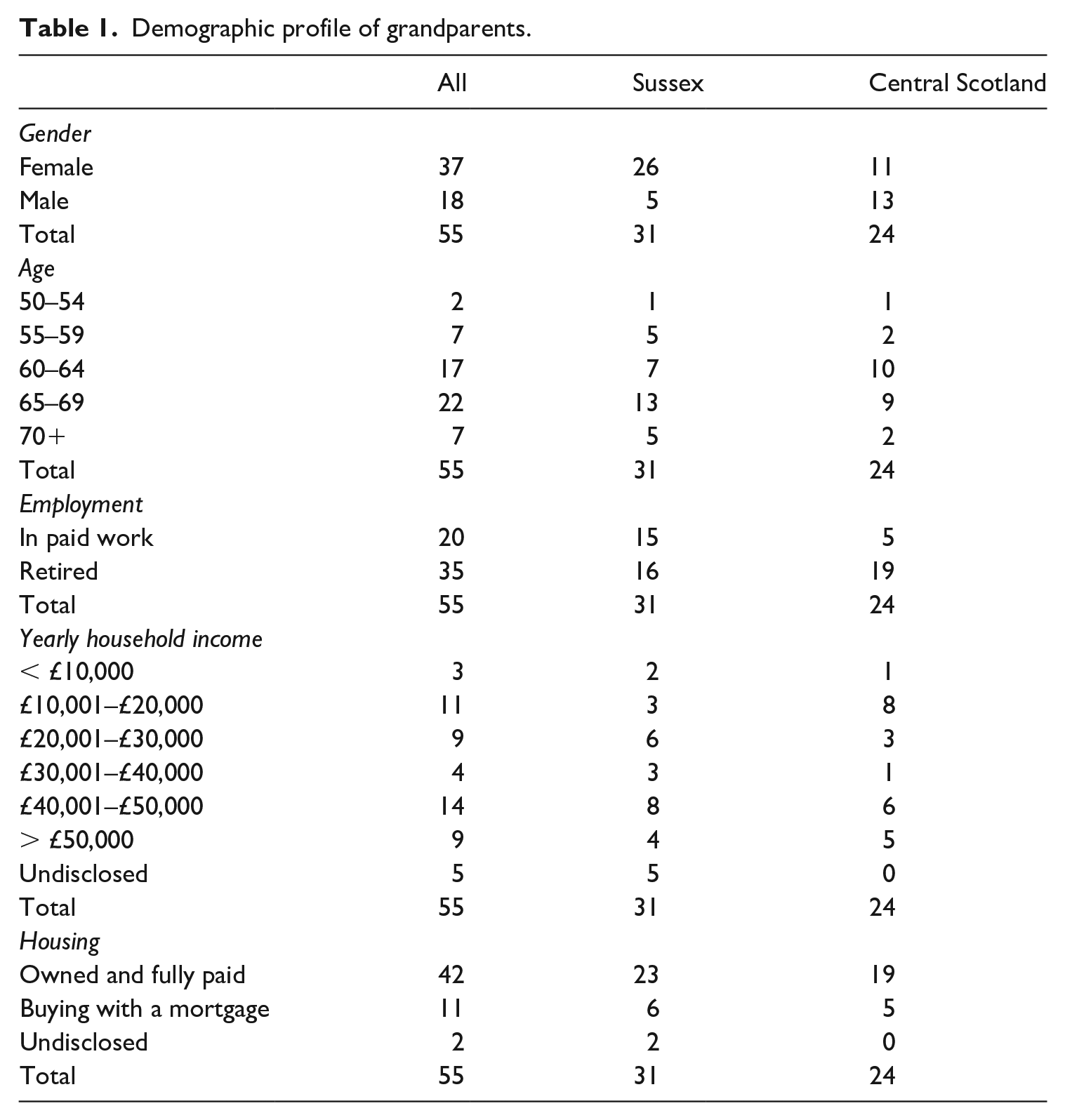
Participants varied in terms of the number and ages of their grandchildren. There was also variation in the hours of childcare provided per week, the duration of each childcare episode, and the number and age of children looked after at any one time. One in five grandparents reported looking after their grandchildren for fewer than five hours per week. Typically, this involved after-school childcare on one or two days per week. Around two-thirds of grandparents provided more than 10 hours of childcare per week; one in six reported providing more than 30 hours per week.
Data collection and analysis
In-depth biographical interviews covered a broad range of topics to enable participants to ‘situate’ their experiences of providing grandparental childcare within the broader context of their lives. ‘Life grids’ (Loretto & Vickerstaff, 2013) mapped out participants’ work, family, caring and health histories from leaving school up until the present day. Information was collected on the number, respective ages and family circumstances of all their children and grandchildren. Grandparents were asked to describe the childcare that they currently provided, how their childcare commitments had changed over time, and how they might change in the future. In addition to these factual descriptions, grandparents were asked about their motivations for looking after their grandchildren. We explored in detail how grandparents had negotiated their childcare responsibilities with their adult children, including whether they themselves had offered childcare or had been asked to provide it.
There are strong normative discourses about the positive aspects of grandparenting, and we were aware that grandparents might feel obliged in the interview context to conform to normative expectations and offer superficial ‘public accounts’ of their views and experiences (Finch & Mason, 1993). Accordingly, we asked multiple questions throughout the interviews probing the potentially negative, as well as positive, aspects of their childcare responsibilities and the amount of choice they felt they had over providing childcare.
Interviews were digitally recorded and fully transcribed. Data were analysed thematically (Seale et al., 2007) to allow for participants’ experiences to emerge from the data. We developed an initial data coding framework from the interview topic guide, as well as from the process of open coding (Corbin & Strauss, 1990) of a selection of interviews. Once the final coding protocol was established, all interviews were coded for key themes using the software package NVivo 11.
Findings
Almost all interviewees indicated that providing at least some childcare for their grandchildren was a positive choice on their part – it was something that they wanted to do (although they were not all happy with the amount or circumstances of the childcare provided). Grandparents emphasised that they had offered to provide childcare out of a desire to develop an independent relationship with their grandchildren, and in order to become an integral part of their grandchildren’s lives. Many grandparents were effusive about the deep love they felt for their grandchildren, and the joy it brought them to spend time with them (see Harrington Meyer, 2014 for US evidence on this). These were not merely superficial, ‘public’ accounts about the joys of grandparenting; many grandparents acknowledged that they had not anticipated feeling this way about their grandchildren before they were born. They implied that love for their grandchildren was what motivated them to provide childcare, as typified by this grandfather: If I was brutally honest I’d say absolutely I’m happy to help my daughter out anytime, but my greater motivation is I just like to spend time with the children. (Grandfather, Couple 3, aged 65, Central Scotland)
Thus, for many grandparents in the sample, provision of childcare could be said to be partly motivated by ‘warm glow’ – that is, the emotional reward they gained from developing close affective bonds with their grandchildren (Ho, 2015). Involvement in childcare was viewed as an important element of building and strengthening relationships in multi-generational families, as well as being a commitment that grandparents found natural and intuitive. Whereas for the grandmothers in our sample, providing childcare was often presented as a continuation of their familial care-giving over the lifecourse, a minority of grandfathers in the study explained their motivation for providing childcare in terms of it providing them with a ‘second chance’ at family life. These grandfathers felt that they had missed out on spending time with their own children when they were growing up, due to the time demands associated with their work commitments. Now, however, they were at a stage in their lives when they had more time available to devote to family relationships: I was very much driven in terms of career and providing for the family, and so I wasn’t at home a lot . . . so now I wanted to commit to being with my grandchildren. (Grandfather 1, aged 70, Central Scotland) Looking back, I see a lot of things I missed. Whereas this time you get this limited access and a focus that you don’t get as a parent. (Grandfather, Couple 7, aged 66, Central Scotland)
For these grandfathers, providing childcare was an opportunity for them to compensate for their absence from much of family life at an earlier lifecourse stage. Their accounts suggest that this investment of time was as much for their own sake as it was for other family members.
Generally, grandmothers were more likely than grandfathers to provide childcare on their own, with limited involvement from a partner. In cases where grandparents undertook childcare jointly as a couple, there was some variation in the extent to which grandmothers and grandfathers adopted traditional gender-based roles in terms of division of labour. Typically, grandmothers were more likely to be involved in domestic tasks such as food preparation and the physical aspects of care-giving, while grandfathers made their contributions by transporting their grandchildren to or from home and school, and playing with them.
Values underpinning the provision of unpaid childcare
In addition to emphasising that childcare was something that they wanted to do, grandparents also frequently expressed the belief that childcare was something that they ought to do. They drew on a set of normative values regarding family roles and obligations – values that appeared to be shared by grandmothers and grandfathers across the socio-economically diverse sample group. Grandparents drew on three main ‘values-based’ discourses regarding motivations to care for grandchildren: (1) the importance of family-based childcare, (2) normative familial obligations to children and (3) intergenerational solidarity. We consider these values in turn, and then discuss ways in which some grandparents adapted their employment and housing circumstances in order to provide childcare.
The importance of family-based childcare
It was common for grandparents to say that children should be with family members when they were very young – under two years of age. Grandparents expressed a belief that it was important for children’s emotional development and sense of security to be looked after in a home setting by family members who could be trusted to provide the best possible care. In some cases, concerns were voiced about the nature and quality of childcare provided in nurseries, especially for babies and very young children: I couldn’t bear in all conscience to be saying ‘no, I’m not going to be looking after her, she can go to one of these places where they’re sort of a bit anonymised’. (Grandmother 8, aged 66, Sussex) My daughters wouldn’t really want them to go to a childminder anyway. They feel happier that, their children are precious to them and they want to know that they’re being looked after properly, as best as they would, and they feel that I would do that, they trust me completely to do the right thing. (Grandmother 23, aged 64, Sussex)
Grandmothers in particular perceived there to be a moral imperative to provide childcare, as they believed that this was in the best interests of their grandchild(ren). These findings echo those of Wheelock and Jones (2002), discussed earlier. This apparent prioritising of the needs of their grandchildren as a matter of ‘conscience’ and ‘doing the right thing’ could be interpreted as an altruistic motivation for providing childcare, which undermines the blanket characterisation of baby boomers as ‘selfish’.
Several grandmothers in the sample group expressed strong views about the superiority of family-based childcare in general – views that they claimed were shared by their adult children. However, grandparents often did not provide all of the childcare for their grandchildren, as parents often also used privately purchased childcare. Grandparents were generally comfortable with this; what seems to have been important to grandparents was that they provided at least some childcare.
Normative familial obligations to children: ‘It’s just what you do’
Most grandparents in the sample expressed the view that parents should transfer help and resources to their children, without expectation that this would necessarily be reciprocated. As one grandmother commented, ‘you help your children, that’s what you do’ (Grandmother 1, aged 61, Sussex). In this sense, our findings are at odds with the notion that intergenerational transfers of resources are necessarily driven by straightforward expectations of reciprocal returns either through care provision in old age (Frankenberg et al., 2002), or through financial support from a state pension (which is available in other countries; see Albertini et al., 2007). Instead, grandparents commonly expressed the normative value that parents have a moral obligation to help their children wherever possible, even once children reach adulthood (Brannen, 2006; Finch & Mason, 1993; May et al., 2012).
Grandparents’ accounts reflected this discourse in a range of different ways. Some grandparents reported that taking on childcare responsibilities had not been preceded by lengthy discussions or deliberations. They indicated that both they and their adult children shared an implicit understanding that unpaid childcare was an integral and ‘natural’ part of the grandparental role. It was taken for granted within their families that they as grandparents would provide childcare; as such it was a ‘non-decision’ (Finch & Mason, 1993): In a funny way I think it was a foregone conclusion, I don’t think it was ever even thought about . . . I think I might have said ‘well obviously I’ll look after him if you want to go back to work’. Yes, in some funny way I think it was just assumed, sort of, if that makes sense . . . I think, probably, they would’ve expected it at some level. (Grandmother 19, aged 66, Sussex)
It is notable that both grandfathers as well as grandmothers expressed this view, given that unpaid caring work is predominantly constructed as a feminised task. The following quotation from one grandfather demonstrates that the perceived ‘naturalness’ of grandparental childcare is not necessarily gendered: I think it’s a natural thing – you have children and then when they have children I think it’s a given really that at some stage you’re going to be doing some caring, especially if you live locally. (Grandfather, Couple 2, aged 69, Sussex)
While for some grandparents childcare provision seemed to be a taken-for-granted part of their grandparenting role, others drew more explicitly on their personal biographies to explain how their own experiences as parents of young children had shaped the values that they now held relating to intergenerational help within families. Some claimed that, having received help with childcare from their own parents, they now wished to do the same for their own children: My parents were there for me . . . as far as I’m concerned what comes around goes around and I did the same for my children. (Grandmother 4, aged 70, Sussex) I just always thought that when there were grandchildren I would look after them because my mother had done that for me. (Grandmother, Couple 5, aged 64, Central Scotland)
Here, grandparents suggested that their decision to look after their grandchildren was a way of expressing gratitude for the help that they themselves had received as parents of young children. These accounts point to the significance of lifecourse transmission of family values and ways of ‘doing family’ (Brannen, 2006). Motivations for providing intergenerational help were not about merely responding to current familial obligations; they were also shaped by grandparents’ experiences in different generational roles. Their past experiences of receiving help with childcare had influenced their decisions to provide childcare for their adult children; this appeared to be a much stronger motivating factor for providing childcare than any expectation of receiving forms of assistance from their children in the future. Motivations for intergenerational transfers of care were more complex than the concept of exchange between two specific individuals, which is a typical theorisation within the literature (Brannen, 2006; Ho, 2015; Kohli & Kunemund, 2003). Rather, our findings support the concept of patterns of ‘generalised exchange’ over the lifecourse, suggested by Grundy (2005, p. 238), whereby ‘parents may help adult children because they themselves received such help in the past’.
In contrast, other grandparents indicated that they had not received help from their own parents when they had young children, and therefore they provided childcare because they appreciated how hard parenting could be without support: I do think that being a single parent and also my parents not being able to help, had quite an influence on me. And therefore, I wanted to help more than I’d had. (Grandmother 6, aged 68, Sussex)
Value-based motivations were therefore influenced by grandparents’ own parenting experiences at earlier lifecourse stages. The broader historical context of their lives was also relevant; we consider this theme next.
Intergenerational solidarity
Grandparents’ willingness to provide childcare was influenced by their perception that their children’s generation was less fortunate than their own generation had been; in other words, they were partly motivated by intergenerational solidarity. Many grandparents drew contrasts between their own generation’s relative financial security and their adult children’s relative insecurity, linked to changes in the labour and housing markets over time. They recognised that, as members of the baby boomer generation, they had been able to accrue financial resources from early adulthood due to more stable employment, more secure pensions and more accessible home ownership. Their accounts expressed empathy for their adult children and a desire to support them: I feel terribly sorry for the young today, I think today you young people have it far harder than we did, far harder. Because most people of my ilk could have afforded a deposit on a home. But nowadays you can’t even save up for one if you’ve got small children, you’ve got to pay for childcare. (Grandmother 4, aged 70, Sussex) You just didn’t think of going out to work when the children were small in the same way, but now really they have to, I think there has to be two wages coming into the house. (Grandmother, Couple 5, aged 64, Central Scotland)
There was a strong sense among the grandparents that part of their parental role was to enable their children to become established as independent adults in their own households. Somewhat paradoxically, this required grandparents to continue offering financial, practical and emotional support to their adult children. Even those grandparents in the lowest income category within our sample group, whose own household income might be lower than that of their adult children, expressed a desire to help their children secure their financial position via unpaid childcare. Grandparents perceived their unpaid childcare provision as a means of enabling their adult children to ‘get on in life’ and develop their own careers: A lot of it was motivated by me wanting them to do something so that they would be more independent really and more able to sustain their family. (Grandmother 20, aged 57, Sussex)
Many grandparents expressed reservations about contemporary social and economic pressures upon mothers to re-enter the labour market when their children were still relatively young. At the same time as recognising financial pressures upon (both) parents to be in paid work, grandparents also identified a lack of available and/or affordable formal childcare as key barriers to mothers’ labour market participation. Thus, providing free childcare to facilitate parental employment was one way in which they could express intergenerational solidarity. Grandparents conceptualised unpaid childcare as a means of indirect financial support for their children; they were sparing their adult children the costs of childcare, which for some parents would have cancelled out any financial gains from employment. As one grandmother explained, ‘One of the main reasons I do it is because that support for my children . . . they simply could not afford the childcare’ (Grandmother 9, aged 58, Sussex).
Grandparents in our study therefore identified a range of socio-economic and cultural changes over time that have altered the contexts within which child-rearing occurs, and which have led to an increased need for informal, unpaid childcare. Grandparents’ awareness of their own generational advantage underpinned a sense of moral obligation to provide unpaid childcare to plug gaps in state and market childcare provision, and thus enable adult children to sustain labour market participation. The desire to help their children, overlaid with a sense of moral obligation to do so, was the key motivation for action that provide a counter-narrative to the stereotypical image of baby boomers as ‘selfish’.
Putting values into action: Grandparental strategies to respond to childcare needs
While our analysis indicates that values influenced the desire to provide some childcare, the socio-economic circumstances of the family influenced the actual amount and nature of the childcare provided. For example, in families where the mother was in low-paid, insecure work, grandparents frequently provided childcare to cover all the time when the mother was at work. However, it should be noted that even grandparents whose daughters/daughters-in-law were employed in professional, relatively well-paid occupations also cited high childcare costs as a factor influencing their provision of childcare (although they were less likely to report feeling under pressure to provide all the childcare). Grandparents recognised that providing at least some free childcare was crucial in terms of making maternal employment financially worthwhile: Even though it’s just the one day, I think it’s quite key to the economics of her returning to work, because she has said that to me, you know ‘if you hadn’t looked after him for one day a week it wouldn’t have been worth my while going back to work’. (Grandfather 2, aged 64, Sussex)
The desire to support the labour market participation of their adult children meant that grandparents also stepped in to provide childcare when formal childcare provision did not match parents’ employment patterns. Some grandparents referred to their adult children having flexible working hours that could change from week to week. Other parents needed childcare from 6.30am to 7pm, in order to enable them to commute long distances to work. One in four grandparents referred to looking after their grandchildren before 8am or after 6pm, or having their grandchildren to stay overnight, or looking after them at weekends, while parents were at work: She looked around for childcare and it ended up that because she had to leave home before 7 [am] and was back after 6 [pm], it meant leaving [grandchild] too long. (Grandmother 2, aged 68, Sussex)
Many grandparents within the study provided a substantial number of hours of childcare every week, often at short notice and at ‘anti-social’ or ‘atypical’ times of day and night. In order to accommodate these needs, many of the baby boomer grandparents in this study had made changes to their employment circumstances and home lives specifically in order to provide childcare. However, their own material circumstances shaped their ability to do this.
Changing employment to provide childcare
A striking finding is that half of the sample group reported making some form of change to their employment situation in order to provide childcare. There were no strong gender differences in this regard. For example, several grandparents had made use of flexible work options so that they could provide childcare when necessary. Some grandparents were prepared to sacrifice their own income from employment in order to provide free childcare and enable their adult children to sustain paid work. For example, one grandmother explained that she had offered to give up a day of work so that her daughter could increase her own working hours: They took on a house and she wanted to earn more money and I said ‘well if I didn’t work on a Friday would that help you?’ and she said it would. (Grandmother 23, aged 64, Sussex)
Leaving the labour market altogether, via redundancy or retirement, was another strategy adopted by some grandparents to facilitate childcare provision: At sixty I gave up work, because [daughter] had to return from maternity leave and it was going to cost her more with train fare and childcare, so that’s when I decided, so then I took on [grandchild] and I had him three days a week, full time. (Grandmother 2, aged 68, Sussex)
Our analysis highlights the relevance of gender, social class and marital status in shaping individual grandparents’ financial position, which in turn structured their opportunities to reduce their working hours or exit the labour market altogether in order to provide childcare. Grandparents indicated that they had made careful calculations as to the economic feasibility of giving up work; their wider household circumstances were relevant to their decision-making. Only those grandparents who were relatively financially secure, with access to decent pensions, could choose to retire altogether in order to provide childcare. For example, married women, who were generally not the main wage-earner in their households, were more likely to report that their husbands’ income from employment or pensions ‘cushioned’ them from the loss of income from their own earnings if they gave up work. A relatively small number of grandparents – mostly men – had been offered financial inducements to retire early, which coincided with the birth of grandchildren. The strategy of labour market exit through retirement, in order to facilitate their adult children’s engagement in the labour market, entailed a loss of potential future earnings and pension savings for grandparents. We suggest that this therefore represents a significant (indirect) intergenerational transfer of both money and labour.
For other grandparents who were still in paid employment, working until and even beyond State Pension age was a financial necessity, albeit the majority were employed on a part-time (rather than full-time) basis. This was particularly the case for grandmothers who had taken time out of the labour market decades previously in order to care for their own children, and who consequently had missed out on the opportunity to build up adequate pension savings. Divorced grandmothers were even more likely to be financially disadvantaged and therefore reliant upon income from employment. The following quotation, from a divorced grandmother who anticipated working until the age of 75, illustrates this point: ‘If I stopped working now . . . I would be very hard stretched to make ends meet’ (Grandmother 4, aged 70, Sussex). This grandmother used her time off from employment to provide unpaid childcare to help her daughter’s family. When grandmothers on low incomes were not working, on the other hand, they frequently provided a lot of childcare, in line with the perceived needs of their families.
Changing living arrangements to provide childcare
One in five grandparents in our study moved house either prior to or after their retirement, predominantly with the aim of making themselves more available to provide childcare. Specific reasons for changing their living arrangements varied between grandparents, from minimising the geographical distance from their families, to supporting adult children who were lone parents or had health problems: We moved there because our daughter was expecting a baby and she has arthritis so she didn’t know, you know, nobody really knew how well she would cope, how much support she would need. So we decided to move nearby so that we’d be on hand. (Grandmother 5, aged 57, Sussex)
Several grandparents in our study also reported that their choice to move was driven by their aspiration to continue pre-established childcare patterns and relationships with grandchildren as the adult children relocated: They needed to move to somewhere bigger so we decided that they would move first and we would follow them. (Grandmother, Couple 7, aged 54, Central Scotland)
In some cases, grandparents negotiated long distances to provide childcare. One affluent grandparent couple bought a second home near their daughter as a base from which to live in and provide childcare. Another grandmother, on a low income, ended up staying at her son’s house to provide childcare over three long days a week, something she disliked. Her childcare responsibilities had increased over time in response to circumstantial need, following the birth of a second grandchild. However, like other grandparents in this study, her initial motivations for providing childcare were rooted in the desire to develop a relationship with her grandchild: ‘I thought it gave me a chance to sort of see and be with my grandchild at the time’ (Grandmother 11, aged 63, Sussex).
Discussion and conclusions
In this article we have problematised the portrayal of baby boomers as a ‘selfish generation’ (Phillipson, 2008) through an empirical examination of grandparents’ motivations for providing unpaid childcare for their grandchildren. We have also examined how they accommodated childcare commitments within their everyday lives. In contrast to the stereotypical construction of baby boomers as ‘selfish’, virtually all of the grandparents in our study articulated a clear desire to provide at least some unpaid childcare.
Our nuanced analysis of why grandparents chose to provide childcare reveals a range of intertwined motivations that were commonly shared within the sample group. Grandparents were vocal in describing the emotional rewards of looking after their grandchildren and being involved in their lives, which is consistent with the ‘warm glow’ category of motivation identified by earlier work on intergenerational transfers (Ho, 2015). Arguably, this theme in the data suggests that grandparents’ reasons for providing childcare were not necessarily wholly altruistic. However, an equally strong theme woven throughout grandparents’ accounts was the clear articulation of personal values relating to the importance of family-based childcare, familial obligations to adult children, and intergenerational solidarity. Grandparents provided childcare because they believed that it was the right thing to do.
A sense of intergenerational solidarity was a significant motivating influence upon grandparents’ provision of childcare. In the UK, the rise of neoliberalism and globalisation in recent decades has led to welfare state retrenchment, alongside rising house prices and a flexibilised, low-wage labour market (Hoolachan & McKee, 2019; Vlachantoni et al., 2019). Grandparents were acutely aware of current economic pressures on their adult children to engage in paid employment and they identified the lack of affordable, flexible, high-quality childcare in the UK as a barrier to parents’ (predominantly mothers’) labour market participation. Grandparents expressed the view that their own generation was fortunate relative to subsequent generations and they regarded unpaid childcare provision as a means of securing the material well-being of their adult children and grandchildren.
Many grandparents supported their adult children by plugging the gaps in formal childcare provision via unpaid childcare, often for long hours at a time. For some, this involved adapting their own employment circumstances (and sometimes even their housing) in order to look after their grandchildren. However, our data reveal that grandparents’ ability to accommodate childcare responsibilities was shaped by structural constraints associated with their own socio-economic circumstances. Relatively well-off grandparents had more choice and control about whether or not to remain in employment alongside providing childcare. For less affluent grandparents, not only was continuing in paid work a financial necessity, but they were also more likely to view themselves as ‘having to’ provide more childcare for their grandchildren than they would ideally like, in order to ensure that their adult children could manage financially (see also Harrington Meyer, 2014).
A considerable proportion of baby boomer grandparents contribute significantly to the UK economy via unpaid childcare. Although this unpaid caring work is acknowledged in UK government policy documents such as Fuller Working Lives (Department for Work and Pensions [DWP], 2017), the policy agenda relating to the baby boomer generation is dominated by expectations that older workers should delay withdrawal from paid work (Vickerstaff & Loretto, 2017). Thus, we can observe twin pressures upon baby boomers: on the one hand, they are being encouraged to remain in paid employment for longer in order to secure a decent standard of living in retirement; on the other, there is an implicit policy assumption that they will support their adult children’s labour market participation through provision of unpaid childcare. Our analysis indicates that grandparents feel a moral obligation to provide childcare; their willingness to do so means that there is little incentive for the UK government to increase investment in formal childcare. However, our findings also suggest that providing childcare may entail changes to grandparental employment (including exit from the labour market). This illuminates the tensions that arise from the UK’s contradictory policy aims relating firstly to labour market participation of older workers and secondly, to the distribution of responsibility for childcare between families, the state and the market (Arber & Timonen, 2012; Bennett et al., 2019).
This research contributes to the study of intergenerational support by focusing in-depth on the complexities of grandparental motivations for providing childcare – a topic that has hitherto remained under-explored. Previous UK research has tended to infer why grandparents provide childcare from the circumstances and care-needs of their adult children. We would argue that the mechanism operates differently to this – grandparents often choose to provide some childcare, in order to develop relationships with grandchildren and because of the values they hold. However, the circumstances of both the adult children and the grandparents themselves shape the nature and amount of the childcare they provide, not necessarily the initial choice to care. Future research should therefore further examine the interplay between values and circumstances on childcare decisions, and should investigate the values and circumstances of grandparents who decide not to provide childcare.
Our analysis contributes to the literature on motivations for intergenerational transfers (Ho, 2015; Kohli & Kunemund, 2003) by demonstrating how grandparents’ decisions to provide childcare were influenced by the complex intertwining of moral values and material circumstances. Crucially, this work underscores the significance of socio-historical context in shaping grandparents’ understandings of their moral obligation to provide childcare (Brannen, 2006; Smart, 2005). Grandparents’ recognition of the relative privilege of their own generation compared to their children’s generation was integral to their decisions to support their children via unpaid childcare. Our nuanced approach to the discussion of baby boomers as a generation reveals the diversity of experience that lies beneath the stereotype of baby boomers as ‘selfish’; we have presented evidence that grandparental childcare may encompass an array of professional and personal sacrifices that can hardly be construed as selfish or self-serving.
Footnotes
Acknowledgements
The authors would like to thank the Special Issue editors and two anonymous reviewers for their insightful and constructive feedback, which was very helpful in developing this article. Particular thanks to the grandparents who gave up their time to participate in this study.
Funding
This research received funding from the University of Brighton Rising Stars Initiative and from the University of Edinburgh (CAHSS Impact Fund).