




Abstract
In this article I introduce the non-English word, harraga, to address the convoluted nature of migration, death, borders and colonial legacies. My empirical material comes from the south of Tunisia. I draw on practices of migration from Tunisia, the extraction of resources and its effect on the economy of the country, and the washing ashore of bodies on the southern Tunisian coast. I also reflect on the recent European border management in this area that is intended to stop migration from both Tunisia and Libya. Harraga (الحراقة) is an Arabic word used in Tunisia, Algeria and Morocco. It could be translated as those who burn. A pragmatic or accommodating translation would be ‘sans papiers’, or ‘undocumented migrants’. However, harraga is not a word for a group of people, but for an activity. The activity of moving out of the Magreb. Those who engage in harga, ‘burn’ borders in order to enter European territories, or overstay their visa. Yet enfolded in the word harraga is much more than the activity of leaving for Europe. I will slowly unpack this word and show that (1) harraga is not about identity (the migrant/the refugee), but an activity, the activity of burning borders and of expanding living space; (2) harraga is not about burning bridges or leaving histories behind, but about crafting connections as well as colonial extractions; (3) harraga problematizes Europe’s borders by siding with those who burn them, human beings.
By way of introduction
Harraga (الحراقة) is an Arabic word used in Tunisia, Algeria and Morocco. It could be translated as those who burn, with the Arab word for ‘to burn’ being ahrag (أحرق). This, however, is too literal a translation to make sense. More meaningful, already, is ‘sans papiers’, or ‘undocumented migrants’. However, also this misses the point, as harraga is not a word for a group of people (‘illegal migrants’) and neither does it apply to those who, after their travels, find themselves in Europe (‘we live here, too’). It is rather a word for an activity, that of moving out of the Magreb. Crucially this moving out is in defiance of the bureaucratic rules and their elaborate visa systems. Those who engage in harga, ‘burn’ borders to enter European territories. They do not, however, burn the bridges to the people and places they depart from. To these they keep all kinds of links. For, as they burn borders, they don’t move away from their place of origin. Harraga is about expanding living space.
Initially the word harraga was not so much related to Europe. It started to be used in the 1970s in Tunisia for the illegal crossings of the border between Tunisia and Libya. Southern Tunisian men burned the Tunisian–Libyan border in the hope of finding jobs in prosperous Libya. 1 More recently, in the early 1990s and related to the introduction of a visa system in France, harraga started to be used for ‘burning’ visas. This doesn’t mean that papers were set aflame, but rather that people disregarded their papers and stayed in France or another European country for longer than they were officially allowed. Gradually, also in Europe, harraga changed from the burning of papers (visas) to the burning of borders. The borders of Europe. Those who engage in harraga brave boundaries that are meant to stop them in their tracks.
In addition the word harraga mobilizes history. Folded into harraga is a story of colonial and postcolonial relations. For a long time after official independence it was easy to travel from the Maghreb countries to the former colonizer, France. 2 Many would travel back and forth between France and Tunisia, and many would in the end prefer to settle down in Tunisia (Natter, 2014, 2015). France would occasionally introduce a visa system and then lift it. But since March 1995, a more rigid visa system has been in place, as part of the Schengen Convention. While this Convention was aimed at the free movement of people and goods within the borders of Europe, it made it more difficult for those outside Europe to access this area. The Convention led to a common visa-system, also called the Schengen Visa, and as a result of this the borders of Europe became ever more severely controlled. 3 That doesn’t mean that nothing and nobody is allowed to pass them. Tunisian salt is eagerly shipped across to the EU, and so are phosphorus, olive oil, fish and other profitable resources. Also, while the so-called tourist visa is highly restricted, some people are invited into Europe. Recruitment bureaus in the capital Tunis draw highly educated young people in. Those who are trained as medical doctors, ICT specialists or engineers are especially likely to be offered a job in European countries (see Lakhal, 2019; Musette, 2016). 4 But not so the people who have nothing going on for them in the villages and small towns where they were born. Not the people who find themselves in a dead end; who feel immobilized by the standstill left after salt and brains have been mined and shipped out. These people, cornered, seek to break out. They are the ones who consider harraga.
In what follows, I will unfold harraga in three steps. The first is condensed in something we might think of as a road sign; the second starts out from the carriage of a truck; and the third speaks from a work of art made out of rubbish found on the Mediterranean shore.
A ‘road sign’ pointing at the sea
A rock among other rocks, some tilted, others straight. Behind them a wide-open sea. This is the Mediterranean. Next to an arrow on the rock, a text in Arabic reads:
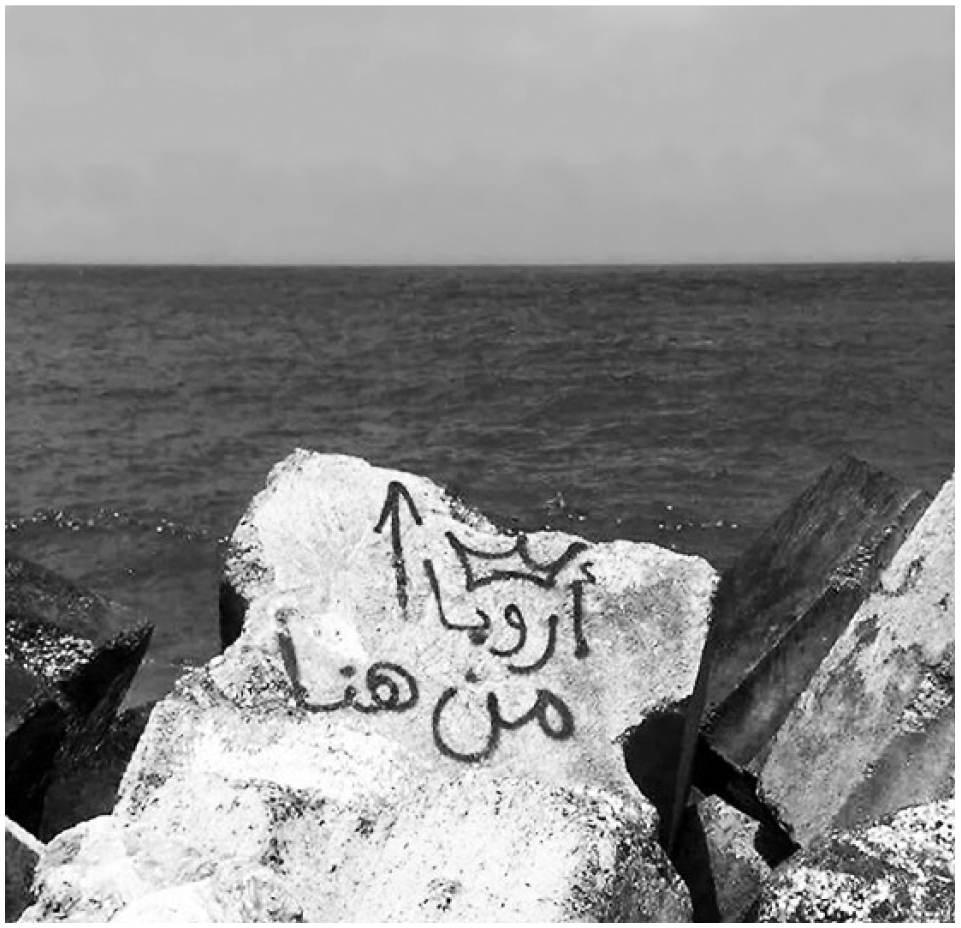
‘Europe this way’.
These rocks are to be found on the coast near the southern Tunisian town of Zarzis. They carry a message and index a route. If you want to go to Europe, you do not necessarily have to drive to Djerba, a nearby island connected to the mainland by a bridge and the location of an international airport. Neither is it necessary to first visit Tunis, the capital 600 kilometres to the north, to file for a visa from one of the European embassies. You simply cross the Med. Right here. All you need to do is get yourself a flouka, a small wooden fishing boat, and sail away. Preferably with the help of an engine.
With this image full of irony, as with the term harraga, this text deliberately starts out from the perspective of the potential traveller: the person in Zarzis who might want to burn borders. Not that this person would need a sign: everybody in Zarzis knows where to find Europe. The problem is not which direction to take. There are plenty of other problems.
Within Europe, in what has been called ‘the refugee crisis’, the focus of attention has been on classifying who each and every migrant is, e.g. a genuine refugee, an economic migrant, a trafficker, or a latent terrorist (Magalhães, 2015; and this volume). Migrants may be called irresponsible because they take so many risks in travelling; or they may be called victims who need to be helped, or they might be labelled thugs involved in the trafficking of people. But one way or another, there is a constant need for identifying and ordering. The key question is by which label to classify these people in order to act. However, from the perspective of those facing the rock, who are thinking about whether or not to cross the sea, harraga is not an identity, but an activity. It requires a lot of preparation, the kind of work that needs to be done to move, and to get yourself to moving. And it doesn’t end when you are in Europe. You’re still this harraag, this person doing harraga.
One of the documentaries recently made in Tunisia has a scene in which a number of young men are sitting in a rundown place. 5 It is late in the afternoon, getting dark, they share a stack of beer cans, Tunisian beer, they are drinking. When the journalist asks them a question about their situation, the first thing to come up is the issue of harraga. One of them says: ‘Well you know, it is better to die than to be a living dead man.’ The others confirm that, of course, they are waiting for their chance to go. They are all set, they have paid for the crossing and are waiting for better sea conditions. So it is there, constantly, the possibility of moving. This is a potentiality that might happen, is bound to happen. And if formerly harraga was something for adventurous young men who wanted to achieve something big, who hoped to come back with lots of valuables, it is nowadays also a matter of survival. You risk being accused of inertia if you are not prepared to go. So everybody is prepared to go. Because there is nothing to stay for.
As harraga requires you to do a lot, it depends on a lot. Here is the story of Majid, a 16-year-old boy. 6
Over the past years he has seen his group of peers diminish. All of them have taken the boats and arrived in Italy and France. For more than a year he has been constantly nagging his parents about el harga. His parents acknowledged that he has little to stay for. Young men tend to populate the terraces of the many Zarzis cafés; an indication that youth unemployment is sky-high. Knowing that the future of his son is not likely to be different from that of these young men, Majid’s father has been stealthily saving from the little he earned, while his mother has borrowed additional money from her brother who lives in France. Majid’s father has looked out for an experienced shipper. ‘You know an older man, not these youngsters who do not know how to navigate a boat’, his sister told me. They paid 3500 Tunisian Dinars (approximately 1000 euro) for the boat journey. The shipper had indicated that the sea is best in September and October. So they’d better be ready by then. Majid will need a mobile phone and some 300 euros cash, to purchase phone cards once on Lampedusa and to travel from Sicily to mainland Italy and then to the French border where he will be picked up by relatives. The first attempt was cancelled because of bad weather, but the second was already successful. No one around Majid knew about his plans to leave, except for his immediate family, in Zarzis and France. In particular one of his sisters in Zarzis was the key to navigating him through Italy: keeping contact with him and his relatives in France to coordinate their journeys, sending online bus tickets to her brother as it appears that long distance buses in certain parts of Italy do not sell tickets on board etc. After a journey of one long week, Majid arrived in France safely and was soon to be enrolled in a schooling scheme to continue his education, in France rather than Zarzis.
7
So harraga is an activity. It requires preparation and a state of preparedness, to take the chance when it comes. You need to collect trustworthy information about shippers, about the journey, about the duration of the trip (when to start panicking in the absence of telephone contact with your loved one), and about the scenarios and sequences of events upon arrival, so that family members can help you navigate your route at a distance; scenarios such as: a medical check upon arrival in Lampedusa, followed by shipping over to mainland Italy, buying bus tickets online, walking 2 hours from the reception centre to take the bus to the Italian–French border. But you also need money, more or less money. You might need to sell your mother’s gold, borrow from close relatives or take the savings that were meant for mending the roof of the house. If the family has some olive trees, well, you try to sell them, even if the family is dependent on them. You sell whatever valuables there are in order to be able to go, because you have to pay the price. 8 Because being a dead man alive, or a living dead man, is not a situation to stay in. So you try to get out of that situation. For whatever it is that you might want to achieve in your life, it cannot be done in where you are. Not in Zarzis.
In the north of Tunisia poverty can be worse. In the south it is more or less rural, so there are ways of getting food. People are not hungry. You may eat from the land, from your extended family. So if you seek to engage in harraga to survive, it is not hunger you are dying from, but boredom. There are no jobs, no prospects; only the fear of things getting worse. 9 Nowadays complete families leave. Not just young men, or girls by themselves, but families. Families including grandparents, families including babies, everybody goes. And takes the boat. Europe, that direction. Arrow. 10
Writing about this in English and trying to translate the term harraga, in one way or another, its genealogy gets lost. For along with the word, the activity, too, has a history. As I said above, the word emerged in the south of Tunisia in the 1970s to be taken up later in Algeria, for people crossing borders illegally, without the proper papers. In some cases they did not have a passport, or they did not have the visa that was needed. In other cases they overstayed their visa. The English word migration includes all sorts of formal state-obeying, law-obeying, movements of people from one country to another. But harraga assumes a situation of challenging the boundaries of the state and of going on where states try to stop citizens from moving about. It assumes the activity, the impetus to cross borders, whatever the rules of the states involved. Or, stronger still, despite the rules of the states involved.
This makes harraga into an activity that interferes with the way states imagine the relations between states and individuals. It makes harraga into an activity that burns state-rules: rules that stipulate that this border can only be crossed in this way and not in another; or that papers are only legal in this way and not in another. And so harraga evokes an immediate relation between the person who does el harga and the state. Thus what people engaged in harraga do is mess up boundaries.
All this is implied in the sign on the rock, and in the crown making Europe into this royal something that everybody is aspiring to. If there had been only the words, then you might have been tricked into believing that somebody had written this sign trying to help others. There is Europe, arrow, in that direction. But there is irony in the crown.
There is also irony in the very fact of this sign on the rock being, as I call it, a road sign. For road signs, along with roads, are things that you find in modern places, like Europe. A road sign signals modernity. A colloquial joke, often heard in the south of Tunisia about someone who is not savvy or up to date with what is going on in the modern world, is: ‘Ah, he lives behind the road signs (Men wra L’blayek, من وراء البلايك’. 11 Living on the wrong side of the road signs then means that the person is from a place where modernity has not arrived. A rural place. Somewhere backward, where nothing happens. A dead end. A place that has not been developed, but may still be implicated in colonial relations. In quite different ways.
Persisting colonial relations
Figure 2 shows a truck. Now a truck is not a remarkable thing – but this one deserves to be remarked upon. I was angry when I first saw it and cannot help being angry whenever I see it again. It carries salt from Zarzis to France for the company Cotusal. This extraction of salt from Zarzis has quite a history as it is entwined with Tunisia’s colonial past, that stretched from 1881 to 1956. Salt has been shipped to France since 1903 by various French companies. 12 Cotusal, active in various Tunisian cities, has praised the Zarzis salt in particular for its high quality and rich minerals, making it suitable not only for bulk use, such as keeping European roads accessible in winter, but also for pharmaceutical purposes. 13 The price that Cotusal currently pays for the salt is still the same as under colonial rule: 5 Tunisian cents for a tonne of salt (1000 kilos). By contrast, local consumers will have to pay between 500 and 2500 cents for one kilo. In May 2014, after the Tunisian revolution, the concessions for Cotusal were ratified again, along with their old colonial conditions.
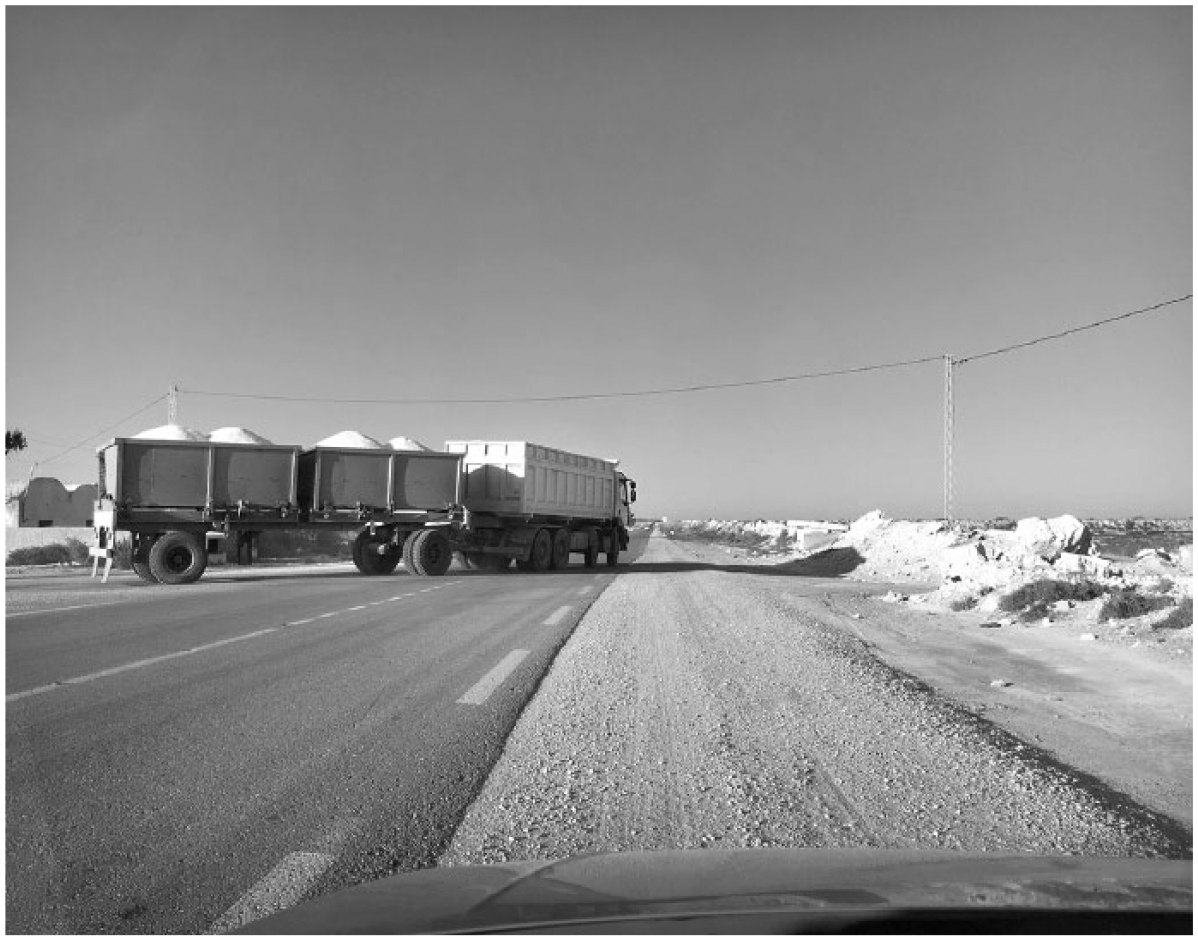
The salt truck.
So the salt is shipped out of Zarzis. Before it is loaded onto the trucks, it has been ‘harvested’ in the basins of the sabkha (سبخة), a saline flat, a huge area surrounding Zarzis. 14 From there it is transported first to be purified and dried; and then deposited with the help of bulldozers in large heaps in the open air. This saline flat, usually featuring three large white ‘mountains, is right next to a temporary cemetery for the dead migrants whose bodies have been washed ashore in considerable numbers since the late 1990s. While the salt ships easily to Europe, the people who are buried here, halted and immobilized harraga, had more difficulty crossing the Mediterranean. The currents in the sea somehow push back the bodies of those who tried to cross but drowned and wash them ashore in Zarzis. They died because of bad boats, bad traffickers, bad luck. Over the years volunteers from the town and the local police and coast guards, who take this as an obligation, have been burying them – but the land in which they are permitted to do so is a former landfill. It is unstable and shifts easily after periods of heavy rain. Litter and human remains get mixed together in deeply uncomfortable ways.
And if you climb the hill right next to this cemetery-cum-landfill, you see the white salt heaps shining brightly and towering in the flat landscape. The salt travels from here to France without too many obstacles. It does not need to go in a rickety boat. It is welcomed. Just like the well-educated who go to the migration desks of France and Germany in Tunis (others are following their lead). There, if you have the right papers, diplomas this time, you can cross European borders without problems (Lakhal, 2019; Mahroum, 2001; Musette, 2016). 15 At the same time, Tunis has become the NGO hub of Northern Africa. All the good intentions of the West seem to be gathered there. Many of the NGOs involved provide all sorts of economic programmes aimed at helping to build the country. Help the country: while depleting it of the people with the most promising education. Is that not an irony? The colonial legacy is therefore not just a legacy. It persists in the extraction of all sorts of goods and intellectual capital.
This persistent set of colonial relations is folded into harraga. For example, it is not an accident that people from Tunisia tend to go to France, and not to Italy. Thus, the bridges that are being built by harraga are not only built by the travellers, but by others as well. This is because, as I indicated above, harraga is not a matter of moving away from somewhere and of leaving everything behind. Even though it literally means burning, it is about crafting connections. It is about the possibility of doing something, both at the site from which you depart and in the site that you go to. Harraga, then, keeps connections going, just as they are kept going when salt and brains are exported. Connections that are too easily hidden in discussions on ‘migration’.
These connections have to do with money – the money that you need to leave and the money that you send back to your family, or that you hope to send back to your family, once you are doing well at the other side. But connections also mean personal networks, links with the people who went earlier and with the people who are coming after you. Such networks make living in the margins of French society possible, they allow newcomers to arrive. 16 So that people from Tunisia go to France not just because of the colonial legacy between the states, and not just because of a shared language, French, 17 but also because in France they are likely to have an infrastructure: cousins of cousins, people who you can go to and who will help you to find a job, to find shelter, to get going.
There are, however, agreements between Europe and Tunisia that oblige Tunisia to keep its citizens within its territory, or at least to control their movement (e.g. Badalič, 2019). So Tunisia has been active in bringing people back and occasionally jailing them, or giving them a choice between paying a huge fine or going to jail. Everyone, including the airlines, has been enrolled in this process of stopping people from moving illegally. This, too, is a persistent colonial connection.
Except that in 2011 it was, for a while, interrupted. In December 2010 the Tunisian street vendor Mohamed Bouazizi set himself on fire as a response to the confiscation of his wares and the constant humiliation by police officers. This event set in motion a social movement against unemployment, corruption and lack of political freedom. It was the start of the Tunisian revolution, which led to the expulsion of President Ben Ali on 14 January 2011. In the aftermath the state became lenient, absent. The police would just be standing by and letting people go. It was all in the open. People were saying: are you sure, can we go? The police were not sure, but they stepped back and in this way, in February 2011 almost 4000 people, at that time still mostly young men became, did, harraga. They took the boat from Zarzis to Lampedusa.
With the president having fled the country and expelled from office, for a moment the military sided with the people. They decided not to shoot, but to say: there is a reason for people to hit the streets. At that same moment, the governors of jails opened their doors to political prisoners who were free to go. So while the state reconfigured itself, it became momentarily absent. The miserable economic situation, the unemployment, the lack of safety, the corruption: they were a shared concern. With poor wages and inflation that was skyrocketing due to neoliberal state politics, police officers were in the same boat as everyone else.
But that moment did not last. In came the IMF with its structural adjustment policy, and an even fiercer commitment to neoliberalism. 18 The call was to reduce bureaucracy, leave more and more to the market (as if the market was functioning), the typical focus of the IMF. Meanwhile, in the tumultuous year of 2013, two secular politicians were assassinated, which prompted the ruling Islamist party Ennahda to hand over power to an interim government. By that time regular citizens had also started to feel the unpredictability of the retreating state. And things became really scary in Tunisia. For the police would stand by, watch how conflicts escalated and do nothing. There would be a conflict on the street, among people demonstrating and blocking a road on the one hand, and passers-by on the other, and the police would not interfere. In the south and in rural areas, crime was rising to the point where people did not dare to go out at night anymore. The absence of the state became palpable. Which indicates that there are different versions of states doing nothing. One is out of solidarity, of understanding, we won’t stop you, just go. The other is that of a retreating state that no longer heeds its responsibilities.
By now things have changed again. The coast guard has become more and more active. If you hope to do harraga they will stop you. 19 This has changed the way people move. Before they would leave in big boats, but nowadays people often leave in really small feluccas, fit for no more than six people. They used to ask a fisherman, but nowadays many buy their own feluccas and go. So a strong market for small boats and for motors that fit them has been developing in the past two years or so. And indeed, despite the heightened surveillance by the coast guard, the numbers of people that are managing to leave have been increasing throughout 2018 and 2019. And as those involved know about the weather and the sea, there are remarkably few casualties. Still hundreds, but not the thousands that we see for those who leave from Libya.
Basta harraga
The people who engage in harraga do not all stay in Europe, quite a few of them return. Europe is not all that kind to migrants. However promising the dreams, things can be sad in reality. Because of that and because harraga depletes the country, some, like Mohsen Lihidheb, turn against harraga. They think it has to be stopped. There has been enough, too much of it. Basta.
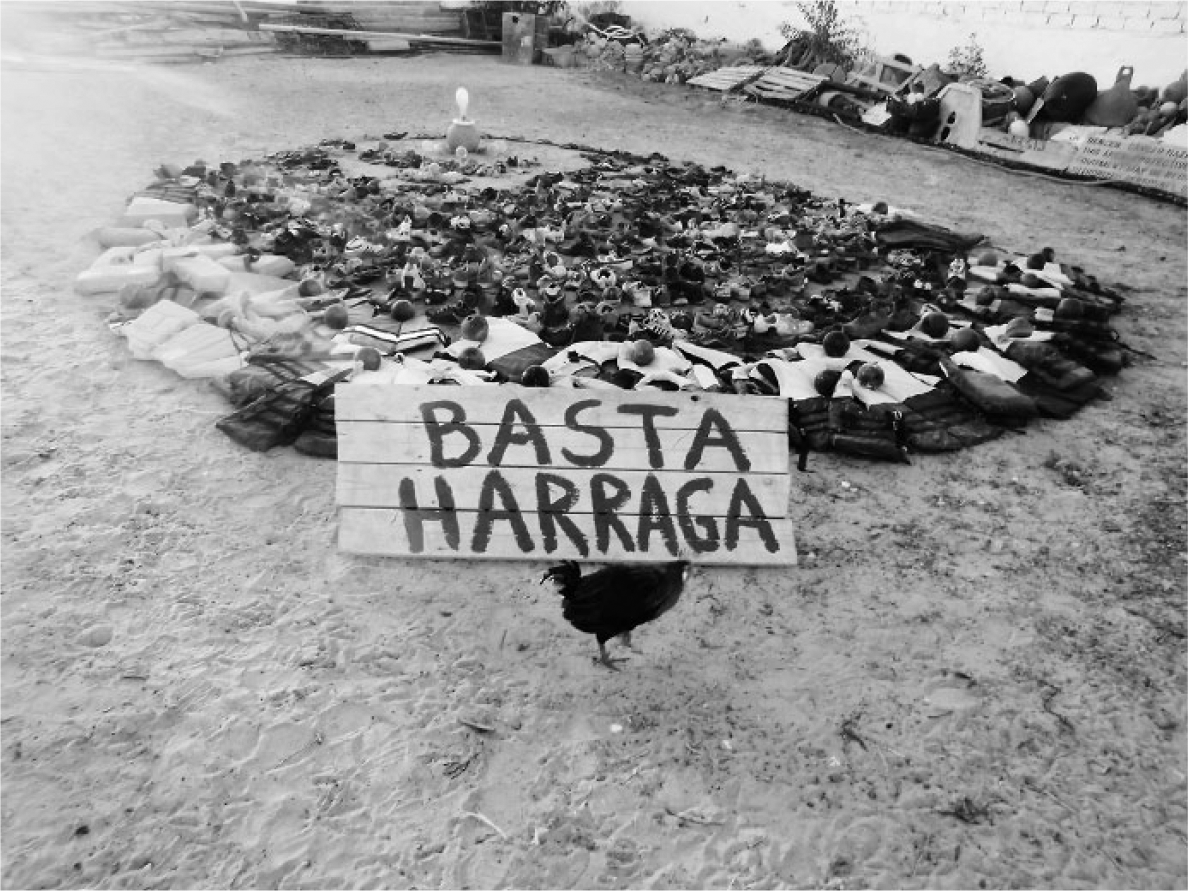
Mohsen’s ‘Basta harraga’ artwork.
Figure 3 depicts one of Mohsen’s artworks. The round object, with the bulb on top, that is Europe, shining in the distance. And in front of it you see the masses that are moving in its direction. The artwork puts us outside Europe looking at these objects that are organized around it.
The plastic ball that calls up Europe is actually the float of a fishing-net. For his art, Mohsen uses objects that he finds on the beaches of Zarzis. So that is one of them and on top of it there is another find, a bulb. Maybe it stands for enlightenment or the lure of Europe: an illusionary shine on top of this Europe that is self-contained and has everything. Around it there is an empty-looking space, that may be water. And then there are lots of shoes and slippers. Mohsen finds shoes and slippers on the beach. For him, they indicate the human beings who have lost them while moving towards Europe. They may have just lost their footwear, but, tragically, of course, more likely they have lost their lives. And around those shoes there are lifejackets that should have been lifesaving. Maybe they stand for human beings. I think they do because of the black balls that resemble heads. But they are also indicative of safety and danger. Of the risks that people take when they try to get to Europe.
But there are also words: basta harraga, they read. Basta from the Italian, stop. Stop harraga. Enough harraga. And this is not a moral but a political statement. It does not accuse those who leave of behaving improperly, of taking undue risks, of betraying their home country. None of that. This statement is sensitive to the fact that harraga is not about identity anyway. It is therefore basta to the system that causes people to leave. That causes them to view Europe as their only possibility for a good life. To survive. If they survive the crossing of the sea.
Harraga is thus about a politics of life and death. While it is an effect of a lack of possibilities in life, the risk of death, death at Europe’s borders, is never far away. 20 A risk that many who are not welcomed are willing to take because they lack a diploma as engineer, ICT specialist or medical professional. But doing so they are confronted with an exceedingly securitized border. Ever since 2011 and the series of revolts in Arab countries, the southern border of Europe has been cast as vulnerable. 21 One that requires care and attention, in the form of huge investment and the use of state-of-the-art technologies. But since all this high-tech surveillance did not stop people from coming, Europe has been looking for ways of stopping them earlier on their journey, and has been trying to execute its border surveillance elsewhere. Such as in Turkey, after the Turkish deal of 2016 (e.g. M’charek, 2018; Rygiel et al., 2016).
Tunisia has been constantly on Europe’s list for an equivalent to this deal with Turkey. Even though its new democracy is still fragile and its economy not moving forward, it has been pressured by various European countries to take the deal. Recently it has complied with a so-called ‘Contingency Plan’ for providing shelter to some 25,000 refugees that are expected to move out of Libya in the near future as a result of continuing and increasing violence.
22
Yet the number of refugees that leave Libya to come to Tunisia is decreasing, because people know that by being in Tunisia, a so-called safe country, they reduce their chances of ever entering Europe. In addition to actively stopping people moving in its direction, Europe has implemented a large programme called EU Emergency Trust Fund for Africa (EUTF), a 4.5 billion euro programme as a whole and with current funding for North Africa of 656 million euros. The management of ‘vulnerable’ borders is a key concern in this programme. Its website tells us: The BMP [Border Management Programme] Maghreb programme aims is [sic] to mitigate vulnerabilities arising from irregular migration and to combat irregular migration. The action aims to do so by enhancing the institutional framework of Morocco and Tunisia to protect, monitor and manage the borders, in line with internationals [sic] standards and human rights that identifies and mitigates risks to rights holders at borders, while ensuring the free movement of bona fide travellers and goods.
23
A lot can be said about this programme and its goals, such as indeed ‘an emergency for whom?’ (Kervyn & Shilhav, 2017). Its focus on migration and borders seems to underline the constant panic about the integrity of Europe’s borders. Now in Zarzis its effect has just started to take shape. As part of this EUTF, 20 million euros have been dedicated to innovations in the Garde Nationale Maritime of Tunisia, because they are often involved in what are called search and rescue operations. Many have said that these are illegitimate ways of stopping migration. The Garde Nationale Maritime will be equipped with new communication technologies and boats, and its staff will be trained accordingly. In addition, it is expected that EUTF money will be invested in innovations in the national police. Although the coast guard might stop people on boats, currently the police does not interfere with them getting on these boats in the first place.
As I said harraga is about a politics of life and death. And so is Europe’s border management regime. Many have therefore argued that the thousands upon thousands of dead in the Med are co-produced by the way Europe seals its borders off (e.g. Cuttitta & Last, 2019). Harraga interrogates this focus on borders precisely by burning these, by pointing the arrow, right there. And it addresses the problem of borders by siding with those who cross them, human beings.
Now there is something tantalizing about the work of Mohsen, the artist. He uses waste to evoke humans. This work calls into question how humans, some humans, are treated as waste. At the same time it seeks to sensitize people to the ecological disasters that are ongoing. He collects waste and displays it. Look, what a lot of waste! But in the artwork pictured in Figure 3, it is important that this is not just any waste. 24 Mohsen has collected traces of movements, traces of harraga, to visualize the magnitude of harraga. To evoke what harraga is all about. If you go, you need decent shoes to walk away, you need bottles of water to take with you, a lifejacket, a boat.
And these are just a few of the objects on display in Mohsen’s domain. When you enter his yard and see the heaps of shoes and slippers that he recently collected, of clothing and of other things not always easy to determine, it is shocking, shocking every time. There is so much. The multitude is overwhelming.
This puzzling work of art is laid out on the ground, next to where Mohsen lives at the edge of Zarzis. The setting is mundane: when the photo was taken, a chicken wandered about, seeking worms or something else to eat. But on a day like any other, Mohsen has made this photo to display it on his website. If you enter his museum, he takes you by the hand, there are conversations, he tells you about his work. But at the same time, he does not just address people nearby, people in the village, passers-by. He deliberately reaches out. 25
To you as well. While the artwork puts its viewers outside Europe to look at it from a distance, the basta harraga that underlines the artwork is directed to people in Europe and beyond. It is, after all, not written in Arabic script like the text on the rock. The juxtaposition of the Italian and the Arabic words are in the Roman alphabet. This is a political call. That should not have to be translated into English to make its point.
Conclusion: Moving on
In this article I have used the word harraga to complicate what is often addressed as ‘irregular migration’. I did not rush to translate this word, but explored it, chewed on it. This has allowed me to write about things that the term ‘migration’ risks hiding. Such as, for one, that ‘migrating’ is not necessarily about others, migrants, ‘those people’, however they may be identified, but that it is something a ‘we’ may be compelled to do if we find ourselves being buried alive, living in a dead end. Next, that colonial relations are not over or a history left behind but leave traces in the present, persist, take ever-new forms (e.g. Stoler, 2016). And then, crucially, that the separation between Europe here and the rest there, beyond its boundaries, does not hold in practice. For the borders of Europe are exported and protected in various locations in the world, by various actors (e.g. Afailal & Fernandez, 2017; Badalić, 2019).
Rather than presenting different views on irregular migration, here I have mobilized three material objects – rock, salt and rubbish – to unfold what harraga is. In the context of the present publication, I have done so with a particular question in mind, namely: how does harraga move social theory?
To address this question head-on, the rock provided a good starting point. The rock allowed me to put Europe out-of-focus, for a moment, and to start from a specific place outside Europe, Zarzis. From the salience that it has in this place, the word harraga allowed me make seven interventions in current ideas about migration.
First, harraga is quintessentially an activity that interferes with imagined relations between states and individuals. While the word migration is tightly related to formal state-obeying, law-obeying, movements of people, harraga is about burning borders. It assumes a situation where states try to stop citizens from moving about. Harraga is thus an activity that burns state-rules and messes up boundaries.
Second, harraga is an activity rather than an identity. This became clear as I explored harraga from the perspective of those facing the rock-cum-road sign, ‘Europe this way’. I did not introduce this perspective by soliciting their views on migration, but by attending to where they are in the world and what they do when engaging in harraga. By attending to the preparation work, knowledge, networks and money that are required for the crossing, which tells that moving out of the Maghreb is not only a risky but also a demanding activity.
Third, harraga is about crafting connections and expanding living space. From the perspective of Zarzis it became visible that migration is not so much about leaving one place for another, but rather about expanding living space. It is about making movement possible rather than staying stuck, buried alive in a dead end. Harraga thus sensitizes us to connections made between there and here, but also to the ways in which movement both depends on already established connections and in its turn brings about links that are new.
Fourth, harraga is about colonial flows and extractions. Flows of people from Zarzis to France and back. Extractions from Zarzis to France only. For while people from Zarzis get on small boats in the hope of a better life in Europe, salt is being carried away on trucks and shipped to France with only very little return. Salt leaves Zarzis for France at prices set under colonial rule. 26 While in current debate on migration the movement of people is cast as a problem, the circulation of goods such as salt is part of formal, free economic trade. Harraga brings this to light. It makes us attend to hidden but enduring colonial relations which mean that burning borders and the shipping of salt are part of the same socio-political reality.
Fifth, harraga intervenes with the politics of borders. For the currents of the sea bring the bodies of people who did not make it to Europe alive, and washes these ashore in Zarzis. This puts salt in a further and different relation to migration, as the sabkha from where salt is extracted is adjacent to a provisional cemetery for drowned migrants. Harraga, then, is not simply about migration and migrants knocking on Europe’s door, but also about dead bodies at Europe’s borders. Many have argued that heightened securitization of Europe’s borders are contributing to increased numbers of dead in the Mediterranean (Cuttitta & Last, 2019; Spijkerboer, 2007). Yet Europe is investing even more in protecting its borders as well as exporting these to other parts of the world. Those who arrive alive in Europe are typically submitted to heightened surveillance. The dead, by contrast, have long been conveniently overlooked (Last & Spijkerboer, 2014) and still receive little political attention (Kovras & Robins, 2016). Harraga calls attention to dead-bodies-at-the-border (M’charek, 2018).
Sixth, harraga intervenes in the separation between the dead and the living. Death is folded into harraga for those facing the rock. 27 It is not something they shy away from, even if they may stumble over the bodies of those who did not make it to Europe alive as these are washed ashore on the very beaches that they will depart from. 28 Harraga thus brings the realities of the dead and the living together.
Seventh, harraga calls into question what is litter and who is disposable. Rubbish, configured in an extraordinary piece of art, evokes the lure of Europe and the risk of death for those trying to reach it. It is crafted with objects found at the shore, objects that belonged to those who tried to engage in harraga but died along the way. Litter of people treated as if they were disposable. At the same time, it also displays words: Basta harraga. This political statement questions the various issues that I addressed in this article. It addresses the problem of borders by siding with those who cross them, human beings. It decries problems of persisting colonial relations, lack of opportunities and unemployment, state surveillance and border management. It is to this spiral of disparities and death that Basta harraga is a call. Basta.
Footnotes
Acknowledgements
I am grateful to Mohsen Lihidheb for his friendship and for sharing his stories and wisdom whenever we have a chance to meet. I thank Annemarie Mol and John Law for encouraging me to write about harraga and for their patience during a slow process. Guiding and gently pushing me further, yet giving me the space to explore the unexpected narratives that emerged. Thank you! Fredy Mora-Gámez I thank for reviewing my article and for his generous feedback. I also thank the members of the TemaT team (Linköping) for their careful reading and discussion of the article, and the members of RaceFaceID team, especially Lisette Jong, Ildikó Plájás and Clément Dreano for feedback on an earlier daft.
Funding
I am grateful to the European Research Council for supporting my research through an ERC Consolidator Grant (FP7-617451-RaceFaceID-Race Matter: On the Absent Presence of Race in Forensic Identification).
Notes
Author biography
 ), a project on forensic identification, face and race.