




Abstract
Creative, visual and multimodal research methods are commonly employed by sociologists in the ‘outward-facing’ activities of data collection, presentation and dissemination of research findings; however, they are rarely applied to the ‘inward-facing’ research practices of conceptualisation and research design. Responding to Pierre Bourdieu’s calls for methodological pluralism in sociology and for the construction of the object to be rigorously undertaken in every moment of research, I explore how such methods can be used by the researcher as effective thinking tools to enhance the creativity and quality of conceptual work as a precursor to empirical investigation. I investigate the affordances of this approach using a creative research method – storyboarding – to examine trust. Although empirical research commonly cites trust as an explanatory factor, its meaning is ambiguous and contested. Based on three imagined trust dilemmas developed with the involvement of a visual artist, I demonstrate how a visual creative process can encourage consistent attention to the construction of the research object. It also speculatively reveals new facets of phenomena and supports reflexive attention to the researcher’s relation to the object of research. I argue for sociological thinking to engage an eclectic range of visual and creative forms as legitimate tools capable of extending rigour and creativity.
Introduction
In recent decades methodological pluralism has become a mainstream commitment within British sociology, although incomplete in its realisation (Ayrton, 2017; Payne et al., 2004). An area of significant diversification has been the uptake of creative, visual and multimodal methods as tools for data collection and for communication and dissemination of research findings. However, despite this potentially extensive repertoire, the range of thinking tools and visual forms that sociologists use for the pre-empirical practices of conceptualisation and research design are still extremely limited and convention-bound.
My aim is to push the boundaries of where creative engagement with visual and multimodal techniques fits in the full operation of research by focusing on their application in the private, or ‘inward’ activities of conceptualisation and operationalisation. Proponents of visual and arts-based research suggest these approaches have the capacity to reveal ‘subtle but significant’ dimensions of social life that may have been difficult to represent or gone unnoticed using more routine approaches (Eisner, 2008, p. 11). As such, they are useful tools for researchers, not only for participants and publics that we might seek to engage.
To illustrate the potential of this approach, I present my use of an expressive multimodal method – storyboarding – as a heuristic device in the process of conceptualising and operationalising an elusive concept: trust. Trust is commonly referenced in everyday life and in social scientific research; however, like many important sociological concepts, it is immaterial and difficult to define, much less operationalise. I argue that the addition of creative, visual and multimodal methods to the repertoire of academic practices increases the rigour of conceptual and research design work.
I begin by critically evaluating the use of creative, visual and multimodal methods in different aspects of the research process and what advantages visual and arts-based researchers claim these methods offer. I then use Bourdieu’s notion of the construction of the sociological object to illustrate the challenge of operationalising trust – conceived as a process – in light of dominant notions of trust as an attitude or behaviour. After outlining my methodology, I present three imagined, storyboarded scenarios involving trust. I demonstrate how this method firstly helps to safeguard the relationship between theory and method by encouraging consistent attention to the construction of the object of research (Bourdieu & Wacquant, 1992). Secondly, it speculatively reveals new facets of trust which may alter approaches to empirical investigation. I then engage in a reflexive discussion of my role in the process, how I am implicated in the scenarios I produced and the constraints this imposes. This in turn indicates a third capability of creative, visual and multimodal methods, which support reflexive attention to the researcher’s relation to the object of research, enabling her to identify and transcend such constraints.
For Bourdieu, theory and methodology form two inseparable actions of research that are held in continual conversation with each other. This article explores the creative potential found in transgressing the unspoken boundaries surrounding how researchers do conceptual work.
The untapped potential of creative visual and multimodal methods in the research process
Since the ‘visual turn’ in the social sciences (Jewitt, 2008) the use of visualisations in research has expanded. However, the range of forms this might take have not diffused evenly across the processes of research. Figure 1 conveys practices that social scientific research typically incorporates (albeit in a simplistic, linear depiction of the research process), to draw attention to their inward- or outward- facing orientation. Inward-facing research practices are private to the researcher or a selected audience of collaborating academics. Outward-facing practices engage wider publics including mixed or predominantly non-academic audiences, such as research participants or users. A range of visual products may be used in different actions of research; however, in inward-facing activities these tend to take on a limited and particular form.
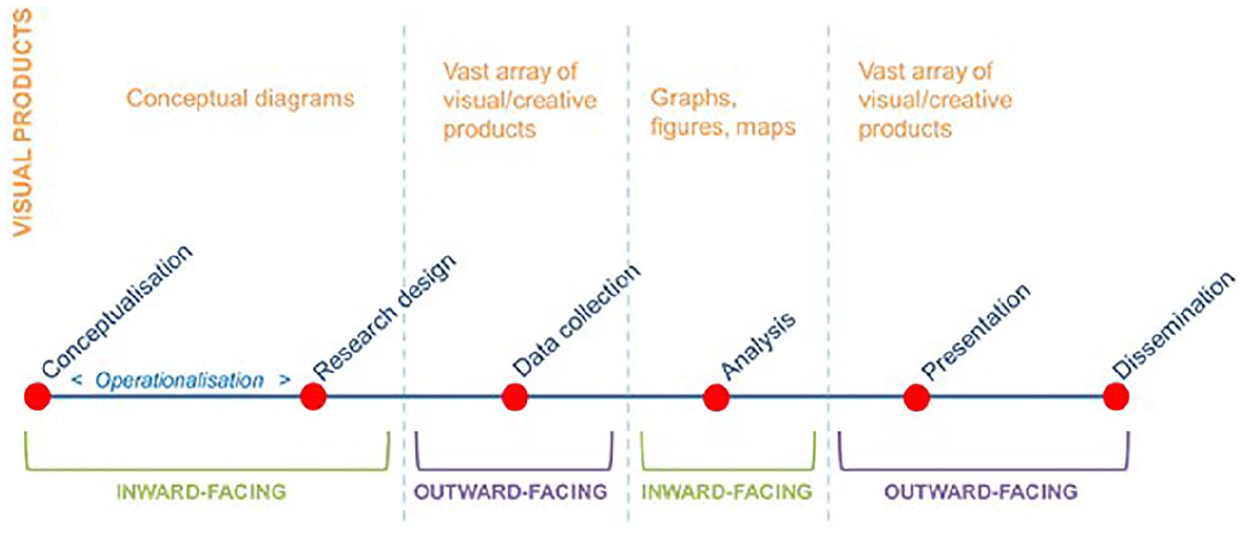
Visual products in the practice of research.
This is exemplified through the visualisations used routinely to depict social scientific theoretical frameworks. They produce scientific reality through inscribing and thereby externalising the researcher’s internal imagery of a phenomenon, creating an intersubjective object that mediates between persons and things (Lynch, 2006; Wagner, 2006). Ordinarily, these visualisations encompass a restricted range of cultural goods (Bourdieu, 1979/1984), such as flowcharts, checklists, figures and tables (Grady, 2006; Wagner, 2006). These are sometimes accompanied by paralleled textual description that renders them ‘a picture of nothing with no distinctive role in the text’ (Lynch, 1991, p. 6). Michael Lynch has observed in the common features of social theoretical visualisations, including bounded labels, quasi-causal vectors and spatial symmetries, a ‘rhetorical mathematics’ which employs ‘modes of representation that act as emblems of scientific authority’ (Lynch, 1991, p. 18). This resonates with Bourdieu’s criticism of methodological prescriptions which he lambasts as ‘more scientistic than scientific’, through attempts to replicate the ‘external signs of rigor’ of established scientific disciplines (Bourdieu, 1993/1999, p. 607). Social thought has as yet made limited use of the range of visual forms available.
In data collection, by contrast, particularly within the field of participative methodologies, a diverse array of visual/creative practices are legitimately used, including mapping, sorting and ranking exercises, photovoice, community-based participatory video, participatory theatre, and drawing or other ‘handmade’ or folk art techniques. Although these methods are rarely taken up by researchers to facilitate inward-facing thinking and creative research activities, this is not unheard of. Within the fields of creative, visual and arts-based research there is clear epistemological space for this approach.
Luc Pauwels (2015) has identified the need for a ‘reframing’ for the visual to become a more central aspect of social scientific practice. In his integrated framework for visual social research he acknowledges the need for visual representations of ‘non-visual data and conceptual representations of ideas’ in order for social science as a whole to become ‘more visual’ (Pauwels, 2015, pp. 22–23). Similarly, Helen Kara points to the ‘invisibility’ of thinking processes in the practice of research and highlights the potential of creative methods to increase openness to the unexpected (Kara, 2015, p. 56). She points to Mary and Ken Gergen’s practice of performative social science, which has involved Ken’s use of poetry and collaboration with visual artists to represent relational theory, resulting in ‘a rich adventure in the visualisation of theory and the theorization of the visual’ (Gergen & Gergen, 2012, p. 169). They propose that aesthetic engagement be considered an ‘essential ingredient of knowledge-making’: If the social sciences expanded the range of representational media . . . to include the entire range of communicative possibilities available to the culture, would this not expand the potentials for illuminating the social world? (Gergen & Gergen, 2012, pp. 17, 26)
Nevertheless, there remain pragmatic and ideological barriers which maintain the use of conventional cultural goods – predominantly words and numbers – among social researchers, including training practices, the forms favoured by print publications and the valuing of the immaterial/philosophical over the visible (Wagner, 2006). Those wishing to use a broader palette of visual forms in conceptualisation and operationalisation remain ‘revolutionaries’ in a fairly conservative environment (Harper, 1998, p. 38).
What potential gains could researchers make in mobilising this eclectic repertoire of methods in the inward-facing research practices of conceptualisation and operationalisation? Proponents of visual or arts-based methods assert that visualisations should not only inform the audience, but also the thinking of the producer(s): generating unexpected results, revealing associations not otherwise evident, and enabling the portrayal of complexity (Grady, 2006; McNiff, 2008; Tufte, 2006). A cognitive theory of art suggests that, as works of imagination, art enables us to better understand the human condition by enriching our experience of the world: ‘The question to be asked of such a work is not, “Is this how it really was?”, but rather, “Does this make us alive to new aspects of such an occasion?”’ (Graham, 2005, pp. 69–70). Different visual media offer different strengths, whether conveying information or evoking emotional responses, reproducing the visible world or conveying ideas in a more expressive form (Langdridge et al., 2019; Pauwels, 2015). Further, the process of production is fruitful, as stepping beyond habitual ways of working can inspire a fresh perspective (Eisner, 2008; Jacobsen et al., 2014): A shift in methodology can bring tremendous insight and relief . . . the use of our hands, bodies, and other senses as well as the activation of dormant dimensions of the mind, may offer ways of solving and re-visioning problems that are simply not possible through descriptive and linear language. (McNiff, 2008, p. 33)
In addition to the visual product, the measured pace of participative activities demarcates ‘reflective time to construct knowledge’, the opportunity to enter into a ‘playful’ mode, but with the purpose of ‘information not distraction’ (Gauntlett, 2007, p. 185; Grady, 2006, p. 250; C. Mitchell et al., 2011b). Although deliberation is part of standard academic writing-based practices, David Gauntlett suggests there is something qualitatively different about the reflection involved in making an artefact – the time taken, the physical act of making, and the product you can look at, think about, and adapt (Gauntlett & Holzwarth, 2006). Taken together, this literature gives a promising impression of how the systematic application of creative visual/multimodal methods might augment theory and research design.
Trust research and the construction of the sociological object
The field of trust research provides a useful test case for the mobilisation of creative, visual and multimodal methods in the pre-empirical stages of research. Trust is fundamentally sociological: it happens between interdependent agents. Trust enables social action and is relevant in contexts of vulnerability and uncertainty regarding the outcome of cooperative action. It is non-material, abstract, and lacks a generally agreed-upon definition (Brown & Calnan, 2012; Lewis & Weigert, 1985; Li, 2012, 2015; Lyon et al., 2012; Möllering, 2014). Despite this pre-paradigmatic conceptual diversity there is surprising methodological conformity, with a strong bias towards positivist epistemologies and quantitative methodology (Isaeva et al., 2015; Li, 2015). This indicates the potential for failures in the construction of the object of research, resulting in theory and methodology becoming misaligned.
For Bourdieu, the construction of the object is a crucial but frequently overlooked aspect of research: a ‘protracted and exacting task that is accomplished little by little’ through the continuous engagement of theory and practice in every act of research, however inconsequential (Bourdieu & Wacquant, 1992, pp. 227–228). It involves maintaining the tension between the constructed, ‘purified objects’ of research and the concrete to which they refer (Wacquant, 2008, p. 265), and avoidance of substantialist thinking, which collapses the object of research, rightly positioned within the network of relations, with an actual population that embodies the phenomenon (Bourdieu & Wacquant, 1992). Insufficient attention to the construction of the object can result in lapses to preconstructions – that is, dominant conceptions that already circulate.
Within trust research, two competing accounts dominate: trust conceived as an attitude, and trust as a form of cooperative behaviour (Li, 2012). Both attitudinal and behavioural approaches to trust assume a rational form of strategic thought and/or action: early trust research in psychology and political science conceptualised it as ‘a psychological event within the individual’, reducible to its ‘cognitive content’ (Frederiksen, 2012; Lewis & Weigert, 1985, p. 967; L. Mitchell, 2001; Williamson, 1993).
A leading configuration of trust as attitude is put forward by Russell Hardin, for whom trust operates exclusively in a tri-part relation where ‘A trusts B to do, or with respect to, X’ (Hardin, 2006, p. 19). The assessment of trustworthiness takes the form of ‘encapsulated interest’ – where the trustor perceives that ‘the trusted encapsulates the interest of the trustor and therefore has incentive to be trustworthy in fulfilling the trustor’s trust’ (Hardin, 2002, p. 24). This conscious, rational appraisal of the motivation and qualities of another produces a ‘psychological state’ which can be accessed by direct questioning in attitudinal surveys (Rousseau et al., 1998). Although Hardin’s version assumes a personalised relationship (i.e. with a known other), trust is commonly treated as an attitude in studies of trust at a range of scales, including group- or identity-based trust, generalised trust (i.e. in ‘people in general’), or institutional trust.
The conception of trust as attitude assumes a directional, uneven kind of relationship and neglects that those that are trusted are active partners in a relationship (L. Mitchell, 2001). Fundamentally, there is a logical disjuncture between the psychological state that is reached through an assessment of perceived trustworthiness and any behavioural decision which makes trust consequential (Li, 2015). Assessment of the character of others and expectation of them do not necessarily coincide (Tanis & Postmes, 2005); anticipatory belief alone is insufficient to constitute trust (Möllering, 2001; Sztompka, 1999).
For some, the solution to this is to construct trust as the behavioural decision to accept vulnerability: commitment through action (Li, 2007, 2012; Sztompka, 1999). In order to capture ‘trusting behaviour’ empirically, trust games have been employed to create an artificial scenario where opportunistic and cooperative behaviours can be evoked and observed (Deutsch, 1958; Schweitzer et al., 2006). However, trust games wrongly surmise that the competitive, individualised, self-interested objectives of a game and consciously strategic mode of action are analogous to everyday life. Social action takes a variety of forms, and is not always ‘the deliberate pursuit of a conscious intention’ (Bourdieu & Wacquant, 1992, p. 121). In a further lapse of logic, this approach assumes that trust can be inferred from cooperative behaviour, which in fact may be based on factors other than trust (Ayrton, 2012, 2017; Möllering, 2001; Rousseau et al., 1998).
In light of these limitations, a more promising approach treats trust as a process. This accounts for the dynamics of trusting (Frederiksen, 2012; Möllering, 2013): rather than being a past accomplishment or a present singular act, trust is located in the present continuous, something that goes on being made and renewed. Guido Möllering draws on Georg Simmel to describe trust as a sequential process involving interpretation, suspension, favourable expectations and feedback/evaluation (see Figure 2). For Simmel, trust is situated between knowledge and ignorance; however, the exercise of judgement, or interpretation, is insufficient to warrant the state of favourable expectations that trust enables to be reached (Frederiksen, 2012; Möllering, 2014). There is a ‘further element’, a ‘leap of faith’ (Simmel, 1907/1990, p. 179), which Möllering terms ‘suspension’. Suspension indicates the leap over the ‘yawn[ing] gorge’ of ignorance and the unknown, a move which ‘brackets out uncertainty and ignorance, thus making interpretative knowledge momentarily “certain”’ (Möllering, 2001, p. 414). The practice of trusting forms a kind of feedback loop as trusting enables the production of trust (Dietz, 2011; Möllering, 2013).
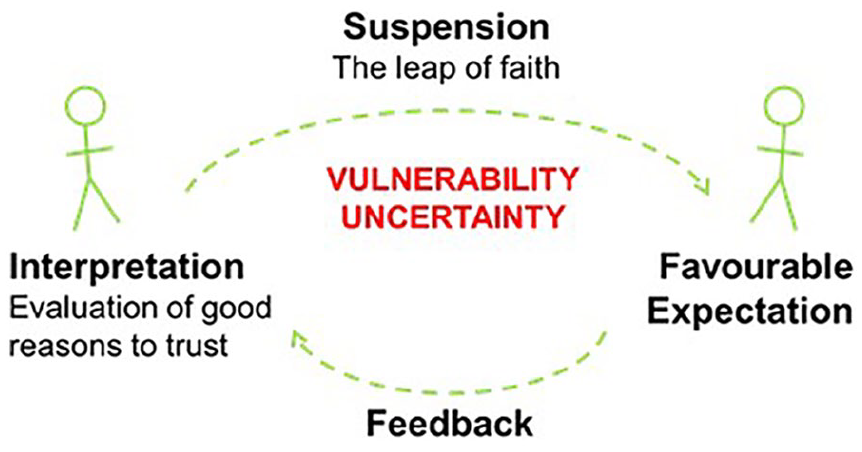
The process of trust.
While an appealing solution to the limitations of attitudinal or behavioural constructions of trust, this process approach is not straightforward to operationalise (Möllering, 2013). Interpretive, in-depth qualitative approaches are most suited to providing rich detail about actual trust experiences (Möllering, 2006); however, in the context of the dominant preconstructions I have described, the use of non-standardised instruments heightens the risk of conceptual lapses. It is all too easy to ask an interview participant, ‘Why did you trust . . .’, which invites post-hoc rationalisations more in keeping with ‘trust-as-attitude’ than ‘trust-as-process’. Creative methods have the potential both to clarify conceptualisations of key phenomena and to support consistency of their application throughout the research process, as well as providing tools that can be repurposed in the ‘outward-facing’ practices of data collection and communication. I applied an expressive, multimodal method – storyboarding – as a tool to support rigorous construction of the object in the processes of conceptualising and operationalising trust.
Methodology: Storyboarding, and questions of status and skill
Storyboards comprise sequences of drawings, each representing a camera shot, which filmmakers use to generate a visual outline. Within the social sciences, storyboarding is generally a stage in the process of community-based participatory video, although it has been used as a stand-alone method (C. Mitchell et al., 2011a). Storyboarding provides a bridge between the static visual art of drawing, the dynamic art of film, and the textual art of narrative fiction (Graham, 2005; Klorer, 2014). It is multimodal: it incorporates both text and image, giving freedom where one mode sufficiently communicates meaning for the other to take on a greater level of abstraction or expression (Jewitt, 2008; McCloud, 1993; C. Mitchell et al., 2011a). Storyboards resemble comics or graphic novels, which Scott McCloud terms ‘sequential art’: ‘juxtaposed pictorial and other images in deliberate sequence, intended to convey information and/or to produce an aesthetic response in the viewer’ (McCloud, 1993, p. 9). There are key formal differences: for example, the fixed aspect-ratio of frames and inclusion of camera notations in storyboards in contrast to the creative arrangement of variously-sized frames to generate a sense of movement/action in sequential art (although professional/technical requirements of storyboards are relaxed when applied as a participatory method; see examples in C. Mitchell et al., 2011a). Although the visualisations presented below overlap the characteristics of storyboarding and sequential art, I favour the term storyboarding due to the status of the storyboard as an intermediate art form in the context of film-making, which echoes my use of the technique as a mediator between conceptual and empirical stages of research.
This practice emerged while I was designing participative qualitative methods to investigate trust in communities affected by intra-state conflict in sub-Saharan Africa. I was called on to produce a poster on trust theory for an interdisciplinary alumni event at my university. In order to improve visual appeal I drew a storyboard depicting the stages in the trust process for a mother undertaking a charity parachute jump. I chose the scenario as I assumed it to be familiar to a general UK audience and therefore an effective vehicle for communicating a theoretical idea. Unexpectedly, I found the process of production gave me new insights that informed my research design. I therefore extended the exercise by choosing two further scenarios to storyboard: the first considers advocacy in the context of mental health care and was suggested by a close friend based on her ongoing experiences. The second concerns sexual health decision-making in the context of high-prevalence HIV. This drew on microbiologist Peter Piot’s (2012) account of his career in global public health tackling deadly viruses such as Ebola and HIV/AIDS in sub-Saharan Africa and took me a step closer to the cultural milieu I intended to research. In one sense the content of the scenarios themselves does not matter – the subject is trust, rather than any substantive domain. The theoretical driver underlying their selection was that each scenario exhibited vulnerability and uncertainty, but these were deliberately manifest in very different ways. In another sense the scenarios matter greatly, in that I conceived of them, they are connected to my biography and are within the scope of what is imaginable to me. I return to this in the reflexive discussion below.
This relates to a question around the status of the storyboards, given the more usual application of the technique in data collection/generation. I do not consider these storyboards to form ‘data’. In order for them to qualify as such they would need to have a real world referent – for example, by being produced within an autoethnographic framework. This explicitly harnesses the self as a means of accessing culture through the use of introspection as a data source (Wall, 2006). Although I have a relation to the scenarios implicated by my choice of them, they do not reflect historical personal experience. Instead, they are ‘sociologically-informed speculative scenarios’ (Jacobsen et al., 2014, p. 12) whose referent is conceptual: the process of trusting. In my view, they hold the same status as pre-empirical logical/verbal argumentation and accompany this more conventional thinking tool.
Although within participatory approaches participants are actively encouraged to put aside questions of skill (Gauntlett, 2007; C. Mitchell et al., 2011b), within arts-based research this issue is hotly contested. Some warn against ‘amateur’ (Eisner, 2008, p. 9) or ‘inferior’ attempts that appear to ‘mock’ the artistic domain (Piirto, 2002, p. 433), while others take the more pragmatic view that it depends on the purpose of the visual/artistic medium within its particular application (Pauwels, 2015; Sinner et al., 2006). I favour the latter approach. While very limited skill was necessary to facilitate my own thinking process, in order for the images to be useful in intersubjective discussion a skilled artist’s involvement was necessary here.
In practical terms, I planned and drew each scenario, annotating with notes and diagrams. Alongside the artistic process, I kept reflective notes. I next shared the annotated storyboards with an illustrator, Jo Le Prevost, and we discussed the theoretical ideas they contain. Jo replicated my storyboards faithfully in relation to the visual and verbal content as well as the expressive intent, and I asked for few amendments, principally the addition of colour. While this collaboration was extraordinarily smooth, I note the potential complexities of researcher–artist collaborations, for example clarifying expectations, externalising internal imagery/ideas, finding a synergy between theoretical representation and artistic freedom, using words to negotiate visual products, and effectively harnessing the complementary and contrasting skills of artists and sociologists. Although I worked relatively directively with Jo on this occasion, she voiced her own reflections on the choice of an appropriate style between realism and a more abstract, informal style, in light of the varied subject-matter of the scenarios. The product is marked with the subtlety of this artistic interpretation which is entirely her own.
Sketching trust stories
The PTA parachute jump
The first storyboard (Figure 3) focuses on a mother, Julie, undertaking a parachute jump to raise funds for the Parents’ and Teachers’ Association (PTA) at her daughter’s school. It focuses on Julie’s trust in Instructor Joe of MEGA PARACHUTES to ensure her safety. In her interpretation, Julie draws on her personal impression of Instructor Joe and knowledge of his credentials. She also considers the national-structural context and (implicit) safeguards in place, as well as relying on a trusted third party. However, her daughter’s dependency on her is at the forefront of her mind and heightens the anxiety that flows from her vulnerability. She is also impacted emotionally by her cultural environment: in this case, her consumption of television programmes that affect her judgement of aviation safety. In the moment of suspension Julie brackets out uncertainty as she reassures daughter Lucy in earnest that the outcome will be favourable. Julie is able to act with the expectation that all will be well, and as she experiences the exhilaration of the jump, she forms a memory that would inform future participation in extreme aerial sports.
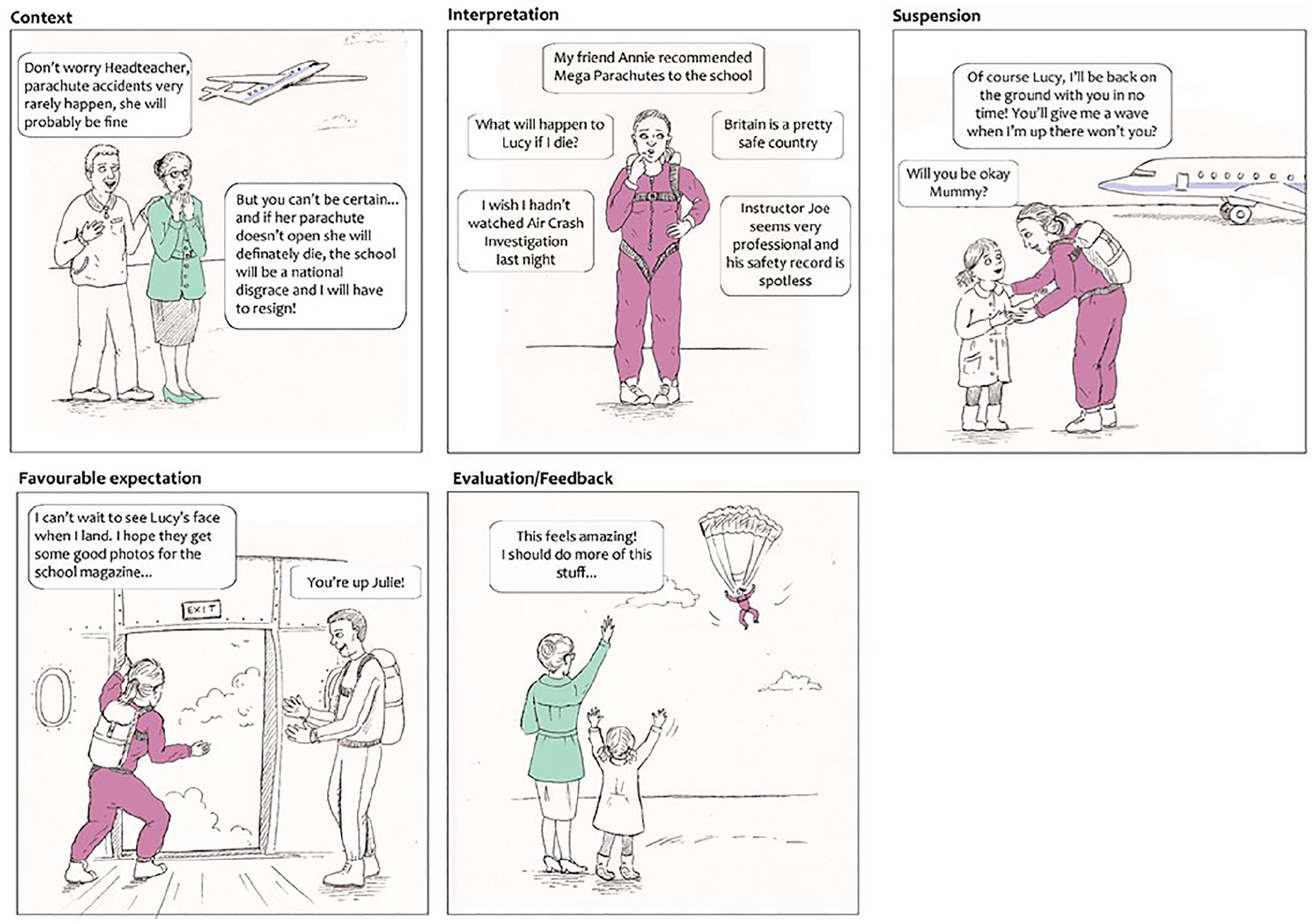
The PTA parachute jump.
I began working with a tri-part relation between two specified individuals and the matter to which trust related (Hardin, 2006). However, storyboarding made it apparent that this relationship is inseparable from the broader relational, institutional and cultural context within which it is situated. Figure 4 indicatively shows the individual, group and organisational actors implicit in the parachute jump scenario and the flows of trust between them (solid arrows), as well as external institutional authorities that come to bear (dotted arrows). Throughout these relationships trust is functioning, often reciprocally, with respect to the dilemma of Julie’s safety, and under the influence of external structural forces. It is feasible, for example, that the ‘moral psychology of being trusted’ (L. Mitchell, 2001) to do the jump has substantial influence over Julie’s action. Rationalist accounts of trust treat it as a substantial property of social agents, which is encouraged by research designs taking individuals, groups or institutions as the units of analysis. Operationalising a relational approach may benefit from analysing the trust dilemma holistically, rather than assuming trustors (or dyadic trustor–trustee relationships) as the unit of analysis. This is likely to encompass multiple interdependencies, vulnerabilities and uncertainties. In so doing, substantialist conflation of the object of research (trust) with the population that embodies it can be avoided (Bourdieu & Wacquant, 1992), and the dynamics of trust may be more adequately captured in their relational context.
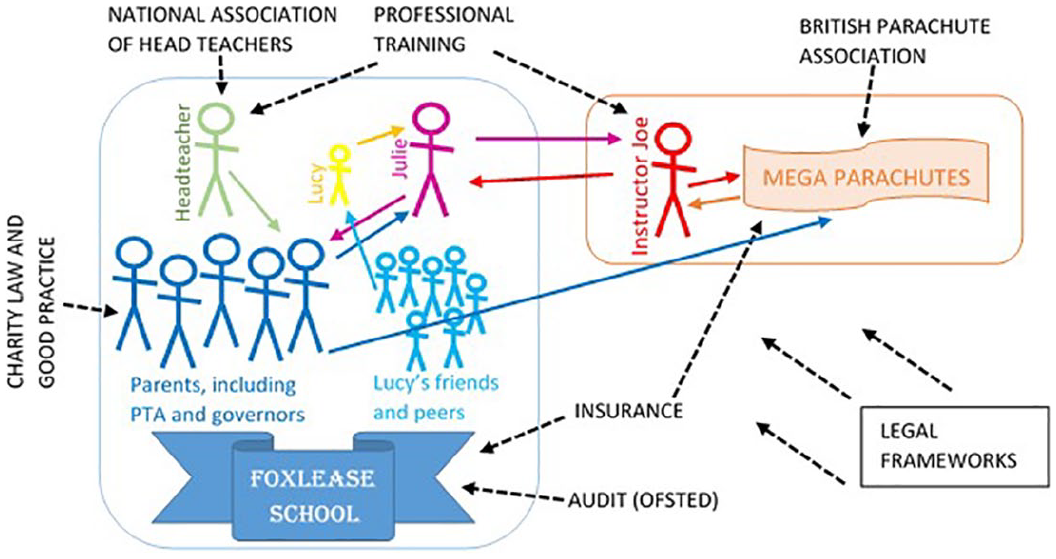
Map of trust relationships implicit in parachute jump storyboard (adapted from annotation).
Mental health advocacy
The second scenario (Figure 5) considers advocacy in the context of mental health. It depicts Nathan’s trust in a new keyworker, Helen, to advocate on his behalf. Nathan’s interpretation is complicated by personal impressions of Helen being combined with her institutional affiliations and professional group identification, as well as seemingly extraneous aspects of his circumstances and wellbeing which enter in. Nathan’s leap of faith is to suspend his reticence and confide in this near-stranger, believing that she will be assertive on his behalf, even as a newcomer in an established professional team. Nathan’s favourable expectation is given a boost when Helen has an early success in securing an extension to Nathan’s therapy, and this is likely to build trust going forward.
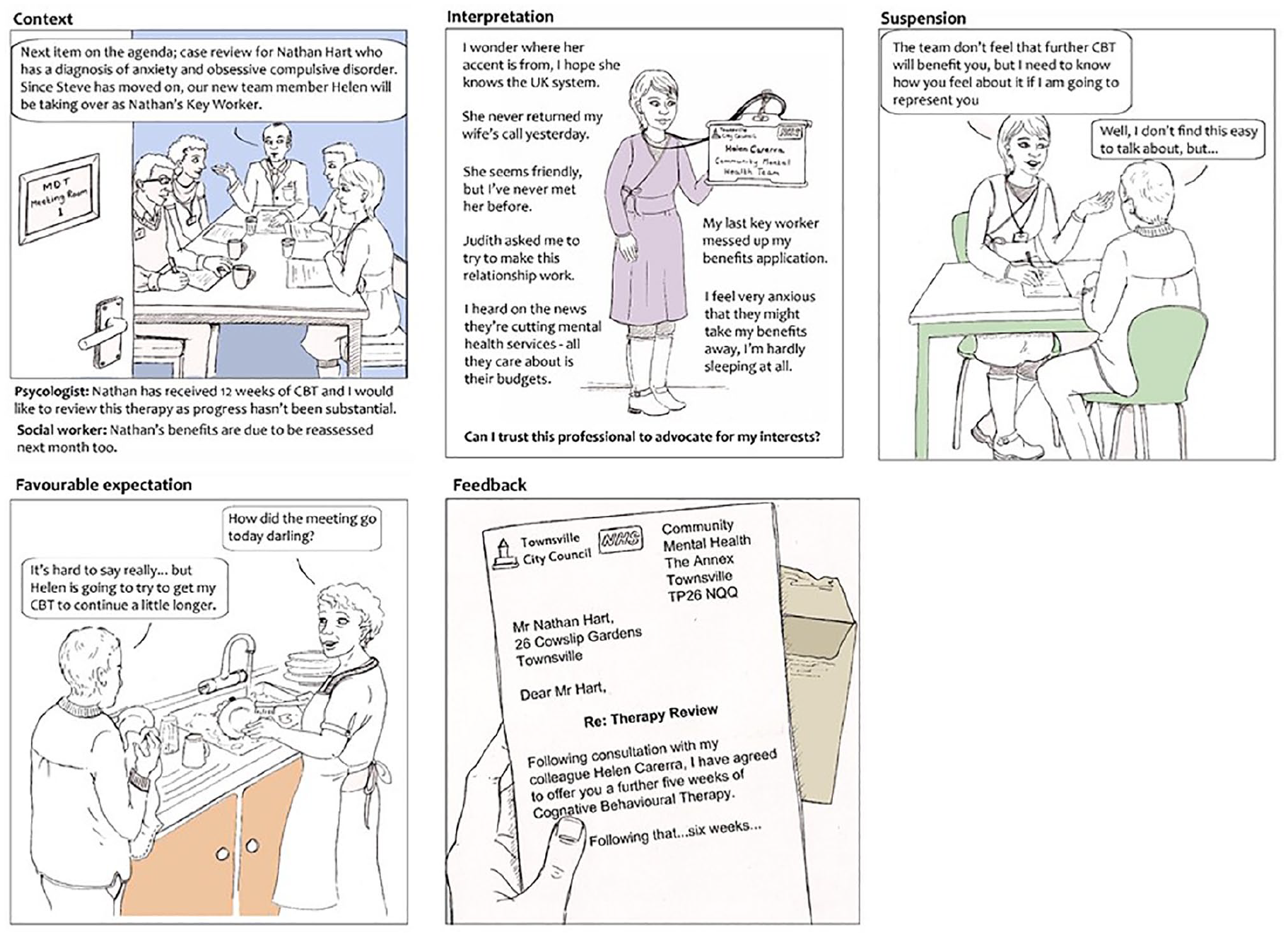
Advocacy in the context of mental health.
The bases of interpretation particularly struck me in this scenario. Despite my criticism of rationalist conceptualisations of trust, I was tempted to focus excessively on cognitive or ‘rational’ reasons to trust. In Nathan’s context a range of institutional, emotional, cultural, interpersonal and physical factors are likely to come into play alongside personal knowledge of Helen (see Ayrton, 2017). Storyboarding revealed a potential lapse to a preconstructed notion of trust-as-attitude and expanded the scope of how the process of interpretation might be operationalised. Further, I began to question the common distinction in trust research between institutional, identity-based and personalised forms of trust, which are usually treated discretely. The device of perspective in the interpretation frame places Helen’s name badge in the foreground, and indicates how her institutional affiliations and professional role mediate the personal relationship. Further, Nathan is likely to have had sustained historical interaction with the agencies Helen represents, which calls into question whether institutional trust can really be considered ‘relationship free’, as it is commonly positioned in trust literature.
Sexual health decision-making
My third scenario departs from the UK context, located in an unspecified place in sub-Saharan Africa where HIV prevalence is high. 1 Unlike the previous scenarios, the focal relationship is intimate – between a couple, Grace and Luc. Grace understands her vulnerability to contracting HIV and she is uncertain as to Luc’s views on condom use (Figure 6). She involves a trusted friend, Mayifa, in her interpretation, where her emotions are in tension with popular wisdom and recent experience of a known third party (Figure 7a). The dilemma reaches a moment of decision at a wedding, where Luc and Grace have the opportunity to be alone (Figure 7b). What response on Grace’s side would indicate that she trusts Luc?
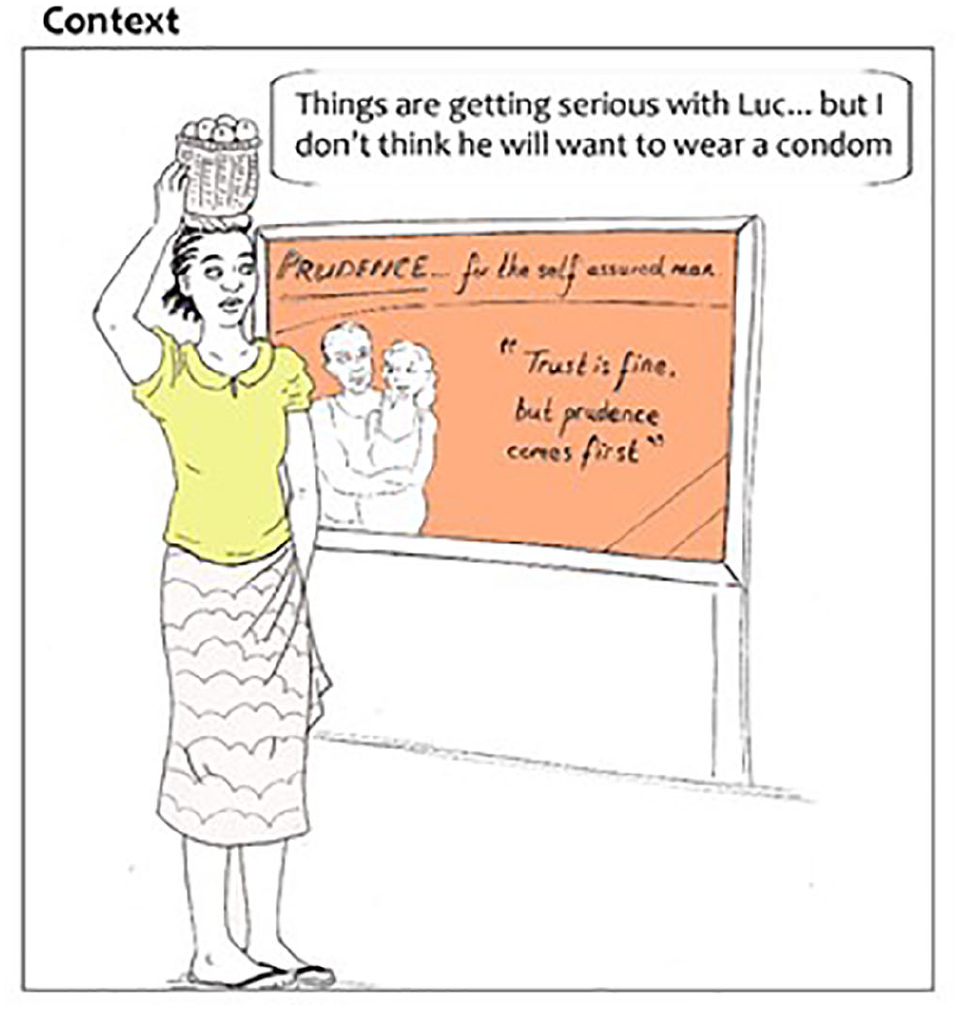
Sexual health decision-making context.
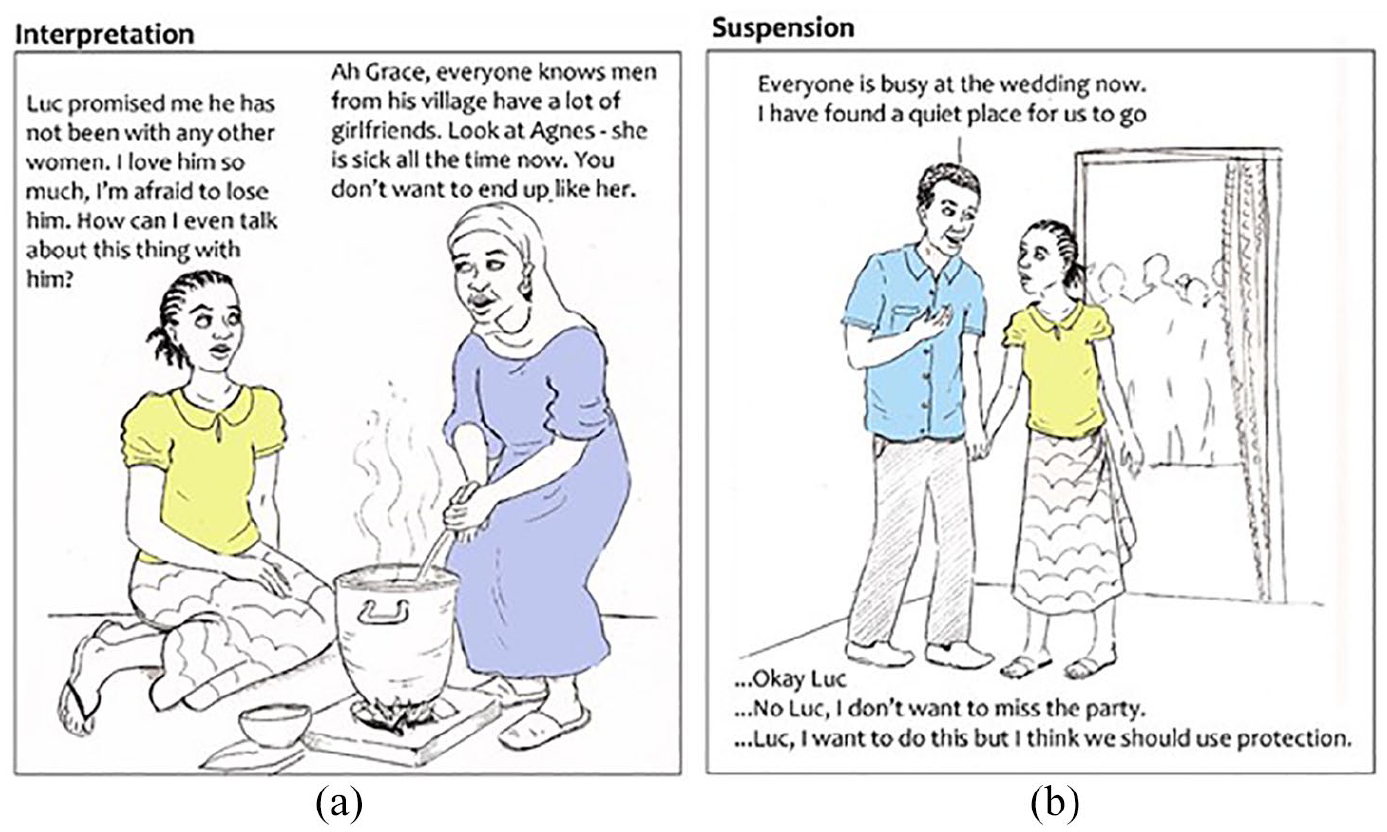
Sexual health decision-making interpretation (a) and suspension (b).
Practitioners of community-based participatory video suggest that the storyboarding task involves both the telling and the resolution of a story – a beginning, a middle and an end (C. Mitchell et al., 2011a). In determining a resolution to this scenario I began to find my authorial voice problematic. Initially I assumed that trusting Luc would involve proceeding with sex without instigating a conversation around condom use. However, I realised that this was exactly the kind of external labelling of ‘trusting behaviour’ that I wished to avoid. In fact, each of the three responses in the ‘suspension’ frame could have a variety of interpretations. For example, if she goes with him it may indicate she has suspended her uncertainties regarding the outcome, or that she is undecided (agnostic) or distrusts Luc, but physical and/or emotional dimensions override, or she lacks a language to engage in a discussion.
In depicting the outcome of the scenario, I was concerned about how contrived the story had the potential to be. In particular, as I discuss below, I was uncomfortable with the risk of stigmatising people in situations like those of my characters through my representation of them. I decided to open up a range of responses for Grace, foregoing the singular resolution a storyboard requires by introducing ‘logic modelling’ (W. K. Kellogg Foundation, 2004), commonly used in programme design and evaluation (Table 1, Figures 8a and 8b).
Possible outcomes of Grace’s trust dilemma.
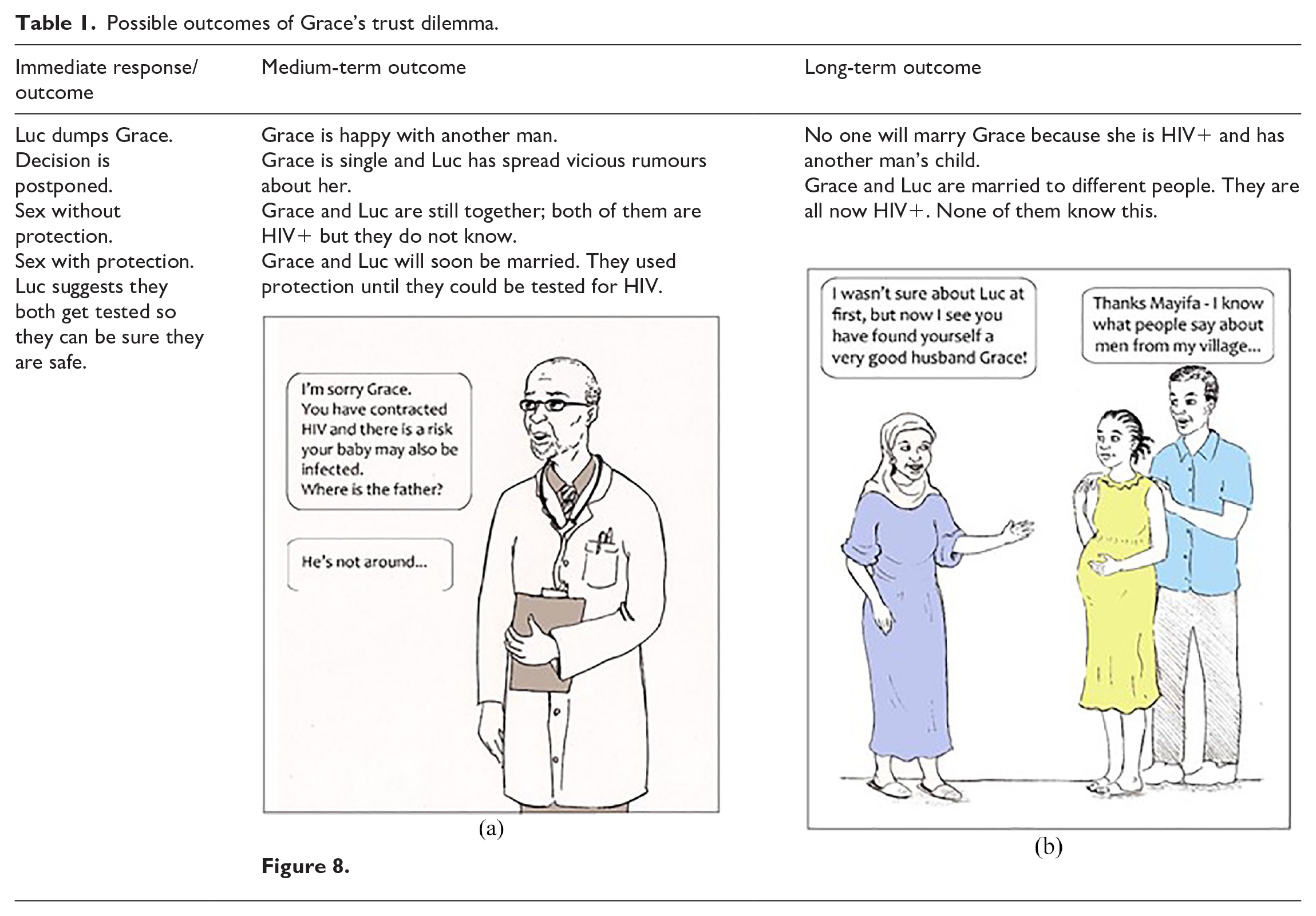
This breaking of artistic forms enabled creative progress (McNiff, 2011). Considering a range of (un)favourable expectations that Grace may reach suggested that these possible futures would have featured in her interpretation. Interpretation not only draws on thoughts, feelings and sensations, but is also an imaginative process of envisaging possible futures. This underlines the interconnections between stages in the trust process and reaffirms that this process framework is a conceptual construction that can be powerful analytically without these stages being neatly distinguishable in empirical reality. At a more detailed level of operationalisation, in order to avoid questions that will implicitly illicit a rationalist response within the context of an in-depth interview, based on the tentative reworking of ‘favourable expectations’ as ‘imagined futures’, I might ask, ‘what did you imagine might happen depending on how you acted?’ This assumes a retrospective approach; however, it would be possible to plan research around times of transition and investigate the trust implications of such conditions in the present.
Reflexivity and the author’s habitus
Proponents of arts-based methods have suggested that images, or art, are deeply revealing of their producers and the artistic process is a rich source of self-knowledge (Cole & Knowles, 2008; Piirto, 2002; Weber, 2008). Bourdieu’s call for greater reflexivity in sociology involves rapt attention to subject–object relations – not only objectifying the object of research, but also the process of objectification of the object, in recognition that I enter research with a pre-existing relation to my research object (Deer, 2014; Inghilleri, 2005). Bourdieu suggests that the range of what is knowable is constrained by the habitus: a structured system of dispositions formed through absorbing the history of the social field and the agent’s particular trajectory within it – ‘embodied history, internalized as second nature and so forgotten as history’ (Bourdieu, 1980/1990, p. 56). The habitus sets the ‘social limits of [the researcher’s] act of objectification’ (Bourdieu, 1997/2000, p. 120), unless those social limits are actively brought to light. Expressive visual methods provide a valuable means of ‘drawing [oneself] into research’ (C. Mitchell et al., 2011b, p. 34).
While drawing scenario two, I was conscious that I have close friends with experiences similar to those of Nathan, and a relative who is a consultant psychiatrist. I initially considered this as informative; however, as I took on the role of the author, able to tell the story of my choosing, I became emotionally exercised by Nathan’s situation, and tempted to use the storyboard as a platform to air political views. There are clues to this struggle: in particular, Nathan’s invisibility – he is spoken about ‘behind closed doors’ in the first and last frame, and his face is never shown.
In scenario two and to a greater extent scenario three I felt troubled by my ability to dictate the outcome of the central characters and, implicitly, people like them that I could not presume to speak for: creating representations of characters was not a morally neutral act (Tufte, 2006). The social and cultural difference between myself and Grace, in particular, made me cripplingly aware that I could know virtually nothing about how she might manage her vulnerabilities. Bourdieu uses the term ‘hysteresis’ to describe the experience of one’s habitus being out of synch with one’s social world. I lost confidence in my own ‘practical mastery’ or ‘feel for the game’ (Bourdieu, 1989; Bourdieu & Wacquant, 1992) and became sensitised to the distance between the social worlds of my characters and any in which I would have tacit knowledge of how to act.
Although I consider myself an ‘outsider’ to the experiences explored in scenarios two and three, the barrier this presented to the creative process caused me to reflect critically on the ease with which I manipulated the characters in scenario one. I felt no sense of uncertainty or ethical compromise in making their decisions for them and speaking on their behalf. I implicitly considered myself an insider to the situation I was depicting and therefore, by taking aspects of it for granted, risked being blinded to power relations and dismissing as ‘the way things are’ aspects that may be significant (Bourdieu & Wacquant, 1992, p. 127). Although these are purely speculative scenarios, were I pursuing any of these substantive areas in practice, being conscientised of my political and emotional responses, my ‘insider’ assumptions, and my ‘outsider’ ignorance, would contribute to keeping these dispositional tendencies from inadvertently entering into empirical research.
Conclusion: Capabilities and mechanisms of creative visual and multimodal methods
The accepted repertoire of methods for thinking conceptually and designing research – logical, verbal argumentation and quasi-mathematical visualisations – are conventional and standardised. While valuable, they represent a narrow and non-pluralistic view of the methods available to sociologists in inward-facing research practices. A more embracive approach may be constructive in yielding new insights or accounting for complex, immaterial forms of social practice, such as trust. Decisions made implicitly or explicitly at the pre-empirical stages of research reverberate throughout, defining what is discoverable. Inconsistencies create issues of quality, but are frequently hidden as sanitised ‘results’ mask the ‘artistry and craft’ embedded in scientific research (Lynch, 2006, p. 29). Creative, visual and multimodal methods can unpack assumptions and reveal inconsistencies in inward-facing research practices while enabling greater transparency of process in dissemination/communication. Although their status in the research is as a conceptual input alongside verbal argumentation, they can provide a model for methods that could be applied in outward-facing activities, breaking down the often arbitrary distinction between methods appropriate to researchers and participants/publics. I have shown the productivity of disrupting habitual academic practices through the introduction of a creative, multimodal method which has demonstrated a number of capabilities.
Firstly, it encourages continual attention to the construction of the object by strengthening the interaction between theory and practice: specifically, uncovering potential lapses to preconstructed notions of trust that are at odds with the relational, process approach advocated above – for example, conflation of trust with the trustor, limiting the content of interpretation to rational considerations, or external labelling of behaviours as trusting. Secondly, the creative engagement of visual/multimodal methods can suggest new dimensions of phenomena to be explored empirically: in this case, the interaction between trust at different scales (personalised, identity-based, institutional) and the connection posited between the conceptual stages of ‘interpretation’ and ‘favourable expectation’ through the notion of ‘imagined futures’. These adjustments to how trust is conceived are not ‘findings’ as such; however, they provide promising directions to be explored empirically. Thirdly, storyboarding has enabled reflexive attention to how the researcher is implicated in the object of her research. It provides space to observe emotional responses to the phenomenon and to reflect on their origins. It reveals how habitus limits the scope of what is ‘thinkable’ or ‘knowable’, which may predispose the researcher towards certain kinds of findings. Cumulatively, these capabilities suggest that creative, visual and multimodal methods are valuable additions to the researcher’s repertoire of thinking tools prior to entering the field.
What is it about the creative/visual/multimodal that distinctively opens up these possibilities? There are (at least) three mechanisms at play. The first concerns the creative process, which iteratively opens up and narrows possibilities. Working through a trust scenario involves imagining many possible responses of the protagonist to their dilemma; however, at some point I had to choose one response, and account for the repercussions in detail. Movement between the general and the specific is at the heart of learning and the structured use of a creative process harnesses these skills. Secondly, the particular qualities of the visual pose unique questions: for example, around setting, point of view, what is included or excluded from the frame, perspective, style, or the use/significance of colour. These decisions illuminate different facets of the object of research. Finally, the process of production opens up deliberative time to enter into a reflective mode of thinking which is conducive to the generation of new insights.
While my discussion has focused on the inward-facing, private potential for researchers generated through the creative process, the product itself is also relevant. Others may have different, complementary or conflicting insights based on examining these storyboards. This demonstrates the intersubjective strength of a visual or multimodal approach. Multimodal outputs lend themselves to the corporate and dialogical dimensions of research practice: I follow Rose Wiles and colleagues (2013) in supposing the most fruitful sites of innovation to be found in the diffusion of developments across a community for engagement and adaptation. Visual and multimodal approaches have a valuable role to play in this horizontal developmental process as they make thought processes, as well as their outcomes, transparent, create a space where abstract discussion can become concrete, and thus provide a platform for dialogue. Trust is one sociological concept which is key to understanding social relations and action but also difficult to define and capture; future work that builds on this approach may promote developments and discussion around other such concepts, for example inequality, spirituality, community or intimacy. More broadly, this article calls into question the dividing line that is often implicitly drawn between researchers and research participants, and the methods that are appropriate to each. In most respects we are not so different, and techniques that participative researchers use for data collection are available to disrupt, inspire, and reflexively shed critical light on our own thinking.
Footnotes
Acknowledgements
The author would like to thank Jo Le Prevost for her excellent artistic contribution, and Rosalind Edwards, Helen Kara, Pauline Leonard, Nyovani Madise, Silke Roth, Malcolm Williams and the reviewers for their valuable comments.
Funding
This work was supported jointly by the Economic and Social Research Council’s National Centre for Research Methods and South Coast Doctoral Training Partnership (award ref. 1096417).