




Abstract
The need for social as well as academic impact in social science research is now well established. Art is increasingly being explored as a means of generating social impact, most commonly as a way to engage publics with research findings, but to date with little exploration of the process of engagement itself. In this study, we set out to explore the power of art to engage the public. We do this by examining the ‘affective’ experience of engagement through a qualitative investigation using one-to-one interviews and a modified visual matrix exercise. In this article we report on the findings from our analysis of the affective experience of watching a film series, and through this discuss the use of film to communicate research findings and value of a novel qualitative psychosocial methodology for exploring the process of public engagement.
Introduction
The need to document impact in social science research has manifested itself most directly in the UK and elsewhere through the requirement to produce ‘pathways to impact’ documents when seeking grant funding and the measurement of impact within the various national assessments of research excellence (Reed, 2016). Impact within the UK Research Excellence Framework (REF) has been defined as ‘an effect on, change or benefit to the economy, society, culture, public policy or services, health, the environment or quality of life, beyond academia’ and is measured in terms of ‘significance’ and ‘reach’ (Higher Education Funding Council for England [HEFCE], 2011, p. 48). Beyond the UK there have been similar attempts to capture the societal impact of research in various ways though not – as yet – with quite the same precision or direct link with funding as we have seen in the UK. In 2016 within the UK there was a government funded review of the REF conducted by Lord Nicholas Stern (‘the Stern Review’). A significant outcome from this review has been the proposal that impact should be expanded to include public engagement, something notably absent in the original definition but which is the primary focus of this article. Needless to say, this growing ‘impact agenda’ has – since its conception – been subject to debate about the nature of what is (and is not) impact (e.g. engagement with publics) and also to considerable criticism of the underpinning market driven approach to research and possible negative effects on the discipline of sociology (see Back, 2015; Brewer, 2011; Martin, 2011; Penfield, Baker, Scoble, & Wykes, 2014; Reale et al., 2017).
Notwithstanding the political imperative and potential harms, the focus on impact and particularly public engagement, as a key component of impact, has led to considerable creativity in how academics might engage audiences beyond academia (Jones & Leavy, 2014; Leavy, 2015). The impact agenda – framed herein to include public engagement – is something that all of us in the social sciences must now grapple with regardless of the complexity of translating academic social scientific work into something more appropriate for diverse audiences (Bastow, Dunleavy, & Tinkler, 2014). With the growing interest in public engagement, which is only likely to increase in the UK if the proposals from the Stern Review are adopted, researchers have been exploring different ways of engaging publics with the use of art in a variety of forms. However, we contend that there has not been sufficient consideration as yet of the way that we might seek to rethink evaluation of public engagement beyond extant ‘cause and effect’ quantitative models. There is a strong case for needing to move beyond simple linear models of impact on the public, and to explore process as much as outcome, if we are to engage with the impact agenda in a way that does not inherently damage or distort social science disciplines (Shortt, Pearce, Mitchell, & Smith, 2016; see also Penfield et al., 2014).
In this study, we set out to explore the value of art as a ‘pathway to impact’ by collaborating with an artist to produce a film series. We describe an innovative psychosocial methodology designed to help us understand the processes involved in the ‘affective’ experience of viewing a film series. The film series was based on a large research project on relationships, with the aim that the films encode the research findings in a form that is affectively potent and readily amenable to decoding by a non-academic audience. In this article we report the findings from our psychosocial exploration of the affective experience of the film series, discuss the value of using film to communicate research findings, and demonstrate how the psychosocial methodology outlined herein provides the means to conduct a process-oriented assessment of impact through public engagement.
Performative social science and the evaluation of affective engagement
There has been rapid growth of interest in recent years in what has variously been called the performative social sciences (Denzin & Lincoln, 1994; Jones, 2006; Jones & Leavy, 2014) or arts-based research practice (Leavy, 2015). This body of work ranges from the forms of participatory action research that uses artistic techniques for data collection (e.g. photo-elicitation) to projects where art (e.g. film) is used to disseminate findings, and much in between (see, for instance, Johnson & Guzmán, 2013; Jones, 2006; Muir & Mason, 2012). The use of art for dissemination of social science findings is of particular relevance to this project and whilst there have been a number of fascinating pieces of work that have used art to engage publics (e.g. the work of Jones, 2006, 2007), there has been little attempt to understand the processes that underpin the potential ‘impact’ of this mode of dissemination itself (see Lambert, 2016, in this journal for a notable exception).
Film, in particular, has become well established as a means of data collection and dissemination within public engaged and visual ethnographies (Degarrod, 2013; Dicks, Soyinka, & Coffey, 2006; Franzen, 2013; Mosher, 2013; Pink, 2013). It is important to note that the work described herein is not ethnographic, nor are we describing a piece of visual methods research per se, accepting the difficulties inherent in making such arbitrary distinctions. Our use of film is as an addition to a more traditional mixed method research project, with the aim to explore and evaluate the value of film to engage publics as a pathway to impact. That is, we gained funding from our University Higher Education Impact Fund and used this to add an additional impact project on to a research project that had recently concluded, with this latter impact project lead by an investigator who did not play a role in the original research project (the first author).
Film is arguably a better medium for evoking emotion, rather than communicating complex information, where the written or spoken word is generally more effective (Gombrich, 1999; Leavy, 2015). Understanding the way that film may serve to facilitate a non-cognitive mode of engagement is critical (see Hill, 2005; Jones, 2003; Skeggs & Wood, 2012, for studies that provide valuable insight into affective processes of audience engagement with broadcast televisual material). With this in mind, it is important to evaluate the ‘affective impact’ rather than measure audience numbers or the communicative effectiveness (knowledge ‘exchanged’) of any artwork designed as part of a ‘pathway to impact’.
Affect is a term that is deployed in a variety of ways in the social sciences but is here being used as a way of referring to people’s emotional response, along with a broader social notion of ‘difference, process and force’ that is beyond any individual feeling state (Wetherell, 2012, p. 2). That is, in line with Lambert (2016), the focus on affect rather than emotion in this study enables us to better resist the individualising tendency that is at play in much research on emotion and turn our attention not to what emotions are but to what they do (Ahmed, 2004, p. 4; see also Fox, 2015). The challenge in researching affect is how it is ‘difficult to grasp methodologically’ (Hynes, 2013, p. 565) but here we follow Lambert (2016) with a focus on an analysis of ‘affective practices’ (Wetherell, 2012) and ‘affective economies’ (Ahmed, 2004). This study pursues similar concerns to Lambert’s (2016) moving ethnographic study of an art exhibition, albeit utilising a different methodological toolkit.
With the above in mind, a key element in this project concerned the ability to determine how we might best make sense of the processes underpinning the impact of the artwork, particularly its ‘affective impact’ and mode of engagement with the audience. This project involves us exploring the way that we might use film to ‘encode’ (Hall, 1980) affect such that people may find themselves affectively engaged with our research material. Our evaluation is therefore targeted at understanding the experience and process of affective engagement and ‘decoding’ happening within our audience.
We employed two methods for the exploration of the affective process of engagement in this study: qualitative one-to-one interviews and a visual matrix exercise (Froggett, Manley, & Roy, 2015). These qualitative methods were chosen primarily for the way that they allow space for phenomenological complexity in the viewing experience, that may also involve material that is – initially at least – consciously intangible or where the meaning is not yet known. They are particularly well suited to an analysis in which complex patterns of affect are central, and are discussed more fully below.
The film series
We called the impact project ‘The Art of Relationships’, with it being designed to explore the potential of art as a means of engaging a variety of publics on this topic. It was based on a large ESRC research project on relationships and involved a transdisciplinary collaboration between the impact project lead (a psychologist, DL), who had not played a part in the original research (adopting an ‘outsider perspective’), one of the original project leads (a sociologist, JG) and an established and well-recognised public artist, assisted by an experienced social science fieldworker (JL). The artist was provided with a book produced from the original research project that includes academic analysis of key findings (Gabb & Fink, 2015), and was also briefed in person. He then sought to immerse himself in the findings independently in order to produce his proposal for the film series. Feedback was provided by the project team, with this mostly concerning the need to encode the research project findings and account for diversity rather than direct input on the production of the output.
The original research project (‘Enduring Love’) was designed to investigate how couples sustain their long-term relationships, focusing on the meanings and practices of relationship quality and stability. An online survey focused on understanding the patterning of relationship practices across a large and diversely constituted sample whilst qualitative research generated rich data on relationship experience and the everyday ways that couples work at their relationships (Gabb & Fink, 2015). Overall, whilst findings point to great diversity in relationship experience, what is clear is that relationships are experienced and sustained through ‘everyday’, often mundane, relationship practices (like taking out the rubbish each week) and shared activities (such as dancing at home). Such everyday couple relationship work is not simply experienced as the drudgeries of domesticity, it enables couples to embrace and nurture their relationship, and to invest in each other and the long-term ‘relationship horizon’ – together.
The artist contracted to work with us on the project was Steve Geliot (www.stevegeliot.com), an established filmmaker who works primarily in producing public artworks, often using large-scale projections. He produced a series of films entitled ‘Molecular Human’, which included 14 films: (1) Primordia; (2) The Awakening; (3) A Proper Cup; (4) Bills and Bathrooms; (5) The Bridge; (6) It’s Been a Year; (7) Apple Pie and Custard; (8) The Argument; (9) Digital Life Together-Apart-Together; (10) Watching Kettles; (11) Game of Phones; (12) Washing up; (13) Home Truth; (14) Binoculars. The films ranged in length from 2.35 to 8.23 minutes with a total running time of a little over half an hour. Each film in the series was inspired by the research findings. The Proper Cup, for instance, focused on the ways that ordinary acts of kindness and ‘deep knowing’ (Jamieson, 1998) serve an important relationship maintenance function, which may help to sustain a relationship over time. Digital Life was inspired by the way that it is possible to negotiate intimacy in spite of and/or through digital technology. Actors were used in some of the films, with friends (e.g. existing couples) and family (e.g. mother and father) of the artist in others. The films were entirely conceived and scripted by the artist, with some improvisation from the participants. None of the participants from the original research study played a role in the films or film process. A key element of the project was to launch the film series at a public event that would provide us with an opportunity to explore the affective impact. This event took place in Central London with approximately 200 people attending. Details of the project and all the films are provided on the project website (www.open.ac.uk/researchprojects/art-of-relationships/), and also on the artist’s own website (www.stevegeliot.com).
Evaluation methodology
This article reports on our use of a modified visual matrix exercise involving 16 people (including the facilitator) and 15 qualitative one-to-one interviews to investigate the affective impact of the film series. Participants were a self-selecting convenience sample of people who responded to an email sent out prior to the launch event and through recruitment at the event itself. We decided to use interviews alongside the visual matrix in order to balance group-level associative data with individual experiential accounts. This provided the opportunity to gain greatest insight into the processes underpinning the affective impact of the film series. The visual matrix exercise was conducted immediately following the presentation of the film series at the launch event. This phase of data collection was designed to generate group-level data and as such we did not collect data on individual participant demographics. We note, however, that the group reflected the make-up of the event audience, with it being well balanced for gender, age and ethnicity.
The visual matrix method was developed as a means of researching shared experience following the collective experience of some sort of sensory material – such as films, visual or phonic art (Froggett et al., 2015). The method draws heavily on ideas and techniques from social dreaming methods (Lawrence, 2005, 2010), with a basis in object-relations and Deleuzian psychosocial theory. It was initially developed as a means of evaluating the experience, rather than economic or environmental impact of artworks in an AHRC (Arts and Humanities Research Council) project (Froggett, Manley, Roy, Prior, & Doherty, 2014). The method is designed to encourage associative thinking (group-level free association) to the stimuli such that imagery, visualisation and affect take priority over cognition or discourse. This aims to generate data on and access to the ‘unthought known’ aspects of experience (Bollas, 1987).
The visual matrix is run as a group exercise and in this study we had one facilitator (JL) with 15 participants. Participants can be selected on any criteria appropriate to the study and in this case participated on the basis of their shared experience of viewing the film series at the launch event. The method requires that participants and the facilitator sit on chairs in a ‘snowflake pattern’ (see Figure 1) such that they can avoid direct eye contact and speak into a shared space rather than to one another. The facilitator invited participants to express their experience in terms of ‘images, associations, thoughts and feelings’, without turn-taking. It was emphasised that no judgement would be made about any contributions. Critically, the facilitator models appropriate behaviour such that participants are encouraged to maintain a similar mode of engagement where they talk about imagery, associations and feelings, rather than engaging in analysis or discussion. The session ran for about an hour and then after a short break the chairs were rearranged into a semi-circle, wherein participants were encouraged to reflect on what emerged in the previous ‘snowflake’ session and identify clusters of imagery, thoughts and feelings. These themes were then mapped on a flipchart by the facilitator. The matrix exercise and summary discussion were both recorded and transcribed verbatim.
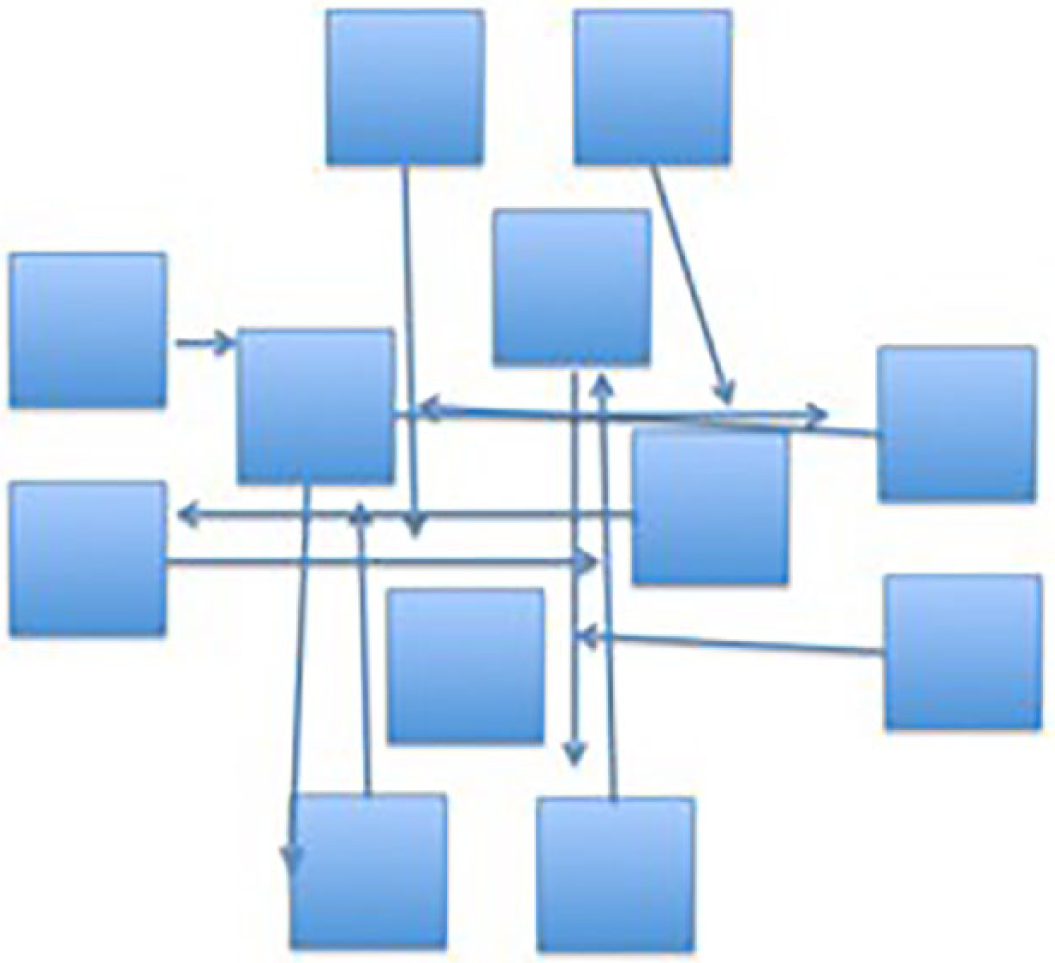
Snowflake pattern’ for chair layout in visual matrix method.
Data analysis is traditionally informed by object-relations theory but in this case we opted for a hermeneutic phenomenological analysis of the matrix material (Van Manen, 1990, 2014), rather than engage in a detailed psychoanalytic analysis. This form of analysis results in themes that in some sense capture the essence of the meaning of the material presented, very similar to traditional sociological modes of thematic analysis (e.g. Miles & Huberman, 1994). This analysis included discussion of processes of identification but did not move further than this into object-relations or other psychoanalytic theory. We believe that this approach better fits the needs of this project because it (1) enables the same method of analysis to be used for both individual and group-level data, (2) reflects the mode of analysis completed in the underpinning research project and (3) avoids the need for extensive knowledge and discussion of theories, methods and debates about psychoanalytic modes of analysis, providing a more readily ‘portable’ evaluation method (see also Langdridge, Gabb, & Lawson, 2018).
The interviews were conducted within three weeks of the launch event. The sample included 10 men and five women, nine of whom were in a relationship. Eleven participants were recruited from the people who attended the event and a further four watched the film series online only. We wanted to include participants who had not attended the launch event in order to determine whether the experience of viewing the films was substantially altered by the viewing context. The mean age was 41 years, with a range from 22 to 68 years (very much reflecting the demographics of the event audience). Eight participants identified as heterosexual, four as gay/lesbian and three others as bisexual or queer. Eleven people described their ethnicity as White British/European, two Afro-Caribbean, one Asian and one Middle Eastern. The interviews were semi-structured and framed across three categories of questions: (1) experience of watching the films; (2) reflection on own relationships; (3) opinions about use of art to communicate research findings. We asked participants to describe their experience of viewing the films, about their thoughts and feelings and any significant moments that they recalled. In addition, we sought out people’s views about the use of art as a means of communicating research findings. The interviews were conducted in person or via Skype by the third author and lasted on average about 30 minutes each. The data generated from the interviews were transcribed verbatim and analysed phenomenologically in the same manner as the visual matrix data.
Findings
The analysis of the visual matrix exercise revealed a compelling picture of complex affect in which images and sensations flowed across a number of domains. This material was captured both in the transcript of the matrix exercise itself and also in the summary discussion that took place with dominant themes written on a flipchart (see Figure 2). Findings from both elements of this process are reported below.
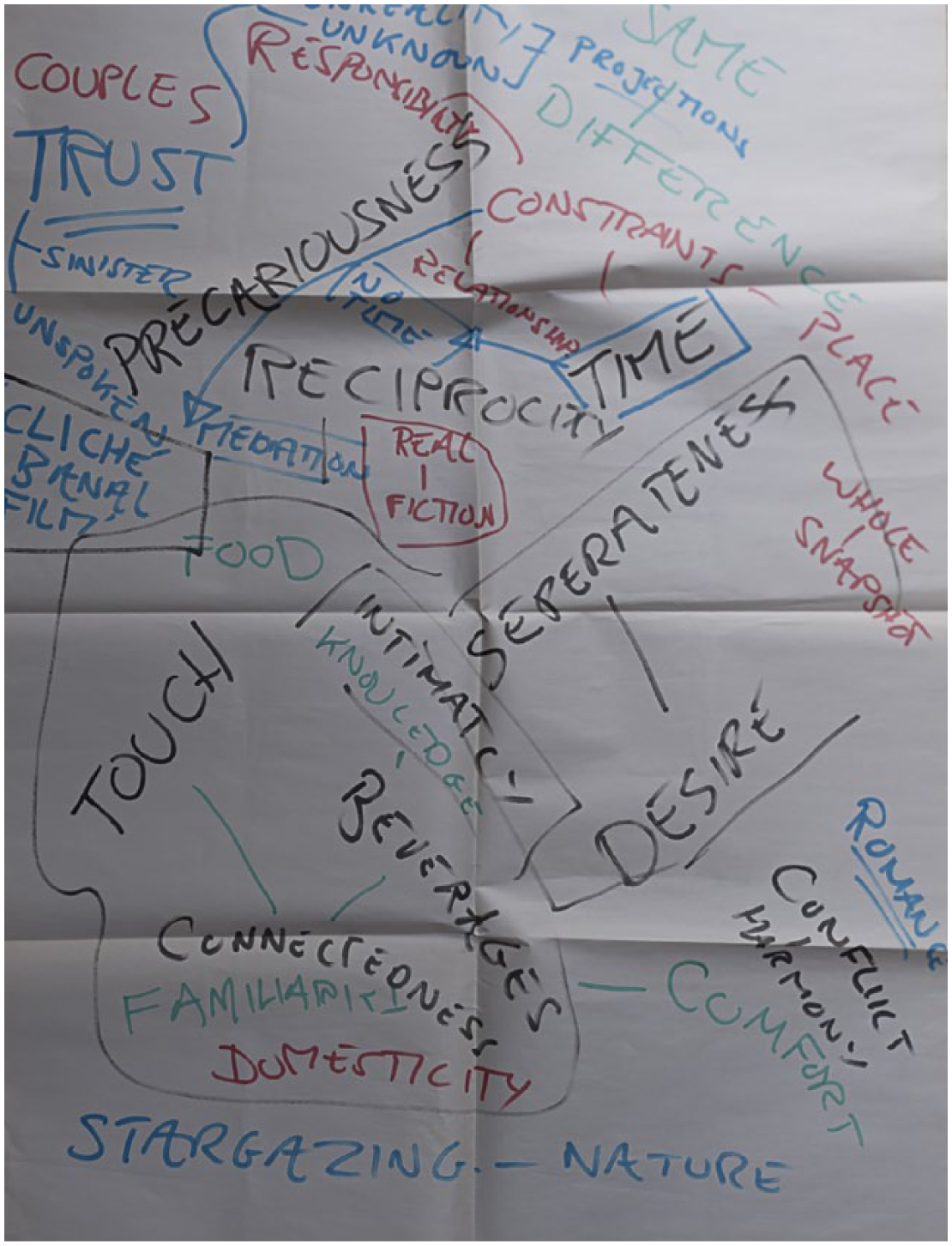
Flipchart recording of themes in summary discussion.
There was talk of temporality, objects and relationships enduring over time, including the potential for positive change even in the context of social and emotional precarity. The theme of embodied touch figured large in the social imagination of the matrix. This was connected to images of bodies engaged in dance, the ritualistic making of cups of tea or in some other everyday act of domesticity. This evoked feelings of comfort and familiarity, trust, intimacy and desire alongside separateness and suspicion about the potential sinister and/or unspoken content. Talk circled around the notions of difference and sameness, conflict versus harmony, the real versus the fictional, and narrative drama versus the poetic snapshot. Some people adopted either side of these polarised positions whilst others resisted or opposed them. Questions of technology and the material world mediating interpersonal connections were raised and inflected by generational difference, alongside concerns about filmic cliché and representation of the banal. People felt privileged to witness the intimate lives of others and identified with stories of intimacy, bonding and struggle, whilst others craved more ‘edgy’ and obvious signs of argument, conflict and anger.
This free-floating group-level affective decoding resonated with many of the central themes encoded in the films. These findings, alongside those of the interviews, speak directly to Hall’s (1980) model of encoding/decoding as they concern the ways in which encoded research messages in the films were engaged with (or not) and then decoded (or not) by the audience. Two complementary themes became apparent in our analysis of both the visual matrix and interview data, which we labelled: (1) affective engagement and identification and (2) ‘real’ versus fictional representation. These themes were very much grounded in the experiences of the participants (singularly and collectively) and represented their phenomenological perception. The themes raise important questions about affective processes of identification and the sociality of affect, which are discussed further below.
Affective engagement and identification
There was a considerable degree of emotional engagement demonstrated in the interview material in addition to that reported above from the visual matrix. Participants’ stories of their experience of viewing the films were deeply inflected with affect and clearly demonstrated the power of artistic media to ‘affect people’ (Ahmed, 2004) who otherwise might be disinterested in academic research findings. The visual matrix was particularly valuable here in providing a space in which the more intangible aspects of this affective engagement could be explored and shared. Participants connected with one another in the production of an affective assemblage concerning their experience, producing data that were distinct from those collected through the individual interviews. Affective imagery rose up and was engaged with across people associatively. In the example below, for instance, a central affective theme of touch and connectedness – and the mediation of this through technology and other material barriers – manifests as a central aspect of the viewing experience.
for that, it’s almost like they have them there, and they were perhaps … connecting with other people but not actually connecting with each other.
And for me the hands and that was almost a yearning to be touched, to be very connected with someone. And so when I saw the screen between them, it came as, I could see quite a can never quite meet, and yet put them down, kind of pretty well the same. I know there is, there seemed to be, I think that kind of for me sense of the alienation that you kind of feel a lot of the time, social media and yet there’s … a huge gulf between us in some ways. […]
The use of light was also, not just the hands but the light was also kind of a constancy throughout the sketches. And to me, it meant so many different things. It meant warmth, meant hope, meant just the beauty of starlight that the last couple was sharing … and it meant protection, there was an aura in the first … I forgot the name of the first movie, it was kind of an aura that was protecting that unit that just met with each other. Light was very powerful and it was really […]
That connects very strongly to the image of the hands touching across glass to bring you back the being quite close but separated by something quite fragile.
The combination of film and music appeared significant in facilitating this affectively engaging experience and, for those people who watched the films at the event their engagement was heightened by the presence of other people. The high level of emotional engagement that was elicited moved the viewing experience beyond that of spectator and spectacle, with it instead provoking reflection on a person’s own relationships. In a number of cases this occurred in quite profound ways.
Well I literally like cried during the one that erm, where the, the child had died, I forget the name of it, you know, on the stairs, erm, and I had to … ’cause I was quite er … I was in the busiest room and erm … I felt like … er you know, I, w, like there was, there was tears streaming and I didn’t want you know … ’cause you know, people were taking pictures and watching and I just was like trying to very … er subtly push the tears away, um, so that kind of surprised me to be that moved by something, and … what other feelings … at the feeling good, like cute, some of it was quite funny I thought and erm it was … um … I felt … I felt sort of privileged to at the time what I thought, share this intimate moment of these people … erm … and I think that’s what really made me feel connected to it, because … like everyone had different experiences of relationships. I guess having said that, like it brought up some of my own stuff with relationships, which I didn’t expect … I didn’t necessary like <laughs>. So there was a few of them, I can’t remember which film clips, but … you know there was d, definitely some of them er … er, made me feel, erm … like I was reliving some of my own lessons in terms of relationships. […] (P3, F, 37)
Identification was highly significant for emotional engagement, predominantly in the form of identification with character or narrative (cf. Baudry, 1970/2011; Metz, 1977/1982). This mode of identification was temporally inflected, with people identifying with past, present and future selves. People would connect with the films on the basis of it reminding them of their own childhood experiences or through identification with a possible future self (in relation to another) as well as through connections being made with their present lives. In addition, people would also identify on the basis of known others in their lives (e.g. friends and family), with some form of ‘vicarious identification’ in play. For example, the story of loss and bereavement that initiated such powerful emotional responses did so not by virtue of shared experience, but through a vicarious ‘what if’ identification.
Only films with an inherently powerful narrative, such as ‘It’s been a year’, which concerns the loss of a child and how the couple manage to strengthen their relationship through this tragedy, seemed able to emotionally engage people beyond processes of identification. This is consistent with recent work on persuasive communication (e.g. Igartua & Barrios, 2012; Igartua & Casanova, 2016; Murphy, Frank, Chatterjee, & Baezconde-Garbanati, 2013) and suggests that if we wish to engage publics with our research findings then we either need to ensure that the material presented offers up the chance of character identification or presents a powerful narrative that speaks beyond personal character identification.
Diversity and representativeness in the film material also proved to be important and was frequently invoked by the participants as directly linked to identification. This lends support to the arguments about the need for ‘homophily’ (similarity) with media figures in addition to narrative identification (Andersen & De Mancillas, 1978), but it also operated as a wider discourse in which people were actively reading the films critically, deploying cultural capital through film theory in the process (Bourdieu, 1986). There was both a positive recognition of diversity in the films and also a critical (almost Foucauldian) oppositional reading of the film discourse of diversity as a ‘tick box’ exercise, similar in form to the distancing work demonstrated by middle-class participants in Skeggs and Wood (2012).
Erm … it … there was a sense of … <pause> when, when there was a working-class couple, a working class black couple, it felt, ‘Oh, oh right, done now, paper ticked, we’ve got some poor black people in, tick, now we can get to the other stories.’ (P1, M, 50)
This identification with the apparatus of the film, particularly the apparent intention of the filmmakers, is challenging because it can subvert the process of engagement itself (cf. Baudry, 1970/2011). That is, when this discourse was invoked it invariably led to people disengaging with the film content and instead seeking to decode the film series on the basis of distancing film theory rather than their own relational experience.
The ‘real’ versus fictional representation
As mentioned above, there was considerable interest in the process of film making itself in both the interviews and visual matrix, which often diverted attention away from personal engagement. People were keen to act as ‘critics’, particularly around the ‘relations of production’ (Hall, 1980). A central part of the critique of the relations of production concerned the notion of whether the films were ‘real’ or ‘fictional’ representations. That is, were the stories ‘real stories’ of everyday lives? Most importantly, were the people involved ‘real people’ or ‘just actors’? Were we getting a glimpse into ‘reality’ itself or seeing something performed? The former was clearly much more highly prized than the latter and undoubtedly reflects the broader change in the public consumption of ‘reality’ programming in film/TV (Biressi & Nunn, 2005; Hill, 2005; Jones, 2003; Skeggs & Woods, 2012). Here, the confessional has become entertainment and notably the private is rendered a public commodity that offers a privileged gateway to the (ideally troubled/scarred) real/authentic self.
This reality TV discourse generated a desire to be ‘involved’ with the real stories of other people’s lives via the furtive excitement of gaining access to something that is normally private. This was about wanting access to something outside the viewer’s own everyday experience to validate, reinforce or even unsettle their own relationship experience, learning something about themselves from other people’s otherwise private experience. It is interesting to note that the desire to glimpse ‘behind closed doors’ is particularly pronounced when the topic at stake is intimacy, a public–private concern that has been the subject of so much discussion in recent years in social scientific research (Giddens, 1992; Jamieson, 1998).
The big shock was I thought they were all real. I didn’t realise that some were, somebody told me, ‘Oh well, they’re not all real stories, they’re, some of them are scripted and actors’, and that was, that just came as a real shock to me, I thought oh really, that was really bizarre, that erm … ’cause I really thought I was watching real stories. (P1, M, 50)
Part of the concern about ‘the real’ was about gaining access and insight into ‘authentic’ stories or ‘snapshots’ of people’s lives as lived – the ‘ideal of authenticity (Taylor, 1991; cf. Atkinson & Silverman, 1997). Fictional representations – even of ‘real’ stories – were not enough. There was a desire for insight into the everyday, a desire for ordinariness to be portrayed on the screen, similar to that reported by Hill (2005). Those viewers who did not immediately engage with the material on an affective level but instead adopted a more distant critical stance were actively refusing any notion of visual performance. People wanted and enjoyed real examples of lives that were familiar, even if they were not part of their personal experience, and particularly if they also challenged and provoked. Referring to the film about queer youth Game of Phones, one participant reflected: Yeah, it was … they were just being themselves it felt like. I felt they were just being themselves. Like I, I’ve erm … met a lot of young people who are questioning their sexuality and they kind of flow between boys and girls and stuff, and that’s quite common. (P2, M, 54)
The films challenged traditional televisual modes of engagement as they were not documentary format in any simple sense nor were they fictional, nor were they even in line with contemporary reality TV. There was therefore a breakdown in the ‘personalised reality contract’ (Jones, 2003). This led to an ambiguity in reading the films that we had not anticipated. Ambiguity has been shown to produce anxiety (Grupe & Nitschke, 2013) and whilst some people simply responded with an affective immediacy to the material, the ambiguity was clearly uncomfortable for other audience members who were keen to critically engage the material on the basis of filmic structure and form, and who were already more detached. Thinking through the lens of what ‘affects do’ (Skeggs & Wood, 2012, p. 144), we inadvertently produced a (possibly class-based: see Skeggs & Wood, 2012, p. 226) dividing line between engagement in the ‘emotional presentness’ of the material, particularly its authenticity, and detachment resulting from a frustrated critical stance (‘cynically chic’: Hill, 2005), at least in part as a result of the perceived breach in viewing contract. It appears that this audience were far from ready to embrace Baudrillard’s (1994) hyperreality, with them instead demonstrating an anxious desire for something of a pre-18th century notion of representational certainty through their determination to engage in judgement about the accuracy of the material (Taylor, 1991).
Linked to the desire for ‘the real’ was a tension around ‘troubling representations’ of minority groups versus a desire for something affectively ‘edgier’, perhaps as part of a voyeuristic search for a troubled authenticity revealed through the twin hands of researcher and filmmaker (cf. Atkinson & Silverman, 1997). The negotiation of an ‘as if’ discourse concerning the management of social judgements (Skeggs & Wood, 2012, p. 223) was apparently transferred from a relationship between audience member and televisual character to a relationship between audience member and film producers. It was the film producers within this affective assemblage who were subject to critique for breach of contract, for not fulfilling the affective needs of the audience, for not delivering our side of the ‘personalised reality TV contractual’ bargain (Jones, 2003). This was a contested realm within the visual matrix, where the ‘fault lines’ of acceptability/permissibility and reality/fantasy could be explored with considerable affective force:
I also picked up some negative messages to be honest. Er, I … what I said to Mary is why is that the gay relationships are in a threesome, that is quite stereotyped. Why wasn’t it more intimate relationship? […]
That’s funny ’cause I was so glad that the first sign of the same-sex relationship was the threesome. I thought thank God it’s not going to be a heteronormative. I was like yeah, great.
I get that.
Break the rules. It’s like break the fucking rules. It’s like yeah, fantastic. I was really pleased about that. […]
There’s a lot of baggage attached to a representation.
Yeah.
I thought the intimacy in the three-man, those three men, that was really lovely. I was thinking how can you do this in practice, men …
For some, at least, we stereotyped, for others we failed to provide the necessary spectacle, the fights and arguments, sufficient to affectively engage these particular audience members. This tension is something that poses a particular challenge for film-based impact projects seeking to affectively engage a diverse audience.
Conclusion
In this article we have sought to describe a novel approach to how we might better understand the affective engagement of people with art. We thus offer a new model for exploring, and also evidencing, public engagement as part of the broader impact agenda. For our part, here, we have explored the way that film has the capacity to represent complex research findings in a readily accessible form. We move beyond measurement of engagement in terms of audience numbers or simple questionnaire feedback on the amount of knowledge that has been ‘transferred’. Instead, we have explored means to generate multidimensional engagement data by capitalising upon widely held media literacy to investigate the process of affective engagement. That is, we identify the key processes of engagement: (1) empathic engagement; (2) transfer of knowledge through an experiential process of identification. We argue, in line with Shortt et al. (2016), that given the enduring nature of the impact agenda, which increasingly incorporates the need for public engagement, it is vital for us to find ways of exploring and evaluating impact that do not unnecessarily distort our work or working practices in ways that are not conducive to creative human scientific research practice.
We have explored how the visual matrix exercise along with individual interviews can provide insight into what affectively engages people and how this manifests at both the individual and group levels. These insights are valuable for improving our own work in engaging different publics and also may assist other researchers who might want to employ similar methods in their own impact activities. The matrix exercise decoupled the data from individual experience. It provided space for the recounting of imaginative moments of engagement, relationships and associations that focused on particular moments of what might be termed ‘affective intensity’. These moments of ‘affective intensity’ help to shine a light on otherwise unknown and/or unknowable aspects of felt experience.
It is valuable to think further how this novel approach to public engagement might be used elsewhere and expanded in scope. For instance, might it be possible to work with mainstream broadcast television to screen findings from research much more widely? This would undoubtedly be a challenging undertaking with considerable complexity in relation to editorial control, ethics and the like, but is a possible avenue for future work that is bigger and bolder in ambition and scope. We might also explore wider engagement through the use of greater online presentation of visual material followed by data collection that is also online. This might prove to be a more cost effective way of investigating affective impact and providing a forum in which viewers can engage with each other in a productive social space following presentation of visual (or other affective) research informed material.
Notwithstanding the limitations of this particular project, the investigation of affective process presented here demonstrates how identification, particularly with character/narrative, alongside a degree of ‘homophily’, proved to be an important aspect to engagement. People engaged with real or imaginary selves in the films, from their own past, present and future. We also gained insight into the potential value of ‘vicarious identification’, with people affectively moved through a process of identification via a known other (friend or family member) or a spectre that represented their imaginary fears or possibly secret desires. Beyond the process of character identification, it was apparent that the most affectively powerful material was that which involved a strong and coherent narrative. The story of the loss of a child was a notable example of a film remarked upon by most (if not all) participants because it not only concerned an inherently provocative topic but also drew on a clear narrative structure that involved the viewer in a temporal process of unfolding discovery, namely how would bereaved parents continue with their lives and relationship thereafter.
Beyond identification, viewers were also engaged in a critique of the relations of production. This involved a particular concern with whether the film series included ‘real’ or ‘fictional’ accounts and ‘real’ people or actors. Access to ‘real’ life stories of the everyday was highly prized, as we might expect in a world of reality TV, where reality and fiction is increasingly blurred (Baudrillard, 1994), with many of us used to televisual access into the private world of another. The way that reality TV knowledge now problematises the presentation of academic material if it moves beyond traditional documentary formats needs to be recognised. We were rather surprised by the critical (at times, cynical) stance of some audience members and the distancing impact of this stance upon their affective engagement. Furthermore, reality TV programming often presents a spectacular vision of ‘reality’ and the non-delivery of spectacular material in these films was – somewhat ironically – perceived as a project failure to represent the ‘reality’ of day-to-day life by some audience members. We also saw the deployment of a critical diversity discourse, beyond issues of whether the stories and people were real or not, which was somewhat complicated. The inclusion of diverse stories brought praise from some and criticism from others. How we might ensure representativeness with future visual media impact activities without appearing to be performing some kind of ‘tick box’ exercise in diversity management remains a challenge.
The visual matrix methodology, combined with individual interviews, proved to be a particularly effective way to determine whether the research messages that were encoded in the film material were successfully decoded by the audience. Through this methodology we also gained a richer sense of the underlying processes of affective engagement generated through associative engagement in the space. We found the messages encoded in the film series were – more often than not – successfully decoded by the audience, with deep and personal reflection on their meaning a central aspect of the affective process (cf. Lambert, 2016). All our viewers thought that the use of film was a worthwhile idea, even those adopting a more critical stance, and one that is more likely to engage them with research findings than written material. They were clear that film and music had the potential to ‘start a conversation’ and through this provoke critically engaged dialogue about more complex academic material. We will need to find ways to continue the conversation and improve our means of engaging publics but we feel we have at least taken a first step in this direction by beginning a conversation.
Footnotes
Acknowledgements
The film series discussed in this article was based on research findings that derive from a mixed methods UK study, Enduring Love? Couple relationships in the 21st century, funded by the ESRC (RES-062-23-3056). Fieldwork for this study was completed between 2011-2014 and the dataset includes qualitative (n=50 couples) and survey (n=5445) materials. All data are archived with the Economic and Social Data Service.
Funding
This project was funded by the Open University Higher Education Impact Fund.