




Abstract
A sociology of street children has emerged defined by its rejection of the dominant narratives of child welfare organisations that identify the street as the root cause of children’s immiseration and improper socialisation. In its place, sociological analysis has undermined the value of conceptualising street children as a coherent group on the street and in a parallel move has looked to conceptually reposition street children away from assumptions of passivity and neglect, towards a foundational insistence that the starting place for analysis is the positioning of street children as active and strategic social agents. It is the adequacy of this latter concern that is the focus of this article. By reintroducing the location of children within the social relations of the informal street economy, this article draws upon extensive and long-term qualitative research examining the lives of street children in Accra, Ghana. The argument here is that sociological notions of strategic action and efficacious agency seem ill-suited to accounting for the dilemmas and difficulties that street children’s quests for paid work inevitably involve. Rather, it is relative good fortune within the radical uncertainty of the social relations of the informal street economy that seems much more appropriate to accounting for how these children are integrated into work.
Sociology has been a dynamic force in the development of the study of street children. A defining feature of this has been the opposition to the insistence of most global child welfare organisations that the street is responsible for the immiseration and improper socialisation of poor children. There are two main aspects to this. On the one hand, street children are said to elude the generalised descriptions of institutional classifications and so comprise no meaningful social category at all. On the other hand, sociological analysis also rejects the representation of street children as passive and dependent, preferring instead to assert that they are serious strategic actors capable of managing their lives and influencing the world around them. It is this repositioning of street children as social agents that is the focus of this article.
In the following section this sociological reconstruction of street children as social agents is considered in further detail. While sociology has undoubtedly raised serious questions about orthodox understandings of street children’s lives, it is argued that there are significant limits to its reconceptualisation particularly as it relates to the assumption that street children are capable strategic agents. These limits become especially apparent when the informal street economy is allowed back into analysis and in the following section the implications of this are explored in greater detail. Answering questions about the agency of street children is ultimately an empirical issue, however, and so the article continues by presenting detailed findings from long-term fieldwork in Accra, Ghana. Following a brief summary of this research, the article considers how street children seek integration into paid employment in the city’s vast informal economy. This is organised into specific sections discussing the principal forms of paid work available to street children, their successes or otherwise in entering these, and their ability to influence the form and content of their work. The general argument developed is that the street children who participated in this research are certainly not passive in the search for paid work, but caution is required in regarding this as evidence of their strategic agency given the conditions they confront each day under the radical uncertainty of the informal street economy.
When street children disappear
In much recent sociological analysis, street children are presented as an invention of the global North. Their existence, so this argument goes, is the product of an instrumental discourse, a social construct created and perpetuated by powerful organisations and one that tells us more about how these institutions establish viable categories to justify their programmes than they do about the lives of poor urban children (Glauser, 1997; Panter-Brick, 2002). By deconstructing this self-serving designation, sociological critique establishes its normative basis in ideas of childhood taken from the global North and how this provides the benchmarks against which poor children are judged. When combined with the epithet street to differentiate these children from their domesticated western counterparts, institutional discourse normalises the notion that children on the street are out of place, at risk, passive, impoverished and disconnected from home and adult society.
Once its existence in discourse has been secured in this way then street children can be made to disappear from view. In an important intervention, Gigengack (2014, p. 267) identifies how the ‘discursive determinism’ that underpins sociological critique permits both the dissolution of street children as a coherent social category and then their rehabilitation as capable social agents. Justification for the former manoeuvre is found in the social constructionism of the ‘new’ sociology of childhood and its rejection of the child as a universal category of human existence. By insisting that the child is a product of society and not nature – ‘[t]he immaturity of the child is a biological fact of life but the ways in which this immaturity is understood and made meaningful is a fact of culture’ (Prout & James, 1997, p. 7) – understandings of childhood require differentiation by time and place; and so street children too are neither ‘a discrete nor necessarily homogenous category’ (Panter-Brick, 2002, p. 150). It is from this that the sociological stress on children as agents emerges. If the unitary street child is no more than a discursive construct, then so too is its (ideological) underpinnings in assumptions about the passive and dependent child brought into existence by orthodox developmental psychology. Once sociology has deconstructed the helpless and singular street child of convention into its fragments, then conceptual space is opened up for street children’s discursive rehabilitation as ‘empowered social beings able to construct meaning and effect change in their world’ (Kovats-Bernat, 2006, p. 4, original emphasis).
Of course, in this deconstruction of institutional discourse careful consideration is required of the adequacy of what is reconstructed in its place. Among the major insights that sociology has brought to the study of street children is the insistence on the inescapable role of discourse and theory in defining understandings of what children do and are on the street; and the limits that sociological analysis places on the often-casual universalisation of what is in fact situated and particularistic knowledge. To acknowledge this, however, does not necessarily mean licensing the sociological alternative so advanced. More specifically, to equate the (non)existence of street children with how they are (re)constructed in discourse is to risk the ‘epistemological fallacy’ (Sayer, 2000, p. 90) of harder versions of social constructionism, where awareness that knowledge of the lives of those like street children is always a social construction is conflated with the constitution and production of those worlds. To make them meaningful the lives of street children necessarily require interpretation and construal, but concepts on their own are rarely sufficient since what is encountered in the process of observation is never amenable to any type of (re)construction.
It is this that Gigengack alludes to when he notes how the street child of contemporary sociological discourse encourages ‘immun[ity] to empirical scrutiny’ (2014, p. 268). Indeed, contained within this emerging canon are examples of the limits of its own constructions where, as Gigengack remarks, findings from the field lend support to the notion that children do establish more-or-less discrete groupings on the street. Of greater concern here, however, are the limits to the sociological reconceptualisation of street children as empowered social beings, whether ‘serious … social, economic and political actors’ (Offit, 2008, p. 59) or ‘capable social agents who construct meaning and subvert power’ (Ennew, 2003, no page). The frequency with which claims to the agency of street children establish the starting point of analysis is especially noteworthy given that the street as a material and practical domain of human activity no longer seems to merit much attention: a ‘change in perspective’, summarised by one influential contribution, ‘that reflects a shift of attention from the street as the primary focus of concern (as an unacceptable or unhealthy environment for children) to the children themselves (paying close attention to the diversity of their actual experiences and their own strategies for coping with adversity)’ (Panter-Brick, 2002, p. 148). Sociology may have done much to question casual generalisations of the street child as the damaged, alienated and isolated victim of institutional lore, but in doing so it has withdrawn from exploring the implications of the street as a site of material practice for the adequacy of understandings of street children as ‘capable’ ‘effectors’ of ‘change’ and ‘serious’ ‘strategic’ players.
Bringing the (informal) street back in
Bringing the street back in seems especially important to the lives of street children in Sub-Saharan Africa. Characterised by remarkable rates of urban expansion (UN-HABITAT, 2010), the subcontinent stands as a ‘radical instance’ (Harrison, 2010, p. 4) of neoliberal globalisation that has disarticulated breakneck urbanisation from sustained development. Described as an ‘urban climacteric’ (Davis, 2006, p. 13), rapid population growth has paralleled anaemic economies and deep structural inequalities, and the denuding of urban infrastructures. It is this that has led one urban theorist to pose questions about the capacity of African cities to function as the engines of development and positive transformation assigned to them by classical urban theory; and to wonder if these new urban forms can enable the freedom and dexterity required if their inhabitants are to refashion them ‘from below’ (Myers, 2011, p. 7).
Myers’ reservations seem particularly appropriate when the spread of urban informality is comprehended. In what is possibly the leitmotif of recent urban transformation across the global South, informality has been etched deep into the urban fabric as ways of working and living ‘outside of the regulative ambit of the state’ (Harriss-White, 2010, p. 170). The African city has been transformed into a new ‘(i)n(f)ormal’ (Myers, 2011, p. 33). What was once regarded as marginal, a residual category that would fade against the advance of market rationality (Hart, 1973), the informal has taken hold as a radical dynamic force (Breman, 2010) and accounts for two-thirds of non-agricultural employment in Sub-Saharan Africa and 90% of new jobs (ILO, 2013). The majority of these are insecure and offer little formal protection, whether undertaken at home, in factories or sweatshops, or in the open air of the pavement, waste-ground or derelict buildings (Breman, 2009).
Among the informal sector’s most visible manifestations are the burgeoning street economies of almost every urban African setting. A heterogeneous assortment of small businesses, self-employed and own-account workers, piece-rate, (un)wage and domestic labourers engaged in the production and exchange of legally and socially acceptable goods and services, publicly accessible spaces outside – or in spite of – permitted zones and prevailing regulatory environments have been thoroughly incorporated into the informalisation of everyday life (Brown, Lyons, & Dankoco, 2010). That the workers in these informal street spaces are disproportionately women should come as no surprise (Budlender, 2011), especially in West Africa where women have long-dominated street trading and vending (Levin et al., 1999).
Less commented on has been the presence of children. ‘Any attempt to map the informal economy cannot ignore the presence of child labour’ (ILO, 2002, p. 25), since under-age working 1 is by definition informal. Children take up work in the informal sector because of their family’s need to mobilise previously un(der)utilised sources of labour, while children make decisions to work in their own right, either alongside family members, in groups or alone (Bourdillon, 2006). Little is known about what this aspect of informal urban childhood involves, other than it is largely unregulated and is usually hidden from official view (cf. UNICEF, 2012). In West Africa, the continuous flow of young people moving from the rural to the urban feeds the informal street economy, as girls and boys see the streets as one means to escape grinding rural poverty (Hashim & Thorsen, 2011) or extended families no longer able or willing to provide them with adequate care and protection (Mizen & Ofosu-Kusi, 2013). As for Ghana, ‘most of the new young entrants to Accra’s labour market without the requisite skills and capital to set up their own enterprises have taken to the street trading’ (Grant & Yankson, 2003, p. 70). What this involves and its implications for the conceptualisation of street children as strategic agents is the focus of the remainder of this article.
Methodology and data
The research presented here draws on data from open-ended research exploring the working lives of street and poor children in Accra, Ghana. Establishing meaningful estimates of the numbers of street children is notoriously difficult due to the definitional and methodological problems it raises, but as discussed further below there is little doubt that the number of street children in central Accra has increased significantly during the course of our fieldwork. It is children who claim the street as a place where they live and work who are the specific focus of this article, notwithstanding their propensity to periodically seek shelter in derelict and half-constructed buildings, empty roadside premises and the tiny plywood ‘kiosks’ in the huge squatter settlement of Agbogbloshie (Farouk & Owusu, 2012).
The data have been collected over more than a decade and a detailed methodological discussion can be found elsewhere (Mizen & Ofosu-Kusi, 2010a, 2010b). The fieldwork is nevertheless briefly summarised here as including documentary data, interviews with government, welfare and police personnel, and extensive research with street children comprising observational research, group, individual and 24-hour recall interviews, and the use of still photography in a sociological show and tell. Almost all of this fieldwork has taken place in central Accra and its busy marketplaces, transit and lorry stations, congested road junctions and thoroughfares, and in the relative tranquillity of its waste-ground and partially constructed buildings. Additional time has been spent talking to street children and those who work with them in refuges and other facilities provided by NGOs.
Into work
The data include detailed information on the children’s paid employment and Table 1 includes 215 jobs identified by 107 children. These data are not an exhaustive list of their jobs and so are certainly an underestimate. Nonetheless, the table provides a valuable insight into the principal forms of paid employment that street children engage in and this is supported by the findings of other research. A 2003 nationwide survey of child labour in Ghana included a sub-sample of 2314 street children, around half of whom were living on the streets of Accra (Service, 2003). All but 3% of those surveyed had worked during the previous week in low skilled jobs similar to those recorded in Table 1: labouring, vending, hawking or running errands.
Jobs held by street children (N = 107).
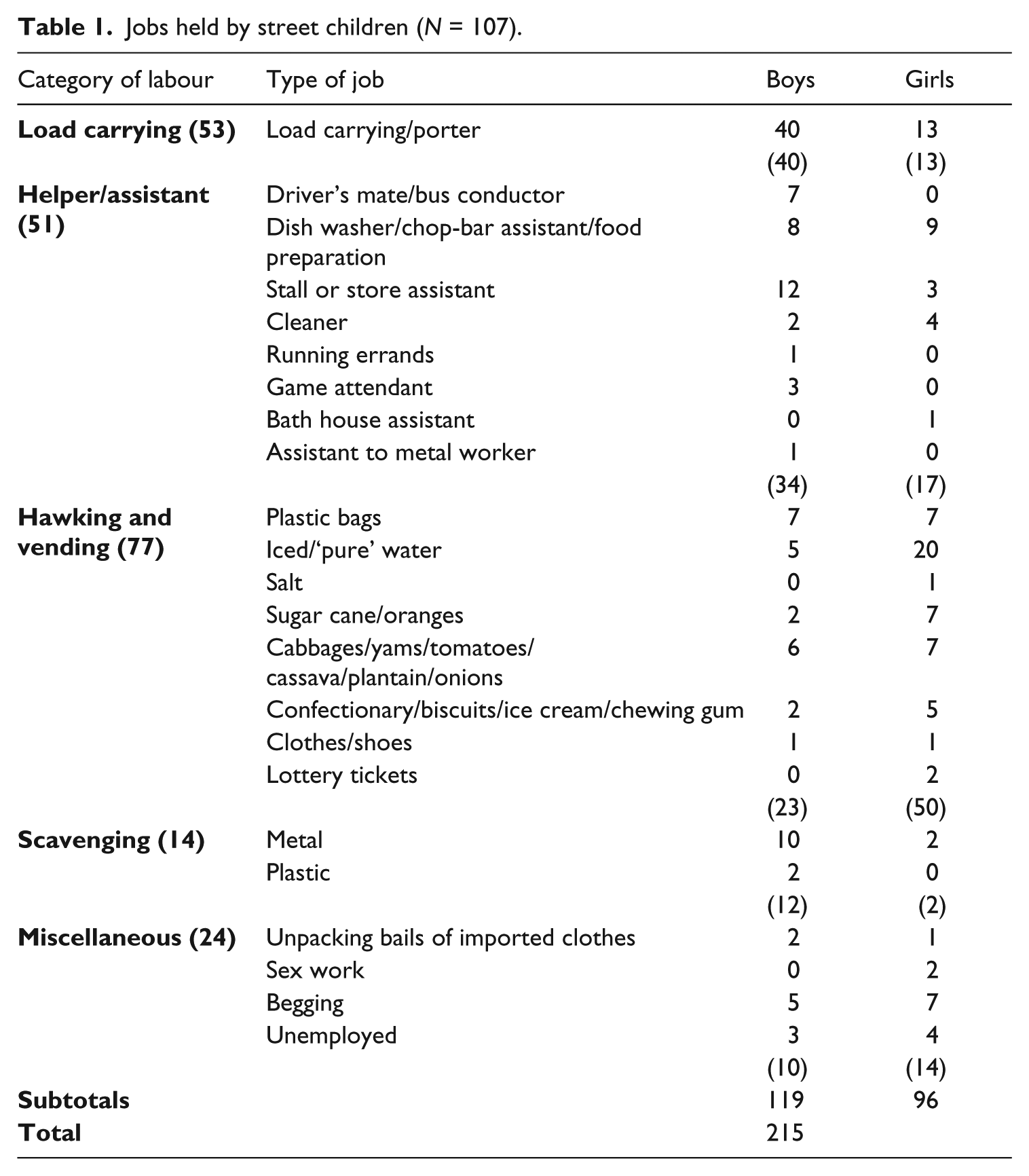
The categories of labour in Table 1 are derived from the children’s descriptions of their jobs and so do not reflect conventional occupational classifications. The data are presented in this way because it allows fidelity to the children’s descriptions, as consistently reported over time. From the total jobs reported in Table 1, three broad categories account for 82% of the paid work the children recounted: load carrying/porter, helper and assistant, and vending or hawking. It is because of this dominance that they are the focus of the following discussion.
Further evidence of the children’s routine involvement in paid employment is also apparent from the rarity of prolonged spells without work. Only two children claimed no paid employment while living on the street and for only one was this the consequence of not trying, when Yaa Martha 2 (14, female) told us that she made her way by relying on ‘occasional gifts’ from an older man. For the other, Bless (9, female), the appeals for work were turned down because of her unusually young age. Other children did describe short spells without work, as also recorded in Table 1, but spells lasting more than a day or two were unusual. Where these were reported it was usually the consequence of misfortune, illness or injury, or, for the girls, immobilisation during the final stages of pregnancy (see Mizen and Ofosu-Kusi, 2010a).
Caveats like these nevertheless underscore how actively the children seek work and the success that this determination can bring. As we argue below, getting into work and staying there is fraught with difficulty and so the high prevalence of paid working at first sight lends support to the sociological reconstruction of children as strategic agents. It is this that allows Bromley and Mackie (2009, pp. 153, 147) to liken the streets of Cusco in Peru to ‘a laboratory for entrepreneurship’, urban classrooms populated by motivated and economically astute children that ‘show a sharp perception of the key sites of demand, with their choices reflecting accepted trading principles’. And yet it seems equally reasonable to conclude that the patterning of work in Table 1 merits an alternative interpretation, one not so easily reconciled with their claim that a child’s ‘choice driven by commercial forces generally overrides … constraint’ (Bromley & Mackie, 2009, p. 154). As is it is argued below, that work in Accra takes place within narrow occupational categories is equally compatible with an alternative view of work defined by narrow constraints that render notions of strategic agency of limited value.
Load carriers and porters
Evidence for this emerges from a closer examination of the children’s work as load carriers and porters. Head carrying in particular has a long tradition in West Africa and in Ghana; its roots can be traced to male migrants from the Sahel (Kwankye, Anarfi, Addoquaye Tagoe, & Castaldo, 2007) and its institutionalisation under colonial labour policies (Ofosu-Kusi, 2009). From the Hausa word for load, the practice of kaya declined following independence but has grown exponentially with informalisation, particularly among young migrants to urban areas. Unable to move goods easily around choked central business and commercial districts by motorised means, youthful human-powered haulage and distribution have become the primary mode of transit for a myriad of small goods capable of being moved by head and hand.
The prevalence of load carrying is in large part explained by the ease of entry. As Steve (16, male) put it: ‘It is the commonest work because that is the easiest work to do’. According to Clay (16, male), ‘you don’t need any money or overheads to go into load carrying’, no dedicated equipment, clothing or footwear, nor much in the way of technical knowledge. There are costs for the children, but these are primarily physical, like ‘your ability to carry the load and to withstand the pressures at the market’. Finding a toehold load carrying is thus relatively straightforward and a move that children can take shortly after arrival in Accra: ‘We saw what people [i.e. other children] were doing and so we started doing the same, which is carrying loads for money’ (Justus, 16, male). Load carrying can be returned to after a visit to village or family, combined with other employment or as a fall-back when times are especially hard.
On closer examination, however, this ease of access is better explained as a consequence of the limits the children face than of their strategic agency. To begin with, the children work in a terrain of employment firmly at the bottom of Accra’s huge informal economy, where its hot, dirty and strenuous tasks are less attractive to adult workers. ‘The loads are heavy and it makes you feel pain in your neck and back and you have to take drugs [i.e. painkillers] to relieve the pains all the time’ (Ekow, 13, male). It is hazardous: ‘Sometimes when the vehicles arrive and we are following it closely to get something to carry and the driver suddenly breaks you might hit the back, or when the load is too heavy but you insist on carrying it’ (David, 16, male). And the pay is meagre and irregular: ‘we don’t charge or tell the owners [of a load] in advance how much we will ask for the service, we just depend upon their goodwill for payment’ (Mustapha, 14, male). It is details like these that explain why this type of work is a last resort for other informal workers, something the children recognise that ‘adults … do when they can’t get any other job to do’ (Asumah, 15, male).
Load carrying like this is thus more a matter of accommodating themselves to constraints rather than the outcome of strategic choice, since it is a realm of work into which the children are confined by the actions of others. It is for this reason that Harriss-White (2010) cautions against easy assumptions about the openness of the informal economy, where the failure or inability to enforce law and official diktat is confused with the absence of regulation at all. The children are certainly well aware that their access to work is regulated by others through their exclusion from certain areas of the city centre, particular streets or even specific sections of pavement, especially during market days or when footfall is particularly heavy, like the morning and afternoon rush. ‘An example is the Takoradi station, if you don’t work there and you go there to work, you’ll be sacked [i.e. told to go or be physically removed] … because those there don’t want their number to increase’ (Michael, 15, male). These exclusions are enforced by intimidation, threat and force, when even moving ‘along the street’ is risky because ‘once you are a child and you get there you will be driven away by the older boys’ (Richard, 14, male). ‘You see, the big boys beat and shove and prevent us from competing with them’, is how Kofi (14, male) explains it.
The small ones will be at the fringes of life in the streets here and we have to wait until about midday when the big boys have earned enough and are tired. That is the time we, the small ones, go in to try and earn something reasonable.
This exclusion of ‘the small ones’ to the ‘fringes of life’ in the street economy has been further exacerbated as the steady increase in the number of street children has intensified competition for work already in short supply. Shortly before the fieldwork began, one headcount had estimated that 20,000 children were living independently on Accra’s streets, a doubling of the number from five years earlier (Catholic Action for Street Children [CAS], 2003). By 2009, when the research was well under way, a further census put the figure at 35,000 (UNICEF, 2009). Throughout the fieldwork children have indicated that ‘the workers have increased in number, I mean the [child] porters’ (Eben, 16, male) and ‘that the number of children in the street increases each day’ (Joseph, 14, male). They also speak of its implications, where pressure on available work means that they are ‘intentionally sent … to faraway places [i.e. told to work elsewhere] and if you tell them that you can’t go, they will threaten you that if a load arrives you shouldn’t go near it, else they’ll beat you’ (Tekye, 13, male). Standing their ground risks encountering force and physical violence: ‘when a car [i.e. minibus] arrives like that, you’ll find people struggling for the loads, so that if you’re not strong enough you won’t get anything to do for the whole day’. Disputes are commonplace and routinely spill over into physical encounters, as ‘sometimes when a lorry comes and you take a bag [to carry] some of them [i.e. adults or older young people] will come and take it from you’ (David, 16, male). ‘Fighting … is normal over the carrying of loads. … When you are able to get loads to carry, they [i.e. other children] complain that you bring bad luck to them because they can’t get any loads to carry’ (Maximus, 14, male).
Helping and assisting
Maximus’s reference to ‘luck’ is more than a casual one, since more or less good fortune seems far more important to finding work within the radical uncertainty of the informal economy than recourse to ideas of children’s strategic agency allow. Yet, to be clear, recourse to notions of luck on its own explains next-to-nothing about the mechanisms that limit the children’s capacity to act strategically to exercise control over the conditions of their labour. Indeed, invoking ‘Chance, Destiny, Fate and God constitute ways of declining to provide such explanation’ (Lukes & Haglund, 2005, p. 54), since people, including street children, do not encounter routine hard times by accident. Rather, a sociology of (bad) luck, in the sense that Lukes and Haglund would have it, must presuppose that the powerlessness of some is as a consequence of the power of others, as in how the actions of older informal workers considered in the previous section succeed in confining street children’s aspirations for paid work to some of its most unpredictable and peripheral forms. It is these ‘older boys’ who are thus among the direct beneficiaries of maintaining the children’s parlous situation, so that what a street child may experience as a specific incidence of (mis)fortune, becomes explicable in terms of the social relations of the informal economy and the processes of discretion and patronage, dispossession and subordination that this involves.
This is certainly the case for the second category of work in Table 1: work the children describe as a ‘helper’ or ‘assistant’. Finding this work once again requires perspicacity and the commitment to identify potential opportunities and foster good relations among the host of street traders and vendors. In what often begins as little more than an extension of, or combination with, load carrying, a child might look to temper the competition for available work by seeking a regular patron. A typical example of this might involve ‘sit[ting] beside one lady who sells biscuits, so when her customers come and they buy in bulk, I carry the packets for them’ (Mawule, 13, male). ‘The lady’ might subsequently then seek further help with running errands or laying out stock, or ‘pack[ing] her things inside her shop when she is about to close in the evening, then she gives me money’. Variations on a similar theme are common, where work seemingly comes out of the blue, like when Philomena (14, female) was asked to ‘assist’ at a roadside chop-bar
3
on one of those days when she had simply stopped to eat there. Once again, what might begin with the occasional request to run errands can then lead to more frequent commissions or more-or-less regular employment: … helping her [i.e. the proprietor] to set the tables and benches at their usual places. I prepare the soapy water, then any time anybody finished eating I would take the plates, wash them and stack them by the woman. Sometimes I put more charcoal on the pot and fan it.
Examples like these are widespread in the data, including among the boys who wanted to work as drivers’ mates or bus conductors on one of the many dilapidated and ageing ‘tro-tros’ and ‘Benzbuses’ that are the workhorses of Accra’s public transport system. These jobs are coveted because they pay by the day, offer some stability and may allow a young person to learn to drive. This was the reason why Tekye (13, male) ‘had been sent to a driver [in Accra] who was expected to teach me how to drive, so I was a mate to him’. John (14, male), Isaac (16, male) and Owusu (14, male) had all worked as drivers’ mates before coming to Accra, hanging from their vehicles to drum up business and collecting fares, and all hoped to find similar work again. Yet this did not work out for any of these boys as expected. Tekye’s misfortune was to encounter a driver who ‘didn’t want to teach me and only gave me 40 pesewas
4
every day after working’, and it was this that made him run away. John was met with the demand for a deposit of G₵50, a huge sum for a street child, ‘because they said some of the conductors run away with the money they collect’. Isaac’s efforts simply came to nothing and while Owusu did find work ‘as a driver’s mate for some time when I came to Accra, but the bus broke down’ and he was told to go. Kobina (14, male), in contrast, did find occasional employment as a driver’s mate but only by taking his chances among the boys who queued for work each morning. Kwasu-Owusu (14, male) was the only boy who had experienced more or less regular employment, but this too was more the consequence of chance than strategic design: I used to carry loads in the area [Kaneshie market], so some of the drivers started asking me to tidy up their vehicles. Then I started working with them. As for this master, I have been working with him for some time.
The flipside of relative good fortune is, of course, misfortune, and in their efforts to work this was also encountered in large measures. If obtaining paid work was more a matter of serendipity than strategic calculation, then encountering misfortune was most definitely one of the few predictable aspects of the children’s lives. This was apparent in the anxiety about work that might accompany a child as they walked the few hundred metres from their sleeping places in doorways, pavements and run-down buildings to where they hoped to work that day. Philomena (14, female), above, spoke of never being confident that she would ‘work regularly with the woman. That is if she comes.’ And Jimmy (14, male), too, admitted to ‘never being completely sure’ that the roadside vendor of maize porridge who he ‘helped out’ first thing in the morning would appear each day. To this might be added the anxiety that work might be terminated without warning, a frequent experience for the children, as in the case of Abigail-Senna (14, female) when the vendor for whom she sold cooked rice around the busy Akoto Junction simply failed to appear one morning and to her knowledge never returned again. Kwaku-James (13, male) was summarily dismissed immediately when his ‘friends’ stole the handbag of the owner of the shoe shop where he helped out and ‘I was told not to come to her place anymore because she feared everything in her shop will be stolen the next time I came around with my friends’. The misfortune of having to leave a job, however temporary, to meet an obligation to family or kin would almost certainly mean the termination of their employment, like when Tara (17, female) returned to her village after the sudden death of her father or when Sara (17, female) left Accra to visit her sick mother.
Vending and hawking
The third and largest category of the children’s labour comprises vending and hawking, where notions of strategic agency seem equally inappropriate. These are characteristic forms of petty trading across West Africa, particularly for ‘Ghanaian women who have a strong presence in the urban economy, especially in the rapidly growing informal sector, working as street food vendors and petty traders’ (Levin et al., 1999, p. 1978). Nevertheless, it is these ‘female activity spaces’ (Overa, 2007, p. 560) that have come under relentless pressure from men and boys seeking new sources of income in the face of deepening informalisation. While limits to the data do not allow consideration of the gendered demand for their labour, both boys and girls shared similar problems in obtaining work in the two primary ways that vending and hawking work is organised: selling goods on behalf of others and efforts to establish themselves as independent vendors and traders.
Attempts to establish themselves as independent vendors and traders are fraught with chance and unpredictability that again significantly qualify over-ready assumptions about the children’s strategic agency. In fact, independent trading was not a serious option for most because of its start-up requirements, modest amounts of capital for surety or the upfront purchase of stock. This had prevented John (14, male), for instance, from selling ice-cream as he had done in Kumasi when he could not muster the G₵20 demanded upfront as guarantee: ‘the shop owner said some of the boys run away with the sales while others don’t do the selling well’. In search of an alternative, John then pooled his small cash savings with those of his friend to buy chewing gum and then handkerchiefs to sell to the travellers in vehicles waiting at busy road junctions. Others would draw on small cash sums earned or, less often, stolen, before their arrival in Accra, as with Abina (16, female), who had started selling cabbages and then pineapples with her sister, before the latter left her without warning. Having had some success, Abina moved on to selling small green oranges to thirsty shoppers around the Kantamanto market and to the auto fitters around Old Fadama, a 2 km walk away. Much rarer were the opportunities to trade after the receipt of an unexpected gift or donation: ‘when I came here somebody [an NGO worker] gave me some money so I was selling chofi, 5 chewing gum and biscuits’ (Pamela, 14, female).
Even when progress was made vending or trading, such ventures were invariably unstable and most usually short-lived. The difficulties generating sufficient surplus each day to purchase new stock were considerable and often at the cost of forgoing food, basic personal maintenance or entertainment, or ultimately giving up. The inability to provide a working surplus explained why John’s street vending, as above, was short-lived and then his subsequent return to basic load carrying. Elsewhere, an otherwise minor mishap might have momentous consequences, where a casual distraction or simple mistake could lead to disaster. To return again to Abina (16, female), by hawking 100 oranges a day she could earn enough to live and buy stock again the following morning, but this came to a sudden end when she lost her takings: ‘I kept the money in my pocket because I wanted to go and buy more oranges. Apparently, I was not careful enough, so it fell out or something. I just don’t know how, but it was not in my pocket when I needed it’. For Pamela (14, female), too: [I] left the money and the things in the head pan here [at the NGO drop in centre] one day. When I remembered and rushed back it was all gone. … Since then I have not been doing anything because I don’t have money to start all over again.
Urban share-cropping is a more apt description than independent trading for the far more numerous second category of vendors and hawkers, where the children sell goods on behalf of others. Breman (2003) describes thus the thousands of rickshaw pullers of Kolkata whom he regards as ‘dependent proletarians’ rather than independent entrepreneurs: workers ensnared within relations of dependence and exploitation over which they have almost no control. The parallels are clear in the street children’s reliance on others to give them work – something easily denied to those boys who wanted to escape basic load carrying by graduating to hand-pulled barrows that permit the transportation of heavier, larger and more profitable consignments. Again, some of the boys had worked pulling barrows prior to their arrival in Accra and so knew both what it involved and that ‘some older porters who pushed trucks … seemed to have some money’ (Justice, 16, male). For all these aspirations, across the fieldwork there have been no examples of a street boy able to realise this simply because, ‘I don’t have the money for that because you have to hire the barrow at G₵4 a day’ (Emmanuel, 16, male).
What might constitute strategic agency was also hard to detect for the hawking and vending work that the children did manage to secure. Competition for this is once again fierce and success equally a matter of good fortune. Mabel (14, female), for instance, was only able to start vending chilled sachets of ‘iced’ or ‘pure’ water after the G₵1 demanded as guarantee was given to her by a ‘teacher’ from an NGO. Anna (15, female) ‘went around asking people if they have any job I can do for them and a lady offered to let me sell her water for her’. That Anna phrases this as if she might be doing the ‘lady’ a favour is unsurprising, given the lack of practical alternatives open to her. Nevertheless, Anna was relatively fortunate in that she worked most days, was paid a set piece-rate for each full bag of sachets she sold and on a good day could earn a cedi or sometimes two in commission. For Abigail (15, female) too, there was a degree of baseline security to her work walking perhaps 8 to 10 km each day hawking salt from a head pan and for which she was paid one cedi ‘chop money’. 6
The terms of this employment are rarely negotiable, however, and seldom to the children’s advantage. For Anita (15, female), getting into the ‘iced water business’ had been a protracted process: ‘When I saw some of the girls who sell iced water, I asked them where they get them from, so that I can also go for some to sell.’ She continued, ‘when they directed me to the place and I went there to get some water to sell, they kept on giving me excuses and so I ended up not getting anything to sell’. Eventually a woman who ran a water business from her chop-bar did offer Anita work – ‘I sell two or five bags of water depending on the weather. Each bag contains around 30 [500 ml] sachets, each of which is sold for 30 pesewas’ – but she never received a cash payment: ‘when she cooks she gives me some [food] but not her money’. Unable to renegotiate the terms of her employment: ‘she asked me to sell her water for her and since I didn’t have any job I agreed to sell for her, but whenever I finish selling she refuses to pay me’.
Anita’s experience is telling, because it underscores the stark limits to the children’s ability to respond to these and other sharp practices. The failure to sell an entire bag of water might mean the cost of unsold sachets being deducted from that day’s pay and where arguing with their employer would jeopardise subsequent employment: ‘you won’t get anything [i.e. pay] because you must get the owner’s money for her so that you can continue selling the rest the next day’ (Mabel, 14, female). Others, like Anna, told of deductions when trade was slow and the weather hot, and they returned with unsold warm water. The deceit of employers might be matched by that of customers, where ‘they may ask you to give them the water when they are about to buy food. When they finish [eating] and you ask them [for payment], they will even tell you that they are not the one who has taken the water’ (Abena, 16, female). At other times, ‘people, especially the drivers’ mates and bus conductors take your water without paying and when you go for the money, they will beat you’ (Naomi, 15, female). Again, both girls spoke of their employers requiring them to cover these short-comings from their daily earnings.
Other associated risks also fell firmly on the children’s shoulders. Vending and hawking was invariably undertaken without a permit, since no employer would purchase one on their behalf and few could afford as much as 10% of their daily earnings to buy one. Yet in taking the chance of working without a permit, being caught could mean routine harassment from the ‘abaayee’, the metropolitan authorities, which at the very least would make working difficult, as a street child was ‘moved on from place to place’ (Abigail, 15, female). More serious was the possibility of a fine for selling without a licence, or even worse the sequestering of their goods and equipment. This had happened to Mabel (14, female) when, ‘one day I was caught for not buying a permit to sell, so they seized the container [head pan] in which I had packed the water inside’. Not only did Mabel go unpaid that day, but ‘when I reported this to the woman I work for, she told me that she won’t supply me with water until I have paid for the container’. The 65 pesewas the vendor demanded as compensation was beyond Mabel’s means and the woman refused to employ her again.
Conclusion
That sociology now emphasises the need to treat street children as active social agents is an important conceptual innovation. It moves analysis beyond the narrow and often one-sided view of street children as simple victims of circumstance and neglect, and introduces the requirement to take seriously street children’s own motivations, thoughts and reasoning: why they move to the streets, the relationships that they forge there and their ability and successes in mustering the resources that the street provides to eke out alternative ways of living as urban children. This seems especially pertinent to street economies that have undergone significant informalisation, in which the social and economic relations that define ways of working and living on the street have been reconstituted outside or in spite of the formal frameworks and practices of regulation customarily mandated by governments. If street children increasingly inhabit new informal urban childhoods, then sociological reconceptualisation has necessitated the need to take seriously the capacity of children to act under adversity and to consider their ability to manage their worlds, effect change and to construct meaningful alternatives.
Whether this conceptual reconstruction of street children as empowered social agents is adequate to an understanding of how street children engage in work in the informal street economy is, however, less certain. Beginning with the foundational assumption that street children are empowered agents in possession of successful strategic agendas implies a determining role for these children’s agency. This is especially so where the coping strategies that street children seemingly develop are examined in isolation from the social relations that structure informal street economies and the material resources that these may or may not allow. As has been argued here, once the informal street economy is brought back into consideration then a different picture begins to emerge, one that is less easily reconciled with the sociological insistence on beginning with the street child as strategic agent able to exercise control and purpose over the work situations that they face each day.
The data presented here suggest an alternative interpretation. It is clearly the case that street children desire paid work, take steps to find it and enjoy notable successes. They are, it must be emphasised, far from passive. However, the argument developed in this article is that a sociology of the street and children’s lives within it must acknowledge that there are severe limits to children’s capacity to initiate and effect strategic change in relation to paid work. In examining the work that street children do and how they come to this, it is more plausible to think about street children’s agency as highly dependent on how situations present themselves and their willingness and ability to take advantage of those opportunities that do appear within the extraordinary unpredictability of the informal street economy. Seen in this way, street children’s relative successes in finding paid work are not so much the outcome of successful strategic agency, but more an outcome of their powerlessness, where (bad) luck and (mis)fortune underscore their dependence upon the ability and willingness of others to give them work. The clear conclusion of our research is that the children are severely constrained by the highly limited and unpredictable opportunities that confront them, so much so that they have in reality few meaningful choices when it comes to paid employment. Work is taken when it presents itself rather than the result of strategic success and calculation.
Footnotes
Acknowledgements
Thanks to my long-term collaborator, colleague and friend Professor Yaw Ofosu-Kusi. Thanks also to all those who participated in this research; to the British Academy who funded part of the fieldwork; to Jane McAllister, Gary Fooks, Dawn Lyon, Phil Hubbard, Roy Giggengack and the anonymous reviewers for their comments and suggestions.
Funding
This article includes research data collected as part of a British Academy funded project examining informal urban childhoods.