




Abstract
How can we recognize the political in the city? How might urban scholars engage with forms of urban politics outside of established sites of research such as those associated with representative democracy or collective mobilizations? This article suggests that new perspectives on urban politics might be enabled through reinvigorated connections between the social sciences and humanities, and by combining long-term urban ethnography and cultural analysis. Reading forms of creative expression in relation to power struggles in and over urban space can direct our attention towards negotiations of authority and political belonging that are often overlooked within urban studies. The article explores the possibilities of such an approach by focusing on the idea of the political imagination as socially and materially embedded in urban landscapes. Expressive culture generates both analytical and normative frames, guiding everyday understandings of how urban power works, where and in whose hands it is concentrated, and whether we see this as just or unjust. Such frames can legitimize or delegitimize specific distributions of urban resources and risks, and can normalize or denaturalize specific structures of decision-making. Through a discussion of popular music and visual culture, the article considers how everyday practices both feed into, and are informed by, imaginations of urban rule and political belonging.
How can urban studies understand rule and belonging in the city? Where is urban politics located and how do we recognize it? An established place to look might be local government – the city hall, the mayor, the rivalling political parties. Or the national government and politicians, whose policies often explicitly target urban problems and the urban electorate. Another image that might spring to mind immediately is people protesting in the streets, to signal their discontent with those politicians and policies, and to express their commitment to various issues, from women’s rights to climate change. In urban studies, these have been the sites that receive most attention from social scientists – from sociologists and anthropologists to political scientists and geographers.
How might urban studies engage with forms of politics outside of established sites of research such as those associated with representative democracy or collective mobilizations? In this article, I suggest the need for an alternative, complementary approach to this dominant focus. I propose an approach to urban politics that connects insights and methods from the social sciences and the humanities, by combining long-term urban ethnography and cultural analysis. While much of my engagement with interdisciplinary urban studies is informed by my own background in anthropology, the approach I elaborate here can also be seen as revisiting the connections between sociology and cultural studies that have been loosened over the past few decades. 1
The type of urban enquiry that I want to outline attends to the intersections between cities, politics and culture. This approach involves a twin, interrelated focus: on politics in everyday urban life and on the political imagination. This interest in the political imagination connects to my interest in taking seriously the role of popular culture in urban life. I was trained as a ‘traditional’ social scientist: our role was to study what people did and why, primarily by talking to them, while music, visual art and so on were the domain of the humanities. This disciplinary segregation has increasingly struck me as counterproductive. Jeroen de Kloet (2014, pp. 16–17), a colleague in media studies, recently commented that field research is too important to be left to social scientists. I would like to make the converse argument: cultural analysis is too important to be left to the humanities. Reading forms of creative expression in relation to power struggles in and over urban space can direct our attention towards negotiations of authority and political belonging that are often overlooked within urban studies. However, it is important to think through the conceptual and methodological links between everyday urban life and the imagination, between social practices and popular culture.
In this article, I explore the possibilities of such an approach by focusing on the idea of the political imagination as located in expressive culture, and by examining how everyday practices both feed into, and are informed by, imaginations of urban rule and political belonging. The empirical context on which I draw in elaborating this approach is the Jamaican capital of Kingston, and through this I also want to suggest that focusing on a Caribbean city like Kingston can help us think differently about urban politics in European or North American cities.
Cities, politics and culture
So, how can one research these concepts? First, let me clarify my use of the term ‘politics’. I use the term here refer to the broader realm of power struggles, including prominently power to distribute resources and risks in specific ways. In cities, we see this not only in the uneven distribution of resources such as welfare, housing and education, but also in the distribution of access to environmental goods and exposure to environmental hazards, or to crime. Other realms of political struggle relate to power over territories and who gets to use urban space in what ways, and power over other people, for instance to harness their labour power. But also, importantly, urban politics includes struggles to control meaning-making – how we understand the value of resources, the extent of risk, the meaning of urban spaces, or the hierarchies between different groups of people.
Politics in everyday urban life
The first way I seek to understand politics in the city – drawing from political anthropology (e.g. Das & Poole, 2004; Hansen & Stepputat, 2001), but also from sociologists such as Asef Bayat (2013) and interdisciplinary scholars such as Partha Chatterjee (2004) – is through a focus on everyday urban life. This involves looking beyond the state, and beyond traditional party politics and social movements, to recognize multiple systems of governance, multiple forms of political community, and the less formal, everyday interactions and enactments through which governance and political belonging take shape.
This means, first of all, taking seriously other types of powerholders than elected politicians and state officials. My own ethnographic research has looked, for instance, at the role that criminal leaders known as ‘dons’ have in governing Kingston’s inner-city neighbourhoods (Jaffe, 2013). But I have also studied the influence of environmental NGOs, or major corporations such as Shell, on urban development (Jaffe, 2016). Urban rule often involves a range of other important non-state actors, including religious organizations, business elites, philanthropists and trade unions.
Studying politics in everyday urban life also involves doing research in other spaces of power than just, say, the Parliament or the City Hall, the formally sanctioned arenas for engaging in political debate and governance. It means expanding the focus to study what happens on the street, in backrooms or by the water cooler, at the bar, but also in church (e.g. Oosterbaan, 2009, 2014) or on the sports field (e.g. Carrington, 2010).
Analysing urban politics in everyday life does not mean ignoring formal representative politics. It also requires developing new ways of looking at these processes. For instance, by doing electoral ethnography (see e.g. Banerjee, 2007). In Jamaica, this helped me understand how – in so-called ‘garrison neighbourhoods’ controlled by politically connected dons – residents understand voting not as a legal right but as a moral duty. Voting here becomes a mandatory expression of allegiance to their neighbourhood, and to the gang and the political party that have shaped that urban territory (Jaffe, 2015).
The political imagination
A second way of researching politics is to focus on the role of the imagination. We can recognize instances of the political imagination in art, in literature, in popular culture – in aesthetic practices and forms of creative expression. These forms of creative expression may, first of all, offer alternative imaginings of existing political realities, reframing the status quo. This reimagining of ‘the now’ is an especially crucial function in those situations where actual political change appears impossible, and the imagination enables endurance rather than improvement (see e.g. Feldman, 2015). In addition, however, the work of the imagination is to actively envision new horizons and future realities, to envision the world otherwise, to assert that another world is possible.
I use the term ‘political imagination’ here not only to emphasize that the imagination is political, as a reference to what we could call the politics of imagination. More specifically, I see this concept as referring to a particular realm of the imagination: to imaginings of political order, of how power works and how it should work. I use the word imagination here, rather than social imaginary, as the latter refers to broadly shared, collective forms of imagination and I want to concentrate here primarily on the ways that politics is imagined in creative expressions, from popular music to visual culture.
These forms of political imagination that I am interested in work as analytical, normative and affective frames. Analytically, they guide us in our understandings of how power works, and where and in whose hands it is concentrated – our attention is drawn to specific locations of power and responsibility, and not others. Normatively, the political imagination shapes our perceptions of the workings of power as just or unjust, and affectively, it imbues our responses to these workings with anger or pride, with sadness or excitement. Beyond delineating the sites and mechanisms of power, the political imagination is central in how we come to see ourselves in relation to others: with whom do we feel affinity or community, what forms of authority and hierarchy do we find acceptable?
We can also understand the political imagination as frameworks that suggest specific attributions of causality and blame, and delineate the conditions of citizenship and other forms of political community. For instance, they connect to specific understandings of the causes of urban poverty and violence – whose fault is it if a city or a neighbourhood suffers from high levels of conflict and deprivation, and who might be able to remedy this? Who should and can protect vulnerable citizens – the state, or other powerholders? To what established or yet to be realized political community does one belong? What normative sense of rights and responsibilities accompanies this belonging, and what emotions does it elicit?
These analytical, normative and affective frames can legitimize or delegitimize specific distributions of resources and risks, such as the concentration of wealth, or the socio-spatial distribution of violence and environmental hazards. They can normalize or denaturalize specific structures of decision-making, shifting our sense of how political decisions should be taken, implemented and enforced, from a preference for top-down, violent authoritarianism, towards a preference for electoral democracy, or horizontal collective action, or vice versa.
I think it is important to note here that many studies of popular culture, focusing on creative expressions of marginalized groups, tend to approach the political imagination as progressive or emancipatory. As I want to show in my empirical examples, this is not necessarily the case at all; there are many types of imagination that connect to violent or exclusionary types of political practice and actors, and it is urgent that we attend to ‘the more dystopian potentials of imaginative engagement’ (Sneath, Holbraad, & Pedersen, 2009, p. 10). Indeed, as Stuart Hall (1981/2016) has stressed, popular culture is neither a straightforward form of resistance, nor a simple tool of oppression and control, but rather the site where such struggles play out.
Connecting the everyday and the imagination in urban politics
In any city, multiple forms of political imagination, located in various types of expressive culture, will compete and coincide, before more coherent, broadly shared social imaginaries may eventually emerge. How do instances of the political imagination, for instance in popular music or street art, relate to everyday encounters? How are they mobilized, and which imaginations become dominant? How do they inform or impede political action? In short, how can we connect our analysis of everyday political practices, spaces and actors to that of political imagination? How does the imagination feed on everyday life, and how is everyday politics enabled through the work of the imagination?
It should be stressed first of all that these relations are not causal in any unidirectional sense, and that the imagination is not so much a concrete causative object or subject, but rather an ongoing process. Audre Lorde (1984, p. 36) describes this succinctly in her analysis of poetry in relation to women’s struggles. Poetry – and for this we can read art and expressive culture more broadly – is, on the one hand, ‘the revelation or distillation of experience’, it is rooted in but also departs from lived reality. On the other hand, poetry is necessary in order to act on this reality. ‘For women, then’, Lorde continues: [P]oetry is not a luxury. It is a vital necessity of our existence. It forms the quality of the light within which we predicate our hopes and dreams toward survival and change, first made into language, then into idea, then into more tangible action. Poetry is the way we help give name to the nameless so it can be thought. The farthest external horizons of our hopes and fears are cobbled by our poems, carved from the rock experiences of our daily lives.
In an urban context, researching the relations between daily lives and the imagination means attending, first, to how the imagination is made material in an embodied fashion in the context of the social and built environment of concrete streets and neighbourhoods. Here I draw on anthropological work on politics, aesthetics and everyday practices of sensory perception. In their work on sensory citizenship, for instance, Susanna Trnka, Christine Dureau and Julie Park (2013) highlight the significance of the embodied sensing of the world in the formation of political subjects and communities. They suggest that sensory differentiation is central in the processes of inclusion and exclusion that structure the boundaries of citizenship: our experience of social sameness and difference works through emotionally loaded senses of vision, hearing, smell and so on. In her work on religion and the aesthetics of persuasion, Birgit Meyer (2009) argues similarly for a sensorial turn in our understanding of the imagination. Her work focuses more explicitly on the role of materiality, emphasizing that for the imagination to be experienced as real in an embodied fashion it must be made material, through religious artefacts and places.
I have drawn on these approaches in researching the popular culture associated with donmanship, exploring how the formation of political communities around criminal dons and their neighbourhood territories is intimately connected to the affective and normative work that a range of popular culture texts, images, sounds and performative practices do within specific urban spaces (Jaffe, 2012). As I will go on to discuss through a number of examples, such a combination of popular culture analysis and neighbourhood-level ethnography can show how aesthetic forms render an imagination of dons’ authority both real and powerful in and through the built environment. The walls on which murals are painted, and the streets in which dance parties are held in celebration of dons, allow people to physically experience their shared location within a specific system of rule and belonging.
Such approaches can help us understand the aesthetic, sensory processes through which forms of political imagination come to resonate more broadly within everyday urban life, as they literally move people in a certain direction, or immobilize them. In addition, it is also important to understand how specific urban environments – and their material and social forms – enable or constrain new forms of political imagination. In their work on ‘technologies of the imagination’, David Sneath, Martin Holbraad and Morten Axel Pedersen (2009) direct our attention to the generative capacity of specific technological implements and artefacts, from software to electricity infrastructure, to enable specific forms of imagination. Drawing on insights from science and technology studies, urban studies might similarly attend to affordances that are both social and material.
Affordances are those specific artefacts or conditions that enable or constrain (but do not determine) specific outcomes (see e.g. Hutchby, 2001). The introduction of specific objects and forms of social organization – from particular styles of architecture, to guns, or ballot boxes – can be connected to the generation of specific forms of the imagination. In a longer exploration of these processes in Kingston, for instance, we might trace the imaginative affordances of socio-material objects such as the public housing projects associated with both urban modernity and partisan politics, the introduction of guns and drugs in the context of Cold War politics, or the Westminster parliamentary system and its privileging of the secret ballot. 2
Violence, protection and authority in Kingston
In the context of this article, I have space only for a brief empirical illustration of the connections between the political imagination and everyday practices, and I will focus here on negotiations of violence, protection and authority in Kingston, Jamaica. These examples connect my previous research on dons and their entanglement with electoral politics to my current work on security assemblages, which looks at the practices and imaginations of security provision beyond the state and beyond the human. Through a discussion of visual culture and reggae and dancehall music, and drawing on my long-term ethnographic work in Kingston, I consider how these forms of the imagination enable or impede the emergence and consolidation of new political subjectivities and action.
Visualizing authority
Starting with a discussion of street art, before moving on in the next section to consider three recent reggae and dancehall songs, I want to explore how policing and protection are imagined in the context of realities of poverty and violence in Kingston. I analyse how the images and music work as analytical, normative and affective frameworks that propose different relations to a range of governance actors, bolstering or undermining their legitimacy and efficacy.
I want to start by discussing the memorial murals commemorating dons. Such murals visualize an imagination in which dons are legitimate rulers, and central figures in delineating the boundaries of political community. 3 By juxtaposing dons with beloved figures in music, sports and politics, such murals enable an imagination in which dons are treasured as local ‘legends’. In Figure 1, for instance, the deceased don Willie Haggart, of Trench Town’s Black Roses Crew, is commemorated on a Wall of Fame together with reggae superstar Bob Marley and with Michael Manley and P. J. Patterson, two former Jamaican prime ministers affiliated to the same political party as Haggart. A comparable mural depicts Jamaican sprint champion Usain Bolt and former US president Barack Obama, under the slogan ‘Zeeks fi [for] life’, a reference to the don of this West Kingston neighbourhood, now in prison (Figure 2). The mural makes perceptible Zeeks’s equivalence with these other two heroes. In addition, it proposes different geographies of political affinity and belonging to those who pass it every day. Where Zeeks represents the space of the neighbourhood, Bolt’s image, against the background of the Jamaican flag, invokes the island nation. The images of President Obama and the American flag not only reference the transnational linkages fostered by inner-city residents, but also point to transnational blackness as a source of collective identification. Through this mural, a don-related form of political belonging is made visually compatible with national and ethno-racial allegiances – donmanship is imagined as an order of rule and belonging that contrasts with (but does not negate) that of the Jamaican nation-state.
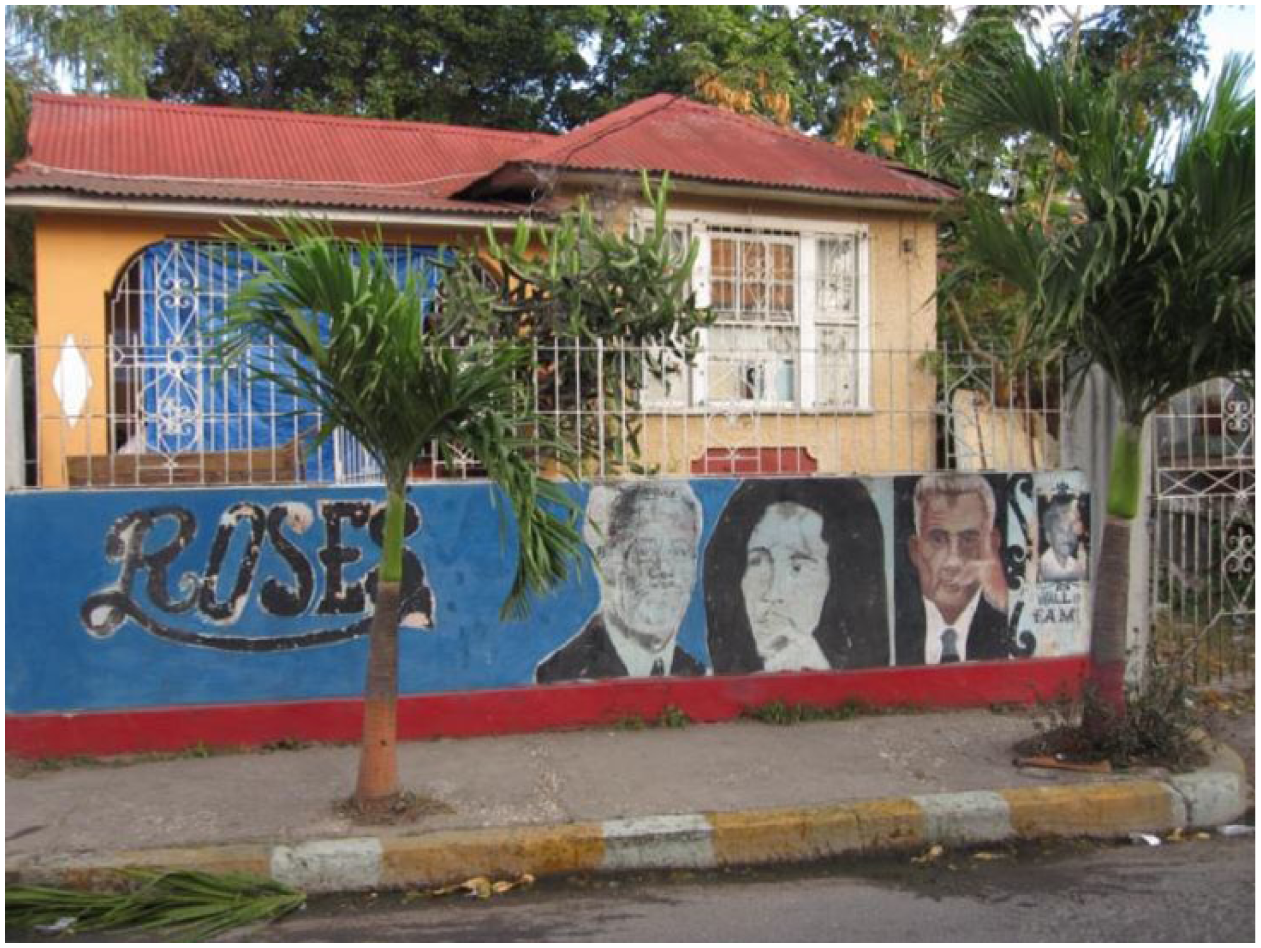
Mural honouring Willy Haggart and the Black Roses Crew.
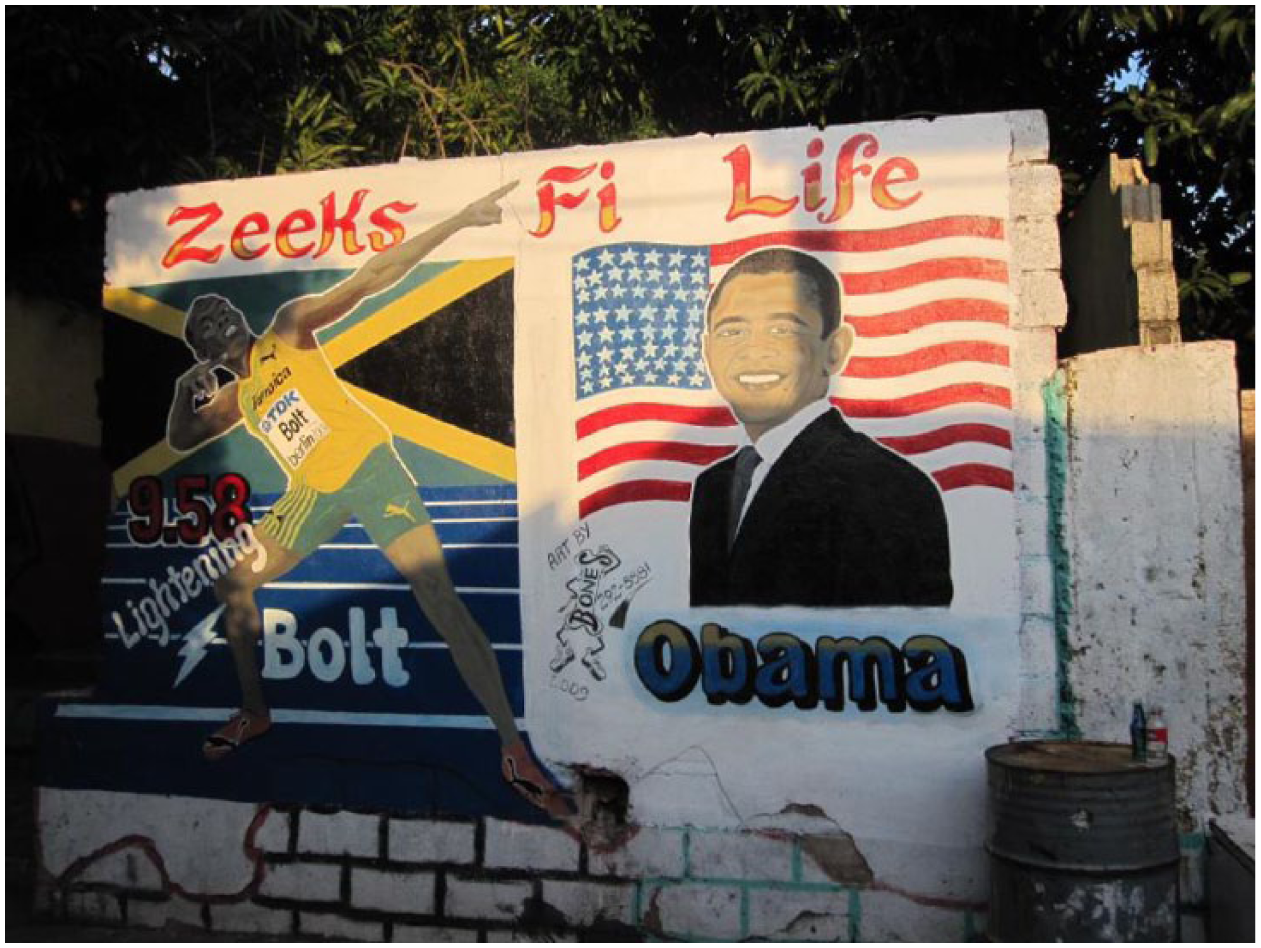
Mural of Usain Bolt, Barack Obama and Zeeks.
The power of this form of political imagination in framing authority in inner-city neighbourhoods is confirmed by the Jamaican state’s responses to the murals. The 2010 extradition of Kingston’s most powerful don, Christopher ‘Dudus’ Coke, disrupted established relations between dons, politicians and the Jamaica Constabulary Force (JCF). Following Dudus’s extradition, the police have embarked on a campaign of painting over memorial murals of deceased dons, often in their trademark colour of ‘constabulary blue’, citing the images’ morally harmful effects (see Meikle & Jaffe, 2015).
These visual processes take place in specific spatial contexts, with the geographical locations of such murals often marking the boundaries of the political community. Images such as the Zeeks mural frame the relationship between a leader, the territory of his neighbourhood and its people. By erasing Zeeks’s name from the mural (Figure 3), and the image of his predecessor, Early Bird, on a nearby wall, the police seek to erase neighbourhood-level political authority and community, visually reimagining these as located only in the Jamaican state. These state interventions into public regimes of vision are an explicit attempt to develop alternative forms of political imagination, mobilizing the space of the streets to re-attune the senses of residents.
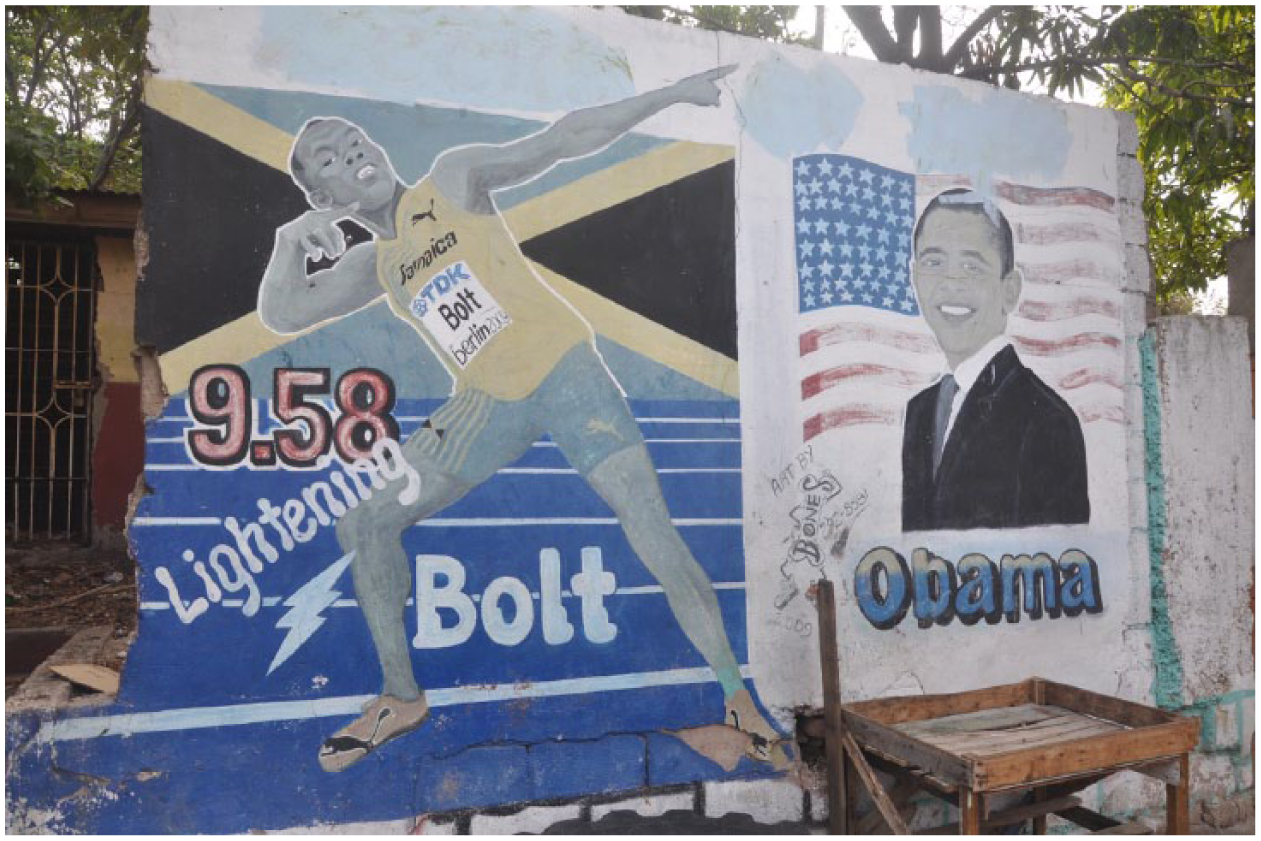
Mural with Zeeks’s name painted out by police.
Singing security
This battle over political imagination evident in the anti-mural campaign is also fought over the soundwaves. There are ongoing attempts to introduce anti-gang legislation that criminalizes song lyrics ‘glorifying’ criminals. These attempts also demonstrate the Jamaican state’s explicit recognition of the force of the imagination to intervene in power struggles over urban spaces and populations.
I want to focus here on three songs, and their different imaginings of policing, in direct relation to recent shifts in Kingston’s geographies of protection, following the Dudus affair. This was a moment of rupture in previously established security arrangements, in which dons, police and private security companies were in charge of protecting different parts of the city and its residents. Who is going to be in charge now?
I start with the hit song Unfair Officer (2010) by reggae artist Wasp, which reimagines the relations between the JCF and residents of inner-city neighbourhoods in Downtown Kingston. The song and the accompanying video clip depict a specific type of engagement between the police and inner-city residents: negotiations over street dances. The role of the JCF in enforcing the Noise Abatement Act by ‘locking off’ such dances at a given hour is sometimes interpreted as part of broader state or elite strategies to curtail the livelihoods and cultural expressions of the (Black) urban poor. Songs such as Unfair Officer present the police’s intervention in street dances as part of a larger historical logic: ‘Me know for a fact / Say them a fight ghetto youths before me born’. This historical contextualization echoes the move by geographers Pat Noxolo and Dave Featherstone (2014) to understand security in light of longer trajectories of colonial endangerment that inform the contemporary economic and physical precarity of residents of Jamaica’s low-income urban areas.
Yet Wasp narrates the lock-off not just as a confrontation, but as a space for negotiation, and this narrative reimagination of what is often experienced as a colonial form of policing is supported sonically and visually through the music and the accompanying video. He hints at the possibility of paying off the police – ‘it seem like them no care, worse me no have nothing fi spare’ – but also appeals to the officers for empathy, suggesting that dancehall parties offer an important form of non-violent sociality. He entreats them to understand street dances not just as noise and nuisance but as the ‘ghetto youth’s’ own attempts at peace and conflict resolution: ‘Officer me beg you please / Come make the ghetto youth them want to hold up the peace / Man from West and East / Me rather see dance than see funeral keep’. The imagination of a less confrontational relationship with the JCF is bolstered by the slow melodic roots reggae style of the music (which contrasts with the faster, more electronic and bass-heavy sounds of the dancehall music that dominates most street parties) and the somewhat dreamlike, soft-focus quality of the video and its depiction of a JCF officer, dancers, DJs and residents. The song also includes a sonic transition that accompanies these visuals, moving from faster beats implying tension and confrontation towards a slower, more harmonious sound of conciliation.
Despite this move to imagine citizen–police relations ‘otherwise’, the JCF are rarely imagined as an effective, legitimate source of protection or authority. Reggae artists are more likely to imagine protection as located in the divine, making a statement about the role of God (or the Rastafari Jah) in providing both physical and spiritual security. In his song Most I, for instance, Chronixx praises Jah, asserting that ‘You are the reason me no inna the morgue yet / A you give me peace inna me heart / All when me get rich with three body guard / And some big bad dog inna me yard’. Even if Chronixx achieves wealth that needs to be guarded by private security and ‘bad dogs’, this song maintains that true peace and security require a spiritual protector. 4
Other artists make a different comparison, contrasting God/Jah with dons. In his song God A Mi Don [God is My Don], dancehall artist Konshens makes a similar metaphorical connection between different sources of protection, likening God/Jah to the don as an extra-legal security protector. Here, an omniscient Jah provides an invisible but most effective kind of surveillance and protection. He alone can distinguish between threat and non-threat, and is a powerful ‘link’ or social connection: You see God / A my don that / … / Boy a fight, haffi fight and drop, them full of links but a God a the right contact / You see Jah, a my linky / And me nah go step lef’ the link with me / All when you no see no man beside me / Me have the greater one beside me / I tell them Jah know it all: who a pray for me down fall / … / Jah show me my enemies, Jah show me my friends.
While analogies such as those drawn by Konshens are perhaps primarily intended as testimonies of faith (and indeed might also be read as a challenge to dons’ claims to authority), asserting that God is one’s don simultaneously serves to associate criminal leaders with a quasi-divine status. Imagining dons as endowed with more-than-human powers is a way of reframing the status quo of their rule in terms of benevolent protection rather than oppression; in so doing, this reimagining of the now also acts as an important form of legitimating the authority of these extra-legal rulers.
These three songs engage actively with on-the-ground renegotiations of security arrangements in Jamaica’s post-Dudus moment. What they show compellingly is that the state does not feature as the natural locus of protection or authority. As Wasp’s song shows, the state-based ‘rule of law’ is easily imagined as unfair, or at the least negotiable. Can the JCF, by incorporating the principles of community policing, replace the don as an effective and largely legitimate protector in inner-city neighbourhoods? Through reference to which moral and spiritual frameworks can different protectors make claims to authority?
In the context of persistent conditions of violence and insecurity, these songs indicate a search for leadership that is not state-based but not necessarily don-based either – the music involves an exploration of emergent futures and possible political orders that move beyond the state and even beyond the human. Such songs show the constant movement in imaginations of political order. As with any form of cultural text, including the images discussed above, these songs contain a large measure of ambivalence. They propose normative statements about the legitimacy and efficacy of different security actors that can be read in multiple, contradictory ways, that also depend on who is listening or dancing to them, and when and where they do so. Popular music sometimes represents the Jamaican police as a brutal, inhuman force, but at other times humanizes the figure of the JCF officer, imagining him (never her) as a figure who is disposed to negotiation rather than merely confrontation. There are songs that celebrate the policing role of dons and emphasize their tendency towards using violence as a crime prevention strategy; yet even as the dons’ supposedly effective violence is lauded, they are also imagined as peacemakers who can overcome longstanding party-political divides between different ‘garrison’ neighbourhoods.
Within specific neighbourhood contexts, the sounds and lyrics of these songs disrupt established regimes of perception, reshaping the parameters of what is thinkable, whether by outlining a God-based order or conceiving of a police that does not operate as an occupying force. To return to Audre Lorde’s quote, these songs – like the murals – are not only based on everyday urban experiences, but they are also essential in making it possible to survive or change those experiences. Directly informed by the socio-material reality of Kingston, these forms of popular culture open up new spaces for hopes, fears and dreams to be translated into, first, sensation and thought and then, action.
Conclusion
To conclude: I have proposed here the development of an analysis of expressive culture and politics writ large, that is situated directly within the social and built environment of cities. In any urban context, multiple forms of the political imagination are formulated and reformulated in an ongoing process, with a broad range of sites of creative expression providing a space for thinking the city’s struggles otherwise, for dreaming that another urban order is possible. I suggest there is much analytical gain to be found in understanding the political imagination as socially and materially embedded in urban landscapes. The visual and narrative forms of this imagination are made material within concrete urban environments: people are moved together by the soundwaves that travel through their neighbourhood, they sway to the bass at memorial dances or political rallies, surrounded by powerful images that shape their ‘lines of sight’ (Crary, 2001; cf. Henriques, 2010). They also intervene directly in these environments, making it possible to rethink and act on existing socio-material arrangements.
Analysing the political imagination in direct relation to everyday socio-spatial practices and a range of urban ‘things’, from walls and amplifiers to guns and dogs, can enrich our understanding of the scope and dynamics of contemporary urban struggles. Engaging seriously with expressive culture directs the attention of social scientists towards the emergence of alternative conceptions of authority and political belonging, and can help us recognize the tentative envisioning of new grounds for contestation, before they may consolidate in the form of more broadly shared imaginaries. At the same time, cultural analysis benefits from being grounded, through social scientific traditions, in the sociality and materiality through which the imagination begins to interpellate, or produce, a public.
My brief illustration of Kingston as a site of political action and meaning-making is only one example of an approach that takes the political imagination seriously. In closing, and connecting to ongoing debates on global urbanisms (Robinson & Roy, 2016), I want to stress that while this example is specific to Jamaica, we might use the insights such methods generate to develop new approaches to urban politics in European and North American cities, and to reverse the established geographies of urban theorization (e.g. van Gent & Jaffe, 2017). My studies of citizenship and security in Jamaica can help us understand what is at stake in cities such as Manchester or Amsterdam differently, raising new and important questions about informal or irregular governance actors, about the role of spirituality in legitimizing authority, and the varied ways in which party affiliation shapes urban space through both everyday life and the work of the imagination.
Footnotes
Acknowledgements
I am grateful to the editors of The Sociological Review for the invitation to give the journal’s Annual Lecture in Manchester, on 28 April 2017, and to Claire Alexander and Emma Jackson, who acted as discussants on that occasion. The Lecture also served as the starting point for my inaugural lecture as Professor of Cities, Politics and Culture at the University of Amsterdam, held on 2 June 2017. I am grateful to the journal’s two anonymous reviewers for their encouraging remarks and constructive suggestions, and to Anouk de Koning, Tracian Meikle, Wayne Modest, Martijn Oosterbaan and Alana Osbourne for comments on earlier drafts.
Author’s note
The article was originally presented as the Sociological Review Annual Lecture 2017, which took place at Manchester Museum on Friday 28 April 2017.
Funding
The ideas presented in this article draw on research funded by the European Research Council (ERC) under the European Union’s Horizon 2020 research and innovation programme (grant agreement no. 337974, SECURCIT), and by the Netherlands Organisation for Scientific Research (NWO, grants no. W01.70.100.001, no. 360-45-030 and no. 452-12-013).