




Abstract
While waste marks the beginning of relocation, re-materialization, and resourcing processes, it is also a set of connections, producing specific figurations of citizenship that follow from, as they inform, waste management strategies. This article regards household practices to do with the disposal of used fats as a site where citizenship forms. The authors see the figure of ‘good citizen’ appear along the trajectory of kitchen fats. They contrast this figure with the ‘re-user,’ who acts by a different set of rules, so as to explore logics and normativities embedded in the mundane processes of discarding fats. Fat waste not only turns out to be different things for different stakeholders; it is in different fat disposal practices that different (kinds of) stakeholders emerge. As the authors situate citizenship in mundane practices, kitchen fats suggest the situational, material-relational character of waste and waste-eliminating schemes – and of citizenship itself.
Introduction
Ever since Rebeca and Paula came to make a tortilla de patatas in Marianne’s kitchen, in a small town in the Netherlands called Delft, a jar with leftover used olive oil has been sitting in the fridge. Waste oil is a problem: it clogs pipes and should not be thrown in the sink. But unlike glass, paper, plastics, and ‘rest’ – separate waste categories for which recycling bins are spread throughout the city (Metcalfe et al., 2012) – oil is not traditionally a waste class in the Netherlands; 1 to dump it one must visit the city’s waste yard, kilometers away. Months later, the oil is still there.
In Rebeca’s hometown of Madrid waste kitchen fat is a known entity. An apparatus of objects exists for discarding it – from blue neighborhood receptacles to dark green 500-liter bins at the city’s waste yard. 2 Still, getting rid of waste oil is a hassle and it can be done in more than one way. In this article we discern various household practices of discarding cooking oil, pointing out how in these practices different logics and normativities are at work. 3 Specifically, we bring into relief the logics of the ‘good citizen’ and the ‘re-user’ – understanding good citizens as subjects willing to contribute to the ‘common good’ at a cost to themselves; re-users as those who repurpose trash for new products so as to leave no trace behind.
Counterpart to the ‘good’ citizen is the ‘bad’ citizen. In order to avoid interpellation as a ‘bad citizen,’ residents must, somehow, further the ‘common good.’ One’s civic score is adjudicated, implicitly, on the basis of public actions such as disposing waste in the neighborhood bin. One might think it a particularly Dutch phenomenon, this public display of good citizenship, but fieldwork in Spain shows a similar agency exerted by material objects in public. In both locales, waste bins have certain powers: they make good citizens. 4 And so waste practices are relational (Gregson & Crang, 2010), for while waste undeniably marks the beginning of relocation, re-materialization, and resourcing processes (Davies, 2012, p. 191), it is also a set of connections, producing specific figurations of citizenship that both emerge from and inform waste management strategies. If a ‘good citizen’ stands for a certain moral fortitude and care for others (including the environment), the public waste disposal bin allows this citizen to materialize. Using the bin, in full view, the good citizen is worthy of enrolment in a community, which affords a sense of inclusion and rights. 5 To some extent, good citizenship is a matter of fees and fines (Callén & Sánchez Criado, 2016). But it also carries a normative charge. And bad citizenship occurs when this normative commitment is broken, and fees and fines must be imposed.
The re-user, our other figure, isn’t necessarily concerned with contributing to the ‘common good’; (s)he is not as obviously subject to fees and fines. Instead, operating an informal economy marked by the logic of resourcing, the re-user mobilizes local, practical, resourceful skills to transform waste – in our case fat no longer fit for consumption – into new substances. These substances are material and relational – oils may be transformed into soap, for instance, but acquiring enough to make the soap may depend on a network in which waste oil is a gift. If the re-user has a counterpart it might be the wastrel: a person who does not attend to the informal household economy of counting all things and making all things count. Re-use denotes practical and relational action; it sustains this household economy with efficient, rational re-allocation of scarce resources. This mode, too, carries a normative charge: that of good housekeeping, stretching the budget, and making ends meet.
We contrast the good citizen with the re-user, but contrast doesn’t mean fidelity; one may be a good citizen always, mostly, some of the time. A good citizen can be a wastrel a re-user, a bad citizen. And it doesn’t entail mutual exclusion, either, for a good citizen can be a re-user, too. While we trace the logics at work in all these modes, keep in mind that re-use and good citizenship are not neatly mapped onto different bodies; we all can, and do, practice both. What is at stake here is to note that the logics of ‘citizen’ and ‘re-user’ pull in different directions, have different normative valence, and rely differently on waste management policy and infrastructure. Both logics and practices mark forms of engagement: the heterotopia that is the landscape of waste management is in citizen bodies, too – none of which is a homogeneous, consistent, non-fractious space. 6
This, then, is our goal: to illuminate, without judgment, these various modes that are at work – animated by different logics and requiring different conditions – as they move, undermine, mix with, and build upon each other. We demonstrate that the material practices of waste disposal produce heterogeneous citizens whose actions may, according to the logics of local opportunities and constraints, perform or resist the ‘goodness’ that the objects and policies of waste disposal prescribe. And this is our point: that good and bad citizenship are less a matter of information and political choice, than an artifact of local, material circumstances; it is these materialities that ‘make’ citizens. And, as one of our reviewers beautifully put it, taking into account material citizenship requires coming to terms with political engagement under conditions of obscure entanglements while, we would add, it is the entanglements that frame who we are.
Framing
We borrow from two related discourses in science and technology studies. The first, derived from user-oriented technology, ‘imagines the user as an active participant during … development and … consumption … of new technologies’ (Wilkie & Michael, 2009, p. 505). The future ‘user’ – in Wilkie and Michael’s case, of a mobile 3G phone technology in the UK – is instrumental in the mediation of expectations concerning that technology. Not a passive ‘consumer,’ the user is framed by her or his relationship to the technology in question – a PC, mobile phone, or other implement. Rather than a stable entity faced with changing technology, this user shape-shifts, moved by the developments in which (s)he takes part.
We take this to indicate that materials, rather than subjectivities, ‘make’ these users what they are. Our case, too, compels us to question the contrast between users and consumers that conventional user-orientation frameworks presume. Taking citizenship as a shifting collection of material relationships (Mol, 2002), and viewing participation in public matters through the lens of domestic practices (Marres, 2008), we submit that it is not character, subjectivity, or performance that frames how ‘citizenship’ is done. If citizenship occurs not only in the deliberative arena but also in mundane and material engagements with things such as food, sewers, light bulbs, or waste fats, the domestic sphere becomes a site for political action – and waste practices, opportunities to act against climate change and to care for the environment (Marres, 2008). How that happens, varies: domestic practices are platforms for participating in the public sphere, yes, but some modes of waste management are political and explicitly public (for instance the mode that we discern as good citizenship) while others (such as re-user-ship) may be quietly private but political no less. As we bring into relief and contrast the figures of the ‘good citizen’ and the ‘re-user,’ we explore the quite different political, policy, infrastructural, and material conditions that enable and are required by each – in order to make the point that it is what we do that makes for who we are – and, so, that politics happens in the material circulation of stuff. 7
A note on fieldwork
This article builds on ethnographic studies of waste in the Netherlands and Spain. In 2012 the regional government of Madrid allowed Rebeca to ethnographically study the recycling station, Punto Limpio (PL), in Madrid city. 8 The bulk of our empirical material is drawn from this fieldwork, conducted from October 2012 to January 2013. 9 Marianne’s current work on waste disposal in Delft attends to the material relationality of waste and puts Rebeca’s observations in comparative perspective.
Rebeca engaged technicians, users, and others related to the PL. The technicians at the PL discussed the actual ‘dirty’ job of handling the greasy materials at the plant, while users invited her into their lives beyond. She visited five households in Madrid and interviewed three women in more remote areas. Informants such as a deputy assistant at Canal de Isabel II – the regional network that manages the sewage system and wastewater clean-up in Madrid – showed up on her radar, too. All informants remain anonymous; to further protect them we do not disclose the location of the PL. Interviews in Spanish were translated by Rebeca; all but our own names are pseudonyms.
Ethnography rests on the case – as the one, that presumably represents many (Yates-Doerr & Labuski, 2015). But that one case never does so exhaustively and completely. If in what follows ‘Pedro’ enacts the ‘good citizen,’ this does not mean that he essentially, always and forever, is. Likewise, while ‘Virginia’ exemplifies re-use, this doesn’t mean that she is not a good citizen – sometimes, at other times, or at the same time. Modes of action – practices – may be distinguishable, and making a contrast enables thinking critically about waste management materials, acts, and policies – but upon enacting a particular mode, one is not stuck in it forever. Modes, characterizations, and the subjects to which they are assigned are abstractions – albeit abstractions that have effect, are world-shaping, and carry reality. Ultimately, such abstraction remains the ethnographers’ analytical tool, with attendant limitations. In people’s day-to-day waste-related practices, abstraction may be at work – as a handle; a way in which one describes one’s self. But these same practices also complicate, disrupt, and destabilize it. Thus, we speak of figurations and modes that enact, rather than persons, characteristics, or identities that are or perform (Forrester, 1996; Mol, 2002; Morita, 2016). 10
Sites and contracts
Punto Limpio (PL) translates as ‘Clean Station’; at the 16 PLs in Madrid anyone may bring their household refuse. Rather than signifying action, as does the term ‘disposal station’ used for the AVALEX waste-site in Delft, the Spanish term links to cleanliness. 11 Waste – or so the name suggests – ceases to be polluting when discarded at the Punto Limpio; the dirty work of sorting and putting it ‘in place’ in separate containers washes it ‘clean.’ 12
AVALEX and PL take almost any household item: obsolete electronics, half empty cans of paint, dead car batteries, glass, paper, furniture, freezers, expired medicines, broken toys, mattresses, you name it. Car-friendly places, they look like parking lots (Figure 1): one drives in and unloads into the big, open containers (Figure 2); closed bins for vegetable oil, car oil, glass, clothes are nearby. A small office at the entrance houses the technician, who receives customers, advises, and keeps records; a closed-circuit TV system is to prevent robberies of electronic parts, computer screens, batteries, and metal, that nevertheless frequently occur.
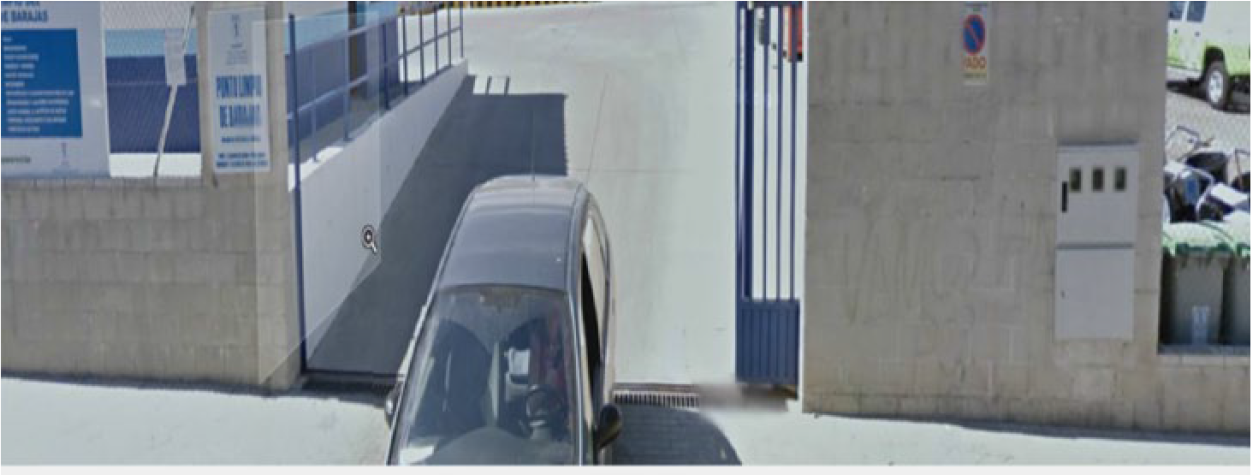
Entry of a random PL located in Madrid (Google Maps).
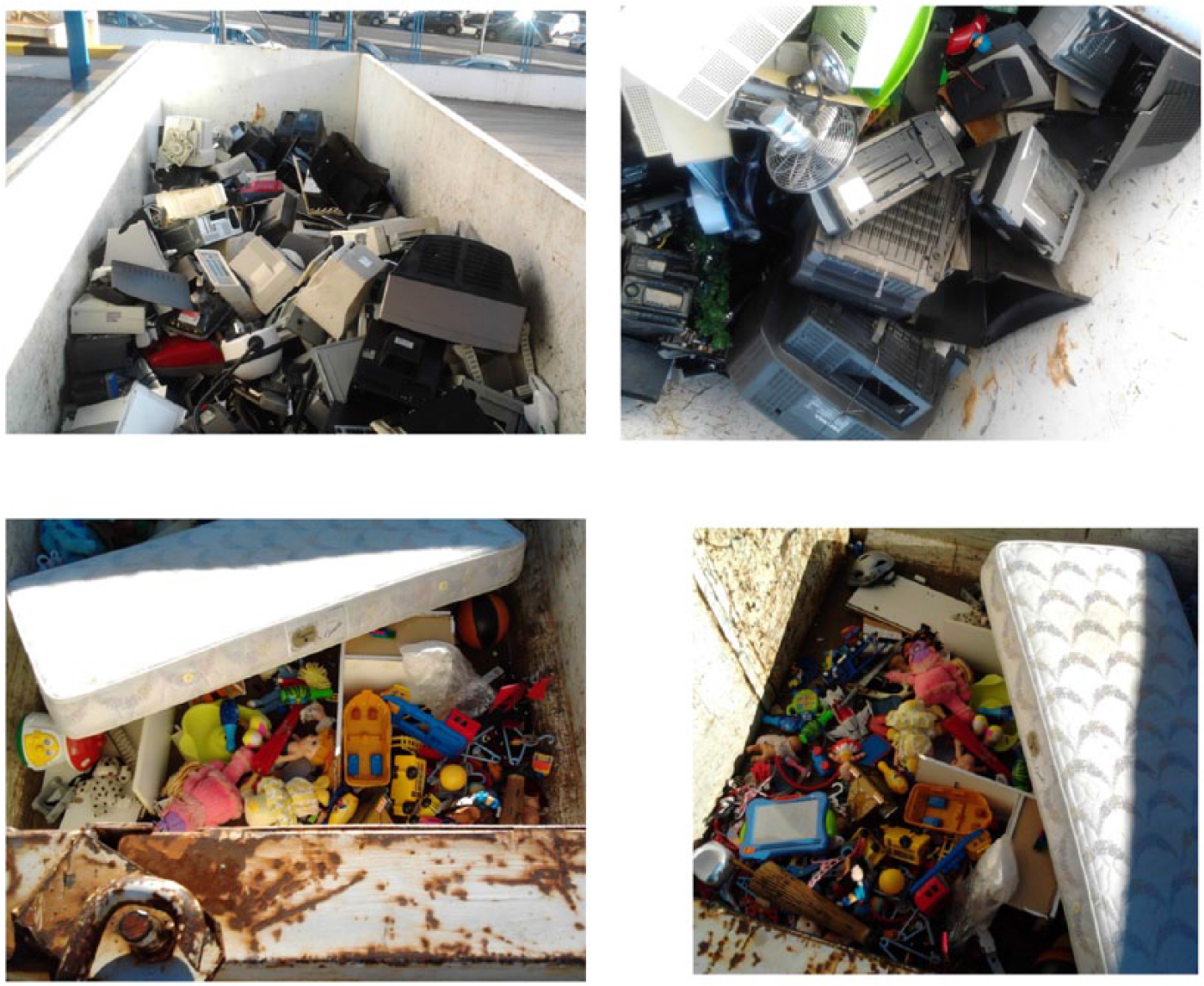
Categories of residue: containers for electronics, toys, and furniture.
Aside from helping sort objects, the technician monitors and scolds. Tracking activities at the PL, recording the number of visitors and their means of transportation, she makes sure that the goods offered do not exceed quantities allowed;
13
if much more is delivered, she suspects that business waste is being discarded without a contract – and reprimands the person in question. A contract matters. Not only does it enforce good citizenship by sanctioning fees and fines; it also signals a specific mode of ‘doing’ waste. Pepe, a maître d’hôte in Madrid, recalls the days when he worked in a restaurant in the countryside:
… the owner had an agreement with a cabrero (goatherd) or farmer, to collect kitchen scraps and waste fat to feed the animals. Food scraps cost one peseta; fully-grown, well-fed animals would go for five. Good business, if you ask me. Today it’s different. As a restaurant owner, you must have a contract with a waste manager. They give you a blue plastic container to collect used oils and fats … they come pick it up … the contract specifies that the fat will not be used to feed animals.
And so our contrast begins to emerge. Agreement juxtaposed with contract; unregulated private resource management versus standardized domesticity; feeding waste to the animals or not; waste practices embedded in local and informal, as opposed to global and institutionalized, economies; the modes of re-use and those of good citizenship. As Pepe tells Rebeca, before recycling spots such as the Puntos Limpios became commonplace, businesses and households related to one another over the handling of waste kitchen fats; raising a household pig was a way to re-use kitchen waste that linked the two together. As contracts have replaced informal agreements – signaling, to good citizens, a cumbersome process and serving meanwhile to easily determine whether the rules of good citizenship are challenged or obeyed – contrast emerges and dissolves. For while in waste disposal practices re-users and good citizens materialize, in the practice of such practices the lines between them are not so neatly drawn.
The ‘good citizen’
Disposing of waste cooking oils can be done ‘invisibly’: throw them down the sink and no-one is any the wiser. The fluid flows with the waters and eventually ends up in the sewage system. Liquid fats are precarious matter in waste ecologies: they are easily discarded and then disappear from sight – if one neglects ecological advisories, that is. But authorities in Spain and elsewhere discourage pouring used cooking oil down the drain.
14
An official document issued by MAGRAMA, Ministry of Agriculture, Food and Environment (Ministerio de Agricultura, Alimentación y Medio Ambiente), advises:
Disposing of used cooking oil … through sinks, toilets or other elements of the public sewage system … should be avoided. Such actions can clog pipes, cause difficulties and increase the cost of wastewater treatment, and lead to the formation of a surface film in rivers, lakes, etc., which affects the exchange of oxygen and harms living things in ecosystems. It is estimated that one liter of oil can contaminate one thousand liters of water. (http://www.magrama.gob.es/; translation by the authors)
15
But recycling is not easy: in Madrid, as in Delft, discarding used cooking fats is a complicated proposition. Proper disposal means separating from other waste, stowing in an appropriate receptacle, carrying to the PL. While this protects ecosystems and reduces the expense of wastewater treatment, it comes at a personal cost. In the exchange – in the public act of delivering oils to the PL at a personal cost – one becomes a ‘good’ citizen. The Punto Limpio, then, is a conduit for the common good; with norms at work here, politics sits in the circulation of matter.
Enter Fátima, the PL technician. When Rebeca meets her at the site, Fátima is busy – cleaning containers, sweeping floors, wiping surfaces, taking charge of used cooking oils. Fátima does not allow anyone else to pour oil into the designated dark green 500-liter vats. Her method of placing flattened cardboard boxes on the floor and old towels around the mouth of the container keeps the place tidy. She checks if the oil/grease is indeed vegetable oil or contains animal fats, which must be avoided. During the cold season, when fats solidify, she lays the containers in the sun (Figure 3). Her work requires intimate engagement with waste fats; using smell and sight, Fátima separates good from bad. Scowling, she points out how dirty her work at this ‘clean site’ really is:
Sometimes people bring in really disgusting, rancid animal grease. Really, I don’t understand why these women don’t filter the food remains and pour off the extra grease. It disgusts me. It smells … too. Clearly, this is my least favorite part of the job. Dealing with used cooking oils and grease. Because it is so dirty. Lo pringa todo (it gets all sticky and dirty).
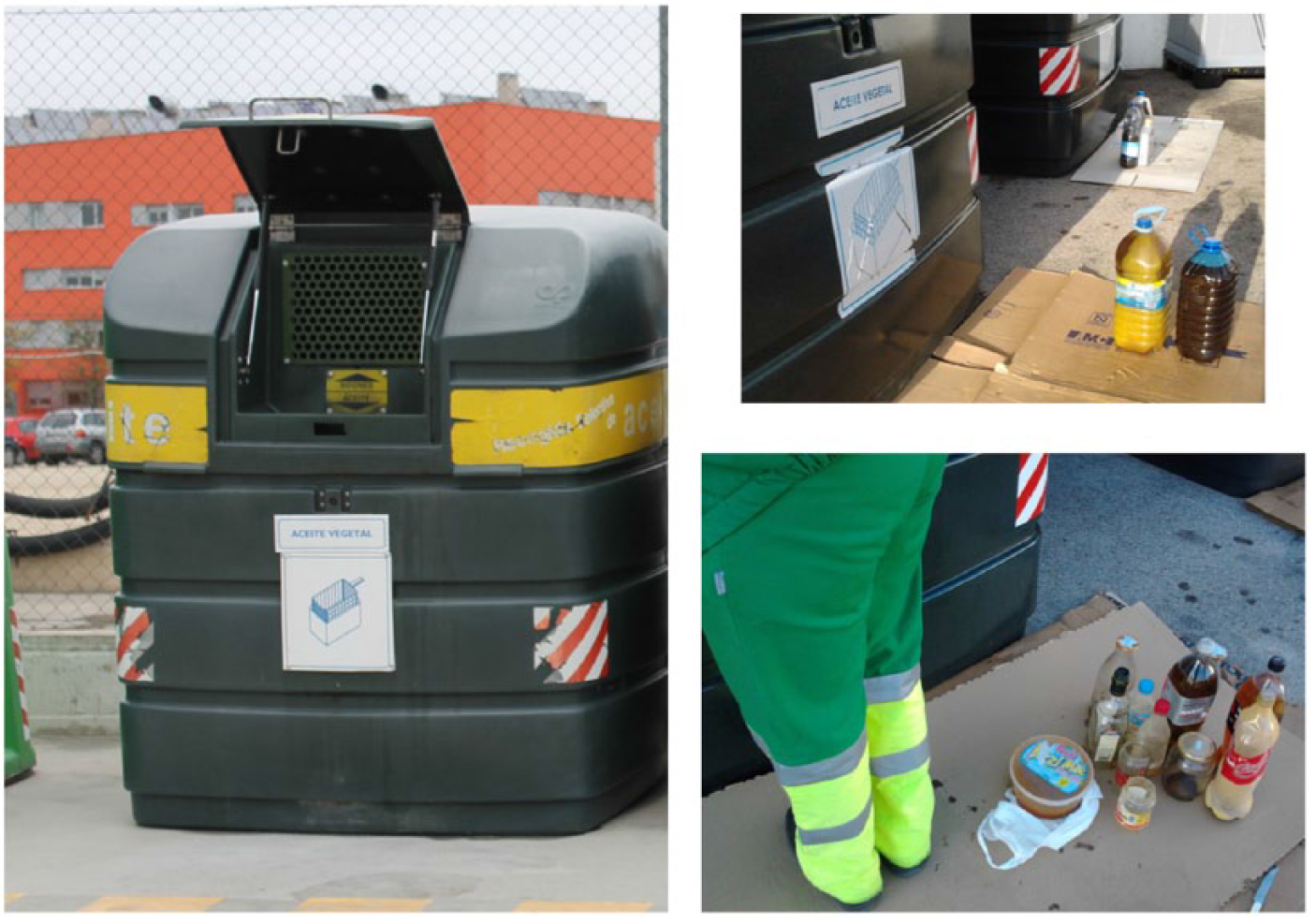
(Left) container for vegetable oils and liquid kitchen waste fats. (Upper right) bottles of oil under the sun. (Lower right) Fátima in action.
People know, of course, that their excess cooking fats are dirty. Pedro, who holds a job in a nearby office, says: ‘I know that it is bad to pour waste fats down the sink. I’ve heard it contaminates the rivers.’ And so he makes the effort to save excess fat in a bottle after he, or his wife, cooks. When the bottle is full he drops by the PL to dispose of it. Pedro calls himself a ‘responsible and civilized citizen,’ which is why – or because – he doesn’t use ‘the kitchen sink as a waste bin for oils.’ Publicly taking excess fat to the PL constitutes Pedro’s politics; not only does he act, he also shows environmental care. And he recognizes that his efforts to collect his fats and take a detour to the PL make him a ‘good citizen.’ Meanwhile, in charge of the process that enables Pedro’s good citizenship, Fátima’s care comes perhaps at even greater cost. She does the dirty work – and even though it is public, since she gets paid to do it, turning dirty oils ‘clean’ does not turn her into a ‘good citizen.’
Trajectory to the unknown
Joining in with the recycling infrastructures that surround him – of which Fátima is a part – Pedro is a responsible ‘good citizen.’ But ‘responsible’ doesn’t necessarily mean ‘informed’ and a lack of transparency about what happens to the oil puts the workings of those very infrastructures under pressure. Pedro doesn’t know what occurs at the PL. ‘Honestly,’ he says, ‘I have no idea what they do with the oil here. Do they make soap with it?’ He is confused: turning waste oil into soap belongs to the other mode of action, that of re-use. A mode he knows well, for sometimes he takes waste oils to his mother – who does turn them into soap. Pedro is not the only one; what happens once the excess oils are collected is unclear to Fátima as well. The green vat at the PL is a black hole, where visitors watch the technician drop their waste fat into the unknown. Information is hard to come by, and this lack of transparency threatens their good citizenship. For what is the difference, really, between throwing oil down the drain at home versus in the container at the PL?
Once out of the hands of humans – be they technicians or (good) citizens – and poured into the green 500-liter container, the oil’s fate falls under the purview of acronyms. After being picked up by a flotilla of suction trucks owned by waste management companies RESIGRAS and GAVE (see Figure 4), processing occurs at the industrial production plant BIONOR. 16 According to MAGRAMA compared to making biodiesel from vegetable crude oils, making it from waste kitchen fats saves 21% of fossil energy; each kilogram of oil collected can be converted to about 0.92 to 0.97 kilograms of biodiesel (MAGRAMA, 2013). On this journey, then, citizens’ gratis contributions of waste oil turn into economically viable biodiesel (BD100).
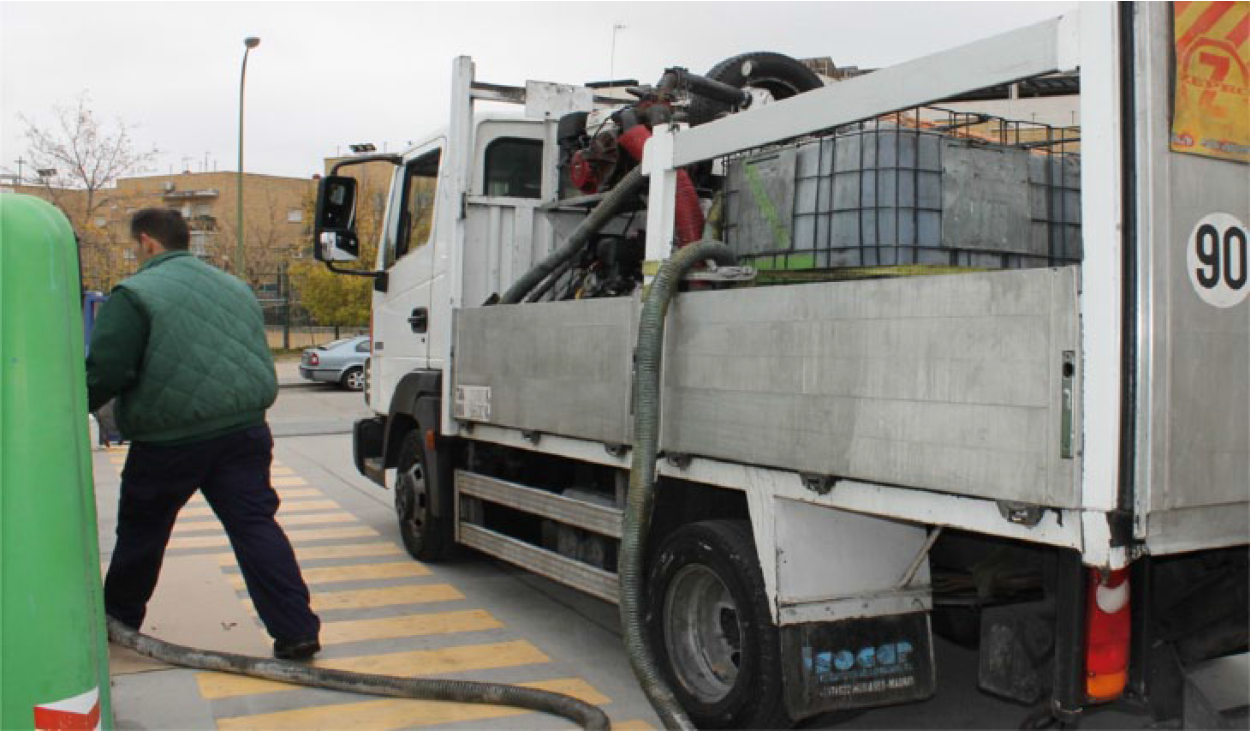
A ‘noisy and dirty job’ – worker empting the container with the ‘sucking machine/truck.’
When waste fat becomes a resource, throwing it down the drain becomes a waste. But how much waste kitchen oil actually finds its way into biofuel? How much does the operation cost, what does it yield? How much waste gets wasted, how much gets used? The oils and fats that disappear into the sewage system are uncountable but estimable; GAVE reckons that between 15 and 18 million liters of oil went into Madrid’s drains in 2012. Every liter of dumped oil contaminates – another estimate – 1000 liters of water and costs the tax-payer 2.40 euros to clean. 17 GAVE is not available for comment; its trucks’ schedule is under wraps, and the truck driver whom Rebeca interviewed would not disclose how many, and which, PLs fall under which waste management company. So, how much oil goes where, for what processes, and to what end, remains obscure.
The deputy assistant to the director of the sewage system maintenance division at Canal de Isabel II – the regional water management company – tells Rebeca that in 2012, 884,000 liters of waste vegetable oil were recovered from the PL; how much got turned into biofuel is unclear. According to this expert, CdI II spends 25 million euros per year cleaning all wastewater in Madrid. But as he jots down numbers on a scrap of paper, he begins to realize that they do not add up. If GAVE’s calculations are indeed accurate, CdI II should spend 36 to 43 million euros per year cleaning the sewage waters of fats alone; a four-year contract would be between 144 and 172 million euros. But CdI II has a 100 million euro deal for four years to clean drain waters of all residues. ‘I’ve done my calculations,’ the deputy assistant says. ‘I wonder how real they are. … some business has recovered those oils. But I have no idea how much of those … have been recycled. I have no idea who makes these numbers. … if you get a good source of information, please, put me in contact.’ Neither Rebeca nor the deputy assistant, they now realize, have a clue how the numbers came about. Confused, they wrap up the interview.
What little information is furnished by the various agencies, is contradictory. The techniques deployed to estimate how much wasted fat goes into the sink in Madrid are not disclosed by GAVE and do not exist in the publicly accessible records of CdI II. We think it is safe to say that Rebeca’s interlocutor is sincere in his confusion. And we submit that if the deputy assistant to the director of CdI II doesn’t know how much oil goes where, no-one does. While the companies like to throw around firm numbers, where oil goes, where it comes from, how much goes where, and what benefits the good citizen’s recycling efforts yield, remains unclear. Uncertainty abounds, then, in this formal fat waste economy, about ways of measuring, about what to measure, about how to measure it, and about what the measurement means. And like all other relationalities, uncertainty has material consequences.
Adjudicating the good
Tracing such material effects of the lack of transparency about the monetary value of waste processing on actual practices is a matter for another article. For our present purposes, noting that it is noted is enough. Pedro, for one, mostly takes it in his stride, this uncertainty that sticks to the system. After all, he routinely makes the detour to the PL where, he realizes, if his oil gets processed into biofuel, value – both monetary and ecologically – is produced (Gille, 2012). Regardless what happens to the oil, he says, he’ll do his share for ‘good citizenship.’ And if he doesn’t pour his excess fat down the sink, if his deliveries are consistent, and Fátima’s records continue to account for them, and if he’s not the only one, good citizenship adds up to responsible environmental action. But Pedro and others must muster the conviction that this is worth (their) while. Against the backdrop of the jumble of knowledges and unknowns that are at work here, sometimes it is compelling to jump ship. For if one pours the oil down the drain, no-one will know. One then contributes to incalculable loss. And so normative judgments, about which story to go by, which numbers to believe, for which ‘good causes’ to go out of one’s way, which values to care about, and which to put out of mind must be made. Good citizenship hinges on this calculatory logic under conditions of uncertainty.
And it resides in how matter is done. Information and marketing campaigns modify, tame, and also politicize citizens’ practices; a series of products and infrastructures are both condition and result. The message that the home is an appropriate site to care for the environment dramatizes and so simplifies this picture (Marres, 2008). And it individualizes the problem: a ‘bad citizen’ pours fats down the sink at home – so ‘messing things up,’ to use the language of Spanish government brochures – while a ‘good citizen’ uses the neighborhood bins and detours oils to the waste disposal site in public (Liboiron, 2016). 18 Again, forms of citizenship emerge out of waste practices.
Pedro and others figure as citizens – good or bad – because (trans)actions that reside in their private spheres (here, practices of waste oil disposal) are heavily politicized: domesticated, orchestrated, and explicitly related to global environmental concerns. 19 What figures as waste and how it is treated is not all that matters, and it is not all that changes in these transactions; the citizen who deals with waste may shape-shift as well – between good and bad and other possible figurations. And so perhaps this is what ‘good citizenship’ entails: in light of uncertainty incited by alter, alien, external formal infrastructures, to make rational decisions, educated guesses, and leaps of faith, to tell the story about how these balance out – in order to keep dissatisfaction, anxiety, and more undesirable forms of citizenship at bay.
The ‘re-user’
Making soap with used oils derived from cooking was a widespread practice in postwar Spain. Pedro and others at the PL reminisce about it: how they used to give their used kitchen fats to their mothers, to be turned into soap. Mothers die or move to smaller apartments, and soap-making slowly dies out. Nevertheless, it didn’t take long to find Virginia, whose soap-making is still going strong.
When Rebeca visits, Virginia is about to make a new batch. She needs 3 liters of used cooking oil, 3 liters of lukewarm water, ½ kilo caustic soda (sodium hydroxide, lye), a colander, a deep plastic bowl, and a wooden stick to stir (Figure 5). It is important to make the soap in a well-ventilated room, Virginia says. Caustic soda is corrosive and very dangerous; she would never allow pets or children around while making soap.
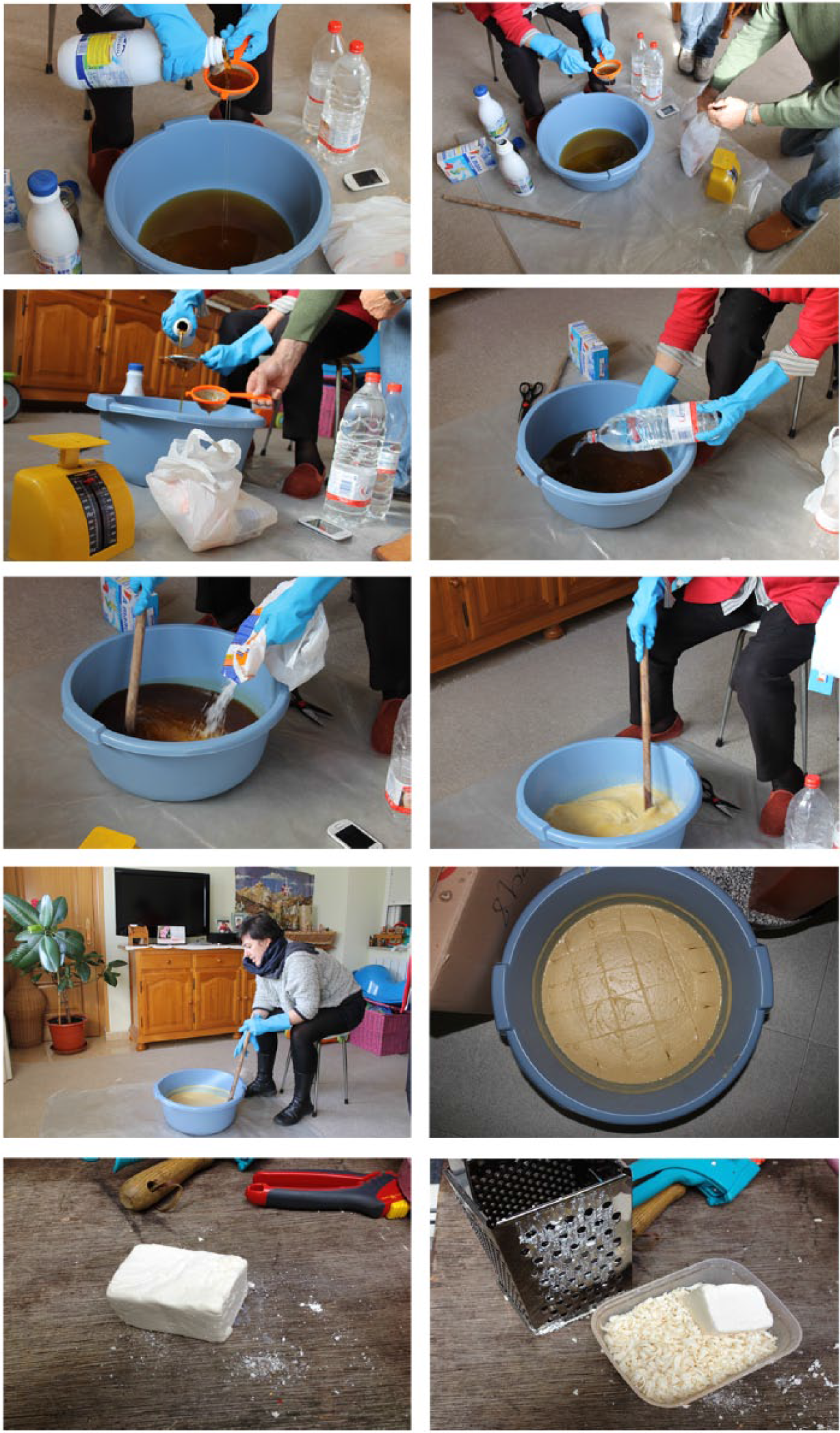
The soap-making process.
Virginia pours the used oil, then water, and finally the caustic soda. She measures by eye, and tinkers with the mix while adding the compounds. Then the tedious part begins: stirring. A slow process, Virginia has to stick with it. She stirs non-stop, always in the same direction, while she and Rebeca talk. Thirty-five minutes later, Rebeca takes a turn. The texture is not right and they keep at it. After almost two hours the mix is ready, though not to Virginia’s satisfaction. She blames the weather: ‘it is too cold; [this] doesn’t coagulate as it should.’ But something else may have gone amiss. While Virginia normally receives used oil from her children – from people like Pedro, when they do not take their fats to the PL – this time she had not collected enough. A new recipe, offered by a friend, requires less. So if today the mixture doesn’t have the proper texture, it is not so clear why that is. Virginia hopes that after cooling down in a dark corner for 24 hours, it will be all right.
Today’s result is more than soap made reasonably successfully under unfavorable conditions; more than money saved on laundry detergent. For Virginia has shared childhood memories, which infuse her work. After all, she learned to make soap observing her aunts as a child; and later, by doing it in the presence of a more experienced ‘re-user’ – much in the way Rebeca learned today. The results are not fashionable, says Virginia, because she re-uses waste fats:
Now it is fashionable to make artisanal soap. … You can get soap bars with colors, aromas, essences, etc. … made with extra-virgin olive oil instead of used oils. What we just made isn’t fancy, just traditional. It’s a way of not throwing things out.
Making soap requires skills, materials, knowledge – all precarious. The substances that are necessary may not be available; the very practice of taking used oil to the PL cuts into Virginia’s supplies. And the skill and knowledge for making soap may be forgotten. Embodied memories matter. For here, by word of mouth and through shared practices and skills, the circulation of knowledge affects the circulation of matter. And the local, informal circle of ‘re-use’ reaches out from the domestic into the collective sphere and back again.
Knowing matter, using materials, mastering skills
While ‘good citizenship’ may be threatened by the obscurities of the workings of the waste processing plant, re-use benefits from the transparency that comes with ‘being in touch.’ Such contrast is deceptive. As for Pedro, Virginia’s waste-related practice depends on factors beyond her purview and control. Yes, the kinds of collectives that animate the ‘good citizen’ and the ‘re-user’ may be quite different: one depending on a formal infrastructure of flasks, recycling stations, blue jars, green bins, acronyms, and economic and normative incentives – all afforded by others; the other on a more informal set of arrangements that shapes her household practices. But in each case, materials ‘make’ citizens; while ‘good citizen’ behavior shape-shifts with new practices that enter the house, domesticating it and its residents, ‘re-users’ likewise engage in domestic action that has a presence in the public sphere – experimenting, tinkering, and modulating the matter as well as the policies at hand. While the latter’s public practice saturates her private space, the former’s private practice has public effect – both showing the leakages between the two spheres. Citizenship is, then, not about transparency, but about coming to grips, literally and materially, with circuits and circumstances that are obscure at best.
Meanwhile, waste fats, the practices surrounding them, and the bodies that engage these practices, are different things in different places. What for Fátima and Pedro counts as recycling, for Virginia and her friends constitutes waste; what the acronyms – GAVE, BIONOR – consider waste, for Virginia is a necessity of household economizing. And the ‘good citizenship’ that counts for Pedro and Fátima’s records, is a different way of doing good citizenship than the frugal goodness that makes for the kind of citizenship that matters in Virginia’s world. Many of our constituents mix roles, too: like Marianne, Rebeca and Paula, Pedro is a re-user, using his olive oil in more than one version of his tortillas de patatas. And when, once in a while, he takes his used oil to his mom’s house, who uses it herself or passes it on to a soap-making friend, that makes him a re-user too.
This redistribution of fats suggests distributed subject positions, as well as a certain variability in what waste matter is, itself (Coles & Hallett, 2012). The acts of recycling and re-using are politically and environmentally distinct, framing waste matters as respectively resources or excess. Recycling – an industrial process, institutionally run, energy-intensive and so not necessarily environmentally benign – welcomes waste materials as ‘naturalized commodities’; as materials designed to be recycled (Liboiron, 2016). A culture of re-use, on the other hand, challenges the institutionalization that comes with the formal economy of recycling; here, waste is excess (Callén & Sánchez Criado, 2016; Liboiron, 2016). The figure of the ‘re-user,’ then, offers a counterpoint to the wasteful consumer found in accounts of the so-called ‘throwaway society.’ 20 But our examples of re-use show how that moniker is a throwaway term that neglects to attend to actual materials and practices – and that material, mundane, and informal practices complicate narratives that frame consumers as wasteful, and used materials as waste.
Some lessons concerning waste and fat
Waste matters differently, then, depending on the knowledge, practices, and matters of concern at work. Our two modes of doing waste, ‘re-use’ and ‘good citizenship,’ pull in different directions. Re-using is also reducing, mending, tinkering, spending and taking time. Meanwhile recycling at the Punto Limpio offers a sense of closure or, as Raúl puts it, is ‘the happy end of our waste. You cook a tortilla de patatas with lots of olive oil. Then, another day, you cook another one. Now the olive oil is of no use, what do you do? Take it to the container at the Punto Limpio and … happy ending.’
A happy ending that is a black box for those who are unaware of what happens to the materials but nevertheless feel accountable and caring after dropping by the PL. We suggest that different material practices of dealing with waste fat – ‘re-use’ and ‘recycling’ – enact different versions of the subject. The ‘good citizen’ can be characterized as relying on a formal, external infrastructure. Domesticated to comply with the necessary procedures, her or his actions are managed by collectives such as GAVE and BIONOR, whose work remains opaque and whose results, procedures, and knowledges are a mystery. With these actions she or he ‘recycles’ – commonly deemed a ‘good’ but not, as we have seen, itself without challenges. The ‘re-user’ doesn’t need a formal infrastructure – instead building on her or his own ephemeral arrangements, sometimes in concert with others. She or he relies on mundane skills to bring to bear ‘re-user’ practices; on patience to put these skills into practice effectively – assimilating knowledge and keeping at it until success ensues; and is thwarted at times by the obscurity of precisely what it is that makes things work. The re-user’s domestic practice doesn’t rely on but is threatened by external infrastructures; it is local but not separate from what lies beyond. The re-user’s is an informal economy, solid and tenuous at the same time. 21
While it is precisely this contrast, between the user as passive consumer of an end-product versus the user as complicit in its production, that we have in mind as the crucial difference between the figurations of ‘good citizen’ and ‘re-user’ of waste kitchen oils, practices of waste also escape this scheme. The re-user processes the waste material, moving and transforming with it and so of necessity relating to it, while the good citizen is inserted in an infrastructural network that enables her or him to delegate the transformation of waste objects to third parties. Or so the user-oriented story would go: while the former is changed, the latter is a conduit; while one is part of the process that shapes a trajectory, the other is a vehicle on a previously laid path. While both participate in public matters through domestic practices, they do so in strikingly different ways.
But waste management practices which depend on intricate and large-scale infrastructure, while calling on recyclers’ ‘good citizenship,’ also hail them as users in the traditional, consumer sense: the infrastructure itself is the product that they ‘use’ and tinker with. After all, they sometimes do run their oil through the sink. They do mix vegetable and animal fats. And they do press Canal de Isabel II to produce more transparent figures about what happens to their waste oils. Meanwhile, the ‘re-users,’ shape-shifting tinkerers who are complicit in shaping processes as they go, are motivated by a strict logic of rationalizing their informal household economy, and so fit an infrastructural mold that frames their actions on a broader scale.
Waste fat occupies a precarious and liminal space governed by various practices and knowledge regimes, global and local networks, traditions, and ways of being together. Our focus on figurations of handling waste fats shifts attention to the relevant relations around waste practices (Gregson & Crang, 2010). If taking fats to the PL is a way of carrying out environmental care, practices that spring from the home, such as cooking, saving, and recycling, become political activities. Recyclers thus participate in and contribute to the common good through their domestic actions. Conversely, the practices related to the re-use of waste fat combine the ‘common good’ and the self-reliance of achieving economy through one’s own hands and skills, so doing politics in and through household practices as well.
The search for other-than-usual enactments of ordinary life, Foucault suggests in Des espaces autres (1984), asks for an ethnographic encounter with ordinary, but under-examined, spaces that allow cutting through the schematic characterizations that social science otherwise provides. Borrowing Foucault’s term heterotopia, Mol (2009) understands (food) practices as such ‘other spaces’; more than one mode of (inter)-action with foodstuffs, labels, cooking, and discarding of leftovers may coexist. We think of the practices, connections, and networks involved in re-use and good citizenship to do with kitchen waste as heterotopias that teach us ‘philosophy.’ For as ‘places that are other to those from which philosophy usually draws’ (Mol, 2009, p. 270), sites in which kitchen oils are discarded or re-used teach how different values may be held simultaneously, other valuations set in motion, practices enacted, and interests served (Mol, 2009). Here, we suggest, ‘re-use’ is the ordinary but under-examined space that can usefully be contrasted with the modes of ‘good citizenship’ in order to render the latter ‘strange.’ Re-use sheds light on stories outside ‘formal orderings’ – formal orderings that are the province of ‘good citizenship,’ par excellence – so revealing other classifications of how ‘waste fat’ gets inserted into different topologies that are equally, and sometimes simultaneously, at work.
But not only do we suggest that it is worthwhile to explore the mode of re-use as framing a counter-space or space of difference, we also depend on the figure of the re-user to show how ‘interrelatedness,’ (bri-)collage, and heterogeneity are at work in discarding fats. For ‘wasted fat,’ as we have seen, is not out-there, as a product – rather, fat is different things for different users in different processes. For MAGRAMA it is a source for making BD100. For GAVE it is that, too – but it is also a dangerous element that contaminates water. For Marianne fat is a jar taking space in the kitchen. For Fátima it is dirty work in a so-called clean facility. Pedro attaches his sense of citizenship to it as he does his share. This simple, day-to-day, inescapable substance is never ‘just’ there, but belongs to, enacts, and emerges in relationship. Fat isn’t something that ‘just is’; in the practices that we describe, it becomes. An achievement, arriving in many versions, it circulates and shape-shifts in practices that are, in themselves, heterogeneous and diverse.
Conclusion: Making citizens
Like waste fats, the figures of ‘good citizen’ and ‘re-user’ become – rather than ‘are’ – in these processes, as well, and they mix better than oil and water. After all, the good citizen is already a re-user when she or he takes the jar of olive oil to the PL, and the re-user does his or her share of good citizenship by keeping excess fats out of the sewage system – at least until they end up there bound as soap.
Those who share the language of the good citizen recognize its normativity as they see it. Nevertheless, as authors we insist that we do not know what a ‘good citizen’ is. For this goodness – the goodness (and badness) that modulates citizenship and that is an attribute of some forms of it and not of others – is made in and of specific, local civic actions. Such as waste disposal practices. Such practices vary. And the ‘good’ is embedded in those varying practices and in the objects that enable them; it is its specific engagement with waste disposal that makes citizenship either good or bad. Such engagement depends, or so we claim, on circumstances and conditions – and so makes citizens shift between good or bad accordingly. Citizens, then, ‘are’ neither just good or bad; they are either, or both, or something in-between. And so this is our point: we don’t know what a good citizen is; it is rather the objects that facilitate waste disposal, that ‘do’ good citizenship. This is what the field told us: when we asked our interlocutors how they deal with excess fats, their answers reflected on citizenship; as it turns out, how they deal with their excess is what makes for good or bad citizens. But how people deal with their excess is not constant, and so ‘good’ and ‘bad’ citizenship can live in one body, pretty much at the same time.
Footnotes
Acknowledgements
We are grateful to all who taught us about wasting and eating, and thank Annemarie Mol, Emily Yates-Doerr, Sebastian Abrahamsson, Filippo Bertoni, Oliver Human, Else Vogel, Justine Laurent and two anonymous reviewers for their insightful comments on earlier versions of this article.
Funding
This research was made possible by ERC Advanced Grant, AdG09 Nr. 249397 (Martín) and Beckman funding from Harvey Mudd College (De Laet).