




Abstract
MN Srinivas’ concept of ‘the dominant caste’ has rightly been highly influential. The forms that dominance takes have changed a good deal since his day, but inequality and hierarchy have persisted. Modern ideological justifications of dominance are frequently at variance with those of former times, leading to plenty of paradoxes. These paradoxes are illustrated with examples from Nepal, but their application is much wider. Thanks to Nepal’s different political history, the Nepali case can very usefully be contrasted with India and other parts of South Asia to highlight how, and in which contexts, hierarchy as a value persists even when equality is written into numerous constitutional provisions and laws.
Preliminaries
There are two reasons why giving this lecture is a particular honour for me. First, M. N. Srinivas was a foundational influence in my study of South Asia. Over 40 years ago, while in India in 1980, I studied Sanskrit for several weeks at the Bhandarkar Institute in Pune (as part of the Oxford MPhil in Indian Religion); I then travelled around South India. I bought copies of The Remembered Village and Caste in Modern India and Other Essays for ₹30 and ₹25, respectively (both have the stamps of the Pune bookshops where I bought them). I read both books from cover to cover. I have been urging people to read The Remembered Village and the essay ‘Varna and Caste’—and putting them on my reading lists—ever since.
The second reason is that, 22 years later, in 2002, I was appointed to the very Oxford lectureship that Evans-Pritchard had created in 1946, especially for M. N. Srinivas. This means that I had become the fifth lineal descendant of M. N. Srinivas in the post (in between Srinivas and me came Louis Dumont, David Pocock, Ravi Jain and Nick (N. J.) Allen).
Srinivas returned from Oxford to India in 1951, first to establish a department in Baroda, subsequently to Delhi, and then to Bangalore. He effectively launched the modern form of the discipline of sociology in India, and it is surely fitting that he is memorialised by this lecture. If only I had known he was there, I could have visited him in Bangalore in 1980, but I was as yet too young and knew too little of South Asian matters for that to have occurred to me as a possibility. 1
I have spoken elsewhere of Oxford’s influence on Srinivas. 2 The story is well known, and was told by Srinivas himself, of how disillusioned he was with G. S. Ghurye’s antiquarian and evolutionist approach—to the extent that he considered quitting anthropology altogether—and how exciting and liberating he found Radcliffe-Brown’s alternative framework of structural functionalism. When Religion and Society among the Coorgs (Srinivas, 1952) came out, it was taken as a triumphant vindication of Radcliffe-Brown’s theory of ritual and religion (Srinivas, 1997, p. 11). The book showed for the first time, it was claimed, that Radcliffe-Brown’s approach could be applied just as successfully to a complex civilizational society as it could to the much simpler societies, such as Australian aborigines and Andaman islanders, with whom it had initially been worked out. However, by the late 1940s Evans-Pritchard himself, and his disciple, Godfrey Lienhardt, had already moved away from the socially determinist and Durkheimian viewpoint of Evans-Pritchard’s predecessor. Evans-Pritchard and Lienhardt tried to persuade Srinivas to rewrite the book, but by that time, it was written, and he resisted (Srinivas offered to throw the manuscript into the fireplace if they did not think it was good enough) (Fuller, 1999, p. 5).
Educated Indians are often aware that Srinivas coined the concept of Sanskritization. They are usually surprised to hear that the term ‘vote bank’, used by Indian journalists every day, is also a Srinivasian coinage. This lecture addresses a third key Srinivasian term, dominant caste. The issue of dominance, and its opposite, subordination, is even more pressing today than it was in Srinivas’ time. Greater and greater acceptance of equality as a value has not led either to equality of opportunity or to equality of outcome. Questions of inequality, dominance and hierarchy are pressing throughout South Asia, and indeed the world. Where Srinivas was concerned to explore and explain the power of the dominant caste, today we are rightly exercised by the power of dominant majorities, both at national and at local levels. 3
Nepal in the Light of India
Since my examples will come mostly from Nepal, first I must say something about Nepal and its relation to India. Nepal’s history and society is a key comparative case in the study of South Asia. In a sense, it could be said that all my academic endeavours—whether about the history of Buddhism and its relation with Hinduism (Gellner, 1992) or about caste (Gellner & Quigley, 1995), borderlands (Gellner, 2013) or Dalits (Gellner et al., 2020)—whatever else they may have been arguing, have also been directed at this: attempting to achieve for Nepal its rightful place in the study of South Asia.
It is a matter of regret to Nepali intellectuals that their country is so little known and so little understood in India. They know a great deal about India—as do most Nepalis—and they feel it very unfair that the compliment is not returned. Pratyoush Onta, pioneer analyst of social science knowledge production in Nepal, has written about India’s academic centres that are supposed to specialise in the study of Nepal and pointed out how their chronic underfunding has prevented them from contributing anything very substantial (Onta, 2001). Of course, exactly the same could be said of the Nepali centres that are supposed to study India. The difference is that every Nepali knows about India and Nepali intellectuals usually know substantial amounts about the history and politics of Nepal’s all-important southern neighbour.
This knowledge asymmetry is not unusual. The subaltern or marginal or peripheral person knows about the centre and the powerful—they have to know, it is a matter of survival—but not vice versa. You find the same ignorance and condescension within the United Kingdom, between England, especially the southeast of England, and the Celtic fringe of Wales, Scotland and Northern Ireland. 4 This point about the sociology of knowledge is not original to me, of course. W. E. B. Du Bois (2007 [1903]) propagated the idea, with respect to Black people in the USA using his concept of ‘double consciousness’. Feminist scholars, at least since de Beauvoir, have made a similar point about women in connection to men.
Nepalis know a great deal about India, because—despite being an independent country and explicitly recognised as such by the British in a treaty of 1923—they are culturally, and to a considerable extent economically, continuous with India. The cultural and linguistic gap between Nepal and North India is much less than the gap between North India and South India. The gap between Nepal and China is a yawning chasm compared to that between Nepal and India. The India–Nepal border is open for the free movement of people: The citizens of either country can live and work in the other without the need for any visa or documentation (though attempts to tighten up on the latter point have been made in recent years). This is in marked contrast to India’s relations with other neighbours (the only partial exception being Bhutan).
From an economic point of view, this open border is a huge advantage for the poorest sections of Nepali society. If they are in dire straits, they can walk out of Nepal and seek work in India’s cities. The movement of people is free, but the movement of goods is not. For those who live near the border, small-scale trade, avoiding the customs posts, what is known locally as dui number baato, offers small economic advantages and a living to many young men and boys, and doubtless to some women too. On the other hand, the open border provides many opportunities for Indians too. In the cities of Nepal, the vast majority of barbers and nearly all plasterers, electricians and plumbers, not to mention itinerant fruit and vegetable sellers and collectors of empty bottles, come from Bihar and Uttar Pradesh. Nepal has a massive trade deficit with India, especially in manufactured goods.
Culturally, too, there are big commonalities. For several reasons—partly because there is so much movement to and from across the border, partly because Nepali and Hindi are quite close in any case, and partly because of decades of influence from Hindi movies and TV channels—most Nepalis have a fluent understanding of Hindi and many can speak it as well. Hindi is not something one studies at school or actively sets about learning; Hindi is just ‘in the air’ and it is taken for granted that any adult has at least a passable acquaintance with it. Religious traditions are shared too. Indians feel quite at home at Hindu and Buddhist shrines in Nepal. It is not only Nepalis in the southern Tarai region who often marry over the border in India. The ruling class—the Rana clan of former hereditary prime ministers and the Shah clan of former monarchs—frequently intermarries with Rajputs in India.
For the north Indian who wants to orient themselves to Nepalese social structure, it is, as one might expect, somewhere—perhaps halfway—between Uttarakhand and Himachal Pradesh, on the one side, and Northeast India, on the other, both geographically and culturally. Simplifying considerably for heuristic purposes, one may say that Nepal’s Janajati groups (corresponding to ‘Tribals’ in India) are neither so fully assimilated to Hindu ways as Tribals are in Uttarakhand nor yet so radically different as in India’s Northeast. Demographically as well, the position of Tribals in Nepal is in the middle, halfway between Uttarakhand and Northeast India: Whereas Tribals are under 10% in Himachal Pradesh and Uttarakhand and are close to 90% in the Northeast, in Nepal, Janajatis make up a third or slightly more of the population. As such, Janajatis fill the political space that in north India is occupied by the OBCs.
As another point of comparison with India, one should consider the position of Dalits. As is well known, the percentage of Dalits varies considerably from place to place, from 7.1% in Gujarat to almost 32% in Punjab, with Uttar Pradesh in between at 21.1% (Jodhka & Manor, 2018, p. 25; Thorat, 2009). In Nepal, since 1991, the figures for all castes and ethnic groups are counted and published, not just SCs and STs as in India. 5 Dalits are, officially, 12.5% in the country as a whole (activists claim this is a considerable under-count). As within India, this varies quite considerably by region, with relatively low percentages in the Tarai plains adjoining India and relatively high numbers in western districts: for example, Achham, Surkhet, Dailekh, Jajarkot, Rukum, Baglung and Myagdi (Tamang et al., 2014, p. 84). There are even 14 VDCs (the smallest local government unit at the time of the 2011 census, totalling over 4,000 in the country as a whole), 9 in the hills and 5 in the plains, where Dalits are over 50% of the population (ibid.). Just as in India, there are significant differences within the Dalit category. The biggest hill Dalit group, the Vishwakarmas (Blacksmiths), number over 1.25 million, bigger than all the others put together. The other two big Dalit groups are the Pariyars (Tailors), 472,862, and the Mijar (Cobblers), 374,816. The Madheshi Dalits are divided into more groups and are smaller in terms of absolute numbers: Harijans (Chamars) are the largest at 335,893, followed by Musahar (234,490) and Paswan (Dusadh) (208,910) (ibid., p. 8).
An important similarity between Nepal and India lies in the emergence of what I call macro-categories. Just as in the USA, the expected melting pot of nationalities and ethnicities did not happen, rather there was a salad bowl, of Polish Americans, Italian Americans, and so on, in the same way a single Indian or Nepali national identity has not yet emerged. Certainly, small differences have eroded. Beteille (1965, p. 73) documented 12 different kinds of Brahmin in his Tamil village, each forming a separate endogamous group, in the 1960s. Hardly anyone cares about such fine distinctions today. Caste, as most people know, exists within the Muslim community too, but that too is eroding even more than that in the past. In India the big cleavages are between the Dalits, Muslims, OBCs and ‘general castes’; Tribals only count as a fifth macro-category in some parts of the country where they are sufficiently numerous. In other words, in large parts of India, there are four big macro-categories in the salad bowl, which the forces of Hindutva are trying hard to simplify into a simple Hindu–Muslim binary. Interestingly, in Nepal too, and this is probably no coincidence, there are also five macro-categories: Dalits, Janajatis, Madheshis, Khas-Aryas (formerly ‘Bahun-Chhetris’, ‘Chhetri-Bahuns’ or ‘Parbatiyas’) and Others (among whom Muslims are the single biggest group).
Major Castes, Ethnic Groups and Macro-Categories of Nepal.
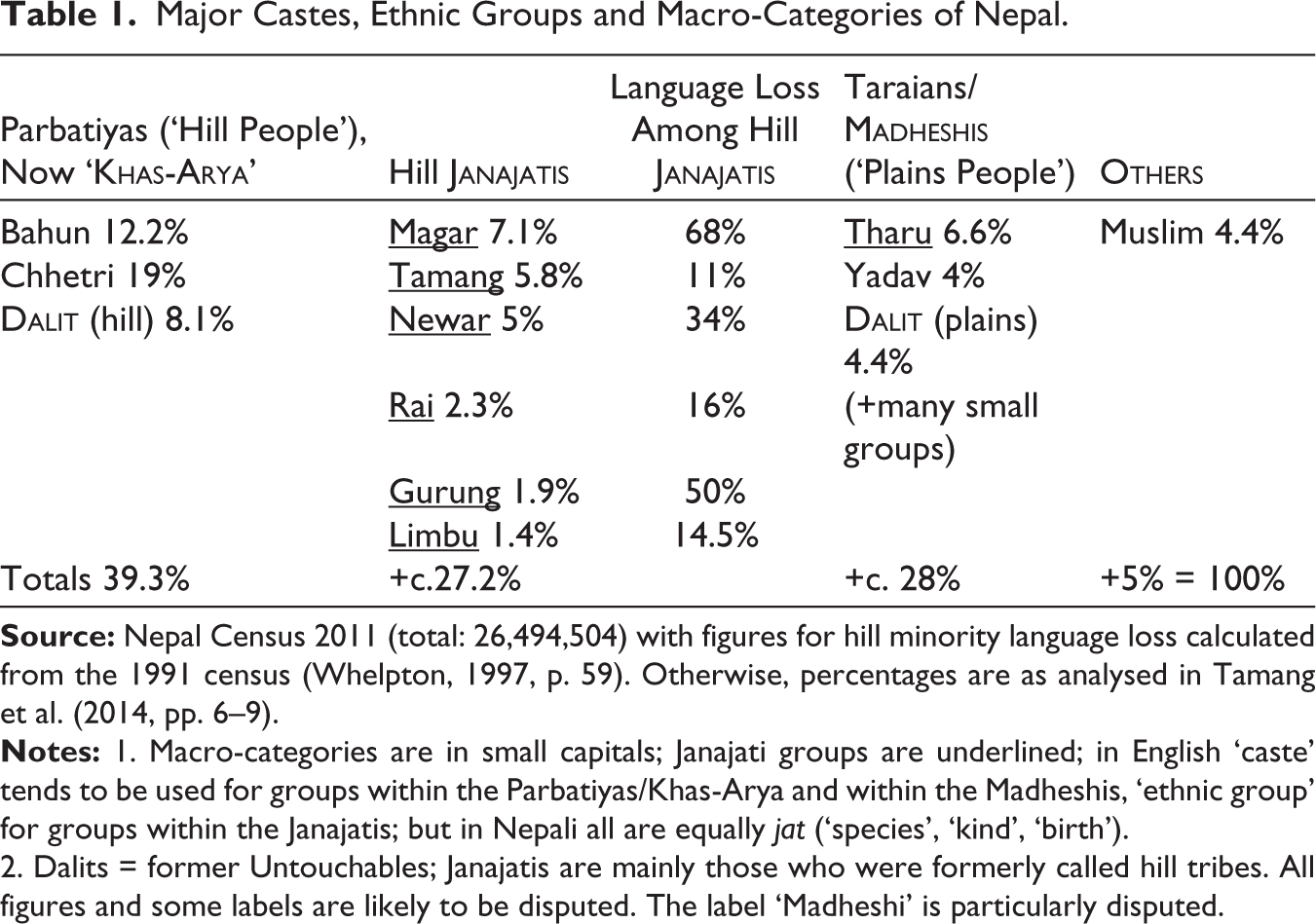
2. Dalits = former Untouchables; Janajatis are mainly those who were formerly called hill tribes. All figures and some labels are likely to be disputed. The label ‘Madheshi’ is particularly disputed.
For all these commonalities between Nepal and India, there are important differences. Nepal remained independent from the British, and avoided the influences of colonialism, to a much greater extent than India’s princely states. Sanskritic Buddhism survived as a continuous and living tradition in the Kathmandu Valley as it did not anywhere else in the subcontinent (Gellner, 1992). Hindu reform movements inspired by the confrontation with colonialism never happened in Nepal, and when people tried to introduce ideas of democracy, Gandhianism or the Arya Samaj from India in the 1920s and 1930s, they faced severe repression by the Rana regime (Joshi & Rose, 1966, Ch. 3; Whelpton, 2005, pp. 79–85) as did parallel Buddhist reform movements (LeVine & Gellner, 2005, Ch. 2). Caste differences were still backed by state law right up to 1963. Nepal retained a monarchy, fully involved in, and legitimated by, Hindu ritual, including mass animal sacrifices during Dasain (the festival known as Dassera or Durga Puja in India) into the 21st century. The removal of Hinduism and kingship from the structure of the state occurred only very recently with a declaration of the Interim Parliament in May 2006 and the Interim Constitution of January 2007, confirmed by the new constitution of 2015 (Gellner, 2022). In other words, Nepal has only been a republic for 15 years, in contrast to India’s nearly 75 years—five times as long.
All these differences mean that changes that in India occurred over 200 years or more were compressed in Nepal into a span of 50 or 60 years. Change has been so rapid that in some respects Nepal could be considered more ‘progressive’ than India (one could cite its mixed proportional-first-past-the post electoral system, the recognition of third gender identities, a more egalitarian ethos in everyday interaction, all kinds of rights recognized in the 2015 constitution, etc.). Controlled comparison between India and a country of very similar cultural background but different political history is therefore possible but rarely attempted. As a rare positive example, one could cite Rajeev Bhargava’s (2016) afterword to Religion, Secularism and Ethnicity in Contemporary Nepal, which sought to place the Nepalese approach to secularism in a comparative framework, particularly in the light of the Indian experience of what he has named ‘principled distance’. I attempt here something similar with that most Srinivasian concept, the dominant caste, and in relation to the position of the most dominated, the Dalits.
The Dominant Caste as Capacious and Stratified
Caste is as fundamental a principle of social organisation in Nepal as it is in India. Thanks to its unique history, Nepal should be ‘good to think with’ for South Asianists, but unfortunately it is often ignored. Even after a modern law code was introduced in 1963, ideas about caste went deep into the daily habitus of most Nepalis. For all these reasons, Nepal–India comparisons and contrasts, if we take the trouble to make them systematically, could be particularly fruitful.
It is obvious from Srinivas’s original definition, which talks of wielding ‘preponderant economic and political power’ (Srinivas, 1959, p. 1), that the key to dominance is power. However, to say that the dominant caste is the caste that wields power is little more than a tautology, as Oomen (1970, p. 75) points out. Srinivas immediately moves on and talks of all the elements of dominance and notes that what he calls ‘decisive dominance’, consequent on possessing all the elements, is not common. What are these elements? Being numerous (more numerous than other castes), owning more land than other castes, having more educated men among their number (today we would count women as well) and not being too low down in the ritual hierarchy (ibid., p. 2). 6 The key point here is surely the control of land, and while in the ‘traditional’ situation there were many people with rights in the land, there was little doubt about who the primary landholder was, even if they held their position at the pleasure of the king.
The main body of Srinivas’s original paper deals almost exclusively with disputes. The overwhelming power of the dominant caste in Rampura is demonstrated by the fact that in Srinivas’s time, and before, even internal disputes within other castes were brought to the headman and to other Peasant caste patrons for resolution. In conclusion, Srinivas mentions numbers as being important, because of the need to mobilise able-bodied men in case of a fight. He also mentions voting. Indeed, in both these cases, numbers are important. 7 Numbers may help, but they are not a sine qua non for dominance. The whole point of caste as a mode of organising society is that there are multiple divisions among the dominated. As Ambedkar (1989/1936, p. 94) so strikingly put it, caste is a division of labourers and not just a division of labour.
Today we might rephrase Srinivas’s insights in terms of Bourdieu’s capitals. The dominant caste, at least a decisively dominant caste, is one that has economic, political as well as symbolic and cultural capital. The ability to convert one form of capital into another means that the dominant caste is in pole position to take advantage of the opportunities afforded by modernisation, thereby enabling its members to maintain their advantageous position. The interaction of these various forms of capital, and the ability of those who possess them to ensure that their offspring go through private education, is a large part of the answer to the question about how hierarchy persists. By contrast, Dalits have what I have named ‘negative cultural capital’: Even when they manage to acquire education and a respectable position in society, the very fact of being Dalit means that negative associations surround them. That stigma explains why many Dalits are not happy with the label ‘Dalit’ and would like to find a more positive and life-affirming alternative.
A good example of how Dalits’ lack of social and cultural capital works against them is provided by Patricia Caplan (1972) in her monograph Priests and Cobblers. In her study site in West Nepal, the Mijars (or, as they often call themselves today, Nepalis), unhonorifically known as Sarkis or cobblers, were, everyone agrees, the original settlers and landowners. Over time, however, Bahuns (Brahmins), who were literate and well connected, politically and administratively, were able to resume it through a combination of loans, mortgages, trickery and knowing how to make use of the arms of the state (ibid., 1972, pp. 36–37). The distribution of landownership in the period when Caplan studied the village (late 1960s) had come to resemble what is typical in many places, with the pattern heavily skewed towards the ‘high’ castes. Only 3% of Dalits produced enough grain to last the year, whereas 39% of non-Dalits did so. 53% of Dalits produced less than half of annual requirements, whereas only 8% of non-Dalits fell into this category (ibid., pp. 22–23).
Following independence in 1947, India embarked on the world’s most ambitious programme of affirmative action in the attempt to break the reproduction of just this kind of reinforcing cycle of advantage. Nepal, having set out on the path of modernisation long after India, only took the first tentative steps in the same direction 50 years later in the 1990s.
Srinivas received some criticism for placing stress on numerical predominance. In fact, many dominant castes are not the largest group, and their dominance is undermined in the age of democracy. In many cases, larger, formerly subordinated groups, typically OBCs, such as Yadavs, start to assert themselves (Jaffrelot, 2003). In some cases, they may even become politically dominant (Michelutti, 2008). Even Dalits have managed, in places where they are sufficiently numerous and are able to ally strategically with other castes, to acquire power through the ballot box, as the example of Mayawati shows.
These considerations make it clear that we need to distinguish dominance in the pre-democratic age with dominance thereafter once competitive voting by secret ballot becomes the crucial technology for maintaining power at every level. In the pre-democratic age, the dominant caste does not have to be particularly numerous. Or rather, and more precisely, the dominant caste tends to be quite baggy and voluminous and to contain within itself numerous grades of status. The truly dominant may consist of a superior grade within the caste that resists marriages from lower-status sub-castes claiming the same identity.
The Rajputs of Kangra, as described by Parry (1979), are a good example of a large dominant caste, with many internal grades, where the lower fringes of the caste are difficult to specify and appear to merge into the caste below. In Nepal, the Chhetri caste is an exact parallel, though the grades of status are less formalised among them (Fürer-Haimendorf, 1966, p. 32). At the apex of the Chhetri caste is the royal Thakuri sub-caste. It used to be very common for Chhetri men to have multiple wives, with the secondary wives coming from what were then called matwali, that is, ‘alcohol-drinking’, castes or ‘hill tribes’ in English and are now called Janajati or Adivasi-Janajati, ‘indigenous nationalities’, or in colloquial English ‘ethnic groups’. All the children of such unions were considered Chhetris but of a lower grade (Fürer-Haimendorf, 1966). When Bahun men took secondary Janajati wives, their children too were classified as Chhetris (despite not having any Chhetri blood). Just as with the Rajputs, the lower fringes of the caste were porous. It seems that in the first half of the nineteenth century, once certain Magar families had achieved sufficient prominence in the army, they could effectively be promoted to Chhetri status, a process undoubtedly facilitated by the fact that Chhetris and Magars share many of the same clan names (Whelpton, 1991, pp. 8, 21, 210). Even today, when such promotions are unlikely to be attempted, there are many highly Hinduised Magar households who are close to Chhetris in their everyday culture and religious practice.
Thanks to these expansive, rather than restrictive, definitions of who counts as a Chhetri, the Chhetris today are the largest single group within the Nepali population, at 19% of the population. If all the Janajatis were unified into a single group, such as activists aspire to create, they would of course outnumber the Chhetris, but they are far from unified in this way. In different localities, the Chhetris, either with Bahuns or not, frequently form the locally dominant caste. Fürer-Haimendorf (1966), writing on the basis of fieldwork done in the 1950s, only a few years after the fall of the Rana regime, noted, ‘However poor and insignificant, every Chetri was conscious that men of his caste wielded supreme power over the whole of Nepal, and this consciousness gave him confidence in his dealings with people of other ethnic groups’ (p. 66).
Another example of Chhetri dominance lies behind the infamous 1984 Piskar incident (kand), in Sindhupalchok district, just to the east of the Kathmandu Valley. Two Thangmi villagers were killed and many more were injured in police firing during a local festival. Sara Shneiderman (2010) has described the relevant ethnographic situation and activist history. Already in the 1980s, this was an area with a considerable history of communist political work. Later, in the 1990s, as Shneiderman (2010) summarises it, ‘CPN-ML activists had done the difficult work of politicizing the populace, but then disappeared to pursue their own paths to power at the centre, leaving the villagers of Piskar open to Maoist recruitment’ (p. 47). One of the reasons that the CPN-ML had targeted this area, apart from its proximity to the capital, was the highly unequal levels of land ownership. In the 1970s, 6.58% of households owned 47% of the land, while 73.68% were either poor or landless (ibid., p. 56). Although data on ethnicity were not collected at the time, it is clear from oral history and figures collected later in nearby villages that the landholders and moneylenders were dominant Bahuns and Chhetris and the poor and landless were all Thangmis (a small Janajati group also known as Thami: see Shneiderman, 2015).
The Shrestha caste within the Newars in the Kathmandu Valley is another classic Nepalese example of a dominant caste. Like the Chhetris and the Rajputs, they are, or rather used to be, divided into several grades, and like them the lower fringes of the caste were certainly porous, allowing certain upwardly mobile clusters to agglomerate to Shrestha status (Rosser, 1966; Quigley, 1995). Like the Chhetris and the Rajputs, they are a sizeable caste but not the largest. However, they are dominant, and they do represent the pinnacle of non-religious status among the Newars, to which others, if they have the opportunity, aspire to assimilate. 8
The Paradox of Belonging in Caste Society
The Shresthas among the Newars are also a good example of what I call the paradox of belonging in caste societies. In the ethnographic context of the Kathmandu Valley, it can also be called the Shrestha paradox (Gellner, 1986, p. 141). The Shresthas see themselves as typical Newars, indeed the typical Newars. Yet other Newars often see them as the least typical Newars: The most likely to speak Nepali, the national language, rather than Nepalbhasa (Newari), the language of the Newars to their children, and the most likely to have assimilated to the dominant Parbatiya culture. How did this contemporary paradox come about?
In the Middle Ages, that is, in the Malla period before the conquest of the Kathmandu Valley by Prithvi Narayan Shah in 1768–1769, the local society was (it hardly needs to be said) hierarchical. Some people belonged more than others. The core was formed by the patron and ruling class, known collectively as syasyo (honorific form: Shrestha). 9 It is above all this group, the local Kshatriyas, who were known as ‘Newa’ or ‘Niwa’ in the Malla period and well into the nineteenth century (Gellner, 1986, pp. 138–142). Only gradually did the ethnonym Newar come to be applied equally to all those who have (or had in previous generations) Nepalbhasa as their mother tongue. That old usage, according to which the paradigmatic Newars were the Shresthas, and other Nepalbhasa-speaking people were only secondarily so and therefore did not call themselves Newars, except, possibly, when contrasting themselves with Parbatiyas, was still current usage in the 1980s in the town of Panauti, just beyond the eastern edge of the Kathmandu Valley (Barré et al., 1981, p. 25n5). 10
Thus, on the one hand, the Shrestha patron and landholding lineages are seen as the paradigmatic core Newars. On the other, it is precisely such groups who cleave to the most persistent myths and histories which trace their origins elsewhere. Higher status is correlated with distant origins. Some Newar clans even trace their origins to the Nayars of south India. Others claim that their ancestors arrived in the Valley as the courtiers of King Harisimhadeva as he fled to the hills after Muslim invaders conquered his kingdom of Tirhut in today’s Nepalese Tarai, near the Indian border. The central core or pivot of the caste system, the premier locals—as depicted in the Hocartian social diagrams of Raheja (1988, pp. 242–243) or Quigley (1993, pp. 152–156)—are precisely those most proud of the fact that they have come from outside. The core ‘locals’, the main powerholders and landholders, the people who give their name to the country, are legitimated by their non-indigenous origin. By contrast, a few ‘tribal’ people who are recognised as indigenous to the place may be granted a ritual role during major festivals, a role that acknowledges their chronologically prior claim on the gods of the place, but their small numbers and low status mean that they are no threat to the dominance of the main landowners and powerholders. 11
The position of the Chhetris among the Parbatiyas/Khas-Aryas is exactly parallel to that of the Shresthas among the Newars. It is they, above all, who are the bearers of the label ‘Khas’. The Khas people supposedly originated far west in the Himalayas, as far away as Kashmir at one time but in any case from Kumaon and Garhwal, and migrated eastwards into what is now Western Nepal. The national language, Nepali, used to be known simply as khas kura, ‘the speech of the Khas’. The Newars refer to all Parbatiyas as khey, that is, as Khas. The adoption of the label ‘Chhetri’, that is, Kshatriya, came relatively late, as part of the formation of the kingdom of Nepal and the Sanskritizing efforts of Jang Bahadur Rana (Whelpton, 1991, pp. 21, 25). Thus, on the one hand, Chhetris are, as we have seen, dominant, yet on the other, they are highly mobile (able to migrate), and they are among the most likely to claim a prestigious lineage outside the locality, that is, in India.
In a comparative South Asian framework, we may want to distinguish situations where the dominant caste is of Kshatriya or Kshatriya-like status (or, in the South Indian cases, sat-Shudra status), and where Brahmins are few in number, from those situations where Brahmins are sufficiently numerous to themselves be the dominant caste. There are plenty of examples of the latter, both in north India and in Nepal. Either way, the focus on Kshatriyas is a move away from a Dumontian purity and Brahmin-centred view of local hierarchy.
Where Dumontian and other theories of caste may coincide is at the other end of the hierarchy. The most impure are also the most lacking in the characteristics of dominance. Those at the bottom of the caste hierarchy were, in Fuller’s (1992, p. 139) words, ‘included precisely so that they can be portrayed as excluded’. Or, as I put it in concluding a study of Newar ‘low’ castes, ‘The caste system requires Untouchables to be integrated as an essential defining feature and ritual role, the essence of which is that they must be different, excluded, and powerless’ (Gellner, 1995, p. 294). Dalits were, for traditional caste society, a symbol of everything society rejected, a living representation of the consequences of poor karma (Levy, 1990, pp. 366–367). They were also a repository of blame and impurity, taking on the role of scapegoats in various rituals (Anderson, 1971, pp. 74–75, 200; Levy, 1990, pp. 368–371). Dalits were, in short, the very opposite of the dominant caste and their presence was necessary as an embodiment of non-dominance. The absence of Dalits in Southeast Asia means that the language of caste, or at least varna, may survive there, specifically in Bali, as a way of talking about status, but we are dealing with a different kind of ‘othering’ in which those of low status may be considered coarse and mean-spirited but not as embodiments of pollution (Howe, 2005, Ch. 6).
The Transvaluation of Belonging Through the Discourse of Indigeneity
It will be clear from these examples how much this hierarchical vision conflicts with the contemporary ideology of indigeneity. According to contemporary ideas of indigeneity, those who belong the most, those with the greatest rights to the land and to call themselves natives, are the people who have been in place the longest, not those who came later and conquered or were invited in as rulers from elsewhere.
It would be an exaggeration to say that ideas of indigeneity were entirely unknown in Nepal before 1993. There is in fact an indigenous term for indigeneity, namely raithane, which is used to refer to whichever group is remembered to have settled first in a particular area. It is also used by botanists to translate ‘indigenous species’ (raithane prajati) into Nepali. That local term is not how ‘indigenous’ is translated in the political sphere, where Adivasi is used. In 1993 the United Nations declared a Year of Indigenous People (which later became a Decade of Indigenous People), that triggered a major shift in Nepal. Three years earlier, in 1990, a national association of minority groups, the Nepal Federation of Nationalities (NEFEN) or Nepal Janajati Mahasangh, had been established, with just seven founding members.
A special committee was set up to respond to the UN initiative and it decided that, in the Nepalese context, ‘nationality’ (janajati) and ‘indigenous people’ (adivasi) were equivalent terms. That meeting may be considered a success, in the sense that, two decades later, the compound term, Adivasi-janajati or ‘indigenous nationality’, has been normalised in Nepalese political discourse. At its meeting in August 2003, NEFEN formally changed its name to the Nepali Adivasi Janajati Mahasangh (NEFIN). The Nepalese state now recognises fifty-nine official Janajati groups. Of these, fifty-seven now have their own representative organisation with a vote in NEFIN’s three-yearly assemblies. Some of these groups are tiny with only a few hundred members; half a dozen are large with populations of a million or more. 12 With the new indigenising trend, there is even one small fraction of the Chhetris that would like to de-Hinduize, reject the Chhetri/Kshatriya label altogether and claim Janajati status (Adhikari & Gellner, 2016, pp. 2027, 2033).
Unlike India, and indeed unlike any other mainland Asian state, Nepal signed up to ILO 169 in 2007, one of the key international legal instruments that seeks to institutionalise indigenous people’s rights. The fact that Nepal did so is a clear demonstration that Nepal at the time was in a revolutionary situation, with the Maoists just having joined mainstream politics and the former establishment in disarray. Propelled by the success of the Maoists, and enthused by the Maoist adoption of ethnic homelands, ethnic activists hoped for much in the turmoil of the period 2006–2012. Eventually there was a considerable pushback from the Bahuns and the Chhetris, who had the most to lose if some form of ethnic federalism was adopted. The majority of Chhetris resisted the Janajati movements strongly and joined an alliance combating the Janajati movement and specifically seeking to combat their claim that only Janajatis could be indigenous. The success of that counter movement led to the collapse of the first Constituent Assembly and eventually to new elections in 2013, in which the Maoists were comprehensively defeated and reduced to the third-largest party (Adhikari & Gellner, 2016; Gellner, 2014).
While the Chhetris are at best ambivalent about whether they should be considered Janajatis, even if they would like to be considered indigenous to Nepal at the same time, the Newars are a different case. Having been conquered in the 18th century and now finding themselves a minority in their own homeland of the Kathmandu Valley, the majority of Newar activists agree that they should be counted as indigenous, though there are some who are ambivalent. In any case, there has been a subtle shift from the Shresthas, the formerly dominant caste, to the Jyapu-Maharjan Cultivator caste, who are by some distance the most numerous group among the Newars. 13
Unlike the Shresthas, the vast majority of Jyapus have no myth of origin from elsewhere. (The exceptions are one section, that formerly considered it had higher prestige as former cooks of the Malla kings, the Suwals, who supposedly came with Harisimhadeva, and a sub-caste that sees itself as Kirat or Kiranti by origin—but that claim to Kirat heritage is nowadays a form of claiming indigeneity.) Jyapu activists and politicians emphasise that the Jyapus were, until the land reform measures of 1964, the suffering tenant farmers, who slaved for their high-caste patrons, handing over half their rice crop and much else besides, while also serving them in various ritual functions (Gellner & Pradhan, 1995; Raj, 2010). In recent years the Jyapus have managed to make their greater numbers count in elections so that their representatives are found in good numbers as local mayors and ward representatives.
In the city of Bhaktapur, it is the Jyapu/Cultivator vote bank that keeps the independent, North Korea-aligned communist party of Narayan Man Bijukchhen in power, election after election (Hachhethu, 2007). They are helped by this by the fact that large numbers of the former dominant caste—those clans who elsewhere among the Newars would be grouped under the label ‘Shrestha’ and here are known as Chhathariyas (the ‘six clans’)—have migrated. They either left Bhaktapur altogether in the 19th century to take advantage of trading opportunities in the hills of Nepal under the new Pax Gorkhali, or more recently they migrated to Kathmandu, to take advantage of the greater opportunities there, in the bureaucracy and for trade. Such outward migration of formerly dominant castes, to take advantage of urbanisation and new educational and commercial opportunities, thus leaving the field of dominance, in politics and local cultural life, open for formerly subordinate, demographically more numerous castes, is common in other parts of Nepal and indeed across South Asia. 14
Who is Left Out by the Trend to Indigenism and Nativism?
The formerly dominant castes, Bahuns and Chhetris (to a lesser, and complicated extent, the Shresthas among the Newars) are (and indeed feel themselves to be) the ‘main target’ of the discourse of indigeneity. It is their privileges and dominance that are being contested. So far, however, they have not fared too badly. It is true that they have to face reservations for other groups in the civil service and other government employment. 15 However, Bahuns have certainly prospered in the market-oriented sphere, which they did not aspire to enter in the more distant past. They have continued to dominate in politics, providing all the Prime Ministers since 1990 and the lion’s share of other senior posts.
One group that has declined to play the indigeneity game are Muslims. As in other parts of South Asia where they are in a minority, they are regarded as a single ethnic category (ignoring internal divisions, which in some cases are quite significant). 16 Rather than stressing their links to a specific place, Muslim identity in Nepal is based on allegiance to a transnational faith (Sijapati, 2011). The other group that cannot claim indigenous status are the Dalits. They are tied to the Bahun-Chhetri combine, as migrants pretty much everywhere. But everywhere they are in the minority. They have no homeland, unlike the Janajati groups. Cut loose in most cases from their old patron-client ties, or in many cases voluntarily abandoning them, Dalits have to make their own way in a market economy, even though they face discrimination there as well (Deshpande, 2011; Gellner 2021; Mosse, 2020; Shah et al., 2018).
Despite all the disadvantages, Dalits usually prefer the market to the traditional forms of community because the latter came with built-in subordination and contempt. Srinivas was right to point out that everyone faces restrictions in a caste society, Brahmins included, and that ‘the exclusion of Harijans from certain important activities, areas, and facilities cannot therefore be interpreted as evidence of their not being part of the village community’ (Srinivas, 1987, p. 57). But, if this is taken to imply that everyone faces restrictions in the same degree or to the same extent, it is clearly not correct. The degree of exclusion and concomitant contempt is different in kind where Dalits are concerned. Dalits’ willingness to walk away from their former economic niche in the community demonstrates this.
Steve Folmar (2019), who has been doing research on Dalits in Nepal for decades, carried out some striking psychological testing in Lamjung district both before and in the aftermath of the 2015 earthquakes. What his study showed, contrary to what one might have expected, was that Dalit youth, especially girls, face stress on such a regular basis that the shock of the earthquake had a relatively limited impact on their mental health. By contrast, Bahun and Chhetri youth, and even the Gurungs, though to a lesser extent, were markedly more anxious and/or more depressed following the unsettling and destructive earthquakes than they were before.
Not only are Dalits reminded of their ‘lowness’ in the eyes of others every time they interact in public and are forced to identify themselves but, as a minority, they also have little chance of winning power through the ballot box under a first-past-the-post system. They have benefited recently from quotas (reservations) in local and national elections and in recruitment to the civil service and other government positions. Because this is so recent in Nepal, there is not yet, as there is India, a sizeable Dalit middle class capable of supporting widespread political activism, though there are signs that this is beginning to change.
The modern insistence on equality puts Dalits in a double bind. They can affirm their identity as Dalits in which case they face either direct and overt or hidden discrimination. As Suraj Yengde (2019, p. 43) puts it, ‘Any Dalit who claims their identity or exhibits their caste culture openly often receives a cold shoulder’. Alternatively, they can try to assimilate, pass, and hide their identity and their past, with all the evasion, fear, and psychological self-harm that goes with that.
Conclusions
Many people asked themselves in 2020: Why was the Black Lives Matter movement so much more widespread and powerful than Dalit Lives Matter in India or Nepal? And how come many South Asians supported Black Lives Matter in the West but not Dalit Lives Matter in South Asia? The simple, crude, Dumontian answer is that the value of hierarchy is more deeply engrained in South Asia than it is in the USA or similar developed countries. Despite being at a very high level of generality, this response has some truth in it. It is not contradicted by the fact that there are many true-believing egalitarians in South Asia. Nor is it falsified by the existence of many hardcore adherents of hierarchy in the USA, as Isabel Wilkerson (2020) has recently reminded everyone. But, insofar as one can measure these things (which is only in a rough and ready way and not very accurately), hierarchy is still a value in South Asia and to the extent that people hold it as a value, whether explicitly or implicitly, they also accept that some groups of people have a greater right to belong and have more rights than other groups.
Piliavsky (2021) has argued forcefully, in her monograph Nobody’s People, based on her doctoral fieldwork with the Kanjars, a caste of former ‘thieves’ in Rajasthan, that scholars of South Asia have made a big mistake in confining Dumont’s legacy to the dustbin of history. 17 In particular, and retracing an analytic move that was central to Dumont’s framework, she argues that the ‘egalo-individualist norms’ (ibid., 2021, p. xxxix) instinctively and often consciously adopted by today’s scholars of South Asia have blinded them to the ongoing importance of, and positive evaluation of, hierarchy in the region. She also, quite rightly, and again following Dumont, points out that hierarchy is necessarily involved in any kind of evaluation, as well as being implied in social relations everywhere ‘whether between parents and children, teachers and students, bosses and workers, or doctors and patients’ and is ‘in fact deeply valued’ (ibid., p. 12).
All of this is true, and social relationships of the kind just listed are certainly understood to be hierarchical in the Nepalese context, but it is also true that something important has changed when the constitution of the country not only declares that all citizens are equal before the law but explicitly bans practices of untouchability. The 2015 Constitution repeatedly emphasizes that all citizens must have equal access to the services of the state and, furthermore, insists that Dalits, Madheshis, Janajatis and other minorities must be assured of proportional representation in the organs of the state. Not only that, Article 50.2, in the section entitled ‘Directive Principles, Policies and Obligations of the State’, states,
The social and cultural objective of the State shall be to build a civilized and egalitarian society by eliminating all forms of discrimination, exploitation and injustice on the grounds of religion, culture, tradition, usage, custom, practice or on any other similar grounds, to develop social, cultural values founded on national pride, democracy, pro-people, respect of labour, entrepreneurship, discipline, dignity and harmony, and to consolidate the national unity by maintaining social cohesion, solidarity and harmony, while recognizing cultural diversity.
In line with this, we find rights to work, health, land, food and housing (alongside many others, such as education, justice and freedom of religion) all included in Nepal’s 2015 Constitution. Article 4 deals with the rights of Dalits.
We may well say that all this is aspiration and idealism, that everyday life and the organization of society and the economy are based on quite different principles. Ambedkar pointed this out at the time of India’s Constituent Assembly, when he warned that ‘…on the 26th January 1950 we are going to enter a life of contradictions’ (Jodhka & Manor, 2018, p. 3). But the presence of ideals makes a difference, in many cases a powerful difference, as many life stories and testimonials demonstrate, in spite of everything. One could cite Banerjee’s monograph (2022), as well as many others, as evidence that the sacred values of democracy and republican citizenship have been internalized at the grassroots.
18
She writes,
Everyone, and especially members of the lower castes in the village, were keen for me to understand that being able to vote without fear was an important indication that they were in-deed equal to the upper caste Syeds and that the act of voting consolidated that sense of citizenship. (ibid., 2022, p. 161)
It is the job of anthropologists and sociologists to investigate that gap between the ideal and the daily practice, or rather, to put it more precisely, between the formal ideals outlined in laws, policy statements, and so on, on the one hand, and the rather more embodied ideals (often implicit, only sometimes articulated) of those contexts where hierarchy is still actively sought and valued, such as family life, pedagogy, and the work place—as mentioned by Piliavsky (2021, p. 12)—but also in organizations and politics. I believe that one place where the ideals of hierarchy are alive and well is in the organization of political parties and their associated practices of patronage.
19
As pointed out in a study of the politics of caste in West Bengal:
Today, the core of patron-client relationships is neither caste, jati, nor labour, but rather ‘politics’— that is, the distribution of protection and access to state resources and programmes, mediated by political parties. (Chandra et al., 2016, p. 14–15)
In addition to the gap between formal policy ideals and the often contrasting embodied ideals of everyday life, there is a further gap between all these different types of ideals and ‘what actually happens’ in practice. This latter gap may be glaring and obvious or subtle and difficult to draw out. What one cannot say is that the ideal of equality, however infuriating and however counterintuitive it has seemed to some, has had no effects whatsoever, nor that those effects have not been largely positive.
One area where the ideals of equality have had a huge impact is in gender relations. One may say that everyday inequality between husband and wife has remained, and indeed feminists in Nepal are rightly outraged by unequal provisions over access to citizenship in the new constitution (Jha et al., 2020), but women’s rights are not honoured only in the breach. Mothers’ groups (ama samuha) are now an influential part of local society and are ignored at local politicians’ peril (Tadié, 2010). The provisions of the new rules of proportionality in local elections in Nepal have meant that a huge number of Dalit women have been elected to office for the first time (Paswan, 2017).
M. N. Srinivas has come in for his share of criticism for failing to take a sufficiently bottom-up view of society. But he had genuine friendships with Dalits while in the field, and he took a serious comparative and analytical interest in caste and inequality at a time when the conventional stance was to ignore it and to pretend that it had no place in the public sphere. For that, and his unwavering defence of the field view of Indian society, we are right to remember him.
Footnotes
Acknowledgements
I would like to thank Professors Paramjit Judge and G. K. Karanth for their kind invitation to deliver the 2021 M. N. Srinivas Lecture to the ISA. I would also like to thank D. P. Martinez, J. Pfaff-Czarnecka, S. Jodhka, R. Schroeder, and K. Fischer for comments on earlier drafts of this lecture, though they are in no way responsible for the result. This lecture draws on many years, indeed decades, of research in Nepal. I would like to thank the British Academy for supporting the most recent project to investigate these matters: ‘The Dalit Search for Dignity: State, Society, and Mobilization from Below in Nepal’ [HDV190020], 2019–2023
Declaration of Conflicting Interests
The authors declared no potential conflicts of interest with respect to the research, authorship and/or publication of this article.
Funding
The author was PI on the British Academy-supported project, ‘The Dalit Search for Dignity’ [HDV190020], while writing this paper.