



Abstract
The socio-economic condition of Scheduled Tribe (ST) groups of India has been a key academic concern since the administrative category was established by Constitutional Order in 1950. This article explores the integration of ST groups into the present-day Indian capitalist economy along with the social and political forces that have shaped this process of inclusion from the colonial period onwards. Specifically, it compares experiences of residual poverty and relational inequality among two groups administratively classified as ST—Gaddi in Himachal Pradesh and Bhils in Maharashtra. Recognising that Gaddi and Bhils remain rooted at the bottom of socio-economic hierarchies we ask why this remains the case despite affirmative action programmes aimed at ensuring ST inclusion in educational institutions, government jobs and elected bodies along with many welfare schemes. Against the backdrop of booming India, the article documents how Bhils and Gaddis struggle to negotiate the obstacles which block paths to economic and social mobility.
Keywords
Introduction
The socio-economic condition of Scheduled Tribe (ST) groups of India has been a key academic concern since the administrative category was established by Constitutional Order in 1950. This article explores the integration of ST groups into the present-day Indian capitalist economy along with the social and political forces that have shaped this process of inclusion from the colonial period onwards. Specifically, it compares experiences of residual poverty and relational inequality among two groups—Gaddi in Himachal Pradesh and Bhil in Maharashtra—administratively classified as ST. These are people who form part of wider groups variously referred to as ‘Aboriginal Tribes’ and Adivasis (literally ‘ancient dwellers’) who have historically inhabited India’s forested and hilly frontier regions. 1 Based on long-term ethnographic fieldwork—Axelby 2 in Chamba district of Himachal Pradesh (HP) and Thakur 3 in Nandurbar district, rural northern Maharashtra—the authors describe and analyse why Gaddis and Bhils, like the vast majority of India’s ST population, exist at the bottom of the country’s socio-economic pyramid. 4 The two research sites have shared features with the Gaddis inhabiting the Himalayas while the Bhils belong to the hilly terrain of Satpuras housing the Narmada River valley though we also focus on the neighbouring plains in equal measure. We show some distinctly similar sociopolitical processes specific to each of the two regions over a century while also pointing to the differences in the two locations that have shaped the life-chances of the various ST groups over time. Bernstein (1992, p. 24) distinguishes between poverty that is residual—that is, a consequence of being ‘left out’ of process of development; and that which is relational—that is, caused by adverse incorporation in social relations of production and reproduction characteristic of certain kinds of development. Taking our cue from this distinction, we argue that complex processes of relational marginalisation of ST groups can be identified in a comparative perspective across the spatiotemporal dimension.
Analysing the condition of ST groups in isolation offers limited analytical purchase. Following Mosse’s (2010) recognition that economic and political inequalities are produced within particular historical and social contexts, in this article we compare the relative position of Gaddis and Bhils against one another and by looking at their changing relations with other local groups and the state over time. In each case, we reflect on how their position compares against non-ST groups in the same localities. Against the backdrop of booming India, this article documents how Bhils and Gaddis struggle to negotiate the obstacles which block paths to economic and social mobility.
This article starts by reviewing some of the conceptual issues to be engaged with in the light of existing analysis on ST groups in India. This section also covers the research methodology we adopted. The following sections document the historical marginality of first Gaddis and then Bhils, compare contemporary household assets and livelihood strategies, and consider similarities in the production and reproduction of political, social, and economic inequality.
Residual Poverty and Relational Inequality
The genesis of Scheduled Tribes lay, like much else, in colonial era efforts to delineate and define the people of India. A host of disparate groups with little in common except for their association with ‘remote’ locations such as hills, thick forests, and deserts, often marking the boundaries of plains’ kingdoms, were lumped into the category of ‘aboriginal tribe’ by colonial administrators during the 19th century (Shah, 2003). Areas inhabited by these groups were marked for special treatment—policies reflecting ideas of social Darwinism and racial hierarchy that was a fundamental aspect of European colonialism (Chandra, 2013; Skaria, 1997). The colonial thirst for incessant profits and its ever-growing need for timber resulted in the formation of the Imperial Forest Department and the imposition of draconian laws that curtailed access for customary forest dwellers and deprived them of the natural resources that were crucial for their survival. Recast as ‘encroachers’ on government property (Guha, 1983; Rangarajan, 1996), India’s forest-dwelling communities were ‘frozen in time’ as a direct consequence of colonial policy.
Moving from the colonial to the post-colonial state, there are clear continuities in the ways administrators approached India’s ‘tribal’ populations: emphasising their essential difference and, following the development discourses of improvement and progress, attempting to integrate them into a notional national mainstream. This can be seen in terms of how the state perceived the identity of these groups (Gupta, 2019; Rashkow, 2021): classification as Scheduled Tribal (ST) was assigned on the basis of unique culture, geographical isolation, and the ‘backwardness’ of traditional occupations (Middleton, 2013). The high-modernist state (Scott, 1998) with its developmentalist agency now targeted the same forested areas inhabited by ST groups for mining, damming of rivers and setting up of industrial plants across the country (Padel, 2011; Prasad, 2016). Poor efforts on part of the state ensured that the ST groups ranked low on vital human development index parameters such as literacy (Chowdhury & Banerjee, 2013) below that of Scheduled Castes (SC) or Dalits (Xaxa, 2001). Given that the dominant anti-colonial platform of the Indian National Congress also included the same set of leaders that exploited the ST groups in varying ways, the centralised schemes were largely a failure especially in the first few decades after the end of the colonial rule (Bates, 1988) with the ST areas now becoming an ‘internal colony’ for the state to exploit (Jones, 1978; Sinha, 1973) where settlers moved in to take control of the resources both during the colonial (Paranjape, 1981) and the postcolonial periods (Damodaran, 2006). Progressive interventions in the form of social movements among ST groups have made some gains only to diminish later due to various reasons (Calman, 1987; Nilsen, 2018). 5 These responses—often led by the upper-caste middle class—typically drew on essentialist and romantic identity claims of being a ‘tribal’ (Baviskar, 2004; Jairath, 2020). 6 There is however a counterpoint to this line of narrative that complicates the picture.
Post-colonial India has been hailed as a successful experiment in grassroots democracy (Brass, 1990; Varshney, 1995) marked by a silent revolution (Jaffrelot, 2003), which, in turn raises two questions. First, despite affirmative action to ensure ST representation in educational institutions, government jobs and elected bodies along with many welfare schemes, has there been no change over seven decades? Is it a case that the points raised by a colonial official D. Symington back in 1938 in a report, popularly called Symington Report, concerning the plight of the Bhils (of Nandurbar) as being badly exploited and completely marginalised still holds true almost a century later? Has there been no significant positive changes in the socio-economic conditions of ST groups over the last few generations? Our extensive field research identified ways that ST groups have benefitted materially from a variety of state projects—poverty reduction schemes such as NREGA (government rural employment guarantee programme), public distribution of food (PDS), affirmative action programmes (reservation and educational provision for STs), infrastructure provisions (Pradhan Mantri Gram Sadak Yojana). The Forest Rights Act of 2006 was intended to reverse forest-dwellers systematic alienation from natural resources initiated by the colonial regime (Bhullar, 2006). We thus echo a similar point made regarding the ST groups of Jharkhand by Stuart Corbridge (2000) about the beneficial effects of various state-sponsored development projects while also highlighting positive outcomes relating to petty entrepreneurial projects and big successes such as extracting a viable resettlement package over time from the state by the Bhils displaced by the Sardar Sarovar Project (SSP) Dam on River Narmada. We also found many narratives of the ST groups considering their present condition better than their previous two generations. How then, we ask, do we make sense of the continued marginalisation of ST groups in contrast to other neighbouring groups that our findings show? Rather than viewing poverty among ST groups as a residual phenomenon—a consequence of their historical isolation—here we draw on Bernstein’s conceptualisation of relational inequality rooted in adverse incorporation into social relations of property and power characteristic of certain forms of development associated with capitalism. These relations of production and reproduction affects the life chances, experiences, and struggles of different groups—in different ways (1992, p. 24). As we show in this article, the historical marginality of ST groups, contemporary processes of exploitation and alienation, and their subsequent efforts to make claims on the state, are qualitatively different when compared against non-ST groups (SC as well as dominant peasant groups in the same region).
Our research draws on long-term ethnographic fieldwork while living in various villages of Chamba (Axelby) and Nandurbar (Thakur). 7 We also used the questionnaire method to compile data on land ownership, subsistence strategies and changes in them over time in addition to educational and employment status along gender lines involving both ST and various non-ST groups of the area. We are thus utilising the comparative perspective at four levels including a focus on various ST groups locally and in different locations (so hills vs. plains); secondly comparing them with non-ST groups; thirdly across two states of India and finally by incorporating the gender component in terms of education and employment. Our research combines the comparative perspective of cultural anthropology while undertaking a diachronic analysis (Chrisomalis, 2006). We also use extensive empirical data in a tabular form to support our argument that is often lacking in anthropological works.
Marginality of ST Groups and State-led Development: A History of Poverty in Chamba and Nandurbar
Gaddis in Chamba
Confronted by high mountains, cold winters and thick forests, Gaddi households in the Chamba Valley (present-day Himachal Pradesh) customarily depended on combinations of small-scale agriculture and nomadic pastoralism. Possibilities for farming on the hillsides of the western Himalayas are limited: land holdings are small, and irrigation dependent on the timing and quality of summer and winter monsoons. Constraints imposed by altitude and the verticality of the terrain meant that now and in the past few households could meet subsistence requirements from farming alone. Migratory pastoralism provided an alternative source of household income. Exploiting a series of narrow climatic and geographical niches in the western Himalayas, seasonal migration with flocks of sheep and goats allowed Gaddis to spread risks in a landscape that was marginal and capricious (Axelby, 2007). Customary Gaddi agro-pastoralist livelihood strategies were equipped to adapt to environmental change; they proved less able to handle the sorts of economic and political transformations introduced following the arrival of colonial rule.
The Chamba Valley was, for more than a millennium, ruled by a line of Rajas whose capital was located first at Bharmour and later in Chamba Town. From the mid-19th century, the region was increasingly incorporated into capitalist market systems underpinned by the administrative structures of the colonial state. Seeking to exploit the rich forest resources of the western Himalayas, the colonial state undertook the systematic mapping, measurement and demarcation of forest and cultivable land across the region (Bhattacharya, 1995). Settled tenurial regimes of private and state property were at odds with customary collective arrangements that permitted temporal and spatial flexibility: ‘the shepherds’ scope to react to climatic and environmental change, to adjust temporally and spatially, was severely constrained’ (Chakravarty-Kaul, 1996, p. 107).
Finding their nomadic movement restricted, and poorly placed to benefit from intensified agricultural production, Gaddi households in Chamba were severely disadvantaged in the new developmental order of post-colonial Himachal Pradesh. The official category of Scheduled Tribe (ST)—created in the recognition that ‘the weaker sections of the people’ were deserving of assistance—formed part of a nation-wide system of affirmative action which sought to improve the social, educational and economic position of tribal communities and integrate them into a notional mainstream. In 1950, on account of their unique culture, their geographical isolation and the ‘backwardness’ of their traditional nomadic occupation, the Gaddis of Chamba district were granted ST status (Government of India, 1965). State-promoted developmental efforts were established to provide educational and occupational opportunities, deliver subsidised food programmes, and extend road connections to remote and ‘backwards’ tribal areas (Axelby, 2018).
Rural life during the post-Independence decades was made less precarious with the provision of subsidised food through the Public Distribution System (PDS), comprised of ration shops, from the 1970s, the delivery of piped water from the 1980s and the arrival of electricity from the 1990s. But the most significant change was the availability of new sources of income. While previously agriculture as practiced by Gaddi families was carried out on a subsistence basis, the metalling of roads and improved communication links now allowed for the transportation of produce for sale at various markets. Government jobs were the employment goal of many families, but the typical reality was of daily-waged labour—on irrigation projects, building roads, constructing dams—often involving migration to other parts of the state. 8 The stated aim of government policy was that people pursuing subsistence livelihoods in remote areas should be encouraged to engage with the economic and political mainstream. But though this phase of integration into wider systems of market exchange was softened by pro-poor state welfare provisions and affirmative action schemes, Gaddi households in Chamba were less able to make the transition compared to non-ST families for reasons examined in the rest of this article.
Bhils in Nandurbar
Like the Gaddis in the Himalayas, the Bhil of western India were included in the list of ST on account of their unique culture, their geographical isolation and the ‘backwardness’ of their traditional occupations. Though Bhil communities are found across western India—Rajasthan, Gujarat, Maharashtra and Madhya Pradesh (MP)—this article studies northern Maharashtra’s Nandurbar district, bifurcated from Dhule district in 1998, bordering Gujarat and MP. Historically known as Khandesh, this territory, bounded by River Narmada in the north, consists of the Satpura Hills and its adjoining plains drained by River Tapi. As was the case with Gaddi households, Nandurbar’s Bhils historically subsisted on a mix of shifting agriculture, cultivating one crop during the monsoon, along with hunting and gathering. Forest produce, including timber, also played an important role. Shifting cultivation slowly gave way to the farming of fixed plots of land, spurred on by progressive deforestation and population growth in the last five decades (Thakur, 2014).
Historically, the oppression of the Bhils can also be traced to the early colonial days. In the pre-colonial period, the Bhils had been integrated in the regional setup, but the colonial regime turned the balance of power against them (Guha, 1999). After the colonial rulers took control of the area in 1818, they either ‘pacified’ or deposed the various hill Bhil rulers (Thakur, 2014). The Bhils of the hills became confined to their local area where they were policed, like many other ST groups across India, by the government’s Forest Department who also controlled their access to land and forest produce till the recent (ibid.). From the middle of the 19th century, the Bhils inhabiting the plains around River Tapi were impacted by the arrive of farming and trading groups such as the Gujars, and later Marwari businessmen. Though the Gujars who immigrated from southern Gujarat were confined to Shahada taluka (administrative unit of a district) of Nandurbar, these in-migrants were early capitalist farmers whose arrival marked the rise of a vibrant cash crop economy, first by way of a cotton boom of 1860s (Paranjape, 1981). The dominant Gujars became involved in regimes of property ownership and commerce that disadvantaged the local Bhils for over a century till the 1980s. Many Bhils were disposed of their land and turned into agricultural workers and saldars (tied farm servants).
Deforestation, road construction, the establishment of government residential schools, and seasonal migration to the plains as agricultural labourers, have all worked to steadily integrate the hill Bhils into the market-based economy of the plain in the last four decades. 9 The construction of the huge SSP dam on River Narmada from 1987 transformed life in many villages of the Satpura Hills. With large stretches of the hill valleys submerged, thousands of families were resettled in the plains, and the lives of those outside of submergence zone also changed forever. As this article shows, in some cases, local circumstances and conditions created by the anti-dam movement against the SSP have enabled additional local means of survival. For most Bhil households from the hills and the plain however, annual seasonal migration as agricultural labourers to neighbouring Gujarat’s plains and other parts of Maharashtra has become a necessity. Here, they mostly find work at the bottom of the sugar production chain, doing back-breaking sugarcane cutting in the fields of the landed castes.
For both Bhil and Gaddi, ST status was assigned on the basis of notions of geographical remoteness and social, cultural and economic marginality (Middleton, 2013). A dominant discourse of linear progress—held in common by colonial and post-colonial administrations—viewed poverty among India’s tribal populations as a residual condition caused from not being sufficiently included in development processes and integration into state and market systems (Bernstein, 1992, p. 24). In short, tribals were poor because they were ‘different’. From this, it followed that efforts should be made to promote, through provisions of education and occupational opportunities and the guarantee of political representation, greater integration into wider social, economic, and political arenas. In the next section, we present evidence that shows, seventy years after Independence, members of the Bhil and Gaddi ST groups continue to exist at the bottom of the pyramid.
Contemporary Inequality: The Position of STs in Chamba and Nandurbar
In this section, we present the results of detailed household surveys conducted in rural Chamba and rural Nandurbar. Respondents, drawn proportionately from ST and non-ST households, were asked questions on assets (including land), education and occupation. The results allow us to draw comparisons of ST Gaddis and ST Bhils against non-ST neighbours in the same location.
Household Survey in Chamba
Himachal Pradesh would, in many ways, appear to have benefited from processes of economic liberalisation and political decentralisation since the early 1990s. However, this is not to say that the benefits of growth have been shared equally. Geographically, certain districts have poverty levels that are significantly higher than others. Chamba’s developmental performance remains among the least impressive in the state. Chamba district has the state’s lowest income per capita with the majority of the population classified as being below the poverty line or only marginally above it. It also has the highest illiteracy rates and levels of life expectancy are far below the state average (Axelby, 2018). ST families in Chamba are over-represented among those living below the poverty line and among the poorest of the poor.
Between September 2014 and August 2015, Axelby carried out a detailed survey of 138 households in a rural area of the Chamba Valley—anonymised as Badagaon—approximately 15 km from the District Headquarters. In this location, there are two communities classified as ST—Gaddis and Gujjars living alongside a substantial number of non-tribal households which permits for useful comparison. 10 In this article, analysis is focused on the position of Gaddi households; for comparable background on the position of ST Gujjars in Chamba see Axelby (2018, 2020).
Land Ownership
In the villages covered by the survey, almost every household in the villages own some land. Typical landholdings are small—the mean average landholding is just 0.72 acres for ST households, for non-ST households it is 0.9 acres (see Table 1).
Distribution of Landownership by Community, Badagaon, Himachal Pradesh (%).
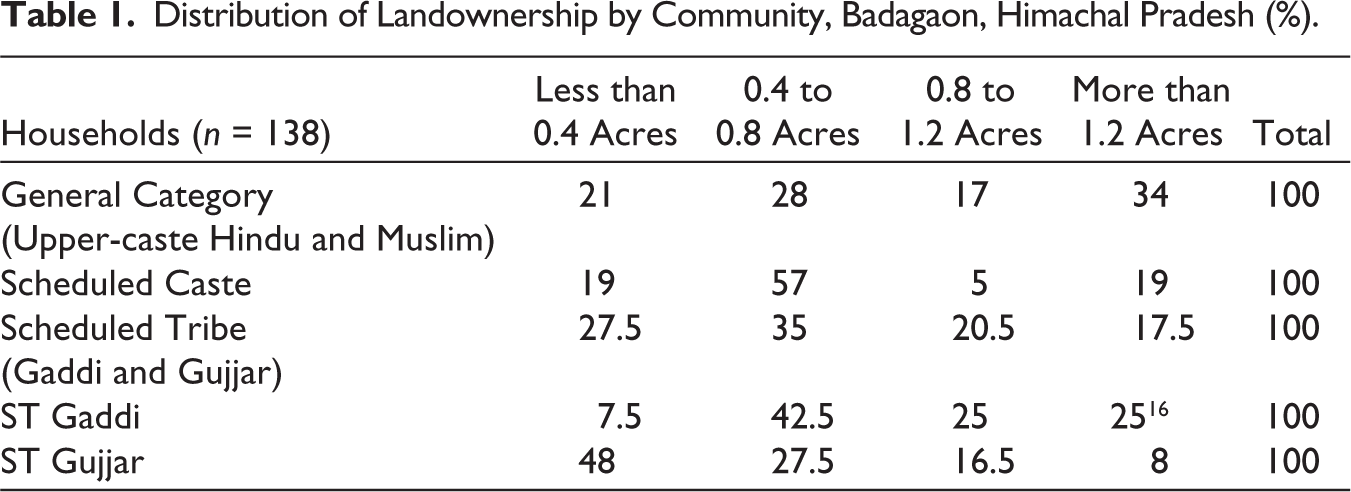
Going beyond the distribution of landholding by size, it is the kind of land to which people have access that shapes their livelihoods. The quality and value of land varies very significantly: in contrast to do fasli (double cropped) fields of General Category Households, the landholdings of ST Households are more likely to be found on the higher slopes where cultivation is limited to a single summer crop (ek fasli). Historically, Gaddis in Chamba were dependent on subsistence farming combined with the resources gained from forests and grazing meadows. With demographic change fragmenting land-holdings, and following restrictions on the access to natural resources, alternatives were required.
Occupation and Employment
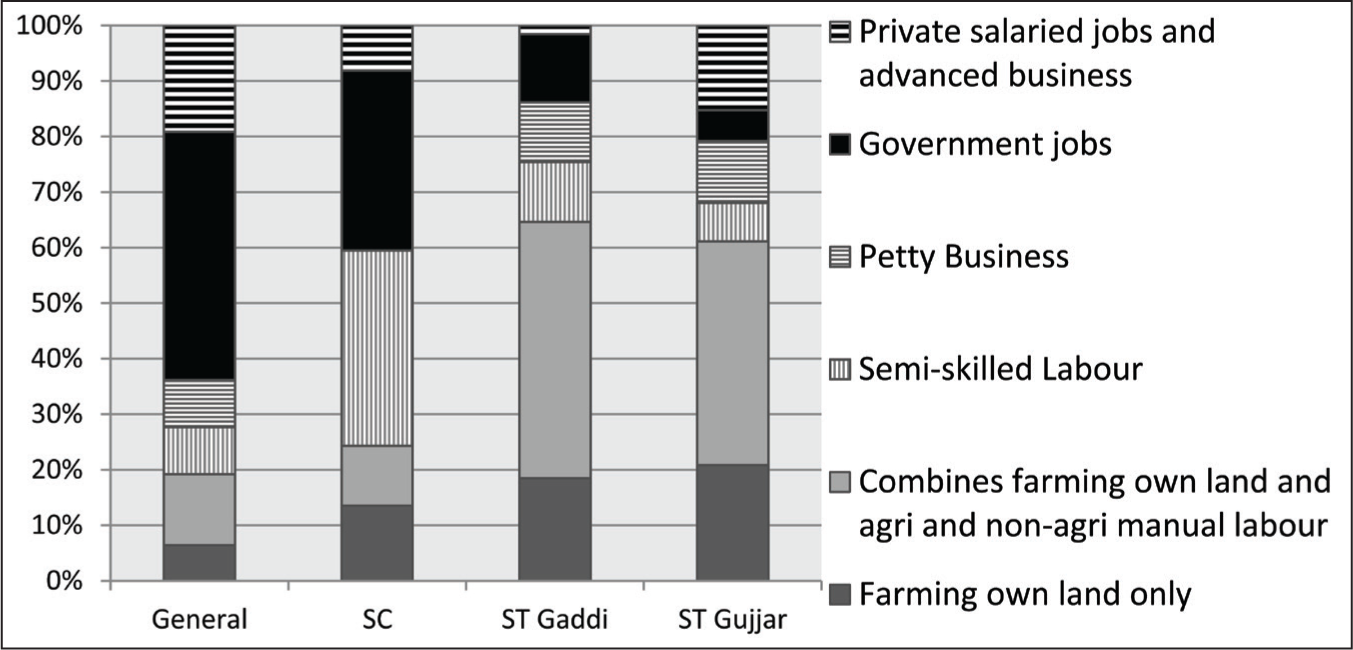
Outside of customary agricultural work, the distribution of employment opportunities is differentiated—apparent in the extent to which access to decent ‘high status’ work is denied to members of ST (Figure 1). The most significant difference between STs and non-STs is in access to more-or-less secure salaried employment. Of the eighty-eight ST households surveyed only nine had family members in government jobs (10%); this compares with twenty-seven out of fifty non-ST households (54%). 11 The sorts of government post that STs are able to access tend to be low level and unskilled. Many non-ST families on the other hand have benefitted from secure government employment—with the police, army, health or education departments. In recent decades, as the number of good government jobs decreases, the children of those in the General Category have also found it easier to obtain higher status opportunities in private service. In our survey, general population men dominate in semi-skilled government jobs, managerial/white collar government jobs, and private sector salaried jobs; SCs are over-represented in semi-skilled work and ‘petty’/small scale business. This leaves ST families confined to small scale farming which, inadequate to meet household needs on its own, must be supplemented with manual labour and ‘daily-wage’ work.
Occupations of Men by Community, Badagaon, Himachal Pradesh.
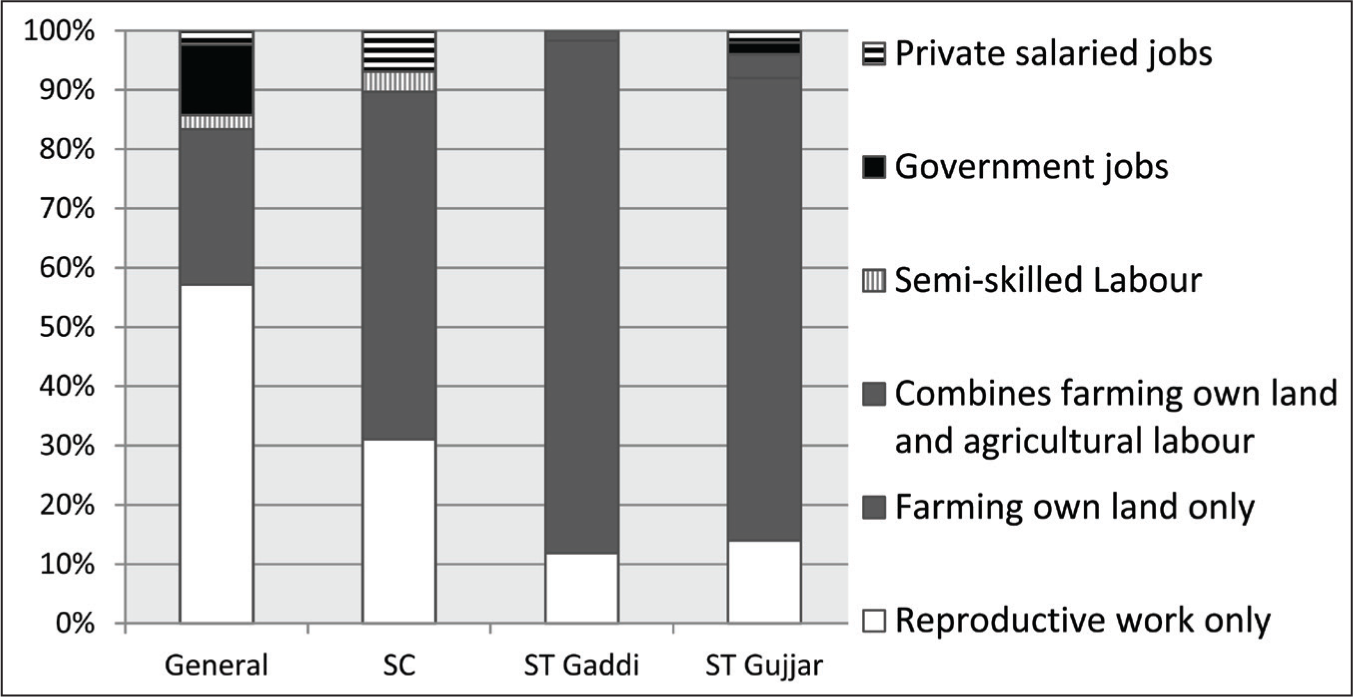
Although occupations are clearly unequally distributed by ethnicity, across communities there are also similarities in the ways that activities and occupations are gendered (Figure 2). At home women of all groups do most of the cooking, cleaning, and childcare. The main divide between ST and non-ST is how common it is that women do such reproductive work only. This is predominant among the general category households whereas nearly all ST women combine household domestic work with working on their own fields, taking animals to pasture and cutting wood from the forest. Out of the forty-two ‘general category’ women included in the household survey seven did salaried work, eleven assisted the family in agricultural activities, and twenty-four were confined to household work. This is in marked contrast with Gaddi women (of fifty-nine there were fifty-two who worked in their fields).
Occupations of Women by Community, Badagaon, Himachal Pradesh.
Turning to manual labour—the temporary and precarious daily-waged employment commonly labelled ‘petty work’. Of the 138 households surveyed, sixty-one households were solely dependent on combinations of agriculture and daily-wage manual labour; of these eight were not ST (16% of non-ST households), twenty-eight were ST Gaddi (70% of ST Gaddi households) and twenty-nine were ST Gujjar (60% of ST Gujjar households). To survive, these households combine a range of activities that might include agricultural and non-agricultural labour, work that may be waged or unwaged, in the formal and informal sector, sometimes self-employed and sometimes working for others. A crucial component of ‘petty work’ is employment on NREGA schemes for a part of the year. In keeping with their nomadic traditions, some Gaddi men now seasonally migrate to seek employment on road or dam-building projects—work that is comparatively well paid, but temporary, dangerous and precarious.
Education
Labour market segmentation is often assumed to relate to levels of skill, training, and education. Figure 3 shows a stark distinction in levels of education between ST and non-ST individuals, whether men or women: the average number of years schooling for non-ST adults it is 7.6; for ST adults it is 4.2. The differences are particularly stark with regard to female education with more than 50% of Gaddi women not having any formal schooling (Figure 4).
Years of Schooling of Men by Community, Badagaon, Himachal Pradesh.
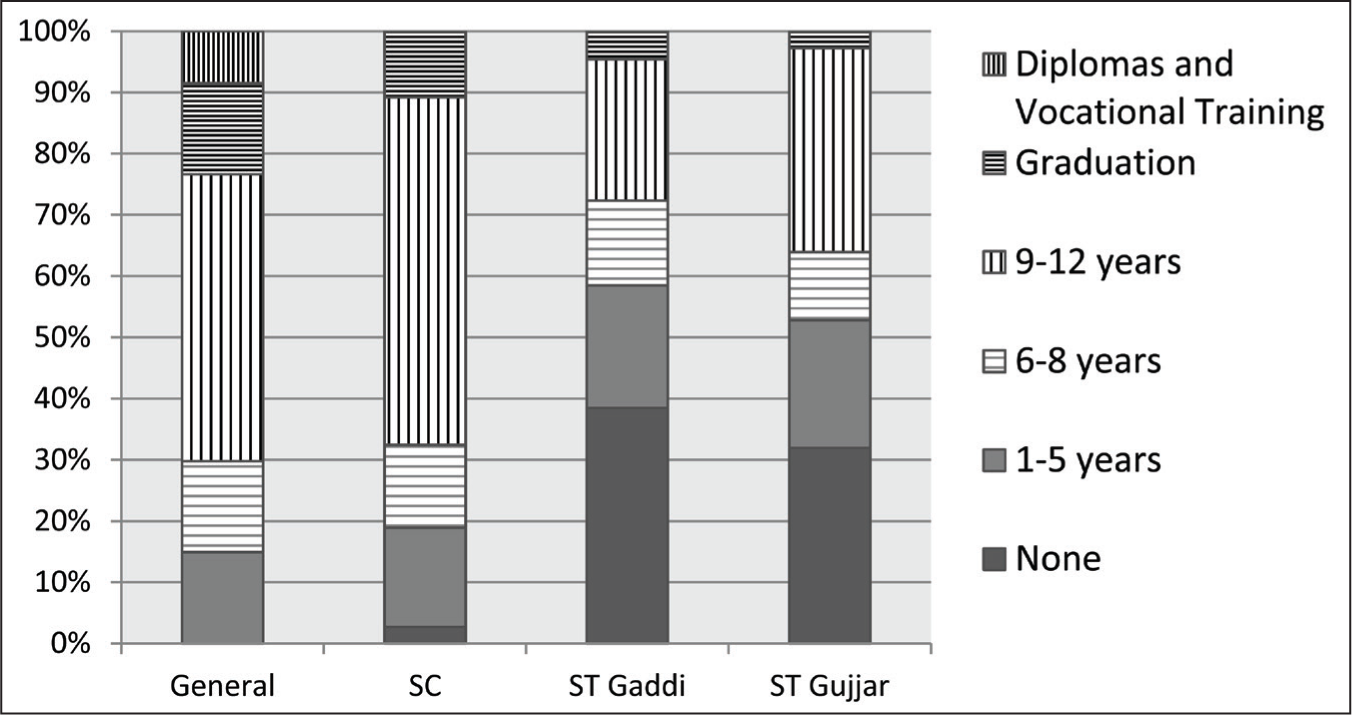
Years of Schooling of Women by Community, Badagaon, Himachal Pradesh.
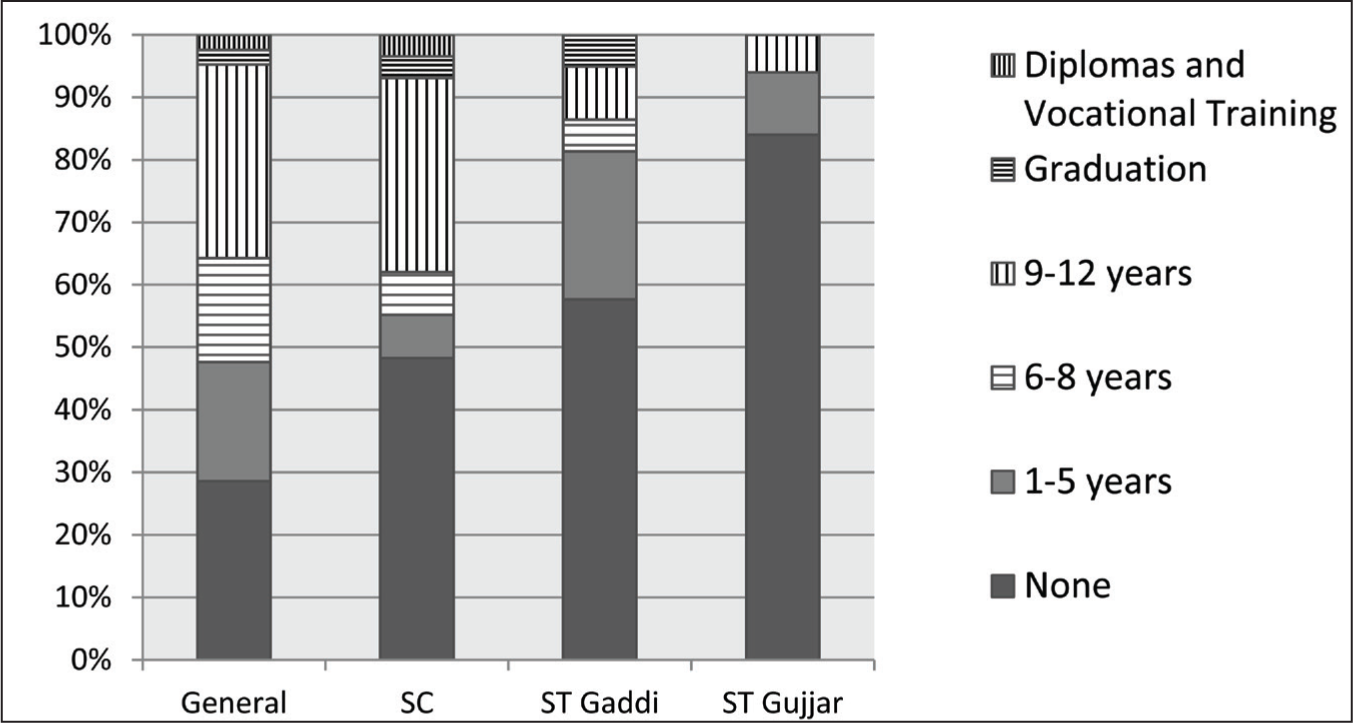
While there has been some progress in levels of education, new divides are opening up (Axelby, 2018). With increasing numbers of ST children attending government schools, caste Hindu and Muslim families are starting to look for alternatives. A private school was established in Badagaon in 2011 though (for those that can afford it) similar establishments in Chamba town are considered as more attractive options. With good government posts in short supply, the provision of educational support for the ST is of limited utility. As shown in Shah et al. (2018, p. 228), educated individuals from the General Category find it relatively easy to access high status jobs; by comparison well-educated individuals from ST backgrounds are more likely to be found in unskilled or, at best, semi-skilled jobs and working on temporary contracts rather than in permanent service. Again, while educational provision and reservation of government jobs were prioritised as a means to overcome the residual exclusion of ST communities, continuing social disadvantage limits real advancement is only available to a privileged few.
We conclude this review of the position of Gaddi households by considering the possibilities of political representation to improve life chances. Among the official measures brought in to improve the position of ST communities in India was the reservation of seats from village panchayats to state legislatures and the national Parliament. The upper part of the Chamba Valley—around Bharmour where Gaddi people are numerically dominant—is classified as a ‘reserved’ constituency in which candidates must belong to a ST community. Restricted elections have allowed a few individuals to advance political careers representing the ST to which they belong. These individuals demonstrate the possibilities of what might be achieved by those from a ST background in this remote rural backwater. However, outside the provisions of welfare support and distribution of government positions to supporters, there are limits to what these political representatives can achieve. The result is that young Gaddis are left feeling trapped in customary occupations and unable to move into the high-status, white-collar jobs, and government service that remain the monopoly of upper caste groups.
Household Survey in Nandurbar
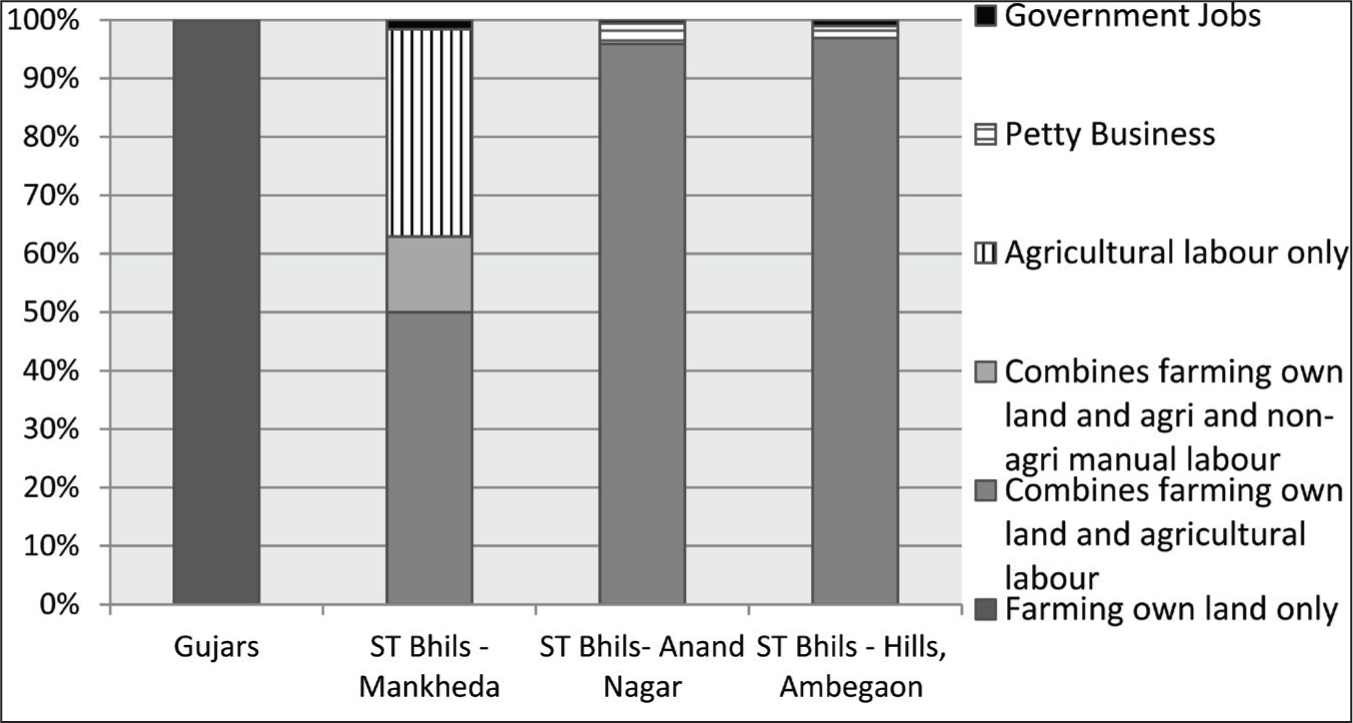
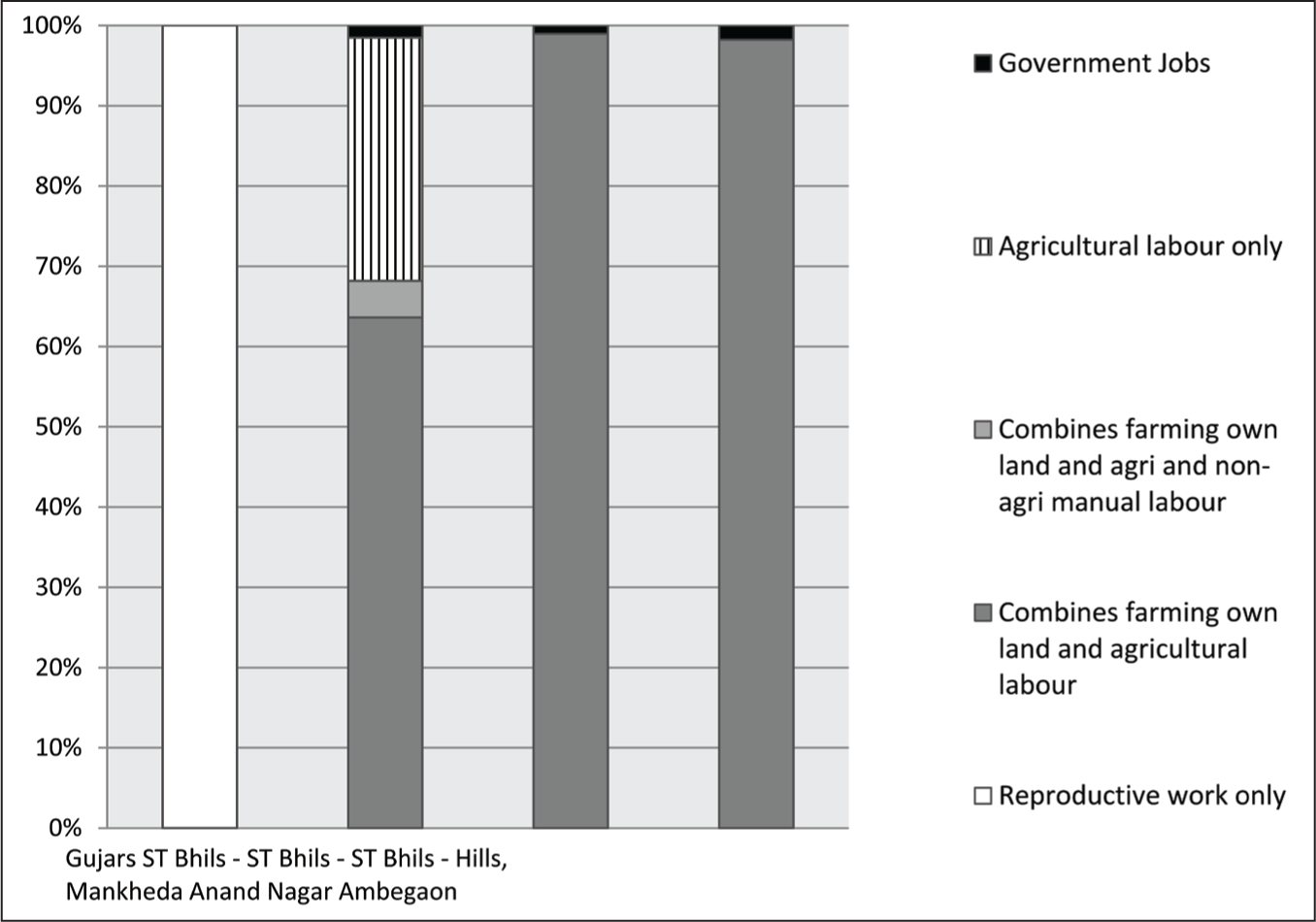
This section presents the findings of a household survey conducted by Thakur between September 2014 and August 2015. Thakur collected information from ninety households in three different rural locations in Maharashtra’s Nandurbar district—the first, a village here called Ambegaon in the Satpura Hills close to Narmada’s banks; the second, Mankheda, a village in the Shahada taluka on the plains of southern Nandurbar; the third, Anand Nagar, also in Shahada, is a resettlement village for Bhils displaced by the SSP Dam. The survey covered thirty Bhil households in Ambegaon; thirty-five Bhil households in Anand Nagar; and in Mankheda, fifteen Bhil households and ten Gujar households. Figures 5 and 6 compare the distribution of occupation for Gujars and ST Bhils in these three locations. There follows an analysis of the differences for each location in turn.
Occupations of Gujar and ST Bhil Men of Three Nandurbar Villages, Maharashtra.
Ambegaon: The Hill Bhil Village
Ambegaon is a Bhil village located in the Satpura Hills close to the submergence zone of the SSP dam on Narmada. Ambegaon is located at the bank of the new dam reservoir, while their kinsmen from the neighbouring, now submerged, villages have been resettled on the Nandurbar plains, including in the second fieldwork village of Anand Nagar. The standard of living in Ambegaon is basic, but land, though on hill slopes and not very fertile, is readily available for all households (average landholdings are around 3.8 acres). Today the main income source of all Bhils of Ambegaon is farming their land. In the absence of irrigation facilities, they can only grow one crop a year, and that too only ‘dry’ crops such as jowar (sorghum) or mokka (maize).
The household survey of Ambegaon confirms that alongside farming practically every household does reciprocal agricultural labour, called laha, for each other (see Figures 5 and 6). Fortuitously, the lake created by the SSP dam along with the coming of road provides good opportunities for fishing and its sale which many households undertake seasonally. Only a few of the households have got government jobs, all low-ranking local ones (e.g., as police patil [village level police personnel] and sarpanch [elected village head]). A few Bhils also have businesses such as a basic village shop or, at best, a jeep plying the dirt road to the nearest market town.
Occupations of Gujar and ST Bhil Women of Three Nandurbar Villages, Maharashtra.
Mankheda: The Multi-caste Plains’ Village
Mankheda, is a village in Nandurbar’s Shahada taluka. The population of Mankheda is mixed—comprising Gujar alongside Bhils and other castes including Rajputs (upper caste) and SC. The condition of the Bhils in Mankheda shows a stark contrast to their Gujar counterparts. Gujar households typically own more land (13.7 acres verses 2.5 acres for Bhils), and all the land they own is irrigated and more profitably used. Additional daily wage workers are often hired by Gujar families who lack the required household labour needed to complete agricultural tasks. All but a few Bhil households are marginal landowners or are landless—this means they have to find additional sources of income. The majority combine farming their own land with labouring in the farms of their better endowed Gujar neighbours or in nearby areas. In addition, many Bhil families including women and children from Mankheda choose to undertake seasonal migration to work elsewhere for 6–8 months each year. Since the late 1970s, the preferred option has been to seek work as cane cutters in neighbouring rural Gujarat while others find work in brick kilns. There is a stark contrast in the gendered nature of work with Gujar women completely away from agricultural activity unlike the Bhil women in all the three villages (Figure 6). As Gidwani (2008) has shown, the complete withdrawal of Gujar women from agricultural activity started two decades ago as a way of gaining social status through emulation of their south Gujarat ethnic counterparts.
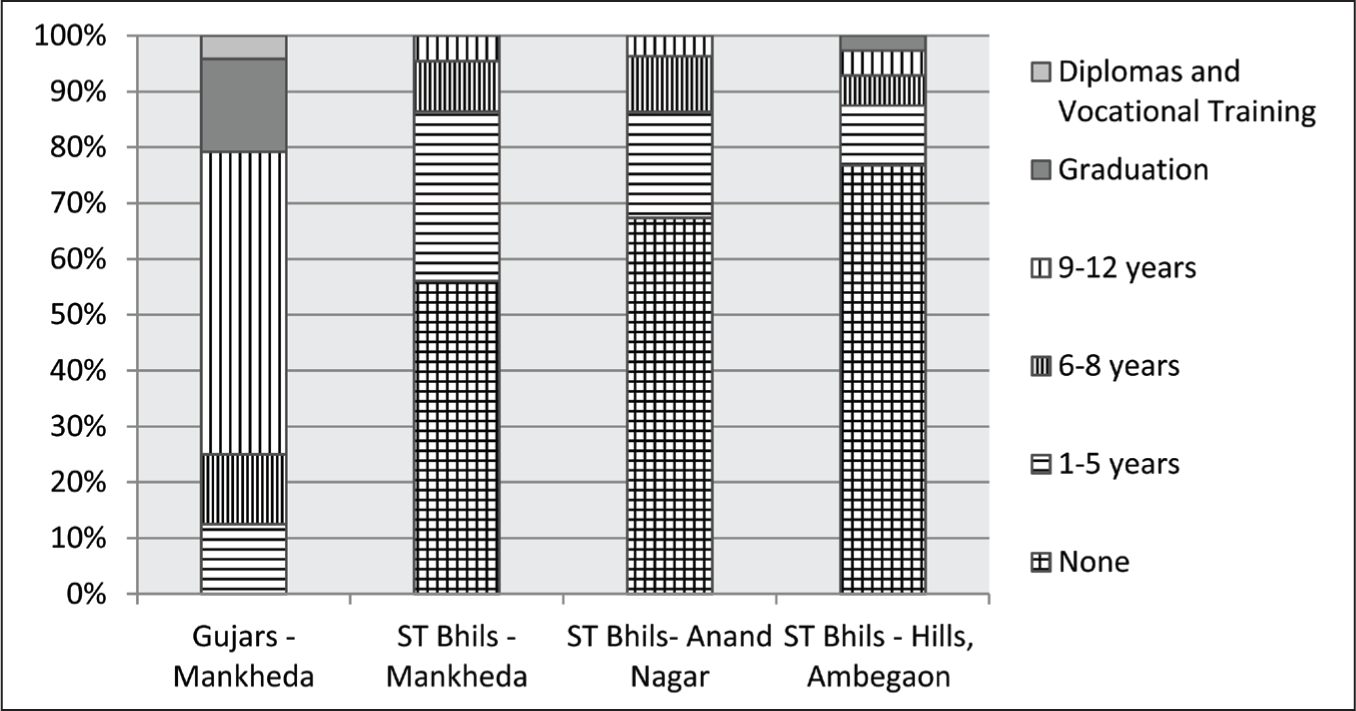
In education terms, 95% of Gujars in Mankheda have more than nine years in education. The gap in education is demonstrated by the survey results—more than 40% of Bhil men surveyed had no education, another 40% had less than five years of formal schooling (Figure 7). Levels of literacy among Bhil women too are lower than their Gujar counterparts in Mankheda while Anand Nagar, like Ambegaon, has no literate women above the age of forty (Figure 8).
Years of Schooling of Gujar and ST Bhil Men of Three Nandurbar Villages, Maharashtra.
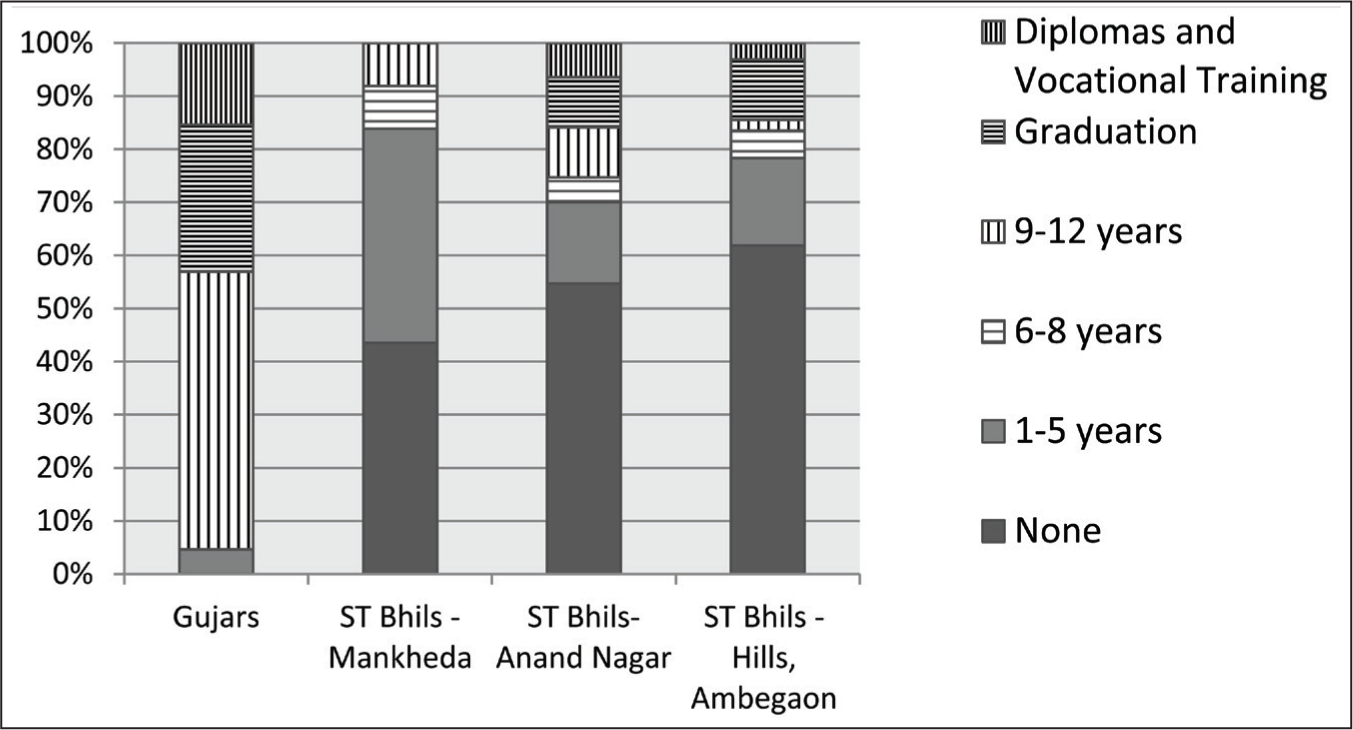
Years of Schooling of Gujar and ST Bhil Women of Three Nandurbar Villages, Maharashtra.
The Bhils in Mankheda are structurally in a position which has clear similarities to Dalit groups across the plains of India, in terms of their integration into the agrarian economy as assetless and powerless agricultural workers and in terms of having broken the worst of the dominance of the local farmers by taking up work outside the village at the bottom of the informalized economy. They have less in common with the resettled Bhils or those in the Satpura Hills and their everyday freedoms.
Anand Nagar: The Resettlement Village
If poverty stems from marginality and being ‘left out’ of development, then what happens to those people forced to leave their traditional homes in the hills and relocated to resettlement villages in the plains? There is a considerable literature on the struggle of the Bhils against the SSP dam. 12 Beginning from 1991, after a prolonged and globally celebrated struggle against the SSP dam by the Narmada Bachao Andolan (NBA; Save Narmada Campaign), the government offered a comprehensive resettlement package, liberalised over several years due to repeated cycles of protest and lobbying by the Bhils and their leaders, that included a housing colony and agricultural plots for every displaced family. One such resettlement village is that of Anand Nagar where the Bhils from hamlets in the submergence zone below Ambegaon in the hills including some main Bhil leaders of the struggle were resettled from 2004 (Thakur, 2019).
Practically all the resettled Bhils live solely off agriculture. They have put in a lot of effort to adapt their life and agricultural practices to the new setting. The state’s resettlement package, though apparently highly beneficial on paper, was a mixed bag on the ground. Each adult Bhil got an agricultural plot of either 2.5 or 5 acres depending on their categorisation of landholding in the submergence village by the government. This land cannot be sold or mortgaged, as per the Government of Maharashtra’s resettlement policy, to ensure that a dominant host community cannot pressurise a resettled group into parting with its land. 13 However, though promised irrigated land by the government, not all plots have irrigation facilities. Those with irrigation have borewells, prevalent in the region and reimbursed by the state as part of the resettlement package, and its water is often shared with neighbouring resettled fellow Bhils. Dry land yields only one crop a year during the monsoon agricultural season of kharip and even that crop is dependent on the vagaries of nature.
The Bhils of the three villages described in this section demonstrate contrasting experiences of integration into the wider economic arena. Though their relationships with the market developed at different times and by different means, the present situation demonstrates that all find themselves at the bottom of the pyramid. The three villages have functional PDS (though a poorly managed NREGA in the hills) for some years. In income terms the hill Bhils of Ambegaon are poor but do at least have some farming land. They are also better off fishing in the SSP reservoir than those in the neighbouring hill villages who have to undertake arduous seasonal migration trips to the plains’ sugarcane fields. The Mankheda Bhils of Shahada, directly oppressed and exploited by their Gujar landowners for generations, are in many ways their exact opposite, even if in economic income terms their position may not be that different. For them seasonal migrant work, primarily in the brick kilns or cutting cane, represents an opportunity to generate cash that can be invested in home improvements, household commodities and lifecycle rituals. 14 Lacking capital buffers, the newly resettled Anand Nagar Bhils’ engagement in the cash cropping is risky. They also do not have access to lucrative jobs in the non-agricultural economy unlike the Gujars. All but four resettled Bhils above the age of forty are illiterate while their adult children, including women, are first-generation learners, many with college degrees. The Bhil youth’s attempts to secure government jobs have however not been successful as state employment has shrunk since the economic liberalisation of the 1990s while thousands of government posts are lying vacant. 15 Historically, the Gujars accumulated agricultural surplus and invested it to move into business, government employment and later into private white-collar jobs in cities over a period of three or four generations. Unlike the other two villages that never even had a shot at replicating this model, the resettled Bhils are playing catch-up in a span of just over a decade; they can however only do too little, too late, compared to the more powerful groups in society.
A review of the position of Bhil households by considering the possibilities of political representation to improve life chances shows a pattern similar to the Gaddi situation described earlier. We find reserved seats for STs in various elected bodies, provisions of welfare support and the distribution of government positions to supporters in the local elected bodies by the elected Bhils. In addition, for many hill Bhils such as those resettled in Anand Nagar, the history of resistance against the state in the anti-dam movement has provided a greater awareness of the wider world and put them on a stronger footing vis-a-vis representatives of the state—demonstrated in their ability to access secure land for resettlement and other state welfare resources. Bifurcation of Dhule district to form the ST-majority Nandurbar district in 1998 along with increased awareness has considerably diminished Gujar dominance of the sociopolitical sphere. It has also resulted in the ascendency of several Bhil politicians in the recent who have headed powerful ministries in the Government of Maharashtra. Yet, in general, the Bhils of Nandurbar and elsewhere are peripheral as a political constituency who, despite some gains, have traditionally wielded negligible clout in provincial legislatures and bureaucracy controlled by dominant peasant and upper castes such as Maratha-Kunbi and Brahmans (Lele, 1982; Mhaskar, 2021), respectively, while their voice in the national Parliament remains inaudible.
Examining the paths taken by Gaddis and Bhils helps to unpick forms of ‘residual’ poverty caused by isolation and marginality from new types of ‘relational’ poverty rooted in processes of social exclusion and adverse inclusion. Data drawn from an extensive household survey—detailing land ownership, education and occupation—shows how, though their lives have changed in significant ways, Bhils and Gaddis remain rooted at the bottom of the socioeconomic hierarchy. Environmental degradation, demographic change combined with educational and occupational inequalities have forced members of Gaddi and Bhil households into forms of work that are precarious and insecure.
Persistent Marginality and Relational Inequality
The disadvantaged position of ST populations has often explained in terms of their geographical isolation and lack of integration into economic markets—what Bernstein (1992) terms ‘residual poverty’. Secluded in remote Himalayan valleys or the forested Satpura hills and scratching a living from subsistence agriculture and livestock rearing, Gaddis and Bhils historically lived largely self-sufficient lives in which survival depended on the vagaries of nature. Mosse (2010) identifies a dominant mode of thinking in which this form of poverty—a condition identified as resulting from being left out of development—can be resolved through state provision, improved connectivity and the ‘trickle-down’ benefits of economic growth.
Much has changed in Nandurbar and Chamba—roads, schools, and reservations brought these have Bhils and Gaddi people closer to a notional mainstream of Indian society. Thanks to the provision of welfare measures—particularly PDS and NREGA—the kinds of absolute poverty described by the older generations are now less apparent. Yet relative poverty among these ST groups persists into the present day—our survey of rural households in Chamba and Nandurbar Districts show continuing differences between ST and non-ST households with respect to assets, education, and employment. Why should this be? Against notions of residual poverty, it can be argued that the poverty of certain categories of people is not just unimproved by growth or integration into markets, but actively deepened by it. For the Bhils and the Gaddis, relational poverty is a direct consequence of what Bernstein recognises as ‘adverse incorporation’ into exclusionary and expropriating aspects of capitalist development. While ST categorisation suggest poverty as a characteristic of a marginalised existence, we have followed Bernstein to argue that the contemporary condition of ST groups such as the Gaddi and Bhils cannot be understood if we focus our attention on them alone. Instead, it is important to draw attention to the kinds of relationships (with landowners, employers, contractors, state officials, schoolteachers, extension agents, buyers and sellers) that shape and define opportunity and therefore through which poverty and inequality are reproduced.
The contemporary condition of the Bhils in Nandurbar and Gaddis in Chamba combines customary marginality, with historical processes of dispossession, and contemporary exploitation and oppression. Unable to access the natural resources they customarily depended for a range of reasons including its depletion, state expropriation as well as population pressure, households must survive on combinations of low-profit agriculture with migrant seasonal labour and various other forms of ‘petty’ work. Here residual and relational aspects of poverty compound one another. Shut off from customary occupations and resources, and with development assistance only permitting an insecure foothold on the lowest rungs of government service, the position of these groups might be accurately characterised as relational marginality—shut off from benefits of development disadvantaged households are left open to exploitation. For some Bhils and Gaddis, improvements in life chances are possible—either through individual attempts at social mobility or jointly through political action. However, as is the case for ST groups elsewhere in India, it is an uphill struggle.
Footnotes
Acknowledgements
Both authors wish to express their gratitude to the two anonymous reviewers of Sociological Bulletin for their insightful comments on the various drafts that helped in sharpening the final version. Axelby is grateful to Uttam, Munno, Ajay and Neha Minhas, Prakash and Vinayak Dhami, Sunil Dhami, Sakeena Begum and Hassan Deen, and all the people of Chamba's Saal Valley who he has lived, worked and researched with over the last twenty years. Thakur is grateful to Chaudhary B. Vasave, Bharat K. Vasave, Vikram J. Pawar and Vijay D. Pawara for help with data collection and tabulation. Thanks also to Chotubhai Patil, Keshav Vasave and family, Rhenjya Patil and family, Dilip Vasave, Dursing Vasave, Kevalsing Vasave, Dinanath Manohar, Mira Sadgopal, Dr Kantilal Tatia, Janarth Adivasi Vikas Sanstha of Shahada, Dipak P. Patil, Dilip N. Patil, Dipak Kulkarni, Ramakant Patil, Gulabsing Padwi, Pushpen Somani, Pratibha Shinde, Sanjay Mahajan, Lok Sangharsh Morcha, Narmada Bachao Andolan, Nandurbar District Collector’s Office and the hundreds of Bhil friends from dozens of villages, too many to be named individually, for their constant support over two decades.
Declaration of Conflicting Interests
The authors declared no potential conflicts of interest with respect to the research, authorship and/or publication of this article.
Funding
The research for this article was conducted between 2014 and 2016 as part of the Research Programme on Inequality and Poverty based in the Department of Anthropology, London School of Economics and Political Science, UK (Funded by the ESRC and the EU, Principal Investigator: Alpa Shah). Axelby would like to acknowledge the European Research Council for supporting the writing of this article as part of the Ethnographies of Parliaments, Politicians and People programme, 2019–2024, no. 834986. Thakur’s fieldwork in 2020 was funded by The Centre for Global and Area Studies, University of Delaware, USA.