




Abstract
While the influence of religious values and affiliation on climate change attitudes has been established, there is limited knowledge about the role of demographic factors such as gender and marital status, especially in the Global South. This study examines the influence of gender and marital status on churchgoers’ climate change beliefs and attitudes in Nigeria. Using a multivariate analysis, the study explores the relationship between gender, marital status, and four latent variables: climate change awareness, perception, action, and perceived church role. The results indicate no significant overall differences between males and females or between married and unmarried individuals in relation to the four variables. However, significant interactions between gender and marital status were found for climate change awareness, action, and perceived church role. Unmarried males demonstrated higher awareness and engagement in climate change action, while married males exhibited greater awareness. Also, unmarried males perceived the church to have a more significant role, while married females had slightly higher perceptions of the church’s role. These findings highlight the importance of considering the intersectionality of gender and marital status in understanding churchgoers’ climate change beliefs and attitudes in Nigeria.
Introduction
Climate change is a global challenge that requires collective action and awareness from individuals and communities. In many faith communities in the global north and a few ones in the global south, religious values and affiliations play significant roles in shaping people’s environmental and climate change beliefs and attitudes (Arbuckle and Konisky, 2015; Barker and Bearce, 2012; Carr, 2010; Morrison et al., 2015; Nche, 2020a, 2020b, 2020c, 2023a, 2023b; Pepper and Leonard, 2016; Skirbekk et al., 2020). However, not much is known about the roles of demographic factors such as gender and marital status especially in the global south.
Nigeria, as a country vulnerable to the impacts of climate change, is of particular interest in studying the intersection between religious affiliation, gender, marital status, and climate change beliefs among churchgoers. With a significant portion of the population identifying as Christians 1 (Johnson and Zurlo, 2020) and actively participating in church activities (Pew Research Center, 2010), examining the role of gender and marital status within this context can provide valuable insights.
Previous research has shown that gender can play a role in shaping individuals’ environmental attitudes and behaviours, with variations in levels of awareness, concern, and engagement between males and females (Hung and Bayrak, 2019; Pearson et al., 2017; Teyton and Abramson, 2021). For instance, women are slightly more likely than men to be more concerned about the environment and to have more pro-climate change beliefs (Ballew et al., 2018). In addition, marital status has been found to influence individuals’ priorities, responsibilities, and social networks, potentially impacting their engagement with environmental issues. For instance, married persons are more likely than single persons to be more knowledgeable and concerned about climate change as well as to have more access (especially by married women) to adaptation strategies largely due to possible marital interpersonal climate change conversations and influences (Goldberg et al., 2022; Halnon, 2022; Hung and Bayrak, 2019; Jaynes, 2022; Van Aelst and Holvoet, 2016)
Employing a multivariate analytical approach, this study aims to provide a comprehensive understanding of the combined effects of gender and marital status on churchgoers’ climate change beliefs and attitudes. Furthermore, it seeks to investigate whether gender and marital status interact in influencing churchgoers’ responses to climate change, particularly in terms of awareness, action, and their perception of the church’s role in addressing this global challenge. The findings of this study have important implications for both research and policy-making. Identifying differences and interactions based on gender and marital status can help researchers and policymakers design targeted interventions that reflect the diverse needs and perspectives of churchgoers. In the end, this can contribute to a more inclusive and effective approach to climate change mitigation and adaptation efforts within the context of religious communities in Nigeria.
Gender, marital status and climate change beliefs/attitudes
Demographic factors have been shown to shape climate change beliefs and attitudes mainly in the western countries such as United States, Canada, United Kingdom, Australia, Italy, and Germany. Of these factors, gender and marital status 2 constitute the focus of this study. With respect to gender, for instance, women are found to be more likely than men to believe that global warming is happening (Hornsey et al., 2016; McCright et al., 2013; Shi et al., 2016); will harm them personally (Hamilton, 2011), and will harm people, plants and animals, and future generations of people (Ballew et al., 2018; Brody et al., 2008; Hamilton, 2011; Van der Linden, 2015). Women are also more likely than men to be concerned about climate change (Finucane et al., 2000), think that it is currently harming people, and support certain climate change mitigation policies, specifically regulating CO2 as a pollutant setting strict CO2 limits on coal power plants (Ballew et al., 2018). Women are further found to be more likely to support the view that people especially in the wealthy countries would need to make major changes in their lifestyles to reduce the effects of climate change (Stokes et al., 2015). They were also found to express higher self-efficacy (perceived ability) to address climate change (Karlsson, 2019)
However, women were found to generally have less scientific knowledge of climate change than men (Leiserowitz et al., 2010), even though there are few studies (e.g. McCright, 2010) that found them to be more knowledgeable. Specifically, women were more likely to express uncertainty about how nuclear power plants, burning fossil fuels, deforestation, the sun, cars and trucks contribute to climate change (Leiserowitz et al., 2010). There are also studies that did not find any significant influence of gender on climate change beliefs (see Karlsson, 2019; Teyton and Abramson, 2021).
A couple of perspectives have been put forth to explain these gender differences in climate change attitudes and beliefs. Some of these perspectives include gender socialization, vulnerability, feminist, and system-justification perspectives (Xiao and McCright, 2012). For the gender socialization scholars (e.g. McCright, 2010; McCright and Xiao, 2014; Zelezny et al., 2000), the tendency of women to care more about the environment and to be more concerned about climate change is connected to how they are raised or socialized across many societies. Women, according these scholars, are socialized to be more nurturing, cooperative and altruistic than men, which may partially account for women’s greater concerns for the needs of the environment. Also, due to their multi-dimensional vulnerability status compared to men in societies, women, according to the women’s vulnerability perspective scholars, have high risks perceptions and safety concerns (Finucane et al., 2000; Kalof et al., 2002; Satterfield et al., 2004). Similarly, the feminist perspective posits that due to the history of men’s authoritarianism and domination of women, women are more likely to identify more with vulnerability related to the exploitation of the natural environment, and thus feel compelled to take action to prevent it (Goldsmith et al., 2013; Gupte, 2002; Shiva, 1989). In contrast, due to the socio-economic and political privileges associated with the patriarchal systems, men, according to the system-justification scholars, are more likely than women to defend the status quo by denying the reality of climate change and fueling resistance to regulatory policies aimed at mitigating climate change (Feygina et al., 2010; Jost and Hunyady, 2005; Jost et al., 2004; McCright and Dunlap, 2011a).
Marital status has also been found to have implications for climate change beliefs and attitudes. For instance, married persons are more likely than widowed, single and divorced to be less worried or have high risk perception of climate change induced heat waves perhaps due to the belief that their social contacts and bonds can protect them from heat-related mobility and mortality (Akompab et al., 2013; Liu et al., 2014). Studies have also reported that married persons are more likely to be insulated from climate change induced heat-related diseases and deaths compared to unmarried persons (Cadot et al., 2007; Fouillet et al., 2006). They are however more likely to perform climate actions such as consuming less water and buying energy-saving light bulbs (Kim and Moon, 2012). Married persons have further been found to be less likely than unmarried people to consider over population and deforestation as some of the causes of climate change and more likely to perceive climate change as an act of or punishment from God/Allah for the sins of humans (Haq and Ahmed, 2017). With respect to climate change adaptation, women who are married have been found to have more access to agricultural adaptive facilities and strategies compared to other women, widows and female divorcees (Van Aelst and Holvoet, 2016). On the other hand, studies have shown that romantic partners can influence each others’ beliefs and behaviours through more conversations about climate change (Goldberg et al., 2022) and women are more likely to drive much of this influence especially in Taiwan (Hung and Bayrak, 2019).
Methods
The study location/area
The six geo-political zones formed the clusters into which the researcher divided Nigeria. With the exception of North East (Adamawa, Bauchi, Borno, Gombe, Taraba, and Yobe states) on the basis of security challenges, the researcher listed all the states in these respective geo-political zones in an alphabetical order. These geo-political zones alongside their states include south – south (Akwa Ibom, Bayelsa, Cross River, Delta, Edo, and Rivers states), south-east (Abia, Anambra, Ebonyi, Enugu, and Imo states), south-west (Ekiti, Lagos, Ogun, Ondo, Osun and Oyo states), north-central (Abuja (the Federal Capital Territory), Benue, Kogi, Kwara, Nassarawa, Niger, and Plateau states), and north-west (Jigawa, Kaduna, Kano, Katsina, Kebbi, Sokoto and Zamfara states).
The third states in each of these geo-political zones were selected using systematic sampling technique. In this sense, the selected states include Cross River, Ebonyi, Ogun, Kogi, and Kano states. Then, the capital cities in these selected states were purposively selected for the study. This is because capital cities and urban areas have more educated churchgoers as well as populated churches than the rural areas. This, however, did not apply to Kano state where most of the local government areas are dominated by Muslims, except for the Sabon-garri area where foreigners and mostly Christians occupy in the state. Hence, the researcher randomly selected churches in the Christian dominated area in Kano state. The selected capital cities in the other four states accordingly included Abakaliki (Ebonyi state), Abeokuta (Ogun state), Calabar (Cross river state), and Lokoja (Kogi state). Finally, the specific locations of churches within the selected cities were randomly selected.
Participants
Participants for the study were n = 1500 drawn from Catholic, Anglican and Pentecostal churches/denominations. These participants were divided among these denominations (i.e. 500 participants from each denomination) in five geopolitical zones (i.e. 300 participants from each geopolitical zone) in Nigeria. These geopolitical zones are south – south; south-east; south-west; north-central; and north-west in Nigeria. The north east was excluded on the basis of security challenges occasioned by Boko Haram insurgency. In each of these geopolitical zones, three churches (Catholic, Anglican and Pentecostal churches) were studied and in each of these churches, 100 randomly selected participants were requested to fill the study questionnaires. However, of the 1500 questionnaires that were distributed to participants, only 582 were valid and analyzable. The rest were discarded due to incomplete responses.
Instruments
The following measures or instruments were used for the study: Climate Change Awareness Questionnaire (CCAQ); Climate Change Perception Questionnaire (CCPQ); Churches’ Role Perception Scale (CRPS); and Climate Change Action Assessment Scale (CCAAS). These instruments were developed by the researcher and pilot tested to reflect the Nigerian religious and socio-cultural context. Items were carefully formulated using familiar language and references common within Nigerian church settings. Although the CCAQ and CCPQ drew some items from an existing standardized tool (the Multidimensional Climate Change Awareness Questionnaire by Chukwuorji et al., 2015), those items were selected specifically because they reflect climate realities and public discourses relevant to Nigeria. Nevertheless, the present researcher conducted a pilot study involving 110 participants drawn from randomly selected churches in Nsukka, Enugu state of Nigeria. These churches included: The Holy Trinity Station, Amenu Edem–ani (i.e. Catholic church (35 participants)), St. Paul’s Cathedral Nsukka (i.e. Anglican church (40 participants)), and the Redeemed Christian Church of God, Zonal Headquarters, No. 11 Obollo Road, Nsukka (i.e. Pentecostal church (35 participants)). It should be noted that these participants were not included in the main study. The outcome of the pilot study is discussed below.
An alpha of .83 was obtained when item analysis was performed on the 16-item Climate Change Awareness Questionnaire (CCAQ). After a review of the output, five items (1, 2, 6, 11, and 16) with corrected item-total correlation less than .3 were reviewed and found to be either ambiguous or confusing and so was removed from the scale. Cronbach’s alpha of .88 was obtained after removing the items. Factor analysis on the awareness scale also showed a good fit (KMO = .87, BTS = 298.46, p < .001) and a uni-dimensional model better for the 11 items than for the original 16 items. Hence the revised 11-item model was adopted. This was therefore used to measure the level of climate change awareness among Catholic, Anglican and Pentecostal churches in Nigeria. This covers the general awareness of the processes of climate change, its consequences and mitigation strategies. Sample items include ‘I have heard of greenhouse gases’, ‘Climate change is adversely affecting the plants and animal species of the universe’, ‘If some greenhouse gases are captured, it will reduce climate change’ etc. Participants rated each item on a 5-point Likert-type scale, indicating to what extent they agree, from 1 (strongly disagree) to 5 (strongly agree).
For the CCPQ, an alpha of .76 was obtained for the original 21 items. However, six items (5, 9, 10, 17, 18, and 19) were found to have corrected item-total correlations below .3. After further reviews and re-computations and additional four items (20, 6, 7, and 8) were found to be inconsistent in the scale with low item-total correlations and so were removed. A final Cronbach’s alpha of .80 was obtained with 11 items. Factor analysis on the remaining 11 items produced a better fit (KMO = .73, BTS = 249.54, p < .001) and confirmed a one-dimensional structure for the questionnaire. This 11-item questionnaire was used to measure the perceptions these three churches have about climate change in Nigeria. Items 1, 3, 4, and 9 were scored in reverse order. Sample items include: ‘There is nothing like climate change, the world is only coming to an end’, ‘Human activities cause climate change’, ‘Climate change can be addressed/tackled’ etc. Participants were expected to rate these items on a 5-point Likert-type scale, indicating the extent to which they agree, from 1 (Strongly disagree) to 5 (Strongly agree).
On examining the reliability of the Churches’ Role Perception Scale (CRPS), item analysis on the initial 12 items resulted in a Cronbach’s alpha of .75. Four items (9, 10, 11, and 12) were removed on account of poor item-total correlation. A re-run of analysis yielded an improved alpha of .90. Factor analysis on the eight items also confirmed goodness of fit (KMO = .89, BTS = 332.43, p < .001) as well as a single factor structure of the scale. The eight-item scale was used to measure the perceptions the churches have about their roles in climate change mitigation and adaptation in Nigeria. Sample items include: ‘Churches can help raise awareness about climate change adaptation’, ‘Churches can help mitigation climate change’. Participants were expected to rate these items on a 5-point Likert-type scale, indicating to what extent they agree, from 1 (strongly disagree) to 5 (strongly agree).
A Cronbach’s alpha of .83 was obtained for initial analysis on the Climate Change Action Assessment Scale (CCAAS). A review of the inter-item correlation promoted the removal of six items (3, 6, 8, 4, 7, and 11). Re-computation with the remaining 17 items gave an alpha of .89 for the remaining 17 items. Factor analysis on the scale was of good fit (KMO = .79, BTS = 515.31, p < .001) and supported a one-dimensional model for the scale. This scale was used to assess climate change actions or pro-environmental behaviours among the churches in Nigeria. The 17-item scale covers two principal ideas which are: (a) Climate change mitigation and (b) Climate change Adaptation. Participants’ actions were assessed along two dimensions: (a) actions carried out by self towards climate change mitigation and adaptation and (b) teaching and encouragement of others to carry out such actions towards climate change mitigation and adaptation. Sample items include: ‘I plant trees’, ‘I recycle waste (paper)’, ‘I encourage people to plant trees’, ‘I donate money to help climate change victims (victims of flood and other disasters)’, and so on. Participants were expected to rate each item on a 4 – Likert-type scale, indicating if they carry out any climate change action and how often they carry out such actions, from 1 (Not at all) to 4 (Always). The item number 9 was scored in reverse order.
Procedure
The researcher recruited two research assistants who were trained to assist in the collection of data. Alongside these assistants, the researcher always sought for a formal permission from priests/pastors, Deacons/Deaconesses, elders or leaders of congregations as the case may be, before administering questionnaires to church members. And this was usually at the end of Sunday or midweek services as the case may be. Members were approached and asked to participate in the study. Those who gave their consent were given questionnaires. The researcher explained the nature of the study to the participants orally or through the Study Information Sheet indicating what they were required to do and who is undertaking the research. They were also encouraged to answer the questions as honestly as possible. In a situation in which a church could not provide up to a 100 participants, the researcher endeavoured to make it up from a nearest branch of the same church within the local government area/state. All information gathered from any church was handled with high level of confidentiality and prudence by storing them in a password-protected computer.
Analysis
A multivariate analysis of variance (MANOVA) was conducted with the four latent variables (awareness, perception, action and perceived church role) as dependent variables (DVs), and gender and marital status as independent variables (IVs). The MANOVA included the descriptive statistics which obtained the mean and standard deviation of participants’ scores on the dependent variables. MANOVA is considered appropriate when the goal is to find out if various levels of more than one independent variable have an impact on more than one dependent variable individually or in combination with one another (Anderson, 2003). There were two categories for gender (male vs female) and two categories for marital status (married vs unmarried), while there were four dependent variables. All analyses were conducted using Statistical Package for Social Sciences (SPSS) version 26.
Results
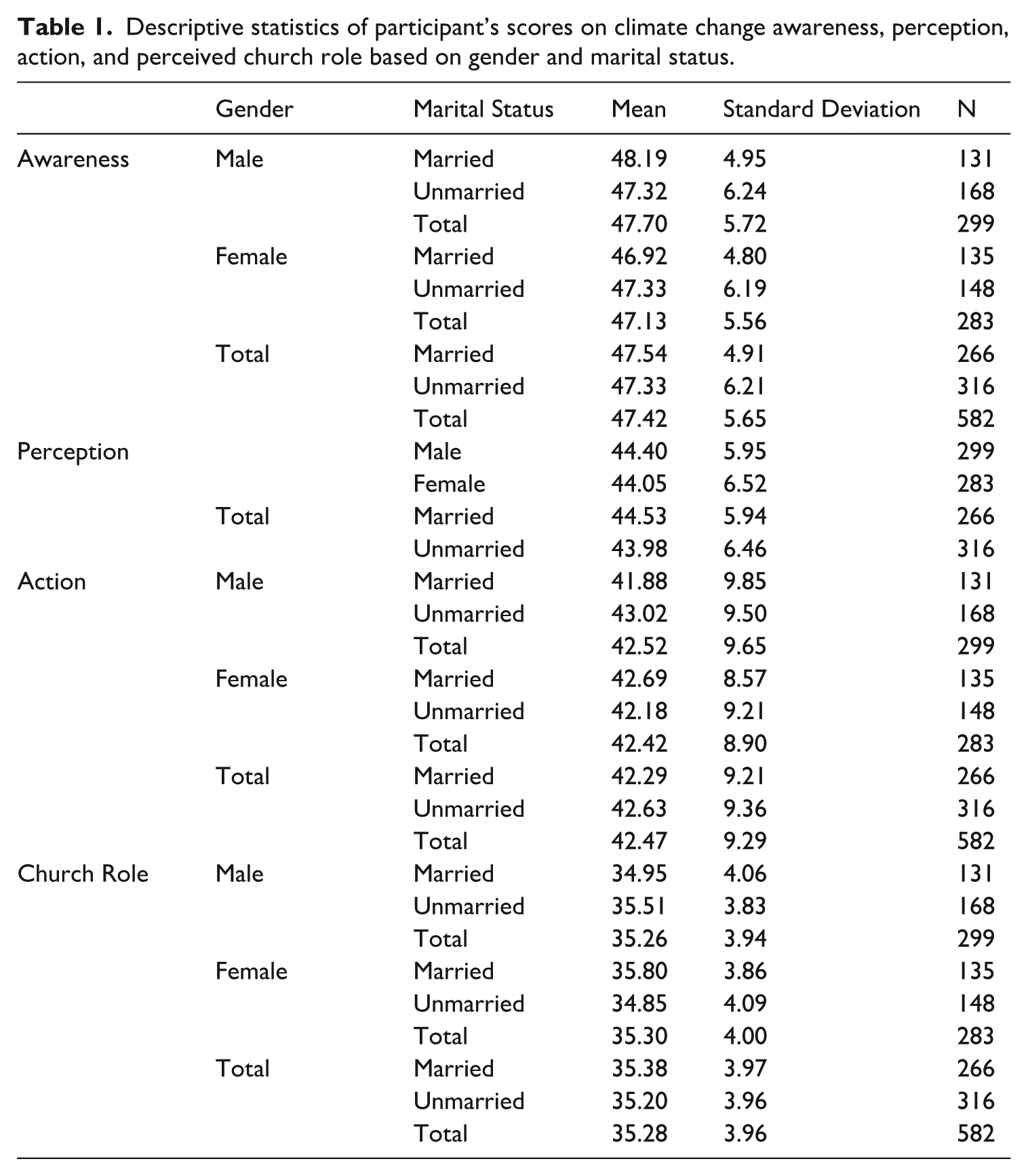
A MANOVA was conducted with the four latent variables (awareness, perception, action, and perceived church role) as dependent variables (DVs), and gender and marital status as independent variables (IVs). There was no significant multivariate effect for the four latent variables as a group in relation to the gender (male versus female: p > .05) and marital status (p < .01). Analyses for gender of participants showed that it did not have any significant influence on climate change awareness (F(1,578) = 1.81, p > .05), perception (F(1,578) = .47, p > .05), action (F(1,578) = .00, p > .05), and perceived church role (F(1,578) = 1.32, p > .05), such that males did not respond more positively than females on any of the variables. Similarly, analyses for marital status was not significant, such that married participants did not differ from those who were unmarried (single) with respect to climate change awareness (F(1,578) = .25, p > .05), perception (F(1,578) = 1.18, p > .05), action (F(1,578) = .17, p > .05), and perceived church role (F(1,578) = .36, p > .05).
Descriptive statistics of participant’s scores on climate change awareness, perception, action, and perceived church role based on gender and marital status.
Tests of between subject effects of gender and marital status on climate change awareness, perception, action, and perceived church role.
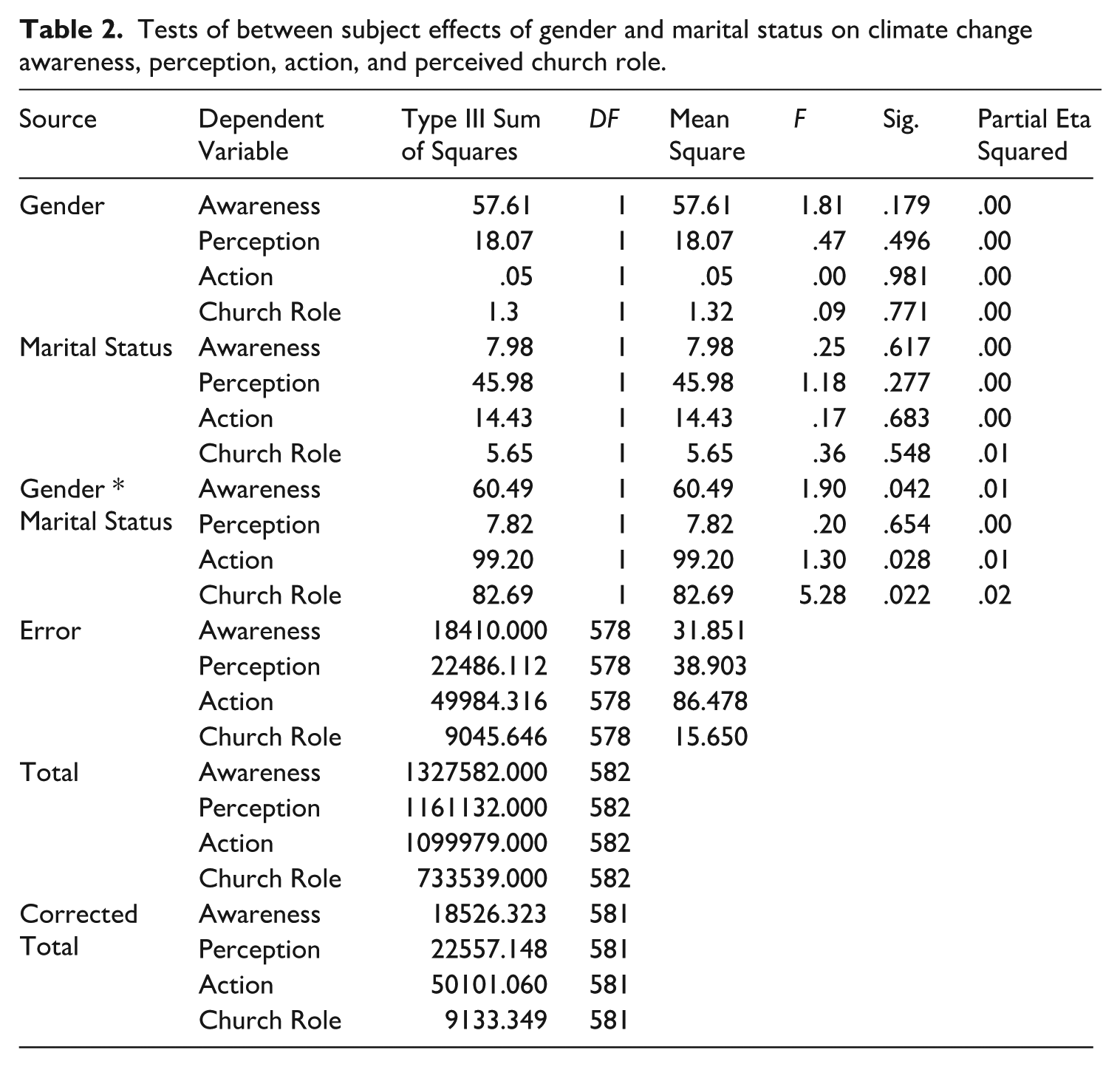
However, the interaction of gender and marital status influenced participant’s scores on three of the outcome variables (awareness, action and perceived church role) at the multivariate level (Wilk’s Lambda = .98, F = 2.59, df = (4, 575) = 2.59, p = .036). A significant interaction was found on climate change awareness (F(1,578) = 1.90, p = .042). Further probing of the significant interaction regarding climate change awareness (See Figure 1) indicated that married male participants were more aware of climate change (M = 48.19, SD = 4.95) compared to unmarried male participants (M = 47.32, SD = 6.24). Conversely, unmarried female participants reported slightly higher awareness of climate change (M = 47.33, SD = 6.49) compared to married female participants (M = 46.92, SD = 4.80).
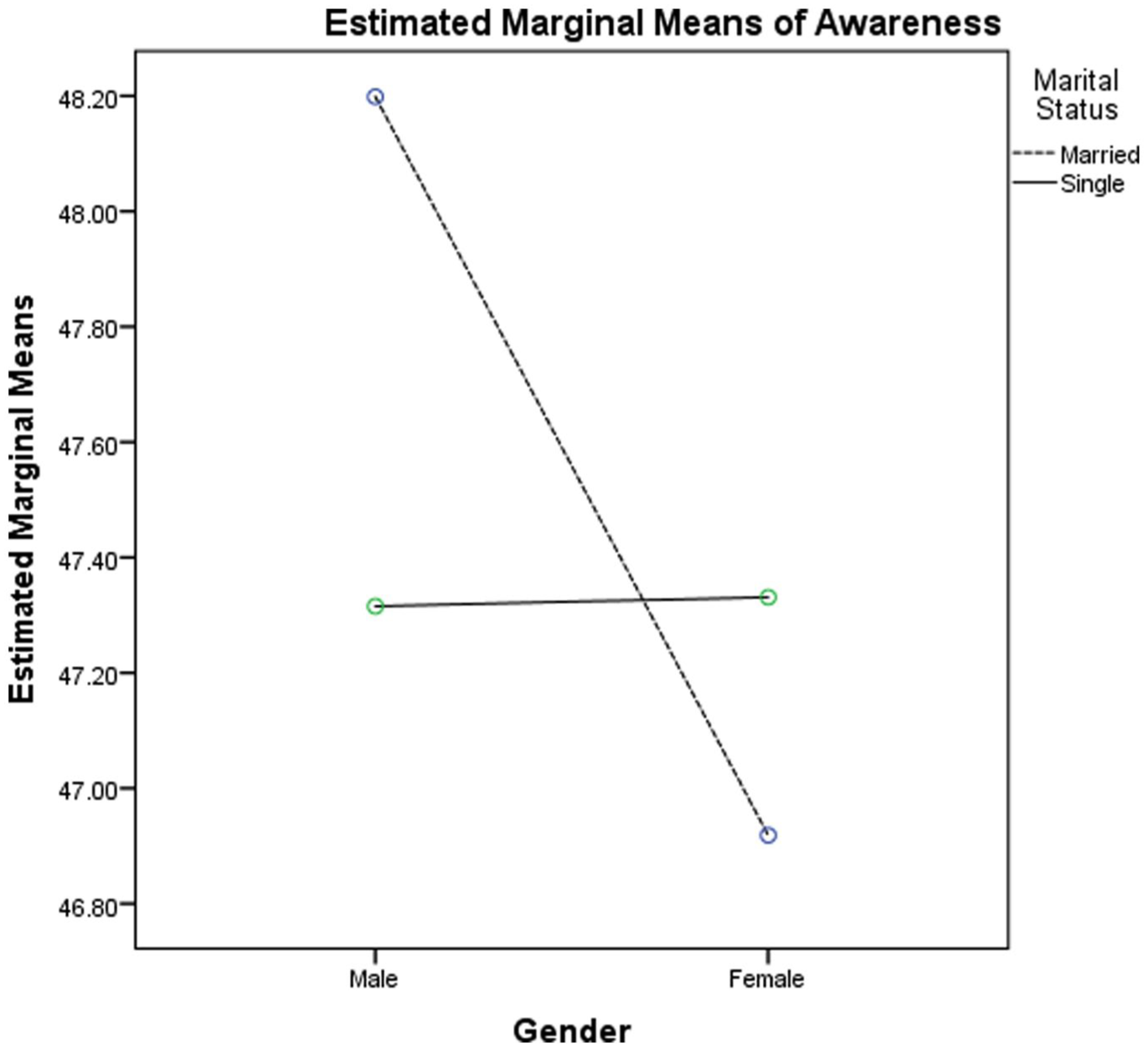
Slope of the interaction effect of gender and marital status on climate change awareness.
There was a significant interaction for climate change action, (F(1,578) = 1.30, p = .028) (See Figure 2). Specifically, unmarried male participants were more engaged in climate change action (M = 43.02, SD = 9.50) compared to married male participants (M = 41.88, SD = 9.85).
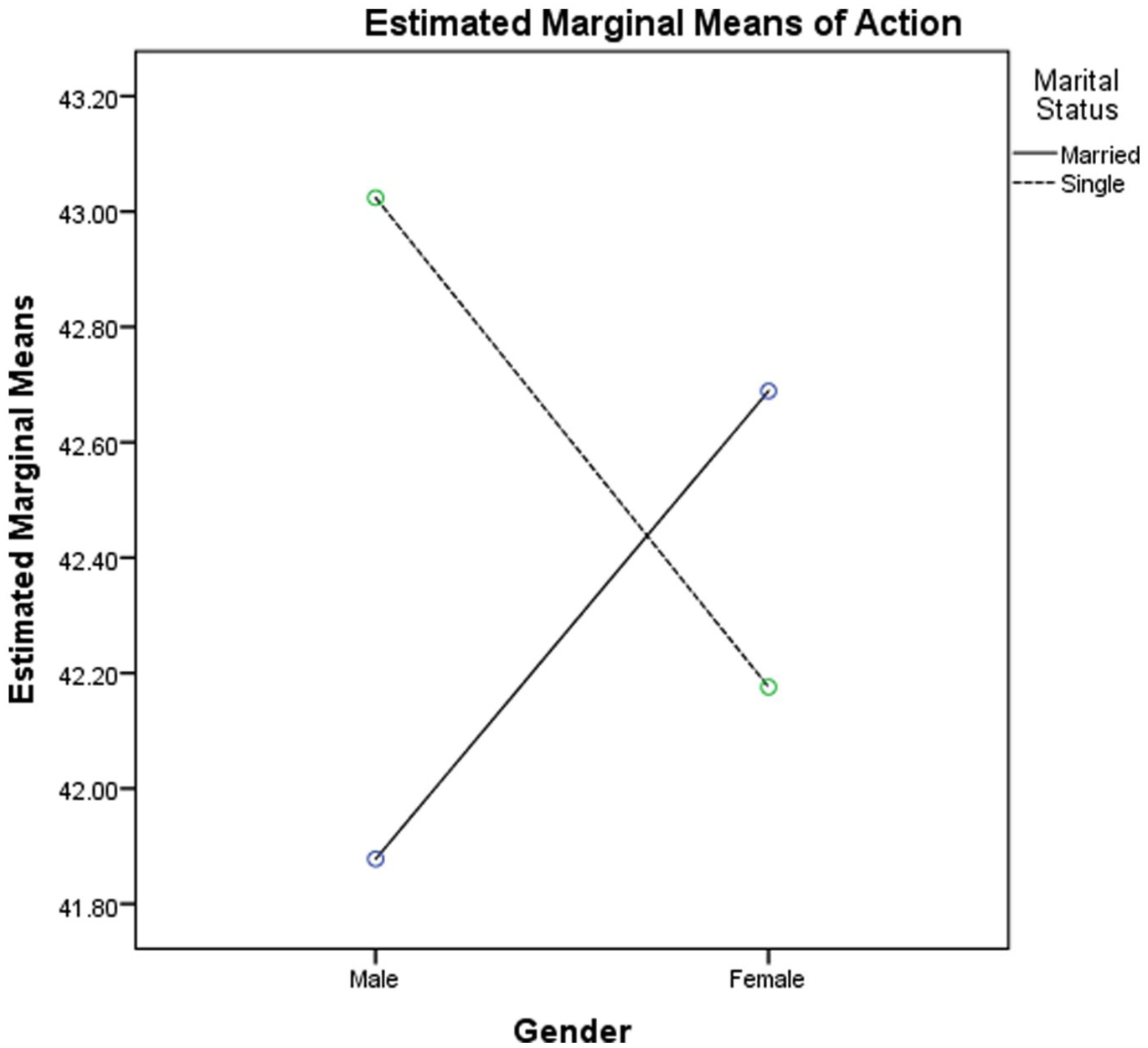
Slope of the interaction effect of gender and marital status on climate change action.
In the same vein, gender and marital status had a significant effect on perceived church role, (F(1,578) = 5.28, p = .022) (See Figure 3). For perceived church role, unmarried male participants scored higher on perceived church role (M = 35.51, SD = 3.83) compared to married male participants (M = 34.95, SD = 4.06). But, married female participants reported slightly higher scores on perceived church role (M = 35.80, SD = 3.86) compared to unmarried female participants (M = 34.85, SD = 4.09).
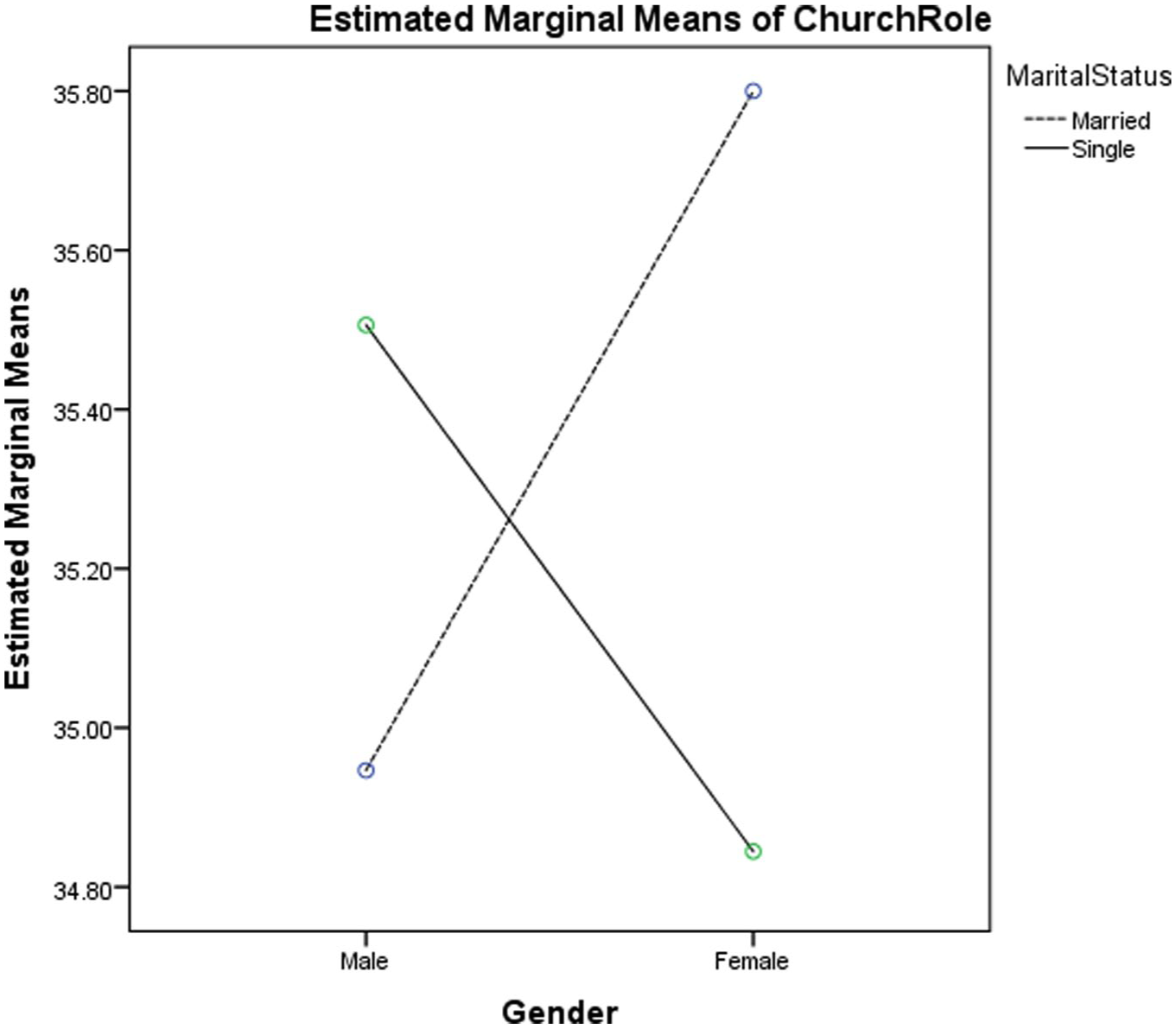
Slope of the interaction effect of gender and marital status on perception of church’s role in climate change.
Discussion
This study reveals that gender and marital status, as individual factors, do not significantly influence climate change awareness, perception, action, or the perceived role of the church. However, their interaction yields significant effects on awareness, action, and perceptions of the church’s role in addressing climate change. These results contribute to the broader discourse on demographic influences on environmental attitudes and behaviours.
The non-significant influence of gender on climate change awareness aligns with existing studies (e.g. Karlsson, 2019; Teyton and Abramson, 2021) indicating that both men and women display similar levels of environmental awareness when exposed to similar socio-cultural conditions (Xia and Li, 2023). However, research has also suggested that women, particularly in developing countries, often exhibit higher concern for climate change due to their disproportionate vulnerability to its effects (Al-Amin et al., 2019; Hornsey et al., 2016; Korkmaz, 2018; Pearse, 2017; Shi et al., 2016). The findings in this study, which show nearly equal mean awareness scores for men (M = 47.70) and women (M = 47.13), suggest that gender differences in environmental concern might be context-dependent and influenced by local socio-economic and religious factors.
Similarly, the lack of a significant effect of marital status on climate change awareness, perception, action, and the perceived role of the church contradicts some studies that suggest that married individuals are more likely to engage in pro-environmental behaviours due to increased family responsibilities (e.g. Korkmaz, 2018). However, other research indicates that single individuals, particularly younger ones, may have higher environmental concern due to greater exposure to climate change education and activism (Poortinga, 2023; Salguero et al., 2024; Tyson et al., 2021). The current findings suggest that within this specific study population, marital status alone does not strongly shape climate-related attitudes and behaviours.
The significant interaction between gender and marital status on climate change awareness highlights nuanced patterns. The finding that married men report higher awareness than unmarried men suggests that married men may be more exposed to environmental conversations through their spouses in family contexts or via community networks. In family settings, studies have shown that such discussions not only shape climate change beliefs among couples or romantic partners (Goldberg et al., 2022) but that, in some contexts, women are the primary drivers of this influence (Godin, 2022; Hung and Bayrak, 2019). Conversely, the finding that unmarried women report higher awareness than married women suggests two possibilities. First, unmarried women, who are often more engaged in educational and activist spaces, may access climate change information through diverse channels (Hunter et al., 2004). Second, marriage may have a slightly negative influence on women’s climate change awareness. This may be particularly relevant in a cultural context like Nigeria, where women’s rights within marriage are limited and where men largely determine the course of marriage as well as permissible values and viewpoints (Diala and Diala, 2020; Oyebade, 2016). This dynamic is further reinforced by Christian doctrines on marriage, which emphasize women’s submission to their husbands (Ademiluka, 2021). Consequently, if husbands are not climate-literate or engaged in climate discourse, their wives are likely to have lower climate change awareness.
A similar pattern is observed in climate change action, where unmarried men are more engaged than their married counterparts. This finding may reflect differences in available time and priorities; unmarried individuals may have more flexibility to participate in climate-related initiatives, whereas married individuals, particularly men, may prioritize economic responsibilities (Xiao and McCright, 2015). This finding has implications for understanding how marital status and gender intersect in influencing individuals’ involvement in climate change-related actions. Conversely, among women, the difference in climate action between married and unmarried individuals is minimal, suggesting that gendered roles may influence men’s, but not women’s environmental engagement. Further research is needed to explore the underlying reasons behind this interaction. Factors such as personal priorities, responsibilities, access to resources, and social norms may contribute to the observed differences in climate change action between married and unmarried men. Also, it would be valuable to investigate whether similar patterns emerge for women and how other demographic and socio-cultural factors may influence climate change action. Understanding the factors that influence climate change action is crucial for designing effective interventions and policies.
The interaction effect on the perceived role of the church in climate change further supports the argument that demographic factors do not operate in isolation but in intersectional ways. Unmarried men scored highest in perceiving the church’s role in climate action, which might reflect their engagement with church-led social and environmental programmes. In contrast, married women reported a higher perception of the church’s role compared to unmarried women, possibly due to their more active participation in religious and community activities, where environmental issues might be discussed. The results highlight the importance of considering the intersectionality of gender and marital status in understanding individuals’ perceptions of the church’s role in addressing climate change. It further highlights the need for religious institutions to be mindful of these intersecting identities and tailor their approaches and messaging accordingly.
In all, these findings call attention to the complexity of demographic influences on climate change attitudes and behaviours. The study highlights the importance of considering intersectional factors rather than treating gender and marital status as independent determinants of environmental engagement. Future research should further explore the socio-cultural and religious dynamics shaping these interactions to develop targeted climate change communication strategies within religious communities.
Conclusion
This study examined the influence of gender and marital status on churchgoers’ climate change awareness, perception, action, and perceived church role in Nigeria. The overall results showed no significant differences between males and females or between married and unmarried individuals in relation to the four variables. However, the interaction between gender and marital status had a significant effect on climate change awareness, action, and perceived church role. Specifically, the interaction revealed that married males had higher levels of climate change awareness compared to unmarried males, while unmarried females exhibited slightly higher awareness compared to married females. Unmarried males were more engaged in climate change action compared to married males, indicating that marital status can influence individuals’ involvement in climate change-related actions. In addition, unmarried males perceived the church to have a greater role in addressing climate change compared to married males, while married females had a slightly higher perception of the church’s role compared to unmarried females.
These findings highlight the importance of considering the complex interplay between gender and marital status in shaping individuals’ climate change attitudes, actions, and perceptions of the church’s role. The study indicates that these demographic factors interact in nuanced ways to influence awareness, engagement in action, and views on the church’s responsibility in addressing the challenge of climate change. This emphasizes the need for tailored approaches in engaging different groups and communities in climate change initiatives and religious institutions. Further research is necessary to explore the underlying factors driving these interactions and to examine how they translate into actual behaviours and actions. Also, the generalizability of these findings should be approached with caution, as they are specific to the sample and context of this study. Nonetheless, these results contribute to our understanding of the complex dynamics between gender, marital status, and climate change-related attitudes and behaviours.
Footnotes
Acknowledgements
The researcher deeply appreciates all the participants/members of the churches who completed the study questionnaires.
Funding
The authors received no financial support for the research, authorship, and/or publication of this article.

Notes
Author biography
Address: Department of Religion Studies, Kingsway Campus, University of Johannesburg, South Africa, A Ring 603.
Email: