



Abstract
This study examines religious changes during Russia’s full-scale invasion of Ukraine through a two-wave panel study of 595 individuals before and during the 2022 war. It explores the relationship between wartime adversity and changes in religiosity. Our findings suggest that greater personal exposure to war does not increase religiosity. At the same time, greater existential insecurity is associated with a greater magnitude of religious change, regardless of its direction. In addition, the research found that individuals who were less religious before the war experienced a greater increase in religiosity. However, the effect of war exposure on the change in religiosity was more pronounced among religious people.
Introduction
Religion and war are often mentioned together, so it is not surprising that the relationship between these phenomena underlies many explanations of human behaviour. In the sociology of religion, one of the most influential theoretical developments is the work of the American political scientists Pipa Norris and Ronald Inglehart, who link the process of secularisation in the world to the degree to which life is perceived to be secure: as the level of existential security increases, the importance of religion in people’s lives decreases, and vice versa (Inglehart, 2021). According to Inglehart, the main mechanism of secularisation is the replacement of generations raised in different environments. However, the theory admits that a change in religiosity can occur during a person’s lifetime.
The question of the second mechanism remains under-researched. With rare exceptions (Immerzeel and Van Tubergen, 2013; Molteni, 2017), empirical studies on the relationship between individual insecurity and religiosity have not analytically separated the influence of current existential insecurity from the conditions in which a person was formed. Moreover, it can be questioned whether the indicators of existential insecurity in some studies really measure it as something that threatens a person’s life and health. At the same time, the theory suggests that changes in religiosity in adulthood occur during periods of significant social upheaval.
In this article, we will focus on examining an impact of the current existential insecurity facing people in adulthood. To explore this issue, we will turn to the tragic experience of the full-scale Russian invasion of Ukraine, utilising two-way panel data, the first wave of which was collected shortly just before 24 February. The case of Ukraine is particularly interesting because Orthodox countries often don’t fit neatly into classic secularisation theories. The ongoing war in Ukraine offers a direct way to see how existential insecurity affects people’s religious beliefs. This real-world situation allows us to look at the different ways in which people deal with their faith in the face of uncertainty and danger.
This article is structured as follows. First, we provide a background on the religious landscape in Ukraine before the full-scale invasion, highlighting regional differences and the historical context of religious developments. Second, the literature review explores the relationship between existential threats and religiosity, presenting the insecurity hypothesis by Ronald Inglehart and findings from studies on religion and personal exposure to threats and traumatic events. Third, the study’s hypotheses focus on the relationships between existential insecurity, prior religiosity, and changes in religiosity. Fourth, the data and methods section details the panel study design, sample characteristics, and key variables. The results then examine the impact of war-related existential threats on religiosity. Finally, the discussion and conclusion interpret the findings and discuss their implications for understanding religious change in times of crisis.
Basic religious patterns in Ukraine before the full-scale invasion
After the first decade following the USSR’s collapse, Ukraine experienced a revival of religious life, marked by the growth of religious organisations and an increase in the number of people identifying with a religion (Brik and Korolkov, 2020). Unlike some other post-communist countries, religious affiliation in Ukraine has remained relatively stable. Since the 1990s, around 70% of Ukrainians have consistently identified as Orthodox (Holovakha and Makei︠e︡v, 2023: 73). This identity can also be cultural – in Ukraine, there is a significant proportion of people who consider themselves Orthodox, but are not practising believers (Bogdan, 2009).
There are regional religious differences in the country. Religious affiliation and practice are traditionally lower in the eastern parts of Ukraine, which are now suffering the most from the war, compared to the more religious western regions, with the central parts falling somewhere in between. The western part of the country, with a shorter history with the Soviet government, has a strong presence of the Greek Catholic Church and is more religious than the rest of the country. In this region, religious traditions were less affected by communist persecution, allowing for greater religious socialisation. The rest of the country is predominantly Orthodox, with two main competing organisations: the Orthodox Church of Ukraine and the Ukrainian Orthodox Church of the Moscow Patriarchate. The latter is frowned upon because of its association with Russia, a sentiment that has been only exacerbated by the invasion (Hrushetskyi, 2023). A significant proportion of people in the east and south, the regions most affected by the war, do not belong to any particular Orthodox church but identify as ‘just Orthodox’.
How is the threat to life related to religiosity?
Roland Inglehart’s theory of evolutionary modernisation suggests that values in society change as a result of changes in the security of the environment in which individuals live. Under normal circumstances, values do not change suddenly; they are formed in childhood and are relatively stable in adulthood (Inglehart, 2018: 14). In this regard, changes in society occur with a time lag relative to the current level of security and become more pronounced as one generation is replaced by another, subject to differences in the level of security of the environment in which they grew up. At the same time, the theory suggests situational fluctuations in values for all age groups as a reaction to certain large-scale stressful events, such as economic recessions or the collapse of a state (Inglehart, 2018: 28). In such times of hardship and uncertainty, people rely on higher powers to reduce stress and concentrate on resolving present challenges (Norris and Inglehart, 2015: 3392).
The latter statement is indeed supported by a body of empirical literature. For example, a systematic review of hundreds of studies on the relationship between religion and health shows that religion helped respondents in many stressful situations, including chronic pain, heart disease, cancer, mental illness, bereavement, natural disasters, and war (Koenig, 2012). In March 2020, in response to the COVID-19 pandemic, there was a significant increase in searches for prayer on the Google search engine. This increase correlates in time with the spread of COVID-19 and related events, such as the World Health Organization pandemic declaration and the first cases in different countries (Bentzen, 2021).
Figure 1 shows the frequency of the search query ‘prayer’ in Ukraine according to Google Trends: a sharp spike in searches occurs in the first months of the full-scale invasion. Among other fluctuations, there was an atypical rise in March 2020 and during the Ukrainian counteroffensive in the Kharkiv region. In general, since the beginning of the full-scale war, the popularity of this search query has been consistently higher than in the previous 4 years.
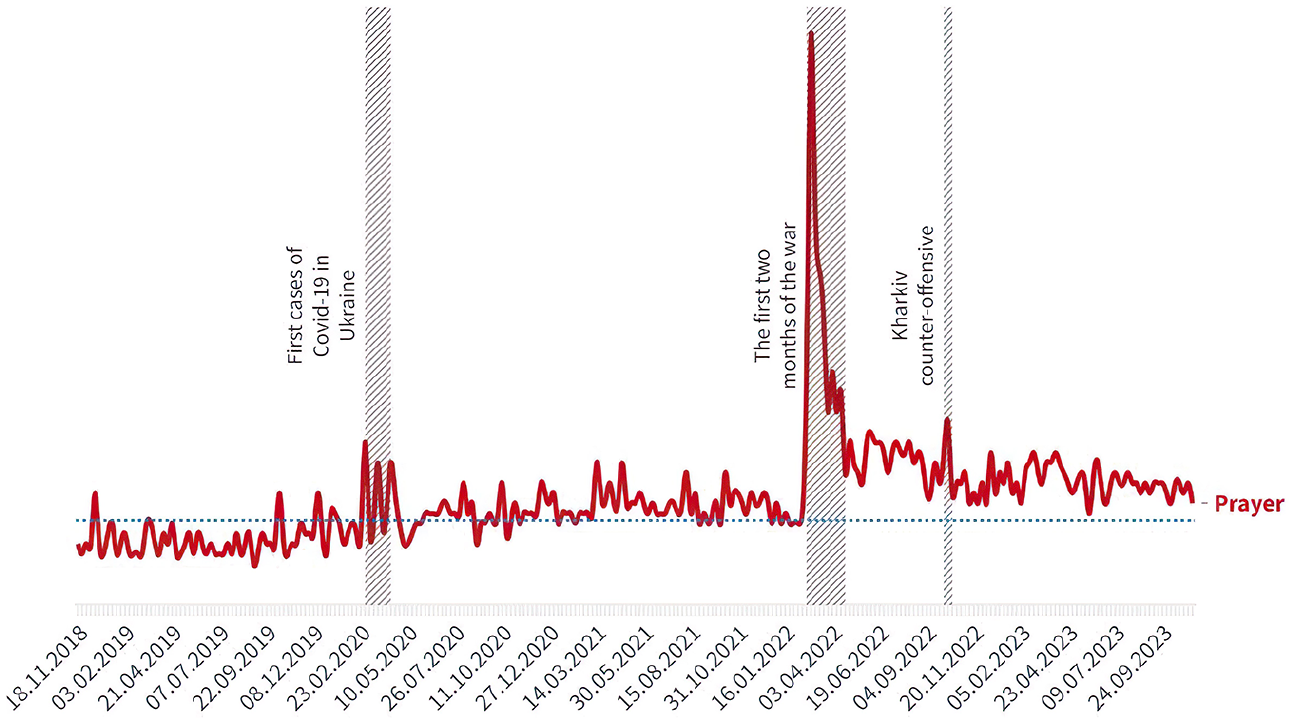
Dynamics of the search query ‘prayer’ (November 2018–November 2023).
These findings support the notion that people’s religiosity is influenced not only by the dangers they face in their formative years, but also by the dangers they face as adults. Furthermore, comparing the impact of existential insecurity in childhood with measures of insecurity in adulthood in regression models based on European Social Survey data, Dutch researchers Tim Immerzeel and Van Tubergen concluded that ‘present and past insecurities are equally important in explaining religiosity’ (Immerzeel and Van Tubergen, 2013: 369).
However, empirical studies also show that individual reactions to adverse events can vary. For example, in a survey of 608 people who lost loved ones in the al-Qaeda terrorist attack on 11 September 2001, most respondents rated the importance of religion in their lives before the tragedy the same as at the time of the survey (3 years later). At the same time, 11% of respondents rated the importance of religion higher after the tragedy, and 10% rated it lower (Seirmarco et al., 2012). Similar results were obtained in other samples, in particular in samples of Vietnam War veterans treated for post-traumatic stress disorder (PTSD; Johnson et al., 2004), tsunami survivors (Hussain, 2012), and victims of sexual violence (Ben-Ezra et al., 2010).
We can also observe the multidirectional changes in individual religiosity in the data directly related to the consequences of the Russian–Ukrainian war. For example, in November 2022 the Razumkov Centre (a Ukrainian non-governmental public policy think tank) conducted a survey (n = 2018). According to their findings, the outbreak of full-scale war did not significantly affect the attitudes of the majority of respondents towards religion. Among those who did experience a change, 25% reported becoming more religious, while only 4% reported becoming less religious. Similarly, the frequency of church attendance did not change significantly for the majority of respondents. Of those who experienced a change, 11% started attending church more often, while 12% attended less often (Razumkov Centre, 2022).
So how can we explain the differences in reactions to war at the individual level? To answer this question, we turn to the work of psychologists. Kenneth Pergament, one of the most influential researchers of religious coping (a stress management strategy), focuses not so much on the psychological and social benefits that believers can potentially receive from religion, but on how they interpret their faith (Pargament, 2009). This interpretation is a dynamic process that occurs throughout an individual’s life. In challenging times, a person’s religious beliefs may be tested. The response to these challenges may vary depending on how well their previous beliefs can account for what is happening around them. For instance, the existence of injustice and suffering in the world can be explained by the inability of good forces to overcome evil forces, the concept of karma or sin, or the tests of faith (Adair-Toteff, 2013; Pargament, 2010). Such interpretations allow believers to find meaning in the troubles that are happening around them and to maintain a relationship with the sacred.
However, if a new picture of the world is not consistent with previous religious beliefs, it may lead to a modification of religious views, up to and including a partial or complete rejection of religion (Janoff-Bulman, 1989; Pargament, 2010). For example, among people who lost loved ones in the terrorist attack of 11 September 2001, a decrease in religiosity is more common among respondents who lost a child 1 and those who had symptoms of psychological disorders (PTSD, depression, ‘prolonged grief reaction’; Seirmarco et al., 2012). In another study of victims of sexual violence, about half of the respondents reported a decrease in religiosity after the tragedy. At the same time, the study found that levels of life satisfaction after the tragedy were not associated with changes in religiousness scores before and after the experience of violence (Ben-Ezra et al., 2010). The latter may serve as evidence that people who have coped with trauma have been able to avoid disillusionment with religion.
Similar changes occurred in a certain part of the population during the full-scale war in Ukraine. As an anecdotal illustration, here is the testimony of a focus group participant who left the Kyiv region in 2022 in the aforementioned Razumkov Centre’s (2022) religiousness survey:
I reconsidered my attitude to the church. I thought that the world should be a little fairer. And I saw that there is a lot of anger and aggression. Well, it depends more on people than on some higher power. That there is no need to rely on higher powers if all this is happening here and to us.
Previous studies also confirm that the reaction to stress and traumatic events depends on the individual’s previous religiosity. The researchers pointed out that a certain level of belief is a prerequisite for the use of religion as a coping strategy. For example, in a study of Presbyterian church members, Pergament et al. (2011) found that people who are more involved in the church (e.g. clergy) are more likely to resort to religious coping. Another study found that among survivors of serious illnesses, those with a clear religious identification were more likely to turn to religious coping (Ferraro and Kelley-Moore, 2000). In a recent study of the impact of COVID-19, researchers found that increases in church attendance and frequency of prayer in response to illness among family members were more pronounced among respondents who had received religious socialisation in childhood (Molteni et al., 2021). The Razumkov Centre’s survey shows that the proportion of people who reported an increase in religiosity since the start of the war is higher among those who identify themselves as a particular church, compared to ‘just Orthodox’ or ‘just Christians’. At the same time, respondents from the western part of Ukraine, which is traditionally the most religious region of Ukraine, reported the highest increase in religiosity and frequency of church attendance (Razumkov Centre, 2022).
However, not all evidence supports a positive relationship between increased religiosity and high prior religiosity during crisis events. For example, a recent panel study of the impact of military conflict on religiosity in Israel found that experiencing traumatic war-related events increased religiosity more among the non-religious people than among the religious people (Shai, 2022). In addition, in a study aimed at identifying factors that directly influence changes in religiosity after trauma, researchers found that high levels of post-traumatic stress and high pre-trauma religiosity were associated with decreases in religiosity (Ter Kuile and Ehring, 2014). The same study found that changes in religiosity after traumatic events are associated with changes in positive worldview in more religious people, but not in non-religious people. These findings can be interpreted to mean that religious people are more vulnerable to religious discouragement.
Hypotheses
The literature review suggests that the relationship between existential insecurity and religiosity is bidirectional. On the one hand, life-threatening events increase the need for the reassurance offered by religion. On the other hand, highly traumatic events can lead to doubts about faith. Thus, an individual’s experience of life-threatening events may have different effects on a person’s religiosity, which may cancel each other out at the group level. In view of this, it is worth considering not only the change in religiosity, taking into account the direction, but also the absolute value of this change (change regardless of direction). Our first hypothesis is therefore as follows:
Hypothesis 1: Higher individual existential insecurity is associated with the greater change in religiosity.
In turn, the response to existential insecurity depends on the individual’s prior religious beliefs. Religious people are more likely to turn to religion to cope with uncertainty in difficult times and to explain what is happening around them. If religion can explain it, they will not become disillusioned with their faith and their religiosity may even increase. If not, their religiosity is likely to decline. Less religious people will also be less likely to become disillusioned with religion (because they are less likely to turn to it) and therefore less likely to change their religiosity. We therefore expect that:
Hypothesis 2: Higher prior religiosity is associated with the greater change in religiosity due to existential insecurity.
Methods and data
Sample and data collection
For our study, we used panel data collected in two waves. Data collection was carried out by the Kyiv International Institute of Sociology.
The first wave took place from 18 January 2022 to 8 February 2022, using the personal interview method. The sample represents the population of Ukraine aged 15 years and over living in territories controlled by the Ukrainian government before 24 February 2022. A stratification by region (24 Ukrainian oblasts and Kyiv city) and type of settlement (rural/urban) was applied. At the first stage, within each stratum, the electoral precincts were randomly selected. At the second stage, random walk selection of households within the selected electoral precincts was used. In the participating households, the interviewer randomly selected a respondent from the list of eligible members. As a result, 1531 respondents were interviewed. The response rate for the first wave of the survey was 30.2%.
The second wave was conducted from 24 August 2022 to 6 October 2022 using a computer-assisted telephone interviewing. During the second contact, 595 respondents were interviewed (39% of those who participated in the first wave; 46.9% of those who agreed to be contacted again in the first survey). It should be noted that the response rate among respondents from the occupied and frontline regions was significantly lower than in the western regions of the country. Participants in the second wave of the survey also differed from those who participated only in the first wave in other socio-demographic characteristics. For example, there were statistically significant differences between the groups by education level and type of settlement – participants in the second wave were slightly more educated and urbanised than those who could not be recruited (see Appendix 1). At the same time, the sample is quite heterogeneous, covering a wide range of social groups. Given that our study focuses on establishing the relationship between variables rather than describing religious change in Ukrainian society, this is sufficient to draw meaningful conclusions. In addition, we found no statistically significant differences in the religious affiliation of respondents between those who were included in the panel and those who were not (see Appendix 1). This indicates that we do not have a bias towards a higher representation of respondents from a particular denomination, which could otherwise distort the results.
The panel design of the survey gives us a number of methodological advantages over cross-sectional or retrospective studies. First, we can measure religious change not by asking respondents a direct question about how their level of religiosity has changed, but by comparing their responses to questions that allow us to assess their level of religiosity for both waves. The latter allows us to really capture changes in religiosity, while asking a direct question reflects rather the situational subjective opinion of respondents, which, however, may differ from the real picture. Second, panel data outline the level of respondents’ religiosity both before and during the full-scale invasion. This enables us not only to find out how religiosity correlates before and during the war, but also to understand how previous religious beliefs of Ukrainians and changes in their religiosity that took place in a period of existential insecurity (i.e. the Russian full-scale invasion) are interconnected.
Variable descriptions
To measure previous religiosity and religious change, a three-variable index was constructed:
Self-assessed religiosity (ranges from 0 to 10, where 0 is not at all religious, 10 is a very religious person);
Frequency of church attendance (has a 7-point scale with the following answers: every day, more than once a week, once a week, at least once a month, only on special holy days, less often, never);
Frequency of prayer (has a 7-point scale with the following answer options: every day, more than once a week, once a week, at least once a month, only on special holy days, less often, never).
To calculate the index, first, each of the three variables was standardised (‘Frequency of church attendance’ and ‘Frequency of prayer’ scales were inverted) on a panel data including both waves of the survey. Then the arithmetic means of the standardised variables were calculated for each observation. The index reflects the respondent’s religiosity (the Religiosity Index 2 ) and can be either positive or negative. Positive values show that the respondent’s religiosity is higher than average, and negative values indicate that it is lower.
To construct a variable that would characterise the respondent’s previous religiosity, the values of the Religiosity Index for the first wave of the panel study were grouped as follows:
More religious: the index values are positive;
Less religious: the index values are negative or equal to 0.
Appendix 2 shows that respondents who are more religious have a much higher level of self-reported religiosity, are more likely to attend church at least once a week or at least once a month, and have a higher tendency to pray every day or more than once a week than less religious respondents. On the other hand, the less religious respondents are much more likely to not attend church at all or very rarely and do not pray or do so at best on special holy days.
To test the hypothesis of a bidirectional relationship, two variables will be created to describe the religious change: a directional religious change and an absolute religious change. To construct a variable describing the directional religious change during the war, the values of the Religiosity Index for the second wave were subtracted from the values of the Religiosity Index for the first wave. The resulting variable is the metric one and can have both positive and negative values. Positive values suggest that religiosity increased during the war, while negative values indicate that it decreased. Zero indicates that religiosity did not change during the war compared to the pre-war period.
We will also calculate an absolute religious change: a directional religious change was taken by module. Accordingly, the values of this variable will be non-negative. Zero indicates that religiosity did not change during the war. The higher the value of this variable, the more pronounced the religious changes during the war.
Variables also were created to represent both directional and absolute changes for each of the three indicators of the Religiosity Index: self-assessed religiosity, frequency of church attendance, and frequency of prayer. The logic of constructing these variables is the same as for directional and absolute religious change of the Religiosity Index.
As an indicator of the relationship between existential insecurity and religiosity, we use religious change between the two waves of the survey. The fact that the data for the first wave were collected just before the war (a few weeks before the invasion) minimises the chance for other external factors to influence respondents’ answers. This increases our confidence that the changes we observe between the waves truly reflect the existential insecurity related to the war, rather than other potentially important events or changes in society.
Individual variation in existential insecurity during the war will be measured through the following variables (these variables represent different traumatic events and appear only in the second wave of the panel study) 3 :
Decrease in income
Loss of employment
Deterioration of physical health
Deterioration of mental health
Separation from family members
Loss or damage to home
Loss or damage to other property
Injury to yourself or family members
Experience of losing someone you know
Experiencing forced displacement
These indicators are typical of studies exploring the effects of war exposure and cover all the main dimensions of exposure to violence at the individual level: primary, material, and secondary victimisation (Yaylacı and Price, 2022).
If the respondent had experienced a particular situation, the variable was assigned a value of 1; otherwise, it was assigned a value of 0. The values of all 10 variables were added (for each respondent), resulting in a composite variable describing war exposure. 4 The resulting metric is significantly correlated (Spearman correlation coefficient = 0.35) with the war-affectedness of a region. 5 People who lived in regions with a low degree of war experience have a lower war exposure score than people from regions that were noticeably affected by war. Accordingly, the latter category has a lower war exposure score than people from mostly occupied regions (see Appendix 3).
Results
This study aimed to investigate the relationship between war exposure and changes in religiosity. The results indicate that the more individuals were affected by the war, the stronger the changes in their religiosity they experienced, both upwards and downwards. The Spearman correlation is statistically significant (although weak) only for the absolute change in religiosity, with confidence intervals that do not include 0, as shown in Figure 2. So, we confirm the first hypothesis. 6
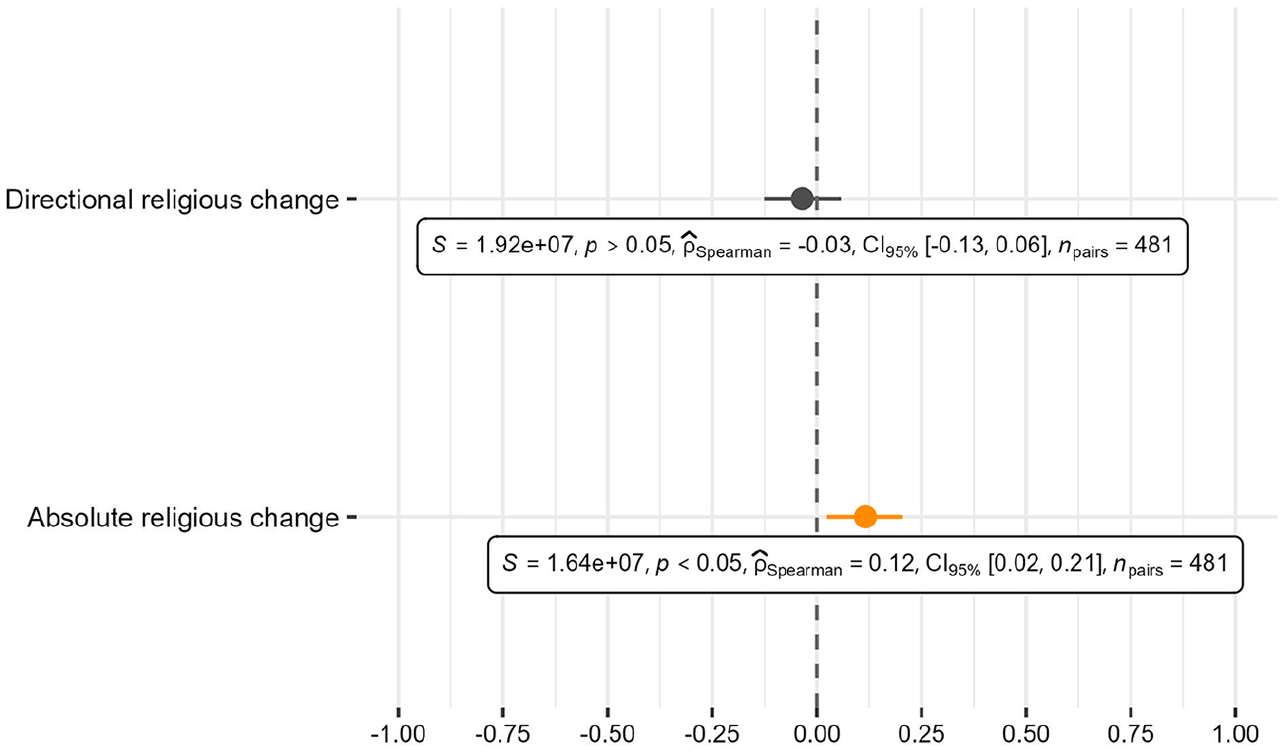
The correlation between changes in religiosity and war exposure.
Now we compare the change in religiosity for more and less religious respondents. The analysis shows that individuals who are less religious experienced a stronger change in religiosity and became more religious. Figure 3 indicates a statistically significant difference between the groups, as revealed by the Mann–Whitney test. However, the differences for directional religious change were more pronounced than for absolute religious change, as shown by the rank biserial correlation coefficient. 7 It can be explained by the fact that more religious individuals were more likely to decrease their religiosity than less religious ones.
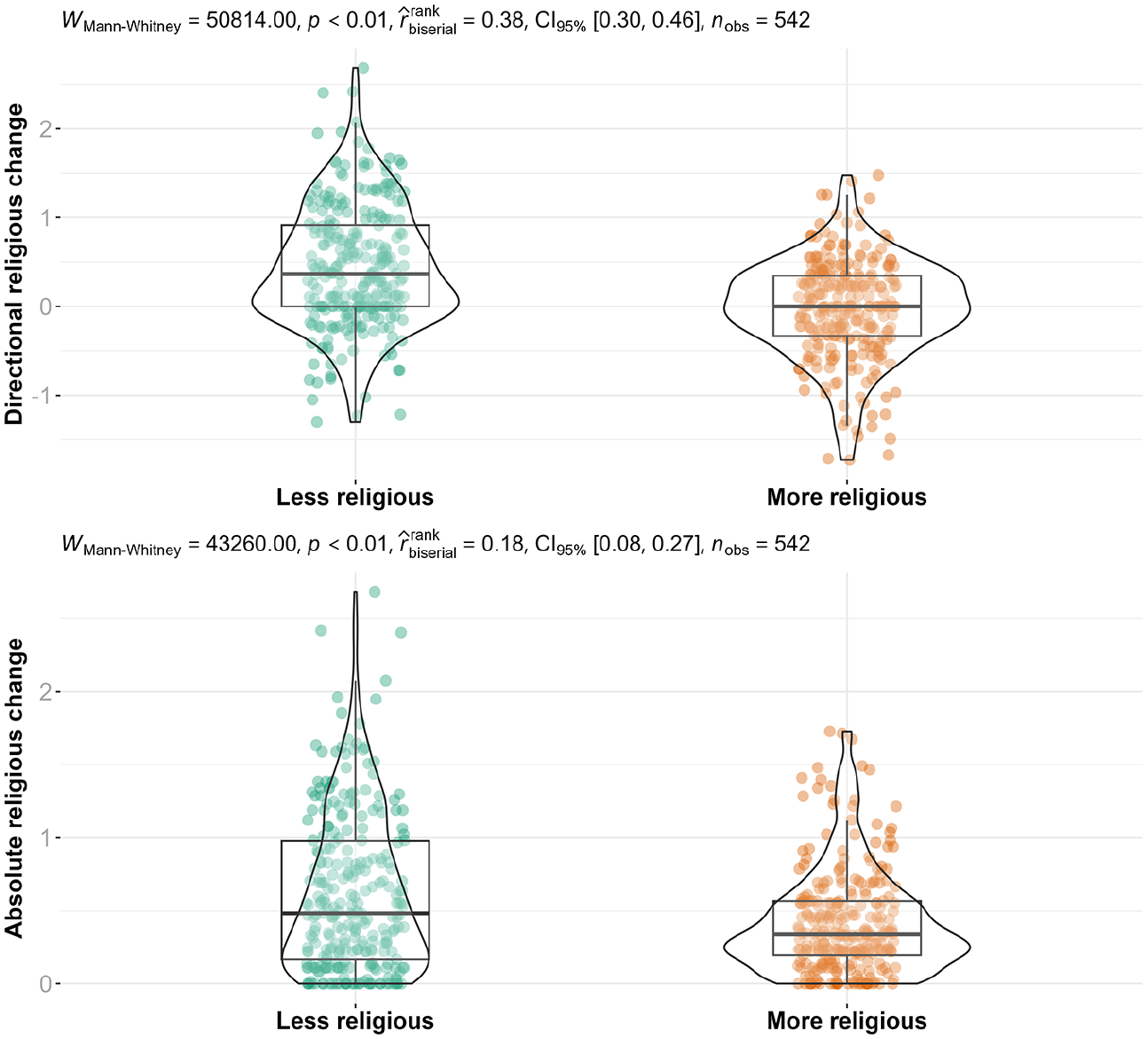
Changes in religiosity among more and less religious individuals.
The Mann–Whitney test showed significant differences between groups with a different religious predisposition based on all three variables of Religiosity Index (see Figure 4). The less religious group experienced a stronger change in their self-assessment of religiosity, with an increase in considering themselves more religious. In addition, the frequency of prayer changed more strongly among the less religious group, with a slight increase in the number of individuals who prayed more. More religious individuals did not, for the most part, change their frequency of prayer. But among them there are more individuals who have started to consider themselves less religious.
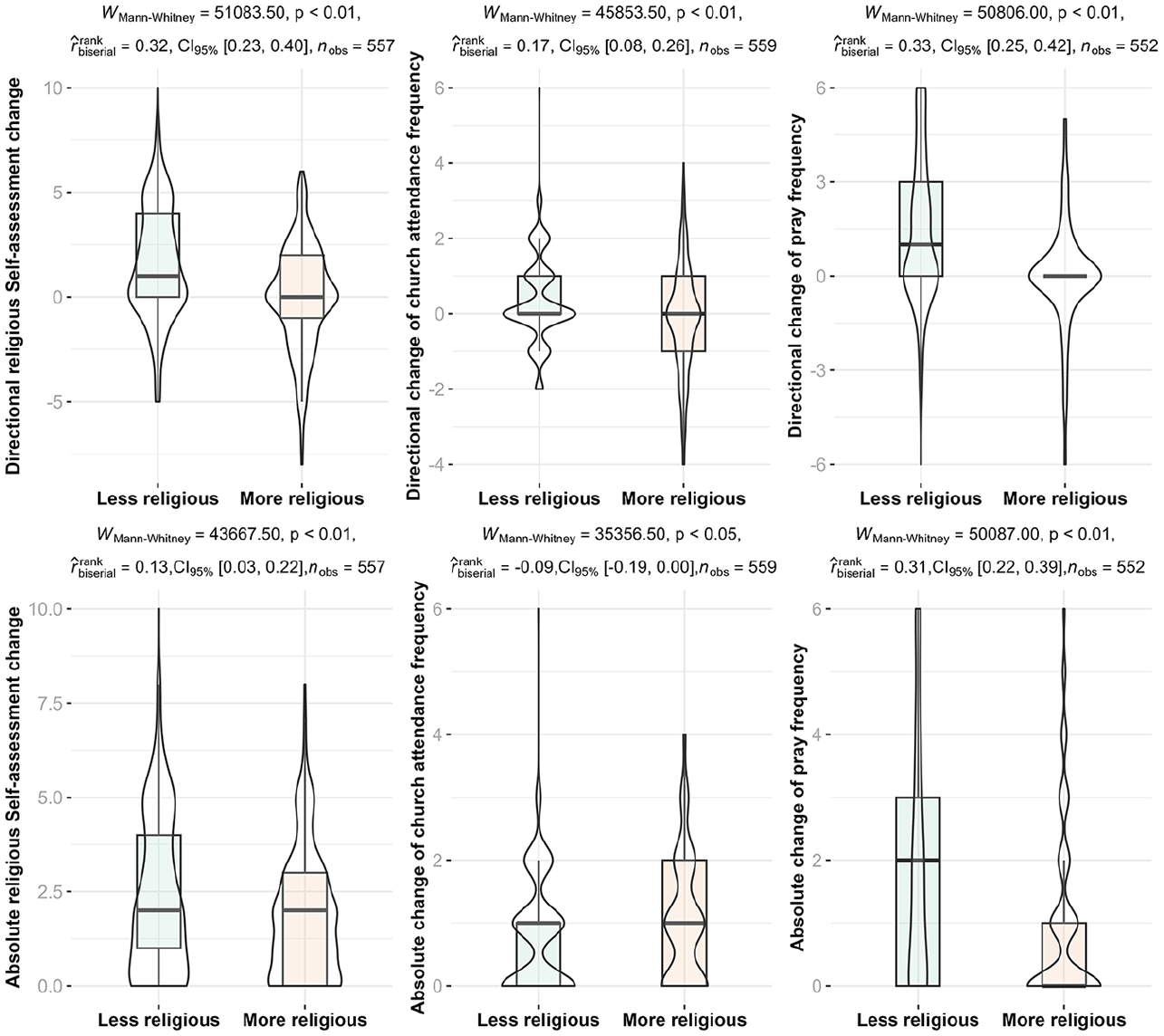
Changes in religiosity by indicators of Religiosity Index among more and less religious individuals.
It is worth noting that for the frequency of church attendance, religiosity has changed slightly more among the more religious people. However, the rank biserial correlation coefficient indicates that the differences between the groups in the change of church attendance frequency were less noticeable compared to the other two indicators. There were more religious respondents who started attending religious institutions less often. While among the less religious people, the share of those who started attending more often did not increase substantially. This can be explained by the following: (1) during the war, attending religious institutions became dangerous and (2) attending church requires more effort than prayer.
Finally, we examine the relationship between changes in religiosity and exposure to war, depending on previous religiosity (refer to Figure 5). This considers both war-related existential insecurity and individual existential insecurity. Among the less religious individuals, there is no statistically significant correlation between religious change and war exposure. There is a statistically significant but not very pronounced correlation between absolute religious change and war exposure among more religious respondents. The greater the exposure to war, the greater the changes in religiosity. Therefore, higher previous religiosity amplifies the effect of individual existential insecurity on religious change, whereas this effect is not observed among less religious individuals. Thus, the second hypothesis was partially supported.
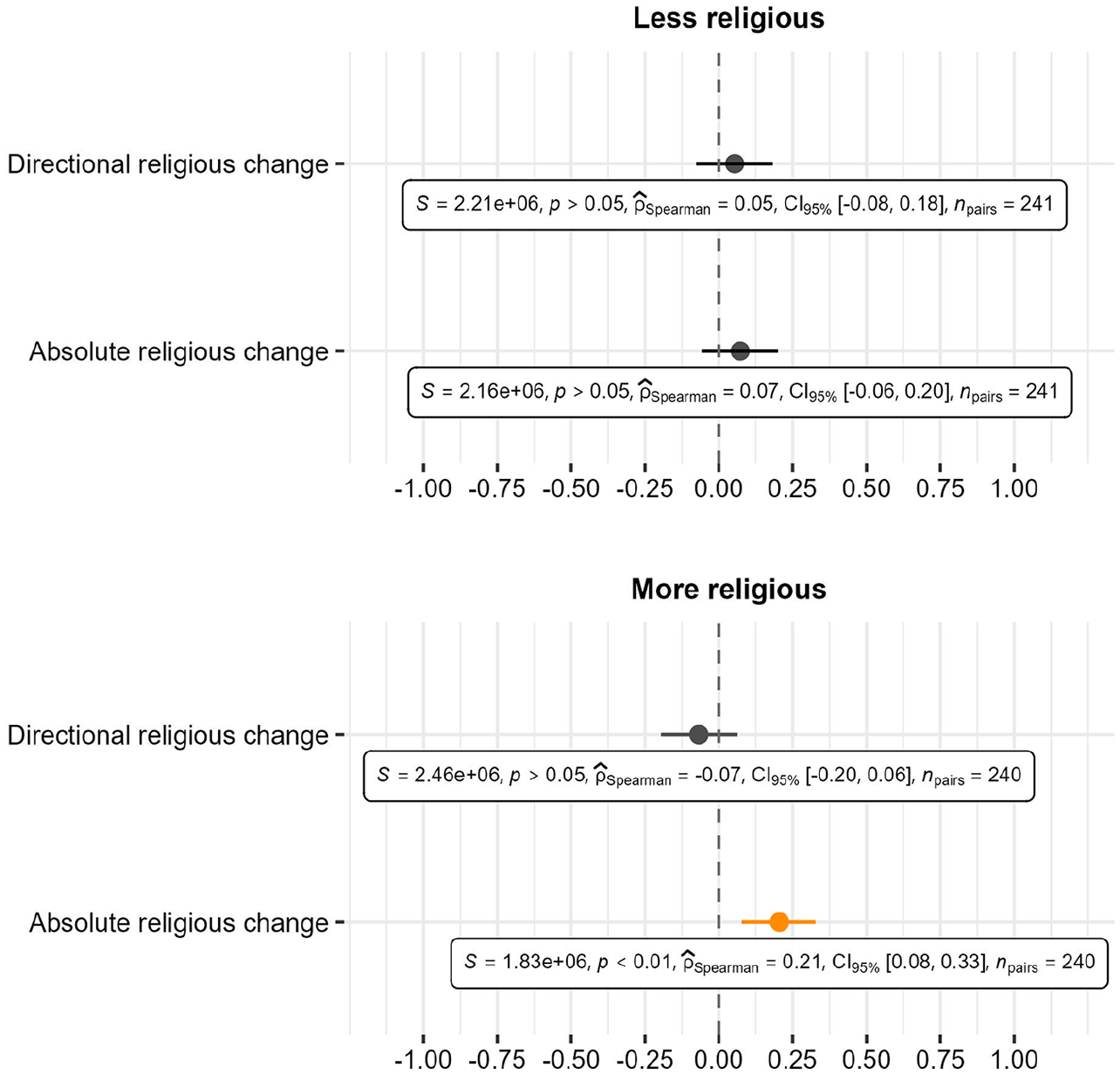
The correlation between changes in religiosity and war exposure among more and less religious individuals.
Discussion
The adage ‘there are no atheists in foxholes’ suggests that in the face of dire, life-threatening situations, individuals inevitably seek solace or support in the notion of a higher power. This study uses the ongoing conflict in Ukraine as a case study to explore this phenomenon. It uses panel data to examine the immediate impact of the conflict on personal levels of religiosity. Although, on average, respondents become slightly more religious, we do not find that greater personal exposure to the war increases religiosity. However, our analysis shows that greater existential insecurity is associated with a greater magnitude of change in religiosity, regardless of the direction of that change.
Previous studies have noted that a certain level of belief is a prerequisite for using religion as a coping strategy. In our research, we found that religiosity increased more among people who were not very religious before the war. If less religious people are less likely to use religion as a coping mechanism, this suggests that (1) the use of religion as a coping strategy may not be directly related to the increase in religiosity during crises, and (2) individuals who were less religious had sufficient religious socialisation to use religion as a coping mechanism.
The latter might be true in the context of Ukraine, where a significant portion of the population identifies as believers and attends church services at least on holidays. This could indicate a baseline level of religious familiarity and socialisation. Therefore, it is possible that even those who did not practice their faith regularly had the capacity to turn to religion in times of crisis. However, we do not have data to confirm this hypothesis.
At the same time, our analysis showed that the effect of war exposure on the absolute change in religiosity was more pronounced among religious people. This supports the hypothesis that the inhumane events of the war could undermine the worldview of people whose lives were centred on God.
The topic of religiosity declines as the consequences of experiencing existential threats in adulthood are clearly overlooked. Our findings suggest that further research is essential to develop a comprehensive understanding of how existential insecurity influences religious beliefs and practices. This entails a deep dive into long-term panel data to uncover the societal mechanisms behind changes in religiosity during crises. Our study underlines the necessity for further exploration into the factors that determine an individual’s religious response to conflict.
Limitations
The study has certain methodological limitations. For example, one of the limitations of this study is the use of different modes of data collection for each wave of the panel study. Therefore, the effect of the war on religious change may be confounded to some extent by measurement error.
The fact that less religious people demonstrated a higher increase in religiosity than the more religious people can be explained to some extent by the specifics of the variable of change in religiosity itself (which is the difference between the level of religiosity during the war and before the war). More religious people already have a high pre-existing level of religiosity, so for them, an upward change in religiosity during the war may not be very noticeable. This prompts further research to create a measurement tool for change in religiosity (rather than its subjective assessment, as is often the case in cross-sectional studies) that does not have the aforementioned drawback.
The population of the territories most affected by the war is underrepresented in our sample. Residents of these territories have historically been less religious than those in other regions of the country. Accordingly, this may lead to a certain bias in the results of our study.
Another limitation of our study is the additive nature of our variable of war exposure. Each adverse event that contributes to the indicator has equal weight, although this may not be the case. Therefore, it is worth considering creating a variable that would take into account the different weights of each of its components.
Footnotes
Appendix 1
Comparison of the distributions of socio-demographic characteristics of the panel sample and the original survey sample.
Appendix 2
Comparison of more and less religious people in terms of the values of the components of the indicator ‘previous religiosity of the respondent’.
Appendix 3
Acknowledgements
The authors are grateful to Tymofii Brik (Kyiv School of Economics) for his invaluable feedback and guidance throughout the project. They also extend their thanks to the anonymous reviewers for their insightful comments and suggestions, as well as to Valentyn Hatsko, Mykola Sydorov, Svitlana Salnikova, and Yuriy Saveliev (Taras Shevchenko National University of Kyiv) and Karina Shyrokykh (Stockholm University) for their constructive feedback at various stages of the work. Finally, they would like to express their gratitude to Andriy Koval (University of Central Florida) for his valuable consultation on data analysis during the initial stages of the project.
Declaration of conflicting interests
The author(s) declared no potential conflicts of interest with respect to the research, authorship, and/or publication of this article.
Funding
The authors disclosed receipt of the following financial support for the research, authorship, and/or publication of this article: This research was funded by the Swedish Institute Baltic Sea Neighbourhood Programme (grant number: 01221/2023). The first phase of data collection was supported by a grant from the International Renaissance Foundation and the Embassy of the Kingdom of Sweden in Ukraine, as part of the project ‘Ukraine in European Social Survey 2021’ (signed on 15 November 2021). The second phase of the study received funding from George Washington University within the framework of the PONARS Eurasia project (The Programme on New Approaches to Research and Security in Eurasia). Both waves of the study were conducted at the request of the Kyiv School of Economics.

Notes
Author biographies
Address: Taras Shevchenko National University of Kyiv, Hlushkova Avenue, 4d, Kyiv 03680, Ukraine.
Email:
Address: Taras Shevchenko National University of Kyiv, Hlushkova Avenue, 4d, Kyiv 03680, Ukraine.
Email: