




Abstract
At least 41 Evangelical Political Parties (EPPs) have been created in Latin America since the 1980s. While some of these political parties have been viable, others have not. This article explores the conditions that contribute to an EPP’s viability from a party-centered perspective. Focusing on the case of Colombia and using csQCA analysis, the study identifies two causal configurations that explain an EPP’s viability. The first shows that ecclesial support combined with a broader programmatic agenda is sufficient for an EPP’s viability, while the second demonstrates that ecclesial support, coupled with an autonomous internal structure, is also sufficient to ensure viability.
Introduction
In Latin America, the rise of new parties (NPs) became evident with the onset of the third wave of democratization (Levitsky et al., 2016). Evangelical political parties (EPPs) also emerged as part of this trend, with at least 41 EPPs formed in the region since the 1980s. However, while some of these parties have been viable, others have not. From a party-centered perspective, 1 this article explores the factors that explain the viability of an EPP. It argues that the viability of an EPP is the result of a complex process in which three key factors converge to explain the destiny of a party: ecclesiastical support (ES), an autonomous internal organization, and a broad programmatic agenda (BA). Here, viability is defined as a political party’s ability to sustain itself across at least three consecutive elections while establishing an internal structure autonomous from its original organization. This concept assumes that NP leaders face not only the organizational challenges of each election but also the need to mediate and mobilize collective demands between elections (Luna et al., 2021).
The concept of an EPP’s viability is prioritized over electoral success because viability, as defined here, captures not only a party’s electoral performance but also its process of organizational consolidation (Key, 1964, as cited by Aldrich, 2006: 556). Since EPPs are externally created parties (Duverger, 1957), meaning they are based on a religious expression of evangelical origin, this article argues that while the founding organization is crucial for the party’s initial electoral success, its long-term continuity depends on the consolidation of a party organization that becomes autonomous from its religious community of origin, as well as the expansion of its programmatic agenda. This requires efforts both to solidify an internal structure and to spread the party’s presence nationwide, establishing a programmatic agenda that, while not conflicting with its roots, extends beyond the interests of religious believers and their corporate interests. In short, the argument is that electoral performance and organizational consolidation are closely related.
This argument rests on the assumption of time – or as Tavits (2006) puts it, the age of the party – suggesting that a fully developed party can only emerge if the EPP remains active in the party system (PS) by consistently winning legislative seats over multiple elections. This assumption highlights the differences in both electoral success and the party’s consolidation as an organization. This is especially evident in EPPs in Latin America, and notably in Colombia, where seven have emerged since 1990. Some of these parties proved electorally unviable and failed to establish a party structure, while others managed to survive with minimal legislative representation, relying on church support. Only one EPP has secured legislative seats for over three consecutive terms, eventually maturing into a fully developed party with an independent organization, national reach, and a BA.
The Colombian case was prioritized over others in the region 2 for several reasons. First, it presents an intriguing paradox: despite having one of the lowest levels of evangelical membership, Colombia has the highest number of EPPs. Data from the Americas Barometer, as cited by Sarkar (2023), show that between 2006 and 2018, only an average of 12.78% of Colombians identified as evangelicals. In comparison, countries with similarly low evangelical membership – such as Argentina (4 EPPs), Mexico (1 EPP), Paraguay (0 EPPs), and Peru (4 EPPs) – have far fewer EPPs, most of which lack viability. Second, Colombia provides a rich narrative with seven parties, allowing for a thorough examination of the conditions necessary for their viability. The Colombian case also offers a clear distinction between viable and non-viable EPPs, a contrast not easily found in other countries, where such diversity is either absent or the data are insufficient. Finally, the democratic reforms that followed the 1991 Constitution, which ended the era of bipartisanship and promoted a multiparty system, created an environment conducive to the emergence of NP.
The notion of NP refers to any political organization created to participate in legislative elections for the first time, including those formed from party splits or mergers (Hug, 2000; Tavits, 2006). In the Colombian context, given the presence of significant citizen groups functioning as electoral vehicles, only organizations with legal status were included in the analysis. The following criteria were applied to differentiate EPPs from other religious or secular parties with evangelical factions: (1) the party was founded by a group of individuals identifying as evangelicals, whether pastors or laypeople; (2) the party’s programmatic or ideological platform is rooted in Christian values and principles; and (3) the party’s primary goal is the defense and/or representation of corporate interests.
Finally, while the proposed explanatory framework is endogenous or centered on party dynamics, it is essential to consider the institutional context in which EPPs emerged in Colombia. This context has been shaped by a series of institutional reforms aimed at reducing the number of parties (NEPs). Since the 1991 Constitution, the PS has evolved into a fragmented, deinstitutionalized, and denationalized multiparty system (Milanese and Albarracín, 2022). However, this transformation only became apparent in 2002, when the effective NEPs reached 7.39 (Taylor and Shugart, 2017). It was during this time window that five of the seven EPPs in Colombia were established. To address growing fragmentation, institutional changes were introduced to strengthen parties and reduce fragmentation (Batlle and Puyana, 2013). As a result, the 2003 reform established a 2% electoral threshold, a single list per party, the choice between a preferential or closed list, and the D’Hondt method for elections to legislative bodies. Although this reform did not reduce fragmentation, it helped stabilize the PS during that decade. However, the parapolítica scandal led to the 2009 political reform and the enactment of Law 1475 in 2011.
This regulation introduced a sanctioning regime for parties that endorse candidates with ties to armed groups, raised the electoral threshold to 3%, restricted double militancy, promoted internal democracy and electoral quotas, and regulated mixed financing. While these changes reduced the NEP to 5.97 in 2010, by 2014 it had risen to 7.36 (Escobar et al., 2023). In 2015, the Balance of Powers Reform allowed minority parties to form coalitions to surpass the electoral threshold and maintain their legal status. Minority parties, including PPEs, have followed this strategy since then. For the 2018 elections, the Movimiento Independiente de Renovación Absoluta (MIRA—Independent Movement for Absolute Renovation) and the newly founded Colombia Justa Libres (CJL—Just and Free Colombia) joined forces under the coalition Nos Une Colombia (Colombia Brings Us Together), which later became part of President Duque’s government coalition. For the 2022 elections, these parties formed new coalitions with secular parties and declared their independence from the government. Following the peace process between the government and the Revolutionary Armed Forces of Colombia (FARC) in 2016, efforts were made to strengthen opposition representation, allowing some parties that had lost legal status to regain it. As a result, 2022 ended with an NEP of 8.74 (Escobar et al., 2023).
Although these data highlight the continued trend of fragmentation within Colombia’s PS, as well as the rise of political personalization due to the widespread use of preferential voting lists (Escobar et al., 2023), it is also important to highlight the diversity and inclusion of various actors (Duque Daza, 2022), including EPPs. As a result, Colombia’s political landscape now features traditional parties coexisting with both newer and more established ones, programmatic and clientelist parties, national and regional parties, and, more recently, inter-party electoral coalitions, which are here to stay.
In this context, the analysis unfolds in three steps. First, I will present the theoretical framework and the causal configuration proposed to explain the viability of EEPs. Next, I will outline the causal configurations that, according to Qualitative Comparative Analysis (csQCA), are sufficient to explain the viability of an EPP. Finally, I will construct brief narratives for each of the viable EPPs in Colombia, highlighting the relevant causal factors.
Conditions for EPP feasibility
Given that the viability of an EPP depends on the type of external organization at its creation, the development of its internal structure, and its ability to expand its programmatic agenda, it is crucial to theoretically outline the key assumptions that support the study of EPP viability.
ES for the formation of the EPP
ES in the formation of an EPP is based on the classification of these parties as being created externally. Early studies by Duverger (1957) and Panebianco (1990) highlighted the connection between a party’s origins and its evolution, which is essential for understanding its historical development. In line with Duverger (1957), this article characterizes EPPs as parties established by pastors and/or laypeople, with some backed by religious institutions or church confederations, while others are supported by individual leaders. The existing ties that these organizations and leaders have with civil society can help strengthen the party and improve its viability, as they often have established social roots. These roots and the relationship with external organizations facilitate member recruitment and help transfer loyalties from an organization—the church—to another organization, the party (Beyens et al., 2016; Bolleyer and Bytzek, 2013). However, resources and social connections differ, just like the types of organizations that led to the formation of these parties. This variation is important because the nature of the organization and the history of its consolidation play a significant role in the party’s survival (Bolleyer, 2013).
It is important to recognize that different types of organizations provide varying levels of organizational resources, which significantly affect the viability of political parties. Organizational resources offer opportunities for political entrepreneurs. For instance, those supported by mega-churches often benefit from national headquarters, a network of volunteers to promote their political agenda, candidates and programmatic agenda, media channels with a receptive audience, economic resources, and the infrastructure needed to make decisions and adapt to changing circumstances. They can also benefit from the church’s organizational structure to bolster their political initiatives and lend legitimacy to the so-called ‘candidates of God’. These advantages can greatly enhance party loyalty and grassroots mobilization. In contrast, those who have built a party around the leadership of a few pastors and/or laypeople with some public recognition but lack the organizational structure to reduce the costs and time of building a political platform to support NP candidacies and improve campaign coordination nationwide, may face greater challenges in making the party viable.
EPPs formed with institutional or corporate support are classified as parties with ES. This category includes the wide range of religious institutions that, based on empirical evidence, have formed the EPPs. These parties have been established by small congregations, mega-churches, associations of churches, or with the support of national church confederations. The key assumption is that EPPs formed by religious institutions, besides leveraging their organizational resources, also benefit from the social programs and services provided by the churches as part of their pastoral mission. These programs help them establish deeper roots in the communities they serve, while volunteers from religious communities, offering their services for free, can also contribute to supporting the church’s political project.
In contrast, parties formed by laypeople and/or pastors without the support of a religious institution tend to have fewer organizational resources than other types of organizations because their action platform is more limited. These leaders may have considerable public recognition due to their roles in the religious community—like Pastor Saturnino Cerrato, who served as the superintendent of the Asambleas de Dios (Assemblies of God) in Nicaragua before entering electoral politics (Chamorro, 2014a). However, he did not receive support from his denomination in his aspirations (Chamorro, 2014b) and his electoral attempts with PANAC and the Alianza Liberal Nicaragüense (Nicaraguan Liberal Alliance) were unsuccessful (Gallegos, 2016). Similarly, Wynarczyk (2010) highlights that in Argentina, the lack of viability for certain EPPs can be linked to rivalries between emerging leaders and national church confederations, which led to insufficient monetary resources, inadequate infrastructure, and limited media support for their electoral campaigns.
EPP internal organization
It has been argued that the internal organization of parties is essential for understanding their electoral performance (Wills-Otero, 2015). During the formation phase, party leaders lay the groundwork by establishing the ideological foundations, programmatic agenda, and internal structure of the party. A strong internal organization helps leadership visibility, creates a party bureaucracy to disseminate principles and the programmatic agenda across different regions, and defines internal rules and procedures. It also helps build an institutional framework with specialized functions according to the party’s geographical presence, distributes decision-making responsibilities, and implements mechanisms for organizing volunteers and mobilizing members. Furthermore, it outlines procedures for candidate selection, prioritizes issues on the programmatic agenda, and coordinates actions to tackle collective action problems, among others.
However, when parties are created externally, their internal organization may overlap with the administrative structure of the originating religious organization. In other words, the party’s framework may be supported by the religious community’s bureaucracy, which can influence various aspects, such as leadership—often headed by religious figures—and the vertical decision-making structure typical of religious communities, which is mirrored in the EPP. This overlap also affects the party’s territorial expansion, often following the establishment of temples or gathering places for the faithful, and the type of legitimacy granted to decisions made by religious leaders. These characteristics impact leadership renewal, candidate nominations, the selection of programmatic agenda items, and the formation of electoral bases, which may be limited to the ‘double militancy’ of those belonging to both the religious community and the party.
In this line of thought, it is argued that the dynamics of forming the party’s internal organization are crucial to its viability. Specifically, while the religious organizational structure may initially provide the EPP with resources to make it electorally viable, creating an internal structure independent from the church can help turn it into a fully developed party. This requires electing party leadership that is separate from the church, developing an internal structure that reflects the party’s own reality, and implementing clear decision-making processes that go beyond the authority of religious leaders, along with internal democratic procedures. In addition, it involves setting up dedicated offices, hiring the necessary personnel to carry out all duties, establishing clear candidate selection procedures, and securing independent financial resources.
In other words, the party’s autonomy from the original religious organization enables the EPP to develop the ability to directly manage its interactions with the external environment (Panebianco, 1990), allowing it to adapt and survive (Levitsky, 2003). These processes ensure leadership renewal, the flexibility of party strategies, independent sources of funding, and the creation of a specialized administrative structure focused on the party’s preservation. It also empowers the grassroots by recognizing their contributions and expanding their chances of becoming candidates, establishes party headquarters across the territory, encourages political training and professionalization, and sets limits on the influence of the founding religious organization. As a result, this process of autonomy allows the party to evolve from a religious movement with electoral ambitions into a fully developed political party.
EPP programmatic agenda
The third condition that explains the varied trajectories of these parties relates to their programmatic profile (Beyens et al., 2016). EPPs emerged to represent the corporate interests of the evangelical community, which established parties did not adequately address. In other words, EPPs were created to fill a gap in representation within society (Harmel and Robertson, 1985). In this sense, Gunther and Diamond (2001) highlight that denominational religious parties often structure their agendas around programmatic commitments that align with their ideological framework, aiming to represent the interests of their religious members. For instance, in Colombia, demands for religious freedom and equality in the 1980s and 1990s, as well as the defense of traditional family values and pro-life positions since 2010, have shaped the demands and programmatic agendas of the EPPs that arose from these political mobilizations (Ortega, 2018).
Previous studies on EPPs in the region have shown that these parties aim to defend the rights of churches as institutions and believers as citizens (Freston, 2004). Specifically, one of the primary motivations for evangelical parties is to secure benefits for churches from the state (Helmsdorff, 1996: 125). These benefits may include establishing educational centers, recognizing the civil effects of religious marriages, granting tax exemptions, and allowing evangelization in places of imprisonment, among others. In addition, from a citizenship perspective, the programmatic platforms of these parties often focus on defending religious freedom and addressing moral issues, such as combating corruption, pursuing social welfare, protecting workers’ rights, supporting children, fighting drug addiction, strengthening the family, and advocating for women (Helmsdoff, 1995).
Despite this, it is argued that while EPPs initially centered their agenda around their religious beliefs and corporate demands, achieving long-term viability within the PS requires diversifying their programmatic agenda. This diversification can help them aggregate interests beyond their religious base without neglecting or opposing their religious beliefs. In other words, for EPPs to be viable, they need to maintain consistency, meaning their stance on public agenda issues must be coherent, which helps preserve established party affiliations (Lupu, 2016). At the same time, they must remain flexible in positions guided by their religious values (Mantilla, 2018) and aim to represent political preferences aligned with their discourse of the common good, addressing pressing Latin American issues such as inequality, drug trafficking, and migration, among others.
Causal configurations and empirical analysis
To determine the conditions that explain why some EPPs are viable while others are not, we used the ‘most similar cases with different outcomes’ method (Przeworski and Teune, 1970). This approach focused on the parties themselves and involved selecting cases based on two key criteria. First, the selection was guided by the empirical definition of EPPs, which includes three defining traits: religious identity, an orientation toward Christian principles and values, and a focus on defending corporate interests. Therefore, the chosen cases are EPPs that meet these criteria. 3 Second, the selection was based on the empirical confirmation of the party’s viability. This means the selected EPPs are those for which we could obtain and verify national-level electoral data.
The cases selected for this study include MUC, PNC, C-4, FEF, MIRA, PACTO, and CJL. For each of these parties, we examined the type of external organization that helped form the party and assessed its internal structure, considering both the statutory framework and the actual party dynamics. To construct detailed narratives for each case, we conducted structured interviews and analyzed information from a press database on politics and religion compiled from 1990 to 2018. 4 We also reviewed official party documents, consulted monographs and master’s theses on the subject, and examined relevant books and academic articles on politics and religion in the region. In addition, we developed a database of bills presented by these EPPs from 1991 to 2018 to analyze their legislative agendas. 5
Considering these factors, we created a dichotomous data matrix, which lists the EPPs examined in detail in the first column (see Table 1). The other three columns indicate the presence or absence of the causal conditions for each party: ES, an autonomous internal structure, and a BA. The final column presents the outcome, with a value of [1] representing viability and [0] indicating the non-viability of the party. The table shows that viability is present in four out of the seven cases, indicating that MUC, PNC, C-4, and MIRA are classified as viable parties, whereas FEF, PACTO, and CJL are categorized as nonviable.
Dichotomous data matrix.
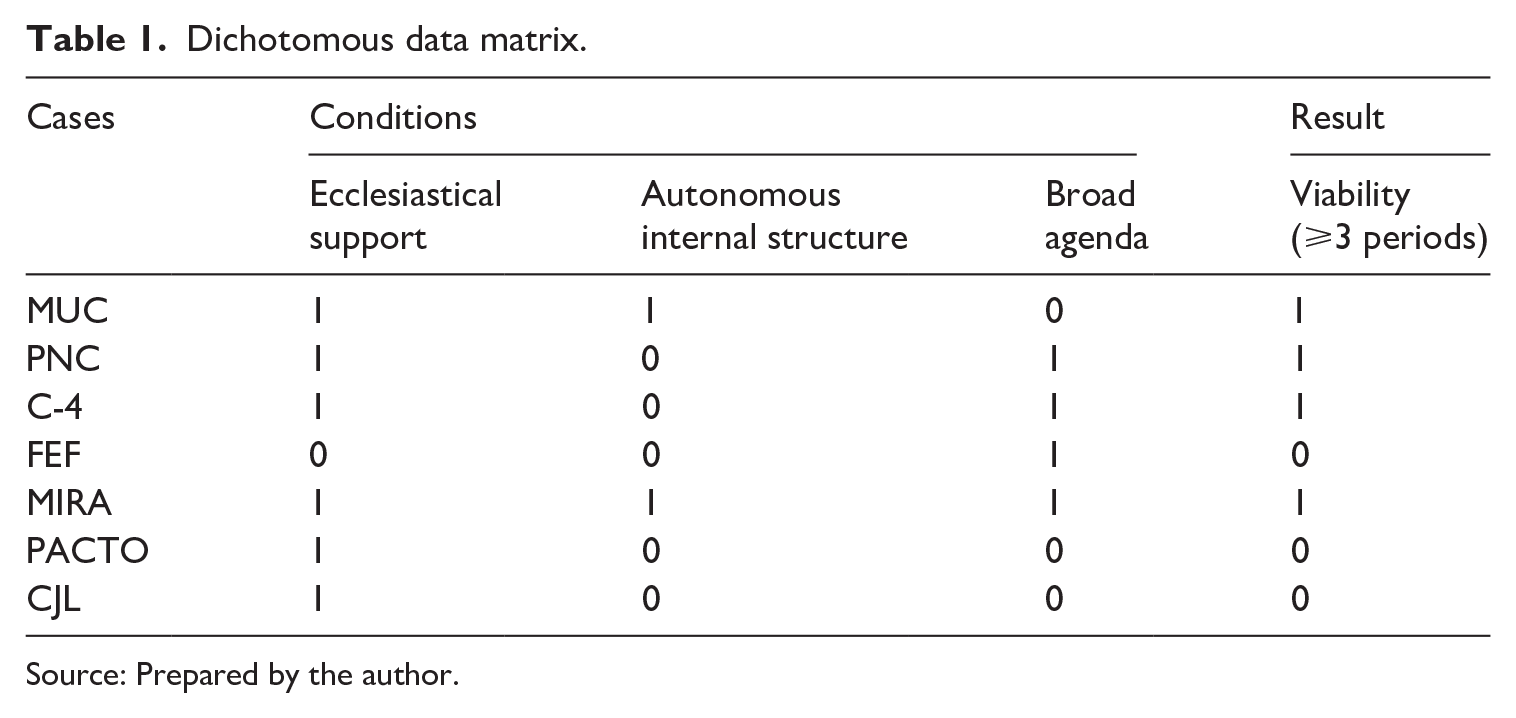
Source: Prepared by the author.
The first causal condition, referred to as ES, pertains to the external organization that gave rise to the party. This condition seeks to evaluate whether the EPP’s organizational and human resources, along with the societal roots stemming from the party’s origins, contribute to its viability. The ES condition highlights the distinction between parties formed by laypeople and/or pastors [0], and those established by churches (institutional support) or by a coalition of churches (corporate support) [1]. Although the results may suggest that this condition is largely consistent, it remains relevant for two reasons. First, the data collected for the region shows that most EPPs were established without institutional or corporate support. 6 Second, even when such support was available, there was considerable variation in the nature of the support provided.
The second causal condition, an internal structure autonomous from the organization of origin (AIS), asserts that EPPs that attain organizational autonomy from the external institution of origin and establish themselves across the national territory, evolve from being simple religious movements with electoral ambitions into fully developed political parties. In other words, these parties transition from being instruments employed by religious communities to gain public recognition, achieve parity with the Catholic Church, and promote their corporate interests, into vehicles advocating for broader societal concerns. Consequently, parties that successfully achieve this level of autonomy are coded as [1], while those that fail to establish such independence are coded as [0].
Finally, the third causal condition, referred to as a BA, seeks to revisit the idea that EPPs are niche parties, as some authors argue. It suggests that diversifying their programmatic agenda is a key factor for their viability. To evaluate this condition, the legislative database was utilized to analyze the types of bills presented by the EPPs. The analysis indicated that while some parties concentrated on bills pertaining to corporate interests—such as those related to family, women, rights to life, health, education, religious freedom, and anti-corruption—others expanded their agendas to encompass broader issues like trade, land use planning, transportation, infrastructure, and housing. The EPPs that expanded their agenda beyond corporate interests were coded as [1], whereas those maintaining a narrower focus were coded as [0].
Based on the data and the application of csQCA to test the theoretical argument, it was established that ES is a necessary condition for the viability of an EPP. This finding is present in all viable cases studied, as shown in Table 1. However, since the aim of this article is to investigate the sufficient conditions and causal configurations for the viability of an EPP, a truth table was created, and the fsQCA software was used to identify the causal configurations that can explain a party’s viability. Table 2 presents this truth table, detailing the potential causal configurations for these conditions. It shows both the cases of viability and non-viability, alongside residual cases.
Truth table.

Source: fsQCA software.
This is a logical residue.
From the analysis of viable cases and the logical minimization process, two causal configurations were identified as sufficient to explain the viability of an EPP: ES*BA + ES*AIS→Viability. The first causal combination indicates that the presence of ES combined with a BA is sufficient for a party’s viability. The cases that exemplify this configuration are PNC, C-4, and MIRA. All of these parties share the characteristic of receiving ES from a mega-church. This aligns with the theoretical argument that suggests a combination of the religious institution’s organizational resources, strong social roots and volunteers’ efforts, and a programmatic agenda that extends beyond mere corporate demands are sufficient for the viability of an EPP.
The second causal combination indicates that the presence of ES, along with an autonomous internal structure, is sufficient for a party’s viability. The cases included in this configuration are MUC and MIRA. Besides having ES, both cases share the consolidation of an autonomous national structure. Although this structure initially relied on the administrative framework of the original religious institutions, it gradually became independent as the party developed. However, it is important to note that both parties achieved this independence through different paths. MUC began its autonomy process in response to internal conflicts that arose over differing leadership positions regarding decision-making within the organization and leadership changes in CEDECOL. In contrast, MIRA’s path to autonomy stemmed from lessons learned during its legislative experience, which led to decisions like implementing internal democracy processes.
The narrative of viable evangelical parties
With the 1991 Political Constitution, a new array of political actors emerged in both the Colombian political system and the PS, including evangelical parties. During the process leading up to the formation of the National Constituent Assembly, two electoral vehicles were established: the Partido Nacional Cristiano, PNC (National Christian Party) and the Movimiento Unión Cristiana, MUC (Christian Union Movement). These parties facilitated the representation of evangelical churches by securing two assembly members and ensured the election of candidates to Congress in the 1992 elections. In addition, the Movimiento Compromiso Cívico Cristiano con la Comunidad, C-4 (Christian Civic Commitment with the Community Movement) emerged for the 1992 legislative elections, followed by Movimiento Independiente Frente de Esperanza y Fe (Hope and Faith Front Independent Movement) in 1998 elections and MIRA in the 2002 elections. In the following decade, other parties emerged: PACTO, which participated in the 2010 legislative elections but did not surpass the electoral threshold, and CJL, which has been active for two legislative periods since its formation in 2018. The following sections will provide brief narratives of viable EPP cases in Colombia.
As previously noted, the PNC exemplifies the ES*BA causal configuration. The party receives ES from the Misión Carismática Internacional, MCI (International Charismatic Mission), a prominent Pentecostal mega-church led by pastors César and Claudia Castellanos. Since the political project emerged from a revelation from the Holy Spirit to pastor Claudia, it was regarded as a religious mission: ‘If I have to become a politician to redeem Colombia, I will do it’ (G12tv, 2016). Consequently, Claudia Castellanos assumed a leadership role, serving multiple terms as a congresswoman for the PNC, while leveraging the MCI’s organizational resources and strong social connections. Although this support did not result in a party structure entirely independent from the church, it significantly enhanced the electoral strategy through the use of a cellular model. These cells serve as the foundation for building the social-order political project (Mora Navarro, 2005) and represent the main organizational resource for both the church and the party. Within these small groups of 12 members, electoral information, ideas, and candidates circulate.
In addition, congregational worship played a significant role in the ‘political process’ for selecting candidates, incorporating elements such as fasting, prayer, and candidate validation (Burgos Barragán, 2015). Other resources, including volunteer efforts, television spots, its own radio station, and social media, were essential in amplifying the messages of the political campaign. Initially, the PNC concentrated on projects related to the regulation of freedom of worship and moral issues. However, once it became established within the political system, the party broadened its agenda to encompass topics such as the economy, trade, and citizen participation, among others.
The MUC is one of the cases that exemplify the ES*AIS causal configuration. The party was established under the auspices of the Confederación Evangélica de Colombia, CEDECOL (Evangelical Confederation of Colombia) (Duque Daza, 2010). Its creation followed recommendations from the National Consultation on the Integral Mission of the Church, which emphasized the need to guide and provide political and social education to the evangelical community (CEDECOL, 1991). As a result, the party was viewed as a Ministry, representing the ‘Union of evangelicals in the ministry of projecting the biblical worldview to society’(Ortiz, 1993). A letter sent to the Electoral Council details the pastors and laypeople involved in forming the MUC, including notable figures such as Eduardo Cañas Estrada, Pastor of Iglesia Manantial de Vida Eterna (Spring of Eternal Life Church), Ricardo Esquivia Ballestas (Mennonite), Enrique Gómez, Pastor of Centro Misionero Bethesda (Bethesda Missionary Center), Fernando Mendoza Ardila, Viviane Morales Hoyos, Héctor Pardo Velásquez, Pastor of Tabernáculo de la Fe (Tabernacle of Faith), Marco Fidel Ramírez, Pastor of Iglesia Familiar Internacional (International Family Church), Darío Silva Silva, Pastor of House on the Rock (Casa sobre la Roca), and Víctor Velásquez Reyes, among others.
Since most of the pastors were leaders of some of Colombia’s most prominent evangelical churches, ES was crucial for securing economic resources, infrastructure, and human capital to gain electoral support. Given the diverse religious leadership and the varying sizes of congregations, establishing a distinct party organizational structure was essential. This structure aimed to spread the political project’s goals through direct outreach with pastors across the country. It also promoted campaigns to register identification cards and promote electoral participation, set up regional MUC headquarters, organized territorial tours to present and publicize candidates, and used evangelical radio media to communicate and advance the political agenda. However, the party’s legislative focus remained narrowly on religious freedom, without extending its legislative agenda beyond its core corporate interests.
C-4 is one of the cases that exemplifies the causal configuration ES*BA, that is, ES and a broad agenda. The party was established by the Cruzada Estudiantil y Profesional de Colombia, CEPC (Pentecostal Student and Professional Crusade of Colombia), which has always emphasized political engagement as part of its mission. This focus on political involvement explains the party’s lack of an autonomous internal structure, as electoral participation was merely an extension of CEPC’s broader mission. Following the constitutional changes, it entered the political arena, carrying forward the church’s sense of crusade and a ‘rescue’ of lost values. Their political approach was characterized by a call for societal order and harmony based on Christian principles (Duque Daza, 2022: 92).
To accomplish its goals, the party used the church’s cell structure, discipleship, and leadership training. These cells, which combined Bible study and prayer, operated with a vertical hierarchy where each member served as both leader and disciple. This structure, along with the social work involving voluntary professionals, supported the expansion of both the religious and political projects by leveraging the social roots established through the cells (Cepeda van Houten, 2007). In addition, the party’s programmatic agenda evolved from focusing on the interests of its originating community to addressing broader concerns for Colombian society as a whole. Notably, the party introduced bills on international policy, citizen participation, and territorial planning, with Jimmy Chamorro’s leadership in advocating for constitutional changes recognizing the jurisdiction of the International Criminal Court (Redacción El Tiempo, 2005).
Finally, MIRA is the only EPP case where all three causal conditions converge. The MIRA party originated from the Iglesia de Dios Ministerial de Jesucristo Internacional, IDMJI (Church of God Ministry of Jesus Christ International), one of the most prominent mega-churches in the country and a multinational faith organization present in over 46 countries. In this Pentecostal church, the gift of prophecy is emphasized. Revelations regarding María Luisa Piraquive’s involvement in politics began in the 1970s through this gift. However, the party was not officially established until 2000, under the leadership of Carlos Alberto Baena and Alexandra Moreno Piraquive. MIRA began participating in legislative elections in 2002 and has since consolidated its position in the political system. The party’s consolidation process has been characterized by two key phases: the first, heavily influenced by the IDMJI (2000–2007), and the second, which highlights the party’s autonomy from the church (2007–present).
In the initial phase, the party was characterized as a nepotistic organization, with its internal structure heavily influenced by the religious organizations that founded it, similar to the PNC and C-4 (Cepeda van Houten, 2007; Duque Daza, 2010). The church’s doctrine played a significant role in shaping the party’s activities, which were viewed as an extension of the religious mission. This influence was evident in various aspects, including the party’s name—Movimiento Imitador de la Rectitud del Altísimo (Imitator of the Righteousness of the Most High Movement)—the party hymn, principles, and statutes. As in C-4, the party’s geographical positioning mirrored the church’s expansion. However, unlike the PNC, worship spaces were not used for party activities. Instead, adjacent church premises were utilized for political outreach. The legitimacy conferred by the pastor’s support was crucial in ‘anointing’ the party representatives within the community.
However, from 2007 onwards, the party’s structure was solidified through the introduction of a course contest for militants and the establishment of the MIRA caucus in Congress, which required enhanced organizational infrastructure and technical specialization to support candidates and legislators. Significant changes included the development of the MIRA ideology, adjustments to the party’s principles, the implementation of the management system, and the creation of a national and regional structure. In addition, population and thematic committees were formed, along with both vertical and horizontal caucuses for decision-making, which helped maintain party consistency. As a result, mechanisms for internal democracy were introduced for candidate selection, leading to a broader programmatic agenda. Between 2002 and 2018, the party presented 1182 bills covering a wide range of issues, including justice, transit and transportation, public force, foreign trade, and the agricultural sector, among others.
Final considerations
This article presented a theoretical narrative on the viability of EPPs in Colombia. From a party-centered perspective, it argued that viability results from specific causal configurations among three conditions: ES, an autonomous internal structure, and a BA. As externally created entities, EPPs are backed by a religious institution, an association of churches, or individual leadership. However, the evidence showed that parties with ES—whether from institutional or corporate sources—are more likely to be viable than those led by individuals alone. This is because ES provides the party with access to the organizational resources of the religious institution, including infrastructure, social roots, economic resources, and media.
Empirical evidence also demonstrated that parties emerging with the support of mega-churches are more likely to endure over time compared to those supported by smaller churches or associations of churches. The cases of MIRA, PNC, and C-4 illustrate this relationship. For instance, MIRA benefits from the support of IDMJI, a church with a national presence, branches in over 46 countries, and substantial organizational resources that support the political project as part of its religious identity. However, ES alone does not account for the viability of an EPP. A party’s viability also depends on the convergence of ES with either an autonomous internal structure or a BA.
These considerations lead us to present MIRA as an exemplary case. It is the longest-lasting EPP in Colombia and Latin America, and the only party where all three proposed causal conditions converge: ES, an autonomous internal structure, and a BA. MIRA is a party established by a mega-church that has developed an internal structure. While it initially depended on the church, it has gradually gained autonomy and while still interrelated with the IDMJI, it has evolved into a fully developed party, as I mentioned earlier. Throughout this process, MIRA has created a programmatic agenda that, while still addressing the interests of its original community—such as the defense of religious freedom—has also incorporated a wide range of issues into its bills.
Footnotes
Funding
The author(s) disclosed receipt of the following financial support for the research, authorship, and/or publication of this article: The author received funding from COLCIENCIAS as a scholarship holder for the doctoral studies that resulted in the doctoral thesis that is the subject of this article.

Notes
Author biography
Address: Facultad de Ciencias Políticas y Relaciones Internacionales, Pontificia Universidad Javeriana, Cl 40 No. 6–23, Ed. Gabriel Giraldo Piso 8o., Bogotá, Colombia.
Email: