




Abstract
This article delves into the evolution of Taiwanese popular religion amid the backdrop of social modernization. The emphasis on orthopraxy in Taiwanese popular religion offers a unique perspective on how religion adapts to modernization. It argues that the significance attributed to rituals in Taiwanese religions not only underscores a long-standing tradition but also serves as a fundamental aspect of popular religion. The materiality of rituals establishes heterogenous connections between the religious and non-religious, enabling popular religion to thrive and evolve in contemporary society. The study focuses on the ritual practice of ‘incense-offering pilgrimages’ by a local lay group, highlighting how the public visibility of deities is rooted in ritual observance rather than faith alone. Through detailed case studies, this article underscores the multifaceted ‘diversion connections’ between religious and non-religious domains.
Introduction
The evolving landscape of traditional and new religions prompts scholars to seek fresh concepts and frameworks that allow for a more accurate representation in religious studies. This imperative arises from the acknowledgment that the intricate and dynamic ethos of contemporary religious expressions eludes the explanatory capacity of antiquated analytical schemas, necessitating a concerted scholarly effort to forge methodologies that convey the intricate landscape of contemporary religiosity more effectively.
In the milieu of Christian studies, academics often strive to reinterpret Christian-centric religious narratives from the perspective of secularized interpretation. Utilizing Charles Taylor’s (2007) theoretical edifice, this reinterpretation situates religion as the animating ethos within the matrix of modern social order, conceptualizing it through the lens of the Zeitgeist, thereby reconstituting the function traditionally ascribed to religion. Other scholars conceptualize ‘religion’ as an evolving domain, distinctly demarcated and evolving separately from other societal sectors (Luhmann, 2002).
Whether such interpretative models, which have been predominantly applied to Christian-centric societies, can adequately explicate religious evolution in a multireligious context such as Taiwan remains an open question. Taiwan represents a society navigating the path toward modern democratization, while concurrently maintaining a religious landscape steeped in the vernacular religiosity of Han Chinese – a paradigm of deity veneration deeply rooted in local communal practices. Are these beliefs and practices likened to the old-generation order that citizens understood in the ancient Greek city-state era? Here we posit that the examination of religious spectacles in twenty-first-century Taiwan could yield additional insights into the interplay between religion and politics at the grassroots level, thereby enriching the discourse within the sociology of religion.
Approaching from a ritual-centric vantage point, this article surpasses the confines of symbolic functionalism, a paradigm traditionally applied to the study of religion in societies characterized as ‘ancient’. Such paradigms, by their overemphasis on the role of faith and mechanisms within religion, often overlook the proactive potential inherent in rituals. This article, via a ritual-centric analysis, expands our conceptual grasp of how religious practices forge linkages with ‘non-religious’ realms and consequently broaden their scope of influence. The ritual-centric examination specifically sheds light on the unanticipated, contextually detached effects generated by rituals, which reciprocally influence the corresponding ritual systems. This vantage point proves to be especially conducive to elucidating the processes by which popular religion adapts and endures within the milieu of contemporary Taiwanese society.
Model of religious development in modern times
Religious ‘modernization’ in the Western context
According to surveys conducted in various Western countries, there is a noticeable divergence between the religious practice of ‘going to church’ and the religious cognition of ‘believing in God’. While the traditional indicator of religious affiliation through church attendance has indeed declined significantly, the index of belief in God remains high (Berger, 1999; Priest and Nieves, 2007). As a result, many scholars have begun to recognize this new trend. For example, Grace Davie (1990) developed the concept of ‘believing without belonging’ in response to this phenomenon, acknowledging that although public participation in traditional institutionalized religion has indeed decreased, belief and faith in God persist. The discussion of modern religious phenomena that has unfolded from this emphasizes that religious practice should not be confined to traditional modes such as attending church, worship services, bible study, and fellowship activities. Instead, a broader inclusion of new forms of practice is warranted. This fits with the trend of individualization in modern Western society, where individuals have significant interpretive and choice rights in cognitive and practical models, leading to many new concepts such as ‘lived religion’ (Hall, 1972; McGuire, 2008), ‘vicarious religion’ (Davie, 2007), ‘diffused religion’ (Cipriani, 2017), ‘atmosphere religion’ (Engelke, 2013), and so on. These perspectives attempt to capture the individualized practice of faith and the informal participation in rituals in modern society, emphasizing a space for multiple interpretations of personal or communal beliefs. In this line of development, ‘religion’ is understood as: (1) a practice model centered around belief that can be highly informal and ritualistic, and (2) the term ‘religion’ becomes a marker of individual practice characteristics and cannot serve as a concept denoting an organizational category.
In addition to the aforementioned arguments that regard the persistence of religious elements as being invisible in secular life, the realm outside the Western Christian system has indeed seen very vibrant ‘religious’ developments since the 1980s. The emergence of new religious sects in Euro-American society and the infusion of Eastern spiritual practices have effectively challenged the once prevalent belief that religious decline was an inherent feature of ‘secularization’. In these emerging developments, there is even a deliberate blurring or challenging of the category of ‘religion’, with representative studies focusing on New Age movements (Heelas, 1996). Such emerging ‘religious’ groups emphasize spirituality over religion, viewing religion as an old tradition that emphasizes authority and external forces providing salvation, and thereby attempting to distinguish themselves from such traditions. Many spiritual groups even highlight their ‘spiritual but not religious’ characteristics (Ammerman, 2013). The most important academic significance of this new development is that it introduces a new demarcation discourse, ‘religion’ versus ‘spirituality’. ‘Spirituality’ has become a core term in modern Western society that challenges and replaces ‘religion’ while coexisting with it. This also confirms that certain elements of traditional religion are continuously excluded from the discourse on emerging trends in modern Western society. In other words, the term ‘religion’ faces a crisis of legitimacy in related discussions.
The religious development in Western Christian societies, since the 1980s, has witnessed two significant shifts in religious trends. First, there hass been a surge in spiritual appeals within the religious system, marked by the evolution and rise of the charismatic movement in Christianity (Bartos, 2015: 35–36). According to the Pew Research Center (2011: 17), the number of charismatic believers has notably exceeded the total of Evangelical believers. Charismatics are characterized by their emphasis on the emotional experiences and mystical encounters of believers, highlighting healing, speaking in tongues, and prophetic prophecy, which elevate the individuality of the believer’s experience. Second, there is a movement outside the traditional system, known as the spirituality movement.
Similar to charismatics in emphasizing individual experiences, the spirituality movement is anti-authoritarian and anti-organizational, thus rejecting the traditional form of ‘religion’, labeling itself as ‘spiritual but not religious’ (Ammerman, 2013). These ‘quasi-religious’ movements reflect resistance and rebellion against traditional religious models in Western Christian contexts. Religious culture here includes organized elements, while spiritual culture refers to another, purer level of soulful belief. This distinction is clearly reflected in the studies of religion in Western societies, where new boundaries have emerged, specifically between ‘spirituality’ and ‘religion’ (Stolz and Könemann, 2016: 15–17). This delineation acknowledges the growth of a personal, individualized form of spirituality that may operate independently of institutional religious structures.
Especially after 2000, these rebellious and evolving spiritual movements jointly represent a main theme: resistance and revision of the past dominance of ‘orthodoxy’ in beliefs. This individualized and spiritualized development of religion translates to the interpretation rights of religion shifting from the church to the individual believer. In such a social atmosphere, many spiritual (non-)religious groups have emerged in European and American societies, showing a trend where people’s beliefs are increasingly based on individual spiritual experiences (Lambert, 2003). It can be said that the content of individual spiritual concerns no longer depends on organizational discourse, or even if it does, it lacks the binding force of organizational ties, and followers prefer a space of high flexibility with the freedom to leave and re-choose. The trend toward spirituality in Western societies indicates that in spiritual appeals, traditional religious models have lost their attractiveness and dominance, with more people unwilling to develop (religious) affiliations within the frameworks of traditional religions.
Orthodoxy versus orthopraxy
Many Western scholars realize the dominance of Western beliefs by reflecting on Western religions when comparing them with non-Western religious phenomena (Davie, 2000; Taylor, 2011). Catherine Bell (1997: 192), using Western Christianity as an example, explained that as a typical orthodox religion, Christianity in Europe and America often allows ‘faith’ and ‘belief’ to serve as substitute terms for ‘religion’. In terms of the issues of ritual density, Bell (1997: 191) distinguishes the orthodoxic and orthopraxic style. The difference between the two is apparent in many aspects: (1) the first puts an emphasis on correct belief in theological doctrines, the latter on a code of behavior, a code that usually includes multiple ritual responsibilities; (2) orthodoxy tends to ‘keep religious orientation from being subsumed into a particular political-social identity’ (Bell, 1997: 191). Orthopraxy may ‘dominate wherever religion, culture, and national or ethnic identity are closely intertwined’ (Bell, 1997: 191); (3) Orthodoxic style grows beyond the regions of origin, crossing a variety of cultural boundaries; whereas orthopraxic style appears often in tribal or local societies, which tend to be relatively closed and homogeneous, and religion is not something separate from community identity, ethnic customs, political institutions, or social traditions. However, Bell emphasizes that no religious tradition can promote belief or ritual at the total expense of the other. In other words, no religion can have one without the other. What matters is the density, style, and domains of ritual. The ritual-based religious form of Taiwanese popular religion reveals one specific form of orthopraxic religion.
When we consider theoretical perspectives like ‘invisible religion’ (Berger, 1967), ‘believing without belonging’ (Davie, 1990), secularization within the ‘secular age’ (Taylor, 2007), ‘vicarious religion’ (Davie, 2000), ‘lived religion’ (McGuire, 2008), and ‘atmospheric religion’ (Engelke, 2013) as reflections of Christianity’s evolution, or regard the increasing interest in spirituality as an ‘outlet’ diverging from established religious standards, we recognize that such progressions are deeply entrenched in the orthodox dimensions of Christianity. These movements indicate a departure from conventional religious observance to forms of faith that are more personalized and internal. These changes in Western religious landscapes reflect a shift toward personal spiritual experiences and a move away from traditional religious structures and beliefs. This transformation is indicative of a larger cultural and societal evolution, where individual spirituality and personal experiences are increasingly prioritized over institutional religious practices and doctrines.
How does this look within other social contexts in terms of religion with ritual primacy? Through the case of Taiwanese popular religion, this article aims to address the question of how ritual-based religions continue to evolve in modern society. Can ritual-based religious forms provide potential solutions to the challenges religions face in modern times?
Overview of Taiwanese religion
The religious affiliation of members of the public is an important topic in religious research surveys, but this question is not as straightforward as it seems. For example, religious belief does not necessarily completely overlap with religious practice, so the classification of religious affiliation involves different layers of meaning. Dougherty et al. (2007) in their study of Christian faith affiliation in the United States pointed out that American churches provide some ‘public narratives’, such as hymns, prayers, and sermons. The contents of these public narratives are religious practices, and they make us realize that some Americans who claim to be non-believers have a deeper connection with the church than it seems; in addition, the study also found a group of people who claim to have faith but do not have religious affiliation because for them, the ‘religious affiliation’ they understand is a figment of imagination tied to the doctrine of religious organizations. ‘Religion’ is distant from their perceived ‘faith’, so they say they have faith but no religious affiliation. In Taiwan, religious affiliation and practice do not always correspond either, but is due to one other piece of context: The inconsistency is highly related to the prevalence of multiple religious practices in Taiwan.
The Taiwan Social Change Survey, conducted by the Institute of Sociology at Academia Sinica, systematically explores a variety of social topics, with each theme surveyed every 5 years. The most recent survey on the topic of religion was conducted in 2018. This survey provides valuable insights into the religious landscape of Taiwan.
When asked about the respondents’ religious affiliation in Taiwan, the data (in Table 1) shows that 48.3% of Taiwanese people identify themselves as followers of ‘popular religion’. This term ‘popular religion’ refers to ritual systems primarily practiced in local communal temples which are deeply embedded in the daily lives of local people. Taoists and Buddhists account for around 15% of the total population each, while Christians make up 5%. About 10% of Taiwanese people consider themselves to be non-religious. The respondents answered this question based on their subjective perception of their own religious affiliation, without considering objective criteria such as membership in specific religious organizations or engagement in specific religious practices.
Religious affiliation of Taiwanese.
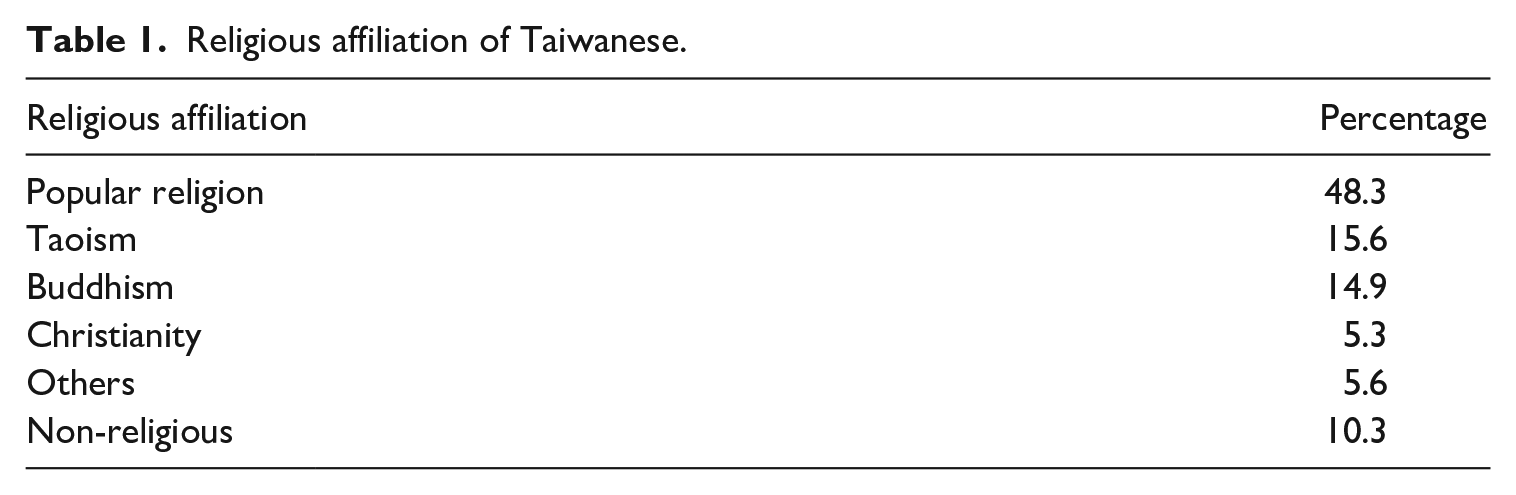
The survey also asked what deities or Gods respondents worship, specifically inquiring which deities they worship the most and the second most. This question aims to capture the diversity of deity worship in Taiwan since it is a widespread ritual practice. Table 2 shows the deities that Taiwanese people worship the most. In addition, the survey results show that, excluding Christians and the non-religious population, a significant 94.2% of Taiwanese people engage in polytheistic practices, worshipping multiple deities.
The main deity of Taiwanese worship.
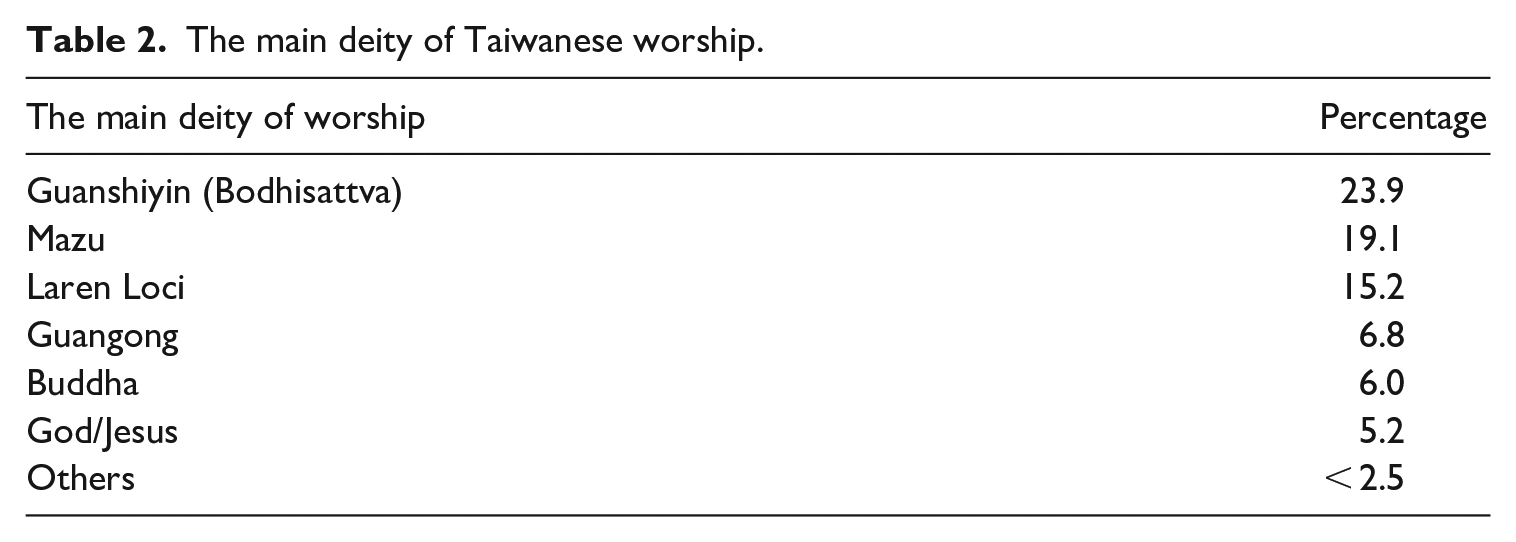
In the corresponding analysis (see Figure 1), we can see a clear distinction between Christians and non-Christians. The Christian God can easily be distinguished from other worshipped deities. Those who claim to be of the Christian religion worship God/Christ, as expected, which is very different from the deities worshipped in other religious beliefs. 1 Figure 1 shows a clear overlap in the worship of deities among Buddhist, Taoist, and respondents of other popular religions. When we focus solely on non-Christians, we have a different result (see Figure 2). Figure 2 shows that there is a relatively clear difference between Buddhism and the other two, but there is a high degree of overlap between the followers of popular religion and Taoism, making it impossible to clearly distinguish between the two based on the objects of worship. It becomes apparent that religious identity does not perfectly correspond to the deities worshipped in specific religions. The deity Guanshiyin (Bodhisattva), which used to be viewed as a Buddhist deity, is categorized by the method of k-mean as being more closely associated with Taoism and popular religion. Particularly when it comes to Taoists and the followers of popular religions, the boundaries become even more blurred. More than 90% of respondents who claimed to be ‘Taoist’ worshipped deities such as Mazu, Laren Loci, Guangong, and Guanshiyin (Bodhisattva); however, these deities overlap with the deities worshipped by those who claim to be believers of ‘popular religion’.
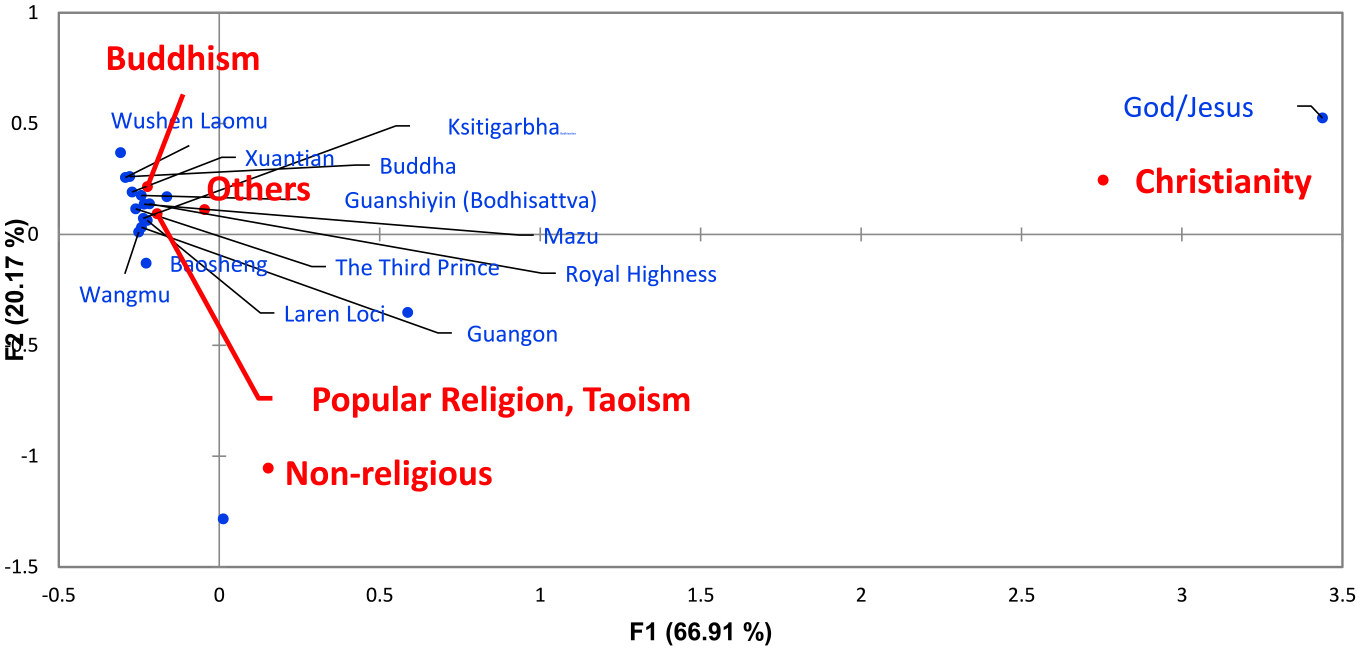
Correspondence analysis: worshipped deity/God versus religious affiliation.
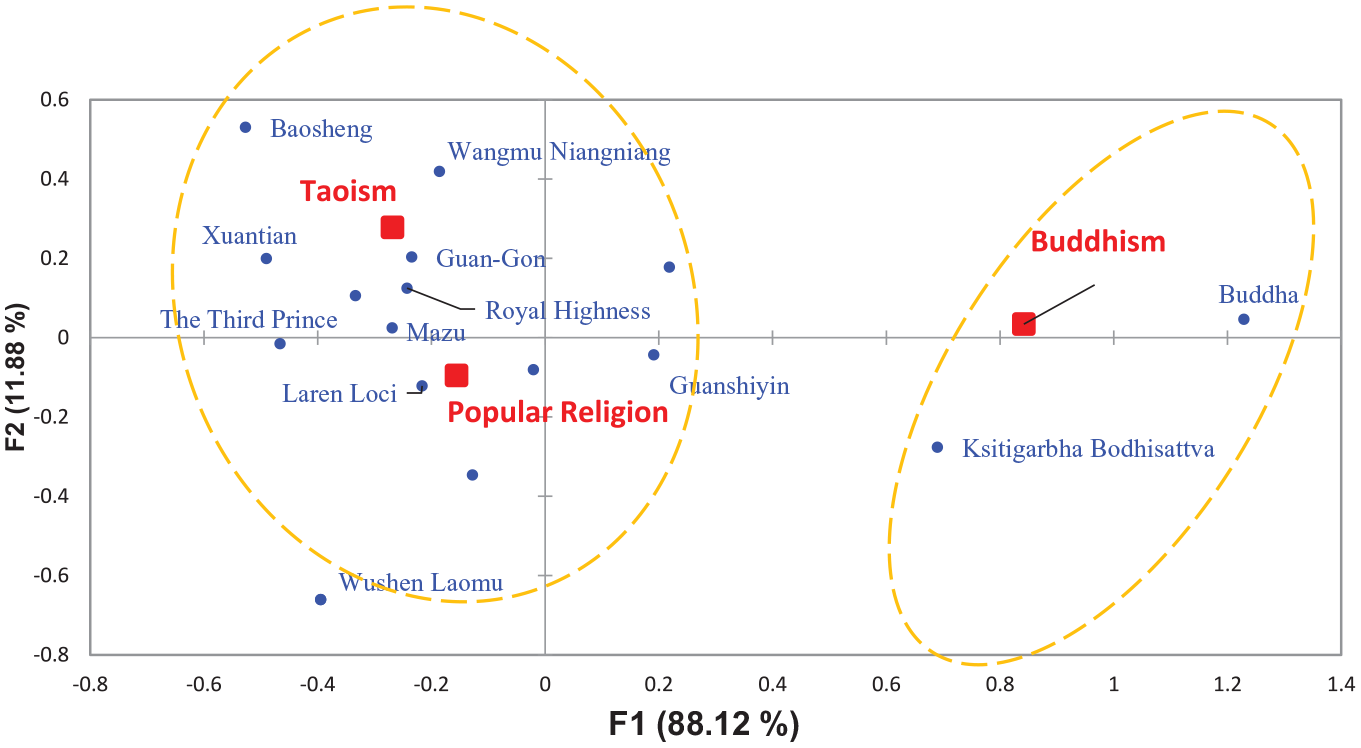
Correspondence analysis: worshipped deity/God versus religious affiliation (only Buddhism, Taoism, and popular religion). 2
In sum, there is no clear categorical consistency between religious practices (worship of deities) and claimed religious affiliations. Practically speaking, it is difficult to differentiate between the followers of popular religion and the followers of Taoism in terms of religious practices. And these two groups together constitute about 60% of the population. Interestingly, worshippers are not concerned about this inconsistency between religious affiliation and worshipped deity. Religious classification is not important to them; they are more concerned with when and how to properly perform specific rituals in certain circumstances.
Ritual primacy of Taiwanese popular religion: ritual is public, belief is private
The intricacies of ‘popular religion’ are intimately tied to cultural contexts and display considerable variation across different societies. This term captures an array of beliefs and practices that range from those deemed magical, cultist, or superstitious – which may not be formally acknowledged as religious – to more institutionalized forms of devotion. In Taiwan, the term popular religion covers local activities and organizations dedicated to worshiping deities, which are crucial in shaping and expressing a community’s collective identity, moral norms, local customs, and local political structures. In the sense of the organizational level, it specifically refers to public temples of different sizes organized by local communities to worship various deities, as well as sacrificial associations and shrines maintained only by a group of people without local public representation. This religious landscape is composed of a mosaic of locally focused worship communities that are self-regulated, yet arranged in a distinct hierarchical order at the regional level. The quintessential embodiment of popular religion is the local public or village temple, a key organizational entity. Within a village, there are often many public subdivision temples and various private shrines subordinated to the village’s public temple. In inter-village scopes, regional ‘great temples’ also exist with a special status recognized by the public temples of the villages within that region, although these are not universally present in every area. The symbolic status of these regional ‘great temples’ comes from historical development processes where they were once important temples in the region, or because they have many daughter temples scattered all over the region, becoming regional pilgrimage destinations. In general, Taiwanese popular religion shares similarities with other ritual-based religions in the world; however, it possesses unique multifaceted characteristics. It combines elements of cult-like worship groups, magician functionaries, and oracle mechanisms, making Taiwanese popular religion truly distinctive.
For followers of popular religion, their discussions and concerns revolve not around ‘beliefs’ but rather around topics such as how to perform the appropriate rituals in specific contexts, when to perform them, and how to carry them out. Many ritual practices have accumulated over the years in response to social needs or based on habits of public life. Therefore, ritual practices can be seen as not merely external expressions of one’s inner beliefs but rather as habitual behaviors. Their legitimacy is established within the context of the social community. Belief is often the result of ritual practices, as rituals serve as a way for individuals to establish a personal relationship with deities. Thus, interpretations and understandings of the relationship between individuals and deities vary greatly between different individuals. In this sense, we argue that, in local societies of Taiwan, rituals are the public affairs of the local community, while beliefs belong to the private sphere and rely on personal interpretations, without any mechanism governing those beliefs.
As depicted in Figure 3, the rituals of Taiwan’s popular religion mainly consist of two types of ritualistic practices: those performed by religious specialists and those carried out by local lay groups. Religious specialists, such as Taoist priests or mediums, are employed by local temples during important ceremonies to provide professional ritual services that have the functions of attracting good luck and warding off evil. The rituals performed by local lay groups include the most common practice of ‘incense-offering pilgrimages’ and the so-called ‘divine processions’ with a deity statue in a sedan chair carried to conduct a territorial inspection tour (Jordan, 1986: 258). This procession is attended by a variety of procession troupes such as those skilled in martial arts, music and dance, among others.
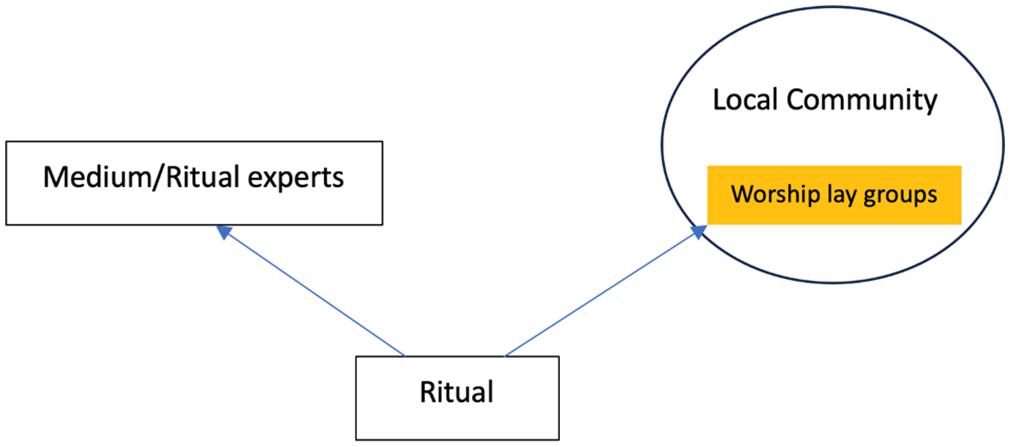
Different kinds of ritual in Taiwanese popular religion.
These ritual practices by local lay groups traditionally foster a sense of collective identity and community belonging, as revealed by Durkheim (1995 [1912]). In the case of youth troupes that serve in the divine processions, they fulfill several key functions that strengthen local collective connections: Since the procession troupes are highly public and performative, local temples and communities feel honored when the performance of the local youth troupes is of high quality, thus generating a sense of collective pride and enhancing a sense of belonging in their own community. In addition, procession troupes allow like-minded locals to gather together and use the temple space for relevant skill training, which also promotes emotional exchanges in their regular practices. On one hand, this expands the participation of people with different character and interests in temple activities, and on the other hand, it strengthens the bonds within the community, enhancing the mobilization energy of the community.
In sum, the logic of orthopraxy does not assume a governing mechanism of a unifying belief system, and each ritual practitioner has his or her own understanding or theory regarding their relationship with the deities. And this orthopraxic trait is also discernible in the way Taiwan’s popular religion has reshaped itself throughout its progression into the modern era. Due to the word-count limitations for this article, the following examination is confined only to the particular instances of incense-offering pilgrimages.
Ritual-based transformation of popular religion
Taiwanese popular religion itself has faced challenges in recent years due to social changes. Declining birth rates, rural population outflows, and aging populations and other factors stemming from the process of Taiwan’s modernization have weakened the solidarity of local communities. Consequently, some ritualistic groups have slowly dissolved under the pressure of these issues. Faced with social challenges, some temples turned to local associations, which maintained public ritual services that locals still enjoyed, but the transcendent benefits of the collective were waning. These temples have started to operate more like associations, increasingly self-funded and less reliant on communal contributions, instead relying on a select few with greater financial means. They seek financial backing beyond the local sphere, particularly during significant events, where the chairperson of the management committee, often a non-local businessperson or affluent individual, typically stands out as one of the primary sponsors.
Today it is quite common for local temples to recruit or hire ritual groups from outside the community to continue to conduct traditional ritual practices. This shift resulted in the weakening of local cohesion and the gradual loosening of traditional restrictions on outsiders’ participation in local ritual groups. Cross-regional movement among ritual practitioners became more common. The sense of responsibility among locals toward their local temples is declining. The staff of the local temple is aging, and young people rarely actively participate in the public rituals of the local temple because they cannot find their own role in religious affairs and their religious identity is fragile. Worse still, traditional temples could not bring any sense of pride to young people in the time before the period of democratization that began in the 1990s. At that time, popular religion was considered an old and outdated form of religion that was viewed by the Taiwanese government as incompatible with the process of social modernization.
The situation shifted when Taiwan began to deepen its political democratization and localization discourses from the year 2000. A variety of localization discourses aroused public interest in local traditions like conventional festivals and local rituals. Different levels of government began to recognize local elements as forms of local heritage, which provided local temples the conditions necessary to re-evaluate their own religiocultural elements. Although unintended, this made it possible for the locally conducted rituals to gain public interest. The cultural heritage of popular religion focused on material dimensions such as itinerate festivals, ritualistic performances, and some manufacturing techniques related to different ritual objects. The framework of modern meaning for the cultural heritage is, in and of itself, the value for the public. This provides the opportunity for popular religion to regain its culturally positive, and therefore politically legitimated, public image.
The case of ‘incense-offering pilgrimages’: the heterogeneous connection between the religious and non-religious
In Western Christianity, pilgrimage activities can be organized by Christian organizations, or individuals may go on their own due to a sense of calling. When individuals go on their own, it is often for personal spiritual growth, in an attempt to achieve a kind of self-spiritual pursuit through pilgrimage (Devereux and Carnegie, 2006; Murakami, 2018: 37). Similarly, in Japan, there are ‘pilgrimage’ activities conducted individually or in groups (Reader, 2005: 18–24). This mode of spontaneous pilgrimage by the public even makes it possible for travel agencies to plan participation. Travel agencies organize pilgrimage tours, allowing individuals to sign up and provide opportunities for those trying to experience or pursue spirituality to participate in a pilgrimage (Reader, 2005: 75–85, 2014, 2015). The Western concept of pilgrimage differs fundamentally in content from the Taiwanese folk practice of incense offering at the temple, often referred to as a ‘pilgrimage’. Incense offering is essentially a ritualistic activity between two temples to reproduce and reconnect the incense of deities.
In the case of incense-offering pilgrimages in Taiwan, because they involve the relationship between the deities of two temples, it is essentially a deity-centered temple visit (Jordan 19: 266). In the context of incense offering to significant temples, the hierarchy is determined by a multitude of factors such as historical origin and the extent of prominence of incense offering at a pilgrimage center. This status is either judged through the mother–daughter relationship between two temples or through mutual evaluation and recognition within the temple community, without any institutionalized standard of judgment.
Traditionally, incense-offering pilgrimages have been conducted by walking. Since the 1980s, due to the convenience of transportation, most temples in Taiwan conduct their pilgrimages by bus (Chang, 2021: 271–272). However, vehicular pilgrimages have reduced the rich possibilities that come with walking pilgrimages. Since the 2000s, the practice of ‘walking pilgrimage’ has brought a retrogressive element to the phenomenon of pilgrimage, transforming it into a form that, while traditional in appearance, encapsulates various contemporary meanings and becomes a conduit for creating new connections.
Pilgrims in the past consisted only of temple devotees. Some well-known new forms of ‘walking pilgrimage’ include the tourist-style and festival-style walking pilgrimage of Mazu in Dajia, with about 200,000 participants, and the more austere, less flamboyant pilgrimage of Baishatun-Mazu in Miaoli, which has no fixed route, with about 70,000 participants every year, emphasizing the solemn and unique atmosphere, ‘growing against the trend’ and attracting public interest. Furthermore, walking pilgrimages initiated by young people, tracing ancient incense routes, have become a trend that revitalizes tradition. The participation of non-pilgrimage temple residents in the modern development of walking pilgrimages represents a novel phenomenon, gradually evolving into diverse models with a certain openness. This multiplicity in interpreting pilgrimage activities has become an inescapable and significant factor in explaining the growth of the pilgrimage trend.
The walking pilgrimage of Baishatun Mazu
The Baishatun Mazu walking pilgrimage is planned by Gongtian Temple in Miaoli County, central Taiwan. Every year, the pilgrims of Gongtian Temple walk to the mother temple Chaotian Temple, a round trip of more than 300 km, taking 4–8 days, depending on the walking speed of the pilgrimage group (Chang, 2021). This previously unknown pilgrimage was reviewed and registered as an important national folk custom in 2010. How could a local activity rise from obscurity to become a national cultural asset? Clues are found in the reasons for its registration. This pilgrimage activity is listed in the folk custom registration as: A folk activity with a history of over 170 years, it has a high degree of local resident participation, with participants coming from all over the country, and it is regarded as a rite of passage for the youth of that year, and has not yet been tainted by commerce or politics. It also has the uniqueness of being the longest walking pilgrimage route in Taiwan, guided by the Mazu deity in both schedule and route. It has the value of being registered as a folk custom. (Bureau of Cultural Heritage, Ministry of Culture, 2017)
Among its significant features are ‘participants coming from all over the country’, ‘not yet tainted by commercial or political influences’, and ‘the uniqueness of having the longest walking pilgrimage route in Taiwan, guided by the Mazu deity in both schedule and route’. The spectacle of the incense-offering activity, which has become a cultural heritage, is the created asset value, rather than the incense-offering itself. This represents an interesting inversion based on cultural governance discourse. The discourse on cultural publicness, as well as the focus on the viewing value to the public of the walking incense-offering, both highlight the actions of the branch temple. The asset value is solely attributed to the branch temple, instead of the mother temple (Chaotian Temple) in Beigang, because the mother temple is not the actor preserving the cultural asset. Modern discourse on cultural publicness recognizes the value of the branch temples, reversing the superiority of the mother temple in the logic of the incense lineage and giving the incense-offering branch temples another kind of superiority in the discourse on cultural heritage.
Following the deepening of localization discourse since 2000, various localization narratives have sparked public interest in local traditions. Governments at all levels have begun to regard local elements as part of cultural assets, providing favorable conditions for local temples to reassess their religious and cultural significance. At the intersection of popular religious and cultural nationalism, traditional local rituals were legitimized as part of national identity, thereby intensifying public concern. The discourse about cultural heritage acts like a web of power; as it becomes widely accepted by society, the preservers of cultural heritage become embedded in this web of power, weighing and evaluating how to respond in this context from their own relevant perspective. At the same time, this context attracts more diverse actors to their practices and interests. The production of cultural heritage discourse is undoubtedly a corner of the practical expression of cultural governance in modern societies.
However, the Baishatun Mazu walking pilgrimage draws its publicity not only from the power of the national audience, but essentially from the general public, both of which are beyond the control of the pilgrimage temple. The services required during the walking pilgrimage are extensive, and include lodging, meal distribution en route (which are considered blessings from Mazu when entirely consumed), complimentary transport for pilgrims along the incense route, and carpooling services for the same-day return journey. Notably, these services are not arranged for the public by the organizer of the Gongtian Temple, which executes the pilgrimage only for its own community. Instead, these are spontaneously mobilized by different groups of volunteer devotees based on the resources they possess.
In terms of accommodations, besides the dormitories in temples along the route that open their doors for pilgrims to spend the night, local residents also spontaneously offer overnight stays or washing facilities. During the pilgrimage, not only at meal times but throughout the day, different trucks spontaneously arrive to distribute lunch boxes to the pilgrim groups for free pick-up. Many households and businesses along the route provide various snacks, drinks, and ointments to relieve soreness. Any physiological need a walking person could anticipate is met by individuals or groups along the way, providing their services voluntarily. In addition to spontaneously organized medical stations, when pilgrims can no longer walk, there are numerous private vehicles and modified trucks offering rides, with conspicuous signs saying ‘Please get on’, reminding those unable to walk that they can board and be taken to the next rest stop. Furthermore, individuals who can only participate for a day or two utilize a benevolently created online application platform to request rides. This platform is freely available for those offering rides to publish information, facilitating connections between those willing to help with transportation and those in need of a lift. These diverse services meticulously cater to the various needs of the pilgrims, creating greater flexibility and openness, allowing anyone who desires to participate in the pilgrimage to do so.
As these incense-offering activities become more well known, the number of curious, experiential, and bandwagon participants naturally increases (Chang, 2021: 252). However, the development of these support mechanisms also reflects the openness of these events, transforming the incense-offering activities from local events specific to a particular community into public events that the general public can participate in and experience. This emblematic change holds significant implications for the transformation in the meaning and essence of an incense-offering event. During the pilgrimage, due to the large number of people following, temporary stall business will be formed in the towns along the pilgrimage route. However, because it is only once a year, it is only a celebration, and it does not form a long-term economic effect that promotes local development. In addition, since many volunteers provide different free services, there are no obvious transactional service opportunities. Looking at the kinetic energy of the entire incense pilgrimage activity, the power of local spontaneous mobilization is far stronger than the power driven by economic interests.
The various divine experiences available along the walking incense-offering route expand the faith base of the organizing temple’s deity. These developments are beyond the full control of the organizing temples. These local experiences have fostered the foundation for the aforementioned spontaneous provision of services. In addition, with the considerable provision of hardware and physical services, cultural prominence and modern social media have also greatly expanded participation. Cultural experience seekers and bandwagon participants, although not motivated by divine experiences, significantly contribute to the popularity and visibility of the incense-offering event. In other words, when the walking incense-offering becomes an open cultural event in the public consciousness, an event that you and I can freely join, it becomes a public cultural asset like a carnival or cultural celebration. The transition from an activity that was originally only part of a local community to a public cultural event is not something that the organizing temples direct or control. The real control lies with the local public along the route and various participating groups, whose spontaneous involvement has created the cultural publicness of the walking incense offering. This can be considered an inversion of local public dominance, causing the local organizing community to lose control over the public nature of the event. The cultural asset nature of the walking incense offering is not created by the organizing temple alone but is co-created by the local public along the route, the cultural public, and the organizing temple. This development reveals an intriguing reversal of ‘public intervention in the local’.
Walking pilgrimage as a ritual, with reference to Keane’s (2007: 21) framework, can be viewed as a semiotic form. The semiotic form of ‘walking pilgrimage’ refers to certain material foundations, activity processes, and organizational forms. However, the form varies with different people, times, and places. Field data indicate that in modern times, there are many groups passionate about walking pilgrimages, and what they recognize is not necessarily the walking pilgrimage centered on a certain temple or a certain deity; what they recognize is the act of the walking pilgrimage itself. For those enthusiastic about walking pilgrimages, this semiotic form has developed a special effect that transcends deities and temples, becoming its own unique semiotic existence. It has materiality, but the material foundation is not the only element for the creation of its semiotic existence; there is also the personal experience of the ritual (as a semiotic form). Through numerous personal experiences, the content of the semiotic form of walking pilgrimage is enriched, becoming a form that can produce an effect on devotees, distinct from deities and temples. Although ‘walking pilgrimage’ is categorized under ‘pilgrimage’, it generates an attraction and influence beyond the original semiotic ideology of ‘pilgrimage’. This influence arises from the effects of the materiality of ‘walking’. This is the phenomenon of semiotic spillover effect, a special effect generated from the specific material aspects originally encompassed by the pilgrimage activity. This process allows the walking pilgrimage to develop a distinct guiding property, becoming a semiotic form with a unique material basis.
Two examples for the ‘diversion effects’ driven from incense-offering pilgrimage
The diversion effect of incense flags
While I did field work at one pilgrimage, a young college student once shared with me that an incense flag was the first object that connected him with pilgrimage and therefore with popular religion. Incense flags are small, eye-catching embroidered banners with bright, vibrant colors, and little bells tied to the top that tinkle as one walks (see Figure 4). Having undergone processes in the pilgrimage ritual such as divination, stamping, incense purification, and talisman binding, incense flags are believed to possess spiritual power. Therefore, they are strictly prohibited from being taken to impure places like bathrooms or bedrooms. Furthermore, as pilgrims pass by temples along the route, the flags are again stamped, purified, and bound with talismans, reaffirming their specific ritual function.
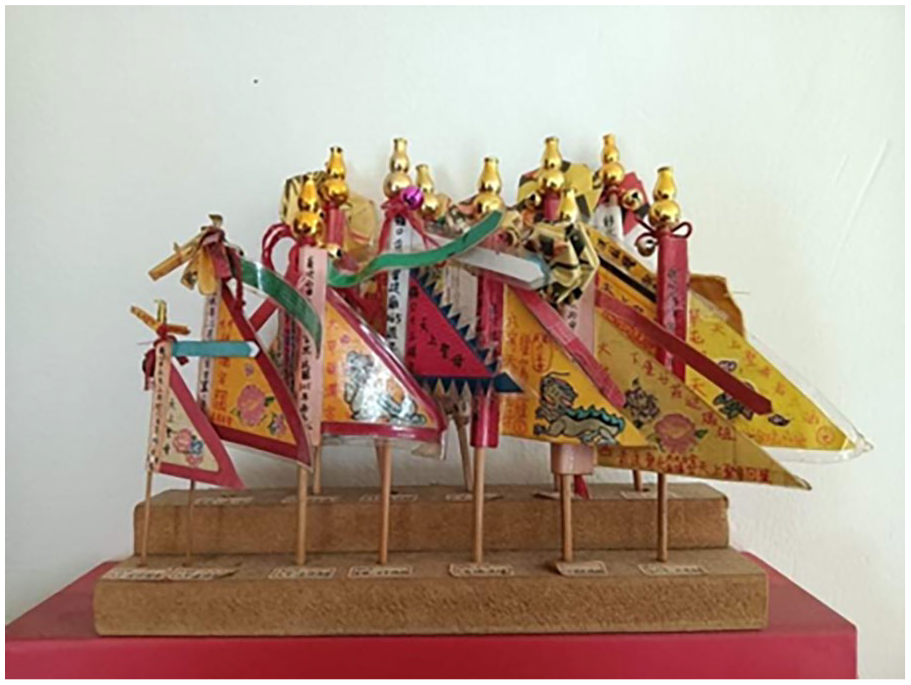
Array of incense flags made by a young college student on pilgrimages.
When the young college student first saw one as an elementary school student, he thought, ‘Wow! I really want one! It’s so cool!’ However, being young and having no idea of how to get an incense flag, he felt it was impossible for him to have one. So, he found some scraps of cloth and made his own mini version of an incense flag, a cute little banner made from three pieces of fabric.
This gradually became a hobby, or perhaps a personal ritual for him. After entering junior high, as a fan of incense flags, he participated in various walking pilgrimages, which were motivated by his interest in incense flags. For each pilgrimage, he would craft a small version of the incense flag modeled after the official one from the pilgrimage temple, and attach it to the larger official flag distributed by the temple. He would then stick the small one on top of the official one as he walked with the pilgrims. All of the incense flags he has ever made over the years are neatly arranged in his home in a flag array, each carefully labeled with its year of creation, a testament to the special care and attention he devotes to them.
What force drives a young boy to invest so much care in crafts akin to the work more often associated with women, and to produce these items in stages, continuously cherishing and refining these ritual objects? As he mentioned, when he was a little boy in elementary school, his connection to folk pilgrimage activities was not out of religious belief but purely from a childlike sentiment, merely attracted by the allure of the incense flag. After entering junior high, he maintained an interest in pilgrimage activities, overcoming all obstacles to participate, a practice he continues to this day. He noted that his friends often ask him with curiosity how someone from a family with no background in popular religion could be so interested in pilgrimages. The incense flag, originally a component of the pilgrimage ritual, became the vital link connecting this college student to the pilgrimage activities. It was not because of the ritual significance or sanctity of the incense flag, but his particular fondness for it that kept him closely connected to the pilgrimages. It was the materiality of the flag – its appearance, its eye-catching nature, its ‘coolness’ – that had an effect on him. Fundamentally, his focus on the pilgrimage deviates from the core spirit of the activity, diverting attention from the sanctity of the ritual objects to the non-sacred elements, which might be considered trivialities.
His focus was not on the ritual significance of the incense flags but on the emotional affect inspired by their design and aesthetics. This affect drove his creative endeavor to meticulously craft charming incense flags and to continue participating in the pilgrimage experience. In a way, by adhering to the ritual objects of the pilgrimage, he practices his own existence with pleasure: carrying his homemade flag while walking with the pilgrimage is how he practices his own joy of being; he practices a non-religious sense of existence alongside the sacred rituals. The reason for staying close to sacred rituals lies in the need for the atmosphere and context constructed by the ritual and scenery of the pilgrimage process, within which his incense flag becomes a symbol of (non-religious) existential practice. This proximity to religious rituals often results in individuals gradually developing religious connections, evolving from non-religious reasons for initial contact to a transformative or reaffirming religious awareness due to particular experiences.
In the realm of popular religion, objects establish connections on several levels via features such as ‘material texture’ – with its curves and lines that not only suggest a range of contextual associations but also lay the groundwork for generating potential and possibilities. The effects of these connections, the diversions of attention they produce, are seen by those within the circle of faith as examples of the impetus for religious reproduction, influencing the discourse within the faith community. This is independent of how the individuals themselves perceive and position themselves; in terms of the reproductive effects of religious discourse, the effects of connections and diversions of attention produced by material textures are substantial enough to become part of the system of deity worship. In the case of the college student, the materiality and texture of the incense flag also tightly link him to the pilgrimage community and the fervor of the pilgrimage activities. The student’s self-perception as a non-believer and the influence his participation may have in the religious context are, in essence, two different elements, each operating under their own unique dynamics.
The ‘diversion’ projects and actions diverge from the traditional religious and faithful paths. Even if they may not be recognized as religious practice in an individual’s own consciousness, they still possess a connective power. The religious efficacy they produce, along with the reproduction of religious meaning, undoubtedly integrates them into the operation of the religious field. The religious field keeps its connection with the people holding secular interests and in this way enriches the variety of religious form from the emic perspective. This connection between believers and non-believers and between the religious and the non-religious also provides scope for the possibility of the transformation from the non-religious to the religious.
The diversion effect of walking pilgrimage ritual
The activity of walking pilgrimages, beyond just ritual objects, can also trigger a sense of distraction within popular religious practices. During my interactions with an enthusiastic youth group devoted to these pilgrimages, I encountered their founder – a recent college graduate – who often took part in various walking pilgrimages. Known by the nickname A-Huo, he revealed to me that he does not align himself with any specific temple or local religious community, nor does he hold a steadfast belief in Mazu of any particular temple when he began to take part in walking pilgrimage. A-Huo shared that engaging in numerous walking pilgrimages became a form of relaxation during his university years, which notably aided him in battling a long-standing depression. Motivated by the relief he found, he has since endeavored to participate in as many walking pilgrimages as possible.
He began blogging in the early 2000s, and over time his blog became popular among the youth with similar interests. Starting initially with the blog and expanding to Facebook post-2010, these young enthusiasts began to create a network, bonded by their collective passion for undertaking walking pilgrimages. Unlike traditional pilgrimages that are typically conducted by local temples and attract mostly the local community, these walking pilgrimages do not focus on any particular one but rather on the act of pilgrimage itself. In the past, people rarely had a reason to participate in pilgrimages beyond their local temples. This has changed with the rise of walking pilgrimage enthusiasts, who have transformed it into a more personal and inclusive experience. They seek out pilgrimages for a variety of personal gains, such as relaxation, enjoyment, and even healing. These enthusiasts often initially meet on the Internet and then form real-life connections during the actual pilgrimages.
He has been a blogger since the early 2000s, and his blog gained popularity among young people who share his interest. They connected with each other through blog and Facebook after 2010, bonding over their mutual appreciation for walking pilgrimages – not in terms of any specific one but the walking pilgrimage in general. This stands in contrast to traditional pilgrimages organized by local temples, which typically appeal to their local congregants only. Traditionally, there was no compelling reason for someone to join a pilgrimage outside of their local temple. However, the emergence of walking pilgrimage enthusiasts signifies a shift, transforming the ritual into a public activity that individuals pursue for various personal reasons, including its ability to provide relaxation, a laid-back experience, or even a sense of healing. These aficionados often meet online and then get to know each other in person during the pilgrimages.
When A-Huo felt inspired to establish a deity altar at home in 2008, this novel move drew several followers from different regions, most of whom were college students. They sustained their relationships through daily online interactions and occasional in-person meetings during ritual events. Subsequently, they started organizing their activities around Mazu, including a unique walking pilgrimage that involved returning Mazu statues to the Mother-temple. As they shared news of their various innovative projects and their own pilgrimage plan on social media, they drew in more participants. Their annual walking pilgrimage now draws about 200 volunteers, although the core group consists of roughly 30 active members.
Since 2016, they have leased a property to establish an independent shrine, setting their sights on founding a real temple in the future. Over time, some group members have evolved into devout followers of the Mazu deity, actively participating in efforts to create their own place of worship. The methods and styles they used to organize the shrine are unconventional, and some view them as a bold challenge to established traditions. Rather than serving a local community, their shrine draws people from different places who share a common enthusiasm for certain ritualistic customs.
Looking back at the group’s evolution, their initial bond was formed purely through a shared enthusiasm for walking pilgrimages and the camaraderie that came with it. Belief was not the cornerstone of their gathering at the beginning; rather, it was the collective experience derived from the pilgrimage itself. Yet, this traditional objective of pilgrimage, rekindling the connection between daughter-temples and the Mother-temple, does not align with the priorities of these walking pilgrimage enthusiasts. Nevertheless, the ‘diversion effects’ of the walking pilgrimage – its capacity to bring people together for diverse spiritual experiences – continue to draw participants and encourage the formation of new devotional groups.
Conclusion: heterogeneity of ritual-based religion
In the post-war era, Taiwan embarked on a path toward political democratization and economic capitalism. After the lifting of martial law in 1987, Taiwanese society officially entered a comprehensive process of democratic modernization. Within this societal transformation with a clear trait of westernization, traditional popular religion also evolved due to changes in the local social structure. Observing the development trend, popular religion did not diminish during this modernizing transition; on some fronts, there was an even more vigorous expansion, due in part to the rise of localized political discourse and the national promotion of cultural heritage, which legitimized many ritual elements of popular religion in the public sphere. These external factors of societal modernization can only explain the conditions of the transformation of popular religion. Under these conditions, how popular religion transforms and develops more diverse forms is closely linked to its religious feature. This article argues that the key lies in the religious nature of its ritual primacy. The orthopraxic religion is based on the ritualistic mechanism. Even facing social change, the transformation of the orthopraxic religion follows the logic of ritual primacy.
The ritual primacy outlined in this article suggests a diversion effect that spills over in a multidirectional manner, including various horizontal linkages, contrasting with Watson’s concept of orthopraxy, which emphasizes a top-down conception of ritual. He implemented the concept of orthopraxy to argue that cultural standardization within China is achieved through rituals, which ultimately serve the interests of the state (Watson, 1988a, 1988b). Watson’s concept of ritual is an understanding that unfolds with political power, manifesting as a top-down influence within the context of imperial Chinese governance. Hence, in Watson’s ritual, the ‘ortho’ of orthopraxy strictly adheres to the vertical dimension of political influence. However, in the context of modern governance in Taiwan, top-down symbolic operations (as discussed in cultural governance discourse regarding cultural assets) represent only one aspect. Many other types of multidirectional diversion effects create connections in the horizontal dimension, which move beyond the ‘ortho’ meaning of regulation. Similarly, the multiplicity of diversion connections proposed in this article distinguishes ‘ritual primacy’ from Stephan Feuchtwang’s (2001) metaphorical conception. Feuchtwang applies the concept of metaphor still in a vertical dimension – albeit in a different direction from Watson’s top-down orientation – where the effects of metaphor mark the operations and interpretations of power that involve multiple localities. His metaphorical explanation ignores the materiality of ritual and its dynamic potential, missing opportunities for horizontal, cross-domain connections. On the contrary, through some micro-operation cases, this article directly highlights the multi-dimensionality of diversion connections, thereby emphasizing the active potential that has not been fully highlighted in the material level of rituals; that is, the religious effects that heterogeneous diversion connections may produce.
This article argues that the public nature of deities is not predicated on the faith aspect but rather on ritual practice. While local public temples and their deities serve a communal role, it does not imply a uniformity in every individual’s understanding or the relational nuances associated with what we generally term ‘faith’. It is through the collective worship of deities and the joint management of temples providing them residence that the ritual aspects become truly public. In contrast to Max Weber’s logic in relating Protestant ethics to the spirit of capitalism, the ‘collective actions’ of popular religion communities are not based on a shared ethical discourse of belief cognition but on ritual practice. Morality, a normative and self-commanding cognitive category, is a value belief. When Weber (1992 [1930]) speaks of Protestant ethics, he denotes a shared value belief within the Protestant community, possible due to institutionalized mechanisms for spiritual governance. Within these mechanisms, the identity of ‘believers’ is especially recognized and protected through faith, as clearly indicated by the notion of justification by faith. However, in the domain of popular religion in the modernization of Taiwanese society, where religious constructs are based on individual ritual experiences, it is difficult to clearly distinguish who are ‘believers’. Yet, common rituals and various individual rituals form the crucial scripts for popular religious practice. Through public rituals, participants find a collective focal point. Individual faith content and intensity are gradually validated and may evolve or transform through these ritual practices. The legitimacy of ritual practices (such as ceremonies) does not stem from collective belief in deities or the power of faith but from an alternative authority underpinned by community relationships – undisputed ‘trust’ established in everyday life. Taiwanese popular religion leverages the materiality of rituals and their resulting heterogeneous cross-domain connections, allowing it to find space for persistence and expansion in the process of modernization.
Footnotes
Funding
The author(s) disclosed receipt of the following financial support for the research, authorship, and/or publication of this article: This article is based on research partially funded by the National Science and Technology Council in Taiwan.

Notes
Author biography
Address: Institute of Sociology, Academia Sinica, No. 128, Section 2, Academia Road, Nangang, Taipei 115201, Taiwan.
Email: