




Abstract
This article argues that the focus on the harm and stigma experienced by LGBTQ+ Christians misrepresents the complexity of the experience of many LGBTQ+ Christians, many of whom report affirmation and self-acceptance. A national representative survey indicates 5.5% of all Australians, 2.9% of Christians, and 8.4% of those with no religion identify their sexuality as lesbian, gay, bisexual, or ‘other’. LGB+ Christians appear to be distributed through all large Christian denominations. A second non-random national online survey indicates that many LGBTQ+ Christians report both self-acceptance and acceptance in their Christian community. While many LGBTQ+ Christians experience significant discrimination in Christian contexts, the often reported incompatibility of Christianity with LGBTQ+ sexual and gender identities is only one part of the story. There are significant sectors of Australian Christianity that are welcoming of LGBTQ+ people. Furthermore, LGBTQ+ people who remain Christians are often deeply committed to their faith.
Introduction
Existing studies portray LGBTQ+ Christians as a highly stigmatized minority within Christianity, often excluded and traumatized by the discrimination they experience. The depth of the struggles experienced by LGBTQ+ Christians is well illustrated in Seitz’s (2017) use of Kleinian psychoanalytic theory to examine how Metropolitan Community Church (MCC) LGBTQ+ Christians engage with the ambivalence, conflict, and vulnerability they experience. In Australia, Hollier (2021) describes the trauma experienced by LGBTQ+ Christians in evangelical churches. He documents the impacts on their mental health, self-esteem, and engagement with community. Other Australian studies also report the traumas and discrimination experienced by LGBTQ+ Christians (Fielder and Ezzy, 2017; Gahan and Jones, 2013; Hillier et al., 2008; Inkpin, 2021). Similar studies in the US document the discrimination, exclusion, and trauma LGBTQ+ Christians experience (Lomash et al., 2019). Such experiences are probably one major source of poorer mental health outcomes for members of sexual minorities who attend church more regularly (Rosik et al., 2022). Other studies describe how LGBTQ+ Christians either leave the church, or set up independent affirming churches, such as the MCC (Fielder and Ezzy, 2017; Wilcox, 2003) in response to the exclusion and trauma experienced. That is to say, the existing literature, with exceptions, portrays mainstream Christianity as largely incompatible with LGBTQ+ sexualities and genders.
The mainstream media in Australia similarly predominantly portrays Christianity as hostile towards LGBTQ+ people, views often fed by high-profile conservative Christian figures. For example, during an intense public debate over equality for same-sex couples from 2004 to 2017, conservative church leaders such as Cardinal Pell and Archbishop Jensen, alongside groups such as the Australian Christian Lobby, received extensive media attention about their antagonistic views toward LGBTQ+ people (Dutney, 2020). In 2017, the Sydney Anglican Diocese donated AU$1 million in support of a campaign against same-sex marriage, reinforcing perceptions that the nation’s largest Anglican community opposes LGBTQ+ equality (Perales et al., 2019). While Christian voices in support of LGBTQ+ equality do appear in the mainstream media, they are much less common. Even after Australian legislation to permit same-sex marriage was enacted in late 2017, public tensions between conservative Christian leaders and LGBTQ+ people continued to simmer. Conservative Christian leaders and lobbies launched a campaign for ‘religious freedom’ legislation which immediately attracted criticism as another means to continue discrimination against LGBTQ+ people (Gleeson et al., 2022). Reaction to the legalization of same-sex marriage created political and social divisions over religion (especially Christianity) and its relationship with LGBTQ+ people (Gleeson et al., 2022; Savva, 2019).
However, some research literature suggests a more complex relationship between Christianity and LGBTQ+ people, often portraying a two-sided experience of both discrimination and affirmation. Hollier (2021, 2023), for example, recounts Australian LGBTQ+ evangelical Christians’ commitment to church and Christianity and their hopes and experiences of affirmation. Complexity, Hollier suggests, emerges as religious institutions and congregations are ‘continuing to shape [LGBTQ+] personal spirituality in profound ways’, and in the influence of ‘queering theology’ on those institutions (Hollier, 2023: 13). Similarly, positive themes are present in Dillon’s (1999) examination of American LGBTQ+ Catholics, and their choice to remain as Catholics through creative interpretative doctrinal reasoning mediated by a strong sense of commitment to the Catholic communal tradition. In addition, Fielder and Ezzy found that precisely through being rejected many LGBTQ+ Christians felt closer to the ‘theology of the downtrodden … that Jesus preached’ (2017: 77). For some this offered a sense of a new life ‘full of justice, integrity and truth’ (Fielder and Ezzy, 2017: 78). Other studies have found similar results. For example, O’Brien (2004) notes that when LGBTQ+ people integrate their sexuality, spirituality, and Christian doctrine in mainstream congregations, this becomes a raison d’être. On a similar note, Glaser (1998: 9) likens coming out as LGBTQ+ and Christian to a sacrament, a ‘rite of vulnerability that reveals the sacred in our lives’. On a more practical note, Cravens’ (2021) study indicates that LGBTQ+ people attending affirming congregations increase their political participation in activities such as volunteering and voting. Rosenkrantz et al. (2016) also outline the positive benefits to LGBTQ+ people who identify as Christian. Their study shows that among other benefits, faith is an important source of strength and resilience, increasing love for self, empathy for others, and aiding family relationships.
Detailed and extensive accounts of the experiences of LGBTQ+ Christians in the United States demonstrate that there are many LGBTQ+ Christians, and that they are distributed throughout the various Christian traditions (Coley, 2018; Dillon, 1999; Moon, 2004; Wilcox, 2003). Using PEW survey data, Murphy (2015) notes that lesbian, gay, and bisexual (LGB) Americans are more likely to be religiously unaffiliated, and more likely to be part of smaller non-Christian faiths. However, what is also notable about this survey data is that many LGB Americans remain in all the various Christian denominations. While 15% of ‘straight’ Americans are affiliated with Mainline Protestant traditions, 11% of LGB Americans are similarly affiliated. Furthermore, 21% of ‘straight’ Americans are affiliated with Catholicism, and 17% of LGB Christians. That is to say, while the proportions of LGB people affiliated are smaller, they are still substantial. The largest difference is in evangelical Christianity with 26% of ‘straight’ Americans affiliated and 13% of LGB Americans. It is the case that LGB Americans are less likely to be affiliated with various Christian traditions. However, it is also clearly the case that many LGB people remain affiliated with Christianity.
The claim that Australian Christians are largely opposed to LGBTQ+ sexualities and genders is not supported by survey results. A 2020 survey indicated that only a minority of Australian Christians thought that religious freedom laws should enable discrimination against LGBTQ+ people (Ezzy et al., 2023). That study found that 19% of the general population, 20% of Catholics, 25% of Anglicans, and 35% of other Christians support discrimination against LGBTQ+ teachers in religiously affiliated workplaces. These results suggest that the majority of both Australians and Christians do not see ‘discrimination against LGBT teachers as a Christian value’ (Ezzy, 2022: 1). These results point to a diversity within Christian communities and suggest that the most prominent voices speaking on behalf of Christianity in Australia do not reflect the views of most Christians.
This article argues for a reconceptualization of the relationship of Australian Christians and LGBTQ+ sexualities and genders. Specifically, we argue that the relationship is more complex, and that many LGBTQ+ people find affirmation and acceptance within mainstream Christian denominations at the same time as many experience discrimination and choose to leave Christianity. First, we examine the distribution of LGB+ Christians in Australia drawing on the Household, Income and Labour Dynamics in Australia (HILDA) survey. HILDA is a longitudinal national representative survey with approximately 17,000 respondents interviewed every year (Melbourne Institute, 2022). We use this to provide an indication of the numbers and distribution of LGB+ people in Australia and within Christianity. We use the acronym LGB+ when discussing the HILDA survey because it only asked a question about sexuality, not gender identity, asking if people identified as lesbian, gay, bisexual, or other, with 201 people identifying as LGB+ Christians in 2018/20. We also examine a second survey that was a non-random national online survey of 2812 religious Australians, of which 300 self-identified as LGBTQ+ Christians. Here we report on these LGBTQ+ Christians who were asked a set of questions about their outness, the attitudes of their church, and their experience of being an LGBTQ+ Christian.
The online survey was conducted in the context of a highly politicized debate about LGBTQ+ equality in Australia. Following a 2017 postal vote the federal government legislated that ‘the right to marry in Australia was no longer determined by sex or gender’ (Australian Government, 2023: 1). Subsequently, in 2021 and 2022 the then conservative federal Government introduced a number of religious discrimination bills, designed to allow religiously affiliated schools, social welfare organizations, and health care providers to discriminate against LGBTQ+ students, clients, and staff (Ezzy, 2023). This legislation did not pass, but created considerable public debate. During these debates the experience of LGBTQ+ people was often in the news. Christianity was typically portrayed as antagonistic to LGBTQ+ sexualities and genders.
We demonstrate that many LGBTQ+ Christians report both self-acceptance and acceptance in their Christian community. While many LGBTQ+ Christians experience significant discrimination and resulting trauma in Christian contexts, the often reported incompatibility of Christianity with LGBTQ+ sexual and gender identities is only one part of the story and the experience of LGBTQ+ Christians. Many LGBTQ+ Christians who completed the second survey report positive responses to their gender and/or sexual identity from their fellow Christians. Furthermore, and somewhat surprisingly, many LGBTQ+ Christians also report a strengthened commitment to their faith.
HILDA method
HILDA is a nationally representative survey of approximately 17,000 individuals (the exact numbers vary in each year). As the same individuals are interviewed every year, this allows survey responses in different years to be linked. HILDA includes a face-to-face interview and a self-completed written questionnaire, with a sexual identity question and religion questions that are part of this self-completed questionnaire in some years. Questions about religious identification and the regularity of attendance at religious services are in the 2010, 2014, and 2018 waves and questions about LGB+ identification in the 2012, 2016, and 2020 waves. The HILDA data are publicly available (Melbourne Institute, 2022). This article focuses on the LGB+ Christians in HILDA.
The HILDA surveys do not adequately represent Australians who are recent migrants or are not confident with written English. For this reason, HILDA data on religious groups with large migrant populations in Australia are treated with caution. In 2011, the sample was expanded to take account of the changing demography of Australia due to high levels of immigration (Watson and Wooden, 2021). However, the survey still under-represents recent Australian migrants. This is clearly seen in that the Australian 2016 Census records 2.6% of Australians as Muslim and 2.4% Buddhist (Australian Bureau of Statistics (ABS), 2017) and in comparison the 2018 HILDA survey has 1.1% Muslims and 1.5% Buddhists. This under-representation in HILDA is probably a product of Muslims and Buddhists being more likely to be more recent migrants and/or being less confident with English, and therefore, less likely to complete the written questionnaire. There is probably a similar under-representation of Hindus, Sikhs, and Christians from migrant backgrounds in HILDA, although the proportion of Christians who are migrants is smaller.
Religious identification was ascertained with the question: ‘Which of the following best describes your religion?’ With the response categories: No religion; Christian religions: Anglican (Church of England); Baptist; Catholic, Lutheran; Greek Orthodox; Other Orthodox; Presbyterian/Reformed; Uniting Church; Other Christian religion (please specify); Other religions: Buddhism; Hinduism; Islam; Judaism; Other non-Christian religion (please specify). They were also asked: ‘How often do you attend religious services? Please do not include ceremonies like weddings or funerals’. With the response categories: Never; Less than once a year; about once a year; several times a year; about once a month; two or three times a month; about once a week; several times a week; every day. Sexual identity was ascertained with the question: ‘Which of the following categories best describes how you think of yourself?’ With the response categories: Heterosexual or straight; Gay or Lesbian; Bisexual; Other; Unsure/don’t know; Prefer not to say. Due to small numbers, the gay or lesbian, bisexual, and other categories are combined, and the unsure/don’t know and prefer not to say categories are combined.
Religion survey method
The Religion Survey was a non-random survey open from October 2020 to October 2021 with 2812 completed responses. It was distributed within Australia through religious organizations and congregations. It was also distributed through paid advertisements on social media. The survey was distributed nationally with a similar percentage of responses for each Australian state to that of the national population. There was a slightly higher response rate for Tasmania (5.5% of Religion Survey responses vs 2.2% of the national population). The survey was advertised to religious people as being about ‘Religious freedom, LGBTQ+ employees, and the right to discriminate’. Most of the organizations who distributed the survey were either affirming of LGBTQ+ sexualities and genders, or not strongly opposed. This means the survey under-represents LGBTQ+ people in religious contexts that are strongly opposed to LGBTQ+ . Some of these people may have been recruited through the social media advertising. Most of the survey responses from conservatives were obtained during periods of social media advertising.
An opening question asked participants to confirm they lived in Australia, identified as religious, and were 18 years or older. Most of the survey was concerned with the attitudes of religious people towards LGBTQ+ people. We also asked participants: ‘Do you consider yourself lesbian, gay, bisexual, transgender, or other sexual and gender identities such as queer?’ With the response categories of Yes; No; Prefer not to say. This article focuses on the responses of the Christians who answered ‘Yes’ to this question. The research had ethics approval from the University of Tasmania.
Religious identification was ascertained through the question: ‘What is your religion?’ With the response categories: Catholic; Anglican; Uniting Church; Pentecostal; Islam; Buddhism; Presbyterian and Reformed; Hinduism; Baptist; Lutheran; Greek Orthodox; Other Christian (please specify); Sikhism; Judaism; Pagan; Other (please specify). Religious attendance: ‘How often do you attend religious services with other members of your religion, including virtual and online services, but not including special occasions such as weddings and funerals?’ With the response options: More than once a week; Once a week; Monthly; A few or several times a year; Yearly; Never.
Sexuality and gender were ascertained through the questions: ‘Which of the following most accurately describes your sexuality?’ With the response categories: Gay/Lesbian (same sex/same gender attracted); Bi (same and other sex/same and other gender attracted); Pan (sex and gender unimportant in choice of partner); Queer (any of the above); Asexual; Hetero (Other sex/other gender attracted); Prefer not to say; Something else? Please tell us how you identify. We asked: ‘Are you transgender?’ with the response categories: Yes; No; Prefer not to say. We asked: ‘Which of the following describes your gender identity?’ With the response options: Male; Female; Other – please specify. ‘Nonbinary’ was recoded from the ‘other’ written in responses.
Those who identified as both religious and LGBTQ+ were asked a series of questions about their experience of being LGBTQ+ and religious. We asked about their ‘outness’: ‘How would you describe your outness with friends?’ With the response categories: All of my friends know; Most of my friends know; Some of my friends know; No-one knows. ‘How would you describe your outness with friends who are also part of your religion?’ ‘How would you describe your outness with family?’ With similar response categories. ‘How would you describe your outness at your workplace? Select all that apply’. With the response options: All of the people I work with know; Some or all my managers know; Some or all my colleagues know; Some or all those I supervise know; Some or all clients/customers/students know; No one knows.
‘How do you feel about being both LGBTQ+ and religious?’ With the response options: Very comfortable; More comfortable than conflicted; More conflicted than comfortable; Very conflicted. ‘What are the attitudes toward LGBTQ+ among the majority of the people who attend the religious service or event that you most often attend? Check all that apply’. With the response options: Welcoming; Loving; Tolerate; Ignore; Judgemental; Regard as wrong; Don’t know.
‘Has being LGBTQ+ changed your faith? Check all that apply’. With the response options: Changed some of my beliefs; Strengthened my beliefs; Considered leaving my religion; I left a religion and joined another; I changed congregations/groups in the same religion. ‘Thinking about the religious leaders you have talked to, who are part of your current religion, how have they responded to your LGBTQ+ identity?’ With the response options: I haven’t disclosed my LGBTQ+ identity; Strongly supportive; Somewhat supportive; Neither supportive nor negative; Somewhat negative; and Strongly negative.
Respondents were also invited to write some additional comments with the question: ‘Would you like to write some short additional comments about religious freedom and LGBTQ+ rights’. In this analysis we focus on the comments that related to being LGBTQ+ and Christian.
HILDA findings
In 2018/20, 5.5% of the Australian population over 18 years old identified as LGB+ (Table 1). This is up from 3.3% who identified as LGB+ in 2010/12. This is consistent with similar estimates in other countries of ‘3.5% for New Zealand, 2.5% and 2.9% for the UK, and 4.1% for the US’ (Wilson et al., 2020: 4). The 5.5% figure is consistent with recent estimates of the Australian population who identify as part of a sexual minority, which range from ‘3.5% to 11%’ (Lyons et al., 2021: 40). As both Saxby (2022) and Lyons et al. (2021) note, there are significant problems with what is included and/or excluded in counting sexual minorities. For example, the HILDA data do not include a question about gender identity, and so probably exclude transgender heterosexuals, although some may have responded in the ‘Other’ category. The growth from 3.3% in 2012 to 5.5% in 2020 is consistent with that observed by Wilson et al. (2020) who note that LGB+ identification grew from 3.3% in 2012 to 4.0% in 2016 in the HILDA data. LGB+ identification almost doubles among those who are not religious, growing from 4.3% in 2012 to 8.4% in 2020.
Religion and sexuality in Australia.
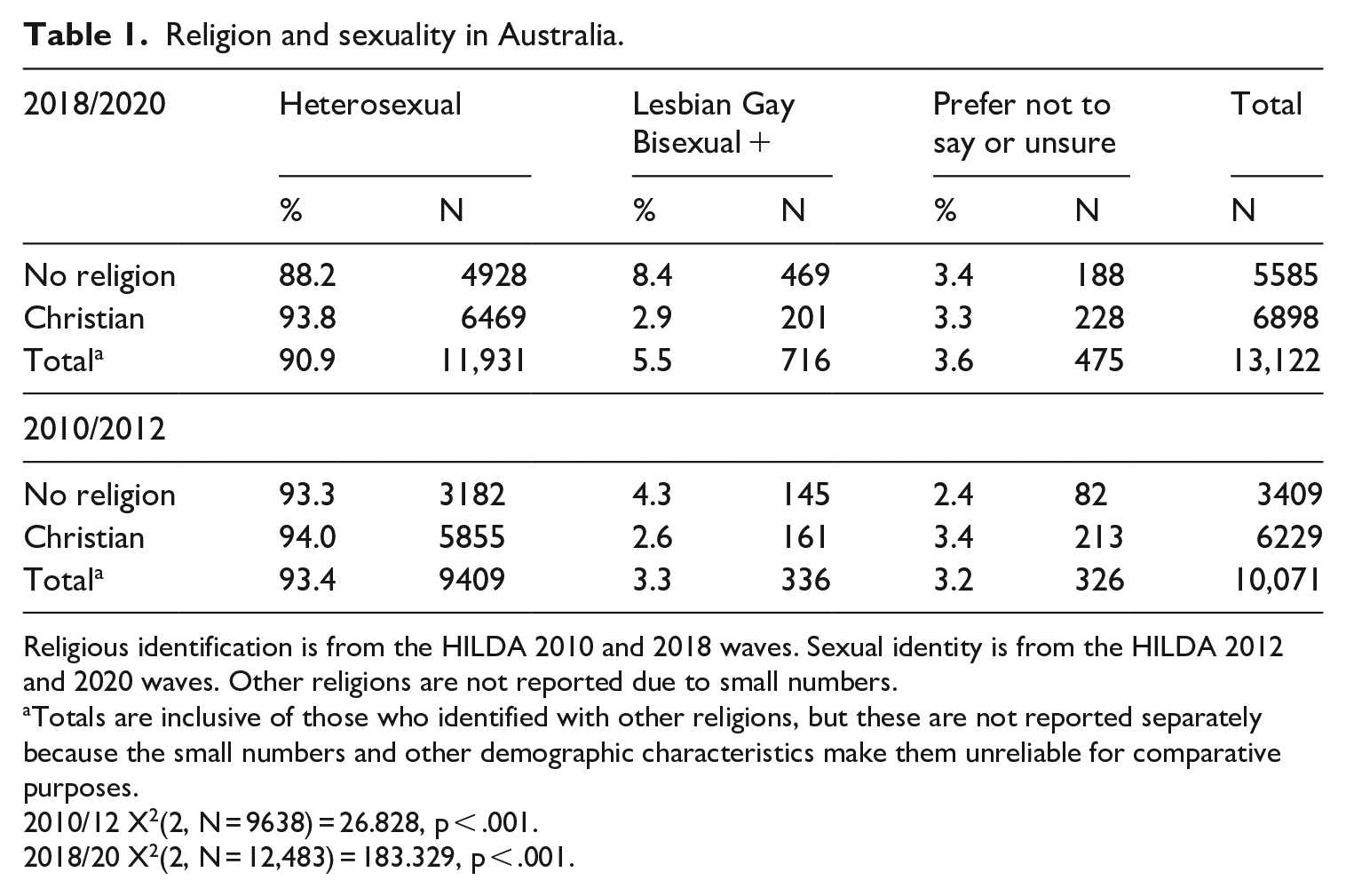
Religious identification is from the HILDA 2010 and 2018 waves. Sexual identity is from the HILDA 2012 and 2020 waves. Other religions are not reported due to small numbers.
Totals are inclusive of those who identified with other religions, but these are not reported separately because the small numbers and other demographic characteristics make them unreliable for comparative purposes.
2010/12 X2(2, N = 9638) = 26.828, p < .001.
2018/20 X2(2, N = 12,483) = 183.329, p < .001.
Nearly 1 in 30 (2.9%) of Christians in Australia identified as LGB+ in 2018/20 (Table 1). The number of Christians who identify as LGB+ has grown from 2.6% in 2010/12 to 2.9% in 2018/20, although to a much lesser extent than among the general population and the nonreligious. LGB+ Christians appear relatively evenly distributed among the major Christian denominations with 3.2% (N = 85) of Catholics, 2.7% (N = 52) of Anglicans, and 3.4% (N = 44) of other Christians identifying as LGB+ in 2018/20 (Table 2). The numbers are small for LGB+ members of Pentecostalism and the Uniting Church, and should be seen as indicative only. However, it is striking that LGB+ Christians are present in relatively even proportions in all the major denominations.
LGB+ Christians by denomination.
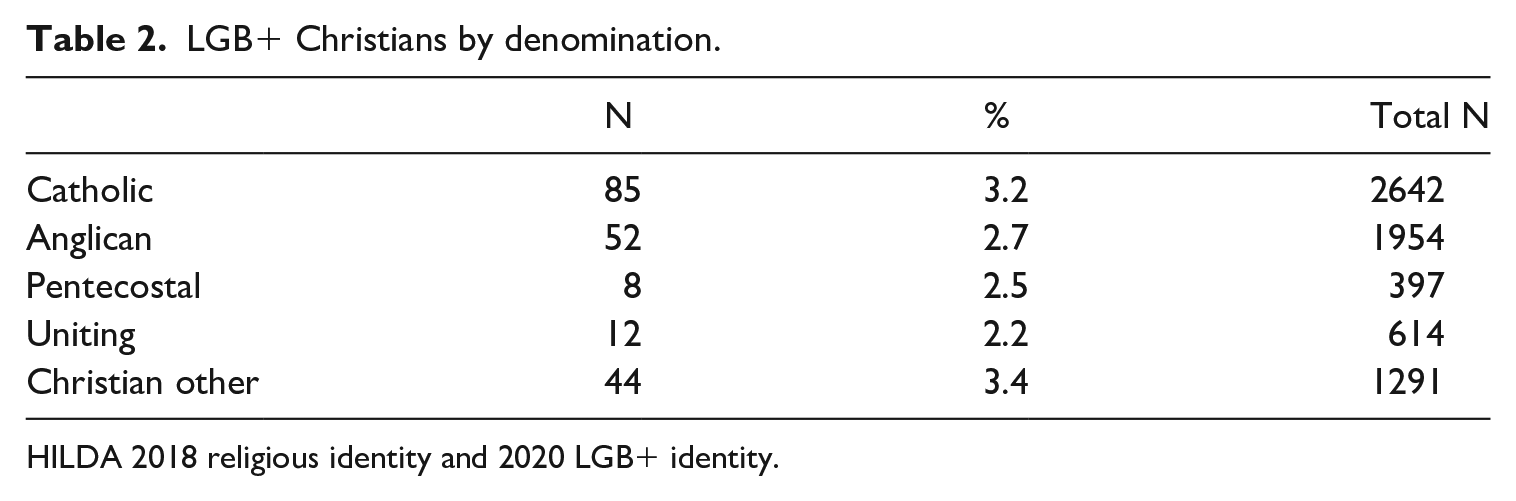
HILDA 2018 religious identity and 2020 LGB+ identity.
Table 3 indicates there are no significant differences between LGB+ and heterosexual Christians in terms of their attendance patterns at church services. However, we note the numbers of LGB+ Christians are small, and should be interpreted as indicative, rather than representative. LGB+ Christians are no more or less likely to be nominal Christians than heterosexual Christians. Analysis of similar data for the 2010/12 HILDA waves did not identify any significant differences in attendance patterns in those years.
Christian attendance at Church services by LGB+ identity.
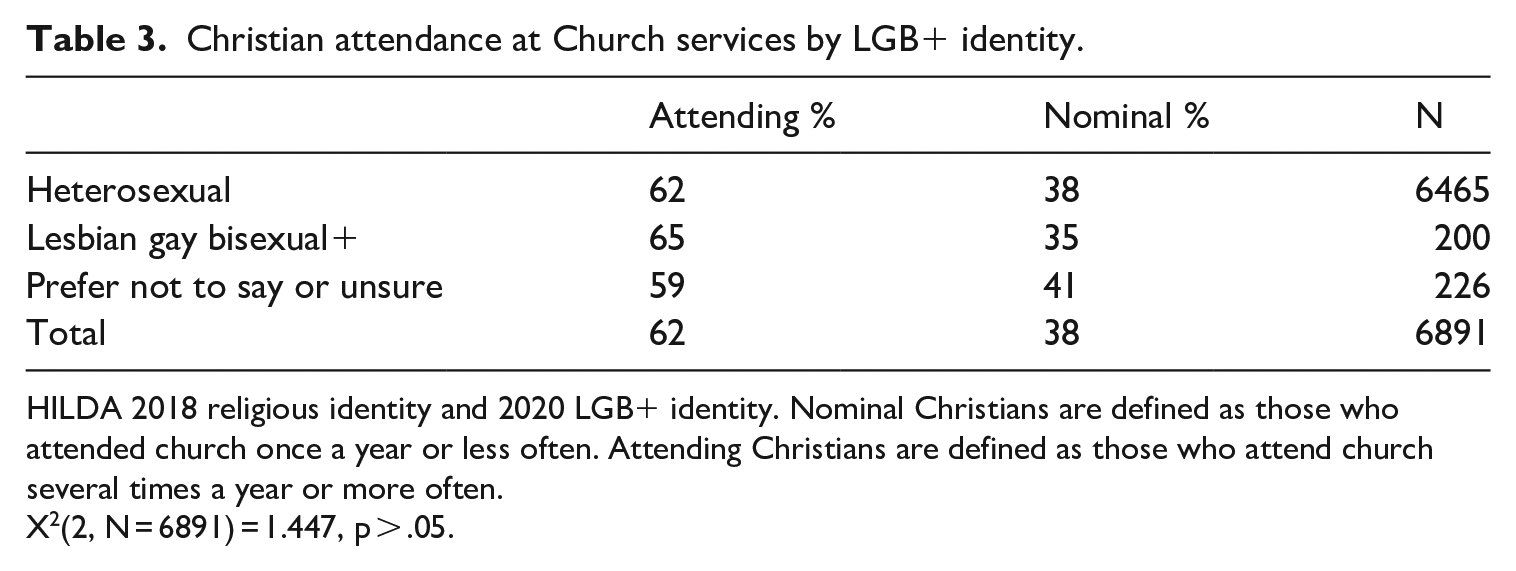
HILDA 2018 religious identity and 2020 LGB+ identity. Nominal Christians are defined as those who attended church once a year or less often. Attending Christians are defined as those who attend church several times a year or more often.
X2(2, N = 6891) = 1.447, p > .05.
Table 4 suggests that LGB+ Christians are more likely to leave Christianity than heterosexual Christians. Among the 5837 heterosexual Christians in 2014, 11% no longer identified as Christian in 2018. Among the 205 LGB+ Christians in 2014, 26% no longer identified as Christian in 2018. However, the numbers of LGB+ Christians are small, may not be reliable for comparison purposes, and should be interpreted as indicative, rather than representative. This suggests that the lower rates of LGB+ identification among Christians may be partly a product of LGB+ people leaving Christianity at a higher rate than heterosexuals.
Christians staying and leaving by sexuality.
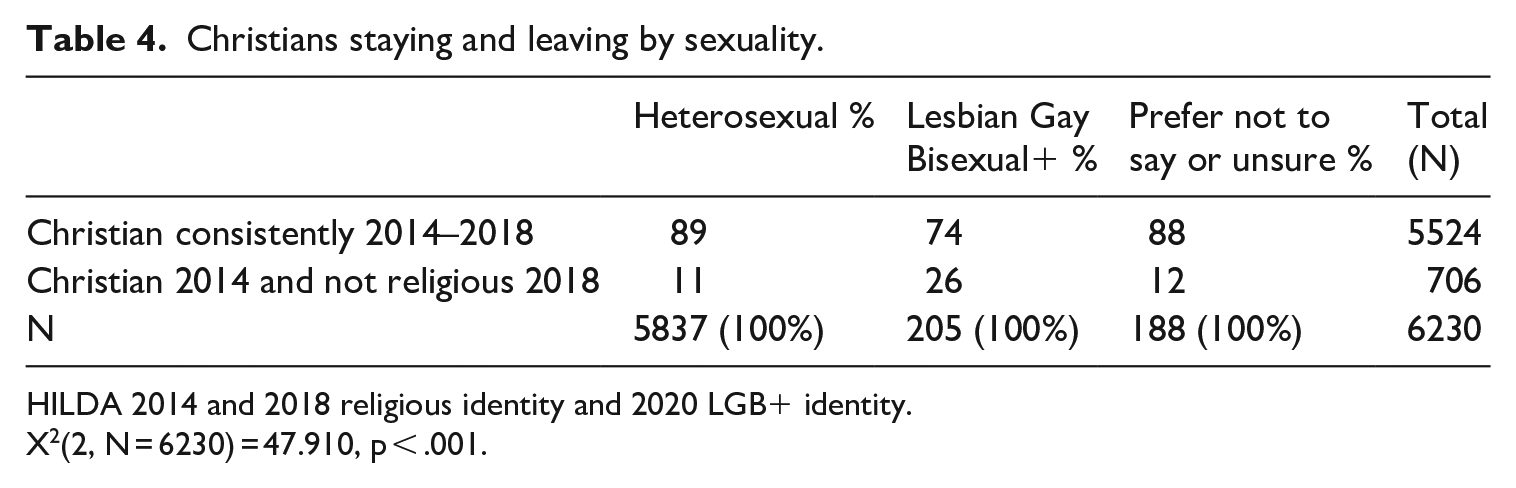
HILDA 2014 and 2018 religious identity and 2020 LGB+ identity.
X2(2, N = 6230) = 47.910, p < .001.
In summary, the HILDA data demonstrate that Christians are much less likely to identify as LGB+ than nonreligious people (2.9% compared with 8.4% in 2018/2020). This probably partly reflects the greater likelihood of LGB+ Christians to leave Christianity. However, among those who remain, LGB+ Christians are distributed relatively evenly through the major Christian denominations and just as likely to regularly attend church as heterosexual Christians. These statistics support the argument that the relationship of LGB+ people to Christianity is a complex one, including both antagonistic and affirming responses.
Religion survey findings
We now turn to both the statistics from the religion survey, and the written qualitative responses from LGBTQ+ Christians . A comparison of the demographic characteristics of the 201 people from the 2018/20 HILDA waves who identify as both Christian and LGB+ and the 300 people from the Religion Survey who identify as Christian and LGBTQ+ suggests that LGBTQ+ Christians in the Religion Survey have similar demographic characteristics to the LGB+ Christians in HILDA, with some important exceptions (Table 5). As observed earlier, The Religion Survey over-represents the experiences of LGBTQ+ Christians in affirming church contexts. However, there is no measure of this in HILDA, so no comparison is possible. The Religion Survey has an under-representation of Catholics and bisexuals and an over-representation of ‘other Christians’ and people who identify as gay or lesbian. The under-representation of Catholics reflects the advertising and distribution for the Religion Survey. The majority of the Catholic responses to the survey were recorded while the survey was being advertised on social media. No Catholic organization informed us that they distributed the survey, whereas a large number of non-Catholic churches and other organizations distributed the survey to their members. The higher proportion of ‘Christian Other’ similarly probably represents institutional support for the survey with denominations such as the Quakers and the Uniting Church who actively distributed the survey to members. This also highlights that the Religion Survey over-represents LGBTQ+ Christians from congregations with affirming stances towards LGBTQ+ people.
LGB+ Christians in the HILDA & Religion Surveys.
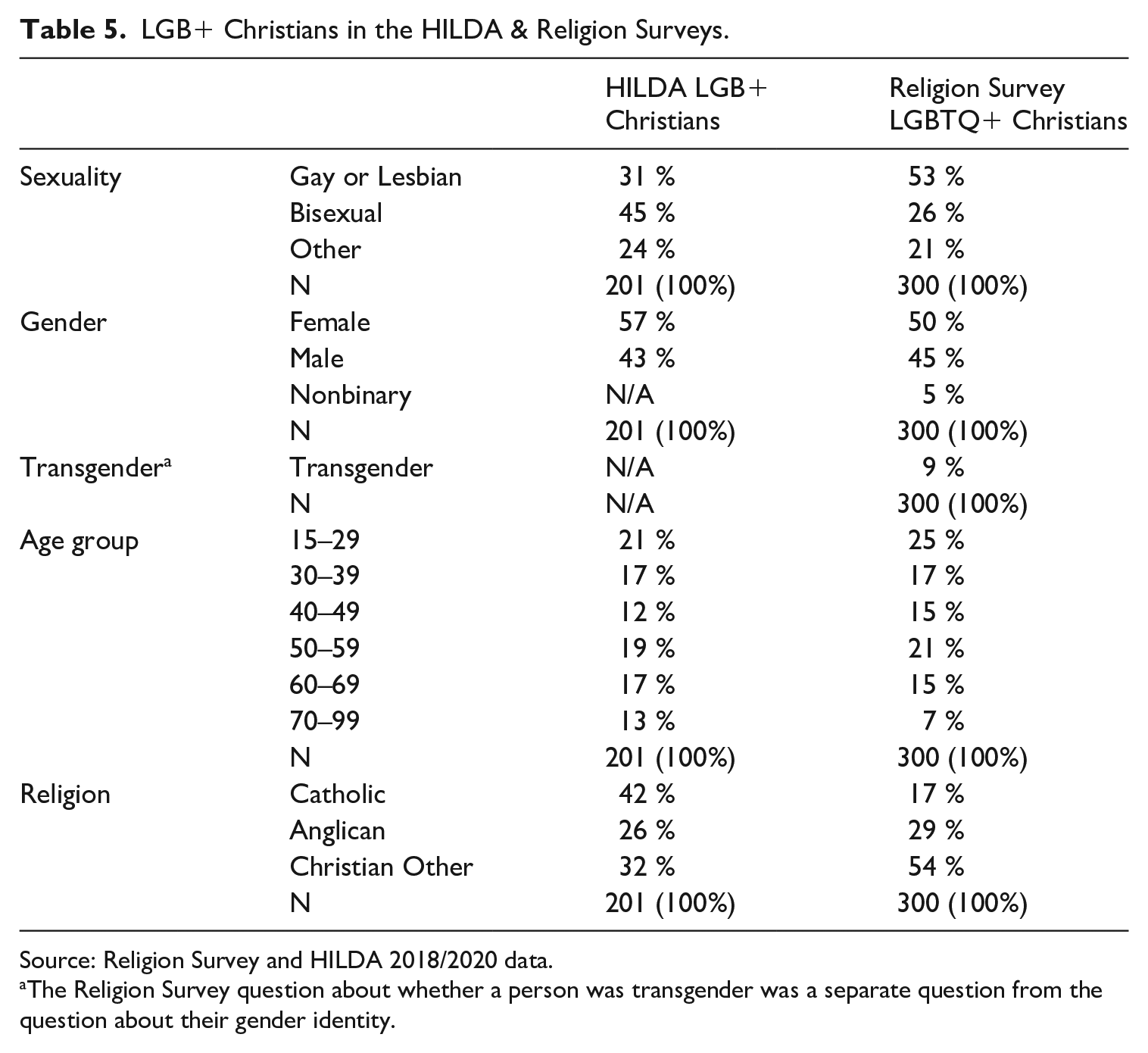
Source: Religion Survey and HILDA 2018/2020 data.
The Religion Survey question about whether a person was transgender was a separate question from the question about their gender identity.
Religion Survey: Being an LGBTQ+ Christian
The vast majority (80%) of LGBTQ+ Christians who completed the survey are comfortable with being both Christian and LGBTQ+, with 47% reporting they are very comfortable, and 33% reporting they are more comfortable than conflicted (Table 6). Only 16% of LGBTQ+ Christians who completed the survey report feeling more conflicted than comfortable, and only 4% report feeling very conflicted. This finding explicitly contradicts much of the public discourse about LGBTQ+ and Christianity, which are constructed as a binary in which the two are portrayed as being in deep conflict. This is clearly not the case for the vast majority of LGBTQ+ Christians who completed the survey, even considering that Christians who were more comfortable with their LGBTQ+ sexuality and/or gender were more likely to complete the survey than Christians who felt conflicted. The survey over-represents Christians from affirming Christian denominations. This means that the proportion of LGBTQ+ Christians who feel discomfort at being both Christian and LGBTQ+ is likely to be higher than that indicated. Nonetheless, the table does indicate that there are a large group of Christians who are comfortable with being both LGBTQ+ and Christian.
How do you feel about being both LGBTQ+ and religious?
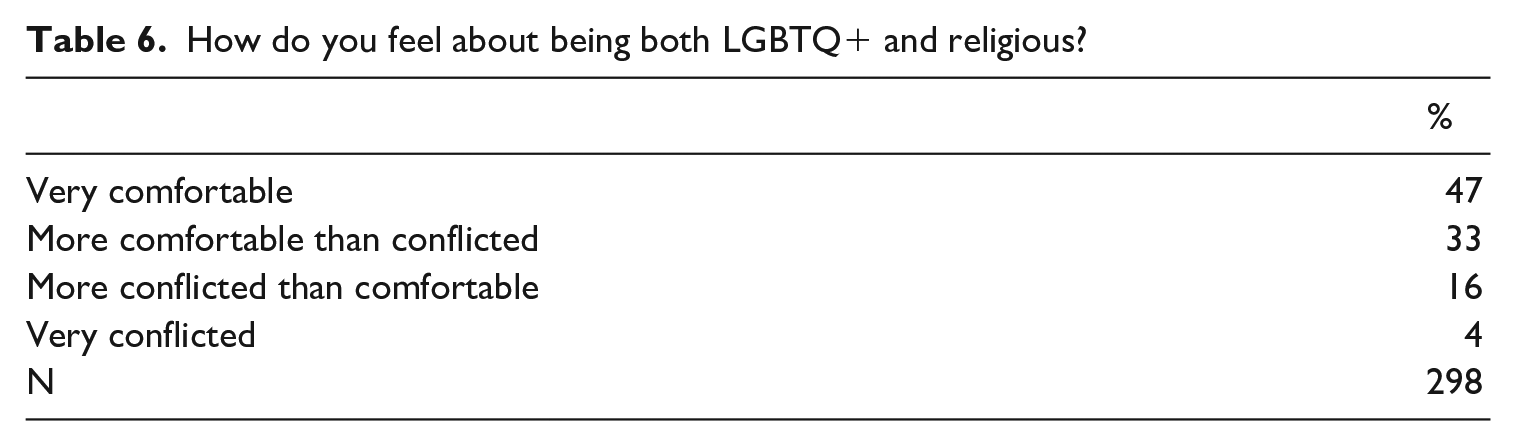
Table 7 again highlights that there are a significant group of LGBTQ+ Christians for whom Christianity and LGBTQ+ identities are highly consonant, with half of those who completed the survey reporting that their faith has been strengthened as a result of being LGBTQ+ . The percentages here should be treated with caution as the Religion Survey includes more Christians in affirming congregations. The HILDA surveys suggest that one quarter (24%) of LGB+ Christians leave Christianity (Table 4). The Religion Survey suggests that just under one third (29%) of those who remain Christians have considered leaving Christianity. Nonetheless, alongside these indications of conflict, both HILDA and the Religion Survey highlight that substantial numbers of LGBTQ+ people remain Christians and remain strongly committed to Christianity.
Has being LGBTQ+ changed your faith? Check all that apply.
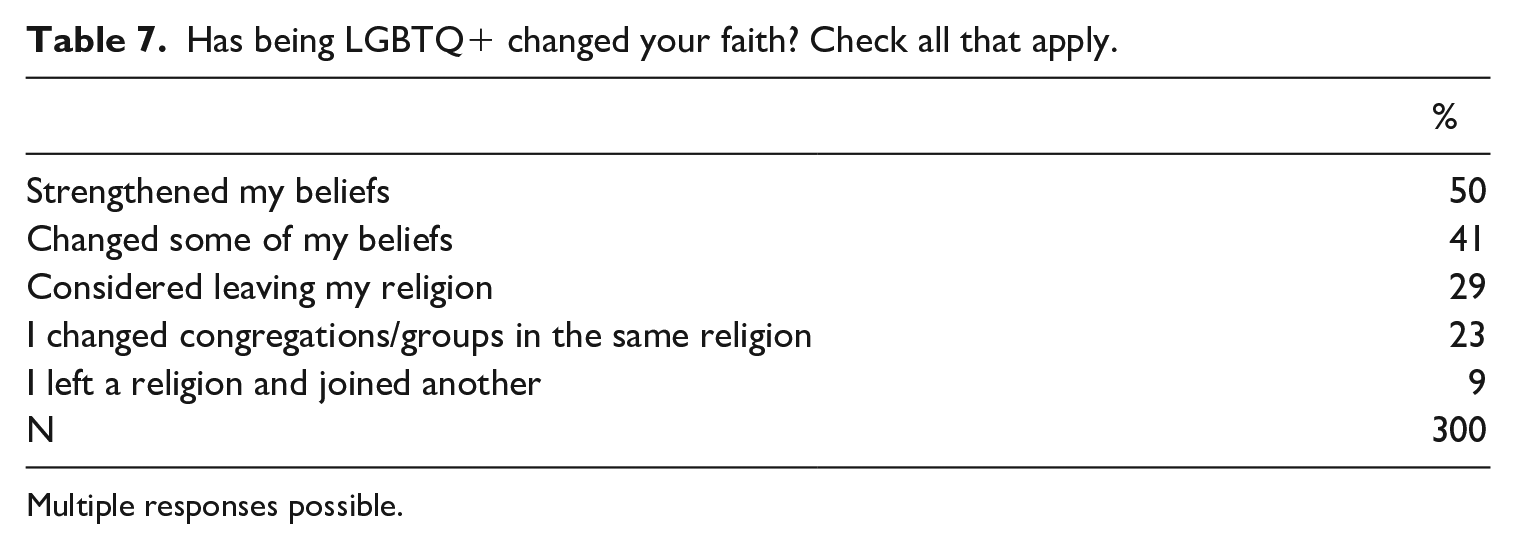
Multiple responses possible.
There were many written comments that indicated that LGBTQ+ Christians understand both their sexuality and/or gender and their religion as deeply interwoven with their sense of self. This was often expressed through a desire to reject and resist ‘the underlying assumption that religious people are not LGBT and vice versa’ (written survey response from a nonbinary Anglican). The desire to be true to themselves, to be ‘authentic’ as both Christians and LGBTQ+ was also regularly noted. A lesbian Anglican wrote:
‘The religious freedom debates are making our lives harder and harder, as we have to experience constantly being positioned in church leaders’ discourse as ‘enemies’ of the communities we love and have loyalty to. Sometimes it feels almost impossible to bear and to keep standing our ground and speaking our truth’.
Similarly, a bisexual Baptist wrote: ‘I hate the ways that this issue is portrayed as a zero-sum game: as if there are no religious LBGTQIA+ people. There are’.
There were many similar comments that rejected the purported tension between Christianity and LGBTQ+ . For example, a bisexual from a smaller Christian denomination wrote: ‘As an LGBTQ+ Christian, I can attest that religion and faith do not need to be in conflict with identity and sexuality’. Similarly, a lesbian Baptist wrote: ‘Jesus came to love all. Jesus died for all. That includes LGBTQ people’. A pansexual Catholic wrote:
I want everyone to be accepted and feel safe and loved. Judging others, especially for their sexuality or their gender identity, is so not what our Lord would have wanted, he would never have preached the hate and discrimination that tell people they’re born wrong.
A number of LGBTQ+ Christians noted that it was their religious freedom and human rights that were being denied, turning the religious freedom argument on its head. A lesbian Mormon wrote: ‘I guess though, that in a sense the church’s stance towards LGBT people is a violation of LGBT people’s religious freedom’. An asexual Anglican wrote: ‘The word ‘religious’ in religious freedom is always used to mean conservative. I know many people who have been fired for their religious beliefs; all of them are LGBTQIA+ affirming Christians who were fired by conservative Christian bosses because they (and their theology) supported LGBTQIA+ rights or were LGBTQIA+ themselves … It seems to be the case that some religious beliefs are more equal than others’.
There were some comments from LGBTQ+ Christians who felt their denomination had been extremely antagonistic towards their LGBTQ+ sexuality or gender. For example, an ex-minister from a smaller Protestant denomination who now attends a different Christian denomination wrote:
I was a [minister of a Protestant denomination] … for approximately 10 years. I felt called to the [ministry of that denomination]. I am same sex attracted and met and fell in love. This I knew was against the [denomination’s rules] and rather than be asked to leave I chose to leave – at great personal suffering and cost. I had believed this was a life-long calling and career. It took me years to debrief. The [denomination] today still SAYS it accepts gay etc. people – they do (?) but NOT as full time [ministers] as I was. LGBTI+ people are viewed as flawed and in need of deep healing and are only acceptable if they live in a celibate lifestyle. I am still working through the sense of being ‘wrong’ and worse ‘sinful’.
Some respondents noted that their religious identity was more central to their sense of self in comparison to their sexuality or gender. A gay Pentecostal wrote:
Though I am gay, my faith is far more important to my identity than my sexuality. I don’t think the public debate respects, particularly the anti-religious elements, understands or even has much empathy for Christians like me. We are often just assumed to be self-hating, and that infuriates me.
A bisexual Baptist wrote:
I think that in this discussion, religion is treated as a person’s opinion rather than something that deeply is ingrained in their experience and not something I can change. Religion is not just a choice, and I find that is the way it is treated in the conflict of LGBT right and religious freedom.
In summary, the Religion Survey responses demonstrate that there are a substantial group of LGBTQ+ Christians who are comfortable being both LGBTQ+ and Christian, many of whom report a strengthening of their faith. There are many LGBTQ+ people who have left Christianity, or changed denominations or congregations due to experiences of discrimination. However, this is not the only story.
Outness of LGBTQ+ Christians: Religion Survey
Similar proportions of LGBTQ+ Christians in the Religion Survey are completely out with family and completely out with friends (50 and 52% respectively say everyone knows) (Table 8). However, fewer (36%) are completely out with religious friends or in the workplace. At the other extreme, only 4% of LGBTQ+ Christians have told no friends, 13% have told none of their family, and 10% have told none of their Christian friends. Interestingly, similar proportions of LGBTQ+ Christians report being completely out in the workplace or with their Christian friends (36% say everyone knows), but more report being closeted in the workplace (28% say no one knows) compared with those who are closeted with their Christian friends (10%).
LGBTQ+ Christians’ Outness.
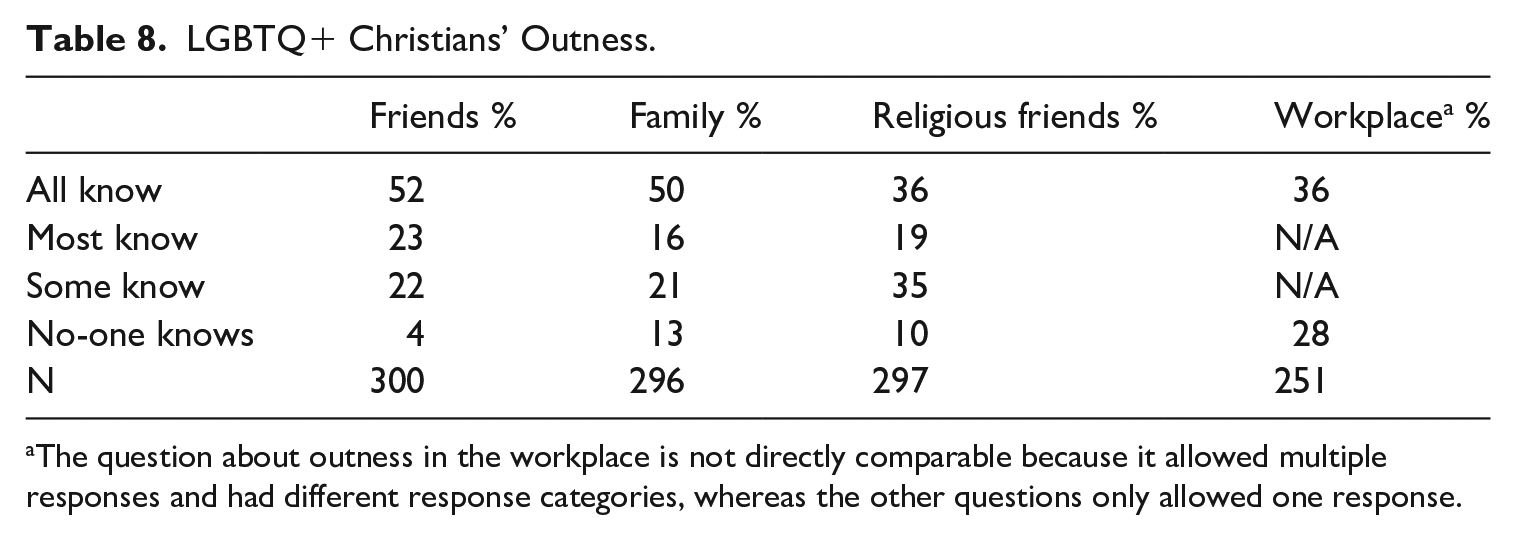
The question about outness in the workplace is not directly comparable because it allowed multiple responses and had different response categories, whereas the other questions only allowed one response.
Overall, allowing for multiple responses, 66% of LGBTQ+ Christians report either welcoming or loving responses from the people in their religious community (Table 9). However, combining all those who indicated negative responses, 60% reported one or more of the negative responses. Thirty per cent reported at least one of both a positive and a negative attitude among the people at their local church. This suggests that approximately one third of LGBTQ+ Christians who completed the survey attend congregations that are largely welcoming, one third are part of congregations with mixed positive and negative responses, and one third are part of congregations with largely negative attitudes towards LGBTQ+ people.
Congregational attitudes towards LGBTQ+ Christians.
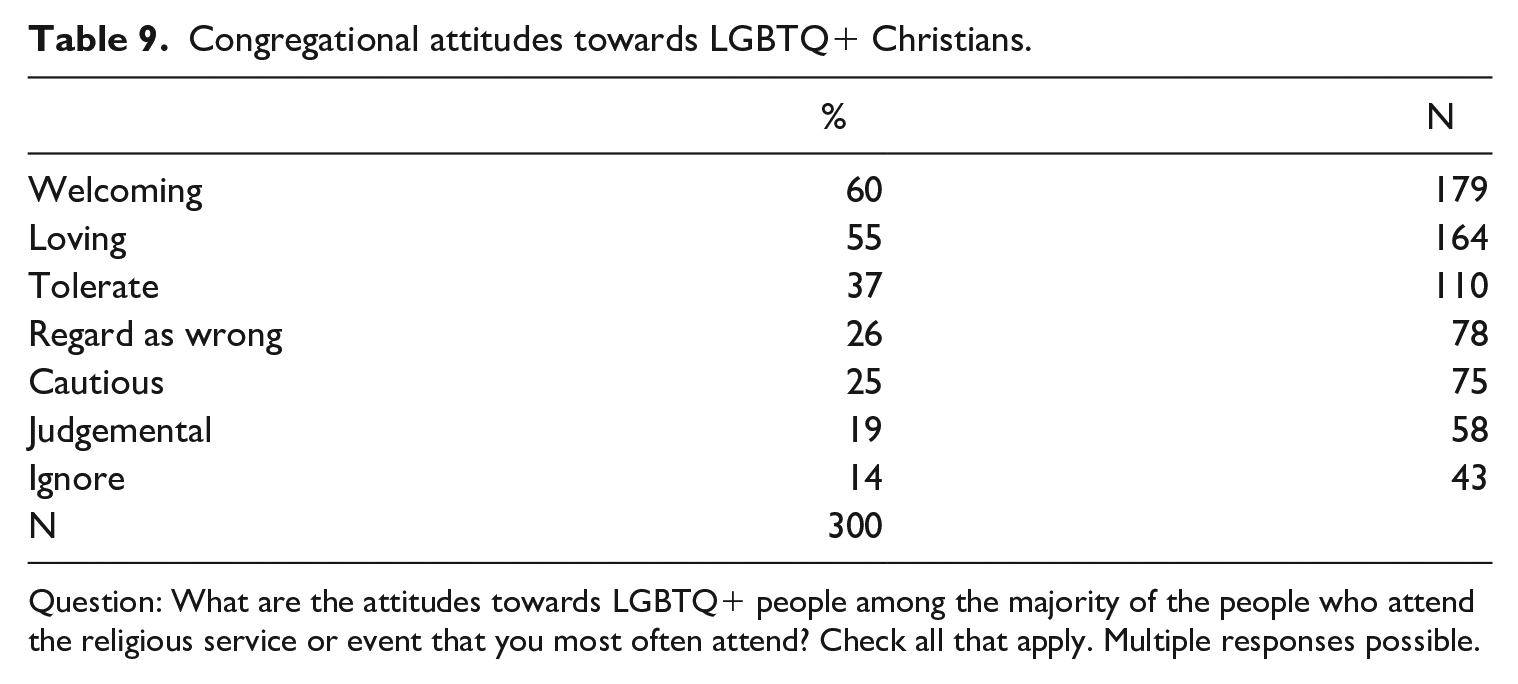
Question: What are the attitudes towards LGBTQ+ people among the majority of the people who attend the religious service or event that you most often attend? Check all that apply. Multiple responses possible.
In the written comments, a few conservative LGBTQ+ Christians distinguished someone who was ‘same-sex attracted’ from a ‘person in a gay marriage or relationship’ or ‘engaging in gay sex or seeking out a gay relationship’. They argued that a same-sex attracted person could be welcomed in church, but only if they were celibate. Some conservative Christians argue that lesbian, gay, and bisexual Christians need to remain celibate to remain faithful as Christians (Moon and Tobin, 2018). The vast majority of comments did not support this distinction, and argued that it was impossible to maintain. As noted in the quote above, implicit in this understanding is a view of LGBTQ+ people as ‘flawed and in need of deep healing’, a view which the majority of LGBTQ+ Christians rejected. They saw their sexuality and/or gender as inherently moral and good.
One quarter (24%) of LGBTQ+ Christians who completed our survey had not disclosed their LGBTQ+ identity to their religious leaders (Table 10). Of the 288 people who answered this question, one third found their leaders strongly supportive, and a further 18% indicated they were somewhat supportive. That is to say, 53% of LGBT Christians found their religious leaders either strongly or somewhat supportive. However, one quarter (23%) found them more ambivalent or negative. As the Religion Survey probably over-represents Christians from affirming congregations, it is likely that the proportion of LGBTQ+ Christians who haven’t disclosed their identity to their religious leaders is higher, and the extent of negative responses from religious leaders is higher.
Christian leaders’ attitudes towards LGBT Christians.
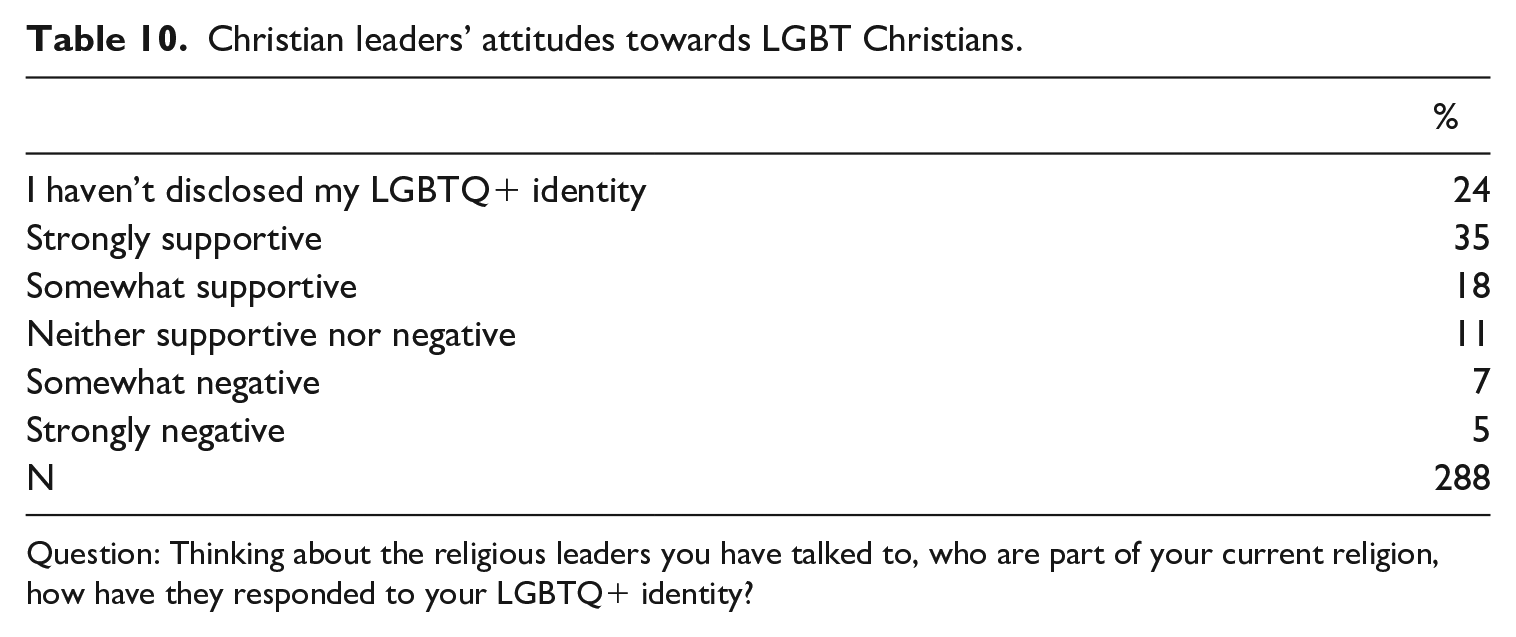
Question: Thinking about the religious leaders you have talked to, who are part of your current religion, how have they responded to your LGBTQ+ identity?
Whether an LGBTQ+ Christian had disclosed their LGBTQ+ identity to their religious leaders was not associated with gender or whether they identified as conservative. However, younger people were less likely to have disclosed their LGBTQ+ identity. One third (33%) of LGBTQ+ Christians under the age of 30 had not disclosed their LGBTQ+ identity to their religious leaders, in comparison to only 20% of those 30 years or older (X2(1, N = 288) = 6.291, p < .05).
Outness and attitudes: qualitative responses
The qualitative responses to the survey reflect this diversity of experience: some were positive, some negative, and some mixed. Some comments described strongly affirming experiences. For example, a lesbian member of the Uniting Church wrote: ‘I have been open about my sexuality since joining the Uniting Church. I was welcomed by my congregation … and [have] been fully supported by my presbytery and synod’. Similarly, a gay Quaker wrote: ‘My religious community has been one of my biggest supporters at the time of coming out and has accepted me entirely’. However, the positive experiences were not always associated with affirmation of LGBTQ+ practices: ‘I am an evangelical Christian, happily gay and celibate’. The Religion Survey did not include a question about sexual practice, but 4 out of the 110 LGBTQ+ Christians who wrote comments indicated in those comments that they were celibate.
Many of the positive comments were framed more cautiously, reflecting the complexity and uncertainty of the experiences of LGBTQ+ Christians. For example, a lesbian Mormon wrote:
I am lucky that my current congregation is pretty tolerant and loving towards me … There are five different families in my congregation that have at least one LGBT family member. I think that is partly why my congregation is so good to me.
Similarly, a gay Anglican wrote: ‘Most of our church community are loving and supportive and came to our wedding in the Uniting church’. Both these reflect the uncertainty and fragility of the acceptance LGBTQ+ Christians experience.
Finally, a group of comments described strong feelings of anger, bitterness, frustration, and hurt. Christian institutions, and particularly Christian conservatives, were identified as the cause of many of these negative experiences. A bisexual Anglican wrote: ‘There IS a significant threat to the wellbeing of LGBTQ+ persons from churches who dress up discrimination and condemnation as Christian love/mission’. Similarly, a lesbian Catholic wrote: ‘My fear is that I will not be respected and [will be] harmed by the religious conservatives because I am a lesbian. The Catholic Church conservatively holds that homosexuality is ‘intrinsically disordered’ and not a normal variation in sexuality’.
These negative attitudes towards LGBTQ+ Christians can be profoundly harmful. A gay Anglican wrote: ‘I have received, and continue to receive, verbal abuse and shunning from conservative fundamentalist Christians once they discover that I am an out gay man who is also still a Christian’. More confronting, a lesbian who is a member of smaller Christian denomination wrote: ‘My Christian foster Mum gave me 24hrs to get out of her house when I came out as lesbian and her pastors told me that I was on the same level as a paedophile’. An older male Baptist reported that a member of his church had ‘put me through electronic shock aversion therapy’. A lesbian Baptist wrote: ‘I felt rejected by the church (Christians). I felt rejected by God. I felt shame, self-hatred, and began self-harming. I worked hard to accept myself and then the church rejected me. The church did a lot of damage’.
The reluctance of LGBTQ+ Christians to disclose their sexuality and/or gender to their religious leaders was reflected in one comment: ‘I find laity who know LGBTIQ people seem much more relaxed (on average, with significant exceptions) than the official teachings of the Church would lead outsiders to expect’.
It is not just Christians who denigrate LGBTQ+ Christians, but also the LGBTQIA+ community and anti-religious elements within mainstream culture. A transgender Pentecostal noted: ‘I have had issues of being rejected from LGBTI communities because of my religion, and rejection from religious communities because of my LGBTI status’. A transgender Anglican wrote: ‘I have experienced online harassment and some alienation in LGBTIQA+ circles from aggressive secularists – including hate comments, attempts to exclude me as a religious person, and refusal to listen’. A bisexual Baptist wrote: ‘Large groups of my cohort decided to ostracize Christians as “punishment” (I went to a very progressive school), which led me to want to end my life/self-harm because it was so isolating’.
A number of comments highlighted the role of Christian leaders in creating misunderstanding about LGBTQ+ Christians. A transgender Anglican wrote: ‘[There is] general ignorance about faith in Australian society and deliberate attempts (almost exclusively from the right) at polarization of faith adherents and LGBTIQ+ people’. Similarly, a lesbian Anglican wrote: ‘It’s disappointing that powerful religious spokespeople consistently refuse to recognize our existence as religious and LGBTQ+, or to listen to our representations’. A lesbian Catholic wrote: ‘the Australian Christian Lobby do not speak for the majority of Christians’.
In summary, the statistics and qualitative responses suggest significant variations in the responses of congregations and ministers to LGBTQ+ Christians. Significant numbers of people reported harmful denigrating responses from other Christians and were reluctant to disclose their LGBTQ+ sexuality or gender to their minister. Others reported more mixed responses from other Christians. However, a significant group reported acceptance and affirmation of their identity as an LGBTQ+ Christian.
Discussion and conclusion
Our data suggest there are significant sectors of Australian Christianity that are welcoming of LGBTQ+ people. Furthermore, LGBTQ+ people who remain Christians are often deeply committed to their faith and distributed through a range of mainstream Christian denominations. Much of the contemporary literature focuses on the inconsistency between Christianity and LGBTQ+ sexualities and genders and the trauma and harm experienced by LGBTQ+ people. While this is clearly the case for a significant proportion of LGBTQ+ Christians, the focus on this negative aspect of the experience of LGBTQ+ Christians misrepresents the complexity of the experience of many LGBTQ+ Christians who feel affirmed and accepted by other Christians, and others who experience more mixed responses.
The data for the Religion Survey indicate that among many LGBTQ+ Christians in mainstream Christian denominations, there is a strongly held view that Christianity and LGBTQ+ sexualities and genders can co-exist. A substantial group of LGBTQ+ Christians clearly indicate that the antagonistic attitudes of conservative Christian leaders towards LGBTQ+ sexualities and genders do not represent their views. LGBTQ+ Christians experience both discrimination and affirmation. Many LGBTQ+ Christians feel accepted, authentic, and remain deeply committed Christians, and they feel that this experience is not adequately represented in contemporary public commentary about LGBTQ+ and Christianity. However, there are a small group of celibate LGBTQ+ Christians who are content with their place in the church and the acceptance they receive. We also note that the survey was conducted in the context of high-profile public debate about religious freedom and LGBTQ+ rights (Ezzy, 2022). The survey is not random, and probably over-represents the experiences of Christians in affirming congregations.
Our data suggest that the acceptance of LGBTQ+ Christianity may be more widespread among Christians than indicated by the public statements and actions of the leadership of conservative Christianity. This is consistent with other research. For example, McIvor (2020: 113) suggests that the views of conservative Christian lobby groups are quite different to those of conservative Christians who attend church. On one hand, the politically activist wings of conservative Christianity in the United Kingdom express ‘outrage or indignation’ at anti-discrimination legislation, on the other hand, conservative Christians who sit in the pews at church are more likely to express ‘resignation, sadness, and disappointment’. Similarly, McGuire’s (2008) analysis of lived religion underlines how statements by the leadership of the church often do not reflect the beliefs, practices, or concerns of members of the church.
Articulating both the negative and positive experiences of LGBTQ+ Christians is important. This is both because it is more empirically accurate, and because it facilitates a social justice agenda of respect and equality. Dawne Moon (2004: 135) argues that in debates about homosexuality and Christianity that ‘the language of pain can further entrench inequality in the Christian context’. Contemporary commentary emphasizes conservative Christian responses to LGBTQ+ people as if they represent all of Christianity. Much of the commentary also emphasizes the trauma and discrimination experienced by LGBTQ+ as a result. We suggest these two narratives play off each other, and serve to marginalize more positive and constructive accounts of LGBTQ+ Christian experiences.
Footnotes
Acknowledgements
The authors are grateful to all the participants who responded to their survey. They also acknowledge the contribution made by thoughtful conversations with other researchers on our ARC grant: Prof Lori Beaman, Assoc. Prof Angela Dwyer, Prof Simon Rice, and Dr Louise Richardson-Self.
Funding
The author(s) disclosed receipt of the following financial support for the research, authorship, and/or publication of this article: The research in this article was funded by an Australian Research Council Discovery Project entitled ‘Religious freedom, LGBT+ employees, and the right to discriminate’ (Project ID: DP200100395).

Availability of Data and Materials
The HILDA data are publicly available, and the analysis can be replicated by requesting that data from HILDA. The Religion Survey data are not publicly available. There are privacy concerns associated with collections of characteristics making respondents potentially identifiable, particularly relating to the LGBTQ+ individuals whose responses are reported in this article. We also did not request permission from participants to make the data publicly available.
Author biographies
Address: School of Social Sciences, University of Tasmania, TAS 7000 Australia.
Email:
Address: School of Social Sciences, University of Tasmania, TAS 7000 Australia.
Email:
Address: School of Social Sciences, University of Tasmania, TAS 7000 Australia.
Email: