




Abstract
This article delves into the profound implications of multi-dimensional religiosity on political party support, with a special focus on the case of Poland (N = 1203). In a society undergoing a transformative journey towards secularism and progressiveness, the traditional role of religiosity in shaping political attitudes has been reevaluated. In order to check the impact of religiosity, binomial logistic regression models were conducted. In the study, combined Wave 7 World Value Survey and European Value Study database was used. With the obtained results, a significant role of normative religiosity was detected. The results do not confirm conclusions discussed by other leading authors in Poland, who use other models and indicators of religiosity. The proposed study provokes and encourages for change in the methodological approach in building party-support models in Poland by including and measuring the normative dimension of religiosity as the leading source of individual party support motivation, discarding thus more traditional ritualistic behaviour measuring.
Introduction
Studies on the association between religiosity and political actions have a very long tradition and today they encompass a rich range of literature (Cordero, 2017; Esmer and Pettersson, 2009; Ignazi and Tuorto, 2023; Lipset and Rokkan, 1967; Norris and Inglehart, 2011). Generally, religiosity is more associated with a tendency to support populist right-wing parties and candidates (Marcinkiewicz and Dassonneville, 2021; Santana et al., 2020; Xia, 2021). However, based on international comparisons, it can be stated that the impact of religiosity on right-wing voting is very country-specific (Cordero, 2017; de Hart and Dekker, 2013; Kerman et al., 2007; Müller, 2011) and visibly diverse in terms of explanatory power. Thus, there is a constant need for debate, replication and case-specific studies in order to avoid information bias and generalizations.
Acknowledging thesis about existing socio-political cleavages leads us to assume that Central and Eastern European (Hernández and Kriesi, 2016; Kitschelt, 2001) democracy and party systems are shaped by some key leading forces such as authoritarianism fuelled by religiosity, traditionalism and nationalism, and by libertarianism fuelled by secular, cosmopolitan progressivism. As detailed studies show, without a doubt, religiosity (Cześnik et al., 2020; Grabowska, 2021; Kotnarowski and Markowski, 2014; Markowski and Stanley, 2016; Ramet and Borownik, 2017) proves to be a solid element of especially Polish political landscape and various collected data support cultural paradigm claiming that in Poland more religious people tend to support conservative right-wing and/or populist parties (Grabowska, 2021; Marcinkiewicz and Dassonneville, 2021; Markowski and Stanley, 2016; Turska-Kawa and Wojtasik, 2020; Xia, 2021). Although religiosity appears to be an important factor behind voting behaviour or party support in Poland, the existing studies offer very limited insight into how precisely religiosity impacts the voting decisions of Poles.
Such shortcomings are often combined with various measurements of religiosity. Many important studies in Poland use single indicators such as attending masses or being a member of a specific denomination to measure religiosity (Marcinkiewicz and Dassonneville, 2021; Zerkowska-Balas et al., 2016). The hidden thesis underlying the usage of those indicators is a conviction about internal coherency and consistency of human actions and thus the consistency of various dimensions of religiosity. In sum, accepting the former justifies uni-dimensional explanation of the latter. Thus, another hidden thesis underlying such research practice is that diagnosing the attitude of individuals in one dimension of religiosity should produce the same results in other dimensions. We perceive such uni-dimensional approach as a serious limitation and potential source of cognition bias. Our attitude is justified by two premises: first, it is still unanswered question: which dimensions of Poles’ religiosity prove to be the most relevant and thus the most impactful in individual voters’ motivation to support a specific party. The question has not been addressed lately due to a lack of any advanced comparisons analysis. The second premise is the constant ongoing socio-cultural revolution Poland is experiencing from the start of establishing true democratic government (Carlton, 2015; Mariański, 2014; Ramet, 2014; Requena and Stanek, 2014) and religiosity also is influenced by said transformation (Zaręba et al., 2022) in form of intensified secularization. Such process has a direct impact on internal structure and coherency of Polish society and has a direct impact on individual religious identity of Poles (Wadowski, 2020), who according to Pew Research Center is a society with one of the highest indicators of religiousness in Europe. 1 We argue that religious experiences may today vary greatly. Moreover, some people may say they are religious, but do not necessarily affiliate themselves with any denomination. Others may say they belong to a specific denomination but have no will to take part in religious practices. We thus assume that individuals may be internally inconsistent in their religious attitudes and they may gain motivation for political actions from different dimensions of their religious identity. Thus, it is crucial to test which dimensions differ Poles the most and thus becomes the true level of social differentiation in socio-political cleavage fuelling. Such problem encourages and necessitates a change in methodological perception of religiosity as a more individual, diverse, multi-dimensional research approach. Especially when more complex and detailed explanation are available and constantly improved (Hayward, 2021; Huber and Huber, 2012; Olson and Warber, 2008; Stark and Glock, 1970).
Multi-dimensional religiosity: concept, operationalization and research model
In this article, we want to make a reference to one of the most impactful universal models of multi-dimensional religiosity proposed by Glock and Stark (Robbins and Glock, 1966; Stark and Glock, 1970). Cited authors distinguished five dimensions of religiosity: belief, practice, experience, knowledge and consequences. The proposed theory assumes that individuals who identify themselves as religious manifest said religiosity in numerous ways. They share some beliefs and knowledge about reality, which are the core axioms stated in the sacred texts or promoted by religious leaders. They want to connect with ‘God’ through prayer and rituals. They manifest positive and/or negative emotions by embracing their religiosity individually or collectively. Finally, they try to apply their religious axioms derived from beliefs and knowledge to make normative claims about reality. The normative distinction is very important because it formulates one’s code of behaviour outside of the private, sacred or ritual sphere and motivates one to be disciplined and coherent in thoughts and actions in public space, for which individual thinks will gain salvation, redemption, immortality or social approval.
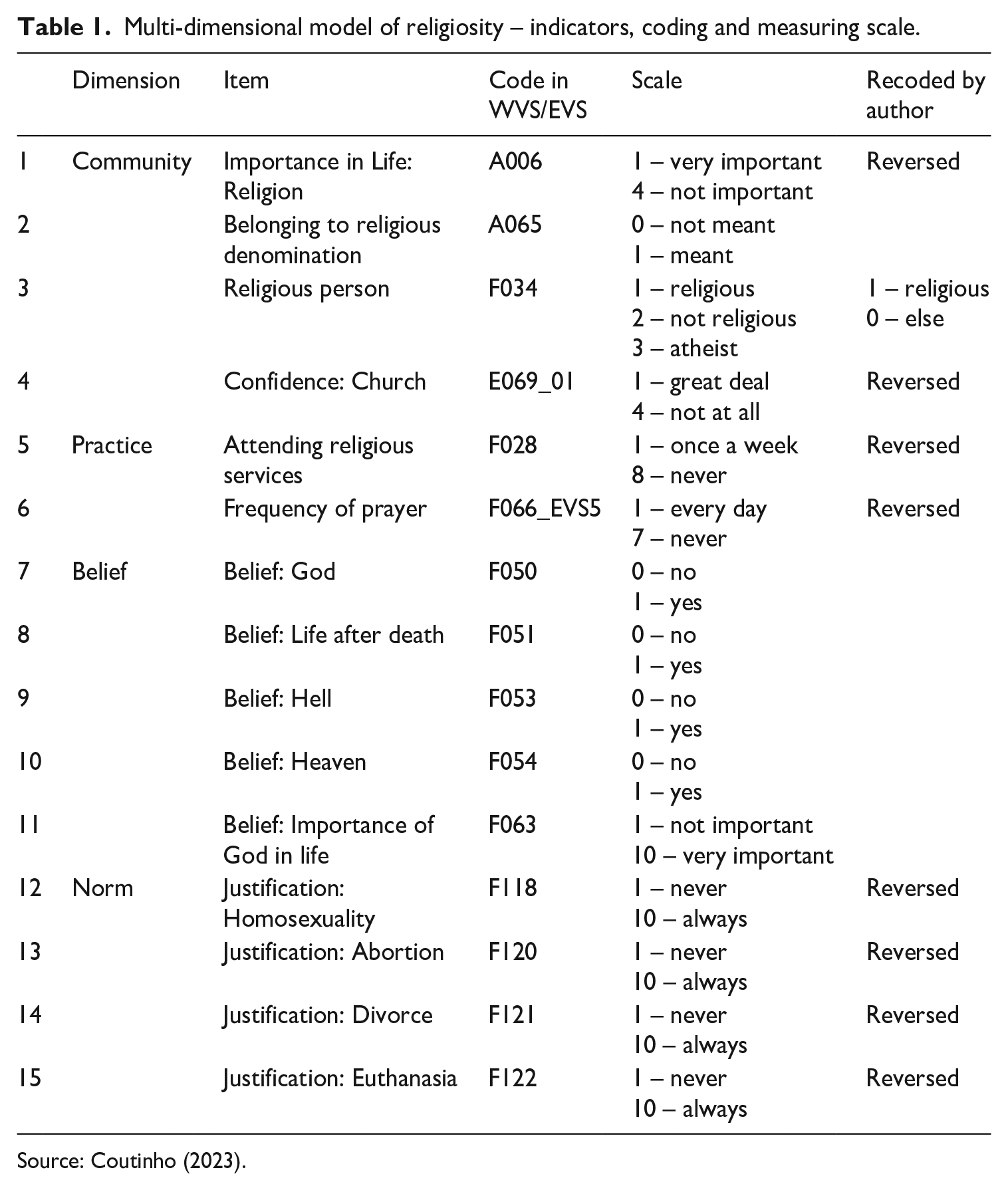
Cited theory has been constantly empirically tested in multiple studies and although results varied (Brown and Forgas, 1980; Coutinho, 2016; Davidson, 1975; Finner, 1970; Huber and Huber, 2012; Remizova et al., 2022), this model of religiosity is still broadly recognized. The main limitation of their project was seen in the lack of clear indicators of how to measure individual dimensions. However, such shortcomings were overpowered, thanks to current analytical possibilities. Due to the development of associations, such as World Value Survey or European Value Study, worldwide international comparisons based on reliable data and statistical validation are possible. One of such studies, which we found very useful for our project, was performed by Coutinho (2016, 2023) who designed and tested which out of the five theoretical dimensions of religiosity proposed by Glock and Stark were in fact measurable and pan-culturally universal. By using data from European Value Study and statistical validation such as exploratory factor analysis (EFA), principal component analysis (PCA) and confirmatory factor analysis (CFA), his studies confirmed four: community (experience), belief, practice and norm (consequences) dimensions to be diagnostically reliable and empirically measurable. Consequently, the original number of dimensions was reduced to four while sustaining large portion of the basic concept of multi-dimensionality. Thus, in the proposed article, we replicated research model, successfully constructed by Coutinho (2023) and we used community, belief, practice and norm religious dimensions in predicting party support in Poland (for full structure of the model and individual indicators with World Value Survey/European Value Study coding, see Table 1).
Multi-dimensional model of religiosity – indicators, coding and measuring scale.
Source: Coutinho (2023).
Analytical procedure: In order to calculate scores for individual religious dimensions, all variables were transformed by normalization into 0–1 range. Then scores for all individual indicators that belong to given dimensions were summarized. Finally, for regression analysis, summarized scores were once more transformed into z-scores for predictor comparability.
Individual dimensions are very distinctive and give various information about one’s religious consistency in various spheres (Coutinho, 2023). Community religiosity manifests itself through open self-identification and a sense of belonging. Practice religiosity is manifested by the frequency of attending religious services and the frequency of prayer. Belief manifests itself by acceptance of basic spiritual concepts such as God, life after death or Heaven. Finally, norm dimensions will be manifested by the level of acceptance for phenomena which are, according to most religious denominations, questionable morally such as: homosexuality, abortion, divorce and euthanasia. From this description, we can conclude that strongly religious person will openly claim as such and will put a strong emphasis on the fact that this part of their identity is significant. Such a person will often take part in religious rituals and will have a strong need for a personal connection with God in the form of prayer. Deeply religious people will openly state that God is somewhat significant for their personal life and will have less acceptance for morally biased actions because they question strict traditional moral code and blur the line between good and evil.
Each religious dimension may have a direct impact on political behaviour. Strong community religiosity is the main source of loyalty towards own group. Loyalty is a strong emotional attitude, which links sincerity of affection with honour and creates an abstract bond between two people who on many occasions may have never met each other in person, yet they feel close and responsible towards each other. This mix of loyalty, emotional bondage and responsibility may encourage to politically support individuals based solely on granted trust and credibility. Thus, in practice, people may support or vote for candidates who only publicly stated to be believers of a certain denomination or they said to be part of a given religious community in present or in the past.
Practice religiosity is based on rituals, which are a form of manifesting religious beliefs in reality. Such manifestations have strong impact on individuals because they combine physical activity (singing, chanting, praying, dancing) with specific mind focus (seriousness). Those factors occupy the attention and effort of one and channel it into a specific set of activities. Thus, for a person deeply involved in religious practices, we may expect deep, serious emotional involvement, which not only may be present in dedicated spaces (e.g. church) but also may appear in private space (house prayer) or in public (public prayer). We may elaborate that for some people voting may also be a form of religious ritual in which they give themselves evidence of their own religious devotion by supporting a ‘chosen by God’ candidate.
Belief dimension may influence political behaviour by forcing strongly devoted people to be consistent in their ideological and/or philosophical approach. Believing in God in the Christian denomination indicates that one believes also in creationism (God created all life), being judged and sentenced after death and thus being punished or rewarded in the outcome. Such strong convictions install and moderate two main emotions: hope (sense in life/need for order and safety) and fear (lack of sense in life/fear of chaos and insecurity). Thus, individuals will make political decisions in order to increase the feeling of hope and diminish the feeling of fear. So, for strong believers, the natural would be to support or vote for candidates that fit and promote actions and public discourse appealing to the need of ‘order’ and will neglect those who in their perspective represent ‘chaos’ or simply uncertainty.
Norm dimension of religiosity may influence political behaviour in similar manner as belief dimensions, so by the sheer need of ideological and philosophical consistency, but with stronger emphasis on social aspects of reality, by imposing the construct of ‘sin’. Thus, if one believes that procreation, family, life and nature are sacred and should be respected and cherished no matter the circumstances, it is natural for one to support and vote for candidates who think alike. Also, the need of ideological consistency creates logical chains and simplifications such as, for example: procreation is sacred, thus relationship between man and woman is sacred, because only they can procreate. Thus, any other relationship that does not serve the need of procreation is ‘unnatural’ or ‘sinful’ and should not be allowed. What is exceptional about norm religious dimensions is the aggressive notion of norm religiosity towards the public domain. All of the measures used to diagnose norm dimensions: homosexuality, abortion, euthanasia and free sex are actions that are mainly manifested in private space or should be a matter of private consideration. Yet religious dogmatism gives no such room for differentiation between public and private space. For a deeply religious person of a Roman Catholic origin, abortion is bad/sinful no matter the premises and no matter if it is considered as their own or someone’s else decision. Thus, strong norm religiosity forced one to seek and support candidates who will try to control public and private space by imposing or protecting specific laws.
The aim of this article is thus threefold. First, it aims to test the predictive capabilities of more up-to-date multi-dimensional religiosity model on party support in Poland. The main research question is thus: Do different dimensions of religiosity hold similar/different predicting potential for party support in Poland? We used general term of ‘party support’ because we were interested if any dimension of religiosity will prove significant in the prediction of attitudes for any political party. Based on available sources (Grabowska, 2021; Markowski and Stanley, 2016; Ramet and Borownik, 2017), we formulate our first hypothesis such as:
H1: All dimensions of religiosity will be significant predictors for party support in Poland.
Second, it will explore potential similarities and differences between religiosity dimensions in predicting party support in Poland. In this sense, it will inquire whether all dimensions of religiosity hold a significant role in predicting party support in Poland. If not, then which of the diagnosed dimensions are more relevant? What are the tendencies of association (positive/negative) between dimensions of religiosity and party support? Based on the already cited sources (Grabowska, 2021; Marcinkiewicz and Dassonneville, 2021; Xia, 2021), we may expect a strong positive association of religiosity with right-wing party preferences. Also, mass attendance, as the most frequently used indicator of religiosity in Poland, should be the most responsive in this regard. Thus, the hypothesis will be as follows:
H2: All dimensions will have a significant positive correlation with right-wing party support. Also for Poland the most strongly correlated dimensions of religiosity in party support will be dimension of practice.
As an additional third aim, we wanted to construct a support attitude model that will somewhat replicate the most important factors used by other authors in the field (Grabowska, 2021; Marcinkiewicz and Dassonneville, 2021; Markowski and Stanley, 2016; Turska-Kawa and Wojtasik, 2020; Xia, 2021). In order to test if individual religious dimensions hold or change their predictive strength and impact, there was a need to use other factors commonly in use such as demographics and other dimensions of ideological identification. Such analysis, although beyond the main scope of the proposed article, gave more comparable reference material in confrontation with the findings of other authors, who by the majority do not use only religiosity as the main factor of predicting party support behaviour in Poland. Using only religiosity dimensions may have been perceived as too sterile and artificial thus receptive to bias.
Methods and data sources
For hypothesis testing, we used combined World Value Study and European Value Study Associations’ survey data published in 2018. WVS and EVS surveys store information gathered from respondents in random population samples, organized as 231 variables and 135,000 observations from 88 countries (Haerpher et al., 2022). The databases are available to be downloaded for free respecting citation rights. The validity of the databases has been confirmed in a vast number of over 1000 studies. To see how large will be the effect of diagnosed dimensions of religiosity on predicting party support, we filtered 17 variables for all observation gathered in Poland (N = 1203) between 2017 and 2018.
The filtered factors enabled acquisition of information with which national party respondents felt the closest alignment, which we assumed the proper indicator for support. Based on Manifesto Project Data Base 2 (Right-Left position (rile) indicator) and Chappel Hill Expert Survey 3 (Left-Right Ideology variable), using time period, party name and left–right programmatic affiliation score, we recoded all parties into ‘right’ (n = 493), ‘left’ (n = 55), ‘centre’ (n = 225) and ‘other/none’ (n = 430) groups. 4
To check the validity of the religiosity model (χ2 = 1689, p < 0.001, comparative fit index (CFI) = 0.844, Tucker–Lewis index (TLI) = 0.806, root mean square error (RMSE) = 0.126, standardized root mean square residual (SRMR) = 0.069), CFA has been applied (Brown et al., 2017), indicating acceptable model fit (for summary, see Supplemental Appendix I – Table 2). Reliability analysis, based on Cronbach’s alpha standardized value for community (α = 0.69), practice (α = 0.81), belief (α = 0.85) and norm (α = 0.85) revealed acceptable levels of internal consistency. CFA analysis of covariance indicated a very weak (r = < 0.05) association between individual dimensions. Thus, we may have expected a low level of autocorrelation across religious dimensions. Individual religious dimensions were calculated by transforming raw scores into normalized (for CFA analysis). Then, normalized scores were summarized and transformed into z-scores (for binomial logistic regression analysis).
In order to address our third aim stated in the article, we decided to construct a comparative model with the most significant and commonly used factors (Marcinkiewicz and Dassonneville, 2021; Turska-Kawa and Wojtasik, 2020; Xia, 2021), available in the WVS/EVS database such as: gender, age, education level (eight-point ISCED classification), left–right ideological identification and nationalistic beliefs.
In order to diagnose left–right ideological identification four-item index has been created which measured (on 10-point scale) the attitudes of respondents in regard to: income equality, private versus state ownership, people versus government responsibility and market competition harmful versus good. It should be noted that in Poland (Grabowska, 2021; Kitschelt, 2001) left–right identification has more cultural (conservative vs progressive) than economical quality. Although such distinction is already made in the multi-dimensional religiosity model proposed by Coutinho (2023) and massed in the ‘normative’ dimension of religiosity, where attitudes towards abortion, homosexuality, free sex and euthanasia, thus purely cultural left–right identification values, are measured. Therefore, we decided to not include one more left–right cultural identification index but economical instead, to not disturb (by autocorrelation) model prediction and enrich the analysis by other relevant values.
Nationalism was reconstructed using the four-item index by Agarwal et al. (2017), which measured the attitude of respondents in regard to: their level of pride of being specific nationality, what should be the first and second political aim of own country, willingness to fight for their country and level of confidence in armed forces.
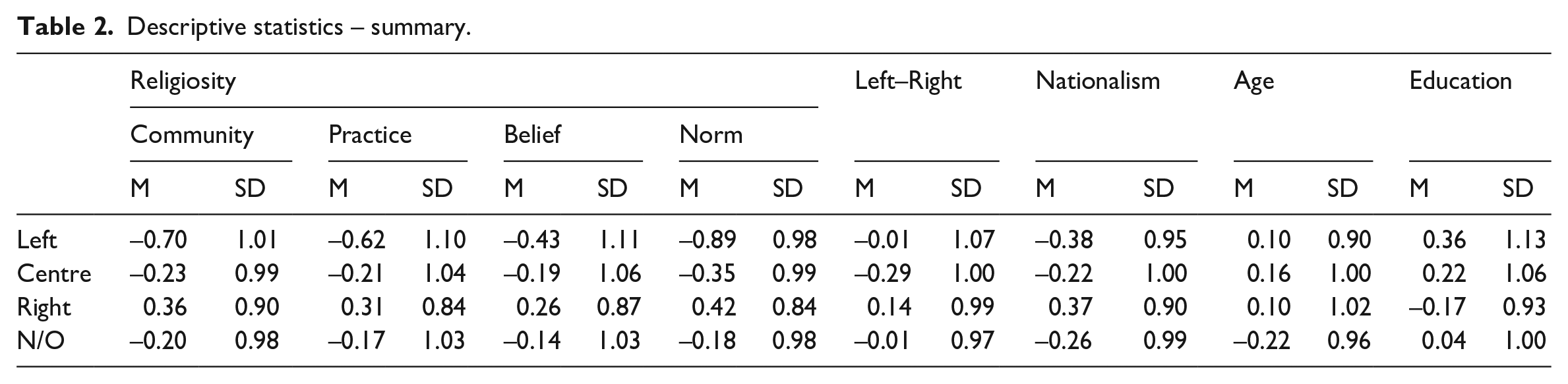
Analysis was conducted using R4.2.2 and RStudio 2022.12.0 software with jtools data handling package (Long, 2022). Missing data (not exceeding 5% for all data) were handled using random forest algorithm included in missForest (Stekhoven, 2022) R package (for summary of descriptive statistics, see Table 2)
Descriptive statistics – summary.
Empirical analysis
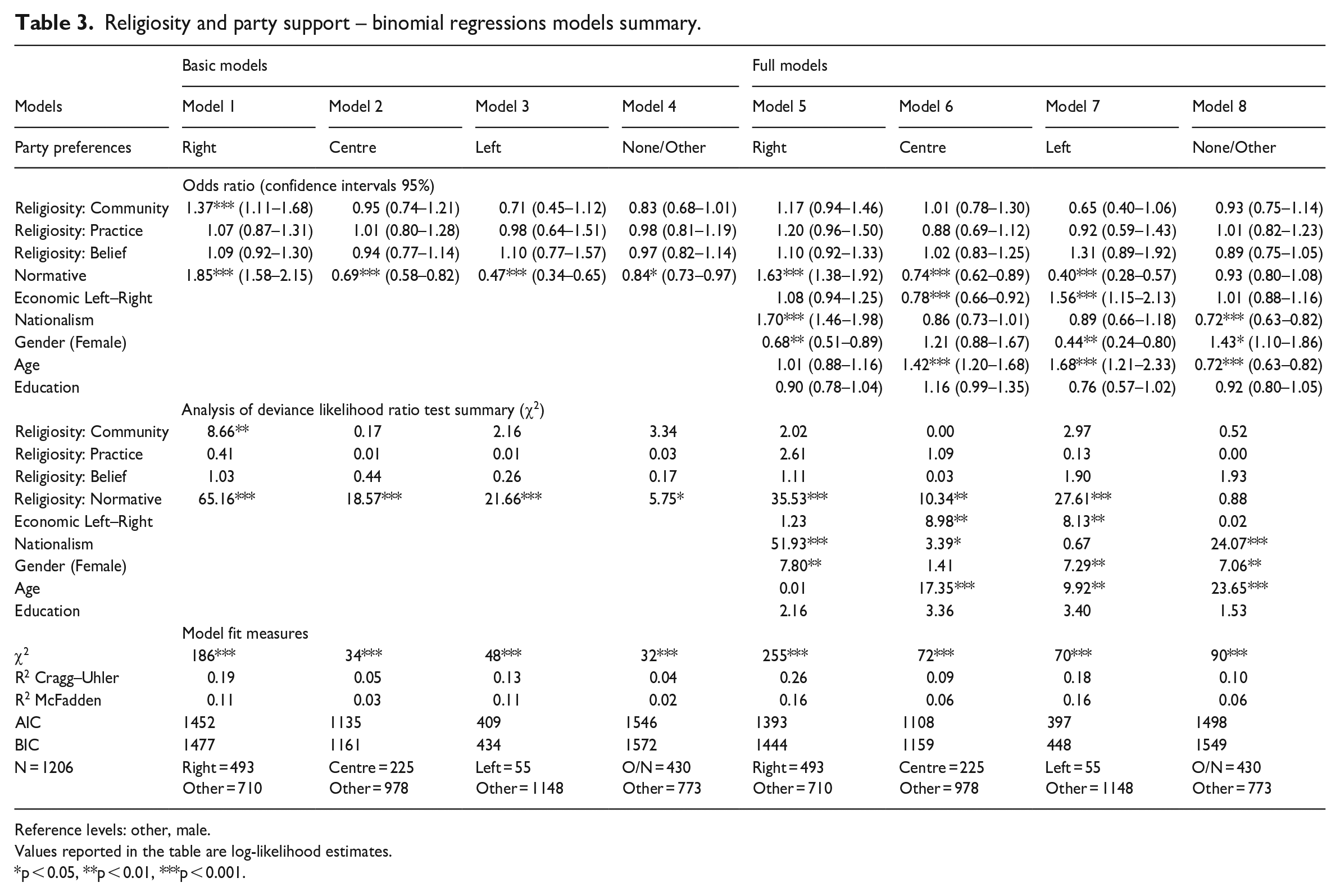
In order to test dimensions of religiosity on predicting party support tendencies, eight Binomial Logistic Regression (Hilbe, 2011) models were created (for models summary, see Table 3). Binomial logistic model requires the dependent variable to be measured on 0–1 scale, so there are only two possible outcomes to predict. Our dependent variable had four options (Right, Centre, Left and N/O) thus in order to apply the binomial model, we dummy recoded each option and created four additional dependent variables, each variable for each supported option, coding the predicted group as 1 and all other options as 0 (for example, if we were to predict voting for Right, we coded it as 1 and other options such as Left, Centre and N/O as 0). Thus, we created series of models, which were predicting the odds of voting for one option in contrast to all other possibilities. Because Logistic Models operate of logarithms and those are unhandy in direct interpretation, thus for better description of estimates, classical odds ratio scores were calculated.
Religiosity and party support – binomial regressions models summary.
Reference levels: other, male.
Values reported in the table are log-likelihood estimates.
p < 0.05, **p < 0.01, ***p < 0.001.
Also, as an additional measure of testing, the relevance of individual predictors in comparison to all others, we conducted likelihood ratio test (Sur et al., 2019) analysis to explore how individual predictor contributes to the model variance. Such a measure is very useful because it shows how much individual predictor contributes on a general level to the predicting abilities of the model in contrast to other included predictors and how much the predicting capacity of the model will decrease if the model would drop given predictor.
The first four models (which we called ‘basic’) included only religious dimensions, next four models (which we called ‘full’) included also all other demographic and ideological factors. All basic models proved to have a high model fit (p < 0.001). Likelihood ratio statistics of deviance indicated mostly significant contribution of norm (for summary, see Table 3: Models 1–4) dimension of religiosity. The only exception was Model 1 (prediction for right-wing party preferences), which revealed also highly significant (χ2 = 8.66, p < 0.001) community dimension.
Analysis of odds ratios for right-wing preferences model (for summary, see: Figure 1) revealed positive impact and odds of support was 85% (p < 0.001) higher for respondents with stronger normative religiosity and 37% (p < 0.001) higher for respondents with stronger community religiosity. Among respondents who had other preferences, we noted negative impact of norm religiosity, thus stronger norm religiosity decreased the odds of support for the centre by 31% (p < 0.001), for left by 53% (p < 0.001) and for other/none by 16% (p < 0.05).
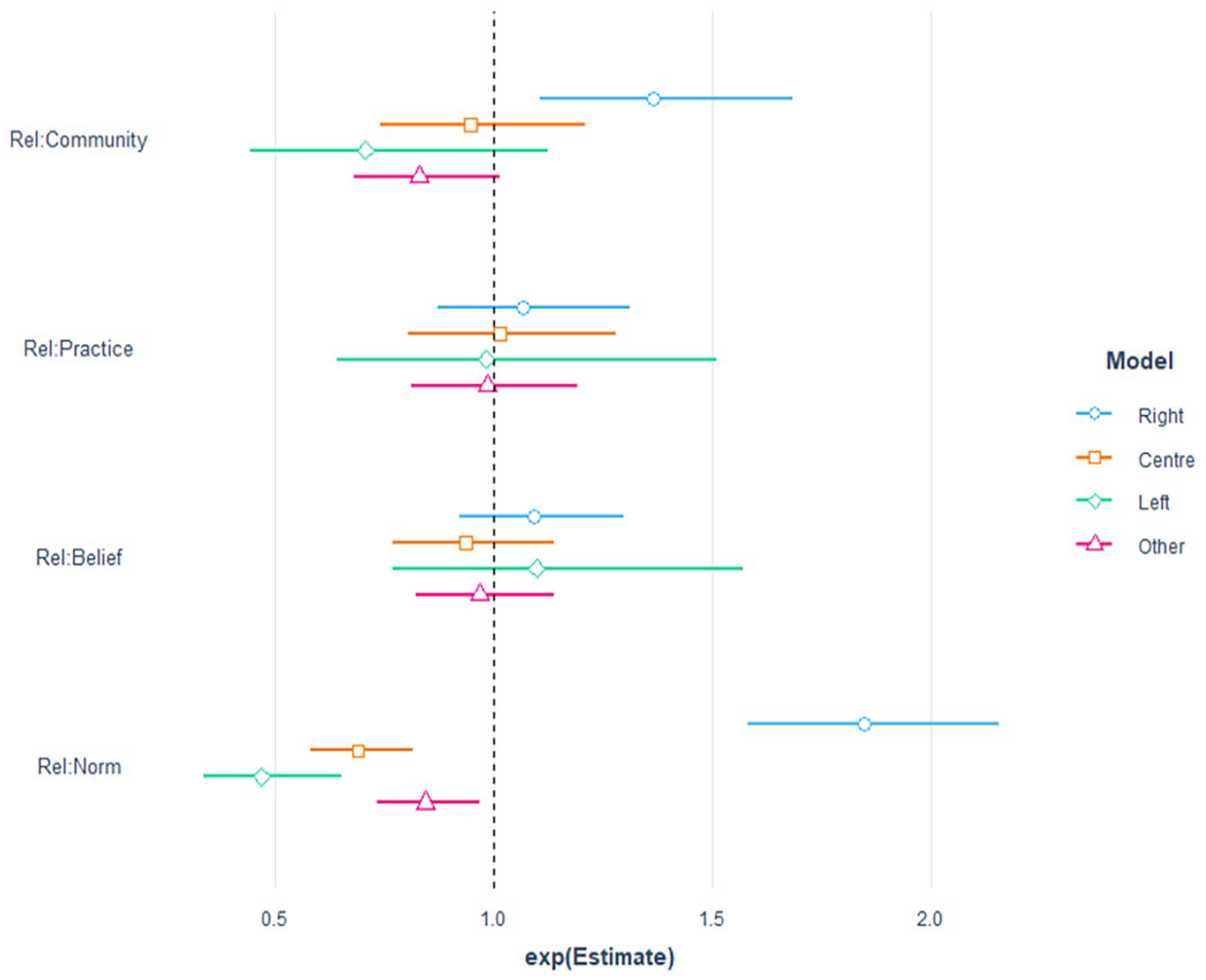
Party support and religiosity (odds ratio, 95% CI) – basic models.
All full models also proved to have highly significant fit (p < 0.001). Likelihood ratio test statistics (for summary, see Table 3: Models 5–8) indicated quite similar scores for religiosity, when compared to the basic model, that only norm religiosity proved to have the highest and the most significant deviance contribution for predicting party preferences, with one notable exception of other and non-voters. From the analysis of the odds ratio (for summary, see: Figure 2), we could note that stronger norm religiosity increased the odds of support by 63% (p < 0.001) for right-wing and decreased the odds of support by 26% (p < 0.001) for centre and by 60% (p < 0.001) for left-wing parties.
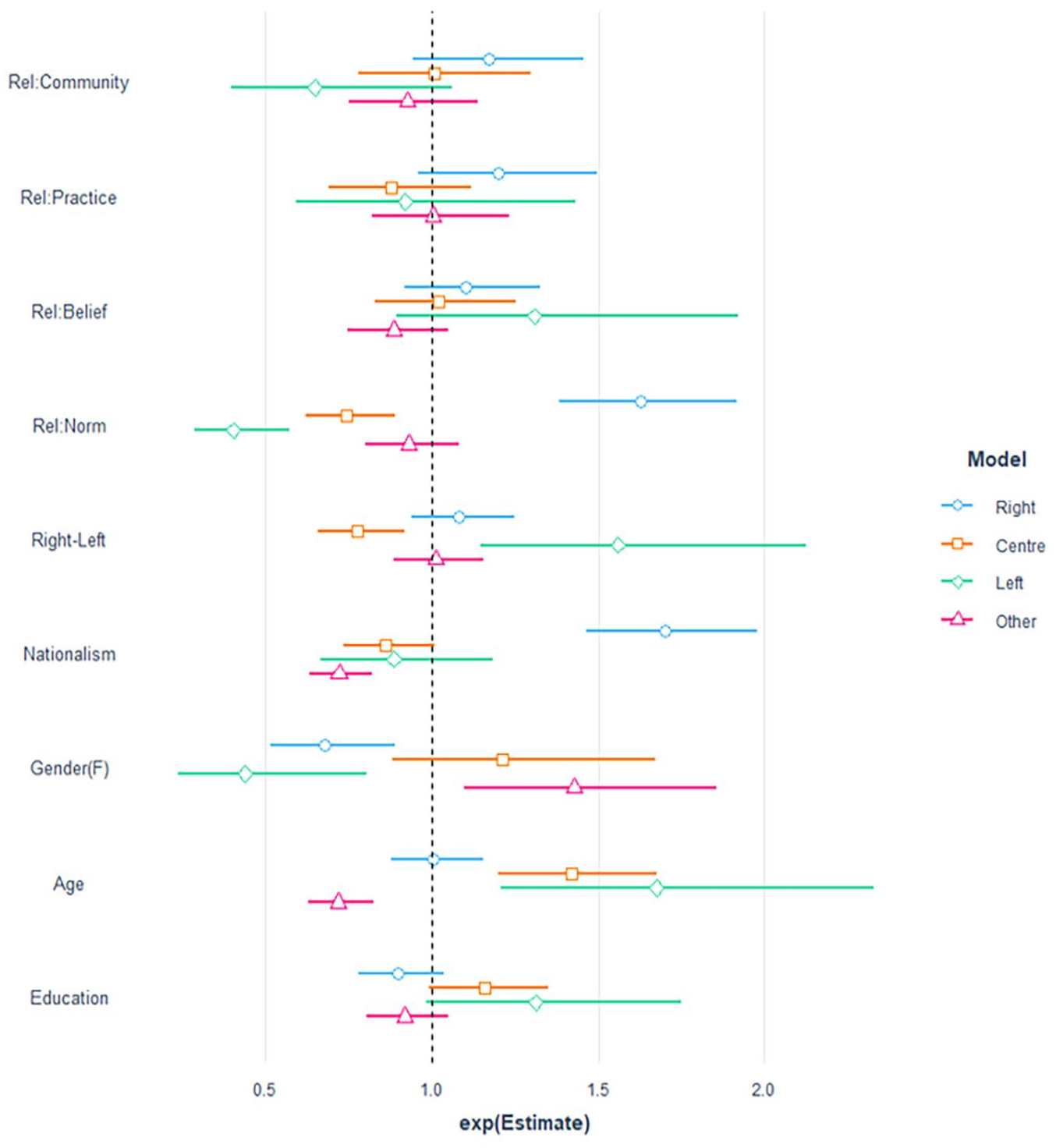
Party support and religiosity (odds ratio, 95% CI) – full models.
We also noted series of additional contributions for predicting party preferences from other factors. Odds for support of right-wing parties increased by 70% (p < 0.001) when respondent had stronger nationalistic beliefs and were male (p < 0.001). For centre, odds were increasing by 48% (p < 0.001) among older respondents and were significantly decreasing by 22% among economic leftists (p < 0.001). For left, odds were increasing by 56% among economic leftists and older respondents (68%, p < 0.001), but were decreasing among females (56%, p < 0.001). Finally, odds of having other/none supporter attitude was increasing among females (43%, p < 0.05) and were significantly (p < 0.001) decreasing among nationalists and younger respondents.
Discussion
Based on the findings, we could discard the first hypothesis, which assumed that all religious dimensions would be significant predictors for party support in Poland. Only one – norm – dimension of religiosity proved to have a strong association with party support attitudes. Norm religiosity proved to be resistant for more complex modelling and was the only dimension of religiosity in basic and full regression models, which held a significant predictive impact. In all models, stricter religious moral code meant higher probability for right-wing support. Such findings are consistent with studies proposed by other authors (Daenekindt et al., 2017; de Koster and Van der Waal, 2007) who indicated moral traditionalism or moral conservatism as a specific indicator inspired by religiosity and which should be diagnosed separately from other ideological attitudes like ethnocentrism, authoritarianism or nationalism to predict populist right-wing support. Also, the gathered results somewhat overlap with the findings of Xia (2021) who discovered significant differences in probability of vote for radical right-wing parties in Poland moderated by moral conservatism and significantly smaller effect in regard to more general religious attitude (no sub-dimensions were explored by the cited author). Based on the sources, we are met with a difficult methodological question: is norm religiosity and moral conservatism the same phenomenon or those are two separate ideological attitudes? If we assume after Daenekindt et al. (2017) that religiosity as a shaping factor in one’s rising is often more primal (it occurs from the beginning of socialization) and superior (religious sphere is forcefully imposed by the parents on the child) to other identity factors, thus we may assume that it sets the basic ground for normative judgement about reality. Cited authors argue that in majority of religious movements there is imprinting of contempt towards homosexuality, abortion, divorce or euthanasia, because they are presented as sinful unnatural aberrations or evil deeds that undermine/endanger traditional moral values. This narration is especially evident for Christian-dominated countries, such as Poland. Such rhetoric is not present in mainstream, secular ideologies. It is hard to find a secular morally conservative individual who has strong contempt for homosexuality, abortion, euthanasia or divorce because what would be the premise of such contempt? Negative attitude towards those phenomena can be only explained by ideological beliefs grounded in socially constructed myths, filled with specific interpretation of sacred value of one’s life and family ties (Levi-Strauss, 1969, 1978). Those are in nature deeply relative culturally and religiously rooted premises. Thus, we can conclude that we may have no clear separation line between secular moral conservatism and norm religious beliefs, and we may treat them as synonymous. If such explanation may be perceived as valid, then obtained results from this study are strongly coherent with already published findings.
Partially discarded should be the second hypothesis, which assumed a positive correlation between all dimensions of religiosity and party support with specific regard to practice dimension. Results indicate that only norm religiosity proves to have strong diversifying impact. Correlation is positive in regard to right-wing voting, but it becomes more negative in regard to central and especially left-wing support attitudes. The findings fit only partially or in direct contradiction (Marcinkiewicz and Dassonneville, 2021; Markowski and Stanley, 2016; Turska-Kawa and Wojtasik, 2020; Werts et al., 2013; Xia, 2021) to other authors who based their measurement of religiosity on affiliation to specific denomination or mass attendance and revealed that religiosity is positively associated with right-wing and/or populist party support. In none of those cited studies normative religiosity per se have been included, thus no direct comparison can be made. Such results thus open new debate about the current state of affairs regarding the role of religiosity in voting/supporting behaviour in Poland. In perspective of the presented findings, use of such ‘classical’ indicators such as mass attendance or affiliation may be redundant and outdated. In theory, we can imagine the mechanism in which higher church attendance means a higher probability of right-wing voting, assuming further that believers who go to the church, are brainwashed in ongoing institutional socialization and the more often they go to church, the more convinced they become to support specific party. Similar logic can be tracked in denomination affiliation, where open loyalty to a group and the need for maintaining ideological coherency between religious beliefs and social behaviour are crucial. Although according to gathered findings it seems that those indicators may be misplaced or their predictive power may be seriously overestimated in case of Poland. We argue that religiosity seems much more complex and is shaped by the condition of Polish religious mentality, which is in the process of serious post-religious transformation. We can trace Polish religious mentality in reports published by CBOS (Bożewicz, 2020a, 2020b, 2022) in which we can note that Poles, although by majority identify as Christians or members of denomination, have in reality small ritual and communal activity. Position of church is becoming dubious and Poles are very diversified in positive/negative perception what ‘church’ is and what values it brings to ones’ life. Half of the religious respondents indicated God as somewhat significant in their lives. Poles also indicated that the main motive to be religious is the need for continuation of tradition in their family and only a small portion indicates deep religious experience as the main motive. Thus, Polish religiosity may be considered very diversified, superficial in behaviour or opportunistic. Although norm religiosity, not even present in those reports, appears to be different and it can have a direct relation to social events that occurred after 2015 in Poland. During this period, Polish society witnessed serious public debates regarding abortion (Calkin and Kaminska, 2020), euthanasia (Gierycz, 2020) and LGBTQ+ (lesbian, gay, bisexual, transgender, and questioning (or queer)) community rights (Laddach, 2021; Żemojtel-Piotrowska et al., 2023). Large protests and demonstrations were organized in the biggest cities in Poland such as Kraków, Warsaw, Poznań or Wrocław. Such social initiatives as Pride Parades (for LGBTQ rights) or Black Marches (for women’s reproductive rights) had serious political impact and according to cited authors they became a cause of even stronger social bi-polar differentiation. During those actions, activists’ effort was focused not only on changing official social discourse but also on the demand to change the stated law. In practice, that meant legalization of same-sex marriages, non-limited abortion services, possibility for controlled euthanasia and changing the legal status and privileges of ‘traditional’ family institution. Indeed, that meant a serious reshaping of Polish quite conservative cultural, political and legislative landscape and was met with serious counteraction directed by the right-wing NGO (pro-life) organizations, conservative United Right government, radical right-wing politicians representing such parties for example as ‘Konfederacja RP’ and the main religious actor – Catholic Church. We argue that normative dimension of religiosity became the leading field of motivation to support specific parties because it is dealing with still most tabooed traditional firmaments and myths of Polish society, preserved by the right-wing conservative government and the dominant public role of the Catholic Church. The role of norm religiosity analysed through prism of cleavage theory (Hernández and Kriesi, 2016; Kitschelt, 2001) may indicate that norm religiosity became the main cultural field of social tension and ideological affiliation manifested in specific party support. For a country dominated by one Christian denomination with strong traditional and conservative values, in order to understand voting/support preferences, there is maybe no point in asking how often someone is praying or if he or she is a member of specific church denomination like in some previous studies (Werts et al., 2013). Today it seems, if we want to predict some political action or we want to understand motivations of religious Poles who support right-wing options, we need to ask about openness towards morally challenging issues and ask them about their attitude towards taboo.
Conclusion
Based on the conducted analysis and discussion, we can formulate a few conclusions. Religiosity is still one of the most influential factors in understanding political attitudes in Poland. Although future studies regarding Poland should consider paying more attention to diagnosing multi-dimensional religiosity and should pay special attention to monitoring and exploring norm religious dimension, which is concentrated on private attitude of believers in regard to hard moral issues as the most impactful and the most diversifying among Poles. The norm dimensions are especially valuable for detecting positive attitudes towards right-wing parties and negative attitudes towards left-wing parties. Lack of possibility to fully replicate already published studies raises serious questions about the current understanding of the role of religiosity in the political space in Poland and gives limited space for making any causal inference claims. From the gathered and processed data, we can conclude that religiosity of Poles is not significant for political actions when defined by religious axioms, beliefs, rituals and prayer. It seems that today in Poland political action, when analysed in regard to religiosity, are dictated by attitude towards controversial moral issues such as homosexuality, abortion, euthanasia or divorce. Those issues force one to reevaluate strict religious code and adapt religious values into very individualistic post-secular social and political reality (Taylor, 2020). Discovering and establishing norm religiosity dimensions as the core focus of religious expression of Poles in political actions is a significant contribution of this article to the ongoing debate and is connecting to the well-established niche of exploring political impact of moral conservatism attitudes (Daenekindt et al., 2017). Norm religiosity may be in Poland the main and most successful source of preserving conservative beliefs and may had become the main cultural field of ideological bi-polar social conflict with direct impact on political motivations of individuals. Such observation seems to hold continuous effect promoted by cleavage theory explored and described in regard to central and eastern European countries almost 30 years ago by Kitschelt (2001).
Supplemental Material
sj-docx-1-scp-10.1177_00377686241239613 – Supplemental material for Impact of multi-dimensional religiosity on party support in Poland
Supplemental material, sj-docx-1-scp-10.1177_00377686241239613 for Impact of multi-dimensional religiosity on party support in Poland by Kamil BŁASZCZYŃSKI in Social Compass
Footnotes
Acknowledgements
The author wants to thank Karolina Borońska-Hryniewiecka, Agnieszka Turska-Kawa, Piotr Sula, Małgorzata Madej, Przemysław Żukiewicz, Mateusz Zieliński and Tomasz Woźniakowski for their helpful comments.
Funding
The author(s) received no financial support for the research, authorship, and/or publication of this article.
Supplemental material
Supplemental material for this article is available online.
Notes
Author biography
Address: University of Wrocław, Building 2/3 Campus of Social Sciences, Koszarowa 3, 51-149 Wrocław, Poland.
Email:
References
Supplementary Material
Please find the following supplemental material available below.
For Open Access articles published under a Creative Commons License, all supplemental material carries the same license as the article it is associated with.
For non-Open Access articles published, all supplemental material carries a non-exclusive license, and permission requests for re-use of supplemental material or any part of supplemental material shall be sent directly to the copyright owner as specified in the copyright notice associated with the article.
