




Abstract
This article analyzes ethical issues arising in transreligious foster care placements in relation to foster children’s needs regarding religious socialization and identification. Applying Urban Walker’s expressive-collaborative framework to 30 qualitative interviews with foster parents, foster children, parents, and professionals, we elaborate and apply a three-level reflection on Christian foster parents’ ethics of care in everyday practice of foster care. A first-level reflection demonstrates that integrating the foster child in the foster family often leads to predominant Christian socialization of foster children. A second-level reflection demonstrates asymmetry between foster parents and birth parents in the religious socialization of foster children, leading to confusion for the foster child and (potential) conflict with birth parents. Finally, a normative reflection leads us to conclude that foster children in transreligious placements need loose and hybrid moral frames in which they can alter, shift, and navigate their multiple identifications and partialities as part of their development.
Introduction
Bouchra is 14 years old; her family migrated from North Africa to the Netherlands. She has been living in a foster family since just after she was born, initially together with her sister Jamila, but Jamila moved back to live with their mother during primary school years. Growing up in a Christian foster family, Jamila became interested when her friends in church and school peers talked about being baptized as a baby. She asked her foster parents if she could be baptized. The foster parents decided to baptize Jamila and her sister Bouchra; they had the legal right to decide. Mother (who is Muslim) had been informed, and gave her permission. After Jamila moved back to her mother, she has grown more interested in Muslim practice. As a teenager, Jamila chooses to wear a headscarf and she frequently raises the issue of religion with her younger sister Bouchra during visits. According to her foster parents, Bouchra sees herself as a Christian. She actively participates in the Christian social life of her foster family, and rejects her Islamic origins. The relationship between Bouchra and Jamila and their mother is strained and has cooled down recently.
The story of the two sisters as narrated by their foster parents shows diverging trajectories of religious identification. It suggests that such identifications may alter and shift over time. This contrasts with the baptism of the Muslim girls at a young age, which seems to suggest their primary identification is Christian. Baptism is a religious practice and a metaphor for the immersion of foster children in a Christian way of living and perceiving the world. Research suggests that foster children with multiple religious identifications, who are mainly immersed into the worldview and religion of the foster family, may (eventually) experience internal or interpersonal conflicts around religion, and pressures in their relationships with the birth family (Pitcher and Jaffar, 2018; Van Bergen et al., 2022). Legally, the decision to baptize is not considered problematic if the legal guardian gives permission. However, as an ethical decision baptism of Muslim foster children has particular consequences for their religious socialization and identification. In this article, we explore how these ethical issues arise in the everyday religious life of foster families, and how foster parents respond to and navigate these issues. We offer an ethical analysis of foster parents’ responses to these ethical issues, drawing on foster children’s needs related to religious socialization and identification.
This study is informed by qualitative research with Christian foster parents, as well as some birth parents, foster children, and foster care professionals. Some of the birth parents of the foster children in this study consider themselves Muslim, Yezidi, or Hindu, while others do not refer to a religious tradition. The majority were Christian foster parents and active members of Protestant churches, including the mainline church PKN, as well as conservative protestant churches such as the Gereformeerde Kerken Vrijgemaakt and the Oud Gereformeerde Gemeenten, and evangelical churches. Despite this diversity in denominations, foster parents often had a conservative orientation (e.g. Klaver, 2011b). Calvinism as a set of ideas and practices deeply influenced Protestant Christian foster parents across denominational divides (Keane, 2002).
This article starts with a literature review on religious socialization and identification of foster children, followed by an introduction to the ethical approach chosen to analyze transreligious foster parenting. After a section describing the methods used in the study, the ethical aspects of foster parenting in transreligious placements will be outlined in three empirical sections. The article ends with an ethical reflection on some of the foster parents’ strategies to deal with challenges in relation to foster children’s religious needs. In the discussion, we summarize the main arguments and review them in the light of some relevant international research on the theme.
Religious socialization and religious identification and implications hereof for foster children
In this literature review, we explore parents’ role in religious socialization and the challenges that emerge around socialization in relation to religious differences. We end with considering the dilemmas that may arise in transreligious foster families.
Family is the primary basis for religious socialization (Smith et al., 2020; Thiessen and Wilkins-LaFlamme, 2017). Parent’s church attendance, for example, predicts future church attendance of their children (Vermeer et al., 2011). In Christian families, children are introduced to basic Christian beliefs, norms and practices, and referential frames, including stories and figures from the Bible, key theological concepts, and church doctrinal debates (Beekers, 2021). By comparison, religious socialization in Muslim families includes learning how to pray, participating in religious ritual moments such as Ramadan, and attending Quran school and social activities (Beekers, 2021; Smith and Adamczyk, 2021).
Research on socialization in non-religious or marginal-religious families demonstrates an emphasis on autonomy and choice (Manning, 2015; Thiessen and Wilkins-LaFlamme, 2017; Zuckerman et al., 2016). In a similar vein, for religious parents it is important that children choose for religion out of free will (Smith et al., 2020: 137; Smith and Adamczyk, 2021). Protestant Calvinist families in particular value sincerity, which means that adolescents are expected to make autonomous religious choices and then act according to these values (e.g. Keane, 2002). The pious young Christians and Muslims researched by Beekers (2015) made a personal choice to practice religion during their teens. Yet, how choice is approached in religious families differs from non-religious families, a strong diversion from parents’ views is not common in religious families (Maliepaard and Lubbers, 2013; Smith et al., 2020; Stark and Finke, 2000; Zuckerman et al., 2016).
Children also develop their religious orientations in interaction with the people and institutions around them (Bengtson et al., 2014). In increasingly religiously diverse societies, this means that children develop their religious identities in interaction with other religious and secular traditions. Children raised by parents with two different religions, for example, are more likely to reject the religious traditions of their parents, while fundamental changes in the family household during childhood disrupt religious transmission (Bengtson et al., 2014). Also, if a child is granted autonomy related to religion at a younger age, this may influence parents’ success in religious transmission (Groen and Vermeer, 2013).
As one of the most secularized societies in Europe with a religiously diverse population (De Hart et al., 2022; Schuh et al., 2012), religious socialization in the Netherlands is not without challenges. In response, conservative Protestant communities have developed a ‘counterculture’ of conservative Christian values, practices, and institutions (Exalto and Bertram-Troost, 2019; Klaver, 2011b). Parents immerse children in a religious social life at a young age to offer them a firm Christian foundation (Smith et al., 2020: 158). As volunteers, religious foster parents have the right to practice their religion as part of family life (Van de Koot-Dees et al., 2023). Yet, transreligious foster placements are challenging in families in which religion deeply defines parents’ identity (Van de Koot-Dees et al., 2023). Ethical dilemmas may emerge in relation to parents’ fear that birth children break ties with religion.
Furthermore, asymmetries in religious socialization by foster families and birth families are to be expected. Minority religious parent’s success to embed children in their religious practices depends on their ability to form warm bonds with them (Van Tubergen, 2013). This is challenged when birth parents have less opportunities to do so due to out-of-home placement. In addition, birth parents who are also religious minority parents are highly aware of their responsibility for religious socialization, which may trigger a preservationist approach (Beekers, 2015; Smith et al., 2020; Smith and Adamczyk, 2021; Van Tubergen, 2007). Limited capabilities by birth parents to contribute to religious socialization after out-of-home placement may put a strain on relationships with the child and foster parents. Since ‘parenting together’ with birth parents (e.g. Aartsen et al., 2021) is the desired direction for foster care, ethical dilemmas may emerge in relation to this.
Finally, foster children’s socialization happens in the context of their multi-directed partiality (e.g. Noordegraaf and Van de Koot-Dees, 2018), a balancing act in which they negotiate their needs, the needs of birth parents, foster parents, and others (e.g. Degener, 2021). Foster children may voluntarily adopt the religion of their foster family (Van Bergen et al., 2022), yet Muslim foster children may still experience insensitivity to their religious needs and wishes (Pitcher and Jaffar, 2018). They may hide these needs or not express them as religious (Degener, 2021), as they wish to engage with Islam as a cultural tradition to fulfill a sense of belonging (Cheruvallil-Contractor et al., 2021). Furthermore, even when foster children lose the religion of their birth families, they may reconnect to it in a later phase. Changes in the religious and non-religious journeys need to be anticipated from the start of socialization by their foster families (see, for instance, Cheruvallil-Contractor et al., 2021 on Muslim foster children). The (non-) religious socialization and identity formation of foster children is, therefore, likely to be complex and throws up ethical dilemmas in relation to religious decision-making on behalf of the foster child.
Care ethics as a lens on dilemmas in transreligious foster parenting
In foster care relationships, the care for the foster child is shared between birth parents and foster parents (Aartsen et al., 2021). Ethical challenges may emerge in relation to foster children and birth parents’ religious needs, given the aforementioned asymmetries in religious socialization. We delineate ethical aspects as ‘those aspects of people’s actions, as well as their sense of self and others, that are oriented with reference to values’ (Keane, 2016: 4). We have chosen an ethics of care perspective that allows us to investigate ethical challenges as they emerge in parenting practices (e.g. Wissö et al., 2019). Care ethics enables us to investigate ethical dilemmas due to religious differences as ‘challenges of care’ (Noddings, 1995: 26) rather than as conflicts over distinct moral (or religious) frameworks.
When foster children’s parents and foster parents come from various religious backgrounds, shared parenting requires the capability to navigate diverging needs and desires related to religion and religious practices. The ethics of care model developed by Margaret Urban Walker (2007) is chosen to analyze the subjective and practical aspects of foster parenting in transreligious placements. Walker’s (2007) expressive-collaborative model of ethics, understands ethics as ‘a socially embodied medium of mutual understanding and negotiation between people over their responsibility for things open to human care and response’ (p. 104). According to Urban Walker, moral principles and judgments emerge from the social worlds in which people live, and it is key to understand the social world to understand how people navigate ethical challenges. Ethics as they emerge in everyday practice of parenting are a dimension of ‘actual social lives that inheres a society’s ways of reproducing its members ‘sense of responsibility’ (Walker, 2007: 238).
According to Urban Walker, there is no universal moral standard, and claims of this nature often fail to consider empirical realities and systemic injustices. However, ethical analysis is possible when it considers the social life world and the ethical standards that people adhere to from within their social worlds. This critical moral ethnography makes possible scholarly reflection on how ethical practices can be improved without losing sight of the lived realities and social world of the study participants.
Urban Walker’s expressive-collaborative model evolves through three levels of analysis:
An empirical analysis of the forms that ethical responsibilities take in the practice of foster parenting in Christian families.
A critical reflection of how these everyday practices are embedded in particular forms of ethics and morality. We will consider how ethical decisions make sense in the context of the moral frameworks that foster parents hold. We will also consider foster children’s positions in relation to these ethical decisions, for example, their social worlds, and in particular the (power-) relations with parents and foster parents in which they are embedded (e.g. Card, 2002).
A ‘fully normative reflection’ in which we evaluate whether better ethical decisions can be made in the future (Knibbe, 2009). Here, we bring the empirical data in conversation with existing knowledge on foster children’s needs in relation to religious socialization and identification.
Urban Walker’s normative analysis fits with the qualitative social science approach we take in this article, because of her focus on ethics in practice. For this article, this means that we focus on what people ‘can do’, on their awareness of what can be done and only then consider it as something that ‘must’ be done (Walker, 2007: 244). Foster parents’ ethical decision-making is understood as an improvable practice and we will conclude with giving some suggestions on how ‘better’ ethical decisions can be made. This is guided by the goals of foster care, to offer children a safe and stable environment to restore and realize healthy psychosocial development (NJI, 2023). The literature on healthy psychosocial development in relation to religious socialization and religious identification guides our analysis of how foster children can be (more) successfully embedded in multiple religious and ethical life worlds that they are part of.
Methods
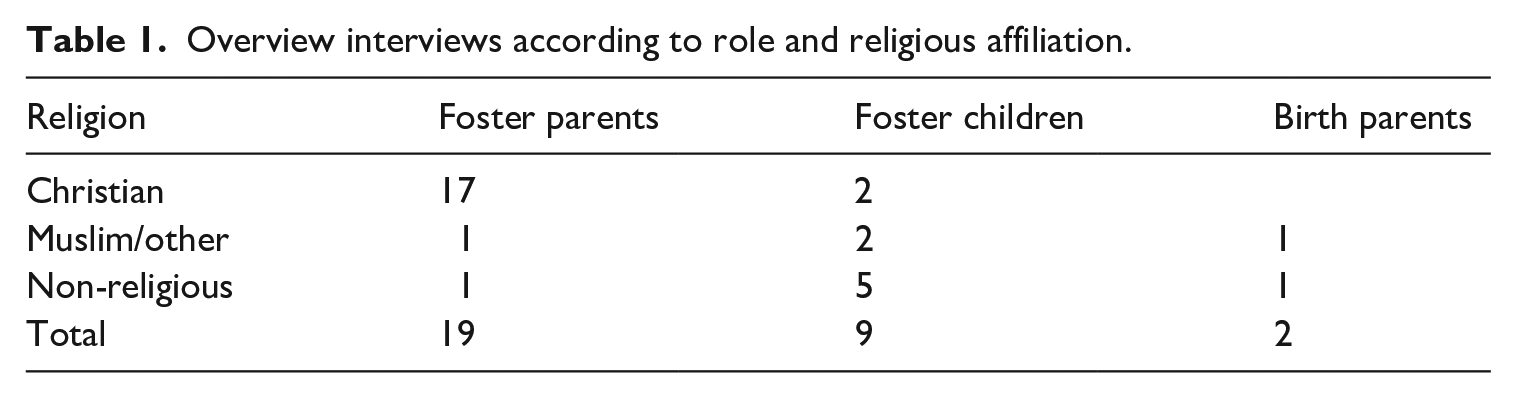
For this study, we have analyzed 30 qualitative, semi-structured interviews with foster parents, foster children, and birth parents in the Netherlands, while the majority of the foster parents (17) were Christian (Table 1). Most of the interview participants were invited to participate via Foster Care organizations; those who volunteered were conservative Protestants. This does not only speak to overrepresentation of Christian foster parents that foster care organizations report; it also indicates a motivation to share experiences in relation to religion. All of the Christian foster parents had experience with transreligious fostering, while some also raised foster children with a different denomination or approach to the Christian religion.
Overview interviews according to role and religious affiliation.
Interviews were conducted by the first author, experienced in ethnographic research in Christian communities and raised in a Protestant family. While familiarity helped to create rapport, this was only mentioned at the end of the interview. The interviews had a narrative character, foster parents shared experiences from their everyday lives, and through paraphrasing and probing, all interview topics were addressed. Interviews with foster parents were 1.5–2 hours each, and interviews with foster children and birth parents varied from 30 minutes to an hour. The interviews took place between October 2020 and October 2021. Most of the interviews were conducted via Google Meet due to Covid-related lockdowns, while some took place in the house of the foster family. This changed the methodological process designed beforehand. Lacking the possibility of an introduction to foster children, combined with Covid-related pressure and online fatigue, fewer foster children committed to an interview than the 20 initially aimed for. In addition, interviewing online interviews also limited the possibility of building rapport and observing the homes. Yet, the interviews elicited concrete descriptions of the everyday practices of foster parents and foster children.
The interviews were recorded, transcribed, and double coded in Atlas t.i., by the first author and a research assistant. Discrepancies and suggested changes were discussed between them. The coding process was both deductive and inductive in nature. Examples of deductive codes were ‘ethical accountability’, ‘religious ontology’, and ‘religious socialization’. Inductive coding focused on recurrent themes and thematic patterns in the interviews. Examples of inductive codes are ‘baptism’, ‘prayer’, and ‘relationship with parents’. Various codes were combined in code groups: baptism and prayer are grouped under religious ritual. Code combinations across the interviews were noted as well. The code ‘baptism’, for example, was often used with ‘relationship with parents’ and ‘religious ontology’. The thematic lines emerging from the analysis inform the subsequent result sections. One exception is ‘Loose threads: collaborating with non-religious parents’ section, as it does not directly cover a thematic pattern that came up in the study but rather describes a unique case that has broader relevance to the findings in the study and the argument we build.
Results
In the empirical sections of this article, we present the findings in this study. In ‘Religion and everyday life in conservative Christian foster families’ section, we apply Walker’s first level of reflection by describing the everyday (religious) socialization context in foster families. In ‘Navigating religious differences in Christian – Muslim placements’ and ‘Loose threads: collaborating with non-religious parents’ sections, we engage with Walker’s second-level reflection considering ethical issues in foster families that care for Muslim children (5) and non-religious children (6). In ‘From immersion in Christian waters to weaving loose webs’ section, we engage Walker’s third-level normative reflection and consider what foster parents can do to ensure healthy religious socialization and identification of foster children.
Religion and everyday life in conservative Christian foster families
Religion has an important influence on the daily life and socialization routines in foster families, as it became apparent in the interviews with Christian foster parents. This includes communal prayers before every meal; daily moments of Bible reading as well as church visits, Bible study groups, and Sunday schools were mentioned. A foster father explained, Well first of all on Sundays, in normal situations we go to church. (...) and there are also things we do not do on a Sunday. We do not play sports. Sunday is a day of rest. During the week we are used to praying before meals and saying grace after. We read the Bible also, after every meal. The children go to confirmation classes, also our foster child goes there. (Foster father, non-religious foster child, May 2021)
Visits with birth parents were usually not allowed on a Sunday. Also, most foster parents send their foster children to Christian schools and social networks were predominantly Christian.
Foster parents in the study were sensitive to challenges foster children might experience at the beginning of the placement. They emphasized their awareness of insecurity and trauma in foster children’s lives. Familiarizing foster children with daily religious practices was intended to contribute to safety and belonging: We have a booklet of the things that happen here in the house, so our foster son could take it in at his own time and at his own pace. When during the Bible reading or prayers he would have a question, we would take the time to talk to him, to explain. Things such as how a church service worked (...) We had a picture book on how the church service worked, the order of things. (Foster mother, non-religious foster child, October 2020)
Some foster children received age-adequate bibles and bible study books from their foster parents, while bedtime rituals included singing and praying with a foster parent. Religious norms and values were seen as important to offer foster children stability. This included restrictions of media use such as TV, social media, and games. In addition, restrictions on swearing were also mentioned. Some families required female members of the family to wear a skirt, while most families would restrict the wearing of clothes with images or objects that were considered unchristian (e.g. a skull).
Religion also influenced socialization in a less tangible manner. A Christian foster mother of Christian and non-religious foster children shared that even though ‘We do not see it ourselves so much (...) it is a very important aspect of being a family, yet not one that is mentioned all the time’. A foster father to a Muslim foster child (14) told about a request from a foster agency to not impose Christian practices on foster children, explained that to him Christianity was not something that could be ‘left in or taken out of the cupboard upon request’. Like other parents in the study, he emphasized that religion was an integrative part of all aspects of his life.
Foster parents reported giving foster children choices regarding religion. The Christian foster mother of a 12-year-old son from a non-religious family explained, ‘My foster son said to me: “I really don’t want to pray”. So, we told him: “If we oblige you to pray, that is wrong. It has to come from your heart and not from your head”’. While foster parents would encourage certain practices, they left it to the adolescents to engage with it. As one parent emphasized, ‘Faith is not about rules, it is something in your heart, something that ... leads you’. This fits with the Calvinist emphasis on interiority (personal experience of religion) and sincerity (that thoughts, feelings, and actions are in line). It ensures that a prayer or conviction is authentic (e.g. Keane, 2016).
In this section, we have applied a first-level reflection of the expressive-collaborative model, describing the everyday religious life in Christian foster families. As Christianity encompasses all aspects of life, foster parents assume that religious practices help foster children to feel safe and at home. This results in Christian socialization of foster children.
Navigating religious differences in Christian–Muslim placements
Walker’s second level of ethical reflection invites us to explore how foster parents navigate religious differences in terms of what makes sense within their moral framework. We will start with a vignette that considers a foster child’s perspectives of Christianity and Islam, and that of her Christian foster parents and Muslim birth mother: Imana (12) shows an antique Bible with on the inside a list with the family lineage upon the start of the interview. Imana is born to a Moroccan Dutch mother who identifies as Muslim, and raised by Christian foster parents since she was a few months old, who also have full legal custody. She considers her foster family as her family. Due to Covid she meets her mother in a public place such as a park, and Imana feels shame to be seen with her mother wearing a headscarf and making her Muslim identity visible. At one point in the interview she even mentions ‘I hate her’, in a provocative way. She goes on explaining how she is critical of Islam just like the Dutch politician Geert Wilders, well known for his Islamophobic discourse in parliament and on social media. Foster parents explain that Imana’s mother struggled with mental health problems and could not structurally be involved in her daughter’s life for a long time. While the mother is now in a more stable situation, foster parents express their concern about the mother becoming ‘somewhat radical’, embracing a more rigid Islamic practice (e.g. observing the fast and praying). Mother’s question to Imana to consider wearing a veil, is perceived by the foster parents as unhelpful in connecting to Imana. Yet, Imana’s mother emphasized that her efforts to commit to a pious religious practice is part of her endeavor to create a stable life. This has also cultivated a desire to contribute to religious socialization, as this healthy and stabilizing influence from Islam is also something she wishes for her daughter.
Imana is socialized in a Christian family and context. Her religious identity strategy includes a rejection of her Islamic background. This is related to the birth mother’s inability to contribute to raising Imana and possibly Imana’s sense of disappointment over this. Imana’s mother is a religious minority parent, who did not seem capable of forming a warm bond with her daughter. This has jeopardized her ability to contribute to minority religion socialization (Van de Pol and Van Tubergen, 2014; Van Tubergen, 2013). The socialization contributions of foster parents and the mother are, therefore, characterized by asymmetry.
In addition, there is another dynamic visible related to the moral evaluation of the Islamic practices of the mother by the foster parents and Imana. The foster parents’ concerns with mothers’ well-being coincided with a concern about her rigid Islamic practice as the contrast they perceive with their Christian beliefs then become aggrandized. The foster parents’ concern contrasts with how the mother herself understands her religious practice as giving mental stability. Prayer and fasting are standard Islamic practices, comparable to prayer and bible reading at mealtime in the foster family. Foster parents may lack this knowledge, or be concerned with the foster daughter choosing Islam while they consider Christianity is a better choice. For most foster parents in the study, Christianity is the ultimate way toward liberation and eternal life.
The religious socialization by birth parents is not only influenced by their religiosity, but also by their capabilities (or lack thereof) to contribute to religious socialization. Jamila, Bouchra, and Imana were born to parents that often struggled with precarious mental health and were parenting in the context of other precarities such as economic instability and domestic violence. This prevents parents from playing a (consistent) role in the religious socialization of their children in foster care. This gap in religious socialization by the birth family can be challenging for the foster child given the impact of Islam on their identification by themselves and their social environment (e.g. Cheruvallil-Contractor et al., 2021).
Some foster parents were critical about birth parents’ inconsistent religious practice and socialization, such as demands for halal or non-pork food for their child, while serving their children pork snacks during visits. A foster parent questioned the sincerity of Islamic beliefs of a mother, because of what they called her ‘loose morals’ regarding sexuality and drugs. It is significant that the critique is framed in relation to the religion of the birth parents. Foster parents who struggle with understanding religion as a cultural tradition give meaning to these struggles in the context of available cultural repertoires. Given the importance of sincerity, Christian foster parents may struggle more with inconsistent religious socialization by birth parents than non-religious foster parents. A critical stance toward Islam in birth families may also echo a secular repertoire in which Islam tends to be seen as dangerous (Schrijvers and Wiering, 2018). Therefore, despite the best efforts, foster parents are not immune to misconceptions about Islam. Unconsciously, foster parents may discourage a foster child from connecting to the religion of the birth family.
In particular, when foster children start exploring their own and multiple religious identifications, this may lead to internal or inter-relational conflicts, as we saw in the case of Imana. While Imana is of course free to make her own decisions regarding religious identification, she may foreclose on this decision at 12 years of age without having had the opportunity to familiarize herself with the religion of her birth mother.
Loose threads: collaborating with non-religious parents
In this section, we will continue with Walker’s second-level reflection by considering examples of collaboration between foster parents and birth parents who consider themselves non-religious. Here, we will zoom in on the webs of relationships in which foster children are embedded, and how foster parents navigate ethical challenges.
First of all, most of the foster parents interviewed in this study emphasized that the birth parents with a different or non-religious background welcomed placement in a Christian family in the process of matching. Foster care professionals confirmed this, because Christian pedagogy is seen as beneficial to foster children because of its recurrent routines. Foster parents strive to make the birth parents ‘feel welcome’ in their family, inviting them to Christmas services to familiarize them with prayer and Bible reading. Some foster parents gave birth parents a copy of the children’s bible they read to foster children. While none of the parents explicitly aimed to convert birth parents to Christianity, their efforts to familiarize birth parents with Christian praxis centralizes the Christian lifeworld of the foster family.
The unforeseen consequences of this centrality are visible in a case concerning the passing of the birth father of a foster child. The case is unique in the data set, but reveals some broader patterns we have observed: When the birth father of Marijn and Evy (ages 9 and 7) passed away, the non-religious birth family wanted to organize a cremation because it is less expensive than a funeral. The Christian foster parents stated: ‘We struggled with this, for religious reasons. We did not want to explain to our children what happened at a cremation. The body will be burned. For a child that is really difficult. We have contacted our foster care professional to explore the possibility of burial, for reasons of the best interest of the children. We have also said that we were happy to cover extra expenses. (...) As it turned out, the brother of the father who was responsible for the cremation, felt very insecure about the farewell and was happy to let them take charge of organizing the burial and memorial service: ‘We wanted to give religion its place, to show the children that... the Bible gives support. We did not want any tensions to emerge during the funeral, because the memorial is more important than the religion. Together with Marijn in particular, we decided to let the children select their favorite psalm and have it play instrumentally, so the children would recognize it and the birth family would not recognize it as religious. (...) At the open grave Johan (foster father) said a short prayer. This was not strange to the children, but we were a bit anxious about the responses of the birth family. (...) In hindsight you experience inner strength for this, there was no tension that day and people expressed that the burial was loving and people were connected together’.
This case about how foster parents navigated the experience of loss in their foster children’s lives reveals aspects of interaction between foster parents and birth parents that require further unpacking. It demonstrates foster parents’ awareness of and sensitivity to the foster children’s well-being in the context of conflicting understandings and practices around death, bereavement, and burial. Furthermore, it reflects sensitivity toward the birth parents and family, the need to connect and collaborate and to prevent tension or conflict from happening. The foster parents’ emotional, practical, and financial efforts made to support the organization of the ceremony speaks to this. In all these efforts, the well-being of their foster children was central. The experience of loss inspired the foster parents to practice ‘parenting together’ in ways they had not done before. However, these efforts simultaneously reaffirmed the centrality of the Christian life world in which the foster parents raised the foster children.
The ethical issue at stake here is whether normative teachings around end of life and burial were in place when raising children who are part of a family system characterized by multiple and diverging religions. In birth families without a concrete religious orientation, such ethics do not always become apparent during the phase of matching. The question then is whether raising children who were born to parents and families with different religious and ethical worldviews would ask for a socialization with space for diverse and hybrid ethics, and what the role of foster parents is in creating space for this.
How will Marijn and Evy reflect on the burial of their father once they are adolescents? Our data suggest that foster children often lack support to mediate between diverging religious and ethical practices. Familiarizing the birth family with the daily religious practices is not enough to bridge this gap. The section title ‘loose threads’, therefore, refers to the awareness of loose threads in foster children’s lives when parents cannot play an active or equal role in religious socialization while remaining part of foster children’s multiple partiality.
From immersion in Christian waters to weaving loose webs
In this section, we turn to Urban Walker’s fully normative reflection. Here we ask whether the ethical understandings and practices of foster parents are good enough, or whether adaptations are needed from the perspective of the foster child’s religious needs.
Most attention from foster parents goes to trying to ensure foster children’s sense of belonging in the foster family (Pinto and Luke, 2022). This flows into the Christian socialization of foster children. Religious decisions are made when considered important to the foster child’s psychological or socio-emotional safety. Yet, foster parents seem unaware that this may jeopardize foster children’s multiple religious identification. Our finding suggests that these ‘natural’ choices by foster parents may lead the foster child to reject one of religious traditions, or be confused over choices they feel they have to make. Healthy religious development, we argue, includes enabling foster children to be connected to diverging and multiple lifeworlds, while the ways in which they interact with it may alter and shift over time according to individual needs.
Foster children need religious and moral frames that are loose and hybrid enough to navigate their multiple and changing religious socialization and identification needs in all phases of the foster placement. This has implications for what foster children are taught on ethical issues, for example, what is a good life, a good person, meaning of life, and death. While we acknowledge that the foster parents of Marijn and Evy made an optimal ethical decision for the children at the moment of the birth fathers passing, a more open and diverse ethics around death, dying, and burial may have prevented the ethical issue from emerging in the first place.
We return to the case of baptism to unpack this further. A fully normative reflection on the baptism of Bouchra and Jamila requires us to consider the multiple meanings of infant baptism in the context of foster care. To the foster parents, baptism is an act of inclusion to let the child know it fully belongs in the foster family. In Dutch Protestantism – distinct from Catholicism for example – baptism is not focused on ‘saving’ the child for the afterlife (e.g. Burgess, 2016; Colijn, 2022; Klaver, 2011a). Parents promise to raise their children in the Christian faith and tradition (Burgess, 2016: 110). Baptism is a sign of Christian socialization rather than conversion across mainline and conservative denominations (Colijn, 2022). In the context of the foster parents’ ethical framework, the choice to baptize the foster child as a sign of inclusion in the family makes sense.
Seen in the broader context of asymmetries between birth parents and foster parents, the choice for baptism can be considered ethically problematic. The decision to baptize the two girls in the vignette made long before they would embark on their individual journeys of identification with religion, marked them primarily as Christian. It did not consider how their needs might shift later in life. Other foster parents in our study had become aware of this ethical challenge through experience. When 13-year-old Berinyan with a Yezidi background asked her Christian foster parents to be baptized, her foster mother explained that she can make that decision when she is a legal adult. This response was influenced by a previous experience with a foster child with a non-religious background whose parents gave permission for the baptism. After the baptism of the foster son, the communication with parents became conflictual, and they wanted to prevent this with Berinyan.
This leads us to argue that taking the multiple partiality of foster children into account in all phases of a transreligious placement is possible for Christian foster parents. When aware, foster parents avoid making religious choices that cannot be changed or undone later on. We do not argue that immersion in foster families is necessarily problematic for foster children, as it offers stability and belonging. However, we consider it ethically problematic if immersing foster children in the family is the only way of making them feel included. Furthermore, as foster children become teenagers, their religious choices should be considered. Finally, it matters if birth parents play a role or are expected to start playing a role in their lives. Foster parents’ ethical awareness on how religious socialization relates to their strategies to include foster children, how this interacts with children’s desires to belong, and with the broader web of relationships is, therefore, crucially important.
We started this article with introducing baptism as a metaphor of the immersion of foster children in Christian family pedagogies. Having come to the end of our analysis, we want to introduce an alternative metaphor. We borrow Virginia Woolf’s (1929) metaphor of a web, both strong and fragile with only slight attachments in all four of the corners. Fostering a child with a different religious background than one’s own means partaking in weaving a new web around the child that may only be slightly attached to what is familiar. Like fiction in Woolf’s metaphor, the new family web resembles something slightly familiar to the Christian family that foster parents know. The new web contains strong threads that are needed for stability and belonging of the foster child, as well as loose threads to ensure foster children can (re-)connect with aspects that are also important, such as the religion of the birth parents. Broken threads are often unavoidable given precarious circumstances and relationships in the foster child’s life, yet all threads are important nonetheless. Foster families need to be aware that parts of this web are unfamiliar, open to change, and influence from other actors that participate in the foster children’s lives.
Conclusion, discussion, and recommendations
We have explored how ethical issues are navigated in the everyday religious life of families in transreligious foster care. In addition, we have offered an ethical analysis of foster parents’ responses to these ethical issues, informed by literature on religious socialization and identification.
In our first-level ethical reflection, we have sketched how we can understand foster parents’ everyday parenting practices in relation to the Christian life world that informs this. Jamila, introduced in the opening vignette, asked to be baptized out of a desire to belong. That was all foster parents had strived for, to offer them safety and belonging. So, we could say that for the foster parents, the decision to baptism also fitted with their understanding and approach to parenting. In the second-level ethical reflection, we evaluated whether this can be seen as a choice that makes sense from the parents’ perspective, as well as from the complex web of relationships in which a foster child is embedded. We have argued that it is important to acknowledge the asymmetries between foster families and birth families, as limited capabilities to offer religious socialization overlap with other challenges birth parents face. A lack of awareness of asymmetry sometimes leads to negative judgment of the religion of birth parents by foster parents. Strong normative positions by foster parents may hinder constructive collaboration with birth families. Therefore, we argued that foster children raised in Christian foster families need loose and hybrid moral frames to explore and alter their multiple identifications and partialities as they develop. A growing ethical awareness on children’s religious developmental needs should be encouraged in foster care and cultivated among foster parents.
The ethical reflection offered in this study is partial and there are ethical issues that arose in the study that need further unpacking. Our focus on religion may unintendedly contribute to essentializing religion in foster families, in particular concerning minoritized religions (Cheruvallil-Contractor et al., 2022). Yet, despite our focus on transreligious placements, ethical issues also emerge in relation to broader worldview differences. The expressive-collaborative model has potential for ethical reflection on such dilemmas, as well as for moving away from the religious/secular binary that informs much social science research on religion (Casanova, 2019).
This article focused only on Christian foster parents. Cheruvallil-Contractor et al. (2022) call for research on religious minority parents’ experiences with and perceptions of foster care, as Muslim parents in particular have been under-researched. Research on the challenges Muslim parents experience in (becoming) foster parents is needed (Cheruvallil-Contractor et al., 2022; Day and Bellaart, 2015). In addition, while a reasonable argument could be made to focus on better religious matches in foster care, research on cultural matching of refugee youth warrants that identities are fluid and negotiated (Raghallaigh and Sirriyeh, 2015). Here, not religion but foster parents’ ability to identify children’s cultural and religious needs and access relevant available resources should be guiding matching.
Finally, there is a need to complement this research with a critical analysis of the cultural competence of foster care policies and ‘religious literacy’ in foster care organizations (Cheruvallil-Contractor et al., 2022). Cameron et al. (2016) who theorize fostering as upbringing in an exploration of fostering in 11 different European countries criticize the ‘psychological reductionism’ that characterizes dominant discourses on child protection in liberal regimes. The authors argue for a focus on ‘upbringing’ in foster families exploring how cultural and intergenerational social reproduction is shared between foster parents, biological parents, and foster care professionals. Transreligious foster parenting needs to be understood in relation to such broadening theoretical endeavors.
Recommendations
The conclusions in this article have implications for foster care organizations and professionals. Professionals should be aware that religious needs of foster children may alter and shift within their life course and evaluate foster parents’ openness to multiple identifications of the foster child. This includes the ability to accommodate children’s and birth parents’ religious needs. That foster children can practice their religion in the foster family may not be enough; children need role models, and instruction on religious and cultural aspects. Rather than building on fixed notions of what religion is, professionals should facilitate foster parents’ reflexive potential. This includes the ability to reflect on their own religious parenting, as well as on their perceptions of this in the birth family. Finally, irreversible decisions relating to religion in transreligious foster care should be avoided, even when there is no legal barrier. Rather, foster children need the space to renegotiate connections in a phase where self-autonomy is more developed. This means that foster parents and foster care professionals need to develop the capacity to discuss children’s choices related to religion with them carefully and emphatically over their life course. Such consistent practices may offer the desired stability to foster children in navigating the familiar and unfamiliar and developing multiple identifications and belonging.
Footnotes
Declaration of conflicting interests
The author(s) declared no potential conflicts of interest with respect to the research, authorship, and/or publication of this article.
Funding
The author(s) disclosed receipt of the following financial support for the research, authorship, and/or publication of this article: This research was funded by ZONMW (Medical and Care Research in The Netherlands), in the programme Ethics and Health.

Author biographies
Address: University of Groningen, Grote Rozenstraat 38, 9712 TJ Groningen, The Netherlands.
Email:
Address: University of Groningen, Grote Rozenstraat 38, 9712 TJ Groningen, The Netherlands.
Email:
Address: Vrije Universiteit Brussel, Pleinlaan 2, 1050 Brussels, Belgium.
Email:
Address: Radboud Universiteit, Erasmusplein 1, 6525 Nijmegen, The Netherlands.
Email:
Address: Vrije Universiteit Amsterdam, De Boelelaan 1105, 1081 HV Amsterdam, The Netherlands.
Email: