




Abstract
A growing body of research has begun to explore the religious and spiritual lives of transgender and nonbinary individuals. Missing from prior sociological research on this topic is how individuals outside the gender binary conceptualize the gender of god(s) and their own genders in the afterlife. Using data from a targeted survey of members of transgender listservs and online activist groups, this study explores two specific religious/spiritual beliefs of transgender and nonbinary individuals in comparison to cisgender individuals: (1) their conception of God’s/gods’ gender(s) and (2) their conception of their own gender in the afterlife. Many trans and nonbinary participants report both their future gender and the gender of any god(s) in which they believe as nonbinary, but not exclusively.
Introduction
While not particularly large, there is a body of sociological research on how people conceptualize god 1 (Bader et al., 2017; Deguara, 2018; Nelsen et al., 1985; Shah et al., 2016; Whitehead, 2012, 2014). Most of this research focuses on Judeo-Christian conceptualizations of God within the United States and draws upon implicitly cisgender samples. Similar to how many surveys exploring prejudice toward religious and sexual minorities (Cragun and Sumerau, 2015) only provide results that assume the targets are heterosexual cisgender individuals (Cragun and Sumerau, 2017), much of the prior research on god images or concepts has drawn on (presumably) cisgender, heterosexual respondents (Nelsen et al., 1985; Sumerau et al., 2017). While that research can be useful in a variety of ways, it obviously leaves out how individuals who are not cisgender conceptualize god(s) and how gender is embodied in the cosmology of transgender and nonbinary individuals.
An additional problem with existing research on god images, within sociology in particular, is that it asks about gender only indirectly and in a somewhat vague fashion. This is in contrast to the variety of explorations of both God’s and individuals’ own gender(s) within theology. There have been a number of explorations of queer and trans theologies within Christianity that seek to ‘queer’ or disrupt understandings of God (Hipsher, 2009). Within these theological explorations of gender, God is frequently portrayed as outside human conceptions of gender, particularly in regard to the Western gender binary system (Bader-Saye, 2019; Cheng, 2011; Stuart, 2007). God-as-father is portrayed as a flawed description of a transcendent being (Cheng, 2011; Deguara, 2018), and gender and sexuality are described as idols to be cast away as all persons become one within the multi-gendered body of Christ (Stuart, 2007). Mollenkott (2007) endows God with the ability to disrupt the gender binary by manifesting in a variety of forms. Thus, while theologians have wrestled with God’s/gods’ gender (Mollenkott, 2007), sociologists have not yet investigated these ideas.
Most of the prior research within the social sciences on god images and gender asks whether people think of god(s) as more of a mother or a father rather than asking if god(s) has/have a gender and what it is (though see Whitehead, 2012 and Howard et al., 2020 as two notable exceptions). At times, people may volunteer their thoughts on God’s gender (Deguara, 2018), but there are few studies that approach this question in a systematic manner. In addition, we are unaware of any research specifically exploring how people think about their own gender in the afterlife. Certainly, some religions have doctrines concerning this issue – like Mormonism (Sumerau and Cragun, 2015) – though for many Christian religions, considering the lack of explicit attention paid to God’s gender in research on god images, a lack of focus on how people conceive of their own post-life gender is perhaps to be expected.
As sociologists, we are motivated, in part, by a recent call for greater attention to how gender and religion intersect (Avishai et al., 2015; Sumerau et al., 2019), though we also note that intersections between religion and gender have been explored in theology for quite some time (Mollenkott, 2007). How nonbinary and transgender people understand and construct their spiritual and religious selves is an important and understudied part of this call (however, see Ashraf et al., 2023, and Pratiwi et al., 2019, for recent attempts to address this issue).
The aim of the present study is to explore how cisgender, transgender binary, and nonbinary individuals conceptualize the gender of god(s) and their own post-life genders. By asking these exploratory questions, we seek to encourage the study of gendered god images and post-life selves among transgender and nonbinary individuals by both gender and religion scholars.
Literature review
Comparative analyses of the different cosmologies of religions have led scholars to realize that there are many ways to think about gods or higher powers (Prothero, 2011; Witzel, 2013). The idea that people hold some image or concept of god(s) is typically referred to as either ‘god image’ or ‘god concept’. 2 Polytheists – people who believe in multiple gods – do not have a singular conception of a god or higher power but rather have many images of gods (Kraemer, 2012). Given the privileging of Christianity and Judaism in social science research on religion (Blumenfeld et al., 2008; Cragun and Hammer, 2011; Josephson, 2012; Schlosser, 2003), there is very little research on god concepts among polytheists, animists, and members of other spiritual and religious traditions.
Theologians, of course, have explored god concepts. Indeed, there are a number of publications from queer and queer-allied theologians that reflect on the nature of God’s gender and the limitations placed upon its understanding by human constructions of gender and sex (Beardsley and O’Brien, 2016; Cheng, 2011; Stuart, 2007). While helpful in understanding the academic conversations happening in divinity schools (Hartke, 2018), these works do not provide empirical data on the ways that trans and nonbinary lay individuals are theorizing their own understandings of God’s gender and their own post-life gender.
Most of the research on god concepts focuses on monotheists – people who believe in a single God. While there are other religions that have a singular conception of a higher power (e.g. Buddhism) or a god (e.g. Zoroastrianism), the world religions that are most commonly thought of as being monotheistic are Judaism, Christianity, and Islam (Kurtz, 2006). Most of the prior research on god concepts focuses almost exclusively on Christians and is largely based on data from the United States.
The bulk of existing research exploring god concepts approaches this question as follows. Respondents are presented with a noun like ‘judge’ or ‘lover’ and then asked how well that noun reflects their conception of their god on some scale. With data on how closely that noun aligns with peoples’ conception of their god, scholars then attempt to correlate god concepts with some other attitude or behavior. Froese and Bader (2008) found that conceptualizing God as wrathful is correlated with denying civil liberties for unpopular groups. Other scholars have shown that belief in a judgmental God is related to more punitive attitudes toward punishments for people who commit crimes (Unnever et al., 2005, 2006). Ellison and Bradshaw (2009) correlated belief in a hierarchical God with corporal punishment of children. Moving away from conceptualizing God as vengeful or judgmental, some research has shown that there are differences in how (presumably) cisgender men and women think about God (Nelsen et al., 1985), and other research has shown that holding a paternal conception of God’s gender (e.g. as a father) is correlated with opposing mothers working in the labor force (Shah et al., 2016).
As the above summary suggests, much of the prior sociological research on god images tries to relate peoples’ conception of a god to some other attitude or behavior. Many of these studies assume that people’s conception of their god proceeds or exists prior to their other attitudes. In most of these studies, the god concept is among the independent variables and some specific attitude is the dependent variable (cf. Ellison and Bradshaw, 2009). Thus, it is implicitly assumed that conceptions of gods come before other attitudes. For example, if someone believes that God is vengeful or judgmental, the assumption in much of the research on god images is that this individual will then hold judgmental attitudes toward certain groups and that it is the god concept that is driving the judgmental attitude toward these groups. We assert that the assumption that individuals’ god image precedes and determine other attitudes should be questioned. We raise this concern as we believe this implicit assumption in much of the prior literature fails to take into account very basic scientific principles of causality, namely that for one phenomenon to cause another, the causal phenomenon must: (1) precede the caused phenomenon in time, (2) must be related to the secondary phenomenon, and (3) other potential causal mechanisms must be ruled out (Baumgartner, 2020; Chafetz, 1978). Research relating god images to other attitudes falls short of Criteria 1 and 3.
God images have been shown to correlate with other attitudes (i.e. Criteria 2). However, recent research on how people construct their gods (Sumerau et al., 2016b) and how they think about the morality of their god(s) has shown that people endow their higher power with their own morality (Epley et al., 2009). Returning to the above-mentioned example, this suggests that people may not derive their judgmental attitudes from their god(s); people could be judgmental and then extend that to both their concept of god(s) and to other attitudes they hold. This raises an important question: Is it possible that god concepts do not precede other attitudes in time but rather that the other attitudes precede and influence individuals’ conceptions of their gods? There could also be some other causal mechanisms that are influencing both god concepts and other attitudes. In short, god images or concepts may be correlated with other attitudes, but it is at least questionable whether people’s conception of god(s) is causing other attitudes or behaviors when the inverse relationship is at least as plausible.
The implicit causal relationship between god images and other attitudes or values is of interest in the current article, but we flipped the implicit causal relationship. To be clear, we are not claiming a definitive causal relationship; our data do not allow that as we have cross-sectional data. However, we frame our analyses in this article such that they assume, opposite to much prior research, that a priori values or beliefs people hold are ‘predictive’ statistically of their conception of their god(s). We hypothesize that if people hold a binary view of gender they will be more likely to think of their higher power as also having a gender that falls into that binary. In contrast, individuals who challenge a binary and biological conception of gender will be more likely to think of their higher power as falling outside the gender binary, effectively ‘transing’ their gods. We use ‘transing’ here in the sense that Stryker et al. (2008: 13) suggest it can be used to function as a disciplinary tool when the stigma associated with lack or loss of gender status threatens social unintelligibility, coercive normalization, or even bodily extermination. It can also function as an escape vector, line of flight, or pathway towards liberation.
Extending the idea that people construct gendered images of gods or higher powers, we also wondered whether people who believe in an afterlife (i.e. a life after the physical death of one’s body) have a concept of what their own gender will look like in that afterlife. There are some religions that suggest gender continues in the afterlife, like Mormonism (Sumerau and Cragun, 2015), but many religions either ignore this question or suggest that gender will be irrelevant in an afterlife (Prothero, 2007, 2011). Despite a fairly extensive literature search, we were unable to find any prior research looking at how people who believe in an afterlife think about their gender in the afterlife.
With no prior research we could find on how people think about their own gender in the afterlife, the present study is exploratory in nature. It is of particular interest in this study since the respondents are people who have wrestled with notions of gender at length (Sumerau et al., 2016a). Thus, two questions are at the heart of this study: How do individuals outside the gender binary think about the gender of their gods? And, how do transgender and nonbinary people think about the gender of their future, post-mortal selves?
Rodriguez and Follins, reviewing the social scientific literature on the religiosity of transgender individuals in 2012, found that there was very little prior research on this topic. They noted that most of the research that claimed to explore the religiosity of lesbian, gay, bisexual, transgender/transsexual (LGBT) individuals prior to 2011 was really on LG individuals with a handful of BT individuals included in the samples (cf. Halkitis et al., 2009). Much of the prior research on how transgender individuals interact with and experience religion has focused on their experience of rejection by religions (Liboro, 2015; Nynas and Yip, 2012; Rodriguez and Follins, 2012) or, in some instances, how they find ways to integrate their gender and their religion (Graham, 2004; Pratiwi et al., 2019; Rodriguez, 2020). Some scholars and therapists have suggested that it can be beneficial for transgender individuals who want to integrate their gender with religion or spirituality to look beyond Christianity to religious traditions that have embraced nonbinary genders in the past (Ashraf et al., 2023; Bockting and Cesaretti, 2001; Kraemer, 2012).
Since 2012, there has been increased attention paid to lesbian, gay, bisexual, transgender/transsexual and queer or questioning (LGBTQ + ) individuals’ experiences with religion and spirituality. For instance, there is a growing recognition that many LGBTQ + individuals have found ways to integrate their gender or sexual identity with their religion or spirituality (Beagan and Hattie, 2015; Fuist, 2016; Moon and Tobin, 2018), though the specifics of how this is done as relates to theology are largely unexplored (though see Poveda, 2017). Sumerau et al. (2019) found that some bi + trans people describe having positive experiences with religion or religious figures in spite of an almost universal recitation of trauma inside religious institutions. The scholarship that does suggest that LGBTQ + individuals can queer religion (Wong, 2017) or integrate religion and spirituality with their sexual/gender identity (Beagan and Hattie, 2015; Fuist, 2016; Yip, 2003) has yet to discuss specific ways transgender individuals’ concepts of god(s) and their ideas about their own post-life gender may help with this integration.
There are several theoretical approaches that speak to how individuals outside the gender binary might integrate their gender with religion or spirituality by reconceptualizing gods’ genders and their own, future, post-life gender. At the sociological level, Durkheim (1995) argued that religion is a way for societies to enshrine, sacralize, and then worship the mores of society. Organized religion has long reflected the environment in which it is located and is continuously constructed and reconstructed (Berger and Luckmann, 1967). At the individual level, there is now compelling evidence that individuals endow their gods with the same values they hold (Epley et al., 2009). Individuals who oppose abortion generally believe that their gods do as well.
While research shows that people may extend their values to gods, it is less clear whether people extend physical characteristics to their gods. Certainly, many people anthropomorphize God (Nelsen et al., 1985) and the ancient gods of the Greek, Roman, and Norse pantheons were very much constructed in the image of humans (Whitmarsh, 2016; Witzel, 2013). However, there are also many individuals and some prominent monotheist religions that refuse to endow gods with a gender – despite historically and commonly using masculine pronouns to refer to their deities (Prothero, 2011). The ways in which individuals conceptualize their God’s/gods’ physical characteristics can have real-life implications. For instance, one study found that regardless of their own expressed gender identity, individuals who explicitly recognize their god as male were more likely to profess support for traditional gender norms, including legitimizing men’s authority in society and rationalizing the existence of gender inequality (Howard et al., 2020).
Given the tendency for people to assign characteristics to gods based on their values and the salience of gender for transgender and nonbinary individuals (Schilt and Lagos, 2017), it seems likely that individuals outside the gender binary may extend their values and beliefs regarding gender to include the way they conceptualize their god(s). This would extend religious embodiment (Talvacchia et al., 2014) and religious and spiritual integration with gender to the level of creating a new sacred canopy that supports both gender identity and religious worldviews (Berger, 1990). The more fluid someone’s conceptualization of gender, the more likely they may be to think of their god(s) as outside the Western gender binary. For instance, if someone holds a nonbinary conception of gender, they may be likely to assert that their god has no gender (i.e. agender) or is all genders (i.e. pangender). This leads to our first hypothesis:
Hypothesis 1: Nonbinary individuals will be more likely to conceptualize gods as nonbinary than cisgender and transgender binary individuals.
This same logic likely extends to transgender and nonbinary individuals’ conceptions of their own supernatural, post-life gender. However, there is another factor at play here as well. For many binary transgender individuals, fitting into the gender binary is an important part of their identity and presentation of self. They may not reject gender as a binary social construct (Schilt and Westbrook, 2009) but rather reject the idea that they were the gender they were assigned at birth. For them, identifying with and being recognized as a specific gender may matter to their conception of self (Baumeister, 1982). The idea that they will be the gender with which they identify in the afterlife may also be an important belief that affirms their self-concept and helps to integrate their religious and spiritual beliefs with their gender identity (Fuist, 2016). In contrast, and relying more on the idea that morality espoused during mortal life will be extended to post-life gender, individuals who reject the gender binary may be likely to suggest that gender will not exist in the afterlife. This leads to our second hypothesis:
Hypothesis 2: Nonbinary individuals will be more likely to suggest their gender in the afterlife will be nonbinary than will cisgender and transgender individuals.
These hypotheses may seem somewhat obvious. Even so, we remind readers that prior research has mostly suggested the opposite – that god concepts influence attitudes. In addition, previous research has not addressed this issue in transgender and nonbinary populations. Thus, our rather simplistic hypotheses actually run contrary to this body of research, making our hypotheses novel.
Data
Data for this study come from a targeted, mixed-methods survey of transgender experience fielded in 2016 after receiving institutional review board approval. The survey was hosted online and used a combined quantitative and qualitative approach. While many of the questions included pre-designed response options, almost all of the questions also included an ‘other’ box to allow people to respond in their own words. In addition, the survey included numerous open-ended responses.
Respondents were recruited using two approaches. First, the survey was advertised by US-focused transgender organizations on their social media and through mailing lists. Second, at the end of the survey, participants were shown a URL that they were encouraged to share with other transgender individuals. The only restriction to participation was that participants had to be at least 18 years old.
A number of cisgender individuals took the survey (n = 172). We include these individuals in our analyses below as a comparison group. After data cleaning for incomplete responses, a total of 467 transgender and nonbinary individuals completed the survey. Of note, 124 of these individuals were from outside the United States. Given that we do not have a clear sampling frame for our study, that we are not making claims of causality, and we are trying to maximize the number of individuals who believe in gods in the study, we include those individuals in our analyses as well. In earlier iterations of our statistical models, we included a dummy code indicating whether or not a participant was from the United States. The variable was not significant in either model and, lacking a theoretical rationale to include it in the models, the variable was excluded from our final models.
This approach to sampling a population is known as a targeted survey (Kraut et al., 2004). Targeted surveys have benefits and drawbacks. The primary benefit of such surveys is that they allow for the collection of data on hard to reach, small, or unique populations. Given that the estimated percentage of transgender adults in the United States is just 0.6% (Flores et al., 2016), gathering a nationally representative sample of transgender and nonbinary individuals would be challenging and prohibitively expensive. Targeted sampling allows for the collection of data on small and difficult-to-reach samples like transgender individuals, but does so at the expense of representativeness. Therefore, we cannot generalize from our sample to the broader population of transgender and nonbinary individuals in the United States or internationally. This study, then, should be viewed as exploratory research providing initial insights on the relationship between gender and religiosity/spirituality among a non-representative sample of transgender and nonbinary individuals.
Methods
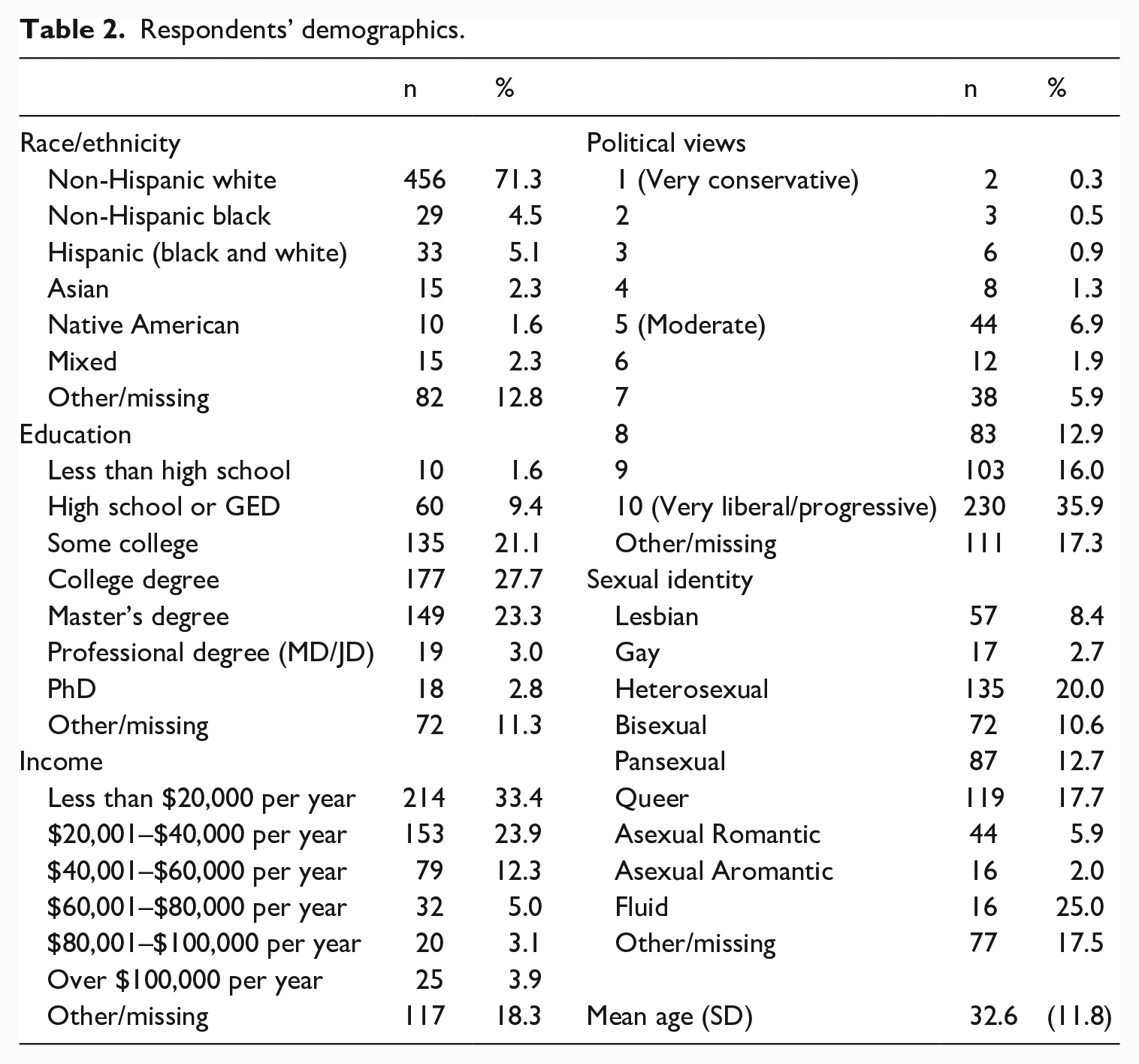
The first question participants were shown asked them the year they were physically born. Response options ranged from 1890 to 2000. This question was used as a screening question. If participants chose 1998–2000, once they clicked next, they were taken to a screen that thanked them for their interest in the survey but informed them that they had to be at least 18 to complete the survey. For individuals 18 and older, this question was used to calculate their age. Age is reported with other demographic data in Table 2.
Respondents’ demographics.
The second question in the survey asked participants, ‘Which of the following best represents your gender identity?’ Participants could choose one of the following 18 options: Transgender, Transsexual, Gender Fluid, Genderqueer, Nonbinary, Intersex, Agender, Gender Neutral, Pangender, Bigender, Transvestite, Cross Dresser, Trans Man, Trans Woman, Cisgender, Cis Man, Cis Woman, or Other (with the option to write in their own gender identity). To simplify our analyses, these options were recoded into just three categories: cisgender (cisgender, cis man, and cis woman), transgender binary (transgender, trans man, and trans woman), and nonbinary (all other options). This coding aligns with suggestions from scholars for how to classify transgender individuals based on the labels they use (Schrock et al., 2014). We recognize that collapsing all trans and nonbinary identities into two categories represents a degree of erasure of intra-category differences. However, due to the exploratory nature of this study and the limitations of our sample size we believe this is the best way to handle these categories for our current analyses. Table 1 shows how the survey participants responded to this question and how the responses were coded.
Survey respondents’ genders and recodes.
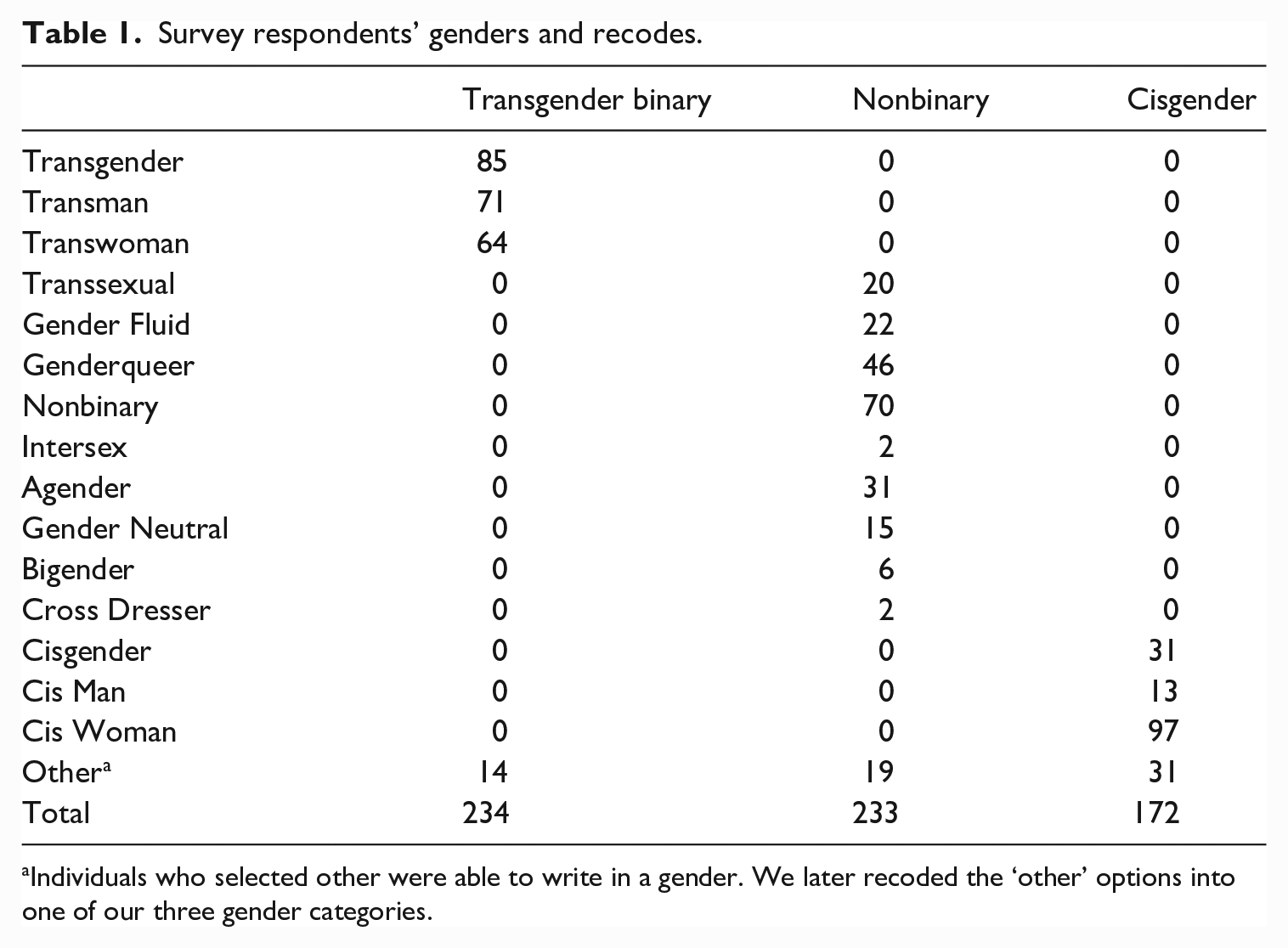
Individuals who selected other were able to write in a gender. We later recoded the ‘other’ options into one of our three gender categories.
Participants were also asked which state they were from (with an option for selecting outside the United States), their race/ethnicity, sexual identity, level of educational attainment, income, and where they would put themselves on a political scale from very conservative to very liberal. Survey respondents were from 42 states, Washington, DC, and about a dozen other countries. Demographic data for the final sample are reported in Table 2.
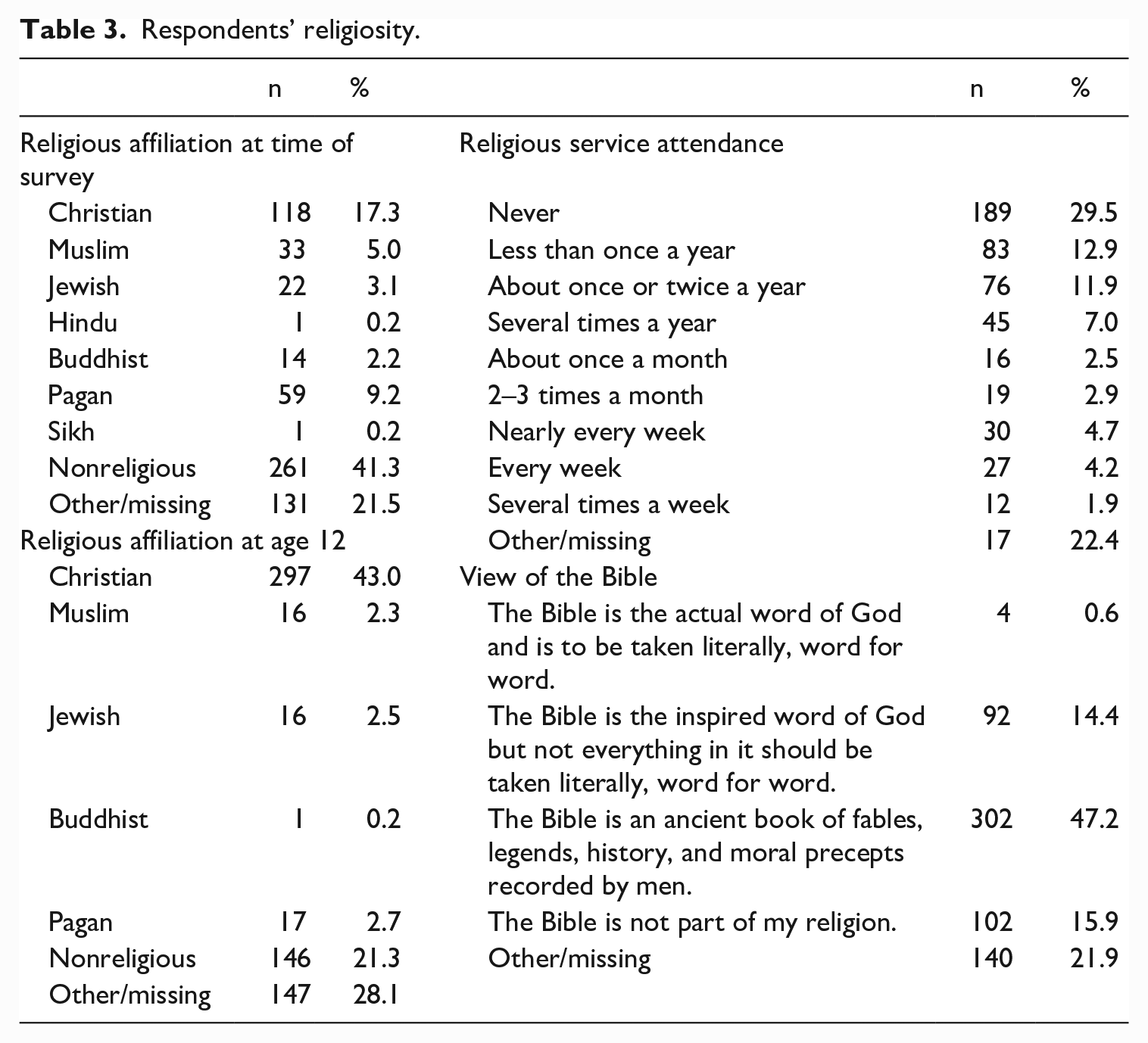
In addition, participants were asked their religious affiliation at present and at age 12 years, how often they attended religious services, and their view of the Bible. The results from these questions are shown in Table 3.
Respondents’ religiosity.
To capture participants’ belief toward a god or higher power, participants were first asked whether they held a belief in a god or higher power with this question, ‘Which of the following most accurately describes your belief toward a God or higher power?’ Response options included: ‘I do not believe there is a God’ (25.7%), ‘I do not know if there is a God and I do not believe there is a way to find out if there is a God’ (17.4%), ‘I believe in some form of higher power’ (23.1%), ‘I believe in God sometimes’ (2.3%), ‘I believe in God, but I doubt my belief sometimes’ (7.5%), ‘I am confident God exists’ (16.9%), and ‘Other/choose not to respond’ (6.9%). If they selected ‘Other/choose not to respond’, they could type in a response that better fit their (non)belief.
Individuals who chose one of the options suggesting belief (i.e. higher power through confident God exists) were later shown our first key, open-ended question: ‘Regarding God or the higher power in which you believe, what is the gender of that entity?’ Respondents were then shown a text box where they could enter a response. We classified these responses into two categories: nonbinary or cisgender. We originally intended to classify these responses into more categories, specifically transgender binary, nonbinary, cisgender-male, and cisgender-female. However, none of our transgender or nonbinary respondents provided a description of gods as transgender binary. Thus, we collapsed the categories into just nonbinary or cisgender. Responses to this question are limited to just those individuals who reported a belief in a god or higher power and then gave us sufficient information to code their conception of their God’s/gods’ gender in the follow-up question (n = 217).
For illustrative purposes, we provide a few quotes from participants describing their God’s/gods’ gender. Individuals who described their gods as cisgender typically did so with a single word: ‘male’, ‘she’, or ‘woman’. Individuals who described their gods as nonbinary occasionally used single words as well, like: ‘pangender’, ‘spirit’, ‘none’, ‘all’, ‘agender’, or ‘genderless’. However, they also provided some lengthier descriptions, like the following examples: The Holy is all genders, no gender, a single gender, above and beyond gender. . . That entity lives within, among, between and beyond the (a)-genders of human imagination. None. To imply God has a gender is to imply that God is definite, and to be defined is human, which God is not. I don’t believe God has a gender. However, I believe that humans have difficulty imagining God with no gender so we gender God. I don’t know if I could put a gender on God if I believed that thoroughly, but because I have attended Catholic school for 18 years and grown up in a catholic household, I think it’s just easy for me to automatically use he/him pronouns for God. In all honesty, my conscious thoughts most often point to an agender God.
Participants were also asked an initial question about their belief in a life after death: ‘Do you believe in a life after death?’ Response options were: ‘Yes’ (32.8%), ‘No’ (33.0%), ‘Not sure/maybe’ (34.1%), or ‘Other’ with an option to provide a written response of their own choosing. Individuals who chose either ‘Yes’ or ‘Not sure/maybe’ were then asked, ‘What will your gender identity be in the afterlife?’ They were shown the same gender options for this question as they were shown at the beginning of the survey. These responses were recoded into nonbinary and cisgender. Like with their conception of their gods, we provide some sample responses from the individuals who chose ‘Other’ and provided their own thoughts: I don’t think gender is a part of God’s plan, so I don’t think we will have gender identities. You’re soul doesn’t have a gender or sex. I don’t believe there will be distinct physical attributes.
The recoded responses to our respondents’ post-life gender are limited to just those individuals who reported a belief in an afterlife and then provided us information on their post-life gender (n = 215).
We regress our participants’ conceptions of their gods’ gender and their own post-life gender onto our key independent variable – our participants’ own gender – while controlling for a number of demographic variables. We use binary logistic regression for these analyses. Dummy codes for nonbinary and transgender individuals are included in the models with cisgender individuals as the comparison group.
Results
Table 4 shows the results of the regression of our participants’ conceptions of their God’s/gods’ gender on the independent and control variables; 1 = nonbinary; 0 = cisgender binary. We controlled for age, education, race, and religious affiliation. None of the control variables significantly predicted whether our respondents conceived of their god(s) as binary or nonbinary. Just one variable was statistically significant in Table 4 – nonbinary individuals were significantly more likely than cisgender individuals to conceptualize their gods as being nonbinary (log odds = 4.492, p = 0.016). Transgender individuals were not significantly more likely than cisgender individuals to conceptualize their gods as being nonbinary (log odds = 1.422, p = 0.451). These findings support H1, which states that nonbinary individuals will be more likely than transgender or cisgender individuals to conceive of god(s) as nonbinary. Of note in Table 4, a very small amount of the variation is predicted by the variables in the model, ranging from about 7 to 12%.
Binary logistic regression of God’s/gods’ gender on participants’ gender and control variables.
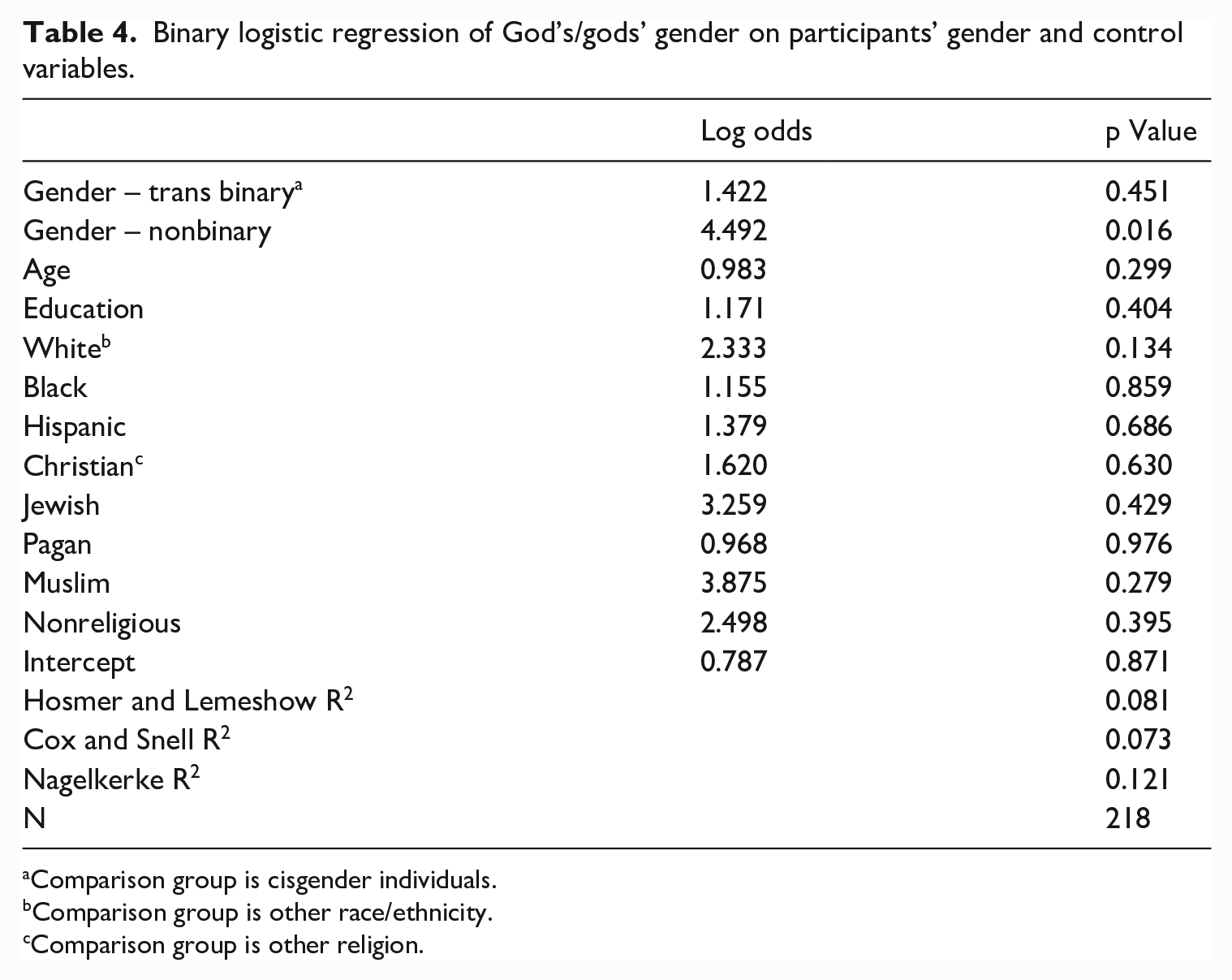
Comparison group is cisgender individuals.
Comparison group is other race/ethnicity.
Comparison group is other religion.
Table 5 employs the same approach but with participants’ conception of their post-life gender as the dependent variable; 1 = nonbinary; 0 = cisgender binary. Younger individuals were significantly more likely to conceptualize their post-life gender as nonbinary than were older individuals (log odds = 0.983, p = 0.018). Jewish individuals were more likely to suggest their post-life gender would be nonbinary than were members of other religions (log odds = 3.259, p = 0.040), while Pagan individuals were less likely to think of their post-life gender as nonbinary than were members of other religions (log odds = 0.968, p = 0.041). The remaining control variables were not statistically significant. Nonbinary individuals were significantly more likely than cisgender individuals to report their post-life gender to be nonbinary (log odds = 4.12, p < 0.001). Transgender individuals were precisely on the border of statistical significance when compared with cisgender individuals in reporting their post-life gender as nonbinary (log odds = 1.422, p = 0.05). With a larger sample and more power, transgender individuals may be more likely than cisgender individuals to conceptualize their post-life gender as nonbinary. The variables in this model explained a sizable amount of the variation in participants’ conceptualization of their post-life gender, ranging from 38 to 55%. These findings support H2, which states that nonbinary individuals will be more likely than transgender or cisgender individuals to think of their own post-life gender outside of the gender binary.
Binary logistic regression of participants’ post-life gender on participants’ gender and control variables.
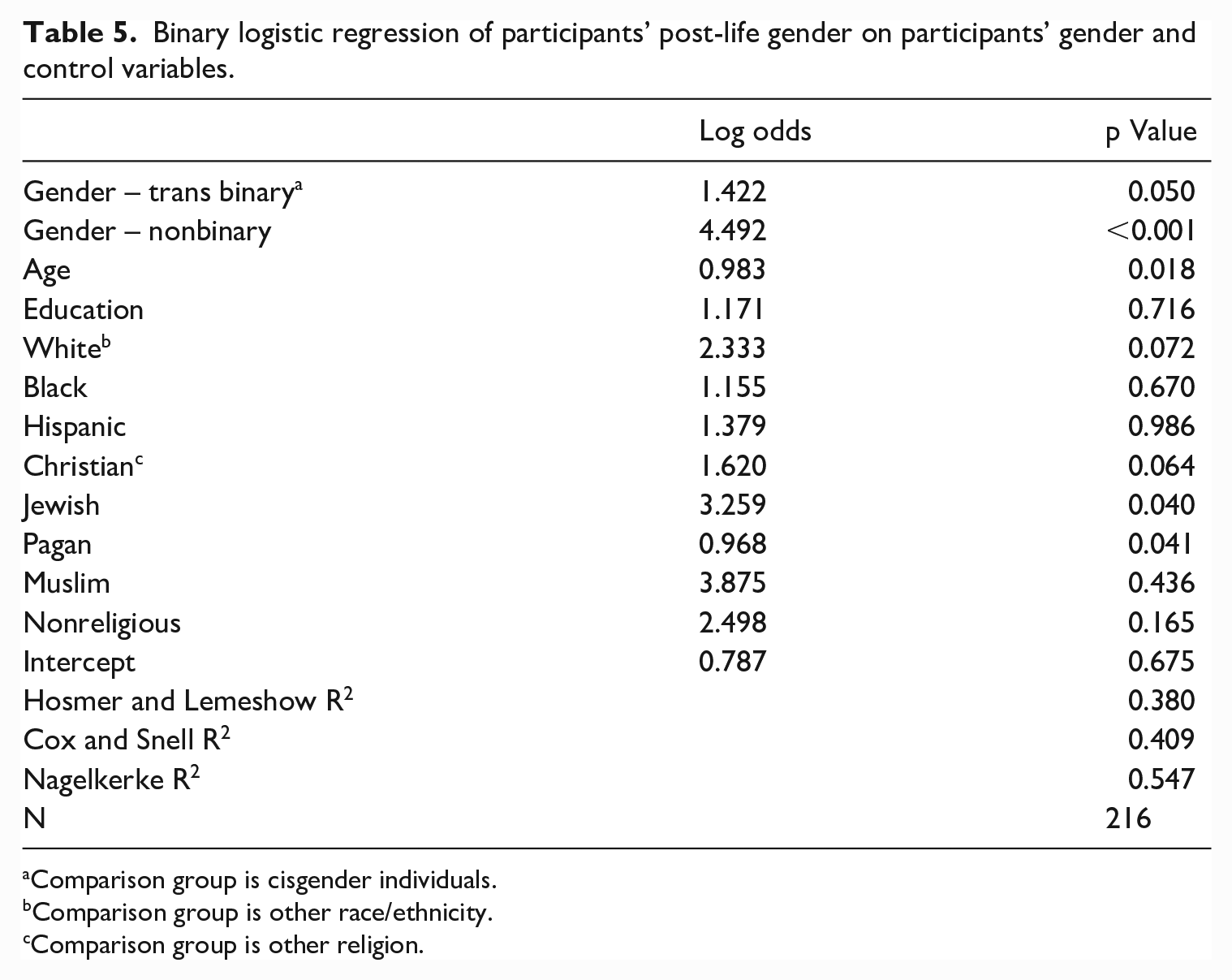
Comparison group is cisgender individuals.
Comparison group is other race/ethnicity.
Comparison group is other religion.
Discussion
Social science research that examines religion and gender needs to include a focus on individuals outside of the gender binary (Avishai et al., 2015; Sumerau et al., 2019). While research on the religiosity of transgender individuals is beginning to grow (Ashraf et al., 2023; Fuist, 2016; Rodriguez and Follins, 2012), this study is the first of which we are aware to explore how transgender and nonbinary individuals conceptualize the gender of their gods and their own gender in the afterlife. As hypothesized, nonbinary individuals were more likely to hold images of gods than were nonbinary cisgender individuals. This finding aligns with the theoretical explanation proposed in this article – that people extend their morals and values to their God or higher power rather than deriving their morals and values from their higher power (Epley et al., 2009). The results of this study indicate that the idea that people can endow their god concept with their morals and values extends to gender.
Unlike much of the prior research on god images or concepts (Shah et al., 2016; Unnever et al., 2006), we are not suggesting that people’s conceptions of a god or higher power influence their other attitudes or behaviors. To the contrary, we are suggesting just the opposite: people’s values and morals, as they relate to other aspects of their lives – in this case, as relates to gender – help construct their understanding of their gods, which they then objectivate and legitimate (Berger and Luckmann, 1967). As the open-ended descriptions of God’s/gods’ gender included above illustrate, for many nonbinary individuals, the idea that a higher power would have a gender is problematic. Thus, an important understanding resulting from this study is that god concepts may not motivate other attitudes or behaviors but rather become divine embodiments of pre-existing morals and values (Nagoshi and Brzuzy, 2010; Pratiwi et al., 2019; Talvacchia et al., 2014). By endowing their gods with their own morality, people sacralize that morality, making it much more difficult to challenge or call into question (Sumerau et al., 2016a).
We also found that nonbinary individuals were substantially and significantly less likely to report that their gender in the afterlife would be binary than were cisgender respondents but the same was not true for transgender respondents who were not significantly different from cisgender individuals. This finding provides provisional support for our theoretical argument that for many transgender individuals, their struggle to be seen as a specific gender within the binary is likely an important part of their self-concept (Baumeister, 1982). Their affinity for the idea that their gender in the afterlife will align with their gender in this life is another way to help manage their self-presentation (Goffman, 1959), to reduce the cognitive dissonance that could result from thinking about gender as a social construct that does not require just two categories (West and Zimmerman, 1987), and a way to reconcile their gender with their religious and spiritual beliefs (Fuist, 2016).
As other research on transgender and nonbinary individuals’ religiosity is beginning to illustrate (Fuist, 2016; Wolff et al., 2017), religion and religious beliefs can actually help validate self and identity for some transgender and nonbinary individuals. For transgender individuals, thinking about a god that fits into a gender binary may help them sacralize their own understanding of their gender. For nonbinary individuals, conceptualizing gods as transcending mortal ideas of gender (‘transing’ God; see Stryker et al., 2008) may likewise sacralize their understanding of their gender. The same utility can be derived from thinking about their own transcendent post-life self as either the gender with which they identify – for transgender individuals – or as agender or pangender for nonbinary individuals. Such religious beliefs and values can affirm transgender and nonbinary identities (Barringer and Gay, 2017). Our findings can assist religious leaders who are interested in ‘queering’ religious spaces by offering a way to speak about God’s/gods’ gender in ways that resonate with transgender and nonbinary individuals.
These findings are also potentially important in another way. While prejudice and discrimination against transgender and nonbinary individuals remains widespread in the United States, particularly from some religious quarters (Halkitis et al., 2009; Johnston and Stewart, 2011), there are many Americans who do not conceptualize their gods as having a gender. For queer activists, this may be a way to build common ground with individuals who struggle to accept the idea that gender need not align with a binary. Activists can point out how gods are or can be agender or pangender. These tactics may help queer activists illustrate that human gender need not be binary either.
There are some limitations to this study. The obvious limitation was noted above in discussing our targeted approach to collecting data. While targeted samples are useful for gathering data on small or difficult to find populations, the drawback is that the data are not generalizable beyond the sample because they do not reflect a known sampling frame and are not representative of the population of interest. That is the case for this survey. Another limitation became apparent when analyzing the data; we used some question wording that was problematic. Many of the participants in our study who indicated a belief in a god or higher power actually reported believing in many gods. As a result, the question asking about God’s/gods’ gender was somewhat problematic as it unnecessarily limited the gods or higher powers people could believe in to just a single god or higher power. We copied this question from the US General Social Survey to allow for comparisons with other samples, but scholars should consider revising this widely used question to allow for the possibility of polytheism or paganism. In addition, while we found it necessary in this article to collapse the many expressions of gender offered up by participants, we recognize that this simplification of gender categories leads to a glossing-over of the differences between these identities. To avoid the need to collapse gender categories and, therefore, produce results that more fully reflect the wide variety of gender identities people hold, future research should collect larger samples from individuals outside the gender binary.
Conclusion
By fielding a targeted survey of transgender individuals, this study was able to explore how transgender and nonbinary individuals conceptualize gods and how they think about their own post-life gender. Nonbinary individuals are more likely than cisgender individuals to think of gods as being agender or pangender and accept the idea that their future, post-life selves will have no gender or a gender that falls outside the confines of the gender binary; transgender binary individuals are not significantly different from cisgender individuals in how they think about their gods and their post-life gender. These findings provide important insights into how people construct deities that align with their pre-existing morals and values and illustrate that conceptions of post-life gender help transgender individuals reconcile their religious and spiritual identities with their gender.
Footnotes
Acknowledgements
The authors acknowledge J. Sumerau and Lain A. B. Mathers for their help in designing the survey.
Funding
The author(s) received no financial support for the research, authorship, and/or publication of this article.

Notes
Author biographies
Address: Department of Sociology, The University of Tampa, 401 W Kennedy Blvd., Box 147 F, Tampa, FL 33606, USA.
Email:
Address: Department of Applied Sociology, Utah Tech University, 225 S University Ave., St George, UT 84770, USA.
Email: