




Abstract
This ethnography analyzes three Israeli Reform Jewish rituals as manifestations of interreligious hospitality. The Daniel Reform congregation invites Muslim residents of Jaffa to participate in rituals incorporating Arabic and Muslim clergy and prayers. The egalitarian and pluralistic Jewish symbols and narratives promote neighborly relationships. Nevertheless, some participants’ responses reaffirm popular suspicions and prejudices, which the ceremony seeks to overcome. Interreligious hospitality here is not so much an act of theological reconciliation, but a political act also directed toward other actors – like the Israeli right-wing and Israeli society, which grant the Orthodox a monopoly on Judaism. While the shared ritual practice offers a dialogical model that engages broader publics through doing, the analytic frame of hospitality sensitizes us to the importance of space and language in the power relationships of hosts and guests. It helps explain the challenges to the messages of coexistence, which the rituals are designed to confirm.
Introduction
In this anthropological study, we focus on three Israeli Reform Jewish rituals dedicated to promote encounter and interaction between Israeli–Jews and Israeli–Arabs 1 in Jaffa. We discover how Islamic prayers and other liturgical changes were introduced into the traditional ritual, and identify the reactions of the Jewish congregants and Muslim onlookers to these changes. We argue that this Reform Jewish hospitality is not primarily a manifestation of theological accommodation with Islam, but a political act of identification with the Arab minority population and resistance to discriminatory hegemonic structures, including patriarchy and Orthodox hegemony in Israeli public life. Nevertheless, the Israeli–Arab conflict creeps into the ritual and results in Islamophobic responses among some Reform Jewish host members. Furthermore, Muslims participants may reject some Reform overtures as a claim of shared or contested space or as a violation of appropriate gendered behavior.
Hospitality has a long history and a rich heritage. In Western tradition, hospitality was grounded in a religious narrative, such Abraham’s inviting the three strangers or angels into his tent (Gen.18: 1–14; Hebrews 13: 1–2; Surat adh-Dhariyat, 51: 24–30). According to Siddiqui (2005), ‘hospitality is fundamental to the spiritual life; a generosity of spirit lies at the core of human hospitality, making hospitality the virtue which defines humanity itself’ (2005: 1). Indeed, one might even say that hospitality is a religion, in the sense of religare: that which creates the possibility of a link, a relation either among men or between man and God (Derrida, 2000a: 26).
One major role of hospitality is to break down boundaries between people and communities and counter the rejection of the stranger as a danger and a threat. In religious hospitality, one community invites the other to take part in its celebration, displaying traditional symbols and elaborating knowledge regarding its sacred taxonomy, historical narratives and customs. Religious hospitality is a performative way to promote interfaith dialogue and foster constructive engagement between religious traditions (Cornille, 2013: 6).
‘Dialogue’ encompasses many sorts of non-confrontational engagement between religious traditions; from formal or casual exchanges between spiritual or institutional leaders, to interreligious activism around social issues. The common denominator in all these forms of interreligious engagement is mutual respect and openness to the possibility of learning from the other (Taylor, 1994). Hence, interreligious ritual may engage a broader group than the clergy and theologians who are often called upon to engage in formal dialogues (Moyaert, 2017: 325). As we will see, the sensory, ambiguous, and multivocal nature of symbols (Kertzer, 1988) and the consecration and appropriation of public space in rituals may create both generosity among strangers, as well as misunderstandings around the status and appropriate behavior of religious hosts and guests, which undermine the conciliatory potential of shared ritual.
Over the last several decades, interfaith dialogue has sometimes been promoted as a framework to articulate and alleviate tensions and conflicts between different communities. Thus, it is employed to acknowledge diversity in London neighborhoods (Prideaux, 2019), to heal the scars of ethno-religious conflict in the Balkans (Merdjanova and Brodeur, 2009), and to expand a peace agenda beyond the circles of secular diplomats in Israel/Palestine (Landau, 2003). In each of these cases, leaders of dialogue groups seek commonalities among religions that will transcend the immediate conflict. Shared ritual may be part of the toolkit of the promoters of peacebuilding, but it may also exist independently, as in the case of pilgrimage sites shared by more than one religion (Albera and Coroucli, 2012).
Methodology
The following analysis, based on fieldwork performed between 2014 and 2017, focuses on three Reform rituals conducted by the Daniel Congregation in Jaffa, now a mixed Jewish–Arab section on the southern municipal border of the Tel-Aviv metropolis.
The Daniel congregation in Jaffa has been operating for over 20 years. Nevertheless, as a non-Orthodox congregation, they were denied government support or a permanent building. The congregants pray in a room on the first floor of the Ruth Daniel Residence Hotel. The 50 members of the congregation are native-born Israelis, residents of Tel-Aviv-Jaffa and other adjacent cities; most are older women from a variety of ethnic and socio-cultural backgrounds, many seeking a connection to their Jewish heritage in a gender-equal space. The congregants define themselves as secular or traditional Jews (masorti), while a few congregants identify as Reform Jews. The members participate in Shabbat services, holiday rituals or Torah study classes (Beit Midrash). 2 Some of them live in Jaffa, while others live in the center of Israel.
The Daniel Congregation conducts hospitality rituals during Jewish holidays to promote coexistence between Jews and Muslims. From among the many holy day rituals that the primary author (henceforth, EBL) observed in 3 years of fieldwork, this ethnographic inquiry focuses on three of them, some repeated several times over the years; three Hanukkah candle lighting ceremonies, three Sukkot Ushpizin, and 10 public Kabbalat Shabbat services. Holiday rituals reflect political inter-subjective relations, as they often celebrate narratives of victory, fear, pride, and security. These rituals have shaped Jewish practice throughout the generations. The following descriptions include participant observations of the rabbi’s speeches and congregants’ reactions, including their interpretations of religious symbols and cultural objects culled from 20 informal interviews. Each interview lasted about 1 hour, and there is a balance between male and female congregants.
While most of the interviews were conducted in the Ruth Daniel Residence’s lobby, several were conducted at coffee shops in Tel-Aviv-Jaffa. The intensive period of interviews was in the third year of the research, after the congregants had come to know and trust me (EBL). Sometimes, we switched roles, and I was the one to be interviewed and found myself responding to their questions. Their questions were particularly useful in helping me understand congregants’ experiences. In addition to the formal interviews, some spontaneous conversations were held directly following the rituals.
All congregants’ names have been anonymized, except for those of Rabbi Mira Raz and the Sheikh Ihab Balha, who are public figures and granted permission to publish their names.
The congregants and the Rabbi knew about the research and were cooperative. The long durée of fieldwork facilitated observation of diverse rituals, and the discovery of changes and spontaneous performances (Ben-Lulu, 2021). In addition, although the ethnography was conducted by EBL, who attended a Reform Movement-affiliated school, and both authors are empathetic with the Reform congregation’s struggle for equality in Israel, they maintained a reflexive mode and cautiously avoided generalizations. While the public nature of the ceremonies made them open to distanced observation, the trust developed by EBL with members of the congregation made them comfortable to express their responses to the ceremony and to the reactions of fellow participants.
Jewish–Muslim dialogue and the Israeli–Arab conflict in Jaffa
Interreligious dialogue between Muslims and Jews has taken place since the emergence of Islam in the seventh century. Although Muslims wielded superior power, the Jewish–Islamic dialogue rarely was as risky for Jews as were Christian–Jewish medieval disputations (Cohen, 1996), in which Jewish victory could result in expulsion or worse. While religious dialogue between flourished in the Golden Age in al-Andalus, it was limited under less tolerant Muslim rulers, when Jews’ status as a protected religious minority was sometimes precarious (Wasserstrom, 2014).
In recent years, Jewish–Islamic relations have been shaped by the conflation of Judaism and Islam with exclusive national symbols of Israel and Palestine and the rise of fundamentalist groups in Judaism and Islam. Continued violent confrontations of Israelis and Palestinians have framed the two national groups as prototypical enemies of each other, and have impeded expressions of empathy and solidarity. This has often hindered Jewish–Muslim dialogue throughout the world, and in some dialogues, participants are explicitly instructed not to mention the Israeli–Palestinian conflict (Goshen-Gottstein et al., 2007). In Israel, and in Jaffa in particular, the political struggle and its religification are never far from mind (Bunzl, 2004; Ruether and Ruether, 2002).
Jaffa, a historical port city, was populated by Arab Palestinians before the 1948 War. The 1948–1949 Independence War, called the Naqba (disaster) by Palestinians, resulted in the departure of approximately 750,000 Palestinians from the territories that came under Israeli sovereignty. Between 35,000 and 45,000 Palestinian Arabs of the previous 70,000 remained in Jaffa on the eve of its fall (LeBor, 2007; Radai, 2011: 34), and the Palestinian social, municipal, and national institutions collapsed (Radai, 2011: 36). Jaffa became an impoverished Arab enclave on the margins of the modern Jewish city of Tel-Aviv.
According to the Israeli anthropologist Daniel Monterescu (2011, 2015), Jaffa, like other binational cities, plays a pivotal role in situations of long-term conflict. He suggests that Jaffa is both a mirror of the Israeli–Arab relationship in Israel, as well as a site with potential for transformative activism and interfaith dialogue. Monterescu claims that few places have been more marked by the tension between intimate proximity and visceral hostility than Jaffa. As in other ethnically mixed towns in Israel, relations between the Arab and Jewish communities in Jaffa are marked by class divisions, political fragmentation, and alienation from both place and the other (Monterescu, 2011: 270). Gentrification by Jewish–Israeli yuppies purchasing housing stock in Jaffa has heightened these tensions.
In 2018, the Israeli government passed the ‘Nation-State Bill’ which diminished the status of the Arabic language and culture in public space. In addition, attacks against Israeli–Arabs, including public incitement on the part of elected officials, have become more frequent. Jewish ethno-nationalism has become more blatant in Israel, as racist calls on the part of National Religious rabbis and right-wing activists multiply (Engelberg, 2017: 229). In Jaffa, National Religious groups have established Torah study cells (garinim torani’im) to spread Orthodox religious practice in mixed Arab–Jewish cities. This is part of the politics of presence, frequently employed to Judaize areas in the Occupied Territories, here extended well beyond the areas assigned them by their mandate (Levy et al., 2014). Small wonder then, that Jaffa Arabs may see any manifestation of Judaism in the public space of Jaffa as an expression of oppressive nationalist policies.
Within the constellation of political powers, the Reform Movement occupies a particular place. Reform Jewish theology seeks to integrate Jewish tradition with the realities of modern life (Meyer, 1995). Their liberal theology is rejected by the Orthodox, who have a government-backed monopoly over the provision of religious services (Ferziger, 2014: 52). Consequently, the Reform congregations have been suffering from institutional discrimination, and are often perceived among the Israeli society as a strange and intimidating Diasporic Jewish intrusion (Tabory, 1991). Given the ethnic tensions and the legitimation given to racist public discourse in Israel in recent years, the promotion of interreligious hospitality between Jewish and Muslim populations may be seen as a subversive political performance.
We now expand the theoretical framework of hospitality, focusing on religious hospitality and its implications. We then describe three rituals, which show how traditional Jewish customs, symbols, and narratives were modified for the purposes of interreligious hospitality, and the contestation these rituals provoked. In conclusion, we will discuss some of the challenges and opportunities offered by interreligious hospitality in situations of conflict.
An anthropology of religious hospitality: challenges, tensions, and opportunities
In an article entitled ‘The return to hospitality’, Candea and Da Col (2012) suggested a thought experiment, applying many of the insights of Mauss’ gift theory to the realm of hospitality. In primitive societies, writes Mauss (2002), ‘exchanges and contracts take place in the form of presents; in theory these are voluntary, in reality they are given and reciprocated obligatorily’ (2002: 3). Candea and da Col use this insight to unpack some of the dynamics of hospitality. If Mauss spoke of the obligation to give, the obligation to receive and the obligation to reciprocate, in the study of hospitality, these might be the obligation to host the guest, the obligation to receive hospitality as a guest, and the obligation to express gratitude and appropriate conduct toward the host.
Moreover, Candea and da Col continue, ‘hospitality also goes beyond the classic ground of gift exchange, touching on a number of other central anthropological problematics: identity, alterity, and belonging; sovereignty, politics, and inequality; the relation between the individual and the collective; commensality, consubstantiality, and kinship’ (Candea and Da Col, 2012: S1–S19).
Hospitality is an act of openness to the other that helps to bring the other temporarily within the sphere of family or group, even if they come as a stranger (Kuokkanen, 2003). We confront and welcome the other who is not one of our family, group, or nation. In hospitality, ‘we want to honor the guest and keep him/her at a distance at the same time’ (Gotman, 1997: 7). In this sense, hospitality is a contradictory experience fraught with tension.
Humphrey (2012) shows how in rural Mongolia, hospitality without expectation of a return is a prime ethical and practical virtue, but it is always performed rather than merely spontaneous. Negative feelings and contrasts between spontaneity and rules are buffered through tiny and strategic gestures, which attempt to create a precarious effect of measured reassurance and detachment. The ideal of hospitality is often shot through with disturbing emotions and negative forms of distancing.
Under intolerant regimes, in the face of religious violence, hospitality provides an ethical and human bulwark against atrocity (Fiala, 2016: 193). There, it provides a rare opportunity to know the other, to recognize similarities and to develop empathy.
Jacques Derrida (2000b) distinguished between unconditional hospitality, which he considered impossible, and hospitality in practice, which in his view was always conditional. Rules of hospitality are also linked to constructions and conceptions of space. For example, Bedouin hospitality has a significant role to play in helping to describe how Middle Eastern cities have been constructed (both architecturally and socially) to welcome guests (Barnes, 2013). However, in applying codes and practices of individual hospitality to cities and states, the ‘register of hospitality must change’ (Griffin, 2020).
According to Gole (2002: 135), religious performance in the public sphere is a political strategy to achieve recognition and dominance. He argues that Islam carves out a public space of its own as new Islamic language styles, corporeal rituals, and spatial practices emerge and blend into public life. On one hand, public Islam testifies to a shift in the orientation of the Islamic movement from macro politics toward micro practices. On the other hand, it challenges the borders and the meanings of the secular public sphere (Katz, 2009: 142–148).
Following Gole (2002) and Griffin (2020), we explore whether and how Reform interreligious ritual in Jaffa interacts with the roles of public Judaism in the ethno-national space. This contributes to the literature on interreligious hospitality, which has often used ‘hospitality’ to speak of theological flexibility, the ‘recognition of actual truth on another religion and hospitality toward integrating that truth in one’s own tradition’ (Cornille, 2013: 28), or the extent to which visitors from other religious communities are allowed to partake in ritual actions (Langer, 2015). These discussions generally ignored the politics of space (Vincent, 2019: 185) and the mutual expectations of hosts and guests. This study applies the sociological understanding of interreligious hospitality, as a relationship that combines generosity and reciprocity, and links hosts and guests in relationships that are always embedded in larger power structures. Focusing on the Israeli Reform congregation, we explore how hospitality can also serve as a strategy for achieving public recognition among others (secular Israeli onlookers), and how the spatial situation and framing of interreligious rituals make claims as to who is the host and who is the guest in each case, and what behaviors are accepted or expected of each.
Chanukah candle-lighting: countering religious triumphalism
Every Chanukah, the Daniel Congregation invites local Muslims leaders and residents to celebrate Chanukah together, by lighting a special candelabrum for eight nights. The festival symbolizes both the victory of the Maccabee rebels over the Seleucid Greeks and the miracle in which a single undefiled cruse of oil, a 1-day supply found in the Temple, lasted for 8 days and nights. The theme of victory has become central in Israel, as it affirms the Jewish national agenda of survival against all odds (Shoham, 2017: 5), in accordance with the Zionist narrative. In contemporary Israeli celebrations of Chanukah and in public sermons and explanations, the ‘Greeks’ are sometimes conflated with Palestinians.
In 2015, candle lighting was led by Rabbi Mira Raz and by the Sheikh Ihab Balha, an Arab–Israeli activist residing in Jaffa. Since 2010, Rabbi Mira Raz heads the Jaffa congregation. She is known as a political activist, associated with women’s grassroots peace organizations. Rabbi Raz draws on Kabbalistic interpretations in support of social justice and coexistence (Ben-Lulu, 2020). Sheikh Ihab has appeared throughout Israel as a consultant and workshop leader on Islam and on spiritual approaches to healing and peacemaking. Around 30 congregants gathered together in the prayer room at the Ruth Daniel Residence. Before Rabbi Raz lit the candles, she proclaimed, Lighting the candles is a spiritual mission. When we light the candles, we light the soul. Take a look … If I take two candles, I will get one huge flame – it means we have to be in the One. One belief – one God – one Creator. We are all one. That’s why I respond ‘Amen’ when I hear ‘Allahu Akbar’.
3
… Isaiah 2 wishes for us: ‘ … and they shall beat their swords into plowshares, and their spears into pruning hooks: nation shall not lift up sword against nation, neither shall they learn war any more’. This current difficult time should promote our hope. There is no real darkness, because darkness is only a situation with less light.
Rabbi Raz emphasized the shared symbolism of flames and light in Judaism and Islam, and invoked the biblical prophet’s humanistic vision. Both monotheistic peoples worship the same God; since Judaism does not have exclusive possession of this truth, she responds ‘Amen’ to Islamic professions of faith. This theology promotes equality as a religious value – as an outcome of the existence of the one God.
After the lighting ceremony, Ihab, dressed in a traditional white Arabic robe, provided an alternative, Islamic meaning for the light: Not only for Jewish people is the light a spiritual sign. Muslim holidays are determined by the lunar cycle. Based on a fixed number of times, in which the moon encircles the earth. Light is the manifestation of Allah’s (الله), of God, whose representative is the Prophet Muhammad; while each prophet symbolizes a different color of light, only Muhammad is the whole light. We too assign great significance to the light, also in lighting candles … We thank God for the shared lighting of the children of Abraham.
After that, Ihab taught the participants a short passage in Arabic. The congregants listened, repeating the words he taught them. Most spoke no Arabic and the language made them uncomfortable. Yoni, one of the congregants, asked him politely to repeat the words several times. In a subsequent conversation, he emphasized that the use of the Arabic language strengthened his hope for peace between the peoples: In my daily life, I don’t speak or hear Arabic … maybe only when I watch breaking news … but, the messages are not pro-Israel. It always sounds like terrorist calls. So, unfortunately, automatically when I hear Arabic, I hear terrorists. It’s a shame that when I hear it, the first images appear in my mind are not pastoral (if you know what I mean). So, it was such a great chance for me to hear Arabic with a different message. It made me optimistic and believe in what we’re doing.
Ihab then supplied a political context for the passage. He said, The human identity searches for freedom, seeks the light. It doesn’t matter if you are a Jew or a Muslim. Every person is like a moon – reflecting the light of the sun. Today we are suffering from evil. There is only one option to get the real light, to come together, to believe each other. All of us together, Jews and Muslims, should turn on the light. It’s an open invitation to unite. Don’t let the different religious identities conceal your human identity. We are all one.
Given the charged political environment, culminating in the 2018 passage of the Nation-State Bill (see Figure 1) annulling the status of Arabic as an official language, the inclusion of Arabic Quranic passages in a Jewish ritual is indeed a political act.
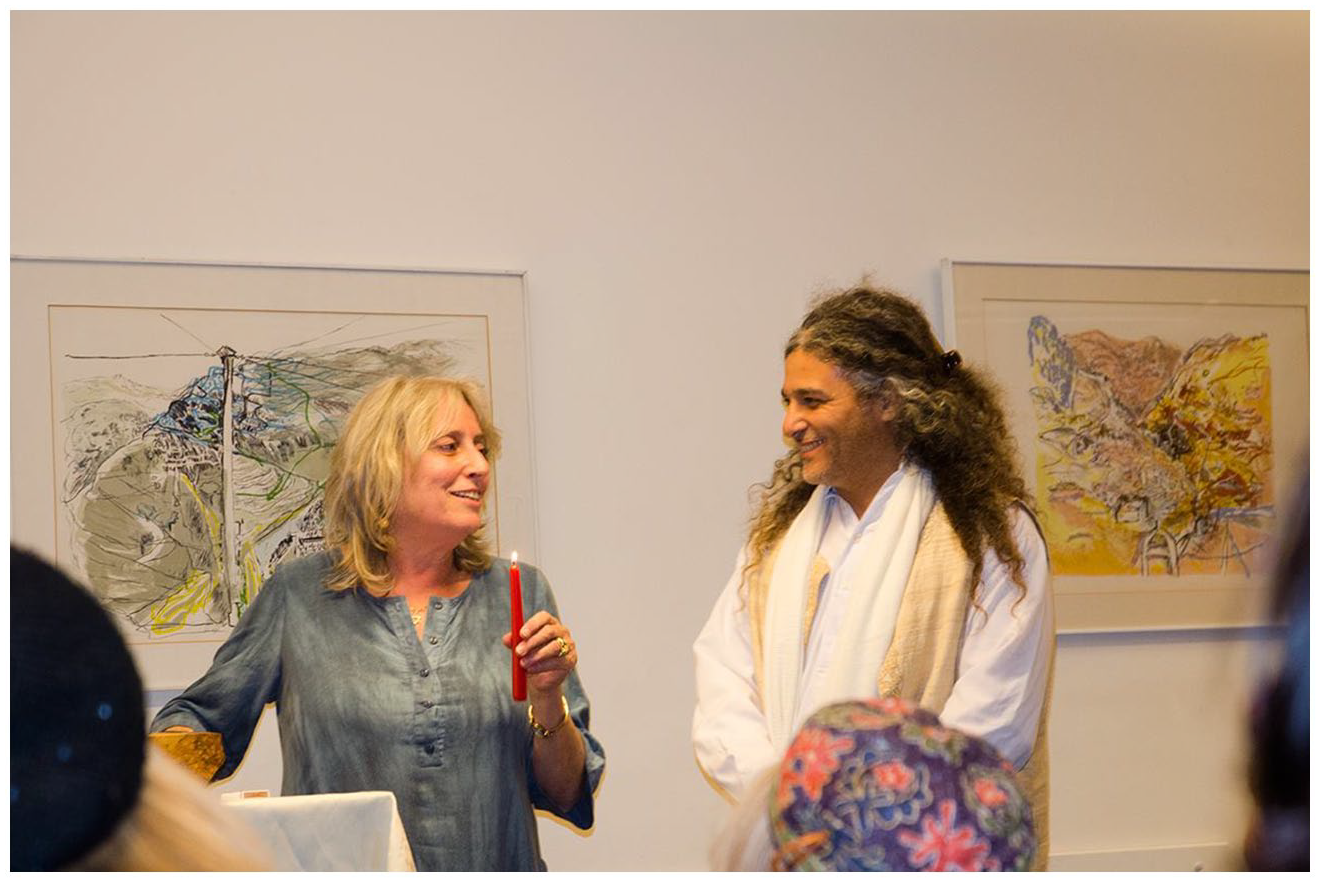
Rabbi Raz and Sheikh Balha.
Ihab, like Rabbi Raz, sanctified the equality of human beings by proclaiming the existence of God as the universal Creator. To appreciate the value of interreligious ritual, imagine for a moment, the same verbal exchange occurring in a meeting framed as a theological dialogue, with each representative seated at the table behind his name plate: ‘Rabbi Mira Raz’, ‘Sheikh Ihab Balha’. The sheikh’s words might then be seen as a proclamation of the superiority of Islam; each prophet has his color, ‘but only Muhammad has the whole light’. In the context of the Jewish ceremony of Chanukah, however, the engagement in the action of shared ritual is an expression of recognition, which summons listeners to be more generous in their reception of Ihab’s words. As Catherine Cornille (2013) writes, ‘empathic understanding of another religion may be enhanced through direct participation in the religious life of the other’ (2013: 28). The sharing of a prayer platform, in which both religious leaders stand on the same level, in the intimacy of the congregation’s prayer room, lighting candles together, displays a performed togetherness that is more influential than the linguistic content of the prayer.
A year later, Suria, an Arab–Israeli woman activist, was invited by one of the congregants to open the Chanukah candle lightning ceremony. She introduced herself as a representative of ‘Women for Peace’, a grassroots movement of Jewish and Arab women, which promotes equality, coexistence and peace, emphasizing gender as a vector for developing solidarity and empathy: ‘We are equal and I hope we will get a peace agreement as soon as possible. Palestinian women love their children like Jewish moms, not less’.
Suria’s appeal, mentioning motherly concern and love for children, linked the loss and pain of both sides and expressed the feminine contribution to the development of gender solidarity.
Jessi, a prominent congregant, explained how the ritual was a chance to get to know Arab women’s daily life and develop an optimistic view on reality in Jaffa, notwithstanding the Israeli government’s security restrictions: Look around you … do you understand why it’s so important to organize these kinds of events? I will tell you something … one of the popular musicians from Nablus was supposed to join us this evening, but the IDF (Israel Defense Forces) didn’t allow him to enter Israeli territory. This is a proof of the darkness we are in. You open the newspaper every day and read about racist and violence occasions. This evening we are doing something different. Two players from Jaffa – Jews and Arabs, together. That is a good sign.
Another congregant, Shira, has been meeting with Arab women for the last 20 years. Almost every week, they study together, cook and travel. She recognizes the ritual as a platform bridging between different political narratives and traditions: If I don’t invite them to my rituals, and they don’t invite me, how can we learn about each other? There is no chance of a relationship without doing something together – to pray together. It doesn’t matter if she uses the Quran and I use the Bible. A prayer is a prayer, and both religions educate for peace. Since we are not only a Jewish state, but also a democracy, we should see this mission as a commitment. Yes, it’s complicated to bridge between conflicting values, but we have to respect all the people in the county.
The candles, the shared blessings, the inclusive religious messages, the use of Arabic in the ceremony, the presence of a sheikh on stage, and his participation in candle-lighting – all manifested, more than theological recognition of Islamic truth, recognition of Arab Muslims as equal citizens of the polis. Through this ritual act, then, the Reform participants declare themselves as agents of reconciliation, thus making a statement to the Israeli public, as well as to the Muslim participants.
From public square to backyard: erecting a tent of meeting in times of fear
One of the traditional customs of the Sukkot holiday is ushpizin – an Aramaic word for guests. It takes place in the sukkah, a temporary structure commemorating the booths that sheltered the Israelis as they journeyed across the desert after the Exodus from Egypt. The Zohar, the foremost book of Jewish mysticism, explains that the sukkah (festival booth) generates such an intense concentration of spiritual energy, that the divine presence actually manifests itself there, like in the Garden of Eden. During Sukkot, the souls of the seven great leaders of Israel – Abraham, Isaac, Jacob, Moses, Aaron, Joseph, and David – leave paradise in order to come as guests and take part in the divine light of the earthly Sukkot (Zohar–Emor 103a).
Every Sukkot, the Daniel Congregation performs the Ushpizin custom, inviting local Muslim leaders, musicians and residents. In 2014, one evening was dedicated to the three Abrahamic religions, which were represented by three religious leaders. One was Sheikh Walid, a well-known activist in Jaffa. He stood in front of the participants, his head covered with a black and white kufiyah and said, According to the Quran – holidays have the power to make us unite. I like to celebrate Jewish holidays – the rituals have the potential to gather us together. There is no way to love, love is the way. Love is not personal; it is social consciousness between people and cultures … No more words and speech, we should promote doing for coexistence.
Afterwards, Rabbi Raz emphasized that the sukkah’s place in public space at the center of Jaffa is a peaceful sign, countering Israeli nationalist rhetoric. Covered in her pink prayer shawl, she held the four plant species that mark the Sukkot festival. She claimed that the meaning of the Sukkah ‘is not to establish it and to destroy it after seven days, but to destroy social boundaries’: Symbolically, a sukkah is a sign of protection, a proof that there is only one Creator who fulfils the needs of all. Look at the four species here. They express diversity, but above the sukkah, there is only one God. We bless the unity of the species. Indeed, everyone has different rituals and churches, everyone has a different sukkah, but there is only one God. This custom helps us to create peace and social justice. That’s why I asked various religious leaders to join us tonight and they are going to share with us their blessings. We are together in the same sukkah – we are in the same home.
Rabbi Raz’s statement, ‘we are together in the sukkah – we are in the same home’, resonates with a political program – one home for two peoples. The ambiguity of referring to ‘home’ while in a temporary shelter, a sukkah, which, according to tradition, should remind Jews of the fragility of home, makes the sukkah into a metonym for the city and the country – the imagined national home.
In addition to the four species, several congregants decorated the sukkah with figures and textual posters reflecting coexistence and peace; quotes from Psalms, verses promoting peace, justice and brotherly love, picture of hello doves, and photos of community activities in Jaffa.
Other congregants provided other, sometimes alternative personal–political interpretations. Sami, one of the congregants, was born in Jaffa and served as a fighter in Yom-Kippur war in 1973. His military experience has not abolished his optimistic vision of co-existence and he participates in multi-religious programs at Jaffa: The Israeli flag in the front of the sukkah’s entrance signals that we are also Zionists. The Israeli Reform movement is identified as on the left side of the political map. I think it’s problematic and is one of the reasons why we are not getting institutional support, especially while the Likud (right-wing party) is in the government. We believe in coexistence, but we still believe in Israel as a Jewish state. This cooperation with the Arab community is blessed. I am not going to solve the Israeli-Palestinian conflict. It’s not my mission.
While the Reform movement’s marginal position is an advantage in spreading liberal religious perspectives among Jews and Muslims, the non-Orthodox theology intersects with the leftist political agenda and creates a political obstacle for some Israelis. Moreover, the power that the Sukkot hospitality may possess in building inter-community bridges is dependent on the identification of the Reform community as a legitimate representative of Israelis. By hanging the Israel flag, which is recognized as a sacred object among Israeli–Jews, Sami marked the Reform congregation as part of the Zionist consensus and the Tent of Meeting as Israeli terrain. One might say that the flag serves him as reassurance that the encounter with the Arab/Muslim other takes place on national territory in which he, as a Jew, is the host.
From September 2015 through early 2016, the Israeli–Palestinian conflict escalated. This period was known as the ‘Intifada of the Individuals’ or the ‘Intifada of the Knives’. On Sukkot (2015), the Daniel congregants decided to move the ushpizin sukkah to the backyard. Sagit, one of the prominent members, explained, We are responsible for the lives of the people who participate … It was a careful decision whether to build the sukkah and where exactly to have it located. You can never know if someone who lives here would freak out and decide to attack us. We couldn’t take the risk. On the one hand, at those moments, it was important to display interreligious hospitality. On the other hand, some of the members felt insecure, so we built it in the back of the building. We just changed the location, not the message.
Sagit insisted that the relocation was merely functional and did not change the sacred goal of ‘co-existence’; that their hospitality confronts intolerance by making the Israeli–Arab community visible and audible, while the interreligious rituals challenge the perception of public space as purely Jewish. Nevertheless, the retreat to the backyard demonstrates the limitations on the performance of religious hospitality in a tense political environment.
Storm in a port: reform Kabbalat Shabbat in Jaffa and practices of gender resistance
In the summers of 2014–2017, the congregation conducted public Shabbat Eve services on a small temporary platform erected at Jaffa Port. The services were framed as coexistence rituals between Muslim and Jewish residents of Jaffa. Not all of the traditional prayers were included in the prayer and other textual blessings were abridged or changed, such as ‘Ose Shalom’ (‘May the one who creates peace in heaven bring peace to us and to all of Israel. And let us say: Amen’). The congregants replaced this prayer with an Israeli popular song, which includes an Arabic word ‘Salaam’ – سَلام – peace: ‘Od yavo’shalom aleinu, Salaam aleinu ve’al kol ha’olam, Salaam’ (Peace will soon be upon us and on everyone. Salaam upon us and upon the whole world. Salaam, Salaam). Rabbi Raz explained this change: It’s not a political decision to sing Salaam instead of Ose Shalom. It’s a moral issue, it’s an essential issue which is typical for any religion. We don’t always sing Salaam, unless the ritual falls on particular dates or includes special prayers, like this one.
Rabbi Raz recognized the importance of language for interreligious hospitality. Arabic is officially the second language in Israel, but de facto, use of the language in public space arouses political resistance and Islamophobic catcalls. In 2018, after the status of the Arabic language had been demoted by the Knesset, several Knesset members tried to pass a law reestablishing the status of the Arabic language in Israel. Thus, the inclusion of Arabic in a Jewish prayer service at this particular time was a subversive political performance. Here again, the hospitality extended toward the Arab/Islamic other is also a political manifestation of the host’s position toward other others – here, the Israeli public and political leaders.
Rabbi Raz promotes a vision of intersectionality of ethno-national, religious, and feminist struggle through ritual and sermons. Her messages to the congregation and to the ‘guests’ attempt to build alliances, accept otherness, and provide theological justification for unity in the struggle against hegemonic oppression of disempowered groups: Arabs, women, and the Reform Movement. These attempts, however, often meet with resistance, both on the part of the ‘hosts’ as well as the ‘guests’.
Dalit, a congregant and feminist activist, invited her Muslim neighbor to one of the Shabbat services. After the service, some of her Jewish friends complained. As she reports, For some of my friends it was weird that she (my friend) came to the service with her hijab. They criticized her appearance more than her presence. They told me ‘it’s so nice that she joins you for the prayer, it’s so important – but, why did she come like this?’ I responded: ‘what do you mean “like this”?’ So, one of the congregants answered, ‘with the dress and the full Islamic appearance – she wasn’t participating in a mosque prayer – it’s a Jewish prayer’. I laughed and said ‘what’s the difference between a synagogue and a mosque?! She came for the prayer. And prayer is a prayer. The space is not a factor. Let’s tell Mira to take her yarmulke off’. I was freaked out and so angry. We chose to do the prayer in a public space to advocate a message of gender equality and multi-cultural appreciation. When my friend decided to participate in a Jewish ritual in public space, she took a risk. She told me that some voices in Jaffa are convinced that we are here to take control over Jaffa – to spread our Reform theology. She told me that a friend of hers tried to convince her not to participate – but that she didn’t give up and decided to participate anyway.
This case demonstrates the gap between the Reform congregation’s proclamation of its space as a safe zone for difference, and the resistance of some congregants. In many parts of the liberal landscape, the hijab is a religious symbol which marks the feminine Muslim as the ‘other’ and as symbol of subservience to patriarchal oppression of women’s sexuality (Armbrust, 2012). Many Western women, for example, create a racist stereotyping of Muslim women as oppressed (Shirazi, 2001: 119). In Jaffa, the lack of respect for the hijab was not only an expression of secular resistance to a religious symbol, but also an expression of fear of the Arab other. Thus, the Muslim ‘guest’ must struggle not only with her own community, who reject her cooperation with a Jewish public (who may see the Reform Movement as Israeli colonizers), but also with the suspicion of the female Jewish ‘hosts’.
Another source of resistance on the part of the hosts arises from the staging of Shabbat prayer in public space. As Margalit reacted, I really believe that the Kabbalat Shabbat initiative can raise the political consciousness of women and expose other women to Progressive Judaism. But, on the other hand, I don’t like that it’s outside. It makes the prayer more populist, less serious and the service abridges them. And it may raise unnecessary provocation. Even if it’s Kabbalat Shabbat and not a political protest. Singing ‘Salaam’ at the end is not enough.
Here, the moving of the ceremony from the synagogue room to public space – ‘outside’ – is seen as a loss of intimacy and ‘seriousness’, and perhaps, a compromise with commitment to one’s own religious identity (Moyaert, 2012: 25–26). Furthermore, something of the ‘hominess’ of the Shabbat service is lost when it is altered or abridged to accommodate the ‘guests’. Unlike most participants, Margalit is aware of the political implications of holding a Jewish prayer service in public in the mixed Arab–Jewish city, as a claim of the Jewish right to the city, which makes her uncomfortable.
The ‘guests’ addressed by the performance may also oppose the feminist liberal values expressed in the performance. In August 2015, a group of Muslim women, who attended the Shabbat service at the Jaffa Port balcony, shouted catcalls when Rabbi Raz delivered her sermon and tried to stop the ceremony. One of the Daniel congregants recounted, I tried to explain to them the meaning of the performance, but they said that women should pray to God differently. I asked them – how? And they told me that it is not respectful for women to pray in the public space with a microphone. I invited them to join us. But they refused. They weren’t protesting against Reform Jews who come to control Jaffa port. They just can’t deal with the fact the women can freely pray in the public space; the ritual was led by a feminine religious leader. They don’t recognize it; they don’t have feminist Muslim leaders.
The Reform liberal orientation sought to convey the political message of co-existence, but it clashed with traditional habits of the Arab Muslim natives. The Muslim women challenged the political vision of the Reform ‘hosts’, voicing their expectation that women at a religious service in Jaffa treat the area as a properly gendered space, in accordance with the norms of the Arab/Islamic hosts and act like respectful ‘guests’. The move from the interior space of the synagogue to the public square has a political dimension, even if not acknowledged by the ‘hosts’. It exposes the implicit host/guest relations of the rituals to contestation.
Conclusion
This article analyzed interreligious rituals performed by the Daniel Reform Congregation, which promoted hospitality as a means of advocating good neighborly relations with local Muslims residents of Jaffa. The rituals presented liberal interpretations of Jewish theology, which are marginalized in Israeli society, enlisted participation of local Muslim leaders, taught Arabic passages, performed songs, and displayed decorations supporting co-existence. Rabbi Raz’s and the Muslims leaders’ sermons demonstrated how religious communities can draw on their own theologically grounded paradigms to strive for resolution and reconciliation (Bretherton, 2006; Oppenshaw et al., 2018).
The case of Jewish or Muslim dialogue in Jaffa broadens the understanding of Jewish interfaith dialogue and encounter. Previous literature examined Jewish practices as an outcome of Jewish diasporic consciousness (Magonet, 2003). Historically, Jewish–Muslim or Jewish–Christian dialogue and religious interaction was conditioned by Jews’ status as a minority, subservient to another majority religious population. In Israel, Jews have power and privilege. Arab Muslims are a minority in the Jewish State and are on the verge of becoming a minority in Jaffa itself. This power may prove to be a challenge for Jewish interfaith dialogue. 4
Within this constellation of power, Reform Jews, as a disenfranchised religious minority, are positioned in ways that can foster intersectional struggles against State and Orthodox Jewish oppression, struggles grounded in liberal religious idioms and practices, which are incorporated into the performances. Yet, as Israeli Jews, they possess symbolic capital that enables them (unlike Muslims) to use space to further their non-Orthodox ideology.
A further intersection is that between religion, nationality, and gender. The congregation was led by a Reform female Rabbi and most of the congregants are women as well. Some of them are activists in interreligious encounters in Jaffa and invite their Muslims friends to participate in the rituals. We witness here their expressions of female solidarity and bridge-building across religious lines, as well as the resistance it sometimes encounters (Fletcher, 2013).
The particular intersections of ideologies and power structures position the Reform congregation in ways that make ritual hospitality toward Muslims a viable tool in challenging hegemonic nationalistic agendas and performances of national-religionization. Participation in the rituals gave the Reform congregants a sense of vital citizenship, which ignited their activism.
Yet, the ritual hospitality was not only an act of theological and religious reconciliation, but a claim made on public space – a political claim posed to the government, to the Orthodox establishment and to other Israelis. As Friedland and Hecht (2006: 34) formulate it: ‘rites depend on rights; the very construction and officiation of any sacred site, no matter how meager, has a component of authority’ (see also Gole, 2002). The performance of public religious rites always asserts political claims to space, especially in contested territory. Thus, the Reform Shabbat service at the Jaffa Port, although inclusive and hospitable, proclaims the Reform congregation as the hosts of the space and may fuel the suspicions of certain Muslims as to their possibly missionary intentions. Furthermore, the visibility of women as religious leaders in public space may arouse opposition of Muslim women ‘guests’, who consider it inappropriate or perhaps impious. These cases should direct attention to further studies of the politics of space in interreligious dialogue (Vincent, 2019: 185).
The performance of a religious ceremony as an act of interfaith or intercommunity hospitality affects the ‘hosts’ as well. Some women, as we saw, found the ‘religious’ dress of their Muslim women guests inappropriate and perhaps offensive to their understanding of gender relations. That is not, they felt, how guests in their synagogue should dress. Others missed the loss of ‘family’ intimacy entailed by the moving of the Shabbat service to public space or saw the modification of the ritual for interfaith communication as a compromise with their identity needs (Moyaert, 2012: 28–29).
In conclusion, the dynamics of performance of the rituals in Jaffa demonstrates how categories of space, citizenship, nationality, and gender affect the success of hospitality rituals among conflicting communities. Interritual hospitality is not always a success story; sometimes it may result in awkwardness, embarrassment, resentment, shame, or the reaffirmation of boundaries (Moyaert, 2017: 325). Perhaps, it is too much to expect that the performance of a religious rite can overcome long-standing tensions between the Jewish and the Arab public, and replace suspicion with shared confidence. Indeed, the forced retreat of the Sukkah to semi-private space during the ‘intifada of the knives’ in 2015 demonstrates the rituals’ vulnerability. But even if the Reform Movement is not representative of the larger Israeli religious establishment, the attempt to forge a shared religious language in Israel is as admirable as it is rare.
The Jewish–Muslim encounters in Jaffa illustrate how interritual hospitality is good to think with. Comparative theologian Marianne Moyaert, encouraged a move away from the classical theological approach of religious pluralism, which begins with an evaluation of the truth claims of other religions in the soteriological scheme of one’s own, and toward theological hermeneutics of interreligious hospitality. She suggests that ritual hospitality, especially in public space, proclaims solidarity – not by fixing theological truths, but by engaging in an ongoing process of encounter and mutual recognition (Moyaert, 2012: 26). These dynamics foster generosity (Siddiqui, 2015) in interpretation of particularistic and potentially competitive messages. The bodily engagement in shared public ritual and in public space, however, also poses risks: of misunderstandings, of ritual ‘misfires’, which expose the limits of tolerance and acceptance, and of the loss of the intimacy of ‘home’ that many need for spiritual expression.
Footnotes
Funding
The author(s) disclosed receipt of the following financial support for the research, authorship, and/or publication of this article: The authors thank the Open University of Israel who provided a special grant for post-doctoral scholars who were obliged to remain in Israel in 2021–2022, as a result of the COVID-19 outbreak.

Notes
Author biographies
Address: The Open University of Israel, 1 University Road, P. O. Box 808, Ra’anana 43107, Israel.
Email:
Address: Department of Sociology and Anthroplogy, Ben-Gurion University of the Negev, Beersheba 84105, Israel.
Email: