




Abstract
The emergence of New Age spirituality in Western cultures during the 1960s and 1970s has been described as a rejection of traditional values, fuelled by disillusionment with the Christian church and a feeling of alienation in mainstream social and work environments. While New Age has been characterised as a ‘turning away’ from dominant cultural ideologies, there is comparatively less discussion about what New Age actors are ‘turning towards’ in their pursuit of subjective spirituality. Research from Australia demonstrates that individuals were primarily searching for deeper meaning and looking for spiritual answers when they first engaged with New Age pursuits. In addition, social and intergenerational transmission are both important factors in the cultivation of New Age spirituality.
Introduction
The counter-cultural milieu of the 1960s and 1970s played an instrumental role in the popularisation of various ‘alternative’ spiritualities that have come to be known as New Age (Drury, 2011; Hanegraaff, 1996; Heelas and Seel, 2003; Van Otterloo et al., 2012). Eager to break free from the perceived limitations of the dominant post-war culture, especially Christian morality and discipline, scientific objectivity, or strictly rationalistic thinking, the youth movement turned to the exploration of mystical or esoteric pursuits in their search for liberation and alternate ways of living (Drury, 2011; Hanegraaff, 2016; Heelas, 1996). Hanegraaff (2016: 155–156) characterises this rebellion as the desire to engage with ‘anything that the older generation had rejected as irrational, unscientific, or immoral’ and fertile ground for experimentation with esoteric practices such as astrology, magic, tarot, or holistic forms of healing. In a study of Dutch New Age teachers who grew up in the counter-culture, Van Otterloo et al. (2012) found that dissatisfaction with Christian churches and modern work environments were significant motivations for turning to New Age ideas and practices. In the counter-cultural climate of the 1960s and 1970s, authoritative cultural institutions were perceived as ‘alienating’ and ‘meaningless’, whereas the promises of authenticity and holism offered by New Age spiritualities became an attractive alternative (Van Otterloo et al., 2012: 253). In his Australian study of New Age actors in Melbourne, Possamai (2000: 367) reports they also rejected the religious doctrines of their upbringing and adopted a cynical approach to both religious establishments and organised spiritual groups, which were perceived as overly dogmatic or controlling, and were determined to find their own ‘subjective religion’ instead.
Since New Age has been characterised as a ‘turning away’ from established authorities and a rejection of cultural norms, then the question naturally arises: What are individuals ‘turning towards’ in their pursuit of New Age spirituality? Although previous studies have reported on counter-cultural influences, life crises, and ‘mystico-pneumatic’ experiences as important trajectories to New Age, this research takes a different approach (Hanegraaff, 2016: 155–156; Possamai, 2000: 373–375; Van Otterloo et al., 2012). In the academic literature, New Age has often been described as a ‘spiritual supermarket’ that caters to the demands of the late-modern consumer (Aupers and Houtman, 2006; Bruce, 2002; Carrette and King, 2005; Heelas, 2008; Lau, 2000). For example, New Age features a plethora of holistic health practices such as yoga, Reiki, and past-life regression along with techniques for attracting financial prosperity and business success (Aldred, 2002: 63; Hanegraaff, 1996: 54–55; Heelas, 1996: 61–65). New Age also offers therapeutic approaches to troubling family dynamics through ‘Family Constellations’ classes and opportunities to explore partnership intimacy through tantric workshops as well as international retreats to ‘exotic’ locations to experience Eastern or Indigenous cultures (Hoo, 2020: 20–21; Frisk et al., 2014). Since New Age is a form of religion a la carte where participants are free to choose the activities that appeal to them the most, this article investigates which prominent features of New Age spirituality are the most influential in stimulating engagement. Van Otterloo et al. (2012: 253) suggest empirical studies are required in various locations and time frames to determine the factors that motivate individuals to become interested in New Age pursuits.
This article responds to Van Otterloo et al.’s (2012) call for research with a study of New Age participants in Australia based on data collected through a nationwide survey. This study identifies and investigates several key elements found in New Age activities and approaches according to previous studies and content derived from the Natural Therapy Pages website, 1 which provides the most extensive database of New Age practitioners in Australia (Hanegraaff, 1996; Heelas, 1996; Heelas and Woodhead, 2005; Possamai, 2005; Rose, 2005; Sutcliffe and Gilhus, 2013). This line of questioning aims to discover whether individuals are drawn to New Age pursuits by a desire for self-improvement, the need to overcome challenges in their professional or personal lives, health issues, an interest in ‘exotic’ cultural spiritualities, or a search for deeper meaning, to name just a few of the options offered. In addition, since Bruce (2002: 79, 99, 105) has argued New Age is a diffuse religion that is difficult to sustain and propagate, this research investigates the evidence for social and intergenerational transmission. This study is substantial in its size and scale, reaching 1008 New Age participants across Australia. Naturally, the use of survey methodology has some limitations since it provides short answers to complex questions and cannot deliver the nuance offered by in-depth interviews. However, there are benefits to reaching a large population sample which may provide a more accurate portrait of the New Age community, rather than relying on the experiences of a select few.
It is important to mention that ‘New Age’ is a problematic term that means different things to different people (Frisk, 2007; Sutcliffe and Gilhus, 2013). The New Age label had early associations with the Age of Aquarius and was popularised by Theosophical writers and subcultural pioneers such as the Findhorn community in Scotland (Hanegraaff, 1996: 95–96; Sutcliffe, 2003: 61, 108). Although ideas of an imminent new era had dwindled in popularity by the end of the 1970s, New Age became an umbrella term that was applied to the growing wave of interest in esoteric and alternative spiritualities that emerged in the wake of the counter-culture (Hanegraaff, 1996: 97; Heelas, 1996: 54: Sutcliffe, 2003: 11–13). Sutcliffe (2003: 9–10, 28–30) argues that New Age is a ‘false etic category’ and a convenient ‘tag’ used to describe participation in ‘alternative’ or ‘popular’ spiritualities, while Possamai (2005: 139–140) recognises that belief in a future Aquarian epoch constitutes only one school of thought in the broad spiritual milieu that has been erroneously referred to as ‘New Age’. Scholars (Bruce, 2002: 105; Hanegraaff, 2000: 289; Heelas, 2008: 14) have also argued that New Age is no longer a counter-cultural movement but a ‘diffuse’, ‘everyday’, or ‘broad folk’ religion with widespread appeal. However, despite these problems of boundary and definition, there remains an observable milieu which evidences sustained engagement with pursuits that have been described as New Age. Although participants within the milieu are known to eschew the New Age label in favour of ‘spirituality’, here this term benefits from the clarification ‘New Age’ to distinguish it from other ‘spirituality’ discourses (Sutcliffe and Gilhus, 2013: 5).
Methodology and participation
A nationwide survey of Australian New Age participants was conducted over 7 months to June 2019 and returned 1008 responses by the close of the research period. The anonymous online survey contained 55 questions about New Age beliefs and practices and was hosted on the Qualtrics platform. Three business types were identified as accessible organisational structures that actively promote New Age engagement and offer localised activities, services or products: New Age retail stores, holistic healing centres, and yoga studios. Suitable businesses were located by Internet searching in the 101 Significant Urban Areas (SUA) that comprise the majority of the Australian population (Australian Bureau of Statistics, 2019b). One of each business type was selected per 200,000 population which resulted in 540 establishments contacted by telephone or email and invited to complete the online survey. This direct contact method returned 196 responses and while this number was lower than anticipated, it was nonetheless substantial at 36%. Although only a few businesses acted on a request to distribute the survey to their client and customer mailing lists, this additional promotion returned noticeable clusters of responses in the Cairns, Bundaberg, and Gold Coast regions of Queensland. The geographic distribution of responses is mapped in Figure 1, where participants’ locations were reported by postcode and plotted by coordinates onto a line map of Australia.
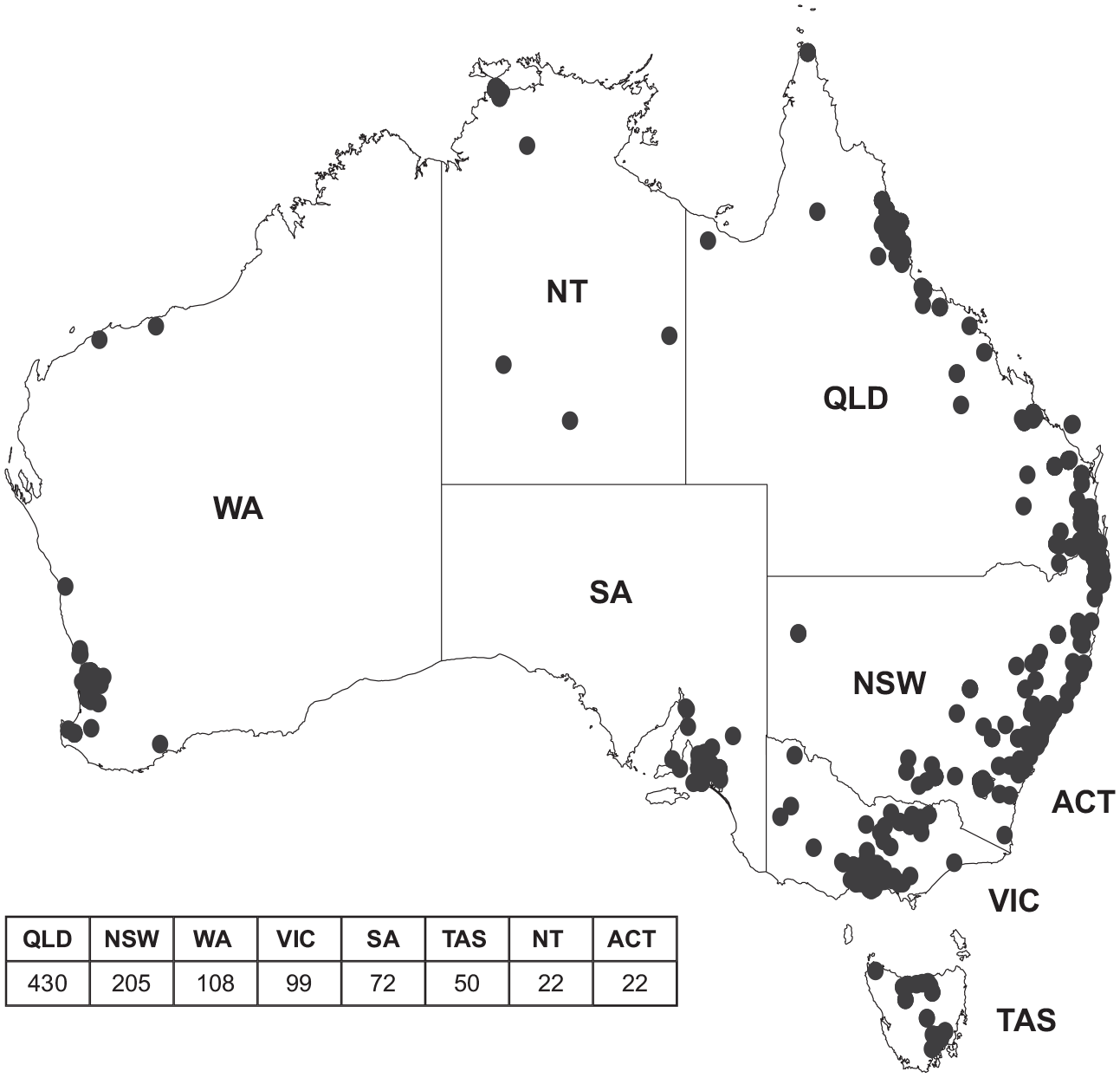
Distribution of survey responses by state (N=1008).
The survey was also promoted through a network of 70 New Age Facebook groups that feature spiritual events, services, or products and act as forums for community engagement. Searching was conducted within Facebook to find community groups that promote a wide range of New Age activities in as many locations as possible across Australia. The 70 Facebook groups employed to promote the survey represent 80 distinct SUAs as well as larger geographic regions such as North East Victoria and South East Queensland, resulting in extensive national coverage. Although most of the activities and events advertised in these groups occur in the local area, members are allowed to join from elsewhere including from interstate. This Facebook Network thereby facilitates the exchange of New Age ideas, experiences, services, and products from one side of the country to the other and promotes ideologies of spiritual growth, awakening, love, and ‘like-minded’ community. A detailed analysis of these Facebook groups including an examination of their published ideologies, activities, and online content can be found at Hoo (2020). This New Age Facebook network afforded invaluable access to the Australian spiritual milieu and returned 812 responses to the survey by the close of the research period.
The survey was limited to Australians over 18 years of age who reported involvement in a variety of activities consistent with previous New Age studies and content derived from the Natural Therapy Pages website (Frisk et al., 2014; Hanegraaff, 1996; Heelas, 1996; Heelas and Woodhead, 2005; Rose, 2005; York, 1995). Respondents were asked to indicate their engagement over the previous 12 months with 35 different activities arranged into five broad groups that covered a wide variety of New Age pursuits. The Meditation and Movement group included physical disciplines such as yoga, tai chi, and chi gong, expressive forms such as chakra dance, as well as meditative practices including creative visualisation, astral travel, and shamanic or inner journey work. The Psychic and Divination group encompassed tarot, divination, witchcraft practices, astrology, numerology, communication with animals, channelling, and psychic mediumship. The Awareness and Self-development group covered ‘human potential’ approaches such as life coaching, vision-board practices, manifestation techniques, motivational programmes, conscious parenting or coupling, and positive affirmations. Retreats and Gatherings encompassed holistic retreats, women’s and men’s circle gatherings, electronic dance music festivals, ayahuasca or other plant medicine ceremonies, and pilgrimage to sacred sites. The Healing and Holistic Therapies group encompassed Reiki and energy healing practices, crystal therapy, Chinese medicine, acupuncture, massage and bodywork, aromatherapy, sound healing, kinesiology, and spiritual healing modalities such as Theta Healing. While every effort was made to include a broad range of New Age interests, there was also space in each section for participants to add other activities that were not listed.
Survey respondents who did not participate in any of the 35 activities over the past 12 months and did not add any similar activities of their own were exited from the survey. However, this number was quite small and comprised less than 2% of total responses. Eligible respondents demonstrated a high level of involvement in New Age practices with 62% reporting daily participation, followed by 20% who engaged 2–3 times per week and 7% who were active once per week. Other respondents participated 1–2 times per month at 4%, 1–2 times per year at 4%, and once every 2–3 months at 3%. The majority of survey respondents, 89%, can therefore be characterised as daily or weekly participants in New Age activities. Participants also reported sustained engagement with New Age pursuits, with 35% claiming to have been regularly involved for more than 20 years. A further 22% reported regular participation for 11–20 years, 37% for 1–10 years and 6% had been active for less than 1 year. Therefore, over half the participants, 57%, claimed to have been regularly involved in New Age pursuits for more than 10 years. This figure is similar to the 51% reported in Rose’s (2005: 95) study of UK participants.
Towards a socio-demographic profile
Studies of New Age spirituality in the United Kingdom, the United States, Western Europe, and Australasia have characterised participants as well-educated and chiefly middle-aged, with women outnumbering men by a ratio of at least 2:1 (Frisk et al., 2014; Heelas and Seel, 2003; Heelas and Woodhead, 2005; Possamai, 2005; Rose, 2005; Sutcliffe and Gilhus, 2013). This study reports similar findings with respect to gender and age, with respondents being 87% female, 12% male, and 1% non-binary, fluid, or transgendered. In terms of age, 32% of respondents were in the 45- to 54 -year age bracket, flanked by 25% at 55–64 years and 23% at 35–44 years of age. A further 9% were 25–34 years, 7% were 65–74 years, 2% were 18%–24% years, and 2% were over 75 years. Although the number of respondents over 35 years of age, 89%, is higher than results from the United Kingdom (81%) and the United States (77%) (Rose, 2005: 86), a total of 66% were born after 1964 and therefore belong to the Generation X, Y, and Z cohorts (McCrindle, 2014: 25–30). This figure confirms Heelas and Woodhead’s (2005: 1910) suggestion the future of New Age spirituality does not depend on those who grew up during the counter-cultural era of the 1960s. In terms of marital status, 48% reported being married or in a long-term relationship of 5 years or more, which is similar to Heelas and Woodhead’s (2005: 1519) figure of 51% married in the Kendal project. The current result rises to 58% if individuals involved in short-term relationships of 5 years or less are included, which brings it close to Rose’s (2005: 84) UK result of 60% involved in partnerships. In the current research, 34% reported being single, in contrast to Rose’s (2005: 84) 40%.
Previous studies have described New Age actors as middle-class or lower-middle-class and while there are insufficient cultural data to establish social class for this study, some statements can be made about occupation, income, and education levels (Heelas and Woodhead, 2005: 2357; Rose, 2005: 89; Sutcliffe and Gilhus, 2013: 5). Since the survey was promoted to New Age businesses, 26% of participants reported their employment in holistic therapies or complementary and alternative medicine (CAM). Other respondents were employed in administrative roles at 13%; medical or health at 12%; education at 10%; legal, social, or welfare at 6%; and arts or media at 6%. A further 5% worked in sales; 5% in hospitality and tourism; 4% in business, human resources, or marketing; and 4% in IT, engineering, science, or technical positions. Nature-based occupations comprised less than 3% of responses including farming, gardening, wildlife and veterinary positions. The lowest figures were in heavy industries and manual labour with construction or mining at 2%, transport or machinery operator and cleaning or laundry both at less than 2% each, while factory or warehouse worker and labourer accounted for less than 1% of responses. These results support previous characterisations of New Age employment in professional, arts, health, welfare and educational fields (Frisk et al., 2014; Sutcliffe and Gilhus, 2013: 5; Van Otterloo et al., 2012: 249).
The gross annual income of all working participants was AU$5000 higher than the national median of AU$50,000 when adjusted for gender (ABS, 2019a). This difference was a result of 7% fewer low-income earners under AU$20,000 per annum than the national figure of 29% in 2016 (ID, 2020). There was no difference in the number of high-income earners over AU$90,000 per annum when compared with the national figure of 12% (ID, 2020). Respondents to the survey reported a high level of education with 42% possessing a Bachelor or higher degree which is significantly greater than the national figure of 24% (ABS, 2017b). Participants in this study can therefore be described as predominantly female, superiorly educated, middle-aged, and gainfully employed in white-collar and social service occupations.
Social transmission and motivations for engagement
Hypothesis and approach
Participants were asked a series of yes/no and multiple-choice questions about their New Age engagement, its impact on their lives, and the extent to which they shared their spirituality with others. They were also asked to recall their reasons for becoming interested in New Age pursuits and offered 17 motivational options in a multiple-choice format where unlimited choices could be selected. Additional responses were collected through an ‘other’ selection where respondents could add their own words. The 17 motivational options were designed to address important spheres of life such as personal relationships, work and career, emotional fulfilment, and physical wellbeing. The motivations were arranged in four groups, Improvement, Challenges, Social, and Spiritual, which targeted key New Age elements that might be attractive to new participants. These four categories were based on highly visible and well-documented New Age characteristics, including its therapeutic features, focus on self-development, social aspects, and existential offerings according to the following hypothesis. New Age has been characterised by a ‘human potential ethic’ that encourages self-improvement through a variety of classes and self-development strategies (Hanegraaff, 1996: 48–50; Heelas, 1996: 31–32; Rose, 2005: 137–138). Therefore, desires for improvement constituted the first group of potential motivations that respondents could choose from. Similarly, New Age is renowned for promoting a wide range of healing therapies and processes for creating positive life changes, with a particular focus on addressing health issues and personal struggles (Hanegraaff, 1996: 53–55; Heelas, 1996: 80–84; Rose, 2005: 192–194). Therefore, personal challenges including illness or emotional distress, and relationship- or career-related stress constituted the second group of motivational options.
The third group addressed claims by Bruce (2002: 100, 101–105) that New Age is devoid of social cohesion by investigating social influences including personal relationships and the search for a ‘like-minded’ community. This group also included the desire to help others and interest in ‘foreign’ or ‘exotic’ cultural practices (Sointu and Woodhead, 2008: 268–269; Possamai, 2003: 33–34). The fourth group investigated the extent to which individuals were attracted to New Age pursuits because they were searching for answers of an existential nature (Aupers and Houtman, 2006: 142–143; Woodhead, 2007: 121). These motivations were framed in the New Age language of ‘spirituality’ and the Spiritual group included the search for a deeper meaning in life which has long been associated with religious frameworks (Campbell, 2001: 75–76). Although it was outside the scope of this study to investigate cognitive influences on New Age engagement, for example, see Hammer (2010), it was considered pertinent to include ‘Curiosity’ as a potential motivation. Since New Age activities have become increasingly visible in the public sphere, there are many opportunities for individuals to come into contact with ideas and publications that may pique their curiosity and stimulate engagement (Hammer, 2010: 59–60; Heelas and Seel, 2003: 233–236). Finally, since many New Age pursuits can be viewed as leisure activities and New Age has been described as an ‘amusement’ rather than a serious religion, it was important to include the idea of ‘Fun’ as a potential motivation for participants (Hamilton, 2000: 196–197; Woodhead, 2010: 34). The options of ‘Curiosity’ and ‘Fun’ were labelled ‘wild’ simply because they each stood on their own merits and did not form part of a larger group of influences examined in this study.
Naturally, these motivational options are not exhaustive and it would be impossible to cater for every potential desire or interest that might lead to New Age engagement. Instead, this research is designed to investigate several key characteristics of New Age spirituality and to ascertain which of these features are most attractive to, or required by, participants. It is also recognised that individuals’ motivations for becoming interested in New Age spirituality for the first time may be different from their reasons for continuing to engage in New Age pursuits. Further research would be necessary to determine whether participants found what they expected to find when initially trying out New Age activities. Since this research relies on the reporting of personal experience, the results are dependent on the self-knowledge and memory recall of participants which may be coloured by personal biases or cognitive inaccuracies (Van Otterloo et al., 2012). Participants who are actively engaged in New Age pursuits may look back on their past choices from a biased position and, for the majority of participants, the research asks them to recall their motivations from more than 10 years ago. Nonetheless, with these limitations in mind, this study aims to report the lived experience of respondents and to investigate the factors that motivated them to become involved in New Age spirituality.
Results
The participants in this study reported a consistently positive experience arising from their New Age involvement. When asked whether their engagement made their lives better or worse on a scale with seven choices, 55% reported Extremely Better, 33% reported Significantly Better, and 8% reported Somewhat Better. Only one participant reported New Age involvement made life Extremely Worse, no respondents reported Significantly Worse, 0.4% reported Somewhat Worse, and 3% reported their engagement made their lives neither better nor worse. In addition, the evidence suggests that respondents were not isolated from the broader community, with 87% of participants claiming to openly discuss their spiritual beliefs and practices with others including friends, family members, co-workers, acquaintances, and social contacts. Moreover, 74% of these respondents said they also discussed their activities and ideology with others who may not, or did not already, share similar beliefs and practices. These results suggest there was substantial potential for the transmission of ideology and activities through social and family connections.
When the motivations for engaging with New Age pursuits were analysed according to the four groups, Improvement, Challenges, Social, and Spiritual, the highest ranking group was Spiritual with an average score of 52%. The Spiritual group of motivations included looking for spiritual answers, following a spiritual calling, searching for a deeper meaning in life, and feeling drawn to exploring different cultural and spiritual practices. The second highest group was Social motivations at 28%, including the desire for social contact with like-minded individuals, wanting to learn how to help others, being influenced by a partner, friend or family member, as well as feeling drawn to exploring different cultural and spiritual practices. This last motivation was included in both the Social and Dpiritual groups since it was considered relevant to both categories. The third most popular motivational group was Challenges at 27%, which included the experience of pain, injury, illness or emotional suffering, difficulties at work or in career, difficulties with partner or family, and feeling that something was missing from life. The motivational type that scored the lowest ranking was Improvement at 22%, which featured the desire to improve fitness or physical well-being, wanting to experience greater intimacy in relationships, the desire to be more successful, get a better job or make more money, and wanting to cultivate intuition, psychic abilities, or healing abilities. The Wild options of Curiosity and Fun ranked at 46% and 12%, respectively. A full list of the individual results can be found at Table 1.
Reasons for initial involvement in New Age activities.
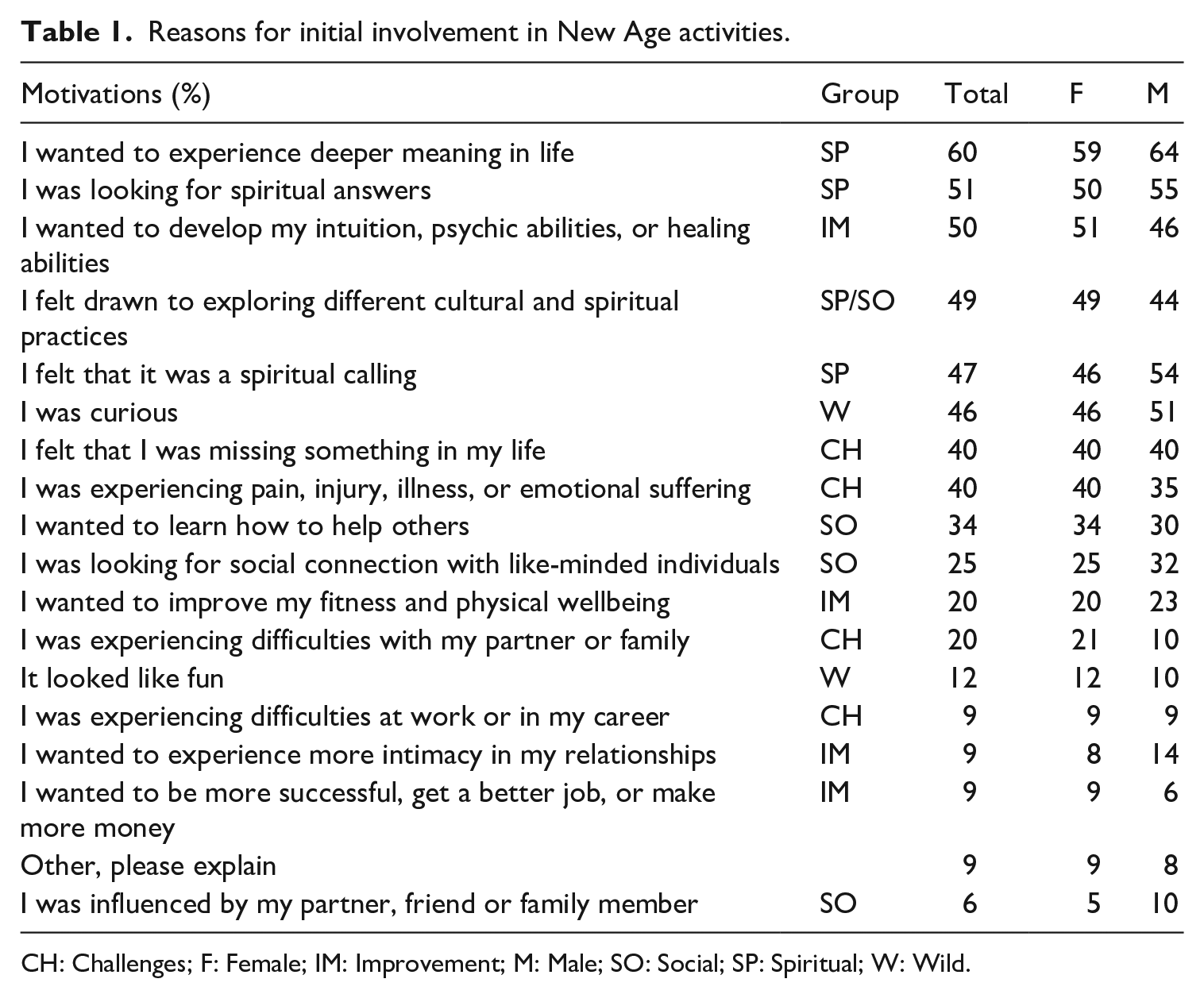
CH: Challenges; F: Female; IM: Improvement; M: Male; SO: Social; SP: Spiritual; W: Wild.
There were some significant differences with respect to gender, with women reporting an 11% higher instance of difficulties in relationships motivating their engagement with New Age pursuits than was reported by men. In contrast, 8% more men than women reported following a spiritual calling, 7% more men were looking for social connection with like-minded individuals, and 6% more men than women were seeking greater intimacy in their relationships. Men also reported a 5% higher instance of being influenced by their partner, friend, or family member along with a 5% higher selection of searching for deeper meaning, looking for spiritual answers, and Curiosity. Women reported a 5% higher desire to develop their intuition, psychic abilities, or healing abilities than men, a 5% higher instance of feeling drawn to different cultural and spiritual practices, and 5% higher motivation due to pain, injury, illness, or emotional suffering. Women also reported a 4% higher instance of wanting to help others than men and a 3% greater desire to be more successful, get a better job, or make more money, while men reported a 3% higher instance of wanting to improve fitness or physical wellbeing. The results for women were slightly higher with respect to Fun, with 2% more women than men choosing this motivation. There was no difference in the results for women and men with regard to experiencing difficulties in work or career and feeling that something was missing in life.
Responses in the ‘other’ selection supported the overall results and highlighted the Spiritual and Social aspects of New Age engagement. Respondents who added their own descriptions reported the experience of mystical or paranormal phenomena in 42% of comments, which supports Possamai’s (2000: 373–374) findings that ‘mystico-pneumatic’ experiences constitute an important factor in alternation to New Age. A further 22% of comments reported social motivations, including 2% who recounted meeting significant individuals who sparked their interest in New Age spirituality, while 20% described growing up with family members engaged in spiritual pursuits. The family members were the mother or grandmother in 50% of cases and the father in 11%, while 39% did not specify. While these figures represent only a small portion of respondents, they do provide evidence of intergenerational transmission of New Age spirituality where children exposed to spiritual practices have maintained these interests as adults. The survey also asked participants if they taught their children about or encouraged them to participate in New Age activities. In response, 30% of participants reported they did not have children or were not involved in raising their children. Of those raising children, 87% reported involving them in New Age activities and teaching them about spiritual pursuits, while 13% did not. Thus, there is substantial evidence of New Age beliefs and practices being passed on to future generations by the respondents to this survey.
Discussion
The research indicates a strong potential for the social transmission of New Age spirituality. However, the reporting of social influence by survey participants was comparatively weak. Although a large majority of respondents viewed their New Age engagement as a positive experience and openly discussed their participation with others, the influence of a partner, friend or family member was the least indicated motivation and selected by just 6% of respondents. It is possible that the individualism of the New Age self-image might play a role in the low reporting of social influence. Since New Age ideology places a high value on following the ‘inner self’, it rejects the voices of external authorities and instead promotes the use of intuition or an inner spiritual gnosis for guidance and self-direction (Hanegraaff, 2000: 307–308; Heelas, 1996: 23; Houtman and Aupers, 2007: 307; Possamai, 2000: 369). With this emphasis on following one’s own path in life, respondents may not see themselves as being influenced by those around them. However, although New Age discourse asserts the primacy of personal authority, Wood (2007: 111) argues that participants’ choices are actually influenced by ‘multiple but relativized social authorities’, including the voices of New Age teachers and facilitators. It is largely for this reason that Houtman and Aupers (2007: 317) have called for a deeper enquiry into the social construction of New Age spirituality.
The results also demonstrate a strong potential for the intergenerational transmission of New Age spirituality since 87% of those with children reported they included them in New Age activities. Although only the children could affirm their commitment to taking up these pursuits, this figure is significantly higher than results from the Kendal study in the United Kingdom, in which 32% of participants claimed their children shared their spiritual interests (Heelas and Seel, 2003; Heelas and Woodhead, 2005: 1938–1944). The attractiveness of various spiritual traditions that may be foreign to respondents’ native culture was also a strong influence, with 49% reporting they felt drawn to exploring different cultural and spiritual practices. Although New Age has been criticised for glamorising Eastern and Indigenous traditions while repackaging them to suit modern Western tastes (Aldred, 2002; Mulcock, 2001; Waldron and Newton, 2012), this appropriation can also be understood as part of a larger trend of cultural consumption in late capitalism where not just religion but also history and popular culture are consumed and transformed by individuals (Possamai, 2003). In contrast, the search for community was not a strong influence for the majority of respondents, with only 25% reporting they turned to New Age spirituality to find social connection with like-minded individuals. Since New Age activities and ideologies have become increasingly assimilated into the general culture, for example, Heelas and Seel (2003: 239) note it is no longer necessary to be a ‘beatnik’ to engage with New Age pursuits, social alienation and the need for community may factor less in recent decades than during the counter-cultural climate of the 1960s and 1970s.
There was considerable interest in the New Age’s therapeutic and holistic aspects with challenges to health and wellbeing providing substantial motivations for engagement. While 40% reported the lived experience of pain, injury, illness, or emotional suffering prompted their involvement, 40% of participants turned to New Age spirituality because they felt that something was missing in their lives. Here, engagement was motivated by a sense of incompleteness which highlights the holistic approach that is one of the central themes in New Age discourse. New Age ideology promotes the notion of a unified self which refutes both the Cartesian mind–body dualism and the Christian God-self divide, in a holistic worldview where everything is interconnected and held to be sacred (Campbell, 2001; Hanegraaff, 2000; Heelas, 1996; Houtman and Aupers, 2010; Rose, 2005). Consequently, New Age spirituality would be an attractive option for anyone looking to resolve a personal sense of lack or incompleteness. While Curiosity received quite a strong response at 46%, only 12% of participants reported they were attracted to New Age pursuits because they looked like fun. This supports Hamilton’s (2000: 196) assertion that New Age engagement is based upon more than a ‘fickle seeking for spiritual entertainment [or] novelty’. Although some critics have portrayed New Age pursuits as a ‘light-hearted romp’ or ‘playful indulgence’, the significant number of respondents seeking relief from physical or emotional suffering and a feeling of incompleteness demonstrates that individuals turn to New Age spirituality for meaningful solutions beyond those offered by the medical profession or established religious institutions (Hamilton, 2000: 197).
Despite the emphasis on self-development in New Age discourse, several life-improvement options furnished consistently weak motivations with one notable exception being the cultivation of ‘spiritual’ talents. Only 9% of participants reported turning to New Age spirituality to become more successful, get a better job or make more money. This makes a sharp contrast to the corporate wellness and prosperity-focused aspects of New Age, in which financial and business success is considered the Holy Grail (Aldred, 2002; Heelas, 2008). New Age spirituality was also not employed to cultivate greater intimacy in relationships with only 9% selecting this option, while the desire to improve fitness or physical wellbeing was moderately popular at 20%. The only area of improvement that was strongly indicated was the desire to cultivate intuition, psychic abilities, or healing abilities, which was selected by 50%. It is quite likely the media have played a role in this motivation since popular films and TV series such as The Craft, Charmed, and Medium have glamorised magical and psychic abilities to a general audience and portrayed women’s empowerment through the intuitive and magical arts (Beeler, 2008; Berger and Ezzy, 2007; Johnston, 2009). However, what this demonstrates is a strong interest in the development of the self beyond its purely rational attributes which reflects both the esoteric interests of the counter-culture (Drury, 2011; Hanegraaff, 2016) and a Romantic self-conception that values the intuitive, mystical, and emotive faculties (Heelas, 1996; Houtman and Aupers, 2007). In this respect, contemporary New Age has not deviated from the core interests and values that were promoted by the spiritual seekers of the Baby Boomer generation (Hanegraaff, 2016; Roof, 1999; Schmidt, 2012).
Overall, spiritual and existential concerns furnished the most popular motivations for becoming interested in New Age spirituality. In addition to the high level of interest in various cultural spiritual practices and the desire to cultivate intuitive and psychic abilities, 51% of respondents were looking for spiritual answers and 47% reported following a spiritual calling. By far the strongest motivation involved looking for a deeper meaning in life, which was selected by 60% of participants and 9% higher than all other options. Campbell (2001, 74–75) suggests the need for meaning is universal and can be satisfied by both religious and secular theodicies which orient individuals within complex systems of value and significance. Naturally, social change can exert stress on theodicies and render their meaning systems inadequate, prompting individuals to look elsewhere for satisfactory answers to existential questions. Aldred (2002: 71) argues modern consumer culture gives rise to fragmentation and an uprootedness which prompts a search for meaning and identity within the very market that causes the dislocation, resulting in a self-perpetuating circular capitalism. For Houtman and Aupers (2007), it is detraditionalisation, understood as the declining authority of the traditional values previously legitimised by Christianity, that creates problems of meaning and identity in late-modernity. Since post-traditionalists may either turn to post-Christian spirituality or adopt a secular stance, Houtman and Aupers (2007: 316) call for further research to investigate whether individuals who experience meaning and identity problems are more likely to turn to spirituality. This research makes a partial contribution to answering this question, by finding that a search for meaning was the strongest motivation fuelling respondents’ turn to New Age.
Since the 1960s, Australian culture has certainly featured a decline in Christianity and traditional family values along with a rise in social instability. With an increasing number of women entering the workforce, children growing up in the 1970s and 1980s enjoyed considerably less adult supervision than their parents and consequently earned the title of ‘latchkey kids’ (Blakemore, 2015; McCrindle, 2014). McCrindle (2014: 60) notes their Boomer parents were ‘the most divorced generation in Australian history’ and claims this has created a ‘fiercely independent’ generation that is peer-oriented and adaptable. By the early 1990s, free university education had been abolished in Australia and young people entered the workforce under a reformed neoliberal economy with weakened job security and reduced power for workers (McCrindle, 2014; Wilson, 2019). Australia has also seen a progressive decline in the popularity of Christianity, with census figures reporting a drop from 88% in 1966 to 74% in 1991 when members of the Generation X cohort were becoming young adults, to just 52% in 2016 (ABS, 2017a). Research from the McCrindle (2014: 41–42) Centre confirms this trend away from Australia’s colonial Christian heritage has continued for Generations Y and Z, who view the Church as a ‘structured institution’ rather than a community and instead search for spirituality outside of traditional religion. Since New Age promotes a theodicy that sacralises the self, it gives meaning and value to the individual spiritual quest and delivers notions such as reincarnation and karma as alternate answers to life’s big questions (Campbell, 2001; Hanegraaff, 1996; Houtman and Aupers, 2010). For the recent generations of spiritual seekers in the detraditionalised culture of late-modernity, New Age evidently offers attractive solutions to existential problems.
Although New Age spirituality has become increasingly integrated into the general culture, it continues to attract significantly more women than men (Keshet and Simchai, 2013; Sutcliffe and Gilhus, 2013; Trzebiatowska and Bruce, 2013; Woodhead, 2007). This topic is the subject of considerable scholarly debate, and here it is only possible to make a brief contribution to untangling this gender puzzle. In the current research, 11% more women than men reported turning to New Age pursuits on account of difficulties in their personal relationships. This evidence supports Sointu and Woodhead’s (2008: 268) suggestion that women tend to carry the burden of emotional labour in relationships where they often take on a caretaker role. However, relational factors were also an important influence driving New Age engagement for men, since 7% more men than women claimed they were looking for social connection with like-minded individuals. Further information is needed to clarify the nature of these desirable ‘like-minded’ qualities which could represent any number of religious, political or environmental commitments or even the search for a ‘safe haven’ from hegemonic masculinity (Trzebiatowska and Bruce, 2013: 37; Sointu and Woodhead, 2008: 261). Men also reported a 5% higher response to the influence of a partner, friend or family member motivating their New Age engagement and a 6% higher claim to desiring greater intimacy in their relationships. Therefore, to a certain extent, men’s and women’s involvement in New Age spirituality reflects their differing experiences and needs within significant relationships.
Conclusion
This article has created a socio-demographic profile of New Age participants across Australia, reported their engagement with New Age activities, and examined their motivations for becoming involved in these pursuits. The portrait of contemporary New Age that has emerged from this research displays many similarities to the spiritual milieu described by the first wave of New Age studies (Hanegraaff, 1996; Heelas, 1996; Sutcliffe and Gilhus, 2013; York, 1995). Like the counter-culturalists, the current generations of spiritual seekers are interested in esoteric disciplines and foreign spiritualities and attracted to notions of wholeness and holism (Hanegraaff, 2016). Contemporary New Age actors are committed to developing their intuitive and psychic abilities and are looking for alternative therapeutic approaches to health and well-being. In contrast to critiques of New Age as a form of capitalist spirituality, for example, by Lau (2000) and Carrette and King (2005), financial and career success held little interest for the individuals examined here and even those employed as holistic therapists rated work, career, and financial concerns as some of the weakest influences on their New Age engagement. While contemporary New Age actors do not appear to have inherited the same degree of social alienation that has characterised the counter-culture, they are primarily seeking spiritual answers and systems of meaning beyond the offerings of Christianity or rationalistic secularism. As Hanegraaff (2000: 307) wrote 20 years ago, the dominant pillars of modern Western culture, summarised as ‘faith’ and ‘reason’, fail to provide adequate theodicies for the spiritual seekers who turn to New Age.
Since the majority of survey respondents were women, the research appears to confirm the theory advanced by Woodhead (2007) and Houtman and Aupers (2008) that post-traditional women experience greater problems of meaning and identity than post-traditional men. Moreover, the tendency for New Age actors to be over 30 years of age suggests the quest for meaning and spiritual answers arises as individuals grow in maturity and are confronted with the consequences of significant life choices (Heelas and Woodhead, 2005: 1568–1587). As New Age activities become increasingly visible in the public sphere, those searching for existential answers can easily encounter New Age pursuits and be curious enough to engage (Hammer, 2010: 59–60; Heelas and Seel, 2003: 233–236). In terms of social transmission, this research demonstrates New Age actors freely discuss their spirituality with others who are not yet involved in similar activities. The extent to which this may constitute proselytising, for example, encouraging a friend or partner to attend a New Age event, requires a closer scrutiny despite the low reporting of social influence by participants. The potential for social transmission was also strongly evidenced within family relations since most respondents included their children in their New Age pursuits. This result along with the anecdotal evidence of familial enculturation reported in participants’ comments contradicts Bruce’s (2002: 105) assertions that New Age spirituality cannot be transmitted from one generation to the next. This is significant because intergenerational transmission represents a reversal of the youth rebellion that characterised the counter-culture and also implies that, as well as representing a search for alternatives to normative cultural ideologies, New Age is potentially becoming a transferrable tradition in its own right.
Footnotes
Acknowledgements
The author would like to thank Huw Nolan, Bob Gilmour and Thérèse Bernier for their technical assistance. Appreciation is also extended to the anonymous reviewers for their valuable suggestions and feedback.
Funding
The author disclosed receipt of the following financial support for the research, authorship and/or publication of this article: This research was supported by an Australian Government Research Training Program (RTP) Scholarship.

Notes
Author biography
Address: Department of Social and Philosophical Inquiry, School of Humanities, Arts and Social Sciences, University of New England, Armidale, NSW 2351, Australia.
Email: