




Abstract
Spiritual connections to the natural world are fundamental to Micronesian worldviews. Structured interviews gathered ethnoecological information about Serianthes. The kosmos-corpus-praxis conceptual framework analyzed spirituality surrounding this leguminous tree and its connection with Indigenous cosmology, traditional knowledge, and practices. We can summarize the results as follows: (a) interspecies relationships expressed through rituals and oral history guide ethnobotanical practices in Belau (Palau) and Wa’ab (Yap); (b) the tree is critically endangered on Guåhan (Guam) and Luta (Rota). In Luta, the tree is celebrated as a flagship species for endangered plant recovery, while the last Guåhan tree has become a rallying point for spiritual resistance when its habitat became threatened by military plans to construct a firing range; (c) spirituality is a fundamental value for island communities; and (d) traditional knowledge holders and scholars strive to work together toward a co-production of knowledge, using spirituality as a fundamental principle toward respectful and sustainable biocultural conservation.
Introduction
Many Indigenous peoples ascribe to spiritual worldviews expressed through cultural practices and beliefs grounded in respect for the natural world (Dorpat, 2011; Harvey, 2005). Sacred connectedness to the land, the ocean, and the spiritual realm of nature is fundamental to coastal Indigenous worldviews (Snively and Williams, 2016). These worldviews hold that plants and humans have the capacity for mutual signaling and these communicative systems develop in a coevolutionary manner (Kimmerer, 2015; Kockelman, 2011). Indigenous spirituality, rituals, myths, and stories oftentimes express and record these relationships (Sepie, 2017). Interspecies phyto-communicability differs among cultures, as cultures interact and develop a specific relationship with plants by storing, adapting, and sharing patterns of communication and knowledge production (Goldstein, 2019; Schulthies, 2019, 2020). Similarly, the gathering of partitioned plant modalities (plant parts, such as leaves, fruits, seeds, wood, or roots) depends on place-specific interactions between humans and plants (Schulthies, 2019). This reciprocal interspecies relationship forms the basis of ecological consciousness and cultural sustainability (Kimmerer, 2015) and can offer insights in how Indigenous plant-human spiritual frameworks can guide conservation.
Micronesia, in the northwest Pacific Ocean, is part of the Micronesia-Polynesia biodiversity hotspot with high species endemism rates and biocultural diversity (Loh and Harmon, 2005; Myers et al., 2000; Figure 1). Many endemic species face extinction because of colonialism, economic development, and cultural globalization taking precedence over sustainability and biocultural preservation, a sad parallel to the traditional knowledge Indigenous peoples have held in relation to these species and other resources in the Pacific Islands. Christian missionaries impacted traditional Micronesian religions and the connections to their environmental knowledge systems. Despite these rapid changes, the Indigenous peoples of Micronesia maintain spiritual connections to the natural world. Similar to the Huni Kuĩ (Brazil) and the Māori (New Zealand) people, Micronesians follow the phyto-communicative model in which they recognize plants as participants in kinship structures (Goldstein, 2019; Rountree, 2012). Nature spirits and spiritual guides mediate plant-human interaction relating to traditional practices such as canoe building (Dobbin and Hezel, 2016). Nature spirits dwell around or can be place-bound. They are ancestral spirits of deities or spirits of the dead (Dobbin and Hezel, 2016).
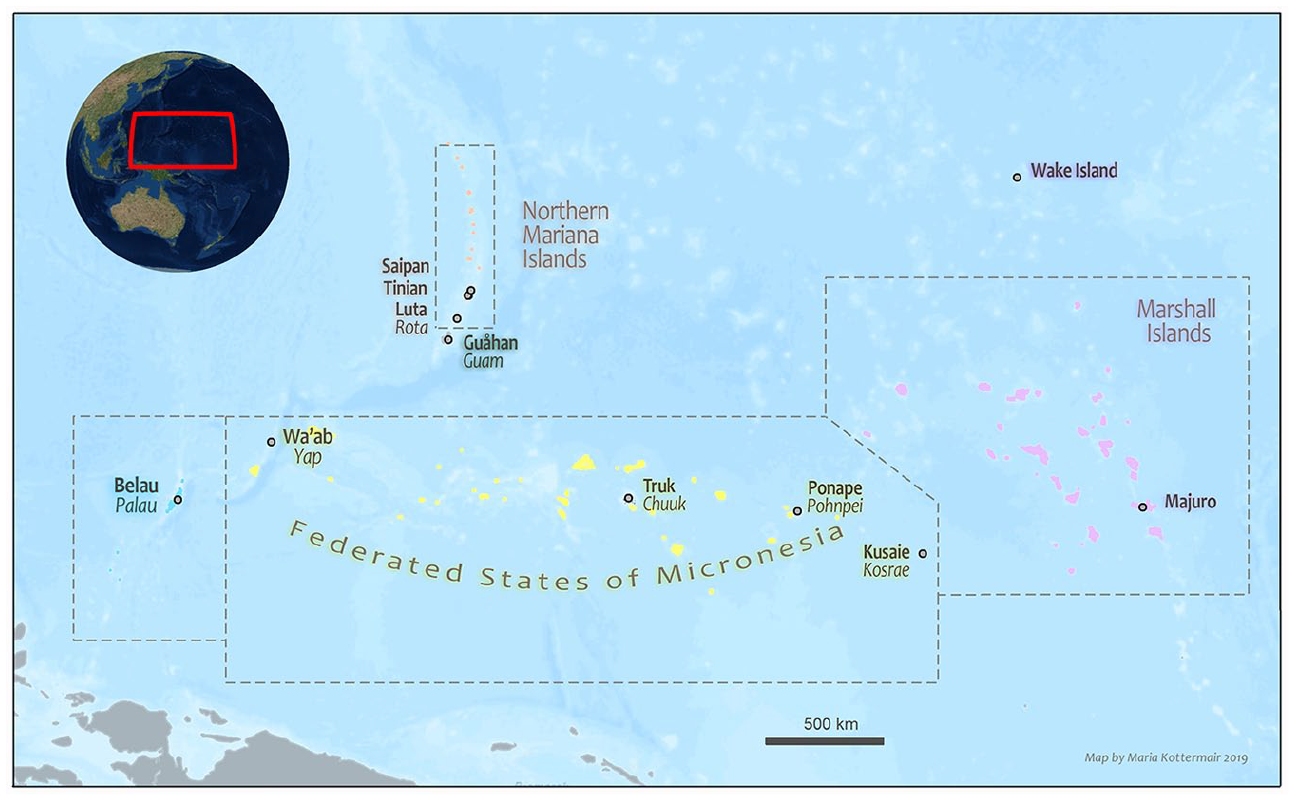
Map of Micronesian islands.
In my own (E.D.) research, I study spirituality and rituals in relation to the conservation of Serianthes, a tree up to 35 m tall, occurring on four islands in Micronesia: Guåhan (Guam), Luta (Rota), Wa’ab (Yap), and Belau (Palau) (Figure 1). Guåhan and Luta are part of the Mariana Islands. Wa’ab is one of the four states of the Federated States of Micronesia. To honor and respect the Indigenous homelands of the Micronesian peoples, we use Indigenous place and plant names throughout this article to recognize their inextricable connection with the land and its people (Smith, 2012).
The ethnobotanical uses, spirituality and conservation practices surrounding Serianthes are different on each island. In Belau and Wa’ab, Serianthes kanehirae Fosberg is still abundant with one variety on Belau, Serianthes kanehirae var. kanehirae Fosberg and one variety on Wa’ab, Serianthes kanehirae var. yapensis Fosberg. The people from Belau and Wa’ab still use Serianthes today mainly for canoe carving, traditional meeting house construction, and medicine, keeping the rituals and cultural practices surrounding this tree alive. Serianthes nelsonii Merr. occurs on Guåhan and Luta and is listed as critically endangered under the Endangered Species Act (ESA). Guåhan has one remaining adult tree, while Luta’s total population comprises less than 35 trees. In Luta, S. nelsonii is a flagship species for endangered plant conservation. In Guåhan, S. nelsonii became the rallying point of Indigenous spiritual resistance because the habitat of the last adult S. nelsonii tree is threatened by the construction of a military firing range. Although the military has stated that they will not bulldoze the last tree, they are committing to preserving only a 100-foot buffer of forest around the tree. We will elaborate on the different traditional practices on each of the islands, the link with traditional governance, and why traditional knowledge and spirituality are important to conservation.
Our central research question asks how epistemological orientations based on Indigenous spirituality and phyto-communication can shape the protection and conservation efforts of endemic plant species, such as Serianthes, in Micronesia. To understand the importance of Indigenous spirituality and its integral connection to sustainable conservation and cultural identity (Fleming and Ledogar, 2008) we suggest the kosmos-corpus-praxis (K-C-P) as a conceptual framework because it provides a holistic approach to study Indigenous epistemology (Toledo, 1992).
Exploring Indigenous spirituality and conservation: an analysis of three ethnospheres
Ethnoecology uses the K-C-P conceptual framework to study the close relationship between traditional knowledge (corpus), practices (praxis), and cosmology (kosmos) (Barrera-Bassols and Toledo, 2005; Pauli et al., 2016; Toledo, 1992; Figure 2). The concept emphasizes that a culture gains individual, community, and generational knowledge by memory and experiential learning. This study analyzes the three ethnospheres in relation to spirituality and conservation of Serianthes. Ethnoecology further examines how traditional and scientific knowledge can generate a co-production of knowledge needed to battle today’s conservation challenges and protect biocultural diversity (Pauli et al., 2016; Snively and Williams, 2016).
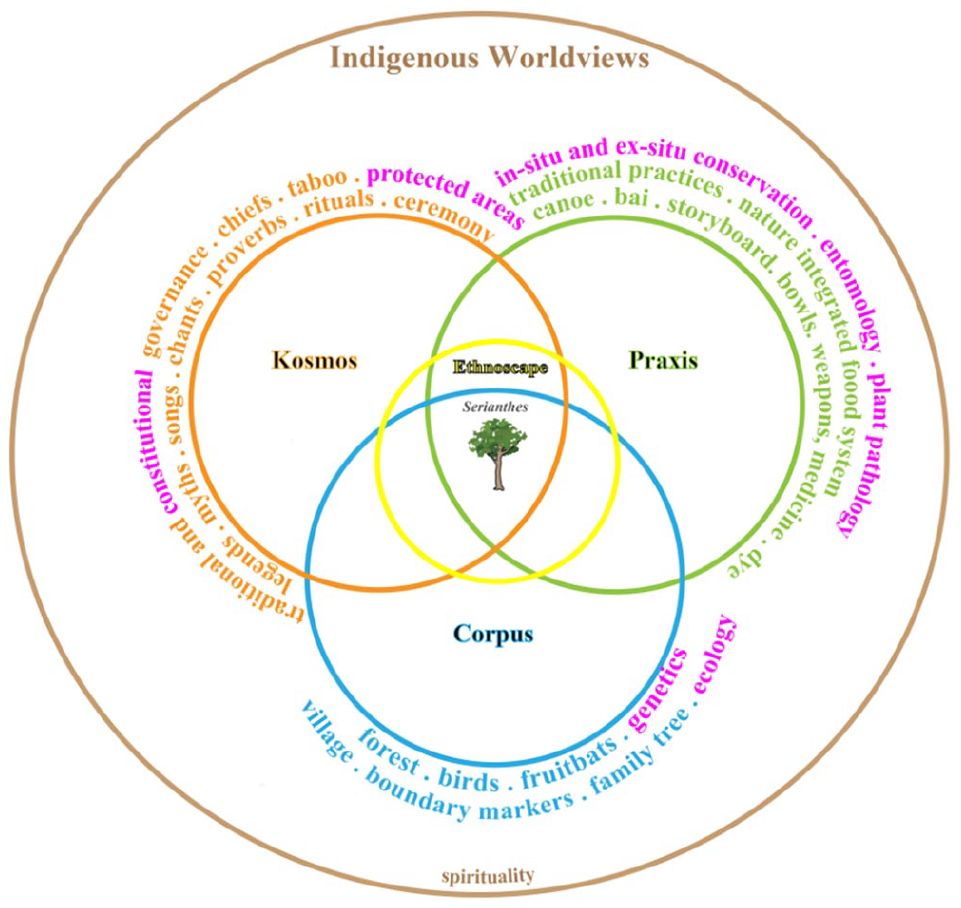
The K-C-P complex based on Barrera-Bassols and Toledo (2005) and adapted from Pauli et al. (2016) illustrates the three ethnospheres and the ethnoscape. The curved words around each ethnosphere detail Indigenous knowledge and scientific knowledge (in pink) mentioned by the participants.
I (E.D.) conducted an ethnoecological field study of Serianthes on Luta, Guåhan, Wa’ab and Belau between April 2018 and December 2019. During structured interviews, I asked traditional ecological knowledge holders to answer a questionnaire about Serianthes. I conducted 14 interviews in Belau, 9 in Wa’ab, 7 in Luta, and 14 in Guåhan. The interviews reveal that traditional spirituality differs between and within island cultures, yet they provide evidence, albeit fragmentary, which I used to construct an overall picture of the importance of spirituality relating to conservation. When quoting interviewees, I have edited their statements for readability1. Voucher specimens of the different Serianthes taxa were collected and submitted to the University of Guam Herbarium.
The results can be summarized as follows: (a) interspecies relationships, rituals, and oral history continue to guide ethnobotanical practices of Serianthes in Belau and Wa’ab; (b) co-production of knowledge can guide conservation practices of Serianthes in Guåhan and Luta; (c) Indigenous spirituality continues to be a fundamental value in all four island communities; and (d) Indigenous spirituality can guide more respectful and sustainable ways of interacting with the environment.
Being a long-time resident of Guåhan, an interdisciplinary scholar, and an environmental activist, I (E.D.) use a holistic research approach. The results of this ethnoecological study will be used together with social movement and phylogenetic data to advise on the development of conservation practices and policies for island endemic plants, using Serianthes as a model species in Micronesia.
The ukall of Belau and its people
Palauans’ relationships with the living and spiritual world are rooted in a deep knowledge and understanding of its elements. Oral traditions such as myths, legends, and proverbs tell about the gods and kosmos, which guide social structure and traditional chiefs’ councils, regulating the polity of Belau (Dobbin and Hezel, 2016). Rituals and chants honor the spiritual world. Palauans use plants in daily life for different purposes (Kitalong et al., 2006). The collection of plant modalities and interspecies phyto-communicative relationships continue to be foundational for conservation and governance in Belau. Belau recognizes traditional and constitutional governance honoring traditional knowledge systems and customary law guided by the Rebekul Belau (Council of Traditional Chiefs). The protected area network, established in 2003, allows traditional knowledge holders to continue their cultural practices. ‘Palauans believe it is important to use the resources to stay connected to them’ (Tellei P). The luaktak (village chief) continues to play an important role in natural resources management and can still assert a bul (harvest moratorium on resources when they become depleted or as a mortuary custom honoring a deceased chief). During interviews, the deep respect Palauans have for ukall or kumer (Serianthes kanehirae var. kanehirae) became evident, as the tree’s name, uses, and the people’s stories intertwine.
K-C-P complex: tree spirits and stories of strength
Ukall grows in mangroves and in coastal, lowland and volcanic forests of Babeldaob and Koror. ‘The tree serves as a landmark. You see trees along stone paths, in villages and old dwellings’ (Kitalong A). ‘Palauans consider planting an ukall an investment. The enormous trunks are used to carve the hull of the kabekl (war canoe), while the smaller trees are used for the kaeb (sailing canoe)’ (Unacio S). Ukall is used for parts of the bai (community meeting house), centrally important in Palauan village organization and culture (Kitalong et al., 2006; Tellei, 2016).
Palauans do not plant the tree for only the current generation, but for generations to come, ensuring sustainability in cultural practices. As the tree grows, Palauans develop a relationship along with the birds and fruit bats that feed on its nectar. Fishermen respond to the phyto-communicative signals of the ukall’s flowering times, as they assure plenty of fish (Alii in Kitalong et al., 2006). Oral histories teach the youth traditional knowledge and imbue spirituality; legends reference the tree’s strength. ‘Techur, a warrior, wanted to claim an entire village. To show he was worthy of ruling the land, he took down an ukall tree and strung millions of small leaves together in one branch’ (Kuiroy B). ‘Fathers tell their sons: “You will be like an ukall when you grow up, but now you are young and need to respect your father”’ (Saoladoab N).
Palauans describe the tree (Corpus) in relation to its use (Praxis) and the spiritual world (Kosmos). ‘One of the best features of ukall is the erect growing pattern and its soft wood’ (Bultedaob RA). The Palauan word ukelall, which means ‘to fell’ (Bultedaob RA), is difficult to translate in the English language because ‘traditionally a tree is not felled but gradually forced down’ (Tellei P). Dachelbai are skilled canoe carvers and house builders who master rituals to appease the tree spirits. Palauans will not take a tree down when it is flowering, as it is giving birth, and needs to absorb all the nutrients. Dachelbai take the tree down when the tide is low and after a long rainy period because that prevents the fibers from being over-saturated: The practice of taking down the tree involves chants and rituals. The chants are about 41 stanzas long and last an hour, invoking all the tree spirits. We perform the rituals in different phases. First, the carver seeks permission from the tree’s ancestors, ensuring the spirits will grow new trees for the carvers to use. During the second part, the carver appeases the tree by asking permission and showing gratitude, ensuring they will not instill injuries on the workers. Last, the carver obtains permission from the forest spirits. (Tellei P) Carvers continue to chant while taking down the tree. First, carvers cut wedges at the base of the tree to let the water seep out. Then, they burn the tree at the base to prevent nutrients being absorbed. This inhibits the growth of the tree and promotes drying and shrinkage of the wood. This process can take up to six months. The community would gather to pull the tree down with a strong vine, iuetekill (Lophopyxis mairgayi). These rituals warrant plenty of fish or a good bounty. (Bultedaob RA)
Although Palauans nowadays use power tools, the beliefs and practices connect Palauans to the spiritual world as they continue to perform rituals and chants, asking the spirits for permission to fell a tree. Oral histories – the telling of stories – preserve these traditional ways. Tools such as the chebakl (adz made of clamshell) are still used to ensure this knowledge does not get lost. ‘The luaktak continues to control the management of the forest’ (Ulengchong Yano S): In order not to overharvest certain tree species, the luaktak decides if a village can cut an ukall to build a bai or canoe. The people from the village themselves will not construct the bai or carve a canoe. Another village will do that for them. The host village will take good care of the workers. Palauans still maintain this custom today. (Kitalong A)
The gumor of Wa’ab and its people
Yapese traditionally hold a worldview focused on kan (gods and spirits) (Dobbin and Hezel, 2016) and rely on magic for protection against spirits. Rituals are performed to honor and appease spirits during traditional practices. Using plants for food, lumber, medicine, fiber, fishing, or other uses is central in the Yapese traditional nature-integrated system (Falanruw, 1994). This traditional management approach fosters phyto-communicative relationships. Governance and conservation integrate traditional and constitutional systems honoring traditional customs, guided by The Council of Pilung (traditional chiefs). Wa’ab also established a protected area network which uses the traditional management approach. All the land is privately owned, but the chiefs oversee the natural resources management. Traditionally, people would use gumor (Serianthes kanehirae var. yapensis) only for house posts, canoe building, and community men’s houses, but when the United States brought portable sawmills to Wa’ab, their use as timber increased. Fortunately, Wa’ab has a traditional system of taboo ensuring conservation of the species.
K-C-P complex: two distinct spiritual stories
Gumor grows in mangroves, lowland forests, in the villages, and along stone paths on Yap, a complex of four conjoined, tectonically raised islands (Yap, Maap, Gagil-Tomil, and Rumung). ‘These majestic trees are part of Yapese nature-integrated food landscape and are a habitat for birds and fruit bats’ (Falanruw M). ‘Gumor are beautiful smooth trees. When a woman is very beautiful, we say she is like a gumor’ (Fanaglibuw H). ‘People plant gumor in the village for future use, mostly for timber and canoes’ (Ruegorong F). Yapese family members will pass the spiritual and practical knowledge about gumor to their heirs and children. Yapese also describe the tree (Corpus) in relation to its use (Praxis) and the spiritual world (Kosmos). In Wa’ab, distinct practices and beliefs surround gumor.
Yap and Rumung: appeasing the gumor tree spirits
On the islands of Yap and Rumung, gumor is used for canoes and houses. When a carver identifies a tree, he will monitor the tree as it grows. ‘Gumor has very valuable wood because it is termite resistant’ (Bigagel P). Carvers soak the wood in the ocean for 3 months to increase its longevity. ‘Gumor is used for the hull of the zowaab (type of canoe), which is used to carry goods inside the lagoon. The ends of the canoe look like a chicken tail’ (Ruegorong F). Traditionally, Yapese would burn the tree and cut it down with the tow (adz made with clamshell). Nowadays, Yapese use power tools, but still ‘carve the hull with fire and the tow’ (Reg F). Carvers perform different rituals to ensure the tree spirits are ready to leave when they cut down a tree: Trees have spirits, which can be good or bad. Carvers perform different rituals to respect the ancestors and the tree. When a tree lands on it branches instead of his trunk, that is a sign the tree sprits are not ready to leave the tree. Yapese call it hatuu shole, because it looks like a black cat crawling down ready to attack. The carver will stop working on the tree and close off the area until the tree is completely down, so the carvers can resume their work. (Raigetal L) Yapese believe trees house small ghosts called Dawachra. Before carvers cut down the tree, they ask magicians to perform a ritual to make the ghosts feel comfortable and ask them to move out of the tree. The carver or builder will wait until a bird flies out of the tree. This signals that the ghost accepted it and left the tree. (Fanaglibuw H)
Maap and Gagil: the story of healing
The people of Maap and Gagil have a different Serianthes story. Although the tree grows in their forest, people in Maap do not plant gumor. I visited one healer in the village who uses gumor for treatment: According to the history of medicine, Yap is divided into seven parts. Our part of Yap belongs to Tamir, our mini god, who is knowledgeable about medicine. According to Tamir, gumor can influence the properties of other medicinal plants. This is a very old story, but we keep following these rules. We do not use gumor for houses or the canoe. I only use the bark in combination with other plants as a treatment for toxins. When I need it, I will go to the other side of Wa’ab and say some magic words as I enter the forest. (Pasan E)
S. nelsonii: the spirit of the largest tree in the Mariana Islands
Despite the long colonial history of the Mariana Islands and the early introduction of Western conservation practices and governance, CHamorus maintain much of their cultural, political, and spiritual identity. The CHamoru worldview respects the taotaomo’na (ancestral spirits) and spirits of all living and nonliving things (Cunningham, 1992). The taotaomo’na can do good or bad. Because they dwell in the natural world, especially in the aerial and subterranean root system of the Nunu (Ficus prolixa), the sacred spiritual significance of the land connects the people’s ecological identity with their spiritual identity (Perez, 2015). The CHamorus are the ‘taotao tåno’ or the ‘people of the land’ and believe the land is their ancestor because she was created from the bodies of Putan and Fu’una, the CHamoru creation gods. Rituals and ceremonies typically start with honoring the ancestral spirits. ‘We believe there is ancestral activity everywhere and therefore start our ceremony by saying “Manotohge hit,” meaning “we stand” over all the old bones, which is a reminder that wherever you go, you are not the first one’ (Master of CHamoru chant, Iriarte L). Other rituals include blowing of the kulo’ (shell trumpet) to call upon the ancestral spirits to guide them, or ‘burning of flowers to honor the ancestors’ (Aguon Cruz E). People still ask permission when entering i hålom tåno’ (the forest). Even Catholic practices incorporate ancient CHamoru spiritual beliefs and practices (Owen, 2011; Schwab, 1996). Contemporary CHamoru values relate to the land, spiritual well-being, and connection to their ancestors. This interrelatedness with nature creates interspecies phyto-communicative relationships. An important CHamoru value emphasizing this interconnectedness with the natural world is inafa’maolek, stemming from the kinship between humans and the natural world (Cunningham, 1992; Perez, 2015). Although the island’s legal framework of conservation and governance is westernized, when S. nelsonii, the largest tree in the Mariana Islands, became endangered, the CHamoru people stood up to protect this species as it is an intrinsic part of their heritage.
K-C-P complex: the importance of connectedness
S. nelsonii occurs on limestone and volcanic soils. Guåhan and Luta have different names for S. nelsonii: Håyun lågu or ‘wood from the outside’ (Underwood R) in Guåhan and Tronkon Guåfi or ‘tree that looks like fire (referencing the reddish flower)’ (Mangloña J) in Luta. In situ conservation practices take place on both islands to augment the wild populations. Propagation of seeds is successful, but outplanting into the wild has been problematic because of pests and ungulate browsing, while typhoons pose a threat to adult trees.
The current generations do not remember the traditional uses of Serianthes because the tree has been rare for a long time. Louis Claude de Freycinet (1939) listed Håyun lågu as a timber tree. Although specific practices for Serianthes could not be documented, there are still traditional practices for cutting down trees. CHamorus cut wood during the first quarter of the moon and at low tide (Punzalan, 2013). Carvers still use ceremony and spiritual chanting to guide canoe making because everything from the earth has a life force, which requires ritual practices ensuring the entire process occurs within the inafa’maolek spirit (Alcantara-Camacho, 2016).
Håyun Lågu: a rallying point for spiritual resistance
Although the CHamoru traditional practice of inheritance of lands through traditional matrilineal relations has been disrupted, these principles guide the CHamorus in how to treat nature. Traditionally, inheritance of CHamoru family land passed through matrilineal relations. Although colonization disrupted this practice, the connection to ancestral land remains. When the military proposed building a firing range complex on the limestone plateau of Tailålo’ (CHamoru place name for Northwest Field, now under jurisdiction of the Department of Defense), where the last Håyun Lågu grows, Prutehi Litekyan, a direct action group, started a social movement to protect Guåhan’s biocultural diversity and regain land sovereignty. The firing range would create a large surface danger zone which would prevent access to 68% of the sacred lands of Litekyan. CHamorus still perform traditional practices and rituals at Litekyan, connect with their ancestors, and find their cultural identity as the landscape embodies wisdom. Despite opposition from the community and their request that the military planners take into account CHamoru spirituality and traditional practices as part of environmental compliance, the military went ahead with its plans. The Håyun Lågu became a rallying point for resistance, with protesters demanding that planners respect the spiritual value of the land and its resources: My mom and maternal grandparents lived in Tailålo’, meaning no flies, due to the coastal breeze. My mom recalls seeing ‘a majestic tree like no other tree in the forest. It made a sound that was different, magical, and warmed your heart. I enjoyed looking at it, by itself, the only one. It stood out and looked nicer than the rest. I tried to climb it but it was too wide. Why was it so tall? Was it planted long ago?’ This story was my spiritual connection to the Håyun Lågu tree which inspired me to join Prutehi Litekyan in order to halt the construction of a multipurpose machine gun range within shooting distance of the lone mother tree of Guam. (Perez S)
Tronkon Guåfi: a symbol for endangered plant conservation
Traditionally, chiefs and the council of elders managed the natural resources. ‘Traditional approaches are holistic, protecting the entire ecosystem, and are embedded in the culture’ (Mendiola T). Conservation practices and ways of gathering plant modalities are included in the CHamoru language. ‘Gua’lak is used for picking the leaves. Hali is to take the roots’ (Mendiola T). Kantan Chamorrita (folk songs) teach about traditional knowledge, practices, and spirituality. ‘Guåfi gi matan-hu – Fire in my eye references to the Tronkon Guåfi flowers that look like fire in the mountain when you wake up in the morning’ (Mendiola T).
The ESA shifted the focus from a traditional conservation approach toward a Western species conservation approach. ‘Although federal funding is available for Tronkon Guåfi, critical habitat is only designated for birds’ (Mangloña J). ‘To increase conservation efforts a multifaceted approach is needed where traditional knowledge holders and the horticultural community support conservation efforts’ (Bamba J). Co-production of both traditional and scientific knowledge and practices can advance species protection in a more holistic way.
In Luta, the tree became a symbol of endangered plant protection as the local forestry department is not only augmenting the wild populations but also bringing the trees back to the villages. ‘We notice that people are proud to see Serianthes in the urban landscape. Nowadays, spirituality is more practiced on a personal level, but when the whole community comes together to bless a canoe, we will all gather in ceremony’ (Mangloña J).
Conclusion
The answer to the initial question, whether epistemological orientations based on Indigenous spirituality and phyto-communication can shape the protection and conservation efforts of endemic plant species such as Serianthes in Micronesia is clear. Our research shows that the spiritual practices, rituals, values, and phyto-communication surrounding Serianthes connect people to the tree and its habitat holistically. While the modern debate often focuses predominantly on singular aspects such as endangered species or loss of traditional skills, the most pressing and dangerous possibility would be a change in the Indigenous value systems connected to spirituality. These cultural structures are connected to spirituality, instill respect, conservation, and prosperity for future generations. By sustaining human-plant relationships, the people of Belau and Wa’ab continue to protect and connect with Serianthes in a sacred way. The role of traditional knowledge in conserving biodiversity is evident. In Belau and Wa’ab, people are able to continue their traditional practice guided by councils of traditional knowledge holders and other levels of social organization.
The Mariana Islands endured centuries of colonization. Although spirituality and traditional practice are still very important to the CHamoru people, foreign laws and regulations not fit for island cultures damaged the important link between traditional knowledge and conservation. In the Mariana Islands, the Serianthes populations diminished. In Guåhan, the ecological-spiritual identity of the CHamoru people and eco-spiritual practices fostered fierce resistance against the military firing range in Guåhan. Activists brought spirituality to the forefront of the discussions and demanded inclusion of this environmental consciousness into environmental compliance laws and regulations. A collaboration between traditional knowledge holders and scientists is necessary to generate a co-production of conservation knowledge and practice guided by spirituality and respect. In Luta, human-plant interactions are being restored by planting Serianthes in the village. Over time, patterns of mutual sensing between Serianthes and the people of Luta can be shared and adapted.
The deep spiritual connection traditional knowledge holders maintain while continuing traditional practice and rituals provides strong evidence of why conservation practices tied to plant-human relationships can increase biocultural diversity. A culture defines itself not only by materialistic expression or political debate, but also by the belief systems and values which guide behavior and provide a lived experience deeper and more persistent than a cultural practice. Oral traditions concerning spirituality encompass a wide variety of expression through both spoken words (legends, myths, songs, chants, and proverbs) and practices (rituals and ceremony) and are essential to safeguard a culture. While similarities exist across the region, every Micronesian culture has its distinct spirituality, which is part of the islanders’ heritage. This spirituality and an ethos of earth stewardship can form the basis of conservation in island cultures.
Footnotes
Acknowledgements
Mesuláng, Kam’magargad, Si Yu’os Ma’åse’ to all participants for sharing your knowledge and wisdom. I (E.D.) would like to acknowledge the Republic of Palau, Yap State, the islands of Rota and Guam for their hospitality, and the Belau National Museum, Yap Forestry, and Rota Forestry for their assistance with organizing the field trips. Special thanks to Pius Bigagel, Sholeh Hanser, Naito Soaladoab, and James Bamba for accompanying me with wonderful stories and enthusiasm, and to Dr Ann Kitalong and Dr Margie Falanruw for providing herbarium space to dry my specimens. Thank you to Dr Kevin Jernigan for your guidance during this research and to Dr Sarah Lemer for assisting with the French translation.
Funding
The authors disclosed receipt of the following financial support for the research, authorship, and/or publication of this article: This research was conducted as part of an interdisciplinary doctoral degree (E.D.) at the University of Alaska Fairbanks and the University of Guam.

Notes
Author biographies
Address: Center for Island Sustainability, University of Guam, UOG Station, Mangilao 96923,Guam.
Email:
Address: Department of Anthropology and Institute of Northern Engineering, University of Alaska Fairbanks, P.O. Box 757720, Fairbanks AK 99775-7720, USA.
Email:
Address: Micronesian Area Research Center, University of Guam, UOG Station, Mangilao 96923, Guam.
Email:
Address: Center for Arctic Policy Studies, the University of Alaska Fairbanks, 2160 Koyukuk Drive, P.O. Box 757340, Fairbanks, AK 99775-7340 USA
Email:
Address: Department of Biology & Wildlife, University of Alaska Fairbanks, P.O. Box 757720, Fairbanks AK 99775-7720, USA.
Email: