




Abstract
While the diversity of diasporic Muslim public experiences has been examined, the social contours of religious approach have received less attention. Moreover, the ways in which religion shapes marital relations remains understudied. This article, which features data from a larger research project, highlights two divergent trends in Muslim approaches to religion: exclusivity, which frames only one approach to Islam as correct, and inclusivity, which frames multiple approaches as correct. This divergence plays a role in shaping definitions of ‘good Muslim’, as exclusivist Muslims focus on ritual acts (outward observance), while inclusivist Muslims prioritize good manners (inward observance). The author demonstrates how these inward and outward definitions of Muslimness in turn inform how participants evaluate their spouses’ religiosity and, thus, the potential for conflict over religiosity with their spouses.
I’ve become more concerned with how things operate at a human level rather than how they operate at a juristic level. My husband is very black and white, and I’m very grey. (Umber, Inclusivist Muslim, married to an Exclusivist Muslim)
Introduction
Scholars have investigated immigrant Muslim gendered religious performativity in public spaces (Khan, 2018; Khurshid, 2012; Latif et al., 2018; Shams, 2018), but Muslim gendered religious performativity within intimate family life has not been explored, nor has attention been focussed on the diverse approaches through which Muslims engage with Islam. Although Joseph (2008) underscored the dearth of critical scholarship on family and gender relations in Muslim-majority contexts over a decade ago, there is an ongoing absence of, and the need for, more research on the intersection of immigrant Muslim religious and family life (Hatch et al., 2017). Notably, Musawah, a global movement for equality and justice in the Muslim family, state in their report, Who provides? Who cares? Changing dynamics in Muslim families, that gender fluid approaches to paid and unpaid work are vital to diasporic Muslim family health and mutually fulfilling family relations (Mir-Hosseini et al., 2018). Indeed, gendered expectations are cited as being at the heart of North American Muslim marital conflict (Macfarlane, 2012). Thus, it is imperative to uncover how Muslims engage with religion within their families, and how gendered religious approaches shape Muslim married and family life.
I pursue these research questions by analysing qualitative interviews with currently married Pakistani Canadian Muslim couples. Canada is home to the second fastest growing Muslim population worldwide, with a population of over 1 million Canadian Muslims that is expected to increase ten times faster than the general Canadian population (Grim and Karim, 2011; Shah, 2019a; Statistics Canada, 2011). Most Muslims entering Canada are from Pakistan. Toronto is home to the largest population of Muslims and Pakistanis compared to other Canadian cities, as 41% of all Canadian Muslims and 63% of all Pakistani Canadians live in Toronto. General concerns about the Muslim population (or, more appropriately, Muslim women) in Canada have peaked during the past decade because of the debates over Shari’ah-based arbitration (Korteweg, 2008; Korteweg and Selby, 2012; Ruby, 2013), the Charter of Quebec Values (which prohibits the donning of conspicuous religious symbols) and pursuant debates on what Muslim women can(not) wear (MacCharles and Spurr, 2015), as well as the ongoing concern about ‘honour’ killings (Korteweg and Yurdakul, 2010). Despite this focus on Muslim women’s public and civic lives, imbued with assumptions about their private lives, little is actually known about the intimate lives, religious practices, and gender relations that structure their family home.
In this article, I define inclusivity and exclusivity, two approaches to religion, and the definitions of Muslimness that align with those two approaches. After reviewing extant literature on religious approaches, with a focus on the diasporic Muslim context, I present empirical examples of participants’ definitions of ‘good Muslim’ according to their exclusivist or inclusivist approaches to Islam. Exclusivist participants, who accept only one way (their way) of Islam as correct, define ‘good Muslims’ as following a set of prescribed actions (e.g. regular prayer) and focus on outward performance of Islam. Inclusivist participants, on the other hand, who accept multiple approaches to Islam as correct, prioritize an inward performance of Islam and focus on akhlaq, or good manners, within the home and intimate relationships.
Literature review
The below review highlights the different approaches to religion with a focus on Islam, followed by an assessment of literature on marital negotiations within religious couples. I demonstrate that, despite the documented diversity in religious approaches, researchers tend to treat religion as a monolith when considering how it plays a role in intimate contexts.
Religious approaches
Much of the literature on diasporic Muslim religiosity fixates on the push for a unified (or an orthodox) Islam. Before turning to this body of scholarship, I discuss the divergence between orthodox and heterodox approaches to Islam. According to Ahmed (2012: 123), there is a spiritual, fluid, unofficial women’s Islam, and an official, textual men’s Islam. Men’s Islam descends from literature mostly accumulated during the medieval era, when men dominated women and believed themselves to be superior. Thus, men’s Islam continues to espouse an oppressive gender ideology, legitimated by merit of historical and canonized texts written by men who were themselves chauvinists (Ahmed, 2012: 125–126). Women’s Islam is ‘gentle, pacifist, inclusive, [and] somewhat mystical’ (Ahmed, 2012: 121). Thus, women often dismissed what shaykhs, the carriers of Islamic orthodoxy, had to say (Ahmed, 2012: 123–125), preferring instead intrinsic foci: making sense of the world, of people, of ourselves, and of God.
Historical evidence indicates that many religious intellectuals, including (female and male) Sufi philosophers and mystics, shared beliefs and values found in women’s Islam (Almirzanah, 2011; Helminski, 2003). Historically, however, given that men’s Islam held power, these intellectuals either kept silent or were silenced (Ahmed, 2012: 130). Today, although women’s Islam hailed from an oral tradition, the relatively recent rapid increase in Muslim women’s literacy and attainment of higher education as well as availability of Islamic resources and references becoming more accessible through print and the Internet have spurred on a scholarship of written texts critical of orthodox Islam (see Hidayatullah, 2014 for review). In turn, heterodox approaches to Islam are widely available to Muslim women and men alike.
Nonetheless, much of the literature on diasporic Muslims focusses on the push for an orthodox, monolithic Islam. No such thing exists, of course, given the variances of experiences, cultural backgrounds, class norms, gender identities and ideologies, sociopolitical contexts, and a plethora of other factors that create unique, varying Islams (Khan, 2016; Wadud, 1999). From the variance of experience, diverse approaches to Islam arise given selective acceptance of different forms of religious-based knowledge as individuals strive to live by the Shari’ah (literally, ‘the way’, a source for fiqh or Islamic laws). The Shari’ah is not monolithic nor static and can be reinterpreted to accommodate shifting social arenas and new tensions in gender relations (Akhlaq, 2017; Bartkowski and Read, 2003; Cesari, 2012; Korteweg, 2008; see Yadgar, 2006 for a parallel study on Jewish women). Global migration has also prompted Islamic jurists to create (and sometimes bend) laws specifically for Muslims living in the diaspora (Kazemipur, 2016; Takim, 2017; see also Akhlaq, 2017). Globalization is also driving boundary work concerning exclusivist and inclusivist approaches to religion (Desplat, 2005: 482).
Inclusivist and exclusivist approaches to religion are defined through salvation accessible to other religions or teachings. Inclusivity is demonstrated when believers or dogmas allow for other teachings to provide salvation, while exclusivity is identifiable if a believer or dogma positions the religion as the only means to salvation (Zhussipbek and Satershinov, 2019: 609). Though the two are framed as opposing categories, conceptually, they are two ends of a spectrum. Drawing on this work for this study, inclusivity is defined as acceptance of other forms of religiosity, Muslim or not, while exclusivity is defined as preference for one’s religious teachings and rejection of others’, even if those other teachings are based on Islam. Inclusivity is associated with pluralism, respect for diversity, and harmony, while exclusivity is associated with authority, intolerance, and orthodoxy (Bakar, 2009; Desplat, 2005; Hew, 2019). Exclusivity typically excludes a religious other, though adherents within a faith tradition may find means to exclude each other (Desplat, 2005: 494).
As this study focusses on the processes of religious negotiations within an intimate context, Islam is not framed as inherently exclusivist; rather, it is framed as a fairly flexible resource with available interpretations that lend to either exclusion or inclusion (Desplat, 2005: 483). However, it is noteworthy that many theologians consider Islam an exclusivist religion, given exclusionary verses in the Quran. This is certainly reflected by the push to objectify Islam in the Muslim diaspora (Brubaker, 2012), as immigrant Muslims seek to purify Islam from supposed cultural contaminants through critical reflection (Rothenberg, 2011). Much of this qualitative literature features intergenerational relations between parents and their children, particularly daughters rejecting their parents’ religion as cultural (see Hildson and Rozario, 2006 for review). There remains an absence of attention to how religious approach shapes relations within diasporic Muslim marriage.
Religiosity and marital negotiations
The predictable consensus in scholarship on marital relations is that men enjoy power over their wives and other women, religious or not. Research on Christian families suggests that religion can be both a resource and a roadblock as women and men engage in complex patterns of deference and control when negotiating everyday matters (Bartkowski, 2001). Much of this research focusses on Christian women’s negotiations of religion and gender ideologies, such as feminist equality and faith-based prescriptions for women’s roles in the family (Ecklund, 2003; Mihelich and Storrs, 2003). Studies focussing on the Muslim context present similar patterns of gender and power negotiations, especially among immigrant women (Ajrouch, 2004; Nyhagen Predelli, 2004). Studies in Muslim-majority settings tend to focus on women actively resisting male dominance and claiming their rights (Jacinto, 2006), sometimes having to resist even their minor sons (Gallagher, 2007). Muslim women leverage religion, as researchers document women utilizing religious rituals to avoid gendered expectations, including unpaid housework (Hegland, 2003).
Focussing on the Canadian Muslim context, Moghissi et al. (2009) explore several areas in the lives of their immigrant respondents, and find that religiosity positively correlates with marital happiness. However, they remain critical of this finding, stating that couples may be hiding their own marital dissatisfaction, even from themselves. While this study did include some measures of religion (e.g. Muslim identity and performance of Islamic practices), it did not reach deeper into the processes and experiences of religiosity within the home, nor did it investigate religious-based patterns of marital conflict.
While these studies explore the processes through which social actors navigate religiosity within their intimate lives, the consequences of these negotiations are featured as ideological positions. In other words, though this scholarship focusses on marital negotiations, the negotiations are often internal to an individual and not between members of a couple, which may be a methodological artefact of research samples comprised by individuals and not couples (see Bartkowski, 2001 for an exception). The studies do not assess consequences for the social groups or institutions these social actors inhabit – namely, the family. To my knowledge, no study has previously captured the role of religious approach in structuring individuals’ evaluations of their spouses and the consequent potential for conflict, which the current study attends to.
Research design
This study draws on qualitative data to capture the mechanisms through which Canadian Muslims navigate their religious, ethnic, and gender identities, practices, and relations (Shah, 2019b). Individual interviews were conducted with a purposive sample of 46 currently married Pakistani Canadian Muslims (23 couples) between the ages of 25 and 40 in which at least one member of the marital couple self-identified as a Pakistani and a practicing Muslim (e.g. are you Muslim and do you practice Islam?). Given the wide range of Islamic interpretations and practices, allowing participants to self-identify – rather than having an a priori list of qualifications – provided a diverse sample that included multiple approaches to religious practice. By requiring at least one member of the couple to identify as practicing, I also ensured that I would be able to speak with individuals for whom religion is a salient aspect of their own lives and/or their family lives. The sample was restricted to Pakistani-identified participants for three reasons: first, given the wide variation in the backgrounds, ethnic identities, cultural repertoires, and religious beliefs and practices among Canadian Muslims, sample limitation reduces sources of variation; second, the interviewers are fluent in Urdu, allowing for the participation of individuals who are uncomfortable with their English language skills (Franceschelli and O’Brien, 2014); finally, the interviewers are Pakistani, allowing for rapport between interviewers and interviewees (Ajrouch, 2004).
A trained male interviewer and I spoke with the couples – I spoke to wives while he, in a separate space out of ear’s reach, interviewed their husbands. Participants were interviewed using a pre-tested semi-structured guide, a useful approach for this study as it allows flexibility in adjusting questions according to interviewees’ responses (Bartkowski and Read, 2003; Berg, 2007). After participants granted consent, the audio recorded interviews took place face to face in the participant’s preferred language (English, Urdu, or a combination). I translated (when necessary) and transcribed all recordings before I coded all transcripts to identify emergent patterns.
The interviews began with a brief life history component (e.g. ‘Let’s start at the beginning; where were you born?’), with targeted probes on their family and married life, religiosity, and experiences of immigration and discrimination. Not surprisingly, these experiences were highly intertwined, so we allowed participants to take the lead, often probing or redirecting to ensure all items from the interview guide were addressed. This interview strategy is common in research on gender and family relations (e.g. Chesley, 2011). The interviews took place anywhere participants requested and felt comfortable; most interviews took place in participant homes or cafes near the participants’ home or workplace. Interviews were collected between October 2016 and May 2018.
Although this study was exploratory, it was shaped by sensitizing concepts (Bowen, 2006) initially drawn from the concepts of religious reflexivity (Brubaker, 2012), religious resourcing (Bartkowski and Read, 2003), patriarchal bargains (Kandiyoti, 1988), hegemonic masculinity (Connell, 1995), gender justice (Gheaus, 2012), and racial formation (Omi and Winant, 2015). Thus, the first phase of analysis involved open coding data using both a priori codes drawn from theoretical concepts and in vivo codes for emergent themes. The second phase of analysis, focussed coding, involved mapping connections across saturated codes (Corbin and Strauss, 1990; Glaser and Strauss, 1967). The second analysis situated the social meanings derived from the first analysis within participants’ social locations, embedding participant experiences within macro- and meso-level factors to identify how social structures shape individual beliefs, actions, choices, and opportunities (Pamphilon, 1999).
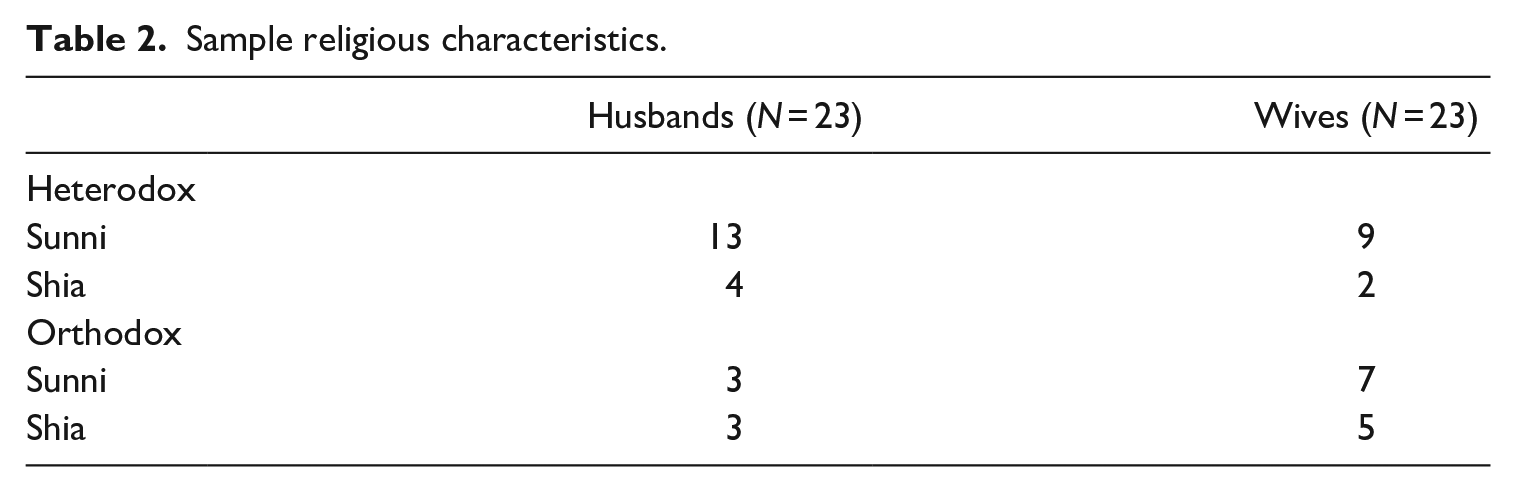
To capture the relationship between religiosity and immigration, the sample was initially broken down by generation of immigration, including increments between first and second generations (see Table 1). However, generation of immigration proved not to be insightful, as there were distinct variations between members of the same immigrant generation, and there were distinct similarities between generations. Likewise, other social indicators, including socioeconomic status, ethnic identity, length of marriage, and age are reported in Table 1 but proved not to provide insight into the processes described below. Instead, approach to religion emerged as a saturated concept in vivo, and thus, I present participants according to their approach to Islam: those who accept only one interpretation of Islam, their own, as clearly superior to others are considered to be exclusivist, while those who accept multiple interpretations are considered to be inclusivist (Zhussipbek and Satershinov, 2019). After identifying specific religious modes emerging from the data (see Table 2), I used Mill’s (1843: 454) Method of Agreement to capture the convergences and divergences in participant narratives.
Sample sociodemographic characteristics.
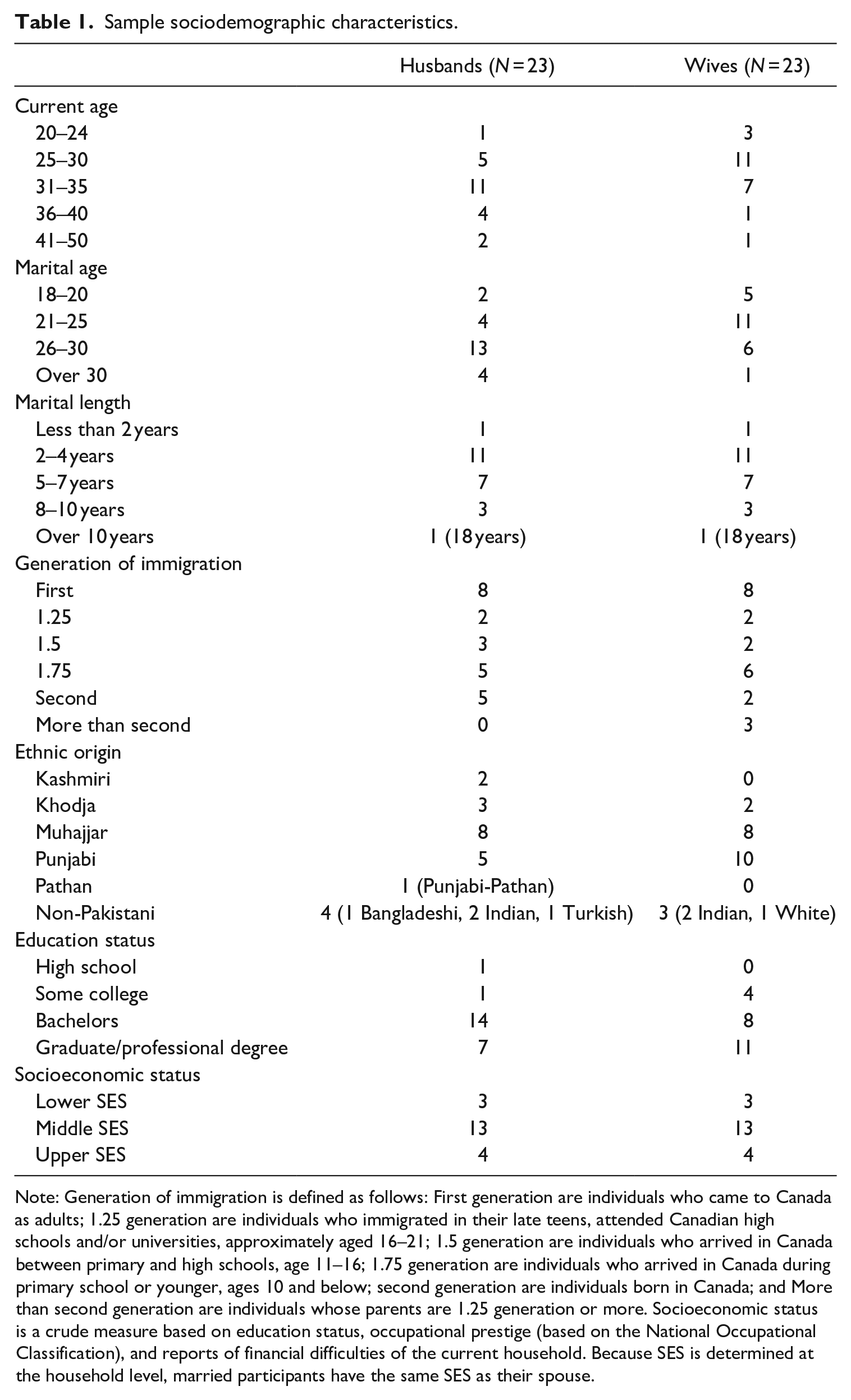
Note: Generation of immigration is defined as follows: First generation are individuals who came to Canada as adults; 1.25 generation are individuals who immigrated in their late teens, attended Canadian high schools and/or universities, approximately aged 16–21; 1.5 generation are individuals who arrived in Canada between primary and high schools, age 11–16; 1.75 generation are individuals who arrived in Canada during primary school or younger, ages 10 and below; second generation are individuals born in Canada; and More than second generation are individuals whose parents are 1.25 generation or more. Socioeconomic status is a crude measure based on education status, occupational prestige (based on the National Occupational Classification), and reports of financial difficulties of the current household. Because SES is determined at the household level, married participants have the same SES as their spouse.
Sample religious characteristics.
In substantiating the claims I make when reporting study findings, I directly quote and describe trends in narratives from participant interviews, and use pseudonyms when referring to participants. Married participants are identifiable through alliterating names (e.g. Fahad and Faiza). When quoting directly from interviews, I adjust the language for the sake of confidentiality (removing identifiable language use), clarity, and brevity; however, the transcripts, which are not publicly accessible, retain the participants’ original responses (see also Gabb, 2008). Quotes and narratives presented below represent trends common for others with the participants’ religious approach (inclusivist or exclusivist), unless the data called upon is an atypical case, in which case I inform the reader of the divergence.
Findings
In the following sections, I highlight the divergence between inclusivist and exclusivist approaches to Islam in how participants define Muslimness. After demonstrating how religious approach and definitions of Muslimness impact how participants evaluate their spouses’ religiosity, I shed light on how religious approach and definitions of Muslimness shape the potential for marital conflict over religious practices.
Inclusivist and exclusivist approaches to Islam
The pattern that emerges from participant narratives is as follows: exclusivist participants accept only one approach (their own approach) of Islam to be correct, while other forms are either less correct or wrong. Inclusivist participants accept multiple paths to Islam, without making moral judgements. Nonetheless, inclusivist participants still prioritize good manners (akhlaq) as salient for good Muslims, while exclusivist participants prioritize ritual acts and prescribed devotions, framing adherence to these acts as a litmus test for Muslimness. For example, Fahad, a second-generation Canadian, is a self-identified religious Sunni Muslim who approaches Islam from an exclusivist perspective, as does his wife Faiza. When Fahad is asked what makes someone a good Muslim, he succinctly states, ‘Pray. Just pray. Once you pray, everything else comes’.
The primal importance of performing prayers is a repeated theme across exclusivist participant narratives, though sometimes other acts are also indicated as important. Regardless of what act is framed as important for good Muslims, exclusivist participants fixate on adherence to rules and regulations around these acts. Like Fahad, his wife Faiza is also an exclusivist participant. In a longer narrative describing the masjid she and her family attend, she mentions: Their deen [religiously prescribed way of life] is very on point, what we believe in. We’ve been to other Pakistani mosques and – like if we go for taraweeh [Ramadhan-specific prayers] – you’re supposed to stand shoulder to shoulder, but in the Pakistani mosques, they don’t stand shoulder to shoulder. Whereas at the masjid we go to, they stand shoulder to shoulder as well [emphases added].
For Faiza, as well as other exclusivist participants, others’ Islams are ‘on point’ or correct if these approaches to Islam are in line with participants’ own approaches. In addition, for Faiza and other exclusivist participants, failure to adhere to participant approaches to Islam is met with criticism, as the acts are framed as highly salient for Muslimness. For inclusivist participants, good manners or akhlaq is framed as salient for Muslimness. When Nadia, an inclusivist participant, is asked what a good Muslim is, she states: For me, it’s trying to be more familiar with my religion, going above and beyond the five requirements, knowing the religion I practice, and trying to make it a part of my everyday life, with the way I look at the world, the way I interact with other people [emphasis added]. And I want Islam to define that for me. For example, giving charity, being kind to others, respecting others. I know it’s across every religion, but for me, it’s defined by how I read religion. By hadith, one of the most recognizable things about the Prophet Muhammad was that he always had good manners towards everyone.
Similar to exclusivist participants, inclusivist participants like Nadia may acknowledge the importance of the ritual acts including the ‘five requirements’ or five pillars of Islam. However, unlike exclusivist participants, inclusivist participants frame akhlaq or ‘good manners’ and how they ‘interact with other people’ as salient to Muslimness. When asked what makes someone Muslim, Jaffer, an inclusivist Muslim, states: Your akhlaq – that’s huge. You can pray, you can be the most – but if you lack basic etiquette and akhlaq, to me you’re not a good practicing Muslim. A good practicing Muslim is someone who will do his wajibat [obligatory practices], will have the utmost respect for others, and will never ever cheat others in any way or form. You look at somebody, you see their actions, their humbleness. They don’t look religious, but deep down, they are [emphasis added]. For me, it’s all about your actions and akhlaq. I’ve always been more interested in that, how you respect others. It doesn’t matter how much you pray or how much Quran you read. We do those things, we do what we have to do. But there’s a difference between rookie religious and being religious. And akhlaq is the main determinant.
Contrasting with exclusivist participants, for whom Muslimness is achieved through outward actions (e.g. prayer and standing shoulder to shoulder in prayer), for Jaffer, akhlaq is ‘deep down’ and not just ‘looking religious’. Again, like other inclusivist participants, Jaffer prioritizes how an individual behaves with others – and the presence of ‘basic etiquette’ – over performance of obligatory, but outward, actions. The prioritization of inward practice over outer manifestation is echoed by Umber, a convert to Islam whose inclusivist approach tempers her husband’s exclusivity (see next section). When I ask Umber what she disagrees with her husband about in terms of religious teachings related to the family, she states: I’ve changed in my Islamic perspectives since we got married. I’ve become more concerned with how things operate at a human level rather than how they operate at a juristic level. My husband is very black and white, and I’m very grey, because for everything he says is a ruling, I’ve been exposed to so much education about Islam, at this point, that I can say, ‘yeah, but, the Shafis [a Sunni school of thought] say this’, or ‘but the Malikis [another Sunni school of thought] say this’. He calls me [laughs] a ‘fatwa [religious ruling] queen’, because he says that – and you hear fatwa shopping in a derogatory sense. I don’t shop for fatwas, I just know the differences. I put them on the table as an alternative, and he doesn’t like alternatives [emphasis added]. He likes black and white. Well, I have no problem with taking an alternative, if there’s a valid justification, which is in my opinion an Islamic thing to do [emphases added].
Umber frames the two approaches in fitting figurative language, one that also describes the patterns of this study’s participants: exclusivist Muslim participants view religious matters as ‘black and white’, while inclusivist Muslim participants view the same in shades of ‘grey’. In addition, her observation echoes Ahmed’s (2012) study, and describes a larger pattern among the current study’s participants: while exclusivist Muslims are more concerned with religious rulings and authoritative Islam, inclusivist Muslims centre ‘how things operate at a human level’.
Umber, like some additional participants, shifted from one approach to the other over her life course – recall above, the two approaches are not separate categories but ends of a spectrum. Umber began her religious life with an exclusivist approach to Islam. As a white Canadian convert to Islam, she was first introduced to religion through a Muslim friend’s family, one that had a rigid exclusivist approach to both religion and gender practices – for example, the father of this family believed his female kin must wear niqab (a face covering), and that it was a sin on his shoulders if his daughters were not married by a certain age. As Umber became exposed to diverse Muslim communities, and the diversity of their religious approaches, she critically assessed Islam in a diverse Muslim context and embraced a more inclusivist approach – one that allowed her to also consider the possibility her non-Muslim natal family would not be ‘condemned’. When I ask Umber what makes someone a good Muslim, she responds: [Amused laugh] My ideas on this have changed drastically in the 15 years or so that I’ve been exposed to Islam. I think the only thing that makes someone a good Muslim is love of God and good etiquette – adab. I didn’t always think that. I used to think that in order to be a good Muslim, you had to check a certain number of boxes of practices, ‘do this, do that. Adhere to this, enforce that’.
Like other inclusivist Muslim participants, Umber defines ‘good Muslims’ as those who have love of God and good etiquette – which she terms adab, a word interchangeably used with akhlaq. Unlike exclusivist Muslim participants, she does not believe good Muslims ‘have to check a certain number of boxes of practices’, since, as she goes on in the interview to state, ‘being a Muslim can[not] be evaluated on the outside’. Like other inclusivist Muslim participants, Umber is more invested in the inward, or private, engagement of religion, whereas exclusivist Muslim participants are more invested in the outward, or public, enactment of religion.
Exclusivist participants prioritize ritual acts of worship as defining of Muslimness, while inclusivist participants prioritize good manners or akhlaq as salient for Muslimness. This informs how participants frame the religiosity and religious practices of their spouses, discussed further below.
Evaluations of spouses’ religiosity
Participant inclusivity and exclusivity are further revealed when they are asked to compare their religiosity with that of their spouse. Notably, inclusivist Muslims tend to respect their spouses’ religiosity, while exclusivist Muslims tend to have rigid definitions of religiousness, frame their own religiosity as better than their spouse’s, and frame their spouses as not religious (or less religious) if their spouses fail to comply with their definitions of religiousness.
Qahira, an exclusivist Muslim, does not identify as a religious Muslim – something that made her question whether or not she should participate in the current study. Because she does not identify as religious, she does not frame herself as more religious than her inclusivist Muslim husband, but she does think he is less religious than he thinks he is. Like other exclusivist participants, Qahira defines prayer as integral to Muslim religiosity, and failure to perform regular prayer proscribes an individual’s religiosity. When asked what makes someone religious, she highlights the pillars: ‘I think praying, fasting, just doing your best to follow Islam’. Though she concedes that her husband does observe fasting and a number of other Islamic practices, he does not pray regularly and thus she considers him less religious. When evaluating her in-laws, she again repeats the same litmus test: those who pray regularly are religious, while those who do not pray five times a day are not religious. When I ask Qahira why prayer bears such weight in defining Muslimness, she states, ‘it’s the number one thing, you’re supposed to pray five times a day, that’s the number one basic thing’. As with the other exclusivist participants, for Qahira, prayer holds central importance for religious identity, and is rigid in this belief, rejecting the salience of other religious practices. Even if a Muslim is doing ‘all the rest’, but not praying, Qahira frames that individual as not religious.
Similar to Qahira, Husna is attached to prayer as a definition of Muslimness given her earlier exclusivist approach to Islam. However, after experiences in her life challenged her exclusivity, Husna has come to an inclusivist approach to Islam. While she harshly evaluates her own religiosity, she respects that of her husband Hassan: though her husband does not pray, she considers him to be a practicing Muslim. How she defines practicing is unclear – at first, she specifies she does not pray nor does she ‘represent Islam’, so she considers herself non-practicing. Eventually, she makes clear that she evaluates Hasan’s Muslimness based on good behaviour (akhlaq):
So what is it about Hasan that made you refer to him as practicing?
Well some of the things he says are very Islamic – he tells me not to do some things because they’re sins. Like if I was to tell a white lie here and there, ‘don’t tell them!’ Just the little things, he’s very aware of. He might identify it as karma or whatever, but it comes from religion. Not doing bad, not doing evil, forgiving – all those things, I learned from Hassan. Those are the things I would say make me call him practicing.
Like Qahira, Husna maintains the importance of prayer given her previous exclusivist approach to Islam. Unlike Qahira, Husna does not harshly judge her husband’s religiosity, and describes him as practicing, despite his lack of regular prayer. Because she values his akhlaq, she considers Hassan a practicing Muslim.
Some participants approach Islam from an exclusivist perspective that leans towards inclusivity – recall above, the two are not separate categories but ends of a spectrum. Exclusivist Muslim participants who lean towards inclusivity present a more nuanced evaluation of their spouses’ religiosity vis-à-vis their own, although they still tend to judge their spouses. Uthman, a happily married Sunni Muslim and first-generation Canadian, approaches Islam from an exclusivist perspective, but this is checked by his wife’s inclusivist approach (see above). When asked about Umber’s religious practice, Uthman states:
Umm [chuckles] I do – I do have those instances where I become a bit too judgey, and we do have conversations about this quite a bit. I think my wife being in the picture has helped with this tendency quite a bit… .
Ok, do you feel like there’s more room for improvement on her part or your part?
On both our parts. Like sometimes, when it’s prayer time, I’m usually the one reminding her, and sometimes she does get ticked off. Like it’s there in the back of her mind. But that being said, I think sometimes I can be a bit judgey, so she helps me stay grounded. So there’s room for improvement on both our parts in different ways.
Do you feel like you’re more religious than she is?
I feel – maybe in my subconscious, I think [chuckles] I do.
Like other exclusivist participants, Uthman perceives of his wife’s religiosity as needing more improvement than his own. He frames his wife’s practice as needing improvement, and that he needs to improve by being less ‘judgey’ (e.g. by having better akhlaq). This approach contrasts with inclusivist participants, particularly husbands, who tend to respect their spouses’ religiosity even when – or, rather, especially when – it differs from participants’ religiosity.
Recall in the previous section that for Jaffer, akhlaq is ‘huge’ and prioritized above outward acts of devotion. And while his wife Jameela, an exclusivist participant, frames him as being more religious than herself, given that she valuates religious knowledge and practice, Jaffer frames Jameela as better because of her akhlaq: Her character is better. Her akhlaq is better. She’s the kind of person that – you look at her, and she’s a very respectful person, a very humble person. To me, that is Islam. That’s something I can learn from her as well.
Likewise, Nabeel is also an inclusivist participant. When asked what makes someone Muslim, he responds, ‘Basically, if they identify as Muslim. Who am I to say they’re not?’ Such modest self-evaluation (‘Who am I to say?’) is a feature of inclusivist Muslim spouses, while exclusivist Muslims feel confident in the metric of Muslimness with which they measure others’ religiosity.
After Nabeel describes his religious progression over his life, which he frames as being in ‘waves’ but that he is more religious now than in the past, the male interviewer asks Nabeel about his wife’s religiosity. He states, ‘It’s different for her because she grew up in Dubai, and she spent her summers in Pakistan, and then she immigrated here, so she has seen more diverse practices’, but then recants the perceived difference by stating, ‘our practices are the same and our views are similar’. Later in the interview, the male interviewer asks Nabeel what his wife values in him, and he refers to his religiosity. The male interviewer probes:
Does she turn to you for religious guidance?
For example, with eating halal, she’ll say, ‘you know I’m only eating halal because of you?’ Before, she might have had the odd Burger King.
Do you feel like you’re more religious than she is?
That’s a tough question to answer. Maybe.
Here, like other inclusivist Muslim participants, Nabeel avoids making claims that he is more religious than his spouse, and downplays his influence in her religious life. Inclusivist participants respect their spouses’ religiosity, which they feel they can learn from, as demonstrated by Jaffer and Husna above. This contrasts with exclusivist participants, particularly husbands, who frame their spouses’ religiosity as needing improvement – which they feel they can provide. These contrasting patterns result in bifurcations around religious-based marital conflict.
Religious approach and marital conflict
Participant exclusivist and inclusivist approaches to religion shape participant definitions of Muslimness, which inform participant evaluations of spouses’ religiosity, and therefore shape marital relations around religious engagement. In marriages featuring inclusivist husbands, religion does not arise as a source of conflict in participant narratives – though, to be sure, other items are named (larger family networks, finances, childrearing, etc.). Marriages that include exclusivist husbands, however, tend to feature religion as a source of conflict.
Starting with the example of inclusivist husbands, and continuing with the example of Nabeel and Nadia, I find that Nadia confirms Nabeel’s influence when, after she mentions her husband is a ‘conservative’ Muslim (which she defines as being ‘more practicing’) but that she is not conservative, I ask:
Has your husband’s conservativism ever created conflict between you two?
No. Never. He’s always been – I think he brought this up even when we were talking [before we got married], ‘look, my mother and sister wear hijab, but there’s no pressure on you to’ – and he’s never ever pressured me. When I thought, ‘ok, I should get married’, one of the things was, I want to marry someone more religious than me, in terms of their practice. And he was. He was very regular with his prayers, he goes to the masjid a lot more. In that sense, he’s really been my partner. I started praying more regularly, and I became more mindful over – even small things, like halal meat. I wasn’t that careful before – ok, where I could, I would, otherwise I was pretty easy going. And then with him, I became more careful.
Although Nadia frames her relationship with Nabeel as positively influencing her religious practice, Nabeel avoids making such claims (see above). When pushed to evaluate her religiosity against his own, Nabeel tepidly responds. And as with other marriages featuring inclusivist husbands, religion as a source of conflict does not appear to be salient.
Contrast this with the experiences of Fahad and Faiza, two exclusivist participants. Like Nadia, Faiza also frames her husband as a ‘good Muslim’, and as helping her become a better Muslim. She admires his religious practice: He’s a very religious person, he’s very good to his parents, he prays five times a day on time. Me, I still miss prayers and I still can’t make it on time for them because I’m just constantly – my head is all over the place. But with him, he’s a very good Muslim and I really look up to him… . He’s very by the book … He’ll do his research, he knows what the right way is. When I got married to him, I was very influenced by my mom and cultural practices. He showed me a lot of things I was doing wrong, and so now I take his word as the word of – I shouldn’t say the word of Allah, but I take his word as the true Islam.
Like Nadia, Faiza ‘looks up to’ her husband’s religiosity; unlike Nadia and Nabeel, conflict still arises around religion for Faiza and Fahad. This tension appears clearly when Fahad discusses Faiza’s religious practice. When Fahad, whose definition of Muslimness rests on prayer (see above), is asked about his wife’s religiosity, he states:
We’ve honestly – we both work on [her religiosity] together. A lot of times, I try waking her up for Fajr [the morning prayer], but she just stays sleeping. It’s hard for me – sometimes I just keep tapping her, ‘Wake up, wake up’. I go back to sleep because I finish praying. And I try to wake her up but she’s still sleeping. It happens really often. I’ve been noticing it a lot more now, before it was like I would wake her up and she’d get up. Now it’s like I struggle to get her up… . It’s really hard because I come back from work – and I come back late. I’ll set my alarm and the clock is beside her. So, she’ll turn it off and go back to sleep and I’m like ‘you didn’t let me get up, you didn’t wake yourself up!’ So even if I sleep through [time for prayer], as soon as I open my eyes, I see that the sun is about to come up. Fajr is at 6:10, say I wake up at 7. I’m like ‘oh crap’, I’ll get up right away and pray and go back to sleep. Whereas her, she’ll wait till Zohr [noon prayer] comes. She’ll be up already, and she won’t pray until that time.
Does it bother you?
[Grave voice] It does. I’ve talked about it with her too.
Fahad frames Faiza’s practice as being subpar to his, ignoring the constraints of her lived reality: she bears a disproportionate share of unpaid labour, including waking up during the night to care for their teething child, making it difficult to awake for prayer. And, according to Faiza, when she asks for his help with childcare, Fahad shirks the responsibility by claiming it is her religious obligation as a mother. When she responds by reminding him of his religious duties as a husband and father, including providing her a separate dwelling from his natal family, he responds by stating that interest on a mortgage is haram (forbidden). Though both describe this conflict as coming to a head over Faiza’s ability to wake up for the morning prayer, Faiza expands the narrative to include additional lived realities that are shaped by Fahad’s religious beliefs and practices, while Fahad remains focussed on, and irritated by, her (delayed) performance of prayer. Note, Faiza does pray, just not when Fahad wants her to.
This reflects a trend among exclusivist husbands: in pushing their wives to practice according to their own understandings of religion, they neglect the needs of their wives and children. For example, Ghazal, an exclusivist Shia Muslim, is married to Ghazanfar, also an exclusivist Shia Muslim. In a larger narrative about how life changed after moving to Canada with her husband and children, Ghazal shares: Something [Ghazanfar] has been trying to convince me of recently is to wear the Irani chadr [full body veil]. I said, ‘it will be very hard for me to manage that with children’. I started it in Pakistan, but it was not so hard in Pakistan, you don’t have jackets, you don’t [have multiple layers because of the cold weather]. But even in Pakistan, I would fall down, the kids would fall!
Ghazal and Ghazanfar describe their marriage as companionate, and neither claims to recall marital conflict even when extensively probed. Nonetheless, when describing her life transitions, Ghazal names numerous occasions where her interests, goals, and even needs were dismissed because Ghazanfar believed he knew what was better for her and the family according to his religious-based ideologies. On his part, Ghazanfar frames his religiosity as far superior to Ghazal’s – as well as to most Muslims generally – and feels he has greatly improved Ghazal’s religiosity.
Unlike exclusivist Muslim participants, who do push their spouses to be more religiously practicing, inclusivist Muslim participants abstain from such practices. For example, Chanda, a happily married 1.25-generation Canadian, is also an inclusivist Muslim. In a longer narrative, Chanda describes wanting to engage in religious practices with her spouse, like reading the Quran, but that he is not willing. When I ask how she feels about that, she says, ‘I don’t really have a feeling. If he does, good. If he doesn’t, that’s okay [laughs]’. Unlike Fahad, who is greatly bothered by his wife’s procrastinated prayers, Chanda does not push her spouse to engage in religious practices, nor does she valuate her spouse’s religious practice (or lack thereof). Likewise, and like other inclusivist Muslim participants, Chanda respects her husband’s religiosity even though he does not practice, thereby avoiding conflicts emerging from differences in and enforcement of religious practice.
Conclusion
This study shed light on how religiosity shapes Muslim marital relations and creates potential space for conflict. According to the findings of this analysis, marriages between two inclusivist participants does not feature religious-based conflict. Marriages between two exclusivist participants feature religious-based conflict. When spouses have different religious approaches (e.g. an exclusivist participant married to an inclusivist participant), then religious-based conflict is a feature of marriages specifically when the husband has an exclusivist religious approach.
These findings are important as they address current gaps in research and theories of religious resourcing in Muslim marriages. Extant literature highlights generational and gendered differences of religious approach (Moghissi et al., 2009: 82). However, I find similarities between, and differences within, these categories. Instead, religious approach emerged as highly salient, and patterns of social processes aligned with the different religious approaches.
The findings of this research also inform directions for future research. While extant literature presents Muslim performativity in uniform frames, allowing Muslim respondents to provide their own definitions of religiosity, and interrogate those definitions alongside social processes, may help shed light on how religion shapes intimate social lives. Though this study focussed on Canadian Pakistani Muslims, this approach would yield fruitful results for other ethnoreligious minority populations.
Finally, given the limited nature of a purposive sample, I cannot make claims generalizable to the larger Canadian Muslim population. However, with representative samples and quantitative analysis, it is possible to establish the relationship between marital satisfaction, conflict, and religious approach (e.g. the oft-used variable of Biblical Literalism in social survey research). If the survey is also longitudinal, then variables can be staged such that causal relationships, in addition to correlations, can be identified.
Footnotes
Acknowledgements
The author gratefully acknowledges the anonymous reviewers for Social Compass. The author would also like to thank Rania Salem, Anna Korteweg, Zaheer Baber, Tahseen Shams, Kristine Ajrouch, Anver Emon, and Youcef Soufi for their comments on earlier drafts of this article. In addition, Youcef was essential in translating its abstract. A version of this article was presented at the Society for the Scientific Study of Religion Annual Meeting (St Louis, Missouri), the CEMFOR Conference on Race and Religion (Uppsala, Sweden), and the International Musawah Workshop (Toronto, Canada).
Funding
The author disclosed receipt of the following financial support for the research, authorship, and/or publication of this article: This research was supported by the Social Sciences and Humanities Research Council of Canada.

Author biography
Address: University of Toronto, 170 Saint George St., Toronto, Ontario, Canada.
Email: