




Abstract
Habermas coined the term post-secularism to reflect a time period in which religions are given a more central part in social and political life. Even if there is more openness to religion, many religious groups would claim that Western societies are nevertheless still dominated by secularism and want to ensure that freedom of religion and belief remain protected and promoted. This article explores the recent Australian Religious Freedom Review as a case study of the social tension between freedom for and from religion to argue that we might have moved beyond a post-secular sphere in this country. In this phase, what is meant by freedom of religion has shifted from a focus in having all religious groups being able to freely practice their faith to a focus by some mainstream religions to remain free to discriminate on the basis of their faith.
Introduction
Australia is a multicultural society that has worked towards including a diversity of religions in its social fabric (e.g. Bouma et al., 2011; Possamai and Lee, 2004). To achieve this aim, Australia has had a series of inquiries into freedom of religion and belief, and religious groups have been invited in the public sphere to take part in this process (see, e.g. Bouma et al., 2011; Joint Standing Committee on Foreign Affairs Defence and Trade, 2000; Ruddock et al., 2018). Such reports have already been extensively analysed (e.g. Bouma, 2012; Poulos, 2019). This article adds to this literature by including the recent and yet to be analysed exposure draft of the 2019 Religious Discrimination Bill. This new analysis highlights a stronger visibility of the change of discourse in the public sphere with regard to what religious freedom is interpreted to be. This article argues that the discourse is moving more and more from understanding freedom of religion to be about having religious groups being able to practice their faith to one which is on how established religions can gain more freedom above the rights of others. Religion has now a stronger presence in public debate and some religious groups are attempting to lead the conversation against other rights. This has become especially salient around the time of the legalisation of same-sex marriage in 2017 (Perales et al., 2018). Because of this law and the previous increase of anti-discrimination laws in Australia over the years, many groups, mainly Christians, are today asking to be able to speak about their view without being charged of bigotry and discrimination. Three reports and a draft bill (see below) came out not only during the time of the same-sex marriage legislation but also at a time that an Australian leading rugby league player, also an active member of the Assemblies of God, was the subject of a controversy when he claimed in April 2018 on social media that God’s plan for gay people is ‘Hell’. He explained afterwards that he was not homophobic or bigoted but that he simply provided his understanding of his Bible teachings. This has been perceived as a threat to some religious people as a threat to freedom of expression in the name of how they view their religion.
From a sociological point of view, this leads to a radical requestioning of the notion of post-secularism in Australia by stating that we are no longer in a phase of post-secularism (e.g. Possamai, 2017; Possamai-Inesedy and Turner, 2016), as today, we can observe salient signs that we might have moved beyond it in the Australian case. This puts into question current research on post-secularism.
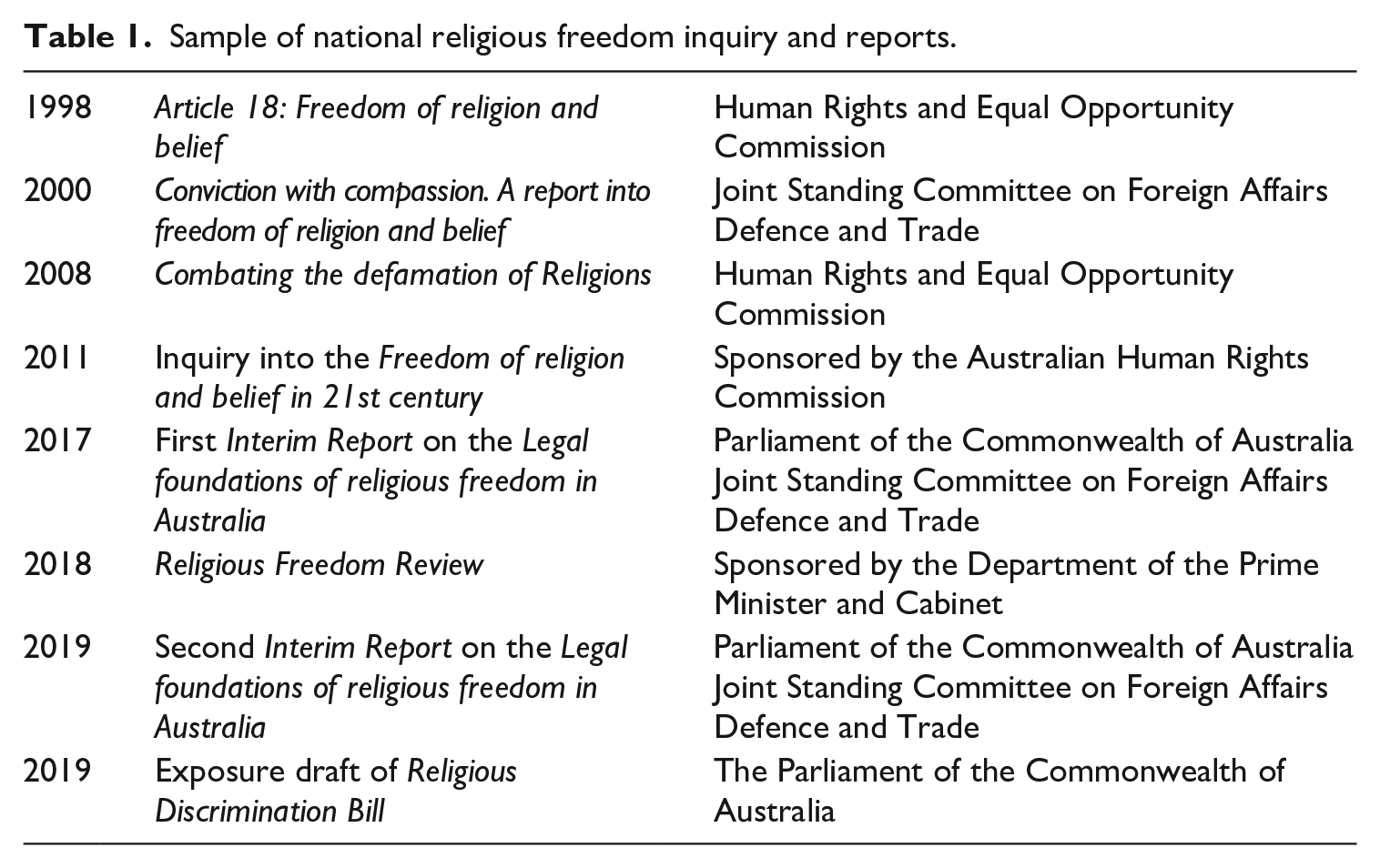
As such, this article analyses the latest government reports and demonstrates a change in public discourse on religious freedom towards a specific new phase of post-secularism. It argues that the term post-secularism (more as a descriptive term than a normative one) is problematic, not because of the term itself, but because what it signifies has now changed. To do this, this article first explores the change of discourse in the various governmental reports as listed in Table 1, then moves to a theoretical discussion using the work of Habermas on post-secularism and that of Beck on the misalignment of social theory with contemporary social reality.
Sample of national religious freedom inquiry and reports.
Freedom of religion or freedom to discriminate in the name of religion 2
This section focusses first on a thematic analysis of the notion of freedom of the three reports that were released while the referendum for same sex-marriage was under way and after it became lawful. The Interim Report on the Legal foundations of religious freedom in Australia was published in November 2017 by the Parliament of the Commonwealth of Australia Joint Standing Committee on Foreign Affairs Defence and Trade (2017). It acknowledges the previous 2000 report (Joint Standing Committee on Foreign Affairs Defence and Trade, 2000) and admits that the social and political situation of Australia is different than 17 years ago. It agrees that the legal protection of religion freedom in Australia is limited and makes references to threats to religious freedom: these being mainly the advent of ‘non-discrimination laws which do not allow for lawful differentiation of treatment by religious individuals and organisations’ (Joint Standing Committee on Foreign Affairs Defence and Trade, 2017: viii). The Inquiry received 700 submissions and held three public hearings. More than half of these submissions addressed same-sex marriage specifically in the context of religious freedom (Joint Standing Committee on Foreign Affairs Defence and Trade, 2017: 79).
The 2017 Interim Report acknowledges that commonwealth protection for freedom of religion or belief is limited and that there is a concern that this freedom can be further eroded in the near future by the enactment of ‘legislation which seeks to uphold other rights but may conflict with religious freedom’ (Joint Standing Committee on Foreign Affairs Defence and Trade, 2017: 50). This comment does not make explicit reference to the same sex-marriage law that was about to be passed a month after (on 9 December 2017) this report was issued. It discusses the possibility of establishing a Bill of Rights, or a single and more comprehensive human rights act. It, however, cites a preponderance of evidences that claim that religious freedom should be specifically protected, rather than all human rights (Joint Standing Committee on Foreign Affairs Defence and Trade, 2017: 74). This preponderance is left unsupported, especially since the report only specifically addressed 26 out of the 700 submissions. Australia, it needs to be reminded, is the only Western liberal democracy that is still lacking a bill or charters of rights (Babie, 2020: 189). Two of the reasons for the opposition to such a Bill over the years (and not just in this 2017 report) is that (1) such a Bill would confer powers to the judiciary and, it is assumed from the US model, would override the executive and legislative branches of the Australian government (Babie and Rochow, 2012) and (2) that some religious groups feel under threat; not because they are opposed to the recognition of human rights, but because they question the means of promoting human rights without providing exemption for anti-discrimination legislation for faith-based organisations (FBOs; Parkinson, 2012).
Chapter 7 of the 2017 report admits that freedom of religion or belief needs to be balanced against other rights. This is not necessarily an issue when it comes to appointing clergy or other key religious appointment, but it becomes one in other areas where some religious groups would like to be able to discriminate in areas, such as admissions to religious schools, employment in religious organisations, or the type of group to whom they rent property and/or provide services. The report acknowledges the challenges and difficulty in determining an appropriate balance as some submissions argue that ‘religious exemptions give unfair weight to religious freedom over equality before the law. Others believe and claim that religious freedom is unjustly subordinated to non-discrimination by religious exemptions’ (Joint Standing Committee on Foreign Affairs Defence and Trade, 2017: 90).
Following the release of this report, a task was then requested by the then Prime Minister Malcolm Turnbull to a panel of experts to cover these issues. The Religious Freedom Review (Ruddock et al., 2018) received 15,620 submissions and held 90 meetings with 152 organisations and 32 individuals. The report discusses one of the main common characteristics of the representation made to their panel, and even mentions the word ‘fear’ to describe people of faith who are apprehensive that religious freedom could be under threat in Australia (Ruddock et al., 2018: 10). The report makes reference to the failure of some religions to protect children from sexual abuse as casting ‘a long shadow over the Panel’s deliberations’ (Ruddock et al., 2018: 11) but this was not discussed in the rest of the document with regards to freedom from religion. The review, however, underlines that there is no hierarchy of rights in their approach to religious freedom. The panel notes that a Bill of Rights or a Human Rights Act was outside its terms of reference (Ruddock et al., 2018: 41) and that a Religious Freedom Act would be ‘out of step with the treatment of other rights’ (Ruddock et al., 2018: 41). It does, however, propose to amend the Racial Discrimination Act 1975 to include religious belief or activity, or to create a Religious Discrimination Act. While acknowledging that religion is not protected under Commonwealth anti-discrimination law, it points out that all jurisdictions already allow religious bodies to discriminate. However, numerous submissions claimed that the preservation of religious freedom was limited through exceptions in anti-discrimination law. Even if the report is clear in not agreeing on a right to discriminate in the provisions of goods and services as this would encroach (Ruddock et al., 2018: 49) on other human rights, its approach to religious schools is quite different. It recommends that faith-based schools be allowed to discriminate in relation to the employment of staff and to the teaching to students. In this instance, their request to discriminate would be part of the precept of their religion and the school would need to provide a policy outlining its position with regards to this issue. This would be publicly available and provided to prospective staff, contractors, and students. To do this, it recommends to further amend the Sex Discrimination Act 1984 that already allows religious institutions to discriminate.
The second Interim Report in 2019 (Joint Standing Committee on Foreign Affairs Defence and Trade, 2019) from the House of Representatives followed the report of these experts and acknowledges that laws in Australia need to be harmonised and be able to provide stronger protection for religion. As with its first report, it underlines the difficulty of striking the right balance of ‘conflicting rights’, that is ‘between the right to freedom or religion and belief and the rights to freedom of speech and to non-discriminatory treatment’ (Joint Standing Committee on Foreign Affairs Defence and Trade, 2019: 71).
All reports above explore international laws on freedom of religion but do not adequately make reference to specific laws allowing religions freedom to act in a discriminatory fashion. These documents, however, make reference to the Siracusa Principle that would allow such discriminatory acts as a response to a pressing public or social need. Gogarty, Hilkemeijer, and Westbury (2018) extended the research on international law from these reports and compared the proposal from the Religious Freedom Inquiry (Ruddock et al., 2018) to widening exemptions in anti-discrimination with 29 other jurisdictions that permit same-sex marriage. They found, apart from a small number of US states where there is a highly contested legislative initiative, that most do not provide such exemptions. The only one accepted across these countries is with regards to ministers of religion. They argue quite clearly that further exemptions from anti-discrimination would put Australia out of step with the overwhelming majority of other countries providing marriage equality.
These reports led to a partial endorsement of the government and the release of the exposure draft, Religious Discrimination Bill in 2019. While the proposed act makes it unlawful to discriminate on the grounds of religious beliefs or activity, it makes it lawful to discriminate on the same grounds in particular exceptions, which includes religious hospitals and religious camps. The Australian Human Rights Commission (2019) in its submission to the Attorney-General’s Department supported the introduction of enforceable protections against religious discrimination for all people but was concerned that it provides this protection against other rights. This includes ‘religious bodies’ being exempt from engaging in religious discrimination if this is in accordance with their beliefs and doctrines. This would undermine protection against religious discrimination in the areas of employment and provision of goods. The Commission claims that what the exposure draft proposes has no counterpart in other anti-discrimination laws. This sets a precedent that does not recognise the indivisibility and universality of human rights.
Years earlier, before talks about the same-sex marriage referendum, Bouma et al. (2011) wrote a report on the outcome of an Inquiry into the freedom of religion and belief in 21st century, sponsored by the Australian Human Rights Commission. They consulted religious and community leaders, government officials and NGO representatives, and the broader Australian public. One of the areas that was being investigated was if Section 116 of the Constitution provided sufficient rights/protection to religious freedom. The outcome that Nelson et al. (2012) found in their analysis of these submissions was that only Christian groups claimed that it did not. In their report, Bouma et al. (2011: 34–41) discuss their findings concerning issues about religious organisations and anti-discrimination. Some representatives of religious groups and FBOs claimed that they should be allowed to hire staff based on positive discrimination (i.e. employ only people of their own faith, who share the same religious values; this ranges from leaders of the organisation to cleaners and gardeners). They also claimed the right to exclude people such as ‘practising homosexuals, promiscuous heterosexuals or believers in witchcraft’ (Bouma et al., 2011: 36). In their analysis of the submissions, Nelson et al. (2012) find that out of the 1,029 submissions that were making reference to exemption, 92% were in favour of religious groups receiving these exemptions. Furthermore, with regards to charity provision, some of those consulted expected to be allowed to proselytise while offering charity, and some were only willing to help people who held the same values. Other submissions to the Inquiry, on the other hand, were against the idea of positive discrimination and argued that if groups receive help from the state then their work and charity should not discriminate against people of other faiths, homosexuals, transsexuals, or single mothers.
More than 10 years before this 2011 report, in 1998, and 20 years before the release of the Religious Freedom Review (Ruddock et al., 2018), the Article 18: Freedom of religion and belief already addresses exemptions for religious discrimination (Human Rights and Equal Opportunity Commission, 1998: 105–111), but differently. It makes reference to submission from fundamentalist (a word not used in later reports) Christians for running businesses and from one principal of a Christian School making reference to the risk of his school property being rented for Satanic rituals (Human Rights and Equal Opportunity Commission, 1998: 105–106). It further lists a few submissions arguing that an exemption is needed for employment within religious bodies. The report emphasises that special provision for religious institution was at that time appropriate and cites the Human Rights and Equal Opportunity Commission Act 1986 (Cth) that takes care for these institutions. It underlines the importance of limiting the scope of exemptions especially with regards to excluding non-heterosexual people from accessing various community services. The report is quite clear in its stance against allowing freedom to discriminate in the name of religion. Conviction with Compassion. A Report into Freedom of Religion and Belief (Joint Standing Committee on Foreign Affairs Defence and Trade, 2000) and Combating the Defamation of Religions (Human Rights and Equal Opportunity Commission, 2008) followed on the 1998 report (Human Rights and Equal Opportunity Commission, 1998) and did not deal with these issues of religious discrimination. All later reports were mainly concerned about a lack of a Bill of Rights and appropriate legal protections of religious freedom for minority religions (see, e.g. Possamai and Lee, 2004).
Except for the exposure draft of the Religious Discrimination Bill, Poulos (2019) qualitatively analysed all the reports mentioned above and has also highlighted a change in the way ‘the problem’ with religious freedom is addressed. Until 2011, the main concern in Australia was on how to deal with religious diversity and on how to protect the freedom of minority religions. The 2011 Bouma and Cahil’s report highlighted the beginning of a shift. A Christian major grouping, not just the Christian fundamentalists from the 1998 report, expressed their ‘threat’ from the support provided to the rights of minority groups, not just minority religions. Strong voices from these submissions emerged around that time and progressively found their place in the public sphere to express religious freedom, no longer from simply asking for the right not to be discriminated because of one’s religion, but also requesting a ‘right’ to discriminate in the name of religion.
The history of Inquiries on protections of religion within Australia does highlight challenges for contemporary societies that are characterised by increased religious diversity and presence of religion in the public sphere, but also present a lens to the shift of Australia towards a new form of conservative intervention. This Australian case, we argue, demonstrate a need to shift our understanding of what post-secularism means.
Post-secularism 3
At the turn of the century, authors such as Habermas, who had previously been defenders of the secularisation thesis, could no longer ignore the new reality of religion’s presence in the public space. If Solidarnost in Poland, Liberation Theology in Latin America, the overthrow of the secular power by Ayatollah Khomeini in Iran, and the Christian Right in America were not enough to change his perspective at the end of the twentieth century, 9/11 at the turn of the twenty-first century did. In dealing with these new issues, Habermas (2006; Habermas and Ratzinger, 2006) reconceptualised his perspective on religion and used the concept of post-secularism. It refers to the process of the deprivatisation of religion and the dialogue about the management of the presence of religious groups in the public sphere; a public sphere, however, still dominated by secular principles.
With globalisation and transnationalism, people from around the world are living in a culture of pluralism and this has impacted on the role of religion (Giordan and Pace, 2012). Indeed, in many monocultural societies, religious institutions used to have almost a monopology of faith. Today, this can be a challenge for some of them. Habermas (2006) underlines that the challenge in today’s plural setting is to draw the ‘delimitations between a positive liberty to practise a religion of one’s own and the negative liberty to remain spared from the religious practice of the others’ (2006: 4). In other words, the issue in post-secular societies’ is on how to work with religious tolerance in ways that celebrate religious diversity but do not put in question the freedom to be from a non-mainstream religious group or atheist. Part of the solution for Habermas is to have religious arguments expressed in secular language in the public sphere. This language is seen as neutral as it does not favour a theological language over another one. For this to happen, governments have to be neutral and thus be secular so they that can ensure that communities of various beliefs are able to coexist on an equal basis. His post-secular project is thus based upon the notion that the state is neutral and objective, yet studies point how the state can instrumentally serve certain religious groups over others (see, e.g. Barbalet et al., 2011).
Furthermore, within this post-secular phase, religion is also seen as a voice to engage with matters regarding the quality of life. It has the potential to provide some new and positive moral insights from civil society to the political sphere (Calhoun, 2011a, 2011b) and be a useful resource and an ally in combatting the discontents of the instrumental rationalisation brought by global capitalism (Mendieta and Vanantwerpen, 2011). Indeed, Habermas sees faith as a source of hope in the sense that it can help to overcome the narrowness of a scientific rationalism always at risk of bias in favour of instrumental over communicative reason. (Calhoun, 2011b: 84)
Trigg (2007) contests Habermas’ idea that reason should be the only language used in the public sphere and is against the view that religious knowledge can be useful only if it is expressed in the language of reason. He takes the view that human knowledge’s are not sufficient enough, and advocates for a metaphysical or religious grounding for the communication action type of discussion proposed to take place by Habermas in the public sphere. Whatever the veracity of Trigg’s perspective, the public sphere is seen by both authors as currently only allowing religious groups that are able to speak a language of ‘secular’ reason. This, as Craig Calhoun (2011b) argues, is a process set by secularists, which limits the presence of religion in the public sphere and prevents the same secularists from engaging and understanding religious discourse. Despite the fact that Habermas aims to create a basis for equal inclusion based on reason, it provokes what Calhoun calls an ‘ironic exclusion’. This, as he claims, is a privilege usurped by the secular middle class in many Western countries, and, in the United States specifically, by white elites at the expense of the more religious African Americans, Latinos, and migrant groups. Along this line of inquiry, Taylor’s (2007) A secular age makes reference to what he calls the ‘immanent frame’ to describe the current context, or social imaginary, in which religion and secularism are in discussion in the public sphere. Rather than asking for religions to give up their own vocabulary and use instead the allegedly neutral language of reason in the public sphere, the Catholic philosopher proposes that religious groups should mobilise their religious language to provide an untranslated voice against the discontent of late capitalism. For the Canadian philosopher, both the secular and the religious would find a higher level of reflexivity if they were able to use their own social imaginary in the public sphere and enter into a relationship of tolerance and recognition. In this sense, Taylor wishes to increase the equality between religion and secularism, rather than have secularism dominating the public sphere.
Coming back to our discussion on religious freedom, Alphia Possamai-Inesedy and Bryan Turner (2016) used the debate in the public sphere around same-sex marriage and found that the communicative action proposed by Habermas within post-secularism was not aligned with his vision. Before same-sex marriage was legalised in Australia in 2017, they analysed the transcripts of Parliamentary hearings into two proposed Marriage Bills, and although there were supports from some religious organisations, others opposed this legalisation based on religious arguments, and not secular reason, and quoted at times the Bible to validate the archetype of marriage between Adam and Eve. For example, Possamai-Inesedy and Turner quote the representative of a Catholic Archdiocese: there is the whole biological physical reality . . . It is just how we are. So we have to say that something different from this is not according to the nature of human beings . . . nature declares what it means to be married . . . The church teaches very clearly that homosexuality is a disordered expression of sexuality . . . in its reflection from scripture and its examination of the natural realities of human life. (House of Representatives Standing Committee on Social Policy and Legal Affairs, Hansard Transcripts of Public Hearing, Sydney, New South Wales; Thursday 12 April 2012: 6)
The values of secular liberalism and religious fundamentalism that distinguish this topic create division and controversy in the public sphere. The presentation of religious arguments in public debate, and the difficulty in translating religious beliefs for a secular audience, undermine social cohesion rather than enhance it as was predicted by Habermasian theory. These circumstances, plus the fact that people involved in post-institutional spiritualities generally do not feel a strong compulsion to enter the public sphere to debate their religious views, lead Turner (2012: 1066) to argue that some arguments about post-secularism are philosophically worthy but can ‘unfortunately be sociologically naïve’. Indeed, in a later publication, Turner (2015) reinforces his point by stating that communicative rationality, in this context, is problematic when dealing with controversial issues, such as abortion, evolution, homosexuality, and gay marriage. On these issues, rationality has not been able to surmount existing divisions in the public sphere.
With this example, we do have here the type of theological dialogue in the public sphere as suggested by Trigg (2007) and Taylor (2007), but one that does not always enter in a dialogue of tolerance and recognition. Putting aside the argument by Possamai (2017) that ‘post-secularism’ is a misnomer and is simply the type of secularism in affinity with late capitalism, and instead of arguing about the failure of post-secularism as stated above, this article is pushing the theory in a new direction, by arguing that with the Australian case and its recent public debate about religious freedom, we are today witnessing a shift further away from post-secularism. This observation, it must be stated, is a descriptive understanding of the theory of post-secularism which is based on current socio-political changes in the Australian landscape, and not a normative understanding as to how a society such as Australia should be. 4
Beyond post-secularism in Australia?
Mayrl (2018) analysed the process of the judicialisation of religious freedom and in exploring the literature has discovered that overall there has been a recent expansion of legal definition of religious freedom. These twenty-first-century laws indicate a change from treating religion in a tolerant way to actively promoting religious liberty as a basic right. This would coincide with the move of these societies to a post-secular one in which religions are more welcome in the public sphere and in turn are given more recognition. However, as discussed above with the shift of an understanding of freedom of religion from a right to not be discriminated because of one’s religion to a right to discriminate because of one’s religion, we have moved to a phase beyond post-secularism: from one that goes beyond the simple promotion of religious liberty to one that impacts on other human rights.
The proposal from Habermas that religious groups entering the public sphere could use a rational discourse to enhance the quality of life in civil society seems not to be working in the current Australian context. The proposal from Trigg and Taylor that religions should be able to use their theological language in the public sphere and be given the same recognition as the rational discourse from a secular language has, however, been fulfilled in this case. As analysed by Bouma (2014), those religious public debates do include a mix of religious and secular discourses by arguing alongside the line of a theological perspective that same-sex marriage, as quoted by Bouma, ‘is bad for your health’ (Bouma, 2014: 8) or is not on par with ‘good order, human well-being and dignity’ (Bouma, 2014: 4). However, these claims, contrary to Habermas’ vision, are not aimed at improving the quality of life for all Australian people.
This shift in change of understanding of religious freedom in these public debates is a reflection of wider political changes in Australia. Glyn Davis AC (2018), the immediate past Vice-Chancellor of the University of Melbourne and Distinguished Professor at the Australian National University’s Crawford School of Public Policy, argues of the reversal in political ideologies found within Australia. Although his argument was presented on academic freedom and freedom of speech, his observations of a creeping conservativism of what used to be progressive parties and the rise of right leaning groups that emphasise the need for increased state intervention and control rather than the previous libertarian stance can be applied to the current debate in Australia on freedom of religion. Davis argues that right leaning conservative groups are challenging the current array of public institutions and are enthusiastic to use the power of the state to remake society can be readily applied to the debate on religious protection in Australia, where an ongoing narrative of the need to protect the rights of conservative religious groups has been explicitly reported since at least, as explored above, the Freedom of religion and belief in the 21st century inquiry (Bouma et al., 2011).
Years before the request to be able to discriminate in the name of religion became normalised in public discourse, as argued in this article, Jakubowicz (2003) already started to use the expression of ‘the new Australian conservative modernity’ to make reference to the country’s resurgent social values of Christian conservatism. This includes the active governmental priorities of disengagement, and a rapidly expanding culture of surveillance and obedience. In his research on contemporary Australian society, he discovered a moral concern (if not panic) that produces a process of delegitimation of diversity, especially with regards to Muslims. In this context, delegitimation ‘does not deny diversity, but rather seeks to reassert a traditional hierarchy of cultural power within which diversity is only acceptable within the dominant moral order’ (Jakubowicz, 2003: 344).
Although Australia prescribes to the notion of state neutrality, or the separation of church and state, scholars, such as Fozdar (2011), Randell-Moon (2009), and Maddox (2005, 2009) have pointed to the privileging of members of one religious faith over others, with an emphasis on associating the character of the nation with Christianity. Fozdar’s (2011) research confirms this retreat from multiculturalism that is in part a consequence of the conservative values of the Howard government (1996–2007) more than a decade ago. In this new Australian conservative modernity, political leaders portray ‘Christianity as the norm, as a non-migrant religion, and as the taken-for-granted foundation for the nation’s values and laws’ (Fozdar, 2011: 632). Years before the Religious Freedom Bill, Randell-Moon (2009) and Maddox (2009) already demonstrated that in the Australian case (a secular liberal society where a strong division between church and State is supposedly definitive), religion has a part to play in politics. In this ‘secular’ liberal culture, religion can sometime be a significant factor in voting decisions and has been intruding more and more into the public sphere since the beginning of the twenty-first century, to reach the situation we have today. If Christianity was for many years a silent backdrop to Australian national identity, Fozdar (2011) observed a decade ago that there was a strong sense of legitimacy for the public place of Christianity, and one of illegitimacy for other religious traditions.
This strongly indicates that Australia has been less and less of a secular state over the years, but as the discourse of some religious groups asking for the right to discriminate is becoming more and more normalised in the public sphere (rather than being an oddity), one might wonder if we have not crossed the line towards a new phase. As discussed in the analysis above on these public inquiries, religions do intervene in public debates. They use their theological voice and are not necessary helping to better the quality of life for everyone in civil society. In this instance, they do not always engage with Habermas’ vision of communicative action. When the early theory of post-secularism was created, it was to reflect the move in the public sphere of religion. We are no longer in this early phase. Religions are now part and parcel of the public sphere and, as seen in this case, some groups and individuals are aiming to act against the rights of other groups through governmental channels. While Australia, as many other Western secular states, have been active in promoting freedom of religion and of religious diversity (what is indeed expected of a post-secular society), we are now observing with the Australian case a call for the promotion of the rights of religion above the rights of others (something that is beyond the notion of a post-secular society). The question is if we are still within the same social conditions and have moved in what could be called a post-post secular phase, of if we are in a different setting and are now in a pre-pre-theocratic phase. These two new terms are synonymous but reflect a different outlook on the issue, that is, is the glass half empty towards secularism or half full towards theocracy?
The struggle to find a language or framework that encapsulates what is occurring within the religious landscape of Australia raises questions about the need to assess and reimagine our overall theoretical toolbox as social scientists. Beck (1992) spoke to this issue in his seminal work, Risk society, by provocatively asking whether the key concepts that sociologists employ are able to make sense of the emerging patterns of a new form of modernity, what Beck was calling high modernity. Like his contemporaries Giddens (1991), Bauman (2000), Castells (1996) and Habermas (1989), Beck attempted to provide a theoretical framework that was capable of the task of making sense of our times, rather than presenting us with zombie categories, concepts continuing as if they are alive but are really are just an empty shell (Woodman et al., 2015). Beck’s challenge for sociologists to rethink key concepts of the social sciences to better understand the contemporary and coming world called for concepts to not only live within the narrative of scholars, but also be reflected in reality. In his last work prior to his death in 2015, Beck (2016: 3) articulated his struggle with the task of tracing the emergence of the coming world, one that had come sooner than we had all anticipated. Indeed, as he states in the opening of his first chapter: This book represents and attempt to rescue myself, and perhaps others too, from a major embarrassment. Even though I have been teaching sociology and studying the transformation of modern societies for many years, I was at a loss for an answer to the simple but necessary question ‘What is the meaning of the global events unfolding before our eyes on the television?’, and I was forced to declare bankruptcy.
For Beck, at the time of his writing, there was no concept or theory capable of making sense of the world that was different to the narrative of our concepts and theories. He thus spoke about the metamorphosis of the world, not the transformation or evolution of it. Beck’s work beautifully articulates the need of sociologists to think afresh our theoretical toolbox, or at the very least, provide fresh blueprints to better understand the radical changes that the globe is being exposed to. As Beck (2016) argued, our ‘fixed stars, fixed certainties, are not fixed any more’ and this is reflected in the shift in the reports analysed in this article from an argument for freedom of religion to one for freedom to discriminate in the name of religion. Our sense of the world during the post-secular phase was to engage with religious and atheist groups and work on a dialogue in the public sphere to ensure freedom of religion and from religion. We now struggle to find a language to explain this metamorphosis to a wide and an open request for the freedom to discriminate according to one’s faith. The best we can state at the moment is that we are beyond post-secularism and a bit closer to (but still very far from) a theocratically inclined state. If the bill is voted, as written at the time of this research, Australia will certainly be even closer.
Conclusion
With the case of the Religious Freedom Debate in Australia, we are witnessing a significant move towards sanctification (Martin, 2005) that signifies a move away from post-secularism. For lack of a better word, we have called this post–post secularism, or pre–pre theocracy. This shift from freedom of religion to a demand to discriminate in the name of religion will certainly lead to a need for ‘non-correctly religiously aligned’ Australian people to be protected from religion, not only from its legal protection, but also from its welfare market expansion (Possamai, 2018). We have discussed this change of discourse about religious freedom in the public sphere using Habermas’ work on post-secularism. We then utilised Beck’s work on the metamorphosis of the world to indicate that we are going through a change beyond post-secularism, but that with other facets of current changes in our society, we, as sociologists, struggle to find an adequate language.
This article has been specific about Australia which is quite particular with regards to religion in the public sphere as it is the only Western liberal democracy country without a Bill of Rights (Babie, 2020: 189) and with the largest amount of anti-terrorist laws (Richardson, 2013; Tittensor et al., 2020). This does not mean, however, that this move towards post–post-secularism is only happening in this country.
Footnotes
Funding
The authors received no financial support for the research, authorship, and/or publication of this article.

Notes
Author biographies
Address: Western Sydney University, School of Social Sciences, Locked Bag 1797, Penrith, NSW 2751, Australia. Email:
Address: Western Sydney University, Chancellery, Locked Bag 1797, Penrith, NSW 2751, Australia. Email: