




Abstract
The Universal Church of the Kingdom of God (UCKG) is a Brazilian neo-Pentecostal megachurch. Over the past 40 years, it has established branches in over 100 countries among the economically and socially marginalised. This holds true in Australia, where congregants are disenfranchised migrants from diverse ethnic backgrounds and (former) refugees. Drawing on 2 years of ethnographic research in the UCKG’s Australian headquarters, this article explores why a Brazilian church, with a seemingly disagreeable character, attracts a multicultural migrant congregation in Australia. I argue that the UCKG is attractive to these congregants because it provides a space where its followers’ ethnicity is accepted; its cosmovision is easily translated to its congregation’s diverse spiritual sensibilities; and it offers ‘pioneering techniques’ to overcome life obstacles for those on the margins of Australian society. This work contributes to scholarly literature concerning Brazilian religiosity outside of Brazil, and the role religion plays in migrant settlement.
Every day, every hour someone try and shut you down . . . I was really feeling like it is a big mistake in my life to come to Australia . . . You can never be Australian . . . you cannot be happy to say, ‘I am Australian’ . . . you not belong to Australia . . . You in Australia here you are refugee or Sudanese . . . You come in Australia you not Australian. That the reason I don’t like Australia. That why I feel a mistake to come here . . . (Interview with Akuach, 2016)
1
Akuach and her young family fled Sudan and lived in an Egyptian refugee camp for 6 years while they were being ‘processed’. In 2004, they were finally resettled in Newcastle, a coastal city in regional New South Wales. They had been told of a better life awaiting them in Australia. Her family was one of the first waves of refugees to flee the unrest that devastated the Sudan region, and be resettled in Australia. Hers was also one of the first ‘Black’ families to move into Newcastle’s suburbs. Upon arrival, Akuach and her children faced racism and intimidation. In one particularly terrifying incident, her home was surrounded by angry locals shouting abuse at the family. It was made clear to them that they were not welcome in the community. Akuach could not even find solace in the local Christian churches (of which she attended many); rather, she continued to be ostracised: They do harassment even in the church. There in the church at the same time they don’t wanna sit, if you sit there and there a chair next to you and no one wanna sit next you because they gonna end up Black or something. They move away. Like they get a virus. (Interview with Akuach, 2016)
She explained to me that the congregations of these churches were mostly comprised of Anglo-Australians, and many were racists. When the daily abuse in Newcastle got too much for her to bear, Akuach moved to Sydney to be closer to her half-sister (who had arrived in Australia a few years before her). Suffering both psychological and physical health ailments, Akuach’s sister persuaded Akuach to attend the healing service at her church. This church was the Universal Church of the Kingdom of God (UCKG). Akuach told me that it was there that she began to heal from her traumas and found sanctuary. For Akuach, and many of her fellow congregants, the UCKG offers a reprieve from the racial discrimination they regularly encounter in Australia. 2
In this article, I explore why a diverse cohort of migrants in Australia attend what is for many in other parts of the world a controversial and emotionally fractious Brazilian church. Those active members with whom I did fieldwork would quickly shut down criticisms of the UCKG by media and academia abroad (and those of former attendees, some of whom left during my time conducting research) with a victimisation narrative that positions the UCKG as being persecuted by secular society and by those who wish to distract from its good work. Although, some do not always agree with the church on certain issues or indeed dislike particular pastors, they continue to attend. It is from an etic position that I grabble with why congregants would attend a church that global literature indicates is unsavoury. Certainly, it is infamous for the social violence it can bring to the lives of its congregants (Van de Kamp, 2016), for its lack of Christian fellowship (Van Wyk, 2014) and for soliciting great financial sacrifices from its predominantly poor congregations (see Mora, 2008; Openshaw, 2020; Premawardhana, 2012; Van Wyk, 2015). These elements are indeed visible in the Australian branches, albeit with less intensity on the part of the church than in other regions of the world. This is possibly because the UCKG is not able to wield any political, economic, and social power in Australia and so is less able to push boundaries in the same ways as it might in the Global South.
I then discuss how the UCKG in Australia primarily attracts those who come from poor countries and who remain marginalised in Australian society. I argue that this is so for three main reasons. First, the UCKG provides a space where its followers’ ethnicity is accepted. This is particularly powerful in Australia where the white national voice and anti-migrant sentiments are strong. Second, the UCKG’s cosmovision is easily translated to its congregation’s diverse spiritual sensibilities. Third, the UCKG offers what Van de Kamp (2016) refers to as ‘pioneering techniques’ to overcome life obstacles for those on the margins of Australian society.
Not all migrants are treated equally in Australia, and even citizenship does not guarantee inclusion into Australian society (Hage, 2000: 50). While Van Wyk (2014) found the South African UCKG to be a ‘church of strangers’, one in which congregants do not share the social warmth usually associated with Christian fellowship, in Australia this is not the case. The UCKG congregation in Australia is a church of Others. The UCKG has been slow to grow in Australia, and so the few branches across the country are much smaller in congregation numbers than in South Africa. This lends itself to greater sociability – a horizontal solidarity among the regularly attending congregants. Alongside organised church activities adherents engage socially with each other beyond the threshold of the church such as helping the older members of the congregation with domestic chores, or meeting for coffee. This solidarity could be in part because there are extended families within and across church branches (particularly among the South Sudanese), but this sociability is also created among those who are not related. The pastors (both the foreign and local) do, as other literature suggests, maintain an emotional distance from the congregation. However, their wives alongside the (female) church assistants tend to take up some of the emotional labour around creating a sense of Christian warmth within the community, particularly among the large women contingent in the church. Within the Australian branches, there is a greater sense of Christian cohesion that seems not to be the case in South Africa. As such, the congregants in the UCKG in Australia are not strangers to each other, but rather they are societal Others.
This article is drawn from ethnographic research (2015–2017) in the UCKG’s Australian headquarters in Liverpool, NSW, where I attended multiple church services each week, as well as some services in smaller branches in Australia. In May 2017, I travelled with a small group of pilgrims from across Australia to the UCKG’s replica of The Temple of Solomon in São Paulo, Brazil (the church’s new spiritual epicentre). I primarily collected data through participant observation, and open-ended interviewing. Moreover, I analysed text and material culture produced and distributed by the UCKG, as well as followed all the UCKG’s Australian, and much of its international media (radio, websites, social media accounts, and live streams). All names of my interlocutors are pseudonyms.
Locating the UCKG’s Australian headquarters
Located about 30 km from Sydney’s Central Business District, Liverpool is one of Australia’s oldest urban hubs. It is a working-class suburb and one of the most culturally, religiously, and linguistically diverse in all of Australia. An amble through its streets highlights how a history of migration has contributed towards Liverpool’s socio-cultural milieu. Punctuating the Vietnamese ‘Hot Bread’ bakeries, bargain stores, and discount chemists are the fragrant smells of curry wafting out of Fijian takeaway joints and the chatter of women getting their ‘weaves’ done in African Hair salons. Neon signage advertises everything from Lebanese confectionaries to fine silk saris. Most congregants I encountered were ‘locals’ living either in Liverpool or in the surrounding areas.
The large communities from Iraq, Vietnam, Fiji, India, Lebanon, and the Philippines largely mirror the waves of migration that have taken place in Liverpool over the past 30 or so years. There are also those from the countries in Africa (such as Sudan, South Sudan, Ethiopia, Somalia, and Sierra Leone) who have sought safety from the conflicts in their homelands. Although Liverpool is in one of the fastest growing regions in Sydney, it also experiences considerable levels of disadvantage, lagging behind in certain socio-economic indicators in comparison with Greater Sydney, as illustrated by education, employment, and household income indices.
It is there that in 2006, the UCKG established its first Australian branch in a cramped, rented room above a row of shops across the road from the Liverpool train and bus stations. As its congregation grew, the UCKG moved to its current location, inconspicuously nestled between a busy doctor’s practice and a Vietnamese bakery. Often mistaken for an office space, the church’s presence is made known by the partially frosted glass front that displays the UCKG’s logo – a white dove in a red heart – and the well-dressed young pastors often stationed at the door handing out leaflets and offering prayers to passers-by. This shopfront church is very much in keeping with the UCKG’s global modus operandi for church planting in urban settings.
Congregants in the Australian headquarters of the UCKG
One busy Sunday morning, Pr. Mattheus (the Brazilian head pastor) asked all those who were born in Australia to raise their hands. 3 Less than ten people out of about 150 attendees raised their hands. This informal poll by the pastor confirmed what congregants often joked with me about – the UCKG is not a church for ‘Aussies’. Moreover, the UCKG in Australia is not a migrant church but rather a church of migrants. This Brazilian church does not cater for the Brazilian community in Australia, as it does not attract privileged migrants. This is certainly true of the second wave of Brazilians who are generally middle class, educated, and living in the well-off suburbs of the Eastern and Northern Beaches (Rocha, 2008). These Brazilians prefer to worship in ‘cool’ Pentecostal churches such as Hillsong (Rocha, 2017, 2019). Rather, it is Liverpool’s socio-cultural and economic profile that can be observed in the seats of the UCKG.
As many scholars have observed (Freston, 2005, 2008; Furre, 2006; Mora, 2008: 407), the UCKG’s congregations outside Brazil tend to be non-Brazilian, socially disenfranchised, and darker skinned, with many being (rural/international) migrants. While some congregants came from a Christian background (as is common in the UCKG’s global networks), I encountered congregants who had converted from Islam or Hinduism to Christianity. These observations speak to the demographics of the UCKG headquarters in Australia. It is worth noting that ethnographies on the UCKG in South Africa (Van Wyk, 2014) and Mozambique (Van de Kamp, 2016) indicate that congregants in these branches are mostly native to these countries but do share the marginality associated with the UCKG congregations, whether this be because of their sex (Van de Kamp, 2016) or because of the legacy of Apartheid (Van Wyk, 2014).
Sudanese/South-Sudanese, Samoans, and Indo-Fijians account for a large proportion of the headquarters congregation. There are also congregants from other countries in the Global South, such as Iraq and the Philippines as well as from countries in Africa and Latin America. Employed congregants tend to work in blue-collar industries with many working shifts or on a casual basis. During my research, I came across labourers, care workers, nurses, cleaners, bakers, shop assistants, and factory workers. The congregation reflects the culturally diverse, working-class community within which it has planted itself.
‘All are welcome’
As in the case of Akuach and her children, many migrants and their children, some of whom were born in Australia, are made to feel as though they cannot call themselves Australian. Even in some places of worship, migrants are not welcomed. However, this is not the case in the UCKG that actively promotes an ethos of inclusivity. If anything, it is radically inclusive for those on the inside while holding a strong exclusivist and even anti-ecumenical stance. In a short promotional video available on the Australian UCKG’s website during 2017, a young woman of colour animatedly explains that the UCKG is a ‘down to earth multicultural church’. The video transitions into a shot of a full church service, again populated by congregants of colour. The text that accompanied this read: ALL ARE WELCOME A church for all people We believe in unity, and everyone is welcomed despite your beliefs, backgrounds or ethnicity
In Australia, where dark-skinned migrants are regularly faced with active discrimination or come under social pressure to assimilate, and yet feel that they can never be ‘True Blue Aussies’, 4 the UCKG is ‘a church for all people’. As Hage (2000) argues, whiteness is positioned at the centre of Australia’s cultural map. By translating this ordering socio-geographically, I suggest that Liverpool, heavily populated by ‘Third world-looking people’ (Hage, 2000: 17), can be understood as peripheral to the white centre of power and affluence held within Sydney, and its surrounding ‘white’ enclaves. In these politics of proximity, the UCKG re-centres Liverpool (marginalised from socio-political power) as an inclusive spiritual epicentre where access is not dependent on the congregants’ migration status or skin colour.
Congregants’ cultural identity is made both visible and invisible by the UCKG. Pastors regularly re-iterate that God does not see skin colour, only souls – congregants are encouraged to focus on being judged by God on their souls, not by people because of their skin colour. Simultaneously, congregants are often encouraged to pray aloud to God in their own languages or dress in their traditional attire at special events. However, pastors warn that some congregants are born into ‘bad cultural customs’. According to the UCKG, these ‘bad’ customs are engaged in ‘Spiritism’ and idol worship. The UCKG positions itself as accommodating congregants’ cultural identity on the proviso that these are compatible with its conservative Christian values. However, importantly, the UCKG and its congregants share mutually intelligible cosmovisions, not shared by wider Anglo-Australian society.
Diverse migrants and shared spiritual sensibilities
Being reborn problematises socio-cultural (dis)continuity in the lives of converts (see Daswani, 2015; Engelke, 2004; Eriksen, 2009; Meyer, 1998; Premawardhana, 2014; Robbins, 2003). Often converts feel pressured by their new church community to break with their cultural practices and responsibilities in order to be reborn and transform their lives. For many, this split with their past is not swift and ‘clean’ but is rather a process of moving between ‘old’ and ‘new’ ways of being.
I propose that for congregants attending the UCKG in Australia there is a complex process of personal transition, involving simultaneous continuity and rupture (Meyer, 1998). It is also one that may or may not involve a conversion to the UCKG long term or at all – but rather a temporary immersion within the church, particularly during times of vulnerability. Christian rebirth is a gradual process that is negotiated and reversible, and may have even started before attending the UCKG (in other Pentecostal/Charismatic churches). My argument speaks to Premawardhana’s research with the Makhuwa-speaking Pentecostal converts of northern Mozambique. He argues that in this ‘traditional’ society, Pentecostal conversion is an extension of, not alternative to, indigenous ways of being – by tradition, Makhuwa are mobile and unrooted. Discontinuity coexists with mobility; rupture is a regular and reversible feature of human experience (Premawardhana, 2014: 114; 2018). The conversion process is intimately linked to the life circumstances of the convert. Arguably, the ripple effect of rupture and remaking with tradition during conversion is more pervasive in a context where the Pentecostals are in their native homelands. Unlike UCKG congregants in Australia who are migrant, Pentecostals in their native lands are immersed within the fabric of their societies; they are surrounded by the pressures of traditional practices and responsibilities towards local extended kin networks. Rupture creates a violence within their social networks.
Given that congregants and pastors alike in the UCKG Australia are migrants from all over the world, there is only a cultural continuity that is made in the process of worshipping and belonging itself. When congregants engage with their own ethnic community, it is easier to choose the terms of this engagement in the diaspora. Broadly speaking, the demands of kin and culture on reborn congregants in the UCKG Australia are largely mitigated by the radical social change they underwent during the migration process, and sometimes in a previous conversion to Christianity. The fractures with ancestral belief systems and responsibilities in the homeland may have already occurred. The everyday rupture encouraged by pastors is with the secular ideals of Australian society, a society in which they are already on the periphery. The pressure to disconnect from traditional cultural values comes primarily from the prevalent Australian discourse of becoming ‘Aussie’ rather than the UCKG pastors.
In the UCKG, there is a focus on rupture with the old (be it habits, traditional spiritual practices, or mindset but not cultural affiliation) and an orientation towards a new prosperous life (consistent with the new life they had hoped for in migration) through a familiar continuity in their spiritual frameworks. For example, one Sunday service in the opening prayer, Pr. Mattheus made reference to an unnamed congregant so desperate to change their life circumstances that they had consulted ‘witchdoctors’ in Africa, and that this dabbling in the occult had made their situation worse. Pastors repeatedly warned congregants of the dangers of consulting those who were engaging in traditional rituals as this only fuels the manifestation of evil and so block their prosperity in Australia. During deliverance services, it was commonplace that ‘non-Australian’ evil was burned up by the Holy Spirit.
In a similar fashion to Ewe Pentecostals in Ghana (Meyer, 1999), the UCKG accommodates the belief in supernatural powers from congregants’ traditional setting, incorporating their ethnically local interpretations of misfortune. For congregants, the boundaries between the earthly realm and the supernatural realm are porous. Even before congregants entered the UCKG, many were managing the supernatural in their lives. One such instance was a Romanian woman who told me her move to Australia was an attempt to escape a ‘gypsy’ curse placed on her by her then husband’s mistress. She felt that the curse followed her and her children and was only broken after months of deliverance in the UCKG.
Freston (2001: 213) suggests that just as Brazil bridges Europe and Africa in ethnic, cultural and economic terms, so too does the Brazilian UCKG play a bridging role for developing world minorities in the developed West. In a related way, Van de Kamp (2013) highlights the south–south links between two of Portugal’s colonies (Brazil and Mozambique) through a very particular framing of the transatlantic slave trade history which facilitated the transportation of evil from Africa to Brazil – through this historical link African evils are known to Brazilian pastors. In a similar fashion, the UCKG in an Australian context also creates a bridge or a spiritually familiar space between congregants’ everyday enchantment in their countries of origin and their ‘secular’ new home in Australia. It is in this space that congregants are spiritually empowered to challenge their suffering, and reclaim, through spiritual warfare, the agency many feel has been slowly dissolved in Australia.
In the UCKG, evil is hyper-mobile – it can be sent from the homeland by a jealous relative, be passed down through familial curses or travel with congregants. In its global networks, the UCKG glocalises evil. The UCKG recognises a worldview largely ignored by mainstream Christianity and dismissed by secular Australia, and provides congregants with the weapons, legitimated through the Christian faith, they need to fight their spiritual battles. The UCKG speaks to these supernatural interferences and helps congregants battle dark forces from all across the world using the power of the Holy Spirit. Oro (2006) refers to it as ‘Neo-Pentecostal macumbeira’, rejecting, appropriating and reworking elements of beliefs of other churches and religions, especially Afro-Brazilian. 5 It is the diffuse nature of the UCKG’s spiritual ontology that allows it to adapt to its global congregants without changing its export from Brazil.
The UCKG offers congregants an enchanted place, under the rubric of Christianity, where they can exercise agency in their lives in ways that might alienate them in other churches. The UCKG incorporates spiritual ‘roots’ as rationales for an assortment of sufferings (physical ailments, financial predicaments, love life woes, and visa complications) and provides culturally familiar ways to address the hardships congregants face when making a life in Australia. UCKG congregants use enchanted technologies to battle the forces of evil by employing similar technologies as their enemies (e.g. blessings vs curses, holy water vs muthi). 6 For instance, during my fieldwork, consecrated oil was used as a powerful spiritual panacea for all life ailments. I witnessed consecrated oil being ingested or anointed to address a vast array of issues ranging from a couple’s inability to conceive a child, to financial instability and terminal illness (Openshaw, 2019).
Spiritual warfare is omnipresent in recent waves of Pentecostalism, especially in Latin America and Africa. Robbins (2004: 129) argues that one of the ways in which Pentecostalism globalises is to pit itself against some parts of local culture while simultaneously accepting the reality of the culture’s existing spirit world. It absorbs local content and engages ritually with these spirit worlds thereby preserving them in its own recognisable shape. Indeed, spiritual warfare is one of the things that the UCKG is well known for globally. In Australia, the UCKG’s global message of spiritual warfare goes beyond a collective local. Instead, given the multicultural makeup of its congregants, the message resonates on a profoundly personal level, addressing highly individualised issues and appropriating the individual’s culturally familiar ideas of curses and negative spirit entities.
During my research, I was introduced to ‘evil’ from across the world. From Nigerian Juju to Romanian ‘Gypsy’ curses, evil manifests in forms as diverse as the Australian UCKG’s congregants. While evil can find its way into the lives of people via a multitude of routes, evil very commonly preys on the desperation of spiritually ignorant congregants or can be sent from the homeland (often by people known to the victim) to victims in Australia. For instance, during one deliverance service pastors found themselves battling Fijian black magic.
It began when an Indo-Fijian woman approached the altar complaining about a persistently sore knee. It got so painful that she was often immobilised. Two pastors went to work on the cause of this pain. As one pastor prayed over her, another lay hands on her knee. Soon, the woman began to manifest, gnashing her teeth and making growly noises. The demon screeched, ‘I want to kill her!’. The woman began to contort. The entity confessed to being part of a curse sent from the woman’s homeland to put her life on hold and to keeping her daughter sick. The demon smugly confessed that every year ‘they’ give a food sacrifice to the demon to maintain the curse and keep torturing the victim – ‘They give me every year food to destroy her!’
In such instances, the pastors use the power of Christian prayer to break the evil sent from the congregants’ homeland releasing the victim from the grip of such magic to now pursue a better life in Australia. The UCKG’s ability to synthesise elements of Christianity and the migrants’ supernatural worlds creates a spiritual continuity of enchanted technologies (where for example what is considered ‘evil’ is de-particularised) that caters to a diverse cohort of congregants.
Stop suffering and pioneer
For the final prayer, Pr. Mattheus removed the Australian flag that had been draped over the front of the lectern. Holding it scrunched in his fist he began to pray: ‘It is promised to all of you that wherever you put your feet is yours. We are going to say the final prayer holding the flag of this country that has welcomed all of us because here, on this land, you are going to succeed; your family will succeed on this land. God will open doors and your family will be blessed here . . .’ (Fieldnotes, The Lifted Event, 28 May 2017)
In recent times, the Australian flag has become synonymous, particularly in the context of Australia Day, with Australian aggressive nationalism and racism. The Australian flag is often understood by migrants to be a display of Anglo-dominance. While congregants have never discussed the bigoted use of the Australia flag with me, unbeknownst to this Brazilian pastor, there is much political significance in his actions. The national flag was used during the final prayer as a symbol of the prosperity both in Australia and awaiting the congregants. Thus, through prayer, the flag was claimed by the UCKG’s migrant congregants and Australia was figuratively dedicated to these migrant adherents – precisely what most Australian white supremacists fear is happening in Australia (Figure 1).
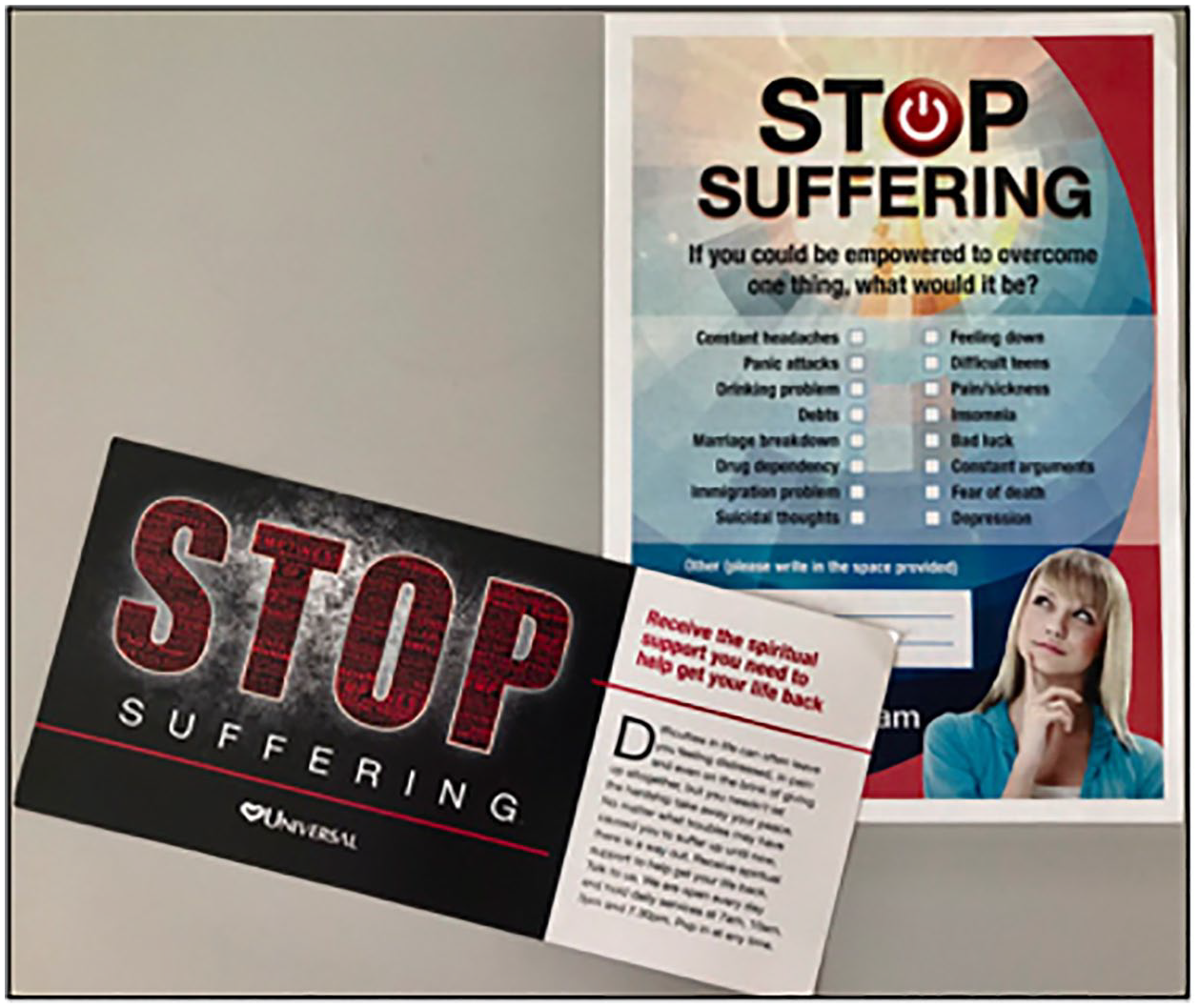
UCKG’s ‘stop suffering’ pamphlets.
As I have shown so far, the UCKG is a church of migrant Others who suffer marginalisation in Australian society. The UCKG acknowledges the suffering of its congregants (Figure 1). According to the narrative provided by Macedo, and perpetuated by the UCKG globally, it was started specifically by Macedo to reach the poor who he felt were being overlooked by other churches. The circumstances for UCKG congregants in Australia are not as dire as those in the slums of São Paulo, or the shanty townships of Durban, given they generally either work or have access to social security; however, their lives are still marked by hardship and precarity. Although the Australian UCKG congregation is by no means a homogeneous group, broadly speaking, many represent the urban poor, the ‘impoverished periferia’ (Birman and Lehmann, 1999: 147) to whom the UCKG caters both in Australia and globally.
Marginalisation and precarity impact migrants’ individual wellbeing and their social relationships, making economic and existential stability difficult to achieve. However, in the UCKG, there should be no victims, only pioneers (Van de Kamp, 2016). Rather, congregants should use their tools of faith to change their physical lives. That is, congregants should commit to their spiritual responsibilities while exhibiting resilience and grit in boldly pursuing a better life. Van de Kamp (2016) argues that in Mozambique women seem to connect well with the pioneering spirit of Brazilian Pentecostalism. Indeed, neo-Pentecostalism (even with its characteristic violent nature, risky behaviour of large financial sacrifices, and social rupture) attracts those for whom these pioneering techniques resonate, those who are trying to benefit from spaces of uncertainty, where there is a strong ‘survival of the fittest’ mentality (Van de Kamp, 2016: 191). This is most obvious in UCKG strongholds such as Mozambique, South Africa, and Brazil, all countries with little social welfare support, tumultuous socio-political histories, and where insecurity and violence are embedded in the fabric of the society.
But what of Australia, a country of relative social peace and privilege? I suggest that this analysis holds true for those in Australia’s peripheral pockets who experience precarity and who, like the Mozambican women Van de Kamp (2016) writes about, desire social and economic mobility. Congregants in the UCKG are taught to measure their life circumstances by the degree to which they have taken responsibility for changing their situation. In fact, congregants are discouraged from relying on anyone but God for assistance in ‘totally transforming their lives’. Buying into the neoliberal idea of individual responsibility and perseverance, and bolstered by their (renewed) faith in the Holy Spirit, congregants use the confidence provided by their faith to strive for better conditions in life. Not only do congregants use technologies such as deeply investing in their spiritual life (with often heavy costs to all their resources, in particular time and money) to gain rewards in their physical lives but are bold in their entrepreneurial endeavours. This approach is built into UCKG weekly services – there is a day dedicated to teaching congregants how to redress the ailment in all areas of a congregant’s life. For example, Monday services are dedicated to financial independence where adherents are encouraged to start their own businesses either based on their existing skills or with ideas inspired by God.
Take Eve as an example. Eve is a South-Sudanese woman, who is also a church assistant and wanted to be a pioneer in her life. Eve received an inspiring idea from God, and after attending every Monday night service for many months, she decided to start her own cleaning business. At one of these Monday financial prosperity meetings, she testified how when she first tried to find work, she inquired with her GP about whether they required cleaning services for their premises. At that stage they did not. However, because Eve continued to use her faith (by praying, giving tithe, attending the Monday financial prosperity services, and pursuing her secular ambitions), her business has gone from strength to strength, and now even has employees. To add to this success story, Eve notes how the doctor she had previously approached about her services actually contacted her, offering her the cleaning contract for their medical rooms. The technologies taught by the UCKG are not merely for financial issues but can be extended to all aspects of congregants’ lives.
Much like the women of Maputo with whom Van de Kamp (2016) did research, migrants in Western Sydney are trying to claim their lives in Australia. Congregants take inspiration from the UCKG instructions to ‘use their faith’ by sacrificing and persevering and now awakened spiritually are confident to pursue the life they believe God has planned for them. Given that many congregants are structurally disenfranchised, and have exhausted secular means to navigate their life difficulties, they choose to spiritually fight to conquer the obstacles in their lives. Arguably, the UCKG’s pioneering spirit is more easily rewarded in the Australian context where resources are available. And although I met many who has experienced great changes in their lives, I also met many who after years were still optimistically fighting for these changes and I have no doubt there were many more for whom the UCKG’s ‘sacrifice and persevere’ techniques did not bear fruit – I suspect they no longer attended the church. Certainly, these harsh technologies of the UCKG do not suit more privileged (or socially mobile) Australians and migrants to Australia, and I suggest that this is one of the reasons why the UCKG is not successful in the Anglo-Australian demographic.
Conclusion
In Australia, the UCKG is a church of Others. Congregants are overwhelmingly migrants from the Global South whose disadvantages have travelled with them to Australia. Accordingly, the UCKG, in line with its global mission targeting those on the fringes of society, has situated its Australian headquarters in an ethnically diverse, working-class Sydney suburb. Its congregants mirror the cultural and socio-economic demographic of Liverpool and surrounding suburbs. Here, I argued that the UCKG is attractive to its congregants for three reasons: in the UCKG, congregants are not expected to discard their ethnic identity to be welcomed; it speaks to their spiritual sensibilities; and provides pioneering techniques to overcome the Devil’s obstacles. In the UCKG, Otherness is not a handicap in the pursuit of a better life.
Footnotes
Acknowledgements
The author would like to thank Cristina Rocha and Cristina Castro editors of this issue and the anonymous reviewers for their generous feedback on earlier drafts of this article.
Funding
The author(s) disclosed receipt of the following financial support for the research, authorship, and/or publication of this article: The author received an International Postgraduate Research scholarship from Western Sydney University to support this research.

Notes
Author biography
Address: Western Sydney University, Liverpool City Campus, 100 Macquarie Street, Liverpool, NSW 2170, Australia.
Email: