




Abstract
Vision and divine voice, however defined, are at the heart of religious experience. The meeting with the Other sustains new ways of life and grants deep transformations in subjectivity. After chronicling the difficulty, indeed outright impossibility, of circumscribing and defining these complex experiences, as well as the opacity of the dominant categories that have been adopted by sociology, anthropology, phenomenology, and psychiatry, this article explores three case histories from southern Italy. Each one reveals a particular knot where private (and traumatic) experience has incorporated historical horizons and collective anxieties. By adopting a historical and comparative perspective, the author investigates how visions, voices – and more generally the encounter with transcendence – enable subalterns to deal with suffering and marginality and, more importantly, to build a view of how the world is and works. Finally, the article suggests that these experiences allow a transformation of the nostalgia for agency into new ‘horizons of expectation’.
The others’ words make me speak and think because they create within me an other than myself, a divergence (écart) by relation to . . . what I see, and thus designate it to me myself. The other’s words form a grillwork through which I see my thought.
Introduction
When we try to give a name to and interpret the experience of a meeting with the Other, the numinous, an ancestor’s voice, the image of spirits or strange events, we hesitate to use ready-made categories,
1
aware that it is impossible to adopt a single term to describe experiences whose shared characteristic is that of inhabiting the borderland between body and world, perception and projection, modes of knowledge and ‘symptoms’, prophecy and terror; where seeing and feeling spill over into each other. On the relationship between these sensory experiences, De Certeau (1986) writes, There is a passage from sight to hearing. Sight blends into a voice-effect with the act of ‘perceiving speech’ . . . The semi-blinding of the subject creates a void from which the word of the Other rings forth . . . there is an inversion of content between the voice and the sight. (1986: 37–38)
In his analysis of mysticism, De Certeau notes that between the seventeenth and eighteenth centuries, mystics originated mainly from a rural aristocracy fallen on hard times, whose privileges had been gradually eroded and whose role in European society was radically changing (1986: 84–85). The mystic experience was a sign of crisis and a herald of change. Its language bears witness to a distinctive alteration and uncertainty, characteristic of periods of transition.
The same holds for witchcraft, as De Certeau writes elsewhere: its language marks the vacillation of our entire culture, manifested in our inability to say whether it is ‘imaginary or real’ (1973: 32). Confession (to being a wizard) alone can restore ‘a shattered social contract’ to the extent that, through public speech, it re-establishes the language ‘that the “pact with the devil” had rent’ (1973: 34). So, the common language of confession (the language of ‘truth-telling’, Foucault, 2014) opposes private (and diabolic) experience of voices or visions.
If mystics’ speech can be so clearly linked to the expression of an aristocracy in crisis, if the language of witchcraft and the ‘counter-world’ that it uses actually inhabits the discourse and existence of marginal groups, the actual experience of visions can less easily be linked to social class, even though it also undoubtedly expresses the distinctive subaltern relation to history (and hegemonic knowledge) and to periods of expectation and promise (on visionaries in France, see Edelman, 1995; Méheust, 2003; on visionaries in Basque Country, Spain, see Christian, 1996). However, seeing is not believing, it has another temporality: Similar in its form to seeing . . . believing takes the form of an interlacing of operations, a combinative of gifts and debts, a network of ‘recognition’ . . . The difference that distinguishes it from seeing or knowing is not at first notable for the truth value of which a proposition is susceptible . . . but by this inscription of time in a subject-to-subject relation . . . The ‘believer’ abandons a present advantage, or some of its claims, to give credit to a receiver. He hollows out a void in himself relative to the time of the other . . . It is by this ‘deferred’ that believing is separate from seeing . . . In a society, belief thus prevents the totalizing unification of the present. It creates in that society a return to the other and to a future. (De Certeau, 1985: 193–194)
This article considers three examples from southern Italy and examines the specific relations between vision, prophecy, subalternity, and (historical) consciousness that lie behind experiences written about in a religious lexicon. The first case is that of a conversion to Judaism by Donato Manduzio and a group of followers in a small town in Puglia in the 1930s. It bears witness to a special relation between vision, belief, subjectivity, and history among subalterns.
The second case concerns the much more recent phenomenon of the visions of Vincenzo Fullone. His complex story was the subject of a recent documentary, Vincenzo da Crosia (Mollo, 2015), some fragments of which are used here as a sort of ethnographic text, or better: a sort of minor archive (I paraphrase here the ‘minor history’ concept, as expressed by Stoler (2009: 7).
The last case, that of Tony, was at the centre of some of my research in Salento between 2012 and 2014 and exposes other aspects of the relation between vision, suffering, and religious imagination.
Through this exploration of the status of vision in individual trajectories marked by suffering and social contexts of uncertainty, these reflections aim to contribute to the historical and comparative study of the religious. They may also suggest possible ways in which vision is articulated in the perspective of micro-history (Ginzburg, 1966, 1982; Levi, 1989) and ‘counter-history’ (Lipsitz, 1990).
‘I’ve had a vision’: Imagining the future in a time of crisis
The case of Donato Manduzio in the 1930s attracted the attention of an anonymous author who wrote a short account of it in Time Magazine in 1947 (Davis, 2010: 1). Emerging as it did amid conflicts around the need for farmable land and large landed estates, as well as the promulgation of the racial laws by the Italian fascist government aimed at restricting civil rights of Jews, its particularity makes the question of religious imaginary and healing as spaces of social criticism (Behrend, 1999; Feierman, 1995) and autonomous action in the face of the dominant power a central focus for thinking about visions.
The story concerns the conversion to Judaism of some inhabitants of the small town of San Nicandro Garganico, most of them farmworkers. This was triggered by the visions, dreams, and intense proselytizing of Donato Manduzio – a First World War veteran, who concurrently wrote a diary 2 containing detailed information on his life, his relations with the authorities, and the experiences that led him to his conversion. The story is interesting for many reasons, not least the fact that this collective conversion took place in an area where the new converts had no previous significant contact with believers in the Jewish faith.
When Donato Manduzio began to see where his experience was leading him, he did not yet know of the existence of other ‘sons of the Old Testament’ in Italy. His first move was to start looking for those who professed the same faith. Then, once he had learnt of the existence of a Jewish community in Rome, he wrote a postcard explaining his desire to convert. When this met with silence from their Rabbi, he followed up with a letter and patiently awaited an acknowledgement and acceptance.
His conversion and that of the small group that joined him in prayer was unusual for significant reasons. At a time when anti-Semitism was increasing and the racial laws were being promulgated (1938), indifferent to this climate of menace, uncertainty, and intimidation, Manduzio not only felt himself called to Judaism but also to preach the truth of the God of the Old Testament. Different to Carlo Levi’s brilliant depiction of the timeless rural world, unresponsive to historical events, of Christ Stopped at Eboli, the San Nicandro community that gathered round Manduzio – as well as the peasants described by De Martino (2005) – seemed to be vigorously questioning the present in a theatre of history that rejected, oppressed, and subjugated them, by resorting to an extraordinary language and practice. In the face of an abandonment and repression that Bayart (2000) might describe as a strategy of ‘extraversion’, conversion to Judaism represented opposition. In an age when emigration was an impossible project for many ‘fervent, individual forms of religious experience offered the alternative of a spiritual emigration’ (Davis, 2010: 10). 3 Moreover, it would also offer a real emigration: at the end of the war, a small group of believers left wretchedness behind for a plot in the emerging state of Israel. 4 But not Manduzio, who for reasons unknown, perhaps due to poor health (he died a few months after the Jewish state was founded), decided to remain in San Nicandro with his wife. Like Moses, he was never to see the Promised Land. Another aspect makes Manduzio’s experience unusual: his visions ran against Jewish tradition. This partly explains the initial mistrust of the Jewish community who found the fact of a collective conversion unorthodox and Donato’s visions unclassifiable and difficult to interpret. A vision that occurred on 27 July 1939 is particularly important in confirming the link between his visionary experience and historical events. He dreamed that ‘the Creator had placed him in a field’ and a voice announced that ‘the Great Empire is coming to vanquish Italy’ (Davis, 2010: 149). As Davis recalls, it was only some years later that the voice and the vision were finally interpreted as being about the arrival of American troops in Gargano. Donato himself believed both these features were but further proof he was the centre of an authentic miracle. What, if not a miracle, could have allowed a simple, uneducated man like him to receive those visions and come close to God and Judaism to the point of becoming a prophet?
That an unschooled person might understand the divine truth, that the Almighty might reveal himself and talk in a manner that even a simple person can understand, is, on the other hand, a canonical theme in the experience of prophets and visionaries, who make their weakness and exclusion from hegemonic forms of knowledge and language a paradoxical source of strength and legitimacy. One of the most celebrated examples is that of David Lazzaretti’s (1870), who wrote the following in the preface to his Il Risveglio dei Popoli. Preghiere, Profezie, Sentenze: My writings – no, they might not be scientific or well written, but they may be simple and good. I say good because that arcane Knowledge that has suggested them to an uneducated, foolish man is always good, whatever language it may be propagated in, no matter how simple, uneducated or barbarous it may be.
Manduzio’s family were extremely poor and could not afford schooling for their gifted child. Yet this strong personality became an orator and storyteller, a voracious reader of works of astrology, and expert in local medical knowledge. Donato was one day given a Bible by his nephew because – in the words of his nephew – he would certainly make better use of it.
Davis insists on the importance of locating Manduzio’s experience in the broader movement that saw the spread of evangelical groups in Italy, who often reached even the smallest towns. Indeed, Donato’s nephew had been given that Bible by the Protestants. This evangelism sprang from returned emigrants (especially from America), introducing what they had discovered (a form of symbolic capital which, like that of our three case studies, ‘rests on cognition and recognition’ (Bourdieu, 1998: 85). The book fascinated Donato, he immersed himself in reading and was particularly drawn to the figure of Moses, whose story seemed to contain an answer to a strange experience he had had a few days earlier: In 1930, on the night between the 10th and 11th August, I had a vision: I was in the dark and heard a voice that said to me ‘Behold a light that I bring you’. I saw in the shadows a man who held a lantern that was dark and gave off no light. And I said to him: ‘Why do you not light the lamp you are holding?’ And the man said: ‘I cannot, I have no matches, but you do!’ And then I looked at my hand and, indeed, I had a lighted match. And so I took the lantern, all ready with oil and wick, I lit it, the shadows lifted and the vision disappeared. But I did not know what it meant and kept it to myself. (Cassin, 1993: 33; my italics)
The Bible he had been given provided a key to understanding the meaning of those words at a time when he was uncertain and divided between his profession of healer, a return to Catholicism, or joining the evangelical movement. In the Book of Genesis, he found not only an answer to his questions on the origin and creation of the world but access to the meaning of his ‘vision’ (as he called it) of a few days before, and the meaning seemed to him unequivocal: that the lighted match in his hand indicated that he had the task of taking up and spreading the word of God.
A few days later, in front of his house, a second vision confirmed this. He heard a voice from within calling him ‘Levi’. Looking inside, he saw a candelabrum with 28 candles, seven on each side. He had no more doubts: he was to become a prophet like Moses.
As De Rosny (1981) observes, referring to his own initiation into the secret practices of the healers in Cameroon, visions gradually become a means of self-knowledge and allow fresh perception of the intentions of those around the seer: his eyes are opened to the violence of the world and its contradictions.
A small group of believers gathered around Donato to pray and to read the Old Testament. Vision followed vision, guiding Donato’s thinking about his condition and conduct. Now he himself invoked visions, he needed them, he waited for God to send them to him, knowing that their language would speak to him in images, like biblical parables. When conflict arose in the group, Donato sought out a secret dialogue, the key to which only he held. It was from the visions that he drew his authority over the group and the visions seemed to offer answers.
The form of these experiences, which had now become part of his existence, was not unproblematic for him; like those authors who have investigated the experience of seers and prophets, 5 Donato, too, wavered in his diary between using the terms ‘vision’ and ‘dream’ and in his case the latter – observed Cassin – meant above all ‘being taken’, ‘caught’ by the divine spirit (avvelato, in local dialect, being taken and at the same time actively seeking this meeting). Awaiting a vision that allowed him to understand events and make right choices about the lives and conflicts of his group followers.
Part protection against psychopathological dangers, part construction of a social tie, and part recognition of its symbolic capital, a vision is in the first place a legitimization of the prophet who, from his niche, can exhibit this proof of a private, direct relation with the holy, a relation whose very repetition is the principle of his legitimacy and an opportunity to affirm his vision of the world.
Starting from Benveniste’s words, De Certeau recalls that the act of belief, which in many respects corresponds to the act of speech, is distinguished from seeing by virtue of the particular temporality that organizes the former in relation to the latter. In Manduzio’s story, vision seems to constitute a combination of these two acts. De Certeau (1985) suggests belief rests ‘at the junction of a practice of time and a social symbolics’, and constitutes a ‘strategic site of communication’ (1986: 193–194). Vision, too, interweaves a temporally located practice and social symbolics, but it creates at once a double, unique territory of communication: among the believers, and with the Other.
Mystics who await the return of the voice (of that alterity) live through this expectation. But, insofar as voice and vision are inverted and replace each other, the vision also seems to be structured inside a temporality analogous to that of believing, immersing itself in a historicity, in a ‘deferred restitution’, not very different from that of belief.
Manduzio depended on and ardently awaited the return of an Other who knew him and had chosen him. He made this expectation the rhythm of his existence and a means for acting in the world and in history. From it he found a way of articulating different temporalities (that of the Bible text with that of the earthly needs of his fellow believers). The visionary discourse activated autonomous historicity and experience even if the full meaning of the San Nicandro events, and here I agree with Davis, can only be understood against the background of ‘multiple narratives’ and the ‘post-war exodus of both European Jews and the poor of Italy’s south, crisscrossing major historical movements’ (Davis, 2010: 15). That all this developed against the background of the political, economic, and moral crisis of the interwar years reveals how these experiences speak of times of crisis and transition, as suggested by Santner. 6
The ‘flesh of the world’ and its wounds
Starting from an analysis of mysticism as ‘hallucination of absences’ (De Certeau 1986: 36), and from the painful experience of President Schreber when he felt his body reconstituted and transformed by the name he received from God (Luder), De Certeau observes: ‘Belief is founded upon the touch of a voice, which makes one believe that he is recognized, known, even loved’ (1986: 39; my italics).
This phrase seems to summarize precisely the experience of Vincenzo Fullone, whose visions and suffering only the convulsions of his body were able to express. They indeed spoke of a pain that no one seemed to see, and it was his dialogue with the ‘apparitions’ that finally broke the solitude that had imprisoned him since childhood: On 25 May, after seeing it for the first time, after hearing it for the first time, that night I slept, I had no nightmares, and I dreamt. I dreamt of what I loved doing the most in my adolescence [plunging into the sea].
These are the first memories that Vincenzo Fullone, now an adult, recounts to the film director in the 2015 documentary Vincenzo da Crosia. It tells the story of a 14-year-old boy in Crosia, a small village in Calabria, who was the victim of abuse from all quarters. In the conspiratorial silence of those surrounding him and who should have protected him (like his mother, who seemed not to notice the signs of the abuse; or his father, who merely threatened to kill him if the homophobic rumours circulating in the village about ‘his behaviour’ proved true), Vincenzo was alone against a society that hid conflicts and was complicit in tolerating repeated humiliation of the weakest.
His was a harsh solitude, broken for the first time when, one afternoon in May 1987, he entered a small church with another boy of his age.
Climbing onto the altar to blow dust off the face of a statue of the Madonna, a ‘strange thing’ happened: ‘When I opened my eyes, I saw something falling from the eyes of the Madonna; it was a tear’. At first Vincenzo thought he had inadvertently ‘moved something’, but his friend called him, shouting: ‘the Madonna’s weeping’.
Agamben wrote of Greek statues that they produce a radical uncertainty: ‘. . . it is wholly impossible to decide if we find ourselves before “objects” or “subjects,” because they gaze at us from a place that precedes and transcends our distinction subject/object’ (1993: 60). The two friends returned the following Sunday and again the statue wept. On that occasion ‘everyone saw it’. The tears of the statue were now a miracle but, for Vincenzo, they were above all a meeting with she who seemed to understand his pain, whose tears of compassion seemed to be saying that he could at last share his own pain with someone. The child who had been trying for 10 years to hide from the world, what the world seemed unwilling to know, discovered that he was no longer alone. An Other knew his secrets and his grief, and his experience was not an error of perception, or just a symptom, but the scene of a miracle because there were witnesses.
The first ‘apparition’ happened 2 days later. When ‘the Madonna had just finished weeping’ he heard a voice calling him by name. Vincenzo’s account continues, At a certain point, she moved her hands and said, ‘Omissis earth. I am the Virgin of peace and miracles, the catastrophe is now near, pray! pray! the world has need of prayer. I want you to come tomorrow at the same time . . . because my warnings for humanity are not yet over’.
This marked an important transition: the miracle was now public but these words made him the chosen one, the sole person to receive a message. It was not only a meeting with the Ganz Andere, it was supported by words, and hearing his name spoken unequivocally certified that the Other recognized him, knew him, loved him. Like Manduzio’s, Vincenzo’s life was now measured in a new rhythm.
But what was the meaning of those words (‘Omissis earth . . .’ etc.)? What was hidden, redacted? For this is the meaning of the term ‘omissis’ in military archives, parliamentary acts or ecclesiastical documents. As for the request to the community to pray and save the world from an imminent catastrophe, what lay behind those words uttered so peremptorily? 7 Perhaps the world that was threatened with catastrophe was the world of Vincenzo?
From then on he would respond to the Madonna’s appeal (now under a constraint that obliged him to dig out of himself a space where he might receive the ‘time of the Other’, to use De Certeau’s expression) by returning to that church.
Anna Biasi, a girl of his age from the nearby village of Mirto had an analogous vision. A journalist recorded an account of it, anodyne from having been oft-repeated: In the night between 22 and 23 May 1987, while I was sleeping, I heard a voice calling me three times. I opened my eyes and saw this lady, a lady with her clothes completely torn, and she told me ‘don’t be afraid, I am the mother of all the mothers and I’ve come here to save you, I want you to go to Crosia and there you’ll meet Vincenzo’.
The two youngsters met and went to the church together. The Madonna asked for water: ‘She said “I thirst, go to the nearest spring”’. There, another miracle confirmed the extraordinary nature of the events: the nearest spring, at Cuppo, which was usually a poor trickle of water, began to gush a clear, powerful stream. A few days later another, very different vision manifested itself to Vincenzo. He felt he was bursting, he had ‘gooseflesh’, he looked to one side and saw ‘a wonderful light’: While I could see this light, the image of a woman began to become clearer. She was about my age, 15 or 16 years old, beautiful, no more than 160 centimetres tall, the lines of her face were wonderful, a perfect oval, thick black eyelashes and brows and fleshy lips. She was full of light.
Tears flowed from the statue. ‘She’s sad, it’s a tear, you can tell’. The sensuousness of the features, the activity of the senses (the ‘taste’ of the tears, when he licked one from his fingertip, ‘the fleshy lips’, the words that came to him as ‘vibrations’), made Vincenzo’s ecstasy an experience in which the body was the protagonist, and it was a sensation that seemed to impose itself on him, leaving no room for doubt: ‘What I saw didn’t need to be confirmed’, he claimed, as what he saw he had already felt in the shiver of ‘gooseflesh’, in those strange ‘vibrations’. And he remembers at this point: ‘One thing is certain: I wanted more!’ During a later passage of his long interview with Mollo, Vincenzo comments, She called me: ‘Vincenzo’. By name and not with pet names as they did in the family and the village. At first I thought it was my schoolmistress. Then, when she began to speak in dialect, I realized it couldn’t be her. I was frightened, but she said: ’Vincenzo, come here. Don’t be afraid’. . . . Then she went on: ‘I’m your father’. Fear gave way to joy. I was in ecstasy. And then she said something I couldn’t understand at first: ’I’m the mother of all mothers’. That was when I stood up and went towards the main altar. And she went on speaking, telling me that the world was heading for disaster. ‘I’ve come to save you’, she said. ‘I want you here tomorrow at the same time. Go and tell the priest. Take him this message: Pray, convert, believe the Gospel. The day is upon us. The end is nigh’.
Let me go out on a limb here: the experience of the vision emerges in Vincenzo’s life just when the psychopathological apocalypse (De Martino, 2016) is on the point of submerging its protagonist (‘There was every reason to think I might go mad: the pain, the isolation, the lack of affection’, says Vincenzo). In this case, sharing the experience of the vision, unlike what we see in the hagiography of mystics or hermits, seems to be an appeal to the group. The vision needs to be spoken and shared if it is to achieve the reintegration of whoever is threatened by an impending crisis. But, at the same time, it is also a judgement on those who were responsible for his pain and on those who had become accomplices by their silence. The vision is a spasm of ‘cultural apocalypse’ designed to reopen communication, one of whose effects is to produce shared, ‘intersubjective’ values (De Martino, 2016: 73); it is the reaction of someone under siege trying to sally out beyond the barricades.
The repetition of the experience, the sight of a crowd praying, the candles lighting up the night, the mantra of the rosary, the public account of the divine messages are, in Vincenzo’s experience, an elementary form of reintegration and assertion, supported by another repetition: that of the miracle. The reiteration of the miracles marks a break and introduces the register of the extraordinary into the village’s life and routine. 8
At a certain point, says Vincenzo, there started to be ‘appointments of a kind . . . she . . . tells me to go there every day’. Waiting for these meetings and visions is close to that ‘credit’ given ‘to another’ that De Certeau describes as a central issue in belief. Meanwhile, the rhythm of the apparitions changed: to weekly, and then monthly.
There is something so obviously canonical in these Marian visions that it is almost superfluous to point it out: two simple, young people, barely adolescent; a small rural township; the announcement of a catastrophe; a request to pray or to build a church and so on. The theologian René Laurentin, who was called upon to express an official judgement on the authenticity of these experiences, met Vincenzo and concluded his were ‘normal [experiences] in the supernatural order’.
The question of the language spoken by the woman who appears to Vincenzo is also somewhat unique. Paradoxically, for the recipient, the authenticity of the messages is proved by their being in dialect, as it overturns the criteria of epistemological authority. On this issue, Vincenzo said that if she had spoken in proper Italian, she could have been just his teacher and her speaking in dialect demonstrates that it is a divine, supernatural language. As in the case of the voices which President Schreber heard, this language has ‘something archaic about it’, both familiar, ‘haunted by a maternal indeterminacy’ (De Certeau, 1986: 37).
This maternal dimension is what Vincenzo seems to evoke when he says, ‘That’s why I couldn’t make my mother understand me . . . She is my mother’. These words and ‘noises of otherness’ allow him to pass from silence and ‘muteness . . . to speech’ (De Certeau, 1996). 9 They contain an attempt to explain to himself why his mother seemed blind and indifferent in the face of his suffering: simply because she was not ‘his mother’, because his real mother was She, the Other, that benevolent Madonna. He sounds here as if he is desperately planning to construct a new lineage – in the end, the ultimate desire of every prophet.
But more had to happen for another story, another truth – his own – to be staged. After undergoing every kind of neurological examination, which found nothing unusual, and after suffering biting judgements from many in his village: ‘[The Madonna] has chosen you because she has put her hands in filth, the first filth she found was you’, Vincenzo told about when it all started, at a moment when he was ‘as if dead’.
Two weeks before the visions began, he was the object of a neighbour’s attention, an adult. When Vincenzo rebelled in exasperation in front of this man, he was struck down. Thinking he’d killed him, the man dug a hole to hide the body and covered Vincenzo with earth before the boy revived. This was a literal metaphor of death and resurrection and Vincenzo’s body would come to know the same painful experiences as Christ: ‘on the first Friday of every month he lives and relives Jesus’ passion personally’, said a journalist, commenting on the convulsions and torments Vincenzo periodically manifested.
‘When the apparitions began’, explained Vincenzo, ‘I saw the passion of Our Lord and it was so touching, I wanted to help Jesus’. It was, he added, as if ‘the nails were being driven in, as if I was on the cross . . . look, that must be the spear in my side’, he added during the interview, as he viewed footage of him years before, twisting with pain. The stigmata were a paradoxical transition into starting to feel himself a body, re-appropriating a sensibility and being healed, thanks to his identification with the body of Christ.
To the bafflement of doctors who, like everyone else, seemed completely unaware of the long-standing suffering of that child, mysterious signs gradually started appearing on his back, like lashes of a whip; drops of blood trickled from his head, as if from an invisible crown of thorns; bloodstains on his sheets and pillows seemed to recall the traces on the Shroud. The spasms and suppressed cries could not be reduced to symptoms of hysteria and attracted the curiosity of scientists who, in the face of signs they were unable to diagnose, were forced to admit their uncertainty: ‘You’ve seen the position of his thumb . . . That suggests a lesion of the median nerve, which, if he were faking it, . . . would be fairly difficult to bring off. What we are seeing reproduced on Fullone’s body is clearly a mental experience’, one expert commented on TV. Science had to admit that Vincenzo’s experience was the singular metamorphosis of a ‘mental experience’, not a mere lie.
Ritual cures did nothing to allay his suffering. Although the system of ‘as if’ 10 was effective and a similar repetition to that of ‘ritual dehistorification’ appears (De Martino, 2016: 340) (everything is repeated each Friday . . .), in Vincenzo’s own account another act was central: that where his body became a ventriloquist of the social. ‘Sinners, sinners . . . save the young people, O Lord, help me’. Vincenzo’s whispered words seem both an appeal for forgiveness and a j’accuse (which ‘young people’ is he referring to?) Like the invisible whips lashing his body, they too seem to point to complicity and violence, long hidden by a code of silence. But people began trying to usurp this shattered body-world, making of it no more than a curiosity, an opportunity for a commercial feast, or the object of theological-scientific TV debates that turned his suffering into entertainment: ‘I made a mistake’, Vincenzo admitted to Fabio Mollo, ‘. . . that I wouldn’t make now . . . At one point I let them say who she was, though I had never said it, for me she was just a stranger, a sweet stranger, She, who was able to talk to me without any distance between us’. Such speeches and memories are often swallowed up by the media – a new territory of the imaginary and of experience – which does not spare the visions of the holy in the age of technical reproducibility.
That is one reason why the visions died away, one reason, it seems to me, why the meaning of the experience he described is not to be found in the register of ritual dehistorification so much as in a context of social criticism. Now an adult, freed of the constraints of secrecy and able to describe his experiences, Vincenzo seems to have no more need of visions. He has become a human rights activist, militant in projects to support children in conflict situations.
Remaking the world: ‘I’ve had a vision’
Tony is a seer born in a small village in Puglia, San Cesario di Lecce, in 1987. Tony first had visions at the age of seven, and when he was 17, what many confidently called stigmata began to appear: wounds in his hands that usually manifested around Easter.
He had lost his father and left school young, working as a baker until he became a seer. Tony lived with his mother in a small village in rural south Italy when I met and interviewed him. He has gathered around himself a small, tightly-knit community of believers, who meet every week, where they speak to him of everyday worries and wait to hear the divine messages Tony has received, which are then passed on by other assistants (six in all) to those present. Tony’s role is that of mediator: he appeals to God for his neighbours, intercedes for them and passes on what God communicates to him during his visions. The timeline of his story was presented to me in these terms by members of the community: God’s project began with Tony on 15 May 1995 when he was seven years old. God the Father manifested himself to him, with the gift of an inner language, brought him up and matured him in spiritual hiding, making [him] the gift of many mystic experiences. For some time now, the Lord has begun to speak [to him] of new chosen ones, has let him see visions; people have joined Tony in this great project of God for this town . . . Two or three times a year, Tony had other mystic experiences: in particular, in one of them he was taken up to heaven, the Lord called him one night while he slept and bore his soul from his body. Suddenly he saw his body lying on the bed, while his soul crossed the ceiling, and in a trice, he was amid the clouds. On one of these occasions . . . he heard a voice: ‘I have chosen a simple lad, free to live a normal life like all other lads. One thing only I forbid you: do not tattoo your skin or use piercings, do not believe in the signs of the zodiac, fortune-tellers and crystal-gazers, because you must remember that if a gift does not come from God its fruits are not God’s’.
11
I would like to underline two aspects of this story: the nature of his visions/dreams and the language of the divine messages.
Like Vincenzo, Tony’s visions are accompanied by messages that take up themes of a shared moral order and, at the same time, guarantee him the right to be ‘free like all the others’ (from what constraints was he to be delivered? From what inner prison to be freed?). Tony and his followers adopt a specific vocabulary, partly inspired by the Christian hagiographic tradition, labelling his experiences (‘inner language’) and his role (‘principle staff’). But, unlike Vincenzo, in this case, the messages are also directed to those who gather round him. A history of visions and mystical encounters characterizes his family history, particularly at precarious times, moments of ‘crisis of presence’. 12
Tony tells me the story of how, as a child, his father fell seriously ill following an ear infection and Tony’s grandparents began ‘preparing the house’ for his imminent death. Abruptly, he called out to his mother and told her to open the door because there were ‘two people’ waiting to enter. ‘My grandmother’, Tony says, ‘thought he was raving’. But he insisted and at that moment the door swung wide open by itself. He started to speak with these people, asking them who they were. After some minutes, he recognized they were Cosmas and Damian, telling him that he would not die, that they would save him. Cosmas and Damian are two important and esteemed saints, objects of great veneration in the local context and, Tony adds, it is also they who gave him his own ‘gift’.
His mother had also had visions: ‘another history to be remembered’ as Tony commented. She was unable to become pregnant again after her first son and, following four miscarriages, was resigned to her destiny. She was ‘without the things that arrive to women’ for many years. But then, during a medical check-up, the doctor announced she was pregnant (with Tony). What is extraordinary, according to Tony, is that she had visions: ‘Some days before the medical visit, she “dreamt a big voice” near her house, anticipating that “something of importance” would arrive’.
Dreams and visions came to Tony as well, including one in which he saw the image of a multitude of people waiting outside his door: an image predicting the believers that would follow him. This marked the beginning of his career as seer, healer, and keeper of God’s messages (see Figures 1, 2, and 3).
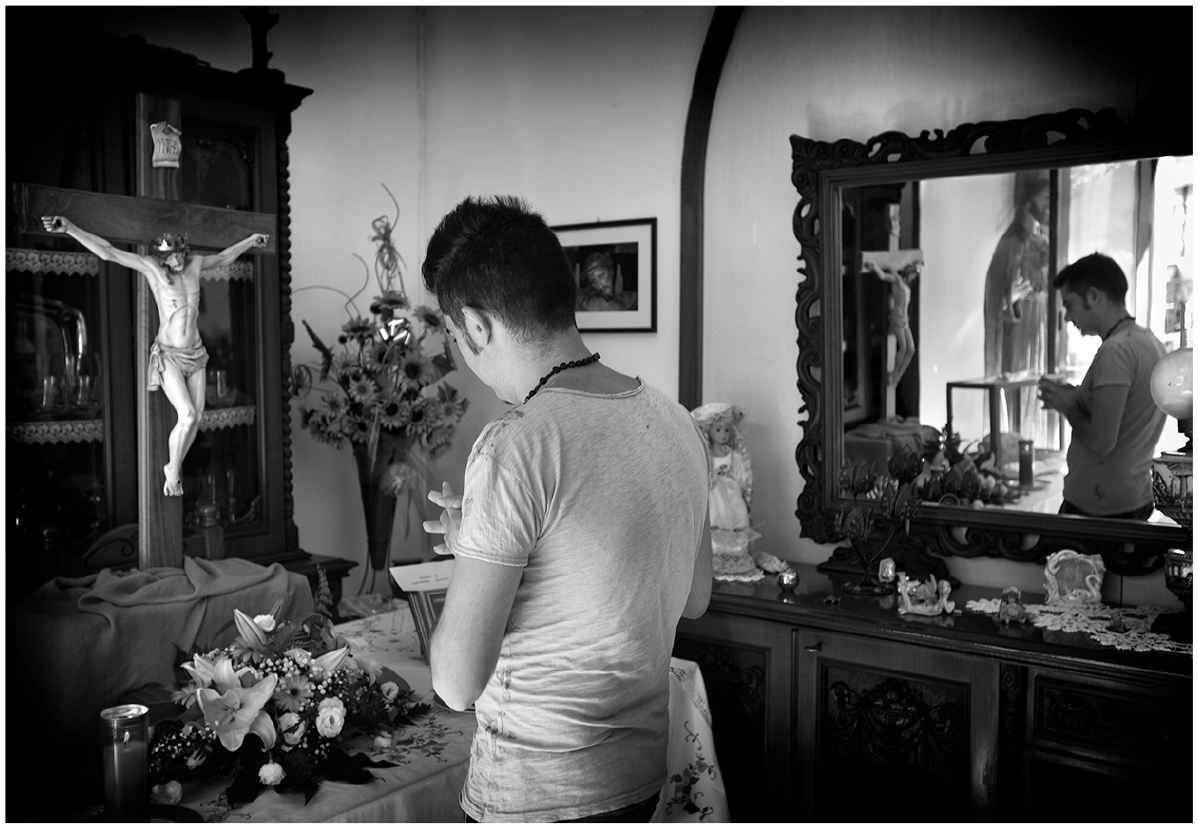
Tony prays before a statue of Jesus in a corner of his home transformed into a shrine (2014, photo by Ciro Quaranta).
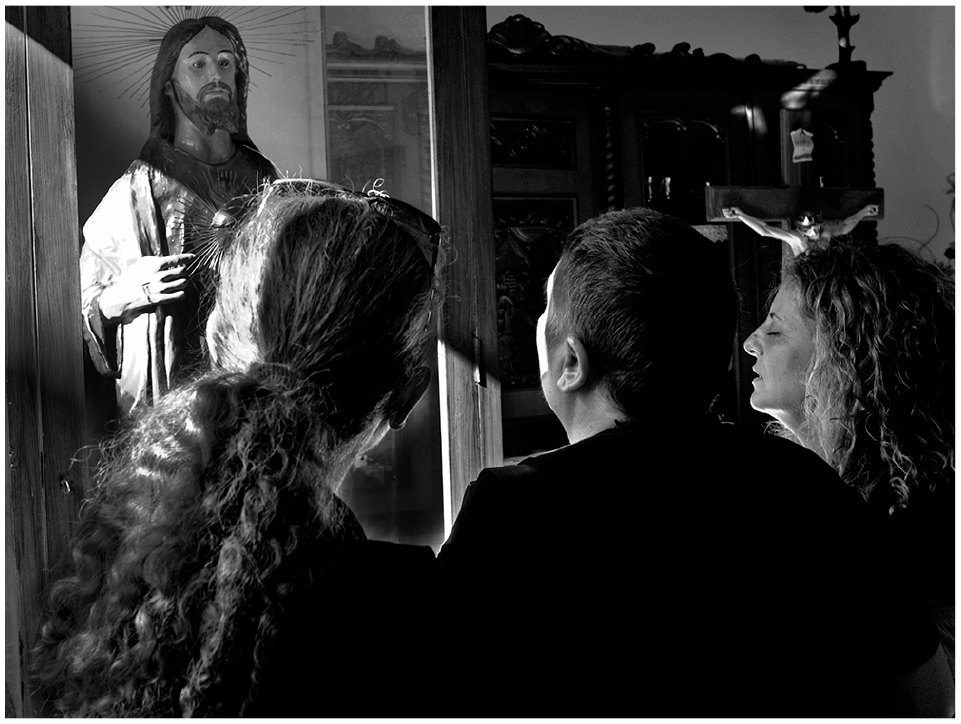
Some members of the little community in Tony’s house while praying (2014, photo by Ciro Quaranta).
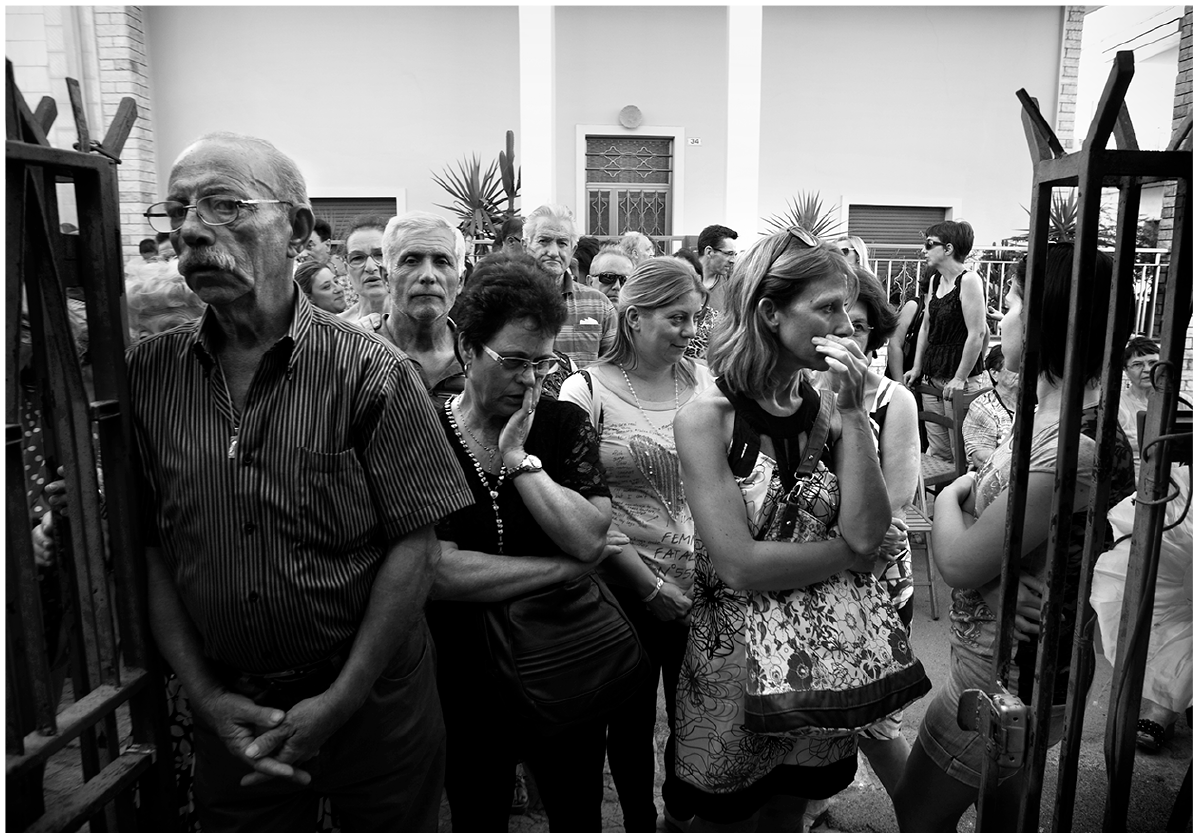
The faithful wait at the entrance of Tony’s house for a communication of the divine message received during the trance (2014, photo by Ciro Quaranta).
In the weekly meetings, the reading of the messages transcribed by his assistants provides support, guidance, suggestions, or instructions to each of the participants, who are identified by forms of address referring to where they come from (‘You, man of Monteroni’, ‘You, woman of Carmiano’) or by alluding to some circumstantial facts (‘You who have come from afar and think you already know everything about us’). But then, is not a voice that recognizes and speaks to each of us individually precisely what the believer is waiting for? Is not this recognition the seal of a pact of love and guidance?
The God who speaks is one who knows each of the believers and their everyday difficulties, their private histories, supports them in moments of crisis, and speaking to them simply, helps them overcome the predicaments of existence. The word of God that Tony hears during his crises, often falling to the ground in a trance, and that his assistants carefully transcribe in a ‘notebook’ to pass it on to the group, does not seem to have any particular features, similar experiences in these regions have already been described (De Martino, 2005). But how it is possible that God speaks in dialect? This fact makes the status of these experiences uncertain: are they a divine manifestation or mere pathology? Deliberate trickery or just the expression of a ‘barbarian’ thought?
13
The language of this ‘groupement communautaire’ (Grossein, 2005: 687–688),
14
quite apart from any doubts about the authenticity of the divine messages or the interests that led other ‘seers’ to join Tony, poses a specific question about its structure. Here again, as for Vincenzo, the language God chose was the local dialect. Its power seems to derive not so much from the content as from the form in which the divine voice is revealed (and, at least for some aspects, from the structure of the enunciation itself: the multiple subjects and issues which God makes reference to, different temporalities and the different ‘positions’ assumed by Tony as a passive receiver of divine messages, an interpreter, a prophet, etc.).
15
Different to the profile of mystical experience described in official hagiography or by theologians, the dominant theme here is not the ‘unspeakable’ but the paradoxical will of God to address everyday problems and ordinary concerns: What is so wonderful is that He talks simply to me, even in the messages, because I have to understand if I want to explain to them after . . . There are messages with words that . . . at first I really couldn’t understand . . . what it all meant, and when the voice comes, and you can’t explain . . . then you say, ‘Hey, Lord.’.. [in the sense of ‘if you talk to me like that I can’t understand’], and then the messages arrive without frills, and once the Lord said to me: ‘I will do what I did with Bernadette’, because Bernadette spoke in dialect, and the Madonna began speaking in dialect too . . . if God wants to, he can speak in any way ….
16
That the Madonna speaks in dialect to Vincenzo of Crosia and Anna of Mirto as well as to Bernadette of Lourdes, that God speaks ‘without frills’ to Tony, reveals an important principle and has a fundamental consequence: no exegesis is necessary, no ecclesiastical authority needs to intervene to interpret the meaning of these events and these words. Everything is said in the language of a community whose economy is based on farming, on increasing seasonal tourism and on the investments of those who have returned after years of emigration.
What we see here is an inversion of the principle that the divine word requires interpretation and builds its power on the revelation of a secret (‘the secret is the precondition for hermeneutics’; De Certeau, 1992: 99). Nothing stands in the way of this dialogue with the divine. It constitutes the nucleus of a desire to speak and act in history and to criticize the hegemonic cultural order that has established hierarchies of meaning and experience. Proof of this is the tension between the community and the official church, which has never recognized his visions and his stigmata as the expression of a miracle. As Obeyesekere wrote (in a Buddhist context), the visionary must establish some kind of intersubjective consensus regarding the authenticity of his vision, and this is not an easy task . . . he is forced to create . . . a convincing expressive apparatus that will foster public acceptance . . . Disciples are indispensable to this process, and the thinker or visionary actively solicits them. (2012: 111–112)
Indeed, we can see this in Tony’s story where slowly, over the years, other members joined the group.
The messages from God and Tony’s visions have nevertheless had the effect of forming a community and a shared memory, a community that, despite conflicts and schisms, is reproduced through the rhythm of the divine messages in the history of the group on the association’s website as well as in the images captured by one young member who films Tony’s trances. During another interview (August 2014), Tony and another of his followers/seers briefly narrated the group’s formation: [Tony] When I was seven years old, God told me that I would meet other people, each one with his/her own gift . . . In 2012 God began to call the first, a woman from Monterone, then came the turn of Giuseppe. The third who received the call was Claudia. She had a vision the day before, announcing to her that something had happened. In fact, during the apparition . . . she saw a strong light coming from the place where Jesus was appearing, that is from my body, and from that light, from that voice, from that house, she heard: ‘you have been chosen’. The fourth was Alessandro . . . [Alessandro] In March I started to feel a call, a strong call from God, calling to me toward the church . . . I was feeling a need for meeting other people, and in May I was filled with love for the Madonna I was always in the churches, and one night, in July, I received the vision of Archangel Saint Michel. He was a man dressed as a Roman soldier, with his red tunic, his sword . . . and he put his hand on my stomach, a light appeared and I lost my senses . . . full of a divine light, inexplicable . . . and the day afterwards I fully changed . . . He was a man, but opened his wings, and they were long, two meters and half at least, and he made me touch them, and I felt the human touch . . .
In the seers’ narratives not only the divine language, even the visions and mystic experiences repeat a common pattern and the well-known topoi and representations of the saints, of conversion, of the call. Over the years since, shared pilgrimages to other cities (Padua and Frankfurt) have projected the small community’s activities far beyond the confines of Salento. In this way, day by day, the group is writing the novel of the vision; which, with Bakhtin (1981), we could describe as an ‘unconscious historical hybrid’, originating in the meeting of different linguistic consciousnesses, specific personal reasons, and unusual experiences. 17
Visions of the transcendent as redemption of daily life?
By turning to the visions of Donato, Vincenzo, and Tony and reflecting on these messages from God that have been able to animate the slow rhythm of their small townships, I am not claiming to channel their diverse experiences into any single structure (psychological, economic, or religious) that ignores the differences or the particular historical contexts. What I wanted to explore in this rapid review of some of this ‘anthology of existences’ (Foucault, 1977), these ‘minor writings’ (Deleuze and Guattari, 1986) of suffering, is what they have made possible. What truth do these discourses appeal to?
As a process that will end when the position of the protagonists in the group, and their destiny too, in part, changes, the visions and voices have been for them the moment that not only leads to their charisma being recognized but also enables them to criticize the moral order that had previously marginalized them (this is particularly so for Tony and Vincenzo). 18 Vision works as an ‘engine’ (Hobsbawm, 1959) for individual as well as social diagnosis. In their trajectories, suffering and precarity are overturned, starting from a vision and a dream that reveal the protagonists’ unexpected capacity to transform their ‘obscure and unfortunate’ lives (Foucault, 1977). Vincenzo, the child of a community which does not know how to love, is a victim of abuse; Tony, who lost his father as a child, is a poor baker; Donato was an injured veteran and unemployed. Becoming prophets and seers, they constructed highly personal ways of appealing to their communities and acting in the theatre of a history that oppressed and distressed them. Even if we cannot extract a general axiom to interpret these stories, the marginality, the suffering, and the social threat these people lived and live, seem here to have given a specific profile to their mystic experience and to their visions, to their will to speak and act, as well as to what are often labelled ‘symptoms’. Their experience offers a crystal-clear example of what De Martino called ‘the decisive heuristic value’ of psychopathological documentation for anthropological interpretation of apocalyptic experience; we must pay it attention or we lose the richness of a ‘unitary anthropological perspective’ in analysing the experience of ‘the end of the world’ (2016: 425).
What visions initiate, with their messages and prophecies, is a particular ‘semantics of historical time’; they are able to build a strange proximity between the ‘space of experience’ and the ‘horizon of expectations’ (Koselleck, 2004). By opening a channel between ordinary daily life and the numinous, visions draw new imaginative horizons and work as a perceptual hope. 19 Theirs is a writing of the unexpected, whose power undoubtedly lies in its capacity to transform or create new experiences. As Koselleck observes, ‘Only the unexpected has the power to surprise, and this surprise involves a new experience. The penetration of the horizon of expectation, therefore, is creative of new experience’ (1988: 275). 20
This power springs from the paradoxical nature of visionary and prophetic language (‘The speaker is not “really” speaking yet bears responsibility for what she or he says’; Csordas, 1997: 330), and from banal circumstances: blowing dust from the face of a statue of the Madonna, receiving a bible as a present Donato Manduzio will understand the obscure meaning of a dream he had a few days before. But again, is not that precisely what a miracle is supposed to do? To ‘produce extraordinary effects with ordinary means’ (Cassin, 1993: 50).
We can reasonably conjecture that these visions have some of the features of those ‘dialectical images’ that, writes Benjamin, 21 illuminate like a lightning flash the dialectical relation between past and present, between what has happened (Manduzio’s traumatic memories of the Great War; Vincenzo’s unhappy childhood; Tony’s marginality) and the present. These images are ‘suddenly emergent’, as are the vocabularies inspired by religious language, the ways in which the subalterns, the conquered, sometimes imagine the future and act on the stage of history. Although sometimes submitting to the empire of the symptom (whose political scope is often difficult to recognize), 22 and without reaching the luxuriant levels of protest and insurrection described in the context of prophetism and local medical knowledge in colonial Africa by authors such as Feierman (1995), here too the cases analysed reveal how the religious-therapeutic imaginary has been able, with its semantics of time, to construct forms of redemption and provisional experiences of heterochrony. 23 By transforming the ‘so it was’ (a ‘not decided’ history, according to De Martino) into a ‘so I wanted’ and, above all, offering a counterpoint to the dominant regime of truth, visions express at once a specific form of nostalgia for agency and a tension between the segregated history of the marginalized and the desire for an alternative history. 24
Footnotes
Acknowledgements
I would like to thank the people of Nardò (Lecce), more particularly Giovanna Stifani, as well as the members of the Tony Lagetta community, and all those I was able to meet and interview at Gorgoglione (Matera) and Grottaglie (Taranto) for their kindness and availability; even if this article does not report the contents of these dialogues, the latter are part of an ongoing research.
Funding
The author received no financial support for the research, authorship, and/or publication of this article.

Notes
Author biography
Address: Department of Cultures, Politics, and Society, University of Turin, Lungo Dora Siena 100, 10153, Turin, Italy.
Email: