




Abstract
This article explores the features of religiousness as it is supported by governmental policies in Hungary. The research interprets the values held by social actors in terms of their relationship to violations of norms that are sanctioned and those that are not sanctioned by the state. The analyses of our representative sample revealed a type of secularised religiousness in more than one dimension. The value orientations of religious people in Hungary appear to be aligned with secular society. The main trend seems to be that the moral judgements of religious people do not differ from those of the people who consider themselves not religious or atheist. Religious people in Hungary no longer find guidance in their religious tradition – which is regarded as obsolete in today’s secularised public discourse – but are oriented by the values of the secularised world, inevitably drifting away from their Christian roots. Differences between religious and not religious people appear only in certain position statements relating to homosexuals.
Religiousness and values in attitudes to norm violations
Social changes during recent decades have repositioned the role of religion and – in a narrower sense – Christianity across the whole of Europe. We consider the reintroduction of issues of religion and church into public discourse the most important of these changes. Identification with a civilisation through religion (Davie, 2006) is observable not only in Western Europe but also in the Central and Eastern European region. Hungary is a special case. The importance of social identification through religion in this country is not simply a result of the borderline situations described by Davie (2006) (personal tragedies, tragic events experienced by communities, terrorist acts) and migration. Given that the rhetoric of the parties in power since 2010 (the FIDESZ-KDNP party alliance) rely heavily on Christianity; religious content is much more predominant in public life in Hungary than in Western Europe. Religious values – and the social conventions in which they are manifested – are markedly emphasised by the targeted propaganda practised through public media, which is dominated by the governing party alliance.
This article explores the extent to which society’s religiousness is linked to Christianity, which is identified as the key source of tradition. Other interesting issues include the extent to which the system of values embodied by Christianity is present in the religiousness of the actors, along with the role of these values in determining the self-identity of a religious person. This article focuses on the relationship between religion and values, exploring people’s relation to values through their judgements of norm violations.
Therefore, this research is primarily an analysis of the typical patterns observed in individuals’ relation to norm violations in various groups of people considering themselves to be believers and of people considering themselves to be non-believers. It focuses on the ways religious sensemaking determines people’s opinions in terms of their judgements of norm violations that are either sanctioned by the state or not, and to what extent the strict ethics of the Judeo-Christian religious tradition are reflected in people’s relation to the violations of norms if they themselves are religious. The different forms of norm violations make it possible to examine concurrences between religiousness and the various types of violations. This in turn enables the identification of types of norm violations in which religiousness is a structuring factor.
European and Hungarian research tradition
Although the relationship between religiousness and value orientation has been the subject of numerous research projects in recent decades, it is hardly possible to talk about any research findings of universal validity. Nonetheless, some major trends can be identified in the European region. A significant transformation has taken place in the sense that the seemingly self-evident strong correlation between religiousness and moral judgement has grown increasingly relative. Early research (Lenski, 1963; Rokeach, 1969a, 1969b; Schwartz and Huismans, 1995) still found a strong correlation between these two phenomena. A number of studies conducted in recent decades, however, found this correlation to be weakening or even to have disappeared. Another important change was that the slow decrease in the percentage of the population considering themselves religious (Voas, 2009) had been accompanied by a gradual change in the content of religiousness in Europe during the past decades. A decline in conventional religiosity and religious practice linked to churches, together with the appearance of new forms of spiritualism took place (Cortois et al., 2018; Davie, 2005; Heelas and Woodhead, 2005; Houtman and Aupers, 2007; Lyon, 2000; McGuire, 2008, 2016; Storm, 2009, 2016).
Moreover, this restructuring has also been reflected in the relationship between religiousness and value relation. Lived religiousness gradually detaching itself from the patterns of denominational religiosity, and moving away from its religious roots, grew increasingly closer to the system of values of non-religious people. This resulted in a decrease in the difference between the moral judgements of religious and non-religious people across the whole of Europe. Accordingly, hard indicators of the secularised society, such as education, family status, and age groups, have acquired dominant roles in the transfer of values, while the importance of religion has gradually decreased (Botvar, 2005; Sieben and Halman, 2014). The differences are now more and more clearly limited to judgements of norm violations not sanctioned by the state (Finke and Adamczyk, 2008).
One overarching question of the study is to what extent the above European trends prevail in Hungary. Similar to other countries of the Central and Eastern European region, the religiosity of Hungarian society was profoundly determined by four decades of communism, when not only religious institutions were under attack but individual religious practice was also made very difficult. Although it failed to eradicate religious belief from the majority of the people, this pressure resulted in a significant decrease in the number of religious people with actual ties to any particular church and the largest group of people identified as ‘religious in their own particular ways’ (Tomka, 2006).
Research also found more pronounced prosocial behaviour among religious people in Hungary: the more deeply religious one is, the more important human relationships will be for them, and the more socially sensitive they will be (Tomka and Zulehner, 1999). Different value systems were found to be associated with different types of religiousness (Földvári, 2009). Analysing young people’s value structures, Gergely Rosta found a different pattern of values among religious people. When looking at the importance of specific values, however, he saw no material differences between groups of religious and non-religious individuals (Rosta, 2010).
Hypotheses
We regard the polycontextual structure of modern society, giving rise to multiple autonomous rationalities (of economics, law, politics, education, arts, etc.; see Luhmann, 1998), and its rationality that may be considered as the heritage of the Enlightenment (see Habermas, 1995), as influences equally eroding the power of the religious viewpoint. In addition, we took into account that value choice is also influenced by the secularised public discourse of modernity (Taylor, 2007). These are the factors that contribute to a definite weakening of religious belief and a decrease in religious practice, a trend unlikely to leave day-to-day sense giving unaffected either.
One peculiar feature of public discourse in Hungary is that, since 2010, political power has taken a stance in opposition to this trend, emphasising the importance of religious education and values. We intend to explore the characteristics such opposing impacts are developing in Hungarians’ relation to norm violations. Out of these two factors, it is secularisation functioning as a ‘longue durée’ that appears to be playing a stronger role. According to Fernand Braudel (1958), it is long-term historical structures that shape mentality and values, rather than the short-term impacts of political discourse which have little effect on deep structures. This long-term impact is capable of relativising the role of religious sensemaking in judging social actions.
Therefore, our preliminary assumption is that the effects of secularisation cannot be overwritten even by a political elite’s emphasis on communicating religious messages through public service media channels, because these are not likely to be able to substantially influence people. People’s judgements concerning norms and their violations appear to be shaped by the ethical principles rooted in secularisation. In an essentially secularised environment, most people may adopt the opinion that norm violations are to be judged from the aspect of the value system communicated by public authorities. Accordingly, the basic hypothesis of our research is that we are not going to find significant differences between various groups of religious and non-religious people in relation to state-sanctioned norm violations (Hypothesis 1).
One particular feature of public discourse in Hungary is that the strongly articulated rhetoric of the Orbán government – in power since 2010 – has been gradually gaining ground besides secularised public discourse. Although, in line with the arguments put forth earlier, we do not think that a 6- to 7-year period could radically override trends that have been dominant for centuries, it will presumably affect people’s value judgement. This is particularly true in a society that has given majority support in three general elections to a government applying propaganda quite effectively, in the absence of any significant market competitor (Bajomi-Lázár and Horváth, 2013). We expect that the rhetoric emphasising Christian principles will most effectively address those who consider themselves to be religious in relation to such ethical issues, which they disapprove of not in legal terms but in terms of a value system. Our research is based on the assumption that religious people make stricter judgements concerning norm violations that are not sanctioned by the state (Hypothesis 2).
A modern pluralistic society may be characterised by parallel discourses. Therefore, we suppose that social groups – which, in their own more intimate communities, encounter sensemaking other than the dominant discourse – are bound to have different value structures and also relate to norm violations in different ways. Such a community may be the minority group of church-affiliated religious people within a secularised Hungarian society where the world is interpreted on the basis of rational values (Keller, 2010). On the basis of a hypothesis confirmed in the United States (Stark and Bainbridge, 1996), we assume that those qualifying as religious in accordance with the teaching of churches tend to preserve Christianity’s ethical and moral principles more carefully, that is, they will form stricter judgements of state-sanctioned (Hypothesis 3a) and state non-sanctioned norm violations (Hypothesis 3b) in their responses.
A lot of research in the fields of social psychology and the sociology of religion has been focused on the relationship between the content of belief and ethical principles (Gervais, 2014; McKay and Whitehouse, 2015; Saroglou, 2011; Shariff and Norenzayan, 2011). In particular, the relationship between the God-image and principles of ethics has been studied extensively. Research has shown that the proposition of a personal God greatly increases the likelihood of one applying stricter principles of ethics to their own behaviour and that of others (Norenzayan, 2014; Shariff and Norenzayan, 2011). The continuous presence of a personal God warns and prompts the person to act in morally desirable ways. A personal God can, therefore, make the observance of, and adaptation to, norms more effective, but he also encourages the formation of a behaviour watching over norms. Based on the above, we assume that religious people who have their individual personal Gods will take stricter views of state-sanctioned (Hypothesis 4a) and state non-sanctioned norm violations (Hypothesis 4b) and form a group whose ethical principles are clearly distinct from those of others.
A separate hypothesis deals with religiousness and how people view homosexuality. This is influenced by the fact that reservations concerning homosexual people appear to be more persistent among people in the Central and Eastern European region (Takács, 2015). There is also a considerable rift between the different regions in terms of how the historical churches relate to this issue. Churches in the West have undergone some major historical transformations, which has resulted in increased openness towards homosexuality as a possible sexual orientation. (This is evidenced by Pope Francis’ statements concerning homosexuality and the practice of protestant churches appointing openly homosexual women and men to be pastors.) In church circles in Hungary, the issue of homosexuality is still something of a taboo, whereas the number of people in society accepting homosexuality in general has increased (Takács, 2015: 25–50). Accordingly, we assume that the churches’ traditionalism affects the attitude of their believers. Although this clearly does not preclude believers being open to homosexuality, we expect that believers in general and those who are faithful in line with the teachings of their respective churches, in particular, will be less tolerant of gay people (Hypothesis 5).
Data and methods
We carried out an online survey on a quota sample of 1000 respondents representing Hungarian internet users aged 18–65. The fieldwork was conducted in November 2017 by NRC. 1 The questionnaire includes items on various norm violations, attitudes towards gays and lesbians, and the religious preferences of the respondents.
Overall, we have three dependent variables (state-sanctioned and non-state-sanctioned norm violations and acceptance of homosexuality), three key independent variables (different types of religiousness), and some demographic control variables. We used Structural Equation Modelling (SEM) to test our hypothesis. In a SEM model, we can calculate measurement model (factor analysis) and path models (regressions) simultaneously. It allows for estimating relations between latent constructs and/or manifest variables (Kline, 2015). We used the lavaan package of R program to calculate our models (Rosseel, 2012).
In a SEM model, we can have several dependent variables. We decided to include all the dependent variables in one joint SEM model. We have only one variable to measure the norm violations non-sanctioned by the state, which is about marital fidelity. This question was presented with a focus on people’s relation to breaking norms in the personal sphere. Differences that may be pinpointed in views taken of the rule of ethic, which ethic to be found in Christian teachings as well, may be indicative of the survival of religious values or their dissolution in society. The question is, ‘How acceptable is a husband’s or wife’s having an extra-marital affair?’. The scale ranged from 1 (not acceptable under any circumstances) to 11 (acceptable under any circumstances). The mean value of this variable is 3, with a 0.9 standard error.
The state-sanctioned norm violations are calculated by five variables, all measured in a 1–11 scale (same scale described earlier). We created a list of various forms of norm-breaking of which people are more tolerant, along with a list of breaches of which people are less-tolerant. The questions were raised to find out whether religious people have been and are still taking a stricter view of breaches of norms or have adopted non-religious people’s more lenient approach. Within the SEM model, a confirmative factor model is fitted, including the five variables. The variables are the following:
Applying for benefits without eligibility (Mean: 2.3, SE: 0.7);
Tax fraud (Mean: 2.6, SE: 0.8);
Accepting bribery (Mean: 3.2, SE: 0.9);
Travelling without paying the fare (Mean: 4.3, SE: 0.9);
Declining to ask for a receipt from artisans or service providers (Mean: 6.3, SE: 1.1).
The acceptance of homosexuality was calculated by three variables, all measured on a 1–4 scale. We applied a confirmative factor model to calculate this index within the SEM model. As regards people’s relation to homosexuality, we wanted to identify, people’s relation to homosexuality itself, their acceptance of day-to-day coexistence of homosexuals, and their relation to the public manifestations of homosexuality. The questions are the following: Do you agree with the following statement (1: not at all, 4: fully agree):
A gay/lesbian relationship is unnatural (Mean: 2.5, SE: 0.4);
Gays and lesbians should be permitted to live such as the way they feel (Mean: 2.9, SE: 0.3);
It is something to be welcomed that thousands march in the Pride parade year after year in Budapest (Mean: 1.7, SE: 0.3).
In the survey, several questions are used to measure religiousness. For testing our hypothesis, we calculated three (partly) different types of religiousness. The first variable is a general one; it measures how religious people are (see Hypothesis 1 and Hypothesis 2). Several variables are included in a factor model to calculate this index:
How religious are you (1–5 scale, 1: I am not religious, I have other strong convictions, 5: I am religious in accordance with the teachings of my religious community);
How often do you pray (1–10 scale: 1: never, 10: daily);
Do you believe in (1–4 scale: 1: not at all, 4: strongly): life after death; heaven; hell; religious miracles; spirit independent from the flesh.
We assumed that those qualifying as religious in accordance with the teaching of churches tend to follow Christianity’s ethical and moral principles more carefully (see Hypothesis 3). We calculated a variable that measures only this type of religiousness. We adapted some questions used for calculating the general religiousness. We used the following three variables to measure this index; all of them are pre-processed.
We recoded ‘how religious are you’ into two categories: 1: I am religious in accordance with the teachings of my religious community, 0: other answers;
We recoded ‘how often do you take part in religious ceremonies/rituals’ into two categories: 1: several times within a month or more often, 0: less often; and
We calculated how many times the respondent answered 4 (strongly), for the following questions: do you believe in: life after death, heaven, hell, spirit independent from the flesh?
The last key independent variable is used to measure Hypothesis 4a and Hypothesis 4b. It focuses on believing in personal God. We measure this, with one variable: which of the following statements is closest to your faith:
I do not really think there is any sort of God, spirit or life force.
I do not really know what to think.
There is some sort of spirit or life force.
There is a personal God.
We include this as a continuous variable in the SEM model.
We included four further variables in the model: age of respondent (4 categories), gender (1: male, 2: female), educational level (1: primary school, 2: secondary school, 3: university), and settlement type (1: capital, 2: city, 3: village) to control for the demographic characteristics of the respondents.
To increase the fit level of the model, we allow correlation between some of the measured variables. Correlation is allowed between the three religiousness index, and correlation is also allowed between the error terms of the three dependent variables. As the three religiousness indices are strongly correlated with each other, we decide to fit separate SEM for all of them, to avoid multicollinearity. The dependent variables and the control variables are the same in the models, but in the regression part, only one religiousness variable appears. We apply case-wise (full information) maximum likelihood estimation to handle missing data. We use maximum likelihood estimator to fit the models with robust (Huber–White) standard errors. The comparative fit index (CFI) is above 0.9 (0.907), and both the root mean square error (RMSE) and the standardised root mean square error (SRMS) is under 0.1 (both 0.057), so the measurement model is acceptable. See Table 4 in Appendix 1 for the factor loadings of the latent variables.
Results
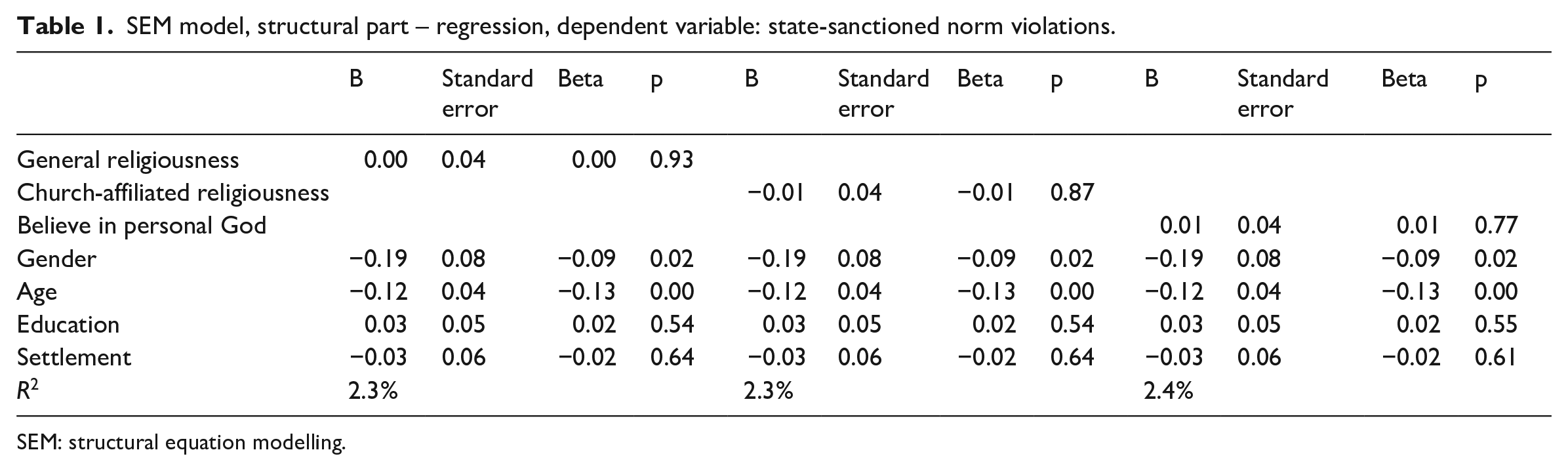
Our results show only small differences in terms of the views taken regarding norm violations among the respondent groups of non-religious and religious people. Religious world-view has only a minor impact on people’s relation to violations of norms. Religious people showed no difference concerning state-sanctioned norm violations (see Table 1). We can conclude that none of the various dimensions most frequently studied in the context of the sociology of religion, such as participation in religious practice or the content of lived belief, had any influence whatsoever on how the various actors viewed state-sanctioned norm violations. Accordingly, these findings confirmed our hypothesis pertaining to this relationship between values and norms (Hypothesis 1).
SEM model, structural part – regression, dependent variable: state-sanctioned norm violations.
SEM: structural equation modelling.
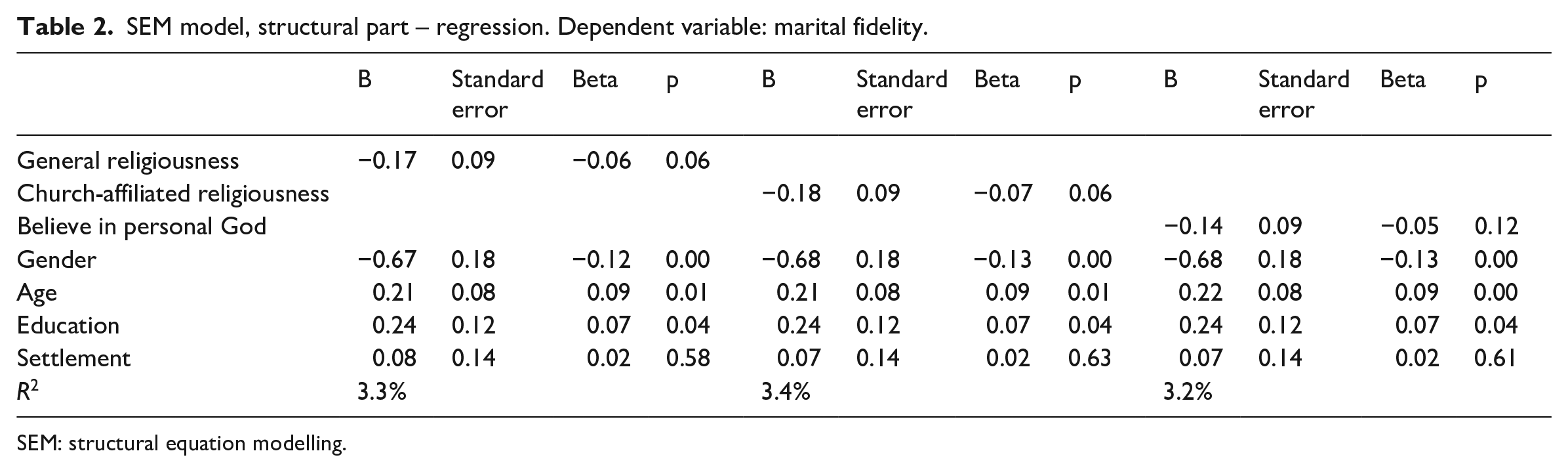
We assumed that those who are religious (a general way) would be more staunchly opposed, particularly to norm violations that are not sanctioned by the state (cheating on spouses), because of their own religious ethical-normative principles (Hypothesis 2). This hypothesis was rejected, as religious people have no different views on marital fidelity than other social groups (p = 0.06 – Table 2).
SEM model, structural part – regression. Dependent variable: marital fidelity.
SEM: structural equation modelling.
Our Hypothesis 3 was also rejected. Church-affiliated religiousness had no significant impact on norm violations, either on state-sanctioned or on state non-sanctioned forms. So based on our results, those qualifying as religious in accordance with the teaching of churches do not tend to preserve Christianity’s ethical and moral principles more carefully.
As part of our hypotheses, we regarded people’s relation to God to be a particularly important aspect, assuming that belief in a personal God creates a less lenient attitude towards norm violations (Hypothesis 4). Our results show that belief in a personal God had no influence on the views of moral behaviour regarding economic activities (prohibiting practices such as tax fraud, receiving benefits without eligibility, failing to issue invoices or receipts, travelling without paying fare), just like it had no effect on people’s relation to active and passive forms of corruption (bribery, gratuity). The separation of the Christian system of values from the less lenient value principles held by religious people can, therefore, be observed among religious people with close ties to the Christian tradition in terms of their God-image. They are the ones who guard the traditional concept of Christianity more faithfully in the face of uncertainty of religious belief, religious syncretism, the depersonalisation of the God-image, and the sacralisation of the interior world (Heelas and Woodhead, 2005; Hervieu-Léger, 2000). Signs of a transition, that is, principles of Christian ethics, appear in this case in the fact that extra-marital sexual relationships are the only norm violations not sanctioned by the state on which people with a personal God have more uncompromising views, even though there is only a weak relationship between these variants. 2 The difference must also have been affected by the fact that people with a personal God tend to be somewhat more politically conservative than those of other faiths, as indicated in a previous study (Froese and Bader, 2008) and the findings of this research. 3
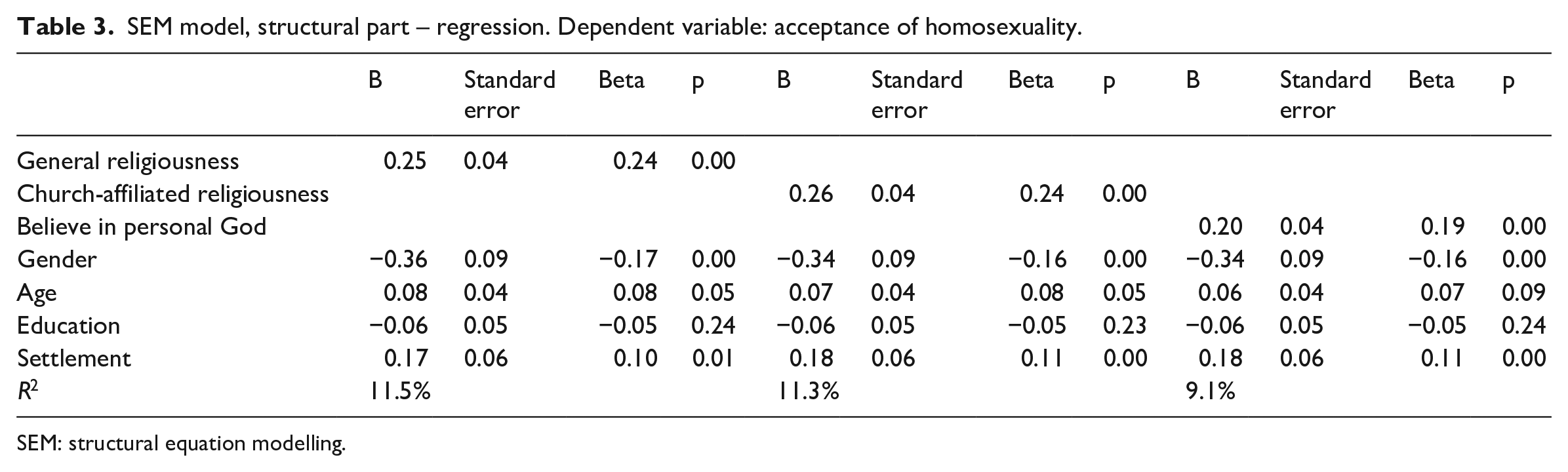
The last hypothesis focuses on the relationship between acceptance of homosexuality and religiousness. Based on the results presented in Table 3, all three religiousness variables are significant in the regression models. A high value of the dependent variable means a rejection of homosexuality. All three religiousness variables have a positive coefficient, which means that those who are more religious, those who have church-affiliated religiousness and those who believe in personal God, have lower acceptance of homosexuality. We have to highlight that we controlled several demographic variables, which makes our results more robust. Based on the Beta values and the explained variances, the general and church-affiliated religiousness have the same explaining power, and the personal God question has a somewhat lower strength.
SEM model, structural part – regression. Dependent variable: acceptance of homosexuality.
SEM: structural equation modelling.
The results show that there is only one factor in which the value judgement of those believing without moralising differs from that of the majority of society: the way religious people relate to homosexuality. This is also indicated by the fact that a higher proportion of people belonging to churches, denominations, or other religious communities regard gay and lesbian relationships as unnatural. Homosexuality is even more strongly opposed by those belonging to religious communities when asked what they think of the public manifestations of sexual otherness. Attitudes towards the Pride demonstrations, generating heated debates year after year, were tested on a positive statement about the event. Besides a definite rejection of the Pride parade across the entire Hungarian society, this rejection was even stronger among respondents belonging to churches, denominations, or other religious communities, even though the link between the variables are rather weak.
Secularised religiousness
We also found a secularised religiousness in more than one dimension, the characteristics of which are manifested in people’s relation to norm violations. It appears that religious people in Hungary relate to state-sanctioned norm violations in the same way as non-religious people. 4 The reason why the importance of this change needs to be highlighted is that the Ten Commandments, in which the basic teachings of the religious tradition are laid down, raise six moral issues, emphasising that proper moral orientation is of the utmost importance for Christian identity. However, we found that this strong value proposition has more or less disappeared. The ethical principles of religious people have become similar to the non-religious people in Hungary, whose views are a lot more lenient than those in Western Europe. Accordingly, the Christian tradition’s emphasis on moral principles is hardly reflected – if reflected at all – by people’s value choices. Instead, it is the value system of the secularised society – at a considerable distance from religious, moral principles – that determines the view of respondents.
These figures may not even be surprising in a society whose recent history did not encourage the passing down of a religious system of values. The anti-religion and anti-church policies of the 40 years of communist rule, however, certainly do not explain the diminishing significance of religious values. In our view, the particular structure of the communist regime in Hungary was at least as important a factor in enabling the secularised values to gain ground. The strict Stalinist rule during the 1950s, followed by the Kádár regime, allowed a lot of space for interpretations of reality independent of the political power. A more permissive behaviour appearing also at the level of the personal life world enabled the appearance and development of a new petty bourgeoisie, resulting in an increase in personal freedom, the accumulation of wealth, the possibility of launching businesses, and the pursuit of certain bourgeois values during the Kádár era of socialism (Andorka, 1997). This attitude contributed to the fact that the political system in Hungary enjoyed the greatest social acceptance in the socialist bloc.
In regard to matters of religion and church, however, the political system was far less permissive. The majority of society accepted the conditions and values of the system in circumstances that did not allow the manifestation of the religious and church viewpoint (Tomka, 2006: 36–40). In our opinion, these socio-historical conditions played a major role in society’s alignment to the state-controlled and centrally determined orientation (and its social values) in such a way that the perspective of religion and church was not allowed to appear in it, except in people’s everyday, which was not so closely monitored by the state.
The brief religious revival of the system change (Froese, 2001) raised the Christian world-view to the level of possible reality interpretations again, after a very long time. The religious revival following the system change is reflected by the growing number of religious people. (The proportion of people considering themselves to be religious increased from 53.9% to 70.9% between 1983 and 1993, see Tomka, 1995.) The appearance of the historical churches and their claim to playing roles in public life and politics, however, was met with major opposition in Hungary. In a public life dominated by parties left of centre, churches were considered representatives of an authoritarian political system of the like of the regime between the two World Wars. In this emotionally overheated debate, churches were seen as instruments that would jeopardise the spreading of western democratic values (Tomka, 2006: 140–142). This discourse that dominated the general public discourse sidelined the religious viewpoint. It reinforced the practice that allowed the discussion of matters of religion only as personal, private issues. Moreover, public discourse is characterised by secular agenda, which leaves little room for the presentation of religious and church viewpoints.
Similarly to the rest of Central and Eastern Europe, religiousness was losing ground (Norris and Inglehart, 2004: 111
This is likely to be one of the factors that have contributed to the lack of difference between religious and non-religious people’s relation to state-sanctioned norm violations in Hungary. An analysis of the above social conditions may help us understand why a secularised public discourse that has been stripped of its religious elements more than in Western Europe leads to a situation where being religious has no effect on how one views norms pertaining to moral behaviour.
These attributes are indicative of a secularised form of religiousness characterised by a more permissive attitude towards norm violations instead of the traditionally strict ethical principles of Christianity. The values of religious people are becoming more and more closely aligned to those of the secularised public discourse. A dilution of the stronger ethical content of religiousness is the most important feature of this increasing similarity. Rather than the value orientation emphasised, in particular, in the Christian teachings, the attitude of the majority of the population, featuring these values less prominently, becomes a benchmark even for those considering themselves religious. Nonetheless, the overwhelming majority of data collected in Hungary show that there are no significant differences to be found in terms of norm violations not sanctioned by the state (with the exception of homosexuality).
Research findings show that even in the case of people qualifying as religious in accordance with the teaching of the church, the stricter ethical principles of religious tradition are gradually becoming diluted. Apparently, not even the alternative religious public discourses that are present alongside the secularised public discourse convey ethical principles that would result in more uncompromising views of such norm violations among those more directly belonging to the community of the religious. Accordingly, the trend is clear and evident in regard to norm violations not sanctioned by the state: believers are less and less oriented by Christianity’s principles of ethics, and they regard the norms of secular society as relevant to their own value choices.
We found that in Hungary belief in a personal God had no influence on the views taken of norms of moral behaviour in terms of economic activities (prohibiting practices such as tax fraud, receiving benefits without eligibility, failing to issue invoices or receipts, travelling without paying fare), just like it had no effect on people’s relation to the active and passive forms of corruption (bribery, gratuity). The separation of the Christian system of values from the less lenient value principles held by religious people can, therefore, be observed among religious people with close ties to the Christian tradition in terms of their God-image. They are the ones who guard the traditional concept of Christianity more faithfully in the face of uncertainty of religious belief, religious syncretism, the depersonalisation of the God-image, and the sacralisation of the interior world (Heelas and Woodhead, 2005; Hervieu-Léger, 2000). Signs of a transition, that is, principles of Christian ethics, appear in this case in the fact that extra-marital sexual relationships are the only norm violations not sanctioned by the state on which people with a personal God have more uncompromising views.
Believing without moralising
In the theoretical part of this article we have highlighted that after Fidesz won the 2010 general elections, they started to massively support the church in various ways. In order to put our results in context, it is worth investigating the relationship between norm violation and religiousness before 2010. The European Value Survey (EVS) is a good data source for such an analysis. The last available EVS was conducted in 2008–2009 in Hungary. The variable set of EVS and our research is not entirely the same, but some of our models can be reproduced using the EVS dataset. The personal God question was measured in the same way in the two surveys, so we used this religion question for comparison. In the case of state-sanctioned norm violation, the same variables are available, and the same question is used to measure marital fidelity.
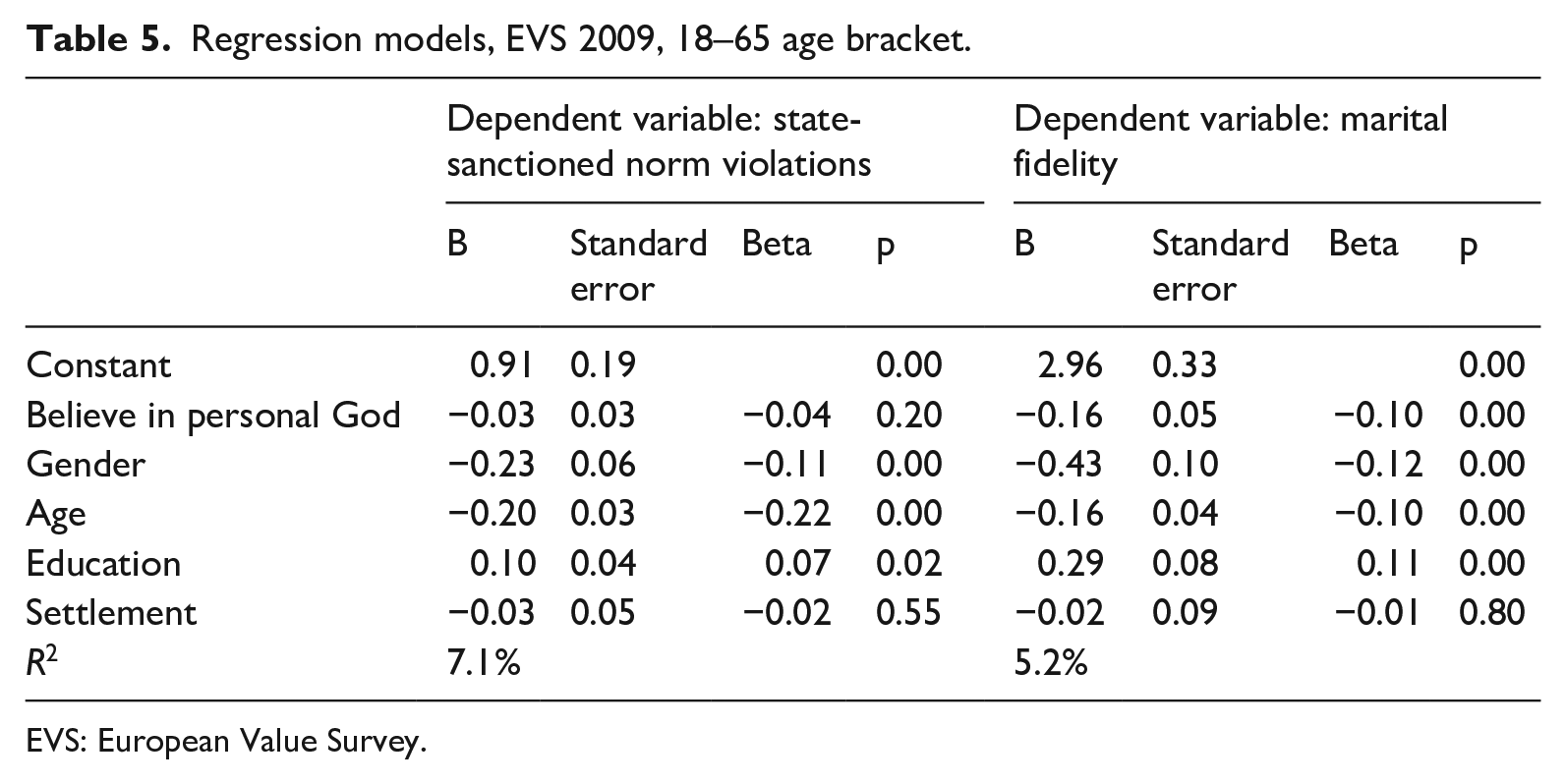
For testing the temporal variation, we have fit two regression models on EVS data. In the first model, we used an index of state-sanctioned norm violation. 6 In the second model, we used the marital fidelity question. Our main independent variable was the personal God question, and we used the same demographic variables as in the SEM models (gender, age bracket, education, settlement type). As in our survey, people older than 65 were not represented; we have omitted this age bracket from the EVS data. The results of the regression models are available in Appendix, Table 5. In the case of state-sanctioned norm violations, the personal God variable was not significant. This result is in parallel with what we found in 2018. However, those who believe in a personal God find it less acceptable if a husband or wife has an extra-marital affair. This effect is rather weak (beta: 0.1), but significant in 2008. This is an important difference between 2008 and 2018.
The growing relativisation of the principles of religious ethics appears in multiple dimensions in our database. Even when compared with earlier studies, the research shows that the current findings are results of structural changes that have been in progress for decades. Principles of ethics upheld by religious people – which are traditionally stricter than those of the majority of society – have been found to be weakening across the whole of the population as well as in specific age groups by earlier Hungarian studies (Polak and Rosta, 2016; Rosta, 2010; Rosta and Földvári, 2014; Tomka, 2006).
The current state of religiousness is a reflection of changes that have been taking place for centuries, creating a cultural tradition where, in Europe, people’s orientation concerning social issues is becoming less and less dominated by religious teachings (Taylor, 2007). The frequent interruptions of the development of Central and Eastern European societies offered limited opportunities for passing down tradition, including religious tradition, for centuries characterised by a succession of global wars and dramatic social and political upheavals 7 (Hamplová and Nespor, 2009). This intermittent development is a contributing factor to the characteristics of religiousness.
The deeper structures underlying the current content of religiosity explain that the religious message of the ‘Christian-conservative course’ that has been dominant in public life in Hungary since 2010, has not been able to make a perceptible impact on people’s religiousness nor has it been able to override the more general trends of the dilution of ethical principles. However, these deeper structures are not the only factors contributing to the weakening of the credibility of the governmental rhetoric with an emphasis on Christianity’s principles of ethics. An additional component is that these principles have been presented to society by a political party which was the most radical left-of-centre, anti-religious, and anti-clerical party in opposition of the conservative government at the time of the system change (1990); a party that did not discover its Christian roots until the transformation of the structure of political parties in Hungary about a decade later. Furthermore, a myriad of corruption scandals, and a sudden increase in the wealth of entrepreneurs with close ties to the governing party (Jakab and Urbán, 2017) eroded the credible representation of Christian principles of ethics.
As a result, religious belief is less and less characterised by deriving its religious world-view from the value proposition of a religious tradition, which is true to its Christian origins. In this sense, being religious is also a form of believing without moralising. The expression itself is not, of course, meant to suggest that religious people find their way around in the world without ethical principles, as it is beyond dispute that a not insignificant proportion of social actions are value-oriented. In other words, individuals’ actions often reflect value choices that can be regarded as originating from principles of ethics (Habermas, 1995; Joas, 2000; Luhmann, 2008), regardless of the differences in the views of social theoreticians on the significance and role of this fact. The expression ‘believing without moralising’ merely indicates that the religious person’s value choices more or less coincide with those of secular society. In this sense, the religious individual’s world-view, rooting in a specific morality, all but vanishes and his or her dogmas are no longer determined by a set of norms associated with principles of ethics that are different from those held by others, that is, non-religious people.
Conclusion
These data illustrate a social change in which people identifying themselves as religious also align themselves more and more with the value judgement of non-religious people. Our findings show that those considering themselves religious express a stronger rejection primarily of homosexuality (and, to a lesser extent, of its public manifestation) than groups of non-religious people. However, it appears that with regard to the relation to homosexuals, it is the values of non-religious people to which the attitudes of religious ones are being adapted. 8 Despite undoubtable differences, this is another example of the dilution of a specific religious value pattern and the fading of the associated ethics principles. This trend is in line with the changes that have been taking place in Central and Eastern Europe for some time now, as a result of which the issue of sexual morality is increasingly becoming a private one (Halman and Arts, 2010).
In our assessment of these phenomena, we considered factors inherent in the specific development of Hungarian society and western patterns of modern social development as equally important. Earlier research showed that in a religious environment, the individual’s norms are determined by the world-view of the religious community. This socialising effect is, however, profoundly changed when the shaping of norms comes to be dominated primarily by a secularised public discourse. Possibly as a result of the above, religion becomes a less important part of the individual’s life in a secularised environment. Its rules are increasingly confined to religious and church events, having diminishing influence on the everyday life and actions of a religious person. The secularised environment weakens religion’s value orientation because the religious individual finds that their world-view is no longer of universal importance in social relations. All of these result in judgements being adapted to those of the secularised community in regard to both values and norm violations.
This sequence of changes has also taken place in Western European religiosity. Rodney Stark and others refer to the change of this socialisation pattern as the Hellfire effect (Hirschi and Stark, 1969). The fact that secularised public discourse can more strongly affect religious content as well also facilitates the erosion of religious values. A religiosity adapted to secularised values invokes/promotes looser forms of faith, a trend which inevitably strengthens the more secular interpretations of the meaning of life even among religious people (Davie, 1994, 2002, 2005). All this is clearly reflected by people’s relation to values and confirms behaviours that question the role, or at least the self-evident nature, of religious ethics in the strict sense of the term. This sort of impact, however, only weakens but does not entirely sideline the role of religious values in Western Europe; although the difference between the value orientations of religious and non-religious people is clearly diminishing, the differences are still significant in regard to quite a number of issues, particularly when it comes to norm violations not sanctioned by the state.
The peculiarity of the Hungarian sample is that – besides the differences reflected in people’s relation to homosexuality – religious people do not stick to their traditionally stricter principles of ethics. In our opinion, this is a result of the different conditions that dominated social history in Hungary. The lack of continuity in the modern history of social development resulted in a more marked erosion of traditions, including religious values, than what can be observed in the western region. The soft dictatorship of real socialism conveyed a social consensus across the majority of society under which the following of western rational values was permitted more than in other countries of the communist bloc, but this was achieved in Hungary by the repression of religiousness and church affiliations. Religiousness, which began to revive after the system change, was treated in public discourse as a representative of traditionalism and of values that have become obsolete in modernity. 9 In our view, these factors collectively contributed to a situation where Hungarian society does not simply follow, with a certain lag, the patterns of Western European social development, but has certain distinct features of its own, with inevitable impact on the characteristics of religiousness as well.
In our opinion, in addition to the features of secularised public discourse that are apparent in this aspect as well, the characteristics of religiousness in Hungary are also affected by the historically conditioned weakness of the alternative patterns of religious sensemaking. These trends have caused a particular type of religious behaviour to take root in Hungarian society, which is, in terms of its principles (such as relations to heaven, hell, life after death, reincarnation, a spirit that is independent of the body), markedly different from the world-view of non-religious people. This different world-view does not, however, entail a different value orientation in regard to social actions. This is leading to a belief without moralising, an attitude characteristic of the majority of religious people, representing their religious world-view without the value orientation that is characteristic only of religious people.
Another special feature of this believing without moralising is that it expresses a specifically Central European – or more strictly speaking, Hungarian – social development by displaying features of Western civilisation in addition to its specific individual features. This form of religiousness strongly reflects a ‘modern moral order’ (Taylor, 2007: 159–171, 184–185), which discards the previously shared religious cosmology, wishing to align no longer to a cosmic (religious) hierarchy in its principles but to an individual way of viewing things, as represented by modernity. This is also accompanied by changes in the image of man. Man appears as a rational social actor aiming at peaceful cooperation with all integrated social actors in the hope of mutual benefits. From the standpoint of the individual, however, the success of this cooperation hinges primarily upon how successfully they manage to reach some degree of consensus concerning the most important social issues. Believing without moralising lays down the foundations of such a consensus, by religious people no longer following their religious tradition, which has come to be regarded as obsolete in the secularised public discourse, but the values of the secularised world increasingly distanced from their Christian roots.
Footnotes
Appendix 1
Regression models, EVS 2009, 18–65 age bracket.
| Dependent variable: state-sanctioned norm violations | Dependent variable: marital fidelity | |||||||
|---|---|---|---|---|---|---|---|---|
| B | Standard error | Beta | p | B | Standard error | Beta | p | |
| Constant | 0.91 | 0.19 | 0.00 | 2.96 | 0.33 | 0.00 | ||
| Believe in personal God | −0.03 | 0.03 | −0.04 | 0.20 | −0.16 | 0.05 | −0.10 | 0.00 |
| Gender | −0.23 | 0.06 | −0.11 | 0.00 | −0.43 | 0.10 | −0.12 | 0.00 |
| Age | −0.20 | 0.03 | −0.22 | 0.00 | −0.16 | 0.04 | −0.10 | 0.00 |
| Education | 0.10 | 0.04 | 0.07 | 0.02 | 0.29 | 0.08 | 0.11 | 0.00 |
| Settlement | −0.03 | 0.05 | −0.02 | 0.55 | −0.02 | 0.09 | −0.01 | 0.80 |
| R 2 | 7.1% | 5.2% | ||||||
EVS: European Value Survey.
Funding
The author(s) disclosed receipt of the following financial support for the research, authorship, and/or publication of this article: This article is part of a project funded by the research grant K-120070 of the National Research and Development Office of Hungary.

Notes
Author biographies
Address: Institute of Communication and Media Studies, Pázmány Péter Catholic University of Budapest, Piliscsaba H-2087, Egyetem u. 1, Hungary.
Email:
Address: Hungarian Academy of Sciences, Centre for Social Science – CSS-Recens Research Group and Eötvös Lorand University, Faculty of Social Sciences, Sociology Department, H-1117, Budapest, Pázmány Péter sétány 1/A, Hungary.
Email: