




Abstract
This article argues that quantitative secularization research has made important progress in the last 20 years in seven areas. We have gained knowledge of how religion and religiosity are connected to insecurity, education, socialization, secular transition, secular competition, pluralism, and regulation. This has led to a better understanding of the causes and the form of the secularization process. In this article, the author discusses the new ideas that have led to these advances, the evidence that supports the claims, and the new problems that have appeared due to the progress made.
In this address, I argue that, as a discipline, we have made important progress in secularization theory over the last 20 years.
This is not a matter of course, and I must admit that I was myself surprised to see just how much progress we have made. I had actually sometimes thought that we were perhaps not moving forward very quickly. When going to conferences, I sometimes find colleagues giving papers where I have the distinct impression that they had already given the exact same paper the year before. When listening to discussions on the definition of religion, I sometimes feel that I had already attended the same discussion in the 1980s. Unfortunately, I also sometimes find myself in repeat mode. Well, in what follows, I will try to convince you that this feeling of standstill is wrong, at least if we look at our discipline as a whole.
My central question is, ‘What progress have we made in secularization theory, and what evidence is there of such progress since the turn of the millennium? What do we know now that we didn’t know 20 years ago?’ Note that I use a conventional definition of religion and treat secularization only with respect to individual religiosity. 1
The literature is immense and I have had to select specific areas where I think progress has been made. I have limited my review to quantitative research 2 and chosen the areas (1) Insecurity, (2) Education, (3) Socialization, (4) Secular transition, (5) Secular competition, (6) Pluralism, and (7) Regulation. It goes without saying that other areas could also have been included. 3
I cannot deal with the history of the secularization debate here. Nevertheless, what I present as ‘progress’ appears as such only against the backdrop of this history. Suffice to say that I identify a neoclassical phase of the secularization debate (from roughly 1960 to 1985), when authors generally accepted the secularization thesis, drew much on the classics like Weber and Durkheim, and created a large body of different and often overlapping secularization theories. Important authors were Peter Berger (1990[1967]), David Martin (1978), and Bryan Wilson (1966).
I also identify a ‘contentious phase’ (from roughly 1985 to 2000), when scholars in the rational-choice and economics-of-religion tradition like Rodney Stark, Roger Finke, and Laurence Iannaccone (Finke and Stark, 1992; Iannaccone, 1991; Stark, 1999), as well as scholars that were in the individualization tradition like Grace Davie (1990) and Danièle Hervieu-Léger (1999), challenged the secularization paradigm represented, for example, by Roy Wallis and Steve Bruce (1995) and Frank Lechner (1996). 4
I believe that this contentious phase has been overcome since roughly the turn of the millennium and that various new developments have changed our thinking about secularization. It is these developments that I’ll sketch in this article.
Insecurity 5
Let us turn to our first new area: insecurity. The idea that insecurity and deprivation could lead to religiosity is certainly not new. It seems evident that religions are concerned with giving hope and promises of a better life to those who feel in some way deprived. Max Weber (1978[1920]: 399) argued that religion had a ‘compensation’ function for the deprived, and a ‘legitimation’ function for the advantaged, and Glock et al. (1967) and Niebuhr (1957) did much to defend deprivation theory in the neoclassical phase of secularization research. For whatever reason, insecurity and deprivation theory went out of fashion in what I have called the contentious phase of secularization research. 6
It was therefore a remarkable event when in 2004 Norris and Inglehart published Sacred and Secular. Religion and Politics Worldwide, which put the idea that insecurity and deprivation are the main causes of religiosity back on the agenda. Steve Bruce, who is not always enthusiastic about the work of his colleagues, described Norris and Inglehart’s book as ‘gold-standard social science’.
Norris and Inglehart argued that religion is essentially a human device to tackle societal (sociotropic) and individual (egotropic) risks, thereby reducing insecurity, stress, and anxiety. They claimed that in less modernized countries, individuals are subjected to a great number and variety of risks (e.g. child mortality, illnesses, being attacked, political turmoil) and often have only religion to react to these risks; in highly modernized countries, on the other hand, individuals have fewer risks and all kinds of secular tools to deal with those risks that remain. Using the Human Development Index (HDI) of different countries to measure living standards and risks in life, Norris and Inglehart showed that agrarian countries (e.g. Chad, Rwanda, Bangladesh) are indeed much more religious than industrial countries (e.g. Argentina, Belarus, Greece, Uruguay), which in turn are more religious than post-industrial countries (e.g. Denmark, the UK, Australia).
Norris and Inglehart’s book has led to an important amount of empirical research that has supported the finding that there is a strong correlation between the HDI and religiosity at the country level (Pew, 2018; Rees, 2009; Ruiter and Tubergen, 2010; Solt et al., 2011). For example, Höllinger and Muckenhuber find for World Values Survey (WVS) Data from 2010 to 2014 a correlation of r = .66 between the HDI and a composite religiosity scale (Höllinger and Muckenhuber, 2019: 25) (Figure 1).
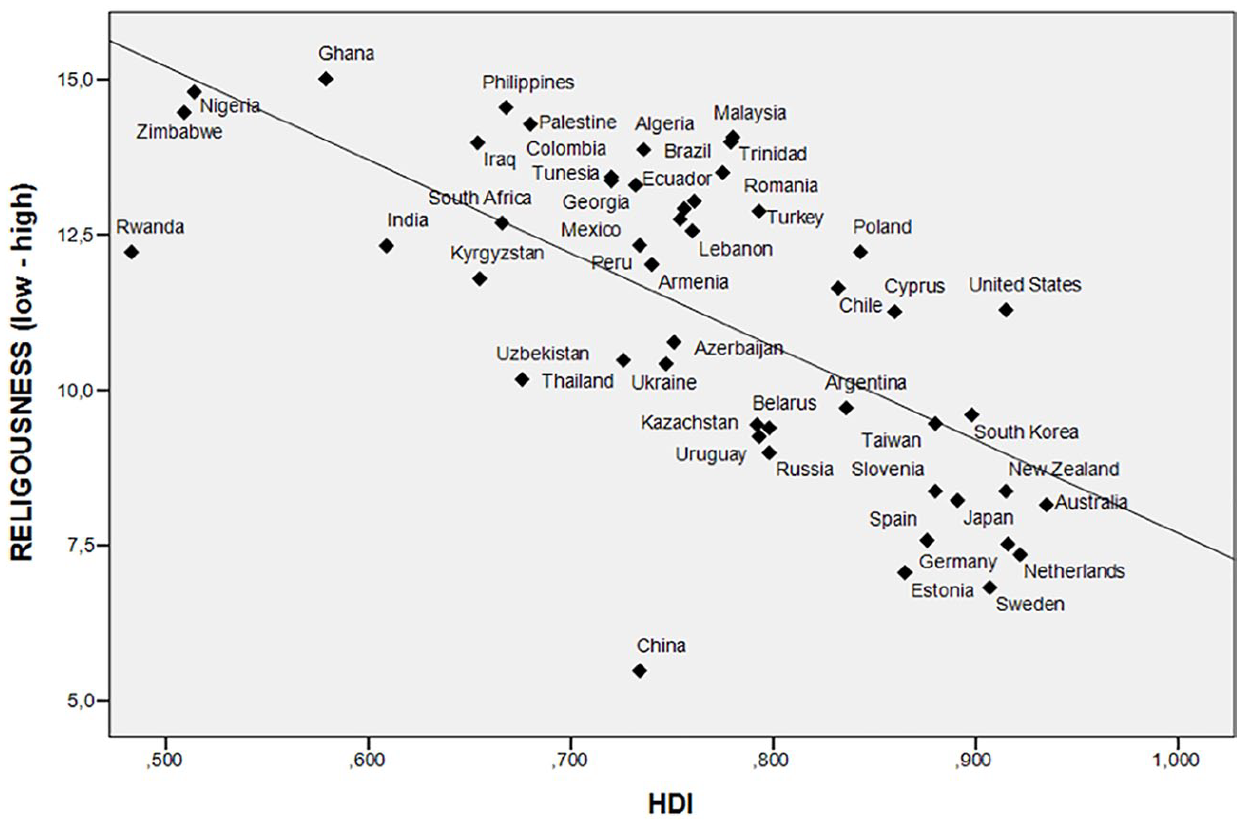
Human development and religiosity.
But, as various researchers have noted, there are serious problems with the Norris and Inglehart account of the insecurity–religion link.
First, the high correlation between insecurity and religiosity at the country level is strongly confounded with other variables that also correlate with religiosity, such as gross domestic product (GDP) per capita, urbanity, literacy rate, educational attainment, and access to mass media (Pew, 2018: 33ff.). This point, already noted by Norris and Inglehart (2012[2004]: 62), means that the data permit various other interpretations besides the insecurity explanation – for example, secularization could be caused by increased education and critical thinking, and not by reduced insecurity. 7
Second, if Norris and Inglehart were right, we should find the link between insecurity or vulnerability and religiosity not only between countries but also within countries, and in longitudinal studies. When we turn to such studies, however, the results become mixed, and, even when positive evidence for the theory is found, the effect sizes remain small and can in no way account for the country differences. 8 The study by Höllinger and Muckenhuber (2019), which used WVS data from the sixth wave (2010–2014) in 49 countries, is very instructive in this regard. The authors show that individual religiosity is very largely explained by the country in which the individuals live, and very negligibly by their individual feelings of existential insecurity. Only two of the five dimensions of individual existential insecurity (loss of a partner and material deprivation) increase religiosity significantly, and the effect sizes are tiny. Using European Values Study (EVS) data, Molteni (2017) comes to a very similar result.
It is still an open question as to why the correlation between existential insecurity and religiosity is so strong at the country level, but so weak at the individual level. Perhaps the relationship is mainly spurious. Another possibility that has not yet been given the attention that it deserves is that it is not so much individual existential security that influences the religiosity of individuals; rather, it is perceived existential insecurity in society as a whole, mediated by parental efforts at religious socialization. Thus, it might be that better living conditions do not have a direct effect on the religiosity of better-off adults; instead, these better living conditions simply make religious socialization a little more difficult for all parents of a society over a long period of time. This might have the effect that a whole society would slowly secularize (for more on this, see the ‘Conclusion’ section).
To sum up, there is ample evidence that individuals in countries with high existential insecurity are more religious than individuals in countries with low existential insecurity. There is much less certainty, however, as to whether (and, if so, how) the decrease in existential insecurity over time has led causally to secularization in various countries. Since the evidence is still mixed, we clearly need more research in this area.
Education
Authors of classical and neoclassical secularization theory already argued that science and education would eventually lead to the demise of religion. 9 According to Wilson (1978), for example, science is ‘largely incompatible with a belief that there are supernatural powers’ (p. 412). Insofar as education conveys scientific thinking (and not religious ideology), it therefore undermines religiosity.
This idea was not very prominent in the contentious phase of the secularization debate. The relatively few claims that were made often followed the fault lines of the competing paradigms – proponents of secularization thought that education tended to depress religion (Wilson, 1982: 174), while rational-choice scholars downplayed the effect of education or even claimed that there was a positive correlation between the two (Iannaccone, 1998: 1470). Findings still tend to be inconsistent today. 10 Clearly, what we face in this area is a problem of endogeneity. There seem to exist various, and partly conflicting, mechanisms that confound the relationship between education and religiosity. 11
Here, significant progress has been made in at least two areas. First, we now have a clearer view of the big picture. It is clear on a worldwide scale that countries with a high aggregate of educational achievement are much less religious than countries with a low aggregate, the former having lower percentages of prayer, attendance at religious service, importance of religion, but higher percentages of ‘nones’ (Norris and Inglehart, 2012[2004]: 70; Pew, 2016: 70). Just as with the insecurity measures, however, education is confounded with all kinds of other measures of modernization, and while there are large education-religiosity differences between countries, the effects inside countries are minor and contradictory.
Another area of progress involves natural experiments that are better able to estimate the causal effect of education. Hungerman (2014) and Dilmaghani (2019) have studied changes in compulsory schooling in Canada, where the compulsory school-leaving age was raised from 15 to 16, 17, or 18 years of age in different provinces between 1980 and 2001. These reforms can be seen as social experiments in which a randomly assigned treatment group with more years of schooling can be compared to a control group with fewer years of schooling. Compulsory school-leaving age can then be used as an instrumental variable in a two-stage least squares (2SLS) regression to estimate the causal, that is, non-confounded, effect of education on religiosity. Mocan and Pogorelova (2014) have used the same methodology in a study comprising 14 European countries.
The results of these studies are very clear, and they are bad news for religion: education does indeed have a significantly negative effect on religious belonging, religious belief, and attendance at religious service.
Figure 2 shows cohort educational attainment (the full line) and non-religiosity (the dotted line) in Quebec for people turning 14 seven years before and seven years after the raising of the school-leaving age from 14 to 15 in 1961. The figure shows a clear jump in both educational attainment and non-religiosity for cohorts in precisely 1961, when the law changed. Hungerman estimates that a 1-year increase in educational attainment would lead to an approximately five-percentage point increase in non-religiosity (Hungerman, 2014: 57).
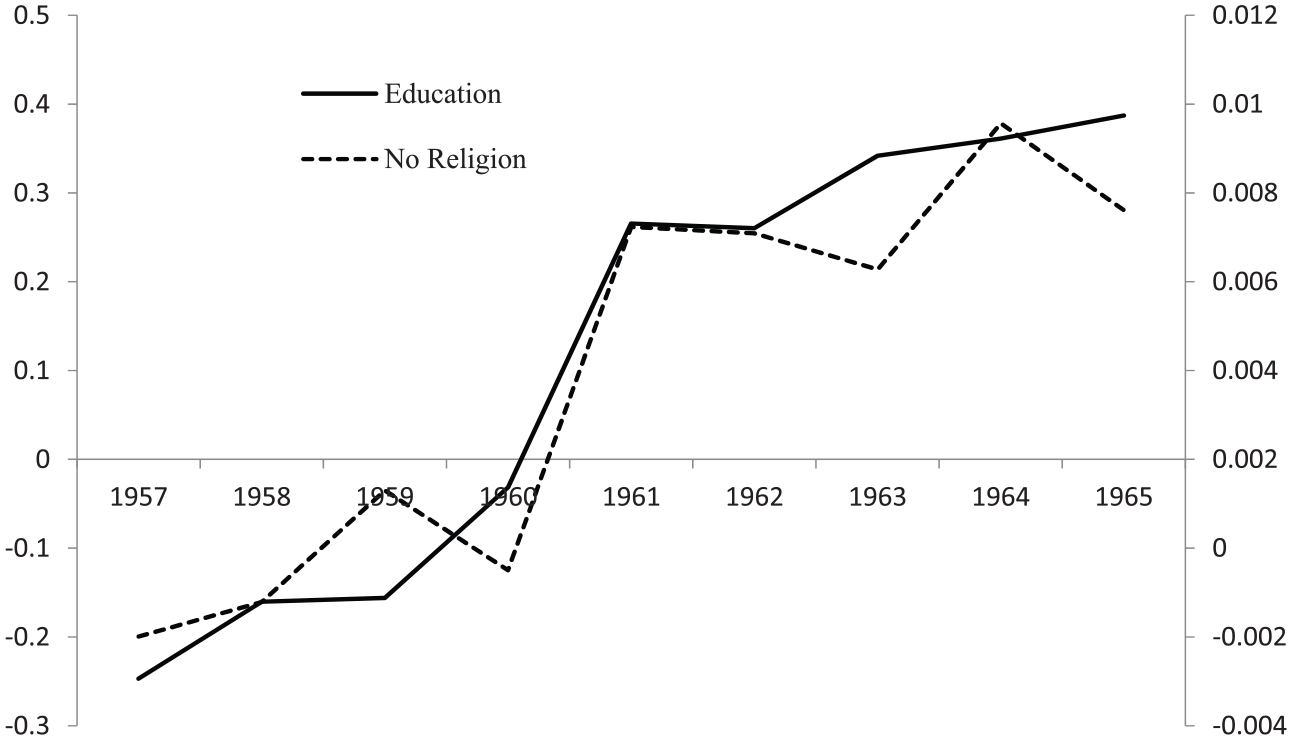
Predicted impact of raising school-leaving age from 14 to 15 in Quebec in 1961.
As the European study shows, years of education also have a negative effect on popular phenomena such as ‘believing in fortune-telling, horoscopes, or having faith in the powers of lucky charms’.
Important problems remain, however. As noted, education is hopelessly confounded with other variables in international comparative research, and we do not know what the relative importance of education really is. Also, there is a clear problem of causal direction, since religiosity may also increase or suppress educational aspirations. The field of experimental research has largely solved this problem, but there still remains the issue that the findings are of limited socio-historical generality. Educational reforms are rare and bound to specific socio-historical contexts, and it is not at all clear whether the effect sizes found in these studies can be carried over to other contexts.
Socialization
In the contentious phase of secularization research, scholars were not unaware of the importance of religious socialization as a predictor of adult religiosity. Nevertheless, socialization only played a secondary role in the theorizing of the main paradigms. In the orthodox secularization model, Bruce (1990, 2002: 99) argued that, once a religion had been weakened by modernization, it was doomed to disappear because diffuse ideologies are very difficult to transmit to the following generations. In the rational-choice approach, Iannaccone (1990) used the concept of religious human capital to account for correlations between the religiosity of parents and children.
Research in the last 20 years or so has highlighted the importance of parental socialization and confirmed that it is the single most important predictor of adult religiosity (Bréchon, 2018; Crockett and Voas, 2006; Stolz, 2009; Thiessen and Wilkins-Laflamme, 2017; Voas and Storm, 2012).
Three important insights have been added. One, it has become clear that it is not just parental socialization that is important; the national religious context also plays an extremely important role in socialization. As Kelley and De Graaf (1997) and Pollack and Rosta (2017) have shown, individuals are much more likely to become religious themselves in highly religious countries than in predominantly secular countries, regardless of the religiosity of parents.
Two, declining religious socialization in families is due not just to decreasing parental effort, but also to children’s increasing resistance. This is because modern educational styles give children more freedom to have their say and to choose what they would like to do (Klingenberg and Sjö, 2019). One of many parents in a study by Stolz et al. (2016: 163) said that, while she would have liked her children to go to confirmation class, they themselves preferred to go ‘dancing or swimming’ (and were allowed to do so).
Finally, various researchers have shown that declining religiosity among the populations of Western countries mainly occurs through the replacement of cohorts. 12 Since at least 1900, every generation has been a little less religious than the previous one. Figure 3 shows this for Great Britain, but Voas and Chaves (2016) have demonstrated that the same applies to the United States, Australia, New Zealand, and Canada. The same phenomenon has been shown to exist in various other Western countries, and it can also be observed in families with a migration background (Maliepaard and Lubbers, 2013). This means that the decline of religiosity in Western countries is due not to the loss of faith by individuals, but to the replacement of more religious cohorts by more secular ones. 13
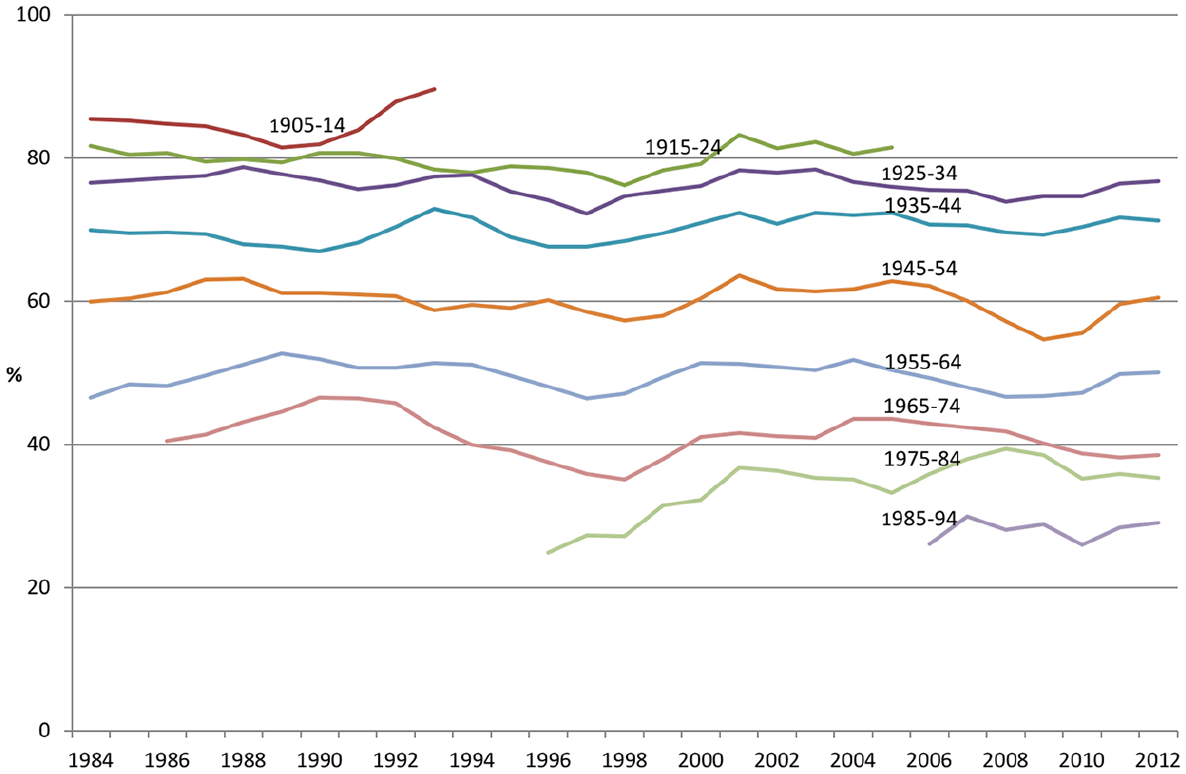
Attendance at religious service by birth cohort, Great Britain, 1984-2012.
While these advances in research are significant, they also create new problems. First, we do not know why it is that people tend to adopt their level of religiosity only in childhood and adolescence. Why are children and adolescents so open to learning about supernatural agents, and why do they not change their religious views in the face of, say, crises or modernization in later life? Nor do we know at what age secularization has its strongest effect exactly – is it children, teenagers, or young adults who are most affected?
Second, we ignore the specific causes that lead every later cohort to be less religious than the previous one. What do children and adolescents experience that makes them less religious than the preceding generation? It is probably the socialization that children receive from a combination of parents, school, and the larger social environment. But how exactly do these three structures work together and how are they in turn influenced by more distant causes such as state regulation and pluralism? In a way, the finding that the decline of religion is predominantly a cohort effect only shifts the problem one step further, since we now have to investigate what has a secularizing effect on parents, children, and teenagers.
Secular transition
One of the most important developments in secularization research in the last 20 years is Voas’ notion of secular transition (2008, 2009).
According to Voas, Western – and perhaps all – countries undergo a ‘secular transition’ much like the demographic transition in the course of modernization. In a nutshell, the ideal-typical model claims the following. Assume three types of people: religious, ‘fuzzy’ (i.e. moderately religious), and secular. Almost everybody starts out highly religious. Because of modernization, some individuals lack religious socialization. While many children of religious parents will also be religious, some will turn out only moderately religious (or ‘fuzzy’). When these ‘fuzzy’ people socialize their children, most of the latter will turn out fuzzy, but some will also turn out secular. Over several generations (assuming that the religious socialization of children remains difficult) this will have the effect that fuzzy fidelity will rise and then fall over time, until a majority of the population are secular. The overall process takes about 200 years.
Note that Voas’ model makes very strong assumptions: all countries are thought to take exactly the same trajectory, at the same speed, and in the same functional form. The only thing that differentiates them is the point in time when the country embarks on the transition.
Using European Social Survey (ESS) data from 2002, Voas showed that 22 Western countries fit the model. Figure 4 shows for five European countries and for the United States the percentages of religious, fuzzy, and secular according to birth year on a theoretical time axis. For example, for Greece, we can see that the cohort born in the 1920s (the points to the left) consisted almost entirely of religious people, and almost no fuzzy or secular people. The cohort born in the 1980s, however (the points to the right), consisted of a little more than 60% religious people, more than 30% fuzzy people, but still hardly any secular people. In contrast, the Czech Republic has far fewer religious people, and many more fuzzy and secular people – but, as in Greece, younger people are more secular than older people.
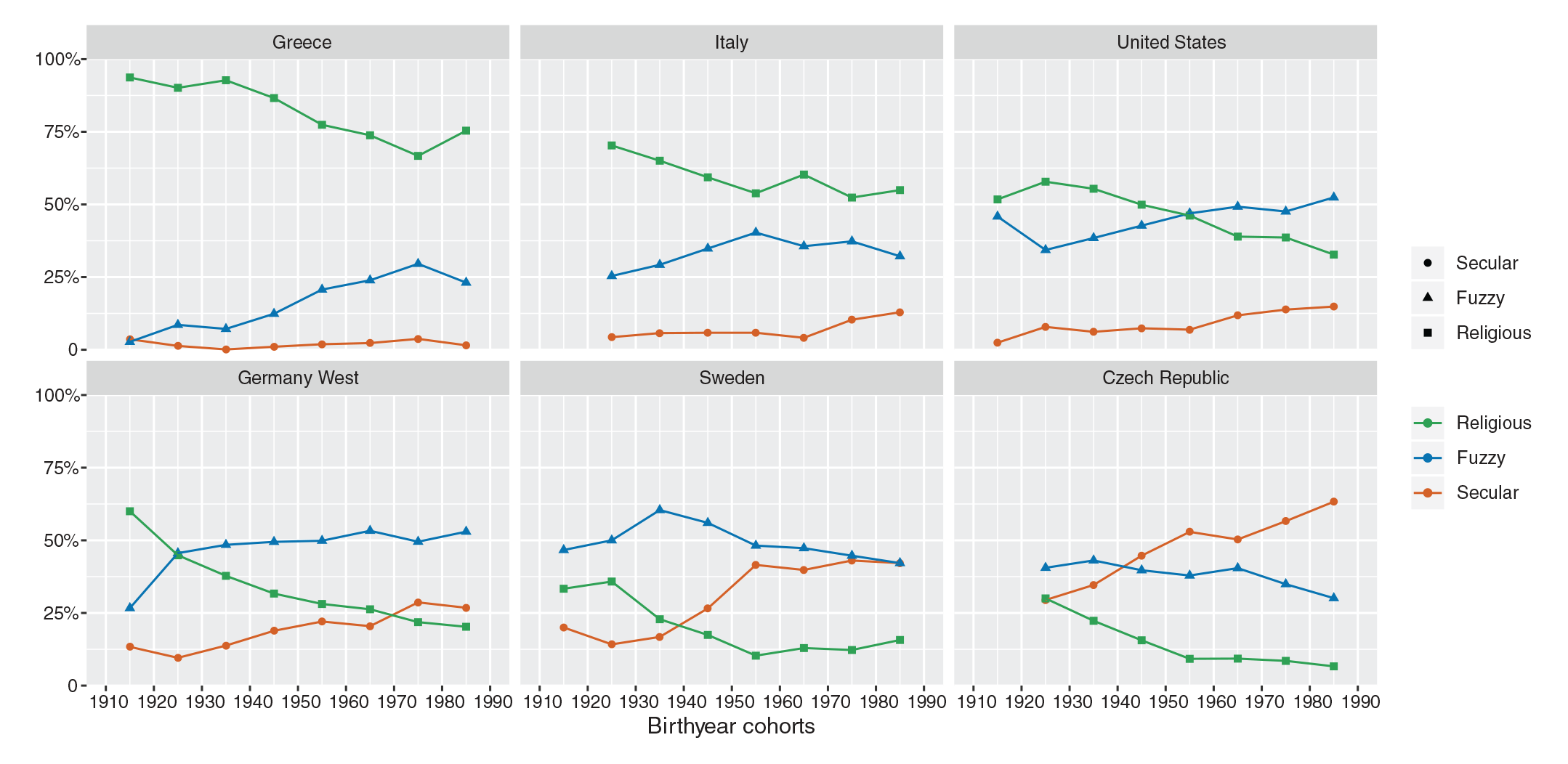
Percentages of ‘religious’, ‘fuzzy’, and ‘secular’ by date of birth in Greece, Italy, the United States, Germany West, Sweden, and the Czech Republic.
Voas’ simple but ingenious idea was to imagine that what we see in all these six pictures is basically the same transition, only at different points in time. We would thus just shift these pictures around and obtain one overall model on a theoretical time axis in Figure 5, in which we can clearly see how the percentage of ‘religious’ declines, the percentage of ‘fuzzy’ rises and falls, and the percentage of ‘secular’ rises over a period of 200 years.
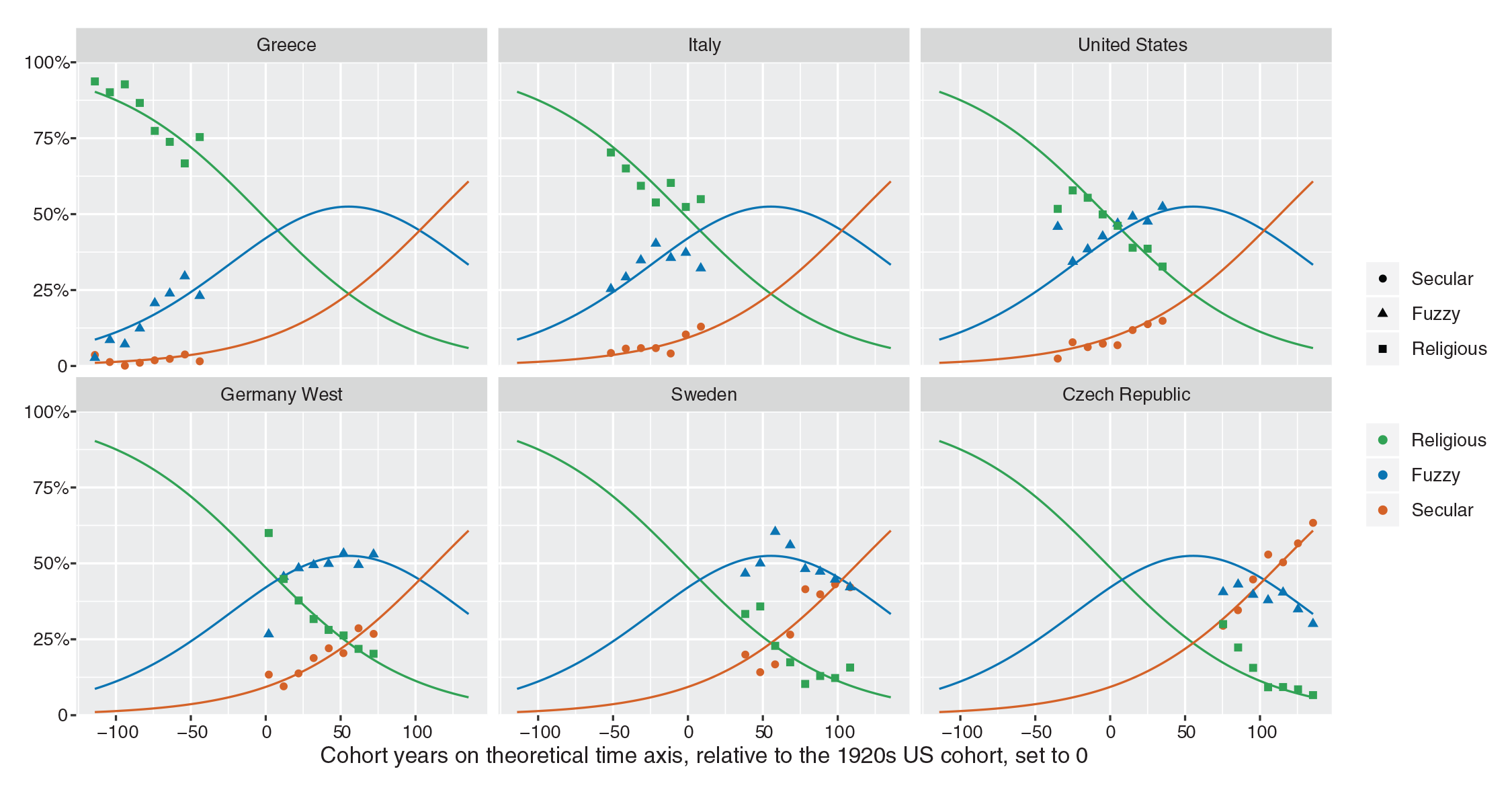
The percentages of ‘religious’, ‘fuzzy’, and ‘secular’ by date of birth in Greece, Italy, the United States, Germany West, Sweden, and the Czech Republic, shifted on a theoretical time axis to fit the Voas model.
This means that Greece finds itself at the beginning of the secular transition, while the Czech Republic is close to the end of the process. Both countries do the very same thing, the small but important difference being that Greece is some 150 years behind.
Note that not all countries behave exactly as the model expects, with the French, for example, stepping out of line somewhat. President Macron will no doubt be interested to know that the French not only protest with yellow vests on the streets of Paris, they also, as a country, refuse to behave as the Voas model expects them to.
You may wonder: Can this model be true? Isn’t this all too simple and beautiful? Well, the most important independent test was published recently by Brauer (2018) in the JSSR, and it gives the model resounding approval (as Figure 5 again shows). Brauer demonstrates that the United States conforms almost exactly to the model’s predictions. In fact, the United States is somewhere in the middle of the process, behind Austria, but in front of Finland.
However, not all tests are positive. In a replication that focuses on the German case, Stolz et al. (2020) show that, while West Germany fits the model very well, East Germany does not, the latter witnessing a strongly accelerated and qualitatively different secular transition. What this means is that the secular transition can be strongly influenced by external shocks.
Quite obviously, the Voas model needs more testing to see whether it holds up when confronted not only with cross-sectional but also with longitudinal, data, and to gauge the extent to which it can be generalized to other countries outside Europe and the United States. But, even should such tests prove positive for the model, there are additional problems to be solved.
First, recall that, according to the model, the only variable that differentiates countries is the point in time when a country embarks on the transition. This begs the question: why and when does a country do so? What are the triggers? No satisfactory answer has been given so far.
Second, if we acknowledge that there are exceptions to the model such as East Germany, then just what are the boundary conditions of the model? In other words, under what socio-historical conditions will countries behave according to the model – and when will they deviate?
Third, literature on the ‘religious crisis of the 1960s’ poses a particular question of the model. Prominent authors have argued that the 1960s were a time of very strong secularization in Western countries (Brown, 2001; McLeod, 2007; Putnam and Campbell, 2010). The Voas model, however, claims that religious decline is a continuous, long-term process. Is one side of the argument right, or might the two sides be combined by showing, say, that a long-term process, as proposed by Voas, includes a short-term (period or cohort) effect in the 1960s?
Fourth, if we acknowledge that alternative spirituality is an important part of the current religious field (Cipriani, 2017; Giordan, 2007; Knoblauch, 2008; Woodhead, 2007), then to what extent can this phenomenon be integrated into the model of secular transition? Is it to be seen as just a different kind of ‘fuzzy fidelity’ that emerges in the course of the secular transition, only to be replaced, eventually, by secularity (De Graaf and Te Grotenhuis, 2008)?
Secular competition
A fifth development may be subsumed under the title secular competition. The idea that secular alternatives might compete with religion in various domains can be traced back at least to the authors of the Enlightenment. Neoclassical authors like Wilson (1966) and Parsons (1984) described how functional differentiation leads to the emergence of secular alternatives to religion, and how religion then loses more and more societal functions. The importance of secular competition was somewhat forgotten in what I have called the contentious phase of secularization research, probably because the rational-choice theorists were so strongly focused on intra-religious competition.
It is only since the beginning of the new millennium that the idea of secular competition has been theorized and a significant number of studies have investigated the idea as an approach in its own right. The approach claims that religious groups compete not so much with each other as with non-religious competitors, the latter putting the religious domain under pressure by force of innovation (Abbott, 1988; Bourdieu, 1987; Stolz, 2009a, 2009b; Stolz and Tanner, 2017). The key idea here is that religions create goods that are both transcendent (e.g. the promise of eternal life) and immanent (e.g. social capital). While they have by definition a monopoly on the former, religions have to compete with secular providers when it comes to the latter. Thus, religions provide social capital, but so do secular clubs; religions provide social welfare, but so does the welfare state; religious specialists provide counselling and support, but this domain has also been invaded by psychotherapists and life coaches.
Probably the most well-known study on secular competition was carried out by Gill and Lundsgaarde (2004), who showed in a cross-sectional study for 27 countries that welfare spending by the state is negatively correlated with religious participation. 14 Similarly, Gruber and Hungerman (2008) have demonstrated that, when ‘blue laws’ were abolished in the United States at different times during the twentieth century, there was a significant decrease in attendance at religious service in Christian churches. In other important studies on secular competitors that are able to crowd out religious practice, Hirschle (2010, 2011) has identified leisure opportunities; Iannaccone and Everton (2004), good weather; Cragun et al. (2015), American football; and Storm (2017a), income.
Interestingly, religious group leaders have a strong awareness of secular competition (McMullin, 2013). Using NCLS data, Figure 6 shows how pastors in different Christian congregations in Australia see themselves in competition not so much with other congregations as with secular activities and worldly attitudes (Stolz and Tanner, 2017); it is not charismatic competition that keeps pastors awake at night, but thoughts of the mall and the movies. 15
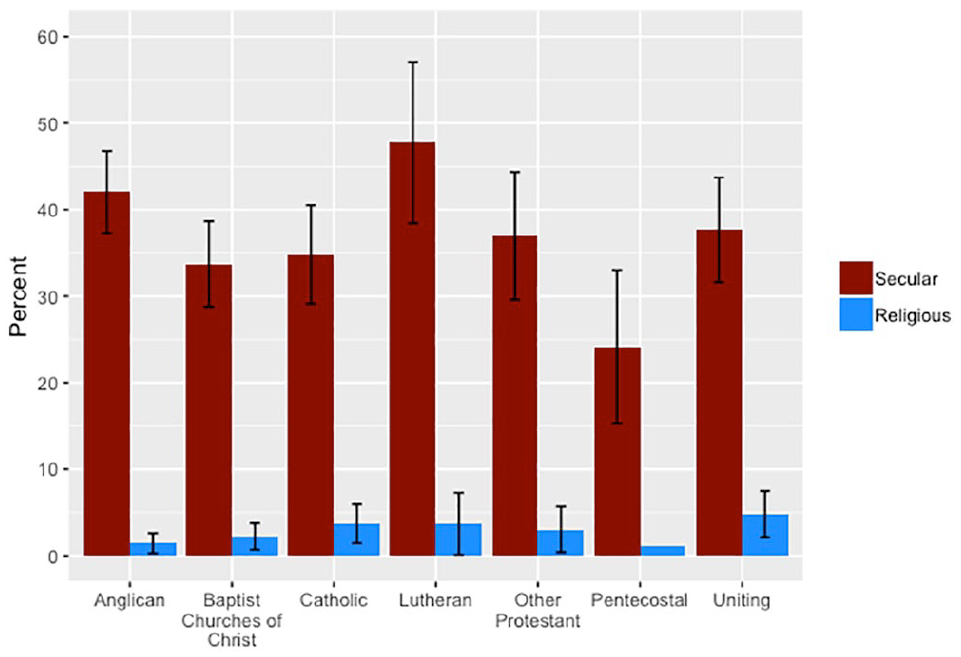
How pastors perceive religious and secular competition in Australia.
Yet, important problems remain here, too. First, there seem to be many secular competitors, and it remains unclear whether some are more important than others. Echoing an Eminem song, one would like to have the real secular competitor please stand up. Also, we would like to know how, if at all, these secular competitors work together to crowd out religion. Second, many studies on secular competitors suffer from problems of possible omitted-variable bias (a form of endogeneity). For example, if an association is found between an increase in the number of psychotherapists and a decrease in the number of pastors in counselling (Abbott, 1988: 100), then it is unclear whether the former has caused the latter or whether the association is a result of an unmeasured variable (e.g. declining birth rates in religious groups; social policy upgrading the profession of psychotherapy). The third problem is possible reverse causality: it is not always easy to distinguish between a situation where new secular competition crowds out the religious alternative and a situation where the decline of the religious alternative creates the condition for the development of a secular alternative. The fourth problem is the relationship that secular competition has with the socialization/secular-transition approach. If secular competition really is so important, then why do people not become less religious over the course of their lives? One answer might be that the importance of secular competition in democratic societies is mediated through socialization (Stolz et al., 2016: 161ff.).
Pluralism
In the phase of neoclassical secularization, and especially as a result of the work of Peter Berger (1990[1967]), pluralism was already thought to be one of the most important factors leading to secularization, since it undermined the plausibility of religion and eroded norms prescribing religion. I am using the term ‘pluralism’ here to denote religious diversity and not in any other possible senses, such as the ideology promoting such diversity (Beckford, 2014).
However, it was in the contentious phase of research on secularization that the question of the effect of pluralism on religious vitality took centre stage and dominated for more than a decade. In a bold move, rational-choice theorists attacked neoclassical secularization theorists, claiming that the latter had it all wrong. Religious pluralism, they said, did not depress religious vitality, but actually strengthened it, since pluralism led to more competition between groups, to better products, and to a higher probability that believers would find a religion that met their preferences (Finke and Iannaccone, 1993; Finke and Stark, 1988; Iannaccone, 1991; Stark and Finke, 2000).
The heated debate that ensued led to a flood of empirical papers, almost all of which used the inverse of the Herfindahl Index to measure religious pluralism. Thus, in an overview of the research that had been conducted on the correlation between religious pluralism and religious vitality, Chaves and Gorski (2001) counted 193 tests in 26 published articles and found mixed results (albeit an overrepresentation of negative correlations). Then, the discussion came to an abrupt end. Why? Well, an article by Voas et al. (2002) showed that correlations in cross-sectional studies between the pluralism index and religiosity were for simple mathematical reasons largely non-substantive, that is, not causal. This article had an effect similar to when parents come home unexpectedly early to find their teenage children having a party in their house: everything ended in general embarrassment, and scholars had to go back to the drawing board – they still did not know what effect pluralism had on religiosity.
Interestingly, though, significant progress has been made in this issue since the millennium, with scholars having found a way to circumvent the problem of non-substantive correlations when using the pluralism index. The method, which Voas et al. (2002) proposed, consists in using longitudinal data and examining how religious pluralism in time t1 influences religious participation in time t2 in a given area – while also controlling for past participation rates. Koçak and Carroll (2008) conducted such a study on rates of church adherence in US cities at the turn of the twentieth century and found that pluralism had a negative effect on rates of church adherence. Similarly, in perhaps the most thorough study yet to use the Religious Congregations and Membership Study (RCMS) for 1980, 1990, 2000, and 2010, Olson et al. (2020[forthcoming]) have found a significantly negative effect of religious pluralism on rates of church adherence in US counties, thereby providing new evidence concerning the effect of pluralism on religiosity that strongly favours the secularization over the rational-choice account.
New problems arise again, however. For, we would now like to know what the mechanisms are that pluralism actually works through. A study by Olson and Perl (2011) on the effect that the religious composition of geographical areas has on the religious composition of a person’s close friends took one step forward, the study showing that pluralism influences individuals because a pluralistic environment increases the likelihood that a given individual will have a close friend who belongs to a different religion or who has no religion at all. Thus, as Figure 7 shows, the greater the proportion of the population that belong to a different religion, the greater the likelihood is that an individual will have a close friend that belongs to that different religion. Pluralistic social environments, then, are not just perceived in the abstract; rather, they ‘impinge’ upon individuals through significant others and may thereby depress religiosity.
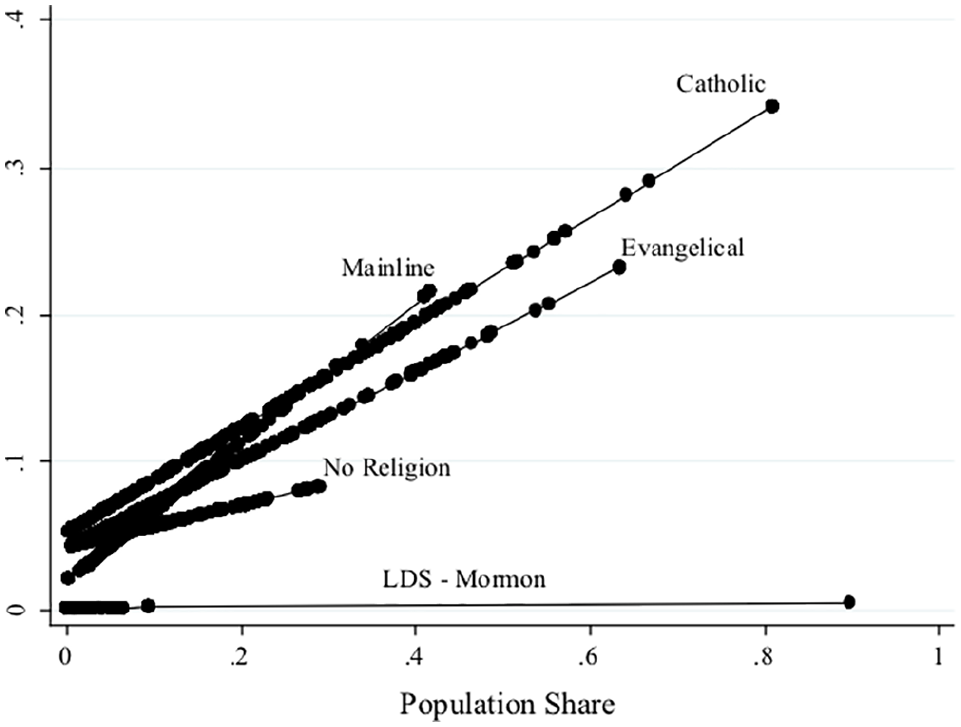
Predicted proportion of close friends belonging to a different religion, based on proportion of population that belong to that different religion.
There must of course be other ways that pluralism ‘impinges’ upon individuals, and we will need a whole series of studies to understand more clearly how the different mechanisms interact with each other.
Regulation
Perhaps the most important claim made by the rational-choice paradigm during the contentious phase of secularization theory was that competition between religions leads to more and qualitatively better religious supply and to a higher level of religiosity on average. As already noted, the studies in this paradigm first of all used pluralism (or: diversity) as a proxy for competition and measured pluralism with the Herfindahl index. When it became clear that doing so was problematical (see discussion on pluralism above), several scholars began using state regulation as an alternative measure of religious competition.
Theoretically, government regulation may both suppress and encourage individual religiosity (Chaves and Cann, 1992; Fox and Tabory, 2008; Iannaccone, 1991; Portier, 2016). It may suppress religiosity by (1) restricting the religions on offer, thereby leading some individuals to refrain from ‘entering the market’ because they cannot find a religion to their liking; (2) creating a situation in which religious monopolists provide religious goods that are less interesting; and (3) hindering or even banning certain religious groups and practices. On the other hand, it may also encourage individual religiosity by (1) prescribing religious belief and practice; (2) incentivizing religious belief and practice by granting certain additional social benefits to those who conform to the norms; and (3) providing a homogeneous belief structure that makes belief easier.
Research on the effect of state regulation on religiosity has produced mixed and somewhat unstable results, however. Some studies have found that regulation has negative effects on religiosity (Chaves and Cann, 1992; North and Gwin, 2004); others, that regulation has no or even positive effects (McCleary and Barro, 2006; Norris and Inglehart, 2012[2004]). A case study on Switzerland that exploits the fact that the degree of religious regulation differs between Swiss cantons has conducted a historical investigation of the link between regulation and religiosity. It finds absolutely no effect of government regulation at the congregational or individual level whatsoever (Stolz, 2018; Stolz and Chaves, 2017). The study by Fox and Tabory (2008), which uses the most sophisticated measurement of government involvement in religion, finds ‘qualified support for the argument that government involvement in religion (GIR) is associated with lower levels of religiosity’. The ‘qualified’ is important, because they find negative effects in only 14 of 72 regressions, and only in religious practice and not in belief. Moreover, even where there are positive effects on religious practice, these effects sometimes depend on how the dependent variable is coded. Interestingly, they find that other variables – such as GDP per capita, religious tradition, and whether the country had a communist past – explain much more of the variance in religiosity than government involvement.
Clearly, more research is needed, but two results seem to be unequivocal. First, government regulation is overall not the most important driver of secularization, at least not through the mechanism of stifled competition that sees the establishment of some religions and not others. In addition, reducing government regulation does not seem to lead to religious revival, which clearly disproves the claim made by rational-choice/economics-of-religion theory that dominated discussion during the contentious phase of secularization research.
Second, government policies may have very important secularizing effects on religiosity when states crack down on religions in various ways, which can be seen in the fact that post-communist countries are significantly less religious than countries not subjected to ‘communist treatment’ (Fox and Tabory, 2008; Froese and Pfaff, 2005; Meulemann, 2004; Pollack, 2003). To give just one example of how a government crackdown on religion was able to hamper religion, we can point to Figure 8, which shows the ‘natural experiment’ conducted in Germany after 1949 (Stolz et al., 2020). Here, the socialist regime’s crackdown in East Germany led parents to desist from having their children confirmed, and to their sending them instead to the non-religious Jugendweihe (which was sanctioned by the state). There is no ‘causality issue’ here: it is evident both historically and statistically that it was state policy that made confirmation (and all other indicators of religiosity) fall extremely rapidly in a very short space of time (Froese and Pfaff, 2005).
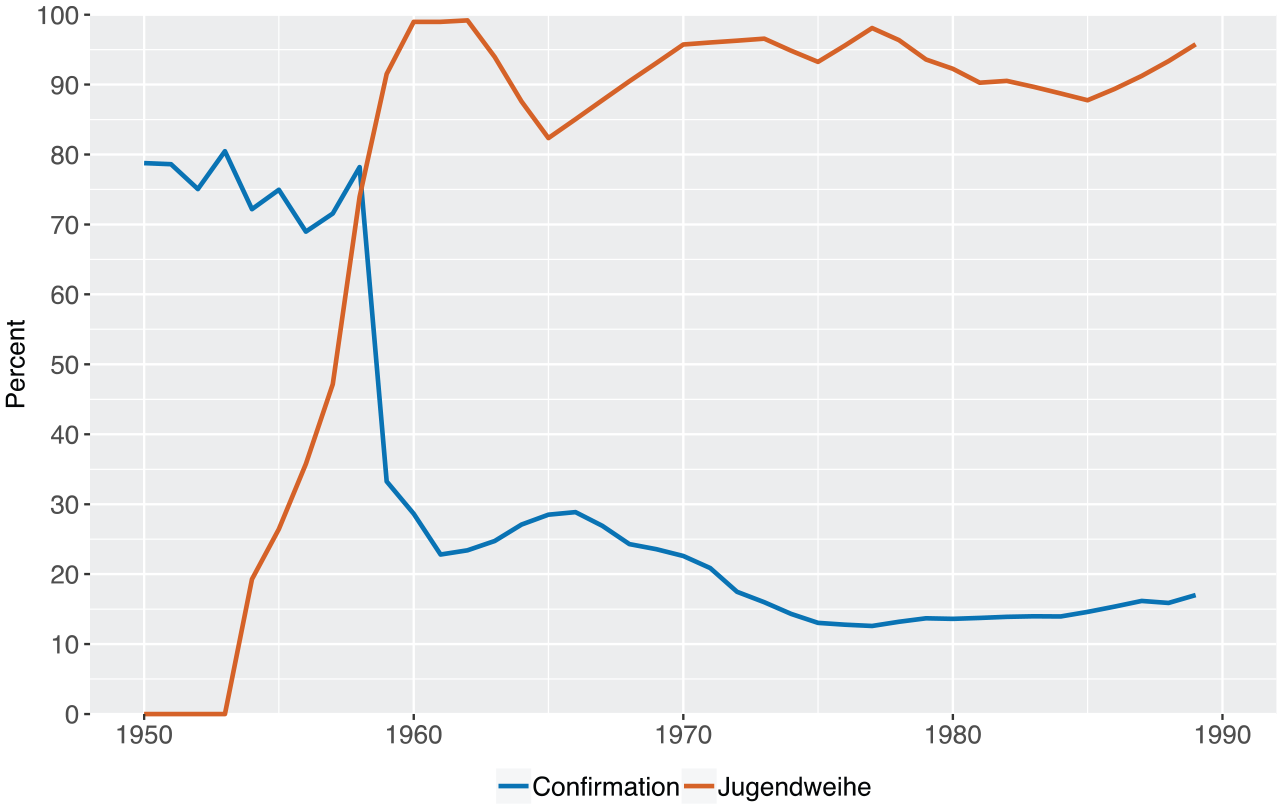
Confirmation and Jugendweihe in East Germany, 1950–1990.
A central problem in this literature on the link between regulation and religiosity, however, is that the results are still mixed, despite obvious advances in how GIR is measured. This suggests that there must be confounding variables determining whether, say, government favouritism leads to more or less aggregate religiosity that have not yet been measured. One solution may be to make more use of natural experiments (as in the East Germany example), since they allow causality claims to be made more easily. Another possibility might be to analyse the data with more attention to possible interactions between context variables and government regulation, and to their effects on religiosity.
Conclusion
In retrospect, research on secularization has yielded an astonishing number of new insights in the last 20 years, and I am happy to say that International Society for the Sociology of Religion (ISSR) members have made a significant contribution to these insights.
While discussion in the 1960s and 1970s was still primarily theoretical in orientation, revolving as it did around defining and applying various abstract concepts such as differentiation, rationalization, and societalization, research on secularization already began testing theories in the contentious phase, and has done so increasingly in the last 20 years (De Graaf, 2013; Meulemann, 2017).
Remarkably, much of the progress has to do not so much with abstract theorizing, but with specific new ideas, new methods, and more and better (and mostly cross-national) data.
I won’t summarize all the insights and problems I have mentioned. But I cannot resist suggesting that perhaps some of the solutions for some problems lie in a combination of the different approaches. A synthesis of the various new insights might look like the following (see Figure 9).
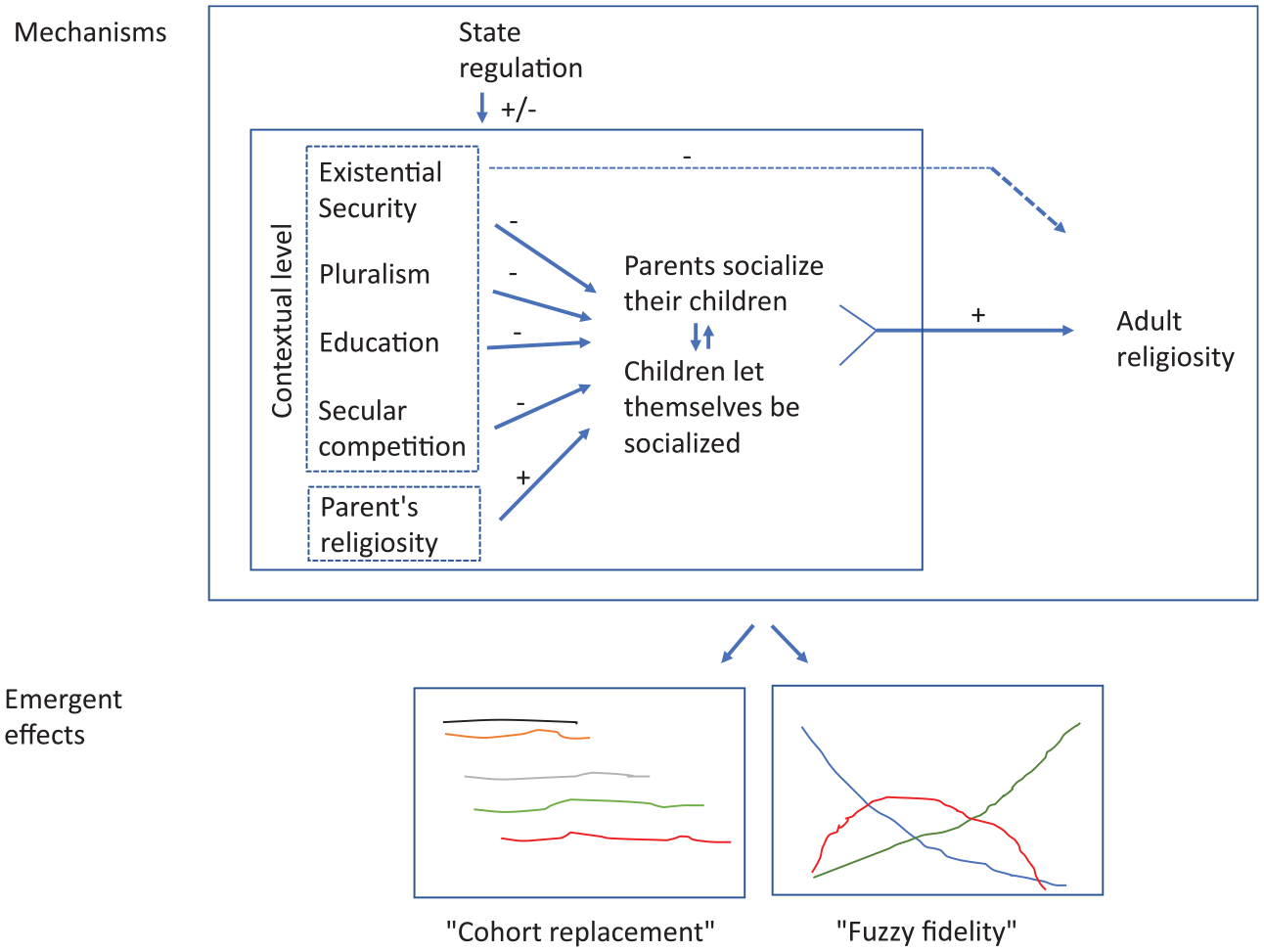
A synthesis.
Religion seems to be strongly social: not so much a tangible product (like a car); more a language spoken with others. It is a symbolic language that helps people interpret and deal with human problems, and that only works when it is used among a group of people. This explains why there are strong correlations between many variables such as income, education, security, and so on and religiosity at the country, but not the individual, level. Whole societies, groups, and cohorts are more or less religious depending on whether the religious language is spoken among members or not. This also explains the pervasive unidirectionality of the secularization process. Once a host of secular alternatives and interpretational frameworks are in place, it is very difficult to return to an all-encompassing religious language that (almost) everyone uses.
Modernization is a process that leads to more existential security, more education, more pluralism, and more secular competition. This has the effect that parents, schools, and society overall teach the religious language to every new generation with decreasing intensity. It remains true that religious parents socialize their children more religiously than secular parents, but the course of modernization means that parents and schools throughout society have fewer incentives to teach religion, and find it increasingly more difficult to do so. In addition, children find it less and less attractive to be socialized religiously: they resist what to many of them is unimportant, untrue, and (perhaps most importantly) uncool. Figure 9 indicates with a dotted arrow that the contextual factors of existential security, pluralism, education, and secular competition might influence adult religiosity not only indirectly but also directly, yet this is clearly only a secondary way of hypothesized influence.
This leads to emergent effects that can be described in one of two ways. Either as a successive replacement of more religious cohorts by more secular ones. Or as a fall in the percentage of religious people, a rise and then fall in the percentage of ‘fuzzy’ people, and a rise in the percentage of secular people. In the secular transition, this is a process that typically influences men earlier than women, since men tend to be exposed to modernizing influences earlier than women. The process also affects urban areas earlier than rural areas, since it is in urban areas that modernization begins. Alternative spirituality may be a form of intermediate religiosity that also adopts ever more secular forms.
Finally, the secular transition is not a sociological law; therefore, policy matters. States can have a strong influence on secularization, either by accelerating or by decelerating it, and sometimes even by reversing it temporarily. If they follow the Western path of modernization, however, their policy decisions on religion seem to matter little; secularization simply takes its course.
This synthesis is not that different from the neoclassical version of secularization theory – but its mechanisms are better spelt out and many of its elements have been tested empirically.
These final comments are just a short summary and not a worked-through theory, but they may help when focusing our future research endeavours. As I have pointed out, there remain numerous and significant problems in research on secularization, and new problems have arisen. An obvious shortcoming is that much of our quantitative data are relatively recent and predominantly concerned with Western societies and the Christian religion. We clearly still lack a model that can be applied across the world, as becomes evident when we look, for example, at developments in countries with Muslim majorities. At the same time, however, we have undoubtedly made significant progress in the past 20 years, and we can expect to continue to do so in the future.
Footnotes
Acknowledgements
I thank Simon Brauer, Mark Chaves, Nan Dirk De Graaf, Conrad Hackett, Franz Höllinger, Anaïd Lindemann, Detlef Pollack, Pascal Tanner, and David Voas for their valuable comments. I thank Franz Höllinger, Daniel M. Hungerman, Simon Brauer, Daniel V.A. Olson, and David Voas for providing me with their figures. David West corrected the English. An earlier version appeared in  . The present text is a completely rewritten and extended version.
Author’s note
This article is an extended version of the presidential address that the author gave on 4 July 2019 at the ISSR conference in Barcelona.
Funding
The author(s) received no financial support for the research, authorship, and/or publication of this article.
Notes
Author biography
Address: University of Lausanne, CH - 1015 Lausanne, Switzerland.
Email: