




Abstract
This article examines the ways in which the emergence of the Seoul Capital Area offered both opportunities and challenges to religious actors in modernizing South Korea. South Korea rebuilt itself from the ruins of the Korean War through an accelerated process of urbanization and industrialization in accordance with a state-led modernization drive. This process, in turn, led to an unprecedented population concentration in Seoul and its surrounding area, where new political and economic centers emerged side-by-side with slums and shantytowns. Amid this turbulent social change, some of today’s most well-known Protestant leaders – especially Pentecostal Cho Yong-gi and Calvinist Kim Chin-hong – joined the caravan of rural-to-urban migration and commenced their ministries in Seoul, adapting their religious messages and practices to address the social aspirations of the growing urban population. This article demonstrates that despite their shared concern for the problem of urban poverty, Cho Yong-gi and Kim Chin-hong faced successes and failures in different ways as they adopted ministerial programs of the gospel of prosperity and the theology of development, respectively.
Introduction
The notion of city occupies an ambivalent position in the sociology of religion. On the one hand, proponents of the secularization thesis have generally accepted the Tönniesian dichotomy between Gemeinschaft and Gesellschaft; the former rooted in the rural hinterlands and the latter prevalently found in the modern-urban environment (Burchardt and Becci, 2013). From this perspective, the process of urbanization leads to a disintegration of ‘community’ where members share traditional (often religious) norms and practices and, in its stead, gives rise to ‘society’ where individuals’ allegiance is directed toward a variety of values of their choosing. Thus, modern cities emerge as a primary site of secularization, as urban pluralism relativizes normative claims and promotes impersonal interactions. If religion manages to maintain its relevance at all, it would only do so as a kind of cultural commodity trafficked in a ‘market situation’ (Berger, 1967: 138).
On the other hand, the supply side economic school has picked up this very language of ‘market,’ but contends that such a competitive situation is the secret of religious liveliness in an urban environment (Finke and Stark, 1988; Iannaccone, 1992). From this perspective, religious entrepreneurs competing in the market of beliefs have no choice but to push themselves harder to draw more religious consumers into their folds. Cities, then, are hardly the graveyard of religion. Rather, they are more like a flourishing marketplace of religion, insofar as religious providers strive to develop cutting-edge religious goods and thereby increase the overall size of religious participation.
In recent years, the tide has turned against the secularization thesis (but not exactly in favor of the supply side economic theory), as increasing attention is paid to the global resurgence of religious fundamentalism and the proliferation of faith-based public engagement (Casanova, 1994). Yet when it comes to questions regarding the correlation between urban diversity and religious vitality, no conclusive consensus currently exists. Whereas some scholars report a positive correlation between urbanization and religious vitality (Finke and Stark, 1988; Koçak and Carroll, 2008), others find no significant difference in religious attendance in rural and urban environments (Breault, 1989; Voas et al., 2002). Still others find mixed results that defy an easy answer to the question at hand (Land et al., 1991). Further complicating the picture is the contemporary surge of New Atheism (Pasquale and Kosmin, 2013), as well as the persistent presence of ‘sacred umbrellas’ (Smith, 1998) or ‘archipelagos’ (Wilford, 2009) – smaller and more localized zones of religious vitality as compared with what Berger (1967) calls an all-encompassing ‘sacred canopy’– in various urban and suburban areas.
If there are mixed reports about religious vitality in urban spaces, perhaps it is time to stop arguing over a grand narrative and instead pay closer attention to how religious actors actually cope with the specific opportunities and challenges of urbanization. This article tries to shed light on this subject by tracking the ministerial careers of two Protestant pastors in South Korea, namely, Cho Yong-gi (David Yonggi Cho) of the Yŏido Full Gospel Church and Kim Chin-hong of the Turae Community Movement. These two religious leaders come from radically different theological and ecclesiastical backgrounds. Whereas Cho is a Pentecostal evangelist of the prosperity gospel, Kim is a Calvinist social reformer dedicated to ascetic-capitalist ideals. Despite their differences, both of their ministries, I argue, have centered upon offering faith-based solutions to urban poverty in the midst of postwar reconstruction and development in the wake of the Korean War (1950-1953). The aim of this article, then, is to compare the ways in which Cho Yong-gi and Kim Chin-hong have conducted evangelism and an anti-poverty offensive under the respective programs of the gospel of prosperity and the theology of development (Cooper, 2007).
Urbanization and religious change in modernizing South Korea
Beginning in the early 1960s, ‘development’ became one of the most discussed topics in international politics. With their nuclear forces and veto rights in the United Nations Security Council, the world powers were often at variance with one another while being locked in a precarious balance of power in the context of the Cold War. If they agreed on anything, it was that they should do something to better the social and economic conditions in the so-called ‘underdeveloped’ nations (Rist, 1997). After all, much of the Cold War ideological conflict revolved around the question of which of the two politico-economic systems – capitalism or communism – was more effective in ushering traditional-feudal societies into the modern stage of universal affluence and prosperity (Rostow, 1960). It was in this setting that, in 1961, the United Nations passed a resolution to designate the 1960s as the ‘decade of development.’
The Republic of Korea was no exception to this general trend of the time, especially after Gen. Park Chung-hee seized control of state power through a 1961 coup. Although it is now ranked among the economically advanced countries, the South Korea of the 1960s was still one of the poorest countries in the world, struggling to recover from the ruins of the Korean War (Kim, 1999). Thus, upon the success of the coup, the Park Chung-hee junta publicly made a promise to ‘ease the economic hardships of people suffering from despair and famine and concentrate all of [the state’s] energies to rebuild the nation’s self-reliant economy.’
What unfolded thereafter was a state-led, top-down modernization (Brazinsky, 2003; Kim, 2004). By mobilizing the entire state apparatus, the Park regime carried out a total restructuring of society through a series of Five-Year plans. This triggered an accelerated process of industrialization and urbanization that led to a dramatic increase in the urban-rural gap. Thus, beginning in the 1960s, millions of peasants left their rural hometowns and migrated to the metropolis of Seoul and its surrounding cities—collectively dubbed the Seoul Capital Area – in search of better opportunities (see Figure 1). The resulting urban concentration led to the proliferation of slums and squatter settlements in various quarters of Seoul, where a growing number of people practically lived hand-to-mouth on a daily basis (Kim, 1973). In other words, South Korea’s modernizing process seemed to come with much light, but not without its miserable shadows as well.
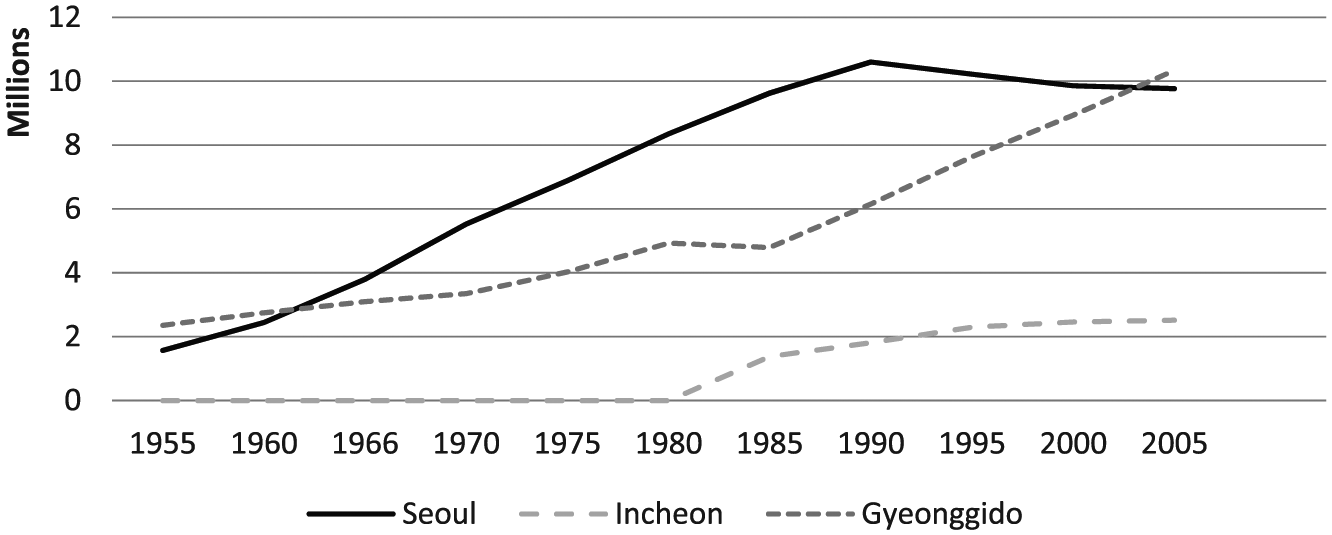
Population change in Seoul capital area (1955–2005).
As Figure 2 shows, the state-initiated social changes were an important historical backdrop to the explosive growth of Korean Protestantism – especially in the Seoul Capital Area – from the 1960s to the 1980s (Lee and Suh, 2017). Prompted by the increasing urban-rural gap, those who migrated to Seoul harbored a strong desire for upward social mobility. Moreover, many of them were severed from the close-knit ties of rural communities for the first time and therefore free to explore new religious options amid urban anomie (Han, 1986). To state it another way, the mission field of Seoul had plenty of ‘harvest’ ripe for the reaping by savvy religionists who could address the desires and anxieties of the growing urban population.
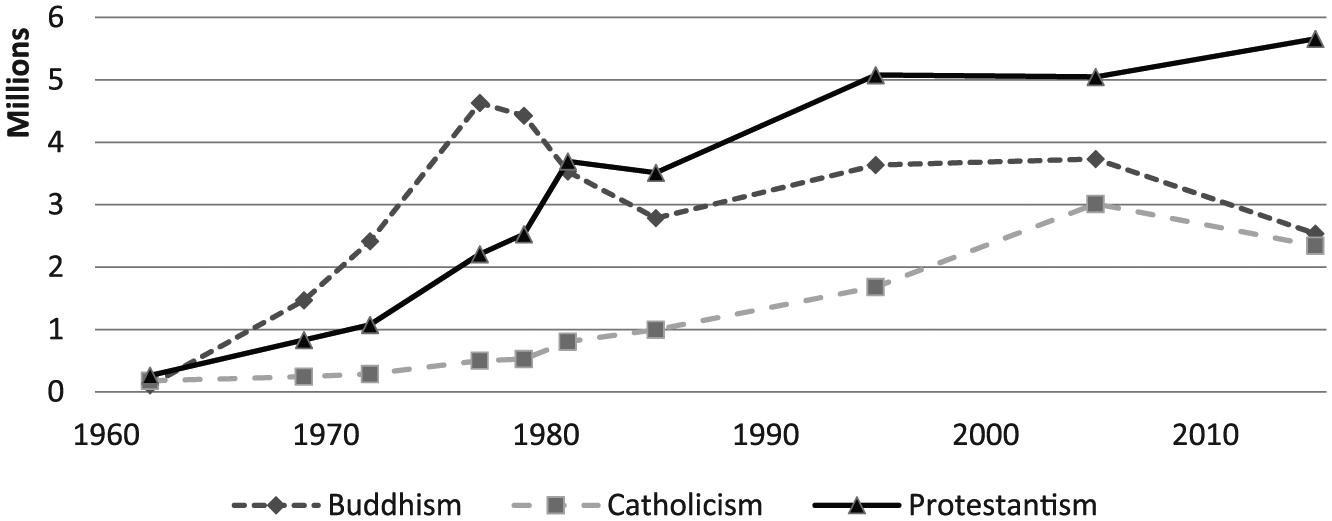
Religious change in Seoul capital area (1962–2015).
In this context, there were generally two types of Protestant response to the urban religious demands of the time. On the one hand, a group of conservative evangelicals who practiced what Paul Freston (2004) calls ‘ecclesiastical corporatism,’ took advantage of the state’s resources for church growth while offering the promise of a prosperity gospel to the poor urban masses. On the other hand, a network of ecumenical urban missions expressed a voice of dissent and protest against the oppressive state while pursuing a bottom-up, community-based approach to poverty reduction (Pak, 1996). From my perspective, the religious discourse and practices of these two Protestant circles are well represented by the ministries of Cho Yong-gi and Kim Chin-hong, as they addressed the problems of urban poverty under the paradigms of the prosperity gospel and the theology of development, respectively.
Cho Yong-gi, champion of the prosperity gospel
Born in 1936, Cho Yong-gi spent his youth in Busan, where he experienced the Korean War as well as the ‘baptism’ of the Holy Spirit (Cho, 2008). After the war, he moved to Seoul to attend the Bible Institute of the Assemblies of God Korea. Upon graduation, Cho built a house church out of scraps of American military tents from the Korean War years and started a ministry in a slum in Taejodong, located in the northwestern edge of Seoul.
While struggling with hunger and disease in the postwar context, Cho Yong-gi found himself surrounded by people in a similarly deprived condition. He supposed that, to the ears of these people, ‘lofty teachings about repentance and the Kingdom of Heaven would only sound hollow’ (Cho and Chŏng, 1983). Instead, he thought they wanted to believe in ‘the God of the present’ (Cho, 1987: 11), who ‘would solve basic problems of food, lodging, and clothing here and now in this mundane life’ (Cho, 2005: 33). This realization inspired him to weld his faith to the concerns of this world. Thus, he decided to distance his ministry from the then predominantly other-worldly tendencies of Korean churches. He preached the teachings of ‘threefold blessing:’ spiritual salvation (salvation from sin) is inseparably linked to physical health (salvation from illness) as well as material success (salvation from poverty) (Cho, 1987). Building upon this principle, Cho further developed – under the apparent influence of the teachings of Norman Vincent Peale and Oral Roberts (Bowler, 2013) – the following four-step prayer:
First, create a detailed wishlist. Try to form in the mind as clear an image of the items you wish to have as possible. Then, ask God to make your wishes come true.
Cultivate and maintain a burning desire to get what you have asked.
Keep praying until the Holy Spirit gives you a firm assurance that God will answer your requests.
Speak out this assurance in words. The spoken word of your faith will serve as a seed material with which the Holy Spirit will make your wishes come true (Cho, 1979: 18–42).
To be sure, skeptics might find it hard to believe in the efficacy of such a seemingly magical prayer formula. Nevertheless, Cho’s message must have resonated well with the desires of his contemporaries, since many of them flooded into his church to seek divine grace, miraculous cures, and financial blessings (Ch’oe, 1979). In fact, Cho’s this-worldly mysticism, so to speak, was by no means exceptional among Christian leaders of his generation. There was such a widespread demand for miraculous healing and material blessing in postwar South Korea that the majority of Protestant preachers across denominations adopted a similar gospel of prosperity and took part in the church’s unprecedented growth spurt beginning in the 1960s and 1970s (Han, 1986; Kim, 1999).
From urban slum to the ‘Manhattan of Seoul’
If he was one of the pioneering preachers of the prosperity gospel in Korea, Cho Yong-gi was also second to none when it came to pursuing his aspirations. This is best illustrated by his meteoric rise to fame and power and the successive relocations of his ministry from a slum at Taejodong (1958–961) to the downtown area of Sŏdaemun (1961–1973) and finally to a new metropolitan center in Yŏido (1973–present).
Cho’s move to the central district at Sŏdaemun was made possible by his personal connection to, and strategic alliance with, the American missionaries of the Assemblies of God. At the turn of the 1960s, there was a serious conflict between Korean nationals and American missionaries within the Assemblies of God of Korea. On the surface, the dispute was over the biblical grounds for the practice of miraculous cures, a question that had divided Pentecostals across the globe for years (Bowler, 2013). Meanwhile, there was a nationalist undertone to the demands made by Korean leaders as they reportedly organized themselves under the motto of ‘Korea for the Koreans’ and challenged the authority of foreign missionaries. These ‘usurpers,’ as the then director of the East Asian mission field, Maynard Ketcham, put it, attempted to take control of the denomination, including all of the church and mission properties, from the hands of the American mission agencies (Ketcham, 1979). While the ecclesiastical infighting intensified, Cho distanced himself from the Korean nationals and maintained good relations with key representatives of the mission home. Likewise, the missionaries made efforts to keep young Cho Yong-gi on their side because he was not only a believer of miraculous healings but also, with his English skills, the most favored English-Korean translator.
It should come as no surprise that the missionaries handpicked Cho Yong-gi as the future leader of the Korean Assemblies of God. In 1959, the Assemblies’ World Mission launched a new worldwide mission initiative called ‘Global Conquest’ and selected South Korea as the first significant mission foothold in the Asian-Pacific region (Foreign Missions Dept., 1960). For this project, the board appointed John Hurston to take charge of building an evangelistic center, which was to become the largest church building in South Korea at the time, in the Sŏdaemun area close to the heart of the city of Seoul (Hurston, 2003). Coincidentally, Hurston had experience working with Cho Yong-gi during his previous visits to Korea in the 1950s. Thus, in 1961, Hurston invited Cho to serve as a translator and co-pastor for this new church planting project. Cho did not pass on this golden opportunity for upward social mobility and left the slum area behind to take the co-pastor position in the Assemblies of God’s new flagship evangelistic center in Sŏdaemun. Almost overnight, this young Pentecostal minister, who was then still in his mid-20s and not yet ordained, became one of the most influential church leaders within the Assemblies of God Korea.
If his close affiliation with missionaries helped Cho make his first inroads into the central district of Seoul, his second relocation to Yŏido even more clearly attests to his religious and social aspirations. The idea of moving to Yŏido originally came from a church member named Ch’a Il-sŏk around 1968 (Ch’a, 2007). As an expert technocrat in municipal engineering, Mr. Ch’a was then serving as the Deputy Mayor of Seoul. Thus, he was deeply involved in the city’s ambitious development plan to transform Yŏido – then nothing more than an unpopulated reclaimed island, except for a landing strip for military aircraft – into the ‘Manhattan of Seoul,’ namely, the new hub of South Korean political and financial power. Through the Deputy Mayor, Cho Yong-gi was able to gain inside information about the city’s Yŏido development project at its embryonic stage. Cho Yong-gi had a meeting with the then Mayor, Kim Hyŏn-ok, and struck a deal to purchase (with a city loan!) more than four acres of land right next to the site where the National Assembly was to be constructed.
Having secured the land, Cho then set out on another daring, almost reckless, venture for the church construction. When the church had only $1,000 U.S. or so in cash, Cho drew up a plan to construct a building that would require at least a few million dollars (Ketcham, 1979). Needless to say, this project would place a significant burden on the congregation, and there was indeed strong internal resistance to moving to the then still uninhabitable Yŏido Island. However, being true to his belief in divine favor, Cho Yong-gi was willing to take on all the risks and ready to set himself with the challenge of fundraising. Once again, Cho was able to get some assistance from his American Pentecostal sponsors who helped him acquire a loan of $250,000 (Ketcham, 1979). However, this was far from enough. Cho put the church construction on hold and took a foray into real-estate development with church funds, building a 260 unit apartment complex to raise money for the church’s construction. Another time, Cho made a deal with a local bank to borrow a few thousand dollars in exchange for the verbal assurance that he would have all of his church members open new accounts at that branch (Cho, 2008). Even so, financial stress was sometimes so overwhelming that, at one point, Cho and his family thought of giving up everything and seeking a way out by drastic measures (for example, suicide or fleeing abroad). 2 After many twists and turns, the construction project was finally finished in 1973, thanks mostly to Cho’s acrobatic fundraising feats and church members’ financial sacrifices.
In the end, Cho’s bold move to Yŏido paid off well in terms of church aggrandizement. For one thing, Yŏido Island was the very first site of the city’s southbound expansion project across the Han River, and it became the entryway between the old downtown on the north and the rapidly-growing Kuro area to the south, that is, the district of emerging export-oriented and labor-intensive industry (Yi, 2012). In fact, part of the reason Cho decided to move to Yŏido was to attract the rapidly increasing population of urban workers from the countryside who often ended up working in the Kuro industrial district (Cho, 2008).
More importantly, in the early 1970s and the years following, Yŏido was to become the focal point of evangelical revivalism for decades. Earlier in 1971, the Park Chung-hee regime constructed the May 16th Plaza in Yŏido to celebrate the 10th anniversary of its coup. From 1973 onward, the May 16th Plaza became the primary site of a series of massive outdoor revival meetings such as the Billy Graham Crusade (1973), Campus Crusade for Christ’s EXPLO (1974), and the Minjok pogŭmhwa sŏnghoe (Holy assembly for the evangelization of the nation, 1977) (Lee, 2010). When millions of religious seekers gathered to participate in these revival meetings, the newly constructed Yŏido Full Gospel Church, conveniently located near the May 16th Plaza, served as a key support base for the meetings. This young Pentecostal pastor subsequently began to join the ranks of the most influential evangelical leaders in all of Korea (Wirt, 1997: 157). Thanks to his success in the 1960s and 1970s, Cho has successfully built a religious empire in the heart of Seoul, which has now grown to be the world’s largest congregation. 3
Development or liberation?
If Cho Yong-gi championed a prosperity gospel in harmony with the developmental ethos of the postwar years, Kim Chin-hong was part of an ecumenical church network that operated under the discursive field of ‘development’ (Cooper 2007). To better understand the implications, one needs to look at a range of theological discourses that emerged among global ecumenical churches in the 1960s and 1970s.
At that time, there was significant confusion in international Christian communities, including the Vatican and the World Council of Churches, regarding the notion of ‘development’ in view of the widening economic disparities between ‘developed’ and ‘underdeveloped’ countries, as well as rapid socio-political changes taking place across the Global South.
For instance, at the Fourth WCC Assembly in Uppsala, Sweden, in 1968, global ecumenical churches affirmed some of the basic tenets of modernization theory: that traditional-feudal elements in developing countries were the main obstacles to their economic progress and that a revolutionary transition from traditional to modern socio-political structures was sine qua non for the modernization of these ‘late-comers’ (Goodall, 1968: 47–8). 4 However, there were others who opposed modernization theory’s tendency to concentrate on economic aid and free trade. From their perspective, what the United Nations had promised to be the ‘decade of development’ turned out to be a ‘decade of disillusionment’ (Goodall, 1968: 46), because money lent to poor countries often failed to reach those in need and ended up in the pockets of a few local elites. In addition, the increase in international trade often resulted in the aggravation of debt on the part of economically disadvantaged nations. Thus, some church leaders suggested more holistic approaches to development to compensate for the shortcomings of the modernization paradigm through such measures as the transfer of technologies along with monetary investment and the introduction of lower interest rates for international loans (Cooper, 2007).
However, those who assumed an even more progressive position criticized all kinds of development efforts based on the doctrine of modernization as lukewarm measures and proposed ‘Liberation Theology’ as a counter-program to the then-dominant discourse of development. Thus, in his seminal article presented in a Vatican-WCC joint consultation meeting in 1969, Gustavo Gutiérrez contrasted ‘development’ with ‘liberation,’ and contended that those who promised development had actually entrapped poor countries into exploited positions in the world system of global capitalism. 5 He called for Christians to bring about a complete ‘rupture with the present unjust social order’ and to contribute to the creation of a ‘new society’ free from human bondage and suffering (Gutiérrez, 1969: 136, 151).
From the today’s vantage point, the 1960s and 1970s were a time when three different development schools – with emphases on economy-centered development (classic modernization theory), holistic development, and counter-development (liberation), respectively – shared a common interest in the problems of poverty and economic inequality and yet disagreed with each other on how to tackle these problems.
Such discord and confusion surrounding the notion of development were similarly replicated in ecumenical churches in South Korea (and in many other Asian countries) 6 since all these competing theological positions on ‘development’ were introduced to the Korean ecumenical churches almost simultaneously at the turn of the 1970s. The confusing vacillation between the poles of modernization and liberation is well illustrated in the ministerial trajectory of Kim Chin-hong.
Kim Chin-hong, prophet of the theology of development
Five years younger than Cho Yong-gi, Kim Chin-hong also grew up under the shadow of the Korean War in a small country town, Ch’ŏngsong, which is located in the southeastern part of Korea. However, if Cho lived through the lean years of the postwar period in Pentecostal revival meetings, Kim Chin-hong struggled, from early on, with existential questions of life and death and eventually found peace in his mother’s Presbyterian Christian faith. Thus, upon graduating from college in 1969, he moved to Seoul to attend seminary.
However, during his seminary years, Kim Chin-hong came to a crucial turning point in his beliefs as he encountered the Urban Industrial Mission movement. In 1968, Saul Alinsky’s Community Organizing was introduced to South Korea by Christian associates of his such as Margaret and Herbert White (White and White, 1973). These faith-based activists established the Institute of Urban Studies and Development at Yǒnsei University and began to train selected candidates, mostly with Christian backgrounds, to become community organizers for the Urban-Industrial Mission (Pak, 2010; O, 1969). As a seminary student, Kim Chin-hong participated in one of the action training programs at the Institute. By late summer of 1971, Kim started his own urban ministry at Songjŏngdong, which was then one of the most impoverished squatter settlement areas on the eastern corner of Seoul.
Under the influence of Community Organizing, Kim’s ministry had a rationalistic, pragmatic undertone from the start. Notably, Kim shared Cho Yong-gi’s concern that Korean churches had become too ‘aristocratic’ (Kim, 1982: 2). Therefore, Kim intended to make a congregation specifically dedicated to the poor by naming it Hwalbin (活貧; invigorating the poor) Church. However, whereas Cho taught the poor a magical way of winning divine favor, Kim tried to better the lives of the poor through community-based improvement. Thus, after he became a full-time resident at the ‘target’ site, Kim launched a comprehensive survey of the approximately 1,400 households in the neighborhood by paying door-to-door visits and carrying out in-depth interviews (Pak, 1996). Through this survey, the Hwalbin Church collected detailed data on the neighborhood’s socio-economic indicators such as demographic structure (age and gender), monthly income, housing situation, religious affiliation, and so on (Kim, 1973).
Based on this data, Kim’s ministry developed into two different but interrelated faith-based programs, namely, service-centered ‘community development’ and action-oriented ‘community organizing.’ 7 On the one hand, the Hwalbin Church functioned as a kind of communal resource center that provided local residents with a range of services from nursery daycare to vocational training and basic health care. Thus, a significant part of Kim’s ministry involved the daily operation of these services according to a community development model. On the other hand, Hwalbin Church sometimes morphed into a basecamp for collective action, especially when the municipal authority tried to demolish unlicensed shacks. Whenever such conflicts arose, Kim Chin-hong and his church members switched into community organizing mode and mounted protests to fight for their residential rights.
From urban ministry to the back-to-the-farm movement
After a few years, however, Kim Chin-hong began to put some distance between his ministry and community organizing. This shift was triggered by his increasing frustration with the apparent ineffectiveness of the community organizing approach in bringing actual change in the lives of the poor. Reflecting upon the first few years of his ministry among the poor, Kim writes: It is sad to watch people suffer so much, but I have limited capacity to address their problems . . . We provided the hungry with food, and they became dependent. We helped the poor borrow some money and stand on their own feet, but the debtors vanished without a trace. We organized a community to overcome the failures of each individual, and the community has stumbled upon internal corruption. A man who has recovered from illness now uses his regained strength to batter his wife. We selected a local leader to handle communal finances out of respect for his character, and we have lost both the money and the person (Kim, 1982: 193–94).
Apparently, Kim Chin-hong suffered from burnout, which community organizers and social workers often experience. While there are various ways to cope with such a crisis, the solution to which Kim Chin-hong resorted was to turn to his Christian faith and make a ‘spiritual’ turn in his ministry to the poor. He became convinced that ‘poverty . . . is not so much an economic as a spiritual problem, which is something akin to a disease, and this disease can be cured only through one’s encounter with Christ’ (Kim, 1973: 21–2). Note here that what Kim means by ‘spirit’ is different from Cho Yong-gi’s Pentecostal understanding of ‘spirit.’ If Cho’s ‘spirit’ refers to a kind of intercessory medium between God and human beings, Kim’s ‘spirit’ is akin to Max Weber’s notion of the ‘spirit of capitalism.’ 8 Kim came to espouse the belief that the only way for the poor to break out of the vicious cycle of poverty was to reform their mindset and conduct and that such conversion would require the Spirit’s working to stir up a kind of inner-worldly ascetic virtue.
Kim’s ‘spiritual’ turn led him to tone down the action-oriented community organizing approach and focus on the service-centered community development project with a renewed emphasis on the role of the church. As he became more convinced that the regeneration of individual souls was the key to changing the lives of the poor, Kim Chin-hong found Alinsky’s action-oriented methods too ephemeral and antagonistic due to its hit-and-run, guerilla-like tactics as well as its tendency to provoke class conflict. Instead, Kim sought to build a community of saints, so to speak, wherein the church would take an extended period of time to stamp out the habitual ‘indolence and self-complacency’ of the poor (Kim, 1973: 54).
Eventually, Kim Chin-hong’s preference for church-centered community development led him to withdraw from urban mission and launch a back-to-the-farm project. In 1975, the City of Seoul reinforced its urban gentrification project and issued a final notice of forced removal to several shanty towns, including those where Kim was conducting his ministry. Whenever such an ultimatum was announced, slum-dwellers and squatters usually moved to another urban fringe area and formed a new slum town until the next cycle of gentrification. This time, however, Kim Chin-hong wished to find a permanent way out of this unending cycle of forced migration. Thus, he negotiated with the state authorities to obtain acquisition rights for reclaimed public land on the western coast and set up a faith-based commune. The interests of the developmental state and Kim Chin-hong’s religious vision coincided. After all, Kim’s project not only made it easier for the public authority to expel slum-dwellers from the capital city but also to find people willing to cultivate the still salty – and, thus, agriculturally undesirable – reclaimed land, in harmony with the state-led development program. At the same time, the relocation of Hwalbin Church outside of Seoul offered Kim what he thought was an ideal site for faith-based community development, namely, a more stable and conflict-free environment for a long-term human reform project. In the rural setting, Kim sought to create a sort of faith-based commune where members would follow the utopian-socialist ideal of ‘from each according to one’s ability and to each according to one’s needs’ just as the members of the early church did in the book of Acts (Kim, 1994).
By the early 1980s, Kim Chin-hong became a nationally renowned figure as stories about his urban ministry were publicized via his bestselling memoir, Saebyŏk ŭl kkaeuriroda (I will awake the dawn, 1982). He was widely praised as a ‘little Jesus’ for his ministry in the urban slum as well as a ‘Moses of the Korean Exodus’ for his efforts to organize a back-to-the-farm project with victims of urban gentrification (Im, 1983). With his national fame, Kim Chin-hong was able to raise funds from all over the country, and even abroad, to build a global network of Turae community churches in Korea and beyond.
Gospel of prosperity and theology of development
When compared side by side, the ministries of Cho Yong-gi and Kim Chin-hong have both similarities and differences. Above all, they were both keenly aware of material insecurities and urban aspirations among a growing number of rural-to-urban migrants. Such a pragmatic awareness made them unsatisfied with the pre-existing, other-worldly orientation of Korean churches. Instead, they infused Christianity with this-worldly concerns, adjusting their religious discourse and practices to the social demands of the time. In this sense, the ministries of Cho and Kim were a contextualized, religious response to the problems of urban poverty as well as soaring desires for upward social mobility in the modernizing, postwar South Korea (Kim, 2007).
However, when carried out in reality, the ministries of Cho and Kim acted on the different religio-economic paradigms, namely, the prosperity gospel and the theology of development. Based on the above discussion, I argue that the economic theologies of Cho and Kim largely differ in the following three aspects.
First, whereas Cho Yong-gi’s gospel of prosperity is grounded on a magical worldview, Kim Chin-hong’s theology of development mostly operates on a rationalistic principle. Cho’s version of the prosperity gospel presumes that the economic condition of people can be improved through God’s miraculous intervention into human affairs. The key to material success lies in believers’ confidence in God who would supposedly grant wishes to anyone who knows the proper form of supplication. Meanwhile, the theology of development basically sees urban poverty as a socio-economic problem. From this perspective, economic insecurities need to be investigated scientifically and can be ultimately addressed through the cultivation of self-discipline and ascetic virtues in consonance with the Weberian ‘spirit of capitalism.’
Second, if Cho Yong-gi’s prosperity gospel is an individual-centered self-help project, Kim Chin-hong’s theology of development takes a community-based approach to poverty reduction. More explicitly, Cho’s ministry is based on the supposition that people’s economic lot can be improved insofar as they maintain a good, one-on-one relationship with God. The way to material success is then essentially a solitary, spiritual path that individuals tread toward divine grace by themselves. In contrast, Kim’s ministry aims at fostering esprit de corps, emphasizing the cooperation of members for the shared goals of the faith-based community. In this program, the individualistic pursuit of selfish interests is censured. Instead, working hard not only for one’s self but also for the community, whether local or national, in accordance with the larger providential plan is encouraged.
Third, the ideal image of homo economicus in the ministries of Cho Yong-gi and Kim Chin-hong comes close to what Lears calls the ‘speculative confidence man’ and the ‘disciplined self-made man,’ respectively (2003). In the case of Cho Yong-gi, he proudly fancies himself as a man of speculation and self-assurance who would dare to take chances for quick and greater returns based on the conviction that God – or, as Lears would put it, the goddess Fortuna – would always smile on him. For him, financially risky acts such as overbudgeting and borrowing beyond one’s means are not so much a sign of imprudence as of courage and complete trust in God’s benevolence. By contrast, Kim Chin-hong extols the man of self-discipline who leads a life of diligence and thrift. His theological system promotes becoming rich in honest ways while indolent poverty, as well as indulgent extravagance, are discouraged as vices.
In sum, the ministries of Cho Yong-gi and Kim Chin-hong have shared an inner-worldly concern for economic flourishing in the context of postwar reconstruction and development. However, Cho’s prosperity gospel and Kim’s theology of development differ in this: the former is fundamentally grounded in magical-speculative individualism, the latter in rationalistic-ascetic communalism.
Concluding remarks: Urban aspirations betrayed?
Musing over Karl Marx’s analogy of religion being the ‘opium of the people,’ McRoberts (2003) questions the secularist assumption that religion tends to have a socio-politically narcotic effect on the urban poor. While acknowledging the other-worldly tendency of some religions, McRoberts argues, putting a spin on Marx’ drug metaphor, that certain religions function like an ‘amphetamine’ for their followers (2003: 413). Such stimulant-type religion not only intensifies believers’ inner-worldly desires but also provides resources for upward social mobility and public engagement. Seen in this light, both Cho Yong-gi’s prosperity gospel and Kim Chin-hong’s theology of development can be considered a religious ‘amphetamine’ for the masses in the sense that they both tried to stimulate urban settlers’ aspirations, although their theological rationales and approaches to poverty reduction differed significantly from each other.
However, to further the analogy, the drugs sometimes fail to produce the intended results or only come with side effects. In the case of Kim Chin-hong’s utopian experiment, it ultimately failed to achieve what it aimed to accomplish in the beginning. Despite all the praise it has received, the Turae community could never achieve financial autonomy, and Kim Chin-hong had to compensate repeatedly for operational losses with external fundraising. Moreover, although the ideal was to follow the utopian-socialist principle of communal work and equal distribution, most members reportedly wanted to work less while earning the same or more (Mun, 1999). Eventually, the years of financial struggle led Kim Ching-hong to acknowledge, once again, the failure of his life-long ministerial project to build a community of Christian saints. This time, however, the failure was explained as a result of a built-in flaw in the socialist system, namely that its emphasis on equal distribution tends to discourage people from working harder thereby lowering the productivity of the community (Kim and Yi, 2002). Thus, by the end of the 1990s, Kim withdrew from the back-to-the-farm movement and returned to the Seoul Metropolitan Area to start a conventional congregational ministry. With his recent conservative turn, Kim is no longer remembered as a ‘little Jesus of the slum’ by his former colleagues and followers. He is now more known as a leading advocate of the so-called ‘New Right’ movement that supports neoliberal reforms and global capitalism (Cho, 2014; Ryu, 2009).
Meanwhile, although he is still considered one of the most influential pastors within Korean churches, Cho Yong-gi has fallen from grace due to his inordinate aspirations. As early as the year 2000, dozens of lay leaders of the Yŏido Full Gospel Church made allegations of embezzlement and nepotism against Cho Yong-gi and his extended family members (Ha et al., 2000). This internal rebellion was promptly repressed by way of expulsion from church boards and even excommunication (Cho and An, 2000). Nevertheless, critics have continued to problematize these issues through public media and legal disputes for over a decade. Finally, in 2014, Cho Yong-gi was found guilty of embezzling church money, although he was released on probation.
In sum, it is still difficult to come to a conclusive verdict on whether modern urban spaces are inherently positive or negative for religious actors and institutions. Certainly, the champions of the prosperity gospel have gone along with the state-led development rush and have enjoyed enormous success in terms of church aggrandizement. However, like Cho Yong-gi, many of them have been implicated in moral failures and ecclesiastical corruption (Lee, 2007) so that Protestant churches suffer from a low reputation in the eyes of the general public (Kidokkyo yulli silch’ŏn undong, 2013; Kim et al., 2010). Meanwhile, practitioners of the theology of development have generally failed to accomplish their utopian ideals. Like Kim Chin-hong, some former faith-based activists have lost confidence in their earlier visions of utopian communes and have recently made a conservative turn (Suh, 2018). Others have kept working with the poor but continuously struggle with organizational and financial challenges as well as diminishing interest from the public (Hŏ, 1994).
Ultimately, urbanization turns out to be a mixed blessing for Korean Christianity. Although they may have made their names by tackling urban poverty in one way or another, the prophets of both the prosperity gospel and theology of development are now spending their final years in disgrace or with a sense of failure under the weight of their own, most likely never-to-be-repeated, past success.
Footnotes
Acknowledgements
The author would like to thank Omar McRoberts, Bruce Cumings, Dwight Hopkins, Angie Heo, Jin-Heon Jung, Jong-Kuk Nam, Hee-Kyu Heidi Park, Koog-Pyoung Hong, Sung-Uk Lim, Jin-ho Kim, the editors of the journal and anonymous reviewers for helpful comments and suggestions on earlier drafts of this article.
Funding
The author(s) disclosed receipt of the following financial support for the research, authorship, and/or publication of this article: This work was supported by the Ewha Womans University Research Grant of 2019.
Notes
Author biography
Address: 52, Ewhayeodae-gil, Seodaemun-gu, Seoul 03760, Republic of Korea.
Email: