




Abstract
This article examines discussions on the reddit.com forum r/atheism in comparison with rhetoric found in contemporary atheist organizations and among leading figures within the atheist movement. We demonstrate how the culture of r/atheism converges with that of formal atheist cultures, most importantly regarding understandings of rationality and how religious people deviate from it, while highlighting areas of tension regarding how to relate to religion and religious people. We conclude that the social experience of community and belonging appears to be as important as other more instrumental goals commonly adopted by secular activists, and that tensions regarding the practice of atheism and the purpose of the forum correspond to tensions found in formal institutional contexts. We thus argue that while r/atheism is not directly or explicitly affiliated with atheist activism, overlap in the nature of discussion and debates is sufficient to consider the forum another window into the development of a general atheist culture practiced in institutional contexts and at the everyday level of ‘lived’ atheism.
Introduction
The term ‘New Atheism’ was originally used to refer specifically to four major thinkers who authored bestselling critical books on religion – these were Richard Dawkins (2006), Sam Harris (2004), Daniel Dennett (2006), and Christopher Hitchens (2007). More recently it has been used in a more expansive sense to describe a large and diffuse network of organizations and informal associations that together constitute a new social movement (Guenther et al., 2013; LeDrew, 2015). New Atheism had a tremendous impact on organized atheism and secularism, and has also attracted a great deal of attention from social scientists interested in the causes and consequences of this phenomenon, ultimately resulting in a research field most commonly referred to as ‘non-religion and secularity.’
Research to date has concentrated in two major areas: (1) critical analysis of the discussion or ideology of New Atheism, mainly coming from the fields of theology (Hart, 2010; McGrath, 2011), philosophy (Plantinga, 2011), and literary theory (Eagleton, 2009), though there are also some multidisciplinary anthologies on the subject (Amarasingam, 2010; Cotter et al., 2017); and (2) social scientific (mainly ethnographic and interview-based) studies of atheist and secular groups, which can be divided into two separate but related sub-literatures focusing on (i) questions of personal beliefs and identity among members (Baker and Smith, 2015; LeDrew, 2013; Smith, 2011); and (ii) researching and analyzing this assemblage of organizations as a social movement (Blankholm, 2014; Cimino and Smith, 2014; Guenther, 2014; Guenther et al., 2013; LeDrew, 2015; Smith, 2013). In all of these cases, atheism and atheists are studied in the context of formal organizations (at local, national, and international levels) or, in the case of the New Atheism and associated thinkers, a popular intellectual and cultural movement that has its own formal ideological structure and boundaries. There is also a body of literature dealing with atheism and non-religion outside of formal institutional contexts (Cotter, 2015; Mumford, 2015; Zuckerman, 2008; 2011). The other major avenue of research in this field concerns the ‘nones’ more generally; that is, those who profess no religious affiliation but are not necessarily atheists (Lee, 2014; Zuckerman et al., 2016). Our concern, however, is not with the broad category of nones or even the more narrow ‘non-religious’ (Lee, 2015), but people who specifically identify as atheists outside of formal institutional contexts, in comparison with popular atheist intellectuals and discourse within organized atheism.
Much like the move from institutional religion to the study of ‘lived religion’ (Hall, 1997), our study seeks to transition from organized atheism to lived atheism, while recognizing the relationship between the two. This article moves toward the non-institutional context by examining discussion on the reddit forum r/atheism. We see r/atheism as being somewhere in between formal organized atheism and ‘banal’ or everyday non-religion that Lee (2015) suggests has not been effectively targeted to date by research in this field. This study takes steps toward addressing atheism in non-institutional contexts, though reddit functions via affordances which may in effect render it akin to an institution. The discussion is formally and explicitly structured around the concept of atheism, and there is some discussion relating to organized atheism and its goals (for usage of affordances cf. Hjarvard and Petersen, 2013). Hence, r/atheism offers a window into atheist culture outside of the context of formal organizations, but it is not exactly an instance of ‘less codified symbolic manifestations’ in everyday life that constitute ‘banal’ non-religion (Lee, 2015: 71).
We use the term ‘atheist cultures’ in our goal to transition to understanding atheism outside of the context of atheist groups and the secular movement. We recognize the lack of analytical precision in this term, and in fact hope to highlight the question of what exactly we should call this phenomenon. Is it a subculture (Cimino and Smith, 2007), a community (Smith, 2011), a religion (Bishop, 2012), a social movement (LeDrew, 2015), a counterpublic (Dick, 2015), or an ‘existential culture’ (Lee, 2015)? We leave this question open, but for the moment consider r/atheism as one manifestation of a diverse and deterritorialized global atheist culture. In line with Cimino and Smith (2011; 2014) we recognize the critical role of the internet in the emergence of atheist culture, which is largely an online phenomenon and a product of the digital age. Local atheist groups tend to be quite small and atheists are geographically dispersed, but the internet has created the possibility of an ‘imagined secularist community’ (Cimino and Smith, 2011) that potentially includes anyone, anywhere in the world. The choice of reddit over other social media sites was in part made because it has the potential of providing richer material as it enables sharing in ways that are both intimate (as fostered by the subcultural feel of the subreddits) and anonymous (Darwin, 2017). In this way reddit can be argued to be both a news aggregator and a space for virtual community, both a public forum and a ‘safe space’ (Darwin, 2017; Jürgens and Stark, 2017; Robards, 2018). Crucially for our study, we note that we cannot determine the nationality of the people participating in online discussions, though the language of discussion is English and, given the nature of the conversations and the references to local and national issues, it is likely that Americans are a strong majority. Finally, we recognize that our limited site of analysis does not allow us to generalize or draw broad conclusions about atheists in general, but it is one of many sites where a transnational atheist culture has emerged in recent years.
This research thus focuses on how individuals negotiate atheism in an unaffiliated online environment, with major emergent themes including (1) the construction of the category of religion; (2) conceptions of authority and human nature; (3) the ‘practice’ of atheism and modes of engagement with religion; and (4) the purposes of the forum and of public expressions of atheism. The intention was not to examine the existence or size of a New Atheist following, but to begin exploring how categories are structured and negotiated by individuals outside of organized non-religion, and to compare these findings with the results of research on secular organizations.
However, we are also interested in how the New Atheism has impacted discussion in atheist cultures. While we cannot draw firm conclusions regarding the degree of influence, we believe that it is instructive to analyze discussion on r/atheism in the context of New Atheist discourse, and indeed some strong similarities – and some key differences – can be seen in terms of the themes and content of atheist discussion and the nature of the arguments that are made. There is no basis for determining whether the New Atheism is a source for the ideas and arguments found on r/atheism, but given the reach and influence of these thinkers in contemporary atheist culture, it is not a reach to speculate that the similarities in how arguments are framed is not a coincidence, though in the specific context of our research site, some different language has developed that is unique to this context. Our findings point to the importance of continuing to study the cultural impact of the (New) atheist movement. We thus begin with an outline of major features of New Atheism and organized atheism in the American context, focusing on aspects pertinent to our study of r/atheism.
New Atheism and the secular movement
Recent scholarship on organized atheism has determined that there is no single dominant discussion or form of atheism, but rather a diverse set of beliefs and identities (Blankholm, 2014; LeDrew, 2015). While the New Atheism and major figures like Richard Dawkins are the most visible public representatives of the movement, there are many others who diverge from this line of thought, and even within the smaller group of figures closely identified with it, the New Atheism is ‘more defined by its plurality than by a programme or institutional relation’ (Cotter et al., 2017: 3). While we acknowledge this diversity, the New Atheism was unquestionably a catalyst for movement growth in the mid-late 2000s, and its core ideology of scientism reflects a persistent dominant stream of atheist thought. Our purpose, in part, is to consider how much these thinkers have structured atheist culture, at least within the context of one particular online space. While it is impossible to determine causality, it is nonetheless instructive to observe the ways in which atheist discussion reflects or deviates from New Atheist doctrine. Finally, while we recognize that the New Atheism movement consists of thinkers with some different ideas, we argue that there are certain core beliefs that can be captured by reference to a small set of the most influential figures, notably the original ‘Four Horsemen’ (Richard Dawkins, Sam Harris, Christopher Hitchens, and Daniel Dennett).
The concept that is most essential to understanding the New Atheism is scientism (Kaden and Schmidt-Lux, 2016). Scientism can be defined as the view that ‘the only reality that we can know anything about is the one science has access to,’ and further, that ‘what lies beyond the reach of scientists cannot count as knowledge. The only sort of knowledge we have is the scientific kind of knowledge’ (Stenmark, 1997: 19). In the case of the New Atheism, ‘science’ is equated specifically with the natural sciences, which are presumed to have authority outside its traditional boundaries of the natural world. Scientism in this view is an attempt to apply the methods, theories, and concepts of the natural sciences to the study of human society and culture (Gorski, 1990; Olson, 2008). The New Atheists’ rigid attachment to scientism – that is, science as the only legitimate form of knowledge in virtually any realm of inquiry – is indicative of an ‘epistemic dogmatism’ (Kidd, 2017) that leaves them incapable of sincerely engaging with critics who advance sociological, philosophical, or theological arguments. The result is that, while claiming to be proponents of freethinking and open inquiry, the New Atheists’ ideological commitment to scientism is actually a ‘disingenuous form of closed-mindedness’ (Cotter, 2017: 45).
Scientism is evident in the New Atheists’ ideas about the nature and origins of religious belief, which are best represented by Richard Dawkins’ notion of the God Hypothesis. Believing that only scientific knowledge is valid and that we are only rationally permitted to believe what can be empirically observed and tested, Dawkins claims that the existence of God is ‘a scientific hypothesis about the universe, which should be analyzed as skeptically as any other’ (2006: 2). Scientism also appears in the explanation of the nature and origin of religious belief given by Dawkins and Daniel Dennett (2006), who consider belief in God a by-product of a tendency to attribute agency to inanimate objects that proved adaptive in our early evolutionary history.
These theories of religion point to the major argument put forward by the New Atheists: that religion must be rejected as a pre-modern explanation of nature that is replaced by modern science (Stahl, 2010). That is, while religion once suitably filled gaps in our knowledge, recent advances in science have left no role for God to play (Dawkins, 2006). Christopher Hitchens takes the same approach, claiming that religion ‘comes from the bawling and fearful infancy of our species, and is a babyish attempt to meet our inescapable demand for knowledge’ (2007: 64–65). Sam Harris similarly describes faith as ‘the licence people give themselves to keep believing when reasons fail – faith fills the cracks in the evidence and gaps in logic’ (2004: 232).
The New Atheists do not restrict their criticism to fundamentalist accounts of creation. Liberal religious ‘moderates’ are also targeted for attack because they are presumed to create safe ground for fundamentalism to flourish. According to Harris, liberal moderates ‘provide the context in which scriptural literalism and religious violence can never be adequately opposed’ (2004: 45). This view is shared by all the New Atheists (Martin, 2014; Zenk, 2013). Fundamentalists are absolutists and therefore their views can be refuted by science, but ‘moderates’ are considered dangerous because they encourage a relativistic position where believers can pick and choose which aspects of scripture they want to follow. Fundamentalism is more compatible with the New Atheists’ scientific worldview because it is similarly absolutist and universalist in its orientation, while religious believers who do not adhere to a literal interpretation of scripture challenge the notion of absolute truth.
The question of how to think about and engage with religious moderates is the basis of one of the major tensions within the atheist movement today – and in fact this has been the case throughout the movement’s history, dating back to the establishment of the National Secular Society in the 19th century (Campbell, 1971). It appears in debates between those who advocate ‘confrontation’ of religion in its all forms and others who favour ‘accommodation’ of more moderate religious groups that are not hostile to science (Cimino and Smith, 2014; LeDrew, 2015). The accommodation approach stresses that it may be advantageous to form alliances with liberal religious groups that share some common values. The confrontation approach, which is favoured by the New Atheism, is based on the belief that in order for science and secularism to assume their rightful dominant position, religion has to be wiped out completely.
The general consensus in the secular movement has been to take an oppositional ‘category-supportive’ (Gamson, 1995) approach that emphasizes differences with the broader society, and where identity is constructed by contrasting atheists with a religious other that is fundamentally different (Smith, 2011; Guenther, 2014; Guenther et al., 2013). This approach can take different shapes, however, depending on the specific goals of those who adopt it. There are some who seek to continue in the footsteps of the LGBT movement with an effort to represent atheists as a socially marginalized and stigmatized minority group that must be protected from discrimination. But some atheists prefer to focus on assimilation rather than distinction, working to break down identity boundaries and emphasize similarities rather than differences. These different goals and strategies have produced what Blankholm (2014) calls a ‘polysemous secular’ where a diverse set of identities have been encouraged as an effective political strategy. This is in contrast with the ideological uniformity of the New Atheism, and to a lesser extent, that of r/atheism. Finally, the existing research on this topic indicates that for many if not most atheists, the most important purpose of these organizations is to provide a community for people who share an identity and worldview (Guenther, 2014; Smith, 2013), though there are actually a number of major worldviews or ideologies at work that sometimes clash (LeDrew, 2015).
The entry into identity politics is a move away from the New Atheists and their goal of universalizing a worldview defined by scientism. They therefore condemn the movement’s employment of an identity strategy that mirrors evangelicals’ self-representation as an ‘embattled minority’ since this positions atheists as just one more group in the religious landscape, as opposed to the representatives of a progressive shift in cultural history (Cimino and Smith, 2007; 2014). In the view of the New Atheists, this is to surrender absolutism to relativism, thereby also surrendering the universalistic claims of scientific authority. These tensions and divisions within atheism and the secular movement are reflected in the discussion on r/atheism that we analyze in this paper.
Research method
reddit.com has been variously identified as an ‘information intermediary’, a news aggregator, or as a social news site (Jürgens and Stark, 2017; Suran and Kilgo, 2017). Founded in 2005, reddit is a hubforum that works by user submissions in the form of hyperlinks, images, and personal stories. The site has a massive number of subforums (subreddits), run on open source, and is largely moderated by users who post links, comments, and vote (up/down) on content. Navigation on reddit is guided by user interaction, and reddit can thus be classified as a medium that introduces new types of biases, meaning that the affordances of reddit do not contain the same sort of ideological embedding as traditional news medias do, but it does have particular socio-technical structures that impacts what information is featured (Jürgens and Stark, 2017). Tracing these types of affordances is complicated as they consist of obscure algorithms based on a host of factors, not least that of reddit’s many millions of users, whose activity is more difficult to trace than that of an editorial board, for instance. Some things can, however, be surmised based on previous research. Adrienne Massanari, for instance, finds that reddit is home to ‘toxic technocultures’, characterized by anti-feminist and misogynistic activity (Massanari, 2017). Massanari uses the term ‘platform politics’ in order to approach ‘the assemblage of design, policies, and norms’ (Massanari, 2017) which enables this type of toxic environment. This is problematic when considering the role of reddit users as ‘information gatekeepers’, controlling ‘construction and dissemination of information’, and thus shaping public discourse (Suran and Kilgo, 2017). While later studies on the site has found that there is a fairly equal gender distribution on the site, US reddit users are on average likely to lean liberal, be higher education, and be classified as White non-Hispanics, when compared to the general US population (Shatz, 2017).
One major of the editorial decisions the reddit staff engages in is the selection of the subreddits that appear on the frontpage by default, which, despite potential user agency in designing their own reddit experience, do appear to guide how the majority of users approach the site (Jürgens and Stark, 2017). The purpose of the subreddits, which are run by volunteers, is to enable registered users to create niche communities focused on narrow topics. This study was limited to the subforum r/atheism, the largest forum focused on atheism on reddit at the time of the study. There are no statistics available from r/atheism at the point of data collection, but it should be noted that at the time r/atheism was a default subforum, which means that reddit users were automatically subscribed to it (at the time r/atheism had had over 1.8 million subscribers). Data collected for this study represents a snapshot of activity on r/atheism; the choice was to opt for the most active comment threads during a shorter time span. This study therefore does not claim to be generalizable to r/atheism, but pertains to the activity of active users of r/atheism. That is, what is explored is not how the average r/atheism user negotiates the site, but what is likely a subset of active users.
Two types of data were collected: (1) the front page (reddit.com/r/atheism) which contains hyperlinks to posted content, as well as hyperlinks to the forum discussion centering around said content; and (2) discussion threads tied to hyperlinks in their entirety. The front page was collected at 4 different occasions to give some insight into how quickly thing move onto and off the front page. The front page displays 25 hyperlinks; these and their connected comment sections were collected in full on two occasions. Time of data collection, number of comments in total recorded on the front page, as well as the type of data collected on each occasion is displayed in Table 1.
Data collection overview.
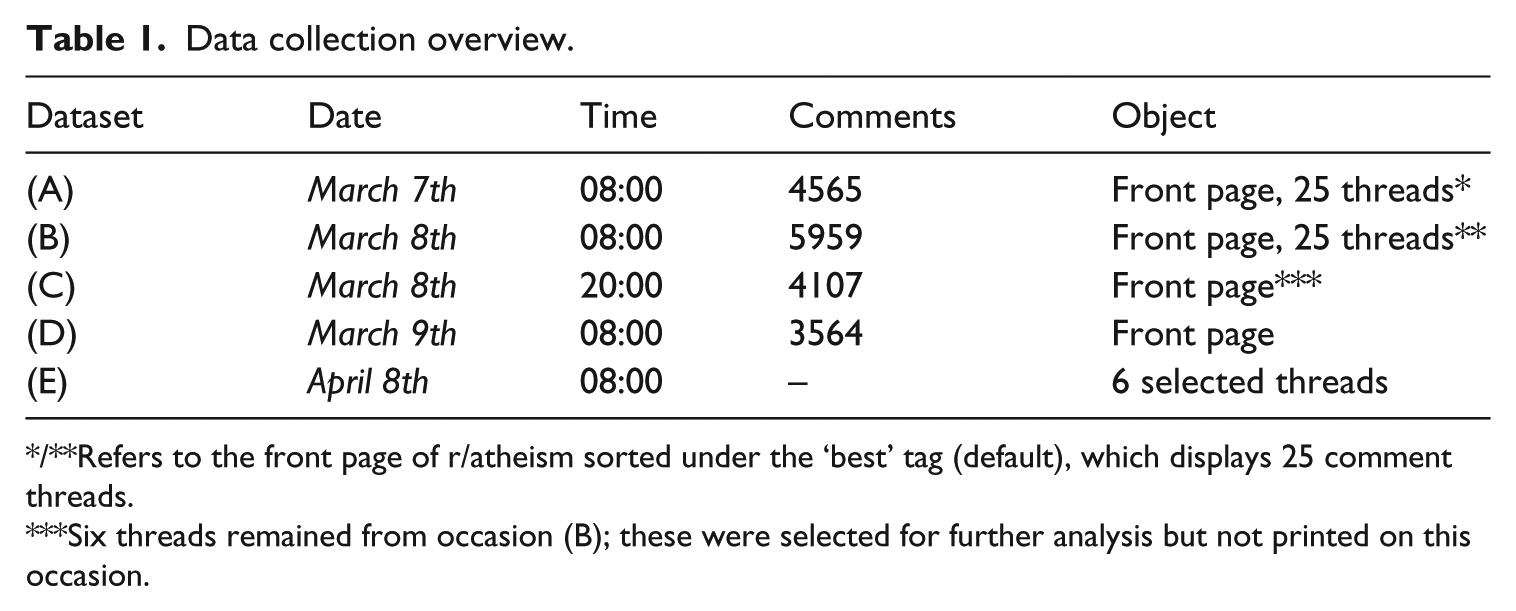
Refers to the front page of r/atheism sorted under the ‘best’ tag (default), which displays 25 comment threads.
Six threads remained from occasion (B); these were selected for further analysis but not printed on this occasion.
The front page was collected during 4 occasions from March 7 to March 8 in order to track how quickly things stayed on the front page. Dataset A and B were the basis of the analysis, and the basis for the initial inductive coding. Dataset C indicated six of the collected threads from dataset B as having remained on the front page from 8 a.m. on the same day. These threads were selected for further analysis (dataset E), and collected in full a month later.
Themes were noted through an inductive analysis of dataset A, from which a tentative coding schema of nodes was abstracted. These nodes remained close to the emic discussions and themes selected for the forum. Dataset B was then approached using the coding schema as a guide, the purpose was both to exemplify and test the schema, which was adjusted and expanded during this part of the analysis. As dataset A and B represent a small portion of forum activity on r/atheism at the time, it is likely that themes that were less salient or non-existent in these datasets would prove to be salient in a larger sample. Finally, dataset E was approached using the coding schema, and analysis focused precisely on how the nodes which appeared to be salient in dataset A and B appeared in dataset E.
The comment threads in dataset E were, in standard reddit fashion, prompted by one user posting a hyperlink or story as starting point for discussion. The threads selected for analysis (dataset E) were in response to (1) a screen capture from Facebook depicting a comic featuring Jesus and an outraged comment by a Christian next to it, (2) is short story of coming out as an atheist to a family member accompanied by a gif. of The wedding crashers asking someone why they are yelling, (3) Link to a meme which suggests that the reason Christians think video games makes children violent is because they cannot separate fantasy from reality, (4) screen capture from craigslist for an ad of an atheist asking believers to save his or her soul if they pay the poster for the trouble, (5) an image of a historical timeline targeted at fundamentalist Christians in order to debunk creationism, and finally (6) a meme that suggests that the only reason to believe that being gay is a choice, is if you are actually bisexual.
In reporting our findings, we present quotes from the forum without revealing the username of the commenter. Usernames allow commenters to protect their identity through an anonymous online identity, and their comments were posted in a public online forum, but the step has nonetheless been taken to further protect their privacy and anonymity. The selected quotes represent a range of users from different discussion threads. We also note a limitation of this research that results from the nature of the forum and the ‘affordances’ of this specific medium, which refers to the ‘functional and relational aspects which frame, while not determining, the possibilities for agentic action in relation to an object’ (Hutchby, 2001: 444). That is, the structure and regulations of reddit structures the conversation to some extent. This is true of any conversation that takes place in a highly structured online forum, but also other mediated forms of communication such as in social media, with the character limit imposed by Twitter being an obvious example (Baym and Boyd, 2012; Boyd, 2011). The specific culture of r/atheism thus cannot be generalized to all of atheist culture, but this study does look for common threads and differences that could be further explored in future research and theorizing on atheist cultures.
Communicative affordances on r/atheism
As stated in the introduction, discussion on r/atheism can be categorized as structured around (1) the construction of the category of religion; (2) conceptions of authority and human nature; (3) the ‘practice’ of atheism and modes of engagement with religion; and (4) the purposes of the forum and of public expressions of atheism. We consider each in turn.
The construction of the category of religion
When it comes to the construction of the category of religion, the discussion is individualized, focusing on religious people who r/atheism users claim to know personally. Thus, the most frequently used term when discussing topics of religion on r/atheism was ‘religious people.’ These generalized religious people are framed as being resistant to facts, and as incapable of processing reality correctly, as in the comment, ‘I’m talking about theists. They’re the ones who get pissed off over learning new information (makes sense that they hate education sometimes).’ Discussion regarding religious people involves associations with ‘hypocrites,’ ‘homophobes,’ ‘racists,’ ‘sexists,’ ‘assholes,’ as well as people who are generally closed-minded and intolerant. The term ‘Murica’ (a colloquial way to say ‘America’ that suggests a stereotypically conservative, patriotic, southern American) is used on occasion to refer to a particular brand of nationalism constructed as default intolerance, which is often equated with the characteristics of religious people, including a resistance to change, and inability to accept what is new and different, aversion to elitism and perhaps to higher education in general, the vilification of communism, and intolerance towards homosexuals and atheists in particular. For instance, the term is used sarcastically by one user to highlight his/her imagined status in relation to this stereotypical religious person: ‘I’m working towards an advanced degree so I’ll be an Elitist atheist sexually flexible commie. Basically everything wrong with Murica.’ Religious people are seen as using their religion as justification for bigotry. For example, on the idea that religious people believe that being gay is a choice, one user says, ‘But that belief is what allows Christians to be intolerant of a huge subset of people and still be “good people” in their own minds…You’re not allowed to hate people for the characteristics, but you’re allowed to hate people for the choices they make.’ As religion is constructed as being used as a legitimizing strategy for justifying intolerance, this intolerance is equated with a conservative caricature. We therefore infer a liberal moral and political stance as at least partially constituting the structure of these discussion.
Religious people are further depicted as scientifically illiterate, and as incapable of constructing arguments due to a refusal to think for themselves, relying instead on indoctrination. Thus, religious people are constructed as having a fundamentally and necessarily inconsistent worldview (unlike the inferred normative user of r/atheism). The idea of inconsistencies as inherent to religious people is particularly salient, and is also tied to an idea of religious people as having chosen to disavow their inherent reason; that is, one has to forgo reason in order to accept the inconsistency of religion, as stated plainly by a user who said, ‘If religious people were reasonable, they wouldn’t be religious.’ There are also links drawn between being poorly educated and/or stupid and being religious, and conversely, an equivalence drawn between not being religious and being intelligent and/or educated.
These descriptions of religious people are contentious and sometimes described as exaggerated or inauthentic when expressed in the extreme. The core idea of religious people having forgone rationality in favor of irrationality is, however, only questioned by users self-defining as religious, who are then declared to be deluded by other commenters. Calling out content as exaggerated is done in order to mark certain content as disingenuous, and seems to be done in order to foster a fact based (and thus correct) understanding of arguments made by religious people, and further, to form a correct basis from which one can demonstrate critical thinking to religious people. These contentious debates about ‘stupidity’ versus a more nuanced and fact-based understanding of religion are exemplified in the following exchange: Call a spade a spade guys, religious people are stupid. Religion is often wide-spreaded [sic] in lower social classes and third world countries with less education, which is no reason to call them insultingly stupid. If there is no school which teaches children stuff, the problem is not that they are ‘stupid’. Their stupidity is the result of a lack of education, therefore it is not their fault? In that mindset you could say not a single aspect of who any person is or what they do can be attributed to them. While I disbelieve in free will and so such a position makes perfect sense from a philosophical standpoint, nobody thinks that way in their life.
While discussions of religious people are contentious, there is more consistency regarding religion itself, which is constructed as an essentially dangerous, inherently absurd, cynical propaganda device that is used to exploit shame and guilt and cause people to become detached from their inherent reason. We infer that religion is understood as causing people to mindlessly submit to authority. It is important to note, however, that religion is not equated with irrationality per se, but rather is considered a tool by which inherent rationality can be disregarded. For instance, one user describes religion as a ‘death-denying coping mechanism,’ while another comments directly on how religion involves rejecting reality: ‘They neatly fold up their reason and skepticism and put it in a locked box. Then they chuck it in the nearest canal with a hearty cry “Well, reality’s not for me after all”.’
Religion is also negotiated as individualized belief (as opposed to systems of belief common to many adherents, churches and their doctrines, etc.). It is then constructed as a projection of a religious person’s value system, and as a way to legitimize bigotry and closed-mindedness. While religion is depicted as inherently harmful, it is not precisely equated with the attributes used to differentiate religious people from the normative r/atheism user, but as ways of legitimizing such attributes as correct and as stemming from a higher power. Given this individualized approach, it is perhaps unsurprising that institutional religion is seldom mentioned, and that when it is it is often in the personalized form of pastors. This view of religion as a way for individual religious people to legitimize their own bigotry means that religious people are negotiated as being threatened by atheism because it represents a personal attack on religious people’s egos. One user describes it like this: ‘God is a manifestation of the ego, which explains a plethora of theistic tendencies, including their typical dislike of atheists, who theists subconsciously perceive to be rejecting a part of themselves.’ Another user says: ‘Because religion is humanity’s worship of itself. We place our values into a separate entity and give it divine status. Nearly every theist projects their value system onto the god they believe in and credit it with all that is good in the world. That’s why they take it as a personal rejection: you’re literally rejecting everything they stand for.’
Conceptions of authority and human nature
Though religion is viewed as absurd and irrational, it is simultaneously considered a primitive effect of inherent rational thinking. This is one of the most interesting findings to emerge from this study, and it is closely related to the idea that worldview should be consistent, with the main critique of religious people being inconsistency more so than irrationality. This touches upon the second theme, that of human nature and concepts of authority. Religion is constructed as a failed science, and thus an expression of inherent human reason, as it was the means by which primitive humans made sense of the material world around them. In this way, religion is conceptualized as a pre-modern way to approach the world scientifically that is now eclipsed by modern science, as in one user’s explanation of the myth of Noah’s ark: ‘I think that the source of all the flood legends isn’t rooted in an actual event (some monster flood), but in trying to explain the existence of fossil bivalves on mountain tops.’ This is why accepting religion and religious authority means giving up ones inherent reason: it is irrational to be religious because religion is a way to make sense of the world that no longer makes sense. The purpose of criticizing religious arguments (and similar ‘unscientific’ beliefs) is thus to demonstrate critical thinking and correct rationality, and thus to de-convert religious people, or cure them of their irrationality: ‘Atheism is not and will never have a “word” or “message” to spread . . . We do the opposite of that, try to show critical thinking to people so they can reason for themselves what is and isn’t real’.
The conception of religion as an inherently rational but outdated form of thought involves a conception of the essence of religion, which leads to a further differentiation of ‘real religion’ and ‘not really religion.’ The difference can be understood with reference to the type of ‘religious people’ associated with each of these categories: ‘fundies’ (referring to fundamentalists) and ‘cherry-pickers.’ Fundies are constructed as an ideal other in forum discussions because their way of relating to religion – by completely submitting to religious authority (in the form of the Bible) – corresponds to forum conceptions of real religion (for usage of split other see Taira, 2013). Religion is differentiated from science, but shares the feature of being a complete, holistic, systematic worldview. One must therefore accept it completely in order to be ‘really religious’, since to reject any aspects of religious authority would be to compromise the integrity of this worldview. This brings into question the commitment of the believer, who might then be considered not ‘really’ religious if they do not fully accept the authority of religion (i.e. accepting the literal truth of religious texts).
This points to a seemingly ironic aspect of the construction of the religious other: fundies are accorded more respect because they at least are consistent in their worldview, and choosing to submit fully to religious authority is not considered to amount to abandoning inherent rationality, since beliefs are walled off within a coherent and systematic worldview. Fundies are thus an ideal other (that is, they are a kind of mirror image of atheists who embrace a scientific worldview). This ideal other is then contrasted with the cherry-pickers, who are equated with the term ‘moderates’. This refers to self-identified religious people who maintain a flexible, reflective and autonomous relationship to religious authority, and is identified as anyone who self-identifies as religious but who cannot be placed in the category of fundies. The term ‘cherry-picker’ refers to the practice of picking and choosing which religious beliefs to accept. Cherry-pickers are criticized for not being really religious as they fail to relate to religion in a way that makes sense, which is to submit fully to a religious worldview (as it is understood by atheists). Further, they are considered worse than fundies because they maintain the essentially harmful system of religion while not really believing it.
Both fundies and cherry-pickers are targeted for criticism, but for different reasons. Consider this quote from a user speaking to a self-identified Christian: ‘Please state your beliefs. I’ll be happy to explain to you why they are either silly and/or ridiculous or, alternitavely [sic], why you shouldn’t be calling yourself a Christian.’ The implication is that if you are a Christian you are required to hold certain beliefs, otherwise you are not a real Christian and thus are an unideal other. One can have ‘silly’ beliefs but still be really religious, while one’s beliefs might be less ‘silly’ (for example, accepting aspects of modern science) but then the charge becomes that the person is actually not really religious, but a cherry-picker.
The ‘practice’ of atheism and modes of engagement with religion
The idea of community is seldom discussed, and when it is, it is discussed in order to imply that atheism is not a movement but a way of thinking rationally. A crucial term for understanding community formation on r/atheism is ‘argumentation’. Arguments and argumentation are emic terms that are used in reference to a specific process, which is the correct construction of logical arguments, primarily in reference to the potential de-conversion of religious people. This is an act of differentiation which constructs the normative forum participant as one who is developing his/her ability to construct logically sound and empirically grounded arguments, while simultaneously representing religious people as incapable of doing the same. The user who wrote, ‘If we are going to argue against religious bigots, we need to be more careful about using equally flawed logic against them’ recognized this need to maintain standards of logic and rationality in order to maintain a distinction between atheists and religious others.
The purposes of the forum and of public expressions of atheism
The most salient convention relating to the notion of community is the idea that the forum is nothing but a ‘circlejerk,’ which is a metaphor for discussions among likeminded people repeating the same themes, opinions, and attitudes, which accomplishes nothing. The circlejerk is specified as a particular way of constructing religious people – that is, it is the representation of religious people (as outlined above) that most often brings out the charge that the forum acts as a pointless circlejerk. It is apparently completely uncontentious to refer to r/atheism as a circlejerk, however, users appear to variously relate to it as being a terrible state of affairs, something to equanimously accept, or as what makes using r/atheism enjoyable in the first place. The former position includes laments of how r/atheism has degenerated into a circlejerk, identifying it as a failure to accomplish its real purpose, which should be to demonstrate critical thinking, as in the following example: Making fun of others’ beliefs is nothing more than juvenile, intellectual masturbation. It feels good but produces nothing. r/atheism has become a caricature of itself.
The middle and latter positions, meanwhile, consider the circlejerk a natural function of the forum as a safe space for venting frustrations about religious people, as in the following comment from a user frustrated with the debates about how to treat religious people: Can we just make r/atheistreligiousapologetics and be done with it? I’m fine with most religious people. But I don’t feel like qualifying every statement I make about religion or religious people in the context of a sub for entertaining atheists. Religions tend to be very anti-atheist, so until that stops, atheists are going to feel pretty anti-theist occasionally. I think we have a common bond in that. Are we hurting anyone? No.
There thus appears to be a tension regarding the purpose of r/atheism between an idea of the forum as a space for fostering rationality, and r/atheism as a safe space for venting and for feeling confirmed in those frustrations. This tension could be theorized as paralleling another tension, namely that of identifying as part of a persecuted minority. For instance, the circlejerk is sometimes negotiated as a positive aspect of the forum because users who live in the Bible belt have not heard the supposed ‘old jokes’ before, and do not have anyone to talk to about being atheist. This appropriation of a minority identity is both embraced and derided. Nonetheless, some users feel compelled to defend the forum as a space where a persecuted minority can come together to freely express their frustrations, and even to make fun of religious people: Realistically, we have this sub because people without belief have common ex-periences [sic]. Usually being bashed or persecuted by people with some belief or other. Laughing at those people of x religion in the confines of a sub specifically exclusive of those people has to be the least offensive retaliation I can think of.
Conclusion: r/atheism and formal atheist cultures
As mentioned at the outset of this paper, four major themes emerged in this study of r/atheism: (1) the construction of the category of religion; (2) conceptions of authority and human nature; (3) the ‘practice’ of atheism and modes of engagement with religion; and (4) the purposes of the forum and of public expressions of atheism more generally. These themes have also featured prominently in research on atheist beliefs and identity in formal organizations and among atheist leaders and public figures. Our aim is to compare these public expressions of atheism in order to identify consistencies and diversity of opinion within and between these levels. This study thus contributes to a growing understanding of atheist cultures, especially with regard to their diversity (Baker and Smith, 2015; LeDrew, 2015; Cimino and Smith, 2014).
The finding that religion is conceptualized on r/atheism as a failed science reflects a dominant trend in popular atheist discussion. An interesting contrast, however, emerges in the way that the harm of religion is conceptualized. For the New Atheism, religious value systems are imposed on individuals who are predisposed to religious indoctrination. That is, religion is a source of immoral values and false pseudo-scientific beliefs about nature that gain their power from being assigned a sacred status, and believers are compelled to accept them. The views of r/atheism users represent a reversal in this relationship between religious beliefs and believers, where religion is not the source of negative attributes, but a way of legitimizing these attributes. In this sense r/atheism users grant greater agency to religious individuals, who are assumed to look to religion to validate their own values, rather than being passive vehicles of religious ideology or victims of indoctrination (though there is some tension in how precisely agency is conceptualized, as noted above).
The view of religion as a failed science leads to a distinction between ‘real religion’ and ‘not really religion’, and between ideal others and non-ideal others, represented by fundamentalists and moderates, respectively. Religion is thus conceived as a split other, with ‘fundies’ the ideal and ‘cherry-pickers’ (or moderates) as unideal. This must be understood with respect to users’ views on how religion relates to rationality and authority. Religion can be described as something which causes inherently rational human beings – or which is used as a legitimizing strategy by rational human beings – to detach from their inherent rationality. It is important to note, however, that even though it functions as the primary vehicle for irrationality, religion is conceived as rational at its conception – that is, as a failed science that was once a rational proposition given a lack of alternative frameworks of understanding. What makes submitting to religion irrational in the modern era is that religion as a holistic proto-scientific system of rationality has been eclipsed by modern science.
It follows from the above analysis of conceptions of human nature that conceptions of authority are crucial for the understanding of religion and how it relates to irrationality. Part of the construction of human beings as possessing an inherent rationality – most perfectly reflected in the scientific way of thinking which is presumed to be the inflection of the normative r/atheism users – is a particular way of relating to authority. That is, the proscribed scientific or rational way to relate to authority is to do so reflexively and critically. The problem with religion, then, is that one cannot honestly relate to it in a reflexive manner; that is, as religion is viewed as a holistic rational system for explaining the world, one either has to accept it without question or reject it completely as it exists in tension with contemporary scientific (thus rational) ways of explaining the world.
This perspective on authority helps illuminate the above finding on a ‘split other’, where fundies are perceived as ideal and cherry-pickers as non-ideal. Because fundies subsume their inherent rationality to religion as a holistic system, their perspective (even if perceived as absurd) makes sense. Cherry-pickers, by contrast, are perceived to be maintaining an untenable position where they use religion as a primitive rational system to legitimate some beliefs, while in other cases showing evidence of scientific literacy and a reflexive stance towards authority. Cherry-pickers are thus deemed inconsistent both in relating to their inherent rationality, and in relating to religious authority. Fundamentalists are actually accorded more respect because they are committed to their worldview and consistent in how they relate to authority, and in that sense adopt a ‘correct rationality’, though their conclusions are considered to be inaccurate – that is, they incorrectly choose religious truth over scientific truth, but they are correctly committed to an absolute truth that must be accepted according to the logic they follow.
This is consistent with the New Atheism’s views on fundamentalists and ‘moderate’ believers (that is, non-fundamentalists). Atheists like Dawkins (2006) and Harris (2004) have argued that moderates are actually more of a problem than fundamentalists because they undermine the ability to critique religion and address its true (violent, irrational) nature. This is closely connected to their frequent criticism of relativism, encompassing epistemic relativism and the social policy of multiculturalism, which they perceive as a threat that undermines the universal authority of science (LeDrew, 2015). For these thinkers religion and science are rival forms of knowledge, and moderates are a challenge to this binary coding, and thus to the tacit assertion of scientific authority. Fundamentalists are less of a threat because they do not challenge the religion/science binary that the New Atheist ideology is built on.
The defence of this binary construction of ‘religion/science’ is the basis of r/atheism users’ views about how atheism should be practiced. They favour a confrontational approach where religious ideas should be publically discredited by arguing from a scientific perspective, while the lack of respect shown for religious moderates seems to go hand in hand with a lack of respect for an accommodating position on religion. ‘Cherry-picker’ moderates are derided as much as ‘fundies’, and there is no suggestion that critique should be modified to target only fundamentalism. Such a position is natural given the common view that the purpose of r/atheism is to demonstrate critical thinking and the correct way to relate to truth and authority, which again corresponds to the New Atheism’s ideological goal of advancing a scientific-rationalist worldview.
The concerns about r/atheism becoming a ‘circlejerk’ are a commentary on a failure of the forum’s purpose in this regard, with some users critical of discussions that serve no other purpose than to vent frustrations about religion. But others view the ‘circlejerk’ phenomenon in more positive terms and consider it a natural function of the forum as a space for sharing thoughts and experiences with others who share a similar point of view. This reflects many studies of atheist communities that have found that the social experience of community and belonging can be as important, if not more so, than other more instrumental goals (Cimino and Smith, 2014; Smith, 2011; 2013). Discussions on the ‘cirklejerk’ may be approached both as a practice of atheism, and as reflections on the purpose of the forum. As such, these discussion must be conceived in relation to reddit as a platform. That is, part of the socio-technical structure of r/atheism is an apparent focus on and categorization of ‘religious people’, which functions both as a device for venting frustrations, and around which a subcultural identity can coalesce.
These disagreements about the purpose of the forum in general also reflect similar tensions found within organized secularism regarding movement goals and the proper way to relate to religion and religious people, for instance, the ‘confrontation’ versus ‘accommodation’ debates that positioned proponents of aggressive and uncompromising criticism against pragmatists seeking alliances with liberal religious groups (LeDrew, 2015). On r/atheism there is a preference for confrontation and, in general, a convergence with New Atheist discussion, though not without exceptions. These tensions regarding the practice of atheism and the purpose of the forum, then, are found in virtually every atheist culture that has been studied, and should be a target for future research in the field.
Footnotes
Acknowledgements
The authors would like to thank participants in the Sociology of Religion seminar at Uppsala University for their feedback on earlier drafts of this article.
Funding
This research received no specific grant from any funding agency in the public, commercial, or not-for-profit sectors.
Author biographies
Address: Department of Theology, Uppsala University, Box 256, 751 05 Uppsala, Sweden.
Email:
Address: Department of Sociology, Memorial University of Newfoundland, 230 Elizabeth Ave., St. John’s, NL, Canada A1C 5S7.
Email: