




Abstract
The aim of this article is to analyze the religious discourse on Polish Facebook in relation to the refugee crisis. The primary focus is on how religious memory is presented. A discourse analysis implemented by the author helps to identify and examine certain nodal points related to the religious debate about refugees, and then instruments used to recall religious memory are shown. In the course of the analysis, the author uses the theory of religion as a chain of memory. As a result, a complex attitude of Polish users toward the Pope, Islam, Christian martyrdom and religious buildings is shown. All of them refer to religious traces from the past.
Introduction
Since 2011 the refugee crisis has occupied the public sphere, conceived especially as a space created by ‘communication about public matters as in journalism, opinion and argumentation, in face-to-face communication as well as in mediated communication’ (Rasmussen, 2014: 1315–1316). The European Union member states have set crisis agendas and implemented different discourses on refugees. On the one hand, the Austrian, Hungarian and Polish governments have been showing a backlash against the allocation of refugees imposed by the European Commission. On the other hand, the rest of the EU members have accepted different numbers of refugees and implemented their own policies of accommodation, joining a number of interested parties (i.e., Turkey, Lebanon, Jordan, but also Canada, South Africa or Australia).
The Polish right-wing government headed by the Law and Justice party has been struggling with the European Commission against opening the borders to these newcomers. As shown by Grzymała-Kozłowska (2007), previous media representations of migrants referred to cultural-ethnic and socio-economic dimensions. Meanwhile, after Law and Justice took over power, it provoked a growing media representation of refugees as barbarians (Średziński, 2017). In contrast to the officially favorable position of the Roman Catholic Church, the radicalization of negative attitudes towards refugees from the Middle East and Africa has also increased (CBOS, 2017).
The refugee crisis has not only been observed to arouse opposition to Muslims, refugees and migrants from the Middle East in Poland, but also in other countries. Therefore, this study proves that, when discussing the social media representation of the refugee crisis, one important reason to distinguish a Polish case is the religious memory of Polish social media users.
At the same time, as can be observed, it is difficult to understand the presence of the refugee crisis in social debate without addressing the matter of social media platforms. Recent studies have predominantly highlighted the negative portrayal of refugee incidents in social media. The results of sentiment analysis of the refugee crisis in Germany, Austria, and Switzerland between October 2015 and March 2016 indicated an increase in negative content in old and new media, which was slightly more prevalent on social media (Backfried and Shalunts, 2016). An analysis of English and German tweets also confirmed an increase in the anxiety level among refugees after November 2015 (Pope and Griffith, 2017).
From this point of view, little is known about the refugee crisis in Europe when considering previous studies on religion in digital media. Existing research fails to address religious issues, which seem to be a fundamental element of tension present in digital media. This gap in the extant scholarship provides a promising space for analysis. However, instead of focusing on apparent negative media attitudes toward Muslims and Islam (Bleich, 2009; Gualda and Reboll, 2016; Savelkoul et al., 2012), in this article the author looks at the problem of traces of shared religious memory that strengthen the users’ identity. For this purpose, the author implements a theoretical background based on Religion as a chain of memory (2000) and later works by Danièle Hervieu-Léger.
Hence, the aim of the article is to analyze a religious discourse on Polish Facebook in relation to the refugee crisis. The scientific objective as described drives the author to address the following question: what was the religious discourse about the refugee crisis on Facebook? In order to answer this question, a discourse analysis on Polish Facebook is conducted.
Theoretical background
In order to analyze how the digital media can shape religious issues, the author applies Hervieu-Léger’s (2000) concept of religion as a belief based on shared memory and tradition. When analyzing Western societies, Hervieu-Léger claims that modernity has proven unable to produce the corresponding collective meanings. An accompanying acceleration that influenced the experience of both the individual and the community has brought a paradoxical rise to appeals to memory. Hervieu-Léger specifies the process of filling the areas devoid of rationality by referring to religion.
Thus, according to Hervieu-Léger’s concept, religion is brought to cultural and symbolic resources, from which fragments of memories and information are collected. This floating memory has been constructed and is being constantly reshaped ‘through the processes of selective forgetting, sifting and retrospectively inventing’ (Hervieu-Léger, 2000: 124).
Hervieu-Léger complements the concept by including the context of high modernity. The more individual believers migrate, the greater their need for community engagement (Hervieu-Léger, 2006). The intertwined processes of the individualization and marketization of belief have triggered a clear change in the context of references to religious memory (Hervieu-Léger, 2006). The focus in the process of the legitimization of faith has moved from religious authorities to individuals (Woodhead, 2016). As a result, confrontation with the interpretation of religious authority has lost its meaning and individuals themselves are responsible for their spiritual paths. Hervieu-Léger (2006: 63) recognizes that the internet resembles ‘the great bazaar of meanings in which individuals move around and take what they want’.
In analyzing religious memory on Polish Catholic forums, it emerges that religious expression offline and online differs in many ways (Kołodziejska, 2014). The democracy of the digital environment exists in opposition to traditional settings like parishes. For this reason, a parish becomes the focal point of one-way church communication, while the digital environment provides users with ‘a new space for meaning-making exchange’ (Kołodziejska, 2014: 159).
The task is so difficult that religious resources on the internet can either join or demarcate users. Kołodziejska (2014) proves that the multifaceted Polish Catholicism present on forums endeavors to create tension between integration and differentiation. On the one hand, forum users communicate at the same level, acknowledge mutual personal testimonies, and ‘do not question the hardship of the spiritual journey recounted’ (Kołodziejska, 2014: 159). On the other hand, when considering controversial threats, participants with opposing views clearly move away from each other. The defragmentation of their opinions results more from the need to disclose their knowledge than to continue to dialogue. This kind of action could be the result of people’s indifference on the internet growing stronger.
While in a study by Kołodziejska (2014) integration and defragmentation are simultaneously present in religious threads, the problem of the presence of religious memory is marginalized. Thus, the present study probes methods of recalling religious memory. In this case, the Polish perspective on the refugee crisis can reveal interesting findings. The next section of the article includes the methodology used in both the research and analysis, and presents a description of users and nodal points from the material and results.
Materials and methods
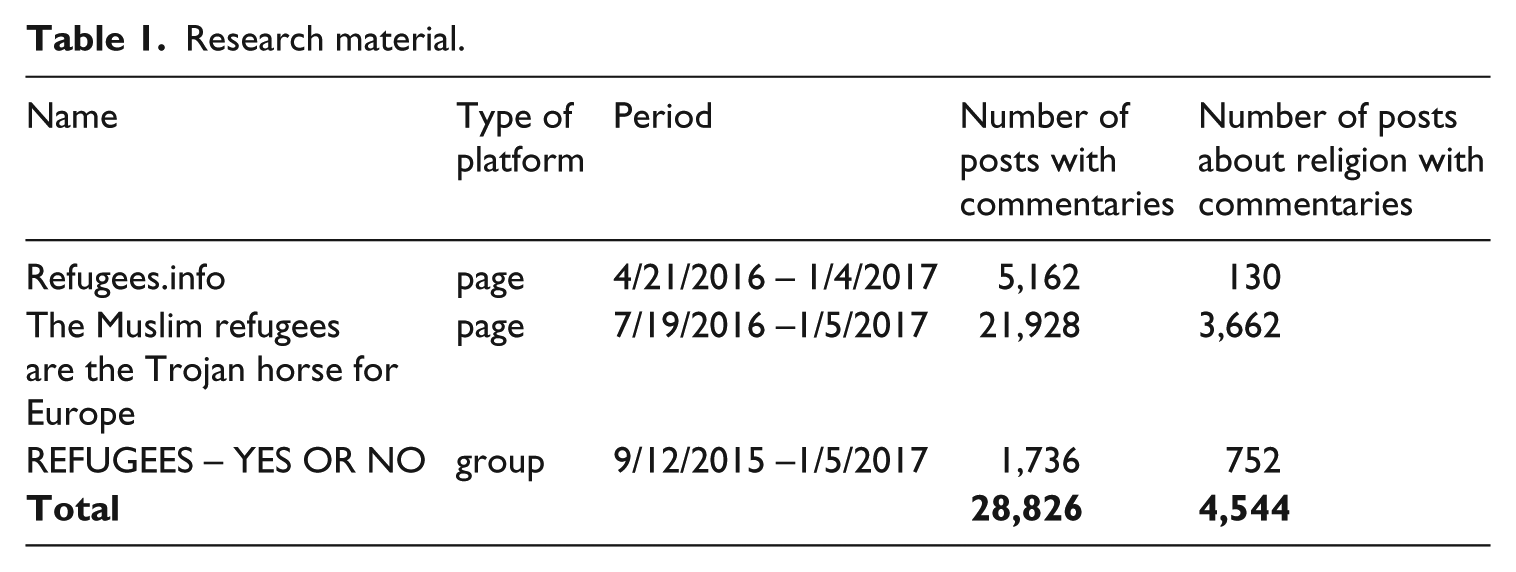
The subject of analysis in this study included Facebook posts and commentaries from Polish groups and pages devoted to the current refugee crisis. The author decided to research Facebook, which is considered the largest social media network in Poland. It is used by 22.6 million of the 27.8 million internet users, which is 81.4% of the population (Gemius/PBI IV, 2017). Computer software was used to collect the material for analysis. The Netvizz App was utilized to identify pages and groups that contained a Polish keyword for ‘refugees’ (uchodźcy). This kind of selection was justified by the perception of the average media user according to media theories (Gerbner and Gross, 1976; Katz et al., 1973). As many as 21 pages and groups were identified by the author. When evaluating the contents of the pages and groups, it was found that only two open pages and one open group contained material on the subject in question. Subsequently, the NVivo software was used to collect and convert the dataset into Excel files. The data included 28,826 posts and commentaries from refugee.info (Polish uchodźcy.info; RI) and The Muslim refugees are the Trojan horse for Europe (Polish Uchodźcy islamscy są koniem trojańskim Europy; RTH), as well as from the group REFUGEES–YES OR NO (Polish UCHODŹCY – TAK CZY NIE; RYN). First, the contents were read by the author. Then, the themes that directly or indirectly related to conventional religion and common religion were extracted. Finally, the corpus was subjected to discourse analysis which covered 4,544 posts and commentaries related to religious issues, as illustrated in Table 1.
Research material.
In this research, the author applied discourse analysis (Carpentier, 2017; Carpentier and De Cleen, 2007; Jørgensen and Phillips, 2002; Laclau and Mouffe, 1985; Torfing, 1999) to tackle the empirical data. It is assumed that both social phenomena and objects are expressed in a discourse that can be described as a certain structural unit resulting from articulation (Laclau and Mouffe, 1985). Despite the critical views of this approach (Howarth, 1998), the author follows Jørgensen and Phillips’ instrumentation of selected concepts from Laclau and Mouffe that are found to be useful as tools for media analysis, namely, floating signifiers, nodal points, antagonism and hegemony.
As a starting point, religion is established as a floating signifier, which means that it cannot be considered as having a unique meaning. Refugee crisis debates on Facebook unveil distinct religious issues articulated by Polish users in different contexts. Among the significant elements of this articulation are traces of religious memory left by the users. Discourse stability, in turn, is based on the nodal points, i.e., privileged or dominant signifiers that are formed in the course of this articulation and constitute discourse organization (Carpentier and De Cleen, 2007; Jørgensen and Phillips, 2002; Laclau and Mouffe, 1985). In practice, this means that elements emerge in refugee debates on Facebook that are necessary for other elements of the discourse to be articulated. On the one hand, these nodal points, around which other elements are ordered, have to be seen as setting collective positions in relation to the refugee crisis (Jørgensen and Phillips, 2002). On the other hand, they are contingent, therefore, stabilizing the discourse temporarily, and not once and for all.
During the analysis, it is important to unveil the nodal points of discursive practices on Facebook. Therefore, when deliberating the organization of religious signifiers, five nodal points, are highlighted. These include ‘attitudes toward Islam’, ‘religious buildings’, ‘attitudes toward the Pope’, ‘Christian martyrdom’ and ‘references to historical events and figures’. It is assumed that within these nodal points a chain of religious memory becomes explicit. In other words, within the nodal points, it can be noted how individuals and the community renew their relationships in line with tradition, heritage, and meanings that were characteristic of the past generations of believers.
Finally, the author investigates how antagonism and hegemony function in the empirical material by posting two questions. With regard to the first concept, the question is: where in religious debates on Facebook can open antagonisms about refugees be found? Here, antagonism does not mean a real conflict in relation to refugees. Instead, it is seen as a construct which indicates the subject of articulation unable to be fully itself due to the presence of refugees. With regard to hegemony, understood as domination that primarily results from the consent and alliances rather than just coercion (Gramsci, 2000; Laclau and Mouffe, 1985), the question is: which discourses are generalizing? In other words, when shaping social order, hegemony serves to stabilize the discursive meaning of what is religious in the case of the refugee crisis. As a result, these meanings are taken for granted and naturalized.
Facebook user identities
When analyzing the methods of recalling religious memory, Facebook groups and pages should be presented first. With this end in view, the author points to the number of users, the general tone of published material for that group or page, and their specific features. An important element of this description includes information on the presence of practices related to antagonism and hate speech. The Muslim refugees are the Trojan horse for Europe is a Facebook page with a total of 9,098 participants who publish the largest number of posts and comments on the refugee crisis. The page is dominated by refugee opponents and negative messages. Here, antagonistic discourses and, to some extent, hate speech, are displayed. The page description made by its creators emphasizes three basic features. The first is the lack of censorship and the presence of content for adults. The second feature, named ‘A wise Pole before harm’, shows that the content posted on the page should be treated as a precaution in the current crisis. The third feature has an information and control function regarding the message about Islam: ‘All information about how far we are from Islam and Islam is to us has been collected in one place. Rate it yourself’ (RTH). Refugee.info (RI) is Facebook’s largest community of 15,901 members, but its participants are not as active as RTH users. It brings together people seeking reliable information and a space for debate over the refugee crisis. In addition, RI is neutral. Here, the user language represents a variety of discourse levels, from the colloquial to an academic style of speech. The goal of this page is to ‘raise public awareness about refugees in Poland and Europe by spreading good knowledge and dispelling stereotypes’ (RI). The page uses a program tool entitled Citizens for Democracy funded by the European Economic Area (EEA). REFUGEES – YES OR NO is an open group with 121 users. Both neutral and negative discourses can be found in this group. Its participants represent diverse levels of education and different attitudes toward refugees. According to the description posted on Facebook, the group’s purpose is to discuss the burning issues about refugees and to establish standpoints both for and against. The comparison of the described groups shows significant common points with regard to the tone of the published material, the need for deliberation, and the action based on one organizational principle. Nevertheless, the subject of the refugee crisis lacks a positive tone. There is, however, a relationship between the group goal and the dominant discourses. When considering an exchange of reliable knowledge of refugees (RI), the tone of the content seems neutral. With regard to views about censorship or political correctness (RHT), the negative tone of the content is dominant. Each group puts a great emphasis on deliberation, where users are not categorized by their profession or social position. Potentially different discourse styles turn out to be consistent within a given group.
Nodal points of the analyzed religious issues on Facebook
What kind of religious issues arise in Facebook debates about the refugee crisis? Based on the analyzed material, discourse organization is shaped by five nodal points, a short description of which precedes the proper analysis. The first nodal point is ‘attitudes toward Islam’, illustrated by the following example: (Post): After the attack in Nice, people have already started to say: ‘But this terrorist was not pious. You see? This has nothing to do with Islam!’ Please, stop (Post from July 22, 2016, RTH).
As a nodal point, ‘attitudes toward Islam’ is predominantly negative and based on antagonism illustrated by negating the attempt to separate the bad terrorist agency from religion, as well as the use of the word ‘pious’ in the context of jihadist attacks.
Another nodal point related to ‘religious buildings’ includes Christian churches and Muslim mosques, as illustrated by examples below: (Post): The Great Mufti of Saudi Arabia calls for the demolition of churches (Post from September 22, 2015, RYN). (Post): Sign of the times: Since 2000, 33 churches have been demolished in France. They were replaced with over 1,000 mosques (Post from September 10, 2016, RTH).
This nodal point is both neutral and negative. Depending on whether it concerns a Christian or Muslim background, it takes a different form. However, it always refers to the current situation in Western Europe. In the case of churches, it concerns the closing or demolition of churches. When it comes to mosques, it indicates the agency of setting up new mosques or negative reactions to the existing ones.
The nodal point of ‘attitudes toward the Pope’ is slightly neutral, but for the major part negative and based on the antagonism of Facebook users toward Pope Francis, as illustrated by the following examples: (Commentary): And why do we care about numbers and the Pope’s appeals–If he really wants, he should take them all [refugees – author] and stop making us happy whether we like it or not. If we want to help, we have children’s homes, Poles who have not yet returned from exiles (Comment from July 28, 2016, RTH). (Post): POPE FRANCIS: At yesterday’s audience in the Vatican’s St. Peter Square, Pope Francis mentioned the words of Jesus: ‘I was a stranger, and you accepted me; I was naked and you clothed me’ (Mt 25: 35–36) (Post from October 27, 2016, RI).
In addition, the nodal point of ‘attitudes toward the Pope’ stabilizes shorter discourses on the Catholic Church. They consist of the Church’s attitude toward refugees, papal interpretation of the doctrine of the Church, the Pope as the Antichrist and the Pope as the emissary of Islam.
The next nodal point concerns ‘Christian martyrdom’ and is illustrated by the following example: (Post): In Nigeria, Christians must face daily persecution. On Friday, July 15, there was another attack on the Catholic Church in this country. This information was confirmed by police sources of Niger state in Nigeria (Post from July 27, 2016, RTH).
Here, negative posts and comments are mostly based on strong emotions. This nodal point focuses on drastic and precise descriptions of Christian murders, in which the perpetrators are identified as jihadists or simply as believing Muslims.
The last nodal point is based on ‘references to historical events and figures’. It has either a neutral or negative character, and is mainly about the moments of clash between the European and Islamic civilizations. They reveal strong traces of the chain of religious memory, which is exemplified below: (Post): The French Church is increasingly under criticism for its attitude toward Islam, even fraternizing with it, which in practice means quietly supporting the Muslim policy of invading Europe for years. (Commentary): In 1683, they also sympathized with the Ottoman dynasty! It’s nothing new! (Post and comment from September 25, 2016, RTH).
Not only do these nodal points stabilize the religious discourse on the refugee crisis, but also show spaces in which appeals to religious memory are activated. Depending on the type of nodal point, the activation process differs. Therefore, in the next section, the nodal points and possible appeals to religious memory are studied.
Attitudes toward Islam
References to ‘attitudes toward Islam’ occur in discourses always as a consequence of certain events involving Muslims. However, the standpoint of the discourse participants varies depending on the role of Islamic followers in the event in question. The first three examples illustrate Facebook users’ attitudes toward Muslims as perpetrators. The other two examples show an attitude toward Muslims as victims.
(Post): Another attack by a Muslim terrorist on an orthodox Jew. This time near the Synagogue in Strasbourg. While shouting ‘Allah Akbar,’ he stabbed a Judaist (Post from August 22, 2016, RTH).
This kind of reporting uses the tactics of uncommitted description, accompanied by drastic detail, to exert a strong influence on the imagination of other users. The author of the post directly displays his or her attitude toward the perpetrator only by identifying him as ‘a Muslim terrorist’. In doing so, the author expresses a relative distance.
(Post): This nice boy, just 19 years old, is already dead. His name was Adel Kermiche and on Monday, July 26, he cut the throats of the priest and the nun (Post from July 27, 2016, RTH).
As this post suggests, drastic detail manipulation is also linked to the perpetrator’s identification as a nice average guy. There is an ironic contrast that indicates a clearly negative attitude of the discourse participant.
(Post): The iconoclastic behavior of Muslims living in Italy is becoming increasingly widespread. They enter churches, destroy crosses, profess hosts (Post from September 30, 2016, RTH).
Here, the description points to a negative attitude toward Muslims as a result of the bad agency attributed to them, and in relation to the elements of Christian worship.
The variant in which discourse participants confront Muslims as victims appears much less frequently. Such instances concern moments of physical violence against Muslims or attacks on places related to their worship. A better illustration of this can be found in the example below: (Post): Firefighters and police desperately tried to extinguish the flames that engulfed the newly opened Islamic Center. (Commentary 2): Great, let’s burn these mosques across the EU. Bravo. (Commentary 4): Why are they quenching them? (Commentary 21): Throw some more logs as it is burning too slowly. (Commentary 32): What happened to you all? You are beasts. (Post and comments from December 29 and 30, 2016, RTH).
In this post, the author emphasizes only the efforts of firefighters. Other commentators, however, express their satisfaction with the fire at the Islamic Center. Their satisfaction is stopped by the last comment, which compares them to beasts. This example shows a typical way of revealing an anti-Islamic discourse. The disruption of the hate speech chain occurs only when discourse participants are confronted with a dehumanized argument that points to the gap between their attitudes and human values, such as compassion.
(Post): Someone has set fire to the Islamic Center in the Netherlands? On Wednesday night, December 29, 2016, the newly opened Islamic Center in Culemborg, the Netherlands, was burnt down. It was probably arson. Firefighters fought with flames all night, yet unsuccessfully. (Commentary 1): What a beautiful view. (Commentary 2): It has immediately become warmer this winter. (Commentary 3): Oh, how beautiful it is! If you want to extinguish it, use petrol! :) (Post and comments from December 30, 2016, RTH).
In analogous discussions, hate speech is not stopped. As a result, users are more likely to be the promoters of violence against Muslims.
If we focus on antagonism and hegemony within the framework of nodal points related to attitudes toward Islam, and the traces of connections between them, two interesting tendencies are outlined: (Commentary): I wonder why, in the narrative of the Left, Levinas’s Other must always be portrayed as someone with a different skin color, someone whose religion is different than Christianity, someone who is nonheteronormative. Isn’t this radical Other just anyone? Or the one who lives in the same country as me, who speaks the same language, but has just different views ‘Each Other is quite different from me, and I cannot feel what he or she feels’, wrote Bataille. People who are worried by Islam, who believe that the principles and values of this religion are in conflict with the ideas of the Western world, for example they threaten women’s freedom and are totally anti-feminist, are called xenophobes and Islamophobes, classified as common racists. Why? […] (Comment from June 10, 2016, RI).
In this passage, a clash can be observed between two discourses that have a potential to be hegemonic. Firstly, the author of the commentary points out that opposition to Islam is not opposition to ‘the other’. This opposition is rather a manifestation of fears of Islam as a religion that does not agree with the values of Western civilization. It shows then that Polish users associate Western civilization with Christianity. As a consequence, whatever would threaten Christianity would automatically also concern European society.
At the same time, the commentator observes that such a hegemonic practice encounters a counter-hegemonic reply, in which the anti-Islamic discourse serves as the basis for categorizing someone as an Islamophobe.
(Post): Militant Islam there, dancing Christians here. Deadly harvest there, life affirmation here (Post from June 27, 2016, RTH).
This short post published for World Youth Day 2016 clearly shows how to implement antagonism when looking at the attitudes toward Islam. First of all, the author of the post contrasts Christians with Islam, rather than with Muslims, and thus starts the process of the depersonalization of Muslims. This can be seen in a distinction between ‘us’ and ‘them’. Adjectives intensify the positive image of Christians and the negative image of Islam. Finally, the author of the post closes the antagonism by comparing ‘here’, referring to an affirmation of life, with ‘there’, referring to the celebration of death. The key sphere of the distinction between ‘here’ and ‘there’ is complemented by ‘us’ and ‘there,’ which depreciates one of the parties.
Religious buildings
With respect to religious buildings as nodal points of Facebook discussions about refugees, examples provided in the analysis show that these buildings become imbued with different meanings. Depending on whether the users are concerned about the church or the mosque, characteristic entanglements of the present with the past can be identified.
In a vast majority of discourses, churches, regarded as objects, are closed, burnt or replaced with mosques. When considered within the heuristic concept of space, they are understood as spaces of either intervention or emptiness. The space of intervention is derived from the need to protect churches from terrorist attacks during Christmas. A good example of this is Cologne Cathedral, the meaning of which transitioned from an asylum into a potential danger area. This is illustrated by the following quote: (Post): Several months ago, Cardinal Rainer Maria Woelk from Cologne set an altar from the refugee boat before the Cathedral, calling for their acceptance. On Christmas Eve, the Cathedral had to be surrounded by armed police cordons to protect it against the same refugees who are now bringing Germans rapes and death […] (Post from December 28, 2016, RTH).
A study by Knott (2010: 36) indicated that the extension of space may trigger a situation ‘in which particular places betray the traces of earlier times and different political and religious regimes’. In this case, the signifier’s change comes as a result of violence. Consequently, the previous meaning is not forgotten, but is entangled with the perspective of danger. The Cathedral example proves the core assumption of the discourse theory that religious spaces can function in the same discourses, at the same level, and can simultaneously contain contradicting signifiers.
(Post): Over the next 10–15 years, at least two-thirds out of 6,000 churches in the Netherlands will lose their religious function. As many as 2.5 thousand organizations have already made an offer to buy sacred buildings. (Commentary 1): They are digging their own grave. (Commentary 3): This is how Europe is dying to gradually become a slave to Muslims. (Post and comments from December 10, 2016, RTH).
In this dialog, Facebook users can be seen as those moderating the issue of churches being devastated and closed, and they understand these secularizing tendencies as a harbinger of bondage. The first commentator identifies the impersonally expressed desacralization of churches in the Netherlands with the Dutch society. The other commentator extends this process over the whole of Europe, and interprets it as bearing the hallmarks of captivity. This seems to be a reference to Polish religious memory, in which the closing of churches was often the result of invasion and enslavement, i.e. during Poland’s partition and time of Prussian Kulturkampf.
When users are concerned about mosques, they identify them as the agency of the new order: (Post): Pisa City Council has approved a plan to build a mosque only 400 meters from the Leaning Tower and other medieval religious buildings from the so-called Campo Santo. (Commentary): Well done morons, build boldly, they will certainly repay for it in a well-known way. (Post and comment from August 19, 2016, RTH).
In the above discourse, the mosque communicates openness to religious diversity combined with the loss of the sense of protection of one’s own cultural and religious heritage. The author of the post reveals his or her negative attitude toward the city’s decision, saying that the location of the mosque is in an insufficient distance from the Christian and cultural heritage of Pisa. It is impossible to judge whether or not the author intuitively refers to the old Christian principle that prohibited places of worship from other religions near the Cathedral. The commentator ironically develops this idea by referring to the relationship between Islam and Christianity. He recalls the ‘well-known’ way in which Muslims will respond to this policy in the future, which is likely to be associated with previous experiences of terrorist attacks or Islamic invasions in Europe. This is explained more precisely in the following passage: (Post): The French Church is increasingly under criticism for its attitude toward Islam, even fraternizing with it, which in practice means quietly supporting the Muslim policy of invading Europe for years. (Commentary 1): Frenchmen are genetic cowards and hypocrites. (Commentary 2): In 1683, they also sympathized with the Ottoman dynasty! It’s nothing new! (Post and comments from September 25, 2016, RTH).
According to the author of the post and the commentator, the cooperation between the French Church and Islam implies that the French support the Muslim invasion of Europe. Based on both comments, it is clear that the current cooperation is analogous to France sympathizing with the Ottoman Empire during its invasion of Austria in 1683. In this way, the memory of a brutal Muslim invasion, known from the past, is entangled with the present migration.
Attitudes toward the Pope
Another nodal point is ‘attitudes toward the Pope’. Its complexity is mainly due to the fact that Facebook users make a distinction between their affiliation to the Catholic Church and their relationship to the Pope. The two phenomena distinguished in this discourse can be seen below: (Post): Either I do not understand what Pope Francis says, or it is just terrible. Not a word about the priest who was murdered in France. Not a word about the faithful persistence of the Polish nation by Christ. Not a word about Polish openness to refugees from Chechnya and Ukraine. Not a word about the threat of violating Christian values. (Commentary 1): In return, they talk about mercy on the people who are murdering us. (Commentary 2): There’s nothing to be surprised about if the Throne of St. Peter is occupied by the ambassador of Beelzebub?? It’s nothing serious, some PRIEST murdered by a chapati! (Post and comments from July 28, 2016, RTH).
In this passage, the questioning of the religious authority of the Pope which emerges from the conservative attitudes of the discourse participants is typical of the whole analysis. First, the author of the post expresses his confusion regarding the Pope’s agency. During 2016 World Youth Day in Cracow, not only did Pope Francis fail to mention the priest murdered by a jihadist in Rouen, but he also was silent on the role of Poland in maintaining the Catholic tradition. This silence is negatively interpreted by the users who identify him as the enemy of Christianity.
(Post): The Vatican has decided to criticize Poland just before the World Youth Day and the arrival of Pope Francis in Poland. This is primarily about attitudes toward immigrants, and especially Muslims. The Vatican criticizes Poland for fueling fear of Muslims by some political circles. (Commentary 1): I do not understand why this traitor is coming to Poland. (Commentary 2): Is he still a Pope or imam already? … : - / (Commentary 3): A politician: D (Commentary 6): The Vatican is brainwashing people (Commentary 11): ‘Woe is you, scribes and Pharisees, hypocrites, snakes, generations of vipers’. Shame on you, Francis! (Post and comments from July 25, 2016, RTH).
This passage shows the resistance of Poles to the Pope and to the Vatican. The users representing conservative Catholicism see that Pope Francis is in direct opposition to them, favoring the left and socialism. Their resistance is primarily revealed with respect to papal openness toward refugees. In the discourse, they use comparisons that discredit Francis by identifying him as a politician or a representative of Islamic interests. Applying the concept of antagonism to analyze the attitude toward the Pope reveals an unusual twist in the research material. The antagonism observed between the Poles and the Pope stands in contradiction with long-term ties between the Papacy and the traditionally Catholic Polish nation (Duffy, 2002; Pease, 1991). Moreover, it is easy to note that the anti-papal discourse is a hegemonic practice with respect to the discussed nodal point. It stabilizes the construction of social order according to which, on the one hand, users support knots between the Polish nation and the real papacy, and on the other hand, they are opposed to Francis’ pontificate. On the hegemonic edge functions antagonism according to which the Pope is the voice of refugees. It shows that Francis’ agency can be used by some people to form a relationship between religion and attitudes toward the refugees. The Pope speaks out on his brokers and supporters. He does not arouse papal authority in himself. In turn, Francis becomes a negative agent for refugees here only called immigrants and Muslims.
Christian martyrdom
Although ‘Christian martyrdom’ is one of the nodal points that stabilize the analyzed discourses, its content is focused on a small number of threads. The first two examples point to one of the typical associations of this nodal point: (Post): Holocaust of Christians (Post from September 12, 2015, RYN).
This short statement after the attack on Christians in Syria indicates the correlation of elements of Christian extermination with the Jewish extermination. Such a correlation can also be observed when Muslims are being accused: (Commentary): At first, we were told that they were Christians trying to escape the Holocaust, then that they were women and children fleeing the war, then that they were Syrians, and finally it turned out that they were healthy Muslim men who, instead of working, wanted only benefits and women to take advantage of them. (Comment from November 20, 2015, RTH).
The quote clearly shows that the Holocaust is identified here with the current genocide of Christians. In Polish, the Holocaust is only associated with the extermination of Jews by Nazi Germany. Thus, the basis of this correlation is the lack of awareness of the meaning of the word ‘holocaust’ among Facebook users. This can be seen as a consequence of the communist regime in which the monumental version of Polish history did not include Jewish memory (Kapralski, 2001).
(Commentary): The French priest shed blood for the faith. On the same day, the well-known journalist was baptized (Comment from July 28, 2016, RTH).
This passage is a characteristic example of the language used in church. The author of the post focuses on the martyr and the spiritual fruit of his sacrifice by converting a non-believer. There is no murderer mentioned. It can be seen here that when Christian martyrdom pertains to individuals, it is based on a specific hagiographic scheme centered on the sacrifice of the Christian individual.
(Post): 11:50 – URGENT: French media confirms that the perpetrators shouted the slogans about the Islamic state during the storming of the church. According to some media–they cut off the priest’s head (probably 92 years old!), others say that his throat was cut. Another person has also been hurt. The perpetrators used knives. DRAMA! (Commentary 1): What shall Christians do? ‘You heard that they say an eye for an eye and a tooth for a tooth. But I say unto you, That ye resist not evil: but whosoever shall smite thee on thy right cheek, turn to him the other also’. Matthew 5:38 It is not easy to be a follower of Jesus. (Commentary 2) I can turn to him the other cheek. They can kill me, I do not care about it, but I do not have the right to expose my children to death and that’s it. The biggest sacrifice is to give up life for your brother, so I’m going to fight once the time comes. (Post and Comments from June 27, 2016, RTH).
The post, in a distinctive way, expresses a reporting tone mixed with a drastic detailed description of martyrdom. The author of the post ends his comment with capital letters, as do other users. When considering the martyrdom of Christians, this practice occurs more often than in other threads. Here, the goal of the users is to express themselves as people terrified of the amount of violence against other believers. Antagonism between the Christian logic of unpaid evil for evil and the universal need to care for one’s own family is clearly outlined in these comments. Therefore, the motive for the development of antagonism is fear, which has religious associations based on Islamic violence.
References to historical events and figures
The last nodal point is based on the practice of referring to historical events and figures. It stabilizes the whole discourse by characteristic approaches to current problems through the lens of past matters. It is illustrated by the following examples: (Post): Sign of the times: Since 2000, 33 churches have been demolished in France. They have been replaced with over 1,000 mosques. (Commentary): F…ck, Sobieski must be rolling over in the grave!!! Guys, in 2050 at the latest, Europe will become Islamic if you don’t get off your butts and fight!!! (Post and comment from August 4 and 5, 2016, RTH).
For the author, a ‘sign of the times’ is the replacement of churches with mosques in France. The commentator, in turn, makes a reference to the Polish king John III Sobieski, who defeated the Turkish army at Vienna in 1683. On the one hand, the reference to Sobieski, who is unambiguously identified with the halting of the 17th-century influx of Muslims into Europe, is a sign of frustration. On the other hand, it is a clear sign that references to historical figures are derived from the resources of past anti-Islamic heroes. Here, Sobieski shows how to use the figure for different purposes. First, he expresses the antagonism of Poles towards the rest of Western Europe. His figure confirms the position which lasts as a subject of selective memory among Polish users. At the same time, it reveals the Western world’s forgetting the case of the influx of Muslims to Europe.
(Post): Alla Akbar in church. The Cross was destroyed, the Host was spat out–Italy has recently experienced desecration by Muslims. Smaller incidents have been happening for quite a long time despite friendly gestures of Catholics. (Commentary 1): YOU WILL HAVE ANOTHER GRUNWALD!! (Commentary 2): WAIT ANOTHER 20 YEARS. VIENNA WAS A PIECE OF CAKE!! (Posts and comments from September 27, 2016).
This quote recalls the medieval victory of Poles, Lithuanians, and Ruthenians over the Teutonic Order at Grunwald/Tannenberg in 1410, and combines it with the victory at Vienna in 1683. Another approach based on references to historical events can be observed. However, these references are different from those based on historical figures. They are accompanied by an attribute from the past, in the form of an event connected with a victorious struggle for a state, civilization or Catholic faith.
(Post): Just before the Mass began, Pope Francis stumbled. Nothing happened to him, as he was supported by the clergy. At Jasna Góra, the Pope celebrated a thanksgiving mass to celebrate the 1050th anniversary of the baptism of Poland. (Commentary 2): Hopefully, he will convert. (Commentary 3): It’s because he is the Antichrist… It was a warning from God. (Post and comments from July 28, 2016, RTH).
Unlike the earlier strategies, this quote shows how strictly the religious signifier connects a thread from the past with the present. Over the centuries, the material aspect of the Sanctuary of Our Lady of Częstochowa at Jasna Góra has become extremely significant for Catholic Poles. It represented the victory over the invader as well as the persistence of Catholic orthodoxy. In this discourse, it can be noted that the past theme is adapted to a new situation. Based on the comments, the signifier is changed from the bastion of defense against invaders from abroad into the exposure of the Pope’s intentions, whose Catholicity is met with denial.
The first two strategies refer to the characters and events that were based on the confusion of religious and national themes. In the third case, the predominance of religious themes is clear. However, they all point to the selective use of religious and national memory. The principle of contrast applies where the reminiscences of religious memory remain in extreme opposition to the present situation.
Concluding discussion
The aim of the article was to examine the religious discourse on the refugee crisis on Facebook. The analysis allows a concluding discussion from the perspective of religion as a chain of memory. As a result, the relationship between the users and tradition, heritage and meanings characteristic of the past generations of believers can be seen. The analysis of nodal points shows that the religious discourse on the refugee crisis on Facebook is partially based on selective references to religious memory (Hervieu-Léger, 2000). An example of ‘attitudes toward Islam’, however, showed that not all threads stabilizing the discourse were based on the mechanism of appeals. Hervieu-Léger (2015) indicates that religion is capable of delivering a certain grammar of meaning. Appeals to the chain of memory present in most of the studied nodal points show that it is neither a homogeneous nor a coherent proposition. Therefore, when using religious lenses to interpret the social reality, the result does not lead to a conventional narrative. In the end, the religious discourse remains unstable and open just like other similar discourses.
First, it needs to be emphasized what lesson can be learned from the weak links with religious memory within the nodal point of ‘attitudes toward Islam’. The analysis shows that the key to understanding the attitude of users is an antagonism that has grown out of the configuration of two factors: bad agency and a division into ‘us’ and ‘them’. This study confirms van Dijk’s (1991) mechanism that ethnic minorities are described using the active voice only when their bad agency is presented. In most cases, Muslim refugees are identified with bad agency, in terms of general tendencies such as the conquest of Europe and the slaughter of Christians, but also in the case of concrete actions such as the desecration of churches in Italy. Secondly, a strong distinction can be noted between ‘us’ and ‘there’ rather than between ‘us’ and ‘them’. Us of ‘us’ and ‘there’ indicates a dehumanization of the opponents. At the same time, Facebook users express their own savage potential. As the case of the burning Islamic Center shows, the language of users shows a shift from an ethics of ‘pity’ toward an ethics of ‘irony’ (Chouliaraki, 2013).
When looking at other nodal points through the lens of methods of recalling religious memory, the answer is more complex. Hervieu-Léger’s (2000) concept provides three parallel processes: selective forgetting, sifting, and retrospectively inventing. The four nodal points, which contain references to the chain of memory, fit into these processes to varying degrees. The example of the Cathedral in Cologne disclaims the mechanism of selective forgetting. Instead, it can be observed that at the same level of discourse, two clearly contradictory signifiers of the same religious object, space or practice can occur.
Within the same nodal point, the mechanism of sifting is expressively displayed. As predicted by Casanova (1994), Poland remains a country based on public religion. Borowik (2010: 271) suggests that ‘religiosity retains continuity on the surface, while underneath the privatization of religion is progressing’. Religious buildings analyzed in this context point to two elements. First, the approach to mosques adopts a known mechanism of dealing with them as symptoms of the agency of the new Muslim order (Beaman et al., 2017). Second, the process of desacralization of churches reveals that sifting is based strictly on the Polish historical and religious matrix, according to which the abolition of places of worship resulted from either slavery or secularization imposed by hostile systems. In the discourse surrounding religious issues on Polish Facebook, the Pope’s agency is met with strong antagonism. This supports earlier studies on the questioning of religious authority (Campbell, 2010; Cheong, 2013; Turner, 2007). At the same time, however, it contradicts the bond with the Papacy attributed to Poles for centuries. Hervieu-Léger’s (2000, 2015) mechanism of selective forgetting, which reveals itself at this point, consists in forgetting the earlier authority of the Pope and the simultaneous emergence of antagonism. This explanation is supported by Kołodziejska and Neumaier (2016), who claim that in the case of Poland, the primary cause of opposition in digital media is the conservative standpoint of the discourse participants.
When considering the mechanism of the retrospective invention, the examples provided indicate that the appeal of this mechanism is based on recalling a fragmentary context from the area of religious and national traditions, particularly the victories over Muslims, and complementing them with personal associations. In this way, unusual combinations such as the Holocaust of Christians, Grunwald of Islam or John III Sobieski are provided as an example of the fight against the current wave of Muslim migration in Europe, which demonstrates that ‘cultural and religious matrices continue to exercise an influence in the present day’ (Hervieu-Léger, 2015: 20).
In conclusion, religious debates on the refugee crisis on Facebook show how religious issues from the past are shaping the users’ views of the present. In this case, the ‘religious production of modernity’, as defined by Hervieu-Léger (2000), is based primarily on cultural codes that link all users. Their choices oscillate around anti-Islamic connotations, traditional Catholicism, and Polish historical and religious themes. Finally, in the present context of the refugee crisis, the victory of Sobieski at Vienna as a symbol of the struggle against Islam appeals more than anything else to the imagination of participants in the process of communication.
All things considered, this study has certain limitations. The threads are based solely on narrowing the representation of what is religious. In future studies, this distinction can become useful. Nevertheless, its theorization will require further analysis in fields like discourse analysis, digital media and religion.
Footnotes
Acknowledgements
This article is part of my research work at Uppsala Religion and Society Research Centre, Uppsala University (CRS), thanks to a Swedish Institute scholarship. I would like to thank Professor Mia Lövheim for her supervision during my postdoctoral research stay. I address my thanks also to the CRS/Impact of Religion Board at Uppsala University.
Funding
This research was supported by the Swedish Institute (Visby Programme for Postdoctoral Researchers, no. 03003/2016).
Author biography
Address: Faculty of Social Sciences, University of Silesia in Katowice, Bankowa 11, 40-007 Katowice, Poland.
Email: