




Abstract
This article examines the individual and societal explanations for the persistence of the hijab as a conservative cultural norm in persistently religious and culturally conservative communities. Analyzing data from 300 hijab-wearing women in Egypt and 198 hijab-wearing women in Kuwait, our findings confirm the importance of considering societal as well as individual-level factors in the persistence of conservative cultural norms. We find that low salience of the hijab is associated with beliefs that others misuse the hijab. High salience of the hijab is correlated with beliefs that the hijab brings its wearer greater social mobility. Exposure to non-hijab-wearers was associated with both high and low salience of the hijab, and demonstrates the influence that exposure to norm breakers has on reinforcing the salience of conservative social norms.
Introduction
Many Western feminist scholars are perplexed by the persistence of what they determine to be patriarchal constraints on women in Muslim countries. The persistence of the wearing of the hijab, or Muslim headscarf, is one important example. The case of the hijab is important because to the outside and uncritical eye, a conservative cultural norm practiced by Muslims is often indistinguishable from exceptional and even harmful cultural practices attributed to Islamic societies, such as honor killings, and marriage of minors. The hijab is an important cultural practice to study because of its symbolic role delineating believing Muslims in secular societies where the hijab is not a predominant norm. In our unique data set, we ask what Muslim women from societies where the hijab is the norm think about the hijab, and how they explain their motivations for wearing it. More broadly, analyzing the case of the hijab has implications for social scientists seeking to understand the individual and social forces that influence the persistence of social norms, including the effects of exposure to norm-breakers.
Sociologists have long considered social forces when analyzing individual behavior, including individual self-reported beliefs and behaviors. But few studies have applied sociological theory to understand how both individual and societal forces motivate the persistence of conservative cultural norms in persistently religious and culturally conservative societies. The difference in the dominant social forces between these two societies will be explained in the discussion of historical context later in the study.
This article examines the individual and societal motivations for the persistence of the hijab as a conservative cultural norm using the most in-depth and comprehensive survey of hijab-wearers we know of, comparing hijab-wearers in two majority Muslim societies, Egypt and Kuwait. Analyzing data from 300 hijab-wearing women in Egypt and 198 hijab-wearing women in Kuwait, our findings confirm the importance of considering societal as well as individual level factors in the persistence of conservative cultural norms.
In the last three decades, we have witnessed growing interest in the veil (hijab) and its relationship with female Muslim identity and empowerment (Mahmood 2005; Badran 2009; Wadud 2013; Ahmed, 2011). While debates in Western societies have led to religious profiling, Muslims across the world have seen the wearing of the veil as an assertion of their identity. This study attempts to uncover the reasons behind the decision to wear the headscarf and to gain a better understanding of the dynamics influencing this decision. Because of the belief that the veil is a symbol of patriarchy, many Western scholars perceive women who don the hijab as controlled by religious ideology or societal pressure. This study chose two countries that share Islam as the dominant religion, but where the social forces and individual motivations behind wearing the hijab differ. We compare hijab-wearers in two Muslim majority countries rather than one Muslim majority country and a non-Muslim majority country, because there are too many confounding variables between two such cases (Egypt and the United States, or Kuwait and France, for example) to make any kind of comparison. These include the political history of Islam in the host country, ethnic and religious differences with the majority culture, and gender norms of the host country compared with gender norms of the Muslim minority community. We build up the gap in the literature of hijab-wearing as a dominant practice in majority Muslim countries where hijab-wearing is voluntary (in contrast to Iran or Saudi Arabia, where it is mandatory). We chose these two countries from among other Middle Eastern countries. Egypt and Kuwait are two countries where the practice of veiling is voluntary, where the Shariah is one of the sources of legislation, where they are of the same sect (Sunni), but with variation in school of law (madhab) within Sunni Islam. Egypt is of the Hanafi school of law, Kuwait is of the Maliki school of law. While we selected two cultural contexts where veiling is a dominant cultural practice, much of the academic literature on veiling has analyzed the practice of veiling in non-Muslim (Western) countries. In order to situate our findings from Egypt and Kuwait, we first review the findings of the literature on hijab in non-Muslim countries.
While the scholarship on the hijab as one of several forms of Islamic dress is too abundant to list here, to clarify our key term as differentiated from other popular forms of modest clothing among Muslim women, we offer a brief summary. The hijab is prescribed in religious doctrine as covering the head and neck. However, the abaya or loose garment covering the body has differed from one Islamic country to another. While it is made of black silk in the Gulf countries of the Arabic peninsula, it is a white cotton loose covering in rural North Africa. The abaya is not religiously dictated and is a social custom that has changed over time. Women in Jordan, Lebanon and North African countries do not wear it. While in Saudi Arabia and Qatar, nationals wear it as a tradition, this custom too is slowly waning. The niqab is a cloth covering half the face below the eyes that has spread amongst more conservative Muslims. Islam states that the face is not ‘Haram’ and in Mecca Muslims are not allowed to cover it. Therefore, the hijab, the abaya and niqab are social customs and not religiously prescribed or dictated. Therefore we focus our study on the practice of hijab-wearing, as it relates to individually interpreted religiosity as well as other social influences.
Review of the literature on the hijab in non-majority Muslim (western) countries
Since September 11, 2001, an increase in attention to Muslims and Muslim women’s visibility through wearing the hijab has given rise to studies showing the civic engagement of hijab-wearing Muslim women in non-majority Muslim countries. A number of studies have pointed out that hijab-wearing Muslim women in non-majority Muslim countries such as the United States and United Kingdom confront both Orientalist ideologies (Afshar, 2008) that minimize the relevance of the veil to modern Muslim women’s lives, and Islamic fundamentalist ideologies which overstate its importance. Both ideologies result in increased political activism and civic engagement by Muslim women to ‘claim their space’ and increase the individualization of their motivations for wearing the hijab (Zahedi, 2011; Droogsma, 2007; Kadri, 2007). Muslim women who do not veil may argue that a piece of clothing has obfuscated the more important Islamic principle of women’s modesty, which can be upheld with or without wearing the hijab (Siraj, 2011).
Such opposing pressures on veiled Muslim women to define themselves within communities of Muslims in a broader community of non-Muslims have led to divergent opinions on the hijab as a vehicle for individual agency. While some scholars portray the hijab as a symbol that allows women freedom of movement between Muslim and non-Muslim communities, between their faith and modern fashion (Botz-Bornstein and Abdullah-Khan, 2014; González, 2013; Mahmood, 2005), others argue that the Muslim hijab has become a political vehicle for all groups – Islamist and Feminist – to claim dominance over an incredibly diverse group of women (Winter, 2006). Some argue that the narrow focus on the hijab ignores not only the individuality of Muslim women, but ignores the intersectionalities of religion and other sources of identity, such as race, class, ethnicity, and gender that affect Muslim women’s lives (Eid, 2015; Ahmed, 2011; Ho and Dreher, 2009). Leila Ahmed found that American Muslims wearing the hijab gave reasons that were ‘typically individualistic and post-modern . . . combining and recombining old meanings in new ways’ (Ahmed, 2014:248). Dalia Mogahed, an American Muslim scholar who wears the hijab stated that the hijab was her personal choice and argued that people presume that it is enforced on women, who are oppressed or brainwashed. At the same time, she may be seen by some observers as a woman of faith, who could be a potential terrorist (Mogahed, 2016).
Countries which placed legal restrictions on women’s ability to wear the hijab, as was true in the past of Muslim Turkey and Tunisia and non-Muslim France, arguably heightened the sensitivity to interpreting the hijab as a political symbol counter to modern secular values of individuality (Carol et al., 2015; Ghumkhor, 2012; Croucher, 2008; Clark, 2007). Other scholars point out the case against regulating freedom of expression through banning the hijab due to inevitable legal inconsistencies of what might be interpreted as legal oppression (Taylor et al., 2014; Allen, 2010; Cumper and Lewis, 2008). It is important for us to note that studies of hijab in non-Muslim and Western countries have been conducted in countries with a significant variation in religiosity levels. One can point to the case of hijab-wearers in the United States, where religious practice (measured by religious affiliation and church attendance) is relatively high compared to France. 1
Review of the literature on the hijab in majority-Muslim countries
Both arguments of the hijab as promoting agency within patriarchal constraints, and masking individuality among a diverse group of Muslim women may co-exist, particularly for majority Muslim societies, in which political Islam plays a bigger role. Studies of the hijab in Muslim majority countries are replete with examples of where women are both unconscious of the political status of the hijab, as it takes on a largely normal status as a prevalent cultural dress, to a deliberate effort on the part of veiled women to reclaim the hijab as a statement of indigenous identity (Rinaldo, 2008) in light of Western hegemonic ambitions (Al Mayassa, 2012). Interestingly, in countries where wearing the hijab is a norm for women, or even regulated by the law, as in Iran, there is still a robust discussion about the various kinds of hijab that are worn, and distinctions in motivation for wearing it (Moruzzi, 2008). One study even addressed the viewpoint of Muslim men’s perceptions of the hijab, as a signal for a woman’s interest and readiness for marriage (Hawkins, 2008).
Literature on norm-breakers and deviant behavior
Although there are few studies of cultural deviance in majority Muslim contexts, in particular where religiosity is concerned, González (2015) found that those who self-described as ‘Not At All Religious’ in a majority religious society correlate with other culturally deviant characteristics such as not having been raised religiously, not having changed profoundly as the result of a religious experience and are less attached to conservative mosque networks. While we do not find much in the literature on this topic, it is possible that a hijab-wearer’s exposure to irreligious deviants in her society, what we might call ‘norm-breakers’, may facilitate a hijab-wearer’s commitment to wearing her hijab. In other words, once a hijab-wearer interacts with another non-hijab-wearing woman, or a boy who takes a liberal attitude towards women veiling, that the hijab-wearer will be forced to be reflexive about her own experience and subsequently reinvigorate her commitment to wearing the veil, otherwise she may open her mind to the possibility of removing it.
Political and historical differences in the practice of veiling
Egypt has experienced different political forces for over a century. The British rule in the late 19th Century led to the rise of the Egyptian Nationalist party Wafd with leader Saad Zaghloul and later others in the early 1990s. Progressive unveiled women gave a picture of secularism and modernity to the outside world (Zuhur, 1992). Egyptian lawyer Qasim Amin wrote an influential book called Tahrir Almara’a (‘The Liberation of Women’) in 1899 where he stated that ‘the veil is a huge barrier between women and their elevation and consequently the nation and its advancement’ (Amin, 1976). Huda Sharaawi, founder of the Egyptian Feminist Union at the beginning of the 20th century stated in her speech at the Feminist Union meeting that the niqab (face veil), not the hijab, is a barrier to women’s advancement (Elguindi,1999). However ‘in May 1923 upon returning from the International Women’s Suffrage Alliance Congress in Rome she unveiled ceremonially’ (Badran, 1987). These women activists had joined their husbands in the 1919 Egypt revolution. Subsequently, a law abolishing veiling was passed in 1932 (Zenie-Zegler, 1988).
The Islamic Brotherhood was founded in Ismailia, Egypt by Hassan al-Banna in March 1928 as an Islamist religious, political, and social movement as a counter movement for liberation from the monarchy. However as this group gained momentum there was a sense of wariness from the army generals. When Gamal Abdel Nasser and army officers succeeded in 1952 in gaining independence, there was a strong curb on the Islamic Brotherhood’s activities and many were imprisoned. Others migrated to the Arabian Gulf states and exported their ideology there.
After the 1967 defeat in the Six Day War, the Egyptian people ‘sought spiritual relief in Islamic fundamentalism’ (Zuhur, 1992; Kocs, 1995).There was a clampdown on the movement. However after the 1970 war the Brotherhood began enlisting support from youth in universities and those who joined were called mutadayaneen (religious). Women’s dress and the veil was the most obvious symbol of the Islamist movement (Reid, 1990; Elguindi, 1999). On October 8, 2009, Egypt’s top Islamic school Al-Azhar banned the niqab in classrooms and reinstated that the face veil was a cultural and not a religious necessity. Therefore we can state that Egypt has undergone waves of political and social forces shaping public attitudes and behavior, particularly regarding women’s dress and the practice of veiling.
From a performative aspect of wearing the hijab, as the cities in Egypt, such as Cairo and Alexandria became overcrowded, women commuting in public transport faced harassment and as a means of keeping men away they began to wear a hijab that would cover the head and also their bodies to the waist. For some it was seen as a sign of modesty that would keep them safe from unwanted overtures. It was also practiced in support of, or as a sign of allegiance to the Islamic Brotherhood. In the rural areas, the population is smaller and communal ties govern spatial relations, and this form of hijab is less common. Rural women in Egypt often wear traditional dress and social movement is easier and more informal.
On the other hand, Kuwait is a monarchy that has been politically stable since its independence from the British in 1961. However while Arab nationalism was sweeping the region, many of Egypt’s Islamic Brotherhood leaders influenced the founding of a similar movement in Kuwait. But modernization was transforming Kuwait through schools and other such government development projects and women were venturing to public places from private spaces. Young women from the middle class discarded the abaya as a symbol of liberation. As Kuwait University opened in 1967, many young Bedouin ladies began to seek higher education and as patriarchal norms still dominated the hijab and black shoulder abaya were seen by parents as a compromise if the daughters wanted to enter the university. The hijab and abaya is a choice in Kuwait and not a cultural norm unlike many of its Gulf neighbors. While it is mandatory in Saudi Arabia for all women, culturally correct for national women in Oman and Qatar, in Kuwait and Bahrain it is a choice. In these countries women do not wear it to be invisible, but rather some wear it to be noticed and as a fashion statement, others to emphasize identity to a group.
The experience of wearing the hijab in Kuwait is different in that most people do not use public transport, so the situation of wearing the hijab as a protection against harassment in overcrowded buses, trains, etc. is not as common. The presence of the hijab increased after 1991 and the Iraq war, as a way to reinforce a sense of cultural identity. While some wear the hijab with the abaya in the tribal areas, it is perceived as a way to move freely and yet retain their cultural norms. In the urban areas, the hijab has become a fashionable form of modesty. Young women wear designer scarves in various forms. It has become a way of stating that the headscarf can be fashionable and not necessarily conservative.
With the difference in political history of the veil in these two societies, we can add more nuance to earlier claims: that describing both Egypt and Kuwait as persistently religious in this study means belonging to or empathizing with a religious group’s ideology. In Arab countries, it was the rise of the Islamic Brotherhood in Egypt who later were crushed by President Nasser and many of its leaders fled to the Gulf States. Culturally conservative implies the influence of the traditional patriarchal system in these communities (i.e. rural Egypt and tribal or Bedouin communities in Kuwait). The social forces behind the veil in Egypt may lean more toward a political view of the veil, and in Kuwait the norms of the community may be a greater driver in the wearing of the veil.
The present study: a comparative perspective within two Muslim countries
In our study, local researchers constructed and distributed an original in-depth survey in Egypt and Kuwait, to a sample of adult women of various socio-economic strata. We believe the intentional socio-economic diversity of the sample, including age, presents a more representative sample for adult women wearing the hijab in two different Muslim countries than has been previously examined. In addition the survey includes a number of unique questions where the respondent could express criticism or dissatisfaction with their decision to wear the hijab, as in whether they had thought of removing the veil or not, and why. We believe our survey to be the most in-depth survey focused on the motivations of hijab-wearers in majority Muslim contexts for wearing the hijab. The main research questions that motivated the study are:
1) What are the reasons Muslim women give for wearing their hijab in a majority Muslim context?
2) In what ways can motivations for wearing the hijab be attributed to social forces beyond individual motivations for this persistent cultural norm?
We chose to not only provide one in-depth case study of hijab-wearers in one majority Muslim country, but pursued a comparative strategy, collecting data in two different Muslim countries, in order to highlight the importance of contextualizing individual self-reported motivations by acknowledging macro-level influences. We report macro-level descriptives by country in Table 1. We are aware of the possibility of social desirability in self-reported survey research which risks the accuracy of the data, particularly in studies of religiosity in religiously conservative societies (Botz-Bornstein and Abdullah-Khan, 2014; Brenner, 2014). We attempt to compensate for desirability bias by asking several in-depth questions and by including a broad range of ages in order to capture heterogeneity in first-stage responses.
Descriptive statistics of sample by country (valid percents).
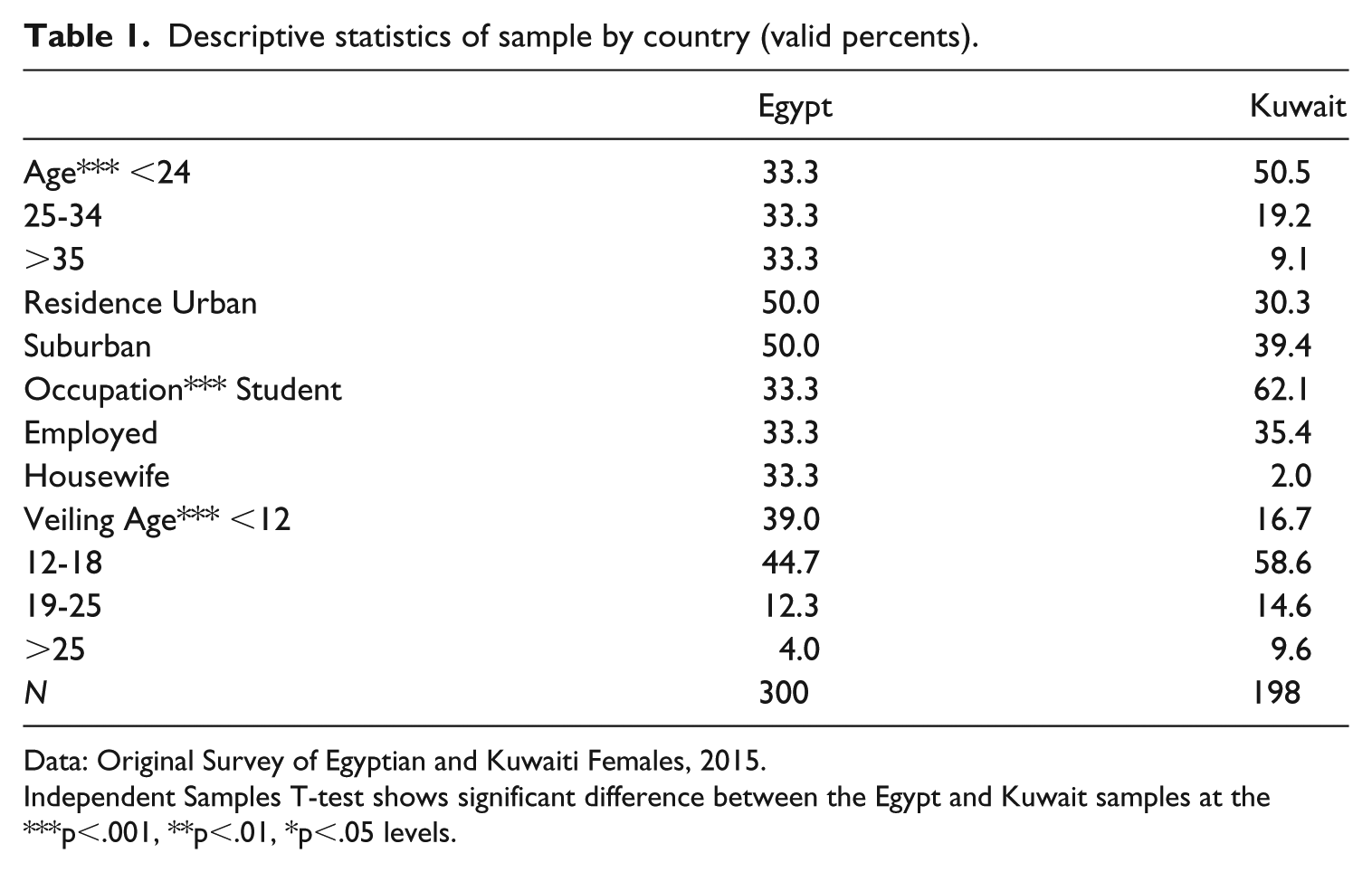
Data: Original Survey of Egyptian and Kuwaiti Females, 2015.
Independent Samples T-test shows significant difference between the Egypt and Kuwait samples at the ***p<.001, **p<.01, *p<.05 levels.
Data and methods
In order to address our research questions, we collected data from an original survey of hijab-wearing females in Egypt and Kuwait in 2015. The survey consisted of 38 question items including demographics, age at veiling, individual and societal influences, and beliefs about the hijab for themselves and perceptions of others. The data was collected from a convenience sample of housewives, students, and employed women in Egypt and Kuwait. We chose a convenience sample due to various practical constraints, including budget, time, and feasibility of finding hijab-wearing women in a diversity of settings within our two country case studies. While the non-random sampling method of data collection limits the generalizability of our findings, we believe that the findings from our in-depth case study of hijab-wearers makes an important contribution to the literature on the motivations of hijab-wearers.
We attempted to get variation in occupation and age, which was achieved more uniformly in Egypt than for the Kuwait sub-sample. The sample from Egypt was obtained from students in Cairo (an urban setting) and from a rural district outside of Cairo. The working women and housewives were from both Cairo and the rural district outside of Cairo. The Kuwaiti sample was collected as a quota sample from Kuwait University Campuses and Kuwait City. We report the descriptives of the sample by country in Table 1. 2
We see that the sample differs by country in terms of age, occupation, and veiling age. The Egyptian sample is more uniformly spread across the age distributions from under 24 to over 35, while the Kuwait sample is skewed towards a younger age. The Egyptian sample is also more uniformly distributed across occupations of student, employment and housewife, while the Kuwait sample, younger as aforementioned, is skewed towards the student occupation. Lastly, a larger number of the group of Egyptians began veiling younger than 12, which differs significantly from the Kuwaitis who were largely teenagers when they first veiled. Table 2 lists frequencies of various hijab variables by country which are described in detail in the findings section.
Frequencies of various hijab variables by country (percent of total).

Data: Original Survey of Egyptian and Kuwaiti Females, 2015. Independent Samples T-test shows significant difference at the ***p<.001, **p<.01, *p<.05 levels. Some subcategories (ex. ‘if yes?’) may have more responses due to respondent error. a indicates less than 3 responses.
In secondary analysis, in Table 3, we display the findings of an ordinary-least square regression on agency in veiling choice. 3 In Table 4 we present the results from a binary logistic regression on the probability that a woman has thought about removing her hijab (low-salience, and whether a woman has convinced another to wear the hijab (high-salience).
Ordinary least-squares regression on agency in veiling choice.
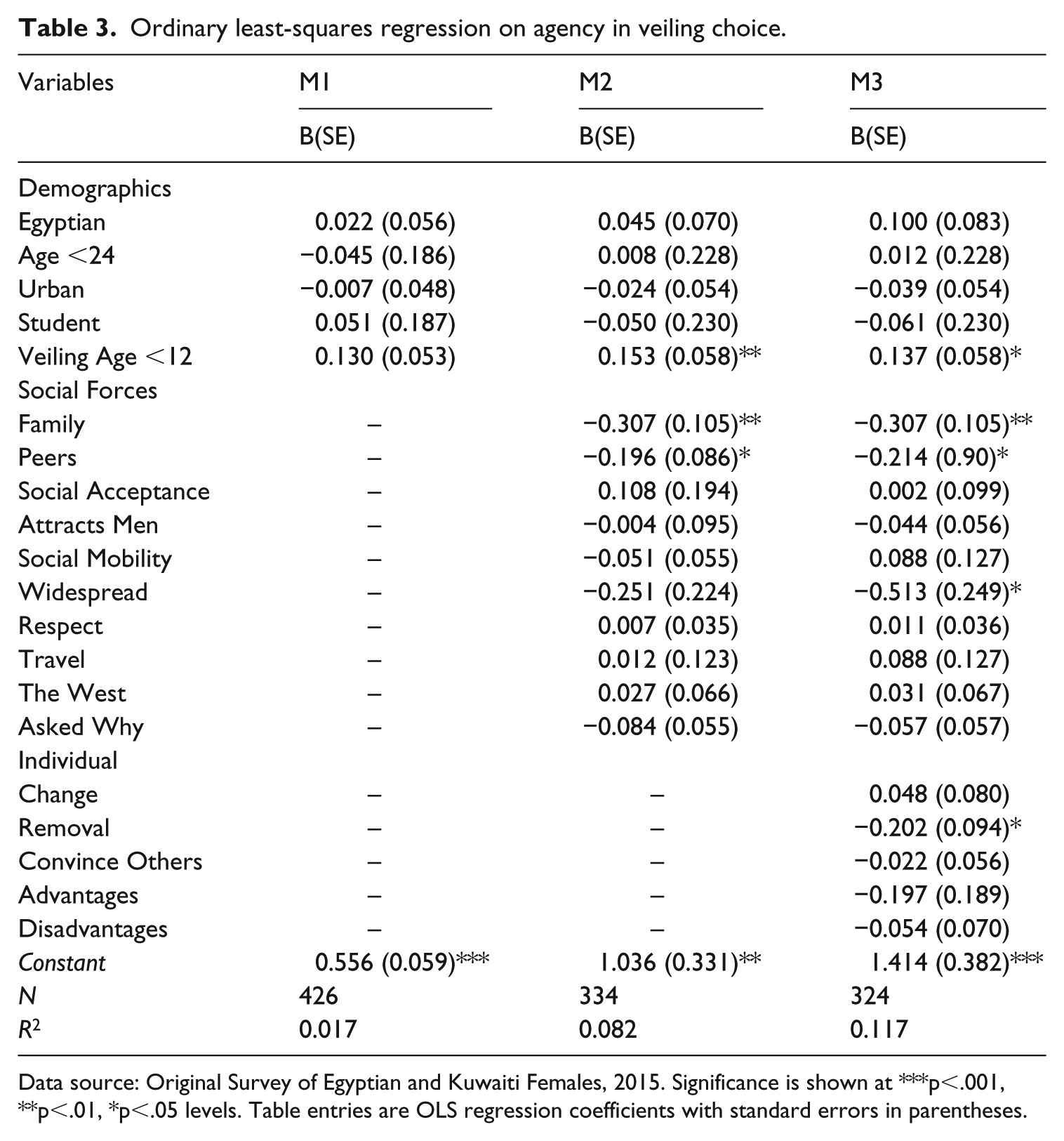
Data source: Original Survey of Egyptian and Kuwaiti Females, 2015. Significance is shown at ***p<.001, **p<.01, *p<.05 levels. Table entries are OLS regression coefficients with standard errors in parentheses.
Binary logistic regression on salience of the hijab.
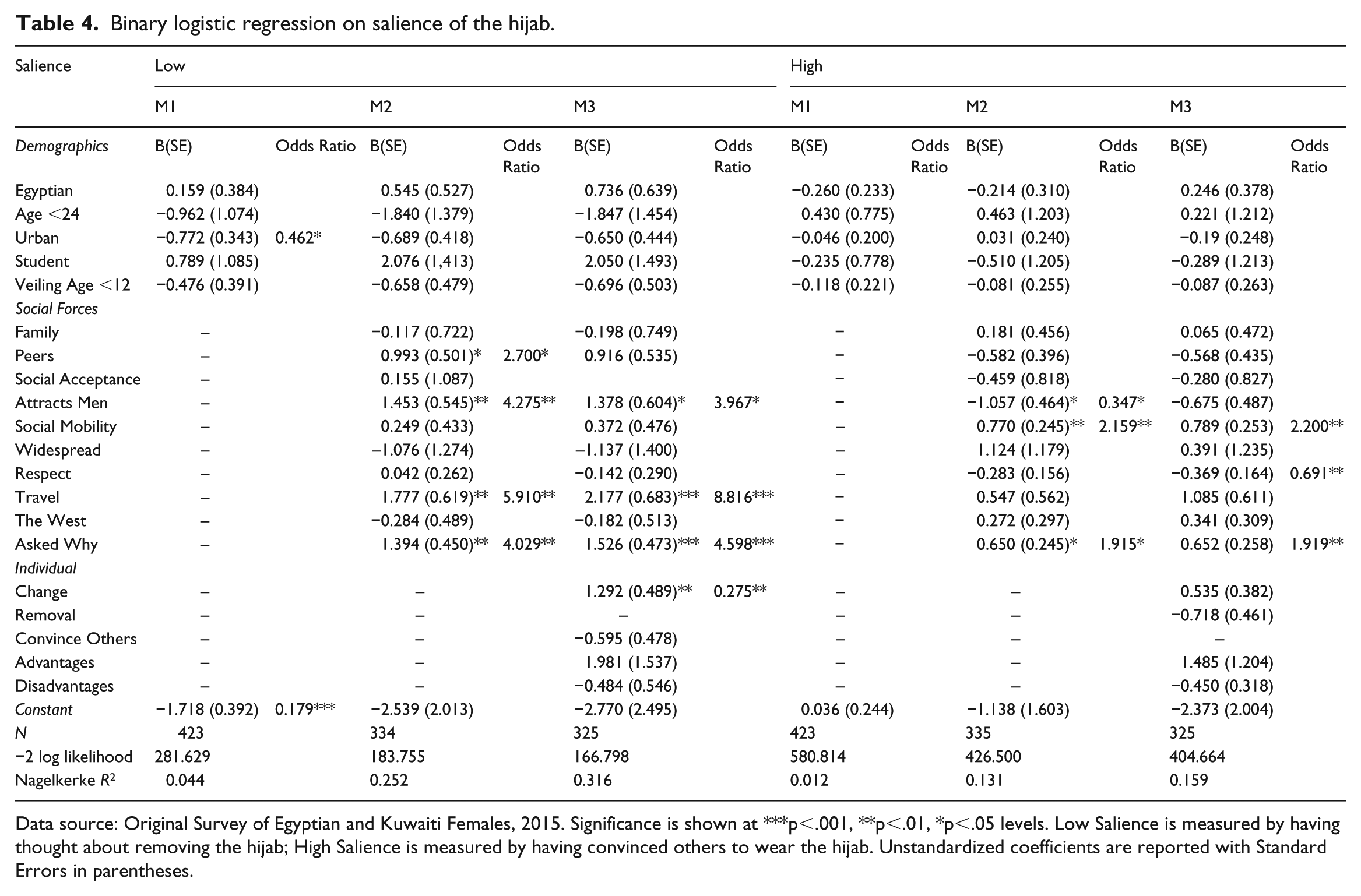
Data source: Original Survey of Egyptian and Kuwaiti Females, 2015. Significance is shown at ***p<.001, **p<.01, *p<.05 levels. Low Salience is measured by having thought about removing the hijab; High Salience is measured by having convinced others to wear the hijab. Unstandardized coefficients are reported with Standard Errors in parentheses.
Findings
Influence
From the results in Table 2, Independent Sample T-tests show a statistical difference between Egyptian and Kuwaiti hijab-wearers on who influenced them to wear the veil. Both samples claim themselves as the main influence on their decision to wear the hijab, but the sample of Kuwaitis, notably younger from the descriptive in Table 1, claim their parents and friends as a stronger influence. The Egyptian sample, more evenly distributed in terms of profession and age, list husbands as a greater influence on their decision. 40% of the Egyptian sample admits that someone asked them to wear the hijab, which highlights the importance of social forces in making this individual decision.
Importance
Again, T-tests show a statistical difference between Egyptian and Kuwaiti hijab-wearers on the most important reason for wearing the hijab. While both samples claim that Faith is the most important motivation, both Egyptians and Kuwaitis feel pressure (7.3% and 5.1%, respectively) to wear the veil. Another claim is that the ‘veil increases people’s respect for the girl’ (5.7% Egypt, 4.0% Kuwait). An interesting difference is that the claim that the hijab offers protection is higher for the Egypt sample (2.7%) than for the Kuwaiti sample (1.0%). Perhaps the sample of Egyptians feel that wearing the hijab offers protection from sexual harassment, in a country that has among the highest known reports of sexual harassment experienced by women in the world (Bernardi, 2017; Lee and Fahmy 2014; Abdelhadi 2008).
Social forces
Next, we analyze a number of categories of social influences on a hijab-wearer, including family, peers, social acceptance, respect, mating and marriage, social and physical mobility, and outside influences. Importantly, we pay attention to variables who do not display a significant difference by country, meaning that perhaps these social and individual variables may be equally significant or insignificant to hijab-wearers in both majority Muslim contexts. For example, the fact that both Egyptian and Kuwaiti hijab-wearers reported someone in the family wearing a headscarf reinforces the general point that family networks are an important influence on women wearing headscarves.
Family
We noted earlier that parents are a significant influence on this sample of hijab-wearers, 22% for the Egyptian sample, and 27.8% for the Kuwaiti sample. Husband is also not an insignificant influence on Egyptian women. The vast majority of both samples report someone in the family wearing a headscarf. Interestingly, there is an almost inverse attribution to their influence, where the majority of Egyptians say this hijab-wearer in the family had no effect on their choice to wear the hijab, while Kuwaitis, again a younger sample, say this family member did have an influence on them to imitate their choice.
Peers
As mentioned in previous studies, hijab is often discussed in tension with secular fashion, particularly for young people (Botz-Bornstein and Abdullah-Khan, 2014). In this sample, there is no statistical difference between the Egyptian and Kuwaiti samples for whether the hijab prevents them from following fashion, the majority say no, it does not prevent them from following fashion. However, among the 10–12% who do believe the hijab prevents them from following fashion, there are differences of opinion. Kuwaitis more than Egyptians believe that there is a restriction in what a hijab-wearer is allowed to wear and that the hijab does not follow international fashion. Among the majority who don’t believe the hijab restricts fashion, Egyptians and Kuwaitis believe fashion can be adapted to the hijab, and then there are differences by samples about the individual importance of fashion, and availability of designer hijabs.
Social acceptance
There is no difference between samples on the belief that the hijab gives the wearer greater social acceptance. This is evidence for a general belief among hijab-wearers that the hijab gives them greater social acceptance in majority Muslim countries. The opposite has been found of hijab-wearers in non-Muslim contexts (Zahedi 2011; Ho and Dreher 2009; Afshar 2008; Moruzzi 2008; Kadri 2007).
Widespread
Another question was whether hijab-wearers believe they are part of something widespread or not. There were differences by country to as to why the hijab-wearer believed that the hijab is widespread in their own society. 50.7% of the Egyptian sample believed that the hijab was widespread in Egypt because it is fashionable and accepted by the youth. 54.5% of the Kuwaiti sample believed that people in Kuwait are more religious and that the media plays a role. Here again, 8.7% of Egyptians report fear of harassment as among the reasons for the increase in hijab-wearing in Egypt, while 14.1% of Kuwaitis list pressure from husband or family.
Respect
There are significant differences between Egyptian and Kuwaiti samples on the issue of respect. The women in the Egyptian sample believe equally that by wearing the hijab they gain people’s respect (36%), that their society has become more conservative (32.7%), and less that the hijab adds to their ability to gain people’s respect (15%). The Kuwaiti hijab-wearers on the other hand believed most that wearing the hijab adds to their ability to gain people’s respect (41.9%). However, the Kuwaiti sample expressed more individual-level agency when they claim that ‘a woman’s behavior is more important [than wearing hijab]’ (23.2%) and they care less about what others think (13.6%). 4
Mating and marriage
A popular argument in Muslim countries is that the hijab serves as a symbol for a woman’s readiness for marriage. The vast majority of the samples reports that they believe the hijab is not worn in order to attract men, but because it is required by religion (Kuwaitis report this at 71.7%), for self-protection and honor, or to gain people’s respect (Egyptians claim this more at 30.7%). But of the minority who do believe that young women wear the hijab to attract men, Kuwaitis have a stronger belief in the perception that young men prefer to marry a woman who wears hijab. 5
Mobility
In societies where Islamic societal norms prefer a separation of genders in order to avoid opportunities for even perceived sexual impropriety, does the hijab offer women greater social and physical mobility? On the other hand, does wearing the hijab cause wearers to occupy a certain Islamist group identification that would limit their ability to travel and obtain work in secular environments? Both the Kuwaiti and Egyptian samples report their belief that the hijab gives them freedom of movement. 6
Those who believe the hijab offers greater freedom of movement differ significantly in their reasons by country. Egyptians believe wearing the hijab gives them greater movement without restriction (38%), while the Kuwaiti sample believes they have greater freedom of movement for religious reasons (53.5%) and because their family has more confidence in them (12.6%) and likely allows them greater freedom. Interestingly, neither sample reports that the main reason the hijab allows greater movement in their society is as protection from harassment.
Travel is another time when hijab-wearers may feel differently about the context for their hijab. Although only a small number from the sample report feeling that the hijab is a handicap to them during travel, some do claim discomfort at being stared at by ‘Westerners’ or what they interpret as ‘harassment’ at the airport security check.
Outside influences
In order to understand hijab-wearers’ motivations for the persistence of wearing the hijab, we also analyze their relationship to outsiders. By outsiders we mean societal influences beyond or outside of their immediate majority Muslim society. We actually see common ground between the Egyptian and Kuwaiti sub-samples on perceived misunderstanding by the West of the hijab (79.3% Egypt sample, 75.3% Kuwait sample). Interestingly, misconceptions they believe the West holds about the hijab are that it restricts women’s freedom, that they see it as radical and related to terror, or that they see it as different and backwards. The Egyptian sample seems more likely to believe that the West sees the hijab as different and backward than the Kuwait sample. In fact, Kuwaitis generously report that they do not believe the West misunderstand the hijab as restricting women but that they do have a misunderstanding about the hijab, seeing it as a sign of religious radicalism.
Lastly, another measure of outside influences on hijab-wearers is by their exposure to non-hijab-wearers. When asked if anyone had asked them why they wear the hijab, 60.3% of the Egyptian sample said no and 63.1% of the Kuwaiti sample said yes. The huge differences by country may indicate that Kuwaiti hijab-wearers are more frequently exposed to non-hijab-wearers, either Kuwait women who don’t wear the hijab or foreigners who do not wear the hijab residing in Kuwait. Given the large percent of non-Kuwaitis residing in Kuwait, it is plausible that Kuwaiti women wearing the hijab are simply more exposed to non-Kuwaiti non-hijab-wearers and are asked to give reasons for why they chose to wear the hijab. Also, wealthy Kuwaiti women may be able to travel abroad and be exposed to Western societies where they may be asked about their hijab.
Individual influences
After seeing the importance of various societal influences on hijab-wearers, next we analyze a number of individual level variables.
Change of lifestyle
First, both samples were asked if the hijab changed their lifestyle. The majority in both samples reported that the hijab did indeed change their lifestyle. Unfortunately, some questions that were only asked in one country or another, such as how did the hijab change your lifestyle, asked only in Egypt, are not comparable. However, the responses to this question from the Egyptian sample still provide some important insights. 36.3% of the 85% of the Egyptian sample claimed they felt closer to God, 19.7% reported that they gained confidence, 15.3% gained people’s respect, 8.7% believed their dress was more respectful, and 4.0% believed it changed their lifestyle because it protected them from harassment.
Removal
Another very individual question was whether the hijab-wearer ever thought about removing the hijab. 11% of the Egyptian sample admitted to thinking of removing the hijab, and 9.1% of the Kuwaiti sample. Of those that did think of removing the hijab (total n=51 for both samples), some reasons given were that they felt the hijab did ‘not suit’ them, and for ‘social reasons’ of their community (total n=36 for both samples). This is an interesting finding that even for such a personal choice as a woman’s daily wearing of a headscarf, a number admitted to thinking of stopping their practice for ‘social reasons.’ This is further evidence that societal pressures influence women not only to take up but to put down certain cultural practices and norms.
A second important question was asking the current hijab-wearer if the hijab they wore was the first time they wore the hijab, or if they had worn it before and removed it. While the majority of respondents reported that this was their first hijab, a number of women, 13.3% of the Egyptian sample and 7.1% of the Kuwait sample admitted to having worn it before and removed it. To the outside observer, wearing the hijab can seem to be a binary variable or outcome. However, the data show that perceptions, feelings, and practice towards the importance and symbolic meaning of the hijab for hijab-wearers are on a continuum, with the possibility always open to remove or to put on. Of those who had removed their veils once, the most popular reason (10.3% of the 13.3% sample) was that they were too young when they wore the veil the first time and perhaps did not fully understand the commitment they were making. The smaller group of Kuwaitis (2.5%) were dissuaded by its lack of aesthetic value and restriction on clothing choices.
Convincing others
On the opposite spectrum of individual questions were the responses to the question of whether the respondent had convinced others to wear the hijab. Here we also see interesting differences by country. 44.3% of Egyptians had convinced others to wear the hijab, and 51% of the Kuwait sample had convinced others. It is unclear at this point why country differences exist on this variable, which would be evidence for the high salience of the hijab to the wearer. In order to understand further the relationship of previously discussed societal influences on the salience of the hijab, we probe this question with further analysis in Table 4.
Advantages
When asked whether the hijab has advantages, the majority in both samples said yes, however there were again differences by country in their reasons why the hijab has advantages. Egyptians quite evenly reported that it gives self-confidence (21.3%), brings them closer to God (26.3%), adds to women’s beauty and respect (22.3%), and prevents them from harassment (27.3%). The Kuwait sample overwhelmingly reported it brings one closer to God (67.7%) and second that it gives one self-confidence (24.2%).
Again, we see an interesting difference by country in reasons for arguing why the hijab has advantages. Egyptians see the value of the hijab as preventing them from harassment while Kuwaitis do not. This could be a commentary on how Kuwaiti women deal with social mobility differently – by car. Since Kuwait does not have public transportation and is not walkable, if driving by car, they may not encounter men on the street as much as Egyptian women who may share public transportation or crowded sidewalks with men in the market, on the way to school, and work. 7
Secondary analysis
After taking note of individual-level variation in an individual’s relationship to her hijab, we next want to see what social forces are influential in determining the agency and salience of one’s hijab. To understand the influence of demographic characteristics on self-reports of self vs. societal influences to hijab-wearers, we present the findings of an ordinary least-squares regression on individual vs. societal influence on wearing the hijab in Table 3. The dependent variable, Agency in Veiling Choice, is measured by self-reported most important influence on decision to wear the hijab, ‘Self’ was categorized as 1, and all other categories (parents, friends, husband, school) were coded as 0.
Model 1 shows OLS Regression on the Dependent Variable (DV) with controls of various demographic variables. Model 2 adds social forces variables. Model 3 adds individual variable controls. Model 1 shows that demographic controls alone do little to explain agency in veiling choice. Model 2 shows that veiling under 12 years of age is positively correlated with self-reported agency on the decision to wear the hijab. Model 2 also shows influence of family and peers are negatively correlated with self-reported agency in deciding to wear the hijab. In Model 3, we see that family and peers, but also a belief that the hijab is widespread are negatively correlated with agency in hijab choice. This might indicate that if one thinks too much about the popularity of the hijab that diminishes the reported agency of one’s veiling choice. Having thought of removing the hijab before also negatively predicts self-reported choice of wearing the hijab. In other words, having thought of removing the hijab is a predictor that one would say societal pressures influenced their decision to wear the hijab. Being less than 12 when veiling continues to be a positive predictor of self-reported agency on wearing the hijab. This evidence contradicts the belief that veiling at a young age is interpreted later in life as having been pressured into a decision that conforms to cultural norms.
Lastly, in order to further analyze the social forces that predict individual level considerations of a hijab-wearer’s relationship to her hijab, we see what social forces influence her considerations of either removing the hijab or convincing others to wear it. Table 4 shows the results of a binary logistic regression on low vs. high salience of wearing the hijab. We measure ‘low salience’ by whether the respondent has thought about removing her veil, and ‘high salience’ by whether the respondent has convinced others to wear the hijab. We report odds ratios and significance to determine which variables were the strongest predictors of salience. Model 1 for both low and high salience show odds ratios of the probability on the dependent variable with controls of various demographic variables. Model 2 adds social forces variables. Model 3 adds individual variable controls.
Low salience
Model 1 indicates that solely controlling for demographic variables, being from an urban area lowers the likelihood that one would think of removing the hijab. Model 2 shows that controlling for social forces eliminates the effect of urban residence, but additional social forces have significance. Believing the hijab prevents one from following fashion (here defined as the effect of peers), believing that young women wear the hijab to attract men, believing the hijab is a handicap during travel, and being asked why they wear the hijab (exposure to non-hijab-wearers) all increase the likelihood of thinking about removing their hijab. Model 3 shows that respondents who believe that young women wear the hijab to attract men are almost 4 times more likely to have thought about removing their hijab. Women who believe the hijab is a handicap during travel are almost 9 times more likely to have thought about removing the hijab. Women who have been asked why they wear their hijab, showing exposure to non-hijab-wearers, are almost 4.6 times more likely to have thought about removing their hijab. Reporting that the hijab has changed their lifestyle reduces the likelihood of reporting having thought of removing the hijab. The findings indicate that the logistical inconveniences and exposure of social risk to non-hijab-wearers does increase a hijab-wearers risk of removing her hijab by increasing the likelihood that she will think about removing it.
High salience
For the High Salience group, demographics does not explain the likelihood of convincing others to wear the hijab. Model 2 shows that believing that young women wear the hijab in order to attract men lowers the likelihood that one has convinced others to wear the hijab. Model 3 gives some evidence that believing that the hijab increases people’s respect in society is negatively correlated with convincing others. However Models 2 and 3 show the importance of social forces on one’s likelihood of having high salience for the hijab. Believing that the hijab gives greater freedom of movement and being asked why they wear the hijab are both positive predictors of the likelihood of convincing others to wear the hijab. What the findings indicate is that for both low and high salience hijab-wearers, being asked why they wear the hijab can be a powerful predictor for exposure to non-hijab-wearers as either a social risk to removing the hijab and joining them or as a means of convincing others to join one’s group of hijab-wearers.
Conclusion
The data presented here, from almost 500 hijab-wearers in two very different Muslim societies provides an important case study into the in-depth motivations, both individual and societal, of the persistence of social norms. We find that family, peers, and perceptions of other’s views of the cultural and symbolic capital of the hijab all influence the individual’s motivations for persisting in a conservative cultural norm. Having thought of removing the hijab is a predictor that one would say societal pressures influenced their decision to wear the hijab. Being less than 12 when veiling continues to be a positive predictor of self-reported agency on wearing the hijab. This evidence contradicts the belief that veiling at a young age is interpreted later in life as having been pressured into a decision that conforms to cultural norms. For both low and high salience hijab-wearers, being asked why they wear the hijab can be a powerful predictor for either exposure to non-hijab-wearers as a social risk to removing the hijab and joining them or as a means of convincing them to join one’s group of hijab-wearers. Our findings contribute to a gap in the literature on the role of ‘norm-breakers,’ those who facilitate a confrontation between a norm-keeper (the hijab-wearer) and those who do not follow or do not agree with the cultural norm. In this case, exposure to norm-breakers both reinforced hijab-wearers’ commitment as well as facilitating the opportunity for hijab-wearers to consider removing the hijab.
While our findings are limited to our sample of Egyptian and Kuwaiti hijab-wearers, the conclusions from this study tell an important story about the persistence of cultural norms such as veiling. In this article we analyze self-reported motivations of hijab-wearers in order to understand this practice from within two different Muslim majority societies. At an individual level, human dress is symbolic of identity and thus gives signals to outside observers of different meanings. At the macro-level, society’s history of interaction with the dominant religion and the relationship of religious factions of the society, such as political Islamists, with the ruling government, also shapes the social and cultural symbolic capital of the veil, where one must overcome the social cost of breaking with societal norms in order to live out one’s faithful practice (whether that means wearing the veil or not). As we find in this study, exposure to norm-breakers is essential to reinforce the individual salience of social norms. To wear the hijab, like many choices of human life, is a decision of individual gravity whose meaning comes alive when made in and for community.
Footnotes
Funding
This research received no specific grant from any funding agency in the public, commercial, or not-for-profit sectors.
Notes
Author biographies
Address: Department of Sociology and Social Service, Kuwait University, Kuwait.
Email:
Address: University of Chicago, Kenneth C. Griffin Department of Economics, 1126 E. 59th Street, Chicago, IL 60637, USA.
Email: