




Abstract
In this article, we aim to reflect on the emergence and manipulation of social feelings in the context of intense transformations, called cold periods in history by Durkheim. The event known in the mainstream media as the ‘gay kit’, and political and religious articulations surrounding its suppression in 2011, is the empirical basis for our analysis. As a counterpoint, we will identify narratives and conservative activism organized around Bill No. 6583/2013, also known as the Family Statute, which has been the subject of numerous public debates, especially in 2015. In both cases, we reflect on social fears, morally based panic and on the situated activation of the rhetoric of loss by politicians with religious conservative liberal profiles.
Introduction
In ‘Social Science and Action’, Émile Durkheim reflects on ‘cold periods’ in history, in which old ideals and deities would be under threat of vanishing or losing their central positions in social life. These cold periods, viewed by the author as existential and morally disturbing to individuals, are so-called because they cover up the sources of furor contained in society. In periods of social transformation that may take on historical dimensions, such as Durkheim’s reflections on what we see in Brazil and the world today, public sentiments emerge that warrant analysis.
Fears are experienced by different groups, for when people cherish some set of values and do not feel any threat to them, they experience well-being. When they cherish values but do feel them to be threatened, they experience a crisis – either as a personal trouble or as a public issue. And if all their values seem involved, they feel the total threat of panic. (Mills, 1969: 17–18)
Social fears can be manipulated in order to contain ongoing processes of transformation and/or to conduct them so that they can be controlled.
In this article, we reflect on political articulations, especially on the conservative religious activism 1 that is organized in order to contain ongoing changes regarding the issue of guaranteeing and expanding the rights of the Lesbian, Gay, Bisexual, Transsexual and Transgender (LGBTT) population in Brazil, as well as transformations in gender relations in socially determined roles for women and men, based on the legal guarantee of an orthodox family standard. The manipulation of fears based on scientific, philosophical, and biblical narratives, as well as the public embarrassment of political leadership through intense parliamentary pressure, are both common artifices mobilized by conservative activists involved in the cases highlighted here for analysis.
The more general context of public emergency regarding the issues we intend to address involves the social empowerment of different social players in recent years in the country. On the one hand, strengthening the social activism of LGBTTs and women, whether at the base of society or at a political level, has resulted in the establishment of the Tripartite Commission for the Review of Punitive Legislation on Abortion (2005), the launching of the Brazil Without Homophobia Progam (2004), in the 1st LGBT National Conference (2008), and the III National Program of Human Rights – PHDH3 (2009). Taken together, they contemplate the deconstruction of heteronormativity, paving the way for other demands of sexual minorities. The National Education Plan (PNE-2014-2024) covering gender issues and Bill 122/2006, which instituted the criminalization of homophobia, were added.
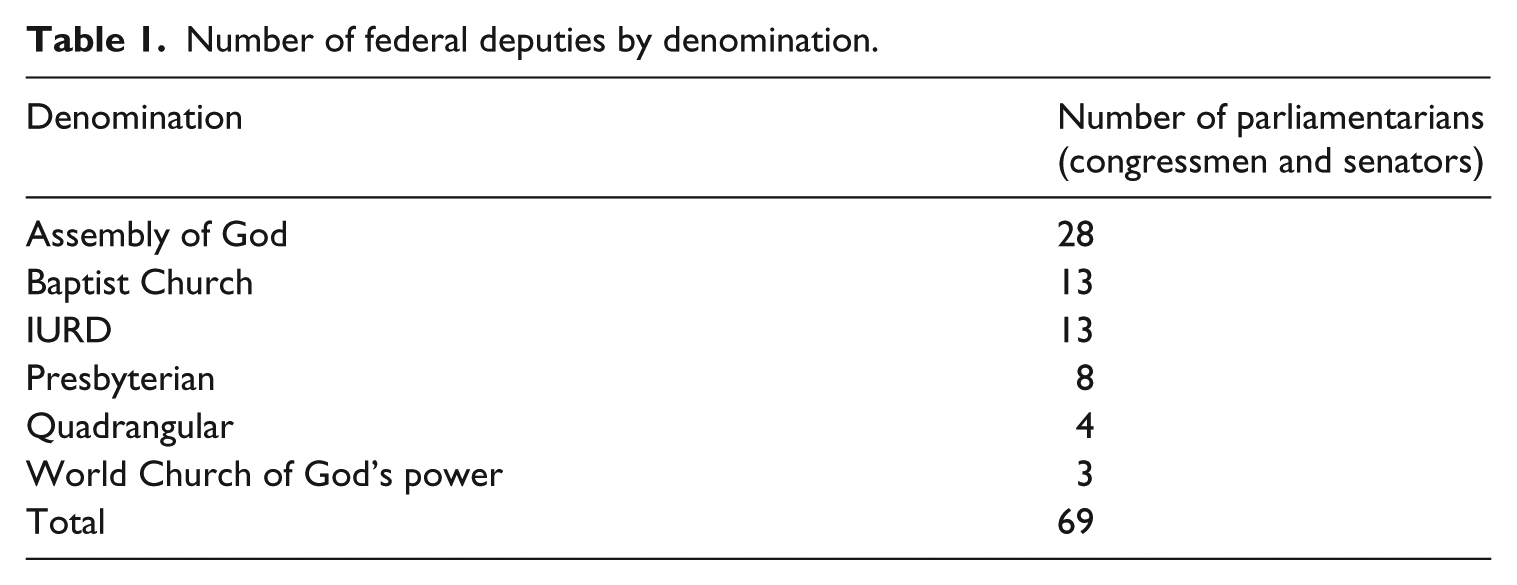
Juxtaposed to this trend, a revitalization of conservative religious activism in national politics has taken place. In Brazil, from the 1980s onwards, Pentecostal churches have begun an intense articulation aiming to occupy legislative positions throughout the country. Studies have shown how such political activism has been aligned mostly to the right of the political-ideological spectrum, penetrating all the party bases (Machado and Burity, 2014; Mariano, 2011; Oro and Mariano, 2011). Although the Pentecostals were initially a majority, there has been an increase in the number of Protestants in the National Congress. In the current legislature, the Evangelical Parliamentary Front (FPE) is composed of 84 Federal Deputies representing 18 Evangelical denominations, 2 the main ones being the Assembly of God, Baptist Church, Universal Church of the Kingdom of God, Presbyterian Church and Foursquare Church, as in Table 1.
Number of federal deputies by denomination.
In addition to the FPE, restructured in 2003, and the Catholic Parliamentary Front, formally founded in 2015, religious Afro-Brazilians also have their representatives in the so-called Parliamentary Front of Terreiros, founded in 2011, with a very different profile and makeup compared to the two Christian fronts.
This strengthening of conservative religious activism in the legislative sphere occurred in parallel with the growth in the number of evangelicals in Brazil with notable theological, doctrinal, ritualistic and political orientation diversity. A rough outline shows that in 1940, evangelicals made up 2.6% of the population, 40 years later in 1980, they came in at 6.6%. In the 2000s, the number jumped to 15%, a decade later, the 2010 Demographic Census indicated that 22.2% of the Brazilian population declared itself evangelical. Even more recent data from the DataFolha Institute 3 show that 29% of the national population is evangelical. Catholicism, the cultural and historical matrix in the configuration of the Brazilian Nation-State, in the same 2010 Census, showed a downward curve found at 64.6%. 4
There are countless bills (PL) and draft amendments to the Constitution (PEC) formulated by evangelical parliamentarians or that have them in their rapporteurships. These projects do not properly indicate their political strength in terms of their effectiveness in approving all or part of their proposals, but rather a modality of action based on the production of ‘political facts’, the placement of their themes that affect the ‘Kingdom’ in the center of the public debate, as they have said countless times in interviews. In more sociological terms, we would face a situation of production of public problems.
Within the premise of this article, it is not feasible to present a history of mobilization and the basis for sustaining arguments about the definition of gender and a normal sexuality (in Goffman’s terms). However, we have here cases that allow us to follow efforts of social players ‘to demonstrate the urgency [of these issues] to be treated and resolved as a priority and inserted in a public agenda’ (Freire, 2016: 86), as well as to analyze the processes of publicity players in these situations (Cefai, 2002).
Spector and Kitsuse, in the 1970s, formulated an important reflection on claims-making activities, generating significant transformations in the studies on diversion and social problems (Cefai and Terzi, 2012). In the 1980s, Gusfield’s (1981) work The Culture of Public Problems: Drinking-Driving and the Symbolic Order, proposed analyzing public problems in light of a group’s cognitive and moral skills when it denounces conditions it considers unfair or abnormal. The protagonists in the public arenas, the author suggests, are dramatists and evaluators of the subject they consider problematic in each sequence of the constitution of the public problem. Therefore, a public problem, in this perspective, presents dramatic, ceremonial and ritualistic qualities that are the focus of Gusfield’s observation and which we will explore here. 5
As an example, we can cite PEC 99/2011, written by João Campos (at the time member of the PSDB party, now in the PSC-GO party), president of FPE. This PEC is intended to add to Article 103 of the Federal Constitution an item that deals with the postulatory capacity of Religious Associations to propose unconstitutionality and declaratory action of constitutionality of laws or normative acts before the Federal Constitution.
Other examples would be PL 160/2009 by MP George Hilton (then of the PRB-BA party, now in the party in PSB-BA). This PL, better known as the General Law Project of Religions provides for the guarantees and fundamental rights to the free exercise of belief and religious worship established in items VI, VII and VIII of article 5 and in paragraph 1 of article 210 of the Constitution of the Federative Republic of Brazil.
Another PL 1219/2015, authored by federal deputy Leonardo Quintão (PMDB-MG), is known as the Statute of Religious Freedom. 6
The actions of members of the FPE and of conservative Catholics in the National Congress can be considered reactive. In the terms proposed by Vaggione (2006), the Latin American context demonstrates the expansion of reactive politicization ‘which generally includes the use of organizational forms of civil society, especially through the creation of NGOs, as well as arguments based on scientific and legal discourse’ (p. 26). As such, they aim to hamper projects and/or public policies that aim to guarantee and/or expand rights for specific social groups, especially the LGBTT population. In Brazil, they have managed to obstruct the criminalization of homophobia, so far with the PL 122/2006, through different public actions aimed at combating homophobia in Brazilian society, as was the case with the MEC teaching material, as we will see later.
We will try to follow here, then, processes of dramatization, performances, visibility and scenarios in the public sphere. Inspired by Gusfield’s point of view, what matters in case analysis is not the truthfulness of the facts, but the dramatic performances of people and public spheres, so that a problem becomes a public drama to be treated with priority (Freire, 2016: 102).
Religious parliamentarians against the LGNTT agenda
On 28 March 2011, federal deputy João Campos (PRB-GO), then president of the FPE, made the following statement in the plenary of the Chamber of Deputies in Brasilia: We respect the sexual option that any citizen ops for; However, I am absolutely convinced that it is not for the public authorities to finance such orientation and encouragement. Let us suppose, in the religious field, that the Brazilian State were to finance various programs, various actions, videos, booklets, saying that you have to make the choice for the Catholic religion, the Evangelical religion, Spiritism, Buddhism, etc. This was never meant to be the role of the Brazilian Government, as it should not be with regard to sexual orientation, to say that you have to be heterosexual or homosexual … The Brazilian Government, not only President Lula, but President Dilma, who have made a commitment to the religious of the country, not only to evangelicals, that it would not take any initiative of this nature, now, in a fraudulent light, says that this material has a pedagogical role to guide teachers and students to prevent homophobia, It altogether features another aim which is to establish this kind of orientation. We cannot permit this.
This was the first public reaction dramatized in the National Congress and contained an evaluation of the educational material destined to set the theme and to prevent homophobic bullying in schools in Brazil. The material quoted was pejoratively known as ‘the gay kit’. Created by ECOS – Communication in Sexuality, a São Paulo NGO focused on reflection on sexuality, gender, age and race. The material consisted of (1) an orientation notebook for the educator, the ‘School Notebook Without Homophobia’; (2) a series of six bulletins written in a youthful language, aimed to be distributed among students; (3) a poster for publicizing the project at school, which encouraged the school community to seek more information about the project; (4) introductory letters for the managers and educators, explaining the project and indicating the best ways of working with it; and (5) three educational videos that, accompanied by their respective discussion guides, functioned as stimulators of debate. The use and distribution of the material, therefore, depended on the guidance of an educator formed by the School Without Homophobia program.
After several meetings with technicians from the Ministry of Education, activists from the LGBTT movement, educators from different parts of Brazil, and having tested the material with a group of teachers from São Paulo, the material had as its objective ‘to contribute to the deconstruction of stereotyped images about lesbians, Gay, bisexual, transvestites and transsexuals, and promote as an extra the coexistence and respect for people of different orientation’ (Caderno Escola sem Homofobia, 2010: 11). Its target audience was the entire ‘school community and, in particular, primary school pupils (grades 6-9) and high school students’. The material was produced under the Program to Combat Violence and Discrimination against LGBT and the Promotion of Homosexual Citizenship, better known as the ‘Brazil Without Homophobia Program’, presented in 2004, thus still in the first term of then President Luiz Inacio Lula da Silva (president from 1 January 2003 to 1 January 2007).
After an orchestrated articulation, mainly by Catholic and Evangelical parliamentarians in the National Congress, that they would obstruct the government’s guidelines in the House, the distribution of educational material in public schools in Brazil was suspended. The suspension was announced by President Dilma Rousseff on 26 May 2001, despite the fact that the material represented assets worth 2 million Reais (in 2010) of public money, and was the result of a popular mobilization of the Brazilian Association of Lesbians, Gays, Bisexuals, Transvestites and Transsexuals (ABGLT).
Since being revealed in two public hearings held at the Federal Chamber in November 2010, the educational material has been the subject of controversies and heated positions of parliamentarians, who have stood against its production and circulation. Initially, federal deputy Jair Bolsonaro (PSC-RJ) was most ardently against, and produced pamphlets with inaccurate information about both the educational material, and the proposals contained in Bill 122/2006 that instituted the criminalization of homophobia in Brazil, 7 and also on the ‘National Plan for the Promotion of Citizenship and Human Rights of Lesbian, Gay, Bisexual, Transvestite and Transsexual’. With slander and vagueness, the deputy tried to produce narrative conflicts that favored the emergence of moral panic. 8 Therefore, in a pejorative and frightening tone, the parliamentarian argued that it was a question of imposing a minority sexual orientation on Brazilian children and that the growth of LGBTT would have the inevitable consequence of the growth of pedophilia.
Because of this, the ‘gay kit’ he called the ‘Plan of Shame’ was part of the Promoção da Cidadania e Direitos Humanos de Lésbicas, Gays, Bissexuais, Travestis e Transexuais (PNLGBT)’s proposals. The original wordings of these proposals called for: Ensuring security in areas frequented by the LGBT population with specialized police groups, above all in which there is a high incidence of discrimination and violence, due to sexual orientation and identity of gender, race and ethnicity, among others, ensuring policing proportional to the number of people at events. Establishing public policy to ensure respect for sexual orientation and gender identity in student houses maintained by public power and private initiative, guaranteeing the accommodation of transvestites and transsexuals, respecting their gender identity. Changing the methodology of pedagogical assistance in prisons, aiming to provide better adaptation of the LGBT population.
9
In the parliamentarian language of the deputy, they became, respectively, Ensuring security in areas frequented by the LGBT population with specialized police groups (creation of battalions of gay police in the states – BGay) Student houses for transvestites and transsexuals (Gay Republic) Special prisons for the LGBT population.
10
The same association between homosexuality and pedophilia is produced by evangelical parliamentarians in the Federal Chamber and in Legislative Assemblies in Brazil. 11 Jair Bolsonaro, in the above passages, operates by distorting information that produces a drama exploring ambiguities and disinformation, which potentiates current social fears (Mills, 1969). Faced with the uncertainty concerning ongoing social transformations, specifically in the field of sexuality, parliamentarians exploit fear, affirming necessary links between social practices in order to contain such ongoing processes.
At the beginning of Dilma Rousseff’s first term, more specifically in May 2011, the discussion about the educational material of the Ministry of Education was taken up by evangelical and Catholic parliamentarians, dissatisfied with the progress of programs aimed at the LGBTT population and women. For them, the suspension of the ‘gay kit’ became a central issue, joining forces and political capital in their fight. In order to do so, they mobilized arguments concerning religious morality and appealed to the preservation of the tradition of the Christian family, in an attempt to obstruct both the advancement of educational material and PNLGBT, PL 122/2006, as well as harm reduction policies in the matter of abortion in public hospitals and the extension of legal protection for abortions in situations such as anencephalic fetuses. According to Machado (2017), all of these measures proposed by the consecutive Governments of the Partido dos Trabalhadores (Workers Party) were identified as a ‘family attack’, an incentive to promiscuity, homosexuality and infertility. The statement by Federal Deputy João Campos (PSC-GO) in the House of Representatives plenary, illustrates this defensive logic: If we are to guarantee a better world for our children than the one we have received, we must react to these innumerable onslaughts of those who want to destroy the Christian values of the family, and for this it is important to know deeply the origins of the attacks on life and the family. Divorce leads to the destruction of the family; Sexual freedom leads to promiscuity; Contraception is contrary to the emergence of a new life; Sterilization dries up the source of life; Abortion destroys life; Pornography ruins human beings; Artificial insemination means making a child without the act of love. All this is contrary to the will of God. Only the monogamous marriage between a man and a woman preserves and gives continuity to procreation. (28 May 2011)
Not being successful in the attacks against the program to combat homophobia, despite having turned to the Minister of Education at the time, Fernando Haddad, the religious congressmen began focusing on the aforementioned strategy of coercion of the government, in that they added to the opposition the demand for the convocation, to the plenary of the Chamber of Deputies, then Minister of the Civil House, Antonio Palocci, who was involved in an alleged illicit enrichment scandal between 2010 and 2011. 12
In João Campos’s statement in the Federal Chamber, which developed into the dramatic and performance-oriented situation involving the suspension of educational material by the federal government, we can observe the attempt of evangelicals to produce an equivalence between religious and other spheres of social life. Thus, they legitimized their participation in the political game and the articulation of their religious repertoires based on a defense of equality between social groups in dispute, secularism and democracy. The background for their defense involves a perception of religion not as a private element, a place of belief, as Asad (1993) argued about the place that religion would have taken in the modern West. Instead they aim to situate religion as a public and political character.
Unlike the guidance given by the Catholic Church’s leadership that the place of the church is not in party politics, evangelicals dispute that space by defending it as fundamental to guaranteeing the rights of the Brazilian majority claiming to be Christian. In the liberal sense of democracy they defend that speaking on behalf of Brazilian Christians can be likened to defending the majority and therefore defending the majority is what matters. This public mode of operation of Pentecostal evangelicals is diametrically opposed to the traditional mode of Catholic institutional action. As a hegemonic institution in the national religious field, it presents itself in a ‘neutral’ position, close to society and distant from power. In other words, it is a twofold position because ‘it is the legitimate model of a Church that remains confined to the socially established domain as “religious,” at the same time as manifesting itself as an agent of defense and constitution of a democratic and secular civil society’ (Dullo, 2015: 40).
The abundant social theory presents us with many reflections on the unplanned facets that social life is likely to assume. Elias (1994) warns us: What kind of formation is this, this ‘society’ that we compose together, that was not intended or planned by any of us, nor by all of us together? It only exists because there is a large number of people, it only continues to work because many people, individually, want and do certain things, yet their structure and their great historical transformations are clearly independent of the intentions of any particular person. (p. 6)
Thus, in spite of the institutional orientation of non-Catholic confessionalisation in politics, the number of candidates in the 2014 elections for a seat in the Federal Chamber increased by 15% compared to the 2010 elections, and in 2015 the Catholic Parliamentary Front was registered in the National Congress (FPC), chaired by the federal deputy Givaldo Carimbão (PROS-AL). In a statement, Carimbão affirms that FPC’s priority agendas are abortion, euthanasia and gender ideology, and that all parliamentary actions are aimed at protecting the Bible from the attacks inferred by the Constitution. We note here the articulation of a public argument that sets the Bible above the highest national law, the Constitution, and that the ‘neutral’ place that the Catholic Church has been assuming, until then, is being challenged.
In juxtaposition, the evangelicals in the National Congress do not produce public speech like those of the president of the Catholic Parliamentary Front. They are careful to speak out, making it in defense of the Constitution and articulating a grammar that is very sensitive to human rights, to the valorization of scientific knowledge and to secularity (Campos et al., 2015; Fry and Carrara, 2016; Ruibal, 2014). Such an artifact operates by way of retaliation.
This argument of the other adapted to the defense of opposing positions is called by Taguieff, according to Pierucci (1990: 11), as ‘retaliation effect’. That is to say, a contender places himself on the discursive and ideological ground of the adversary and fights with his arms, which, because they are successfully used against him, cease to belong to him because they now work for his adversary. The retaliation operates at once, a resumption, a reversal, and an appropriation-dispossession of arguments: it is intended to prevent the opponent from using his most effective arguments, by actually using them against him. Although we agree with the analytical limits of this proposition, commented by Pierucci, it still seems to us rich enough to understand the appropriations placed by the arguments of religious parliamentarians.
In these cases, we perceive that the subjects or collectives that have received a certain characterization in which they did not identify, move forward instead of rejecting the terms from which the attacks occurred, to appropriate the terms constructing their own meanings. Political-argumentative games that we identified at the Public Hearing, for example, in which we participated, held in Brasilia on 8 June 2017. The session focused on discussing the exclusion of the expressions ‘sexual orientation’, ‘gender identity’ and guidelines for Religious education in the third version of the National Curricular Common Base. On the day, federal congressman Sosin Cavalcante (DEM-RJ) assured that evangelicals are called fundamentalists in the National Congress. Rather than be offended by the call, he embraces and recognizes it, for ‘there would be no society and there would be no religion without foundation’. It is considered fundamentalist, therefore, in a clear manipulation of the senses that have recently been attributed to the term, in the social and political context of militancy against the FPE.
From another viewpoint, the games of occultation and revelation of the religious in these situations are abundant. The religious argument is articulated as such in relation to a certain public, but the defense of morality as tradition is another feature that partly eschews the religious element, and in part plays into the (supposedly) solid and universal character of its defenses. In terms of a social theory of power, such as the one produced by Elias (1994) in his vast work, with emphasis here on The Established and the Outsiders, originally published in German in 1990, the presentation of self by a social group as traditional, in a situation of dispute, emerges as a legitimating element before the ‘new’ other and on which a moral doubt falls.
Thus, the aim of religious deputies will be the family, proposing PL 6583/2013, better known as the Family Statute, authored by federal deputy Anderson Ferreira Rodrigues (PR-PE), a member of the FPE and the son of Bishop Manoel Ferreira, President of the National Convention of Assemblies of God – Madureira Ministry and the National Council of Pastors of Brazil. In its first articles, the statute featured family rights, public policy guidelines aimed at valuing and supporting the family entity and defined this as a ‘social nucleus formed from the union between a man and a woman, through marriage or stable union, or even by a community formed by any of the parents and their descendants’. The statute deals with the treatment of families by schools, the introduction of a discipline called ‘Family Education’ and establishes 21 October, each year, as National Family Valuation Day.
The family statute has passed committees in the Federal Chamber since 2013. In 2015, when the Federal Deputy Eduardo Cunha (PMDB-RJ), a member of the FPE, assumed the presidency of the Chamber of Deputies, there was a great deal of movement around the proposal. A number of highlights were made mainly by the deputies of the Left, Bacelar (PTN-BA), Jean Wyllys (PSOL-RJ), Glauber Braga (PSOL-RJ) and Érica Kokay (PT-DF) in the Special Committee to deliver an opinion on Or PL 6583/2013. Despite this, since then there has been no further attention surrounding the bill.
If we cannot speak of the effective success of this evangelical parliamentary initiative, in terms of guaranteeing any of the points proposed in the statute, since its formulation, especially in the year 2015, it has given rise to a public debate around the family question and revolved a set of arguments. Those mainly articulated by their advocates claimed that the statute advocated a notion of ‘natural’, ‘original’, scientifically based family, since only in this traditional nuclear family pattern composed of a man and a woman could the species reproduce. Reinforcing this ‘scientific’ argument, advocates articulated the legalistic and heteronormative view of the statute, since, based on the Federal Constitution, it is expressed that the family is made up of people of opposite sexes. The statement of the Catholic representative, the Federal Deputy Evandro Gussi (PV-SP), is added, The Constitution of the Federative Republic of Brazil of 1988 recognized a fact that is of the nature. Because affection is not the criterion of the family. People who want to have the affection they have and the state will guarantee that. Hence transforming into a stable entity, which guarantees procreation and the formation of people is another conversation. We do not want to impose anything, on the contrary. We are humbly acknowledging what nature prescribes.
13
Both in the case of the teaching material of the MEC, suspended by direct intervention of evangelical parliamentarians allied with other members of conservative moral profile, 14 and in the case of the family statute, we have verified the use of legalisms and supposedly scientific and traditional bases to legitimize their positions as Universals. Thus, in general, religious arguments lose emphasis on the debate with society.
Public secret and secularism: final considerations
The defenses of a family pattern and of social roles to be played by men and women in society emerge before a society that undergoes profound transformations in more general behavioral terms (Carrara, 2010; Fry and Carrara, 2016; Machado and Burity, 2012; 2017; Vaggione, 2006). In this scenario, social actors of a conservative religious profile promise to recover and value what was being lost through traditional political games, performances, skills and specific public plays. Rhetoric of the loss that surrounds the Durkheimian narrative, with which we began, marks the perspective of social actors involved in the dramas publicized here. The predictability that offered comfort in relation to what to be and to do is disputed by different contemporary behavioral references.
In this case of great social, cultural and political effervescence, social fears hatch and actors interested in containing public life under the currents of tradition strengthen their political capital. The reactions of segments identified as conservative trigger a ‘mechanism of resistance and control of societal transformation known as moral panics’, elements that ‘emerge from social fear in relation to change, especially those perceived as sudden and perhaps even threatening’ (Miskolci, 2007: 103). In the name of guaranteeing tradition and the social, and even ontological comfort produced among those who meet the established standards, social actors oppose the demands for recognition and promotion of differences.
In the National Congress, Catholics and evangelicals work in collaboration on these agendas identified by them as ‘moral’ or ‘Kingdom’. The demands for the extension of LGBTT rights that began to be identified in national and state public programs and policies, especially since 2005, have become the focus of attention of parliamentarians and Christian leaders. Pastors with decades of work in their denominations and even on TV have gained national expression and have begun talking about these issues in the name of an ‘evangelical collective’.
At the same time, according to empirical data from the first decade of the 2000s, Parliamentarians and Catholic leaders such as federal deputies Eros Biondini (PROS-MG) and, more recently, Flavinho (PSB-SP), are being activated by evangelicals restraining the advance of the LGBTT agenda in Brazil (Carranza, 2015; Procopio, 2014). In the same way, as evangelicals were once activated by Catholics in their historic agenda of containing advances in the agenda of women’s rights, notably abortion.
The percental growth in the number of evangelicals in Brazil has occurred in politics as well as in the arts and in the peripheries, producing unexpected interfaces, provoking other forms of sociability, affecting diverse social dynamics. This is due to the great presence in the media that Pentecostals and charismatics have, and the public marking of their narratives, grammars and aesthetics with the Marches for Jesus (Sant’Ana, 2017), the blocks of Jesus in the carnivals (Vital da Cunha, 2014) and Christian graffiti, among others (Carranza, 2013). We can also claim that the growth of these religious groups and their manifestations provoked an important discussion in the Academy and in the social movements, involving the question of state secularism and secularization.
Generally speaking, it is important to note that the growth of evangelicals and the forms of publicity mobilized by these players (Montero, 2016) were received as ‘invasion’ by different sectors of society, bringing about the public secret that enveloped us. We have acted on the notion of public secret to refer to what, in Taussig’s (1999) perspective, is widely known in society and which in extreme situations is (or may become) publicized. But this sort of revelation of the secret does not weaken it, on the contrary, argues the author: Yet what if the truth is not so much a secret as a public secret, as is the case with most important social knowledge, knowing what not to know? Then what happens to the inspired act of defacement? Does it destroy the secret, or further empower it? For are not shared secrets the basis of our social institutions, the workplace, the market, the family, and the state? Is not such public secrecy the most interesting, the most powerful, the most mischievous and ubiquitous form of socially active knowledge there is? What we call doctrine, ideology, consciousness, beliefs, values, and even discourse, pale into sociological insignificance and philosophical banality by comparison: for it is the task and life force of the public secret to maintain that verge where the secret is not destroyed through exposure, but subject to a quite different sort of revelation that does justice to it. (pp. 2–3).
In the past, the secretly revealed information about Catholic hegemony in cultural terms revealed the intense participation of the Catholic Church in national politics, whereas in the time of the Republic in Brazil, the state defends its secular position. In this logic of encapsulation of questions and situations that were eclipsed by tradition, by public secrecy, we now consider the important role of the Catholic Church and progressive evangelical churches in the conformation of democracy in Brazil (Montero, 2012), as well as the special role of Catholicism in the conformation of what was established as laity in the country (Dullo and Quintanilha, 2015). A very important point in this discussion is to understand, according to the authors, that the very notion of laity is forged in Brazil by the religious. What might seem a contradiction in terms would be the cornerstone on which secularism would have been constituted in the country.
The laity of the state has assumed great importance in the debates since 1990 and, more recently, has been triggered by the social movement as an issue. Taking into account the polysemy involved in the term, it is worth noting that the way in which the social movement deals with secularism, it would emerge as opposed to the presence of religions in the public sphere. The theoretical, methodological and political problems in the treatment of laity as an affirmation of the non-presence of religion in public life are multiple. Within the limits of the discussion we propose, we highlight at least one of these problems: the Salvationist perspective that involves the debates around secularism in the context of social movements.
This Salvationist perspective seeks to affirm the emergence of secularism, its legal and effective guarantee as a means to combat the advance of a political conservatism, identified as harmful to minority rights in Brazil. The laicity dictates that the legal statute that establishes the separation between State and Church proves incapable of guaranteeing this. Although religions are identified as the public enemies of minorities in Brazil, they act according to the rules of the political game. That is to say, if they elect duly registered legends in electoral courts, adopt political strategies to occupy committee presidencies in the National Congress, direct advisors to follow this or that agenda of greater interest in the proceedings, they can align themselves with other parliamentary fronts to form Blocks with greater internal bargaining power – just as non-religious deputies do. What should be the focus of public attention is the mobilization of authority arguments based on sacred books of one or other religion as if they were universal arguments and that face the right to public existence and the citizen recognition of entire social groups.
With the debate about the state secularism in Brazil, Christian religious politicians in the National Congress produce defenses of their priority interests in the name of tradition and/or majorities as we have seen in the cases narrated above and in many others covered by the bibliography Specialized in Brazil. The urgency for the resolution of public problems, posed by modernity, would be inflated by the fear of the new and imponderable transformations in progress.
The reconstruction of what constitutes secularity passes through other milestones than those established by the Catholic Church. These favor the wide participation of religious institutions in the State through religious assistance in places of deprivation of liberty, religious and psychosocial support for drug addicts, tax exemptions for churches and religious foundations, impossibility of transferring funds from these entities to candidates. All this has been concomitantly proposed, but finds difficulties in advancing in society since the effects of policies that go against the status quo do not interest different religious traditions in Brazil. The disputes present in national politics today are countless and evangelicals and conservative Catholics assume centrality in conducting agendas or obstructing others identified by them as threatening to life and family; 15 however, they are not alone in these defenses.
The issue of sexuality and the affirmation of gender roles take center stage in the political and doctrinal strategies of parliamentarians and religious leaders in Brazil today. Courses aimed at updating male behavior in adapting it to the demands of women and postmodern society proliferate in the evangelical universe as is the case of the Intellimen Project (Gutierrez, 2017). There are programs for couples, such as The Love School, 16 which are gaining a larger and more varied audience, as are those for women only, such as those organized by the missionary Ana Paula Valadão, Lagoinha Baptist Church (Rosas, 2016).
In them bodies are disciplined from a dynamic that seeks to recover the place of women in social, family, affective relations. The notion of recovery takes on a centrality because it is based on the assumption that modernity produced changes that while emancipating the woman from her domestic circumscription, at the same time led her to abandon the exercise of her maternal, feminine ‘nature’ (Rosas, 2016). Therefore, to reclaim this supposedly comfortable place of subordination to men and exercise her feminine ‘nature’ is crucial to social balance.
Within the churches, as well as in the National Congress, the rhetoric of loss reveals attempts around the resumption of male dominance. In this key of analysis, the social imbalance would have its genesis in the family imbalance produced by the transformation in the gender roles. The social emancipation of women and the promotion of sexual diversity would be the epicenter of the problem, according to these religious actors. In this context, the familiar pattern of Gilberto Freyre’s (2003[1936]) Sobrados e Mucambos, emerges as a reference: the domination of the man over the wife and children and the use of sadisms, as Jessé de Souza (2000).
Although conservative evangelical politicians and leaders are predominant in the mainstream media, in academic studies and have greater political and economic capital, they compete with the – in political and media terms via social networks – progressive groups that align with the social movement, expanding the meanings of being Christian, family, sexual diversity and being a woman in Brazil. We must remain attentive to the relative empowerment of these groups and to the political, social and economic repercussions of these clashes.
Supplemental Material
Portuguese_Translation – Supplemental material for Conservative religious activism in the Brazilian Congress: Sexual agendas in focus
Supplemental material, Portuguese_Translation for Conservative religious activism in the Brazilian Congress: Sexual agendas in focus by Brenda Carranza and Christina Vital Da Cunha in Social Compass
Footnotes
Funding
Part of this article is based on two researches: ‘Religion and Politics in Brazil: a study on the performance of evangelical leaders in the national political scenario’ (2011–2012) and ‘Brazil for Christ: Religious candidacies in the 2014 elections’ (2014–2016), both funded by the Heinrich Böll Foundation and Institute for Religion Studies (ISER).
Notes
Author biographies
Address: Doutor Quirino Street 1733, Campinas, CEP 13015-082 São Paulo, Brazil.
Email:
Address: Professor Ortiz Monteiro Street, 276, Laranjeiras, CEP 22245-100 Rio de Janeiro, Brazil.
Email:
References
Supplementary Material
Please find the following supplemental material available below.
For Open Access articles published under a Creative Commons License, all supplemental material carries the same license as the article it is associated with.
For non-Open Access articles published, all supplemental material carries a non-exclusive license, and permission requests for re-use of supplemental material or any part of supplemental material shall be sent directly to the copyright owner as specified in the copyright notice associated with the article.
