




Abstract
This article focuses on the community of Polish nonbelievers; according to different surveys, they constitute approximately 8% of the overall population. In this research-grounded opinion they should be treated as a minority, not only strictly numerically but also culturally, with all the consequences of this fact. This research conducted on the members of this group showed there are some important levels of such consequences. The first is the level of identity. The vast majority of my respondents were raised Catholic and therefore one may call them converts to non-religiousness. The second is the level of (non)religious consciousness. Less than one fifth of my respondents clearly expressed certain forms of religious belief, such as faith in an impersonal form of deity or in an afterlife. The third is the level of subjectively perceived discrimination. Polish nonbelievers rarely meet with direct expressions of prejudice against them during face-to-face encounters. However, they feel a strong social pressure to cultivate some elements of the ritual dimension of religiosity. At the end the author considers to what extent their minority status has a relative character.
To be ‘anti’ something is to still be concerned about it, to still be engaged with it, to still be dancing with it. To care.
Poland has a well-known label of being a religious country. Not without reason. According to the different surveys made using different indicators, more than 90% of Poles are religious people. Both within the parameters of belonging, and believing in a personal God (Boguszewski, 2015). Usually Poles declare they belong to the Catholic Church. As such, Poland is one of the most homogenous European countries in terms of religiousness. Despite that, one may ask, are there any nonbelievers in Poland? There are not many, but there are some. Often they are neglected, not only in common knowledge, but also by sociologists (Pasquale, 2007a), despite the fact that the Polish sociology of religion has a long tradition and is considered well-developed. The effect of such neglect in this research area is a relatively low number of sociological publications on nonbelievers, not only in Poland but also in other Eastern and Central European countries (with some exceptions: Borowik et al., 2013; Mucha, 1989; Smrke, 2005; Smrke and Uhan, 2012; Zrinščak, 2004).
Nonbelievers actually constitute approximately 8% of the overall population of Poland (Boguszewski, 2015). There are no doubts they are minority in the numerical sense of this word. But to grasp the problem properly, one should say something more along the lines of: they are not only strictly a numerical, but also a cultural minority, with all the consequences of this fact.
As a result of this situation, every social category in Poland whose members are not identified with Catholicism may be treated as a cultural minority; including the communities of unbelievers, atheists, agnostics, apostates, humanists, and skeptics. In sociology, using Louis Wirth’s definition, one may define a cultural minority as a group of people who have distinctive features (for example racial, class, cultural) and are aware of their otherness. A group like that does not have to be a numerical minority, but in the case of the Polish unbelievers they are. Significantly, members of cultural minorities are often (objectively) discriminated against by the rest of society because of their otherness, and they (subjectively) regard themselves as objects of collective discrimination (Wirth, 1945).
What makes Polish atheists 1 different from the rest of Polish society is a lack of belief in God or any higher power, and the behavioral consequences of this fact. My research conducted on members of this group showed there are some important levels of such consequences and as such I am going to focus my attention on:
identity
(non)religious consciousness
subjectively perceived discrimination
Research
I designed and conducted empirical research for this article in two stages. The first step was quantitative. An online survey was conducted in late 2008, encompassing approximately 60 questions; it was distributed primarily via the Racjonalista.pl portal which was the biggest Polish website directed at nonbelievers at the time. There was an unexpectedly high response rate with over 7,500 respondents taking part in this stage. Of course, this was not a representative sample. Generally, it is difficult to execute such a sampling on the internet, especially when the target population is dispersed and a sampling frame does not exist. Nevertheless, the population of nonbelievers was highly mobilized to participate in the research.
The second stage was qualitative. In 2009, I conducted 28 semi-structured in-depth interviews with nonbelievers from across Poland. For neither of the stages of this study did I apply a list of pre-conditions a respondent had to fulfill to be able to contribute to this investigation. I regarded every person who declared themselves a non-believer as such. A mere self-declaration was the necessary and sufficient condition for non-belief. I did not create any a priori lists of requirements a person should meet. I did not ask any filter questions, such as whether or not the respondent actually believed in God (in the personified or non-personified form) or any other symptoms of supernaturalism; if they thought themselves a member of any church or denomination unit; or if they practiced any religion or experienced any religious emotions. Hence, in both the survey and the interviews, it was enough for a person to declare him or herself a nonbeliever: such a self-declaration was the only criterion.
It is also worth considering what the socio-demographic profile of respondents in my sample was (distribution of socio-demographic features was similar in both – quantitative and qualitative – parts of my study). As one may see in Table 1, a nonbeliever is in general a young, well-educated man living in a big city. That is the confirmation of results obtained in other research conducted in such different countries as Hungary or the USA (Keysar, 2007; Kosmin et al., 2008; Tomka, 1979; Zuckerman, 2012b).
Socio-demographic profile.
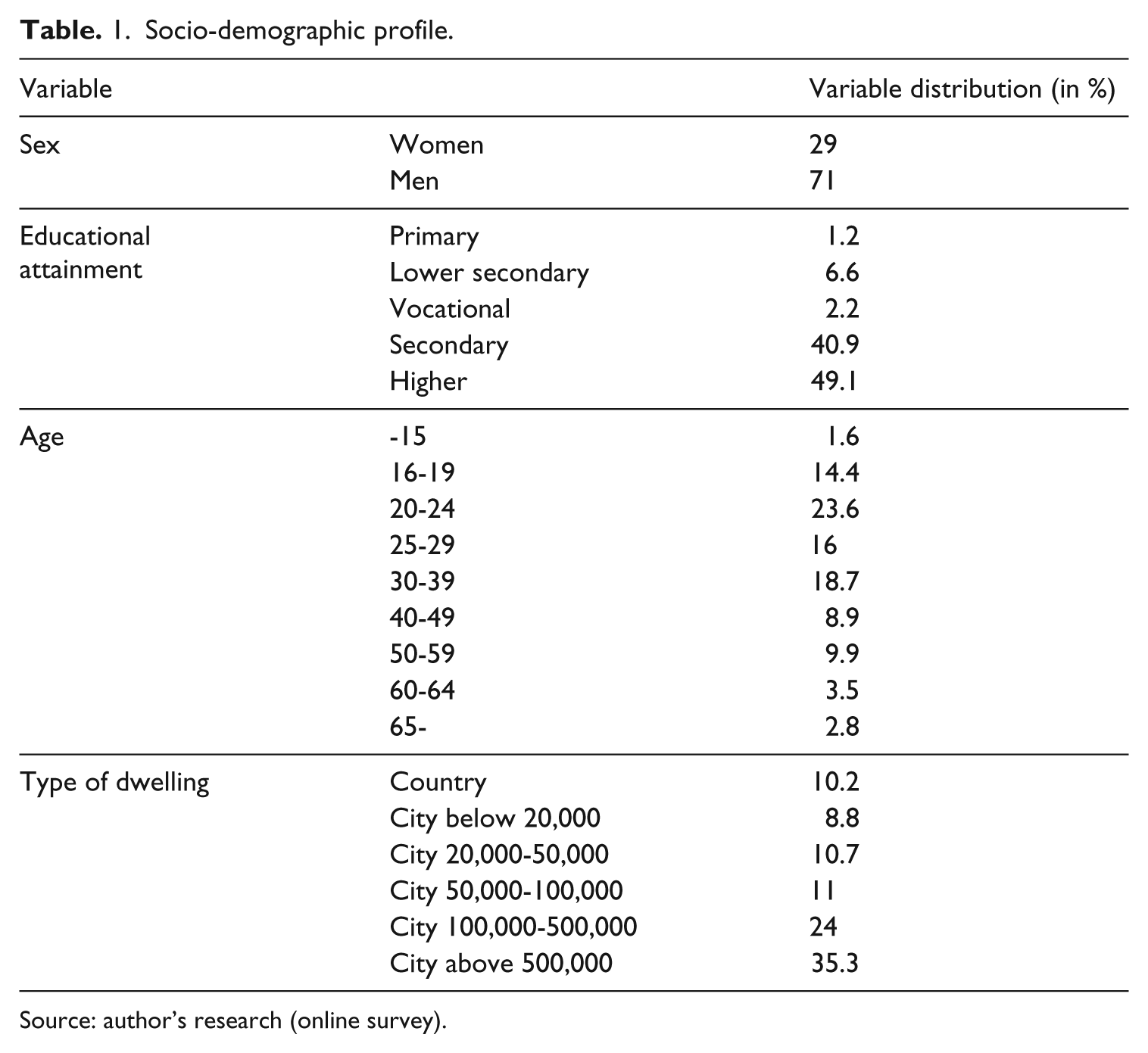
Source: author’s research (online survey).
Identity
I have to emphasize one specific feature of Polish nonbelievers. Catholicism is not something totally foreign for them because it composes an integral part of their cultural and social environments. Their identities are steeped in the Catholic lifestyle, ways of thinking, system of norms and values; becoming a kind of synthesis of unbelief and Catholicism. A vast majority of them were Catholics in the past and were socialized in the Catholic way. Being aware of the fact, they even created a specific phrase to describe this kind of identity – ‘Catholic atheist’. The French philosopher and one of the propagators of ‘new atheists’ movement, Michel Onfray (2005), claims that all contemporary atheists are ‘Christian atheists’, because they all still live within the ‘Judeo-Christian episteme’. Opposite them he places ‘atheistic atheists’, shaped by the influence of a suggested post-religious culture.
Some results of my survey show to what extent Polish nonbelievers are steeped in Catholicism:
sacraments: 95% of my respondents were baptized, 91.6% received First Communion and 70.5% were confirmed;
religious education: 72.9% of my respondents attended religious lessons for some years at least;
moment of departure from faith: 78.7% of respondents declared they had been believers in the past (mostly Catholics);
social environment: 71.8% still live surrounded mostly by believers.
There is one significant consequence of the previous religious socialization of Polish nonbelievers. The process of the shaping of their unbelief is simultaneously the process of abandoning the religious starting point. It is important from a sociological point of view, because we can analyze the problem using the theory of reference groups. I think that culture based on Catholicism is a significant source of negative references for Polish nonbelievers. Despite having abandoned religion, they still keep in contact with it (believing family members and colleagues, ubiquitous religious symbolism and rhetoric). 2 In most cases they cannot cut themselves off from religion, even if they really want to. Robert K Merton (1968) said indifference towards group membership and motivation to not-belonging to the group are two completely different attitudes. So the unbelief shaped in spontaneously secularized countries is not the same that unbelief shaped in countries with high level of religiousness. The former leads to an attitude of indifference described vividly by Phil Zuckerman in his book Society without God (2008) and the latter to unbelief meaning as a negative reference to Catholicism. The second of those two attitudes we can recognize as a ‘Catholic atheism’.
It is worth considering in detail what differs in those two attitudes. Described by Zuckerman, Danes and Swedes mostly treat religion as something completely insignificant (he called such an attitude ‘benign indifference’). Religion evaporated from their lives. It is not a source of reference for them, neither positive nor negative. But for nonbelievers living in countries where they have a minority status (for example in Poland or the United States), it is a different story (Zuckerman, 2012a; 2012b). Their unbelief is powered by a negative reference mechanism. They cannot forget about religion, due to its visibility. Moreover, it becomes more and more foreign to them because of an ongoing deconversion process. The more visible it becomes, especially in the public sphere (a very good example is the debate over in vitro fertilization that took place in Poland in 2015), the worse a nonbelievers’ opinion about it becomes. It is a kind of paradox, because such a situation forces them to think and say a lot about issues they want to remove from their lives (many of them even dream about it). Therefore their nonbeliever’s identity is further activated by such religious stimulus. It intensifies their negative attitude to religion, especially the institutional aspect. 3
(Non)religious consciousness
Unbelief is usually associated with a lack of affiliation to any religious institutions and a lack of any religious beliefs. The ‘Ideal’ nonbeliever should be completely ‘impregnable’ to any forms of the sacred; completely desacralized. They should not attend services or receive any sacraments. They should reject religious beliefs, norms and values. This would be an ideal, Weberian ‘pure’ type of consistent unbelief. However in my Polish research I observed a kind of mutation of such unbelief.
It was very puzzling for me that around one fifth of the respondents of my survey – which was directed at nonbelievers – declared sympathy or belonging to different forms of non-Catholic religious or spiritual movements (see Table 2).
Religious/spiritual movement (sympathy or belonging).
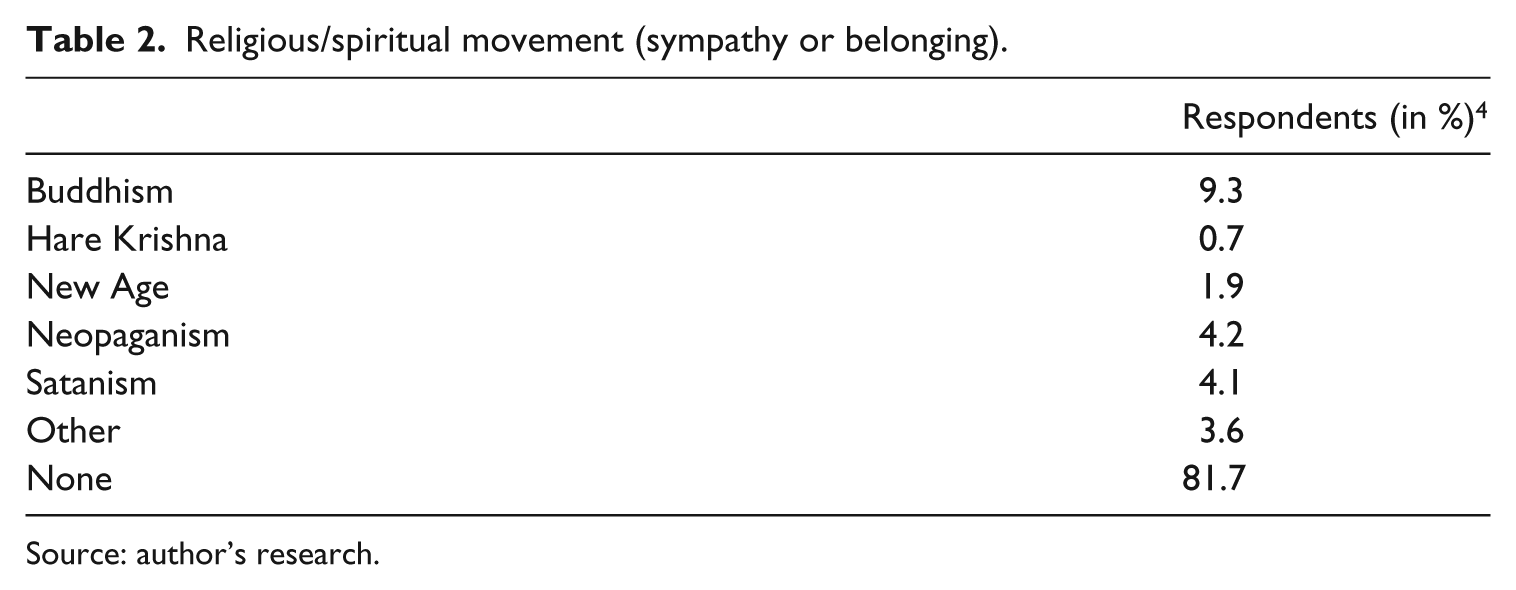
Source: author’s research.
The results of asking my respondents about their religious/spiritual beliefs was also interesting:
The answers in Table 3 reveal an interesting pattern, contrary to all expectations. For most questions (other than personified God, form of supernatural power, human soul, life after death, bioenergotherapy/healing effectiveness, and supernatural phenomena) only around two-thirds of respondents answered: ‘I don’t believe’. Though many more respondents chose that answer in the case of questions about personal God, horoscopes, and talismans, even here the result is below one hundred percent. And it must be said that some previous research has confirmed this observation (Pasquale, 2007b: 52–54; Vernon, 1968: 223).
Religious/spiritual (un)beliefs.
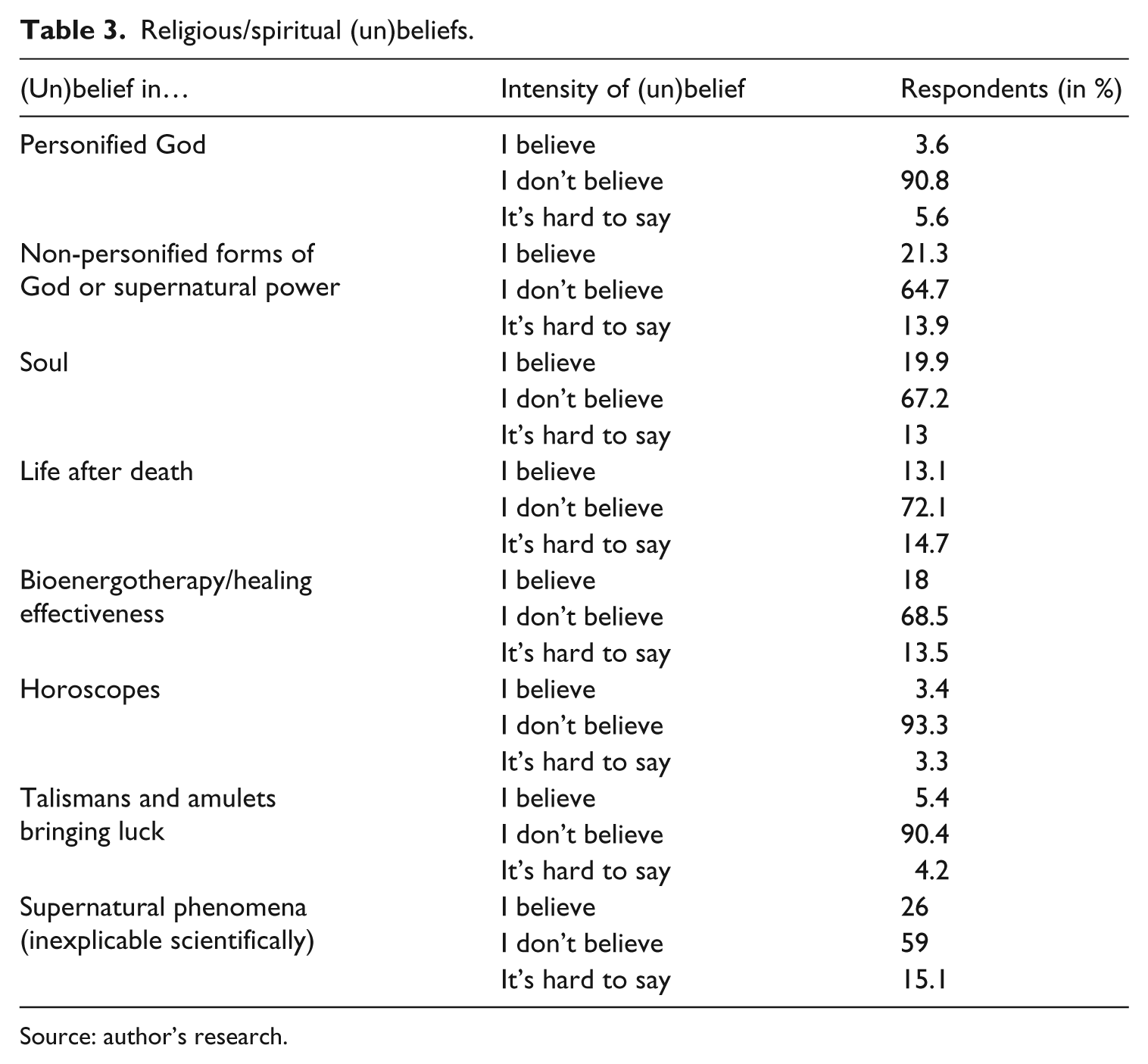
Source: author’s research.
Does this mean atheists believe in God and souls? How to explain these counterintuitive results? In my opinion the answer is as follows: non-religiousness, similarly to religiousness, is subject to the processes of pluralization and privatization in postmodern societies. And Poland, since the 1989 transformation, has started to become a postmodern country (Borowik and Doktór, 2001). One may look at traditional ideologies as packages or sets of beliefs, which have to be taken as they come. If you want to be a Catholic, for example, you should apply most of the guidelines of the doctrine. Today it has changed, it is now possible to selectively choose isolated elements from those packages and create from them (non)religious worldviews without the necessity of accepting the whole package. Nonbelievers do this well. They take elements from fragmented traditional religious metanarrations, adding them to their secularized identities (Lyotard, 1984). This is how I explain the paradoxical examples of nonbelievers who do not believe in God, but believe in life after death. What is the difference between them and Catholics who believe in God, but do not believe in heaven and hell? In my opinion there is no substantial difference here, because the process of privatization and individualization of non/religious beliefs involves both groups to a similar extent.
A further detail should be stressed – the fact that beliefs stated as internalized by my respondents are not Catholic ones. They are foreign to Catholicism. They were derived from different forms of non-monotheistic religious traditions. It is suggested there is strong distancing from the religious tradition they are culturally bound to. Polish nonbelievers are negatively oriented mostly towards the religious tradition in which they arise, but they are relatively often positively oriented towards elements of other religious traditions. One may interpret that distancing as a act of struggle against the dominant religious tradition.
Subjectively perceived discrimination
Atheism has been treated as a kind of stigma since it was introduced in ancient Greece. As Jan M. Bremmer wrote: ‘The invention of atheism would open a new road to intellectual freedom, but also enabled people to label opponents in a new way’ (Bremmer, 2007: 22). It has to be said that the topic of discrimination towards nonbelievers is widely discussed in scientific literature nowadays (Edgell at al., 2006; Cragun et al., 2012; Gervais et al., 2011).
First I would like to distinguish two levels of analysis – macro and micro. To each I assign a specific behavioral reaction: discrimination at the macro level, and stigmatization at the micro level. Discrimination was defined as difficulties in accessing different kinds of socially important resources that are arbitrarily caused by state authorities. The main possible fields of such difficulties are: church/state relations, work, education, and lawmaking (Marger, 2009). On the other hand, stigmatization was defined as difficulties in the face-to-face relations with significant (and not so significant) others. The main possible spheres of such difficulties are: relationship with parents, parents-in-law, grandparents, spouses, extended family members, children, coworkers, and schoolmates (Goffman, 1963).
Macro level
Formally, Poland is a secular state, meaning the most important legislation acts guarantee the separation of state and church. These issues have been regulated by the existing Polish Constitution since 2 April 1997.
In addition there are specific legislations, including acts, addressing the protection of the rights of nonbelievers:
The Act on Freedom of Conscience and Confession of 17 May 1989.
The Penal Code.
I was curious to assess the impact of religion on politics in my sample. My respondents are strongly in favor of social secularization, especially in the dimension of separation of state and church institutions. The influence of the Roman Catholic Church on politics, in the opinion of the vast majority of my respondents, is far too big, and it is clear when we look at the data in Table 4.
Impact of the Catholic Church on the sphere of politics.
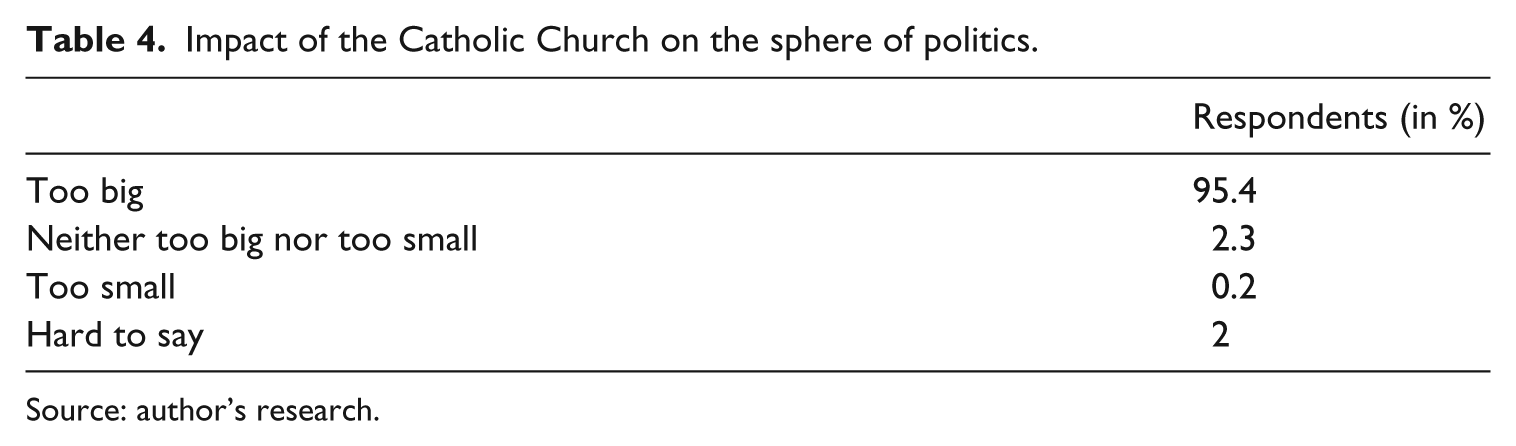
Source: author’s research.
As you can see, my respondents are proponents of a differentiation between these two institutional spheres, almost without exception. This tells us how nonbelievers perceive the differentiation (between church and state) should look.
Despite such strong recognition of the Roman Catholic Church’s excessive impact on the sphere of politics, just a few respondents consider Poland a ‘confessional state’. Hardly any interviewees admit Poland is a religious state. Rather, they look at ‘confessionalism’ of the state on a continuum, where it may be of greater or lesser intensity compared to other countries. According to my interlocutors, Poland is in this respect far apart from countries such as Iran, and even closer in its standards to France, which is perceived as a highly secularized country.
Taking into consideration the objective quantitative indicators, it is impossible to say Poland is a confessional state. Important data is provided by the Association of Religion Data Archives, with its website offering comparative data on the degree of favoritism of religion by the state, objectified as the Government Favoritism of Religion Index. 5 This index can be regarded as a quantitative measure of the degree of ‘confessionalism’ for particular states. It consists of data on subsidy by the state institutions and religious officials, religious education, or the construction and maintenance of religious buildings. On a ten-point scale, Poland has 4 points. For comparison, the average value of this indicator for the countries of Eastern Europe is 5.8, and for all countries whose data were included in the base 4.6. The Polish result, compared to the other countries, does not seem very high.
Micro level
Previous research has shown that in countries where nonbelievers are a dominated minority, the disclosure of their non-religious identity is associated with some problems (Smith, 2011: 24–28). I was interested to see how this looks in Poland.
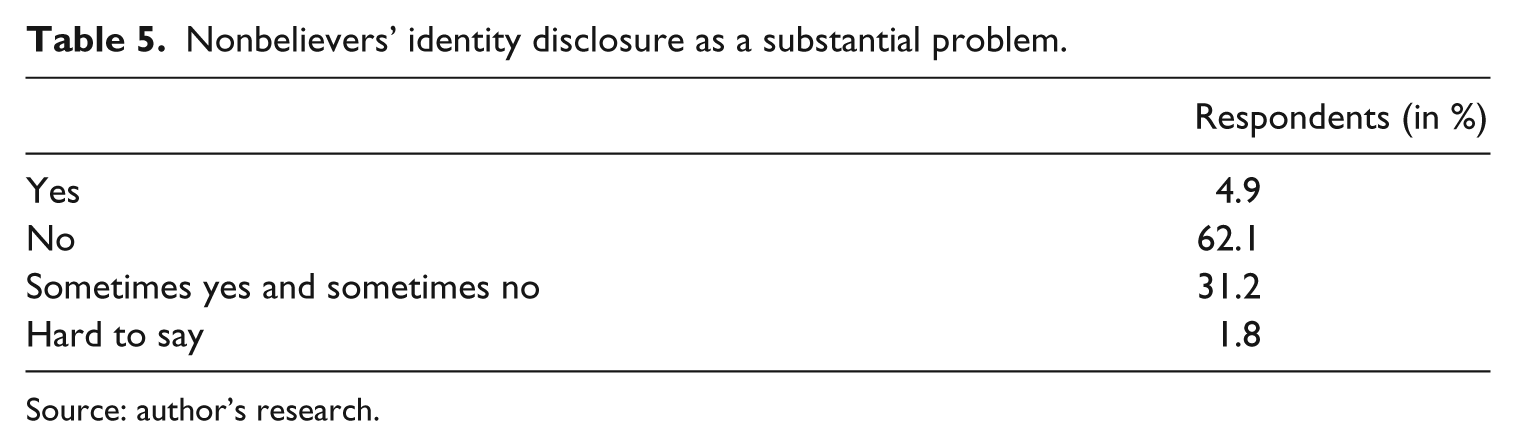
A general answer to this question may be found in Table 5 showing the frequencies of my respondents’ answers on the question of whether they perceive disclosure of their nonbeliever identity as a substantial problem.
Nonbelievers’ identity disclosure as a substantial problem.
Source: author’s research.
As Table 5 shows, just 4.9% of respondents perceive disclosure of their nonbeliever identity as a substantial problem. Almost two thirds (62.9%) do not have any problem with it. The rest say it is depends on the situational context.
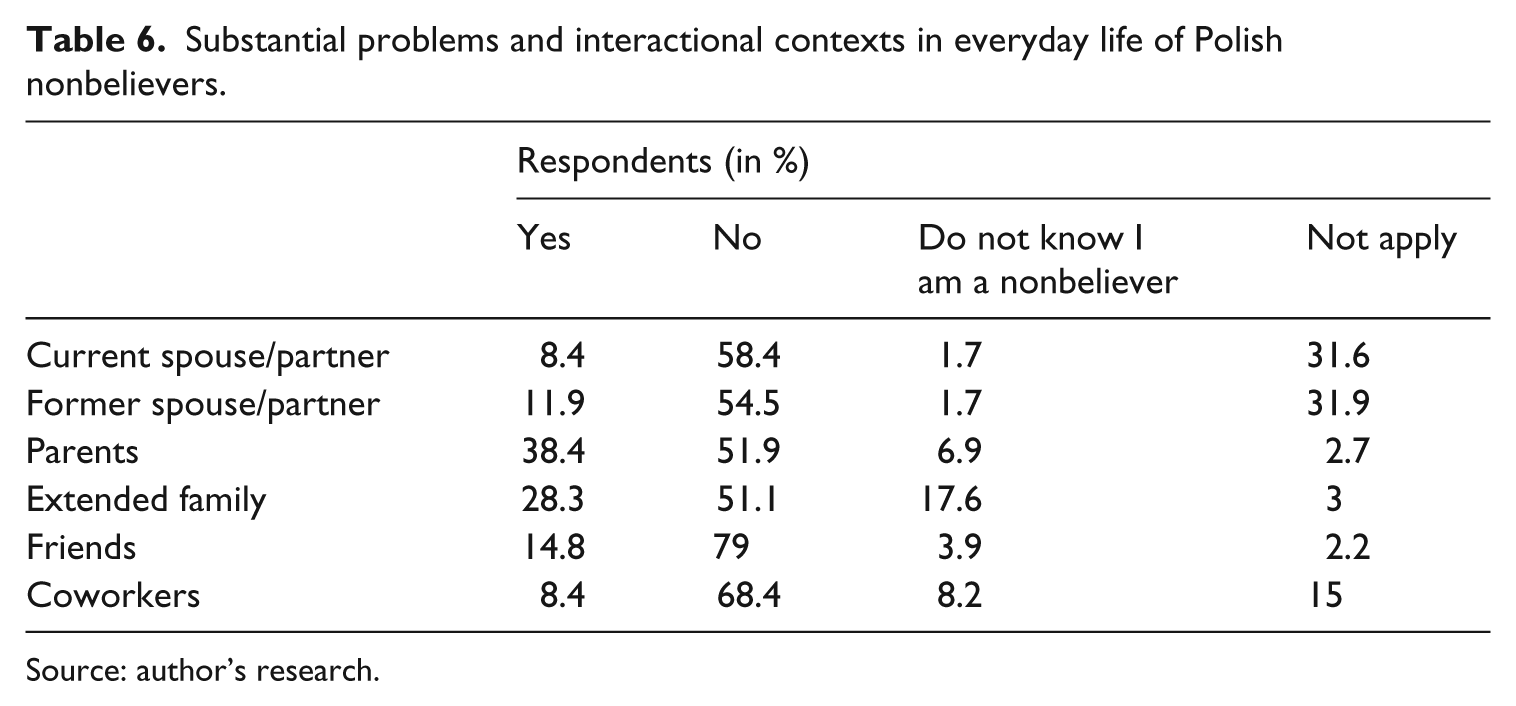
It was extremely interesting to identify and differentiate the situations in which Polish nonbelievers had substantial problems, and those in which they did not. Table 6 sheds some light on this matter, showing how it looks with regards to the most important types of face-to-face interaction.
Substantial problems and interactional contexts in everyday life of Polish nonbelievers.
Source: author’s research.
First of all, one should note that my respondents do not tend to hide their nonbelief in any of the contexts mentioned here. In the case of partners/spouses, due to the closeness and intimate nature of the relationship, and also due to the upbringing of common children, it is almost impossible. Most frequently an unbeliever’s identity is not disclosed to the extended family – in 17.6% of cases. This result can be explained by the wide range of this category. As well, it often happens that one so rarely has contact with the extended family members that there is no opportunity to externalize one’s opinions on matters of (non)religion. The most common source of substantial problems caused by unbelief is the relationship with parents.
The situation is the opposite in the case of work. There is no need to disclose all dimensions of our identity at work. One may participate in work life using only part of his/her identity, excluding the nonreligious part. Or one can simply meet the people for whom religion has no meaning.
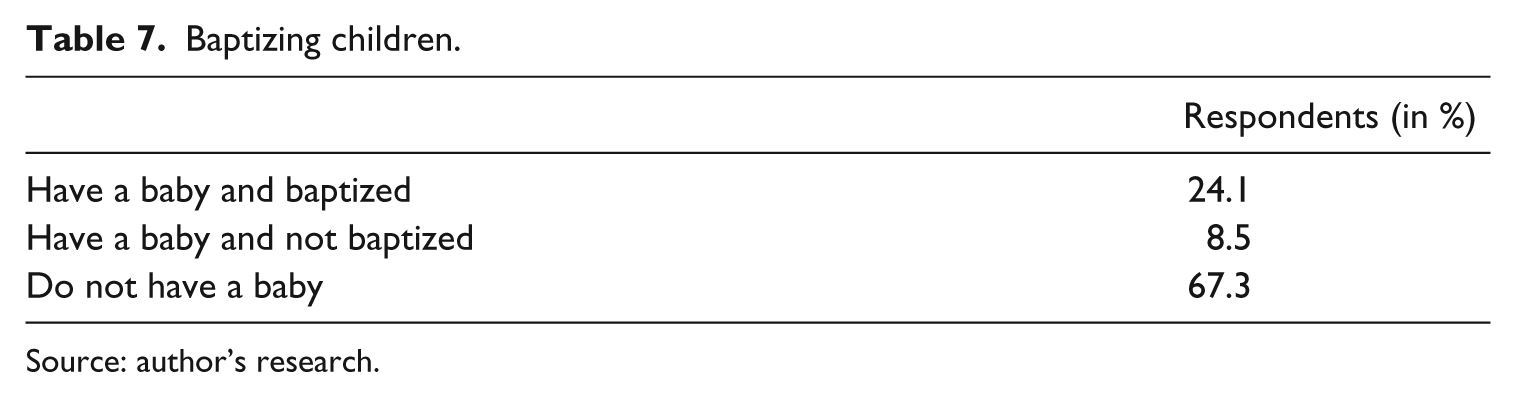
While disclosure of unbelief generally does not cause dramatic examples of stigmatization, the matter may become a problem in certain circumstances. One could talk here about a kind of biographical ‘bottleneck’ when unbelief is no longer a private matter, and the reactions of significant others become negative, even if they were previously indifferent. From the statements of my interlocutors one may conclude that the most significant situations of this kind are marriage and, in particular, having a child (see Table 7).
Baptizing children.
Source: author’s research.
This is a partial answer to the question of why nonbelievers baptize their children. Often they have no choice due to the strong social pressure from family members (mostly parents and parents-in-law). People in Poland are very attached to religious ceremonies accompanying the most important rites of passage like birth, marriage and death and there are no secular alternatives in the country for such ceremonies (Baniak, 2007; Mariański, 2004).
This is one aspect of a more general problem for Polish nonbelievers – the lack of an institutionalized ‘environment’ of nonreligious norms. This is why one of the most important goals of the emerging social movement of nonbelievers in Poland is the promotion of humanistic ceremonies, 6 to give an alternative for religious rites of passage that have dominated in Poland for years.
Discussion
To conclude, one may say that Polish nonbelievers are a cultural minority because they share some distinctive group features and they are aware of their otherness. Lack of belief in God brings some important behavioral consequences on the levels of identity, (non)religious consciousness and subjectively perceived discrimination.
Firstly, the vast majority of my respondents were raised Catholic. They passed through a longer or shorter process of religious socialization – meaning that they were religiously educated in families and schools, and attended different kinds of religious practices and rituals. Therefore, one may call them converts to non-religiousness.
Secondly, only less than one fifth of my respondents clearly evidences certain forms of religious belief, such as faith in a non-personified form of deity or in an afterlife. Sometimes these persons call themselves spiritual atheists. In my opinion, there are two possible explanations for this counterintuitive fact – neither excluding the other. On the one hand, this may be an effect of the influence of a dominant religious culture in Poland. On the other hand, it may be an expression of a nonbeliever’s need to preserve a deep, spiritual dimension of his or her personality. But the vast majority of my respondents have a very negative attitude towards manifestations of institutionalized religion.
Thirdly, there is the issue of a subjectively perceived discrimination. In actual fact, nonbelievers rarely meet with direct expressions of prejudice against them during face-to-face encounters (although, if it does, this is usually in the parent–child relationship). However, they feel a strong social pressure to cultivate some elements of the ritual dimension of religiosity: parents, distant family, or partners often require them to attend regular religious practices, have a church wedding, or baptize their children. Additionally, many of my respondents felt strongly discriminated by the state.
On the other hand it is important to stress that the Polish unbelievers’ minority status has a relative character. When speaking about the relativity of minority status I mean the existence of fields, situations, historic moments, places or niches where nonbelievers are not subjected to dominant group oppression but, moreover, become the dominant group because of their (in this case resource/form of capital) unbelief. So the roles are changed in this case. One may also understand the relativity of minority status in a lesser way – as a lack of discrimination in some areas. I wondered if this also applied in the case of Polish nonbelievers. While conducting my research, I found such assumptions confirmed to some extent.
Firstly, the social environment of Polish nonbelievers is dominated by believers, but they have a mostly tolerant attitude toward nonbelievers. Moreover, believers are generally perceived by nonbelievers as ‘cryptoatheists’. In addition, it is possible to distinguish several contexts in everyday life, where unbelief mostly does not cause any problems – like interaction with partners/spouses and colleagues.
Secondly, a low frequency of stigmatization. The relatively high level of cultural capital of my respondents seems to mitigate the negative effects of the stigma of unbelief. Moreover, it turns out that in the sphere of face-to-face encounters with believers, the unbelievers often become offensive and play a dominant role, which can be regarded as a sign of the domination of nonbelievers in the micro-interactional aspect. In addition, the vast majority of believers face many difficulties when it comes to publicly expressing homosexuality. This is much harder to do in Poland.
Thirdly, there are no facilities available as a consequence of unbelief. It was not easy for my respondents to point out some facilities concerned with access to important resources (money, work, education etc.) or facilities concerned with relationships due to unbelief. There was one topic that appears in almost every nonbelievers’ statement. The feeling of liberation that is an effect of the conversion to unbelief. Liberation, alleviation, calmness and a feeling of inner order. These are, of course, facilities of a psychological nature. What is interesting at this point is that the statements of my respondents run in parallel with those by American nonbelievers. Non-religion researchers including Zuckerman (2012b) and Smith (2011) have also reported the high emphasis on the feeling of liberation as an important consequence of conversion to unbelief.
To conclude, one may say there is a significant relationship between the minority status of Polish nonbelievers and their functioning in the social space. This is a multi-dimensional relationship – one may observe it both at the level of individual consciousness and cultural patterns, as well as at both micro- and macro-social levels. It significantly and noticeably influences the way my respondents function in the various spheres of their lives. On the other hand, one cannot say the minority status of Polish nonbelievers entirely determines their daily chances and choices. Nonbelievers are not an example of a community totally excluded from social life. Respondents told me about the relatively rare number of cases in which they faced negative reactions against them based on openly expressed prejudices. It would also be difficult to state that they are deprived of access to many categories of material resources because of their unbelief. Thus a minority status is sensed by most of my respondents and they are aware of it, but it does not determine every aspect of their daily lives. As one of my respondents said: ‘Being an atheist in Poland does not cause serious problems. It is more like walking barefoot through the woods and a pinecone sometimes pricks your foot’.
Footnotes
Funding
This research received no specific grant from any funding agency in the public, commercial, or not-for-profit sectors.
Notes
Author Biography
Address: AGH University of Science and Technology, ul. Gramatyka 8a, Kraków, 30-071, Poland.
Email: