




Abstract
This article analyses the responses of the Catholic Church in Croatia and Italy to the refugee crisis, particularly the churches’ discourses on human rights issues and positions in public debates on refugees and migrants. Although both Catholic churches followed the Church’s teachings on ‘strangers’, associated with providing concrete help to people in need, the Catholic Church in Croatia pursued what can be classified as a charitable approach, while the Catholic Church in Italy followed solidarity and utilitarian approaches. Equally, the Catholic Church in Croatia remained a silent public actor in the refugee crisis, while the Catholic Church in Italy became a prominent actor in public debates, engaging with human rights discourses. The selective and ambivalent uses of human rights discourses emerged as a factor in understanding these two churches’ different positions on refugees and migrants.
Introduction
Two contrasting perspectives dominate scholarship on the relationship between religions and human rights. On one hand, some argue that it is not possible to reconcile religious precepts, which require obedience, with recognition of individual freedom and rights. On the other hand, some are convinced that religions can play a key role in recognition of human rights, either by providing a ‘transcendental foundation’ for the concept of human dignity or by practicing human rights principles (Banchoff and Wuthnow, 2011; Witte and Green, 2012; Sarkissian, 2015).
These two perspectives stand at the two extremes of the continuum of the profound ‘ambivalence of the sacred’ (Appleby, 2000): religions can simultaneously be the cause of conflicts and violence perpetrated in God’s name and a resource to support peace processes and aid those who find themselves in situations of difficulty and need. There is no need to look at the numerous examples in history. Today, religions still play profoundly different roles in determining good and evil in social, cultural and geopolitical contexts as the ways social actors use and understand religion vary dramatically. Wherever one falls along this continuum, as Witte (1996: 3) pragmatically notes, ‘religion must be seen as a vital dimension of any legal regime of human rights . . . Religions will not be easy to engage, but the struggle for human rights cannot be won without them’. Thus, the understanding of what religions are and social actors’ perceptions of human rights, as this article explores, can be specific to their social, cultural and geopolitical contexts (Witte and Green, 2012).
Within this framework, the main aim of this article is to show how a specific social problem is understood and defined by a universal religion and, more importantly, how it is framed in different social and cultural contexts. The article examines how the refugee crisis has been understood and defined at the central level by the Catholic Church in the Vatican and at the rhetorical and practical levels by the Catholic Church in two neighbouring countries, Croatia and Italy. As these are countries where the Catholic Church plays a strong role and countries which, though differently, have been facing a high number of migrants and refugees, they are chosen as an interesting comparative case. The starting point is, though, the human rights discourse. What today is termed human rights arguably is similar or even identical to the traditional teachings of many religions, such as the dignity and equality of all persons, respect for human beings and the responsibility to love and help the stranger, which eventually lead to social and political engagement on behalf of marginalised and endangered people. The question is, then, if and how religious discourses include and use, in real terms, a human rights discourse in relation to refugees. In varied social and cultural contexts, Catholicism may or may not use the language of human rights in different, selective and ambiguous ways. We try to understand whether, how and under which conditions the human rights frame can present an opportunity for religions to gain a new visibility and relevance in the public sphere by activating different interaction processes with the state and other social actors (Mooney, 2006; Itçaina and Burchianti, 2011).
We focus on what happens in the process of moving from the abstract universe of religious rhetoric to the concrete details of various national contexts. Our goal is not to reveal the internal variations in Catholicism, a topic already extensively studied (for example, Diotallevi, 2001), but to illustrate how the relationship between religions and human rights, studied in the case of the recent refugee crisis in Europe, may lead to different results in various social and cultural contexts and to understand what social factors influence that process.
What follows is an analysis of the religious response to refugees in two countries. In addition to describing the Church’s official teaching and the national contexts, we performed content analysis of Catholic weeklies in both countries and interviewed key actors in work and policies related to refugees. In analysing the discourse and acts employed by the Catholic Church, we relied on Itçaina and Burchianti’s (2011) analysis and typology based on the representation of migrants by the Catholic Church in Spain. By identifying the different approaches used by these two churches we captured not only their different standpoints towards refugees but also their public positions, and we connected these different public positions to significant variations in use of the human rights discourse.
The migration crisis and religion in context: From the universal to the particular
Migration, which has been increased by the humanitarian crisis caused by the Syrian civil war since 2011 and by wars and conflicts in other countries such as Afghanistan and Iraq, has brought into question the foundations of the European social order and values based on respect for human rights. In recent years, the speed and size of migratory flows in many European states have evolved from a social issue to a public issue to a political problem (Itçaina and Burchianti, 2011). Migration flows change the religious landscape in host societies and consequently also the political regulation of religion. At the same time, however, the problems caused by migratory flows offer opportunities for religious actors to strengthen their position in the public arena through offering faith-based assistance and engaging in public debates.
Over the years, the Catholic Church has developed a specific rhetoric on migration. Documents produced by the Pontifical Council for Migrants and the popes’ annual messages on the World Day of Migrants and Refugees articulate this rhetoric, particularly on the topics of the other and the stranger. At least until the last years of the 20th century, this rhetoric seemed to highlight the positive aspects of migration, especially opportunities for cultural exchange and mutual enrichment. Moreover, according to these documents, migration reminds the Church that it should consider itself to be the other and the stranger in this world, a pilgrim community, ‘gathered from all nations’ (Ralston, 2016). From this perspective, migration is often overvalued, romanticised and idealized as the beauty of traveling and discovering new cultures. Even when dealing with problems of forced migration, the Church still adopts a paternalistic and pietistic attitude, which could be a result (unwanted and perceived as a side effect) of colonial ethnocentric superiority (Snyder, 2016).
Over the past ten years, with the escalation of the refugee crisis and especially the humanitarian catastrophes in the Mediterranean Sea, the Catholic Church’s rhetoric on migration has become concrete, and the romantic vision of migration has given way to a message directly addressing the social, political and legal circumstances (including human rights) of the thousands of people seeking to reach Europe. It is in this movement from a romantic to a concrete vision of migrants’ human rights and right to integrate into host societies that the Catholic Church has gained new visibility in the public debate. Explicit references to the human rights of all migrants – including undocumented refugees and asylum seekers – seem to offer, at least in some social and cultural contexts, a new contractual force and fresh credibility to the Catholic Church in the face of political power and even other humanitarian organizations (Mooney, 2006).
The Catholic focus on migration has intensified during the recent humanitarian emergency caused by the Syrian war, as symbolized by the role played by Pope Francis. Elected in March 2013, Pope Francis decided to make his first trip outside Rome to Lampedusa, a small Italian island in the Mediterranean Sea, between Europe and Africa. Over the past 15 years, this small island, lying between Sicily and Tunisia and very close to the Libyan coast, has become the main landing point for thousands of people on boats, mostly from Africa but also the Middle East. In recent years, many thousands of migrants have drowned off Lampedusa while attempting to reach Europe. ‘Lampedusa has thus become for Italy, and indeed for Europe, a symbol of the complexity and the drama of migration . . . it is precisely in what happens on and around this island that the future of Europe will be decided’ (Campese, 2016: 25).
The papal visit on 8 July 2013 signalled that the topic of migrants, refugees and asylum seekers would become a cornerstone of the ministry of this Argentinean pope, himself a son of migrants. The media visibility of the pope’s Lampedusa visit was replicated with a trip in April 2016 to the Greek island of Lesbos, which has become another landing point for refugees travelling to Western Europe. It was from that visit that the pope brought back three Muslim refugee families to the Vatican – a choice consistent with what he pleaded for monasteries and parishes to do.
A few weeks after his trip to Lampedusa, the pope visited the Astalli Center for asylum seekers and refugees in Rome run by the Jesuits. There, in addition to an explicit reference to the need to protect human rights, he called upon members of religious orders to affirm that ‘the Lord calls us to live with greater courage, generosity and hospitality in communities, in houses and in empty convents. Dear men and women religious, your empty convents are not useful to the church if they are turned into hotels and earn money. The empty convents do not belong to you. They are for the flesh of Christ, which is what the refugees are’. 1 On 6 September 2015, the Pope issued another appeal even more ambitious and demanding: ‘I make an appeal to parishes, religious communities, monasteries and shrines throughout Europe that they express the Gospel in a concrete way and host a refugee family . . . May every parish, every religious community, every monastery, every shrine in Europe welcome one family’. 2
The pope’s words usually have the ability to influence the public sphere both directly and indirectly. They directly influence the public sphere when they are targeted at politicians and public authorities and indirectly when they address the faithful, asking them to put the principles of their faith into practice in matters of daily life. In these two appeals, the pope issued a message to the faithful to influence their actions and form of engagement with society. 3
Religious rhetoric, refugees and human rights in two Catholic countries
The following analysis is based on a content analysis of two Catholic weeklies: Glas koncila (Voice of the council) in Croatia, jointly published by four archdioceses in Croatia and one in Bosnia and Herzegovina, and La difesa del popolo (The defence of the People), the official weekly of the Padua diocese, one of the largest dioceses in Italy.
The content analysis drew on the methodologies of Van Driel and Richardson (1988a; 1988b) and Possamai et al. (2013). The unit of analysis was every article published from September 2015 (which coincided with the pope’s appeal for every parish to welcome one migrant family) to September 2016 containing the words ‘migrant/s’ and ‘refugee/s’. The content analysis included several variables: the value of the occupied media space and the article size, type, section, publication date, value orientation and subjects discussed and mentioned. For the purpose of this paper, we analysed the contents (migrants and wave of migrants or refugees and wave of refugees plus detailed categories, such as Syrian, Iraqi, Afghan and economic migrants) and value orientation of the articles. Value orientation was classified as positive (articles discuss human rights issues from a humanitarian or multiculturalism standpoint), neutral (articles present several positions, do not feature a dominant position and mostly give information about refugees) and negative (articles depict migrants as safety, health, economic, social or cultural threats).
The analysis was also based on in-depth interviews with key persons from organizations working with migrants. In both countries, these organizations included Caritas, the Ministry of the Interior and/or Police, and other secular and religious-based non-governmental organizations (NGO). Ten interviews were conducted in Croatia, and eleven in Italy. In each interview, ten questions were posed covering basic information on working with migrants and refugees, coordination with state officials and other actors involved, attitudes towards other actors and their policies, impacts of migrants and refugees on society, attitudes towards the role of the Catholic Church and the pope and attitudes towards the role of European states and common European Union (EU) policy.
National backgrounds
For centuries, Croatia was primarily a country of emigration, which was intensified first during the Homeland War in the 1990s, when the former Yugoslavia fell apart and Croatia gained independence (this period saw migration between the former Yugoslav republics and the emigration of refugees and displaced persons aboard). Emigration again increased after Croatia joined the EU in 2013. Consequently, the recent refugee flow to Croatia is a completely new situation for the country. Between September 2015 and March 2016, approximately 700,000 refugees crossed the territories of Macedonia, Serbia, Croatia and Slovenia to reach their target countries, primarily Austria, Germany and Sweden (Šelo Šabić and Borić, 2016). This route, called the Western Balkan route, emerged after Hungary decided to close its border with Serbia, which continued through March 2016, when Macedonia closed its border with Greece. Of all the refugees entering Croatia, only a negligible number applied for asylum. According to official reports, many did not even know through which country they were passing. While Croatia faced the challenge to balance humanitarian and security demands in managing the refugee flow (Ćapo, 2015), the aims of the authorities and the refugees themselves had one apparent similarity (Valenta et al., 2015). As explained by a former minister of the Interior Ranko Ostojić, the priority of the government was to safeguard ‘the untroubled and human transit of the migrants through its territory . . . First of all, we wanted to secure free transit. Thus, the government wanted to show that Croatia could take responsibility and had the capacity to assist the migrants with food, temporary shelter and medical care’ (Ostojić, 2016: 4).
Although the refugees (merely) passed through the country, the overall discussion revolved around the huge societal challenge for Europe in general. Refugees provoked debates about common EU policies and security issues with neighbouring countries (for example, stricter border control and building of border walls and fences by Hungarian and Slovenian authorities). In addition, after the closing of the Western Balkan route, Croatia had to accept a certain number of returned refuges and asylum seekers in accordance with the EU regulations on the reallocation of refugees. Given that Croatia was traditionally an emigrant and a somewhat ethnically homogeneous country, this situation posed a completely new challenge. However, as seen in the following analysis, except for charitable involvement, the Catholic Church remained a silent actor in the refugee crisis.
On 31 August 2015, only two weeks before the refugee wave hit Croatia, six religious community leaders (representing the Catholic Church, Orthodox Church, Protestant-Evangelical Council, two Jewish communities and the Islamic community) issued a joint statement warning that the refugee wave likely would come through Croatia and that it was every person’s duty to accept each refugee. 4 The statement evoked Pope Francis’ statement that rejection of refugees was equal to a war crime. It stressed that accepting refugees encompassed understanding their problems and establishing human relationships with them but also that accompanying refugees until they gained the right to work and to a decent life was required. Just two days after the first refugees came to Croatia on 8 September 2015, the Justitia at Pax Committee of the Croatian Bishops’ Conference issued a statement noting the absence of a strategic debate about the causes and solutions to the refugee crisis, asserting that states and governments had responsibility for taking care of refugees and declaring that the Church stood ready to help infirm people forced to leave their homes in search for safety and protection, along with state authorities, other churches and religious communities and domestic and international humanitarian organizations. 5 In addition, some bishops referenced the pope’s words, mainly in the context of Caritas’ work helping refugees in their passage through Croatia. No other substantial public involvement of the Church has been noticed.
The Italian situation, however, is very different. Since the 1990s, Italy has progressively become a country of immigrants. A little more than 1 million foreigners held regular residence permits in 2002, but their number reached 5 million in 2017. Italy already has a second and, when it comes to those who arrived before the 1990s, a third generation of immigrants. However, currently the most important issue in Italy, due to its particular geographic position, is the humanitarian emergency created by the uncontrolled and increasing number of arrivals by sea: 63,456 asylum seekers in 2014, 83,970 in 2015 and 123,000 in 2016. From 2014 to 2016, Italy experienced the arrival of some 500,000 people, mostly from Eritrea, Nigeria, Somalia, Sudan, Gambia and Syria (Galantino, 2017). Many continued on to other European countries, some remained in Italy, some were sent back to their countries of origin, and some simply disappeared.
The situation has challenged this nation that has incorporated its ‘homogeneous identity’ into national rhetoric at the social, political and religious levels (Pace, 2013, 2014). The humanitarian emergencies and regional crises in the Middle East and some African nations which led to the increased landings in Italy have intensified the sense of insecurity and suspicion directed at immigrants. This ‘fear of the other’ is a core concern of right-wing parties, which capitalize on it and present the issue of migration as an ‘invasion’ by people who ‘carry diseases’ and ‘steal work’ from Italians. The economic and financial crisis that began in 2008 aggravated these issues. The political agenda of the right-wing Lega Nord (Northern League) party solely addressed such topics and can effectively attract consensus beyond northern Italy. Its leader, Matteo Salvini, has swung between openly xenophobic rhetoric and more or less vehemently racist allusions.
The law regulating migratory flows in Italy was approved in 2002 by the right-wing government led by Prime Minister Silvio Berlusconi. The aim of the law then was to stop clandestine immigration by imposing restrictive measures on new arrivals of immigrants. Following Lega Nord’s proposal, the Italian government introduced a new crime of illegal immigration in 2009, sparking a big debate in the country and a strong reaction from left-wing political parties.
In this context strongly politicizing the theme of migration, the Catholic Church has tended to strike a balance by recognizing the rights of migrants, on one hand, and not disregarding the feelings of fear and concern of many faithful who see migration as a danger to the stability of Italian society, on the other hand. It has been a difficult balance because it creates the risk that the Church may lose consensus, especially among the faithful in northern Italy, and be labelled as communist by Lega Nord.
However, the role of the Catholic Church in this country with 25,000 parishes and many social and welfare activities has always been to build an ‘inclusive identity’ for Italy. This effort has conflicted with right-wing parties with rhetoric supporting an ‘exclusive identity’. The bishops who have given official statements on these topics have increasingly criticized the restrictive and sometimes discriminatory policies of the central government and regional governments. The bishops have not supported such discriminatory policies, with the sole exception of Cardinal Giacomo Biffi of Bologna, who, in a 2000 letter to the city of Bologna recommended that public administrators promote the immigration of Catholics, or at least Christians, to counter the immigration of Muslims.
After the arrival of Pope Francis in Rome, Italian bishops felt more encouraged to speak openly in favour of migrants and have become very active in the debate on the jus soli law, aimed at granting citizenship to children born in Italy to foreign parents with long-term residence permits and to children who have attended five years of school in Italy.
Content analysis
The analysis presented in the following three tables shows the recurrence of keywords, the authors’ overall attitudes towards immigrants and refugees and the articles’ general attitudes towards migrants and refugees. The difference between the authors’ overall attitudes and the general attitude of articles can be illustrated with an example. In one article, the author expresses positive attitudes towards migrants and refugees but also describes the refugee wave as a socially problematic issue with unknown consequences for Europe. Such general attitudes were identified as ambivalent. Going deeper, we analysed whether and how articles’ references to human rights are explicit.
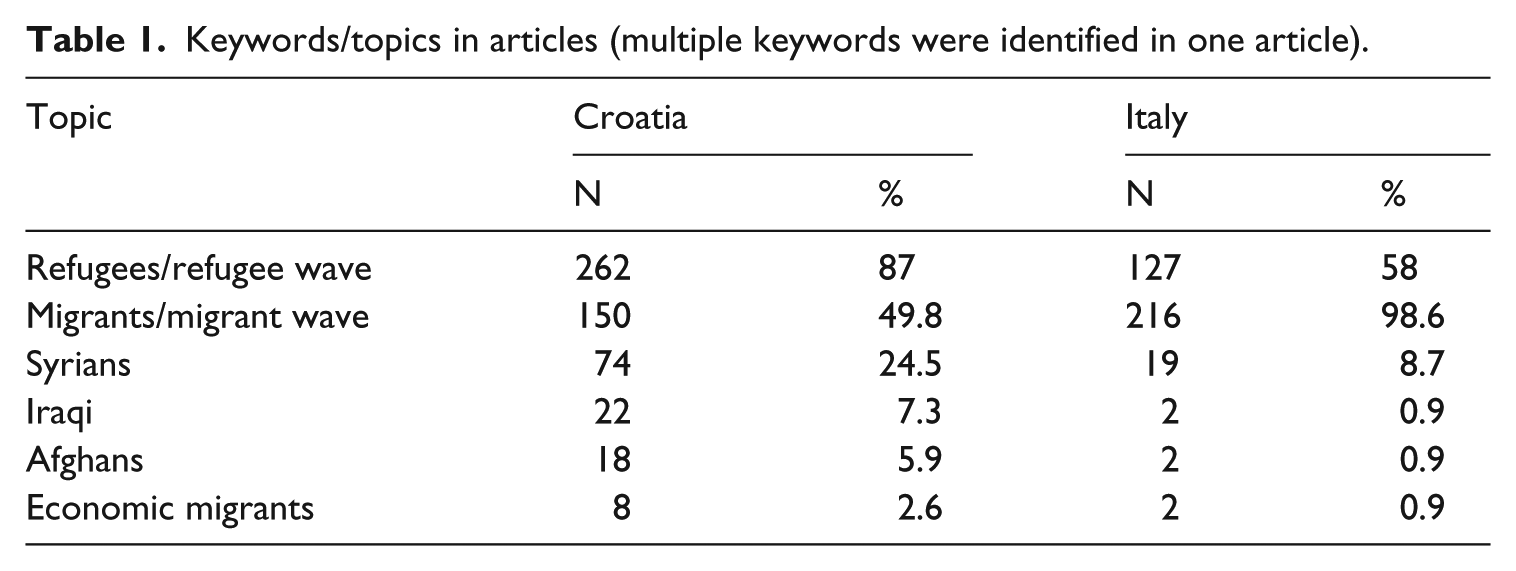
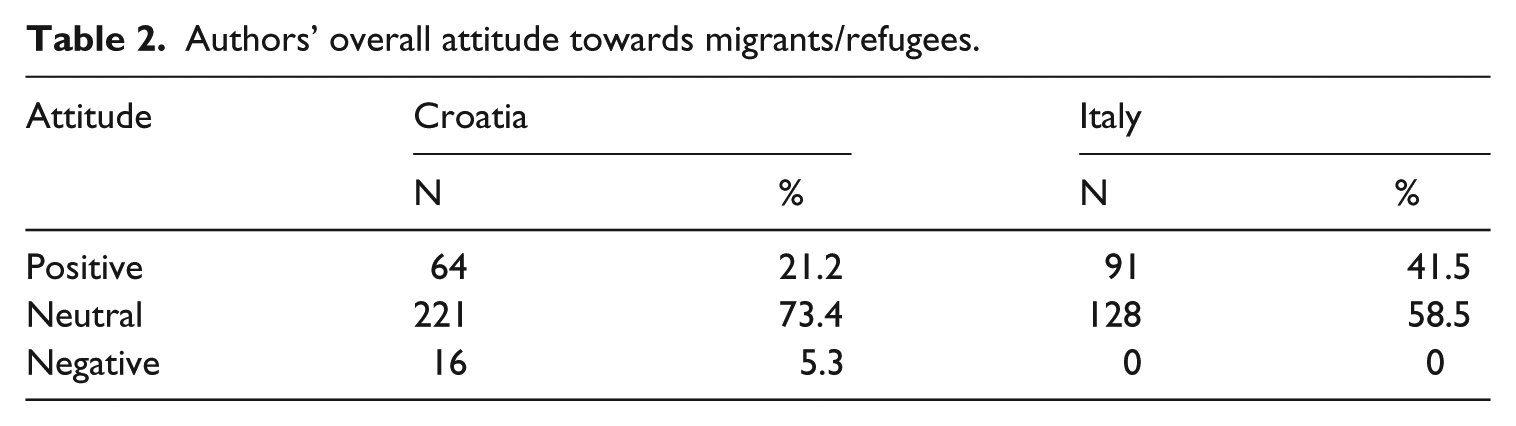
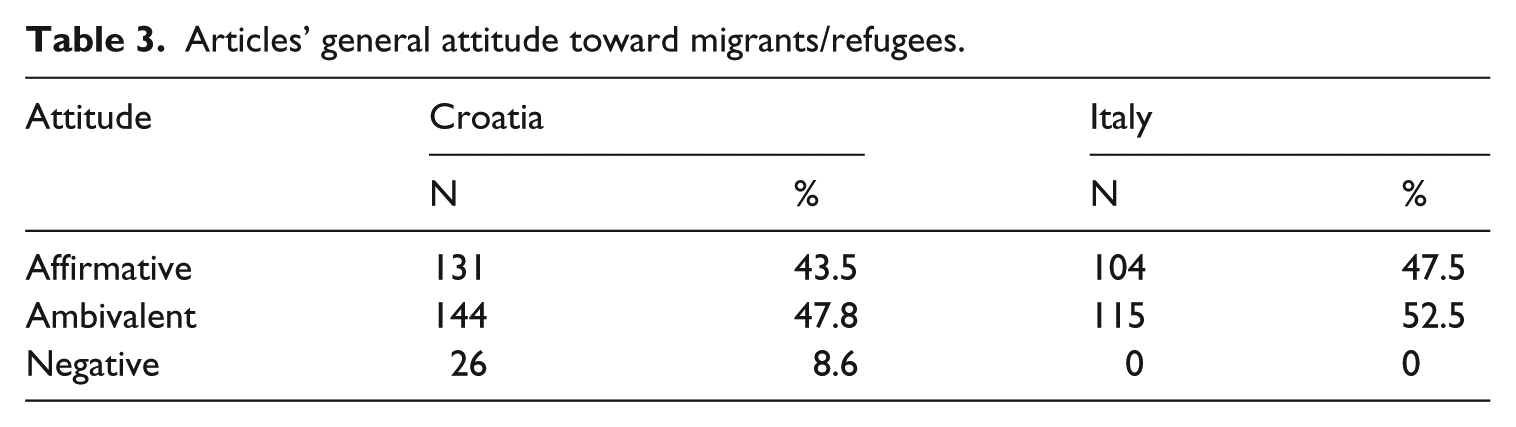
In the Croatian weekly Glas koncila, 301 articles containing the words ‘migrants’ and ‘refugees’ were identified. ‘Refugees/refugee wave’ was the most commonly used term to describe the people crossing the country (Table 1). The term ‘migrants/migrant wave’ was also used frequently, in many cases synonymously with refugees. A few articles which used the term ‘migrants’ emphasised that some refugees were not escaping from wars, conflicts or terrorism but were using the opportunity to seek a better life in Western countries. The term ‘economic migrants’ was used very rarely. It can be argued that this term points to the somewhat problematic motives of persons who were not refugees themselves but ‘infiltrat[ed]’ refugees who, according to rhetoric found elsewhere, were the only ones (not economic migrants) deserving of help (Kyriakides, 2016). This reflected the Croatian situation in which migrants did not intend to stay in the country, although there was also no policy of welcoming migrants (Valenta et al., 2015). Regarding ethnicity, Syrians were mentioned more frequently than other nationals. Turning to the authors’ overall attitude, the majority of articles were classified as neutral (73.4%), with some positive (21.2%) and a few negative (5.3%). An assessment of the general attitude in articles painted a slightly different picture as the share of affirmative (43.5%) and ambivalent (47.8%) articles was almost equal. Negative attitudes were also rare here (8.6%).
Keywords/topics in articles (multiple keywords were identified in one article).
Authors’ overall attitude towards migrants/refugees.
Articles’ general attitude toward migrants/refugees.
The dominance of neutral articles indicated that most articles provided only basic information about the refugees passing through Croatia and the help offered to them and did not offer any additional information about the refugees or the situation they faced. These articles primarily informed readers about the number of refugees, their conditions (hunger, medical needs and a lack of adequate clothing) and the organizations helping them. Many articles classified as positive were related to the pope’s words and acts, such as his speech expecting each parish to welcome one refugee family, and his visit to Lesbos. Positive articles also reported on Caritas’s active involvement with refugees, with the Church’s official support; for instance, bishops visited refugee camps to thank Caritas officials and volunteers for their work. Negative articles framed refugees as security, cultural and economic threats. Regarding the authors’ overall attitude, most affirmative articles discussed how the Church should help refugees. In contrast, the ambivalent articles primarily questioned the overall situation of the huge refugee wave and its unknown consequences for Europe, European culture and the European way of life. Ambivalent articles also informed about different attitudes and debates in other countries, primarily Hungary, Austria, and Germany.
Although present, the human rights discourse was not prominent in the positive articles as the majority framed the refugee crisis through a charitable lens. The human rights discourse was mostly associated with the pope’s words and actions, expressed in statements such as ‘we should not be indifferent to the rights of others’, ‘we are all created in God’s image’, and ‘we are all brothers’. Some bishops also talked about the need to not only accept refugees but also integrate them into society and appealed to the government to plan the integration of migrants into their new countries. Despite the difficulty in making a clear distinction, the majority of the positive articles slipped from a human rights discourse to a purely charitable discourse. Although the intent here is not to devalue the positive aspects of the charitable approach, the human rights discourse was not so apparent in statements such as, ‘when a refugee comes, we should accept him/her’, ‘we should show solidarity and Christian love’, ‘if you see and meet a person in need, you should help that person’, and ‘the faithful would help a refugee’.
During the first months of the refugee crisis in Croatia it received more neutral (facts oriented) and positive (human-rights and charity oriented) coverage, while neutral and ambivalent coverage increased over time. Neutrality and ambivalence were associated with an intention to offer a broader picture of a refugee wave, as evident in expressions such as ‘the wave of refugees in the EU results from political hesitance and divisions’, ‘solutions should be found in refugees’ countries of origin’, ‘it is not Christian to depopulate refugees’ countries of origins’, and the ‘migrant crisis should be faced with a clear national vision based on the values of Croatian identity’. These articles offered abundant information about policies in other EU countries, including those which could be classified as hostile towards refugees. Building walls and putting barbed wire along borders were generally perceived as unacceptable but also as a signal of an emergency and the need to develop common European solutions. Interestingly, although present to a lesser extent, editorials and readers’ letters clearly expressed some negative attitudes. An editorial asked whether the flow of young and middle-aged people was connected to the ‘globalization ideology aims’ which might destroy families, nations, cultural identities and even Christianity as we know it today. A reader’s letter articulated the same sentiment more openly: ‘each day, the wave of Muslim emigration gets bigger and more devastating for the areas and societies in which it flows’.
The Italian weekly La difesa del popolo contained 219 articles about migration, and as shown in Table 1, the most commonly used words were ‘migrants/migrant wave’. This language reflected the social and cultural situation of a country where, despite the presence of refugees, the most controversial issue was the management of migrants who intended to remain in and integrate into Italy. Terms referring to ethnic affiliations appeared less frequently, although Syrians were mentioned more than other ethnicities. Notably, public debate employed the phrase ‘economic migrants’, indicating the specificity of Italian immigration, where many migrants were part of the host country’s workforce.
Regarding the assessment of the authors’ overall attitudes towards migrants and refugees, the majority of articles (58.5%) were classified as neutral, and a large minority (41.5%) were positives; none were negative. Turning the articles’ general attitudes towards immigrants and refugees, the majority (52.5%) were ambivalent, while 47.5% were affirmative. Interestingly, articles highlighting problematic or negative aspects of migration flows were completely absent.
The content in La difesa del popolo shows a fundamentally positive approach to migration. Even amid a humanitarian crisis that had severely tested the Italian reception system, the weekly apparently had not changed its positive tone. Moreover, the analysis showed that the multicultural perspective was the framework into which the rhetoric of positivity was inserted. Indeed, the language and the logic of multiculturalism were mixed with explicitly religious values and themes. The most common expressions were ‘the richness of the other’, ‘they are our brothers and sisters’, ‘the cultural exchange enriches everyone’, ‘interreligious dialogue helps us understand better and purify our faith’, ‘migrants remind us that we are all pilgrims in this world’, ‘we [Italians] also used to be migrants’, ‘helping migrants is a simple act of charity that makes our faith true’, and ‘we need them both for economic reasons, because they sustain and support our welfare, and for demographic reasons, because they have more children than Italians’. This rhetoric of positivity found in the Italian Catholic weekly seemed to simply follow the tendency of religions to romanticize the issue of migration.
The absence of negative content was striking. We found only two hints of criticism of unregulated and uncontrolled migration. An immigrant, who worked regularly in Italy, stated that ‘there is a need for strictness in solidarity: it is obvious that we must save those who run away from wars and want to save their lives, but that does not mean that we can welcome everyone . . . If we do not rule out some of them, the situation will become problematic for the same immigrants who have already integrated into Italy’. Similarly, the director of the Catholic weekly pointed out that ‘it is fair to question the equal distribution of migrants in Italy and Europe. Moreover, it must be clear that those who come must respect certain fundamental values of European culture, such as democracy, respect for women and equality between men and women, the protection of freedom of thought and religion’.
The positive outlook does not exhaust the vast repertoire of discourse and themes as in the majority of articles the general attitude towards immigrants and refugees was ambivalent. These are articles which discuss the wider Italian and European politics, or articles which point to the Catholic Church to do more to put into practice what the pope had instructed.
If criticism of Italian political authorities focused on the Lega Nord party, generically accused of spreading fear and contempt for people who sought only rescue and acceptance, criticism of Europe and some European countries was much more detailed and precise. The targets were Austria, Hungary, Germany and France, which tried in different ways to build walls to stop the flow of refugees. The toughest criticism, though, was directed at Europe, which ‘on the issue of migrants [was] likely to lose its soul, which [was] based on the integration of diversity’. Parishes were also criticized as they did not seem to follow the pope’s call for concrete reception. The director of the weekly promoted a specific integration project called ‘widespread micro-hospitality’, in which parishes worked with municipalities and public structures to accommodate a few refugees to help them better integrate into the social and cultural texture of the community.
In addition to explicit references, human rights issues were implicitly and transversally present in many other articles mentioning the rights to citizenship, education, nutrition and healthcare access in the event of illness. The goal was the integration of immigrants into Italian society, so the reference value was full recognition of human dignity, providing the basis for all other political, economic, social and cultural rights.
According to the director of La difesa del popolo, migration could no longer be considered an emergency but had become a normal reality with which we henceforth had to come to terms in everyday life: ‘From when Pope Francis invited every parish to host a family of asylum seekers, we have dedicated a special section of our weekly every week throughout the year . . . From this issue, we will not go on with this special section again. Not because we are tired or because the problem is solved. The reason is that we all need to understand a simple truth: it is not an emergency what we are facing but the new normality. And so it should be treated as such, not in a special section, but as an integral part of the story of our land we try to offer every week’.
Insights from in-depth interviews
Dealing with the refugees passing through Croatian territory required the involvement of numerous organizations. The key actors were the Ministry of the Interior and the Red Cross, which assumed responsibility for coordinating other NGOs. After the early days of disorientation, a relatively efficient system was set up, and notwithstanding minor problems, all organizations were satisfied with the work done and the coordination among the stakeholders involved. The interviewees stressed the good treatment and fundamentally positive attitude of not only organizations and volunteers but also the general population. Especially at the beginning of the refugee wave, many ordinary people wanted to help by providing food, clothes and shelter. For many, this situation recalled their own refugee experiences during the Homeland War in Croatia in the 1990s. This finding indicates that the refugee wave was perceived and treated as a purely humanitarian issue and that consequently, the response was humanitarian, with a high level of respect for refugees. Almost all the interviewees emphasized that those standing in front of them were ‘just’ human beings in need. They did not question who these people were or their ethnicity and religion or whether they were deserving refugees or economic migrants. The interviewees only saw human beings who desperately needed help.
However, this seemingly kind humanitarian approach had another feature: it was another face of the so-called closed transit system, as interviewees termed the government’s organization of the transit of refugees through Croatia. The public celebration of the humanitarian approach thus reflected the migrants’ actual non-visibility in the public space. They did not stay in Croatia for long and did not come into contact with citizens, apart from structured contact in shelters. The humanitarian approach could be interpreted as a justification for avoiding public debates about what would happen if refugees wanted to stay in Croatia. This was underlined by one interviewee (Jesuit Refugee Service), who concluded that the closed transit system actually prevented the spread of intolerance as the Croatian people did not interact with refugees. Only one interviewee (Centre for Peace Studies) questioned this rigid Croatian policy toward refugees and asylum seekers and the avoidance of public debate on the human rights and multiculturalism discourse. Furthermore, almost all the interviewees felt that the Catholic Church also took this kind of approach.
The interviews conducted in Italy had a different tone, reflecting the different context in which migratory flows were inserted: migrants had been present in Italy for nearly three decades, which put humanitarian emergencies in a different light. The interviewees representing Catholic and non-Catholic NGOs, as well as police and political parties, regarded immigrants as a stable, non-transitory element of Italian society. Their discourses referred to the ‘rights of migrants’ and did not merely consider the emergency situation.
Similar to the findings from the content analysis of the Catholic weekly, the first rhetoric that also emerged in interviews was humanitarian, but when more deeply considering the immigration issue, the interviewees quickly slipped into the rhetorical register of rights. These references to human rights were often interpreted within the logic of integration. Although the theme of rights appeared frequently in the interviews, it was expressed with different nuances, highlighting the problematic nature of this new situation. It was possible to perceive the high level of politicization of this subject within Italian society. Along with multiculturalist rhetoric, even among the interviewees who agreed with welcoming immigrants and helping them integrate into the new social fabric, it was possible to notice concerns about the sustainability of this process.
None of the interviewees used the xenophobic rhetoric of the right-wing politic parties, but still some expressed fears about unconditionally welcoming migrants and refugees. On one hand, they all appreciated the role played by the Catholic Church, but on the other hand, some wondered how much and for how long this approach would be realistic. Nonetheless, all the interviewees agreed that migration flows had already changed Italy.
Discussion and conclusion
This paper has examined the positions of the Catholic Church towards migrants and refugees in two European neighbouring countries, Croatia and Italy. This comparison, however, was constrained by profound social differences causing divergences in the recent history of immigration to the two countries. Whereas Italy experienced a longer immigrant surge and has become a destination country, Croatia has encountered refugees only very recently as a country of passage. However, the number of asylum seekers has been growing in Croatia as well. An apparent similarity between these two countries was the dominance of Catholicism, united by the Vatican and the Pope. Without expecting this to negate any differences between the two churches, we sought to determine what happened when the message from the Vatican and the pope was transmitted in different social milieus and whether and how particular churches used the human rights discourse. The question was whether and how migrants were perceived as a relevant issue for the Church to position itself as a public actor, as a defender of the rights of others.
In explaining the extensive differences found between the two Catholic weeklies, further confirmed by in-depth interviewees, we used the approach developed by Itçaina and Burchianti (2011: 59–60), who identified four distinct yet complementary representations of migrants that the Catholic Church in Spain developed in its repertoire of hospitality: the charitable, solidarity, utilitarian and identity approaches.
The approach identified in Croatia can be classified as a strictly charitable approach, as described by Itçaina and Burchianti (2011: 60): ‘The first representation of the immigrant – which we call the charitable approach – is indeed that of a person in need, a modern-day substitute for the traditional object of the Christian solidarity. Relations with the state are therefore limited to the subsidiarity’.
This argument about the humanitarian or the charitable approach is based on the content analysis and in-depth interviews, which revealed that Caritas was one among many organizations which did a marvellous job of helping refugees on the ground, but nothing more than that. An additional interesting point here was that the charitable work was genuinely charitable in the sense that the religious organizations did not publicly promote themselves or the work they did. The charitable organizations’ work went mostly unnoticed in public or was mentioned only superficially. This pattern applied not only to the Caritas of the Catholic Church but also to other religious organizations involved, such as Muslim and Baptist communities. Consequently, the religious communities engaged in helping refugees took the position of silent, invisible actors. It can be argued that all the relevant public actors, except for a few NGOs, deliberately opted for a non-visibility approach. Despite the news coverage of the refugee wave, refugees remained non-visible in the public space, along with the highly praised but largely invisible charitable work with them. The position of the Catholic Church in Croatia remained ambivalent, torn between the pope’s approach, the everyday charity, and the desire to engage, though somewhat hesitantly, in the debates on the future of the European/Croatian Christian background. Intentionally or not, the human rights discourse was downplayed in relation to refugees, in contrast to its extensive use by the same Church to defend the rights of Catholics and the separate Croatian ethnicity, language and culture during Communism. Recently, as well, parents’ right to educate children according to their own values has been a key argument opposing the government’s proposed new health curricula which is seen as threatening the values of Catholics. Facing what could be termed a (still) limited pluralism in Croatia, the Catholic Church remained focused solely on the role of Catholicism in education, ethics (marriage, abortion and gay rights) and identity issues (defending of the Croatian identity and culture) (Ančić and Zrinščak, 2012; Zrinščak et al., 2014).
On the contrary, the Italian way of facing the migration issue corresponds with what Itçaina and Burchianti (2011:60) call the solidarity and the utilitarian approaches: ‘In the solidarity approach, immigrants are regarded as victims of a situation of social and political inequality . . . There is a new call for state intervention in social matters . . . This representation insists on the figure of the immigrant as a citizen with, and aspiring to have, political rights . . . In what we call the utilitarian approach, immigrants are mainly regarded as workers. Catholic mediation is targeted at local companies and households’.
These two approaches fit the specificity of migration in the Italian social and cultural context. Migration is destined to profoundly change Italian society, and the Catholic Church has the role of mediating among the newcomers, state and civil society. The Church thus has played a political role, countering right-wing political parties but also differentiating and distancing itself from left-wing parties for the fear of being labelled a Communist church. Conscious that immigration is a strongly divisive issue not only in Italian politics but also in society, the Catholic Church wishes to be an element of integration.
Interestingly, to do this – that is, to play the role of a mediator in the public sphere – the Catholic Church in Italy resorts to the language of human rights. The rhetoric of Christian compassion is not abandoned, but it seems to be validated and legitimized by another rhetoric more understandable to those who are not Catholics.
In conclusion, this article has shown how a universal religion, the Catholic Church, has dealt with the humanitarian refugee crises in Croatia and Italy. The two churches have interpreted migratory flows differently, employing rhetoric that selectively and ambiguously references human rights. Though these differences result primarily from the various social, political and cultural contexts of migration, it is interesting that the Church can use the human rights discourse as a tool not only to support its religious and ethical teachings but also to position itself as a relevant public actor, or to gain visibility and legitimacy in the public sphere (Italy). In contrast, not using this discourse is a way to avoid public debates and (maybe) expressing concerns about the possible threats posed by migrants to particular religious and cultural identities (Croatia). Thus, the (mis)use, or completely different use, of the human rights discourse by dominant public actors warrants further study.
Finally, the relationship between religious tradition and human rights cannot be seen as a static situation as the Church is part of larger civil society. Furthermore, in church–state relations in which human rights should be seen as a particular issue, it can be assumed that the Church follows the state’s commitment on these issues (Simmons, 2009) and accordingly adopts more active, passive or similar roles in human rights promotion. Further research on migration, religion and human rights could be complemented with analysis of church–state relations to shed light on religious groups’ commitment to human rights.
Footnotes
Acknowledgements
Siniša Zrinščak thanks his colleagues Dario Čepo and Mateja Čehulić for their enormous help in designing and undertaking the research. Giuseppe Giordan thanks his student Simone Delicati for help in undertaking the content analysis of the Italian Catholic weekly.
Funding
The empirical work in Croatia was funded by the University of Zagreb’s research grant to the project Refugees and the Social Elite in Croatia.
Notes
Author biographies
Address: Department of Philosophy, Sociology, Education, and Applied Psychology, University of Padova, Via Cesarotti 10-12, 35123, Padova, Italy.
Email:
Address: Faculty of Law, Trg R. Hrvatske 3, 10000 Zagreb, Croatia.
Email: