




Abstract
Very little is known about the adult religious retention of children and adolescents in New Religious Movements (NRMs). The current study seeks to examine the factors that determine the success of one NRM, contemporary Paganism, at retaining the children of its first generation of converts. Using a small convenience internet sample (n=183), we found that 45% of our sample continued to practice Paganism as adults, and a further 25% remained spiritually Pagan. We find that children and adolescents who were very religious Pagans are much more likely to remain members of the religion as adults, controlling for age, gender and sexual orientation. We also find that children who grew up in more specifically defined Pagan paths, such as Wicca or Druidism, are more likely to remain Pagan and in those paths, than children who were raised in more vaguely defined ways such as ‘eclectic Pagan’.
Introduction
Although the meaning, nature and extent of secularization in post-modern America has been the subject of considerable debate among scholars of religion (Berger, 2001), it is clear that young Americans are leaving organized religion at an impressive rate. Indeed, one-quarter of young adults choose not to affiliate with any religion at all (Pew Forum on Religion and Public Life, 2010). Moreover, research indicates that only about 50% of Americans remain in the faith of their childhood (Pew Forum on Religion and Public Life, 2009b). New Religious Movements (NRMs), small minority faiths of modern origin that usually differ greatly from established religions, have gained converts from Americans’ tendency to switch religions (Pew Forum on Religion and Public Life 2008). Although a few studies have focused on the effects of a second generation on NRMs (Kermani, 2013; Rochford, 2007; Palmer and Hardman, 1999), much less is known about the effects of NRMs on this potential second generation (van Twist, 2015). In particular, very little is known about the factors that determine the success of NRMs in retaining subsequent generations of followers, who are usually the children of converts.
Excepting Mormonism, modern Paganism (hereafter simply referred to as ‘Paganism’) is probably the most successful NRM in America, with some studies concluding it is the fastest growing religion in the country (Jensen and Thompson, 2008). Initially strongly associated with the countercultural movement of the 1960s (Höllinger, 2004), contemporary Paganism was a flourishing subculture by the 1980s (Sutcliffe, 2003), and has become even more popular since internet social networking began facilitating communication in the late 1990s (Cowan, 2004). The movement has existed long enough now that there is a sizable population of adult children of first-generation Pagans (Kermani, 2013; Berger, 1999a). As Kermani (2013) documents in depth, the Pagan subculture has argued extensively about how to involve children in this new faith, what their place in it should be, and how likely they are to remain in a faith that is often scorned by their peers and members of their extended families. Moreover, Kermani notes, in contrast to most other religions, Pagan parents almost never place a very high priority on their children continuing to share their faith. Given this unusual religious context, Paganism poses an interesting test for traditional theories of religious retention, which emphasize the importance of structure and organized religious beliefs for maintaining members (for example, Stark and Finke, 2000). With so little known about the factors that keep adult children in NRMs in general and in Paganism in particular, the current study seeks to make a preliminary attempt with a convenience sample to predict how likely the children of Pagans are to remain in the faith as adults. Given the limitations of our sample, we are more persuasively able to examine what factors predict their likelihood of remaining and how growing up in the Pagan subculture has affected their adult worldview and attitudes.
Background
Modern Paganism functionally began with the publication of Gerald Gardner’s books on Wicca and witchcraft on the early 1950s (Jorgensen and Russell, 1999). Although Gardner was British, the larger religious and cultural movement that his works spawned gained much of its momentum within the American countercultural movement of the 1960s (Höllinger, 2004). The appropriate label for this movement – which has been referred to as neo-Paganism, Paganism, Wicca and witchcraft – has been hotly debated by both scholars and adherents. We follow the common language of most contemporary members and refer to it simply as Paganism. The lack of a readily agreed upon term for the religion is symptomatic of Paganism’s larger countercultural tendencies, which have resulted in a religion that lacks defining dogma, central authorities, or a common structure for worship (Jorgensen and Russell, 1999). These characteristics, combined with its emphasis on individual beliefs and personal gnosis (Berger, 1999b) make it a quintessentially post-modern and ‘disorganized’ religion (Hope and Jones, 2006; Neitz, 1994).
In its early days, Paganism was almost exclusively composed of adults, who would gather at each other’s houses or occasionally in larger groups at private venues to practice (Berger, 1999b). These first-generation Pagans were nearly all converts (Johnston, 2013), and were almost always adults. As converts to a stigmatized faith (which was certainly more heavily stigmatized at the time) (Neitz, 1994), we may reasonably assume that they demonstrated an even greater religious zeal than what is ordinarily found among converts (Pew Forum on Religion and Public Life, 2009a). With roots in esoteric occult magical traditions involving complex ritual structures, and sexual analogies and practices often viewed as unsuitable for children, there were many within the Pagan community itself who believed it to be a religion suitable only for adults (Berger et al., 2003; Adler, 2006). It continues to be standard practice for many Pagan groups to refuse to admit minors to their rituals or study groups (Berger, 1999a).
During the 1980s, the religion gradually started to shift in important ways. During that time, large days-long Pagan festivals began to appear around the country which allowed for broader Pagan networking (Pike, 2001; Neitz, 2000), and parents started bringing their children to them. Slowly, many sects within the nascent religion started to make noticeable shifts in practices – including de-emphasizing complex ritual, nudity and sexuality – in order to accommodate and incorporate the presence of young people (Kermani 2013). There has always been hesitation and scepticism among portions of this community of converts about how faithful their children are likely to be relative to the first generation, given that they were raised in what some perceive as a diluted ‘family-friendly’ version of an adult faith (Berger, 1999a). Although previous research has looked at the process by which teenagers are attracted to Paganism (Berger and Ezzy, 2009), and qualitatively examined the experiences of second generation pagans who remained in the faith (Kermani, 2013), no studies have looked at the factors that determine whether young people raised Pagan remain so as adults.
The only study that has evaluated the factors related to retention for any NRM is Rochford (2007), who looked at young people who were raised in the Hare Krishna subculture (ISKCON). The ISKCON context is clearly quite different from the Pagan context, as Rochford reports that young people in ISKCON (like young people in many NRMs (van Twist, 2015)) were deliberately isolated from the rest of the world, and were also often isolated from their families and abused. In his study, ISKCON was not very successful at maintaining young people in the religion, although the majority remained spiritually associated with the beliefs of the group as adults. In contrast, children raised Pagan are usually encouraged to explore a variety of religious paths, in a context of intense social and political liberalism, while maintaining full contact with non-Pagans (Kermani, 2013). Thus we should expect that the experiences of children raised Pagan might be very different from children raised in other NRMs.
We know much more about religious retention among mainstream faiths than NRMs. Research has shown that the religious education parents provide to their children is paramount in determining whether or not children remain within the faith of their upbringing (Bengtson, 2013). The more religious children are in their formative years, the more religious they are likely to be as adults (Petts, 2009). These findings also suggest that parental transmission of religious ideas is more important than formal religious practice (Sherkat, 2001).
Previous research has also shown that groups with ethnic and cultural ties to their religions are the least likely to leave them (Zhai and Stokes, 2009). Thus the five religions with the highest intergenerational retention in America are Hinduism, Judaism, Islam, Greek Orthodoxy and Mormonism (Pew Forum on Religious and Public Life, 2008). Notably, none of these religions has more than 2% of the total population as members, and all are closely tied to ethnic and subcultural experiences and identities. Indeed, the experience of being a minority is probably crucial in and of itself: sociological theories of minority group identity in general suggest that the experience of being a minority often helps to strengthen the significance of the identity (Bearman and Bruckner, 2001). Yet there is a palpable difference between being a member of an established minority faith (in America) such as Amish or Islam, and one like Paganism which is so heavily stigmatized that various institutions of government have sought to refuse it official recognition during one’s upbringing (Pike, 2001; Neitz, 1994).
This research on minority subcultural identification is relevant for Pagan children even though Pagans could not be reasonably characterized as an ethnic group. However, thanks in part to its countercultural legacy, there is a thriving subculture associated with the religion (Berger, 1999b). Thus the potential minority religious identity of children raised by Pagans may be strengthened by participation in the Pagan subculture. As documented by others (Kermani, 2013; Berger, Leach and Shaffer, 2003), Pagans are overwhelmingly white and tend to be relatively well-educated and middle-class. The Pagan subculture is characterized by an interest in specific hobbies (such as medieval re-enactment, fantasy novels and roleplaying games) (Pike, 2001), as well as an extremely liberal political and social atmosphere (Berger et al., 2003). We hypothesize that being part of a religious minority subculture (hereafter ‘the minority identity effect’) should increase the likelihood that children raised Pagan will continue to identify with and practice Paganism.
Amidst its generally socially and politically liberal atmosphere, the Pagan subculture has been particularly noticeable for embracing people with non-heterosexual identities such as gays, lesbians and bisexuals (long before these groups achieved larger social recognition and acceptance) (Neitz, 2000), and several prominent Pagan writers and leaders are also trans. The Pagan subculture has also been welcoming to other sexually deviant practices/identities, such as BDSM (Bondage and Discipline/Dominance and submission/Sadism and Masochism) and polyamory (a particular form of consensual non-monogamy) (Kramer, 2012). We hypothesize that adults who were raised Pagan and who are gay, lesbian, bisexual, or trans will be more likely to remain Pagan due to the subculture’s acceptance of them relative to other religions.
If the children of Pagans are like the children of mainstream non-minority faiths, about 50% of them will remain in the faith of their youth as adults. However, there are compelling reasons to believe that they may be more likely to remain in their religion due to the minority subcultural identification effect described above. Conversely, they might leave their religion at a higher rate than children raised in other religions because they had little institutional access to it due to the religion’s relatively limited acceptance of children. Moreover, they still may not have easy access to it as adults, since the religion remains deinstutionalized and disorganized (which we will refer to as ‘the disorganized religion effect’ and will explain more below). Given these structural and practical problems with practicing the religion, we further hypothesize that children raised Pagan may retain the social and political values they received from the Pagan subculture even if they no longer practice Paganism per se. This study will make a preliminary attempt to test these competing hypotheses as we look at how likely the children of Pagans are to remain in their childhood faith.
Sect 1 and religiosity among Pagans
Previous research has paid little attention to the meaning of ‘religiosity’ in the context of Paganism. This study should not be interpreted as an exhaustive attempt to catalogue the meaning and measurement of religious practices of the many Pagan sects. However, it is difficult to interpret our results without some fairly extensive background information on the meaning of religious practices among Pagans.
As discussed in previous works (Adler, 2006; Berger, 1999b; York, 2005), in contrast to more traditional organized religions, Pagans have no required set of criteria for becoming clergy and very few permanent standing structures for worship. Literally anyone can declare themselves to be a Pagan priest or priestess, 2 form a religious group (often called a coven) for worship and/or study, and claim to be practicing the faith. These groups usually meet in practitioners’ houses, although they sometimes meet in more public settings. As mentioned earlier, there are many days-long Pagan festivals that take place on campgrounds and in hotels around the world which also serve to create more intensive and extensive spaces for networking, education and ritual.
What is less clear from previous work are the implications of these differences for researchers studying religiosity among Pagans. Traditional measures of religiosity in America do not apply well for Paganism. These include ‘I believe that [my religious text] is the literal word of God’, which is inapplicable since there are no standard religious texts in Paganism; and ‘how often do you attend church/synagogue/mosque?’ which is inapplicable given that most Pagans do not have regular religious services organized by someone else that they can easily attend. Given that Pagans frequently must create their religious services themselves or travel long distances to participate in them, one could reasonably argue that Pagans might be ‘very religious’ even when they only attend religious services once a month.
As initially documented by Margot Adler (2006), and further shown by Berger’s Pagan Census (2003), Pagans have always had many sects. Some of the more cohesive and long-lasting of these sects have notably included the sects of Gardnerian, Alexandrian and Blue Star, which all identify as Wiccan. There is no clear consensus about what it means to be ‘Wiccan’ as opposed to ‘Pagan’, but self-identified Wiccans are usually to some degree associated with one of those three sects or their relatives. Gardnerian, Alexandrian and Blue Star sects are particularly notable for identifying as lineage-based Wiccan traditions, which are relatively organized, hierarchical traditions that practice similar types of magic and ritual, and have a system of training, education and initiation for members to become clergy. Religious authority is granted in these sects (almost always emically called ‘traditions’) by being initiated and trained by someone else who also has religious authority in that tradition, usually traced back to a founder in the 1950s or 60s – hence the term ‘lineage-based’. In addition to these Wiccan sects, the ADF (Ár nDraíocht Féin) Druids are another one of the longest-lasting Pagan groups, and they meet most of the same sociological criteria in terms of organization, hierarchy and training, but practice very different types of magic and ritual.
Until the late 1980s, these Wiccan traditions and their neo-Druidic compatriots formed the backbone of the larger Pagan community, and they remain some of the most stable groups amidst the largely disorganized religion. Virtually all Druidic and lineage-based Wiccan and traditions claim that a person can easily transition from one group to another within their specific tradition, so that if people have to move or change covens/groups for other reasons, they can theoretically remain in the same hierarchical position within their tradition.
In addition to these core groups, there are a number of other smaller (and often more regional) groups which usually sponsor rituals and training, and which we will conceptualize as ‘Other Pagan, training-based’ groups. These have included, among others, various sects such as Feri, Faerie, and Dianic (whose members, like Wiccans, will often identify themselves as witches), as well as more culturally focused Pagan groups such as Asatru 3 (who focus on Norse deities), Hellenic, syncretic Shamanic/Native American, and syncretic Buddhist/Taoist/Hindu groups (whose members usually label themselves Pagans, not witches, or sometimes only identify with their specific group, for example, ‘I’m a shaman’). The dogma, theological focus, and ritual practices of these different groups vary greatly, and they tend to lack the hierarchical nature and relative cohesiveness of some lineage-based Wiccan groups and Druids. Most important for sociological purposes is that these groups often still maintain a regular ritual schedule and a fairly rigorous system of education and training for members, but there is usually little continuity between groups to allow a person to easily move between groups associated with the same sect.
Still other people identify as witches or Wiccans, but do not associate themselves with any particular group or set of ritual traditions. These people usually describe themselves as ‘solitary practitioners’, meaning they have a set of core beliefs and ritual practices that they primarily engage in by themselves. From a traditional sociological perspective, they might not even be described as ‘religious’ since they often do not engage with other members of the faith. There is generally no common set of practices or beliefs among solitary Wiccans.
One of the most common Pagan sect identifications is ‘eclectic’, and the term is definitely as broad as the name suggests. Eclectic groups tend to be relatively short-lived, almost always lack hierarchical structure, and virtually by definition have little or nothing in common with other eclectic groups. Eclectics are not a ‘tradition’, but they have increasingly become the majority of people who self-identify as ‘Pagan’. There is no common system of training for Eclectic clergy.
Given the massive variation in religiosity among Pagan sects, there is every reason to believe that the sect that children are raised in may greatly affect how likely they are to remain in the faith. Although religiosity is clearly associated with denomination in more organized religions (Pew Forum on Religion and Public Life, 2015), the breadth of that difference in religiosity is far greater among Pagan sects – which may vary from weekly rituals in some sects to no official rituals at all in many others. Even though nearly all lineage-based groups officially restrict their membership to adults, we hypothesize that children raised by parents who are members of these more organized sects are more likely to retain their faith than children raised in more loosely Pagan households.
Methods
In order to determine the factors that predict religious retention among the children of Pagans, we created an electronic survey using the website surveymonkey.com. Our survey focused on the religious upbringing and subsequent religious behaviours and spiritual beliefs of adult children who were raised in Pagan homes. These questions included simple demographic information, detailed information about spiritual and religious sect and practices as children and teenagers, satisfaction with religious upbringing as children, and information about spiritual beliefs and religious sect practices as adults. Lacking any organized religious institution to distribute the survey, we instead advertised the survey via major Pagan websites such as witchvox.com, and also on secular social networking websites such as Facebook, Twitter, and FetLife. We explicitly sought adult respondents who were raised Pagan, regardless of their current religion; we also asked Pagan parents to share the link and encourage their adult children to respond to the survey. We recruited respondents throughout the summer of 2013. Ultimately, we received 276 surveys, but 93 had to be eliminated because the respondents were not actually raised Pagan or because they had not answered questions about their childhood religion, leaving a sample of 183 respondents.
Although most of our experience and knowledge pertained to American Pagans, we made the survey available to everyone who could read and respond in English (with the knowledge that people also move internationally). Ultimately, 89% of our respondents were primarily from the US and 9% were from Canada; two respondents were from the United Kingdom, and one each was from Australia and New Zealand. To the best of our knowledge, there have been no studies focusing on Canadian Pagans, but we have no reason to believe that their experiences are notably different from those of American Pagans. Studies of British and Australian Pagans (Hope and Jones, 2006; Crowley 2014; Coco and Woodward, 2007) suggest that they are quite similar to American Pagans. Consequently, we decided not to exclude non-American cases, except when analysing political affiliation.
To measure childhood religious upbringing, we created a series of questions asking respondents about the frequency with which they had engaged in specific religious activities as a child. Based on that information, we sorted respondents into three categories: very religious, moderately religious, and less religious. ‘Very religious’ children were those who self-identified their ‘primary’ religion as a form of Paganism, and fit specific criteria for heavy involvement in the religion growing up. ‘Less religious’ children were those whose only exposure to Paganism was as a self-identified ‘secondary religion’, or children for whom Paganism was their primary religion but who rarely participated in basic religious activities. We then created an intermediary category of ‘moderately religious’ for respondents who fit the criteria for neither group, or for the few respondents who fell into some of the criteria for both. Respondents were next asked whether their participation in these activities had increased, stayed the same, or decreased as teenagers. Based on this information, we created a parallel set of categories for teenagers of ‘very religious’, ‘moderately religious’, and ‘less religious’. 36 respondents did not answer the questions on teen religiosity, so we imputed their values based on their responses for childhood religiosity. We assumed that all of those respondents’ adolescent participation was the same as their childhood participation, as ‘stayed the same’ was clearly the modal response category for those questions. Finally, we separately created three categories of adult participation as ‘very religious’, ‘moderately religious’, and ‘less religious’, with the less religious including all participants who did not identify with a religion as adults (all of these adult categories excluded the four respondents who had joined other religions). We also created three categories for respondents’ adult beliefs and practices as ‘religious Pagans’ (meaning those who still participated in Pagan rituals), ‘spiritually Pagan only’ (meaning those who self-identified as having Pagan spiritual beliefs but who did not participate in rituals or practices), or ‘neither religious nor spiritual’.
Respondents were given a long list of Pagan sects to identify with, and still permitted to write in specific ‘Other’ sects. We employed Chi-square analyses to determine if respondents who were raised in specific Pagan sects would be more likely to practice within those sects as adults. We used multivariate ordinal logistic regression to predict whether adults were very religious, moderately religious, or less religious based on childhood religiosity and controls. Due to collinearity, we had to create separate models to use teenage religiosity to predict adult religiosity. The test of parallel lines was non-significant for both models, indicating that ordinal logistic regression is an appropriate modelling technique. We also used multinomial logistic regression to predict whether adults became religious, spiritual only, or neither religious nor spiritual. Both sets of models produced very similar results, and we only present the results of our ordinal regression here, because we believe that our variables are indeed ordinal in nature. Unfortunately, only 136 respondents answered questions about their adult religious practices and spiritual beliefs, and these missing cases were not evenly distributed throughout the sample: 12% of very serious, 21% of moderately serious, and 19% of less serious Pagan children did not answer questions about their adult beliefs. Consequently, our final dataset probably slightly underestimates the probability that children raised Pagan will become non-religious, since more moderately serious and less serious children eventually became non-religious than very serious children. Because 4 respondents were currently practicing other religions, our regression sample was 132.
All multivariate regression analyses control for gender; this control was necessary for three reasons. First, gender and religiosity are well-known to be highly interactive factors in the U.S., with women much more spiritual and religious than men (Collett and Lizardo, 2009). Second, we assume that gender is even more important when analysing Pagans since Paganism has been consistently theologically tied to issues of gender rights and feminism (Berger, Leach, and Shaffer, 2003). Third, our sample is not representative, with only 32% of the sample identifying as men. 4 We assume that men are less likely to remain seriously religious than women or the 5 people who identify as transgender; thus all multivariate analyses treat women and people who identify with another gender as a single category, and men as a separate category.
Our models also control for age, which is presumably an important factor when considering generational effects. Unfortunately, age was not included in Survey Monkey as a continuous variable, so we have a four-category dependent variable. These categories are ages 16-24, 25-34, 35-44, and 45-74 (the final group collapses three original categories from the survey, because there were only 9 respondents who were between the ages of 55 and 64, and 3 between the ages of 65 and 74). Due to the categorical nature of this variable, and the small sample size, all multivariate models were run initially without age as a dependent variable. However, covariate estimates appeared to be largely stable across models with or without age, so all multivariate models reported here include age as an independent variable. The effect of age was additive to the overall models, but had no obvious effect on the variables of interest.
We had hypothesized that young people who were lesbian, gay, bisexual, or transgender (LGBT) would be more likely to remain Pagan due to the religion and subculture’s general support for LGBT people and issues. Only 58.5% of our sample identified as heterosexual, while 33% identified as bisexual, and 5.5% identified as homosexual (all 5 trans people identified as Queer or bisexual). Bisexual and homosexual respondents were collapsed into a single category, but that variable was never a significant predictor for any outcome in any model. Consequently, we rejected this hypothesis, and this variable is not included in the reported models.
Although our survey collected information on race and ethnicity, these variables were not included in the analysis due to uncertainty about their overall meaning. 83% of the sample identified simply as White, 8.2% identified or were coded as ‘Multiracial’, 1.6% of respondents identified as Native American, 2.2% identified as Hispanic, 1.1% identified as Asian, and 3.3% of respondents identified as ‘Other’ and described themselves as ‘human’. No respondents identified as Black, which is unsurprising, since there are few African-Americans in the Pagan community. Given the low numbers in each of the non-White categories, and given that the vast majority of ‘non-Whites’ in this sample are multiracial or Hispanic, we decided not to include race in our analysis.
Results
Religious exposure during childhood and adolescence
90% of the final sample reported that they had been raised Pagan as their primary religion; the remaining 10% reported another religion as their primary religion, but said that Paganism was their only other religion. Respondents whose primary religion was Paganism overwhelmingly reported that they were satisfied (51%) or very satisfied (34%) with their religious upbringing.
As shown in Table 1, 40% of children identified their primary religious upbringing as ‘Eclectic Pagan’, ‘New Age’, or ‘Spiritualist’ (which were grouped together because responses confirmed our observations that these groups seemed to be the least religious); 17% as lineage-based Wiccans or Druids (which were grouped together because responses confirmed our observations that these groups seemed to be the most religious); 23% as Wiccan or ‘Witch (generic)’; 11% as other Pagan; 7% as Jewish or Christian; and 2% as none. Exposure to multiple faiths was common. 36% of respondents who reported that Paganism was their primary religion growing up said that they had been exposed to another form of Paganism as part of their religious upbringing. 55% of respondents said they had been exposed to a non-Pagan religion as part of their religious upbringing.
Sample descriptive statistics.
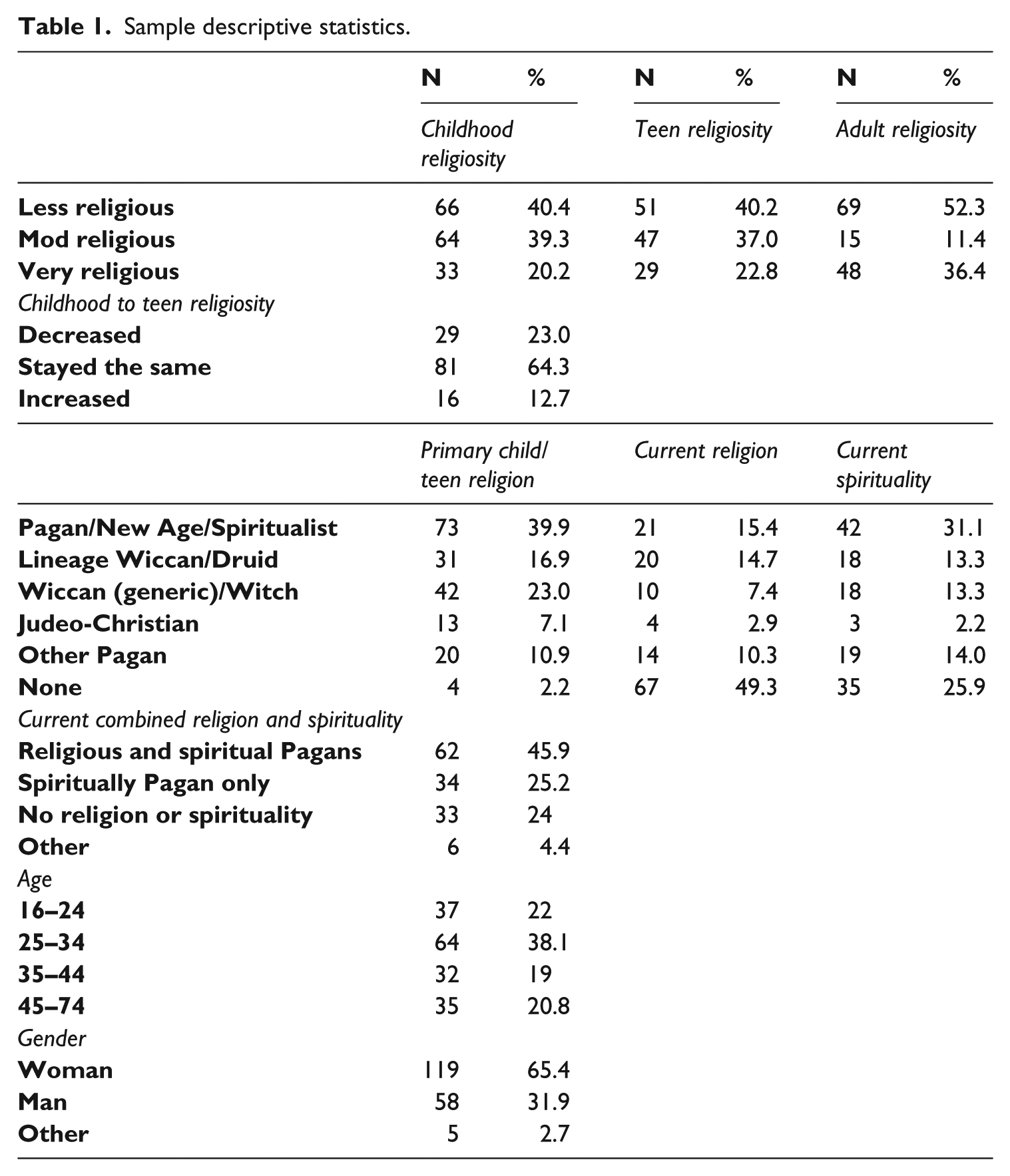
Based on our coding scheme, 20% of respondents were ‘very religious’ as children, 39% were ‘moderately religious’, and 40% were ‘less religious’. Chi-square tests (not shown) indicated that respondents who had been raised in general Pagan paths were less likely to have been seriously religious as children. Only 13% of children raised ‘eclectic Pagans’, ‘New Age’, or ‘spiritualists’ were ‘very serious’, whereas 33% of lineage Wiccans and Druids, 27% of generic Wiccans and Witches, and 33% of children raised in other specific Pagan paths were ‘very serious’. 12% of respondents indicated their religious participation increased as they grew into their teen years, 45% said that it stayed basically the same, and 23% said that it decreased. 75% of respondents who reported that their participation had increased as teens were already coded as ‘seriously religious’ children, and only 1 ‘seriously religious’ child reported a decrease as a teen. The reported decreases in participation were fairly evenly divided between ‘moderately religious’ and ‘less religious’ children. Ultimately, 23% of respondents were coded as ‘seriously religious’ teens, 37% as ‘moderately religious’, and 40% as ‘less religious’; most of the categorical shifts (n=13) occurred among ‘moderately religious’ children who became ‘less religious’ teens.
Religion and spirituality in adulthood
Now mostly adults, 51% of respondents said that they were very certain, 16% were certain, 17% were unsure, and 7.5% were uncertain about the existence of God/dess 5 (8% said they were certain God/dess does not exist). In terms of their spiritual beliefs, 31% identified as Eclectic Pagan, spiritualist, or New Age; 13% as lineage-based Wiccans or Druids; 13% as Wiccan or Witch; 10% as other Pagan; 2% as Jewish or Christian; and 26% as none. These numbers obviously reflect major declines from the respondents who were raised within Paganism, but the declines are even more dramatic when we look at the number of respondents who say they currently practice a religion, which 49% say they do not. Of the remaining respondents, 15% say they practice Eclectic Paganism/spiritualism/or New Age religion, 14% lineage-based Wicca or Druidism; 7% Wicca or generic witchcraft; 3% Judaism or Christianity; and 10% another form of Paganism. When we combine religion and spirituality, 46% of respondents identify both their religion and spirituality as Pagan, 25% identify as spiritually Pagan only, 24% identify as neither spiritual nor religious, and 4% fit another category. Chi-square analyses (not shown) indicated a highly significant relationship between respondents’ childhood religious sect and their subsequent religious sect, as well as their subsequent spiritual sect in adulthood. These relationships were particularly strong for respondents who had been raised in a specific tradition (for example, lineage-based Wicca) as opposed to those who were raised more generally Pagan.
The distribution of adult religiosity was highly skewed. Although we felt that our criteria for qualifying as ‘very religious’ were fairly strict, excluding respondents who were practicing other religions, 39% of respondents met the criteria for being ‘very religious’ as adults. Using this scale, only 11% of respondents were moderately religious, and 49% were less or non-religious. In sum, while many adults who were raised Pagan were no longer practicing Paganism or had abandoned spiritualism entirely, those who were left in the religion seemed to be actively involved.
Predicting adult religiosity
Although we had originally hypothesized that respondents whose primary religion was Paganism and were more satisfied with their religious upbringing would be more likely to remain Pagan as adults, we found no support from chi-square analyses or from an ordinal logistic regression that looked at the outcome of adult religiosity (results not shown). Most respondents were very satisfied with their religious upbringing on average, and the lack of variation probably contributed to this statistical insignificance.
We had hypothesized that respondents who practiced Paganism more seriously in their formative years would be more likely to identify as Pagans and practice Paganism as they grew older. Univariate and multivariate ordinal regressions consistently supported the hypothesis that children who were very serious Pagans in their youth were more likely to remain very serious Pagans in adulthood, compared to children who were not very religious.
Table 2 shows the results for partial and full models, using childhood religiosity and then teen religiosity to predict adult religiosity, controlling for age and gender. The Cox and Snell Pseudo-R^2 for the full model is 0.18, indicating that about 18% of the variance in adult religiosity is explained by the covariates. We see that the odds that very religious children become non-religious adults is .24 times that of children who were not very religious, and the effect is highly significant (p=.003). The effect is not significant for moderately religious children. Controlling for age does not diminish the strength or significance of this term, although age is a powerful predictor here. Respondents in the younger age categories (ages 16-34) are more than 4 times as likely to be non-religious as the oldest respondents (45+). 6 Without imputed values, we find similar effects from adolescent religiosity, except that both levels of adolescent religiosity become significant in predicting adult religiosity.
Ordinal logistic regressions predicting less religious adults.
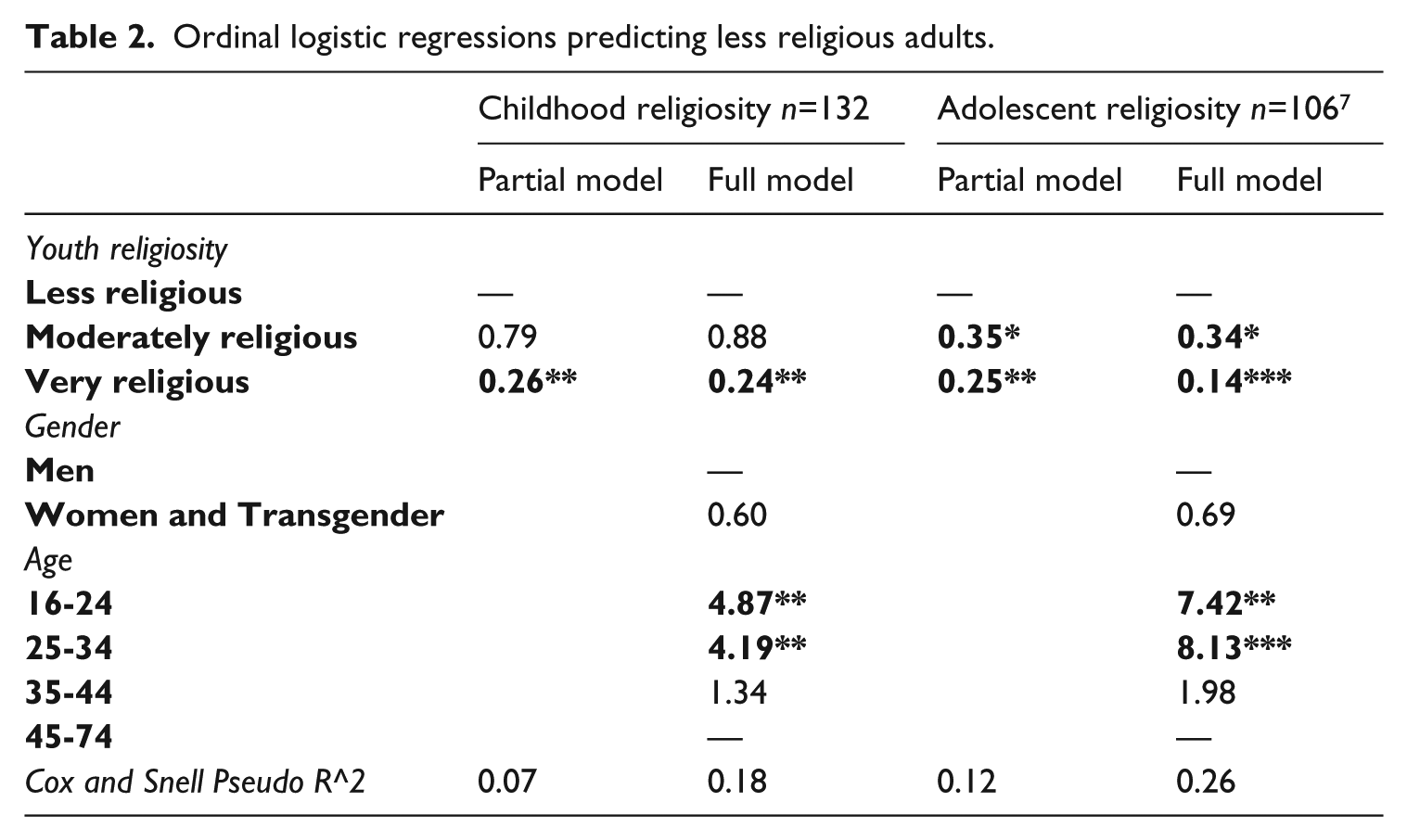
Figure 1 shows the major pathways that respondents took from childhood, through adolescence, into adult religiosity. All but one of the very religious children remained a very religious teen, but only 58% of very religious children ultimately became very religious adults. Similarly, 92% of less religious children remained less religious as teens, but only 62% of less religious children became less religious adults. Nearly all of the transitional changes from childhood to adolescence were from moderately religious children, 24% of whom became less religious as teens. From adolescence, we see that a clear majority of the very religious teens (60%) and less religious teens (72%) remained in their respective categories as adults. Because our sample was skewed in terms of adult religiosity, with most respondents being very religious or not religious at all, there was no common pathway into becoming a moderately religious adult. This skew also meant that most of the categorical shifts occurred among moderately religious teens, 42% of whom went on to become very religious, and 50% of whom became less religious as adults. The clear impression overall is that the majority of children and adolescents at the far ends – the very religious and the less religious – tend to remain in those groups as adults; meanwhile, most of the religious categorical shifts occur within the middle of the distribution, with a slight downward trend. These trends were not deterministic – some less religious children (28%) and adolescents (16%) eventually became very religious adults, and some very religious children (27%) and adolescents (32%) eventually became less religious adults. However, the overall trend is one of categorical continuity.
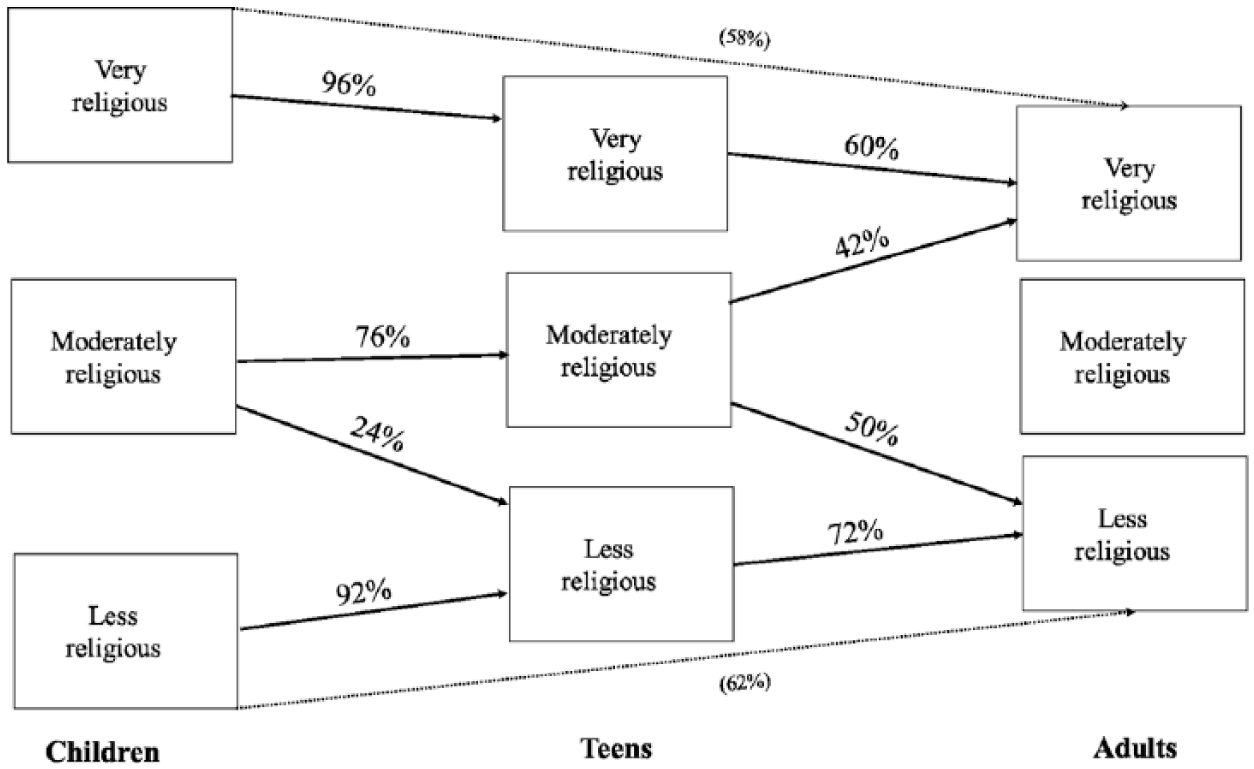
Pathways from childhood to adult religiosity.
Political and social attitudes
79% of respondents whose primary religion was Paganism said that Paganism had been a major or great influence on their worldview. By contrast, only 60% of respondents who had been raised with Paganism as a secondary religion said that it had been a major or great influence on their worldview. Regardless of whether it was their primary or other religion, however, the children of Pagans were overwhelmingly liberal in their political orientation. Among American respondents (n=110), 74% identified with a liberal party (Democrat, Green, or Liberal), 3% (4 people) with a conservative party (Republican, Tea, or Conservative), 17% with Libertarians and independents, and 4% (5 people) with none. Indeed, more people wrote in that they were ‘anarchists’ than identified as Republicans.
Paganism emphatically preaches that the Earth (usually personified as a goddess or sometimes even the Goddess) is sacred and should be protected and preserved, and this dogma was reflected in our respondents’ consistent reports that environmentalism was tied to their beliefs. Among all respondents, the majority reported that ‘environmental concerns’ (67%), ‘animal species extinction’ (55%), and ‘global warming’ (55%) were ‘extremely relevant’ or ‘very relevant’ to their spiritual beliefs. Likewise, the religion’s emphasis on gender equality (at both the human level as well as the divine level where both gods and goddesses are usually worshipped as equals) was reflected in respondents’ consistent agreement (68%) that women’s rights were connected to their spiritual beliefs. And finally, the consistent agreement (65%) that the rights of Gays and Lesbians to marry was tied to spiritual beliefs also demonstrates the longstanding support within the Pagan subculture for LGBT rights, which in turn is connected to the commonly held Pagan belief that sexuality and bodies are sacred. On the other hand, most did not feel that abortion, the right to own guns or human population growth were related to their beliefs. Those unfamiliar with Pagan dogma might be confused by the consensus of our respondents that ‘abortion’ rights were not relevant to their spiritual beliefs. However, in contrast to most other American religions, modern Paganism has no real value position on abortion.
The counter-cultural associations of Paganism were also apparent in respondents’ sexual and relationship behaviours. As mentioned earlier, only a slight majority of respondents (58.5%) identified as heterosexual, and a few (5.5%) identified as homosexual. Meanwhile, 60 (33%) of respondents checked the box for ‘bisexual’, with 4 of those respondents specifically labelling themselves Queer, and 9 of them labelling themselves Pansexual. Moreover, 8% of respondents said that they had been primarily raised in polyamorous households; as adults, 10% of respondents identified themselves as polyamorous (most of whom had not been raised in polyamorous households as children), and a further 11% said they usually engaged in ‘open relationships’.
Discussion
Our results might have been different if we had let respondents identify themselves as ‘very seriously religious’, ‘moderately religious’, or ‘not very religious’ as children, teens, and adults. It is possible that the coding system we used for sorting respondents into these categories from the questions they answered is flawed. Although we considered developing an index of religiosity, there was no logic to doing so, since questions captured intensely different aspects of religiosity (for example, frequent attendance at weekly rituals was clearly not equal to frequent attendance at (the eight times a year) holiday celebrations). In short, the validity of our results may have suffered from a surfeit of information. It is also important to remember that our measures and coding of religiosity are contextually dependent and are not in line with conventional measures of religiosity for mainstream faiths. Thus a ‘very religious’ adult in our study might appear as ‘barely religious’ on a more conventional survey. However, we believe that using conventional measures of religiosity for a conspicuously unconventional religion would create invalid measures and results. We acknowledge that the system we used may have problems, but we believe it is superior to using more conventional (and in this context, largely meaningless) measures of religiosity.
Given that only 30% of our sample is male, we can be reasonably certain that we do not have a representative sample of the children of Pagan parents. We must therefore be cautious in interpreting our other descriptive statistics as being representative of our population of interest. In particular, we suspect that non-Pagan adult children of Pagans would have been less likely to answer our survey, due to less interest in the subject matter. We must acknowledge the likelihood that we have overestimated the children who remained in the faith in our descriptive statistics. However, we do not believe that our potentially non-random sample may have interfered with the results from our multivariate analyses finding that childhood religiosity is a major and significant predictor of adult religiosity.
Given the limitations of our possibly non-random sample, and our small sample size, this study should only be considered a preliminary attempt at studying religious retention among Pagans in particular and NRMs in general. However, having acknowledged these limitations, our descriptive results suggest that the adult children of Pagans are about as likely to remain in their childhood faith as adults who had been raised in mainstream religions. Our results show that the children of Pagans very rarely convert to other religions – most who leave Paganism claim no religious affiliation.
We set out to test competing hypotheses of religious retention for the children of Pagans: a minority subcultural identity effect hypothesis suggesting that respondents might feel deeply connected to the unusual Pagan subculture and thus be more inclined to stay in the faith, and the disorganized religion effect suggesting that respondents may have felt excluded from the faith as children and that the lack of organization and structure in the religion would make it difficult for respondents to continue to practice their parents’ faith as adults. Our results strongly suggest that the children of Pagans do not remain in the faith at the same high rate of other well-established subcultural American minority faiths like Hinduism or Judaism, potentially indicating little support for the minority subcultural identification hypothesis. Due to our sample limitations, we must say more tentatively that our results suggest that being a disorganized religion does not limit Paganism’s second generation religious retention as much as might be expected. Further study is certainly necessary, but we believe that both effects are in play and appear to be functionally cancelling one another out. That is, there is a strong sense of minority subcultural identification among the children of many Pagans that increases what might otherwise be the very weak retention resulting from the disorganization and lack of structure in the religion.
Our regression analyses should be less affected than our descriptive statistics by our possibly non-representative sample, and they quite compellingly indicate that the same key factor that affects religious retention among children raised in majority faiths also affects those raised Pagan: namely, the level of religious participation as a child and adolescent. This effect persists unabated even when we control for age (which is highly significant such that older adults are more likely to be religious) and gender (which is not significant). Thus in spite of its disorganization, small size and steadily decreasing stigma, it appears that the same factors that affect retention among mainstream religions may be operating within Paganism as well.
Our results both support and call into question traditional theories of generational religious retention (for example, Stark and Finke, 2000). These theories usually assume that structure and organization are essential for building a successful and growing religion. On the one hand, modern Paganism appears to utterly defy this theory: it is a rapidly growing religion (Jensen and Thompson, 2008) characterized by a profound lack of structure and centralized organization (Neitz, 1994). Moreover, our study suggests that it is reasonably successful (and perhaps as successful as more mainstream religions) at retaining its second generation of followers. On the other hand, our finding that the more structured Pagan sects are conspicuously more successful at retaining a second generation supports those more traditional theories of religious retention emphasizing structure. Subsequent generations and further study are necessary to determine if the unstructured adaptability and flexibility of modern Paganism will improve or harm its continuity. At present, it primarily remains a religion of converts, although it appears to be more successful at maintaining its children than most academics (and many Pagans themselves) would expect.
Footnotes
Acknowledgements
Thanks to Helen Berger, who provided feedback on an earlier draft of this paper.
Funding
This research received no specific grant from any funding agency in the public, commercial or not-for-profit sectors.
Notes
Author biographies
Address: HMB 134, 800 Florida Ave NW, Washington, DC 20002, USA
Email:
Address: 438 Tobin Hall, University of Massachusetts Amherst, MA 01003, USA.
Email: