




Abstract
Hurricane Katrina forced one of the largest internal migrations of people in US history. Among the evacuees were 28,000 Filipino Americans many of whom fled to Houston. In a short period of time, Filipino American Catholic Houstonians relocated their co-ethnics with host families, facilitated documents needed for US federal aid (FEMA), provided material assistance, and addressed evacuee medical needs through the establishment and staffing of a crisis triage clinic. Drawing on ethnographic and survey data we explore the factors that impacted and shaped Filipino American community participation and volunteerism during the events of Hurricane Katrina and after. We found that both religious and non-religious organizations were vital in the mobilization of Filipino Americans during the Katrina relief effort and subsequent natural disaster1 responses.
Introduction
In August 2005, Hurricane Katrina struck the Gulf Coast of the United States. With maximum sustained winds in excess of 120 miles per hour, reaching as high as 175 miles per hour, the category five hurricane proved to be the most destructive US storm on record (Knabb et al., 2005). Beyond the historic cost to lives and property, Katrina forced one of the largest internal migrations of people in American history (Brunsma, 2007). Over one million were displaced from the Gulf region and forced to take temporary, and in some cases permanent, residence in neighboring states.
Although largely ignored by the media and scholars alike, among the evacuees were an estimated 28,000 Filipino Americans from Alabama, Florida, Mississippi, and New Orleans, Louisiana – the oldest Filipino American community in the country (Ciria-Cruz, 2005; Donato et al., 2007; Filipino Express, 2005; Kao, 2006). The majority of the Filipino American evacuees, many of whom were/are first-generation immigrants, ended up in Houston en route to the shelter of the Astrodome, one of the largest sporting stadiums in Houston 2 . Because Houston took in more evacuees than any other city, over 150,000 people, local and state agencies were challenged to manage the crisis (Holcombe, 2007). Unable to respond to these challenges through any one agency, all large-scale and grassroots efforts required the coordination of multiple organizations and individuals. For Filipino American evacuees, the majority of their needs were met by the quick mobilizations of fellow Catholic Filipinos living in the city.
Few studies have explored the roles of religion and religious institutions in local natural disaster response (Fiddian-Qasmiyeh, 2011). Those that have largely ignore immigrant populations that are equally affected or, in some cases, more affected by these events. Prior research in Peru demonstrates that community organization is the most important factor in reducing risk and vulnerabilities to natural hazards (Maskrey, 1989). Therefore, it seems imperative to understand how immigrant communities respond to such events. Drawing on extensive ethnographic data, interviews and surveys with members of the Filipino American Community in Houston, we explore the factors that impacted Filipino American community participation and volunteerism during the events of Hurricane Katrina. It is essential to understand the motivations of a community, which may connect individuals to one another and can be utilized in disaster responses (Cannon, 2008). We specifically ask what influence Catholicism and active religious participation has on mobilizing Filipino American civic responses to natural disasters. Results suggest that being religiously active can and does facilitate Filipino American community volunteerism and civic mobilization during these chaotic circumstances. However, given that our sample is very religious in terms of frequent religious attendance, we find that participation in religious groups also significantly influences their responses to natural disasters. It is not just being religious, but rather being connected to religious and civic groups and networks that seem to be the most salient factors when it comes to actually volunteering or financially contributing to disaster aid. At the same time, Filipino cultural understandings of reciprocity and mutual obligation to each other through a spirit of community unity further bind them to these networks and groups and animate their disaster response.
Religion, volunteering and disaster relief
The role of religion and religious institutions has long been overlooked, and in some cases underestimated, in the study of natural disasters and community responses to people’s emergent needs following these events (Candland, 2000; Cheema et. al., 2014; Chester, 2005; Fiddian-Qasmiyeh, 2011; Gaillard and Texier, 2010). This is particularly true in the study of Hurricane Katrina, which presents a unique case in the literature on faith-based responses to forced migration (overview in Fiddian-Qasmiyeh, 2011). In all the cases presented in Brunsma et al.’s (2007) pioneering work on Hurricane Katrina, for example, only one chapter specifically addresses the role of religion, and it is not among immigrant communities affected by the storm. This is somewhat surprising considering what we know about the general relationship between religion and American civil society, especially in the voluntary sector. Volunteering is one of the most prominent forms of civic participation in the United States and one in which religion has historically played a major role (Becker and Dhingra, 2001; Musick et. al., 2000; Putnam, 2000; Wilson and Musick, 1997). By some estimates half of all American volunteerism occurs in a religious context, if not through a place of worship (Putnam, 2000: 65-79). Research also suggests that frequent religious attendance can increase the likelihood of volunteering (Hodgkinson, 1995; Musick and Wilson, 2008; Wilson and Musick, 1997). Only education rivals frequent church attendance as a predictor of volunteerism (Campbell and Yonish, 2003; Musick and Wilson, 2008).
As social capital, religion can provide opportunities to cross social boundaries, forge ties with people from other groups, and bridge individuals to the wider society (Campbell and Yonish, 2003; Putnam, 2000; Wilson and Musick, 1997; Wuthnow and Hackett, 2003). The work of Aldrich (2012) highlights the critical role religious social capital plays in the ability of communities to rebuild both the infrastructure and the ties that are the foundation of future disaster responses. Beyond these extensive networks and the resources they present for volunteering to occur, religious institutions can also mobilize more intrinsic forms of capital that motivate volunteers by instilling a sense of duty to serve others in the community (Ellison, 1992; Hodgkinson, 1995; Musick and Wilson, 2008; Wilson and Musick, 1997; Wuthnow, 1990; 1991). This is true of everyday volunteering circumstances; however, as noted above, little research has explored the role of religion in volunteering for disaster relief (Aldrich, 2012; Holcombe, 2007). The role of religion seems particularly important to examine because understanding what motivates people to collaborate can reduce vulnerabilities to future disasters (Cannon, 2008).
Among the few studies that address the role of religion in disaster relief, most highlight the degree to which religious institutions contribute to both the recovery and rehabilitation of local communities during natural disasters by feeding hungry victims, providing shelter, and mobilizing other basic needs such as emergency healthcare (Bano and Nair, 2007; Candland, 2000; Cheema et. al., 2014; Chester, 2005; Clarke, 2013; Stern, 2007). Smith (1978), for example, found that churches who responded to a destructive tornado in Ohio had immediate access to local church networks that allowed them to mobilize social cohesion during a time of distress and quickly deploy both social and safety mechanisms that helped to accommodate the emergent needs of victims (also see Bano and Nair, 2007; Candland, 2000; Wisner, 2010). He also found that these churches not only were able to provide emergency services but long-term recovery activities that extended well beyond the immediate responses of the community (Smith, 1978). Bolin and Bolton (1986) found similar results across a broader sample of disaster recovery efforts in California, Hawaii, Texas and Utah.
Like Smith (1978), Cain and Bathelemy (2008) and Holcombe (2007) in their studies of community responses to Hurricane Katrina found that churches were able to quickly mobilize in the Baton Rouge (Louisiana) and Houston (Texas) areas in large part because of their network resources. Although churches and other houses of worship are not set up to meet the needs of any given disaster, and typically do not have budgeted resources allocated to disaster response, they do have numerous local community networks that can be mobilized in cases of emergency through shared theological messages of altruism, brotherhood, and self-sacrifice that can bring communities together (Dynes, 1970; Koenig, 2006; Provenzo and Provenzo, 2002; Smith, 1978). The most effective disaster response efforts are often not mobilized by individual churches working alone, but rather in collaboration with a host of individuals, groups, and institutions who share in a singular mission at a given time and who collectively can mobilize community networks and resources (Smith, 1978). While a common faith and religious practice often lies at the center of these collective efforts, few, if any, have studied it in the disaster literature (Candland, 2000; Cheema et. al., 2014; Chester, 2005; Mitchell, 2003). Among those that have, none have explored the role of Catholicism in immigrant civic mobilizations during natural disasters.
Catholicism and Filipino American volunteerism
Filipinos, in general, are religiously active and are overwhelmingly Catholic by affiliation. Although clearly not all Filipinos are Catholic, Catholicism has been one of the most culturally pervasive influences in the Philippines over the last four hundred years (Cherry, 2014; Gonzalez III and Maison, 2004; Lipka, 2015; Park, 2009; Pido, 1997). Since Spanish colonial rule, the Philippines has been and remains one of the most traditional and conservative adherents to Catholicism in the World (Cherry, 2014; Lipka, 2015). Today it is the only predominately Catholic nation in Asia and home to the world’s third largest Catholic population (Lipka, 2015; Pew, 2013). Roughly 81 percent of Filipinos are Catholic (Lipka, 2015). Over half of all Filipinos in the Philippines (52 percent) attend church at least once a week (Pew, 2013; Social Weather Survey, 2002).
Filipinos are the fourth largest immigrant population in the United States and the Philippines is the second largest source of Catholic immigration to the country (Cherry, 2014). In migration, Catholicism remains important to the Filipino American community both as a resource and a cause or motivation for solidarity (Cherry, 2013; Cherry 2014; Gonzalez III, 2009; Gonzalez III and Mason, 2004; Okamura, 1998). Cherry (2014) demonstrates how Catholicism and the centrality of family shapes Filipino American Community life by mobilizing cultural frameworks and mediating institutions that facilitate the planning and construction of Filipino community centers and Filipino volunteering at health fairs and other civic projects. Likewise, Chao (1999) suggests that Filipinos tend to stress obligations to family, ethnic organizations, and their religious institutions. Thus Filipinos often engage in informal sharing and giving that may not be perceived as formal volunteering (also see Bonus, 2000; Lien, 2001).
Gonzalez III (2009), however, finds that Filipino Americans are involved in a host of hometown associations that link Filipino migrants to their provinces in the Philippines through social and economic projects. He suggests that being involved in these associations, as well as religious institutions, further connects Filipino Americans to American civil society through informal participation in events and projects. Additionally, Cherry (2013) finds that it is not just being involved in these associations that mobilizes Filipino community involvement but being actively Catholic. He also finds, like Chao (1999) and Gonzalez III (2009), that Filipinos are involved in a host of informal voluntary networks that are bound by cultural understandings of reciprocity and mutual obligation (Aguilar, 1994; Jocano, 2008). This sense of reciprocity or debt of gratitude, utang na loob (Tagalog), is not something that can be repaid but is a lifelong obligation that compels Filipinos to continually make sacrifices for the greater good of the family and community (Aguilar, 1994; Cherry, 2014; Cruz et al., 2001; Parrenas, 2005; Pido, 1997; Racelis and Cabegin, 1998). It compels Filipinos to think less about themselves through a sense of mutual obligation and cooperation – pakikisama (Tagalog), that is animated by a spirit of community unity – bayanihan (Tagalog) (Cherry, 2014; Gonzalez III, 2009; Parrenas, 2001; Pido, 1997; San Buenaventura, 1999; Scott, 1997). These cultural understandings influence Filipino American civic life both formally and informally (Hollinsteiner, 1997).
Although much of Filipino American civic life is informal, Filipinos do formally volunteer (Cherry, 2013). In fact, Sundeen et al. (2007) find that Filipino Americans volunteered on average 33 more hours annually than other Asian Americans. Likewise, Sundeen and colleagues find that Filipinos volunteer most for religious organizations. This should not be a surprise, given what we know in the general literature on volunteering, but less is known about the relationship between religion and community civic mobilizations during natural disasters such as Hurricane Katrina.
Data
Data presented are drawn from ethnographic work, face-to-face interviews, and a survey of first-generation Filipino Americans in Houston. The initial sample was recruited through one parish, after an introduction to parishioners from the parish priest. A respondent from the initial sample helped establish contact with those who were not regular church attenders and those who had left for another parish. Ethnographic data were collected over a three-year period, 2007–2010, through participant observation in the Filipino American community in Houston and archival research of local newspapers and correspondences. Face-to-face interviews were conducted with 50 first-generation Filipino Americans from a sample of local community leaders, including Catholic priests, founders of Filipino civic groups, leaders of Filipino prayer groups, and those who volunteered during Katrina relief efforts. First-generation Filipino American Hurricane Katrina evacuees were also interviewed. The data used in this project comes from a larger study that explores the intersection of civic and religious life in the Filipino American community. For more details on the study, see Cherry (2014).
The Houston Filipino American Hurricane Katrina Survey was conducted in 2010 at the 112th anniversary of Philippine Independence celebrated at Notre Dame Catholic Church. The Philippine Independence celebration at Notre Dame is the largest single annual gathering of first-generation Filipino Americans in the city of Houston. Out of 300 administered surveys, we had 264 valid and completed surveys returned with a response rate of roughly 88 percent. Both the ethnographic and survey samples are roughly 35 percent male and 65 percent female, which resembles the general Filipino American population (2000 US Census; also see the national sample of the Social Capital Community Benchmark Survey, Putnam, 2000). Socio-economically these samples are also similar to that of the 2000 US Census in terms of educational attainment and income. However, the samples are considerably older on average than the general Filipino American community at a mean age of 56 years versus 31 nationally (2000 US Census). The difference in mean age may be attributed to a) the specification of only first-generation immigrants in the sample; b) the ten-year gap in time since the 2000 and 2010 Censuses; and c) the Houston population itself.
In terms of religious participation, our sample is highly religious 3 . Approximately 86 percent of our sample reported attending worship services at least once a week. Our sample was also connected to religious communities outside of formal worship services; approximately 55 percent of our sample participated in a religious group, such as Santa Nino, Totus Tuus, and Couples for Christ. In addition, roughly 49 percent participated in a civic group, like the Knight of Rizal, Filipino American Council of South Texas (FACOST), Philippine Masons Association of Texas (PAMAT), and a host of other ethnic and broad-based associations. Not all respondents who participated in a religious group participated in a civic group and vice versa. 35 percent of our sample participated in both religious and civic groups, 20 percent participated in religious groups only, 14 percent participated in civic groups only, and 31 percent participated in neither group type. Our sample is one that was very connected, both religiously and civically, with their local community.
Filipino American community responses to Katrina
When news of Hurricane Katrina’s massive devastation first spread, Filipino Americans around the country, like many groups and individuals, exhausted all text, email, and phone communication networks for updates on the whereabouts and statuses of their friends, family, and fellow co-ethnics. In California, the Philippine consulate called on all Filipino networks and associations around the country to mobilize at the grassroots level (Filipino Express, 2005). In Houston, as word spread that thousands of Filipinos were heading toward the Astrodome, it sparked a rather rapid community response in advance of the consulate’s request. Key community leaders, who were either current presidents of Filipino American associations or who had served at some point as officers in associations both at the national and local level came together in private to discuss what could be done to aid the evacuees.
We did not know what to do but we knew we needed to do something. I called the meeting of past [Filipino] association presidents and a host of groups to my house for a prayer meeting. We took our problems before the Lord and then went about the task of trying to figure out how we could mobilize to help our fellow Filipinos who were on their way to Houston. We had experience on our side but it was only through God that our prayers were so quickly realized (interview, 2010).
Given the fact that Filipinos represent a rather diverse population, coming from over 7,000 islands, and bring with them a host of regional linguistic and provincial differences, these community members and their connections to local churches were vital to grassroots mobilizations across these diverse and often conflicting regional Filipino groups and organizations (Bonus, 2000; Cherry, 2014; Gonzalez III, 2009; Terrazas and Batalova, 2010). These individuals were well known, well connected, and well respected across these communities.
Rallying around a unified sense of urgency for their fellow Filipinos or kababayans (Tagalog) and drawing on a sense of obligations toward them, what many Filipinos would call the bayanihan (Tagalog) spirit, the meeting of community leaders brought about swift action and the mobilization of considerable resources. As one Filipina told us, ‘bottom-line is we are all Filipinos and in time of crisis we come together … it is what God would ask of us’. Echoing this same sentiment, another Filipina commented that, ‘Filipinos will never be left stranded in the Astrodome as long as we live … we will always come to their rescue’. Out of the numerous Filipino evacuees that fled to Houston, none of them stayed longer than a few hours in the Astrodome. Filipino Houstonians held up signs in the parking lot at the Astrodome as busses and vans arrived. As evacuees arrived, Filipinos among them saw the signs written in English and Tagalog and were directed to a newly formed Filipino relief group.
Under the umbrella of the National Federation of Filipino American Association (NaFFAA), the aforementioned community leaders, all devout Catholics, formed Filipino Disaster Relief of Texas (FDRT). Within hours of their initial meeting, they were able to find foster families for many of the evacuees through several local Catholic churches. FDRT was able to access community directories through these churches and call upon Filipinos who had historically supported and funded community projects. Due to the generosity of one local real estate sponsor, FDRT was also able to acquire vacant apartments for the remaining evacuees. When we asked this sponsor how this unfolded he stated, ‘well it had been a bad time for us and we had several vacancies we could not rent… it was just fate that we had the space for those in need’. This response was not unique to the Filipino community. Since official city resources were strained during this time, a host of different organizations stepped up to fill the gaps and provide essential aid at the grassroots level. Chief among these mobilizations were religious institutions, organizations and groups. Relief workers estimate that 500,000 people, not all Filipino, were provided shelter throughout the region by these groups with many being housed in over 500 local houses of worship (Cooperman and Williamson, 2005; Holcombe, 2007).
Later in the week after housing had largely been secured for Filipinos and others, FDRT called on all community associations, organizations, and individuals to meet with the evacuees at Oyster Creek Park in Sugarland, a suburb of Houston. They also invited local Filipino priests from surrounding parishes to give a brief mass and pray for the evacuees.
Lord, in the time of our greatest needs, we turn to you. Hear our prayers and bring comfort to those who are here today. We call on those who have the resources to help our fellow brothers and sisters. Give, as our Lord Jesus has given to us. Help them as he has helped us in our own times of need. Let us pray … (Event recording, 2005).
It was an emotional plea but one that seemed to inspire those in attendance. As one Filipina we interviewed stated, ‘this is the true mark [of] our faith. It’s not about showing up to mass but faith in action, doing for others as the Lord commands us’. Agreeing, another Filipino standing next to her commented, ‘If you didn’t already feel obligated to help, I think the priests just put the fear of God into them. Some people are here today to be seen, to be heroes to our fellow Filipinos, but true action must come from faith and the humbled heart’.
Our survey of first-generation Filipino Americans suggests roughly 37 percent donated food or clothing during this time, 58 percent gave money, and 26 percent volunteered in some capacity during the Hurricane Katrina response. Figure One illustrates our respondents’ motivations behind volunteering. When asked to rank their top three reasons for volunteering, respondents overwhelmingly seemed to be motivated by religious reasons. 48.6 percent of our volunteers selected ‘religious obligation’ as their top motivation, and approximately 88 percent of the sample chose this as one of their three motivating factors. Given that the sample is very religious, it is not a surprise that their religious commitment compelled them to act, especially when their local priest cited scripture in reminding them of what God would want them to do (Cherry, 2014). The second most popular response was that the church asked for help; approximately 14 percent selected this as their first option and 77 percent selected this as one of their three motivating factors. Finally, civic connections also seemed to motivate our volunteers. Roughly half our sample cited a Filipino organization asked for help as one of their three motivating factors.
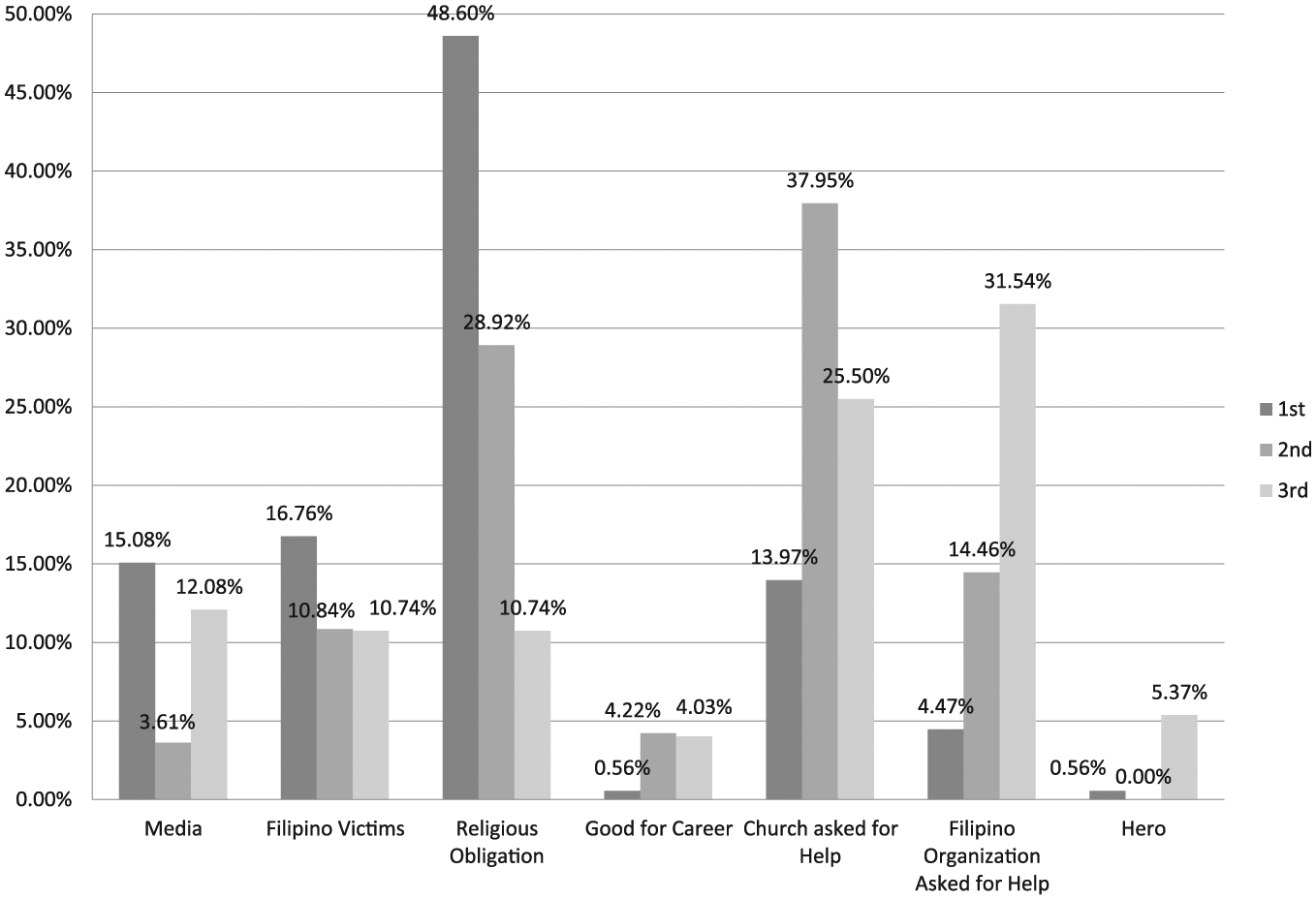
Motivations for contributing to Hurricane Katrina response.
Resource mobilization during and after Katrina
After the brief mass discussed above, the local Filipino American community had the opportunity to meet face-to-face with the majority of the evacuees, feed them, hear their stories, and assess their numerous needs. Several of the Filipino Houstonians we interviewed commented that they had no idea how long Filipinos had been living in New Orleans. As one Filipina stated, ‘When I think about Filipinos, I think California … I had no idea that New Orleans was actually the oldest community in America’.
Among the immediate concerns that became apparent was the general health of the evacuees. One Filipina told us she was surprised how hard the stress of the situation had been on the evacuees physically. Another commented, ‘you know most of them were not really poor but they seemed so needy… they looked like they had been through years of war and wandering’. Understanding that the Red Cross and FEMA were overburdened and in many cases ineffective at addressing these needs, FDRT approached HOPE (Helping Other People through Encouragement) health clinic in Houston to sponsor a triage clinic for the evacuees. After mobilizing the needed funds, securing a building and staffing the clinic with volunteer Filipino nurses and doctors, the clinic was up and running within a week and either free of charge or based on a sliding scale for those who actually had insurance. Getting the clinic up and running required tremendous networking and mobilization of resources. One member of FDRT who is also a key board member of the Houston Filipino Nursing Association was able to find several volunteers willing to staff the clinic. Another member of FDRT had connections with local representative Gordon Quan through the Asian Pacific American Heritage Association (APAHA) and was able to negotiate the use of the HOPE site for the clinic in collaboration with other Asian communities. Without these key contacts, and the inspiration of their Catholic devotion, none of this would have been possible.
Beyond the clinic, the meeting at Oyster Creek Park also revealed that the evacuees lacked basic necessities such as clothes and toiletries. Drawing on local agencies, including their own Catholic churches, the Filipino American community was able to secure numerous donations for these needs. Both spontaneously and at the urging of FDRT members at the Park, Filipinos also gave generously as individuals. In addition to individual contributions, FDRT in collaboration with associations and sponsors both from within and outside the Filipino community were able to raise well over $20,000.
Looking further at our survey data, results suggest that religious and civic networks and connections were important for volunteering during the relief effort. While we did not find any statistically significant differences with regard to volunteering 4 , our results suggest that religious group participation and civic group participation mattered when it came to donating food/clothes and money. All of the differences we report are statistically significant ones. As Figure Two illustrates, approximately 42 percent of respondents who participated in a religious group donated food/clothes compared to 30 percent of respondents who did not participate. Similarly, approximately 45 percent of respondents who participated in a civic group donated food/clothes compared to 29 percent of respondents who did not participate. Trends were similar with regard to donating money for evacuees; approximately 66 percent of respondents who participated in religious groups donated money compared to 49 percent of respondents who did not participate. In addition, 66 percent of respondents who participated in civic groups donated money compared to 50 percent of respondents who did not participate.
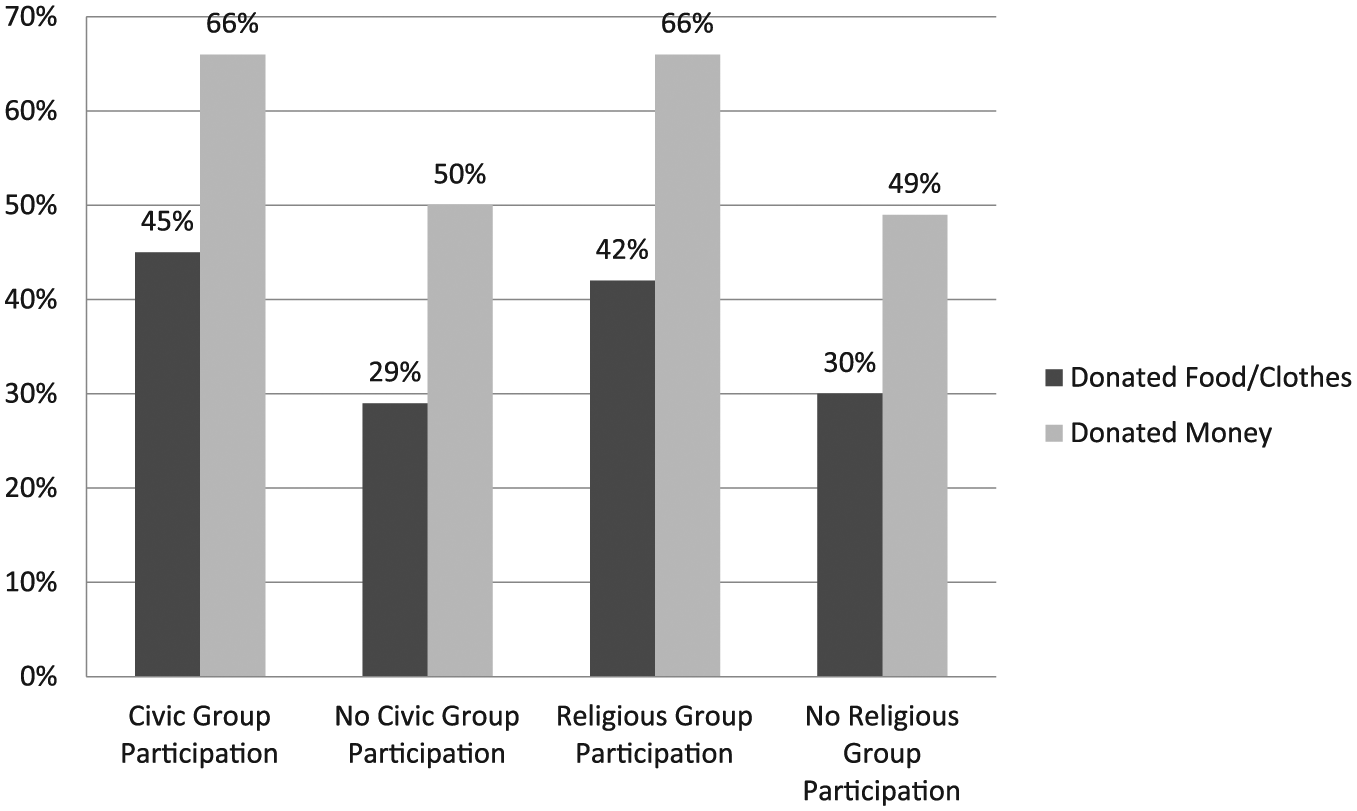
Donating during Hurricane Katrina response.
With these resources in place and utilizing a well bridged series of community networks through FDRT, the Filipino American community in Houston was then able to facilitate paperwork for new Philippine passports, file documents of authenticity needed for US federal aid (FEMA), register children for school, and facilitate the finding of new jobs. As one Filipino evacuee described it, ‘I would have been lost without their help … FEMA was such a mess and no one outside my fellow Filipinos seemed to really care’. Another Filipina, a bit angrier, asked us, ‘where was the government in all of this?’ Continuing she stated, ‘They should worry about things here at home before they send more troops overseas, the real war was Katrina’. When we later asked Filipino evacuees why their experiences with FEMA and other agencies were so bad, they often stated that language and a general sense of uneasiness or perceived prejudice among those attending to them were the main issues. As one Filipino put it, ‘we speak English just fine but I always get the feeling that people treat me different when I speak or when they see my Asian face’. Continuing he explained, ‘With other Filipinos I don’t have to worry about whether I am pronouncing my Ps and Fs right or not, I can just speak Tagalog and besides that is what I prefer especially when things are crazy or I am just pissed off’.
Other Filipinos suggested that it was not just language or uneasiness with FEMA and Red Cross workers but the other evacuees that presented problems. Describing this, one Filipina explained to us, ‘Look I am not prejudice but we heard rumors when we were at the Astrodome that Blacks and Asians were getting into fights in the lines and that frightened us’. She then stated, ‘Nothing happened to us and I didn’t see anything but we didn’t stick around either – thank God the community rescued us’. Continuing, she explained, ‘given that we have not always gotten along [Filipinos and African Americans], it’s not surprising but even if nothing did happen it is always a blessing to be with people who understand you and where you are coming from and that’s why we left the dome’.
Outside of simply attending to or supplementing their fellow Filipinos needs, the Filipino American community in Houston was able to mobilize considerable resources that were ultimately better organized and delivered faster than FEMA or the Red Cross. Evacuee families received roughly $100 cash for groceries and basic needs in addition to other aid. This aid helped to fill the gaps in evacuee needs while the community helped each family or individual secure more long-term aid through FEMA or their insurance companies. It is also important to note that not all evacuees aided were Filipino. The mobilization of the Filipino American community in Houston was so effective in working with agencies in other states to create a disaster relief task force that its efforts extended to other displaced groups. Working together with other Asian agencies the relief efforts of the Filipino American community extended to both Chinese and Vietnamese evacuees that had taken shelter in Houston’s Hong Kong Market. While the Chinese and Vietnamese communities mounted their own relief efforts, Filipinos supported these efforts with their own funds and most noticeably in their staffing of emergency medical clinics that were available for all evacuees regardless of their race or ethnicity.
Today, the triage clinic that was founded to aid Katrina evacuees is still open and operates as a free clinic serving all of Houston under HOPE clinic community health centers. FDRT, now renamed Offering of Filipinos and Friends for Emergency Relief (OFFER), is still together raising money and coordinating disaster response efforts. In September 2009 OFFER raised over $6,500 for victims of Typhoon Ondoy in the Philippines in addition to sending numerous care packages (balikbayahan boxes) to the Philippines. In November 2013, OFFER raised over $200,000, in addition to other physical aid resources, for victims of Typhoon Haiyan, also known in the Philippines as Typhoon Yolanda. Typhoon Yolanda killed over 6,500 people in the Philippines and proved to be the deadliest and costliest storm to hit the islands since the late 1800s (Bankoff, 2002; Luna, 2001 on Filipino responses to natural hazards in the Philippines).
What was initially established as a one-time emergency mobilization for Hurricane Katrina has now been institutionalized for future disasters. As one member of OFFER [FDRT] told us, ‘It is a miracle that it all came together as well as it did, but now we are prepared for anything’. Continuing, ‘We renamed ourselves OFFER because Katrina is over… today we keep our networks alive and our donations flowing just in case because something always happens’. Agreeing, another member of OFFER stated that, ‘we know who we can count on, we know where to find the resources, and we know who will answer the call… Katrina taught us this’. Continuing, and summarizing a key lesson, she suggests, ‘We keep OFFER going because we know that someday our fellow Filipinos either here or at home [Philippines] will need us and we can do a better job of helping them than any government … we don’t need to get elected, we just get stuff done’.
Discussion and conclusion
Hurricane Katrina forced one of the largest internal migrations of people in US history. Among the evacuees were an estimated 28,000 Filipino Americans, many of whom fled to the Houston metropolitan area. In a rather short period of time, Filipino American Catholics, working through OFFER in Houston, relocated their co-ethnics with host families, facilitated documents needed for US federal aid (FEMA), provided material assistance, and addressed evacuee medical needs through the establishment and staffing of a crisis triage clinic. Today, OFFER continues to facilitate emergency disaster relief in Houston and the Philippines. The triage clinic established during Hurricane Katrina is also still in operation, serving Houstonians not just during emergencies but year-round on a sliding scale for those who cannot afford healthcare. None of this would have been possible without the mobilization of religious resources and networks among devout Filipino American Catholics. Likewise, this mobilization would not have occurred without Filipino cultural understandings of reciprocity and mutual obligation to each other that further bound them to these networks and groups and animated their rather quick disaster response.
The Filipino American Catholic community’s response to Hurricane Katrina and its evacuees provides an important model for how local, state and federal agencies can better serve and support ethnic communities, particularly immigrant populations, during natural disasters. This model highlights the importance of partnering with ethnic/ regional-based community organizations such as OFFER that have well established networks with detailed membership rolls that can be mobilized quickly and in a language that better serves those in need of assistance. This model also highlights the importance of religion to those in these networks and in facilitating resource mobilization across them. Few studies have explored the roles of religion and religious institutions in natural disaster response. Those that have, largely ignore immigrant populations, such as Filipino Americans, that are equally impacted or, in some cases, more affected by these events.
This research has made an important contribution to our understanding of the role of Catholicism and/or other religious denominations and institutions can play in disaster response and management. Communities often need an incentive to respond to disasters (Cannon, 2008), and our results demonstrate how both religious and civic organizations can help motivate community members to respond. Key actors in local, state and federal agencies involved in disaster response must not only understand the complex relationship between people’s faith and religious institutions as they are connected to civil society, but they must also seek them out in their strategic disaster response planning. However, whereas previous studies have focused on religion-based institutional responses to natural disasters and found them to be the key to community mobilizations (Cain and Barthelemy, 2008; Cheema et al., 2014; Holcombe, 2007), our results suggest a more complex mobilization of religious resources beyond institutional support. Like previous studies, we do find that religious institutions are important to disaster relief but their importance spread beyond simple church attendance. For example, Filipino American Catholics who participated in religious groups were more likely to donate food and/or clothes, money and volunteer for disaster relief than those who did not participate in these groups. In terms of motivations, our respondents who volunteered or provided aid during Hurricane Katrina selected ‘religious obligation’ as their top motivation. In fact, 88% of the sample chose ‘religious obligation’ as one of their three motivating factors. The second most popular response overall was that the church asked for help and roughly half our sample cited a Filipino organization asked for help as one of their three motivating factors. Where previous studies of the role of religion in disaster relief have often ignored non-religious civic organizations as an important motivation of volunteering and aid during these crises (Holcombe, 2007), we find that both religious and non-religious organizations are vital parts of disaster mobilization networks.
Although our findings suggest a more complex role of religion in disaster response than previous studies, including the role of non-religious associations and groups, they are consistent with what has begun to emerge in the broader religion and civic engagement literature, including those looking specifically at Asian American Christians. Where both Ecklund and Park (2007) and Cherry (2009) find that participation in religious activities beyond church is important to Asian American civic engagement, we find a similar pattern of results among Filipino American Catholics specifically. However, unlike Cherry (2009), we find that non-religious groups also play a part in Filipino American civic engagement. In general, religious groups, both those associated with and outside of places of worship, may support a host of social activities through which civic skills are acquired and though which recruitment into community service can occur. Despite the fact that some scholars have historically questioned the role of Catholicism in American civic life (Verba et al., 1995), more recent studies have demonstrated that the Catholic Church can and does promote civic involvement through Catholic charities and other parish projects (Tropman, 2002; Will and Cochran, 1997). A growing body of literature also suggests that Catholicism is vital to motivating and mobilizing resources within the Filipino American community specifically (Cherry, 2014; Gonzalez III, 2009).
Building on previous studies of religion and civic life, we find that religion can serve as an important form of social capital that provides vital opportunities for people to cross social boundaries and forge ties with other people across a city during natural disasters such as Hurricane Katrina (Aldrich, 2012; Putnam, 2000; Wilson and Musick, 1997). As we have seen in the case of the Filipino American Catholic community, religion served and continues to serve as both the motivation for civic engagement during these crises and the most powerful link to social networks that allow for resource mobilization to occur quickly and effectively across a city. Religion animates these networks and provides more intrinsic forms of capital that motive people to respond in times of need.
As the Asian American population continues to grow at a rapid pace and Filipino Americans continue to play an important role in this trend, it is important that we understand the role of religion and religious resources in shaping their civic engagement. Strengthening communities is one of the key means to mitigate disaster (Maskrey, 1989). As one of many effective community mobilizations during Hurricane Katrina, we must also understand the role of religion in their quick response to this and subsequent natural disasters. Much can be learned from their example. Although this study highlights how religion was important to their successes, future studies must explore the ramifications of our findings among other populations. Unfortunately, it is not matter of if another natural disaster occurs in the United States but when; hence our findings extend beyond their contribution to religion and civic engagement studies and provide an important spring-board for subsequent policy and disaster research.
Footnotes
Acknowledgements
We would like to thank Dr. Anne Marcoline for translating our abstract into French.
Funding
Data collection for this project was partially funded by FRSF grant #989 from the University of Houston Clear Lake.
1.
There is considerable debate in the literature over whether to use the term hazard or disaster to refer to an event like a hurricane. We will use the term ‘natural disaster’ to refer to Hurricane Katrina, because it was a sudden and overwhelming event that originated from a source of nature and led to the inability of those affected to cope without outside assistance (International Federation of Red Cross and Red Crescent Societies, 2008).
Notes
Author Biographies
Address: University of Houston-Clear Lake, School of Human Sciences and Humanities, 2700 Bay Area Blvd., Suite B-1508, Houston, TX 77058-1098, USA.
Email:
Address: University of Houston-Clear Lake, School of Human Sciences and Humanities, 2700 Bay Area Blvd., Suite B-2121, Houston, TX 77058-1098, USA.
Email: