




Abstract
Building on the conference theme, ‘Sensing Religion’, this article argues that the sociology of religion needs to pay attention to sensory experiences. Our discipline has traditionally focused on religion’s cognitive qualities – beliefs, creeds, and theologies – along with its organizational structures. By and large, we have failed to encounter, much less think about, other aspects of religion, particularly those that involve the senses. We have treated them as epiphenomenal, not central to religious life. This will no longer do. Examining religion as it is actually lived requires an attention to sensory religious experiences, as they are a core part of religious practice. Doing so requires, however, that we learn how to attune ourselves to that experience. Otherwise, we will fail to perceive the experiences that people actually encounter. This presentation provides some practical guidance about how to do this. It also presents diverse examples of embodied religious practices for which sensory experience is essential.
Thinking about the SISR conference theme of ‘Sensing Religion’ brings me – personally and professionally – full circle. During my first SISR conference, Thomas Luckmann (1973) gave a trenchant critique of a Dutch research team’s proposal for studying the beliefs and practices of emerging religious movements. Luckmann had been my professor during my first semesters of graduate studies at the New School for Social Research, but I had never had the opportunity to hear him apply his phenomenological approach to the sociology of religion.
He criticized the researchers’ entire methodological approach, because it made assumptions about religious beliefs and practices that would have prevented researchers from even noticing what Luckmann (1967) called ‘invisible religion’. How can we comprehend emerging religious expressions if we limit our purview to what existing religious institutions define as properly religious?
I have framed my last book, Lived Religion: Faith and Practice in Everyday Life (McGuire, 2008), as a research-informed reflection on religion-as-lived in ordinary, everyday contexts. Much of the research I cite has attempted precisely the kinds of exploratory, open-ended, and experience-grounded inquiry that Thomas Luckmann was urging. So, it feels like coming full circle to suggest today why phenomenological approaches that valorize ‘sensing religion’ are a promising way for us to see farther from a viewpoint upon the shoulders of giants. 1
The term ‘sensing religion’ was chosen by the conference organizers, so I have no idea whether the double entendre was intentional. As I struggled with how to present, at a scholarly conference, my points about how our own perception and apprehension as researchers involve our senses, I found the use of the present participle ‘sensing’ not only useful, but provocative. Of course, translation of experiential exercises into a journal article cannot convey fully my points about ‘sensing religion’. I hope, though, that this article calls forth both meanings of ‘sensing religion’: We need to notice and pay more attention to a vast range of religious experiences and expressions that do not fit our field’s tidy cognitive emphasis on beliefs. We need, also, to hone our own abilities to perceive such experiences and expressions when they are occurring. Literally sensing religion can be a valuable part of our ways of knowing.
Lived religion and embodied practices
In studying individuals’ beliefs and practices, sociologists of religion have relied far too heavily on the packages of religious narratives supplied by institutions as the criteria for identifying individual religiosity.
We need to take seriously, as equally – if not more – important, the multitude of individual ways by which ordinary people remember, create, adapt, mix, and share the ‘stories’ out of which they live. As historian Robert Orsi reminds us, in contrast to religion-as-preached (whether one promoted by a religious institution or one ‘preached’ by a spokesperson for one of the many ‘spiritual’ alternatives), each individual’s religion-as-lived is constituted by these ordinary practices for bringing to awareness, sharing, and creatively assembling their most compelling religious narratives (Orsi, 1997).
Human bodies matter, because those practices – even interior ones, such as contemplation – involve people’s bodies, as well as their minds and spirits. I use the concept of embodied practices (McGuire, 2007, 2008) to emphasize those ritual and expressive activities in which spiritual meanings and understandings are embedded in and accomplished through the body (for example, bodily senses, postures, gestures, and movements).
All religions engage individuals through concrete practices that involve bodies, as well as minds and spirits. It is easy for us to recognize those bodily practices when we think of, for example, Native American religious experience (Spickard, 1991). In that cultural context, intense bodily involvement in such practices as drumming, dancing, vision quests, smoking, feasting, and sweating is completely consistent with a high level of spiritual development.
European and Euro-American religious practices seem to be more cognitive, but in fact they are similarly linked with people’s bodies. For instance, imagine how you 2 would arrange your physical environment if you wanted to reach a profoundly prayerful or meditative state. Where would you choose to be? What postures and gestures would you find conducive to deeper religious experience? Kneeling? Standing? Lying prostrate? Sitting on the ground? Eyes closed or open? Head bowed or upright? Hands clapping? Folded on your lap? Uplifted? Holding the hands of others? Arms swaying? Body rocking? Body twirling? Breath slow and drawn out? Breath rhythmic and in time with a drum beat or music? What physical connection to others do you imagine? Does a human touch promote your spiritual depth or does it get in the way? Do you need to be alone or in a group? And so on.
My point is that, like the Native Americans, most of us also experience certain body practices – postures, movements, and ways of focusing our attention – as more conducive to spiritual experiences than others. Certain visual images, sounds, and smells heighten our spiritual focus and evoke meaningful religious experiences.
Our sense of connection with our spiritual community, with whom we share collective memories and experiences, is likewise promoted by concrete body practices, such as a deeply felt embrace during the Passing of the Peace in the Roman Catholic and Anglican liturgies. Our sense of connection – our identification with family, community, and others – is based on a myriad of remembering practices, involving our bodies and emotions, as well as our thoughts (Connerton, 1989).
Where is memory located? In Western ways of thinking, we tend to identify the memory as an operation solely of the brain. But biological and anthropological evidence suggests that memory resides in the whole body, such as in nerve connections and in the cells of the immune system. That means that memory can be closely connected with our senses and bodily states, including experiences of which we are not even conscious.
Our senses are critical in perception, the process of becoming aware of something. Individuals’ physical sensory faculties differ greatly, as do individuals’ understanding or appreciation of what they perceive. We should not, however, infer from those differences that sensory perception is purely subjective. In many ways, our physical senses are socially shaped, trained, and changed. The social is integral (not additive) to each individual’s mind-body experiences and expressions.
Pierre Bourdieu (1977: 24) suggests that all our senses – not just our physical senses, but also our social senses – are involved in remembering practices and embodying practices. Accordingly, our bodies have embedded in them certain learned senses (such as a sense of justice, sense of good taste, moral sense, sense of disgust, and common sense). For instance, our sense of disgust is learned; it is clearly not the same in all cultures, and babies have not yet acquired it. However, once learned, that sense causes us to react viscerally to a disgusting scene, for example needing to vomit if we witness gruesome torture.
Each culture imbues the body with numerous meanings which serve as both maps and repertoires for individual experience and expression. This meaning, however, is not merely a cognitive or symbolic overlay. Rather, comparable to how the music of an étude becomes part of the ‘ways of the hand’ (Sudnow, 1978) through ritual practice, 3 social meanings become physically embodied. If we accept Bourdieu’s thesis about embodiment and social practices, then we can understand how senses – not only moral senses, but also religious senses – can be acquired and embedded in our bodily experience.
Danièle Hervieu-Léger has described religion as a chain of memory, by which people are linked with the traditions of their faith community. Most people think of transmission of such memory as a cognitive process, with children learning about the community’s religious beliefs, scriptures, and norms. But she reminds us that there are other important components, such as emotion, that are transmitted as part of that memory (Hervieu-Léger, 2000).
Religious ritual is like a chain of such embodied practices, each link having the potential to activate deep emotion and a sense of social connectedness, as well as spiritual meanings. The practices for engaging in ritual are embodied – embedded in the participant’s mind/body as a unity.
Through embodied practices, we confirm the reality – not just the symbolic idea – of the ritual act. In this sense, ritual produces a real effect, sometimes privately for the individual practicing it and sometimes for a whole social group engaged together in ritual practice (Bell, 1992).
Senses and experience
This is not the case only with ritual. For example, as you have been reading this article, you have probably forgotten that you had a body. In this brief while, how much attention have you paid to your feet or your ears? Other than your eyesight, how have your own senses been involved in your reading? We academics tend to tune out our bodies and to merge our minds into abstraction. We forget that thinking about experience is not the same as experiencing.
We can, however, do better. To show you how, let’s try a little exercise. Take some time with it. Read each line and savor it. Don’t read it as quickly as you might normally do, but instead have the experience it asks of you. After each prompt, allow 8–10 seconds before you gently move on to the next. You’ll find it will help you understand this article’s point in a deeper way.
Look at Figure 1. Imagine it is in color (which unfortunately we cannot print in a scholarly journal).
Just look at it, nothing else . . . . . .
Now, while still looking at the picture, observe yourself looking at it. . . . . . . How are you seeing it? What do your eyes feel like? What are you thinking?
Attend to yourself as a self, engaging in the experience . . . . . . What do you notice about yourself, as you continue to observe the picture? . . . . . .
(Don’t forget to let your experience during each prompt settle in before you move on.)
Think back to how you first looked at the picture. How quickly did you start thinking about what the picture was, rather than just looking at it? . . . . . .
Set aside that thinking and go back to just seeing the picture, without thoughts. . . . . .
Difficult, isn’t it? 4 Keep looking at the picture . . . . . .
Now, while still looking at the picture: Remember your first thoughts about it. What do you see now that does not fit with those first ideas? . . . . . .
Do you see things now that you didn’t see before? . . . . . . .
Notice how quickly you suppressed whatever didn’t fit your first mental suppositions . . . . . .
For example, was your first experience of this picture based on the assumption that it pertains to religious practices? What made you think that? . . . . . .
Even if it is related to religious practices, what assumptions do you make about whose religious practices these are? . . . . . .
How do these ideas get in the way of what you are actually seeing?
How much do our scholarly ideas about religion prevent us from seeing what people are actually doing?
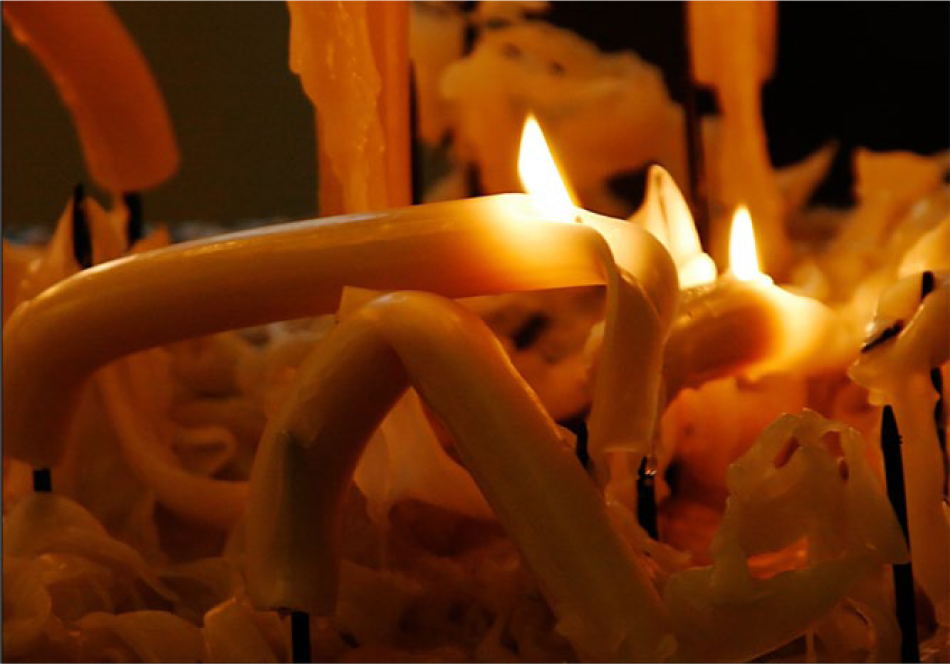
Church candles.
At this point, let’s return to reading.
As you now know, we cannot reduce such experiences to ideas or scholarly concepts, much less explain them away by ‘translating’ them into scientific discourse. However, these experiences involve some useful parallels to how a researcher ‘sees what people are actually doing’. Some of these are: How we focus our attention matters. Observing ourselves as part of the observing a ‘scene’ can be an integral part of seeing ‘what people are actually doing’. Even as skilled researchers, we make lots of assumptions of which we are unaware; such assumptions can prevent us from seeing ‘what people are actually doing’. Taking time to remember experiencing helps us keep the right perspective. Now, let’s do a different embodied practice. This one involves paying attention to your breathing …
This exercise would be wonderful if you could experience it as a video with color and sound, rather than as a black-and-white photo. 5 Here’s what to do: Imagine yourself breathing with the waves as they go in and out – build, crash, and recede.
(Again, slow your reading, such that you actually experience these phenomena.)
Take a normal breath in, then breathe out slowly: 1, 2, 3, 4,
Now breathe slowly in – 2, 3, 4, and out 2, 3, 4, and in 2, 3, 4, out 2, 3, 4, . . . .
Stay with the slow, steady breathing . . . . . .
Catch a wave breaking, and breathe out, 2, 3, 4, and in . . . . . . (letting the waves set the rhythm)
Stay with the slow, steady breathing . . . . . .
If you lose the count, that’s okay, just catch another wave and breathe out, slowly and steadily . . . . . .
. . . . while you watch the rhythmic waves . . . . . .
(Try to hold this pattern for at least 60 seconds.)
Continuing the slow breathing, gradually let your eyes soften their focus and lower your gaze to the floor . . . . . .
Watching the waves in your mind . . . . . .
Attend to the breathing . . . . . .
(At this point, during the conference presentation, the video sound faded and a Tibetan singing bowl began to reverberate.)
How do we use our senses in attending to something? . . . . . .
Does it make any difference if this sound was relatively familiar or not?
(The singing bowl sounded again.)
Watch yourself experiencing the sound of the singing bowl . . . . . .
Your experience simply is.
And it is whole, integral – not a body-experience set against a mind-experience.
We learn to attend to certain things, but the learning doesn’t erase the experience . . . . . .
Lived religion cannot be reduced to ideas, theologies; cultural stuff is going on the whole time – it is simply there . . . . . .
Remember a sound from your childhood – perhaps the sound of bells, or some other instrument that you remember well . . . . . .
Try to experience that as vividly as you experienced the bell a moment ago . . . . . . What feelings does your sound-memory evoke? . . . . . . What images does it call up in your mind? . . . . . .
Can you still have a real experience of it in the present moment, even if the experience was triggered by memory of a sensory experience? . . . . . .

Montoya wave in black and white.
Those are the experience exercises. Now you may return to reading normally.
Sensing religion through embodied practices
If you have done these exercises deeply, you are now more attuned to your senses than you were when you started reading this article. You can still engage your mind, but you are more aware than before of how your mind-body worked as a unity to further your understanding. This is one form of embodied practice: An attentive reading to parallel the attentive seeing and attentive breathing that you have just accomplished.
Breathing is the epitome of an embodied practice (Lyon, 1994; Mauss, 1973 [1934]). Although all living persons must breathe, and do so autonomically, our breathing patterns can be profoundly affected by our social, psychological, and religious practices. Pranayama yoga, for instance, is a physical and spiritual discipline that uses control of the breath to effect other changes in the mind/body/spirit as a whole. One pranayama practice involves regular rhythmic, slow breathing through alternate nostrils, and practitioners hold that it literally accomplishes physical, emotional, spiritual, and social balance. Pranayama yoga is important for our understanding of embodied practices, because it illustrates how the holistic engagement of our minds, bodies, and spirits in something seemingly so simple and basic as breathing could be understood as a religious practice.
Consider another sensory experience: singing. Singing is more than just sound. It often involves three key elements of all religious experiences: attention, co-presence with others, and time.
Phenomenologist Alfred Schutz used ‘making music together’ as a metaphor for the ways by which people relate deeply with each other, sharing subjective experiences (Schutz, 1964). Although this metaphor could apply equally to a jazz combo as to a religious choir, it gives us a clue about how an embodied spiritual practice (especially singing) could literally produce religious experience and a sense of community.
Perhaps because of my own experience of choral singing, I could easily imagine how such singing together could become a moving spiritual experience that literally accomplished a sense of community. Also, my childhood experiences of my family of seven heartily singing together in the car, around the campfire, and beside Grandmother’s piano, are deeply embedded – and profoundly embodied – memories of how singing together both reflects and produces unity and harmony. The physical sensations of producing song – sensations of resonance in one’s head, of breathing deeply to sustain long notes, of hearing one’s own voice meld in harmony with others’ – are all deeply sensual, yet potentially also spiritual, experiences.
The uses of time in making music together also produce an experiential sense of togetherness – perhaps even inter-subjective experience. Inter-subjectivity refers to the apprehension of another’s subjective experience, like emotions, that is not mediated by conscious thought – in which the other or the other’s experience is the object of thought. Schutz was interested in how the structure of individuals’ ‘life-worlds’, which are socially shaped and thus shared, made possible such intense social experiences (Schutz and Luckmann, 1989 [1983]: 109ff.). If we combine Schutz’s insights about the complex ways people can transcend everyday boundaries between self and other, with Merleau-Ponty’s (1962) emphasis on the immediate connection between a person’s body and consciousness, we get clues about how religious experience could be a deeply subjective, yet shared, experience. 6
To sing together, we must adjust our timing to fit with others’. Often this means bodily timing, such as our breathing or rhythmic motions like toe-tapping or rocking. 7 Communal religious settings can produce a resonance of several individuals’ experiences and thus an even deeper sense of sharing ‘inner time’ (Neitz and Spickard, 1990; see also, Spickard, 2012).
A good example of such intersubjective experience is the several-days-and-nights-long Navajo chant for healing, through which participants attune their individual experiences toward the culturally valued sense of harmony between the individual, the social group, and the environment (Spickard, 1991). Such intense intersubjective experience and shared time can accomplish the needed harmony that constitutes healing.
Each of these kinds of spiritual making music together reflects and reproduces a different kind of spiritual experience. Such experiences clearly involve the body integrally. Embodied practices, such as singing, tap emotions and memories. Collective embodied practices, such as singing or dancing together, can produce an experiential sense of community and connectedness.
This experiential sense is more than just the collective effervescence that Émile Durkheim (1965 [1915]) emphasized but, relying on second-hand ethnographic sources, failed to describe accurately. Rather, in Schutz’s (1964) terms, the experiential sense of community and connectedness results from a concrete sense of co-presence, in which individuals ‘tune in’ to one another while engaged in common effort. According to James Spickard (1991, 2012), religious rituals actualize this co-presence, the experience of which can also create a sense of community (Spickard, 2005).
I emphasize this communal aspect of religious sensing because it is so often neglected by sociologists. For example, many scholars, including me (McGuire, 2008: 54), have criticized Robert Bellah and his co-authors of the famous Habits of the Heart (Bellah et al., 1985) for their over-emphasis on individuals and nearly complete disregard of groups in their description of Americans’ ethical discourses. Although that disregard grew directly from their research question, its consequence was to ignore the genuine social connections of people like ‘Sheila Larsen’, whom they typed as religious individualists. We should not make this mistake in studying religions’ sensory side! Not only can sensory experience be learned, as described above; it can also be shared.
My basic point, however, is simple. Without the full involvement of the material body, religion is likely to be relegated to the realm of cognitions – beliefs, opinions, or theological ideas. Embodied practices, including mundane and seemingly unexceptional activities like singing and preparing a meal, link individuals’ materiality as humans and their spirituality. For ethnographic researchers, apprehending how the senses – including the social senses – are involved in such embodied practices is central to ‘seeing what people are actually doing’ when engaged in lived religion.
Footnotes
Acknowledgements
I wish to thank Jim Spickard for his generous gift of time and inspiration for preparing both the SISR plenary presentation and its transformation into a journal article. We worked hard to make the experiential portions of the talk as effective as possible, despite complications of technology and the necessity of using interpreters to mediate, for the francophone audience, the message – albeit a minute or so behind its most effective timing. Subsequently transforming those experiential portions into a print medium was even more difficult, but worth the effort, I believe. Thanks, also, to our colleague, Anna Halafoff (Deakin University, Australia) who sounded the singing bowl far more beautifully than any recording I could find online.
Funding
This research received no specific grant from any funding agency in the public, commercial or not-for-profit sectors.
Notes
Author biography
Address: Department of Sociology and Anthropology, Trinity University, One Trinity Place, San Antonio, TX, 78212-7200, USA
Email: