




Abstract
The borders between sacred and secular music are often believed to be fixed and impenetrable. However, when a secular musical genre is reworked for consumption by religious audiences, a space is created where the sacred meets the secular, and this can be used to examine the variety of ways in which cultural norms, values, and ideologies fluctuate and converge between the religious and temporal spheres. In this article, the author looks at the overlapping of Christian and secular heavy metal music, focusing on the ways gender is described, celebrated, and normalized in the lyrics of Christian metal. After analyzing the lyrics of 351 Christian heavy metal songs, she conducts an in-depth analysis of three sets of lyrics. Despite the obvious antithesis between the worlds of heavy metal music and evangelical Christianity, her analysis highlights one avenue where the sacred and secular merge. The display, production, and management of gender can be viewed as a common trope that links Christian metal to secular metal and can function as a means of creating a space for the alignment of religious beliefs within the larger cultural expectations of gender.
The song begins as expected, musically following a standard structure. First, there is an overly bright, distorted, anthem-like electric guitar solo. The accompanying rhythmic pulse is reminiscent of a battle snare drum, a hallucination of a military march. Then a pause, a drum roll, and the introduction of the power chord, a series of musical intervals of a root and a perfect fifth repeated over and over again, rhythmically designed to relate to short, sharp physical movements. In other words, this music is ideal for headbanging. The vocalist enters the picture, singing at the lower end of his range and producing clear tones that are such a deep contrast to the tainted electric guitar chords that the emotional intensity of the song is turned up a notch. Just when I adjust to the cacophony of sounds, the singer lunges into a virtuosity of vocal jumps, which at times produce pitches so high in the vocalist’s falsetto that it is unclear if he is singing or screaming as he utters, ‘Men of iron will …’ There is no doubt in my mind that this song is heavy metal. Then I hear the phrase, ‘Denying ourselves in the glorious name of the Lord.’ The wording seems out of place but the lyrics continue along the same line, ‘We fight for the glory of God.’ 1
The song described above is Temple of Blood’s 2005 ‘Spiritual warfare.’ A coalescence of heavy metal and Christian values, ‘Spiritual warfare’ is a unique cultural hybrid of heavy metal culture, hegemonic masculinity, and traditional conservative Christian practices. Musically, the piece is undoubtedly heavy metal. At the same time, it promotes a set of core Christian values that place it in the evangelical realm. Christian heavy metal provides a space where the sacred meets the secular through a larger, socially constructed and agreed upon set of norms and values, and therefore can be used to examine the variety of ways in which cultural norms, values, and ideologies fluctuate and converge between the religious and temporal spheres.
The general empirical issue explored by this article is how secular objects are reproduced, reframed, and adapted in a scared context; specifically how gender scripts are presented for consumption by a Christian audience. While scholars have provided important contributions on evangelicalism and popular culture (Smith, 1998, 2000), on gender in conservative Christian communities (Davie, 1995; Griffith, 1997; Kimmel, 2006), on music’s relation to spiritual themes (Wuthnow, 2003), and on gender (re)production in music (Moisala, 1999), what is missing is a dialogue about the overlapping messages of faith, culture, and gender that exist in popular religious music. A study of the gender scripts in the lyrical texts of popular religious music opens the door for such a discussion. In this study, I focus on one of the most unusual sacred–secular hybrids: the lyrical texts of Christian heavy metal music. Studies by Marcus Moberg (2009) and Eileen Luhr (2005) have looked at the world of Christian heavy metal through a sociological lens; however, these studies only briefly examine the representation of gender, a key parameter at the intersection of sacred and secular ideologies.
I hypothesize that the lyrics of Christian metal music, which are overwhelmingly written by male musicians and performed for male fans, incorporate gendered tropes similar to those in secular heavy metal music, creating a space where the gap between the secular themes frequently associated with heavy metal music and the religious expectations of evangelical Christianity can be bridged and the two worlds connected. The presence of lyrics including notions of hegemonic masculinity and subordinate femininity not only places a piece more in line with the motifs of secular heavy metal; it also provides Christian men with a unique mechanism for proclaiming their faith while simultaneously blending into the popular music scene of secular society.
Metal, gender, and Christianity: The creation of a hardcore trinity?
On the surface, heavy metal music and conservative Christianity are situated at opposite ends of a cultural morals-and-values spectrum. Heavy metal has been known to celebrate and glamorize explicit sex, defiance, aggression, violence, and alcohol or drug use (Gore, 1987; Walser, 1993: 139), while modern conservative Christians often see themselves in absolute contrast to the sex-drugs-party world. In embracing a code of strict, absolute, and unchanging moral standards, conservative Christians often view themselves as free from an egotistic, libidinous, and morally pernicious mainstream society (Smith, 1998: 131).
Jay R Howard and John M Streck’s examination of separational contemporary Christian musicians focused on musicians who viewed the Christian and the secular music worlds as locked in opposition (Howard and Streck, 1999: 49–74). For those outside of the Christian music world, separationalists are frequently viewed as exemplars of Christian musicians. Separationalists emphasize difference, ministry, and propaganda, through clearly articulated religious lyrics. They suggest that Christian music can serve as a safeguard against cultural contamination, a reaction against immoral youth culture, and a tool for spreading the word of God (Hendershot, 2004). For separationalists, the most important aspect of any genre of Christian music is the Christian message.
However, not all Christian musicians take a separationalist stance. Heather Hendershot’s study of Christian media highlighted the diversity that exists between and among Christian musicians (Hendershot, 2004: 52–84). Crossover bands and musicians that want to produce a specific musical sound are frequently less focused on the literal reproduction of biblical text than on formulating a musical ensemble that is rooted in a set of beliefs. Thus, despite the obvious confliction of values that often exist between heavy metal culture and evangelical Christianity, variations in the definition of Christian music also permit the overlapping of hard-core music and conservative faith.
Its unique sound notwithstanding, heavy metal music is a broad category that can be difficult to define. The first heavy metal bands inched onto the popular music scene in the late 1960s and early 1970s. While instantly acquiring a loyal subcultural fan base, bands were given limited, if any, radio spots. Blocked access to airtime meant that bands needed to constantly tour, creating a unique connection between performers and audience, who came to share a set of experiences, values, and ideologies (Weinstein, 2000: 7). As the genre moved from the subcultural to the mainstream music scene, heavy metal became more diverse. Musicians, fans, and magazine publishers began to find that the lines defining metal were blurring. However, the majority of heavy metal songs continued to contain overarching features that separated them from other types of music.
Most musicologists agree that the power chord is the staple component of heavy metal music. Robert Walser describes it as ‘[t]he one feature that underpins the coherence of heavy metal as a genre’ (Walser, 1993: 2). This musical technique, an amplified interval of a root and perfect fifth, as well as the frequent use of distorted electric guitar solos, extended vocals, and musical modes such as Dorian, Locrian, and Phrygian, are commonly used to identify heavy metal music. 2
While such musical techniques have become the identifiers of heavy metal music, recurring thematic patterns also exist across a diverse range of metal subgenres. Historically, heavy metal has often focused on themes of good and evil as well as a variety of themes related to gender (Ahlkvist, 1999; Breen, 1991; Krenske and McKay, 2000; Walser, 1993). These have been interpreted and decoded in numerous ways by scholars, politicians, musicians, band members, and audiences. Musicians and fans have argued that the themes are complex and symbolic representations of the psycho-social problems existing in society or a critique of these problems (Ahlkvist, 1999: 130), while critics have vilified the genre as a threat to morality and youth culture, but also raised legitimate questions concerning the undeniable glorification of violence, sexual exploitation, homophobia, misogyny, and civil disobedience that is part of metal culture (Walser, 1993).
Conservative Christianity, like heavy metal music, is also a complex category that can be difficult to define. Indeed, identifiers such including ‘evangelical,’ ‘born again,’ and ‘conservative Christian’ are frequently conflated and used interchangeably. The term ‘evangelical’ has been used to describe conservative Protestants, as a synonym for ‘born-again’ Christians, in alluding to members of the Christian Right, and to refer to specific subsets of conservative Protestantism (Smith, 2000: 14–15). Most religious scholars and social scientists have come to use the term evangelical to refer to theologically conservative Protestants, using measures of denominational affiliation, self-identification, and theological beliefs as mechanisms for measurement (Smith, 2000). Even using such a broad definition, recurring patterns can be seen across large populations of conservative Christians. In addition to making a life commitment to Jesus Christ and faith based activism, conservative Christians are more likely to hold orthodox views about the sinful nature of human beings and the necessity of God to redeem and restore mankind (Smith, 1998: 22).
These two drastically different cultures merged through the creation of Christian heavy metal music. Marcus Moberg defines Christian heavy metal as ‘metal with a Christian message, with lyrics dealing with either explicitly Christian theological topics or other social or cultural issues from a Christian perspective’ (Moberg, 2008: 3). Some groups self-identify specifically as Christian heavy metal bands. Others choose not to label themselves as part of the Christian music genre, but nevertheless attract a large Christian following as a result of their performances at Christian festivals, because band members are professed Christians or their work is featured and reviewed on Christian websites and in Christian magazines, or through lyrical themes that reflect core conservative Christian practices and ideologies.
Similar idealized notions of masculinity in the Christian heavy metal music subculture and nonreligious mainstream society provide Christian metal artists with an ideal point of mergence between the sacred and the secular. From the early days, heavy metal has been asymmetrically gendered. Performers and fans have been overwhelmingly young white heterosexual men (Walser, 1993: 3). The promotion of an exaggerated and idolized dominant, heterosexual form of masculinity is not surprising given the androgyny that also exists within the heavy metal realm. Androgyny was especially prevalent during the 1970s and 1980s, when heavy metal music peaked in popularity. The style and fashion of the period – long hair, make-up, and tight-fitting clothes – meant that male musicians and fans needed to reframe masculinity through an exaggerated and performative display of heterosexuality, which became the ‘sex-drug-and-groupies heavy-metal lifestyle’ (Breen, 1991: 194). This metal mantra was often upheld at the expense of women and homosexual men, who were relegated to the category of ‘other’ and represented as a threat in visual images, lyrics, and video representations (Walser, 1993: 119). 3
This focus on exaggerated heterosexual and masculine ideals does not mean that women are excluded from the metal scene. The minority of women who choose to participate, especially in the more misogynistic subgenres such as death metal or black metal, are aware of the obvious culture of marginalization but they find other aspects of metal culture empowering. These women often report that the metal scene provides a sense of individual agency, as they are permitted to break away from the gendered restrictions of mainstream society. However, this freedom comes at a cost, which involves reframing empowerment through a masculine notion of legitimation (Vasan, 2011: 334).
Like the heavy metal scene, American religions are gendered in structure, history, and power dynamics (Braude, 1997). The disproportionate number of female church members has led to what historians and sociologists have termed the ‘feminization of religion’ (Kimmel, 2006; Shiels, 1981; Welter, 1966). Men who adopt non-leadership roles within congregations often look for ways of presenting themselves as masculine as well as religious. Therefore, one can find a historical trend of religious men forming a variety of hyper-masculine religious groups, organizations, and movements. In addition, Christian doctrines and scripture have traditionally emphasized male authority, sending subtle but powerful messages about women’s choice, voice, and power. Thus, despite the fact that gender relations are extremely complex in the Conservative Christian context, men’s ability to access power through leadership roles including pastors, husbands, and advisors, has resulted in the subordination of women (Griffith, 1997; Smith, 1998).
The ways in which gender issues have played out in the history of both heavy metal music and evangelical Christianity open the door to an exploration of whether Christian metal bands use gender in similar ways as their secular counterparts. It also illustrates how religiously oriented gender representation in Christian metal can mirror the gender representation in secular metal. Thus, even within the lyrics of separational and ministry-oriented Christian heavy metal songs, the representation of gender and gender scripts can serve as bridges between the mundane world of metal and the esoteric world of evangelical Christianity.
Data and method
I begin with a content analysis of Christian heavy metal texts to determine the central themes embedded within the genre and confirm the overlapping subject matter between the lyrics of secular and Christian metal. Using data collected by www.angelicwarlord.com, a trusted and established internet resource for Christian metal reviews, links, discographies, interviews, and news, I created a dataset of the documented 304 Christian metal albums released between 2006 and 2013. 4 From this dataset, I took a random sample of 50 albums. This sample included both new releases and re-issued albums. After removing all instrumental tracks and spoken tracks from my dataset, I was left with a sample of 518 tracks. To verify texts, I compared my transcription of lyrics to lyrics posted on bands’ webpages and two recognized heavy metal archives, Dark Lyrics (www.darklyrics.com) and Encyclopedia Metallum (www.metal-archives.com). In cases where texts were not available from these sources, I verified lyrics using mainstream databases. A total of 167 tracks were removed because the lyrics could not be verified or were not in English, resulting in a final sample of 351 tracks.
Next, the sample was analyzed to determine the most popular themes and the percentage of lyrics that focused on particular themes. (In most lyrics several major themes overlapped and intersected throughout the song.) I then grouped these themes into ‘families’ to examine more generalized concepts as a means to gaining a better understanding of the overarching themes Christian heavy metal music utilizes in evangelizing and promoting a Christian agenda. 5 In this I found evidence that supported the existence of overarching similarities among secular and Christian heavy metal.
Next, I turned to the specific question of gender representation. Do the gender scripts in Christian heavy metal mirror the notions of masculinity and femininity represented in secular heavy metal? In secular metal, men are celebrated for strength, rationality, aggression, bravery, and conviction, while women are reduced to objects and women’s power is minimized, ignored, or vilified (Krenske and McKay, 2000; Weinstein, 2000; Walser, 1993). How are men and women represented in Christian heavy metal? Is there an overlap?
Finally, to demonstrate the ways in which notions of hegemonic masculinity and subordinate femininity embedded within the lyrics of Christian metal construct a metal conglomerate that creates a space for the alignment of religious beliefs with cultural expectations of gender, I pull three cases from my sample for in-depth analysis. I argue that the lyrics of Temple of Blood’s ‘Spiritual warfare’, Grave Robber’s ‘Screams of the voiceless’, and Impellitteri’s ‘Wicked maiden’ illustrate common mechanisms for aligning the scared and the profane in Christian heavy metal through the presentation of larger culturally constructed gender ideals.
Nothing is more metal than Christ: Themes of death, darkness, promise, and light in Christian heavy metal
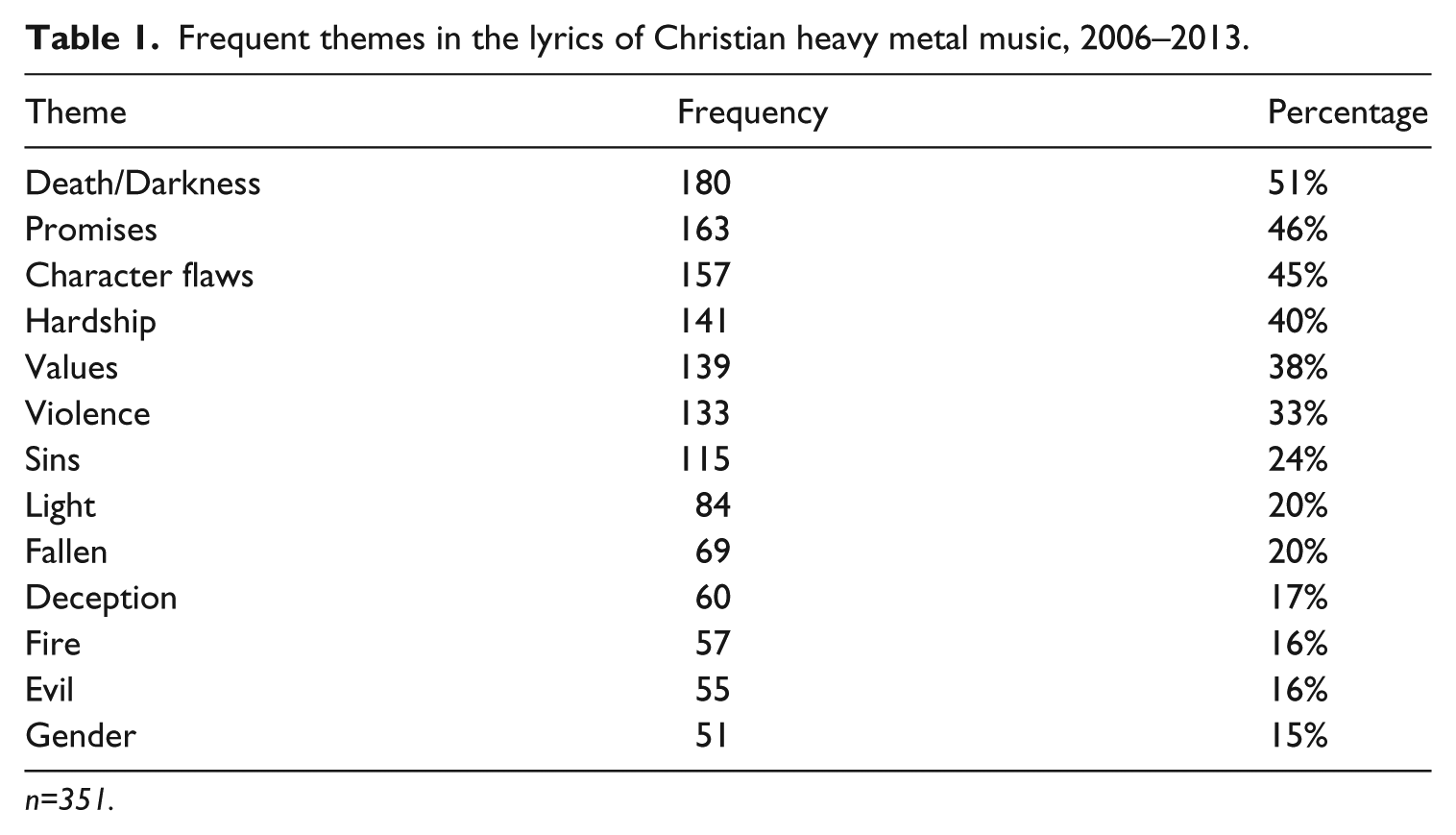
Of the 28 thematic families that were extracted from the sample, the most popular theme was death/darkness, which was central in 51% of the lyrics (see Table 1). Although death/darkness can be viewed as an umbrella theme subsuming sub-themes such as killing and mortality, it is important to note that not every song containing the sub-themes of blood or violence directly connected these themes to death or dying.
Frequent themes in the lyrics of Christian heavy metal music, 2006–2013.
n=351.
The promise of living a Christian life was almost as popular, being found in 46% of the lyrics. Again, promises could be considered an umbrella term for sub-themes such as freedom, love, and hope. It was also common for texts to combine themes of death/darkness with themes related to promises. For example, the lyrics of Impellitteri’s 2009 song ‘Garden of Eden’ speak of burning in hell, running from the reaper but ultimately being able to ascend from the grave to salvation. The lyrics of this song combine hell, death, and salvation to predict the future for those who fail to live a Christian life as well as to highlight the promise of salvation for believers.
Character flaws and hardship were also popular themes in this sample. Fear, shame, weakness, and madness were common character flaws found within the texts. In addition, lyrics warn against illicit relationships, destructive reproductive choices, temptation, and mocking or rejecting Christian tenets. In some texts anger is considered a character flaw, while in others anger is framed in terms of God’s wrath and Judgment Day. For example, in Golden Resurrection’s 2013 song ‘Spirit war,’ anger is a character flaw that the vocalist continues to ask to be removed, whereas in Saint’s 2010 ‘Bowls of wrath,’ the focus in not on anger as a flaw but on God’s wrath on Judgment Day. The lyrics paraphrase text from a chapter in Revelation. The biblical text reads:
The armies of heaven, arrayed in fine linen, white and pure, were following him on white horses. From his mouth comes a sharp sword with which to strike down the nations, and he will rule them with a rod of iron. (Revelation 19:11–16)
In this context, anger is framed as part of God’s ultimate plan, as outlined in the Bible. 6
Closely linked to character defects, sin was also a common theme in this sample. Often the theme of sin was treated in a general way, as in the text of Affector’s 2012 ‘Falling away and the rise of the beast.’ In this song, the lyrics warn that men of sin will be revealed. In other texts, specific sins are addressed. In Kansas’ 2011 re-issue of ‘End of the age,’ the lyrics specifically speak of the sins of pride and lust.
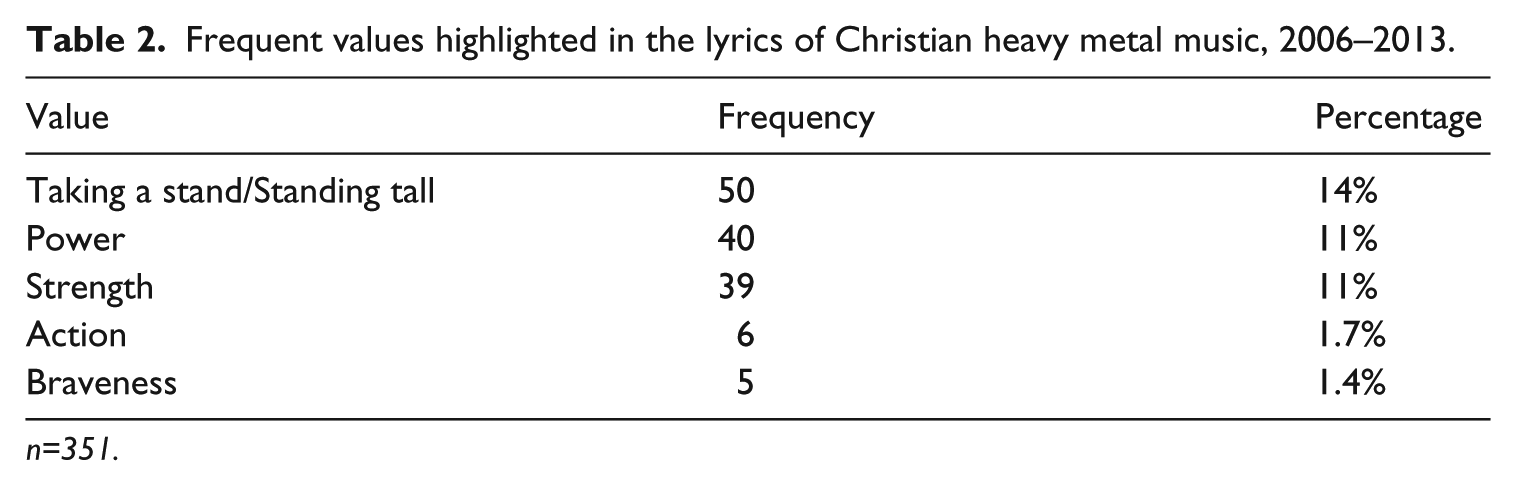
In cases of great or multiple sins, many lyrics focus on the theme of falling. Some texts refer to Lucifer’s fall to hell, while in others falling is a reference to a man or woman’s failure to live a Christian life. The notion of falling, which could be seen in 20% of the sampled lyrics, was always framed as a character defect, while the concept of standing or standing tall, found in 14% of the texts, was exclusively framed as a character asset or a valued trait.
In numerous texts, character flaws, sins, and values vary according to gender. These differences can be seen in the 14% of the sampled texts that linked human attributes to gender-specific nouns and pronouns. Messenger’s 2008 song ‘Forbidden love’ illustrates the ways in which Christian heavy metal music can use lyrics to describe desirable and undesirable qualities through gendered language. In this song, desirable female qualities are described not only in terms of faith but also in terms of physical beauty. The lyrics of the song begin with the phrase, ‘I saw her there, her eyes, her hair, her smile, shining bright.’ Desirable qualities in men are more often described in terms of strength, be it physical, mental, or emotional. In Joshua Perahia’s 2008 song ‘Steady weapon,’ a boy becomes a man when he fearlessly walks tall. The lyrics read, ‘Now the helpless child is gone and in a man walks who’s not afraid.’ In the next verse, the lyrics more directly address the importance of strength and willpower for survival.
These valorized masculine characteristics are echoed in Temple of Blood’s 2006 ‘Spiritual warfare.’ In this piece the text reads, ‘Men of iron will take up your arms with a strength and conviction of steel.’ While both men and women are criticized for failing to uphold the tenets of Christianity, men are also rebuked for failing to advocate characteristics such as strength, power, and severity. Generally in the texts in this study, men lacking bravery, strength, and courage were both directly chastised and indirectly deemed inferior through the celebration of these characteristics.
Symbolic representations of good and evil were also gendered in some texts. For example, Saint’s 2006 ‘Babylon the Great,’ based on the biblical text from chapter 18 of the book of Revelation, is a symbolic description of the fall of a great but morally repugnant city. In the song and in the biblical story, Babylon is coded as feminine. In the text, the city is described as a ‘whore in the night,’ ‘the queen who has boasted,’ and ‘the mother of harlots.’ 7
The symbolic representation of good was consistently coded as masculine. This is not surprising since the majority of lyrics that explored good and positive power referred to either God or Christ. The representation of good framed in terms of hegemonic masculinity can be further examined by turning to the specific values most frequently highlighted within the sample (see Table 2). Each of the top five values seen within the sample, taking a stand/standing tall, power, strength, action, and braveness, were positive character attributes used to describe the ideal Christian, God, the Holy Spirit, Christ, and idealized masculinity. As previous research has shown, these hyper-masculine attributes are linked to Western social and cultural expectations of men (Kimmel, 2006; Connell, 2005; Messner, 2000).
Frequent values highlighted in the lyrics of Christian heavy metal music, 2006–2013.
n=351.
While the tenets of conservative Christianity and secular heavy metal may seem antithetical, the popular themes extracted from the Christian heavy metal songs examined in this study are also clearly represented in the secular metal realm. Some of the most successful metal bands have released songs titled ‘Angel of death’ (Slayer), ‘The punishment due’ (MegaDeth), ‘Killers’ (Iron Maiden), ‘Raining blood’ (Slayer), ‘The number of the Beast’ (Iron Maiden), ‘Evil woman’ (Black Sabbath), ‘War pigs’ (Black Sabbath), and ‘Hallowed be thy name’ (Iron Maiden). Thus, it is clear that themes of death/darkness, violence, sin, character flaws, and war, the gendered representation of good and evil, and biblical texts are representative of both the sacred and secular metal realms.
Gendering Christian metal: A lyrical analysis
In secular metal men are celebrated for strength, rationality, aggression, devotion, bravery (Ahlkvist, 1999; Walser, 1993; Breen, 1991). The thematic analysis of common themes in Christian metal has provided evidence of a celebration of similar masculine characteristics. Women, in contrast, are notoriously reduced to objects, women’s power is minimized, ignored or vilified, and evil is often coded as feminine in the world of secular heavy metal (Vasan, 2011; Krenske and McKay, 2000; Weinstein, 2000). Again, similar framings of women and femininity can be seen in the lyrics of Christian heavy metal. This leads one to question the core gendered issues embedded in the lyrics of Christian metal. How exactly is gender presented in the Christian metal context? How closely do gender scripts in Christian metal reflect the gender scripts in secular metal? To untangle these questions it is necessary to look more closely at the lyrics of Christian heavy metal music. Therefore, I now turn to the lyrics of three popular Christian metal songs: Temple of Blood’s ‘Spiritual warfare,’ Grave Robber’s ‘Screams of the voiceless,’ and Impellitteri’s ‘Wicked maiden.’
‘Spiritual warfare’: Masculinity in Christian metal
The opening lyrics of Temple of Blood’s 2005 song ‘Spiritual warfare’ provide insight into one common and celebrated masculine theme in Christian heavy metal music, the spiritual soldier:
Men of iron will Take up your arms with a strength and conviction of steel Do not lose your courage From the fallen ones whose husks are strewn on the battlefield
The lyrical structure is built upon an overarching theme of war, as seen in the song title. Battle imagery, cultural expectations of soldiers, and language related to warfare are the foundations of the text. Masculinity is valorized through the desirable characteristics of strength, bravery, an iron will, courage, and conviction. These hyper-masculine character traits are ascribed to a hero-warrior figure that ultimately helps to slay the enemy.
Like the language used in religious men’s movements, the lyrics of ‘Spiritual warfare’ present the ideal Christian man as physically strong, courageous, and relentless. These qualities are even more celebrated since they are set in contrast to the extensive struggles of the Christian man. The Christian man is surrounded by evil and exhausted from his constant need to battle temptation, yet he continues to hold strong:
Though we are besieged For this cause we are brave to the end and lay our lives down Each year this war rages on And we begin to grow weary from the many battles we’ve lost But we still hold this flag high We know that victory is certain to come through the cross
The lyrics of ‘Spiritual warfare’ also promote the homosocial bonding representative of numerous religious men’s movements. The vocalist ends the piece with the cry:
We have gathered together at the great feast We will meet again all those who persevered We are given spoils from war Riches abound that are given as treasure for our years
Clearly, the ‘spoils from war’ and ‘riches’ are to be read as access to heaven and heavenly rewards. However, there is another connection underneath these obviously symbolic phrases. Literally, ‘spoils of war’ refers to any profits or property extracted as the result of winning a battle or other military victory. Historically, acts of plundering, including the rape of women, were also associated with male bonding and (Neill, 2000). Therefore, these seizures were a celebration not only of military power, but also of male domination, masculinity, and heterosexuality. This emphasis on homosociality is also part of the larger heavy metal genre, further illustrating one of the ways in which gender can be used as a tool for aligning aspects of the conservative Christian community to the heavy metal realm.
One of the most problematic elements in Temple of Blood’s 2005 song ‘Spiritual warfare,’ the larger genre of heavy metal music, and the social construction of gender in general is the celebration of specific and dominant forms of masculinity. In ‘Spiritual warfare’ there is no room for gender non-conformity or alternative notions of masculinity. For Temple of Blood, the spiritual solider is not only a symbol of the exemplar masculinity, but also the embodiment of the requirements of the Christian man.
‘Screams of the voiceless’: Women, choice, and gore in the Christian context
Grave Robber’s lyrically terse ‘Screams of the voices’ takes the complex web of connections between gender, voice, patriarchy, power, history, and choice and places it within the context of Christian heavy metal through lyrics focused on the abortion debate. Feminine gender scripts and the cultural expectations of women have focused on reproduction and the body across time, space, and societies. This conversation has been a central topic for many contemporary American Christians, specifically with regard to motherhood and abortion.
Abortion has been the focus of Christian music across an extensive range of styles and genres. The violence associated with the procedure as well as the connection to death, sin, and murder makes the topic ideal for a genre of music that emphasizes power, devastation, evil, anger, frustration, and hypocrisy (Ahlkvist, 1999). Grave Robber’s ‘Screams of the voiceless’ can be read as standard Christian heavy metal in that it utilizes the musical techniques and thematic elements of the heavy metal style to frame Christian tenets and values, and to promote a pro-life position.
Crucial gender codes can be extracted from the first verse of the song, as the male lead vocalist sings:
You don’t have a voice But mommy has a choice To let you live or die Baby, baby, don’t you cry It’s murder in the first degree But, she’ll walk away free
8
In contrast to the hyper-masculine heroic symbolic violence in Temple of Blood’s ‘Spiritual warfare,’ death and killing in ‘Screams of the voiceless’ are connected to an immoral choice and a female actor. The text is positioned in such a way that the male lead vocalist takes a solid position against abortion while serving as an agent of judgment and condemnation toward women who undergo the procedure.
This text not only focuses on the surface issue of abortion but also illuminates an entire underbelly of gender scripts related to power, voice, and choice through the relationship between the agent or musician and the cultural object or scenario outlined in the song, although beyond the analysis of lyrical texts, it is important to recognize that the cultural producer and representative voice of this song is male and the main player seen within the song is female. Prior to any commentary related to the actions of the principal character, there are already power dynamics at play that due simply to the gender inequality that exists in the world of heavy metal, conservative Christian communities, and contemporary American society.
Throughout this piece, choice is characterized as dimorphic. There is no gray area for the woman in the scenario. She is either a murderer or she is not a murderer. She chooses to let the fetus live or die. At the end of the song, the text reads:
The ultimate horror Termination, human gore It’s not a choice You have no choice You have no choice
The text articulates the position of the fetus, having no voice (or choice) in the abortion debate. However, underneath this reading is a direct order to contemporary women, through the symbolic female character in the song; a woman must reject abortion or become a murderer. She also has ‘no choice.’
On another level, the final lyrics make the song into a cautionary tale about a woman who makes a tragic mistake in choosing to abort her fetus. This fatal choice is ironically similar to Eve’s choice to pick and eat the forbidden fruit in the Garden of Eden. Eve’s choice in taking and feeding her husband fruit from the forbidden tree results not only in their expulsion from the Garden but also in all women’s reduction to a vessel of painful reproduction and a servant to their husbands.
Unto the woman he said, I will greatly multiply thy sorrow and thy conception; in sorrow thou shalt bring forth children; and thy desire [shall be] to thy husband, and he shall rule over thee (Genesis 3:16).
Motherhood becomes the command of a punishing God rather than free choice, further complicating the meaning of the final lyrics ‘you have no choice.’
The topic of abortion is still deeply contested in American society. Although there is no denying that religion plays a critical role in this debate, it is also one of the most prominent gender issues in secular America. By focusing on abortion, as opposed to other issues related to human sexuality such as premarital sex, the lyrics in ‘Screams of the voiceless’ allow the adoption of a Christian position while staying away from the more problematic conversation on virginity and sexual activity in which Christian ideology comes into conflict with larger gender expectations, specifically for men. Abortion can also be framed as a form of mutilation, which is a popular theme in many subgenres of secular heavy metal, including death metal and thrash metal (Vasan, 2011; Weinstein, 2000). Therefore, the abortion theme, the focus on abortion as mutilation, and the denouncement of female choice create an ideal space where Christian metal can align with both secular metal and gendered debates in the larger social world.
‘Wicked maiden’ and the vilification of female power
The band Impellitteri provides an interesting example of the ways in which the sacred and secular collide in Christian heavy metal music. The members of Impellitteri do not consider themselves to be a Christian band. When asked what impact Christian beliefs have on the music of Impellitteri, guitarist Chris Impellitteri replied, ‘This is not a Christian rock band and never was. There is a misconception about this. I personally am a Christian, but the band is not’ (Ritchie, 2009). However, the music of Impellitteri is often reviewed by Christian magazines and bloggers, and is listed in the Encyclopedia of contemporary Christian music (2002), sold at Christian bookstores, featured on Christian websites, and popular in Christian venues. In addition, the lyrical themes often reflect core Christian practices and ideologies.
‘Wicked maiden’ is the title song of Impellitteri’s 2009 album of the same name. This song is another example of how gender is used to align Christian and secular heavy metal. In coding feminine power as evil and destructive, the lyrics bring together elements of both religious and cultural ideologies. The song opens with the text, ‘Better run from the wicked maiden.’ 9 The vocalist then describes the wicked maiden as a fire-embodied machine of war, a monster, and a rumored mutilator that comes without warning and brings (men) to their knees.
Throughout the bible there are numerous examples of evil women and evil beings described in feminine terms. In addition to Eve, Delilah (Judges 16:4), Jezebel (1Kings, 2Kings), and Babylon the Great (Revelation 17:4–18) represent the personification of evil in the feminine form. These biblical figures all symbolically or literally lead to the demise of a man or mankind. The figures are also described not only in terms of their corruption and unscrupulous actions, but also in terms of their bodies, physical beauty, and/or sexual agency.
The vilification of feminine power has been a cultural as well as religious phenomenon. During the 17th century, accusations of witchcraft peaked in Europe and the American colonies, merging Christianity with secular politics. Although not all the accused were women, witch hunts have been depicted as a war against women’s access to power. Men overwhelmingly conducted the trials, and individuals found guilty of witchcraft were often single women with access to financial and social autonomy (Purkiss, 1996). Women were stripped of authority through the association of the feminine with evil and dark forces. Today, powerful women are scrutinized, criticized, and suspiciously regarded both in politics and in business. In addition, women in these positions find themselves, like their biblical counterparts, described in terms of their bodies, beauty, and/or sexuality.
The religious and social histories of women’s connection to evil further complicate Impellitteri’s ‘Wicked maiden.’ In addition to the vilification of feminine power, the song’s title and lyrics are focused on the symbolic ‘maiden,’ an unmarried woman. As explored earlier, unmarried women have been historically associated with evil, specifically those with access to independence and personal autonomy. The language becomes more complex when exploring Western culture’s representations of maidens as young and beautiful, playing to the notion of female power and corruption being associated with physical beauty and sexuality.
Throughout the song, the feminine power of the ‘wicked maiden’ is symbolized through numerous emasculating scenarios. The text makes direct reference to weeping, bleeding, falling (symbolic of either death or damnation), mutilation, and the need to run away. All of these actions are the result of confrontation with the ‘wicked maiden.’ The power of the ‘wicked maiden’ is defined not only in terms of death and destruction but also in terms of her ability to reduce or remove status associated with religious and cultural masculine expectations. To avoid death one must run away or hide, actions that are in direct contrast to the celebrated qualities of the spiritual soldier. As in the stories of Delilah, Jezebel, 17th-century witches, and the modern ‘bitch,’ the wicked maiden’s power lies in her ability to impair men.
Conclusion: Christian heavy metal and gender conformity
This article is an examination of the overlapping of religion, gender, and popular culture. It proposed a number of questions related to the ways in which secular objects are reproduced, reframed, and adapted in a sacred context. I have focused on the popular themes in secular heavy metal and how these same themes are framed by Christian musicians for consumption by Christian audiences.
I have hypothesized that by incorporating notions of hegemonic masculinity and subordinate femininity in the lyrics of their music, Christian metal lyrics, even those written by separationalists, can function as a means of creating a space for the alignment of religious beliefs with secular cultural norms and values. Regardless of intent, these mirroring gender scripts create a space where the lyrics reinforce a more general heavy metal mantra.
By conducting a content analysis based on a random sample of the lyrics of Christian heavy metal songs released between 2006 and 2013, I have shown that the same central themes embedded within secular heavy metal can be found in the lyrical texts of Christian metal, specifically related to gendered expectations of men and women. Since these gendered expectations also speak to larger secular cultural norms and values, gendered themes in Christian heavy metal music produce a gray zone where the sacred and the secular overlap, providing the fans of the genre with a space to proclaim their faith while participating in mainstream secular culture.
A closer examination of three popular Christian metal songs from my sample, Temple of Blood’s ‘Spiritual warfare,’ Grave Robber’s ‘Screams of the voiceless,’ and Impellitteri’s ‘Wicked Maiden,’ illustrates the ways in which the lyrics in Christian metal links the genre to the larger conservative Christian community; how notions of men’s strength and women’s sinful nature conform to secular gendered myths; and the limitations within Christian metal on alternative gender identities and gender non-conformity.
The findings presented in this paper support the hypothesis that the core themes presented in the lyrics of Christian metal music align with similar themes in secular heavy metal, and therefore can serve as a vehicle for authenticating Christian heavy metal as a legitimate metal subgenre. By focusing of themes of death and darkness, promises, character flaws, and sin, Christian heavy metal lyrics are thematically similar to popular secular heavy metal texts, including songs by Slayer, MegaDeth, Iron Maiden, and Black Sabbath. This study has also illustrated how the overlapping of themes, specifically those themes that incorporate gendered expectations of men and women, can be used as a tool for aligning religious identities with cultural expectations. Although access to the secular through Christian heavy metal would serve only a small population of conservative Christians, this research has illustrated how secular ideologies can be reframed and accessed by religious populations. In addition, it opens the door for future research related to the intersection of faith, culture, and gender that connects the secular and religious spheres.
Footnotes
Funding
This research received no specific grant from any funding agency in the public, commercial or not-for-profit sectors.
Notes
Author biography
Address: Department of Sociology, State University of New York at Stony Brook University, Stony Brook, NY 11794-4356, USA
Email: