




Abstract
Current literature finds that radicalization is correlated with both the holding of fundamentalist religious beliefs and low socio-economic status. The authors interrogate these proposed relationships through a survey we commissioned of 1,200 Muslims living in Western Europe. They analyze, inter alia, Islamic religious fundamentalism, and explore its relationship to self-reported affluence. Controlling for demographic variables, they find that, on average, respondents from more prosperous families are more likely to practice Islam in a way closely associated with fundamentalism – they are more conservative regarding gender roles, seek the universal application of Islamic law, and embrace attitudes associated with a more politicized Islam. This relationship is strengthened among respondents who are unattached to the labor market due to unemployment. Additionally, respondents espousing this belief set are more supportive of the use of violence to ‘defend their faith’.
Introduction
The ‘War on Terror’ has sometimes been spoken of as a war against poverty, inequality, and despair. Yet examples suggest otherwise: of the five most deadly Palestinian suicide bombers, one had a law degree, two had master’s degrees and two were high school graduates (Benmelech and Berrebi, 2007) – in a nation in which the average person does not complete the eighth grade (United Nations Development Programme, 2014). Leaders of al-Qaeda have often come from wealthy families and have professional training in a variety of prestigious fields. Osama bin Laden himself was a member of one of the more prosperous Saudi families with kinship ties to the ruling Sauds. These are hardly desperate people, at least not in the financial sense.
The anecdotal does not in itself negate the statistical, but extensive research on the relationship between affluence and religiously motivated political violence has found inconsistent patterns of correlation between the two variables (Abadie, 2006; Benmelech and Berrebi, 2007; Callaway and Harrelson-Stephens, 2006; Crenshaw, 1981; Haddad, 2004; Hoffman, 2006; Krueger and Malečková, 2003; Morgan, 2004; Mousseau, 2003; Newman, 2006; Piazza, 2006; Post et al., 2003; Wolfensohn, 2002). Although there is some empirical evidence of a relationship between unemployment and susceptibility to radicalization (Caruso and Gavrilova, 2012; Cesari, 2007; 2009; Hegghammer, 2006; Helly and Cesari, 2005; Piazza, 2006), the ways in which unemployment among the affluent works to influence perceptions of violence remains largely unexplored. The research in this article investigates the role of what we posit to be an intervening variable in the relationship between these socio-economic factors and religiously motivated violence: fundamentalism.
We argue that the relationship between support for religiously motivated violence and socio-economic status is best understood through the filter of individual religious practice. To this end, we discuss the extent to which existing models correlate – or fail to correlate – material wealth with religiously motivated violence. We then treat the literature that connects connection to the formal labor market with fundamentalist religious beliefs and these beliefs with religiously motivated violence. We contribute to the literature by using new survey data to link self-reported affluence and employment status to religious fundamentalism, and fundamentalism to willingness to engage in violence, suggesting that social facts predict a propensity for violence – a tendency that investigations into fundamentalist religious practice fail to capture.
We use a number of variables that the literature posits as indicative of fundamentalist religious beliefs, and we explore their relationship to self-reports of material lifestyle and job status, using 1,200 responses to a survey given to Muslims living in France, Germany, and the UK. Using a binary logistic regression procedure to the estimate logged odds of respondents choosing identified responses, we control for a variety of demographic variables and find self-reported household prosperity to be a significant predictor of the opinion that the West exerts a moral influence on the Muslim world, of orthodoxy in views on women, of belief that Sharia should have a role in the justice system, and of a willingness to sacrifice one’s life for one’s faith. We also measured the extent to which these individual measures vary in combination in order to accurately operationalize a single concept – namely, fundamentalism.
We find that, on average, respondents from more prosperous families practice a more conservative and orthodox Islam, and are more radically protective of the religion’s morality and less averse to the idea of self-sacrifice in order to ‘defend their faith.’ Data also showed that these relationships were made stronger by unemployment and that the most fundamentalist respondents are those most likely to express a ‘willingness to use violence to achieve Islamic goals’ (Khashan and Kreidie, 2001: 84) by agreeing that violence was justified in defense of their faith. These results were significant to at least a p<.01 in all cases. Given the existing literature linking fundamentalism to support for (or even engagement in) religiously motivated terrorism, these findings indicate that it is the affluent who, when not incorporated into the labor market, may be most vulnerable to radicalization.
Context
The origins and importance of research on religiously motivated political violence
Hoffman (2006) notes that ‘the religious imperative for terrorism is the most important characteristic of terrorist activity today’. David Rapoport (2001) posits that religiously motivated terrorism represents the latest wave in the evolution of terrorism, having been preceded by terrorism focused on the destruction of empires, de-colonization, and then anti-Westernization. It is therefore unsurprising that actors engaging in religiously motivated political violence, though they are to be distinguished from ‘those terrorists with religious components, but whose primary goals are political’ (Morgan, 2004), are generally characterized as terrorists (Jacobson and Delia Deckard, 2012) and have been studied extensively to learn more about both them and their actions.
This terrorism literature has had large implications in the non-academic world. As the creation of coherent and comprehensive anti-terror policies have become de rigueur for governments in much of the world, the determination of the factors that influence radicalization and religiously motivated political violence has become salient (Rogers, et al., 2007; Wolfensohn, 2002). When the events of September 11th changed the perceived urgency of this imperative over the course of a morning, half a century of research (Crenshaw, 1981; Hobsbawm, 1973; Laqueur, 1977) was quickly and somewhat carelessly distilled into one principle – poverty creates terrorism (Morgan, 2004; Mousseau, 2003; Wolfensohn, 2002). It became a truism that fighting poverty was one way to fight the so-called War on Terror – so much so that President Bush named foreign aid as among the most important armaments in the ‘war’ (Blustein, 2002).
Over the last decade, however, scholars have had the opportunity to thoroughly investigate the linkages between poverty and terror, broadly conceived. Because religiously motivated violence has been framed as both a function of individual action and national policy, research has taken place on both the individual and national levels of analysis. The conclusion is, notably, that not only is there no ‘comprehensive explanation in print for how poverty causes terror’, but there is also no ‘demonstrated correlation between the two’ (Mousseau, 2003: 6). Rather, the research bears out subtler relationships, which inform this study.
Links between poverty and religiously motivated political violence on the national level
Some of the most compelling work has been done on the level of the nation-state, the same level at which formal international aid is given, essentially driven by the assumption that poorer nations experience and create more terrorist activities. This work has generally debunked the idea that there is a relationship between, for example, per capita GDP and incidences of political violence. Piazza (2006), using a series of multiple regression analyses, shows no significant relationship between economic development and terrorist incidences in a nation. Instead, he argues that social cleavage theory, which posits that fractionalization causes the formation of divisive economic and social gaps in a society, is better equipped to explain terrorist tendencies within a nation than are theories that link terrorism to poor economic development. Abadie (2006) agrees that socio-economic factors are not able to significantly explain terrorism, but finds that political freedom in a nation is clearly and inextricably correlated with terrorist activities. Similarly, Callaway and Harrelson-Stephens (2006) find that, of the plethora of human rights, it is principally security rights that condition the growth of terrorism and terrorist movements. They argue that it is in the middle ground, where security is neither respected nor brutally enforced, that terrorism flourishes.
In a later work, Piazza (2011) explores the effects of economic discrimination against minority communities on the rates of domestic terrorism across countries. Simply, countries that have very low levels of fractionalization between ethnic or religious groups or that effectively economically integrate minority communities also have low levels of terrorism. Piazza uses data from the Minorities at Risk program to operationalize economic discrimination, but does not control for security or political freedom in his research – leaving the reader unable to discern how much of the effect he documents is related to economic discrimination per se. The implications of economic discrimination having this degree of influence are far-reaching and broadly applicable to Muslim diaspora communities in the West – though this conclusion certainly does not imply that poverty leads to terrorism; it might imply that poorer Muslim communities in relatively wealthy Western nations are relatively prone to religiously motivated terrorism.
These paradigms may also be relevant to the dynamics of terrorism within Western nations. Although the general level of political freedom in these nations is comparatively high, as well as the level of security rights, these freedoms are not evenly distributed within the countries. Racial and ethnic minorities may, and often do, see their political freedoms impinged upon for various reasons. Muslim groups in the West have certainly experienced a high level of discrimination in their host countries, one that has infringed upon their levels of political freedom and rights to security and economic equality. Using the findings of Abadie (2006), Piazza (2011), or Callaway and Harrelson-Stephens (2006), one could argue that Islamist terrorism in the West is related to the lower levels of rights experienced by the Muslim communities within the nation.
Links between poverty and religiously motivated political violence on the individual level
Although this literature is theoretically provocative, summarizing research on the level of the nation-state and extrapolating the findings to the behavior of individuals and individual communities is obviously fraught with challenges and the danger of fallacy. Various research does explore these relationships through individual analysis. Krueger and Malečková’s (2003) work, though it rests heavily on an analysis of hate crimes and terrorist activity more narrowly conceived, is just such an individual exploration. Investigating the relationships between poverty, low education, and terrorist activities, the authors find that there is no substantive connection between these variables. However, their finding that support for violent attacks does not decrease with higher income or education, which are generally considered to be the major constituents of higher socio-economic status, is provocative. These findings suggest that a higher standard of living and education may be associated with a greater likelihood of participation in religiously motivated terrorism generally and the Hezbollah terrorist organization specifically (Post et al., 2003).
Roy (1994) investigates the connection between Islam and socio-economic class. He finds that Islamism and Islamist group followers are overwhelmingly members of the disaffected lower and working classes, particularly their young male members, while Islamist leaders tend to be professionals and reasonably well educated members of the upper middle classes. Both Henzel (2005) and Miller (1993) identify a distinction between radical Islamist recruitment methods for lower- versus middle-class prospects. They argue that while the lower classes require the promise of a complete package of social reforms, including not only a return to traditional social values, but also a redistribution of power away from alleged apostates to more pious Muslims, the middle class is promised social stability centered on a return to traditional values. Stern (2003) notes that these promises particularly resonate among members of the lower and working classes in Western nations, who, in addition to the characteristic strains they suffer in modern developed society, feel threatened with identity loss and cultural alienation. Yasemin Soysal (1997) argues that, unlike youths of other demographic groups in Europe, young members of the Muslim working class fight for the right to be traditional – to practice Islam openly.
Although there are many class dynamics at play, the relatively short-term status of unemployment, in the current literature, is especially seen to alienate individuals from the existing social structure (Hegghammer, 2006; Caruso and Gavrilova, 2012; Piazza, 2006). It dashes hopes for upward mobility, while lowering opportunity for assimilation into the labor market and, consequently, acceptance by wider society. In contexts as disparate as Saudi Arabia (Hegghammer, 2006) and Palestine (Caruso and Gavrilova, 2012), the unemployed exhibit a greater tendency toward radical belief sets and less aversion to the prospect of violence. In Western Europe, this relationship may be more attenuated; given that immigration is economic at its core, a failure in the labor market may provoke especially extensive feelings of alienation from society as a whole (Cesari and McLoughlin, 2005). And, although ‘[n]o one knows the real scope of job refusals’ (Helly and Cesari, 2005: 392) that are caused by discrimination against Muslims, there is evidence that rampant prejudice contributes to the outsized unemployment rate in Muslim communities – in the UK over triple the rate seen in the nation as a whole (Cesari, 2006).
The existing literature demonstrates that both affluence and occupational status independently work to affect and predict the likelihood of engaging in violence. But how do they work together? We investigate this question by exploring these variables and the ways in which they interact with fundamentalism and the self-professed willingness to engage in violence.
Fundamentalism
The literature contains allusions to the emergence of an Islam that is largely apart from the traditional practice of the religion of Mohammed – a fundamentalist, political Islam. Bassam Tibi (1998) makes the argument that, in the case of Islam, there are now two forms of religiosity – orthodoxy and fundamentalism. While orthodoxy may be measured using variables like mosque attendance and prayer, fundamentalism is a more complex construct that relates to worldview. Simply, orthodoxy is religiosity as traditionally conceived across religious lines, while fundamentalism is a nuanced, socio-political belief set that ‘seeks to establish its own order, and thus to separate the peoples of Islamic civilization from the rest of humanity while claiming for their worldview a universal standing’ (Tibi, 1998: xi). Islamic fundamentalism is not distinct from other types of fundamentalism in its reliance on a highly politicized view of tradition, its insistence on universality, or its lack of aversion to the prospect of violence in the name of faith (Armstrong, 2011).
Fundamentalism broadly, and Islamic fundamentalism specifically, is associated with a number of attributes. A return to what are perceived to be traditional gender roles is paramount in the fundamentalist belief system (Chaturvedi and Montoya, 2013; Chhachhi, 1989; Göle, 2002; Jacobson, 2012; Moghadam, 1994). An alliance between the national system of law and religious texts is also characteristic of these movements (Akhtar, 2014; Tibi, 1998), as is a glorification of the ideal of martyrdom (Armstrong, 2011; Best, 2010; Pace, 2013). Islamic fundamentalism is specifically distinguished by its anti-Westernism, which is largely framed as a moral question (Eisenstadt, 2000; Huntington, 1993; Tibi, 1998).
The origins of and contributions to fundamentalist belief sets remain unclear in the existing literature. Connor (2010) finds that the relative hostility of the immigrant host nation contributes to an increase in religiosity in immigrant populations. Kashyap and Lewis (2013) find that, in Britain, it is disproportionately Muslim youths who express a belief set associated with fundamentalist religiosity – but their patterns of religiosity are very similar to those of religious youths from non-Muslim religious traditions. Not referring specifically to Muslim immigrants in Western Europe, but rather to immigrant experiences more broadly, van Tubergen (2006) finds that religious practice is related to a complex intersection of home and host country effects. These articles, however, do not specifically address the issue of affluence or unemployment – a gap that this research moves toward closing.
Links between religious beliefs and political violence
Works like that of Hassan (2001) and Post et al. (2003) explore, mainly through interviews and other qualitative methods, the motivations behind religiously motivated terrorists in the Middle East. This literature consistently finds that ideology and religiosity are the defining factors in predicting which individuals will engage in political violence. Hassan (2001) notes the deep religiosity of failed suicide bombers, speaking of their devotion to the Islamist version of ultra-orthodox Islam and their hatred of Western values, which are an affront to that belief system. Post et al. (2003) make the distinction between secular and Islamist groups in Palestine: while the former attracts recruits who are concerned with their standing in the community and preoccupied by questions of honor and justice, the latter are motivated by a moral and religious need to defend Islam from subjugation by the dominant Jewish culture. This deep religiosity, rather than the individual application of such structural factors as class or wealth, appears to motivate them to become involved in terrorist violence. This research was not done in Europe, however, and although it is broadly informative, it leaves the reader without insights into the specific dynamics of radicalization in the West.
Post et al. (2003) posit that the degree of religious feeling and belief is related to the question of whether or not individuals will engage in religiously motivated violence. Gartenstein-Ross and Grossman (2009) identify a high level of religious orthodoxy as the key component of the radicalization process – they argue that the highly religious are particularly susceptible to exhortations to turn that religiosity into violence. Reynolds (2008) found that religiosity, operationalized through mosque attendance and trust of imams, did indeed increase the likelihood of radicalization among British Muslims.
Jonas and Fischer (2006) go as far as to argue, albeit in a different context, that only individuals who hold deep religious convictions are able to escape the crippling fear of death that causes most individuals to become paralyzed in the face of danger. Surely this is an important attribute for an individual who seeks to engage in violence, which is perhaps the most dangerous of all pursuits. Rogers et al. (2007) also use the framework of social psychology to draw the conclusion that religious fundamentalism is a strong link in the causal chain to terrorism, and one that has been grossly neglected in the literature.
Research questions
Following the extensive work done exploring the connection between socio-economic factors, such as affluence and job status, and religiously motivated violence, as well as exploring the connection between religious belief and violence, this research moves towards empirically closing the causal gap between position in the host country’s economic structure and violence. We ask how self-reported affluence and job status correlate with level of fundamentalism among Muslims in Western Europe, after controlling for a variety of demographic variables. We then assess the extent to which fundamentalism correlates with willingness to engage in violence to defend one’s faith.
Hypotheses
Given the existing literature, we hypothesize that lower levels of prosperity will lead subjects to a more fundamentalist Islam, operationalized through conservative beliefs on gender (Chaturvedi and Montoya, 2013; Chhachhi, 1989; Göle, 2002; Jacobson, 2012; Moghadam, 1994) and the desirability of secular justice systems (Akhtar, 2014; Tibi, 1998), willingness to engage in sacrifice for one’s religion (Pace, 2013; Best, 2010; Armstrong, 2011), and anti-Westernism (Eisenstadt, 2000; Huntington, 1993; Tibi, 1998) – measures we collectively refer to as proxies of fundamentalist religious belief. We further hypothesize that respondents of higher socio-economic status living in the West will also be more assimilated to Western culture and values, and will thus tend to mimic Westerners more closely in their moral systems – exhibiting a lower degree of fundamentalism. We also predict that unemployment will alienate respondents from the host country’s institutions, and that unemployed respondents will exhibit more fundamentalism. We hypothesize that greater fundamentalism will be correlated to higher willingness to engage in violence to defend one’s faith.
Data
Data collection methods
Participants
The survey involved 2,810 Muslim respondents in seven countries, interviewed over a period of two months. The surveys were conducted in France, Germany, Malaysia, Niger, Nigeria, Senegal, and the United Kingdom (UK). Four-hundred individuals completed the survey interviews in each of the countries except Malaysia, where 410 individuals completed the survey. The survey was directed by this article’s co-author David Jacobson, in consultation with a principal, multi-university, research team and with indigenous research teams in each of the seven countries, as well as the commissioned survey company Abt SRBI. The recruitment and data collection procedures were approved by Human Subjects Institutional Review Boards at multiple universities. This article focuses on results from participants in the United Kingdom, Germany, and France.
Sample recruitment and selection.
France, Germany, and the UK (England and Wales only – Scotland, Northern Ireland, and UK overseas territories were not included) represented sample selection challenges due to the low incidence of Muslims in those countries. A lack of official data on the number of Muslims in France and Germany further complicated the matter. In these countries official data on unnaturalized populations combined with insights from ethnographers working in the regions were used to estimate the size of the Muslim population. Arrondissement (France), Kreise and Städte (Germany), and County and Unitary Authority (UK) level estimates of the size of the Muslim population were divided into up to four strata: high incidence, medium incidence (except Germany), low incidence, and very low incidence. In the high, medium, and low incidence strata random digit dialing was used to enroll participants. In the very low incidence strata phone numbers were randomly selected from directory listings of households with typical ethnic Muslim names. Within eligible households the recent birthday method was used to select participants if there was more than one eligible household member.
In total 92,172 residences were reached through randomly dialed/randomly selected numbers. Of those, 62,052 (67.3%) of those screened did not report Muslim or Islam as their religious preference and were therefore not eligible. Across the three countries, 13% of eligible households participated.
Eligibility
Enrollment criteria required that participants be over the age of 18 and report Muslim or Islam as their religious preference. Efforts were made to ensure that the samples contained approximately equal numbers of male and female respondents.
Procedures
Data was collected by Abt SRBI, which subcontracted to local market research firms in each country. All interviewers were residents of the area and native speakers of the language in which the interview was conducted. After screening questions to confirm eligibility and the determination/selection of the participants using the Kish diagram or the recent birthday method, participants were asked for oral consent (written consent was not required) and the interview was either conducted immediately or scheduled for a later date/time. Interviews were conducted in the interviewee’s native language. The majority of interviews were conducted in private and any interviews where another individual was present during the interview were noted as such. No incentives were provided to participants.
Independent variables
We isolate measures of affluence and employment status.
Affluence
In this research, we use respondents’ long-term perceptions of the lifestyles of their families. Rather than including measures of education, cultural or social capital, or occupation in a complex composite measure of class – a particularly difficult endeavor in immigrant contexts, as it presupposes the placement of foreign capital in host nation markets – we use self-reports of material comfort at the family level in order to assess affluence. Reports of affluence were significantly positively correlated with both educational level and immigrant generation – meaning that prosperity increased with both education and number of preceding generations in the host country. These correlations indicate that respondents’ self-reports have prima facie reliability. Self-reports of prosperity may be influenced by expectations, whether met or unmet, and we control for employment status to tease out some of this effect.
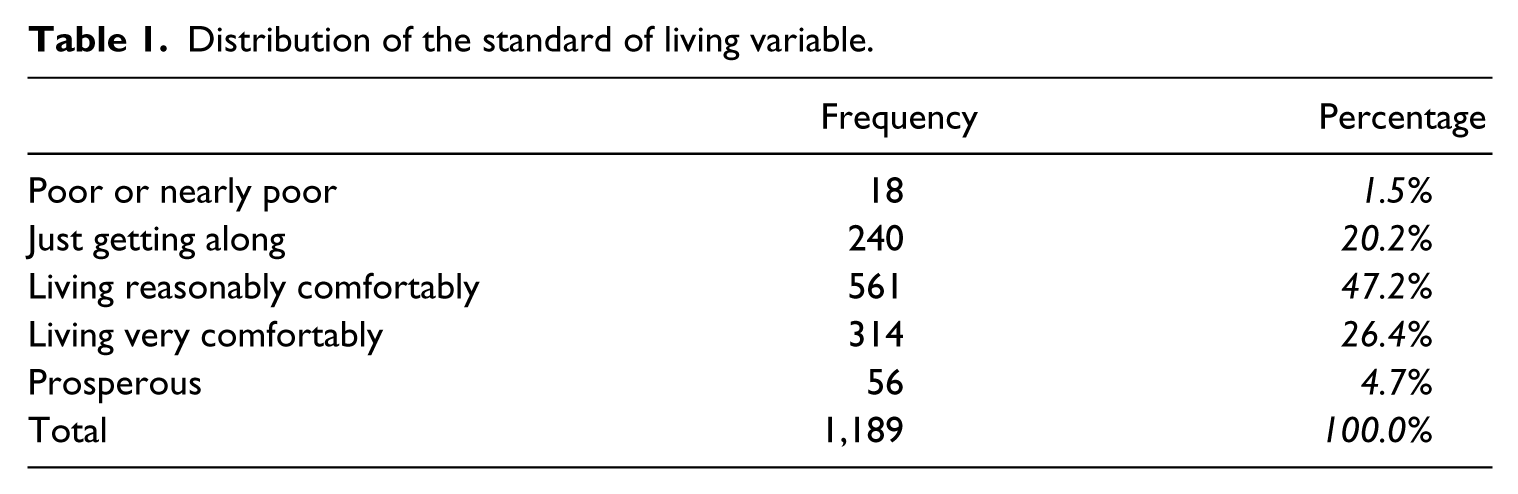
Respondents were asked: ‘Which of the following words or phrases best describes your household’s standard of living? Choices were ordinal: ‘prosperous,’ ‘living very comfortably,’ ‘living reasonably comfortably,’ ‘just getting along,’ ‘nearly poor,’ or ‘poor’. Only nine respondents did not respond to the question or answered that they did not know, or 0.8% of the total. Because only eight respondents identified as ‘poor’ and ten as ‘nearly poor’, this research combines these two categories into a single ‘poor or nearly poor’ category that constitutes 1.5% of all responses. The distribution of the independent variable is presented in Table 1.
Distribution of the standard of living variable.
Employment status
The respondent’s employment status may be a significant predictor of conservative religious and cultural beliefs. Respondents who are unemployed may be resentful of the host country and their experiences in it – they may be more likely to believe ill of the society in which they are not necessarily financially successful. Analysis of this measure was facilitated by the creation of a dichotomous variable that more accurately captured the research question. Unemployed respondents, whether or not they claimed to be actively looking for work, were coded ‘1’ and other respondents were coded ‘0’ in the data set. Surprisingly, the unemployed were not significantly more represented among those respondents identifying with the lower classes than the higher ones.
Control variables
We control for demographic variables including native birth, gender, age, educational attainment, and marital status.
Generation of immigration
Distance from the immigrant generation was coded as an ordinal variable with values between ‘1’ and ‘4.’ Approximately 69% of the respondents surveyed were first-generation immigrants (foreign-born of foreign-born parents); these respondents were coded ‘1.’ Eleven respondents were foreign-born but had at least one parent who had been born in the host nation, and were coded ‘2’. Those who were born in the host country but had foreign-born parents, 23% of those surveyed, were coded ‘3,’ while those (7%) whose grandparents had immigrated, subsequent generations being born in the host country, were coded ‘4.’ Unfortunately, we have no information regarding age at immigration, making it impossible to distinguish respondents who immigrated as adults from those who immigrated as children, known as 1.5 generation immigrants.
There is also a pattern of rising self-reported prosperity as the respondent moves further from the point of immigration. While first-generation immigrants represented 69% of the respondent pool, 77.5% of those who were ‘just getting along,’ and 72.2% of the ‘poor’ and ‘nearly poor,’ those who had been born in the host country and whose parents had been born in the host country represented 6.6% of the survey pool and 9.5% of those who identified as ‘living very comfortably’ or ‘prosperous.’
Although our data does contain information regarding immigrant generation, we do not know respondents’ country or countries of origin. We also have no information regarding religious sect within Islam, or mosque of practice. This means that we are unable to allow for these effects in controlling for immigrant generation.
Gender
Female respondents were overrepresented among subjects, with just over 52% of surveys answered by females. Women were more likely to identify with the middle class and were over-represented within the answer choice ‘living reasonably comfortably.’ Men appear to have preferred both lower- and upper-class answers; 53.6% of respondents identifying as ‘prosperous’ were men. For the purposes of statistical interpretation, males were coded ‘0’ and females were coded ‘1’ in the data set.
Age
Age is a continuous variable in this dataset, the lowest value being 18 and the highest 82. The mean age of respondents is 40.39 with a standard deviation of 13.71. Younger respondents report living in disproportionately affluent households, while middle-aged respondents were more likely to identify as ‘just getting along,’ which reflects the likelihood that many young respondents had not moved out of the parental home.
Educational attainment
Respondents were asked for the highest level of education that they had completed, creating an ordinal variable. Predictably, the data shows that there is a relationship between schooling and socio-economic class, with more educated respondents identifying as more prosperous than their less educated counterparts. There is a strong possibility that educational attainment is also correlated to social and political beliefs, as both anecdote and literature (Cahn and Carbone, 2010; Tezcür and Azadarmaki, 2008) indicate that low levels of education are correlated to high levels of conservatism. Given this, using educational attainment as a control is essential.
Marital status
Although there was no significant difference in the prosperity levels of married and unmarried respondents as a group, the possible role of anomie in determining the likelihood of both fundamentalism and radicalization makes it necessary for this research to control for marital status on the individual level. While the married are in committed relationships that presumably require some degree of responsibility and accountability, individuals who are not married may have sufficient freedom to pursue radical belief systems. Analysis of this measure was facilitated by the creation of a dichotomous variable that more accurately captured the research question. Married respondents were coded ‘1’ and non-married respondents were coded ‘0’ in the data set. Just over 75% of respondents reported being married.
Dependent variables
This research uses the independent variable to predict a number of dependent variables of interest, while controlling for demographic variables. Existing research posits that four factors are paramount in the fundamentalist belief system: (1) a desired return to what are perceived to be traditional gender roles (Chaturvedi and Montoya, 2013; Chhachhi, 1989; Göle, 2002; Jacobson, 2012; Moghadam, 1994), (2) a desired alliance between the national system of law and religious texts (Akhtar, 2014; Tibi, 1998), (3) a glorification of the ideal of martyrdom (Armstrong, 2011; Best, 2010; Pace, 2013) and, in the case of Islamic fundamentalism particularly, (4) anti-Westernism, which is largely framed as a moral question (Eisenstadt, 2000; Huntington, 1993; Tibi, 1998). Given this, we use four dependent variables: (1) conservative beliefs regarding the role of women, (2) belief in a secular justice system, (3) professed willingness to sacrifice one’s life for faith, (4) negative opinion of the West’s moral influence on the Muslim World. Each of these variables is a quantitative measure of some facet of Islamist thought and religious zeal, and we treat them both separately and as a single construct – fundamentalism. Responses to these variables tended to move together, and the measures had a Cronbach’s Alpha of 0.759 – indicating a high degree of reliability.
Negative opinion of the West’s moral influence
Negative opinion of the West’s moral influence on the Muslim World is measured by response to the question: ‘People have different views on the influence of Western countries on the Muslim world. Do you strongly agree, somewhat agree, somewhat disagree, or strongly disagree with the following statement? Western countries lower moral standards in the Muslim world.’ Responses were originally coded ‘1’ through ‘4’ – ‘1’ being ‘strongly agree’ and ‘4’ being ‘strongly disagree’. The greatest number of responses, 988 – or 36% – strongly agreed that Western countries lowered standards in the Muslim world. Just over 23% agreed with the statement. To facilitate clarity, this variable was converted into a dichotomous variable. Subjects responding that they strongly or somewhat agreed with the statement that the West lowers moral standards in the Muslim World were coded as ‘0’ for a negative view of Western influence, while those answering that they somewhat or strongly disagreed with the idea were coded ‘1’ to indicate their relatively positive view of Western moral influence.
This research posits that respondents who are strongly attached to Islam, and therefore the Islamic system of morality, will be more dismayed by and suspicious of Western morality than their less orthodox counterparts. As fundamentalism increases, therefore, so will the perception that Western values are somehow infecting the Muslim World. The use of the term ‘lower moral standards’ was purposeful and serves to bring out respondents’ belief that their original, indigenous values were superior; respondents who feel that Muslim values are merely changing or evolving should be expected to disagree with the statement.
Secular justice system
Belief in a secular justice system is determined by the response to the question: ‘There has been much discussion about the place of Sharia in the modern world. In your opinion, which one of the following best describes how Sharia should fit in the legal system? Sharia should be …’ Respondents were offered the options ‘The only source of law,’ ‘The main source of law,’ ‘One of many sources of law,’ or ‘A guide to moral behavior, not enforceable law.’ This variable was also converted into a dichotomous one: subjects responding that Sharia should be the only or main source of law were coded as ‘0’ for not seeking a secular justice system, while those believing that Sharia was a guide to moral behavior or one of many influences on the justice system were coded ‘1’ to indicate their preference for largely secular systems of law.
This variable speaks to the extent to which the respondent feels the Islamic way of life, that recommended by the Quran, should be the one people adopt. Because the system of law is necessarily binding on all citizens, irrespective of religion, answering that Sharia should be law – or the majority of the law – indicates a belief that Islam should be binding on everyone in the nation. This espousal of political Islam is a hallmark of great religiosity (Khashan and Kreidie, 2001; Tezcür and Azadarmaki, 2008).
Conservatism on the role of women
The variable ‘conservatism on the role of women’ is composed from responses to the following four questions:
The role of women in Islam has been a matter of wide debate. Do you think Muslim women should …
Be able to take leadership roles over both women and men?
Be able to choose their husbands?
Shake hands with men who are not relations?
Be able to initiate divorce?
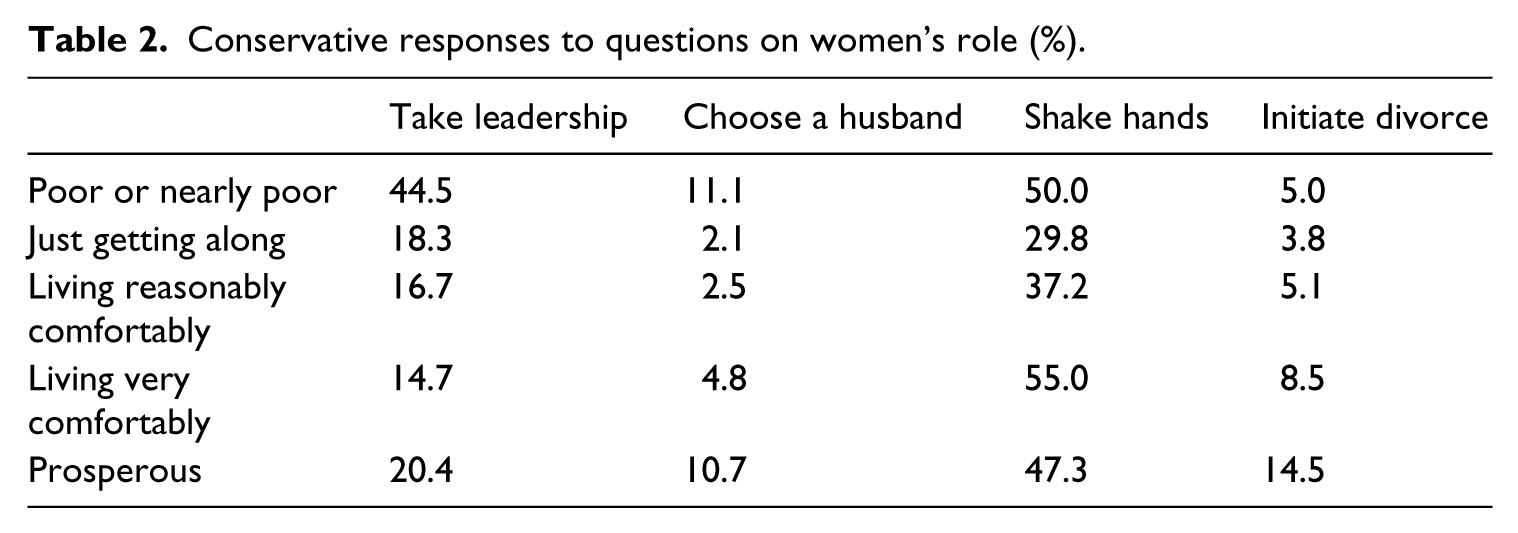
Table 2 details the distribution of responses to these questions across socio-economic statuses.
Conservative responses to questions on women’s role (%).
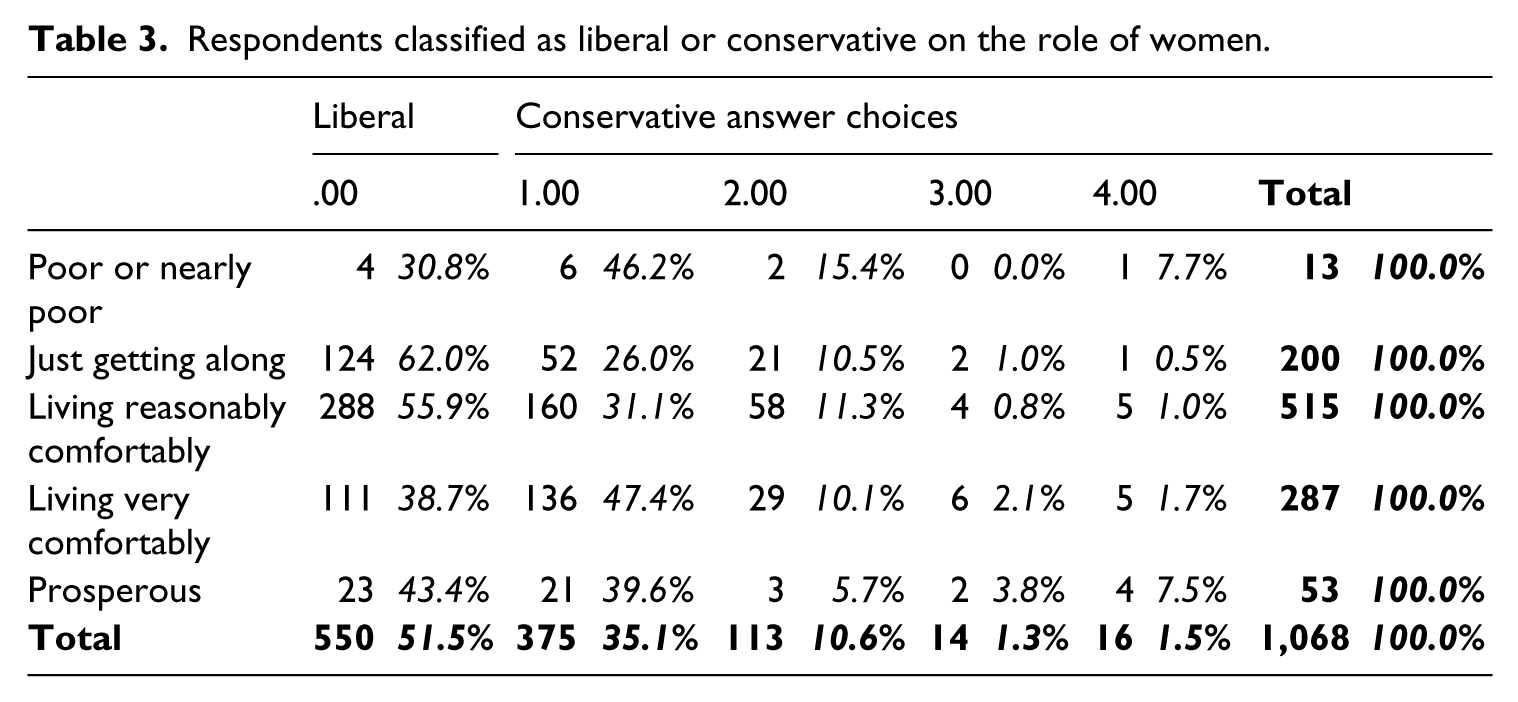
An aggregate score ‘conservatism on the role of women’ was compiled using responses to these questions, with values that varied from ‘1’ to ‘5’ – ‘0’ being the most liberal and ‘5’ the most conservative. Using this measure, a dichotomous variable was created. Respondents who chose at least one conservative answer choice were coded ‘0’ for conservative, and respondents that chose none of the conservative answer choices were coded ‘1’ for liberal. Table 3 illustrates the distribution of liberal and conservative assignations based on the number of conservative responses to these questions.
Respondents classified as liberal or conservative on the role of women.
Personal sacrifice
Willingness to sacrifice one’s life for one’s faith was measured by response to the question: ‘What do you think is worth your personal sacrifice, even that of life? Your faith?’ Response options were ‘Yes’ and ‘No,’ and 40% of respondents chose ‘Yes.’ As socio-economic status improves, the likelihood of claiming a willingness to sacrifice one’s life in the name of one’s faith tends to increase. This variable proxies the idea of martyrdom well.
The ‘fundamentalism’ construct
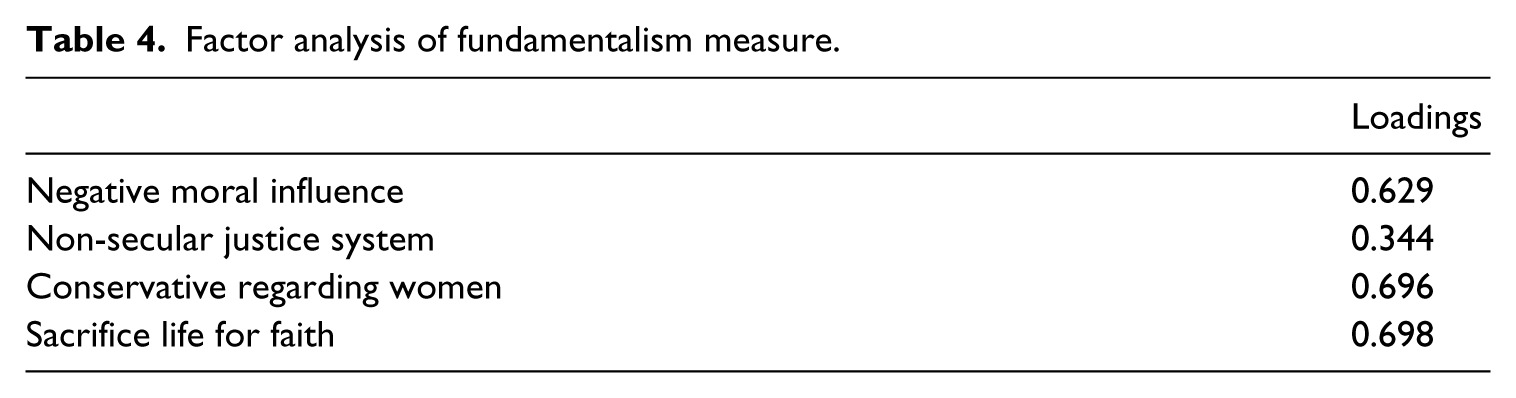
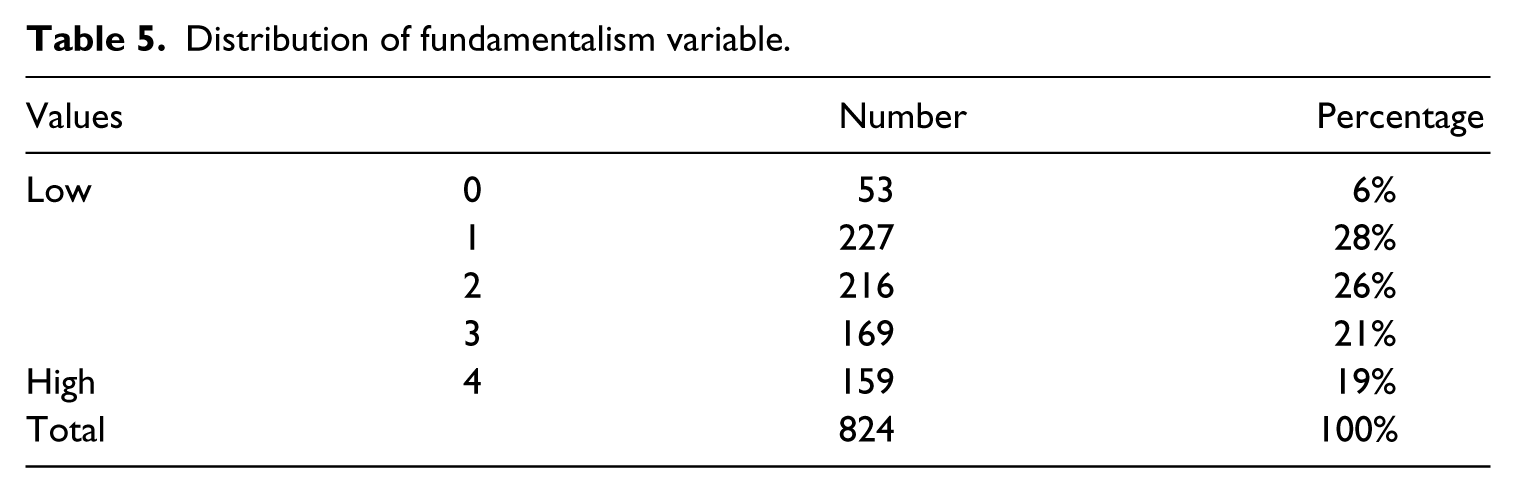
In order to work with the dependent variables as a single concept, and allowing the results of factor analysis, pictured in Table 4 and indicative of the presence of a single broader paradigm, to lead, we create a single conceptual variable – fundamentalism – created through the aggregation of its component values. The creation of this single variable allows the research to test the importance of the entire construct for a professed willingness to commit violence. In Table 5, we present the distribution of the resultant ordinal variable.
Factor analysis of fundamentalism measure.
Distribution of fundamentalism variable.
Data analysis – affluence, job status, and fundamentalism
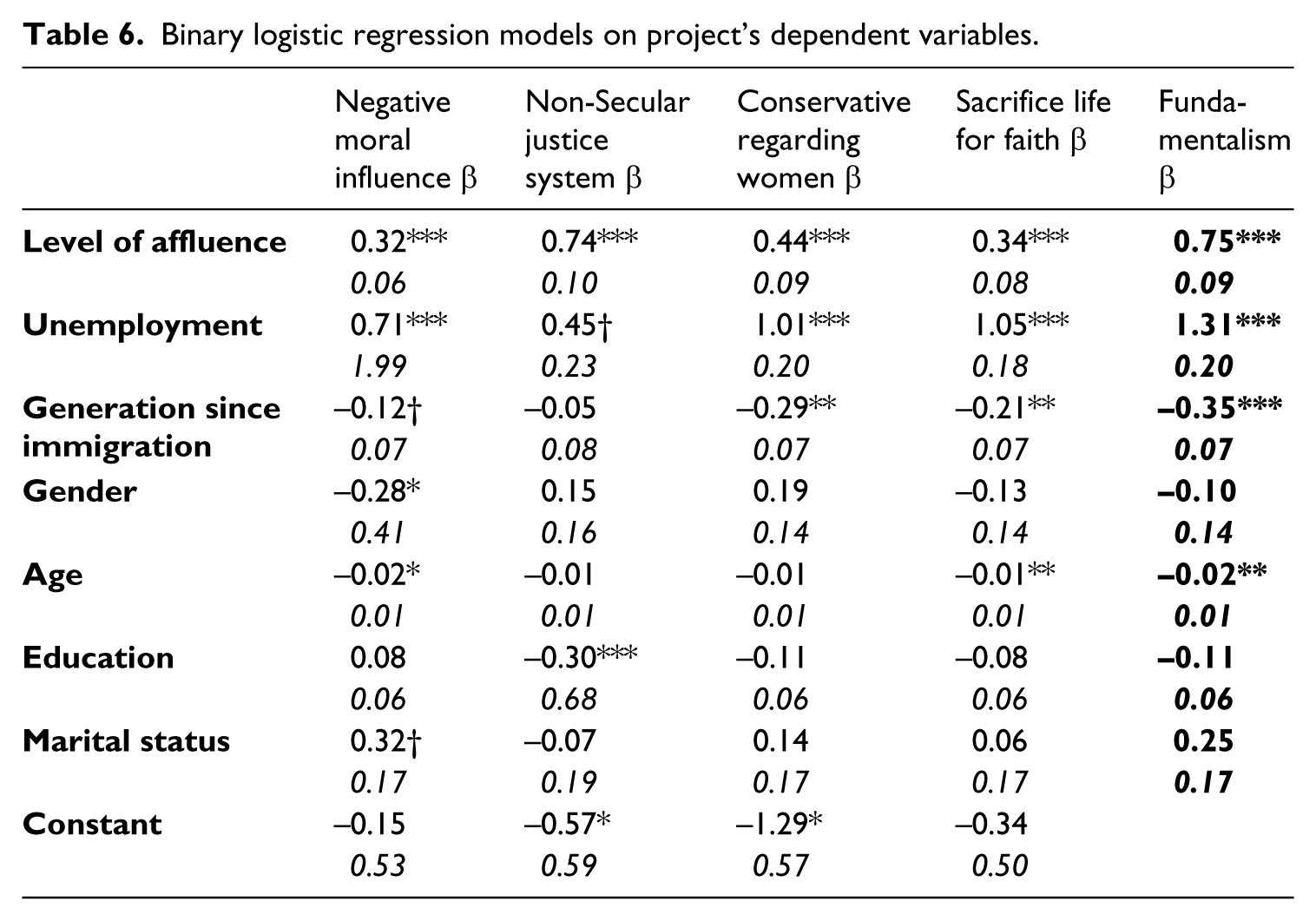
Creating an individual model for each dependent variable of interest, we use binomial logistic regression models to estimate the importance of standard of living in predicting each of the single dependent variables. In order to estimate a best-fit line for fundamentalism, an ordinal variable, an ordinal logistic regression procedure was used, which parallel line tests indicated to be valid. Testing for a variance inflation factor (VIF) resulted in no factor greater than 1.6 – indicating that collinearity is not a problem. The data analysis results are shown in Table 6. The beta figures given are the results of logistic regression and, as such, must be exponentiated to be interpreted as changes in the odds of a positive unit increase in the dependent variable.
Binary logistic regression models on project’s dependent variables.
Negative moral influence
With each increase in level of self-reported affluence, the likelihood of the respondent having a negative view of the West’s moral influence in the Muslim World increased by 38%, while unemployment increased that likelihood by 103%. Educational attainment was not a significant predictor of views of the West’s moral influence, but the remainder of the control variables were significantly correlated.
A role for Sharia in the justice system
With each increase in level of self-reported affluence, the likelihood of the respondent desiring a justice system based on Islamic Sharia law increased by 110%. Educational attainment was also a significant predictor of belief in a secular justice system – each incremental degree predicted a 26% increase in the likelihood of seeking a justice system that was primarily secular. As respondents became more affluent, they were more likely to support the implementation of Sharia in the national justice system, but increases in educational level worked in the opposite direction. Unemployment was significant to p<.10, predicting a 57% increase in desiring non-secular law.
Conservative beliefs regarding women
With unemployment, the likelihood of espousing conservative beliefs about the role of women increased by 175%. With each increase in self-reported prosperity, the likelihood of the respondent having a relatively conservative view regarding women increased by 55%. Immigrant generation was also a statistically significant predictor of conservative beliefs, each increase in generation of nativity being correlated with a 22% decrease in the likelihood of holding conservative beliefs. Unemployment status was also an excellent and strong predictor, even after controlling for all other control variables.
Willingness to sacrifice life for faith
The unemployed are significantly more likely to profess a willingness to sacrifice personally – including their own lives – for their faith. Being unemployed equated to a 186% increase in the likelihood of such a profession. With each increase in affluence, the likelihood of the respondent claiming to be willing to make a personal sacrifice, including that of their own life, increased by 40%. Generations since immigration, age, and unemployment status were also significant predictors of a willingness to make personal sacrifices – increased nativity being associated with a 19% decrease in the likelihood of willingness to sacrifice personally, each year of age with a 1% decrease in likelihood.
Fundamentalism
With each increase in self-reported prosperity, the likelihood of a respondent increasing one step in fundamentalism grows by 112%. With each additional generation since immigration, the likelihood of increasing in fundamentalism decreases by 27%. Although the relationships between on the one hand gender, education, and marital status and on the other hand fundamentalism are insignificant, an increase of one year of age leads to a 2% decrease in the likelihood of reporting fundamentalist attitudes. In contrast, being unemployed increases the likelihood of moving up a step in fundamentalism by 297%.
Data analysis – fundamentalism and willingness to engage in violence
Having explored the relationship between affluence and fundamentalism, we turn to the relationship between fundamentalism and radicalism – which we define as willingness to engage in violence (Tezcür and Azadarmaki, 2008). We operationalize radical beliefs using a single survey question: ‘When do you think resorting to violence is justified? To defend your faith?’ The question is part of a series, in which the stem ‘When do you think resorting to violence is justified?’ is followed by options including ‘To defend your nation?,’ ‘To promote a more just world?,’ and ‘To defend your political beliefs?’ The respondent is required to answer ‘Yes’ or ‘No’ in each case. Table 7 presents a distribution of willingness to resort to violence for faith, sorted by level of fundamentalism.
Willingness to resort to violence for faith, by level of fundamentalism.
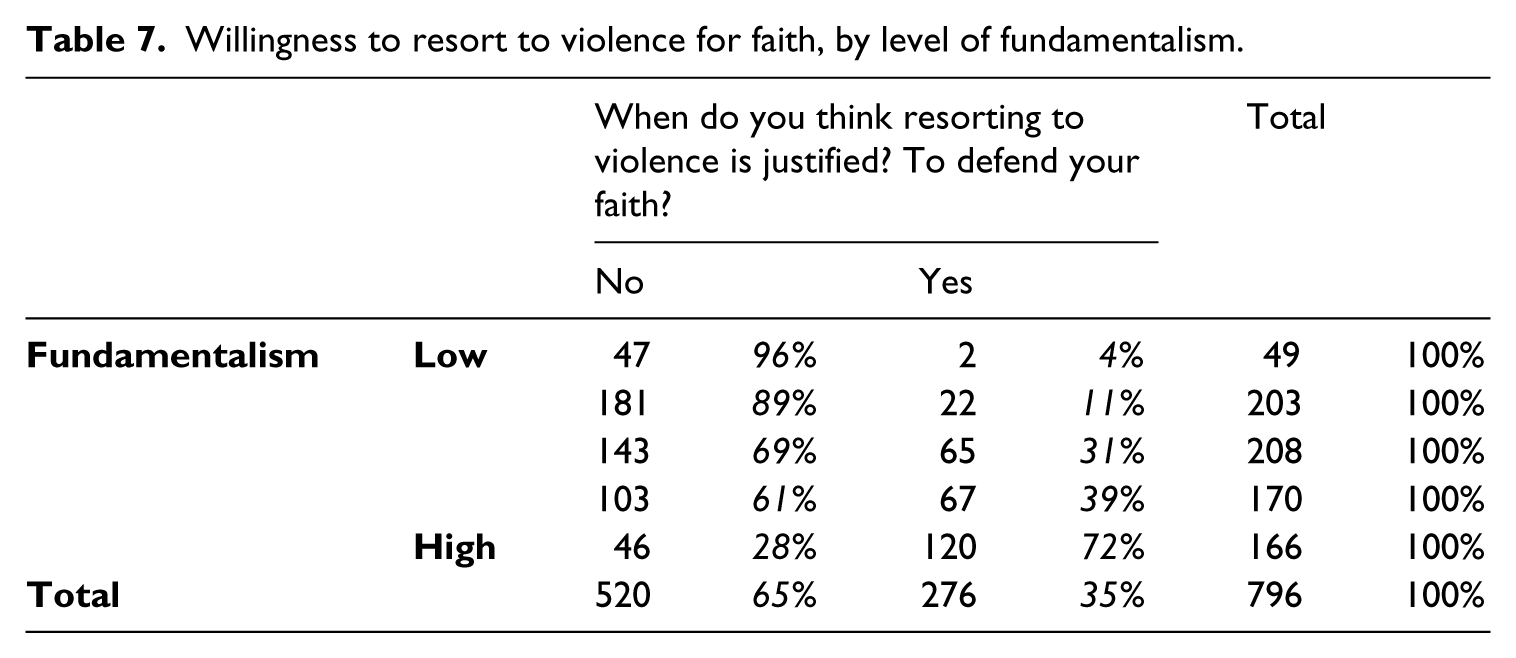
The relationship between a willingness to resort to violence to defend religion and level of fundamentalism is immediately apparent. As the respondent becomes increasingly conservative regarding the role of women, distrustful of the influence of the West on the morality of the Muslim World, more supportive of Sharia in the justice system, and more willing to make personal sacrifices for religion, he or she becomes more likely to profess a willingness to resort to violence to defend faith.
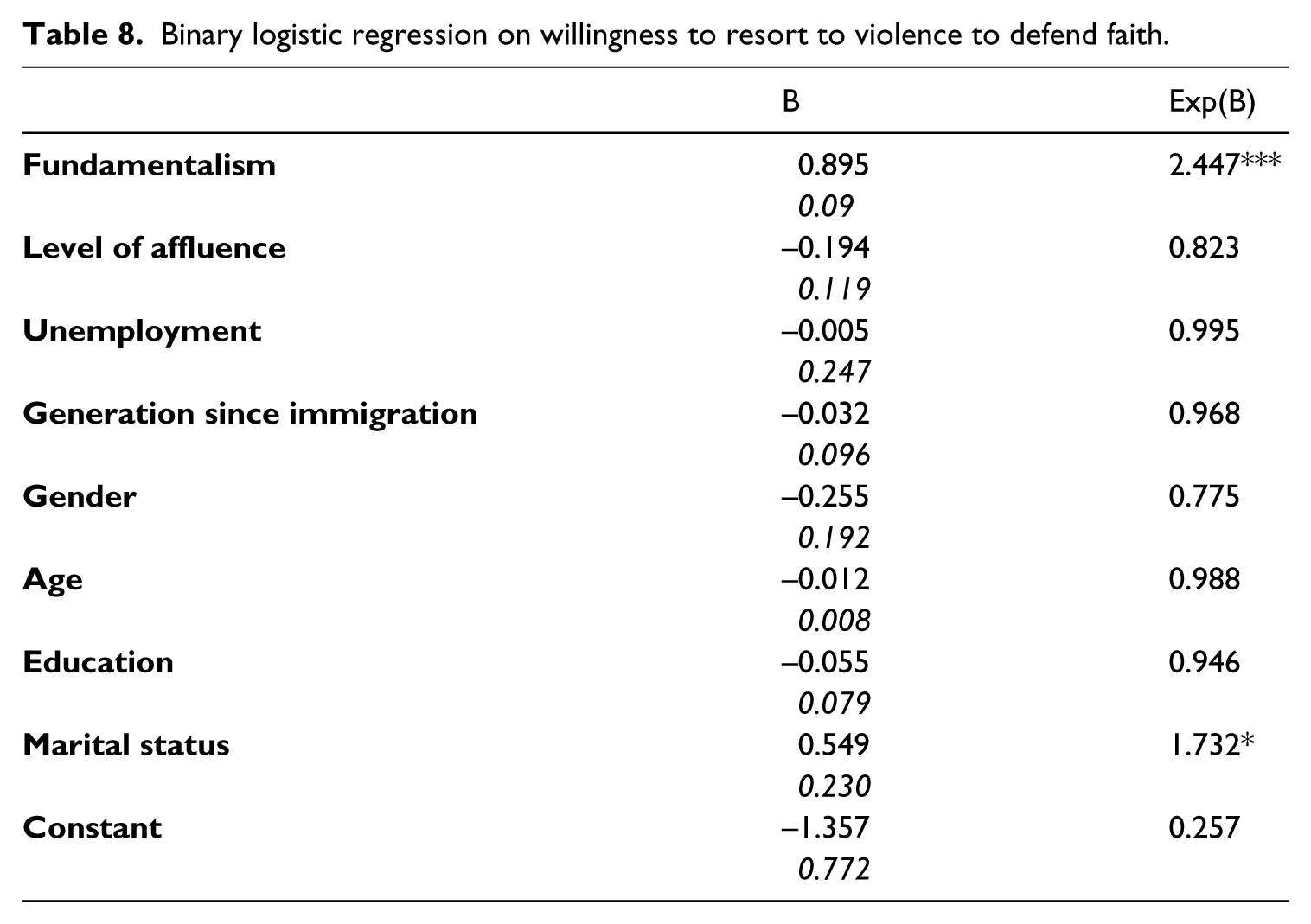
In order to estimate the relationship between level of fundamentalist religious beliefs and willingness to use violence, we use a binomial logistic regression model. We control for the same variables as in the previous model, in order to isolate the effects of fundamentalism from those of socio-economic status, generation since immigration, gender, age, education, marital status, and employment status. The results of this regression are depicted in Table 8.
Binary logistic regression on willingness to resort to violence to defend faith.
Fundamentalism
The use of fundamentalism in this model renders all other variables, except for marital status, irrelevant. With each increase in fundamentalism, the likelihood of the respondent answering that he or she would be willing to engage in violence increases by 164%. Of the other variables – level of affluence, employment status, immigration generation, gender, age, education, and marital status – only one significantly affects this likelihood: being married amplifies it by an additional 77%.
Discussion and conclusion
Given the existing literature, we hypothesized that lower levels of prosperity would lead subjects to espouse a more fundamentalist Islam – with less liberal views on the role of women, a greater focus on religiously inspired systems of justice, a more critical opinion of the West’s moral influence in the Muslim World, and more radical beliefs regarding sacrifice for faith. In contrast, we expected that respondents of greater means would be more assimilated to Western culture and values, and would thus tend to mimic Westerners more closely in their moral attitudes. The data, however, showed a strong, positive relationship between prosperity and fundamentalism. As respondents reported being more prosperous, they also reported having more orthodox views of gender roles, a greater affinity with Sharia-inspired justice systems, more anti-Westernness, and a greater willingness to sacrifice themselves for their faith.
The data also revealed a strong, and hypothesized, correlation between unemployment – independent of economic prosperity, age, or education – and the dependent variables. Irrespective of the level of material prosperity enjoyed by the household in which the respondent lives, unemployment causes an increase in fundamentalist religious belief. This is especially interesting because unemployment is not an essential state, so the idea that it predicts such far-reaching changes to a set of beliefs that is sometimes thought of as ascriptive is provocative (Schwedler, 2001).
Our data, then, implies that radicalization may be more aptly associated with the alienated than with the poor. In the immigrant communities of Western Europe, the working poor are the least likely to express fundamentalist religious beliefs. The relatively prosperous, however, are likely to express these beliefs – especially if they are involuntarily in the position of having no formal relationship with the labor market.
Our hypothesis that more religious respondents would be more likely to espouse radical beliefs regarding violence was confirmed strongly. Irrespective of the demographic control variables, level of fundamentalism was a significant and powerful predictor of willingness to engage in violence. Although this finding was not unexpected given the literature, the clear relationship it confirms is an important addition to our understanding.
The fact that more successful, higher-class respondents were more religious, with more of the moral standards and convictions espoused by the highly religious, may be a consequence of a number of dynamics. Perhaps more prosperous respondents have greater freedom from inflexible work schedules or family responsibilities, giving them the ability to engage more fully with the structures of fundamental religious practice. Alternatively, the causal pattern may work differently – perhaps respondents who are closely connected to ancestral nations in the Muslim world both identify themselves as more prosperous because of a different frame of reference and retain a schema of religious values that is more reflective of that in the native country. In either case, those that feel more affluent are more likely to espouse radical beliefs – and this tendency is greatly enhanced when there is an involuntary separation from the labor market. Future research should certainly attempt to disentangle these possibilities.
Finally, research must continue with further exploration of the implications of the other conclusion presented in this article. The relationship between fundamentalism and a positive response to the question ‘Do you believe that resorting to violence to defend your faith?’ is clear from our data, but to posit that religious practice is in itself correlated with religious violence is, we believe, merely to confirm existing research on the motivations of that violence in the West. In contrast, we find that religion per se does not promote violence. Rather, our research suggests that it is a frame through which anomie expresses itself and becomes dangerous.
Footnotes
Funding
The research was supported by a grant funded through the Office of the Secretary of Defense Minerva program and managed by the Office of Naval Research (N00014-09-1-0815). The content is solely the responsibility of the authors and does not necessarily represent the views of the Office of Naval Research.
Author biographies
Address: Department of Sociology, 1555 Dickey Dr. – 225 Tarbutton Hall, Atlanta, GA 30322, Emory University, USA
Email:
Address: Global Initiative on Civil Society and Conflict, 4202 E. Fowler Avenue, CPR107 Tampa, FL 33620, University of South Florida, USA
Email: