




Abstract
This article traces the emergence of climate change discourse and its related practices in one of the largest and globally most influential Taiwanese Buddhist organizations – Tzu-Chi (Buddhist Compassion Relief Tzu-Chi Association). The authors analyse more than 500 volumes of Tzu-Chi’s periodicals and describe its recycling practice from the social organizational perspective. Our findings suggest that climate change discourse has emerged in recent years as a response to increasing natural disasters, particularly typhoons. Practices such as recycling are implemented in order to address this crisis through the cultivation of a disciplined inner self. The article compensates for the lack of current studies on what Buddhist organizations actually do for the environment and how they address climate change. It also offers a correction to the studies on environmental movements, in which religious environmentalism is often overlooked.
Although studies on environmental organizations, protests and social movements are abundant, few social science work has studied how religious organizations differ in terms of their environmentalism, and how they respond to climate change. Hence, Haluza-DeLay (2014) calls for more social science work to examine how religion responds to the issue of climate change. 1 At the same time, most of the existing sociological studies have been oriented toward examining White’s (1967) thesis, which is whether Judeo-Christian traditions have negative effects on people’s environmental attitudes (e.g. Sherkat and Ellison, 2007). Nevertheless, apart from religious and environmental studies (e.g. Miller et al., 2014; Kaza and Kraft, 2000; Sahni, 2008; Sørensen, 2013; Tucker and Williams, 1997), little social science work has been done to investigate the argument also made by White that Buddhism, specifically Zen Buddhism, is the potential cure for the contemporary ecological crisis. 2 Although studies of Buddhist cosmology and ethics have generated useful insights, we know relatively little about what Buddhist organizations actually do for the environment, and how they respond to issues of global climate change, especially from an East Asian perspective. 3 This article is the first attempt to answer the following questions: To what extent do Buddhist organizations from East Asian religious traditions care about the environment? How do they understand issues of climate change? If climate change is their concern, how do they address this problem? What kinds of action do they take to tackle these problems?
Limited by the length of this paper, we focus our discussion on a single case. We examine both environmental discourses and their related practices using the renowned Buddhist Compassion Relief Tzu-Chi Association (Tzu-Chi thereafter). Tzu-Chi is currently the largest and the most influential Buddhist organization in Taiwan and has extensive influence in many other countries. Its success in the past five decades has attracted many studies (Huang, 2009; Madsen, 2007; Yao, 2012). Extant studies provide different valuable angles to examine its development and social impact. For example, Tzu-Chi is sometimes viewed as a new religious movement, sometimes as a charismatic movement, sometimes as a middle class movement. However, the environmental dimension of the Tzu-Chi movement has mostly been ignored by the existing studies. Recognizing the merits of these studies, we attempt to demonstrate that concern for the environment is a fundamental element of the Tzu-Chi movement. We re-examine Tzu-Chi by viewing it as a response to the degradation of the environment and trace its incorporation of climate change discourse into its theology-practice system.
Specifically, we approach our questions by analysing two periodicals published by Tzu-Chi to examine the rise of climate change discourse and the corresponding environmental activism. These two periodicals are Tzu-Chi Monthly (ciji yuekan), published since 1967, and Rhymes Monthly (jingdian yuekan), which was purchased by Tzu-Chi and has been published by it since 1998. We focus our analysis on Tzu-Chi Monthly, since this magazine is the better source for understanding the evolvement of the Tzu-Chi movement, and use Rhymes Monthly as a supplement. We converted 529 volumes of Tzu-Chi Monthly (1967–2010) to searchable files. Then, we searched for keywords and recorded the frequency of each keyword. We specifically searched for three keywords and their related terms – environmental protection (huanbao), recycling (huishou) and climate change (qihoubianqian). By doing so, we were able to identify how the environmental discourse has evolved over the past half century. We paid specific attention to the context in which these terms were mentioned; and whether they were used in statements by the mission or only in a secondary reports.
This methodology generated fruitful results. For example, our data suggests that as early as 1990 the term ‘environmental protection’ was frequently being mentioned in the Tzu-Chi Monthly: Tzu-Chi began recycling in 1991, ten years earlier than the nationwide implementation of government-mandated recycling. Climate change and its related terms appeared as early as 1992. However, its full theorization as a discourse of ideas and practices did not occur until the new millennium. This transformation, we argue, accompanied the increase in natural disasters, and was especially marked after 2000, in the wake of several devastating typhoons. The data suggests a strong connection between natural crises and the increase in climate change discourse.
This article proceeds in the following way. In the next section, we briefly discuss the theological background of Buddhist environmental ethics. We concede that it is impossible to provide a complete summary of Buddhist environmental thought in this short paper and doing so is not our goal. Second, we provide a brief introduction to Tzu-Chi and point out its significance in contemporary Taiwanese, as well as Chinese, Buddhism. Then, we move to our content analysis of the two periodicals and present our findings from the data. Next, we discuss the transition from general environmental protection to the discourse of climate change. Finally, we examine how specific practices – recycling and individual disciplining – were implemented as a way to deal with the crisis of climate change.
Environmental ethics, climate change and Buddhism
Buddhism is generally regarded as an ‘environmental friendly’ religion. This view is best argued by the historian Lynn White (1967: 1206), who contends that ‘what we do about ecology depends on our ideas of the man–nature relationship’ and ‘more science and more technology are not going to get us out of the present ecologic crisis until we find a new religion, or rethink our old one’. Observing the intimate link between the increases in student movements and cultural movements and the rise in Zen Buddhism during the tumultuous 1960s, White presented a rosy view of Buddhism as the cure for the ecological crisis of the time. For example, he asserted that ‘the beatniks, who are the basic revolutionaries of our time, show a sound instinct in their affinity for Zen Buddhism, which conceives of the man–nature relationship as very nearly the mirror image of the Christian view’ (White, 1967: 1206).
Why is Buddhism the mirror image of the Christian view? Scholars of religious studies have examined this issue extensively. Arguably what fundamentally distinguishes Buddhism from other religions is its emphasis on the (inter)-dependent origination. This ethical principle provides what scholars call a ‘holistic worldview’ in which Buddhists see that all lives on Earth are interconnected and that the actions of one person influence others (Swearer, 2006). Furthermore, Buddhist theological structure is marked by nondualistic and nontheistic characteristics. It is argued that Buddhist ‘nondualism is based in the same kind of awareness of interdependence, resulting in the same kind of dethroning of humanity from the center of the universe that deep ecology suggests’ (King, 2009: 123). Buddhism is conceived as being a religion ‘without a transcendent God’. The logical consequence of this nontheistic principle is that there is no rigid distinction between the sacred and the profane, as is seen in theistic religions such as Christianity. Consequentially, it leads to the dethroning of humanity from the centre of the universe.
Although these ethical principles are common to all Buddhist traditions, we should be aware that the singular term ‘Buddhism’ actually covers various teachings and texts, and that teachings and texts do not automatically lead to environmental activism. In fact, scholars argue that ‘green’ Buddhism is a recent phenomenon, which is linked with the environmental movements of the 1970s in Western countries (Kaza, 2006). 4 The framing of Buddhist environmental thought was also associated with the Deep Ecology Movement in the fields of ecology and environmental studies (Barnhill and Gottlieb, 2001; Swearer, 2006). Surveying several Buddhist traditions, Henrik Sørensen (2013: 103) argues that ‘environmentalism, and nature conservation, as we understand them today, were not significant issues in traditional East Asia Buddhism’. In addition, it is recognized that current Buddhist environmental concerns usually focus on certain areas (Kaza, 2006). For example, Western Buddhist environmentalism mostly prefers a cultivation of lifestyle via meditation on one’s connection and co-existence with all lives rather than direct mobilization using organizational power. The Buddhist lifestyle is characterized by a vegetarian diet, refraining from harming animals, and consumerism with a specific focus on food quality. However, some critical issues are barely mentioned and are under-theorized. Kaza (2006: 3) argues that ‘key issues such as global climate change have hardly been mentioned in either academic or popular discourse.’ In short, Buddhist environmentalism cannot be taken for granted and has to be examined carefully.
Tzu-Chi and the Tzu-Chi movement
Over the past two decades, the success of Tzu-Chi has been thoroughly studied. Previous studies have usually considered Tzu-Chi as an organization. They are usually focused on Tzu-Chi’s charismatic leadership, and attempt to explain its rise via the link to charisma. We suggest that a distinction be made between the study of Tzu-Chi as an organization and the study of the Tzu-Chi movement. This is useful because the study of the Tzu-Chi movement concerns broader empirical and theoretical questions (e.g. the environment, public welfare provision). Recognizing this distinction, we provide a brief history of Tzu-Chi, its basic organizational structure and its influence.
The Buddhist Compassion Relief Tzu-Chi association was founded in 1966 by a Buddhist nun, Cheng Yen, and several laypeople in Hualien, a town on the east coast of Taiwan. 5 Women constituted the majority of its early participants. The organization in its initial form was similar to a Chinese local mutual-aid association in that it provided material support to the local poor or victims of emergency (e.g. fires, floods or diseases). The active and regular participants called themselves weiyuan (commissioners). 6 Commissioners differed from members (huiyuan) who only made regular donations. Commissioners had to devote their time to regular tasks assigned by the organization. These included visiting poor families, collecting donations and distributing resources (e.g. money and food). It is worth noting that mutual-aid associations were common social organizations in Chinese society. Their popularity often signified the insufficiency of state welfare provisions and at the same time they served the functions of communication and social integration.
Tzu-Chi grew slowly but steadily in the 1970s. At the end of the 1970s, it was an organization with approximately one hundred commissioners. Each commissioners was usually in charge of the collection of donations from a group of around forty members. Thus the estimated total membership at the end of the 1970s was roughly three to four thousand. Yet, we should not put too much emphasis on the number of members, since they were just people making regular donations to the organization. Although members frequently became commissioners, their connection and commitment to the organization varied greatly. For some still unclear reasons, this small to medium-sized mutual aid organization gained momentum in the 1980s when it decided to build a modern hospital in Hualien. This project inspired and motivated much of Taiwan’s population. In the 1990s, the number of commissioners jumped to more than three thousand, and its membership jumped from under five thousand to around one million.
Currently, the organization claims to have more than a hundred thousand commissioners and more than ten million members globally, the largest group being in Taiwan. Evidence from the Taiwan Social Change Survey (TSCS) supports this claim. The percentage of people who report that they are Tzu-Chi members is consistently around 10–13%. 7 Therefore, an estimate of its total membership in Taiwan is between two and three million. This number far exceeds the reported membership of the second largest Buddhist organization, Foguang Shan, which claims less than 3% of the total population.
Viewing Tzu-Chi as a social movement, Richard Madsen (2007) has argued that Tzu-Chi had a positive effect on the democratization process during the 1980s in Taiwan by easing the tensions and conflicts between the authoritarian government and the oppressed middle class. Chengpang Lee and Ling Han (2014) recently analysed the transnational mobilization efforts of Tzu-Chi in three locations to provide welfare provision that states and private companies could not. However, there are still many other dimensions that have not been explored.
The rise of environmental awareness and recycling
In the following two sections, we present the result of our content analysis from two of Tzu-Chi’s periodicals – Tzu-Chi Monthly (ciji yuekan) and Rhymes Monthly (jingdian yuekan). Tzu-Chi Monthly is the oldest official Tzu-Chi publication, first published in 1967, one year after Tzu-Chi’s founding. In contrast, Rhymes was originally an art and culture magazine targeting urban intellectuals. However, it had financial problems in the 1990s. It was purchased by Tzu-Chi in 1998 and has been published continuously since then. The target audiences of these two magazines are different. Tzu-Chi Monthly is free to all members, and is said to be the most widely read monthly magazine in Taiwan. In contrast, Rhymes targets educated intellectuals and the urban middle class. Its articles are more concerned with cultural and social issues and are not directly related to Tzu-Chi’s activities.
Recognizing the difference between these two periodicals, we concentrate our analysis on Tzu-Chi Monthly and use Rhymes to supplement our analysis. We examined 528 volumes of Tzu-Chi Monthly published between July 1967 and December 2010. 8 The abundance of information contained in this monthly magazine enabled us to trace when and why certain terms and discourses arose and how discourse on environmentalism, climate change and their related practices have changed over the past four decades.
We searched for three categories of keywords in these 528 volumes. The first category was environmental protection. We use the Chinese keywords huanbao and huanjing baohu – both meaning ‘environmental protection’. Our second category was recycling. We used the Chinese keyword huishou. Our third category was climate change. Normally, people use qihoubianqian to mean ‘climate change’. However, there are several other ways to express it. For example, wenshi xiaoying (greenhouse effect) and qihoyichang (abnormal climate) often connote ‘climate change’. Therefore, we used all three of these keywords. Another criterion for deciding the frequencies was that we only counted the number of articles, reports and lectures which contained these keywords. In other words, if a keyword appeared in one article five times we counted it only once in our data. The result is shown in Figure 1.
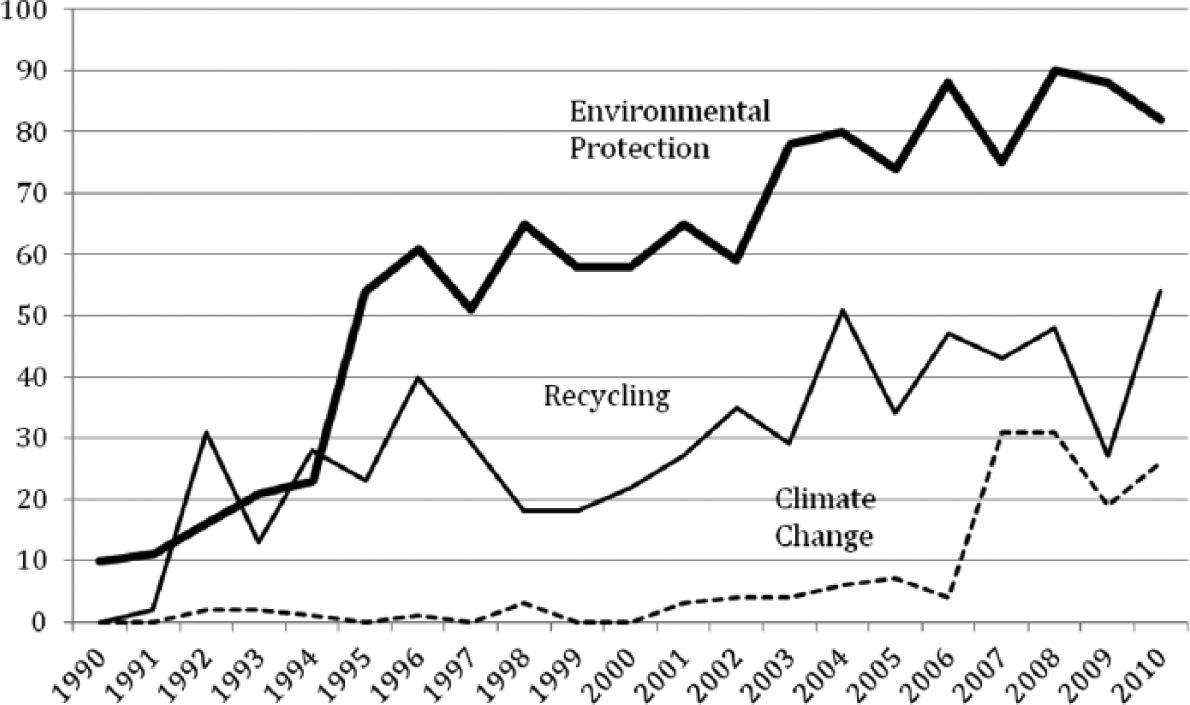
Frequency of three categories of keywords in Tzu-Chi Monthly.
We can identify three stages in the use of environmental protection terms. The first stage is from 1990 to 1994, the second between 1995 and 2003, and the third from 2003 to 2010. The term ‘environmental protection’ (huanbao) first appeared in the Tzu-Chi Monthly in 1990, after which the frequency of articles mentioning this word grew slowly. It reached its first peak in 1995, jumping from 20 articles in 1994 to more than 50 in 1995. Then the frequency followed a steady upward trend until it made another jump in 2003. After 2003, the frequency mostly remained at this high level, but it jumped again in 2005 and 2008.
The term ‘recycling’ (huishou) appeared later than ‘environmental protection’. It first appeared in 1991 and reached its first peak in 1992. The period from 1992 to 1998 can be thought of as the first stage of recycling. Recycling as a practice was introduced by a commissioner in 1991. It was then recognized and implemented by Tzu-Chi, which began to encourage its local branches and members to recycle materials. This organizational effort continued for several years until the new practice was widely accepted and implemented. This is why the frequency of the use of this term declined after 1998. However, after 2002 the frequency of references to recycling rose again, and it reached another peak in 2004, remaining at a high level thereafter.
The term ‘climate change’ (qihoubianqian) appeared sporadically during the 1990s. It was first mentioned in 1992, in an article about the importance of environmental protection. The author reported the conclusion of the Rio de Janeiro Earth Summit, held that same year. A central issue of the Rio Summit was global climate change due to energy consumption. Then, throughout the 1990s the magazine mentioned the greenhouse effect several times each year, mostly in news reports. The term ‘abnormal climate’ (qihoyichang) was constantly mentioned from 2001 to the end of the study, but after 2008, references to ‘climate change’ exceeded both ‘greenhouse effect’ and ‘abnormal climate’ and it soon replaced those terms, becoming a concept that received systematic treatment in multiple articles. To sum up the pattern of climate change-related terms, the data suggests that the concept was not regularly mentioned until 2001 but became a frequent reference after 2005.
Although we did not perform a statistical analysis, we did find a correlation between the changes in the frequency of use of these terms and the natural disasters happening during this period. Furthermore, the frequency increased particularly rapidly after disasters in which Tzu-Chi was involved. Table 1 lists the natural disasters to which Tzu-Chi sent teams to distribute resources.
List of the natural disasters to which Tzu-Chi sent teams to distribute resources (1990–2009).
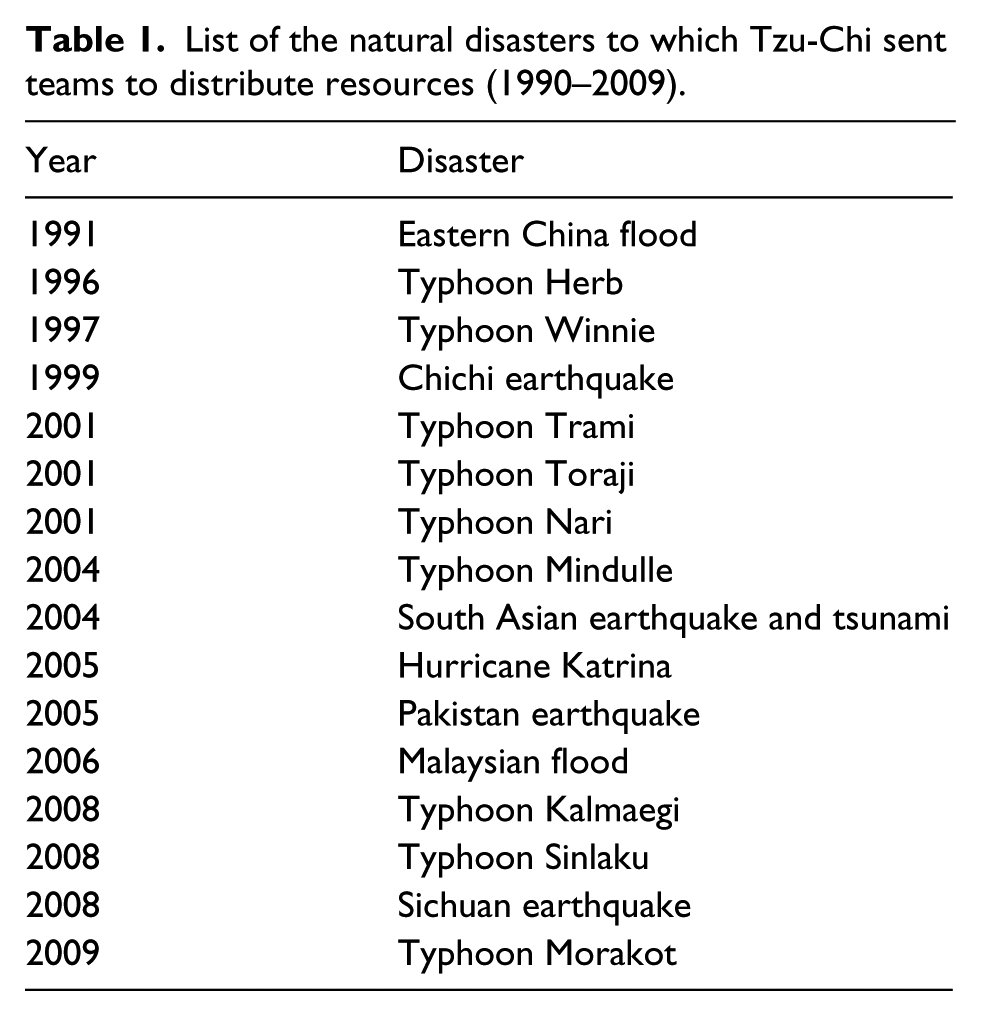
However, we suggest that different types of natural disaster have different cognitive effects. Typhoons and earthquakes were the two most common natural disasters reported in Tzu-Chi Monthly, but they evoked quite different responses. An increase in both the frequency and the intensity of typhoons is generally regarded as a sign of global climate change, while earthquakes are not directly linked to climate change.
To summarize the findings from Figure 1 and Table 1, we suggest first that Hurricane Katrina in 2005 triggered a sense of global climate connection. North America was the continent where Tzu-Chi had the second largest number of members. When Hurricane Katrina turned the city of New Orleans into a swamp and left thousands of people homeless, Tzu-Chi’s American branches soon mobilized thousands of volunteers and sent resources to cities in need. The impact of Hurricane Katrina was significant. Via the description of a special volume of Tzu-Chi Monthly, people now understood that even a country as strong as the USA could not cope with natural disasters without assistance. 9 Tzu-Chi organized a campaign to mobilize resources and volunteers from branches in 30 countries. The campaign strengthened the sense of connection. When people read articles reporting the relief work thousands of miles away from Taiwan and saw photos of hundreds of Tzu-Chi commissioners collecting donations and distributing resources in cities such as Dallas and Houston, global climate change was no longer an abstract idea but a reality. In short, Hurricane Katrina was the result of the ‘greenhouse effect and the phenomenon of global climate change’. 10
Second, the first decade of the 21st century witnessed both an increase and an intensification of natural disasters. Seven of the ten typhoons that brought the most rain in the recorded history of Taiwan have happened since 2000. 11 These seven typhoons caused unprecedented damage to Taiwan, which forced people to reflect on the consequences of unconstrained modernization and economic development. For example, Typhoon Morakot in 2009 levelled one village and killed more than seven hundred people. An editorial article declared that this ‘nightmare has shown the terrible consequences of over-development’. 12
From ‘environmental protection’ to ‘climate change’
In the previous section, we showed that the frequency of references to ‘environmental protection’, ‘recycling’ and ‘climate change’ went through different stages. ‘Environmental protection’ appeared first, then ‘recycling’, and finally ‘climate change’. In this section, we delve further into the meaning of these concepts and analyse how they have changed over time. We identify two lines of evolution of these concepts. First, the environmental discourse was initially focused on local issues such as pollution by local industries, but it gradually evolved to address the global environmental situation. Second, the discourse evolved from addressing personal material concerns (e.g. clean neighbourhoods) at the beginning to emphasizing the interdependence of global citizenship. These two lines of development converges with the ‘climate change’ discourse in 2006, when climate change began to be considered not only on the personal/local level, but also via the lens of interdependence and global crisis.
When the term ‘environmental protection’ was first used by Tzu-Chi’s spiritual leader Cheng Yen in 1990, it appeared as a concept with communal implications. In a public lecture on the planned work of Tzu-Chi, Cheng Yen said: ‘I feel that Tzu-Chi’s work should not be limited to teaching the wealthy and assisting the poor … We should especially promote the task of environmental protection. Tzu-Chi must stand up and call for the removal of heavy industries in Hualien [the district in which Tzu-Chi had its headquarters]’.
13
The communal meaning of ‘environmental protection’ equates to the NIMBY phenomenon (‘not in my back yard’) that scholars studying environmental protests have long identified (Robbins, 2007: 1246–1247). However, Tzu-Chi articulates the meaning of environmental protection broadly to incorporate universal concerns such as over-consumption of materials and energy. In a lecture to more than ten thousand people, Cheng Yen first articulated a systematic view of the broader implications of environmental protection. The title of the lecture was ‘huanbao shi xifu yeshi zaojiu jingtu’ (environmental protection is about appreciating what we have and also creating a pure land).
14
She said that the goal of environmental protection was not only to have a comfortable and clean neighbourhood but also to help save resources by being frugal and recycling. In this early stage, Tzu-Chi’s environmental discourse was mainly concerned with the scarcity of our natural resources and how wasting materials could create obstacles to survival for the next generation. For example: Human beings rely on the Earth to survive. However, many people do not cherish it, so that the resources on Earth are becoming scarce. Wasting resources deliberately and destroying the natural environment will cause a vicious cycle in the ecosystem, and this will make human, as well as all other, life difficult. Everyone should practise environmental protection to protect our Earth. This will benefit the next generation.
15
The devastating Chichi earthquake in 1999 and the consecutive typhoons of 2001 further threatened people’s belief that they were living in a peaceful world. Leaders of Tzu-Chi were aware of this change and began to address the natural crisis by environmental action. The earthquake and climate crisis were argued to be the result of an unharmonious relationship between human beings and the Earth. The Earth was ‘tired’ just like an old ‘mother’ who has devoted all her life to her children. However, human beings, like those children, did not cherish their mother and did not let her rest. Therefore, she was exhausted and that is why there were so many natural disasters. In order to remedy this situation, people were urged to reform their hearts: How do we harmonize the relationship between the Earth and human beings? We have to begin this harmonious relationship from the heart (congxintiaoqi). Everyone takes care of his/her thoughts (xinnian). Do not yield to your desires. This will lead to resource conservation.
16
The emergence of the global ‘climate change’ discourse was accompanied by a transition from emphasis on the material aspect of life to the spiritual aspect. We found that the first systematic treatment of the issue of global climate change was right after Hurricane Katrina in 2005. One year before Hurricane Katrina, the South Asian earthquake and tsunami had shocked global society and triggered a wave of transnational humanitarian efforts. Tzu-Chi mobilized thousands of volunteers in Malaysia, Indonesia and Singapore, who went to the disaster area and built temporary houses for victims. With the memory of the South Asian earthquake and tsunami still fresh, and relief work still ongoing, Hurricane Katrina was the last straw that broke people’s confidence. A special report in the Tzu-Chi Monthly was devoted to the crisis. In an article titled ‘The global climate crisis: The responsibility of global citizens’ (quanqiuqihou yichang: diqiugongminbixumianduidezeren), the author wrote: In recent years, we have witnessed abnormal weather that continues to break records. It is getting harder to predict weather. Natural disasters come in quick succession and bring severe destruction. The situation is beyond our expectations. The destruction of Hurricane Katrina is undoubtedly an alert to all human beings. The climate crisis is not a regional issue, but a global one … We cannot rely too heavily on technology and luck. Everyone belonging to the Earth Village should take responsibility for loving our Earth and living peacefully with nature. That is how we can reduce the damage.
17
Because the global climate crisis was a result of the acceleration of the greenhouse effect caused by increasing emissions of carbon dioxide, a crucial step to mitigate the crisis was the reduction of carbon dioxide production. In other words, people must be aware of the ‘carbon footprint’ produced by their daily activity. In one slogan, ‘where people go is where there is a carbon footprint’, Tzu-Chi urged its members to reduce unnecessary consumption in order to lower their carbon footprints. 18
The effort of mitigating the crisis of global climate change was finally theorized in the Kejifuli (restrain oneself and return to the order) movement proposed in 2007. This term originates from classical Chinese Confucian thought, and is unrelated to Buddhist principles. From a Confucian perspective, Keji is inner-self cultivation through continuing self-surveillance. Fuli is the idea that outward practices should correspond to the cultivation of an ideal, gentlemanly image. Harmonious social order is achieved only when people (in most situations, men) can respect these two principles. Tzu-Chi gave this age-old Confucian idea a creative, modern meaning. In its usage, the ideal, harmonious natural order replaces the ideal social order. This harmonious natural order can be achieved only when people cultivate frugal and environmentally friendly ethics. In short, to solve the global climate crisis people needed to return to a frugal and simple style of life. 19 For example, they were encouraged to (1) adopt vegetarianism, not waste food and prefer locally produced foods with a low carbon footprint; (2) save energy, paper and water and use bicycles or public transport instead of driving cars; (3) live frugally, not follow trends or fads blindly, reduce consumption, extend the life of reusable items (wuming) and not use disposable items. 20
Environmental protection discourse gradually evolved from its early emphasis on local issues to a concern with global climate change. The proposed solution also gradually evolved from an emphasis on material frugality to an emphasis on spiritual and inner discipline. The implication is that science and technology alone cannot help us solve the problem of global climate change. To Tzu-Chi, climate change is an ethical question and thus religion should play an important role.
A solution to climate change: Recycling
We have already discussed the meaning of environmental protection for Tzu-Chi and the transition from environmental protection to a more generalized global climate change discourse. In this section we shall describe one of the most important environmental practices of Tzu-Chi – recycling. To the best of our knowledge, there are no directly comparable cases in other countries in which Buddhist groups have organized and established recycling operations. Words such as ‘industry’ and ‘business’ better capture the scale of Tzu-Chi’s recycling operation. According to Tzu-Chi’s report, it now operates more than five thousand community-based recycling sites in Taiwan with more than two hundred thousand regular environmental volunteers dedicated to sorting recyclable materials. 21 Economically speaking, the revenue generated from these recycling sites is remarkable and helps to support Tzu-Chi’s other activities, such as philanthropy and disaster relief, which do not generate revenue but are very expensive.
Tzu-Chi’s recycling sites vary in size. In urban areas, they are frequently located in volunteers’ houses or on street corners. In areas where population density is low, a recycling site can be as large as a small park. However, no matter where it is located, a typical Tzu-Chi recycling site comprises several components (see Figure 2). First, there is a public space to accommodate 10 to 50 people. This public space is usually divided into a classroom-like space and a kitchen. There is always a photo of Cheng Yen – Tzu-Chi’s spiritual leader – hanging in the centre of the classroom. Several of Cheng Yen’s slogans are also on the wall. Sometimes, there is a Guanyin statue in the site. 22 The kitchen is used for serving vegetarian food for the volunteers, and the cooks are also volunteers. There are often visitors to the recycling site. They may be senior Tzu-Chi commissioners, government officials or invited speakers, who give a talk in the classroom to all the volunteers and share a meal with them afterwards.
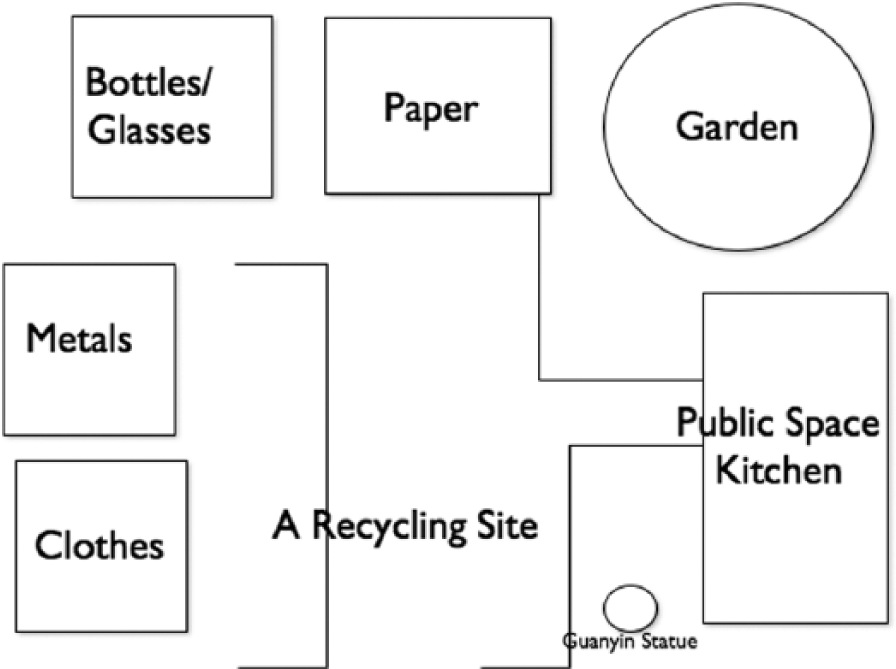
Layout of a recycling site.
The public space and kitchen is the centre of the recycling site. The site then is divided according to the types of items it collects. Normally, there is a large space for paper, including newspapers, magazines and other paper-based items such as bento boxes. There is another space for bottles and glass. Metals such as broken bicycles and electronics are located separately. Used clothes comprise another category. Depending on the size of the recycling site, the number of volunteers also varies. At big sites, there could be several hundred volunteers. Volunteers are usually divided into groups and they go to the site on a rota basis. Each volunteer usually goes to the site twice a week, but some go more frequently. Each site normally divides the day into two shifts of around two hours. Volunteers can choose whether to go in the morning or in the afternoon.
Recycling occupies a unique position in the Tzu-Chi environmental movement, since it is one of the environmental practices with the longest tradition within the organization. Recycling has a double meaning to Tzu-Chi’s members. On the one hand, recycling is argued to be the best way to solve the problem of global climate change due to the greenhouse effect. Scientific knowledge is used to prove that in order to reduce energy consumption a constrained lifestyle is necessary. Recycling is thought of as the core of this lifestyle, in which people should cherish the items they use. On the other hand, recycling has a religious meaning. Recycling helps to blur the social boundaries of gender, occupation, wealth and age, and therefore facilitates group integration.
Recycling is not only an environmental practice for nature but also an environmental practice for your mind. The Master always tells people the great wisdom ‘discipline the mind by doing tasks’. What does this statement mean? That every environmental volunteer, regardless of age, gender or social status, when they get together they aim for one purpose … This is to teach people to forget their social role and to concentrate on cultivating themselves [via recycling].
23
In several examples we found in the periodicals, recycling is viewed by the Tzu-Chi members as a way to practise Buddhism and achieve the status of Bodhisattva. The action of properly recycling is considered sacred and has to be carefully performed. The ritualistic aspect of Tzu-Chi’s recycling practice is shown in several examples. One is that when recycling at the site, volunteers are discouraged from talking to each other. They are encouraged to concentrate on their actions and to appreciate the recycled materials, which give human beings a comfortable life. In Tzu-Chi’s own words, every item has its own life (wuming). People should respect the life of every item no matter how small it is. Recycling in this sense is a collective funeral of used items, but the ceremony gives a new life to these same items. The following example further shows the ritualistic and religious dimension of recycling.
Besides taking care of people’s hearts, Tzu-Chi’s volunteers also embrace environmental protection [recycling] to take care of the Earth. There is a 93-year-old woman from Jilong who woke up when the sky was still dark. She dressed neatly and fastened her urine collection bag to her leg. She said: ‘I begin to chant the name of Buddha (nianfo) and walk around Buddha (raofo) every morning. For me, seeing litter and bowing to pick it up is equal to chanting the name of Buddha. Recycling along every street is equal to walking around Buddha.’
24
Conclusion
In this article, we have examined the environmental discourse and the related practices of Tzu-Chi from a non-member perspective. The results answer several of the questions we asked at the beginning of the article. First, as a Buddhist organization, Tzu-Chi has participated extensively in promoting environmental protection. It not only provides a theoretical background for environmental action, but it also directly involves its organization in environmental practices. Second, Tzu-Chi’s environmental discourse corresponds closely to global environmental trends. We have shown that after 2000, references to global climate change gradually increased in its environmental discourse. We argue that the increase is related to an increase in natural disasters both locally and globally. For example, we find that Hurricane Katrina in 2005 created a new wave of efforts to link past environmental protection practices like recycling to the phenomenon of global climate change. Third, we briefly examined the social organization of Tzu-Chi’s recycling operation and explained how this is systematically organized. This widespread and highly institutionalized recycling operation has made Tzu-Chi’s approach different from other types of religious environmentalism, which normally focus on the cultivation of a harmonious relationship with environment. In contrast, Tzu-Chi’s recycling practice has taken a step further by establishing a strong organizational infrastructure. Finally, we argue that the discourse on climate change and environmental protection has been integrated with recycling so that the practice of recycling has a ritualistic and religious meaning.
In sum, this article is a first attempt to delineate the actual practice of a Buddhist organization facing the crisis of global climate change from a sociological perspective. The findings support the claim that Buddhism has a selective affinity to environmentalism by showing how Tzu-Chi draws on theological teachings such as a belief in interdependent origin for its environmentalism. However, we also find that in order to theorize an ethical solution to climate change, Tzu-Chi returns to the source of traditional Chinese Confucianism and draws on the ethical principles of a disciplined lifestyle.
Footnotes
Funding
This research received no specific grant from any funding agency in the public, commercial or not-for-profit sectors.
Notes
Author biographies
Address: Social Science Building, 1126 East 59th St. Chicago, IL 60637, University of Chicago, USA
Email:
Address: Stanford University (San Francisco), USA
Email: