




Abstract
Increasingly, interreligious encounters occur through internet communication. The debate on the influence of internet communication on interreligious encounters is characterized by a contradiction between the theory of cyber-balkanization on the one hand and the theory of networked religion on the other. However, neither theory is contextualized and neither can therefore explain why an interreligious encounter results in either interreligious conflict or mutual understanding. In this article, a contextualized approach to the implications of internet communication for interreligious relationships is advocated. The authors show that contextualization on the level of the openness of the religious group is too one-dimensional. Therefore, a contextual reception model on the level of the situation is developed to explicate the possible attitudinal and behavioral positions within an online interreligious encounter. This model can be used to investigate the implications of internet communication for interreligious relationships.
Introduction
Pluralization, the process of progressive interaction between different world views and religions, is one of the key characteristics of modern societies. One of the most important vehicles of this process is information technology, which opens up the possibility of communicating with all people in the world that are connected to the internet (e.g. Papacharissi, 2002; Castells, 2007).
In a globalized, pluralist, media-saturated society, encounters between different world views and religions are among the biggest challenges to all types of relationships. Such encounters increasingly take place through internet communication (Boyd, 2008; Rideout et al., 2010; Van de Beemt et al., 2011). Assuming that the features of the medium determine to some extent the social consequences of communication (e.g. McLuhan and Powers, 1989), scholars in the field of media and religion have formulated two contradicting theories that discuss the consequences of internet communication for interreligious communication (Alvstad, 2010; Howard, 2010).
In the theory of networked religion it is assumed that internet communication stimulates the democratization of religious doctrines and weakens religious boundaries (Campbell, 2012; 2013; Castells, 2007). Consequently, it is expected that the dissemination of new media technologies and the assumed increase in interreligious encounters will result in the weakening of religious exclusivism and the upswing of individualistic and relativistic beliefs (Wagner, 2012). On the other hand, the theory of religious cyber-balkanization predicts a different outcome (Alvstad, 2010; Howard, 2010). In line with the argumentation of Sunstein (2007), this theory states that the internet’s ability to adapt itself to the preferences, tastes, and unique profiles of individual users enhances exposure to the individual’s preferred religious opinions. Hence, interreligious interaction is expected to decrease and intra-religious interaction to increase, leading to religious fundamentalism and interreligious polarization (Alvstad, 2010; Howard, 2010).
Although it could be possible that both networked religion and cyber-balkanization will appear in an age of internet communication, it is logically impossible that both will occur at the same time. In this article we argue that both theories fail in their accounts of the social influence of internet communication, due to their deterministic approach to media: the social meaning of internet communication is understood as the result of media efficacies, passing over individual agency and contextual considerations (Couldry, 2012). We will argue that it is more fruitful to investigate the consequences of online interreligious encounters from the perspective of the individual who uses media for particular purposes and gives meaning to online encounters based on contextual considerations. Therefore, we develop a general reception model in which several types of behavioral and attitudinal consequences of online exposure to religious others are described. With this model, it becomes possible to understand how particular contextual features influence the reaction to online interreligious encounters.
In this article, we will first define our two main concepts, interreligious encounter and internet communication. Second, we will discuss the two theories mentioned above, the theory of networked religion and the theory of cyber-balkanization, in more detail. In the next sections, the reception model will be introduced and the urgent importance of using it in research on the implications of internet communication for interreligious encounters will be clarified by an example.
Internet communication and interreligious encounter: a literature review
Concepts
The notion of interreligious encounter presupposes a social theory of groups and individuals that are identified as members or representatives of particular social groups. Individuals belong to all types of social group, including groups that are centered on world views and religions. As a consequence of this social organization a difference exists between the in-group and the out-group. Bourdieu (1977), among others, argued, discussing group membership, that individuals who are socialized in a particular group possess particular internalized social knowledge of the habits and unwritten rules of that group. Bourdieu called this knowledge habitus, which he considered to be a crucial factor in identifying groups and the boundaries and differences between groups.
In terms of communication, group formation is associated with particular forms of communicative interaction, which differ in direction and purpose. In general, messages are communicated differently to the in-group and the out-group, due to differences in background knowledge between in-group and out-group individuals, but also due to different goals of communication (Persson, 2010). Communication within one’s own group usually aims to bond and to define and reproduce the religious identity of the group (Putman, 2007). In contrast, communication with someone from the out-group usually aims to create a bridge between different world views and to represent the in-group on the public stage. However, interreligious encounters may also have an in-group bonding effect, for boundaries between groups need to be described and sustained in the confrontation with other groups (Roeland et al., 2010). Also, bridging is only one possible outcome of interreligious encounters, one that follows an intention to interact with religious others. Encounters may also prompt individuals to negate and distance themselves from religious others.
In this article, we discuss the idea that interreligious encounters might be affected by a relatively new form of communication, namely internet communication. Internet communication can simply be defined as communication through and by use of electronic devices (computers, tablets, smartphones) that offer interactive communication possibilities via platforms such as Facebook, Twitter, Pinterest, and Instagram.
Networked religion
Internet communication has received attention from many scholars in several disciplines, partly because of the expectations with regard to its implications for social interaction – including interreligious interaction. Some predict democratization and increased religious relativism as the main social consequences of the internet (Campbell, 2012; 2013; Wagner, 2012; Castells, 2007). These expectations are based on two arguments.
First, the increased potential for individuals to disseminate messages will expand the opportunities to discuss religious matters with other members of one’s own group without interference from religious authorities (Cheong, 2013; Kyriakopoulou, 2011). Thus, those authorities will lose their monopoly to define religious beliefs; in-group communication will become more diverse and democratic, and less hierarchic. Second, the internet opens up many opportunities for interreligious contact, which will expose individuals to a diversity of religious ideas and offer them many more options for defining their own beliefs and identities (Turner, 2007; Wagner, 2012). As a result, the influence and power of institutionalized religions will wane and be replaced by the authority of the individual, who has to define his or her world view in an ever more multi-sided reality of offline religious institutes and religious repertoires, beliefs, and identities (Campbell, 2012; Wagner, 2012). Online, moreover, the differences and boundaries between groups, and consequently between in-group and out-group, will become blurred.
As Campbell (2012; see also Castells, 2007) points out, the growth of internet communication fits the scholarly assumption of the contemporary religious need to deinstitutionalize religion and to combine different religions traditions (e.g., Campbell, 2008; Giddens, 1991). These expectations are based on the principles of contact theory. The core assumption of contact theory is that living in a pluralized society stimulates intergroup interaction and tolerance (Allport, 1954; Pettigrew, 1998). Empirical research shows that interreligious contacts (even in unfavorable situations) foster mutual understanding, especially because of the shared affections and a feeling of commonness that people experience through interaction (Pettigrew, 1998). 1
Contact theory thus assumes that the individual will be transformed into a more tolerant person through interreligious interaction (Riesman et al., 2001 [1950]) – particularly when interreligious differences are more or less denied and similarities are emphasized. Internet communication will foster such similarities, because the internet will stimulate interreligious interaction and blur group boundaries.
Cyber-balkanization
However, not all scholars share this belief in the democratizing and unifying effects of internet communication (Alvstad, 2010). Some support the theory of cyber-balkanization, in which a completely different scenario is expected, arguing that internet communication fosters religious extremism and interreligious polarization (Howard, 2010; Sunstein, 2007). The argumentation behind this theory is as follows.
Pluralization and mass democratization are undermined by the fragmented nature of internet communication (Papacharissi, 2002). The countless unorganized messages that are emitted cause an information overload for individual users. Therefore, the internet becomes increasingly personalized and individuals select information that is in line with their wishes, preferences, and viewpoints. According to the cyber-balkanization theory, individuals increasingly live in a ‘filter bubble’ characterized by repetitive exposure to their own viewpoints and an absence of interreligious communication (Howard, 2010; Pariser, 2011; Sunstein, 2007). The ultimate result of this filter bubble will be the proliferation of extreme viewpoints and increasing intolerance towards out-groups. Religious polarization, moreover, will be emphasized by the communicative particularities of online communication (Alvstad, 2010; Papacharissi, 2002). Nonverbal messages and immediate feedback are mostly absent from online communication (Persson, 2010). As a consequence, miscommunication will be a common characteristic of internet communication – and therefore present in the online encounters between people from different religious backgrounds (Alvstad, 2010).
According to the religious cyber-balkanization theory, that individuals are generally strongly inclined to discriminate between the in-group and the out-group, and prefer to be exposed to messages of likeminded others (Howard, 2010; Sunstein, 2007). These assumptions about the religious needs of individuals in a pluralistic society are rooted in the conflict paradigm. The conflict paradigm is skeptical about both the reality of intergroup interaction (Merino, 2010; Wessel, 2009) and potential attitudinal changes in tolerance as a result of intergroup interactions (Dixon et al., 2005; Quillian, 1995). The basic assumption of conflict theory is that individuals bases their attitudes towards religious others on the beliefs and opinions of the (religious) reference group the individual identifies with (Blumer, 1958). While pluralization might indeed result in an increasing awareness of religious others, this awareness is mainly accompanied by fear of religious others (Quillian, 1995; Riek et al., 2006). In the interest of defending their own religious identity and protecting their own viewpoints, individuals’ interreligious interaction will be characterized by an emphasis on the differences between religious groups (Stephan et al., 2000; Tilly, 2004). Evidence for this standpoint can be found in empirical studies, in which it is demonstrated that intolerance appears to be positively connected to the perceived threat from other religious groups (Quillian, 1995; Riek et al., 2006).
To conclude: in line with the conflict paradigm, the theory of cyber-balkanization assumes that internet communication results in a preference for in-group communication and an avoidance of out-group communication (Sunstein, 2007), because that is believed to be the general reaction of individuals to a pluralistic environment.
Towards a contextualized approach
While empirical evidence has been found to support both the contact and the conflict paradigm, hardly any empirical research has been done on the consequences of online interreligious encounters – except for the few studies mentioned by Howard (2010) and Alvstad (2010) that offer evidence for both religious cyber-balkanization and networked religion. Moreover, the few studies that prove the existence of networked religion and religious cyber-balkanization lack a good answer to the questions why and in which situations either contact or conflict is fostered.
As we, following Wuthnow (2004), will argue further on, such explanations can be offered when the particular contexts in which either mutual understanding or conflict is triggered are taken into account. Furthermore, both theories share the common assumption of McLuhan and Powers (1989) that the attitudes and behaviors of individuals are determined by the features of the medium. Hence, both the theory of cyber-balkanization and the theory of networked religion assume that individuals use the medium uncritically either by developing their own opinion more extremely or by developing a networked religious identity. However, both Fiske (1989; see also Jenkins, 2006) and Couldry (2012) show that the reception of media is much more complex and contextually embedded than is assumed by the medium-deterministic paradigm. Since human agency is at work and individuals interact with and make choices related to particular contexts, it is not at all certain that potential effects will become real. To understand the consequences of internet communication, a more contextualized approach is therefore needed.
The context of the religious group: doctrine
A first contextual factor that might be of interest with respect to interreligious encounters online is whether the doctrine has an inclusive or exclusive stance with regard to other religions. Especially in the United States, different responses to religious diversity are often explained by the degree of religious exclusivity (Eck, 2003; Keaten and Soukup, 2009; Merino, 2010; Trinitapoli, 2007). Often explained by doctrinal differences (Ellison and Musick, 1993; Merino, 2010; Trinitapoli, 2007), the reaction to interreligious contact is described in the typology of exclusivity, inclusivity and pluralism (Eck, 2003; Hick, 1985; Keaten and Soukup, 2009). This typology is based on the doctrinal axis of openness versus closedness to interreligious exchange and the doctrinal axis of acceptance of just one religious truth versus the acceptance of more than one religious belief (Eck, 2003; Keaten and Soukup, 2009). Both exclusivists and inclusivists are closed to interreligious exchange, but inclusivists believe that all religious doctrines are cultural paths to religious truth, while exclusivists accept just one doctrinal route. On the contrary, pluralists accept just one truth, but are open to interreligious exchange, because the core of their doctrine is that all religions are right ways to approach the common, but unreachable, Real (Hick, 1993; Moyaert, 2011). Therefore, pluralists are convinced that this interaction can enrich their own belief.
Pluralists are often described as ideal-typical partners in the interreligious dialogue, since ‘at the heart of pluralism is … a desire to infuse personal religious experiences with the experiences of religious others’ (Keaten and Soukup, 2009: 180; see also Moyaert, 2011). Although the theological debate on pluralism is characterized by this moral preference for pluralism and often lacks empirical evidence, research within the social sciences shows that people with exclusivist religious beliefs are less accepting of individuals from other religious groups and are indeed more prejudiced in comparison to inclusivists and pluralists (Brown and Brown, 2011; Jung, 2012; Merino, 2010; Trinitapoli, 2007). Compared with mainline Christians, evangelical Christians appear to be more negative toward the existence of other religious groups. Thus, the positive effects of contact as depicted by contact theory do not exist among evangelicals (Brown and Brown, 2011; Jung, 2012).
It is, however, questionable whether the acceptance of different religious groups can be associated with a higher level of tolerance. The identity of a self-defined tolerant group is based on the core doctrine that all religious groups proclaim a valid way of believing (Eck, 2003; Hick, 1985; Keith, 2004). However, the logic of self-identification – that it is possible to define one’s world view only in contrast to ‘deviant’ others – also applies to tolerant groups (Luhmann, 2000). When the acceptance of all religions is the core value, it is logically impossible to accept exclusivist doctrines, because that would undermine one’s own values (D’Costa, 1996; Moyaert, 2011). It is therefore expected that a tolerant world view is intolerant to intolerance and/or exclusivity. Thus, as Mary (2005) and Aupers (2004) conclude, pluralist beliefs and ‘bricolage’ religion do not escape from social group formation or the exclusion of individuals that do not share group norms.
This logic is not challenged by the research mentioned above (e.g., Merino, 2010), because these studies do not measure attitude towards exclusivity at all. The dependent variable ‘response to diversity’ is based on items that measure opinions about religious diversity and about the existence of different religious buildings. It is rather obvious that pluralistically oriented people agree strongly with both items, given that these are their core values. However, initial research indicates that conservative beliefs (which can be viewed as exclusivistic) are not accepted by tolerant people (De Koster et al., 2011). Thus, it appears that pluralists are as exclusivist to the opposite of their core values as exclusivists are (D’Costa, 1996; Moyaert, 2011).
Hence, the question remains why responses to interreligious interactions are so different. Since, as we have discussed above, every religious group is characterized by some degree of exclusivity, the doctrinal stance vis-a-vis exclusivity/inclusivity is not a valid explanation. Some scholars (e.g., Moyaert, 2011) have therefore argued that it is not exclusivity and inclusivity, but openness and closedness to religious others that should be studied as the key doctrinal factor in interreligious dialogue. This approach is, however, equally problematic, since these notions are subject to many different interpretations. In New Age religions, for instance, openness to other religious beliefs is a core doctrine (Aupers, 2004; Aupers and Houtman, 2006; Heelas, 1996). However, religious institutions are rejected and individuals who do not share the opinion that spiritual growth is a fundamental spiritual value are excluded by New Age groups (Aupers, 2004; Heelas, 1996). Being open to religious others might be a key value for New Agers; however, very often, openness has its limits (Versteeg and Roeland, 2011). Moreover, openness is interpreted in many different ways, and as a consequence, different reactions to interreligious interactions can be justified from the same doctrine of openness.
In conclusion, the religious doctrines of a religious group contain elements that foster openness, but also elements that stimulate closedness and even conflict. Therefore, religious doctrine seems not to be decisive for the way believers act in interreligious encounters. Although doctrine may play a role, it is the individual actor who relates to doctrine in his or her actual attitude and reaction to the religious other. The consequences are twofold. On the one hand, the response to interreligious encounters can never be understood on the basis of one’s religious affiliation, since individuals decide to be either open or closed to the religious other on the basis of their own religious doctrine. Second, the response to an interreligious encounter is determined neither by a fixed religious doctrine nor by a fixed idea of a religious individual. The response can differ between different situations and has to be analyzed on the contextual level (De Koster, 2010b; DiMaggio et al., 2001): the particular context of a particular interreligious encounter, in which individual believers negotiate between individual and group identities, and between a more open and a more closed stance towards the religious other.
Contextual reception model
Transformation
Defining a consequence of a social interaction is rather difficult. The construction of an objective scale that measures the change of opinion afterwards might be possible, but it will not provide valid results. Every individual will define an opinion change in a different way, which will make the results incomparable. Besides, numerous other circumstances can influence an opinion change. It is therefore more fruitful and valid to use the cultural assumption that the individual’s reality construction determines reality (Alexander, 2003; Zijderveld, 1988), since from this perspective only the situations individuals define as interreligious encounters will have consequences on their attitudes and reactions to the other participants in the encounter.
To understand the consequences of intergroup encounters, Soren’s (2009) transformation theory is very useful. This theory assumes that every confrontation with something that does not fit one’s own world view, or someone with another world view, will transform the individual in a certain way (Mezirow, 1996). For many individuals, the confrontation with another world view is the starting point for discovering the differences between one’s own perspective and the perspective of the other. Such a confrontation is followed by reflection on one’s own perspective, to acknowledge and probably solve the discrepancy. The result of this reflection is a (sometimes only slight, sometimes more fundamental) change in world view, which incorporates the vision of the other in a certain (not automatically positive) way.
Thus, when an individual becomes involved in an interreligious encounter, (s)he takes a particular attitude to the other and responds in a particular way to the religious other. Dependent on the attitude and behavior of the actors within the encounter, the individual reacts in a dialogical or non-dialogical way. Afterwards, the attitude and reaction of the actors involved will influence the transformation resulting from the interreligious dialogue. To discover this perceived transformation, respondents can be asked to describe the transformation process and change they experienced during and after an interreligious encounter (Soren, 2009).
Attitudinal and behavioral choices
To define the attitude and the reaction to an interreligious encounter, the individual has to make two choices, dependent on the contextual situation. These two choices translate into four possible attitudes, each generating a different reaction and transformation pattern along two axes (see Figure 1 below). One axis represents identification with the world view of one’s religious group versus identification with one’s individual world view. Especially in pluralized and deinstitutionalized societies with waning authority of groups, it is the ‘decision-making power of the individual’ (Christians and Servais, 2005: 275) that matters most in the outcomes of this process and act of identification. Following Giddens (1991), in late modern societies, the self is a reflexive project, i.e., constructed by the individual, rather than inherited. Individuals are confronted with many meaning systems and they have to (and want to) construct their own identity (Gergen, 1991; Laeyendecker, 1988; Warner, 1993). Increasingly, the world view of those individuals who ‘belong’ (and belonging comes in many gradations) to a religious group will not completely converge with the defined doctrines of this group; they rather negotiate between group convictions and personal convictions. Therefore, within every interreligious encounter, the individual has to define whether (s)he identifies with a religious group or with his or her individual world view.
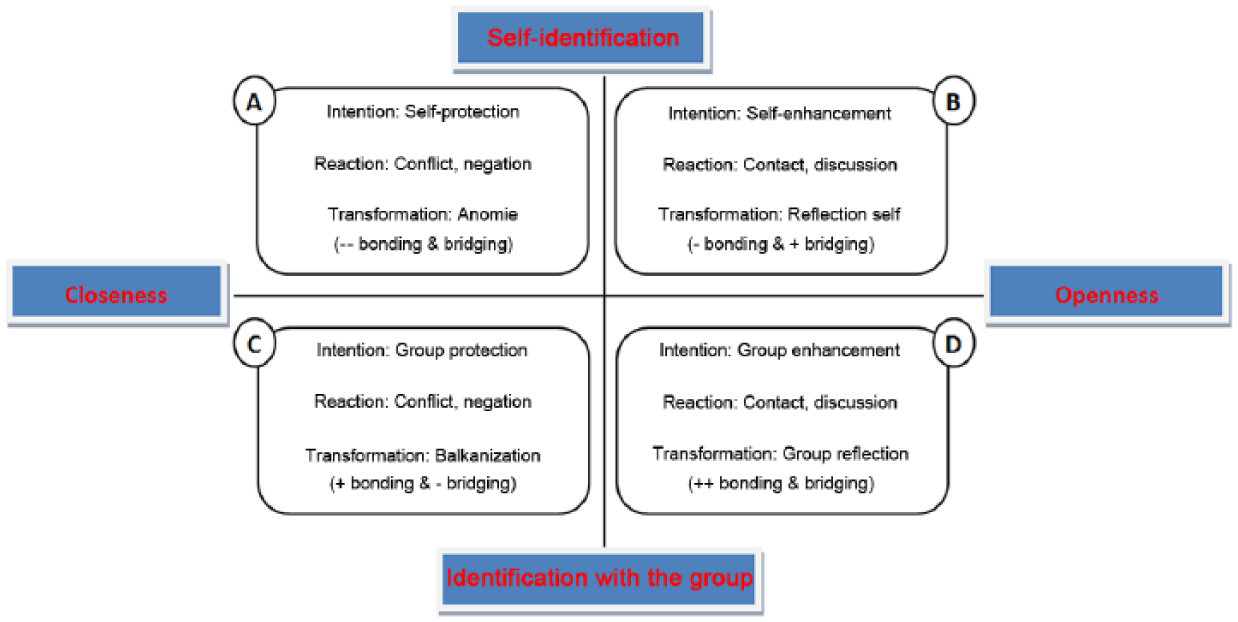
Typology of contextual reception.
The second axis represents the choice for openness or closedness to the religious other – which Saroglou (2002a; 2002b), among others, has shown to be a key factor in the relationship with religious others. Dependent on many possible contextual features of the specific interreligious encounter, individuals decide whether they will emphasize protection of their own (group) identity or openness to the religious other. For example, when a conservative Christian is confronted with a negatively formulated Twitter message about discrimination against homosexuals by Christians, (s)he will probably not react or will answer in a conflict-enhancing way. However, when this person is confronted with the same message sent by a fellow student, (s)he might interact online and explain his/her standpoint in a more understanding interaction.
Crossing both axes produces a scheme with four ideal-typical identification combinations of intentions connected to behavioral actions and attitudinal transformations that can occur in interreligious interaction.
In a specific interreligious encounter, one can feel threatened and disconnected from the doctrine of one’s own religious group. In that case, the individual identifies with his or her own opinion and intends to protect it (ideal type A). This closed individualistic identification will stimulate an assertive or ignoring reaction, which is meant to emphasize interreligious differences and to defend one’s own opinion (Stephan et al., 2000). This interreligious encounter will transform the individual in an anomic way in which both interreligious bridging and intrareligious bonding ties diminish (Putman, 2007). On the one hand, the difference between one’s own religious convictions and those of others will become sharply demarcated and interreligious boundaries will be strengthened. On the other hand, by explicitly diverging from her own religious group, the individual emphasizes disconnection from the group. In conclusion, through this specific interreligious encounter, both bonding with one’s own religious group and bridging with other religious groups decreases.
The ideal-typical B situation occurs when an individual also disconnects from the religious group and identifies with the self, whilst at the same time emphasizing interreligious openness. The individual is interested in the religious other and intends to become self-enhanced through this encounter. Therefore, in this situation the individual reacts by being positively involved in interreligious communication. Because the individual in this case explicitly distances him- or herself from his or her religious group, bonding ties diminish. However, the positive participation in interreligious communication enhances bridging ties and fosters a reflection on one’s own opinion.
Ideal type C occurs when an individual in a specific situation of interreligious encounter identifies with the religious group and feels threatened. In that situation, the individual intends to protect the group and reacts by negating or confronting the religious other. Through this interreligious encounter the individual is transformed into a less interreligiously (bridging) and more intrareligiously (bonding) connected person. The individual looks for protection from her own group and excludes the religious other. Balkanization is the result. As described in the literature of boundary work, group boundaries become particularly salient and differences between the in-group and the out-group are emphasized (Jung, 2012; Tilly, 2004).
In the case that identification with the group is combined with openness to the religious other (ideal type D), the interreligious encounter fosters the reaction of listening to the religious other and/or explaining the opinion of one’s own religious group. In this interreligious encounter, contact with the interreligious other is positively evaluated, because it is thought to enrich the group. The logical transformation is an intensification of the bonding ties, because these interactions affirm the individual’s identification with the group. However, bridging is stimulated as well, since a positive conversation with the religious other forces the individual to reflect on the religious group.
It is important to realize that the different combinations mentioned here are ideal-typical. For that reason, attitudes and reactions will not always be so clearly identifiable. It is, for example, possible for an individual to react ambiguously, e.g., when he identifies with the group but simultaneously disagrees with it. In that case, there will be a transformation of reflections both on the individual’s opinion and on the group’s opinion. However, the most extreme positions are described to make the differences most clear.
The role of internet communication
Above, we argued that the current academic debate on the consequences of interreligious encounters through internet communication needs to be contextualized. As explained, contextualization on the level of the group and even on the level of the individual is too general, which makes contextualization on the level of the situation necessary. Contextualization of the implications of online communication for interreligious relationships assumes that online communication has different consequences for interreligious relationship in different contexts. The contextual reception model developed in this article describes the general attitudinal and behavioral implications that are possible in reaction to online interreligious encounters. However, which implication occurs when, and how the features of internet communication interact with the context, needs explanatory research in specific contexts. Thus, this model does not explain how and why online interreligious interactions have certain implications, but provides a description of the different possible implications of online interreligious encounters, which is crucial to explanatory research using a contextualized approach.
Research based on this contextual reception model can incorporate all types of contexts that may explain the implications of online interreligious encounters, including offline and online situations, prior experiences, and the cultural repertoires the individual is identifying with (e.g. Swidler, 1986).
A good example of research that shows how internet communication has different implications for interreligious relationships, in different contexts, is the study of De Koster (2010a; 2010b) on the meaning conservative (Calvinist) Protestant homosexuals derive from participating in an online conservative Protestant forum for homosexuals. He finds two types of user, which derive different meanings from the forum because of different offline experiences with the acceptance of their homosexuality. Some forum members feel stigmatized in offline life, while others do not. Typically, the members who experience stigmatization in offline life search for empathetic support from the forum and value online group solidarity. However, for the non-stigmatized, the forum is a tool for personal development in being a homosexual Christian. They value openness on the forum. As a result, the stigmatized members emphasize group boundaries and want to forbid the involvement of diverse people – like heterosexuals or people with another opinion – on this forum, while the non-stigmatized favor forum diversity and want to learn from discussions with, for instance, heterosexuals. It appears from this case study that internet communication in the form of forum participation has a unique, but different, meaning for its members due to different offline stigmatization experiences. Moreover, in this situation of discussing their homosexuality online, offline stigmatization is a contextual feature that is important for an understanding of the different ways of dealing with diverse opinions – or intergroup encounters – on the forum.
The contextual reception model can help to interpret the implications of offline stigmatization as a contextual feature for the intergroup relationship between likeminded conservative Christian homosexuals and other groups. In line with ideal type C, offline stigmatized members strongly identify with their own group and regard diverse opinions as threatening because of their need for a closely knit group that provides empathetic support. They intend to protect the group and protest against out-group members. For them, intergroup encounters result in a wish to strengthen bonding ties and diminish bridging ties. On the other hand, members that do not feel stigmatized offline behave as B types in dealing with intergroup encounters. While relating to the forum group, they do not identify exclusively and totally with this group and are open to out-groups. Since they use the forum for the sake of personal development, they prefer discussions with out-groups and use this input for self-reflection.
As this example shows, the developed contextual reception model helps to clarify the basic ways in which individuals deal with online interreligious encounters, while contextually informed theories will explain when and why individuals deal with these encounters in one of these basic ways.
Conclusion
Although the existing literature offers many ideas about the behavioral and attitudinal implications of internet communication for interreligious relationships, the importance of the context is hardly recognized. In this article, the need for a contextualized approach is advocated and demonstrated. Only such an approach can produce a real understanding of the mechanisms at work behind the different implications of internet communication for interreligious relationships. The developed contextual reception model helps us to understand the different implications that are possible at the level of the situation.
Besides using the contextual reception model in future research into the implications of internet communication for interreligious relationships, researchers might also explore further the different aspects of the typology. Questions as to whether and how identification with the group or the self takes place, and how openness and closedness are related to the described intentions, reactions, and attitude transformations, can be investigated more deeply.
Footnotes
Funding
This research received no specific grant from any funding agency in the public, commercial or not-for-profit sectors.
Notes
Author biographies
Address: Centre for Sociological Research, University of Leuven, Parkstraat 45, PO Box 3600, 3000 Leuven, Belgium
Email:
Address: Department of Social and Cultural Anthropology, VU University Amsterdam, 1081 HV Amsterdam, The Netherlands
Email:
Address: Faculty of Theology, VU University Amsterdam, 1081 HV Amsterdam, The Netherlands
Email: