




Abstract
The authors’ purpose is to investigate the relationship between religiosity, authoritarianism, and moral authority by considering religiosity as a multidimensional construct and morality from its sources of influence. Religiosity, authoritarianism, and moral authority scales were applied to a sample of 109 students from one high school and one university college in Semirom city in the province of Isfahan, Iran. Results showed that religious beliefs, feelings and consequences are related to external sources but only religious beliefs and feelings correlate with the principal source of moral authority. Findings also demonstrated a significant relationship between religious consequences and authoritarianism, and that their combination significantly predicts the external source of moral authority. Findings are discussed in relation to previous studies and we argue that previous conclusions about the authoritarian tendency of religious people and their reliance on external sources of moral reasoning are mostly about the religious consequences dimension.
Introduction
Previous studies on the relationship between religiosity, authoritarianism, and morality are inconsistent and many contradictory findings have been reported. In addition, we have limited information on the effect of cultural differences and the content and philosophical foundations of different religions on these associations. Most of the previous studies have focused on Christianity and studies on the relations of these three constructs among Muslim populations are sparse. The emergence of religious extremism derived from radical religious thought considered as authoritarian in nature can readily be seen in some fascist groups, such as the Taliban and Al-Qaida. However, some researchers doubt the generalization of such conclusions on religiosity as a whole. They believe that some dimensions of religiosity, such as intrinsic religiosity, not only do not have an authoritarian nature but also emphasize acceptance of others, forgiveness and care for other people.
Religion is a social institution that dramatically influences individuals’ behaviors and daily actions as well as their social and political orientations. While authoritarianism is an individual attribute related to attitudes, it can influence and shape the social, political, and cultural spheres of the community. The confluence of these two separate constructs, religion and authoritarianism, causes some sociologists to consider them as one phenomenon and as inseparable. Investigating the relationship of authoritarianism, moral authority, and religion is necessary to understand the meaning of actions at the societal level. Such actions needs to be viewed as meaningful and they rely on ideology for that. This raises the question whether or not the meaning religion gives to an action is authoritarian in nature or stems from lower level of reasoning.
Thus, the relationship of religion, authoritarianism, and moral authority is inconsistent and it should be carefully scrutinized before making any conclusions. This study was designed to clarify their relationship by looking at religiosity as a multidimensional construct and considering morality from the ascribed sources of influence during moral judgment in a sample of students with a Muslim family background in Iran.
Background
Religiosity and authoritarianism
Following powerful individuals and satisfying their expectations are traits of authoritarians. Altemeyer (1998) reported that authoritarian people become more religious and less doubtful toward their religion throughout their lives. Furthermore, authoritarians are more willing to fulfil religious requirements like going to church, praying, and reading scripture. Altemeyer interpreted these factors as ‘submission to the family and religious authorities of their life’ (Altemeyer and Hunsberger, 1992). An association between religiosity and authoritarianism has been found by the majority of other studies as well (Ji and Suh, 2008; Altemeyer, 2004; Blogowska and Saroglou, 2011; LaBouff et al., 2010; Laythe et al., 2002; Hunsberger et al., 1999; Mavor et al., 2011; Rowatt et al., 2005; Rowatt et al., 2006; Wink et al., 2007). However, Hunsberger (1991) called these findings ironic since ‘Christian teachings typically portray Jesus of Nazareth as tolerant, forgiving, and preaching a message of universal love – characteristics diametrically opposed to those typical of authoritarians’ (501). Accordingly, Strickland and Shaffer (1971) did not find any relationship between religiosity and authoritarianism. In their study of Muslims in Indonesia, Ji and Ibrahim (2007) also did not find a significant relationship between authoritarianism and religiosity. Kahoe (1974) showed that extrinsic religiosity is related to authoritarianism, but intrinsic religiosity does not have a significant relationship with it. In another study, Kahoe (1977) found that intrinsic religiosity is related to conventionalism and superstition, two aspects of authoritarianism. Petropoulos (1979), in an investigation of Greek Americans, found little support for the relationship of church attendance with intolerance; however, in Petropoulos’s study there was a systematic relationship between Greek Orthodox Church membership and intolerance, members of the Orthodox Church showing greater intolerance.
Ji and Suh (2008) found that a tendency towards intrinsic religiosity has an influence on social conservatism, authoritarian submission, and authoritarian aggression in both American and Korean Christians, and extrinsic religiosity leads to respect for authority figures and authoritarianism. They concluded that ‘authoritarianism is a function of Christian intrinsic and extrinsic religiosity, and this finding is likely to be invariant across American and Asian cultures’ (263). On the other hand, Ji and Suh found that, for Korean Christians, the quest dimension of religiosity (an individual with a quest orientation being characterized by openness, flexibility, questioning or challenging traditional beliefs, and a willingness to face existential questioning of religion) had a significant relationship with social conservatism but not with authoritarian submission or aggression; for Americans, however, quest religiosity obstructed the spread of authoritarianism. They concluded that this cross-cultural incongruity implies that quest religion possibly gets counterbalanced by Asian respect for authority and social order in relation to its adverse effects on authoritarian submission and aggression and that the impact of quest religiosity in Asian cultures is thus not necessarily identical with its weight in the United States. (Ji and Suh, 2008: 263)
From a different view, many studies have reported that religious people are sexist, prejudiced, and ethnocentric and have a negative attitude toward homosexuals and minorities as well as a close identification with the family (Altemeyer, 2004; Altemeyer, 2003; Altemeyer and Hunsberger, 1992; Hunsberger et al., 1999; Rowatt et al., 2006), characteristics that were demonstrated as traits of authoritarian individuals. Rowatt, Franklin, and Cotton (2005: 31) asserted that religious fundamentalism is strongly correlated with authoritarianism and some of the negative attitudes of fundamentalists such as prejudice can be explained by their authoritarianism, so some of the variation in prejudice attributed to religious fundamentalism could be due to authoritarianism or orthodox beliefs’. Blogowska and Saroglou (2011), in an experimental study, showed that religious fundamentalism is related to prosociality toward the in-group and associated with authoritarianism against the out-group through a display of aggression and violence. In Rowatt, Franklin, and Cotton’s (2005) study, religious fundamentalism was highly and positively related to right-wing authoritarianism; moreover, right-wing authoritarianism was positively related to an intrinsic religious orientation but negatively to extrinsic and quest orientations. Blogowska and Saroglou, in their review of the literature, pointed out that the relationship of religious fundamentalism and prejudice was due to authoritarianism, and their findings supported this view.
In their analysis of previous studies, Leak and Randall (1995) reported that the dimension of religiosity and the types of scale used to assess it had a considerable influence on the previous conclusion that religious people have an authoritarian tendency. They found that authoritarianism positively related to a less mature religiosity orientation like Christian Orthodoxy, traditional and spiritual religiosity, religious belief and commitment, practical religiosity, and a lower level of faith, but negatively with mature religiosity like stages 4 and 5 of faith development, and quest religion. In the light of these findings, the relationship between religiosity and authoritarianism needs more clarity and it would be beneficial to look at it by applying a multidimensional perspective of religiosity and taking a different sample from a new culture and religion.
Authoritarianism and morality
The morality of authoritarians values obedience to authority figures and upholds the authority of powerful individuals rather than reliance by individuals on their own thoughts (Van Ijzendoorn, 1989; Crockroft, 1995). Van Ijzendoorn (1989), in reviewing the literature, concluded that authoritarians’ morality is problematic and showed through two empirical studies that authoritarianism has a significant negative relationship with moral judgment and that a higher level of authoritarianism is associated with a lower level of moral reasoning. Later, however, Van Ijzendoorn (1990) did not find a significant relationship between authoritarianism and morality. Napier and Jost (2008) considered four characteristics of authoritarians based on the literature: conventionalism, moral absolutism, obedience to authority, and cynicism; however, they empirically found that authoritarianism was strongly associated with obedience to authority and cynicism only in lower socioeconomic groups.
Thus, it seems that authoritarians rely on authority figures while making decisions and judging moral issues and are not able to attribute their judgment to principle sources of moral authority (fairness and equality) since obeying authority and following the expectations of others fit with their heteronymous morality (Van Ijzendoorn, 1997). From a psychoanalytical point of view, authoritarians are described as having a weak ego, a rigid and external superego, and a strong id. Malfunctioning of the superego implies conventionalism, submission, and aggression, which are characteristics of authoritarians (Adorno et al., 1950). In reviewing the literature, Crockroft (1995) produced some answers to the question why highly authoritarian individuals do not display a higher level of moral reasoning. Crockroft stated that authoritarians have ‘a) acquiescence to authoritarian figures and to social convention; b) lack of creativity; c) rigidness of thinking patterns; d) intolerance for [sic] ambiguity; e) fear of change; and f) desire to maintain the status quo’ (10). Therefore, having an external source of control and being authoritarian would most probably affect the morality of individuals by making them ascribe to an external source of moral judgment.
Religiosity and morality
Generally, the results of studies on religiosity and morality have not been consistent. Some have asserted that religions consist of lessons on moral issues. For instance, Rossano (2008) believed that religion implies moral values and standards and that adherence to them is considered as ‘deliberated moral practice’. From another point of view, Ellis and Peterson (1996) found that even at the societal level, more religious countries have committed fewer immoral actions and crimes than less religious countries, while, in reviewing the literature, they concluded that at the individual level, even religiosity is inversely related to criminal behavior. Consistent with this conclusion, many studies have revealed that there is a significant relationship between religiosity and mature moral reasoning (Rossano, 2008; Scheepers and Van der Slik, 1998; King and Furrow, 2008; Maclean et al., 2004). For instance, in Scheepers and Van der Slik’s (1998) study, religious characteristics (religious beliefs for females and religious beliefs and involvement for males) turn out to be strong predictors of individuals’ moral attitudes. Maclean, Walker, and Matsuba (2004) also found significant positive relationships between religious interest, intrinsic religiosity, and religion quest and moral reasoning. Glover (1997) found a significant positive relationship for moral reasoning only with quest, and not with extrinsic and intrinsic religiosity. In addition, intrinsic religiosity was significantly related to altruism. Saroglou et al. (2005) reported that every psychological theory of religion believes that religiosity contributes to prosociality and altruism. They found that religiosity was negatively related to aggression and personal distress, and positively related to in-group helping, altruism, prosociality, perspective-taking, empathy, and honesty. Thus, some researchers do believe that religiosity, morality, and prosocial behaviors are positively related.
On the other hand, religious people have elsewhere been found to have lower levels of moral reasoning. Glover (1997) showed a significant negative relationship between moral reasoning and religiosity and also stated that morality is independent of extrinsic religiosity. In a survey of Indonesian Moslems, Ji, Ibrahim, and Kim (2009) found that respondents generally had a lower level of principle moral reasoning. Against their expectations, they found that those with intrinsic religiosity are better able to judge on the basis of the principle issues and the post-conventional level of moral judgment while those with extrinsic religiosity tend to use the conventional level. They did not find any relationship between principle moral reasoning and some religious orientations like Orthodoxy and quest religiosity. In short, previous studies have mostly showed that extrinsic and intrinsic religiosity have negative relationships with a higher level of moral reasoning (Sapp and Gladding, 1989; Sapp and Jones, 1986) and asserted that extrinsic and intrinsic religiosity are more strongly related to conformity. This finding is consistent with the conventional level of moral judgment in Kohlberg’s (1986) model of morality. Sapp and his colleagues showed that only quest orientation is related to the principle moral reasoning.
In contrast, some believe that religiosity and morality are unrelated constructs (Kohlberg, 1981), as they are related to two different areas of human beings’ concerns. Kohlberg believed that morality is about interpersonal relationships and applies among individuals whereas religion is about religious authority. In addition, Kohlberg, in a cross-cultural study, found that individuals with different religious beliefs (such as Buddhists, Moslems, Protestants, and Catholics) were not different in level of moral development and concluded that religion is unrelated to morality (cited in Sapp and Jones, 1986).
Summing up the literature on the interrelation of religiosity, authoritarianism and morality, Starks and Robinson (2009) asserted that from the moral cosmology approach, religious people take more communitarian/authoritarian positions on cultural, social and moral issues like sexuality, gender roles, and abortion because of their emphasis on sacred things and a universal, God-centered morality. However, those with quest religious tendencies and modernists take more individualistic/libertarian positions on cultural, social and moral issues on account of their emphasis on individually determined moral codes and fates. To provide empirical evidence for such assertions and to clarify previously contradictory results, the current study considered religiosity from a multidimensional viewpoint and morality in terms of its sources of influence.
Current study
As mentioned earlier, we aim to find out how religiosity, authoritarianism, and moral authority are related if religiosity is considered as a multidimensional construct and morality is assessed in terms of its sources of influence. To expand our understanding of their interrelation, this study evaluated how religious beliefs, feelings, and consequences are related to external, principle, and self-interest sources of moral judgment.
We take Glock and Stark’s (1965) multidimensional approach to religiosity, which classified individuals’ religiosity along three dimensions: religious beliefs, feelings, and consequences. They believed that religious beliefs are the ideological dimension of religiosity, which followers of the religion are expected to hold; religious feelings are experiences that individuals feel with divine essence and are about their spiritual communication with the divine essence; religious consequences are the effect of the followers’ religious beliefs on society and everyday matters (Glock and Stark, 1965).
It seems that religiosity is more related to sources of moral authority than to moral reasoning alone, since religiosity is more an authority-related issue. Therefore, it seemed that taking a more authority-related approach to morality would clarify the relation of religiosity with morality. Moral authority theory, which is a psychodynamic approach to morality, was reformulated by Henry (1983), who emphasized the content of moral reasoning rather than its form. Content of morality refers to the sources of individuals’ moral judgment, meaning that the question ‘who or what’ is more commonly used to judge moral or social issues. In fact, Henry proposed that it is the ascribed sources of influence that shape morality. As Freud (1974) had previously pointed out, parents have the most powerful impact on individuals’ moral development, while other authority figures, like educators, who earn individuals’ admiration are chosen as role models, can influence individuals’ morality during development, and may even take the place of parents as moral guides.
Thus, this study will examine the relationship of religiosity dimensions with authoritarianism and moral authority, to examine whether religiosity and authoritarianism are able to predict the reference of individuals to different sources of moral authority.
Method
Participants
The participants in this study comprised 109 students, of whom 50 were male, 57 were female, and 2 did not specify their gender, in the age range 15 to 24 (M = 19.95, SD = 1.88), recruited from one high school and one university college in Semirom city, Isfahan, Iran. Since university facilities are widely spread around the country and most of the population, from whatever social class, has access to university-level education, it was thought that the student sample would be representative of the different social classes in Semirom city. All the participants came from Muslim family backgrounds. Subjects anonymously completed a packet of questionnaires – including Moral Authority Scale-Revised (MAS-R), Authoritarianism Scale, and Religiosity Scale – besides demographic information.
Instruments
Religiosity Scale
The multidimensional scale of religiosity of Glock and Stark (1965) was used to capture individuals’ religious beliefs, feelings, and consequences. Serajzadeh (2002) translated the Religiosity Scale into Persian and validated it in order to provide a scale based on Islamic practices and construct a Religiosity Scale for Iranian society. Religious belief comprises a set of beliefs about the existence of God, the Devil, angels, the Day of Judgment, and the Koran, the holy book of Muslims (e.g. ‘I am not sure yet that God really exists’ and ‘The Koran is God’s word and everything it says is true’). Religious feeling refers to emotions related to a religious view, such as not being afraid of death, the fear of God, or the feeling of approaching God (e.g. ‘Sometimes I feel fear of God’ and ‘One who believes in God is never afraid of death’). Religious consequences are about the imposition of Islamic rules in society. Specifically, they measure the opinion of individuals about issues prescribed or proscribed by Islam and their consequences on society. Religious consequences refer to the extent to which individuals insist on having an Islamic leader, conforming to dress codes, avoiding alcoholic drinks, and so on (e.g. ‘It seems that most Islamic laws are not applicable in modern society’, and ‘Political leaders should be experts, whether they are Muslim or not’).
The validity of the scale was confirmed by experts and criterion validity was also obtained by the significant association of this scale with self-evaluation of individuals about their religiosity (r = .61) (Serajzadeh, 2002). Cronbach’s alpha of .72 to .83 for different dimensions and test-retest reliability of .80 were also reported by Serajzadeh. All questions were answered in terms of Likert scales ranging from 1 (strongly disagree) to 5 (strongly agree).
Authoritarianism Scale
Heydari et al. (2012) developed and validated a 12-item scale for measuring authoritarianism in Iran (see appendix). Items were chosen from valid scales of authoritarianism, especially from the three dimensions (authoritarian submission, authoritarian aggression, and conservatism) of the Right Wing Authoritarianism scale of Altemeyer (1998) and the F-Personality scale of Adorno et al. (1950). Considering the socio-cultural and political spheres of Iran, Heydari et al. (2012) chose items that have no bias for participants. Answers to five questions were in 5-point Likert-type scales from 1 (strongly disagree) to 5 (strongly agree). Higher scores indicated higher authoritarian tendencies of the individuals. Five criminology and sociology experts confirmed the face validity of the scale and internal reliability of .83 was also obtained (Heydari et al., 2012). In addition, the scale was shown to have significant relationships with external source of moral reasoning (Teymoori et al., 2012), perceived parental control (Heydari et al., 2013), ethnocentrism (Heydari et al., in press), and anomie and socioeconomic status (Heydari et al., 2012), which is consistent with the literature and confirms the content validity of the scale.
Moral Authority Scale (MAS-R)
To reveal the relationship of morality with religiosity and authoritarianism, it was thought that attribution to different sources of moral influence during moral decision making would give more reliable and valuable results than scales that just assess the cognitive process. Based on the psychodynamic perspective of morality of Henry (1983), White (1996; 1997) developed the MAS-R, which assesses individuals’ attributions of moral authority to different sources. The MAS-R captures information about ‘who or what’ and to what extent different sources have influence on moral judgment. Individuals refer to those sources that have the most effect on their thinking and differences in attribution can be attributed to the process of individuals’ development and their socialization process. The MAS-R comprises six socio-moral questions, which should be answered ‘yes,’ ‘no,’ or ‘can’t decide.’ For each question, subjects have to rate the influence of each of five sources (family, media and educators, social welfare, equality, and self-interest) on their judgment on a 10-point Likert-format scale from 0 (no influence) to 10 (a powerful influence). The score for each of the moral authority sources across all of the six moral questions is summed and the total score for each represents the individual’s attribution to that source; higher scores indicate stronger attribution to that source of moral authority. Finally, due to the sources’ inter-correlation, scores for the family and media and educators were summed to form external sources of ascribed moral authority, and the social welfare and equality scores were summed to form the principle source of moral authority (Teymoori and Shahrazad, 2012; White, 2000).
The MAS-R has test-retest reliability for the subscales ranging from .75 to .93 (self-interest = .88, family = .93, media and educators = .93, social welfare = .75, equality = .82) over a period of four weeks and very high internal consistencies, ranging from .95 to .98 (White, 1997). The MAS-R showed convergent and discriminant validity. White (1997) reported both discriminant and convergent validity for MAS_R.
The Persian Moral Authority Scale was validated by Teymoori et al. (2011), who reported the internal consistency of the source as follows: family = .71, media and educators = .68, social welfare = .59, equality = .72, self-interest = .58. Another indication of the reliability of the scale was the same pattern of sources’ inter-correlation with the original scale in English (Teymoori et al., 2011). All of the sources were positively and significantly correlated. As with the original scale in English, Teymoori and Shahrazad (2012) found that the highest significant correlation was between the social welfare and equality sources of moral judgment (r = .68, p < .001), which, when combined, form the principle source of morality. They found that the next highest correlation was between the family and media and educators sources (r = .59, p < .001), which comprises the external source of moral authority. This consistency in the correlation of sources with the original work of White implies a good internal consistency of the MAS-R in the Persian language.
Criterion validity was also obtained when significant relationships were found between self-efficacy and principle source of moral judgment; between authoritarianism and external sources of moral authority; and between the sources of moral authority and both empathic concern and attachment security (Teymoori and Shahrazad, 2012).
Results
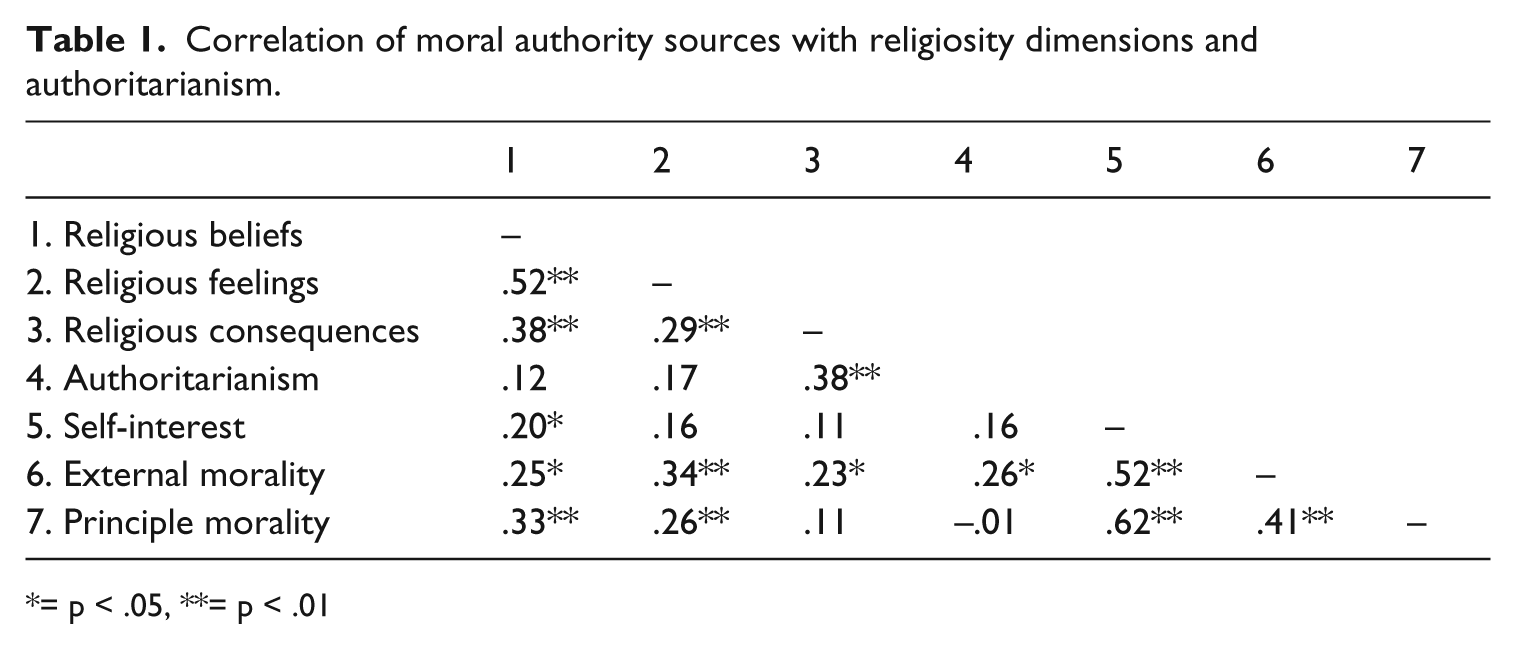
To test the hypotheses, Pearson correlation between religiosity, authoritarianism and moral authority sources was calculated (Table 1). Religious beliefs and feelings had a significant correlation with both external and principle sources of moral authority (Religious belief: r = 25, p < .05, r = .33 p < .01 for external and principle source, respectively; Religious feeling: r = 34, p < .01, r = .26, p < .01 for external and principle sources, respectively) and they did not have significant correlation with authoritarianism. In addition, religious belief had a significant relationship with the self-interest source, r = .20, p < .05. However, religious consequences had a significant relationship with the external sources of moral authority, r = 23, p < .05 but did not have a significant association with the principle and self-interest sources. Another noteworthy finding is the significant association of authoritarianism only with the external sources of moral authority, r = .26, p < .05. Finally, authoritarianism had a higly significant relationship with religious consequences, r = .38, p < .01.
Correlation of moral authority sources with religiosity dimensions and authoritarianism.
*= p < .05, **= p < .01
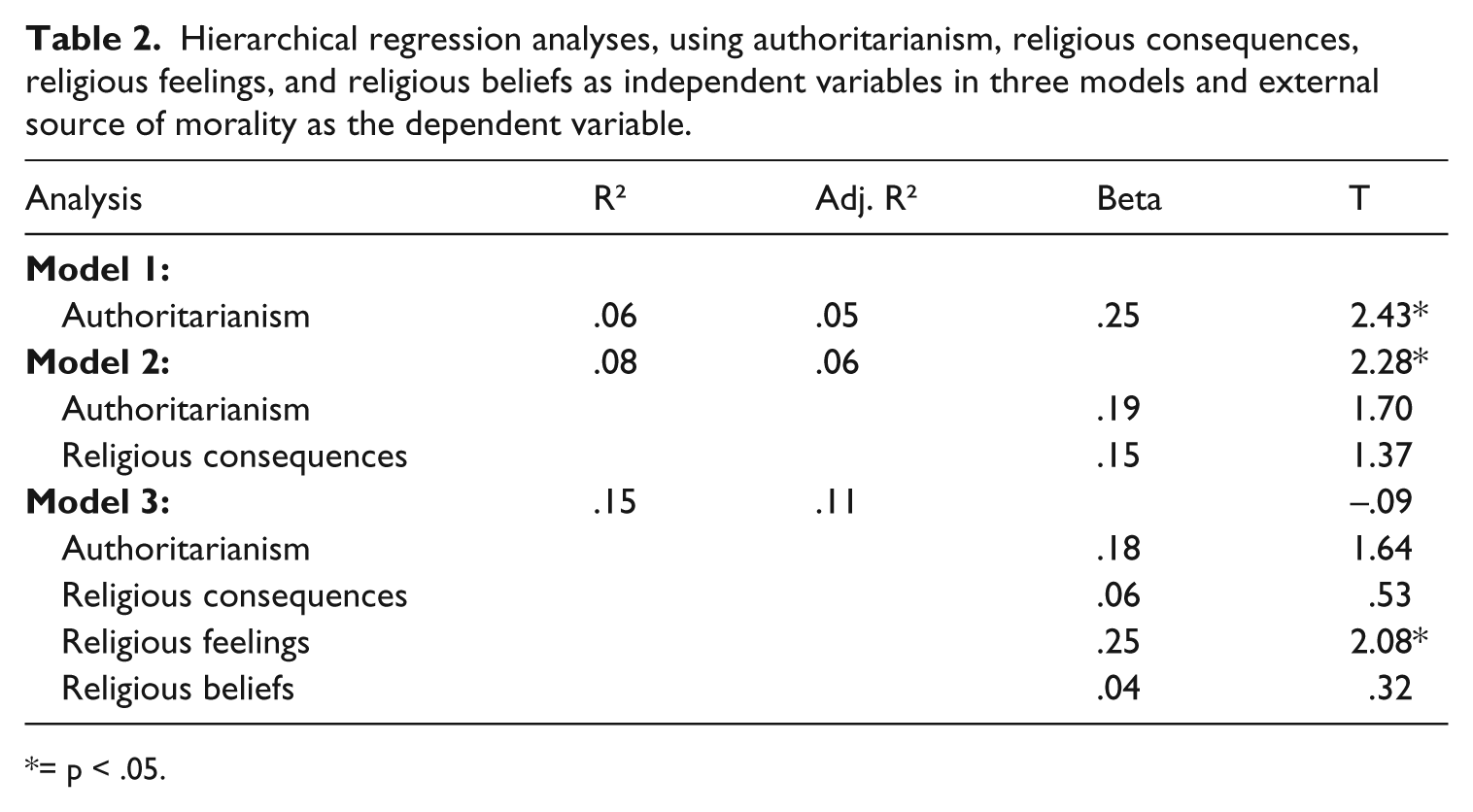
Thus, significant interrelation was found between authoritarianism, religious consequences, and external sources of moral authority. Furthermore, all the religiosity subscales and authoritarianism correlated with external sources of morality. To determine the combined effect of authoritarianism and religiosity, and the unique effect of each variable on variation in external source of moral authority, hierarchical regression analysis was used. ‘External source of moral authority’ was entered as the dependent variable; as independent variables, authoritarianism was entered in the first model, ‘religious consequences’ in the second model, and religious feelings and religious beliefs in the third model. As Table 2 shows, all three models were significant. In the first model, when authoritarianism was regressed on external source of moral authority, a significant result was obtained, R2 = .06, indicating authoritarianism predicted 6% of external source variance and had a significant effect on moral authority, B = .89, β = .25, t = 2.43, p < .05.
Hierarchical regression analyses, using authoritarianism, religious consequences, religious feelings, and religious beliefs as independent variables in three models and external source of morality as the dependent variable.
*= p < .05.
The second model was also significant, R2 = .08. The combined effect of authoritarianism and religious consequences could predict 8% of ascribed external source of moral authority variance, B =32.05, t = 2.28, p < .05. This showed that individuals who are authoritarian and also have high religious consequences scores ascribe their moral judgment more to external sources; however, none of the variables contributed uniquely to ascribed external source, which meant that they predicted the external source only in combination. The final model was also significant, R2 = .15. The combined effect of authoritarianism, religious consequences, religious feelings, and religious beliefs on external source was not significant. In the third model, only religious feelings accounted for a significant variance of external source individually, B = 1.46, β = .25, t = 2.08, p < .05, while the separate effects of the authoritarianism, religious consequences, and religious beliefs were not significant.
Discussion
The purpose of this study was to examine the relationship between three dimensions of religiosity, authoritarianism, and sources of moral authority, as authority plays an important role in all of these three variables. It was found that all three dimensions of religiosity are related to external sources of moral authority and two religious dimensions (religious beliefs and feelings) are related to principle source of moral authority as well. In addition to their relationship with authoritarianism, religious consequences have a significant relationship with external sources of moral authority, while they are not significantly related to principle or self-interest sources.
The significant relationship between authoritarianism and external sources of moral authority (family, and media and educators) and the lack of relationship between authoritarianism and principle and self-interest sources was in accordance with the Van Ijzendoorn (1989) and Crockroft (1995) statements that authoritarians follow the authorities’ expectations even when it means sacrificing their own interest. The result was in harmony with the finding of Napier and Jost (2008), who found that obedience to authority (as a characteristic of seeking an external source of moral authority) is significantly related to authoritarianism. They proposed that moral absolutism is a characteristic of authoritarians, but they did not find empirical evidence for this among the working class.
It could be concluded that authoritarians rely on an external source of moral authority when they make a moral decision; however, White (1996; 2000) and Henry (1983) emphasized that the sources simply refer to differences in the content of moral authority and they have no priority over each other. The conclusion reached by Van IJzendoorn (1997; 1989) about the problematic morality of authoritarian people might have more to do with the form of moral reasoning than its content. However, moral reasoning tends to increase the individual’s effective functioning by finding a balance between individual and social welfare (principle morality). Ascribing to principle source of moral authority during moral judgment seems to make more desirable outcomes relative to self-interest and external sources of moral authority.
Also noteworthy were the relationship between religious consequences and external sources of moral authority, and the lack of relationship between religious consequences and principle and self-interest sources. This is consistent with the findings of some previous studies that religious people have a lower level of moral reasoning (Glover, 1997; Ji et al., 2009; Sapp and Gladding, 1989; Sapp and Jones, 1986). For instance, Ji, Ibrahm, and Kim (2009) stated that Muslim Indonesian respondents generally have lower level of moral reasoning and a lower level of principle moral judgment. In opposition to their finding, the current study found a significant association of religious beliefs and religious feelings with principle source of moral authority in addition to their relationship with external sources of morality. This result confirms Hunsberger’s (1991) and Rossano’s (2008) conclusion that religion has always been about conveying messages encouraging prosocial behavior, empathy, tolerance and respect for others. Some others have pointed to the relationship of religion with mature moral judgment (King and Furrow, 2008; Scheepers and Van der Slik, 1998; Maclean et al., 2004). However, these inconsistencies among previous studies can be explained by the types of religiosity scales that have been used and the aspects of religiosity that have been looked at by different researchers, as Leak and Randall (1995) have pointed out.
The significant relationship between religious consequences and authoritarianism is consistent with the majority of previous studies, which have found a significant association of religiosity with authoritarianism (Ji and Suh, 2008; Altemeyer, 2004; Blogowska and Saroglou, 2011; LaBouff et al., 2010; Laythe et al., 2002; Hunsberger et al., 1999; Mavor et al., 2011; Rowatt et al., 2005; Rowatt et al., 2006; Wink et al., 2007). Ji and Suh (2008) asserted that there were invariant relationships of both intrinsic and extrinsic religiosity and authoritarianism across cultures. This seems to be concordant with the current study’s finding that there is a significant association of religious consequence with authoritarianism; however, religious feelings and religious beliefs have no significant relationship with authoritarianism, implying that some aspects of religiosity are independent of authoritarianism.
Interestingly, the combination of authoritarianism and religious consequences significantly predicted external sources. This was further evidence that there is an interrelation and interdependence between authoritarianism and religious consequences. To clarify this evidence, the combination of religious beliefs, religious feelings, religious consequence, and authoritarianism did not significantly predict ascribed external sources of moral authority. The religious consequence dimension is about the imposition of ideology on others, aggression towards out-group and submission to in-group members, and when these attitudes are coupled with high authoritarianism, individuals rely on external sources of moral authority.
It can be concluded that there is a stereotype about the relationship between religion and authoritarianism, which considers religious people more authoritarian, whereas the present study shows that this relationship is not necessarily true. Authoritarian beliefs may be held by religious and non-religious people alike. For instance, many Orthodox Marxists support authoritarian movements while holding no specific religious beliefs. What can be concluded here is that it is not the religiosity itself but the dogmatism in any ideology, whether the ideology is religious or not, that may relate to authoritarianism. It may be better to look at authoritarianism as a personality type or an attitudinal trait that is not necessarily associated with religiosity, and at fundamentalist and dogmatic forms of religion, or any other ideology, as revealing signs of authoritarianism.
Finally, these findings have philosophical and political implications as well. The confluence of religion and authoritarianism has a long history; however, some intellectuals tend to treat them as one phenomenon. Anti-religious attitudes can be just as authoritarian as the rejection of minorities or any other groups. We believe that authoritarianism is a tendency that can creep into any ideology, thought, belief, or religion. The underlying issue here is the authoritarian interpretation of ideologies, thoughts, and religions. Not all religious tendencies can be seen in a unidirectional relationship to authoritarianism. For instance, Iranian Sufism and Mysticism are based on tolerance and love of other human beings. Sufism is a form of religious practice but is not necessarily authoritarian. Thus, it should be noted that authoritarianism can dominate any ideology and attitude, casting socio-democrats as fascists, socialists as Stalinists, liberals as McCarthyists, Muslims as Taliban, etc. Here, it is authoritarianism that is the constant underlying all these different materialistic and non-materialistic ideologies.
Footnotes
Appendix
Funding
This research received no specific grant from any funding agency in the public, commercial or not-for-profit sectors.
Author biographies
Address: Research Student Space, Gordon Greenwood Building, University of Queensland, St Lucia, 4072, QLD, Australia
Email:
Address: School of Sociology, Faculty of Communication and Social Science, Allame Tabatabaei University of Tehran, Golnabi St., Zarabkhane, Shariati St., Tehran 1544915113, Iran
Email:
Address: School of Sociology, Yasouj University, Artesh St., Yasouj 75914, Iran
Email: