




Abstract
Historically, the Chilean evangelical Churches belonged to a marginal religious category, discriminated against by the dominant Catholic culture. Nevertheless, during the last 20 years, new generations of believers are challenging the authorities and traditional power relations in their Churches, elaborating new forms of civil participation and changing the previous evangelical identity. The higher levels of education and living standards allow the religious youth to question their pastors’ power and to form more secular relations with national politics and society. This could be leading to a clash between the new generations of evangelicals with a university education and the established Church authorities, producing more diversity within evangelical religiosity, conflicts inside the communities, and/or ‘extra-ecclesial’ forms of the religious manifestations: inter-denominational movements, research centers, non-governmental organizations, websites. From another perspective, higher education and relative secularization are helping to liberate young evangelicals from marginality and include them in society, with the same socio-political status as Catholic and agnostic Chileans.
Introduction
For many years, Chilean evangelicals constituted a ‘handicapped citizenship’ that had low social recognition. Their religion was associated with poverty, lack of culture, and ethical and political conservativeness. Being rejected by the dominant religion and culture, evangelicals created an alternative religious subculture and values, which, following the classic study of Lalive d’Épinay (1968), became known as the ‘refuge of the masses’. Their ‘social strike’ turned them away from political and national issues.
We define this religious attitude as ‘cultural citizenship’. This concept is related to the increased cultural and religious pluralism after the fall of the Berlin Wall and the extension of the debates on the correlation of universal (political, economic) and collective (cultural, social) rights in the context of the growing struggle for status and recognition of various social movements (ethnic groups, women, religious communities, sexual minorities). From the 1990s, it became evident that the traditional concepts of citizenship, which focused on juridical, economic, political, and social aspects, were becoming insufficient and discriminatory by not considering individuals’ symbolic or cultural identity, which could lead to a better integration of minorities into society. Developing this idea, Stevenson (2003: 333–334) suggested that these rights go beyond the right to welfare protection, political representation or civil justice and focus on the right to propagate a cultural identity or lifestyle … Cultural citizenship needs to be able to define new forms of ‘inclusive’ public space so that ‘minorities’ are able to make themselves and their social struggles visible and open the possibility of dialogic engagement … [So], issues of inclusion and exclusion are the heart of notions of cultural citizenship.
On the other hand, for Rosaldo (2006: 260) the main requirement of cultural citizenship is the demand for respect: ‘Cultural citizenship attends not only to dominant exclusions and marginalizations, but also to subordinate aspirations for and definitions of enfranchisement … The universality of cultural citizenship aspirations most probably reflects the historical experience of civil rights and suffrage struggles’. The term has to do with ‘the needs to be visible, to be heard, and to belong’.
In fact, these evangelical communities are part of Chilean society, and the problems that matter to Chileans in general and the divisions that separate them are also experienced by evangelicals. Therefore, we affirm that the main changes that have marked Chilean society during the last 20 years also affected the evangelical population. Indeed, the significant improvement in living standards, decreased poverty, general acceptance of democracy, changes in consumer patterns, and massive access to cultural goods (book fairs, access to the internet and to movies, and electronic methods of communication) have changed in an important way the whole of Chilean society, regardless of the creed followed by one person or another.
On the other hand, an important socio-cultural process is taking place in Chile: nearly 70% of undergraduate university students are the first generation of their families to attain this educational level. This means that within a few years there will be a citizenship whose culture, mentality, and social expectations will be completely different from those that prevail in present day society. This phenomenon can be compared to the period in the 1960s in developed societies, when the halcyon years of peace and prosperity generated a well educated and post-materially oriented generation. The civic and political aspirations of this generation, and the demands they gave rise to, transcended the materialist values and aspirations of the war generation and proved increasingly difficult to satisfy. The new aspirations concern freedom of choice, personal development and quality of life. They are often articulated in the language of citizens’ rights though they transcend the traditional repertoires of state-guaranteed social welfare rights. (Pakulski, 1997: 79)
The subject of study of this article is Chilean evangelical youth. 1 We chose this category of the population because in this sector the changes in socio-cultural and educational level take place in parallel with changes in the evangelical community in Chile in general, which is improving its juridical-social status and extending its presence in the public sphere. This phenomenon could imply remarkable transformations in the theology of different evangelical sectors as well as the way they relate to society and build the power relationships within the Churches. As well as through new post-material expectations, the new evangelical generations are reconsidering their concept of citizenship as they become more integrated into the country’s political and social life. Therefore, the objectives of this article are: to establish whether social, political, and value similarities or differences exist between various generations of evangelicals; to establish how changes in education and preferences affect the traditional power relationships in Churches; and finally, to find out to what extent the cultural transformations of evangelical youth are likely to realign this religious segment in Chilean society, giving them greater recognition and inclusion.
The data for the analysis and evaluation of these changes derive from a FONDECYT project, ‘Chilean evangelicals: participation and citizenship’, which conducted a survey among evangelicals between November 2007 and January 2008. The analysis of the survey results was conducted by researchers of the Institute for Advanced Studies (University of Santiago de Chile). 2
New evangelical generations: cultural changes
The results of the survey caused more surprises than expected. Contrary to what was predicted, we found that since 1990 there have been no major changes in the financial situation of evangelicals: this sector of the population has remained mostly poor – 50.6% of those surveyed claimed that they had a low income (less than 50% of the average income), while 46% had a medium income (between 50% and 110% of the average), and only 3.7% had a high income (more than 110% of the average) – which more or less tallies with the results of surveys in previous decades (Fontaine and Beyer, 1991). However, it is essential to keep in mind the deep changes in the nature of poverty that took place in this period. Being poor in 1990 is not the same as in 2008, because due to the country’s economic stability and progress, and to the political and social dynamics, the living standards and purchasing power of the poor were increased and/or changed significantly.
The data from the survey showed a greater recognition of evangelicals by society in general. This trend is verified by the replies to the question of whether the faith of evangelical believers had been the result of ‘family tradition,’ ‘the grace of the Lord,’ or ‘personal experience.’ We find it very important that even though 42% replied that they were evangelicals due to personal experience, and 35.5% were converted ‘by the grace of the Lord,’ more than 22% were evangelicals ‘by family tradition.’ The number of evangelicals born to families that follow that creed increases if we break down the replies by age. Among those aged 15–29, 31.5% of believers derived their faith from evangelical family tradition (they were the second or third generation of believers), while a large majority of older adults belonged to the first generation (42.6% were converted through personal experience and for 44.3% their faith was the result of ‘the grace of the Lord.’
These figures mean that believers due to ‘family tradition’ continue the spiritual legacy of their parents, because they feel inserted in society and do not see any contradiction between being evangelical and being Chilean citizens. That is, from being ‘handicapped citizens’ (van Oenen, 2002), professional and university evangelicals are joining the category of citizens with full political, economic, social, and cultural rights.
A notable and radical change in terms of socio-cultural evolution has occurred on the educational level. To measure the educational transformations we took as our reference the research done in 1990/1991 by the Center for Pubic Studies (CEP). We are aware that the CEP study and the present study are not quite comparable. The research settings of the two studies were different: in 1990/1991 a CEP-ADIMARK questionnaire was circulated among the population of the main urban centers of Chile, regardless of religion (Fontaine and Beyer, 1991: 75). On the other hand, the present survey took place among the purely evangelical population in both urban and rural zones. Therefore, to make comparisons possible, we had to make use of the common denominator of the two studies: urban observant evangelicals.
The comparison between the 1990/1991 CEP study and the 2008 survey gave the following results. The number of urban observant evangelicals with a high school education increased from 40.4% in 1990 to 49% in 2008, while the number of believers with only elementary education decreased from 55.1% to 17.5%. At the same time, the percentage of urban observant evangelicals who have or had professional or university education increased substantially from 4.5% in 1990 to 33.4% in 2008. That is, one-third of urban observant evangelicals (33.9%) had higher education (Table 1). According to the 2008 data, among nonobservant evangelicals the percentage of university students/professionals is even higher and reaches almost 40%. Therefore, there is a trend toward an association between a higher educational level and the fact of being nonobservant. This leads to the following interpretation: as urban evangelicals increase their socioeconomic status and their educational level they tend to stop being observant and become less religious and more ‘cultural’ evangelicals. 3
Educational level of urban observant evangelicals.
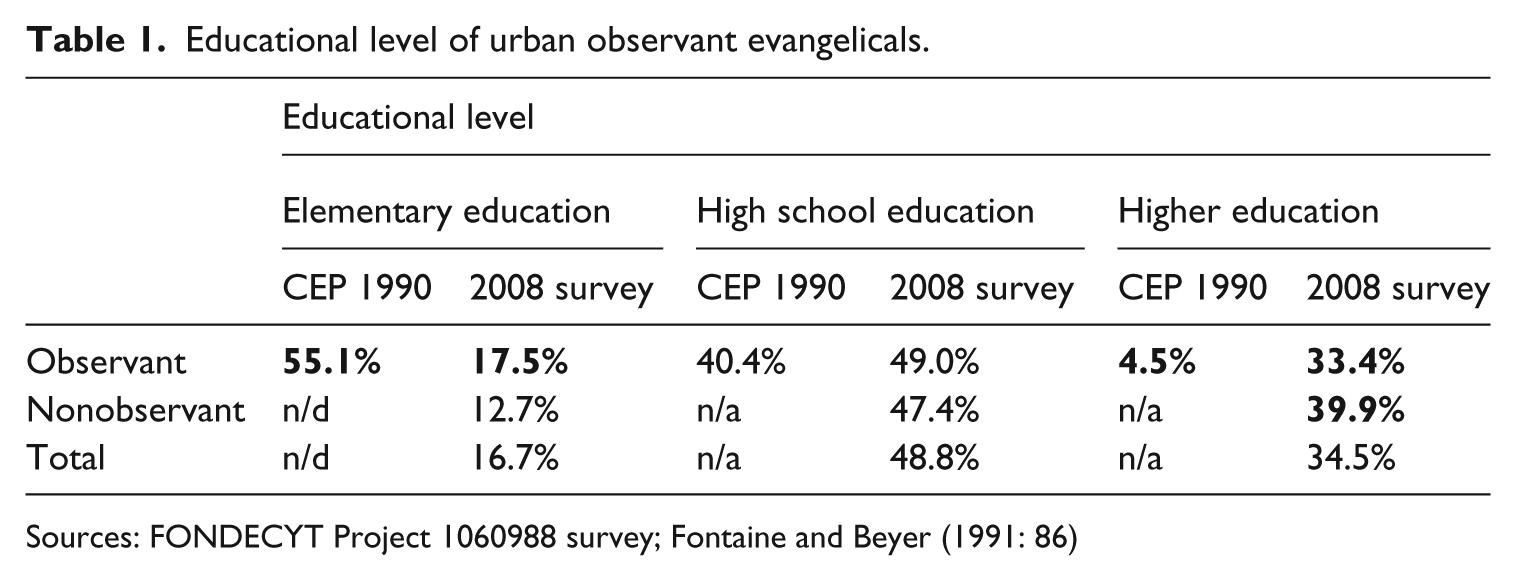
Sources: FONDECYT Project 1060988 survey; Fontaine and Beyer (1991: 86)
These figures mean that more than one-third of students who are observant evangelicals and 40% of those who are nonobservant represent the first generation with university or professional education in their families (in agreement with the national trend). Clearly, the process of democratization and the increase in access to universities has opened the possibility for the lower income sectors to increase their social mobility. This trend allows us to visualize the important changes in the process of human capital formation in Chile, and the creation of a new profile, new needs, and high political and socio-cultural expectations for the evangelical population, whose social status is increasing rapidly and for the first time in their family history.
Another important trend is that of age/educational level correspondence: the 2008 survey shows that as the age of evangelicals decreases, their educational level increases (Table 2). The number of people under 30 years old with access to university education is significantly greater than that of their parents’ or grandparents’ generation.
Educational strata by age.
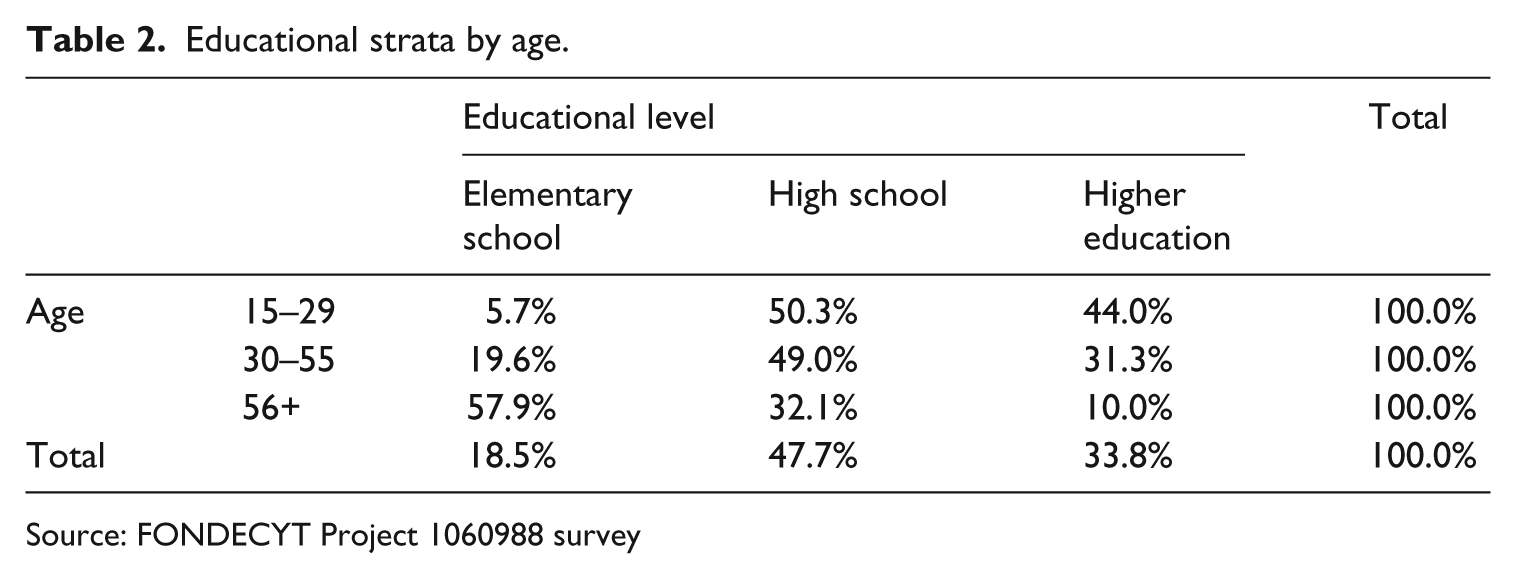
Source: FONDECYT Project 1060988 survey
These data can be interpreted from a double standpoint. On the one hand, the increasing university-educated population among evangelicals allows the assumption that in the near future this category of Chileans will have greater labor mobility and better possibilities for receiving recognition and insertion into society. On the other hand, this optimistic perspective will depend largely on the success of Chile’s economy and its political-social modernization. If the Chilean socio-economic model is unable to correspond to the expectations of new professionals (regardless of their system of beliefs), it will cause frustration, estrangement from society, and questioning of the country’s political-social model.
Does this educational leap among evangelical youth point to the existence of fundamental differences in political behavior and value systems between the different generations? Can the difference in educational level between today’s youth and church leaders affect the power structure within the Churches? These questions are meaningful in particular if we are dealing with the institutionalized Pentecostal Churches, historically very hierarchical, where the pastors not only held unquestionable authority over the faithful, but also were strongly opposed to the introduction of studies and educated culture into their community.
Ethical norms: Is there a generational difference?
The focus groups and our interviews of church leaders showed us that the topics of greatest concern to evangelicals are those related to values (divorce, abortion, sexual habits of the young), as well as those that have to do with their quality of life (delinquency, poverty, addiction). Our interviewees expressed their concern for the growing moral relativism of Chilean society, for the extension of the rights of sexual minorities, and for the increasing use of contraceptive measures. For them, increasing ethical relativism is a ‘disease’ of Chilean society and the ‘negative side’ of democracy. However, differentiation of the surveys by age and educational level shows clear differences in values, which shift from one generation to the next.
As to the general perception of the Law on Divorce, the evangelicals who reject it are slightly more than those that are in favor of it: 40.7% are in disagreement with this law, while 36.9% partially agree or fully agree with it. Those aged 15–29 tend to support the law: 39.4% are in favor of it, while 21% disagree with it, and the greatest rejection is expressed by adults between 30 and 44 years old. This can be explained by the fact that young people are generally opposed to the ‘culture of old people’ and therefore they support the Law on Divorce as a way of challenging that culture. However, as they get older, the need to establish a family and the expectations associated with it tend to lead to increasing rejection of divorce among older evangelicals.
As to educational level, the highest approval of the Law on Divorce corresponds to those with high school education (35.1%), followed by those with higher/university education (34.5%), and the lowest support comes from those with only elementary education (29.6%). But at the same time, evangelicals with high school education are more polarized with respect to divorce: 37.1% partially disagree or strongly disagree with the law, while among those with elementary education 34.4% do not approve of it, and 30.8% with higher education disagree with it.
With respect to the right to therapeutic abortion, those that show greatest tolerance are people up to 30 years old (14.7% expressed their support) and people with more than 13 years of schooling (14.8%). The main opponents of the right are older adults (64.5%) and people with elementary education (72.1% rejection vs. 61.5% among evangelicals with higher education). However, the ‘youth/higher education–ethical liberalism’ and ‘elders/lower education–conservatism’ correlations are not always automatic or linear. For example, among adult evangelicals the level of rejection of the right to abortion is lower than among youngsters (56.6% versus 59%).
Age and education criteria are also significant if we analyze the level of ethical liberalism and tolerance of evangelicals. Even though the level of rejection of equal rights for sexual minorities is very high in all the categories surveyed, it is seen that as age decreases and educational level increases, the percentage of people who support that right increases. Younger and more educated evangelicals are more willing to accept sexual freedom and to respect the diversity of people. This trend makes us believe that young and university-educated or professional evangelicals are beginning to elaborate their worldview and to issue judgments on other people not based on religious convictions but on secular criteria. In their interaction with the world, more open attitudes toward others and the possibility of building social relationships based on inclusion and respect for diversity are beginning to show up.
A deeper analysis of the results of the survey leads us to the conclusion that it is not so much age that is the main cause of the differences in ethical-social values and attitudes between generations, but rather the increased access to universities that young Chileans from low income sectors are beginning to have. Therefore, we share the opinion of Parker (2008: 300) when he states that ‘modern and formal education is a determining factor that influences the religious options among the young and middle-aged generations, but not among the older generations’. Consequently, as the educational level of believers increases, their attitudes become more liberal, or secularized. If we assume that as time goes by, most present day evangelical students will, on becoming adults, continue in their Churches, that could lead to the deepest change in the ethical nature of Chilean evangelism, decreasing its conservatism. On the other hand, if the Churches (particularly the more conservative Pentecostal and Neopentecostal Churches, as well as the Fundamentalist Protestant Church) are going to oppose to the liberalization of believers, that may cause a major conflict within the communities, increased divisions, and/or migration of the faithful to more liberal Churches, or turn them into nonbelievers.
New evangelical generations and political issues
In our project we also became involved with the question of the extent to which the civic habits acquired within the religious communities can turn into more direct public political participation. We also tried to find out whether there are different political viewpoints between the various generations of evangelicals depending on their different educational levels. The results are shown in Table 3.
Political preferences by age/education.
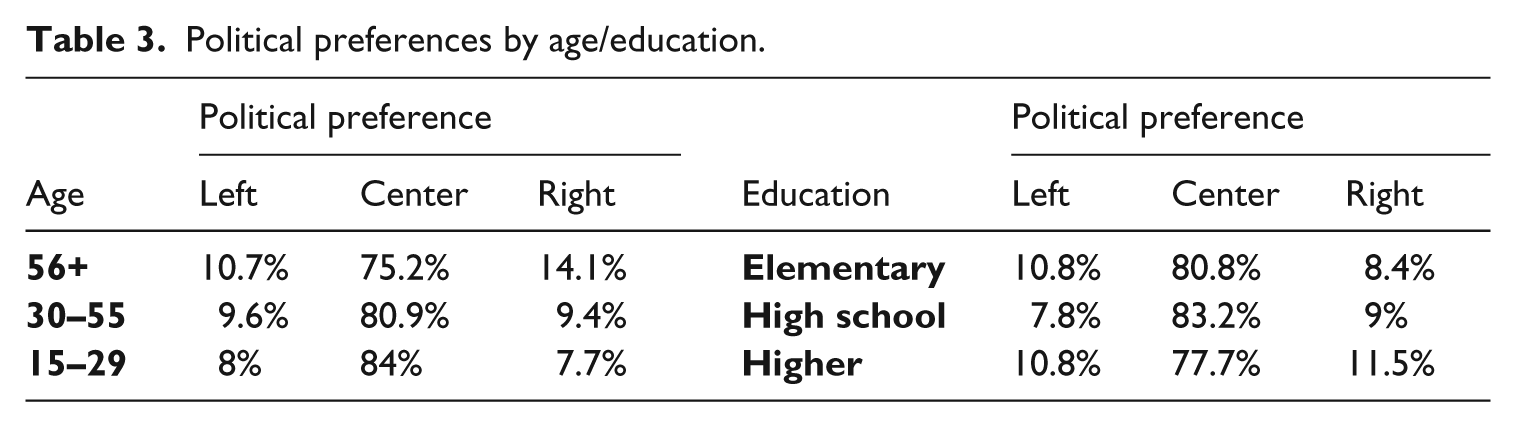
We think that the results of the survey show the disenchantment of young evangelicals with ‘great ideological narratives,’ coinciding with the national trend. Among those less than 30 years old, the majority define themselves politically as ‘center,’ while older adults appear ideologically more polarized. However, those with more education also have more clearly defined political positions. We believe that the political positions of older adults are due to the political history of Chile in the 20th century, which was marked by ideological conflicts, while the political sympathies of the young are determined by the active public life that takes place in the universities where they study. The less pronounced political inclinations of adult evangelicals with a medium level of education are possibly explained by the fact that this generation grew up during the political and cultural ‘blackout’ of Chile under the military government, when in most evangelical communities apoliticism and absorption in spiritual matters increased. The reasons evangelicals claim that they do not feel represented by any of the Chilean political parties are the following: they cannot support the right because its main motivations are selfishness and individualism, but they do not identify with the left, which ‘has no God.’
There are younger evangelicals with a higher educational level who show greater interest in participating in some political activity, talk about politics, and follow political news in the written press or television. At the same time, in terms of political activity, the ‘education’ factor has more influence than ‘age’ (Table 4) 4 .
Degree of interest in political activities.
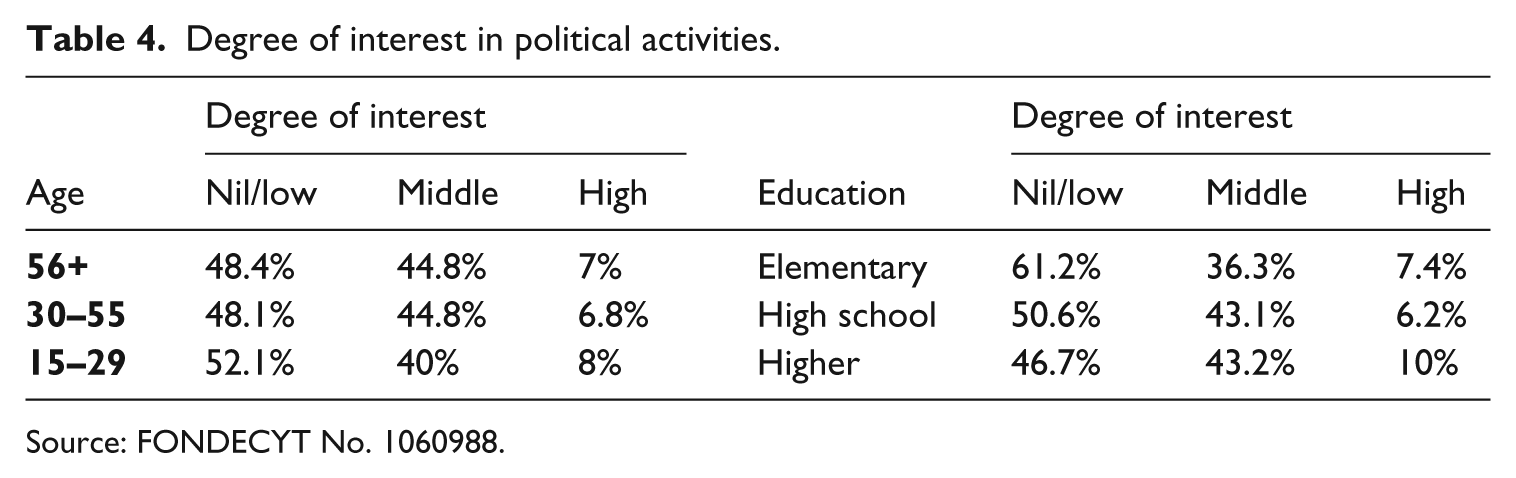
Source: FONDECYT No. 1060988.
The same pattern is followed in the replies to the question on interest in going into a political party, and even more illustratively, on readiness to participate in campaigns for human rights, an area in which younger people and those with better schooling were noticeably more sensitized than previous generations. Certainly, beside the factors that have been mentioned, this trend is related to the general democratization of the country and to the fact that the majority of those under 30 were born under a democratic political regime, so that for them the value of human rights is above that of salvation and evangelization.
As we have tried to show, different evangelical generations also show diverse political positions. The differences in civic behavior between adults and younger people, and between those with little schooling and those with a university education are clearly seen. Apparently, to younger people and to those with more schooling the concepts of citizenship and participation are not necessarily related to political elections. They seem to be more interested in following the country’s political life through the mass media and participating in public activities in the universities without relating closely to the political parties or to the debates on national affairs. More than in voting, young evangelicals are interested in publicizing the problems that concern youth in general and religious youth in particular, for example through organizing solidarity campaigns in agreement with their spirit of service to the community. Again, in the process of training a citizenship that is young, aware, and committed to democracy, professional and university education plays a fundamental role.
How do these trends impact on the inner life of the Churches? Is there an internal debate on the role of the religious community in Chilean society? Can young evangelicals, who, in comparison with previous generations, are apparently more politically active, less obedient to the pastors and more ready to collaborate with other religious and secular actors, challenge the positions of their parents or the authority of their pastors?
Cultural changes and religious authority: Is youth rebellion coming?
The evangelical Churches and, in the first place, the Pentecostals, are characterized by the high authority of the pastors over the faithful. They are the faithful’s infallible reference for making decisions related to both everyday and political life. In the Epistle to the Romans 13:1–7, Saint Paul sets the principles of Christian ethics: Let everyone be subject to the governing authorities, for there is no authority except that which God has established. The authorities that exist have been established by God. Consequently, whoever rebels against the authority is rebelling against what God has instituted, and those who do so will bring judgment on themselves. (Rom. 13:1–2)
It is known that this Epistle has traditionally been interpreted by evangelicals as a foundation for apoliticism and even authoritarianism, and for that reason they have supported any authority regardless of its political nature. The attempts of some pastors to manipulate the electoral expression of believers in favor of particular candidates are also known. However, the important point is that the principle of legitimacy and of respect for authority is established here, as well as the judgment criteria that theologians and ecclesial leaders have mentioned in order to lay the foundations of the right to resistance to an iniquitous authority. (Parker, 2008: 34)
It would be difficult to talk about democratic evangelical citizenship and the contribution of this religious community to the development of civil society if we were dealing only with a passive population completely obedient to its spiritual leaders.
The interviews and opinions expressed in focus groups evidenced some unhappiness felt by the younger evangelicals at the way in which some of their pastors assert their leadership, and their intention to change authority relationships. The main themes that caused major questioning were social inequality between the faithful and their leaders, lack of transparency in decision making, and lack of probity in the management of money. Some statements by participants in focus groups lead us to believe that there may be a tendency to question the infallibility of the pastors’ authority: I do not agree with the fact that in the Church there are people who are in great need of money, that there are children who cannot go to school, but the pastor lives in a well-to-do neighborhood and has two cars. … To me, that is a fault of the evangelical Church. (Sandra, 21, university student, Santiago)
If previously the older generations felt obliged to follow strictly the instructions of their pastors, even if that caused them internal conflicts, now the situation is beginning to change. Although young evangelicals continue to consider the opinion of their spiritual leader, they also feel that they are independent individuals who do not have to think in the same way as their pastors. With greater literacy, the experience of participating in debates, and familiarity with diverse points of view, university evangelicals stop seeing in their pastors absolute models to be followed. By developing their own biblical discernment, young evangelicals respect the pastors as leaders of their community, but the top ethical authority to them is no longer the pastor but Jesus Christ. As stated by one of our Focus Group participants: I believe that evangelicals have an intrinsic culture of accepting the words of their leader as absolutist … I think that our parents were taught that they were not able to criticize the pastor. But we as a generation have realized that it is possible, that it is necessary and we must do it. (Gonzalo, 23, university student, Santiago)
Representatives of the younger generation are aware of the cultural differences that exist between them and their pastors, most of whom have no professional training. There are multiple cases in which believers, after confronting their pastor, broke with their community and went into political or solidarity activities, turning into Christians without a Church. It should be noted that in this case we are not talking about conflicts of a personal nature or power struggles, but about matters that have to do with citizens’ rights and with the participation of the Church in civil society.
However, the critical view of the pastors is neither linear nor generalized. Although some communities are still concentrated strictly on spiritual matters, more and more evangelical Churches are trying to increase their presence in Chilean society. This is due not only to the need to compete with the Catholic Church, but also to the increased self-esteem of the evangelicals themselves, the awareness that their Churches have much to contribute to the country, and that they are an important socio-political force that is increasingly taken into consideration by Chilean political forces. The Churches are also trying to modernize and adapt to changing national scenarios, technological changes, and new expectations of their believers, so the religious authorities themselves promote increasing education of the faithful by creating different programs of study, establishing contacts with the secular academic world, and stimulating the elaboration of their own evangelical opinions on various matters of national interest. In these communities the ‘social strike’ has been broken and active religious citizenship, committed to society and democracy, is being fostered.
We therefore assert that the positions and opinions of young evangelicals do not permit us to talk about a clash of generations in the Churches. The young can be quite critical about the points of view of their parents or the lifestyle of the pastors, but belonging to a traditionalist, morally conservative culture that teaches respect for order and higher authority does not permit talk of a possible ‘revolution’ of youngsters against the ‘culture of the elders.’ The Gospel to the Romans interpreted more widely allows them to debate with authorities or disobey their suggestions, but not to disrupt the power structures. They are conscientious, autonomous citizens, but respectful of order, of hierarchy, of age.
Therefore, slow but important changes can be perceived that will affect the nature of Chilean evangelism due to the increase in the number of university professionals, the consolidation of family tradition with an evangelical religious formation, and the improvement of the living standards of the population. We are not dealing with a clash of generations but rather with a silent revolution. It is possible that the majority of the evangelical Churches (particularly the Pentecostals) will increasingly share the experience of the Protestant Churches, which were historically associated with a high educational culture and the relatively well-to-do social sectors. Or maybe, believers who are more highly committed politically and have greater social mobility will decrease their degree of observance and practice their faith outside the religious institutions. In this sense, the greater openness of the evangelical community, its integration into Chilean society, and its greater willingness to dialog with the political and secular world do not derive from the origin or doctrine of that community, but rather from the educational level of its believers.
Conclusion
As we have attempted to show, two parallel processes are taking place within evangelical Churches in Chile. On the one hand, like any voluntary organization, they promote the acquisition of civic habits that implicitly prepare the members of the Church for greater political and social participation. On the other hand, the evangelical Churches are trying to increase their presence in Chilean society in the search of greater recognition of their rights and status as a cultural minority. Closely linked with the latter process are the changes that we have highlighted in this article – the increased educational level of evangelicals, the increasing cultural gap between different generations, and the questioning of the authority of the pastors and the traditional inner power structures by young evangelicals. These processes allow us to refer to evangelicals as ‘cultural citizens,’ that is, as a minority which, thanks to its access to knowledge and capacity to produce new meanings in the context of a multicultural society, has equal rights and social status with other minorities within the dominant culture. This does not mean that evangelicals should be granted special cultural rights, which would turn them into a cultural enclave within Chilean society, increasing segregation and discrimination. It has to do with the gradual overcoming by evangelicals of their ‘otherness’ and their transformation into Chilean citizens with full recognition and insertion in civil society.
It was found that there are different moral and political perceptions that separate the younger generation from the older ones; that evangelicals feel that they have the right to express their opinions and to act independently from their pastors. Many young evangelicals are calling for Church democratization, and some leave the Church because ‘there is no rom for the young’ or organize another Church that is less hierarchic, more liberal and democratic. However, the internal transformation of the evangelical Churches will be a silent process of natural change, as the new generations, now with higher socioeconomic and cultural levels, start replacing their predecessors. On the other hand, we must consider that the process of democratization touched the whole spectrum of Chilean society, from the military and political to the academic and cultural settings. The evangelical Churches also lived or are living through this process, overcoming paternalistic practices and becoming more open, tolerant, inclusive, and attentive to the different opinions within their structures.
Furthermore, the changes that have marked Chilean society in general (market reforms, dismantling of the welfare state, increased quality of life, and extended access to sources of knowledge and information) have also promoted the process of forming a citizenship that is autonomous, responsible, competitive, and free from authoritarian attitudes. So in the evangelical communities as well as in other segments of Chilean civil society the development of new forms of citizenship that transcend political settings is taking place.
Finally, we believe that it is important to stress that the increasing levels of participation by evangelicals in the social and political debates in Chilean society are not determined completely by the doctrine of a given evangelical Church or by the historical trajectory of its relationships with the outer world. The fundamental factor that stimulates the increase in the social commitment of the Churches is education: the higher the educational level of the parishioners, the greater are the fields of collaboration between the Church and the socio- political world. The higher the educational level, the higher the presence and participation of the Church in public debate, its social visibility, and its constructive dialog with the political, academic, and religious world. Precisely these generational and educational changes in various evangelical sectors make us suppose that in the next decades the evidence of integration of evangelicals in Chilean society will increase through less enclosed religious forms or more open and ‘secular’ forms.
Footnotes
Funding
This article was written within the framework of FONDECYT project 1060988.
Notes
Author biography
Address: Institute of Advanced Studies, Universidad de Santiago de Chile, Román Díaz 89, Providencia-Santiago, Santiago, Chile
Email: