




Abstract
Research on social movement life-cycles specifies four stages of movement progression: emergence, rise, decline, and dormancy. This article challenges conventional perspectives on the final stage of the movement life-cycle, arguing that movement trajectories do not always follow this pattern. At times, social movement organizations (SMOs) within a social movement campaign survive, or even thrive, even when the opportunity for mobilization declines. Using the Central American Solidarity Movement (CASM) campaign and the School of the Americas Watch (SOAW) social movement organizations as examples of this phenomenon, I argue that there are important characteristics of movement infrastructure that warrant movement survival. By sustaining the spirit of the CASM, the SOAW remains the organizational foundation for religious constituents of the peace movements. Moreover, the SOAW has also extended its frame, expanding its networks into broader, secular organizational support and framing it within non-CASM movement campaigns. Though scholars have suggested that the CASM has disappeared, the SOAW has kept the movement alive as it transitions into another movement campaign to secure its longevity.
The Central American Solidarity Movement (CASM) of the late 20th century inspired thousands of Americans to join organizations, form coalitions, and fight for peace on behalf of a foreign region that many North Americans had never visited. The zealous activists – who generally came from within America’s religious middle class – inspired thousands more to join the movement, form rallies, and work toward changing policies that would end government-sanctioned violence against the Central American poor. The religious-based CASM, such as the Sanctuary Movement, undermined government regulations and created unique mechanisms for providing political asylum to Central American refugees. Other groups marched on Washington in opposition of the administration’s close relations with ultra-conservative Central American politicians. After nearly a decade of ongoing objection, and declining public support for the Reagan administration, protestors – many of them religiously convicted – persuaded the political ideologues of the decade to withdraw government support and look toward reconciliation with these nations. 1 Shortly after the signing of the peace accords of late 1980s and early 1990s, the CASM seemed to fade from public view, as activists slipped back into their politically acquiescent lifestyles as non-confrontational, law-abiding citizens.
But the story does not end here. As wars continued to rage throughout the region, thousands of people fell victim to state-sanctioned political violence. Among the most noted of such acts was the massacre of six Jesuit academic priests, their housekeeper and her daughter at the University of Central America (UCA) in San Salvador in November 1989. News of the assassinations quickly spread and gained a vast amount of international attention, particularly from within the Catholic community. Jesuits worldwide demanded justice for the violence committed against their Catholic brothers and sisters at the UCA. One North American Catholic priest traced the assassin’s training back to the US School of the Americas (SOA) stationed on a U.S. military base. This public knowledge led to the creation of the School of the Americas Watch taskforce (SOAW) and was the inception of the annual School of the Americas protests.
Though the wars in Central America were officially concluded by the early 1990s, the anti-SOA protest continues, making it the only trace of the solidarity movement still alive and active today; thus, the anti-SOA protest appears to be an anomalous case to scholars of social movements. The conventional view assumes that movements will naturally decline and die off as their immediate goals are accomplished. Yet, the growth of the anti-SOA movement does raise some issues of sociological interest. For one: the pool of constituents has broadened, participation numbers are increasing, the presence and coverage of national press is more widespread, enhancing the protest’s public image, and policy change seems more within reach after each protest. Second, the literature on social movements does not account for self-sustaining SMOs – SMOs that survive independently of the overall movement campaign. This paper addresses the question: What are the dynamics of this peace movement that enable it to persist internationally while the remaining organizations connected to the solidarity movement have mostly dissipated?
This paper explores why the anti-SOA protest has not only survived the last 20 years, but actually enlarged despite the decline of the mainstream CASM campaign. The article proceeds as follows: First, I briefly review the existing literature on movement participation and sustainability. I then outline the historical roots of the SOA and the anti-SOA protests and provide a brief ethnographic description of the protest itself. This section relies on ethnographic data collected at the 2008 protest, content analysis of press coverage, and accounts from anti-SOA protest participants as the primary sources of information. Next, I analyze the dynamics of the movement through a critical lens, looking primarily at cultural capital, the ongoing emotional energy created by intense rituals increasing group solidarity and institutional networks, and the broadening of movement objectives to expand the movement’s organizational capacity. Finally, I illustrate the importance of using the SOA protest as a case study for further studies directed at the origins and implications of movement continuity by looking at SMOs independently rather than an aggregate social movement campaign.
Explaining movement participation and continuity
For the most part, social movement theorists have avoided the question of how and/or why movements survive beyond their expected life course; rather, previous scholarship on social movements has focused on explaining why movements fail or succeed, what variables determine longevity and effectiveness, and how movement culture and framing expand a movement’s constituency. Previous approaches to movement life-cycles revert to the theoretical concept of social movement abeyance structures (Taylor and Whittier, 1992) and theories of diffusion and protest waves (Minkoff, 1997; Oliver and Meyer, 1998) as the principal explanations for social movement progression. Many of these arguments are based on the structural circumstances that lead to waves of protest behavior. Yet none of these studies has considered the variation that may occur at the end-of-life stage in social movement development.
Rupp and Taylor (1990; 1999) found that the National Women’s Party, which traces its roots back to the women’s suffrage movement of the early 1900s, experienced waves of mobilization. As time progressed, the women found safe spaces to discuss their feminist ideals. In these spaces (such as coffee houses), ideologies were refined and the movement’s objectives clearly determined. The movement lay in abeyance until the political opportunity arose half a century later (McAdam, 1982). By the mid-20th century, feminist ideology reemerged on the political scene, professing the goals of its feminist predecessors. The time between the suffrage success and the boom of the women’s movement (about 50 years, from 1919 to the late 1960s) may not have been politically mobile, but neither does that period of abeyance imply movement stagnation. Taylor (1989) argues that movement stagnation does not signify the dispersal of a movement; rather, the activists may be in a state of limbo, waiting for both external and internal structures to strengthen so that the movement can proceed. These so-called ‘abeyance structures’ are defined by Taylor as structures that ‘emerge when society lacks sufficient status vacancies to integrate surpluses of marginal and dissident people’ (762). When a movement is in abeyance, it is building an internal infrastructure to maintain its culture and political vision. The construction of a strong collective identity is therefore salient in order to maintain a core group of constituents, dedicated and committed to the cause, serving as a ‘symbolic resource’ for future attempts at mobilization.
Yet, the cycles of protest are not merely dependent upon structural conditions. Taylor and Rupp (1990) state that ‘the history of any social movement is shaped by an interactive process in which the movement pursues a course of action and the societal response to its actions, in turn, modifies the movement’s structure, goals and strategies’ (195). Indeed, we must account for both external and internal movement infrastructures to determine the variables prevalent in a particular social movement life-cycle. Here, concepts such as framing may also be a significant indicator of social movement trajectories and life-cycles. Snow and Benford (1992) argue that master frames 2 affect the cyclical nature and clustering of social movement activity. Their fundamental argument is that ‘framing activity and the resultant ideational webs that some movements spin or that emerge from the coalescence of collective action can also be crucial to the emergence and course of a cycle of protest’ (142). The level at which movement organizers are able to keep the master frame of the movement and movement participants in line determines rates of mobilization.
Only recently has social movement scholarship identified the different movements in a social movement life-cycle. Nepstad (2008), for example, has argued that there are four identifiable stages in social movement progression: movement emergence, expansion, decline, and abeyance. However, Nepstad demonstrates that that the four stages of movement development are not necessarily generalizable across movements, as movement trajectories and outcomes may vary. Not all social movements fit the symmetrical rise-and-decline model of social movement continuity and progression; instead, levels and rates of activism are varied. For example, some movements have sporadic and intermittent activity, some movements develop with limited expansion, and other movements simply persist and never experience decline. 3
While Nepstad offers a fresh insight into how we evaluate movement trajectories, I argue that we can take this social movement life-cycle concept one step further and argue that it is important not only to consider the trajectory of the movement life-cycle, but also to re-assess its period of so-called abeyance. The stages in a movement life-cycle are not always easily discernable: How can we detect movement climax if we cannot see past its zenith? Or how is a movement defined as being in a state of ‘abeyance’ if it never re-emerges? Moreover, the current movement life-cycle approach lacks a clear definition of what is considered a movement’s end of life. The decline of a social movement campaign is not necessarily inclusive of all of the social movement organizations supporting that particular cause. Indeed, movement spillover may occur, where the same players assume similar roles with ideas that have ‘spilled over’ the boundaries of the previous social movement organization. This results in the resurrection of movement objectives or a reincarnated movement, transformed as a new social movement campaign (Meyer and Whittier, 1994).
While scholars have argued that ‘early risers’ (McAdam, 1995) can expand movement trajectories and determine the movement’s course of action, I argue that this is only part of the story. I propose instead that ‘late arrivals’ in movement activity – constituents whose participation comes near the end of the movement’s lifespan – have the potential to bring new energy, contacts, motivations, and goals to the movement, causing it to spin upward while maintaining the basic tenets of the original movement. The social movement sector is then expanded, while remaining within the same social movement campaign. The following section explores the internal dynamics of the SOAW, a late arrival in the broader CASM campaign.
Political opportunity structures
The concept of ‘political opportunity’ is central for understanding the emergence of political mobilization. However, the concept has undergone some scrutiny regarding the fuzzy conceptualization of the topic. Doug McAdam first presented the concept in his classic 1982 work on black insurgency in the civil rights period. Here, McAdam argues that there are three essential components of movement emergence in harsh socioeconomic settings: indigenous organizations, collective consciousness, and an opening in the political system, which provide an opportunity for movement success known as political opportunity structures, or POS. Simply stated, the model argues that a movement will emerge if constituents sense that the political structure is weak or amenable to the changes outlined by the movement, or if they sense that the political structure will support the movement’s goals. The theory looks at social movements primarily as political phenomena and as ‘a continuous process, from generation to decline, rather than a discrete series of developmental stages’ (McAdam, 1982: 36).
Moreover, according to McAdam, POS include the following four components: (1) access to the political system; (2) elite availability; (3) elite alignment with the political system; and (4) the state’s propensity for repression. One of the trends we see in the political process model is that movements tend to emerge when states are neither very closed (where there is absolutely no opening in the political structure) nor very open (where social change could occur by institutional means as opposed to contentious political activity).
Political opportunity may be perceived by participants as the state’s general political instability or its weak structure. It is implicit in McAdam’s model that these ‘opportunities’ will be correctly perceived by the movement participants: social movements result when ‘expanding political opportunities are seized by people who are formally or informally organized, aggrieved, and optimistic that they can successfully redress their grievances’ (Goodwin and Jasper 1999: 42).
A number of studies subsequently emerged that attempted to assess political opportunities and discovered that the concept was quite difficult to measure. For example, Kitschelt (1986) looked at the anti-nuclear movement in Western Europe and in the U.S. and argued that it is the state’s input and output, as well as the strategies of the mobilizers, that determine the state’s general receptivity or closure to a social movement. Kurzman (1996) looked at POS in Iran leading up to the 1979 revolution and found that the state was strong according to McAdam’s model. 4 However, given the (mis)perception of social movement actors of a weak state, the movement still succeeded, thus implying that when looking at POS we also need to consider the perception of the mobilizers, because a strong state does not necessarily prevent movements from succeeding.
While the political opportunity for mobilization in the CASM may have been ripe in the 1980s, the conclusion of the war suggests that there is no longer a need to support non-violent political activity in the region. However, the CASM has spun off, or ‘spilled over’ into movements that keep the spirit of the movement alive, but under the auspices of another name.
The development of the Central American Solidarity Movement
In the span of about 25 years, the CASM sector contracted nearly 2,000 social movement organizations and mobilized over 100,000 constituents in the U.S. (Smith, 1996b: 348). Smith has argued that the ongoing efforts of movement protestors and activists to frame the issues relates to the larger American polity, as public support for the cessation of involvement in Central America posed a challenge to the Reagan administration (1996b). Promising to ‘expand the economy, clean out the government, revitalize the military, stand up to Americans and ‘restore American pride’ (1996b: 21), Reagan drew the interest of a number of Americans. In the wake of the Vietnam War, the Cold War, and the threat of a communist domino effect, intervening and taking charge in Central American politics, the framing of Reagan’s international politics clearly posed an acceptable political solution. However, as solidarity groups arose in the United States and in Central America and the violent reality of the political situation in Central America became apparent, opposition at home in the U.S. grew. But Reagan was firm in his policies, and ‘remained fully committed ideologically and politically’ to the tactics he was employing in Central America (1996b: 27).
The success of the CASM in the U.S. is largely attributed to its tactical innovation strategies and use of biographies, narratives, and symbolic resources to make an emotional and cultural connection between the stories of religious martyrs on El Salvador and the people back in the U.S. (Nepstad, 2004). The religious martyrs – namely, Archbishop Oscar Romero, the four Churchwomen of El Salvador, and the six Jesuit priests at the UCA – were all models of Christian living; they were likeable and approachable, and their tragic and unjust deaths had moral and religious implications. The cultural agency that was generated from these martyrs fostered more support in the U.S., as American Christians felt that their own brothers and sisters had been attacked. Stories were retold in churches, universities, and the media as knowledge of the Jesuits’ martyrdom spread. Indeed, their sacrifice for social justice had such an impact that sympathizers from the U.S. traveled south of the border so that solidarity networks could show them exactly where these assassinations took place. Utilizing citizen rights granted by the Freedom of Information Act, CASM constituents uncovered the identities of the Jesuits’ assassins, whose military training was traced back to a U.S. military training camp: the School of the Americas.
The School of the Americas/Western Hemisphere Institute for Security Cooperation 5 is located at Fort Benning in Columbus, Georgia. The school allegedly trains Latin American military personnel in combat tactics, for dealing with insurgency movements and controlling narcotics trafficking in the region. However, there is an unfortunate and incontestable correlation between SOA graduate demographics and their countries of origin’s human rights violations. The SOA is also responsible for training the most notorious human rights abusers in Latin America in the last 40 years. Graduates include figures such as Manuel Noriega of Panama, Rios Mont of Guatemala, and the assassins of Archbishop Oscar Romero of El Salvador in 1980. This takes away from the supposed efficiency of the SOA curriculum, which ought to be aimed at guerilla warriors, narcotics traffickers, and organized crime, while the long list of SOA graduates that have abused their training in their own national settings seems to suggest this is not the case. However, defenders of the SOA, including the U.S. government and tax-paying citizens, contest this allegation, stating that these graduates acted independently of the SOA; how they use the skills taught to them by SOA instructors is beyond the jurisdiction of the school. 6
The controversial military school remains open while a social movement organization known as the School of the Americas Watch (SOAW) presents Congress each year with a petition asking them to consider the closure of the institution. The SOAW was conceived in 1990 by a Catholic Jesuit priest, Father Roy Bourgeois, after he had uncovered the correlation between the deaths of these Catholic martyrs and graduate assailants of the SOA. The mission of the SOAW is decidedly nonviolent and grassroots, and it ‘works to stand in solidarity with the people of Latin America and the Caribbean, to close the SOA/WHINSEC and to change oppressive U.S. foreign policy that the SOA represents’ (official SOAW mission statement). The SOAW has three clearly-defined objectives: continued investigation of the school’s curriculum, the discontinuing of government funding of the school, and retrieval the names of the graduates of the SOA so that justice may be done. The organization is largely founded upon religious conviction and a sense of moral obligation to defend social justice and act for the defenseless. Catholic social teaching calls its followers to stand up for the dignity of human life and justice, and to work in solidarity with those who have been silenced. The thousands of protestors at the gate of the School of the Americas have sacrificed their time and – in some cases – even their freedom to defend this message of the gospel.
Previous scholarship on the CASM has demonstrated the importance of cultural agency, political opportunities, and religious-based recruitment efforts in sustaining a large transnational constituency (Nepstad, 2001; 2004; Smith, 1991; 1996). Indeed, much of the SOAW’s national and international reputation was achieved through its strategic dissemination of movement objectives, and by reaching a broad base of religious sympathizers. Bourgeois has made himself available for campus visits to religious universities across the country, encouraging students to recognize the injustice abroad and the similarities between their own religious communities and those in Latin America. Campus ministers and Peace and Justice co-ordinators at a number of schools include the SOA protest in their student activity programming, as an annual event in which university students may participate. Representatives of the SOA and high-profile supporters are often invited to participate in live debates and radio shows or to make television appearances, giving the organization a national reputation that expands beyond the boundaries of purely religious organizations.
Also contributing to the organizational success of the movement is the fact that the SOAW has maintained a viable organizational headquarters in Columbus, Georgia, providing it with the on-site advantage of tracking the legislature related to the school. Moreover, the SOAW publishes material on the school that is often unpublished by the media. It is thanks to the SOAW’s media and technological savvy that articles have been published as editorials in reputable national newspapers such as the Chicago Tribune, New York Times, and Los Angeles Times, sympathizing with the organization’s objectives and even encouraging the government to recognize the activists (Gill, 2004). Celebrity sponsorship from high-profile figures such as Susan Sarandon and Martin Sheen has prompted even the non-political press to document their participation in the protest. Finally, catching up with the new generation of online gurus, the SOAW has recently generated an online Facebook profile, which currently has 2,500 online ‘fans’ or supporters. According to estimates of participation in the annual SOA protest, nearly 10,000 protestors took part in 1999 (Nepstad, 2000: 71), approximately 18,000 in 2003, and up to 25,000 in 2008.
According to Smith, CASM began its demise in the mid 1990s, as a result of the minimization of political opportunity (1996a: 348). Bourgeois and other SOAW founders emerged during the denouement, following the movement’s climax, making them late arrivers capable of channeling the disquiet of activists into a new action that carried the same spirit of solidarity. The activists’ initial ‘sense of moral outrage, the violation of their deeply held Christian beliefs, and a shared and enduring commitment to progressive social change’ (Gill, 2004: 203) resonated with those who could relate to sentiments of the CASM period, giving the SOAW that initial boost. Now, 18 years past the initial action, these ‘enduring activist subcultures’ (McAdam, 1994) have helped to extend the movement by attracting other CASM constituents.
The annual protest
The anti-SOA protest occurs at the same time each year: the third weekend in November, marking the anniversary of the death of the Jesuit martyrs at the UCA. Over the years, the protest has evolved into a kind of convention for the Catholic left. Each year, the Ignatius Solidarity Network reserves the conference center in Columbus, Georgia, from Friday night until Sunday afternoon. During the long weekend, there are workshops, plenary sessions, and other seminars and panel sessions related to anti-violence. The ubiquity of Jesuit university recruitment representatives, religious paraphernalia (crosses, paintings, etc.), and a Catholic vigil the night before the protest remind the participant of the Christian nature of the protest organization.
The actual protest is on the Sunday morning. After a morning of music, speakers unite the protestors as they prepare for non-violent action. The somber event included a funeral simulation as the names of the victims of SOA violence across Latin America are read out. The thousands of participants then raise a white cross and melodically respond, in Spanish: ‘Presente.’ The slow march in front of the gates of Fort Benning, home of the SOA, takes about three hours. It takes the form of a dramatized funeral procession, symbolizing the deaths of the thousands of victims supposedly due to the training the militants received at the SOA. As the funeral procession passes the gates, there is what protestors call a ‘die-in,’ where actors lie across the gates painted with ‘blood.’ As protestors pass, they insert their white crosses in the wire fence of the military base. When all the protestors have passed the gate, a dramatic scene is played out. A puppet representing the ‘evil U.S. Empire’ tramples on puppets representing figures fighting for human rights, indigenous rights, and workers’ rights. Then, a puppet with colorful streamers, representing the ‘winds of change,’ passes by. It combats the Empire puppet, vanquishes it, and raises a large banner reading, ‘Close the SOA.’
The movement lives on
Previous scholarship on social movement participation has placed a strong emphasis on movement participation as a key explanatory variable for movement progress. Generally, studies have examined who gets involved in social movements and why. Dominant trends in the literature suggest that collective identity is central to movement participation (Castells, 1997; Friedman and McAdam, 1992; Goodwin, Jasper and Polletta, 2000; Melucci, 1995; Nepstad, 2005; Robnett, 2002; Snow and Benford, 1992; Taylor and Whittier, 1992). Social connections to people in the movement constituency increase the ideological commitment of the group, and sustain participation. If collective identity does not resonate with adherents, people are unlikely to commit to the movement’s trajectory. In both the CASM and the SOAW, constituents are clearly driven by ‘the politics of moral conviction’ (Epstein, 1990), making the SOAW a movement sustained by the new ‘political generation’ (Whittier, 1997) of CASM activists. Because the collective identity of both movements is similar, we can classify the anti-SOA movement as waves, rather than the emergence of a new movement.
I suggest that the SOAW has been able to keep the CASM afloat for two primary reasons: First, its ability to mobilize a pre-established network of religious progressives has sustained the constituency of the CASM, embedded in the concept ‘moral convictions’ and collective identity. Second, I argue that the ability of the SOAW to broaden its frame to a larger, non-religious group of constituents has led to an increase in participating institutions, constituting more organizational resources. Given these transitions in the culture of the SOAW, the anti-SOA protest not only increases the numbers of protestors, but also reaches new networks, couching the SOAW in broader contexts such as the peace and anti-war movements, providing it with a broad-based group of constituents, and resonating with the objectives of both religious and secular-based organizations.
Defining movement culture
Benford and Snow (2000) have written extensively on the salience of movement framing as a mechanism to attract and strengthen a movement cadre. In order to solidify a movement culture, participants must be aware of the goals and objectives of the SMO’s organizational frame. This so-called ‘frame amplification’ process involves the ‘idealization, embellishment, clarification, or invigoration of existing values or beliefs’ (Benford and Snow, 2000: 624). For example, the frame amplification process involves accenting and highlighting some issues, events, or beliefs as being more salient than others and which may provide a foundation for movement objectives, but are linked to broader events and issues (623). The use of religious symbols, rituals, and figures further embeds the Christian notion of solidarity in the initial phases of the protest.
It is not unusual for any social movement to use symbols, rituals, narratives, icons, and songs to help construct identities (Aminzade and Perry, 2001), though religious-based movements are more often depicted as creators of these elements. The emotions generated from such cultural elements are necessary to build and contain a strong constituency (Smith, 1996a: 10). Randall Collins (2001) identifies protest behavior in the traditional, Durkheimian sense of the collective effervescence, characterized by high ritual density. This assumes that protest participants share an interest in, commitment to, and emotional investment in the rituals of the protest. In this process, which he calls emotional energy, emotional responses increase among and become the foundation for collective solidarity. The emotional energy generated in the protest rituals is heightened every year as the goal of policy change becomes closer, thereby invoking in anti-SOA protests a stronger level of commitment year on year.
Scholars have demonstrated that throughout the history of the U.S., religious voices have often served as the primary instigators of social change (Young, 2007). Black church figures and organizations in the southern United States helped foster black participation in the civil rights movements (McAdam, 1982; Morris, 1984) and continue to be a primary mobilizing organization in many black communities today (Patillo-McCoy, 1998). Christian-based narratives and biographies helped to sustain and grow the Central American solidarity movement in the 1970s and 1980s (Nepstad, 2004; Smith, 1996a). Faith-based community organizing institutions have repeatedly demonstrated successful political ‘actions,’ furthering democratic goals in inner cities; more so, it seems, than their secular counterparts (Pagnucco, 1996; Swarts, 2007; Wood, 2002).
Passy and Guigni (2002: 119) have argued that a critical factor in protest participation is ‘the way participants perceive their position as activists and relate that to their own personal life, both concretely and symbolically.’ More specifically, movement activists are more likely to remain involved in protest when their social networks and moral obligation (as it relates to their personal life-spheres) are ‘coherently and consistently interconnected’ (120). A number of previous studies have found that religion is an active organization that affects the personal elements in protest activity by ‘increasing recruitment efforts, fostering a willingness among congregants to act contentiously, increasing political efficacy, and enhancing organizing skill’ (Beyerlein, 2002: 10). Nepstad (2004) argues that even in cases of high-risk activism, religious communities and ritual practices provide participants with a meaningful purpose as they construct their own boundaries to legitimate their participation. Putnam (2000) found that religious affiliation is by far the most common associational membership among Americans; that church-related groups constitute the most common type of organization joined by Americans. In essence, religion serves a dual purpose in movement participation and commitment: the generation of networking through cultural infusion, and the moral conviction it invokes in people motivating political action.
Nepstad’s (2004) study of the SOAW’s strategy to capitalize on religious culture has contributed to the appeal to many left-of-center religious groups and individuals. This religious ritual and emotion is fully incorporated in the anti-SOA protest particularly; liturgy becomes protest mantra, solidarity is a spiritual ‘baptismal’ and the appeal of strong celebrity support reframes the movement to appeal to non-Christian anti-war or just plain supportive Americans. Thus, constituting a religious frame as a master frame is a strong tactical strategy for recruiting and maintaining social movement participation. The fact that the SOAW was able to directly relate the protest activities to those of the broader CASM sustained its core base of constituents. Moreover, newcomers to the SOAW may not have been involved with the CASM directly. However, the use of religious rhetoric, symbols, images, narratives, and figures attracts individuals throughout religious-left communities, congregations, and universities.
Though there are hundreds in the list, the more notable organizations collaborating with the SOAW include: the Association for Jesuit Colleges and Universities, Fellowship of Reconciliation, Pax Christi USA, Leadership Conference of Women Religious, Ursuline and Maryknoll Sisters, Witness for Peace, Church of the Brethren, Presbyterian Church, Catholic Worker communities, United Church of Christ, United Methodist Church, and Unitarian Universalists. Additionally, there are approximately 183 sponsoring organizations in the U.S. and Canada, including 70 specialized SOAW regional offices.
Frames are unequivocally an important concept in the formation of a strong collective identity, which then reinforces social movement participation and solidarity. As McAdam writes, ‘people do not “join” social movements in the same sense that they join formal organizations’ (1986: 66); rather, the strong ideational commitment is necessary prior to participation in collective action that pursues the goals identified by that ideology. As the number of anti-SOA protestors expanded, founders recognized the need for maintaining members outside the limited pool of Catholic constituents. As a result, the SOAW expanded the vocabulary of the movement, secularized its symbols, and loosened the mythological elements founded in religious rhetoric to recruit non-religious activists.
Expanding organizational capacities
Frame extension involves an SMO’s interest or frame(s) ‘extending beyond its primary interests to include issues and concerns that are presumed to be of importance to potential adherents’ (Benford and Snow, 2000: 625). For example, movement slogans or chants may serve as a protest ritual that resonates with the original objective of the movement, but can also be translated across the specific context of that grievance. The protests at the SOA incorporates language, rituals, and imageries that extend beyond traditional Catholic Christian elements and teachers, honoring other figures of non-violence such as Gandhi, Aung San Sui Kyi, Martin Luther King, Jr, and ‘all those who have gone before us in the way of justice’ but beyond even Latin America, integrating other cases of government-sanctioned violence that may have its origins at the SOA. For example, the following oration was the pre-protest litany all protestors were encouraged to recite in unison:
SOA violence and the racist system of domination it represents are a continuation of the ‘trail of tears’ that ravaged the indigenous people of this country. We hold up the ongoing struggle of our Native American sisters and brothers who lived on this land. We cry… [Chorus] No más! No more!. We must stop this dirty war!
Compañeros, Compañeras
We cry out No más! No more!’
The scope of the movement was broadened even further when the protest adopted the popular chant against fighting the ‘dirty war.’ Clearly, the wars in Central America were not the target for this particular action – those wars had officially ended more than a decade previously – instead, the movement was referring to war and military violence in general. Following the discourse on violence against Native Americans, the informative liturgy on military violence also mentioned present-day Central America, Mexico, Columbia, Bolivia, and even military violence occurring in Iraq and on U.S. soil against border-crossing immigrants. Before each short description, the crowd recited the ‘No más’ chorus.
Snow and Benford state that ‘movements that emerge later in the cycle will typically find their framing efforts constrained by the previously elaborated master frame’ (1992: 145). Indeed, there is a lack of political opportunity to directly attack the U.S. military for intervention in the Central American civil wars (hence the decline of the CASM movement). However, using the SOA as a symbol for military intervention overseas keeps the spirit of the solidarity movement alive by framing the stories of the Central American religious martyrs in a way that connects them to a population broader than just Central American Catholics. Making that connection across movements is what Benford and Snow call frame bridging: ‘the linking of two or more ideologically congruent but structurally unconnected frames regarding a particular issue or problem (2000: 623). By bridging movement goals and objectives, the 2008 protest drew participants representing secular peace movement organizations such as Veterans for Peace, Greenpeace, the Alliance for Global Justice, and National War Tax Resistance, as well as many Café Campesino, War Resisters League, and other left-wing secular SMOs. Thus, the master frame as a religiously motivated movement is maintained, but the organization also attracts constituents from inside and outside that religious base, and directs the energy of the movement into a broader anti-war/peace protest.
Surviving beyond a dying movement
I argue that there are two primary conditions that contribute to continuous CASM mobilization: First, the cultural capital and institutional contacts the SOAW has generated have unequivocally contributed to the survival of the movement. Second, without the ongoing support from groups rooted in the solidarity tradition, the SOAW might not have sustained widespread support for its cause. Moreover, the religious convictions that mobilized the religious left to participate in such movements demonstrate the movement’s continuity with the Central American Solidarity Movement of the 1980s. This second condition involves the broadening of movement objectives in order to attract a wider constituency while maintaining its master frame as a Catholic-sponsored protest; an important factor in reviving the CASM (drawing from the same pool of constituents) while broadening its objectives to make the organization more culturally inclusive and to increase its organizational capacity.
Representing the continuation and growth of the post-solidarity movement, the survival and expansion of the SOAW makes three important contributions to social movement research. The first challenges the traditional perception we have of a social movement trajectory and/or life-cycle (as shown in Figure 1). As Nepstad (2008) has demonstrated in her study of Plowshares religious activists, a particular social movement campaign may have a variety of movement objectives or trajectories in different social contexts (the US Plowshares movement used religious culture as a mobilizing tactic more directly than in the Plowshares movement in parts of Western Europe). Moreover, social movement scholars must be cautious when inferring movement abeyance, since movement constituents and adherents may be involved in grassroots mobilization at a different scale.
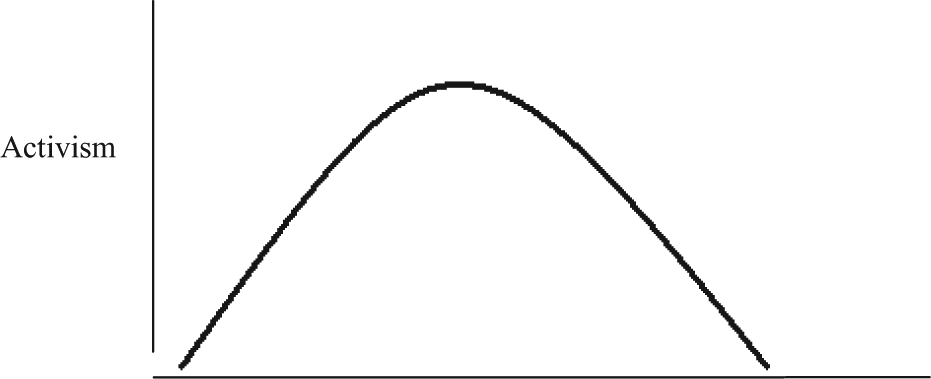
Conventional understanding of movement life-cycle: emergence, rise, climax, dormancy.
Though the spillover effect may disguise the origins of the regenerated movement, such movements may well be an offshoot, spin-off, or resurgence of the ideas, tactics, style, participants, and organizations of the original movement (Meyer and Whittier, 1994). The SOAW’s ability to channel emotional energy from a religiously dominated movement into a broader movement with more political opportunity challenges the prevailing literature that social movement trajectories normally have a bell-shape pattern. Instead of intercepting the X axis, signifying inactivity, a particular SMO may increase activism, while other SMOs of the broader social movement campaign decline (see Figure 2).
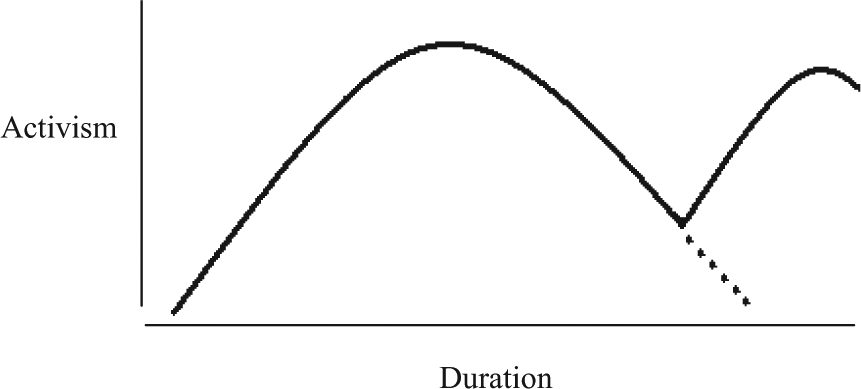
Alternative life-cycle scenario: emergence, rise, climax, transition, rise.
The evidence presented here suggests that the SOAW is an organization rooted in the CASM campaign, but has transferred its activity from a previously extended movement into a single SMO. Due to the limited opportunities for expansion, the SMO is likely to enter the final stages of the movement life-cycle. In order to survive as a movement, the SOAW is extending and bridging its frames, making it an organization that is in transition into a broader mobilizing campaign: here, the anti-war peace movement (see Figure 3).
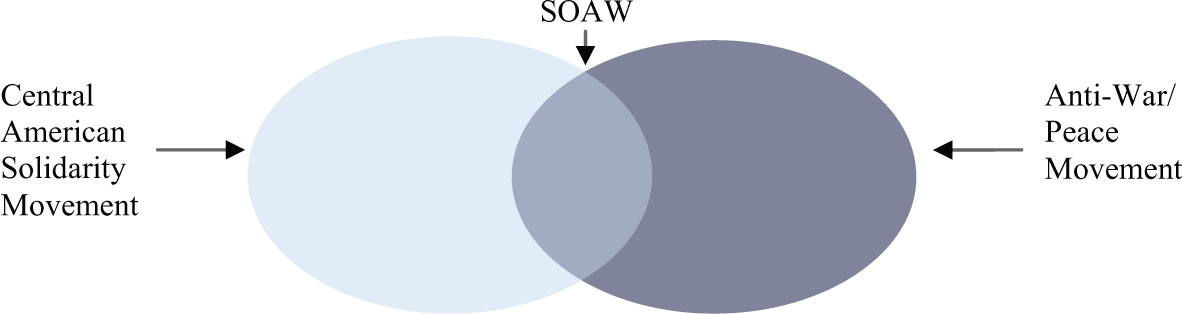
Expanding organizational capacities.
The expansion of the anti-SOA movement can largely be attributed to the expansion of sponsoring organizations and networks, agreeing with resource mobilization/political process theories that emphasize the importance of an organization’s ability to manage monetary resources, sustain external organizational support, acquire a group of constituents with leadership skills, and access publicity in order to broaden its network of support (McCarthy and Zald, 1977). The ability of the SOAW to mobilize organizations – whose mission may or may not be directly sympathetic to Central America or the religious right – has generated a broad-base constituency while maintaining a strong Catholic base. Activists’ dependency on outside support from religious congregations, faith-based communities, and religious organizations has led to an array of resources that might not otherwise have been available, such as facilities and meeting spaces, funding contributions, and the distribution of SOAW information (Gill, 2004: 210). Without the broad-base group of constituents, the resources available to the SOAW would be limited. However, since the SOA has drawn on networks from both social movement campaigns, it has gained overwhelming support. Social movement organizations that work in coalition with other groups are more likely to achieve success (Gamson, 1990). Moreover, the extension of the SOAW into the peace movement sector provides an opportunity for expansion should the resources inherited from the CASM and its constituents reach saturation point.
Conclusion
In this article, I challenge the conventional perspective on social movement life-cycles, which assumes that all movements have a similar fate of inactivity or abeyance. Instead, I suggest that some forms of activism (particularly, religious activism) can utilize broad cultural elements to keep movements alive by using the same constituency and promoting similar goals and objectives. In order to survive and expand as a transitional SMO, a movement must ensure that its organizers maintain their core group of constituents by amplifying the master frame of the movement. This can be done by reinforcing the movement’s collective identity through cultural representations in the forms of symbols, rituals, biographies, narratives, etc. Additionally, movement organizers must broaden their network base by drawing on themes shared by similar social movement campaigns. Doing so expands the organizational capacity of the network and opens more opportunity for activism – an important component of mobilization that the previous organizations can no longer provide. Using the SOA protest as a case study for further studies directed at the origins and implications of movement continuity. Arguably, the SOAW represents the last surviving strain of the CASM. If this is the case, the energy and commitment of the hundreds of thousands of activists during the 1970, 1980s, and 1990s have been channeled into one movement.
Afterword
In 2007, the legislative bill to stop funding to the SOA fell short of being passed by just six votes. In the November 2008 elections, 35 members of Congress who had opposed the bill were elected out of office. At the October 2008 SOA protest rally, Father Roy Bourgeois proudly and enthusiastically pronounced: ‘This is a revolution! We can stop the SOA in 2009!’ Should the bill be passed, and immediate goals and objectives met by the closure of the SOA, what will be the future of the SOAW? If the institution is closed, movement organizers and long-time participants have agreed the annual protest at the gate of the SOA will continue to take place in the form of a victory celebration (Ledger-Enquirer, November 22, 2008).While the SOA is still an active military school, the public has gained more access to the information kept confidential for decades. In April 2013, for example, a federal judge ordered the SOA to release a list of names of those who had graduated from the school.
While this is a small step toward justice, it does imply a growing level of accountability for those who have been trained by, and have possibly acted upon some of the violent tactics learned at, the school.
Despite efforts to stifle the movement with counter-movements and the use of police force, the SOAW’s position in the peace movement campaign remains active. For as long as international violence persists, I venture to say that the SOAW will find a way to remain politically active and find opportunities to protest to the powers that be.
Footnotes
Funding
This research received no specific grant from any funding agency in the public, commercial or not-for-profit sectors.
Notes
Author biography
Email: