




Abstract
American religious exceptionalism is investigated by comparing the US sample with the seven western European samples from the Bertelsmann Religionsmonitor 2007. Three customary aspects of religiosity, namely religious worldviews, church practices, and non-church practices, and one new aspect, dogmatism, are investigated. Two questions are examined. First, does American religious exceptionalism have two faces – i.e. is it not only American levels of religious belief and practice that surpass those of Europe, but also those of religious dogmatism? Second, does dogmatism correlate positively with religiosity in the USA and negatively in Europe? Both questions are examined with and without controls for religious affiliation and religious need dispositions. In short, the answer to both questions is ‘yes’ – America does exhibit exceptional traits when compared with western European religiosity and dogmatism.
Research design
Theoretical considerations: Religiosity, uncertainty and dogmatism
‘A human being is someone who constantly questions life. Therefore, we begin this book with the question of the meaning of life. That is not to say that we assume a non-Christian point of departure, but that we, we Christians, are querying humans’ (Glaubensverkündigung für Erwachsene, 1969: 4, my translation). As in this famous Dutch example, most Christian catechisms’ first question is the question of what one is living for on this earth. This can be called the religious question. Moreover, religion and its philosophical and secular counterparts, i.e. worldviews, can be defined as answers to this question. Religiosity, in turn, can be defined as a person’s attitude to the religious question.
As the citation points out, the religious question is rooted in the human condition. As all human beings know that they will die some day, they cannot evade the distinction between the world they live in and the world beyond. The distinction between immanence and transcendence is at the heart of the religious question, and it aims at the determination of something which cannot be determined. By definition, the religious question cannot be answered through experience, that is, by the examining this world; it must be answered through speculation or belief about another world. Yet, as speculation and belief lack the confirmation that experience provides, the religious question cannot be reliably and definitively answered. The query lasts as long as one lives. As the citation also points out, one can adopt a standpoint which guides the search and even hold some substantive answers to be intrinsically true. But even on these premises one remains a seeker, someone who believes or does not, yet never definitely knows. One cannot ‘determine the undeterminable’ (Luhmann, 1982: 26) – if one could, the religious question would be solved and religion would end.
Because of their transcendent nature, answers to the religious question, namely beliefs, linger between certainty and doubt. Everybody must get along with the problem of uncertainty as best they can. Consequently, substantive answers held to be true and tolerance of the inexorable uncertainty associated with them are analytically, but not necessarily empirically, orthogonal to each other. Those who seek to describe people’s religiosity should therefore consider beliefs on the one hand and the tolerance of uncertainty on the other.
This holds despite some differences between the two. Beliefs are at the heart of religion and constitute the object of religiosity. They are chosen among the set of options circumscribed by religions and worldviews. Yet tolerance of uncertainty is a personality trait which can express itself in religious, as well as in other more mundane, matters. One has to get along with the fact that some say the Bible is the true and literal word of God, whilst others maintain it is to be taken metaphorically. And equally one has to get along with the facts that one never knows whether a favor will be returned by a neighbor or whether an investment will pay dividends. Yet as religion responds to a question never to be answered in this world, it is fundamentally rather than incidentally related to tolerance of uncertainty. As for the other world, certainty will be never achieved; as for this world, experience can provide it in due course.
In the context of religion, tolerance of uncertainty is more suitably addressed with reference to its opposite pole. As uncertainty is inherent in the religious question, a tendency to enforce it against any doubt arises. One is no longer able to balance belief against doubt and, so the thinking goes, there must be some truth, thus there can be only one truth and consequently everything else must be wrong. Thus dogmatism, being the intolerance of uncertainty, arises (Saroglou, 2002). It accepts only one answer and negates all others. In such cases religious belief simultaneously solves the religious question and the problem of uncertainty.
American exceptionalism as research topic: Data and questions
Yet dogmatism will accompany not only belief, but practice as well, which is guided by belief. In the following study, belief, practice, and dogmatism will be analyzed with regard to a specific topic, namely American religious exceptionalism vis-à-vis Europe. All three have been surveyed in the Religionsmonitor of the Bertelsmann-Stiftung (2009), which contains data from 21 countries drawn from across the globe, as in 2007. Representing Europe the following countries are analyzed: Austria (A), Spain (E), France (F), and Italy (I), classified as ‘Catholic’ countries; and Switzerland (CH), Great Britain (GB), and West Germany (D-W) classified as ‘Mixed’ countries. In order not to confuse the effect of ‘Europe’ with the effect of membership of the former blocs of ‘East’ and ‘West’, the Eastern European countries also surveyed (Poland and Russia) have been dropped and Germany reduced to its former Western component. Thus, seven West European countries are analyzed in comparison to the United States.
The selection of the West European countries is biased. Protestant societies are absent and the Catholic societies are almost completely represented. Given that many studies show Catholic societies to be more religious than Protestant ones (Norris and Inglehart, 2004: 60, 74, 84–91; Halman and Pettersson, 2006: 46–47; Pettersson, 2006: 245; Andersen et al., 2008: 63), this bias underestimates the secularization within Europe and, consequently, the exceptionalism of the USA vis-à-vis Europe. The overall gap between the USA and Europe is probably larger than the gap between the USA and the seven European countries selected.
The samples of each country contain about 1,000 respondents. Where demographic weights were available they have been applied. Moreover, each sample has been weighted to contain exactly 1,000 respondents. The unweighted total sample consisted of 7,815 respondents.
The number of response options for each dependent variable varies between five and eight. In order to compare differences and to construct indices, all have been normalized with a range of 0 to 100, from lowest to highest.
American exceptionalism has been researched before with reference to belief (Halman andPettersson, 2006) and practice (Norris and Inglehart, 2004: 89–94), yet not – as has been criticized (Andersen et al., 2008) – with regard to both of them or to dogmatism. To our knowledge, all three will be investigated here for the first time. Two questions are raised: is the known first face of American exceptionalism – stronger belief and more intense practice – accompanied by a second, so far unrecognized, face, namely stronger dogmatism? And are belief and practice related positively to dogmatism in the USA, and negatively in Europe? The first question is treated in the next section and the second in the section following.
Belief, practice and dogmatism in the USA and Europe
Whether religiosity in America is exceptional vis-à-vis Europe will be examined in three steps. First, raw means for the USA and Europe will be compared. Second, means will be compared controlling for religious affiliation within the USA and Europe. Third, the USA and Europe will be compared controlling for religious affiliation and for what will be called ‘religious need dispositions’ by means of regression analysis.
Mean comparisons
Hypotheses
American religious exceptionalism has historic roots and contemporary foundations. Historically, the dissenting sects which had founded the colonies fostered democracy and backed nation formation in the USA, while the State Churches established in many European nations after the reformation opposed democratic tendencies (Anderson, 2004: 148–153; Berg, 2006: 32–38; Torpey, 2009: 149): Thus, religion became an element in rather than an enemy of the modern world in the USA. Experiences of the growth of the economy, the rise of science, the clashes between social classes and cultural stances, and the conflicts among political programs did not nourish tendencies to withdraw from religion, but could rather be linked with, even integrated into its lore and practice. People could acknowledge the modern world without leaving religion. There was no inner tension such that modernization ‘disenchanted’ religion and triggered off secularization.
Contemporarily, the USA harbors at least 8 mainline Protestant, 28 Conservative/Evangelical Protestant, and 3 other Christian congregations as well as the Catholic and the Orthodox Church and Jewish, Muslim and Hindu/Sikh congregations, which compete with each other (Roof and McKinney, 1987: 83; Pew, 2008: 12); and denominations are split into theologically liberal and conservative factions (Wuthnow, 1988: 132–138; Hunter, 1991: 135–158; Alwin et al., 2006: 536–539). Competition, in turn, should invigorate the activities of suppliers, the clergy, such that ultimately the demand, the religiosity of people, should increase (Stark and Finke, 2000: 201). In Europe, however, Churches are State-run or State-subsidized (Stark and Finke, 2000: 228–239). They hold a near monopoly such that they need not compete. Consequently, important mechanisms to heighten religiosity are not at work. In brief, two specific features of the USA, the religious roots of its democracy and the competition among its congregations, justify the religiosity hypothesis: Religiosity – that is, beliefs and practices – are stronger in the USA than in European countries.
The very features which increase religiosity should decrease dogmatism in the USA. As historically, religion has helped to establish democracy and to accept the modern world in the USA and as democracy nourishes pluralism among its constituency, religion should also have fostered open-mindedness. Accordingly, American religious history has been told as a journey from Puritan dogmatism to religious pluralism (Berg, 2006). As contemporaneously, competition among denominations fosters the endeavors of the clergy and, ultimately, the religiosity of the faithful, it should also instill a sense of pluralism and foster open-mindedness. And as democracy has no religious roots and Churches do not compete in Europe, dogmatism should be lower in the USA than in Europe. In spite of this, two publicly debated issues in the USA may have tipped the balance.
First, the educational expansion and the diffusion of television since the 1960s have triggered off a value change which delegitimized traditional religion and its moral teachings and became palpable in, for example, the Supreme Court decisions banning prayer in public schools and legalizing abortion as a constitutional right (Roof and McKinney, 1987: 188–191; Wuthnow, 1988: 153–164; Casanova, 1994: 145–157; Williams, 2002: 381–383). Liberal norms concerning abortion, euthanasia, in vitro-fertilization, gay marriage, and stem cell research – in sum, issues concerning the beginning and ending of human life – have elicited strong counter movements of Evangelical and fundamentalist Protestants which legitimize themselves by literal interpretations of the Bible. Within American Protestantism, theological conservatives sparred with theological liberals over these value changes in the public arena (Alwin et al., 2006: 535–537).
Second, since 9/11 the ‘religious right’ which backed George W Bush during the Iraq and Afghanistan wars has detected an ‘axis of evil’ and identified Islam as a new enemy. Ultimately, the conservatives have won adherents while the liberals have lost out (Wuthnow, 1988: 173–191). Thus, the Republican Party platform has adopted almost all of their claims although not even Bush tried to implement them (Bruce, 2002: 214–217).
Yet the victory went hand in hand with an invigorated dogmatism (Berg, 2006: 45). Unsettled by the advances of liberalism in the late 1960s and by the perceived threat of Islam, America’s churchgoers have increasingly longed for moral certitude and for assured answers to the meaning of life (Anderson, 2004: 154–157; Berger et al., 2008: 12, 72–79). Although issues concerning the beginning and ending of life and the ‘clash’ between Christianity and Islam are discussed in Europe as well, the debate is less intense there (Berger et al., 2008: 12, 80–81). Thus, dogmatism may have been strengthened recently in the USA and may also have surpassed the European level. As a matter of fact, the USA scores lower on tolerance – which negatively relates to dogmatism conceptually – than many European countries (Das et al., 2008: 197), in particular, four of the six countries considered here. 1 In brief, although the systematic reasons to the contrary may persist, the insistence on conservative values and the defensive rhetoric against Islam in large parts of the American public supports the dogmatism hypothesis: Dogmatism in the USA is higher than in European countries.
Results: Religious belief
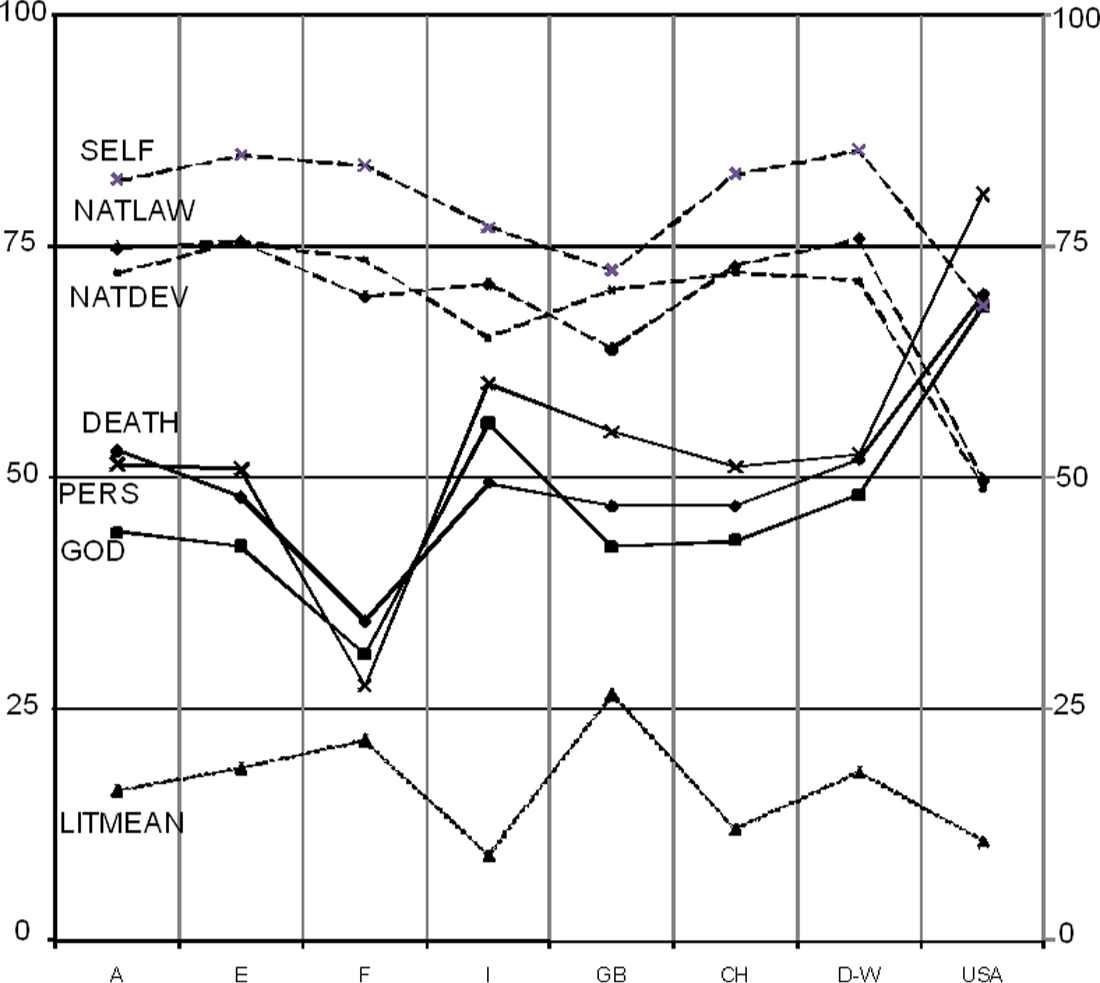
Religious belief will be considered here as to how far it provides answers to the religious question and constitutes a religious worldview. Five worldviews have been surveyed by an inventory first developed in the Netherlands (Felling et al., 1987) which follows an assumed developmental line from religious to secular. They are detailed below, along with the corresponding statements with which respondents had to agree or disagree on a five-point scale.
Theism, the first stage, implies that God has made man and the world and still cares for both, implying that believers can still talk to him by means of prayer. This was measured by the following statement: ‘There is a God who cares about each human being personally’ (PERS). Deism, the second stage, implies that God has made man and the world, but no longer plays an active role in the world. It was measured by two statements: ‘Life only has significance because there is a God’ (GOD). ‘Life has significance because there is something after death’ (DEATH).
The first and the second stages share the assumption of a transcendent reality, a notion that is at the core of religion, but not of the religious question. Each stage finds the meaning of life somewhere beyond this life. Together, they can be labeled transcendent. Transcendent worldviews contrast with immanent ones, which derive an answer to the religious question from immanent processes – the development of the person, the perfection of man’s power over nature, the unification of man and nature, transmigration or metempsychosis. Immanent worldviews do not deny the distinction between immanence and transcendence that is at the core of the religious question, but they do deny the contention that a transcendent world exists – an idea at religion’s core. They respond to the distinction between immanence and transcendence, and to the religious question, by focusing on this world and finding transcendent meaning in immanent processes. One may order such processes according to their relative distance from the self – that is, to the vanishing point of secularization. Natural evolution represents a process beyond the sovereignty of the person; by contrast, a person’s self-realization falls by definition under this sovereignty. Accordingly, a third and fourth worldview can be distinguished: naturalism and existentialism.
Naturalism, the third stage, searches for meaning by conceiving the person to be a part of the evolution of nature. Nature transcends the person, but does not transcend the world. It is an abstract term for everything embracing human existence. In brief, nature is immanent transcendence. The meaning of life slumbers in nature; it has only to be detected. Natural laws not only delimit the potential of the human species, but also can be interpreted as a power indirectly shaping personal existence. Nature is not only fundament, but also firmament. Thus, naturalism competes with theology, ‘nature’ with ‘god.’ This stage was measured by the following two statements: ‘Ultimately our life is determined by the laws of nature’ (NATLAW) and ‘Life is just part of the natural evolution’ (NATDEV).
Existentialism, the fourth stage, searches for meaning in individual self-realization. It derives meaning in life from the life of the person. At first sight, this may seem to be circular, as the question of the meaning of life cannot be answered simply by asserting the existence of life. But it need not be. It is circular if ‘the life of the person’ remains the person as she exists here and now. It is no longer circular if ‘the life of the person’ is seen as a dynamic, ongoing project. The immanence of an individual’s present state is transcended by what that state will become. Meaning is identified with a person’s self-creation according to his own plans. This stage was measured by the following statement: ‘Life only has significance if you make it significant yourself’ (SELF).
Finally, a fifth stage, senselessness, gives a negative answer to the religious question and was measured by the following statement: ‘In my opinion life has little significance’ (LITMEAN).
The means of the seven statements on worldviews in the seven European societies and in the USA are presented in Figure 1. The three transcendent worldviews are depicted by solid lines, the immanent worldviews by broken lines and senselessness by a dotted line.
Religious worldviews in European Societies and the USA: Means.
All European countries share the same order of worldviews: existentialism, naturalism, theism, deism, and senselessness. The ‘implicit belief’ in these explicitly Christian societies is not Christian, not even transcendent, but secular. The USA, however, deviates conspicuously from the western European picture. The theistic item PERS moves to the top; it is followed by the two deistic ones and existentialism, and, by a wide margin, by naturalism and senselessness. The USA ranks first on every transcendent worldview, last on every immanent worldview. Americans’ worldviews are exceptional vis-à-vis Europeans’. In particular, the strong rejection of naturalism echoes America’s reservations regarding evolutionary theory (Berg, 2006: 43; Pew, 2008: 141). Thus, the religiosity hypothesis is confirmed.
Results: Religious practice
Religious practice has been surveyed by ritual observance and, as a precondition of observance, also by self-identification. The rituals one observes as well as the communities one identifies with are either institutions of the Churches or not. Crossing both dimensions yields a four-fold table to classify the six variables surveyed.
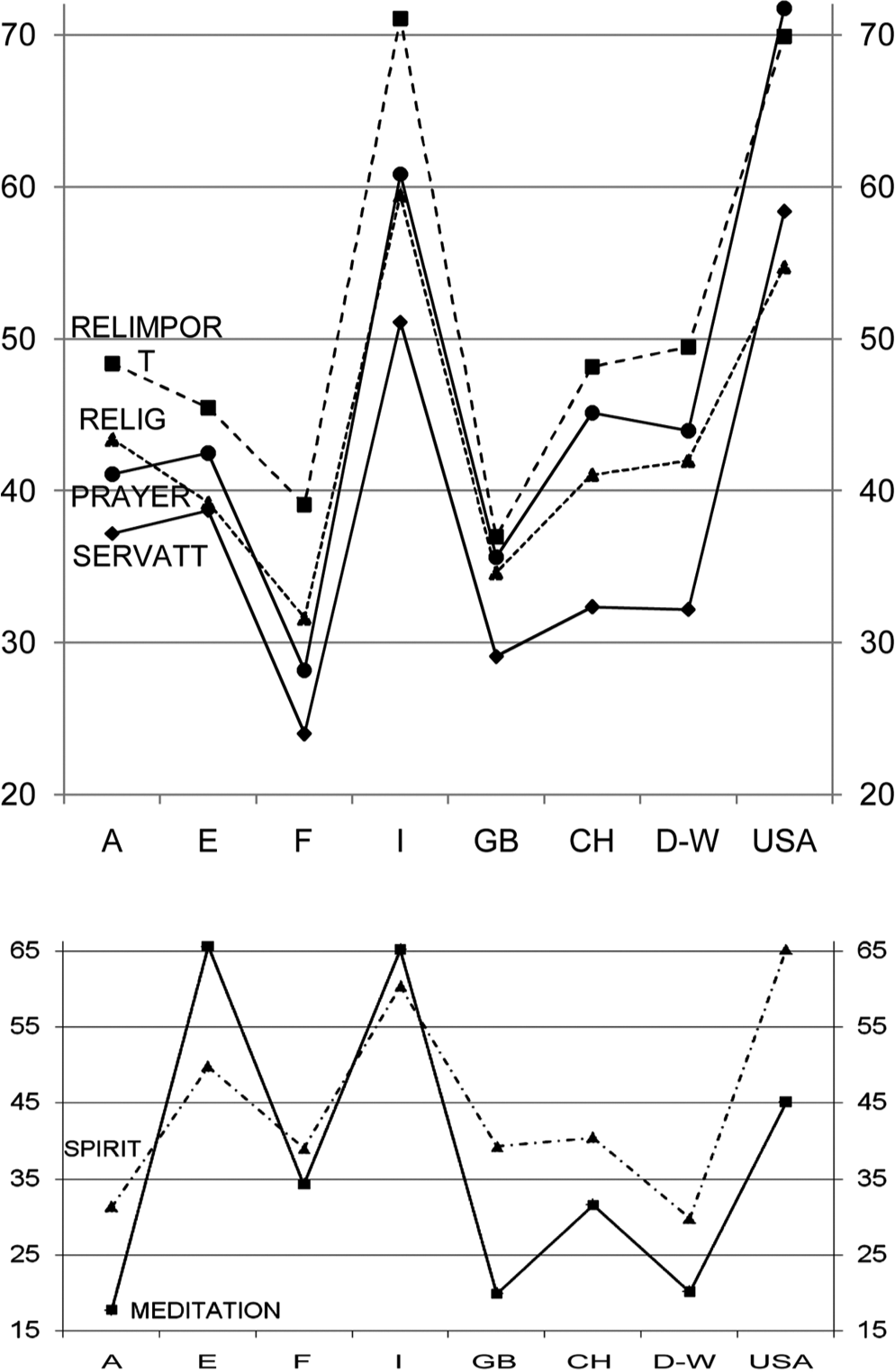
With regard to church rituals, service attendance and prayer were surveyed. Service attendance was ascertained with the following question: ‘How often do you take part in religious services?’ (SERVATT) to which six response options were given. Frequency of prayer was ascertained with the following question: ‘How often do you pray?’ (PRAYER) with eight response options. As for non-church rituals, the question was: ‘How often do you meditate?’ (MEDITATE) with eight response options. As for self-identification with a church, the importance of religion and the self-assessed religiosity were asked with two questions: ‘Please tell me how important is religion to you personally?’ (RELIMPORT) and: ‘All in all, how religious would you consider yourself to be?’ (RELIG). Although both questions do not literally refer to a Church, they are – as confirmatory factor analyses in European countries have shown – understood as referring to church religiosity (Billiet and Welkenhuysen-Gybels, 2004). To both questions five response options were given. As for self-identification with non-church religion, self-assessed spirituality was assessed by means of the question: ‘Putting aside whether or not you would describe yourself as a religious person, how spiritual would you say you are?’ (SPIRIT) to which five response options were given.
The means of the six indicators of religious practice in the seven European societies and in the USA are presented in Figure 2. The four indicators of church religiosity are grouped together in the upper panel, and the two measures of non-church religiosity in the lower panel. Indicators of rituals are represented by solid lines, indicators of self-identification by broken lines.
Religious practice in European societies and the USA: Means.
Looking at church rituals, SERVATT and PRAYER in the USA are higher than in all European countries. Yet Italy comes close to the USA for both indicators, and Spain for PRAYER. Thus, the religiosity hypothesis is confirmed. Looking at Church self-identification, RELIG and RELIMP in Italy and USA are clearly above the other countries, and this time Italy beats the USA on both indicators by a small margin. Again, the religiosity hypothesis is confirmed, but Italy is as exceptional as the USA. Looking at non-church rituals, that is, MEDITATION, the USA comes in only third after Spain and Italy; they are only slightly above the mean between the highest and the lowest European countries – West Germany, Great Britain and Austria. Finally, looking at non-Church self-identification, the USA is again clearly the first on SPIRIT. As for non-church religiosity, the religiosity hypothesis cannot be consistently confirmed.
Looking back on worldviews and on practices, the first face of American exceptionalism surfaces here as well – but only with its customary traits; the less conventional trait, non-church religiosity, however, does not emerge because it lacks consistency in itself.
Results: Dogmatism
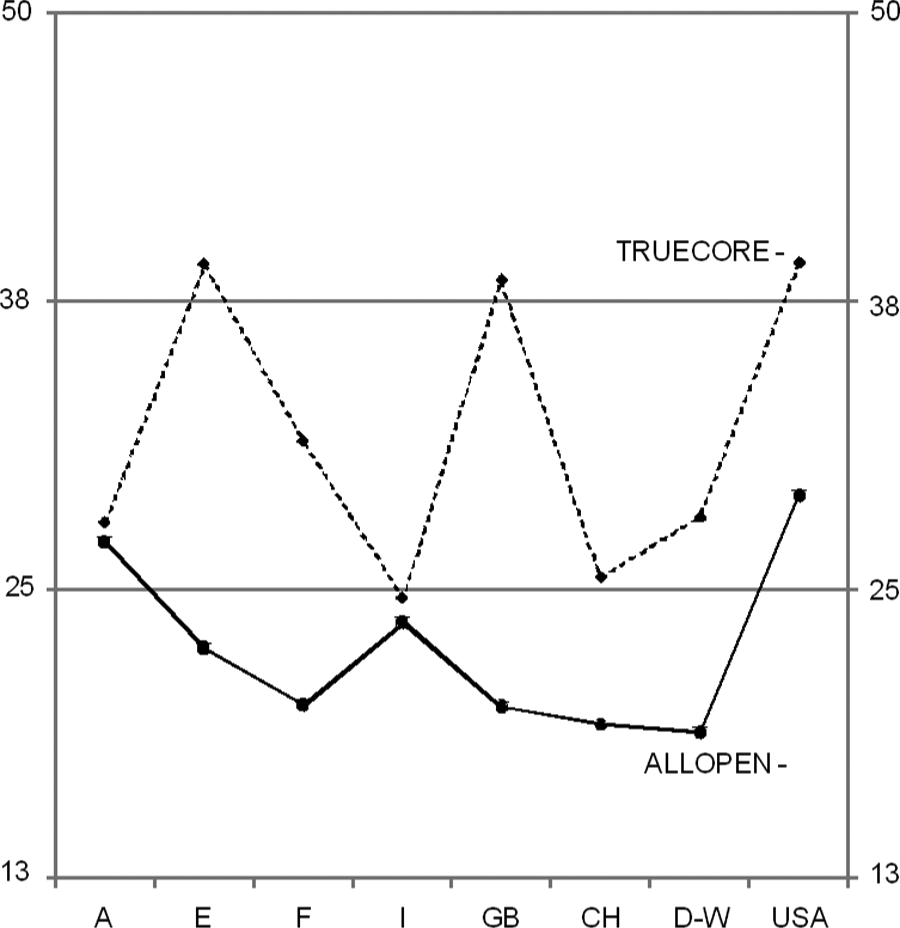
If dogmatism is defined as intolerance of uncertainty, it should imply intolerance of other religions. Therefore, it was measured by two statements on the equivalence of religions which originally (Huber, 2009: 28) were intended to measure religious pluralism: ‘For me every religion has a core of truth’ (TRUECORE) 2 and ‘I believe that one should have an open mind to all religions’ (ALLOPEN) with five response options from ‘totally disagree’ to ‘totally agree’ open for both items. Their distributions are both skewed: 36% of the total sample chose full agreement to TRUECORE, 48% to ALLOPEN. We reverse-coded both items and named the resulting indicators of dogmatism TRUECORE- and ALLOPEN-.
The means of the two statements on dogmatism in the seven European societies and in the USA are presented in Figure 3. As expected, dogmatism in the USA is higher than in all European countries for both items; and given the relatively narrow range of the responses, the differences are substantively significant. However, with regard to TRUECORE-, the differences between the USA and Spain and the USA and Great Britain are minimal. With regard to ALLOPEN-, the difference between the USA and Austria is also minimal. As for the combination of both items, which can be easily drawn by eye, averaging the two lines, the USA ranks higher than every European country. All in all, then, the dogmatism hypothesis is confirmed.
Dogmatism in European societies and the USA: Means.
Factor analyses, index construction and selection of dependent variables
In order to validate the classification of items, factor analyses with orthogonal rotation have been computed.
As for religious worldviews, these yielded three factors with very similar loadings in each of the seven European countries, in all European countries combined, and in the USA. They explained about 75% of the variance and yielded the same factors with the same ordering of the Eigenvalues: one for the theistic and the two deistic items; one for the existentialist and the two naturalistic items; and one for LITMEAN. Accordingly, indices for the transcendent and the immanent worldviews – TRAN and IMMAN – have been constructed. Cronbach’s Alpha for TRAN ranges from .89 in the USA to .80 in Italy, and for IMMAN from .73 in the USA to .56 in France.
As for religious practice, factor analyses grouped the variables according to ‘Church or non-church’ more than to ‘ritual or self-identification.’ Therefore, indices for church religiosity (CHURCH) and for non-church religiosity (NONCHU) were constructed. For CHURCH, Cronbach’s Alpha is .91 in the total sample and ranges from .86 in Switzerland to .91 in Spain; for NONCHU, it is .66 in the total sample and ranges from .52 in Italy to .70 in Austria.
As for dogmatism, we combined the two items, just as Huber and Krech did (2009: 72), into a scale of dogmatism (DOGMAT). Its distribution is still skewed: 28% of the total sample fall in the lowest, that is, most pluralist, category. Cronbach’s Alpha for this scale is satisfactory at .62. From country to country it ranges from .55 in Spain to .76 in the USA.
Using these indices, the American advantage in TRAN (eta = .252) and its disadvantage in IMMAN (.260) as well as its advantage in CHURCH and NONCHU religiosity (.238 and .179) are stronger than its advantage in DOGMAT (.100).
For the following hypotheses tests, the dependent variables will be represented by indices only. Of these, NONCHU, which had low Alpha values and did not show an American advantage consistent over its two indicators, will be dropped. Of the remaining indices, TRAN, IMMAN, and CHURCH will be dealt with in the rest of this section, while DOGMAT is analyzed in the next section. Of the three indices of customary aspects of religion, the two positive ones, TRAN and CHURCH, correlate both strongly and positively (r=.76) with each other and moderately negatively (r=-.24 and -.30) with the negative one, IMMAN. Hypotheses will be stated with reference to the two positive indices; for the negative one, they must be reversed.
Mean comparisons according to religious affiliation
Hypothesis
Religious affiliation pre-conditions a commitment to a specific religious teaching so that the relevance of the religious question is heightened. The mere fact that one’s church, sect or denomination proclaims some dogma on the afterlife and demands compliance to some moral outlook in this life underscores the difference between immanence and transcendence and increases the relevance of the religious question independently from the specific contents of dogma and morals.
However, the impact of belonging should depend on the strength of the commitment it requires. If belonging results from a voluntary choice it implies self-commitment, which will strengthen belief and spur practice. If belonging is a mere self-categorization taken over from parents or milieus it need not have such consequences. As belonging to a sect is much more a matter of voluntary choice than belonging to a Church, its effect should be stronger in sect-like organizations than in mainstream Churches. This leads to the belonging hypothesis: Being affiliated generally increases religiosity, but more strongly so in sects than Churches.
From questions on belonging to a religion and to a ‘Christian denomination,’ seven religious affiliations have been constructed (percentages for the USA and the European sample are given in brackets): CATHolic and orthodox (19.1/56.4), Mainline PROTestant, called ‘Evangelic’ in the report (Bertelsmann-Stiftung, 2009: 717) (20.1/13.8), EVangelical-INDependent (5.2/1.3), PENTECostal and charismatic (4.6/0.3), OTHer CHRistian (23.8/4.2), OTHer RELigions (8.3/3.9), and ‘no religious community’ (18.8/20.2). 3 The capital letters refer to the six dummy variables used in regressions in the next section. CATH and MPROT are Churches established in Europe after the Reformation in which, at least in Europe, one is mostly born into and which provide institutional ways to salvation; PENTEC and EVIND are American formations, which one mostly joins voluntarily and which teach that salvation must be personally attained and cannot be provided by institutional means (Alwin et al., 2006: 536). Therefore, for the sake of brevity the former will be referred to as ‘Churches’, and the latter, together with OTHCHRI and OTHREL, as ‘sects’. Because of the biased selection of countries, Catholics are much more strongly represented in Europe than in the USA while Protestants have a small numerical advantage in the USA. Each sect, however, is more strongly represented in the USA.
Results
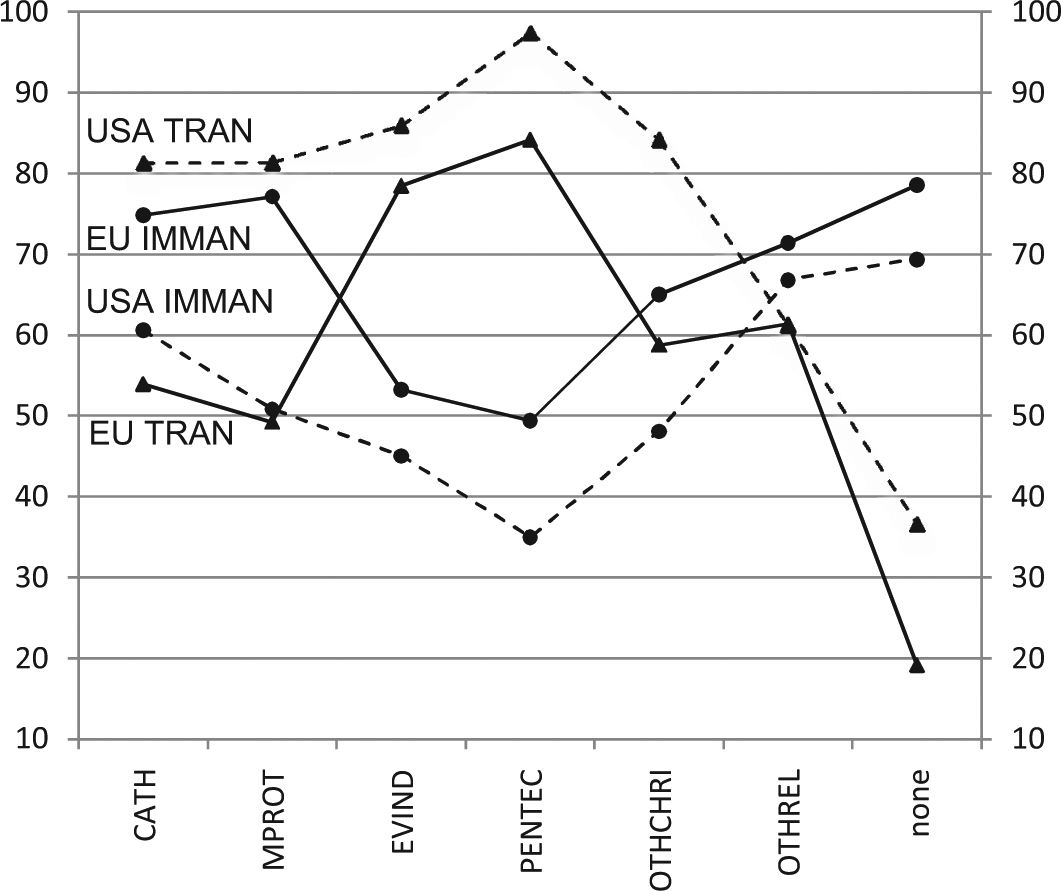
Means of TRAN and IMMAN according to religious affiliation in the USA and in Europe are presented in Figure 4. The USA is presented by dotted lines, Europe by solid lines; at each point, TRAN is presented by triangles, IMMAN by circles.
Transcendent and immanent worldviews according to religious affiliation in European societies and the USA: Means.
As for TRAN, its endorsement is still higher in the USA than in Europe for each affiliation except OTHREL; even those who belong to no congregation more often subscribe to transcendent worldviews in the USA than in Europe. Thus, the religiosity hypothesis holds even under the control of affiliation. Moreover, transcendent worldviews are stronger in the two sects PENTEC and INDEP, and in OTHCHRI and – in Europe only – OTHREL, than in the churches CATH and EVIND and again stronger than among the unaffiliated; and this rank order is very similar in the two samples. Thus, the belonging hypothesis is confirmed.
The difference between the USA and Europe ranges from 32 points for EVAN to zero for OTHREL. The difference between the highest and lowest affiliation – PENTEC and none – amounts to 65 points in the USA and to 61 in Europe. Thus, contrary to often held assumptions (Berger et al., 2008: 29), location determines transcendent worldviews less strongly than affiliation. And affiliations do not matter more in the USA than in Europe. The ranking of religious affiliations according to transcendent worldviews is nearly the same on both sides of the Atlantic. Here and there, religiosity is strongly and similarly molded by institutions. Yet there is one exception. The distance between the USA and Europe is bigger for the two churches CATH and MPROT (and also for OTHCHRI) than for the two sects PENTEC and EVIND. This interaction between location and affiliation can be described from both sides. Either the two Churches become more like the sects they have to compete with in the USA, where the state does not favor them, or the two sects spur their adherents particularly strongly in Europe, where they are disadvantaged by the lack of state support.
As for IMMAN, a complete mirror-image emerges. Its endorsement is lower in the USA than in Europe for each affiliation so that the religiosity hypothesis holds. And it is lower in the two sects PENTEC and INDEP, in OTHCHRI and – in Europe only – OTHREL than in the Churches CATH and MPROT, such that the belonging hypothesis is again confirmed. Again, the American advantage is smaller than the distance between the lowest and highest – PENTEC and none – affiliation. Also, the same interaction between location and affiliation reappears. Additionally, another such interaction crops up. Unaffiliated people support immanent worldviews more strongly than each affiliation except OTHREL in the USA, yet as strongly as CATH and MPROT in Europe. That interaction becomes understandable if one looks at the original, naturalistic and existentialistic, wording of the worldviews grouped together as immanent. The fact that people with other religions endorse immanent worldviews as strongly as the unaffiliated hints at the attractiveness of Hinduism and Buddhism, which attribute religious dignity to the laws and developments of nature. The fact that people with other religions endorse an immanent worldview as strong as Protestants and even Catholics hints at the near-universality and the Protestant roots of existentialism (Meulemann, 2009: 677).
Means of CHURCH and DOGMAT according to religious affiliation in the USA and in Europe are presented in Figure 5. As for CHURCH, the picture very much resembles the one for TRAN. Here, as before, the USA is always ahead of Europe, and the two sects are ahead of all others such that the religiosity hypothesis and the belonging hypothesis are confirmed. Again, the American advantage is smaller than the distance between the lowest and highest affiliation. Again, the distance between the USA and Europe is bigger for the two Churches than for the two sects.
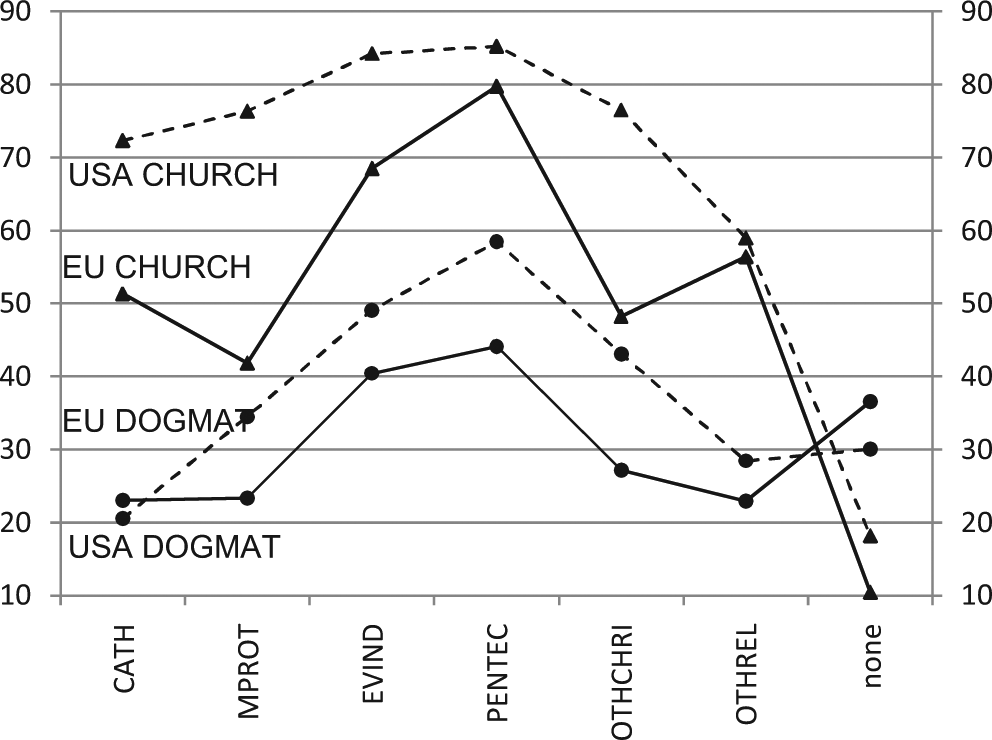
Church practice and dogmatism according to religious affiliation in European societies and the USA: Means.
As for DOGMAT, the picture repeats the one for CHURCH at a lower level, such that the religiosity and belonging hypotheses are again confirmed. 4 Again the American advantage is smaller than the difference between the highest and lowest affiliation, PENTEC and, this time, CATH. Yet there are two exceptions which also deviate from the until now unshaken pattern of American religious exceptionalism. First, the distance between the USA and Europe is no longer greater for the two Churches than for the two sects; Catholics are even minimally less dogmatic in the USA than in Europe. Second, the unaffiliated, rather than being the least dogmatic in both samples, are more dogmatic than CATH and as dogmatic as MPROT and OTHREL in the USA, and more dogmatic than CATH, MPROT, OTHCRI, and OTHREL and almost as dogmatic as the two sects in Europe. Indeed, the unaffiliated are less dogmatic in the USA than in Europe. Because in Europe the Churches did not support democracy and intellectuals have become hostile against them for that reason, being unaffiliated has become a sign not only of indifference but of opposition to the Churches (Anderson 2004: 149), which may have been generalized to a critical attitude against religions per se. Indeed, people might disagree with TRUECORE and ALLOPEN not only because they narrow-mindedly adhere to their one and only true religion, but also because they see fundamental flaws in any religion.
The results of this section can be summarized in two points. First, the religiosity hypothesis is confirmed even if religious affiliation is controlled for – Americans’ religiosity is exceptional regardless of their religious affiliation. This holds for each of the four measures and each of the seven affiliations with a single exception, namely the higher dogmatism of the unaffiliated in Europe. Second, the belonging hypothesis is confirmed. In the USA as well as in Europe, belonging to a sect determines religiosity more strongly than belonging to a Church. This holds for each of the four measures. On both sides of the Atlantic, religious affiliation molds religiosity strongly in the same way – and more strongly than location. The teachings of Churches, sects or denominations matter more than American exceptionality. In particular, the distinction between ‘Churches’ grown out of European history and ‘sects’ developed in America is pervasive. Even after crossing the Atlantic, each keeps its separate impact on religiosity. In spite of historical differences and the ensuing unavoidable partiality of terminology, the distinction remains valid.
Regressing religiosity on location and religious need dispositions
To test the belonging hypothesis by regressions, six dummy variables for religious affiliations (with the unaffiliated as reference category) were used as predictors. As an indirect indicator of belonging, religious socialization was added. Respondents had to choose between ‘Yes’ (78%) and ‘No’ to the question: ‘Has religion been part of your upbringing?’ Accordingly, a dummy variable RELSOC was constructed. Furthermore, religious need dispositions – that is, personal life conditions which alert people to the religious question – will be controlled in the regressions. If religiosity is related to attitude to the religious question, it should increase when the religious question gains relevance. Anything which calls death from back to center stage of everyday life and thus highlights the religious question can be seen as an indicator of a religious need disposition which should increase religiosity.
Hypotheses
First, advances in the life cycle can increase the relevance of the religious question. If the certainty of death is at the root of the religious question, growing old reveals its inexorability and nurtures a religious need disposition. Thus, age should increase religiosity (Norris and Inglehart, 2004: 70, 123; Sullins, 2006: 867; Huber and Krech, 2009: 69; Müller and Pollack, 2009: 412). Age was measured by years and coded as deviation from its mean.
Death gains prominence in everyday life not just with the passing of years, but also with the procreation of new life. Children will bury their parents; they symbolically anticipate their parents’ death and transcend their life horizon. They ‘de-virtualize’ death in everyday life and nurture a religious need disposition. What holds for parenthood should indirectly hold also for any partnership contracted as a pre-condition of parenthood. Thus, parents should be more religious than childless people, and people with a partner more than singles. Parenthood was measured by the number of children (CHILDNR), which ranged from 0 to 7. Also, a dummy variable PARTNER was constructed.
Advances in the life cycle may put death not only in the foreground but also in the background of everyday life. The more someone is devoted to this life, the more death is driven to its periphery so that the religious question becomes less importunate and religious need dispositions lose impetus. The intensity of this life is increased particularly through employment. Thus, employment should decrease religiosity (Sullins, 2006: 867). A dummy variable EMPLOYED was constructed.
Second, transcendent answers to the religious question may be challenged by the secular forces of education and urbanity. Education is geared towards the scientific explanation of this life and conveys explanations of this and the afterlife, which – from the big bang to parallel universes to evolution – compete with religious ones. Although it does not necessarily play down the religious question or diminish religious need dispositions, it may tip the balance from transcendent to immanent answers. Thus, increasing educational levels should decrease religiosity (Sullins, 2006: 867; Huber and Krech, 2009: 67). Education (SCHOOL) has been measured as age when finishing school grouped into three metric classes from 0 to 2. Urbanization (URBAN) provides variety and slackens social control so that, again, the certainty of any answer to the religious question is shaken. Thus, the degree of urbanization of someone’s place of residence should decrease religiosity (Müller and Pollack, 2009: 425). It has been coded from 0 (country village) to 3 (big city) as a metric variable.
Finally, gender was controlled by a dummy variable, MALE. Many studies (Norris and Inglehart, 2004: 123; Sullins, 2006; Huber and Krech, 2009: 67; Berger et al., 2008: 109–113; Müller and Pollack, 2009: 425) have found higher religiosity among women.
Results
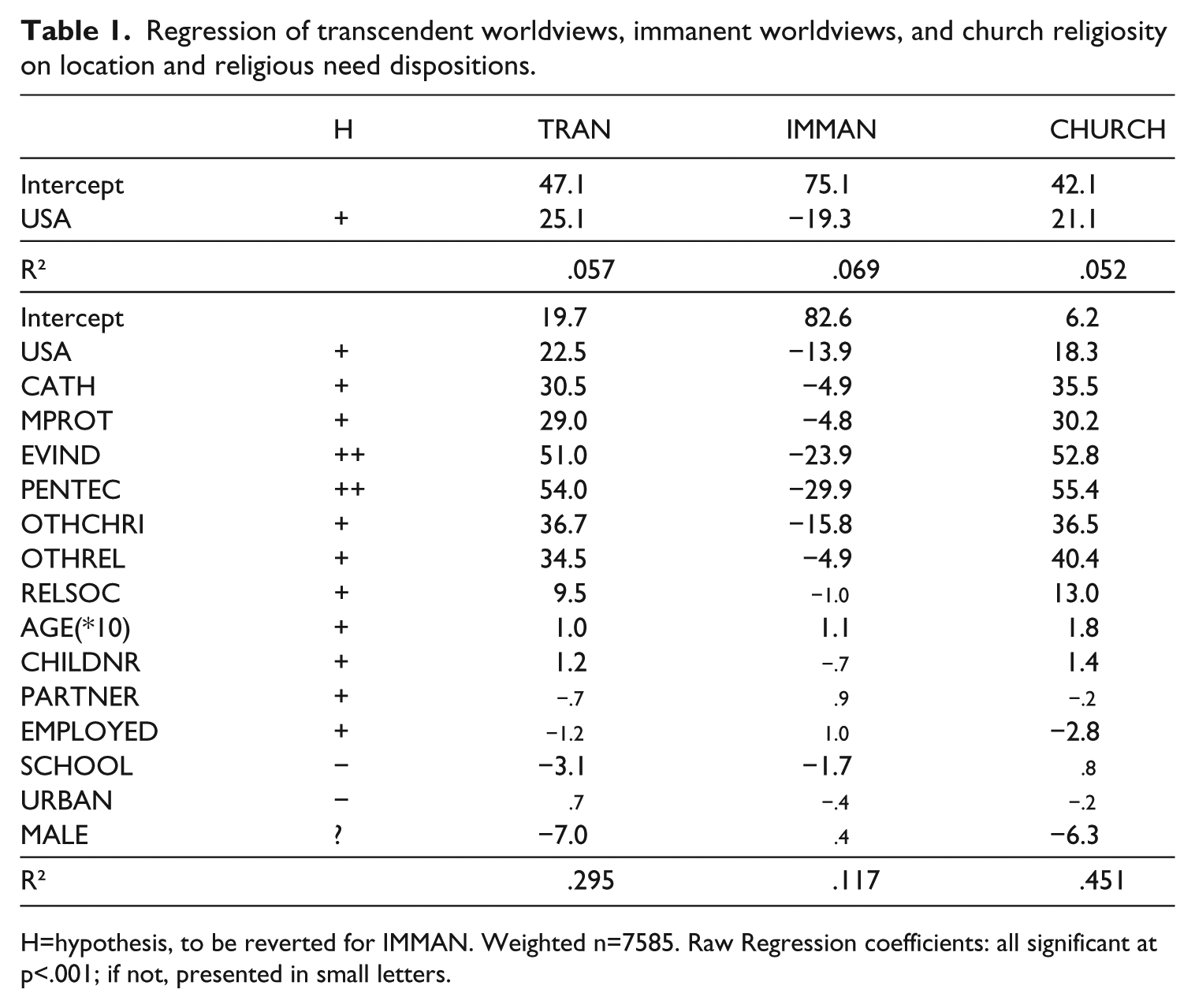
The regressions of TRAN, IMMAN and CHURCH on location – a dummy variable for USA – and religious need dispositions are presented in Table 1.
Regression of transcendent worldviews, immanent worldviews, and church religiosity on location and religious need dispositions.
H=hypothesis, to be reverted for IMMAN. Weighted n=7585. Raw Regression coefficients: all significant at p<.001; if not, presented in small letters.
In the upper panel a regression without controls is presented. Its intercept represents the European mean, and its regression coefficient USA measures by how far the American mean differs from it. The average American’s preference for transcendent worldviews vis-à-vis the average European is stronger than his preference for church religiosity and his distaste for immanent worldviews.
In the lower panel, a regression which controls for religious need dispositions is presented. Now, the American’s preference for transcendent worldviews and church religiosity and her distaste for immanent worldviews is reduced by about 10–20%. Furthermore, being affiliated – in particular with one of the two sects – strengthens religious worldviews and religious practices and weakens immanent worldviews. Also, having been raised religiously strengthens transcendent worldviews and religious practices. Of the remaining religious need dispositions, finally, only parenthood consistently affects all three dependent variables as expected. The other indicators have small or inconsistent effects. Age increases all three, although a negative impact on immanent worldviews was expected. Education weakens transcendent worldviews, but contrary to expectation also immanent ones. Finally, men are less religious than women. Partnership, employment, and urbanization have no effect at all.
As the increase of R2 from the first to the second regression values shows, religious need dispositions strongly determine transcendent worldviews and church religiosity, but only moderately affect immanent worldviews. In particular, belonging to a Church and having been socialized religiously have a much stronger impact on transcendent worldviews and church practice than on immanent worldviews. The Churches have stood strongly in their proper domain – but there alone.
In sum, the religiosity hypothesis is confirmed even when religious need dispositions are controlled for. Yet the size of its effects is reduced. The reduction is due above all to the strong effects of the sects, which are more widespread in the USA than in Europe. Part of America’s exceptionalism hinges on its religious composition. The USA hosts more of those most religiously engaged.
The impact of dogmatism on belief and practice in the USA and Europe
As previously described, the conditions which have strengthened dogmatism in the USA may also have linked it with religiosity. If in the USA conservative positions on the beginning and the end of life have recovered in the public in large part thanks to the support of the religious conservatives, then the traditional forms of religion may have been fused with dogmatism. While the moral and religious conflicts between conservatives and liberals are built up, each side becomes increasingly intolerant of the other (Hunter, 1991: 148–149), such that on both sides religious convictions become more closely connected with dogmatism and dogmatism increases in the total population. Religious people see secular people as being intolerant, and secular people have the same view of religious people (Putnam and Campbell, 2010: 499). In particular, religious conservatives, after they could not sell their ‘normative ware’ in public discourse and political bargaining, had to claim its truth dogmatically (Casanova, 1994: 166). As a matter of fact, the advantage of the highly religious over the non-religious in terms of dogmatism is greatest among all Religionsmonitor countries in the USA (Huber and Krech, 2009: 75) – which implies that dogmatism correlates positively with religiosity. However, if in Europe similar debates had been less fervent and less often religiously tinged, then religiosity might have continued to be not at all or negatively related to dogmatism. This suggests the linkage hypothesis: Transcendent worldviews and church religiosity correlate positively with dogmatism in the USA, and not at all or negatively in Europe.
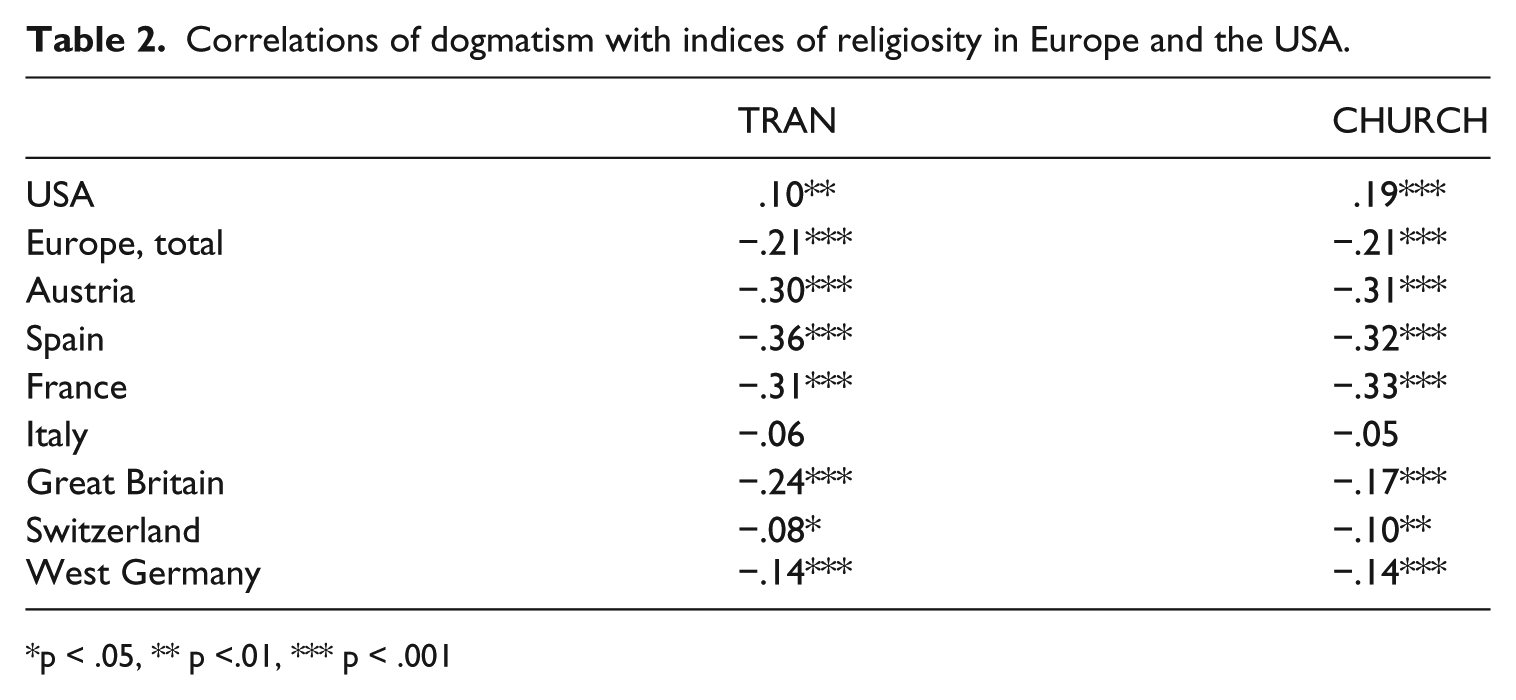
To examine the linkage hypothesis, first simple correlations and second regressions which control for religious need dispositions will be presented. The correlations between dogmatism and the two positive variables of religiosity are given in Table 2.
Correlations of dogmatism with indices of religiosity in Europe and the USA.
p < .05, ** p <.01, *** p < .001
Indeed, dogmatism correlates positively with religiosity in the USA and negatively in Europe as a whole. Using the Fisher transformation, the differences are significant at the 0.01% level. The European pattern re-appears in each European country – except in Italy. Thus, the linkage hypothesis is confirmed.
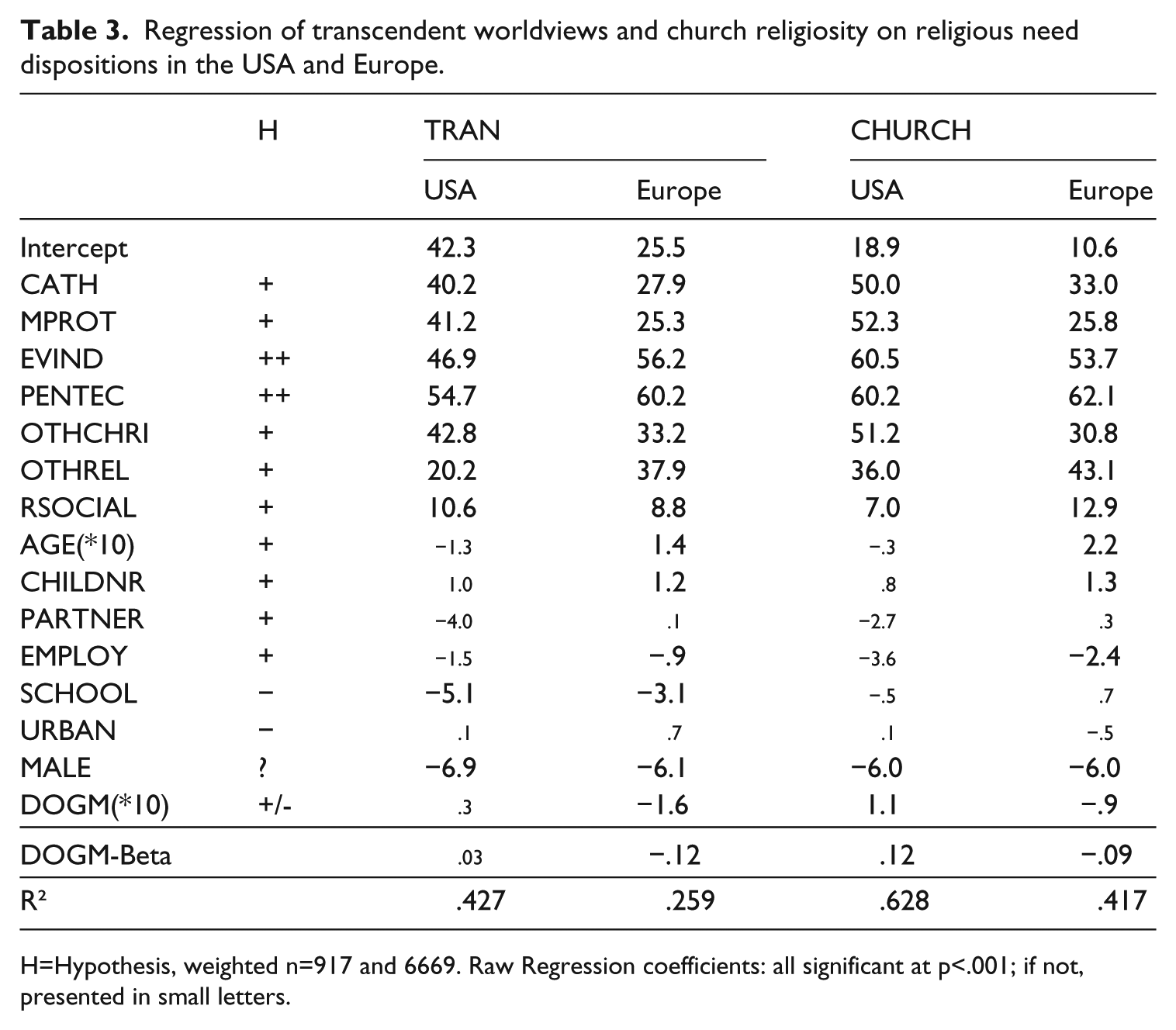
The regressions of the two positive variables of religiosity on religious need dispositions in the USA and in Europe are presented in Table 3. As the regression coefficients show, they most strongly depend on religious affiliation on both sides of the Atlantic. A look back at Figures 4 and 5 shows that the rank order of the regression coefficients reproduces the rank order of the distances between the means of each denominational affiliation and the unaffiliated. Thus, the belonging hypothesis is confirmed even when controlling for religious need dispositions. Also, the interaction effect between sample and affiliation visible in Figures 4 and 5 persists under the controls – the two Churches are less far behind the two sects in the USA, where Churches, sects, and denominations have to compete, than in Europe, where the Churches are privileged. Additionally, religious socialization increases the positive pole of religiosity on both sides of the Atlantic. As for the remaining predictors, men are less religious than women on both measures in both locations. But apart from that, there are only small and inconsistent effects. Once the institutional imprinting is controlled for, religiosity mirrors religious need dispositions but only faintly. As the R2 values reveal, both measures of religiosity are better explained in the USA than in Europe. This reflects the fact that the two sects as well as OTHCHRI, which have the strongest effects, are also strongly represented in the USA, while the two Churches, which have only small effects, are strongly represented in Europe.
Regression of transcendent worldviews and church religiosity on religious need dispositions in the USA and Europe.
H=Hypothesis, weighted n=917 and 6669. Raw Regression coefficients: all significant at p<.001; if not, presented in small letters.
In sum, the linkage hypothesis is confirmed even when religious need dispositions are controlled for. The positive impacts of dogmatism in the USA and the negative impacts of dogmatism in Europe persist, although they lose significance in one case. The comparison of the standardized (beta) coefficients of DOGM additionally presented at the bottom of Table 3 with the correlation coefficients in the first two lines of Table 2, shows that roughly half of these impacts are taken over by religious affiliation and religious need dispositions.
The opposition of effects found in the case of dogmatism does not reappear for any other predictor of religiosity. The strong institutional imprinting of religiosity by religious affiliation and its dim reflection of religious need dispositions is the same on both sides of the Atlantic, but the recent growth of fundamentalism has infused some grains of dogmatism into religiosity in the USA, while the two remain antithetical in Europe. America is exceptional as to the impact of dogmatism on religiosity, but not as to other impacts.
Conclusion
The answer to both questions of this research is positive. In the USA, belief and practices as well as dogmatism are stronger, and dogmatism is more strongly fused with traditional religiosity than in Europe. Moreover, religious affiliation more strongly determines belief, practice and dogmatism than living on either side of the Atlantic. Evangelicals and Pentecostals are more believing and observing, and also more dogmatic than Catholics and mainline Protestants – and the gap between religious affiliations is bigger than the gap between the continents. The distinction between European Churches and American sects can be validly used across the Atlantic to describe current differences in religiosity. Yet there are more Evangelicals and Pentecostals in the USA than in Europe. Thus, American religious exceptionalism more strongly reflects distributional differences than cultural or constitutional peculiarities on either side.
Footnotes
Funding
This research received no specific grant from any funding agency in the public, commercial, or not-for-profit sectors.
Notes
Author biography
Address: Forschungsinstitut für Soziologie, Universität zu Köln, Greinstraße 2, D-50939 Köln, Germany.
Email: