




Abstract
A majority of scholars agree that late-modern religiosity is characterized by ‘privatization’, particularly in Western Europe. However, even a general picture reveals that the privatization thesis is both verified and contradicted by aspects of the European religious scene. Particularly, since religion de facto is a social phenomenon, what is the meaning of a community to an individual with privatized religiosity? This is the focus of the author. The data include 17 in-depth interviews, which were analyzed with grounded theory methodology. The analysis generates a novel authenticity model of individual−church relations which consists of the interplay between three elements: experiences (especially rites, traditions, and emotions), values (both expectations of the church and personal values in relation to the church), and truth (frameworks for reflection, supply of religious activities, clear standpoints, and space for individuality) – as well as authenticity, which is present in all three.
Introduction: European religiosity urges research on the meaning of a community
Empty churches during masses but great interest in spiritual matters. Fewer members of majority Churches but strong trust in the welfare services provided by them. These paradoxes describe the religious scene in many Western countries in late-modernity, particularly in Western Europe. Secularization is a general concept, with its numerous connotations and definitions, that cannot be used to describe this phenomenon in a way that scholars would agree on. However, a majority of scholars agree that the privatization of religiosity – be it understood as a sub-species of secularization or as a mode of religious transformation – describes it better. This process of privatization, by which religion moves into the private sphere of life, refers to the process of religiosity becoming both more subjective and less of a public political role for religion and the Churches (Bruce, 2002; Dobbelaere, 2000, 2002; Martin, 2005; Sommerville, 1998). Religion in late-modernity has increasingly become an arena of individual choice (Dobbelaere, 2002: 173). Personal spiritual experience and personal truth is emphasized, even in institutional religions (Heelas and Woodhead, 2005; Roof, 1993). Choice is what matters in late-modernity since even if one chooses to stick to more traditional forms, a choice has been made by the person her/himself.
Even so, too little is known. A general picture reveals that the privatization thesis is both verified and contradicted by aspects of the European religious scene. Traditional majority Church membership rates and participation in their activities are declining in most countries of Europe. At the same time, there is religious vitality in both the private and the public spheres. Even if individuals participate less in public forms of religiosity (such as the mass), religion has been unexpectedly prominent in public debate during the last two decades (Davie, 2006) over such issues as the role of majority Churches in providing welfare and combating social problems (see Davie and Bäckström, 2010; Pessi, 2008). In the private sphere, about half of Europeans pray or meditate at least once a week and three out of four say they are religious. People’s interest in pondering the meaning of life and its spiritual dimensions has also increased. (European Values study, Religion, 2009; Heelas and Woodhead, 2005). All in all, even looking only at Western Europe, privatized religiosity genuinely seems a multifaceted phenomenon. Particularly, however, since religion de facto is a social phenomenon 1 , what is the meaning of a community to an individual with privatized religiosity?
In late-modernity, not only the relation of the individual to religious institutions but also overall individual–community relations are changing in European and other Western countries. Present-day belonging is based on communicative processes rather than traditional institutional spaces and cultural structures. Individuals now have multiple and overlapping bonds which may lack continuity. Just as traditional communities were characterized by locality, stability, continuity, and borders, today’s communities are by contrast discontinuous, open, and individualized (Delanty, 2003: 187). Communities have certainly not vanished. At the same time, however, simple dichotomies – such as individualism vs. collectivism – are not sufficient to describe the current significance of communities to individuals.
Little research, however, exists exactly on individual–community relations in late-modern religiosity, particularly on the fascinating case of privatized European religiosity. We do have some studies, particularly concerning religiosity and communality, togetherness, and cohesion, but most research applies only to particular groups, and often in a US context, such as academics (Anderson, 1968) and college students (Cukur, de Guzman and Carlo, 2004). Recent empirical survey research indicates that the majority of Europeans adhere to fuzzy fidelity, since they are not really characterized by either religiosity or non-religiosity (e.g. Voas, 2009). Recent qualitative studies (e.g. by Collins, 2008; Eccles, 2008) have also illustrated that the individual and the social, the religious and the secular, form continuums and cannot be completely separated in analysis. Eccles’s study on British women’s religiosity, for instance, indicates a continuum from completely non-subjectivized to subjectivized belief. All in all, dichotomies such as practicing versus non-practicing no longer describe the religiosity of Europeans (Davie, 2006: 284), just as individualism and collectivism are not adequate to describe their relation to communities. Privatized religiosity thus remains a fascinating topic for research. It is not sufficient – even if interesting – to note that religion is privatized or that it is related not only to collectivism but also to individualism (e.g. Ketola, 2003). A particularly fascinating element of privatized religiosity is the element that is assumed, by definition, to be the weakest: the individual’s relation to a religious community. This is the focus of this article. 2
The case of ‘fuzzies’: Data, methods, and grounded theory analysis
This article focuses on the individual’s relation to a religious community – and more specifically the meaning of a religious community to individuals with privatized religiosity. Its concern is thus the community meanings of privatized religiosity, not privatized religiosity per se, nor membership of a religious community per se.
The meanings of a religious community have been investigated by interviewing individuals who are members of religious communities, but passive ones, in a country whose religious scene is dominated by a traditional European majority Church, the Lutheran Church of Finland. Finland represents a particularly interesting Western European case for a study of late-modern privatized religiosity. In comparison with the rest of Europe, Finland is a very strong example of active private religiosity (e.g. prayer) and of the most passive religious participation (e.g. going to church). Still, two out of three Finns consider themselves religious whether or not they go to church, and a majority thinks that ‘there is a personal God’. In addition, 80% belong to the Evangelical Lutheran Church and two-thirds (63%) trust it (Kääriäinen et al., 2008). Furthermore, Finns, together with other Nordic people, have in recent survey research been found to include a higher proportion of ‘fuzzies’ (people between religious and non-religious), particularly individuals who belong without believing (Storm, 2009: 713). What is the actual meaning of a religious community felt to be – a community Finns belong to and trust, but whose activities they very seldom participate in?
The original data of this article included 25 in-depth interviews 3 , lasting 26 hours 22 minutes in all (the average being 63 minutes) and yielding 287 pages of transcribed text. As this study concerns privatized religiosity and the meaning of a religious community to an individual, both interviewees not belonging to a religious community and religiously very active individuals were omitted from the data. The final data then consists of 17 interviewees: ten women and seven men. Fifteen are members of the Evangelical Lutheran Church, and two of the Pentecostal Church. Their age varies, five being between 19 and 30, five 31–40, four 51–60, and three 61–78 years old.
Grounded theory methodology, developed by Glaser and Strauss in the 1960s in sociology as a reaction to the deductive research tradition, was utilized in the analysis. The aim of this method is to produce a theory based on empirical data (Glaser and Strauss, 1967: 2–3). The basic idea is to compare data-based categories and their parts against each other, to integrate these categories, and then to write a theory based on all of this; that is, to compare materials and to make internal generalizations based on them. Attention is directed especially to divergent cases. Grounded theory applies particularly well to topics on which we have little information or on which we wish to have novel insight and perspective – as in this study. In this study, the Straussian inductive-deductive approach was chosen; we can never be free from our assumptions, concepts, and theoretical views but we can attempt to investigate the empirical data with open eyes and ears and with creativity. Conducting analysis and (later on) relating to previous theories (whilst already developing the model) can thus be presented as a concise dialogue.
In the grounded model, phenomena are thought to be not static but changing, and the purpose is to process this dynamic change into a theory. The analysis process of grounded theory can be described as comprising three stages (Strauss and Corbin, 1990). First, in open coding the materials are named and categorized freely. The present analysis was concerned with identifying, naming, categorizing, and describing the phenomena relating to the meaning of a religious community as a whole. This process of forming concepts took place along with the data collection; in grounded theory methodology, the gathering and analysis of materials are simultaneous processes. All in all, analysis moved from hundreds of codes (even very small ones, e.g. ‘emotion’, ‘Bible’) towards dozens of concepts and categories (somewhat larger ones, e.g. ‘rites’). 4
Second, axial coding analyzes the relationships between categories, the focus being on the process of relating categories and sub-categories to each other via both inductive and deductive thinking. In this phase, various main categories were tried and tested, alongside further data collection. Similarly, the phases of analysis were not completely separate from each other in practice. At the very end, the three main categories of experiences, values, and truth emerged, describing the entire data and the core phenomenon of the meaning of a religious community to an individual.
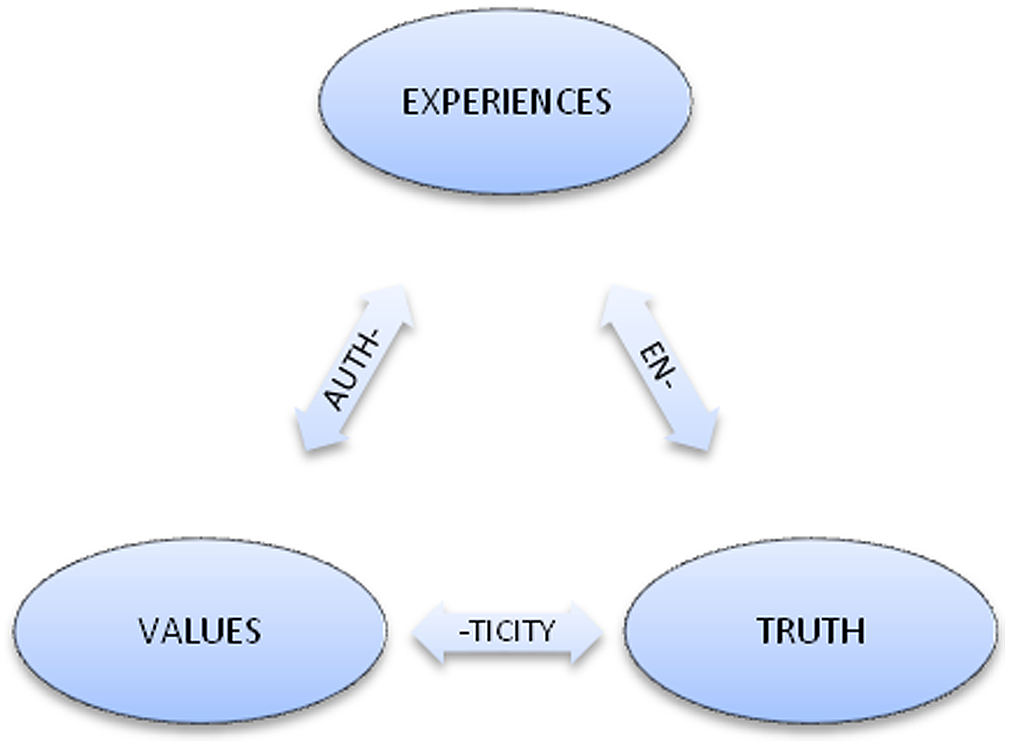
The authenticity model of individual−church relations
Third, selective coding specifies the categories and unravels their relationships to the end. One larger, wider category is chosen as the core category and all other categories are related to it. This is the stage at which a new theory (I call this a model in my study) based on the data is produced. In the present analysis, the core category centered on the concept of authenticity, since the focus of individual-level meanings in all three main categories of data is on searching, considering, and consistency on the one hand, and personal, genuine originality and uniqueness on the other. The core concept and its main categories were then developed by theoretical integration (i.e. dialogue with previous writings and theories, as shown below in Conclusions). This was useful not only for reflection but also to test the category of authenticity and the model being constructed.
In the event, the analysis did produce a new model: the authenticity model of individual−church relations. This model consists of three premises constituting the core of authenticity as illustrated above.
Here individual–church relation refers particularly to the meanings of a religious community for the individual, and the concept of church is used because most of the interviewees are members of a majority Church.
Findings
On experiences
Experiences was chosen as one of the main categories in the analysis as it covers several primary elements of the meaning of a religious community arising from the data: rites, traditions, and emotions. Sociologists have by and large ceded the study of religious experiences to other disciplines – partly due to the emphasis on their individual and noncognitive aspects (Bender, 2007: 204–205). A classic definition of religious experience by William James is as follows: ‘feelings, acts, and experiences of individual men in their solitude, so far as they apprehend themselves to stand in relation to whatever they may consider the divine’ (James, 1982: 31). The focus of this study, however, is narrower: the analysis includes religious experiences as they relate to the interviewees’ relation to their religious communities, the focus of this study. More precisely, these included numerous elements related to religious communities’ rites and traditions, as well as to the emotions they (not only they but particularly they) evoke. Moreover, the interviewees in most cases described these elements particularly as religious experiences.
All interviewees, even if religiously passive, found religious traditions – particularly the annual celebrations, the feasts which form part of the liturgical year – meaningful and emotional. As experiences, they are considered ‘kind of tranquilizing’ (M 32 Lut.) and they awake various emotions, often strong ones:
‘I think Easter time in the church is wonderful. There is, for example, Good Friday, when the feeling is very gloomy and grim and that I find so great!’ (F 23 Lut.)
‘Emotional occasions like the Christmas service. The best part is the atmosphere and the organ playing and the hymns. I personally get the spiritual message from the atmosphere.’ (F 59 Lut.)
As is apparent in these quotations, events such as the Christmas season especially (such as church 5 singing with a large number of people) are considered great emotional experiences, often of the sacred. However, seasonal celebrations and traditions – and particularly their connections to religiosity and church – also provoked mixed emotions. On the one hand, they are seen as a holiday time in which religiosity is not apparent. For instance, ‘You don’t really think [of Christmas] as a Christian thing, so to speak. Maybe one thinks of it more as a vacation’ (M 24 Lut.). On the other hand, many interviewees criticized the commerciality of Christmas and were vexed about the way Christianity is ‘not sufficiently visible’ (F 54 Lut.) in the celebrations of their own family. They feel that their own ideals and behavior are in an inauthentic relation.
Furthermore, not only the church’s seasonal traditions but likewise the church’s rites and traditions related to the course of life are appreciated and regarded with enthusiasm. Interviewees speak of their own often very emotional experiences, which are positive, without exception. Interviewees also note how rites and traditions, such as confirmation school, reach individuals generally: ‘Well, there are good ideas in the church. And as I said, there are good values. And again the church does very good things. For example, a confirmation school is in my opinion a very worthy thing. So in that respect the church reaches a whole lot of people, or almost everybody.’ (M 24 Lut.) One way in which people are drawn closer to church during memorable traditions and rites is the contact with church workers; for some interviewees these had been a surprisingly positive experience.
Interviewees hoped the church would emphasize the role not only of rites and traditions but also of experiences and emotions more in the future; for instance, religious education in schools: ‘to read the newspaper for a blind person. Such projects, campaigns, more drive for religious education, that would be a good idea!’ (F 27 Lut.). Overall, it is not always even significant which religious community provides the spiritual emotion-provoking experiences of the sacred: ‘Experiences are good – say, a concert’ (M 32 Pent.) notes a member of the Pentecostal Church when asked if he wants anything from the majority Lutheran Church. It is, however, considered significant that the feelings and experiences be genuine and authentic – both the way they are experienced by the individual and the way they are offered by religious communities.
All in all, traditions and rites – and particularly the strong emotions they may evoke – are indeed personal experiences in relation to religious communities. Such experiences maintain the relationship to a religious community, even if only in the minimal sense of not resigning church membership: ‘No. I have never thought about it [resigning from the church] and neither has my husband, like well, I don’t really fancy paying [church] taxes and all, but then I think that when it comes to that, I want to be blessed for burial in that church’ (F 78 Lut.). Most of the elements related to experiences are seldom apparent. They are not parts of the everyday lives of these individuals; their religiosity is de facto privatized. Moreover, experiences and emotions are difficult to articulate – they are often beyond words: ‘Q: Why do you think you are a Lutheran? A: Well, it’s hard to say anything other than it just feels right’ (M 65 Lut.).
On values
In the social sciences, values are often referred to by cognate terms (such as needs or desires). On the basis of a literature review, van Deth and Scarbrough (1995: 46) conclude that values can be seen as ‘conceptions of the desirable which are not directly observable but are evident in moral discourse and relevant to the formulation of attitudes’. Values are distinguished from mere wishes by their normativity: a value is a wish that one considers justified and moral (Schwartz, 1992; van Deth and Scarbrough, 1995). Since this was also apparent in this data, values was chosen as one of the three main categories to refer to expectations, views, and experiences concerning a religious community’s values as well as the interviewees’ own values, as long as these were linked to their relation to their religious community (the core of this study). Both these aspects are covered next, in their own sections.
Expectations of the church: acts of helping, words of justice
In their experiences of the meaning of a religious community, interviewees strongly underscored their appreciation of acts of helping, especially by the Evangelical Lutheran Church. A central message arising from the data is that the church’s helping activities are expected to be strong, visible and unprompted; there are all in all very high expectations of the church. The interviewees also felt strongly that the church should inform people better and more often about the various forms its social work takes. Helping activities are sometimes even seen as the primary function of the church; ‘In my opinion the purpose of the congregation is philanthropy’ (F 59 Lut.).
But does this really reveal something about their individualized religiosity and their relation to their religious community, its meaning for them? Indeed, appreciation of helping seems to be a crucial part of privatized religiosity: welfare activities are considered to be the most important, or one of the most important, of all church activities, even if most of the interviewees have no personal experience of them. For many, the personal significance of a religious community is indeed the altruistic values of the church. Acts of helping may even be precisely the reason to pay church tax and to remain a member:
I no longer think that it [resigning from the church] was right; some time ago I thought about it a lot. Every now and then I thought about it, but I really have now decided that I do want to be a member of the church and I am, even if [it’s only] because of the good values they are promoting. And because of all the good work that the church is doing. (M 24 Lut.)
Furthermore, interviewees themselves also spontaneously wondered whether welfare acts by the church may be a route for the church to gain a wider audience:
… there is a message of loving one’s neighbor and helping in that [the church’s acts of helping, social work, etc.]. Not that that [the church’s] law and gospel should be preached in everything but you can see it as, like, getting people acquainted with the church workers, so maybe they will also come to church and listen. (F 23 Lut.)
Throughout the data, the expectations of the church’s helping activities and social work also remain high in the sense that the church is expected to be a mediator that knows other organizations and help-providers and guides individuals to the right places. Some of the interviewees also noted that if they needed help, the church would be the institution they would hope to guide them to the right place:
If I only have something and I want to unburden myself, of course I should seek, like, some professional counseling. And that is of course expensive and so, so maybe it’s, like, easier to turn to some church person, who can tell, who can guide me. (F 27 Lut.)
This quotation also illustrates a common trend in the data: the threshold for seeking help from the church may be lower than with other helping agents. Most interviewees see the church as a less bureaucratic and more flexible helper than, for example, public sector agencies. The interviewee continues:
The church is less performance-orientated and more time-giving. I feel like church people are maybe somewhat more approachable because they have, like, a such … like, human dignity is a vital part of their work – one can get better service from the church. (F 27 Lut.)
However, it must be noted that even though a clear majority of interviewees had high expectations and appreciation of help from religious communities, this does not apply to all. There were a couple of interviewees in the data who saw helping as the responsibility of other actors, especially the public sector. They thought the church should help people only via discussion, chatting, offering somebody to talk to. For instance, for the elderly ‘the church should not take care of practical matters but, for example, arrange home communions’ (M 35 Lut.). In these cases, the meaning of and the expectation concerning the church are primarily spiritual.
Still, even among these interviewees the appreciation of helping is particularly apparent in their expectation that the church will talk about helping and justice. Indeed, all interviewees greatly appreciated actions by religious communities, particularly the majority Churches, as a voice for justice and altruistic values; for instance, active discussion of justice as well as the values of corporate life. There was also hope that this would be a rising trend in religious communities. Such vanguard battles for justice were seen as urgent during the current ‘time and values of selfishness’ (F 27 Lut.). Religious communities, and specifically the church, were also expected to set an example here: ‘The church could act as a voice, a mouthpiece for caring so that people would wake themselves up. Surely they could be more visible out there?’ (F 53 Lut.). For many, this – like the acts of helping – was a central reason for paying church tax, and thus maintaining a continuous bond with the church community.
All in all, the church is required to be and claimed to be an institution upholding the intrinsic and absolute value of caring, and is respected for this. The acts and words of altruism and justice by religious institutions are seen as a countervailing force against harsh values, competition, and injustice. This may further promote the trust of individuals in religious communities as institutions. Furthermore, a thread running through the entire data is that acts and words should always coincide; deeds particularly – whether churches offer welfare assistance or not – should conform with words.
Church values versus personal values
The interviewees sometimes also reflected church values in their personal ones. As the focus of this study is the meaning of a community in religiosity, these elements are indeed of great interest. However, for the same reason, the analysis does not include interviewees pondering their personal values per se.
Discussion on church values versus personal values most often concerned the themes of helping and justice. Many of the interviewees emphasized the fact that values – particularly that of altruism – are built into all church activities. In their view, this separates the church from all other actors, like municipalities, making the church a unique institution. One interviewee commented that:
They [people in the church] have this written background ideology and Bible on which they can build all that helping work. Well, of course, public helpers have some laws, but that’s a little different, so in that respect they differ. So in principle the message of the Bible is there in the background. (M 24 Lut.)
Moreover, as already noted, religious communities were seen to specifically represent the value of love for one’s neighbor, helping, caring – all values respected by the interviewees:
In my opinion the church promotes – although it’s a massive institution and that’s why you cannot really feel it’s really your own – the church promotes, the values it promotes are in my opinion really good. In that sense it’s really a good thing, and in my opinion needed, that it promotes such positive values like caring for your neighbor in a not-so-caring society. Without it society would probably be a somewhat colder place. (M 24 Lut.)
The interviewee here contrasts the values of the church with his experience of being distanced from it: the values of the church are appreciated and considered needed even if ‘you cannot really feel [the church is] really your own’.
At an even deeper level than appreciation, some of the interviewees indicated that they had been able to build their personal values from what the church offers. For them, the church values were ‘the basic life philosophy’ (M 32 Lut.), ‘the basic values – a guideline’ (F 27 Lut.). Thus, it is not only that people appreciate church values but that these are experienced as personally meaningful. Thus, like-minded people may also be found in religious communities:
So, since the feeling of community is a relatively important value to you, do you feel a sense of community with your own parish?
Well, maybe not my parish. However, in a certain way certainly with the people who are in the church, or I’d hope that there would perhaps be like-minded people there, like, with respect to values. That they also care about other people. (F 27 Lut.)
Interestingly, this positive statement comes from a young lady who does not have any particular connection with her parish; she is speaking hypothetically. But this quotation does indeed illustrate her image of the church and her expectations of it. Furthermore, it shows that it is again particularly the values of helping and caring that are considered meaningful in the church.
On truth
Truth has six classical usages: fidelity or constancy (e.g. sincerity in action, character); the state of being the case (fact); the body of real things, events (actuality); a transcendent fundamental or spiritual reality (judgment, proposition, or idea that is true or accepted as true); the property (as of a statement) of being in accord with fact, fidelity to an original or to a standard (true); and, sixth, God (Merriam-Webster Dictionary). Religious institutions have traditionally been contexts of the last-mentioned as well as places that offer views and words of truth, particularly in this sense of ‘transcendent fundamental or spiritual reality’. In this analysis of interviewees’ experiences of the meaning of a religious community, however, various other themes also arose that can usefully be gathered under the main category of truth: frameworks for pondering and discussion, supply of religious activities, clear ethical standpoints, and space and flexibility.
The youngest and the oldest interviewees in particular said they like to discuss religious matters and spiritual issues with their immediate relatives and friends. They saw religious communities as like mirrors – a framework, although a fairly distant one, for their own reflections and pondering about such questions as truth, values, and spirituality. That is, religious communities are needed to offer frameworks for discussion and pondering of facts, actuality, and fidelity – to use the dictionary terms. Some of the interviewees underscored their conviction that the church would offer them a dialogue and discussion partner, if they ever needed to or wished to reflect upon these matters with someone: ‘If I wanted to discuss something, like, thoroughly [in the church] then that’s going to be OK and here it is kinda like … and there are pastors who are, like, ready to discuss and [who understand] pretty sort of broadly about many things’ (F 40 Lut.). Thus, privatized religiosity notwithstanding, the church still seems to be the institution – if any – that is used as a framework for one’s ruminations on spiritual issues. The data also shows examples of how the feeling of community in relation to a religious community and hope for both discussion and support might be available at a time of crisis.
Furthermore, all the interviewees, with their privatized religiosity, still emphasize the fact that religious activities must be arranged; religious supply must be offered. This experience is linked with the idea above that if needed, there should be someone to talk to in the church, a community to belong to, activities in which to participate:
At the moment there is probably hardly anywhere, nowhere [I feel a sense of community]. But I do think it’s good to have, like, a spiritual home, where … or a kind of religious group. In the background. I know I have experienced that. But maybe not just at this very moment; I have no such a place. But it is necessary for it to be there. (F 24 Pent.)
Deeply essential, and also closely connected to this ‘if I need it’ feeling is the fact that religious communities offer space for individualistic, privatized religiosity. This may be apparent, for instance, in open discussion on truth(s) and on ethics: people want to have flexibility from the church to form their own views. One interviewee noted: ‘I’m more of a private person in this respect [religiosity]. In the Lutheran church that is possible’ (M 65 Lut.). Indeed, religious communities are seen as supporting one’s religiosity by giving space for it:
The church really emphasizes that each and every one must make certain choices, and that you find answers. And you can find people in the church who are ready to discuss with you so that you can find the answers yourself – there is room for individualism. And then there are a lot of strong views in the church – it’s a huge and stiff organization, but, like, it’s changing in time, with time. They do sort of understand individuals there. I don’t feel like it would be a threat, like they wouldn’t understand my views. (F 27 Lut.)
As this quotation shows, interviewees have noted a recent change in the church, which has become more space-offering and more flexible. Some even noted that the church needs an image campaign, a PR campaign to reveal to all citizens how positively it offers space for individuality and individual choice.
All in all, the picture is two-sided: at the same time as individuals want to have space, they also long for clear mirrors and reflection points for their own pondering. Most interviewees urged the church to have clear standpoints on various issues, particularly ethical. In their view, religious communities should have unambiguous stances, a coherent doctrine. They noted that the church’s theological debates (related to, for instance, women priests and homosexuals) between different, often extreme, views distance them from the church. There is thus a clear overall expectation of coherence, a common policy. The internal theological arguments of the church are pushing people further from the church community. To use the dictionary concepts, more constancy and sincerity are desired, as mentioned earlier in this article in relation to values. Consistency is crucial. The church should stand united. Theological disagreements are detrimental to respect for and trust in the church, and the interviewees even see them as tragicomic: ‘It’s certainly not making me smile, these arguments over female pastors and gay people and such. I mean, is there any sense in all these arguments? What is it about?’ (M 65 Lut.); ‘This is a little dispersing, disruptive [to the church], these grumpy old men’ (N 59 Lut.).
Interestingly, interviewees noted that clear ethical and theological standpoints would be respected by them even if they might not always agree on them personally. They just seem to wish to know that the community does have a clear stance on fundamental matters, one that they can relate to – agree or disagree with – in their own view. The core is thus not so much the content of the church position but that it does exist. Thus, all in all, in respect to truth, a fascinating dilemma for religious communities arises: on the one hand they are expected to give plenty of space for individual reflection, and on the other hand to offer clarity in the institution’s own views. The interviewees, however, saw no dilemma in this expectation.
Conclusion: Privatized religiosity as authenticity
The core of this model of individual−church relations came thus to concern authenticity. Intuitively, authenticity is about one knowing what one is and (then) being it, or about one intuitively/automatically being what one is. Authenticity thus carries with it the notions of consistency and coherence – both consistency over time and in different situations and different contexts. Starr (2008: 55), after conducting a concept analysis of various fields, defines authenticity as ‘realizing personal potential and acting on that potential’. On similar lines, Corey (1982, on counseling) notes three elements of authentic existence: being aware of the present moment, choosing how to live one’s life in the present, and taking responsibility for that choice. All in all, two overall cores of authenticity can be detected in these notions: awareness/self-discovery and consistency. All three elements of the authenticity model of individual−church relations (experiences, values, truth) resonate deeply with both these aspects of authenticity, as will be illustrated below.
But whose authenticity is the center of the authenticity model of individual−church relations? Whose authenticity is at stake here? The focus of this research is the meaning of a religious community for individuals, and all the three main categories above include elements related to both individuals’ personal relation to the church and their expectations of the church. The critical finding, authenticity, thus also concerns both these viewpoints. In other words, according to the findings of this article, first, one’s personal relation to the church – no matter how distant or close – must be authentic in relation to one’s views and values. Second, individuals expect the church to act in an authentic manner in relation to its own (not the individual’s) views and values.
The first aspect of authenticity thus concerns self-discovery; authenticity is deeply concerned with – or indeed is – a process of self-discovery (Starr, 2008: 58). This is a basic human need, a central element of human existence; as one interviewee pointed out: ‘One must find sort of an inner self – it’s linked to religiosity and probably other things, too. Life in general’ (F 53 Lut.). Self-discovery is built into the very definition of authenticity as it is about realizing and acting on personal potential, as is evident in experiences, values, truth, the three main categories of the authenticity model of individual−church relations. For instance, emotions (a part of experiences in the analysis) are emphasized, and particularly their authentic, touching, moving, real nature. Furthermore, experiences, values, and truth may as such all promote individual self-discovery, not simply in the religious sense. Such reflection may then further build the individual’s relation with various communities, including religious ones. Reflection seems to be more central for some individuals than for others, and this surely also varies with one’s lifespan. Interestingly, the pluralization of society and the diversification of religiosity were seen by the interviewees as promoting such reflection, to challenge individuals to further reflect upon their own viewpoints: ‘More foreigners are coming and they have their own religion, so maybe that’s positive too in a way, so that … ordinary Finns somehow think more about their own religion and pay attention to it’ (F 31 Lut.).
This leads us to a question concerning the role of the church in authenticity as self-discovery. That is, where then can one find answers on experiences, values, and truth? What is the role of the self in relation to the religious community? This theme actually divided the interviewees. On the one hand, there were those who considered that the church plays a role in their reflection and self-discovery. A particular role is played in this by the values of the church; many interviewees indeed identified more with the care-oriented values of the church than the church community per se. These interviewees considered the flexibility and internal pluralism of the church as particularly supporting their search, their personal authenticity. They also emphasized the ideal of questioning and provoking and that the church must not give facile answers: ‘That they [people in the church] would offer ready-made answers and thoughts, that is not true. The church and parish live. It is a community. That’s good’ (F 54 Lut.). On the other hand, there are interviewees who consider the deepest answers in self-discovery, including the relation to religiosity, to be found only individually and in the self: ‘I don’t like it if religion is foisted on one. I get very irritated by that. Everyone can, like, have their own feeling, everyone gets to choose, it’s, like, everyone’s own business. Everyone should be happy’ (M 35 Lut.). As the interviewee stresses, each and every person has their own ‘feeling’ about religion and religiosity and, at the same time, religiosity and/or one’s relation to a religious community may be linked to individual happiness. All in all, however, many interviewees espoused a position between these extremes; for instance: ‘Most importantly, no one can, I think, ever really find the truth. Of course the church has a lot to say about it. But individuals need to seek it themselves too. And to question, to ponder, to think’ (M 59 Lut.). Individualism and collectivism mix inseparably.
Cranton (2001) has noted that the basis of authenticity is not only self-awareness and self-discovery but the expression of the genuine self in society. This takes us to consistency, the second aspect of authenticity. Authenticity is about being genuine and particularly having coherence between actions and values (Cranton and Carusetta, 2004). As Starr (2008: 58) puts it ‘the culmination of this process (authenticity) is a demonstration of congruency in ideals, values, and actions in relation to the self and others.’ Consistency indeed has a crucial role in the findings, not so much with respect to individuals’ personal relation with the church but very much to their expectations of the church as an institution (and particularly in all the elements of the values category). The point highlighted by the data is that if values are genuine and authentic, they are apparent in action. All the interviews indeed dealt with the question of whether values and concreteness, words and deeds are parallel and in unison in the church; whether the church acts according to its values and words to a sufficient extent. This matter also divided the respondents: some saw the church as a consistent, coherent agent for which words and deeds match, while others considered that its words and deeds should match better. To illustrate both viewpoints: ‘Words and actions do match in the church. Helping, one might say, follows; the good deeds follow from the good words’ (F 54 Lut.), as against: ‘Well, quite often they [words and deeds] are in conflict in the church; [laughs] the words are prettier’ (F 40 Lut.). This dichotomy underscores the importance of consistency and coherence within a religious community.
Discussion
The core question in this article was: what is the meaning of a religious community in privatized religiosity? This is indeed both a fascinating and a bewildering question in the European religious scene, where so many individuals are religiously passive yet remain members of their religious communities. This article has now shown that the meaning of a religious community concerns particularly experiences, values, and truth, and specifically authenticity in all these three. That is, this articles constructed an authenticity model of individual−church relations which consists of the interplay between three elements: experiences (rites, traditions, emotions), values (both expectations of the church and personal values in relation to the church), truth (frameworks for reflection, supply of religious activities, clear standpoints, and space for individuality) as well as the idea – and ideal – of authenticity in all three.
The overall authenticity model of individual−church relations may be summarized in six theses. First, religious communities are supposed to have clear and authentic ethical stands and ideas of the truth, even if individuals disagree with them. Second, these clear standpoints are expected to be authentic, that is, consistent and explicated in action. Particularly, third, the idea of care and love – in words and in deeds, and specifically the consistency between words and deeds – is considered as crucial. Fourth, this demand for clear standpoints exists in a dual process of authenticity: on the one hand, the churches are expected to offer the individual clarity, and on the other to give plenty of space for individual reflection and viewpoints. Fifth, this dual process further illustrates that individuals long for reflection points for their own pondering (such as churches with clear standpoints); the idea of self-discovery was a central thread in some of the interviews, also in relation to one’s religious community. Sixth, the idea of ‘if I need it’ was often underscored; for instance, authentic religion must be offered even if one does not personally feel a need for it at the moment.
This article has indicated that the idea of authenticity is a thread running through all three dimensions of privatized religiosity; authenticity reveals the relation between privatized religiosity and a religious community. Individual-level meanings of religious communities on the one hand embody elements of individuality, self, and independence, and exemplify many more communal elements on the other, such as the importance of care and emotional experiences of the sacred among large groups of people (such as singing Christmas hymns together). Elements of individualism and collectivism are inextricably interlaced in the findings – and such a dichotomy alone, even as a continuum, would be an empty conceptualization to describe the rich individual-level meanings of religious communities. Authenticity epitomizes this interrelatedness.
Privatized religiosity as authenticity is at home in this blurry late-modern mix of individuality and communality. There may actually be particular potential for religious communities in present-day societies, where, as Willaime (2006: 87) has put it, the ‘quest for meaning and the search for relationship are the chief characteristics’ in the present ‘anomie of ultramodernity’, ‘dominated by uncertainty and subjectivization of values’. For Willaime, ultramodern societies have become powerless to convey collective meaning, and religions can thus take on the appearance of socially significant reference groups. This is related to the overall process in which the social location of late-modern religion is moving from focusing on group identity towards focusing on personal and human identity: religion today offers meaning and provides trust (Dawson, 2006: 105), as indicated in this study as well. The present-day potential for religion, and religious innovation, may be related specifically to tradition and morality. As pointed out by Dawson (2006: 114–116), religions often have the advantage over other institutions and movements that they can provide ultimate ethical legitimation – legitimation that has both experiential and ideological dimensions. They can also offer various systems of behavioral guidelines and social interactions to promote this. Thus, they can offer ‘experiential, ideological, and social grounds for the vital sense of authenticity required for the project of self-construction in a manner that few secular orientations can match’; the privatization of religion may, contrary to what the secularization model has predicted, actually ‘be emblematic of the progressive adaptation of religion to the emergent identity concerns of citizens of globalizing late modern societies’ (Dawson, 2006: 116).
These notions concerning religious potential resonate powerfully with the findings of this study. However, two particularities of the authenticity model must be noted. These take us, interestingly, in very different directions. First, these notions of potential often particularly concern new religious movements and religious innovations (for instance, Dawson has focused on new religious movements). The present spiritual revolution is seen to favor subjective forms of religion, such as holistic spirituality, spiritualities of life, and spiritualities of healing (e.g. Heelas and Woodhead, 2005). They have seemed the most prominent places and ways for individuals to find a sense of fulfillment and authenticity without sacrificing individual uniqueness (Heelas, 2006: 57). Hervieu-Léger (2006), however, notes a paradox of late-modern religiosity here. The individualization of religiosity boosts the need and longing of individuals for community niches of religiosity: individuals long for ‘sharing of certainties’ in order to create personal identities. To render spiritual experience as a narrative – which is needed in order to create meaning from an individual experience – one needs to meet another individual, or a community. One needs to have access to symbols, cultural references, and dialogue. This process then in part explains the present-day proliferation of cults and fundamentalist movements (Hervieu-Léger, 2006: 66–68), yet the authenticity model (even if focusing solely on the individual–church relation) has now illustrated that similar points – a similar search for and emphasis on authenticity – may also resonate with religiosity and religious communities in much more traditional forms, even a majority Church. Moreover, the authenticity model seems to offer a particularly multifaceted prism of authenticity; for instance, Hervieu-Léger (2006: 60–61, 64) underscores the primacy of authenticity in late-modern religiosity in her fascinating text, but only in the sense of legitimization of belief, self-fulfillment, and personal sincerity and commitment. This article has illustrated that the emphasis on authenticity in late-modern religiosity concerns a very wide range of elements from those of experiences to those of values, and of truth – and all of them as they apply to authenticity both as self-discovery and as consistency (again, even if looking just at the individual–church relation).
Second, recent studies on the religious transformation, particularly in majority Church traditions (such as Furseth on Norwegians’ life stories) have indicated movement from, as Furseth (2006) notes, a ‘quest for truth’ towards ‘being oneself’ in the way people speak of religion. This change towards individuality relates specifically to the search for wholeness, consistency, and authenticity (Furseth, 2006: 299–300) – elements similar to those highlighted in the present findings. Interestingly, however, the authenticity model of individual–church relations has here indicated that the emphasis on individuality and authenticity may just as well, and certainly not alternatively, include the ‘quest for truth’ (such as longing for a clear institutional stand on truth). The quests for truth and for being oneself seem to exist in synergy.
If authenticity may be a central concept in our future studies on privatized religiosity, and particularly its individual–community relations, does it not sound too abstract, too remote from the everyday life of individuals, in which religiosity is far from immediate concerns? And how should it be studied, and captured, if it is more or less subconscious – and what then has this whole article been about? These questions touch upon the essentials of the authenticity model of individual–church relations: the findings suggest that authenticity is not abstract reflection but compacts and compresses the multifaceted meanings religious communities may have in individual lives, even in privatized religiosity. For instance, being in the habit of not going to communion as it does not feel authentic, valuing ethical statements of the church as they are considered authentic, wanting to remain a member of a church as it makes one consider and question personal views. Authenticity is about the everyday life of the individual, not above or beyond it (at least for the individuals in this study, bearing this methodological caution in mind). Much more research is needed, however, for instance, concerning age and gender variations in authenticity and the role of authenticity in experiences of the sacred. Moreover, the situation in Finland seems to be changing with increasing speed too; the need for authenticity and a ‘true to myself’ spirit are more and more evident according to the very recent church polls. The Lutheran Church of Finland has an increasing number of members, and church ceremonies, particularly church weddings, are becoming less and less popular. Finns are also increasingly critical of theological dogmas. Still, the majority considers itself Christian, and half spiritual, and the Church continues to be most respected for its altruistic and social activities. (Haastettu kirkko, 2012) All this resonates strongly with the findings of this study. People want to personally choose the targets and items of their commitment – and they value highly actions of caring, deeds of love.
The findings of this article are by no means generalizable and they call for quantitative studies, although operationalizing authenticity will not be an easy task. This study has, however, hopefully illustrated something novel concerning the colors and depth of privatized religiosity – elements that are more multifaceted than might appear at first glance.
Footnotes
Funding
This research received generous funding from the Academy of Finland.
Notes
Author biography
Address: University of Helsinki, Collegium for Advanced Studies, PO Box 4, Helsinki, 00014 HY, Finland.
Email: